
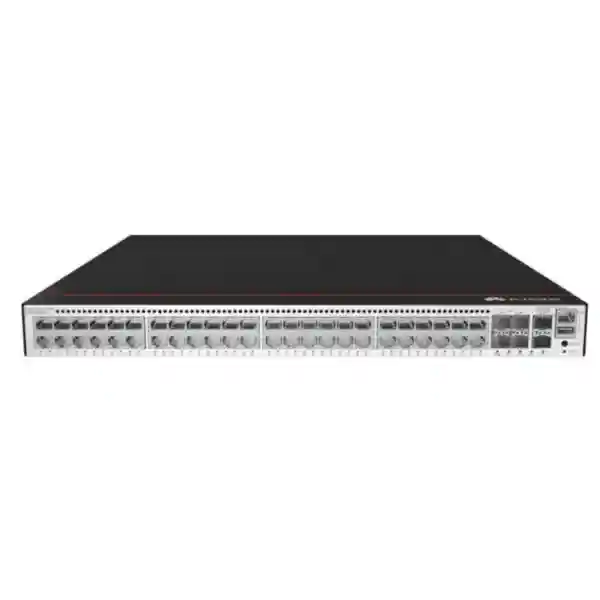
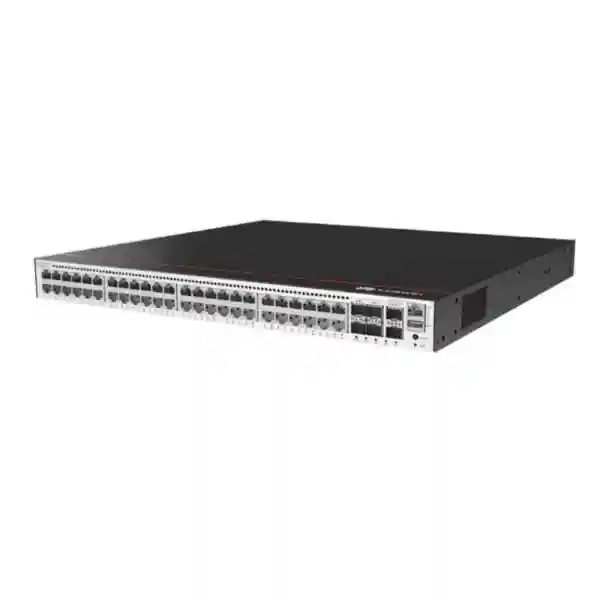
Huawei CloudEngine S5735-S48P4XE-V2
A 48-port Gigabit PoE+ access switch with four 10GE SFP+ uplinks, dedicated stacking interfaces, resilient power architecture, and Huawei VRP-based Layer 2/Layer 3 services for modern enterprise campus networks.
For UAE projects, FourTeck can align the switch with access-point density, IP telephony, CCTV, user VLANs, routing boundaries, rack power, optics, redundancy targets, and operational management requirements before quotation.
Verified core hardware profile
Direct answer: where the S5735-S48P4XE-V2 fits
The Huawei CloudEngine S5735-S48P4XE-V2 is best positioned as a high-density enterprise access switch, or as a compact aggregation device where Gigabit copper edge connectivity, PoE+, 10GE optical uplinks, stacking, and dynamic routing are needed in the same platform. Huawei lists the model with 48 10/100/1000Base-T ports, four 10GE SFP+ ports, dedicated stack ports, PoE+ support, 168 Mpps forwarding performance, and 224 Gbps device switching capacity with 520 Gbps stated system switching capacity. The series is built on Huawei’s high-performance hardware platform and unified software environment and is intended for campus access, campus aggregation, and selected data-center access use cases.
For a Dubai office tower, school, clinic, retail environment, hotel, warehouse, branch campus, government department, or multi-floor commercial building, the practical value is consolidation. One switch can connect standard user endpoints while powering many access-layer devices, and its 10GE optical interfaces can carry aggregated traffic toward a distribution or core layer. This reduces the need to dedicate separate edge switches to IP phones, wireless access points, surveillance cameras, printers, building systems, and conventional users when VLAN design and PoE budgets are properly planned.
The model should not be selected only by port count. A production design must also consider PoE draw, uplink oversubscription, fault-domain size, routing location, stack architecture, optics distance, fiber type, rack cooling, power redundancy, endpoint growth, multicast requirements, cybersecurity controls, and the network-management model. FourTeck uses these inputs to determine whether the S5735-S48P4XE-V2 should be deployed as a standalone switch, as part of a stack, or alongside higher-capacity distribution switching.
Hardware architecture and port map
48 × Gigabit copper access ports
The fixed 10/100/1000Base-T interface block is designed for dense endpoint attachment. In a typical enterprise floor, these interfaces serve PCs, phones, printers, building controllers, cameras, wireless access points, thin clients, access-control equipment, and other Ethernet devices. Auto-negotiated copper access simplifies mixed-device environments while preserving a clean migration path from legacy 100 Mbps endpoints to Gigabit-capable equipment.
4 × 10GE SFP+ uplinks
Four 10 Gigabit SFP+ interfaces provide high-speed optical or direct-attach uplink options. These links can be used for redundant paths to distribution switches, high-throughput server or appliance connections where appropriate, or port-channel designs that increase aggregate bandwidth and link resiliency. Optics must be selected for fiber type, wavelength, distance, connectorization, and peer-device compatibility.
Dedicated stack connectivity
The platform includes dedicated stacking interfaces, separating stack interconnection from normal user-facing and uplink ports. A stack can simplify control, configuration, and resiliency across multiple physical units, but the final architecture should still account for stack bandwidth, member failure domains, maintenance procedures, and how uplinks are distributed across members.
Resilient power platform
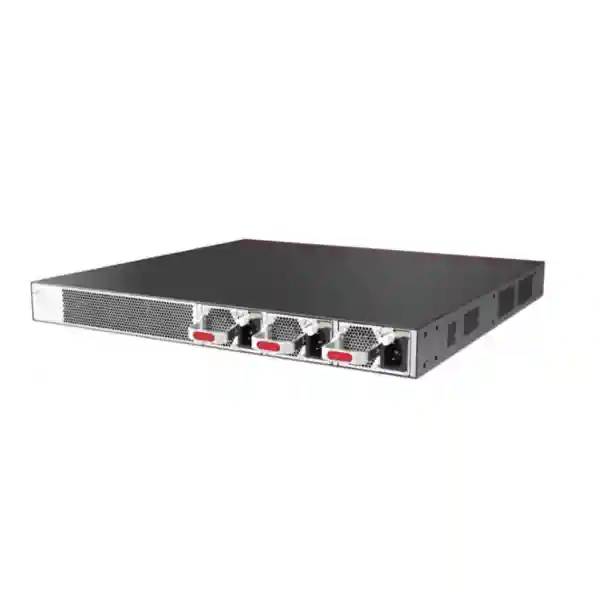
Huawei positions the PoE model with three power-module positions and N+1 power backup capability. This matters when endpoint availability depends on switch-delivered power. Proper design separates the concepts of switch power redundancy and PoE capacity: a system can remain operational after a supply failure while still requiring enough remaining power headroom to support all critical powered devices.
Performance profile: forwarding, switching, and real network behavior
Huawei states 168 Mpps forwarding performance for the CloudEngine S5735-S48P4XE-V2. It also states 224 Gbps device switching capacity and 520 Gbps system switching capacity for the model in international product information. Those figures describe the platform’s forwarding design, but they should not be confused with an application’s guaranteed throughput. Actual traffic behavior depends on packet size distribution, protocol mix, ACL policy, QoS configuration, uplink topology, link aggregation, routing design, broadcast and multicast load, endpoint behavior, and congestion points elsewhere in the network.
For access-layer sizing, the most important exercise is usually oversubscription analysis rather than simply comparing switch fabric numbers. Forty-eight Gigabit edge ports represent far more theoretical edge bandwidth than one 10GE uplink. That is normal in enterprise campus networks because most user and IoT endpoints do not transmit at line rate simultaneously. The correct uplink ratio therefore depends on user density and application mix. An office dominated by SaaS, voice, printing, and normal collaboration behaves differently from an editing suite moving large media assets, a surveillance floor with continuous camera streams, or a wireless-heavy environment where multiple high-density APs aggregate large client populations.
Four 10GE uplink ports provide useful design flexibility. A project may dedicate two uplinks to a redundant distribution pair, aggregate multiple links where the architecture permits, or reserve interfaces for growth and cross-connect requirements. When multiple access switches are stacked, uplink bandwidth must be calculated for the stack as a whole rather than per chassis. This prevents a design where port density scales but upstream bandwidth does not.
PoE+ engineering for phones, access points, cameras, and IoT
The S5735-S48P4XE-V2 supports PoE+, making it suitable for power-delivery designs where data and electrical power share the Ethernet cable. Typical powered devices include IP phones, wireless access points, fixed and selected PTZ cameras, access-control readers, intercom endpoints, thin terminals, and other standards-based network devices. The practical design question is not whether a switch says “PoE+”; it is whether the selected power-module combination and redundancy target can sustain the actual wattage profile of the connected estate.
A robust PoE worksheet should list each powered endpoint by model, quantity, negotiated power class, expected draw, peak draw, location, criticality, and whether the device must remain powered after a single PSU failure. Engineers should include growth headroom rather than consume the power budget to its theoretical maximum on day one. Wireless AP refresh cycles are especially important because future radio generations can demand more power than existing models. Camera estates can also grow after commissioning when security teams add new coverage zones.
PoE resiliency should be treated as an application availability topic. If IP telephony is considered business-critical, a switch that stays online but has insufficient remaining PoE capacity after a power-module fault may still produce an operational incident. Similar concerns apply to access-control systems, WLANs, surveillance, and emergency communication devices. The correct design aligns PSU redundancy, UPS runtime, generator strategy, and PoE priority configuration with business continuity requirements.
FourTeck can map endpoint counts to the appropriate switch and power configuration, avoiding two common mistakes: overspending on unnecessary capacity or under-sizing the PoE subsystem and discovering the limitation only after endpoint deployment. For broader UAE infrastructure support, customers can also coordinate network rollout and related field services through FourTeck IT Services UAE.
Layer 2 design: VLANs, segmentation, loop prevention, and access policy
Huawei lists support for up to 4094 VLANs along with Voice VLAN and MUX VLAN capabilities. In a real campus deployment, VLANs are not merely a way to separate IP subnets; they create administrative and security boundaries that make the network easier to troubleshoot, protect, and scale. A typical UAE enterprise may separate corporate users, guest wireless, IP phones, cameras, facilities systems, printers, access control, management interfaces, servers, and contractor devices. The switch can participate in this segmentation while uplink trunks carry selected VLANs toward upstream routing and security services.
Voice VLAN functionality can simplify IP phone deployment by distinguishing voice traffic from workstation traffic on shared access links. This is particularly useful where a phone exposes a downstream PC port and the organization wants voice and data to remain logically separated. QoS, DHCP options, LLDP-related discovery, and call-platform requirements must still be validated end to end because a Voice VLAN alone does not guarantee voice quality.
Loop prevention is critical on dense access networks. Redundant cabling improves resilience only when the spanning-tree or equivalent control model is correctly designed. Huawei’s enterprise switch family supports standards and interoperability mechanisms intended for campus environments, including compatibility approaches for mixed-vendor spanning-tree designs. Engineers should explicitly define the root bridge location, link costs, edge-port behavior, BPDU protections, and recovery expectations. Uncontrolled loops can consume an access layer in seconds, so these settings deserve the same design attention as IP addressing.
Access security can be strengthened by limiting learned MAC behavior, filtering unwanted sources, applying ACL policy, protecting management access, and restricting which VLANs appear on each trunk. The exact feature set and syntax depend on the deployed VRP software release, so production templates should always be validated against the chosen software version before rollout.
Layer 3 routing and gateway placement
Huawei publishes an enhanced Layer 3 feature set for the S5735-S-V2 family, including static routing, RIPv1/v2, RIPng, OSPF, OSPFv3, ECMP, IS-IS, IS-ISv6, BGP, BGP4+, VRRP, and VRRP6 on the international product pages. This enables the S5735-S48P4XE-V2 to participate in designs that go beyond pure Layer 2 access. However, the presence of routing protocols does not mean every campus should place all default gateways on the access switch. Gateway placement is an architecture decision that affects fault isolation, convergence, policy enforcement, east-west traffic, troubleshooting, and operational complexity.
In a traditional three-tier campus, access switches often remain largely Layer 2 while distribution switches provide SVI gateways, first-hop redundancy, route summarization, and policy boundaries. In a routed-access design, access switches can terminate Layer 3 closer to users, reducing spanning-tree domains and potentially improving failure isolation. Both patterns are valid when engineered correctly. The right choice depends on campus scale, operational maturity, security architecture, and whether application traffic must traverse centralized firewalls or policy gateways.
OSPF or IS-IS can provide dynamic interior routing, while ECMP can use multiple equal-cost paths where topology permits. BGP may be relevant in more advanced enterprise, data-center-edge, service-provider-adjacent, or multi-domain scenarios. VRRP and VRRP6 can support resilient default-gateway designs. These functions should be planned with route filtering, authentication where available, prefix control, failover testing, and change-management discipline rather than enabled simply because the feature exists.
For organizations integrating switching with perimeter or internal segmentation firewalls, FourTeck’s Firewall Dubai practice can align VLAN routing boundaries, firewall zones, high-availability uplinks, and access-switch handoffs so that switching and security policy are designed as one system.
IPv6 readiness
Huawei positions the series with mature IPv6 capabilities and lists IPv6-aware routing such as RIPng, OSPFv3, IS-ISv6, BGP4+, and VRRP6. This matters even in enterprises that remain predominantly IPv4 because modern operating systems, cloud services, guest networks, and service-provider connections increasingly encounter IPv6.
A controlled dual-stack strategy should include address planning, RA and DHCPv6 policy, first-hop protections where supported, IPv6 ACLs, monitoring parity, DNS planning, and security inspection. Ignoring IPv6 while endpoints silently enable it can create a visibility gap, so the safer approach is to govern it explicitly.
Multicast-aware campus design
Campus environments can carry multicast traffic from IPTV, digital signage, surveillance, market-data feeds, discovery protocols, and collaboration systems. The switching design should prevent unnecessary flooding and ensure multicast control is consistent across access and distribution layers.
When multicast is business-critical, validate the exact software feature support, querier location, routing requirements, VLAN boundaries, and failover behavior. Multicast problems often look like random application instability, so design documentation should identify group sources, receivers, expected rates, and permitted paths.
Stacking: scaling port density without multiplying operational complexity
Dedicated stack interfaces are an important feature of the S5735-S48P4XE-V2 because they allow multiple physical switches to operate within a coordinated stack architecture. For a campus floor or equipment room, stacking can simplify configuration, uplink redundancy, and day-to-day administration. Engineers can distribute endpoint connections across members while designing uplinks from different physical units, improving resilience against a single member or cable issue.
A stack is not a substitute for architecture. The stack becomes a larger shared operational domain, so its failure modes need to be understood. Projects should document stack-member numbering, physical stack-ring layout, master-election behavior, software-upgrade procedures, split-stack recovery, uplink distribution, power-source diversity, and which critical endpoints are spread across separate members. Cables should be labeled in a way that allows technicians to replace a unit without guessing at topology.
Capacity planning must also consider traffic concentration. Adding a second or third 48-port member increases access density rapidly, but the design must ensure the uplink layer scales with it. A stack serving dozens of APs or cameras may require multiple 10GE links or a different aggregation model. Conversely, a conventional office floor with normal desktop usage may remain comfortably within a smaller uplink footprint. Measurement and application knowledge are more useful than generic oversubscription rules.
From an operations perspective, use standardized templates and keep firmware alignment across members. Before a production change, confirm the supported version path, stack compatibility, reboot behavior, and maintenance-window plan. Configuration backups should be taken before member replacement or major upgrades.
10GE uplink design: optics, fiber, and redundancy
The four 10GE SFP+ interfaces are central to the switch’s role in a modern campus. Copper access ports are normally limited to local horizontal cabling, while 10GE fiber uplinks connect telecom rooms to building distribution or core locations. The correct transceiver choice depends on the installed fiber plant. Multimode fiber generally suits shorter in-building distances, while single-mode fiber supports longer links and is common between buildings or across larger campuses. The transceiver on each end must match the fiber type and optical standard.
Do not treat every SFP+ as interchangeable. Verify Huawei compatibility, wavelength, connector type, distance rating, DOM requirements, peer-platform support, and the actual patch-panel path. If an existing fiber run is undocumented, it should be inspected or tested before the optics are ordered. Many deployment delays are caused by simple physical-layer mismatches: LC versus another connector presentation, single-mode optics on multimode plant, dirty connectors, polarity issues, or an unexpectedly long path through building cross-connects.
For resilient design, uplinks should terminate on separate upstream devices where possible, and physical paths should be diverse when building infrastructure allows. A logical port channel improves link utilization and failover but does not protect against a common cable tray cut or upstream chassis outage unless the whole topology is designed for diversity. The switch’s four uplink ports create options for dual-homing, link aggregation, a dedicated management or service path, or growth capacity.
A pre-deployment bill of materials should therefore include transceiver part numbers, fiber patch leads, patch-panel ports, destination switch ports, optic distances, and labels. This turns an abstract network diagram into an installable plan.
Power, cooling, rack, and UPS planning in UAE environments
PoE access switching changes rack-power engineering because the switch is not only powering itself; it can also become the electrical source for dozens of downstream devices. That makes rack power, UPS autonomy, and thermal management part of the network design. A switch room that previously hosted low-power data-only switches may require a reassessment when high-density PoE is introduced.
The UAE climate makes environmental discipline especially important, even though equipment is normally installed in conditioned spaces. Network racks in warehouses, retail back rooms, guard houses, temporary buildings, and small branch telecom closets sometimes experience higher temperatures or restricted airflow. Engineers should ensure front, side, and rear clearances match the equipment airflow pattern, filters and vents remain unobstructed, and the room’s cooling system can handle switch plus PoE-related heat under realistic peak load.
Power redundancy also needs source diversity. Installing redundant modules but plugging every feed into the same non-UPS power strip leaves a common point of failure. Where availability matters, feeds should be mapped to appropriate UPS circuits and, where site infrastructure supports it, separate electrical paths. The UPS sizing calculation must include the switch’s own consumption plus the PoE load delivered to endpoints and the desired runtime. Future endpoint growth should be included.
Rack elevation documents should reserve space for cable managers, patch panels, fiber trays, PDUs, and service loops. Good physical organization reduces accidental disconnections and helps technicians identify ports quickly during incidents. FourTeck can incorporate these details into broader UAE infrastructure deployments through FourTeck UAE.
Intelligent operations, telemetry, and campus visibility
Huawei highlights telemetry and collaboration with iMaster NCE-CampusInsight across the CloudEngine S5735-S-V2 family for intelligent operations and maintenance. The design principle is valuable regardless of the exact management stack: network operations improve when teams can observe device health, interface state, traffic behavior, errors, endpoint events, and performance trends centrally instead of logging into switches only after users report a problem.
Traditional SNMP monitoring remains useful for inventory, utilization, interface status, CPU and memory trends, and alerting. Streaming telemetry can provide more granular or near-real-time data depending on platform and controller integration. Syslog centralization is equally important because events that disappear from local buffers can be critical to root-cause analysis. NTP should be consistent across switches, firewalls, wireless controllers, servers, and security platforms so event timelines correlate correctly.
An operational design should define which events create tickets, which thresholds trigger alerts, how long logs are retained, who receives notifications, and how configuration changes are tracked. Interface descriptions should identify connected devices or patch-panel references. Unused ports should be administratively controlled according to security policy. Management access should use dedicated VLANs or out-of-band architecture where appropriate and should be restricted by ACL and authentication policy.
Visibility also supports capacity planning. Monitoring uplink utilization over weeks or months gives better evidence for upgrades than one-time spot checks. CRC errors, discards, flaps, PoE events, and optical diagnostics can reveal failing cabling or transceivers before they become major outages.
Wireless access-layer use
A Wi-Fi deployment often looks simple at the switch: one Ethernet cable per AP. In practice, AP density, radio generation, client concurrency, PoE requirement, roaming architecture, and WLAN controller design all affect the edge. The S5735-S48P4XE-V2 offers a dense PoE+ port bank with 10GE uplinks, making it a practical fit for many enterprise WLAN access layers where individual AP Ethernet requirements remain within the platform’s port capabilities.
Before final selection, confirm the specific AP’s power draw and Ethernet speed. If the planned AP model requires multigigabit access or higher PoE classes than this switch delivers on its copper ports, another switch variant may be more appropriate.
IP telephony and collaboration
For IP phones, PoE+ normally provides comfortable power capability, while Voice VLAN and QoS policies help keep voice logically separate from standard user traffic. A shared phone-plus-PC access design should define trust boundaries, endpoint discovery, DHCP behavior, VLAN assignment, and queue policy.
Call quality depends on the complete path. Jitter, latency, WAN congestion, wireless behavior, firewall inspection, and SIP infrastructure can matter as much as the access switch. For broader voice deployments, FourTeck can coordinate switching with its IP PBX Dubai solutions.
Surveillance and physical-security network design
IP surveillance can be an excellent use case for a 48-port PoE+ switch, but camera networks have different traffic characteristics from office networks. Many cameras generate continuous upstream traffic for recording, and high-resolution, high-frame-rate, or low-compression streams can accumulate quickly. A camera VLAN containing dozens of endpoints can therefore create sustained uplink utilization even when no user is actively interacting with the network.
The sizing process should calculate average and peak bitrate per camera, number of cameras per switch, recording destinations, multicast or unicast behavior, retention architecture, failover recorder paths, and whether analytics traffic returns to central servers. PTZ cameras, heaters, IR illuminators, and auxiliary devices can also consume more PoE than simple fixed cameras. Critical security cameras should be mapped to the switch’s power-resilience plan and UPS runtime.
Security segmentation is especially important. Camera and access-control devices should not share a broad user VLAN merely because they connect to the same switch. Separate VLANs, restricted routing, ACLs, firewall policy, management-source controls, and controlled NTP/DNS paths reduce exposure. Default credentials must be changed, and camera management should be limited to approved administrative systems.
When surveillance traffic shares uplinks with user, voice, and wireless traffic, QoS and capacity engineering should be based on measured or vendor-specified application rates. A properly designed 10GE uplink can support substantial aggregate traffic, but capacity must be assessed against the whole switch or stack.
Security hardening for the access layer
Campus switches sit close to users and unmanaged devices, so they are an important security enforcement point. A hardened S5735-S48P4XE-V2 deployment should begin with management-plane protection. Use secure administrative protocols, role-based accounts, strong authentication, centralized AAA where appropriate, restricted management source networks, consistent time synchronization, configuration backups, and logging to a protected central system. Disable legacy or unused services whenever operational requirements permit.
At the access edge, ports should be configured according to purpose rather than left as generic trunks or unrestricted access interfaces. Unused ports should be shut down or placed into a controlled state. Trunks should carry only necessary VLANs. MAC-learning controls, source filtering, ACLs, storm control, spanning-tree protections, and DHCP-related safeguards should be considered based on the feature set of the exact software release and the organization’s security standards.
Segmentation should reflect trust level and business function. Corporate endpoints, guest devices, IoT systems, voice, CCTV, building management systems, and management interfaces often require different policies. The switching layer creates separation, while upstream firewalls or distributed policy mechanisms enforce permitted flows between zones. Documentation should state why each inter-VLAN flow exists and who owns approval.
Software lifecycle is another security control. Keep an inventory of switch models, serial numbers, software versions, support status, and configuration baselines. Security advisories should be reviewed against the actual deployed version. Upgrades should be staged, tested, backed out if necessary, and scheduled with clear outage expectations.
Physical security matters too. Lock network rooms, control rack access, label console connections, and prevent unauthorized patching. A technically hardened switch can still be bypassed if anyone can enter the closet and connect equipment to unrestricted ports.
Common deployment topologies
Single-switch branch
A single S5735-S48P4XE-V2 can serve a branch with mixed users, phones, APs, printers, and cameras. Two 10GE uplinks can connect toward a resilient core, firewall pair, or distribution layer. This design is simple but the switch remains a local fault domain, so critical branches may require a second unit or stack.
Stacked floor access
Multiple switches can form a stack for larger floors. Endpoints are distributed across members while uplinks leave different physical units. This increases port density and simplifies management, but uplink capacity, stack topology, maintenance procedures, and power diversity must be designed deliberately.
Routed access
Where the enterprise prefers smaller Layer 2 domains, the switch can participate in routed access using supported dynamic routing. This can improve fault isolation and convergence but requires mature IP addressing, route policy, monitoring, and change processes.
PoE-heavy IoT edge
The switch can aggregate large numbers of phones, cameras, sensors, or controllers. In this pattern, the main engineering constraints shift from user burst traffic toward PoE capacity, sustained device traffic, endpoint segmentation, and UPS runtime.
Sizing methodology: how FourTeck determines whether this is the right model
A professional switch selection begins with the endpoint schedule, not the product catalog. We first count every device that requires a switch port: desktops, phones, access points, cameras, printers, door controllers, environmental monitors, uplinked small switches, servers, appliances, and reserved future positions. Port counts are then grouped by telecom room and floor. Growth capacity is added so the design does not launch at full utilization.
Next comes PoE. Each powered endpoint is assigned an expected and peak wattage. Devices are classified by criticality, and the design tests what happens after the loss of one power module. This reveals whether the proposed PSU configuration preserves all devices, only priority devices, or insufficient capacity. That analysis is especially important for sites where WLAN, telephony, or physical security is considered essential.
Traffic sizing follows. We estimate or measure the aggregate bandwidth generated by user applications, APs, cameras, and local services. Continuous streams are separated from bursty traffic. The resulting profile is compared with uplink design, redundancy requirements, and expected growth. If a stack is planned, the calculation covers all stack members.
The physical layer is then validated. Copper runs must meet structured-cabling standards and distance limits. Fiber paths are mapped to SFP+ optics. Patch-panel presentation, connector type, transceiver reach, and peer compatibility are documented. Rack space, PDU capacity, cooling, UPS load, and cable-management needs are checked.
Finally, we map software and architecture requirements: VLAN count, routing protocols, first-hop redundancy, multicast, ACLs, authentication, management platform, telemetry, monitoring, syslog, NTP, software version, and interoperability with the existing vendor environment. If any requirement sits outside the platform’s validated capability, a different model is recommended before procurement rather than after deployment.
This process turns product selection into an engineering decision. It is also why two sites with exactly 48 endpoint ports can require different switch models: one may be a low-power office with modest traffic, while the other may be a camera-heavy site with high PoE demand and resilient uplink requirements.
Migration from an existing access switch
Replacing an access switch is not only a hardware swap. Existing configurations may contain years of accumulated VLANs, trunks, QoS rules, MAC restrictions, voice settings, static routes, port descriptions, monitoring destinations, and undocumented exceptions. A migration should begin with discovery: capture the current configuration, interface status, MAC tables, VLAN membership, spanning-tree state, uplink utilization, PoE usage, optics, and connected-device inventory.
The new configuration should then be built from a clean standard rather than blindly translating every legacy command. Obsolete VLANs and unused trunks can be removed after validation. Port descriptions should be normalized. Security controls can be strengthened while preserving required application behavior. If moving from another vendor, spanning-tree, link aggregation, VLAN tagging, LACP timers, routing adjacencies, and management protocols need explicit interoperability testing.
Cutover planning should identify which users and services are affected, the expected outage window, rollback triggers, and the order of reconnecting critical systems. For PoE endpoints, remember that moving the Ethernet cable also power-cycles the device. Phones, APs, and cameras may take several minutes to return and re-register, so application teams should know what to expect.
After cutover, validation should include uplink state, stack health, VLAN reachability, routing neighbors, gateway redundancy, DHCP, DNS, IP telephony registration, WLAN AP status, camera recording, monitoring alerts, syslog, NTP, and representative user applications. Error counters should be checked after traffic begins flowing. A migration is complete only when both network and application functions are verified.
FourTeck can support staged rollouts across multiple UAE branches so that lessons from the first site are incorporated into the standard template before the remaining locations are migrated.
Interoperability in mixed-vendor networks
Many UAE organizations operate mixed environments created by mergers, phased refreshes, or different teams buying different platforms. The S5735-S48P4XE-V2 can be integrated into such networks when the design relies on standards-based interfaces and carefully validated vendor-specific behavior. Ethernet, VLAN tagging, LACP, IP routing, SNMP, syslog, RADIUS/TACACS-related AAA designs, and common spanning-tree standards provide the foundation for interoperability.
The challenging areas are usually not basic connectivity but control-plane details. Spanning-tree variants can calculate topology differently. Link-aggregation defaults and timers may vary. Native VLAN expectations can create accidental untagged traffic. Routing authentication, MTU, ECMP behavior, and route-policy syntax differ between vendors. QoS class mappings are rarely identical. Even optical modules may be subject to vendor support restrictions despite using familiar form factors.
A mixed-vendor cutover should therefore use a small acceptance matrix. Confirm trunk VLANs, LACP bundle formation, spanning-tree root and blocking state, routed-neighbor establishment, MTU, multicast behavior where relevant, management reachability, and failure recovery. Test both normal operation and failure conditions such as one uplink going down. A topology that works only while every link is healthy is not fully validated.
Documentation should clearly show vendor boundaries and responsibility for each protocol. This is especially important during troubleshooting because each side may initially appear healthy when the actual issue is a mismatch in assumptions across the boundary.
Configuration governance and change management
Enterprise switching becomes reliable at scale when configuration is treated as controlled infrastructure. Each S5735-S48P4XE-V2 should follow a baseline covering hostname convention, management addressing, NTP, DNS where required, AAA, logging, monitoring, SNMP or telemetry, VLAN standards, trunk rules, spanning-tree roles, QoS, security controls, interface descriptions, and banner or compliance requirements. Site-specific exceptions should be documented rather than hidden inside the configuration.
Configuration backups should be automated where possible and tested for recoverability. A backup is useful only if teams know which software version it belongs to, when it was captured, and how to restore it. Changes should have a ticket or record, business reason, implementation plan, validation steps, and rollback method. High-risk modifications such as spanning-tree changes, routing-policy changes, or stack upgrades deserve peer review.
Standardization reduces mean time to repair. If every floor uses the same port naming, uplink numbering, VLAN conventions, monitoring settings, and security templates, engineers can diagnose issues faster. A technician should not need tribal knowledge to understand whether interface GigabitEthernet x/x/x connects to an AP, camera, phone, user, or uplink; the description and documentation should make that evident.
For multisite businesses, template discipline also helps procurement. New branches can be designed from a known reference architecture, with deviations driven by measurable differences such as endpoint count, PoE requirement, or uplink distance.
Operational troubleshooting: a structured approach
When a user reports “the network is slow,” the switch may or may not be the cause. Troubleshooting should start by defining scope: one user, one VLAN, one floor, one switch, one application, or the whole site. Interface state, negotiated speed and duplex, CRC errors, drops, utilization, MAC learning, VLAN assignment, PoE state, and recent logs provide immediate evidence. A single bad patch cable can produce symptoms that resemble congestion or application failure.
For uplink issues, check both ends. A port channel can remain up with reduced capacity after one member fails, creating performance problems without a complete outage. Optical receive power, transceiver alarms, fiber cleanliness, and patch-panel changes can expose intermittent faults. Spanning-tree state should be reviewed if paths unexpectedly block or reconverge. Routing neighbors and VRRP state should be checked if the issue crosses VLAN or subnet boundaries.
For PoE incidents, distinguish between data-link failure and power-delivery failure. A powered endpoint may reboot repeatedly because of marginal power, cable problems, or device faults. Review switch PoE status, available budget, power class, and event logs. If many devices fail simultaneously, check power modules, UPS status, and environmental conditions before replacing endpoints.
For intermittent problems, telemetry and historic monitoring are more valuable than snapshots. Trending interface utilization and errors can reveal patterns tied to backups, camera recording, shift changes, or building systems. Syslog timestamps can correlate switch events with firewall, server, and application logs.
The goal is evidence-driven troubleshooting. Rebooting a switch may temporarily clear symptoms but can erase valuable state and interrupt dozens of users. Controlled diagnosis usually finds the real cause faster and prevents recurrence.
UAE procurement and project considerations
Network procurement in Dubai and the wider UAE should account for more than the switch chassis. A complete bill of materials may include power modules, region-appropriate power cords, SFP+ transceivers, fiber patch cords, copper patch cords, stacking accessories, rack hardware, console access, spare optics, cable-management components, UPS capacity, and support coverage. Missing one small accessory can delay commissioning even when the main switch has arrived.
The project schedule should align procurement with site readiness. Racks, cooling, electrical circuits, structured cabling, fiber cross-connects, labeling, IP addressing, firewall rules, and upstream switch ports should be ready before installation day. For new offices, network requirements should be coordinated with fit-out contractors early enough to influence telecom-room layouts and cable quantities.
Organizations with multiple GCC or African locations should also standardize what can be standardized while respecting local site differences. The same access-switch family may be used across sites, but power infrastructure, fiber availability, endpoint density, and support logistics can vary significantly. A repeatable reference design with site-specific parameter sheets is usually more maintainable than a completely bespoke configuration for every branch.
Warranty and support planning should match business criticality. Spare strategy can be centralized for clustered Dubai sites or distributed for remote branches where delivery time is longer. Critical environments may justify on-site spare switches or optics even if vendor replacement services are available.
FourTeck can coordinate UAE supply and network engineering while also supporting regional projects through its broader FourTeck Africa presence where cross-region standardization is required.
What should be confirmed before ordering
First, confirm that 48 Gigabit copper access ports match the endpoint requirement. If many devices need 2.5GE or faster access, particularly next-generation wireless APs, evaluate whether a multigigabit switch is more suitable. Second, confirm that PoE+ is sufficient for every powered endpoint. Some devices require higher power classes, and their needs should be checked by exact model rather than category.
Third, calculate the total PoE budget under both normal and single-PSU-failure conditions. Fourth, verify that four 10GE uplinks provide the desired upstream bandwidth and redundancy. Fifth, confirm fiber type and optic reach. Sixth, determine whether the switch will operate standalone or in a stack and order the required stack components. Seventh, validate the intended VRP software release and exact feature support for routing, security, management, telemetry, and interoperability requirements.
Eighth, assess rack power and cooling. Ninth, map UPS runtime to both switch and downstream PoE load. Tenth, define management integration: IP addressing, AAA, monitoring, logging, NTP, backups, and controller requirements. Eleventh, verify support entitlement and spare strategy. Twelfth, create a port schedule and configuration template before the switch reaches site.
These checks prevent specification drift between design, procurement, and deployment. The product name on a purchase order is only one part of a working network solution.
Why organizations choose this class of switch
The S5735-S48P4XE-V2 addresses a common enterprise requirement: many standard Gigabit endpoints at the edge, centralized PoE delivery, 10GE optical connectivity upstream, resilient power options, and enough Layer 3 capability to support both conventional and more advanced campus designs. It can therefore serve as a building block rather than a single-purpose device.
Its density is valuable where rack space is limited. Forty-eight copper ports allow a full patch-panel block to be served from one access switch. PoE+ reduces local power adapters and can place phones, APs, and cameras under centralized UPS protection. Four SFP+ ports allow flexible uplink patterns, while dedicated stacking helps scale beyond one chassis.
The platform is also relevant where organizations want to move beyond basic Layer 2 switching. Huawei’s published routing set includes widely used IPv4 and IPv6 protocols, and the series supports enterprise O&M features intended for campus visibility and management. This creates room for architecture evolution without replacing the edge platform solely because the network adopts dynamic routing or more centralized operations.
The most important benefit, however, comes from correct integration. A capable switch deployed with poor VLAN design, insufficient PoE power, mismatched optics, or undocumented uplinks can still produce a fragile network. FourTeck’s role is to turn the hardware capabilities into a supportable production design.
Frequently asked technical questions
Does it support PoE?
Yes. Huawei identifies the S5735-S48P4XE-V2 as the PoE+ model in this 48-port family. Exact total available PoE power depends on the selected power-module configuration, so endpoint wattage and redundancy goals should be calculated before ordering.
How many 10GE uplinks are available?
The model provides four 10GE SFP+ ports. They can support optical transceivers or other supported SFP+ media according to the chosen design and compatibility requirements.
Can it be used as a Layer 3 switch?
Yes. Huawei publishes enhanced Layer 3 support for the series, including static routing and multiple dynamic routing protocols. Exact behavior and feature availability should be validated against the software release planned for deployment.
Is it suitable for Wi-Fi access points?
It is suitable for many PoE+ Gigabit-connected APs. If the selected AP requires multigigabit Ethernet or PoE above the capabilities of this model, choose a switch designed for those requirements.
Can multiple units be stacked?
The platform includes dedicated stack ports. The stack design should account for supported topology, member limits, cabling, software alignment, uplink distribution, and maintenance procedures.
Is it suitable for CCTV?
Yes, where camera PoE and Ethernet requirements fit the switch. Camera bitrate, total sustained uplink traffic, recording topology, and power-failover requirements should be sized before deployment.
Deployment checklist for engineers
Discovery: inventory endpoints, existing switches, VLANs, IP subnets, uplinks, optics, power feeds, rack space, software versions, and monitoring systems. Capture current configurations and utilization data where replacing live equipment.
Design: define port allocation, PoE budget, VLAN architecture, routing boundaries, uplink topology, stack layout, optic types, management addressing, AAA, NTP, syslog, monitoring, QoS, multicast, security policy, and growth headroom.
Procurement: order the switch with correct power modules, stack accessories, SFP+ transceivers, patch cords, rack hardware, spares, and support coverage. Cross-check all part numbers against the intended software and regional supply.
Staging: inspect hardware, record serial numbers, install the target software release, apply the baseline configuration, test management access, verify stack formation if used, validate optics, and store a clean backup.
Installation: mount equipment, label cables, connect redundant power paths, verify airflow, connect stack links, patch uplinks, migrate endpoints in controlled groups, and monitor PoE draw as devices return.
Validation: test user access, voice, wireless, CCTV, routing, DHCP, DNS, management, monitoring, logging, redundancy, uplink failover, and representative applications. Check error counters after traffic stabilizes.
Handover: update diagrams, rack elevations, IP plans, port schedules, configuration backups, asset records, support details, and change documentation. Confirm who owns monitoring alerts and future software updates.
Lifecycle planning and future growth
A switch purchase should support the expected lifecycle of the site, not only its current endpoint list. Ask what will change over the next three to five years: more wireless APs, higher-resolution cameras, workspace expansion, new floors, IPv6 adoption, cloud migration, new voice systems, building automation, or stronger segmentation. Each change can affect port density, PoE requirements, uplink bandwidth, and software features.
Wireless is often the biggest unknown. Even when current APs use one Gigabit Ethernet interface and modest PoE, future APs may demand faster access links or higher power. If an organization expects an aggressive Wi-Fi refresh soon, it may be more economical to select a multigigabit PoE++ access platform for AP-heavy areas while using the S5735-S48P4XE-V2 for conventional Gigabit users, phones, printers, and cameras.
Uplink capacity should also be revisited as local applications change. Moving file services to the cloud may increase WAN traffic but reduce local east-west traffic. Introducing high-resolution surveillance can do the opposite. New backup workflows, VDI, or media production can create sustained load where office traffic was previously bursty.
Good lifecycle management includes configuration standardization, periodic software review, monitoring of interface and PoE utilization, spare strategy, and accurate asset data. When refresh time eventually arrives, historical monitoring makes it easier to select the next platform based on measured demand rather than guesswork.
A mixed refresh strategy is often sensible: replace the switches in high-growth areas first while retaining capable equipment in lower-demand locations. The key is to keep the overall architecture coherent and supportable.
Technical decision recap
Choose it when
You need 48 Gigabit copper access ports, PoE+ for standard powered endpoints, four 10GE SFP+ uplinks, stacking capability, resilient modular power design, and enterprise Layer 2/Layer 3 functions in a Huawei campus environment.
Re-evaluate when
A large portion of edge devices needs multigigabit access, 60 W or 90 W class PoE, substantially higher uplink bandwidth, specialized industrial environmental tolerance, or software functions that are not validated for the target release.
Design priority
Treat PoE budget, uplink oversubscription, stack architecture, routing boundaries, optics, management, power redundancy, and physical installation as one integrated design rather than separate procurement items.
Operational priority
Standardize configurations, centralize logging and monitoring, maintain backups, document ports and uplinks, review software lifecycle, and test failover behavior before declaring the site complete.
Quotation input checklist
To prepare an accurate Huawei CloudEngine S5735-S48P4XE-V2 quotation for Dubai or another UAE location, provide the information below. This avoids an incomplete quote that contains a chassis but misses the accessories or power capacity required for deployment.
Plan the S5735-S48P4XE-V2 as a complete access-layer solution
FourTeck can scope the Huawei CloudEngine S5735-S48P4XE-V2 for new deployments, branch refreshes, campus upgrades, CCTV networks, voice environments, and wireless access layers across Dubai and the UAE. The engineering scope can cover switch quantity, power-module sizing, PoE calculations, stack design, 10GE optics, VLANs, routing, redundancy, firewall handoff, monitoring, migration, testing, and documentation.
Send the endpoint count, powered-device models, required uplink distances, existing core or firewall platform, and preferred site schedule. The resulting bill of materials can then be aligned with the actual architecture instead of relying on a generic switch-only quote.

Reviews
There are no reviews yet.