
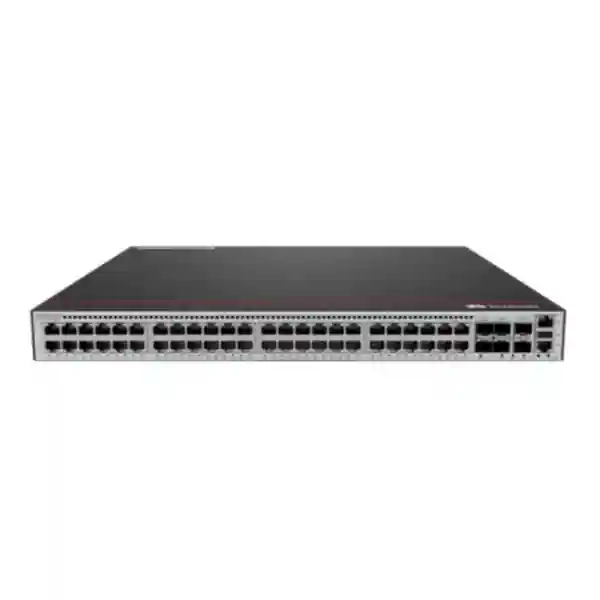
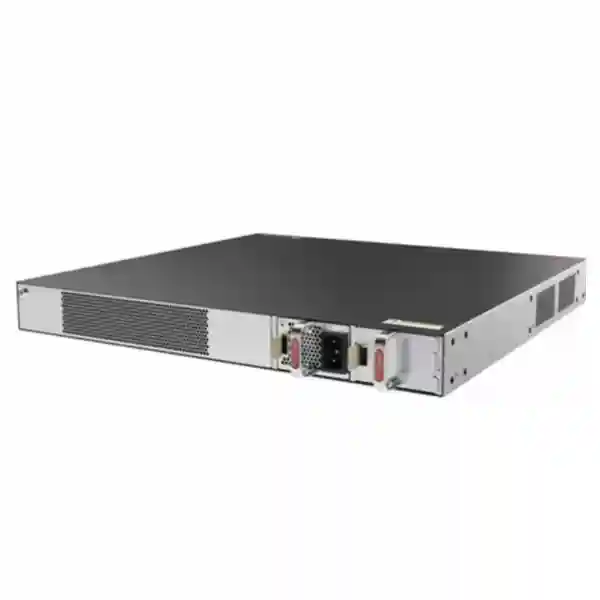
Huawei CloudEngine S5735-S48T4XEZ-V2
A resilient 48-port Gigabit Ethernet campus switch with 10GE uplinks, dedicated stacking, enhanced Layer 3 capabilities, mature IPv6 support, telemetry-ready operations, and modular power redundancy for demanding enterprise access and aggregation designs.
4 × 10GE SFP+ uplinks
2 × 12GE stack ports
168 Mpps forwarding
224 Gbps device capacity
1+1 power backup
Why the S5735-S48T4XEZ-V2 Fits Modern UAE Campus Networks
The Huawei CloudEngine S5735-S48T4XEZ-V2 occupies a useful position between basic fixed-access switching and larger modular campus platforms. For many organizations in Dubai and across the UAE, the core requirement is not simply to provide forty-eight copper ports. The access layer must carry business-critical traffic predictably, support segmentation at scale, provide resilient upstream connectivity, integrate with IPv4 and IPv6 routing, offer meaningful operational visibility, and remain serviceable when a single power component or uplink path fails. This model addresses those requirements with a compact 1U architecture, enterprise routing and VLAN features, dedicated stacking interfaces, redundant power options, and four 10GE SFP+ uplinks.
That combination is particularly relevant in offices, education campuses, hospitality properties, healthcare facilities, government buildings, industrial administration blocks, retail headquarters, data rooms, and distributed branch networks. Forty-eight Gigabit Ethernet downlink ports can serve a complete rack-level user population while four 10GE uplinks give the network designer room to separate northbound paths, connect to redundant distribution switches, provide high-speed links to local services, or create aggregated uplink capacity. The design is also appropriate where organizations are standardizing on optical uplinks between floors or buildings while retaining familiar copper connectivity at the endpoint edge.
The S5735-S48T4XEZ-V2 should be evaluated as part of a system design rather than as a stand-alone port count. Good campus engineering examines oversubscription, uplink diversity, VLAN and routing boundaries, failure domains, management access, optics compatibility, environmental conditions, software lifecycle, and the availability of local implementation support. FourTeck can align the switch with firewalls, structured cabling, server connectivity, monitoring, and managed services through the wider FourTeck UAE portfolio, giving procurement and technical teams a single point of coordination for a complete access-layer deployment.
Huawei describes the S5735-S-V2 family as being built on a new-generation high-performance hardware platform with a unified software platform. For this exact model, public Huawei specifications identify 168 Mpps forwarding performance and 224 Gbps device switching capacity, with a 520 Gbps system switching-capability figure used in Huawei’s specification convention. In practical design work, the most important interpretation is that the platform is intended for wire-speed enterprise campus switching when deployed within its supported feature and interface profiles. Huawei does not publicly expose a marketing-level ASIC part number for this exact switch in the standard product page, so responsible architecture documentation should describe the published forwarding and feature capabilities rather than inventing a chipset designation.
Verified Hardware and Port Map
Port Architecture: Building a Clean Access-to-Aggregation Path
The forty-eight copper downlink ports are the foundation of the switch. Each supports 10, 100, and 1000 Mbps Ethernet, which allows organizations to support a mixed endpoint estate during migration while still standardizing new connections on Gigabit Ethernet. In a typical office deployment, these interfaces can serve desktop PCs, printers, thin clients, building-management gateways, access-control controllers, security appliances, AV devices, and non-PoE wireless infrastructure. Because this is a non-PoE model, endpoints that require inline power should either use their own local power source, a suitable injector, or a PoE-capable access switch selected for that portion of the design. This distinction is important during bill-of-material preparation because a visually similar model suffix can represent a materially different power-delivery capability.
The four 10GE SFP+ interfaces are particularly valuable for avoiding an access design in which forty-eight Gigabit users share a single low-capacity uplink. A common enterprise pattern is to allocate two 10GE links toward a primary distribution system and two toward a secondary distribution system, or to form logical aggregated uplinks where the upstream topology and software support the intended design. Another pattern is to reserve a pair for network uplinks and use the remaining pair for high-throughput local infrastructure such as server clusters, storage gateways, security service chains, or building-level aggregation. The correct approach depends on traffic locality, resiliency goals, spanning-tree or routed-access design, and whether the switch is deployed independently or as part of a stack.
Optical design must be treated separately from port count. The switch provides SFP+ cages, but the actual link characteristics depend on the selected transceiver, fiber type, connector standard, distance, and the optic support matrix for the software release in use. Short-reach multimode links inside a building, longer single-mode campus links, and direct-attach copper links within a rack each have different engineering and procurement requirements. Before installation, the project team should document the media for every uplink, confirm the optical budget, check patch-panel and fiber polarity, verify connector cleanliness, and confirm that both ends of the link support the chosen module.
The two dedicated 12GE stack ports are another architectural advantage. By keeping stacking separate from the four 10GE service uplinks, the switch does not need to consume all of its northbound interfaces merely to create a multi-unit logical system. A properly engineered stack can simplify configuration, provide a larger logical port pool, and improve operational consistency across adjacent access switches. However, stack topology, supported member count, cable type, software compatibility, and upgrade procedure should always be validated against the exact Huawei software train deployed. Stack design should also include failure testing so that the operations team knows how the network behaves when a stack link, member, uplink, or power source is deliberately removed.
Switching Capacity, Forwarding Performance, and Oversubscription Planning
Huawei publishes a forwarding performance of 168 Mpps for the S5735-S48T4XEZ-V2. It also publishes a switching-capacity value of 224 Gbps for the device, together with a 520 Gbps system capability figure in the manufacturer’s specification format. These values should be read as platform performance data, not as a promise that every real deployment will deliver identical application throughput under all configurations. Actual user experience is influenced by packet sizes, traffic distribution, feature combinations, uplink design, quality-of-service policy, physical media, upstream bottlenecks, endpoint behavior, and the health of the wider network.
For sizing, the first practical question is the expected concurrency of the forty-eight access ports. Office users rarely transmit at a sustained 1 Gbps each, while backup stations, media-production systems, imaging workstations, or large file transfers can create very different traffic patterns. The four 10GE uplinks provide substantial aggregate headroom for typical campus access, but capacity planning should still identify peak north-south demand and any east-west traffic that remains local to the access layer. A useful design exercise maps the expected workload of each endpoint class, then calculates likely busy-hour uplink utilization rather than merely multiplying forty-eight ports by one gigabit.
Oversubscription is not inherently a flaw; it is an intentional engineering choice. A user-access switch can be safely oversubscribed when traffic profiles are understood and uplinks have enough headroom for bursts, business-critical applications, and failure scenarios. The more important risk is hidden oversubscription created by placing several high-bandwidth applications on a single uplink without measurement. Telemetry, interface counters, queue statistics, and historical utilization should be used after deployment to validate assumptions and identify whether additional uplink capacity or traffic engineering is required.
For UAE organizations with growing cloud usage, centralized backups, video collaboration, VDI, and inter-site SD-WAN, network teams should also consider how access traffic enters the firewall or WAN edge. Upgrading the access switch to 10GE uplinks will not improve end-to-end performance if the aggregation layer, firewall, internet circuit, or server NIC remains the bottleneck. FourTeck’s Firewall Dubai practice can help align campus switching capacity with security-edge throughput so that the switching investment and perimeter architecture scale together.
Layer 2 Segmentation and Ethernet Control
The S5735-S48T4XEZ-V2 supports up to 4094 VLANs, giving network architects ample logical segmentation for enterprise campus designs. VLANs are the basic isolation mechanism for separating departments, endpoint classes, management networks, servers, guest access, building systems, security devices, and other traffic domains that should not share a single broadcast segment. Huawei’s published feature set includes conventional VLAN functions together with voice VLAN and MUX VLAN capabilities. VLAN assignment can be based on attributes such as MAC address, protocol, IP subnet, policy, and physical port, allowing the network to move beyond a purely static port-based model where appropriate.
Good VLAN design is not about using as many VLANs as possible. The objective is to create meaningful security and operational boundaries without creating an unnecessarily complex control plane. A small branch may need only user, voice, server, guest, management, and security-device VLANs. A multi-tenant building or education campus may require many more segments aligned with departments, laboratories, faculties, contractors, CCTV, access control, IoT, and wireless service sets. Each segment should have a documented purpose, IP plan, gateway location, security policy, DHCP strategy, monitoring owner, and path to shared services.
At the MAC layer, Huawei lists automatic MAC-address learning and aging, support for static, dynamic, and blackhole MAC entries, source-MAC-based packet filtering, and interface-based MAC learning limits. These controls are useful for minimizing uncontrolled endpoint growth and for implementing local access rules at the switching edge. MAC limiting can help reduce accidental loops or unauthorized mini-switch proliferation, while blackhole MAC entries can be used operationally when a specific source must be suppressed. Such features should be managed under change control because an incorrect static or filtering entry can create a localized outage that may be difficult to diagnose from the endpoint side.
Huawei also publishes VBST interoperability, which is designed for compatibility with PVST, PVST+, and RPVST environments, as well as LNP behavior similar in purpose to DTP. These functions can simplify migration or interoperability in heterogeneous campus networks, but they should not be treated as an excuse to leave topology control undocumented. During a multivendor transition, spanning-tree root placement, edge-port behavior, trunk VLAN allowance, native or untagged VLAN handling, and convergence expectations should be tested explicitly. A successful migration plan verifies failover using controlled link shutdowns rather than waiting for a production failure to reveal an interoperability assumption.
Where possible, enterprise networks should also reduce large Layer 2 failure domains by moving routing boundaries closer to the access layer. The S5735-S48T4XEZ-V2 provides extensive Layer 3 protocol support, making it suitable for designs that use routed uplinks or local gateway functions instead of carrying every VLAN across the entire campus. The best model depends on the upstream architecture, security inspection requirements, operational maturity, and whether the organization prefers centralized or distributed routing.
Layer 3 Routing and IPv6 Readiness
Huawei lists a broad routing feature set for this platform: static routing, RIPv1 and RIPv2, RIPng, OSPF, OSPFv3, ECMP, IS-IS, IS-ISv6, BGP, BGP4+, VRRP, and VRRP6. The breadth of this list allows the S5735-S48T4XEZ-V2 to participate in designs that go beyond simple Layer 2 access. In a routed-access campus, for example, the switch can establish dynamic adjacencies upstream, advertise local subnets, use equal-cost paths where the topology supports them, and avoid extending unnecessary broadcast domains through multiple distribution layers.
OSPF is commonly selected for enterprise campus routing because it provides mature link-state behavior, clear area design, and broad multivendor interoperability. OSPFv3 extends similar design principles to IPv6. IS-IS and IS-ISv6 may be appropriate in larger or more standardized architectures, while BGP or BGP4+ can be useful when policy-driven routing, large-scale route exchange, multi-domain designs, or particular data-center and service-provider integration patterns are required. The presence of a protocol in the feature list does not automatically mean that every advanced feature variation is available in every software image, so final design validation should reference the deployed VRP release and license state.
VRRP and VRRP6 are important for first-hop redundancy when the switch participates in a redundant gateway pair or resilient distribution design. If endpoints depend on a single default gateway, a switch or gateway failure can interrupt an entire user group even when physical uplinks remain available. A properly tested redundancy protocol provides a virtual gateway identity that can move between participating devices when the active path is lost. Engineers should test gateway convergence, upstream routing convergence, ARP or neighbor-cache behavior, and security-device statefulness together because application continuity depends on the full path, not on VRRP alone.
IPv6 maturity is increasingly important in long-lived campus investments. Even organizations that operate predominantly on IPv4 should avoid purchasing an access platform that creates an unnecessary future transition barrier. Huawei positions the S5735-S-V2 family with mature IPv6 features, and the exact model’s published routing list includes RIPng, OSPFv3, IS-ISv6, BGP4+, and VRRP6. A practical IPv6 rollout should include dual-stack addressing, router advertisement design, DHCPv6 policy where used, DNS readiness, access-control parity, monitoring visibility, and security testing. Simply enabling an IPv6 address without matching controls can create blind spots because some legacy monitoring or firewall workflows may still focus primarily on IPv4.
For organizations with multiple sites across the UAE, routed access can also simplify fault isolation. When each floor or building has explicit routed boundaries, the path between a user and a shared service is easier to model, and broadcast or spanning-tree problems have a smaller blast radius. The tradeoff is that network teams must be comfortable operating dynamic routing, summarization, route filtering, gateway redundancy, and structured IP addressing. FourTeck can combine the switching implementation with broader IT Services UAE planning for migration, documentation, monitoring, and ongoing network operations.
Stacking, Power Resilience, and Failure-Domain Engineering
Availability is built from multiple independent layers. A switch can have redundant uplinks and still fail because it relies on one power module or one electrical circuit. It can have redundant power and still fail because the only upstream link terminates on a single distribution device. It can be stacked and still experience an outage if both stack members depend on the same UPS, same fiber tray, same patch panel, or same upstream maintenance window. The S5735-S48T4XEZ-V2 provides useful building blocks—dedicated stack ports and 1+1 power-supply backup—but the design team must place those capabilities into a complete failure-domain strategy.
When two or more switches are stacked, cabling should be arranged according to Huawei’s supported topology so that a single stack-link failure does not unnecessarily partition the system. Member placement should also reflect physical risk. If all stack members are in one rack and fed from one PDU, stacking improves logical operation but does not protect against a rack-level power incident. In higher-availability sites, the design may use dual power feeds, separate UPS outputs, redundant upstream distribution switches, and diverse fiber paths where building infrastructure permits. The operations team should keep an accurate diagram of both the logical topology and the physical power path.
The published 1+1 power-supply backup capability means that a correctly equipped switch can continue operation when one power module fails. This is particularly relevant in the UAE, where enterprise data rooms often use dual PDUs or UPS-backed feeds and expect network equipment to take advantage of that redundancy. Power modules should be selected according to the correct input type and approved ordering configuration. AC and DC engineering must account for local electrical standards, connector type, upstream breaker capacity, grounding, UPS behavior, and maintenance access. Redundant modules provide the greatest benefit when they are connected to independent upstream power sources rather than to adjacent sockets on the same unprotected strip.
Failure testing should be part of acceptance. During commissioning, the project team can remove one power feed, disconnect one uplink, simulate a stack-link loss, and verify management-plane reachability while monitoring application traffic. Tests should be pre-agreed and performed in a controlled window, but they provide much more confidence than a configuration review alone. The resulting evidence should be captured in handover documentation together with port maps, software versions, configuration backups, optics inventory, serial numbers, rack positions, cable labels, and escalation procedures.
Resilience also influences spare strategy. A campus with dozens of identical access switches may keep a cold spare chassis and compatible power modules locally, reducing restoration time compared with emergency procurement. Smaller environments may rely on supplier support and a documented temporary bypass plan. The most cost-effective spare strategy depends on business impact, equipment count, logistics, and acceptable recovery time rather than on a universal rule.
Operations, Telemetry, and Troubleshooting Visibility
Modern campus operations require more than occasional SNMP polling and manual CLI checks. Huawei’s S5735-S-V2 platform supports telemetry functions for real-time or high-frequency device-data collection, and Huawei positions the series for integration with iMaster NCE-CampusInsight for network fault identification and user-experience analysis. Huawei’s published V600R024C00 documentation lists telemetry for the S5735-S48T4XEZ-V2 and states that telemetry itself is not under license control in that software context. Licensing and management-platform requirements can still change by release and feature, so the final implementation should confirm the exact software version and management architecture.
Telemetry is most valuable when it answers operational questions. Interface utilization can show whether the uplink design is approaching a bottleneck. Error counters can indicate a fiber, optic, patch cord, or duplex problem. Queue and drop behavior can reveal congestion that does not appear in average bandwidth graphs. CPU and memory trends can identify abnormal control-plane activity. Link-flap history helps separate physical instability from application issues. MAC movement can expose loops or unintended bridging. The goal is to create a monitoring model that maps device data to service health rather than collecting metrics that nobody reviews.
The switch also supports web UI access in the referenced Huawei V600R024C00 basic-configuration documentation, where web UI login is listed as not being under license control. Whether web management is appropriate operationally is a separate security decision. Many enterprises prefer SSH-based CLI access through a dedicated management network, centralized AAA, role separation, configuration backup, and controlled change windows. If the web UI is enabled, it should be restricted to trusted management sources, protected with appropriate credentials and cryptographic settings, and included in vulnerability-management procedures.
A strong operational baseline includes synchronized time, descriptive interface labels, consistent VLAN names, management IP documentation, secure remote access, AAA integration where available, automated configuration backups, syslog export, monitoring alarms, and a clear distinction between user-facing and infrastructure-facing ports. Configuration templates should avoid unnecessary commands copied from unrelated sites. Each policy should have an operational reason and an owner. This makes troubleshooting faster because the running configuration remains intelligible to engineers who did not originally deploy the switch.
For managed environments, monitoring should also follow the full service path. A user complaint about slow cloud access may originate at the access port, the uplink, the firewall, the WAN circuit, DNS, an application server, or the remote service itself. Correlating switch telemetry with firewall and server monitoring reduces time spent treating every incident as an isolated network problem. FourTeck can support this cross-domain approach through network, security, and infrastructure services rather than treating the switch as an appliance that is simply installed and forgotten.
Access Security, Policy Boundaries, and Operational Hardening
An access switch sits at one of the most important control points in the enterprise because it is where user and device traffic first enters the wired network. The S5735-S48T4XEZ-V2 provides Layer 2 and Layer 3 functions that can contribute to a broader security architecture, but the switch should not be treated as a replacement for firewalls, NAC, identity services, endpoint protection, or monitoring. The correct strategy is defense in depth: use the switching layer to establish clean segmentation, predictable forwarding, endpoint limits, and trusted management paths, then enforce application and threat-control policy at appropriate security boundaries.
MAC learning limits and source-MAC filtering are examples of useful local controls. An office port intended for one managed endpoint should not silently become an unmanaged fan-out point for dozens of devices. Learning limits can help highlight that behavior. Static and blackhole MAC entries can support specific operational scenarios, although they must be documented because they can persist beyond the original incident if change control is weak. VLAN assignment mechanisms can also place devices into appropriate segments based on defined criteria, helping separate building systems, contractors, printers, laboratories, and user populations.
Management-plane hardening deserves equal attention. The switch management interface should be reachable only from authorized administration networks or jump hosts. Default credentials should never remain in production. Administrative access should use secure protocols, centralized authentication where practical, and individual accounts rather than shared passwords. Logging should record configuration changes and login events. Where supported by the deployed release, access control should restrict management protocols by source, and unused services should be disabled. Firmware or software updates should follow an approved lifecycle that includes backup, release-note review, compatibility checks, and rollback planning.
Segmentation should be coordinated with firewall policy. Creating separate VLANs without controlling traffic between them may provide organizational clarity but little security benefit. In many UAE enterprise designs, sensitive segments such as finance, security cameras, access control, guest systems, servers, OT gateways, and management networks are routed through a security enforcement point or protected with tightly defined ACL policy. The chosen approach should reflect risk, performance, compliance, and operational capability. Security policy also needs IPv6 parity; a network that filters IPv4 carefully but allows uncontrolled IPv6 can create an unintended path around established controls.
Physical security matters as well. Access closets should be locked, patch panels labeled, console access controlled, and unauthorized unmanaged switches discouraged. A sophisticated logical design can be undermined by uncontrolled physical access to network equipment. Documentation should identify the rack, RU position, power feeds, uplinks, stack links, management address, software version, and responsible support team for every switch.
Deployment Scenarios for Dubai and the UAE
Corporate Office Floors
One switch can serve a dense office zone with forty-eight copper connections while 10GE uplinks connect the floor to redundant distribution. VLANs can separate users, printers, meeting-room systems, facilities equipment, and administrative infrastructure. The non-PoE profile works well where powered endpoints are handled separately or where the floor has a mixed switching design.
Education and Training Campuses
Classrooms, laboratories, administration, libraries, and shared services can be segmented into separate VLANs with routed boundaries where appropriate. Stacking can simplify adjacent rack deployments while 10GE fiber uplinks support inter-building or distribution connectivity.
Hospitality and Mixed-Use Properties
Back-office systems, property-management devices, IPTV infrastructure, staff networks, building controls, and non-PoE edge equipment can be placed into clearly defined network zones. The switch can sit in a floor or service-room architecture with optical uplinks toward the main communications room.
Branch and Regional Offices
The routing feature set enables more than simple Layer 2 extension. A branch can use dynamic routing toward resilient WAN or security infrastructure, while forty-eight access ports provide room for growth without immediately adding another switch.
Server and Infrastructure Racks
The model can connect management interfaces, appliances, backup devices, KVM infrastructure, and Gigabit server endpoints while using 10GE links to higher-capacity aggregation. For workloads that require sustained multi-gigabit access per server, a higher-speed server-access platform should be considered.
Government and Regulated Environments
The switch’s segmentation, routing, redundancy, and management features can support structured enterprise designs where configuration control, documented resilience, secure administration, and change management are as important as raw port count.
For infrastructure projects that include compute platforms in the same facility, the campus switch should be coordinated with rack layout, server NIC speeds, virtualization traffic, storage paths, and management networks. FourTeck’s Server Dubai practice can help align server-side connectivity with the selected switching topology so that uplink capacity, redundancy, and cabling are planned as one system.
UAE Environmental, Rack, and Power Planning
Huawei’s recent published product material for the S5735-S48T4XEZ-V2 lists a 1U chassis with dimensions of approximately 442 × 420 × 43.6 mm. These dimensions are important when planning compact wall cabinets, shallow racks, or congested communications rooms. Rack depth should include not only the switch chassis but also the rear power cabling, front fiber bend radius, patch-cord management, stack cables, and enough service clearance to replace a power module without disturbing adjacent equipment. A design that technically fits the chassis but crushes fiber loops or blocks ventilation is not production ready.
The same published material lists a long-term operating temperature range of approximately -5°C to +50°C from 0 to 1800 meters altitude, with temperature derating above that altitude, and storage conditions extending substantially beyond the normal operating range. UAE deployments rarely face high-altitude derating, but ambient heat is a serious consideration. Network switches should operate in conditioned communications rooms or properly engineered enclosures, not in sealed cupboards exposed to direct solar load. Cooling capacity must account for the full rack, not only the switch, and filters or dust management may be required in industrial or construction-adjacent environments.
Power design should start with the ordered power-supply modules. Huawei publishes multiple compatible power-module options for this model family, including AC and DC choices, but the exact ordering combination must be checked before procurement. Redundant power is only meaningful when both modules are installed and connected correctly. For business-critical sites, each module should ideally terminate on a separate UPS-backed feed or PDU path. The electrical team should verify local socket and plug requirements, PDU rating, breaker capacity, grounding, and maintenance isolation.
Published noise data for this model family indicates sound output appropriate for equipment-room use rather than quiet desk-side placement. Even when acoustic levels are moderate, enterprise switches should be placed in dedicated communications spaces because fans can change speed with temperature and load. This also improves cable security, airflow, grounding, and maintenance access. In hospitality or executive-office environments, rack location and acoustic isolation should be confirmed before installation.
Environmental monitoring is a worthwhile addition in remote closets. Temperature, humidity, door state, UPS status, and water-leak alarms can identify risks before they become outages. Switch telemetry should be integrated with those facility signals where operationally practical so that network teams can correlate a device alert with power or cooling conditions rather than troubleshooting in isolation.
Optics, Fiber, and Cabling Design
The four 10GE SFP+ interfaces provide design flexibility, but they also place responsibility on the project team to select the right optical medium. Inside a rack, a compatible direct-attach cable may provide a simple short-distance 10GE connection. Between racks in the same room, multimode fiber is common where existing structured fiber supports the required transceiver type and distance. Between buildings or over longer campus runs, single-mode optics may be more appropriate. The switch itself does not determine the final link budget; transceiver power, receiver sensitivity, fiber attenuation, connector loss, splice loss, and reserve margin all contribute.
A professional bill of materials therefore lists each uplink as a complete link, not merely as “10G SFP+.” It should identify the switch-side optic, upstream optic, fiber type, connector, patch-cord length, panel location, pathway, labeling convention, and spare requirement. If third-party optics are considered, the organization should understand Huawei support policy and software behavior before standardizing on them. Compatibility should be validated in advance rather than discovered during a maintenance window.
Copper access cabling should be assessed with the same discipline. Gigabit Ethernet requires standards-compliant structured cabling and correctly terminated pairs. Intermittent errors can result from damaged patch leads, poorly terminated keystones, crushed cable bundles, electromagnetic interference, or legacy horizontal cabling. Port counters can indicate physical-layer problems, but a certification tester is often the correct tool for persistent copper faults. During migration, each port should be labeled end to end so that VLAN assignment and physical location remain traceable.
Fiber cleanliness is especially important. Dust on an LC connector can cause attenuation, reflections, and intermittent 10GE links even when the optic appears healthy. Installation teams should use inspection and cleaning procedures before connecting production fiber. Bend radius must be respected, and slack should be managed so that patching does not obstruct airflow or expose fiber to sharp rack edges. Diverse uplinks should avoid a single physical pathway where resilience is a requirement; two logical links routed through the same tray can still fail together if that tray is damaged.
The two 12GE stack ports also require model-appropriate stack cabling. These links should be documented separately from service uplinks so technicians do not accidentally move them during routine patching. Stack cables, uplinks, and power feeds should use a consistent labeling convention visible from both ends of the rack. Simple labels reduce restoration time dramatically during an outage.
Migration from Legacy Access Switches
Replacing a legacy access switch is not just a hardware swap. The migration should begin with discovery: capture the current port map, VLAN assignments, trunks, link aggregation, spanning-tree role, management addresses, routing adjacencies, gateway functions, DHCP relay, access controls, monitoring, and any unusual static MAC or route entries. Engineers should identify which configuration elements are still required and which are historical leftovers. Copying every legacy command to a new platform can preserve undocumented mistakes.
A staged configuration is safer. Build the management plane first, confirm secure administrative access, establish time synchronization and monitoring, create the required VLANs, configure uplinks, and validate routing before moving endpoints. If stacking is used, form and test the stack before production cutover. Port descriptions should be copied from verified cabling records rather than from assumptions. For high-impact migrations, a temporary parallel link can allow validation of the new switch without immediately moving all endpoints.
Spanning-tree behavior deserves special attention in multivendor networks. Huawei’s VBST interoperability is useful during transitions, but bridge priorities, edge-port configuration, and VLAN-specific topology should be reviewed carefully. An unexpected root-bridge election can shift traffic paths or create instability. Engineers should document the desired root location before connecting the new switch and verify the resulting topology after activation. Link aggregation also requires consistent mode, member parameters, and VLAN configuration on both sides.
Routing migrations require route-by-route validation. Confirm adjacency formation, expected prefixes, path cost, failover, route filtering, and default-route behavior. For VRRP or VRRP6, verify virtual address ownership and convergence. If firewalls are present, confirm that asymmetric routing does not break stateful sessions. If DHCP relay is used, verify that each client VLAN reaches the correct server and that scope configuration matches the new gateway design. DNS, NTP, authentication, and monitoring should be tested from representative endpoint VLANs.
Cutover plans should include a rollback path. A useful rollback is specific: which cables move back, which legacy configuration must be restored, which routing announcement should be withdrawn, and what decision point triggers reversal. Teams should not discover the rollback procedure after an outage has already exceeded the maintenance window. After migration, the network should be observed through at least one normal business cycle where possible, with interface errors, uplink utilization, logs, and user tickets reviewed for unexpected patterns.
Finally, decommissioned equipment should be handled through the organization’s asset and data-security process. Configuration files, credentials, certificates, and device metadata may remain on old switches. Secure wiping and inventory updates are therefore part of the migration, not an administrative afterthought.
Software, Licensing, and Lifecycle Considerations
Enterprise switching features depend on the hardware platform and the software release operating on it. Huawei’s current documentation lists extensive Layer 2, Layer 3, IPv6, telemetry, and management functionality for the S5735-S-V2 family, but an implementation team should always verify the exact VRP version, feature support, bug fixes, and licensing requirements before production deployment. A feature that appears in family-level marketing material may have configuration prerequisites or release-specific behavior that matters in a real network.
The deployment record should therefore include the installed software version, selected feature set, license state, boot image, patch level, and recommended target version. Upgrade planning should review release notes for changes in protocol behavior, hardware support, management integration, known defects, and interoperability. When a stack is used, all members should follow the supported software consistency rules. Maintenance windows should account for reboot behavior and the possibility that a rollback requires restoring both software and configuration.
Huawei documentation for V600R024C00 identifies both telemetry and web UI access for this exact model and states that those functions are not under license control in the referenced guides. That information is useful, but it should not be interpreted as a blanket statement that every management, automation, analytics, or controller capability is license-free. Products such as centralized management or assurance platforms can have their own entitlement and deployment requirements. A final quotation should distinguish switch hardware, power modules, optics, software entitlements where applicable, support subscriptions, installation, and management services.
Lifecycle planning also includes vendor support status, spare availability, replacement strategy, and standardized configurations. The best time to define the next upgrade path is during deployment, not when the hardware becomes difficult to source. Organizations with multiple sites can reduce operational cost by standardizing a small number of approved switch models and maintaining common templates, optics, spares, and training.
Sizing Methodology Before You Order
Start with endpoint count, but do not stop there. Count active copper devices today, then identify expected additions over the planned lifecycle. Reserve ports for new staff, printers, controllers, temporary projects, monitoring appliances, and maintenance. A forty-eight-port switch that launches with forty-seven assigned ports has no practical growth margin. At the same time, excessive spare capacity across dozens of closets can inflate cost, so the goal is a documented reserve based on business plans rather than an arbitrary percentage.
Next classify power requirements. The S5735-S48T4XEZ-V2 is not a PoE switch. If the same rack must power IP phones, cameras, wireless access points, badge readers, or IoT devices, include a PoE-capable model or a mixed-switch strategy. Counting only Ethernet ports and discovering the power requirement after delivery is one of the most avoidable access-layer design errors.
Then estimate traffic. Identify heavy users, backups, imaging systems, video flows, cloud synchronization, server access, and inter-VLAN traffic. Decide whether two, three, or four 10GE uplinks are required and whether they should be active-active, active-standby, aggregated, or split across upstream devices. Capacity must also be calculated under failure conditions. If normal traffic uses two uplinks and one fails, the remaining path should still have enough headroom for the business’s acceptable service level.
Define the Layer 3 boundary. Decide whether the switch operates primarily as Layer 2 access, provides local VLAN gateways, or uses routed uplinks. This decision determines the routing protocol, redundancy mechanism, firewall path, DHCP relay design, and monitoring model. It also affects migration complexity. A routed-access design can reduce Layer 2 failure domains, while a centralized gateway design may align better with security inspection or an existing campus standard.
Finally, map physical infrastructure. Confirm rack depth, available RU space, airflow, temperature, power feeds, UPS capacity, fiber paths, patch panels, optic types, stack-cable routing, and labeling. The output should be a complete bill of materials rather than a single switch SKU. That bill typically includes the chassis, power modules, stack components, optics, patch cords, rack accessories, installation services, configuration, documentation, support, and spare strategy.
A structured sizing exercise often saves more money than simply selecting the cheapest switch with the right port count. It reduces emergency purchases, incompatible optics, unnecessary downtime, and redesign work after installation.
Procurement Guidance for UAE Projects
For UAE procurement teams, the most important first step is ordering the exact model suffix. Huawei’s S5735-S-V2 family contains models that look similar in name but differ in PoE support, port mix, power architecture, built-in versus pluggable power, and expansion capability. The requested item should be written in full as Huawei CloudEngine S5735-S48T4XEZ-V2 on the quotation, purchase order, delivery note, and asset register. Abbreviating the model increases the risk of receiving a neighboring variant that does not match the network design.
The quotation should list power modules explicitly where they are not inherently bundled in the required configuration. It should also identify the quantity and type of 10GE optics, stack cables, fiber patch cords, rack accessories, and support entitlement. For redundant power, the quotation must include enough modules to deliver the intended 1+1 design. For redundant uplinks, it must include optics at both ends of every link. An incomplete bill of materials can leave a technically correct chassis unusable on installation day.
Lead time and compatibility are as important as unit price. Enterprise projects often depend on construction milestones, building handover, ISP activation, server deployment, or office move dates. Network components should arrive early enough for staging, burn-in, configuration, labeling, and acceptance testing before the production cutover. If an alternative optic, PSU, or switch variant is proposed because of availability, the technical team should approve it against the design rather than allowing an unreviewed commercial substitution.
Support planning should reflect business impact. Critical locations may require faster replacement or a local spare, while smaller sites may accept standard vendor support. The final handover should include serial numbers, warranty or support references, software version, configuration backup, port map, rack location, and escalation contact. These records make future support much faster than relying on purchase invoices alone.
FourTeck can support supply, integration, and related infrastructure through its UAE technology practice. This is useful when the switching project also includes firewall upgrades, server refreshes, structured cabling, branch connectivity, or managed support, because the dependencies can be reviewed together rather than purchased in isolation.
Operational Acceptance Checklist
Confirm exact model, serial numbers, power modules, rack position, stack components, optics, patching, labels, grounding, airflow clearance, and independent power feeds where redundancy is required.
Record VRP version, patch level, boot variables, license state, management addressing, NTP, AAA, logging, telemetry, monitoring, and configuration-backup destination.
Verify VLANs, trunks, allowed VLAN lists, edge-port behavior, spanning-tree root placement, MAC learning, port security policy, link aggregation, and endpoint reachability.
Check routed interfaces, static or dynamic routes, OSPF/OSPFv3 or other adjacencies, ECMP behavior, VRRP/VRRP6 state, route filtering, DHCP relay, and gateway reachability.
Perform controlled removal of one uplink and one power source, validate stack behavior, observe convergence, and confirm that critical applications remain within the agreed recovery expectation.
Deliver rack diagram, physical and logical topology, port map, IP plan, VLAN list, optics inventory, power mapping, configuration backup, test results, and support escalation details.
Decision Recap: When This Model Is the Right Fit
Choose the Huawei CloudEngine S5735-S48T4XEZ-V2 when the design calls for a dense, non-PoE 48-port Gigabit Ethernet access switch with four 10GE uplinks, dedicated stacking, redundant power capability, and enterprise Layer 3 features. It is especially well suited to racks where endpoint power is not required from the switch, but where routing, IPv6, segmentation, resilient uplinks, telemetry, and operational consistency are important.
The model is also a strong candidate when an organization wants to reduce the number of small switches per floor by consolidating forty-eight copper ports into a single 1U device while retaining 10GE northbound capacity. Dedicated stack ports allow adjacent units to be combined without automatically consuming the SFP+ uplinks used for production traffic. One expansion slot provides additional model-specific flexibility, although compatible expansion hardware should be validated at the time of quotation.
A different model should be considered when most connected devices require PoE or PoE+, when access ports need native multi-gigabit speeds beyond 1 Gbps, when server workloads require a higher density of 10GE or 25GE interfaces, or when the site needs a chassis platform with much larger modular scale. Selecting the right switch is therefore a workload and topology decision, not a brand or port-count decision.
For a typical UAE enterprise campus, the S5735-S48T4XEZ-V2 can form a reliable access building block when paired with well-designed fiber uplinks, redundant distribution, secure management, disciplined VLAN and routing design, and monitored power and cooling. The hardware capabilities are most valuable when the surrounding architecture uses them deliberately.
FourTeck can help translate the model specification into a deployable bill of materials and implementation plan, including switch quantities, power modules, optics, stack accessories, rack requirements, uplink topology, routing design, firewall integration, monitoring, and support. This reduces the risk of ordering a correct switch with an incomplete set of supporting components.
Quotation Input Checklist
To prepare an accurate UAE quotation and deployment recommendation, provide the following project inputs. These details allow the switch, power modules, optics, stacking components, and services to be sized as one solution rather than quoted as disconnected line items.
City, building, floor, rack location, available rack depth, free RU space, cooling conditions, and whether the communications room is continuously air-conditioned.
Current copper-port requirement, expected growth, device classes, and confirmation of whether any endpoints need PoE or multi-gigabit access.
Number of 10GE uplinks, distance, fiber type, connector standard, upstream device model, and whether the links must be redundant or aggregated.
Number of switches to be stacked, physical rack arrangement, desired redundancy, and any existing Huawei stack hardware that must be reused.
AC or DC requirement, UPS availability, dual-feed requirement, PDU type, and whether the 1+1 power design must be fully populated on delivery.
VLAN count, routing protocol, gateway design, IPv6 requirement, firewall path, DHCP relay, management platform, AAA, telemetry, and monitoring integration.
FourTeck Consultation for Huawei S5735-S48T4XEZ-V2
A successful switching project combines the correct hardware SKU with verified power components, compatible optics, a clear Layer 2/Layer 3 design, documented resilience, secure management, and an installation plan that matches the site. FourTeck can assist UAE customers with product supply, architecture review, migration planning, rack and fiber coordination, configuration, testing, and post-deployment support.
When requesting a quote, include the site location, switch quantity, number and length of uplinks, optic preference, stack requirement, power redundancy requirement, existing upstream switch or firewall model, and whether implementation services are required. With those inputs, the proposed bill of materials can be checked for missing transceivers, power modules, cables, or compatibility dependencies before the purchase order is released.
For broader enterprise technology requirements, visit FourTeck Global for multi-region capabilities and technology services.


Reviews
There are no reviews yet.