
Huawei Industrial Ethernet • Dubai & UAE
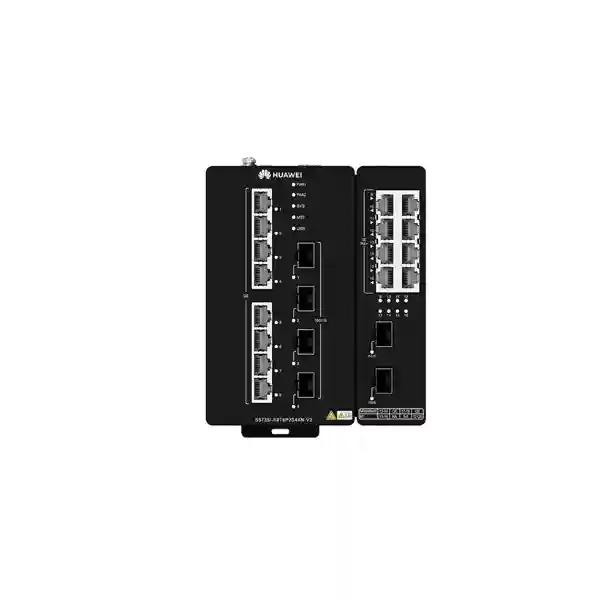
Huawei CloudEngine S5735I-S16T2S4XN-V2 Industrial Switch
The Huawei CloudEngine S5735I-S16T2S4XN-V2 is a fanless DIN-rail industrial Layer 3 switch for resilient Ethernet access and aggregation in factories, transport systems, utility networks, surveillance estates, smart-city infrastructure and other environments where conventional office switches may not provide the required temperature tolerance, power flexibility or field-hardened design. Its fixed interface mix combines 16 x 10/100/1000Base-T copper ports, 2 x GE SFP ports and 4 x 10GE SFP+ ports, giving system designers a practical blend of local copper access, fiber handoff and high-speed uplink capacity.
For UAE projects, the model is especially relevant when the network must operate inside roadside enclosures, industrial cabinets, plant rooms, production lines, substations, logistics sites or outdoor-adjacent technical spaces. Huawei publishes 87 Mpps forwarding performance, 116 Gbps device switching capability, 520 Gbps system switching capability, redundant 1+1 power input, MACsec support on downlink and uplink ports, industrial protocol forwarding and a fanless thermal design. FourTeck can assist with switch selection, optics, power architecture, cabinet engineering, VLAN and routing design, deployment and lifecycle support.
Direct answer
Choose this model when you need a compact industrial switch with sixteen copper GE access ports and multiple fiber uplinks, but do not require PoE from the switch itself.
It is designed for DIN-rail installations, supports broad Layer 2/Layer 3 services, offers up to four 10GE SFP+ interfaces for aggregation, and can be deployed with redundant DC power for higher availability.
Verified hardware snapshot
Copper access
16 x 10/100/1000Base-T Ethernet ports for PLCs, industrial controllers, cameras with local power, HMIs, gateways, servers, edge devices and other wired endpoints.
Fiber interfaces
2 x GE SFP ports plus 4 x 10GE SFP+ ports provide flexible fiber attachment for plant backbones, redundant uplinks, rings and aggregation to distribution switches.
Forwarding
Huawei specifies 87 Mpps forwarding performance and 116 Gbps device switching capability. The published system switching capability is 520 Gbps.
Industrial build
Fanless natural heat dissipation, DIN-rail mounting and industrial temperature specifications support deployment outside conventional air-conditioned office racks.
Power resilience
The platform supports dual power inputs operating in 1+1 hot-backup mode, enabling redundant feeds from suitable DC sources or supported power adapters.
Security
The S5735I-S16T2S4XN-V2 supports MACsec on downlink and uplink ports, alongside authentication, DHCP snooping, ARP protection, ACLs and control-plane defense mechanisms.
Port architecture and physical platform
The interface layout is one of the strongest reasons to consider this switch for industrial edge aggregation. Sixteen copper Gigabit Ethernet interfaces can terminate local field equipment, while the two GE SFP ports and four 10GE SFP+ interfaces can be allocated to backbone, ring, cross-building or redundant distribution links. This separation allows a designer to avoid consuming every high-speed uplink for low-bandwidth field connections. A common pattern is to use the GE SFP pair for legacy fiber segments or slower deterministic links and reserve the 10GE SFP+ ports for uplinks toward the core, aggregation switches, data collection systems or higher-capacity video backhaul.
| Specification | S5735I-S16T2S4XN-V2 | Design implication |
|---|---|---|
| Copper ports | 16 x 10/100/1000Base-T | Dense local GE access without an additional edge switch. |
| GE optical | 2 x GE SFP | Useful for 1G fiber rings, legacy optics and field distribution. |
| 10GE optical | 4 x 10GE SFP+ | Supports high-speed aggregation, dual-homing and scalable uplinks. |
| Forwarding performance | 87 Mpps | Relevant for packet-rate sizing, especially with many small packets. |
| Switching capability | 116 Gbps device / 520 Gbps system | Use the device figure for practical model-level capacity comparisons. |
| CPU / memory | 1.1 GHz dual-core, 2 GB RAM, 1 GB flash | Supports control-plane services, management and routing functions. |
| Dimensions | 150 x 127 x 133 mm | Compact DIN-rail form factor for industrial cabinets. |
| Thermal design | Natural heat dissipation, zero fans | Removes fan maintenance and avoids fan-noise concerns. |
Huawei does not identify the switching ASIC by commercial silicon name in the referenced product datasheet. For engineering and procurement, it is therefore more reliable to size against Huawei’s published forwarding rate, device switching capability, port speeds, latency specification and service scale rather than infer an undocumented chipset. This distinction matters in tender documentation: a verifiable performance metric is defensible, whereas an assumed ASIC family can create unnecessary technical compliance risk.
Why this model fits industrial UAE networks
Industrial Ethernet in the UAE often has to cope with conditions that differ substantially from a normal enterprise office. Equipment may be installed in factory-floor cabinets, substations, roadside enclosures, logistics yards, parking systems, airport operational areas, rail or metro infrastructure, pump stations, solar facilities, district cooling plants or utility compounds. Even when the cabinet itself is weather-protected, internal temperature can rise significantly because of solar loading, nearby process equipment, limited airflow and the heat generated by power supplies and other electronics. A fanless industrial switch with an extended environmental range is therefore valuable because it reduces dependency on moving parts and can be engineered for controlled airflow or sealed enclosure strategies.
For the S5735I-S16T2S4XN-V2, Huawei documents extended operating conditions up to +75°C when the cabinet design provides the required forced airflow and industrial optical modules are used. In a sealed cabinet the long-term limit is lower, and the datasheet specifies installation constraints based on ambient temperature, airflow, input voltage and the number of optical modules. That means the headline temperature range should never be treated as a universal cabinet rating. FourTeck recommends a project-level thermal review that considers enclosure volume, orientation, direct sunlight, internal heat load, airflow path, DC power dissipation and optical transceiver temperature class.
The switch is also specified for 5% to 95% relative humidity, non-condensing, and storage from -40°C to +85°C. Operating altitude is specified up to 5000 m, although UAE deployments are generally well below this threshold. The practical advantage is not altitude itself but the evidence that the hardware is designed as an industrial platform rather than a repackaged office access switch. This makes the product suitable for procurement specifications that explicitly call for DIN-rail mounting, fanless cooling, redundant power input, industrial temperature tolerance and high-speed optical uplinks.
Switching capacity, packet rate and latency: how to interpret the numbers
The product datasheet lists 116 Gbps as the device switching capability and 520 Gbps as the system switching capability. Huawei explicitly distinguishes these values. For this model, the 116 Gbps figure is the more useful number when an engineer is calculating the traffic envelope available to the fixed ports in this specific chassis. The 520 Gbps figure represents the system-level switching capability used across the platform family. Mixing those values can lead to an unrealistic design assumption, especially in competitive comparisons where vendors present capacity metrics using different conventions.
The 87 Mpps forwarding figure is equally important. Bandwidth and packet rate are not interchangeable. Industrial telemetry, control traffic, network management and certain surveillance or IoT designs can generate a large number of small packets. A switch can appear to have ample aggregate bandwidth while still facing a packet-processing limit in an extreme small-packet scenario. The published 87 Mpps number gives architects a concrete basis for calculating worst-case forwarding demand and checking headroom.
Huawei also specifies forwarding latency below 4 microseconds for the series. That is useful for access and aggregation designs where delay must remain tightly controlled, but latency should be viewed end-to-end rather than as a single switch number. Fiber length, queuing, congestion, routing, security processing, endpoint stacks and upstream devices all contribute. For production networks, the correct approach is to define the application latency objective and then design each network segment with sufficient bandwidth and QoS so congestion does not become the dominant delay source.
A simple sizing method is to reserve at least 30% headroom above the calculated busy-hour traffic, then check both bit rate and packet rate. If sixteen copper devices each average 300 Mbps, the aggregate access load is about 4.8 Gbps before considering burst behavior. A single 10GE uplink could carry that average load, but a resilient design may use two 10GE paths or a link aggregation group so maintenance, a fiber fault or a distribution-switch failure does not isolate the cabinet. The four available 10GE SFP+ interfaces create useful design freedom for this purpose.
Layer 2 services for segmented operational networks
The S5735I-S-V2 feature set includes a 32K MAC address table and support for up to 4K VLANs, with 1K VLAN interfaces listed in the datasheet. For industrial architecture, the more important point is how these functions are applied. VLANs should map to trust zones, operational functions or application groups rather than be created without a segmentation policy. A factory could separate PLCs, machine HMIs, engineering workstations, IP cameras, building-management devices, wireless infrastructure and management interfaces into distinct VLANs. Inter-VLAN communication can then be permitted only where business and control workflows require it.
The platform supports standard spanning-tree options including STP, RSTP and MSTP, as well as Huawei SEP and ITU-T G.8032 ERPS. These features are relevant to industrial rings and redundant field topologies. ERPS is particularly useful where deterministic ring recovery behavior is required. Huawei states a fast protection switching mechanism around 10 ms under the relevant design. Actual convergence depends on topology and configuration, so acceptance testing should measure service restoration with the intended optics, fiber paths and neighboring switches rather than rely only on a nominal protocol figure.
Link aggregation using LACP can combine multiple physical interfaces into a logical connection for capacity and resilience. Smart Link provides another uplink-backup mechanism. The practical design choice depends on the upstream architecture. In a modern dual-distribution network, an LACP design may be preferred when both links can be active. In a ring, ERPS or SEP may be more appropriate. In a simpler two-path access design, Smart Link can provide straightforward primary/backup behavior. FourTeck can map these options to the site’s failure domains, maintenance procedures and recovery-time objectives.
Layer 3 routing at the industrial edge
The switch supports static routing plus RIPv1/v2, RIPng, OSPF, OSPFv3, IS-IS, IS-ISv6, BGP, BGP4+, ECMP, VRRP and VRRP6 according to Huawei’s service specification. This is substantially more than basic access-layer capability. It allows the device to operate as a routed industrial aggregation node, a distribution point for multiple VLANs or a resilient Layer 3 edge in a larger campus or operational network.
Routing at the industrial edge can reduce Layer 2 fault domains and make traffic engineering more predictable. For example, each production cell or roadside cabinet can advertise a summarized subnet into OSPF rather than extending a large VLAN across many physical locations. If a fiber loop or endpoint fault occurs, the impact is then contained. Routed uplinks can also make dual-homing cleaner because equal-cost routes or first-hop redundancy can be used instead of relying only on spanning tree.
Huawei specifies up to 8192 IPv4 FIB entries and up to 3072 IPv6 FIB entries for the series. These scales are more than sufficient for most industrial edge sites, but large smart-city or transport deployments should still compare route requirements against the total architecture. The number of connected VLANs, summarized routes, dynamic routing neighbors, access-control policies and multicast groups all contribute to resource planning. It is better to model a five-year network expansion than to size only for day-one endpoints.
VRRP and VRRP6 enable first-hop gateway redundancy when two switches provide a shared virtual default gateway. BFD is supported and can accelerate failure detection for routing and other applications. Combined with redundant optical paths, these capabilities can create an architecture in which endpoint gateways, uplinks and upstream routing each have a defined recovery mechanism. The design should avoid stacking multiple overlapping redundancy protocols without a clear failure model, because complexity can make troubleshooting harder during an incident.
MACsec and access security
The S5735I-S16T2S4XN-V2 is specifically listed by Huawei as supporting MACsec across downlink and uplink ports. MACsec protects Ethernet frames at Layer 2 by providing authentication, encryption, integrity protection and replay defense. In an industrial setting, this can be valuable for links that traverse shared infrastructure, accessible cabinets, untrusted pathways or locations where physical interception is a realistic risk. MACsec does not replace higher-layer security, but it can add a strong link-protection layer between compatible devices.
The broader security toolkit includes IEEE 802.1X authentication, MAC address authentication, AAA, RADIUS, HWTACACS, port isolation, port security, sticky MAC, blackhole MAC entries and hierarchical user management. These controls can be applied differently across IT and OT segments. An employee-access port may use 802.1X with centralized authentication, while a legacy PLC that cannot run a supplicant may require MAC-based access controls plus a tightly constrained VLAN and ACL policy.
DHCP snooping, IP/MAC/port/VLAN binding and ARP defense can reduce risk from rogue DHCP servers and address spoofing. These controls require disciplined configuration. Trusted DHCP ports must be defined accurately, static endpoints may need exceptions, and change-management processes must account for device replacement. Security features are most effective when integrated with asset inventory and operational procedures rather than enabled as isolated checkboxes.
Control-plane protection is equally important. Huawei lists defenses against DoS, ARP and ICMP attacks, CPU defense mechanisms, blacklists and whitelists. In a production environment, management access should use SSH v2 and HTTPS rather than unencrypted protocols, SNMPv3 should be preferred over SNMPv1/v2c where operational tooling permits, and management interfaces should be restricted to dedicated subnets. FourTeck can align the switch hardening baseline with an organization’s OT cyber-security standards and remote-access model.
Industrial protocol forwarding
Huawei lists forwarding support for mainstream industrial protocols including PROFINET RT, EtherNet/IP, Modbus TCP, OPC UA and GOOSE. This is important because industrial Ethernet networks often carry traffic with different timing, multicast and availability characteristics from normal office applications. The presence of protocol support does not mean the switch acts as a controller or converts one industrial protocol to another. Instead, it means the switching platform is designed to forward these traffic types within an industrial network while applying VLAN, QoS, multicast and resilience policies.
PROFINET RT and EtherNet/IP environments should be engineered with careful attention to broadcast containment, multicast behavior, queueing and ring topology. Modbus TCP may carry relatively light bandwidth but high operational importance, so a small traffic volume can still require strict access control and redundancy. OPC UA is increasingly used for secure, structured data exchange between control, edge and analytics systems. GOOSE traffic in power environments can be latency-sensitive and often relies on multicast; the surrounding network design must therefore ensure predictable forwarding and avoid oversubscription.
The switch also supports IGMP versions 1/2/3, IGMP snooping, PIM DM, PIM SM, PIM SSM and PIMv6. Those capabilities allow a design to control multicast distribution instead of flooding streams across every port. For video surveillance, process visualization and utility networks, that can materially reduce unnecessary traffic. The correct multicast architecture depends on whether the switch operates purely at Layer 2, acts as the local multicast router, or connects upstream to a centralized PIM domain.
QoS for mixed control, voice, video and data traffic
Industrial access switches often carry a mix of traffic with very different service priorities. A control packet may be tiny but operationally critical, while a video stream may consume far more bandwidth yet tolerate some buffering. The S5735I-S-V2 series supports eight queues per port, port-based rate limiting, traffic policing, two-rate three-color CAR, packet redirection, Layer 2 through Layer 4 filtering, 802.1p and DSCP remarking, traffic shaping, and SP, DRR and combined DRR+SP scheduling.
A robust policy typically starts by classifying traffic by application or trust zone, not merely by endpoint. Critical control traffic can be mapped to a high-priority queue with a defined ceiling so it remains protected without starving all other services. Voice can receive low-latency treatment. Video can be assigned guaranteed bandwidth with controlled buffering. General data and management traffic can use weighted queues. The exact scheduler should be chosen from a traffic model and verified under load.
QoS cannot create bandwidth that does not exist. If four high-resolution cameras and several data acquisition systems share a congested 1G uplink, queueing policy can prioritize packets but it cannot eliminate sustained oversubscription. The four 10GE SFP+ ports are therefore important because they allow the aggregation layer to increase backbone capacity while keeping copper access at 1G where appropriate. Capacity planning and QoS should be designed together.
Power engineering and redundancy
The S5735I-S16T2S4XN-V2 is not a PoE model. That distinction is important in bill-of-material planning. The sixteen copper ports provide data connectivity but do not power attached devices. Cameras, access points, phones or other powered endpoints therefore need their own local power source, an external industrial PoE injector, or a separate PoE switch. This may actually be desirable in many OT designs because field equipment is frequently powered from dedicated industrial DC systems, and separating data switching from endpoint power can simplify fault isolation.
Huawei specifies a broad DC input range for the model, with a rated 12 V DC to 48 V DC range and a maximum 9.6 V DC to 60 V DC range in the hardware table. The switch supports 1:1 hot backup with dual power feeds. This makes it possible to connect the device to independent DC sources, subject to Huawei’s power design requirements and local electrical standards. In a critical cabinet, a practical configuration might use two separately protected DC circuits fed from different power supplies or UPS-backed DC systems.
Maximum switch power consumption is published as 31.3 W at low input voltage and 27.5 W at 48 V, with a typical power consumption of 22.3 W. Thermal design should use the maximum expected heat contribution, not the typical figure alone. Cabinet design must also include losses from DC power supplies, fiber transceivers, media converters, relays and other electronics. In a sealed enclosure, even a modest total heat load can raise internal temperature well above ambient.
For UAE installations, power quality and earthing should be treated as part of the network design. Industrial sites can expose equipment to transients, switching noise and grounding differences. Appropriate surge protection, bonding and shield practices should follow the project electrical standard and Huawei installation guidance. Redundant power inputs improve availability only when their upstream sources do not share the same single point of failure.
Thermal design for cabinets, kiosks and roadside enclosures
Huawei’s extended-temperature claims must be interpreted together with enclosure airflow. With industrial optical modules and at 0 to 1800 m altitude, the datasheet lists operation from -40°C to +60°C in a sealed cabinet, up to +70°C in a vented cabinet with at least 80 linear feet per minute airflow, and up to +75°C in a blower-equipped cabinet with at least 200 LFM airflow. Additional restrictions apply at lower input voltages and depending on the number of installed optical modules. These details are especially relevant in Dubai and other UAE locations because outdoor cabinet temperature can exceed ambient temperature when exposed to solar load.
A proper thermal design begins with the worst-case external ambient, solar exposure, cabinet material, color, internal equipment heat dissipation and airflow path. Placing the switch at the top of a sealed enclosure may expose it to hotter air than the average cabinet temperature. Installing high-power DIN power supplies immediately beside the switch can create localized heat. Fiber modules also add heat at the front panel. These factors can be addressed through component spacing, heat sinking, forced ventilation, sunshields or an actively cooled enclosure where required.
The fanless switch itself is useful because there are no internal fans to clog with dust or fail mechanically. However, a fanless device does not mean the overall cabinet can ignore airflow. The enclosure strategy must still keep the switch within its specified operating conditions. FourTeck can help review a cabinet bill of materials and mounting arrangement before installation, reducing the chance that environmental constraints become a reliability issue after commissioning.
Fiber and transceiver planning
The switch’s combination of two GE SFP slots and four 10GE SFP+ slots gives substantial optical flexibility, but the correct transceiver must be selected for fiber type, distance, connector, temperature rating and peer compatibility. Short building links may use multimode optics, while campus, utility or transport links often require single-mode transceivers. Industrial-temperature optics should be chosen when the cabinet environment can exceed the commercial temperature range.
Distance must be calculated from actual optical budget, not only nominal reach. Each connector, splice, patch panel and fiber segment adds loss. Older field fiber may have higher attenuation or uncertain quality. For long routes, a measured optical time-domain reflectometer trace and end-to-end power test can confirm margin before commissioning. Excessive optical power can also be a problem on very short links with long-reach optics, so attenuators may be required in some designs.
The four 10GE interfaces can be assigned in several ways: two for a resilient core uplink and two for a ring; four as two LACP bundles; or one pair toward each of two aggregation layers. The two GE SFP interfaces can preserve compatibility with legacy 1G fiber systems. This mixed-speed approach can be useful during phased upgrades because a site can continue using existing 1G field links while introducing 10G capacity toward new distribution infrastructure.
When procuring optics, the bill of materials should identify wavelength, fiber mode, connector, supported distance, digital diagnostics requirements and operating temperature. Spare optics should be stocked for critical links, and labels should clearly map each fiber pair to its remote endpoint. These operational details often have more effect on mean time to repair than the switch configuration itself.
Four practical deployment topologies
1. Industrial access cabinet
Use the sixteen copper ports for PLCs, HMIs, gateways and locally powered cameras. Connect two 10GE fiber uplinks to redundant distribution switches. Keep one GE SFP pair for a legacy field ring. Route each production VLAN at the distribution layer or on the switch where local containment is preferred.
2. Resilient transport ring
Use optical ports to form an ERPS ring between field cabinets. Local copper ports connect controllers and roadside systems. A separate 10GE uplink can provide local breakout or connection to a nearby aggregation node. Ring recovery should be validated under live traffic during acceptance testing.
3. Utility or substation edge
Segment operational devices by VLAN, apply multicast controls for GOOSE where relevant, use redundant DC feeds, and protect uplinks with MACsec when peer devices support it. Integrate SNMPv3, syslog, telemetry and NTP into the utility monitoring environment.
4. Surveillance aggregation
Aggregate locally powered cameras or downstream PoE switches over GE access ports, control multicast where needed, and use one or more 10GE fiber uplinks toward video recording infrastructure. Traffic calculations should include codec bit rates, recording peaks and future camera growth.
OT segmentation methodology
A switch with advanced VLAN and routing capability is most valuable when it is deployed within a clear segmentation model. Start by identifying operational zones such as production cells, safety systems, utilities, building management, video surveillance, access control, wireless infrastructure, engineering workstations and network management. Each zone should have documented communication requirements. From there, create VLANs and subnets that reflect those zones, then restrict traffic with ACLs and upstream firewall policy.
Avoid placing every field device in one flat VLAN simply because it is operational technology. A flat design increases broadcast scope and can allow a fault or compromise to propagate widely. Conversely, excessive segmentation can create management overhead if every small device group requires a separate subnet and policy. The correct level is a balance between risk containment, operational workflow and maintainability.
Management traffic should use a dedicated network. Switch administration, SNMP, telemetry, syslog and configuration backup should not share the same unrestricted path as general user traffic. Access to the management VLAN can be limited to jump hosts, monitoring platforms and authorized engineering stations. If remote support is required, terminate it through a controlled security gateway rather than exposing management interfaces directly.
The S5735I-S16T2S4XN-V2 can perform Layer 3 routing, but the security boundary may still belong on a dedicated firewall. In that design, the switch provides deterministic local switching and routed transit while the firewall enforces policy between high-risk zones. FourTeck’s Firewall Dubai practice can support projects where industrial switching must be integrated with next-generation firewall segmentation and secure remote access.
Multicast engineering for video and control systems
Multicast is often misunderstood because it can appear to work in a small network even when no deliberate design has been implemented. Without IGMP snooping, multicast frames may be flooded to ports that do not need them. As the number of streams grows, this wastes bandwidth and can overload endpoints. The S5735I-S-V2 supports IGMP snooping and multicast routing features including PIM-SM, PIM-DM and PIM-SSM, giving architects tools to constrain and route multicast traffic correctly.
For surveillance networks, calculate the total bit rate of live views, recording streams and analytics feeds. A camera may generate multiple streams, and an operator wall can multiply traffic if receivers are spread across several locations. For power or industrial control systems, multicast volume may be lower but latency requirements more stringent. Both cases benefit from clear VLAN boundaries and monitored group membership.
The choice between pure Layer 2 snooping and routed multicast depends on network scale. A small local cell may need only IGMP snooping. A large transport or utility network may use PIM to route multicast between subnets. When routing is introduced, rendezvous-point design, redundancy and filtering become important. Acceptance tests should verify join/leave behavior, failover, and that unrelated access ports do not receive unnecessary multicast traffic.
Operations, telemetry and troubleshooting
A resilient industrial network needs visibility as much as redundancy. The switch supports SNMP v1/v2c/v3, RMON, logs, traffic statistics, sFlow, NQA, iPCA and telemetry. These tools can be integrated into a network operations platform to track interface utilization, errors, packet loss, latency, route state and environmental or device alarms. The objective is to detect degradation before it becomes an outage.
Telemetry can provide more frequent and structured data than traditional polling, which is useful when troubleshooting intermittent events. Huawei also positions the series for integration with CampusInsight, where telemetry data can be analyzed for network health and fault localization. Whether a project uses Huawei’s broader campus tools or a third-party monitoring platform, the monitoring design should define which metrics matter, how long data is retained and what thresholds generate alerts.
Virtual cable testing can help isolate copper faults without immediately dispatching a technician. Interface counters can reveal duplex problems, physical errors or congestion. NQA can measure connectivity and service quality. Syslog should be sent to a central collector with synchronized time so events across switches, firewalls and controllers can be correlated. A configuration backup process is equally important; recovery from a hardware replacement is faster when the last validated configuration is available.
For UAE customers that need broader infrastructure monitoring, structured cabling support, onsite troubleshooting and managed network services, FourTeck’s IT Services UAE team can be incorporated into the deployment and support plan.
Management and zero-touch deployment options
Huawei documents several management methods for the S5735I-S-V2 family, including CLI, SSH v2, web-based management, SNMP and cloud management. The platform also supports NETCONF/YANG for programmable management. For a small site, local CLI and a central SNMP platform may be sufficient. For a multi-site rollout involving dozens or hundreds of cabinets, automation becomes more important because manual configuration increases the chance of drift.
Huawei Easy Operation capabilities are designed to simplify deployment, batch configuration, upgrade and device replacement. WebMaster provides an embedded local management option that can discover topology and present alarms without requiring a separate management server for smaller networks. Cloud management can centralize configuration and inspection when the organization’s policy allows cloud-based operations. The best choice depends on security rules, internet reachability, data residency requirements and existing operational tools.
For automated enterprise environments, NETCONF/YANG and the Open Programmability System can be valuable. Huawei states that OPS supports Python-based scripting on the platform. Automation should be governed carefully: scripts must be version-controlled, tested on a staging device and subject to change approval. An automation error can propagate faster than a manual mistake, so role-based access and rollback procedures are essential.
Zero-touch deployment is most useful when configuration intent is standardized. A project might define a base template for hostname, AAA, NTP, SNMPv3, syslog, management VLAN, route policy, spanning-tree or ERPS settings and interface descriptions, then apply site-specific variables. This reduces commissioning time and makes audit results more consistent across distributed facilities.
Licensing and software planning
Huawei supports both traditional feature-based licensing and its N1 software model for the S5735I-S-V2 series. The N1 structure includes Basic, Foundation and Advanced levels. Huawei’s datasheet shows that core Layer 2, IPv4 and IPv6 network functions are included across the levels, while automation and intelligent operations features are associated with higher packages. Foundation adds basic network automation based on iMaster NCE-Campus, including device and topology management and user access authentication, while Advanced adds higher-level intelligent O&M functions such as iPCA and CampusInsight capabilities.
Licensing should be selected from actual operational requirements rather than automatically purchasing the highest tier. A standalone industrial cabinet managed by CLI may not need the same software package as a multi-site campus integrated with iMaster NCE-Campus and analytics. Conversely, a large distributed operation may save significant engineering time by using centralized automation and consistent policy deployment.
Before order placement, FourTeck recommends confirming the desired software train, required features, management platform, support period and any subscription or software-service entitlement. This avoids a common procurement problem in which the hardware is correct but a needed management or analytics function is not included in the ordered software package.
Sizing methodology for a new project
Start with endpoint count. The switch provides sixteen copper GE interfaces, so count every directly attached PLC, HMI, camera, gateway, server, access controller and downstream switch. Reserve spare ports for maintenance and growth. A practical industrial design may target no more than 70% to 80% port occupancy at commissioning, depending on cabinet constraints. If all sixteen ports are required on day one, there is no local expansion capacity without adding another switch.
Next calculate bandwidth. Estimate average and peak rates by endpoint type. Industrial controllers may consume little bandwidth but require predictable latency. Cameras can dominate traffic. Edge servers, historians and backup operations may create short high-bandwidth bursts. Sum the traffic that will cross each uplink, then apply growth and failure-state assumptions. A dual-uplink design must still carry critical traffic if one path is unavailable.
Then calculate packet rate where appropriate. Small control and telemetry packets can generate high packets-per-second relative to bandwidth. Compare worst-case demand against the 87 Mpps forwarding figure. In most typical industrial access networks the switch will have substantial packet-rate headroom, but a formal calculation is useful in high-density sensor or aggregation designs.
Check route, VLAN and MAC scale. The platform’s 32K MAC table, 4K VLAN support and thousands of IPv4/IPv6 FIB entries are ample for many industrial deployments, but the design still needs to fit. Large smart-city networks may connect many remote segments, and route redistribution or poor summarization can inflate FIB usage unnecessarily. Good route design keeps the edge table stable and understandable.
Finally, validate environmental and power constraints. Confirm input voltage, redundancy, cabinet temperature, airflow, optical module temperature rating, grounding and surge protection. This final step is often overlooked because it does not appear in a logical network diagram, yet it is critical to field reliability.
Capacity examples
Consider a manufacturing cell with eight PLCs, four HMIs, two industrial PCs and two gateways. Even if each endpoint occasionally bursts to 100 Mbps, the sixteen 1G access ports provide significant local bandwidth. Most traffic may remain within the cell, while only historian, supervisory and management traffic crosses the uplink. In that case, a single 10GE uplink is more than sufficient for capacity, and the second 10GE path can primarily serve redundancy.
Now consider a surveillance-heavy site with twelve cameras averaging 25 Mbps plus four general industrial endpoints. Camera traffic alone is about 300 Mbps, but recording, analytics and multiple live-view streams can increase effective upstream bandwidth. The switch still has ample capacity, but multicast or replicated unicast behavior must be understood. A 10GE uplink provides comfortable headroom and allows the design to scale without replacing the access switch.
For a smart transportation cabinet, traffic may consist of cameras, variable-message signs, radar sensors, environmental sensors, controllers and telemetry. The challenge is not only aggregate throughput but fault isolation and recovery. Two 10GE links can form redundant paths toward separate aggregation nodes while GE SFP ports connect legacy roadside fiber. Routing or ERPS can be used depending on the topology.
These examples show why interface flexibility matters more than simply quoting a large switching number. The S5735I-S16T2S4XN-V2 offers enough high-speed fiber interfaces to separate uplink roles, reserve capacity for future expansion and build redundancy without consuming the entire port budget.
Reliability engineering beyond redundant power
Redundancy is effective only when independent failure paths exist. Two power inputs connected to the same DC supply do not protect against failure of that supply. Two fiber uplinks routed through the same duct can both fail during one cable cut. Two switches mounted in the same cabinet can be lost to the same thermal or power event. A resilient design must therefore identify failure domains explicitly.
At the network layer, the switch supports LACP, VRRP, BFD, Smart Link, SEP, ERPS and standard spanning tree. These mechanisms can protect against different failures. LACP handles member-link failure inside a bundle. VRRP protects a default gateway. BFD can accelerate failure detection. ERPS protects a ring. Use each mechanism for a clearly defined purpose and document the expected convergence behavior.
At the physical layer, specify diverse fiber routes where practical. Use separate patch panels for redundant links if a single panel failure would otherwise disconnect the site. Label power feeds and fiber paths clearly. Maintain spare transceivers and pre-terminated patch cords. For remote sites, operational simplicity is critical because the nearest technician may be far away.
At the configuration layer, keep validated backups and standardized templates. Huawei supports fault-device replacement workflows, but replacement is fastest when the organization knows exactly which software version and configuration the site should run. Good documentation is a reliability feature, not an administrative afterthought.
iStack considerations
Huawei lists iStack support for the S5735I-S-V2 family, with the datasheet noting support through electrical ports and indicating a software-version dependency. Stacking can combine multiple physical switches into one logical system, simplifying management and enabling cross-device link aggregation. This can be useful where port count must grow while preserving a single management plane.
However, stacking is not always the best choice for industrial environments. A stack creates operational coupling between members, and the supported stacking method can consume ports or impose topology constraints. In widely separated field cabinets, independent routed switches may provide cleaner fault isolation. The datasheet also notes that DI/DO and RS485 interfaces are unavailable when switches operate as stack members, which may matter for industrial integration.
FourTeck recommends deciding between stacking and independent switches from the resilience objective. If the key requirement is simplified management and a unified LAG across two nearby switches, iStack may be useful. If the priority is strict isolation between cabinets or independent maintenance windows, a routed dual-switch design may be preferable.
DI/DO and RS485 integration
The S5735I-S16T2S4XN-V2 includes a DI/DO interface and an RS485 interface. These are industrial-oriented interfaces that can support alarm and external device integration scenarios depending on the supported software and deployment design. Their presence can reduce the need for a separate monitoring interface in some cabinets, although project engineers should verify the exact supported functions in the chosen software release before relying on them for an operational requirement.
Digital input/output can be useful for cabinet alarms or relay interactions, while RS485 is common in industrial monitoring and legacy serial environments. The networking architecture should still distinguish between switching traffic and external alarm/control functions. If the project has strict safety or protection requirements, those functions should be designed according to the relevant industrial standard rather than treating the network switch as a safety controller.
As noted in Huawei’s documentation, DI/DO and RS485 ports are unavailable when member switches operate in an iStack. This is a good example of why feature interactions must be checked before final architecture approval. A design that requires both local I/O integration and stacking may need a different topology or an external I/O module.
IPv6 readiness
The platform supports IPv4/IPv6 dual stack, RIPng, OSPFv3, IS-ISv6, BGP4+, VRRP6, IPv6 ACL-related functions, ND snooping and other IPv6 features. This gives organizations a path to introduce IPv6 without replacing the industrial switch. Dual-stack operation can be used during a staged migration, although running two protocol families also increases configuration and monitoring complexity.
Industrial organizations often move to IPv6 more slowly than office networks because of legacy controllers and long equipment lifecycles. That makes support on the switching infrastructure valuable even when endpoints remain IPv4-only. The network can be built with IPv6-capable routing, management and security from the start, allowing future equipment to be introduced without a major hardware refresh.
Security policy should be duplicated intentionally across both protocol families. An ACL or monitoring rule that exists only for IPv4 can leave an unexpected IPv6 path. ND snooping and DHCPv6 controls should be considered where IPv6 is enabled. The goal is not merely protocol compatibility but equivalent operational visibility and security.
Procurement planning in Dubai and the UAE
Industrial networking projects often fail procurement review because the bill of materials is incomplete rather than because the core switch is wrong. The switch itself is only one part of the system. A complete quote should identify the required power modules or DC feeding arrangement, optical transceivers, fiber patch leads, copper patching, DIN rail accessories, grounding hardware, cabinet thermal components, spare optics and support entitlements.
Lead time should be checked for the exact part number, not only the product family. Optical modules can have different availability from the switch. If the project needs industrial-temperature optics, long-reach wavelengths or specific regulatory certificates, these should be included in the procurement schedule. For phased rollouts, keeping a small spare pool can reduce downtime and avoid emergency imports.
FourTeck’s UAE technology portfolio can support a broader project that includes switching, security, servers, cabling and integration. For organizations with regional operations, FourTeck also maintains a pan-African technology presence and a dedicated Kenya technology site, which can be useful when a common network standard must be extended across UAE and African locations.
For tender work, the technical compliance matrix should use verified manufacturer specifications and state any assumptions clearly. For example, do not describe the S5735I-S16T2S4XN-V2 as a PoE switch; it is the non-PoE model. Do not treat the 520 Gbps system switching figure as the model’s fixed-port forwarding capacity. These details protect both the purchaser and integrator from scope disputes later.
Installation workflow
1. Survey
Confirm cabinet space, DIN rail, ambient conditions, power feeds, fiber routes, copper endpoint count and grounding.
2. Design
Define VLANs, IP plan, routing, redundancy, QoS, multicast policy, management access and monitoring requirements.
3. Stage
Load approved software, apply baseline configuration, test optics and validate access security before site delivery.
4. Install
Mount securely, connect dual power, verify earth bonding, dress fiber correctly and maintain thermal spacing.
5. Test
Validate port operation, VLANs, routes, failover, latency, multicast, monitoring, logging and management restrictions.
6. Handover
Deliver diagrams, configuration backups, firmware records, serial inventory, support contacts and acceptance results.
Acceptance testing for industrial deployments
A production-ready installation should be tested against the design rather than simply checked for link lights. Begin with physical verification: confirm power redundancy, expected input voltage, correct earthing, fiber type, optical levels, port speed and duplex, and cable labeling. Record serial numbers and software versions so the as-built documentation matches the installed hardware.
Then validate logical segmentation. Each endpoint should appear in the expected VLAN, receive or use the intended IP configuration, and reach only authorized services. Test DHCP snooping behavior where enabled. Verify 802.1X or MAC authentication on representative endpoints. Confirm management access is blocked from untrusted VLANs.
Resilience testing is essential. Disconnect one power feed and verify uninterrupted operation. Break each redundant fiber path one at a time and measure convergence. If ERPS, VRRP, LACP or BFD is used, capture the actual recovery time. Reboot one upstream device and confirm the site remains reachable. These tests should be performed with realistic traffic rather than an idle network where possible.
Finally, validate monitoring. Trigger a test interface-down event and confirm it reaches the operations platform. Verify syslog timestamps, SNMPv3 polling, telemetry collection and configuration backup. A network that operates correctly but is invisible to operations is not fully commissioned.
Common design mistakes to avoid
Assuming PoE: the S5735I-S16T2S4XN-V2 does not provide PoE. If endpoints require power over Ethernet, use external injectors, a separate PoE access switch or the appropriate PoE model.
Ignoring cabinet temperature: the highest published temperature requires specific airflow conditions. A sealed enclosure has a lower long-term operating ceiling. Thermal engineering must match the actual installation.
Using commercial optics in a hot cabinet: optical transceivers may have lower temperature ratings than the switch. The overall system is only as robust as its most temperature-sensitive component.
Building a flat VLAN: industrial traffic benefits from segmentation. Keep broadcast domains controlled and enforce traffic policy between functional zones.
Calling two feeds redundant when they share one upstream supply: true redundancy needs independent sources or at least independent protected branches.
Skipping failover testing: redundancy protocols must be tested with the actual topology. A configuration can look correct while hidden dependencies prevent expected recovery.
Lifecycle management
Industrial switches can remain in service for many years, so lifecycle planning should begin at deployment. Record the software version, license state, installed optics, power arrangement and configuration baseline. Establish a regular review cycle for security advisories, software maintenance and configuration drift. Upgrades should be tested against critical applications before broad rollout.
Huawei documents intelligent upgrade capabilities for the series, including obtaining recommended upgrade paths and supporting preload to reduce service interruption. Whether automated upgrade is used or not, maintenance windows should include a rollback plan. For ring or redundant architectures, upgrades can often be sequenced so traffic remains available while one device is serviced.
Spare strategy should reflect site criticality and replacement lead time. A large organization may keep one cold spare for a group of identical sites. If the configuration is standardized, a replacement unit can be staged quickly. Spare optical modules and power components can be even more important because these are common field failure points and may have different lead times from the switch.
Documentation should be kept current after changes. Port descriptions, fiber routes, VLAN purpose, IP addresses and redundancy relationships all need to reflect the live network. This reduces troubleshooting time and makes future expansion safer.
Who should choose the S5735I-S16T2S4XN-V2?
This model is a strong fit for organizations that need ruggedized Ethernet switching with a substantial copper access count and multiple high-speed fiber uplinks. Typical buyers include manufacturing plants, utilities, transportation operators, oil and gas facilities, logistics centers, smart-city contractors, surveillance integrators and systems integrators building remote industrial cabinets.
It is particularly attractive where the network needs four 10GE optical interfaces in a compact DIN-rail platform. Many small industrial switches provide only one or two uplinks, which can constrain redundancy or ring design. Here, the extra 10GE ports allow separate roles for core connectivity, ring continuity or future expansion.
It is less appropriate when the primary requirement is to power a large number of PoE cameras or access points directly from the switch. In that case, consider a Huawei industrial PoE model or a separate PoE access layer. It may also be unnecessary for a standard indoor office where temperature, DIN-rail installation and industrial protocol support are not required; a conventional campus access switch may be more cost-effective.
The correct decision should be driven by environment, port mix, power architecture, uplink capacity, resilience and management requirements rather than by model family alone.
Integration with firewalls, servers and broader infrastructure
An industrial switch rarely operates in isolation. At the northbound boundary, traffic may pass through a next-generation firewall before reaching enterprise systems, cloud services or remote users. The switch can perform local routing, but a firewall is usually the better enforcement point for deep inspection, VPN, threat prevention and policy between major trust zones. VLANs and routed interfaces on the S5735I-S16T2S4XN-V2 can therefore be designed to hand off cleanly to a firewall pair.
At the server side, historians, video recorders, engineering servers and edge compute nodes may connect to an aggregation layer rather than directly to the industrial switch. The 10GE uplinks provide enough capacity to move operational data toward those systems. Where a local edge server is installed in the same cabinet or nearby, one copper GE port can be used if 1G is sufficient, while 10GE fiber can preserve backbone capacity.
Time synchronization, DNS, NTP, AAA and centralized logging should be included in the architecture. Industrial applications often depend on accurate timestamps for sequence-of-events analysis. Network devices should use authenticated or trusted time sources where the operational standard requires it.
FourTeck can coordinate switching with firewall, server, structured cabling and support requirements so the final bill of materials is consistent across the infrastructure stack rather than assembled as disconnected components.
Security hardening checklist
Management plane
Use SSH v2 and HTTPS, restrict source addresses, prefer SNMPv3, centralize AAA, disable unused services and send logs to a protected collector.
Access ports
Apply port security, 802.1X or MAC authentication where appropriate, limit MAC learning and shut unused interfaces.
Layer 2 protection
Use DHCP snooping, ARP defense, BPDU protection, root protection and loop protection according to the topology.
Link encryption
Enable MACsec on supported peer links when Ethernet-layer confidentiality and integrity are required.
Bill-of-material guidance
A typical order may include the S5735I-S16T2S4XN-V2 switch, one or two appropriate power solutions depending on redundancy, the required SFP/SFP+ optical modules, fiber and copper patch leads, DIN-rail cabinet accessories, grounding materials, cable management and support entitlement. If the switch is installed in an enclosure exposed to high ambient temperature, add the ventilation or cooling components required by the thermal calculation.
For a dual-homed design, order optics in matched pairs for each link and include at least one spare of each critical type. If the project has geographically distributed sites, standardizing on a small number of optic types simplifies sparing. Avoid mixing multiple wavelengths and connector standards unless the fiber plant requires it.
Power supplies should be sized not only for the switch but also for any other cabinet loads sharing the DC bus. Include startup current and derating for temperature. Use separate protection devices for independent feeds if the electrical design calls for redundancy. Ensure the enclosure has clear labeling for both power paths.
Finally, include engineering and commissioning effort in the project scope. Advanced features such as ERPS, OSPF, BGP, MACsec, 802.1X and telemetry require configuration, test and documentation. Hardware alone does not deliver the intended resilience or security.
Decision recap
Choose it for
Industrial DIN-rail installations requiring 16 GE copper ports, multiple fiber uplinks, extended-temperature operation and Layer 3 capabilities.
Key advantage
Four 10GE SFP+ interfaces plus two GE SFP ports provide unusual uplink flexibility for a compact industrial access switch.
Watch for
No PoE on this model. Thermal limits depend on enclosure airflow and optics. Verify software and licensing for required management features.
Resilience
Dual hot-backup power input plus ERPS, SEP, Smart Link, LACP, VRRP, BFD and routing options support resilient topology design.
Security
MACsec on downlink and uplink ports complements authentication, ACL, DHCP snooping, ARP protection and secure management.
UAE fit
Well suited to factories, roadside systems, logistics, utilities, smart-city, surveillance and outdoor-adjacent technical cabinets.
Quotation input checklist
For an accurate project quotation, provide the details below. These inputs allow the switch, optics, power and support to be sized together rather than quoted as isolated parts.
Network details
Number and type of copper endpoints, required VLANs, expected traffic, multicast applications, routing protocols, and required uplink redundancy.
Fiber details
Multimode or single-mode fiber, link distances, connector type, existing optic standards, spare requirements and industrial temperature needs.
Power and cabinet
Available DC voltage, redundant feeds, cabinet dimensions, maximum ambient temperature, ventilation and whether the enclosure is sealed or actively cooled.
Operations
Preferred management platform, SNMP/telemetry requirements, AAA integration, software licensing, support term and required staging or onsite commissioning.
Plan the Huawei S5735I-S16T2S4XN-V2 deployment with FourTeck UAE
FourTeck can help validate the part number, power design, optical modules, cabinet environment, Layer 2/Layer 3 topology, MACsec requirements, industrial protocol handling, monitoring and software licensing before procurement. This reduces the risk of ordering a technically capable switch without the surrounding components needed for a complete field installation.
For multi-site and regional projects, we can also align the Huawei switching design with firewall policy, server connectivity, structured cabling and operational support so deployment standards remain consistent from the core network to the industrial edge.
Before you request pricing
Have your endpoint count, fiber distances, input voltage, cabinet conditions and redundancy objective ready. These five details allow a much more accurate BOM.

Reviews
There are no reviews yet.