
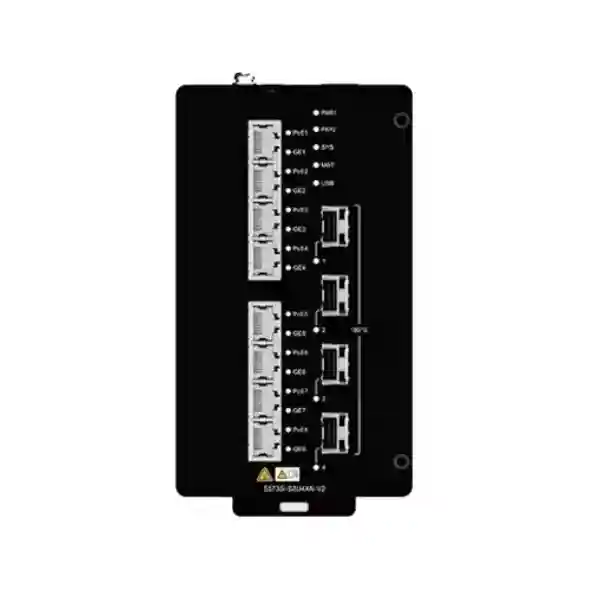
Huawei CloudEngine S5735I-S8T4SN-V2 Industrial DIN-Rail Switch
The Huawei CloudEngine S5735I-S8T4SN-V2 is a ruggedized, fanless industrial Ethernet switch engineered for reliable Gigabit access in plant rooms, roadside cabinets, production facilities, utility sites, transport environments, security networks, and other locations where temperature, dust exposure, maintenance access, and power continuity require more than a conventional office switch. It combines eight 10/100/1000BASE-T copper interfaces, four GE SFP fiber interfaces, industrial monitoring connectivity, Layer 2 and Layer 3 networking, resilient power options, and Huawei campus-management capabilities in a narrow DIN-rail form factor.
Industrial temperature design
Designed for industrial environments with an extended operating-temperature capability across the S5735I-S-V2 family, making the platform suitable for outdoor cabinets and harsh field locations when installed according to Huawei environmental and optical-module guidance.
Compact DIN-rail footprint
A narrow industrial chassis simplifies installation in control cabinets where rail space is constrained. The model is suited to distributed access locations closer to cameras, controllers, PLC networks, sensors, access terminals, and edge equipment.
Copper plus fiber access
Eight copper Gigabit Ethernet ports handle local device connectivity while four GE SFP interfaces provide flexible optical uplinks, inter-cabinet links, fiber access, or redundant paths back to aggregation infrastructure.
Operational visibility
Telemetry, SNMP, CLI, SSH, web-based management options, statistics, alarms, and Huawei campus-management capabilities support structured operations rather than unmanaged or lightly managed industrial switching.
What is the Huawei CloudEngine S5735I-S8T4SN-V2?
The S5735I-S8T4SN-V2 is an industrial member of Huawei’s CloudEngine S5735I-S-V2 family. In practical network design terms, it is intended for edge or access-layer switching where eight local copper Gigabit connections and four Gigabit optical interfaces are sufficient, but environmental tolerance, DIN-rail mounting, Layer 3 services, ring resiliency, industrial I/O, and disciplined management are required. Huawei specifies the model with eight 10/100/1000BASE-T Ethernet ports, four GE SFP ports, one DI/DO interface and one RS-485 interface. The switch is fanless and supports direct external DC power or use with an appropriate AC adapter, with support for 1+1 power backup.
For UAE projects this architecture is especially relevant when networking is distributed into small outdoor or semi-outdoor cabinets instead of concentrated only inside climate-controlled server rooms. Typical examples include security-camera zones, traffic systems, factory cells, gatehouses, pump stations, utility compounds, warehouses, substations, remote building-service cabinets, and smart-city infrastructure. The device should still be engineered within Huawei’s stated installation limits; industrial-grade hardware reduces environmental risk, but it does not remove the need for correct enclosure selection, grounding, surge strategy, approved optics, clean power, and proper thermal design.
Detailed hardware specification and port architecture
| Specification | Huawei CloudEngine S5735I-S8T4SN-V2 |
|---|---|
| Copper ports | 8 x 10/100/1000BASE-T Ethernet |
| Optical ports | 4 x GE SFP |
| Industrial interfaces | 1 x DI/DO, 1 x RS-485 |
| Forwarding performance | 18 Mpps |
| Switching capability | 24 Gbps device switching capability / 520 Gbps system switching capability, per Huawei’s published notation |
| Cooling | Fanless, natural heat dissipation |
| Power architecture | External DC or supported AC power adapter; 1+1 power supply backup supported |
| Rated DC input range | 12 V DC to 48 V DC |
| Maximum DC input range | 9.6 V DC to 60 V DC |
| Typical power consumption | Approximately 17.44 W in Huawei product documentation |
| Maximum device power consumption | 18.59 W in Huawei product documentation |
| Memory | 2 GB RAM |
| Flash | 1 GB total |
| CPU | 1.1 GHz, 2 cores |
| Management port | RJ45 console supported; this specific model does not provide a USB port |
| Physical format | DIN-rail industrial chassis; approximately 150 x 46 x 133 mm in Huawei portfolio material |
| PoE | Not supported on S5735I-S8T4SN-V2 |
The port mix is deliberately different from many office access switches. Instead of prioritizing high port density, Wi-Fi access-point power, or desktop aggregation, the S5735I-S8T4SN-V2 focuses on compact industrial connectivity and fiber flexibility. Eight copper ports are enough for a small concentration of field devices while four GE SFP interfaces provide an unusually useful ratio of optical connectivity to local copper access. That is valuable where one switch must connect a handful of devices and also participate in a resilient fiber topology, link separate field cabinets, or provide multiple optical paths to aggregation points.
The absence of PoE is an important sizing point. If the project requires the switch itself to power cameras, wireless access points, VoIP endpoints, or other powered devices, this model should not be treated as a PoE substitute. It is better suited where endpoints are independently powered, where separate industrial injectors or power systems are used, or where the access devices are controllers, computers, gateways, RTUs, PLC-related equipment, metering systems, non-PoE cameras, security appliances, or other Ethernet-enabled industrial endpoints. FourTeck can help map a requirement to the correct Huawei industrial variant when PoE or 10GE uplinks are required.
Industrial mechanical design for UAE field environments
Industrial network reliability begins with mechanical and thermal design, not simply with protocol features. The S5735I-S8T4SN-V2 uses natural heat dissipation instead of fans. Removing fan modules eliminates a common moving component, reduces maintenance associated with dust-loaded fan assemblies, and supports deployment in constrained cabinets where airflow is managed passively or through the enclosure. Fanless operation also lowers acoustic noise, although noise is rarely the primary design criterion in an industrial cabinet. More importantly, it changes the thermal-engineering responsibility: enclosure selection, orientation, rail spacing, cable routing, solar exposure, internal heat sources, and ventilation must all be planned so the switch remains within its qualified temperature envelope.
Huawei positions the S5735I-S-V2 family for an extended operating-temperature range and harsh outdoor environments. Public Huawei material for the series lists operation up to +75°C under specified conditions, while detailed documentation further qualifies allowable ranges according to installation environment, altitude, enclosure type, airflow, and optical-module class. For a UAE deployment, that qualification matters. A roadside or rooftop cabinet can become significantly hotter than ambient air when exposed to direct solar radiation. Therefore, a specification such as “industrial temperature” should be interpreted as an engineering envelope, not as permission to ignore enclosure thermal calculations.
In Dubai, Abu Dhabi, Sharjah, Ras Al Khaimah, Fujairah, Ajman, and other UAE locations, outdoor communications enclosures may face high summer temperatures, airborne dust, humidity swings, and long duty cycles. The correct design approach is to evaluate cabinet shading, ingress-protection requirements, internal dissipation, cable glands, grounding, fiber entry, power-supply heat, and the thermal contribution of every device. Where a sealed cabinet is required for dust protection, heat rejection becomes more difficult; where a ventilated or actively cooled cabinet is selected, filter maintenance and fan reliability become additional operational tasks. The S5735I-S8T4SN-V2 gives designers a robust starting point, but successful field deployment still depends on the complete enclosure system.
The DIN-rail format is valuable because it allows the switch to sit alongside industrial power supplies, terminal blocks, control relays, media components, and automation hardware without consuming a 19-inch rack position. This supports distributed architecture: instead of pulling large bundles of copper back to a distant communications room, an industrial switch can be positioned near the field devices and uplinked over fiber. That can reduce copper distance limitations, improve isolation between field areas, and simplify expansion. The model’s narrow chassis is especially practical when designers need to preserve rail width for power components or control-system devices.
Port map: eight GE copper ports and four GE SFP interfaces
8 x 10/100/1000BASE-T
These interfaces connect local Ethernet endpoints using standard copper cabling within appropriate industrial or building-network practices. Auto-negotiation enables connection at 10, 100, or 1000 Mbps where supported by the attached device. In new deployments, Gigabit-capable structured cabling is preferable so the physical plant does not become the bottleneck.
Because this model is non-PoE, power for connected endpoints must be designed separately. That separation is often acceptable or even desirable in industrial systems where devices already use dedicated DC supplies, redundant control power, UPS-backed circuits, or machine power.
4 x GE SFP
Four SFP slots provide design flexibility for fiber links. Depending on supported Huawei optical modules and the project fiber plant, designers can use these interfaces for uplinks, ring segments, distribution connections, or long-distance inter-cabinet links. The SFP interfaces on this exact model are Gigabit Ethernet rather than 10GE SFP+.
Optics must be matched to fiber type, distance, wavelength, connector plant, temperature requirement, and vendor compatibility. For industrial outdoor cabinets, use of industrial-temperature optical modules may be necessary to maintain the intended environmental specification.
A common topology is to reserve two SFP ports for a fiber ring or dual upstream paths and use the remaining optical interfaces for a downstream cabinet, remote building, surveillance zone, or adjacent production cell. Another design uses one or two SFP ports for aggregation and keeps spare optical capacity for future expansion. The optimal assignment depends on whether the project prioritizes path redundancy, local cabinet interconnection, fault-domain boundaries, or available core ports.
Because the switch has four GE optical interfaces, it can be more adaptable than an access switch with only one or two uplinks. However, link speed still matters. If the expected aggregate traffic can exceed 1 Gbps per uplink—for example, dense high-bitrate surveillance, large data acquisition flows, or multiple cascaded cabinets—the S5735I-S8T4SN-V2 should be assessed against higher-speed S5735I variants with 10GE SFP+ interfaces. Port count alone is not a sizing method; traffic profile, oversubscription, burst behavior, multicast, latency requirements, resilience, and future growth all matter.
Switching performance, forwarding rate, and practical throughput planning
Huawei publishes a forwarding performance of 18 Mpps for the S5735I-S8T4SN-V2. It also expresses switching capability as 24 Gbps / 520 Gbps, with Huawei documentation noting that the value before the slash refers to device switching capability and the value after the slash refers to system switching capability. These figures should be interpreted in context rather than compared superficially with unrelated chassis or data-center platforms. The switch is built for industrial Gigabit edge connectivity, and its architecture is aligned with the number and speed of fixed interfaces.
For sizing, engineers should determine how much traffic each copper endpoint can generate, whether traffic is mostly local or upstream, whether multicast replication is present, and whether multiple cabinets feed a single aggregation link. A switch connecting eight low-bandwidth PLC gateways may use only a fraction of its forwarding capability, while a surveillance deployment with multiple high-resolution video sources can create sustained upstream load. Similarly, an industrial inspection system that periodically transfers large images can produce bursty traffic even if average bandwidth appears low.
The four GE SFP ports make it possible to distribute traffic across different paths, but logical segmentation and topology should be designed deliberately. Link aggregation may be appropriate in some architectures, while ring protection may be preferred in others. If resilience is achieved through physically diverse paths, those paths should also avoid common failure points such as shared cable trays, a single patch enclosure, or a common power circuit. Network redundancy is only effective when the underlying physical design is also resilient.
Forwarding performance should also be considered together with features such as ACLs, QoS, routing, multicast, telemetry, and management. In most properly sized industrial access scenarios, the S5735I-S8T4SN-V2 provides ample functionality. For unusual workloads, deterministic industrial protocols, very high multicast replication, or low-latency control requirements, application compatibility should be validated against the specific Huawei software release and design requirements rather than assumed from generic Ethernet capability.
Layer 2 services for segmented industrial networks
Industrial Ethernet should not be designed as one large flat broadcast domain simply because endpoint counts are modest. Segmentation helps isolate operational areas, simplify troubleshooting, control fault propagation, and enforce security policy. The CloudEngine S5735I-S-V2 family supports conventional enterprise switching functions such as VLANs, spanning-tree mechanisms, link aggregation, multicast handling, and access-control capabilities. This makes the platform appropriate for structured industrial access rather than unmanaged switching.
VLANs can separate camera traffic from controllers, building-management systems from corporate devices, contractor access from operational technology, or different tenant and facility zones. The exact segmentation model should reflect security architecture and operational ownership. For example, a remote utility cabinet might carry one VLAN for field devices, one for management, and one for security systems. A manufacturing area may require separate VLANs for machine networks, quality-control stations, cameras, engineering laptops, and management. The switch can provide the access edge where those logical boundaries begin.
Loop prevention is critical in industrial environments because maintenance work, temporary patching, or incorrect field cabling can create accidental Layer 2 loops. Huawei documentation lists STP, RSTP, and MSTP support across the family, and also references Huawei Smart Ethernet Protection and Ethernet Ring Protection Switching based on ITU-T G.8032. Ring-based designs are especially relevant when fiber routes connect multiple cabinets in sequence and the project requires continued connectivity after a single link failure. The choice between ERPS, spanning tree, link aggregation, or routed resilience should be driven by convergence requirements and topology.
Multicast control is another practical requirement. Video surveillance, industrial discovery mechanisms, and operational applications can use multicast. Huawei documents support for mechanisms including IGMP snooping and Layer 3 multicast protocols across the S5735I-S-V2 family. Proper multicast design can keep unnecessary streams away from unrelated ports and reduce avoidable bandwidth consumption. For large video systems, multicast behavior should be mapped end to end, including cameras, encoders, VMS servers, core switches, queriers, routing boundaries, and WAN links.
Layer 3 routing capability at the industrial edge
Huawei positions the S5735I-S-V2 as a Layer 3 Gigabit industrial switch family. Documentation lists static routing and dynamic routing technologies including OSPF, IS-IS, BGP, and related IPv6 protocols at the family level. This allows the switch to participate in routed industrial access designs rather than functioning only as a Layer 2 bridge. Routing at the edge can reduce broadcast domains, create clearer fault boundaries, improve path control, and support resilient multi-site or multi-zone architectures.
In a small industrial cabinet, static routing may be entirely sufficient. A few routed VLAN interfaces and clearly defined upstream routes can keep the design easy to audit. In larger distributed systems, OSPF can provide dynamic reachability and convergence between field switches and aggregation. BGP may be relevant in more complex enterprise, service-provider, or multi-domain designs, though its use at a small access node should be justified by architecture rather than enabled simply because it exists. Complexity should earn its place.
VRRP is also documented in the family feature set and can support default-gateway resilience in suitable topologies. As with any redundancy mechanism, engineers should verify the intended software release, supported topology, convergence objectives, and interaction with upstream firewalls or routers. Industrial networks frequently combine campus-style access with security zones controlled by firewalls; in those designs, the switch may route locally while sensitive inter-zone traffic is forced through a security gateway.
A routed access design can be particularly effective when cabinets are geographically dispersed. Instead of extending the same VLAN across many sites, each cabinet or zone can use local subnets and routed uplinks. This limits Layer 2 failure propagation and makes IP addressing more hierarchical. The tradeoff is operational: routing requires structured addressing, monitoring, configuration standards, and disciplined change control. FourTeck’s UAE IT services team can assist with network architecture, migration planning, configuration templates, and deployment validation for projects that move from unmanaged or flat networks to managed industrial switching.
Security controls for industrial and infrastructure access
A rugged enclosure does not make a network secure. Industrial switching must combine physical reliability with access control, management security, anti-spoofing protections, and traffic policy. Huawei documents multiple security mechanisms across the S5735I-S-V2 family, including MAC authentication, 802.1X, ACL and QoS policy delivery, defenses against several denial-of-service patterns, DHCP snooping, IP/MAC anti-spoofing techniques, and strict ARP learning.
802.1X can help control which authenticated endpoints or users gain network access, while MAC-based authentication may be useful for devices that cannot run an 802.1X supplicant. In industrial networks, many embedded endpoints have limited authentication capabilities, so a practical access-control model often mixes stronger authentication for capable devices with MAC-based or port-based policies for constrained equipment. The security architecture should recognize that MAC addresses can be spoofed; MAC authentication is therefore one layer, not a complete identity solution.
DHCP snooping and ARP-related controls help defend against common Layer 2 attacks or configuration mistakes, but their deployment must be planned. Trusted ports should be defined correctly so legitimate DHCP servers remain reachable while unauthorized servers are blocked. Binding tables and source validation should be tested with static-address industrial devices, DHCP reservations, redundant servers, and maintenance laptops. Security features that are enabled without understanding traffic behavior can interrupt legitimate operations just as easily as they can block unwanted activity.
Management-plane security is equally important. Huawei documentation lists SSH v2.0 and SNMP options. In production, insecure management protocols should be avoided where secure alternatives exist. Management VLANs, ACL restrictions, centralized authentication where supported, strong credential policy, configuration backups, logging, time synchronization, and change tracking should be part of the operating standard. Internet exposure of switch management interfaces should not be used as a shortcut for remote access. Remote administration should normally pass through controlled enterprise VPN, secure jump-host, or management-network architecture.
For projects that also require perimeter segmentation, secure remote access, or firewalling between operational and corporate networks, FourTeck maintains specialist resources through Firewall Dubai. The industrial switch should be treated as one element in a layered security design that includes endpoint hardening, identity, segmentation, firewalls, logging, vulnerability management, and secure maintenance procedures.
Power architecture, redundancy, and cabinet electrical design
The S5735I-S8T4SN-V2 supports direct external DC power or operation through a supported AC adapter. Huawei documentation for this model lists a rated DC input range of 12 V to 48 V DC and a wider maximum input range of 9.6 V to 60 V DC. It also supports 1+1 power backup. These characteristics are useful in industrial cabinets where DC distribution is common and where availability may be improved by feeding the switch from two independent power sources.
Power redundancy is only meaningful if independence exists upstream. Connecting two feeds to the same single-output power supply does not create true source diversity. A stronger design may use separate DC supplies, independent protected circuits, dual UPS paths, or different distribution branches according to the site architecture. Engineers should examine common-mode failure points from the utility incomer through UPS, DC conversion, breakers, terminal blocks, and field wiring. The switch can support redundant inputs, but the site power system determines whether that redundancy survives a real fault.
Huawei’s published typical power consumption for the S5735I-S8T4SN-V2 is approximately 17.44 W, with maximum device consumption stated at 18.59 W. This relatively low load is advantageous when calculating cabinet heat, UPS runtime, solar or battery-backed systems, and DC power supply sizing. Nevertheless, designers should size power systems with suitable engineering margin and account for the AC adapter’s conversion efficiency, other cabinet loads, cable voltage drop, inrush behavior, ambient temperature derating, and future expansion.
If the PAC60S12-AN industrial AC power module is selected where applicable, Huawei documents a 60 W output rating, 12 V DC output, and support for hot swapping. The project bill of materials must be checked carefully because power components, input wiring, terminal accessories, and installation method can vary by deployment. Do not assume that a switch order automatically includes every external power component required for a finished cabinet.
Grounding and surge protection deserve the same attention as power redundancy. Outdoor copper runs can create exposure to induced surge events. Fiber uplinks are often attractive partly because they provide electrical isolation between cabinets, but local copper interfaces and power inputs still require proper protective design. Site engineers should follow Huawei grounding, surge, and installation guidance and coordinate with the project’s electrical standard. The switch should not be treated as a substitute for a complete lightning and surge-protection system.
Fiber uplink design and SFP selection
The four GE SFP slots are central to the value of this model. Industrial networks frequently extend beyond the 100-meter practical copper Ethernet limit, traverse electrically noisy areas, or require physical separation between cabinets. Fiber is well suited to these conditions. It can cover longer distances, avoid ground-potential issues between sites, and reduce susceptibility to electromagnetic interference. The S5735I-S8T4SN-V2 allows multiple fiber paths without needing an external media converter for each connection.
Optical module selection should be based on the actual link budget. Begin with fiber type: multimode or single-mode. Then determine path length, connector count, splice loss, patch-panel loss, required wavelength, and temperature rating. An optical design should have margin rather than operating at the edge of the transceiver budget. Dirty connectors and poor terminations are among the most common causes of intermittent fiber issues, so inspection and cleaning procedures should be part of commissioning and maintenance.
In industrial outdoor locations, temperature-rated optics are important. The switch chassis may be specified for an extended temperature range, but the overall link is only as robust as the installed transceiver. Using a standard commercial-temperature optic in a hot cabinet can undermine the environmental design. Huawei documentation explicitly differentiates behavior according to industrial optical modules and installation conditions. For that reason, the optics should be specified at the same time as the switch, not selected as an afterthought.
Designers should also decide whether the fiber topology is point-to-point, dual-homed, daisy-chain, or ring based. Point-to-point uplinks are simple and easy to troubleshoot. Dual-homed designs can provide path diversity but require correct loop prevention or routing. Fiber rings can be efficient for linear physical layouts such as roads, pipelines, perimeters, warehouses, or production areas, provided the protection protocol and convergence requirement are designed correctly. The switch’s four SFP interfaces make these choices more flexible.
Before procurement, document every optical link in a schedule containing source switch, source port, destination device, destination port, distance, fiber type, strand count, connector type, optic model, wavelength, protection role, and expected receive level. This avoids mismatched SFPs and simplifies future maintenance. For broader Huawei and multi-vendor network sourcing, FourTeck’s UAE main site provides a central route for consultation and project coordination.
Industrial I/O: DI/DO and RS-485 integration
The S5735I-S8T4SN-V2 includes a DI/DO interface and an RS-485 interface, features that distinguish industrial switches from typical enterprise access products. Digital input and output connectivity can support alarm interaction with external systems, while RS-485 can be useful in industrial monitoring and control contexts depending on the supported Huawei functions and software configuration. These interfaces should be integrated according to the documented pinout, electrical specification, and intended use; they are not generic substitutes for a PLC or full industrial gateway.
A practical use case for digital I/O is site alarm integration. A cabinet door sensor, power alarm relay, environmental controller, or other dry-contact system may be tied into a monitoring architecture so network operations can correlate connectivity events with physical alarms. Conversely, a digital output may participate in a site signaling workflow. The exact behavior should be validated in the Huawei configuration guide for the deployed software version because industrial alarm behavior is operationally sensitive.
RS-485 is common in meters, environmental sensors, building systems, and legacy industrial equipment. Where the switch’s RS-485 functionality is used, cabling practice matters: correct polarity, termination, grounding strategy, baud configuration, and protocol expectations must be consistent end to end. Long RS-485 runs in industrial environments can be affected by noise or grounding issues, so engineering discipline is essential.
The inclusion of industrial I/O also means that switch configuration and replacement procedures should record more than Ethernet port settings. Commissioning documentation should include DI/DO wiring, RS-485 configuration, alarm mappings, contact labels, and test results. A spare switch can only be considered deployment-ready when both network and industrial-interface configurations are reproducible.
Reliability: ring protection, Smart Link, stacking, and power backup
Industrial availability is rarely achieved by one feature. It comes from layering redundancy across power, links, topology, hardware, and operations. Huawei documents STP, RSTP, MSTP, Smart Ethernet Protection, ERPS, Smart Link, and iStack capabilities in the S5735I-S-V2 family. The value of these mechanisms depends on the design. A simple single-switch cabinet may need only redundant power and dual fiber uplinks. A linear series of field cabinets may benefit from an ERPS ring. A higher-availability aggregation point may use multiple switches with stacking or other redundancy.
ERPS, defined by ITU-T G.8032, is intended for Ethernet ring protection. Huawei describes rapid protection behavior in the family documentation. In a correctly built ring, a single link failure can trigger traffic redirection over the alternate path. The design still needs capacity planning because failure mode concentrates traffic on the surviving path. A ring that works under normal conditions but overloads after a fiber cut is not truly resilient.
Smart Link provides another method for uplink backup. It can be useful where an access switch connects to multiple aggregation devices and the goal is straightforward active/standby behavior. Selection between Smart Link, ERPS, spanning tree, routing, and link aggregation should follow the network architecture and operational skill set. Standardized designs are easier to support across many remote sites than a collection of one-off redundancy mechanisms.
Huawei documentation also notes iStack support for the S5735I-S-V2 family, with stacking through electrical ports and software-version considerations. When stacking is used, engineers should review model-specific restrictions, port use, software level, failure behavior, and the effect on industrial I/O. In some cases, a routed pair of independent switches may offer clearer fault separation than a stack. The right choice depends on availability objectives, maintenance practice, and topology.
Redundant power, meanwhile, protects against one category of failure but not against a cabinet-wide outage. If the project requires service continuity through prolonged mains loss, UPS or battery autonomy must be calculated. If the cabinet can be physically damaged, geographic path and node diversity may be required. The S5735I-S8T4SN-V2 is a strong industrial access component, but high availability is a system property, not a label on a single device.
Telemetry, CampusInsight, WebMaster, SNMP, and operational monitoring
Huawei emphasizes intelligent operations across the S5735I-S-V2 family. Telemetry can collect device data in real time and send it to Huawei campus-analysis platforms such as CampusInsight. Compared with relying only on periodic polling, streaming telemetry can provide more granular visibility into changing conditions when the surrounding management architecture supports it. This is useful for large distributed networks where operations teams need early indications of degradation rather than waiting for users to report an outage.
Traditional SNMP remains important because many enterprise monitoring platforms depend on it. Huawei documentation lists SNMP v1, v2c, and v3, along with CLI, SSH, web-based management, RMON, logging, traffic statistics, and network-quality functions. In security-sensitive deployments, SNMPv3 is generally preferable to earlier community-string-based versions because it can provide stronger authentication and privacy controls, subject to implementation and policy.
WebMaster is documented by Huawei as an embedded local management approach for supported campus environments, with functions that can include topology discovery, device alarms, service provisioning, batch upgrades, replacement workflows, and management of switches, routers, and access points. For a small site, this may reduce the need for a separate network management platform. For a large enterprise, centralized systems such as iMaster NCE-Campus may be more appropriate. Licensing and feature availability should be checked for the actual software package and project scope.
Operational monitoring should start with an inventory. Record serial numbers, software versions, management IP addresses, physical locations, cabinet IDs, power feeds, uplink destinations, SFP types, fiber-core assignments, and configuration backups. Monitoring then becomes more actionable because an alarm can be mapped to the real physical infrastructure. A port-down event on “GigabitEthernet” is less useful than an alarm tied to “North Gate Camera Cabinet – Fiber to Building B.”
Good telemetry also enables preventive maintenance. Rising error counters, frequent link flaps, temperature alarms, optical receive degradation, repeated topology changes, or increasing packet drops can indicate developing problems before a full outage. The management system should therefore retain trends and alerts, not merely show current status. For distributed UAE installations, where site access may be time-consuming, early fault detection can significantly reduce operational cost.
IPv6 readiness and dual-stack deployment
Huawei documents mature IPv6 capability for the S5735I-S-V2 family, including IPv4/IPv6 dual stack and routing protocols such as RIPng, OSPFv3, and BGP4+. This allows organizations to deploy the switch in IPv4-only, IPv6-only, or mixed networks depending on the broader enterprise roadmap. Even when an industrial environment remains primarily IPv4, buying infrastructure with IPv6 support helps avoid creating a future migration barrier.
Dual-stack deployment should be treated as a security and operations project, not simply as enabling an additional protocol. Access controls, monitoring tools, management systems, firewalls, logging, DNS, addressing plans, and incident-response procedures need to support both protocol families. A common risk is to secure IPv4 thoroughly while leaving IPv6 traffic less controlled. Engineers should apply equivalent policy intent to both.
For industrial sites, address planning should remain easy to audit. Hierarchical subnets aligned with physical zones or operational functions simplify troubleshooting. Whether using IPv4, IPv6, or both, documentation should tie addresses to cabinet IDs, device roles, VLANs, and security zones. A well-structured addressing model often delivers more operational value than sophisticated features that are poorly documented.
Use cases in the UAE
Smart manufacturing
Connect industrial PCs, gateways, machine interfaces, inspection devices, controllers, monitoring equipment, and uplinks inside production-area cabinets. VLAN segmentation can separate machine zones and management traffic while fiber uplinks connect back to plant aggregation.
Transport and roadside networks
Deploy in roadside, parking, tolling, signaling, surveillance, or transport-support cabinets where DIN mounting and industrial temperature design are preferred. Fiber uplinks support distance and electrical isolation between field locations.
Utilities and energy sites
Use in substations, pumping facilities, water systems, renewable-energy installations, building-services plants, and remote utility compounds where DC power, compact rail mounting, alarm connectivity, and managed Ethernet are beneficial.
Security and surveillance
Aggregate independently powered cameras, analytics devices, access-control gateways, intercom controllers, or security appliances. The four SFP ports can support resilient links and distributed camera zones, subject to bandwidth calculations.
Warehousing and logistics
Place network access near loading bays, conveyor controls, scanners, industrial terminals, gate systems, and yard equipment. Fiber can link distant warehouse zones while the switch provides local Gigabit connectivity.
Smart buildings and infrastructure
Support distributed building-management, metering, environmental monitoring, parking, perimeter systems, and plant-room networks where standard office access switches are not ideal for the enclosure or temperature conditions.
How to size the S5735I-S8T4SN-V2 correctly
Start with endpoint count, but do not stop there. The switch has eight copper access ports. Reserve capacity for maintenance laptops, future devices, or alternate connections rather than designing to one hundred percent port occupancy on day one. If the cabinet is expected to grow past eight local copper endpoints, either select a higher-density model, use a second access switch, or redesign the distribution so expansion does not depend on unmanaged mini-switches added later.
Next, calculate traffic. Identify nominal and peak bandwidth for every endpoint. Video, imaging, industrial data acquisition, backup, software distribution, and engineering workstations can create much higher flows than basic telemetry. Determine how traffic converges onto each SFP uplink during normal operation and after a link failure. In redundant designs, the surviving path must carry the failure-state load without unacceptable congestion.
Then assess power. Confirm whether endpoints need PoE. If they do, this particular model does not provide it. Do not compensate by adding a collection of consumer-grade injectors inside an industrial cabinet without considering temperature, grounding, maintainability, and redundancy. If PoE is a core requirement, evaluate a Huawei industrial PoE model designed for the required power budget.
Review uplink speed. The S5735I-S8T4SN-V2 provides GE SFP, not 10GE. For many industrial edge cabinets, 1 Gbps is more than adequate. For high-density camera networks or aggregation of several downstream switches, 10GE may provide more growth margin. Network sizing should include expected life of the deployment, not just first-year traffic.
Finally, validate environmental conditions. Record minimum and maximum cabinet temperatures, enclosure type, altitude, airflow, solar load, humidity, dust exposure, corrosive atmosphere risk, and optic temperature class. Environmental qualification is a system-level exercise. If any part of the design—power supply, SFP, enclosure, patching, or endpoint—has a lower temperature rating than the switch, that lower-rated component may define the practical limit.
FourTeck can assist with model selection, bill-of-material planning, optics, power accessories, topology, and deployment scope. For multi-country organizations or central procurement teams, FourTeck Global can also be used as a coordination point for broader requirements.
Deployment topology examples
Topology 1: Single cabinet with dual fiber uplinks
Eight copper ports serve local field devices. Two GE SFP ports connect to separate aggregation switches or paths. The remaining SFP ports are reserved for expansion or an adjacent cabinet. The switch uses dual power feeds where site infrastructure supports them. This is suitable for a high-value remote cabinet where simple redundancy is required.
Design focus: verify path diversity, gateway redundancy, spanning-tree or routed behavior, and failure-state bandwidth. Physically diverse fiber routes provide more value than two logical links that share the same conduit.
Topology 2: Industrial fiber ring
Multiple field cabinets are connected in a ring using SFP interfaces. Each local switch serves a small set of devices. ERPS or another validated ring-protection method provides an alternate path after a single link failure. This layout can match roads, production lines, warehouse perimeters, utility compounds, or campus boundaries.
Design focus: ring capacity during failure, convergence requirement, maximum node count, fiber-route diversity, operational testing, and clear documentation of east/west ports. Every maintenance team should know which link can be safely isolated without breaking redundancy.
Topology 3: Routed field access
Each cabinet uses local VLANs and Layer 3 uplinks. Dynamic routing or static routing connects the cabinet to an aggregation layer. Broadcast domains remain local, and failures are easier to contain. This approach scales well when many geographically distributed sites need standardized addressing and clear operational boundaries.
Design focus: IP addressing, routing protocol design, route summarization, management reachability, firewall policy, DHCP relay where used, logging, and standardized templates. Routed access can reduce Layer 2 complexity but requires stronger IP design discipline.
Commissioning checklist for UAE industrial deployments
Physical installation
Confirm DIN-rail security, enclosure clearance, cable bend radius, grounding, labeling, port accessibility, airflow assumptions, cabinet seals, fiber management, and separation between data cabling and noisy power conductors where applicable.
Power validation
Measure input voltage, validate polarity, confirm protection devices, test both redundant feeds if used, document breaker and PSU references, and verify expected behavior during removal of either power source.
Fiber testing
Verify optic compatibility, clean connectors, confirm transmit/receive pairing, test optical levels where required, document strand IDs, validate path diversity, and record the destination of every SFP interface.
Configuration baseline
Apply hostname, management addressing, secure credentials, SSH, SNMP policy, NTP, syslog, VLANs, uplink configuration, loop-protection or routing settings, ACLs, port descriptions, and unused-port security.
Resilience testing
Simulate one uplink failure, one power-feed failure, and—where applicable—ring interruption. Observe convergence, packet loss, alarm generation, management reachability, and traffic load on the surviving path.
Handover documentation
Export configuration, software details, port map, fiber schedule, power-feed map, rack or cabinet drawing, management credentials procedure, monitoring enrollment, test results, and spare-part recommendations.
Operations and lifecycle management
Industrial switches often remain in service much longer than office access devices because replacement may require permits, site access, lane closures, machine downtime, security escorts, or coordination with multiple contractors. Lifecycle planning should therefore begin during design. Select a software baseline, define backup procedures, record configuration standards, and maintain compatible spares before the first device is commissioned.
Software upgrades should follow a controlled process. Review Huawei release notes, compatibility statements, feature changes, known issues, and upgrade paths. Test representative configurations where possible before wide rollout. For remote industrial sites, preload software and configuration before dispatch so field work is minimized. A rollback plan should define what happens if the new software affects uplink behavior, industrial I/O, routing, or management connectivity.
Configuration backups must be versioned and associated with the correct physical device. A generic backup directory containing anonymous files is difficult to use during an outage. Name backups with site, cabinet, hostname, model, and date. Document which values are site-specific, such as management IP, routing IDs, VLAN assignments, and interface descriptions. Standard templates reduce human error and make replacement faster.
Spares should include more than the switch. Consider compatible SFPs, patch leads, power components, terminal accessories, labeling materials, and the tools required to access the cabinet. If an industrial switch fails but the replacement cannot be powered because a proprietary accessory is missing, the spare strategy has failed. For critical sites, keep a preconfigured spare or a well-tested zero-touch replacement procedure.
Maintenance windows should include visual inspection for contamination, loose wiring, heat discoloration, damaged fiber, cabinet-seal degradation, and signs of condensation or corrosion. Network monitoring can reveal logical issues, but physical inspection remains important in field environments. Trends such as increasing interface errors or repeated link transitions should trigger investigation before service is lost.
Model selection: when the S5735I-S8T4SN-V2 is the right fit
Choose this model when the project needs a compact industrial DIN-rail switch, no more than eight local copper Gigabit endpoints, multiple Gigabit fiber interfaces, fanless operation, industrial temperature capability, managed Layer 2 and Layer 3 features, and flexible DC or AC-adapter power. It is particularly attractive where four GE SFP interfaces provide the right balance of uplink and ring connectivity without moving to a larger chassis.
Do not select it solely because it is industrial. If the project requires PoE, 10GE uplinks, higher copper port density, time-sensitive networking, precision timing, integrated special-purpose industrial protocols, or a particular certified environmental rating, compare the exact requirement against other Huawei industrial models. Product families include variants with 10GE SFP+, PoE++, larger port counts, and other feature differences.
The most common selection error is to focus on one specification and ignore the system. A switch can have the correct port count but the wrong power architecture. It can have the correct temperature rating but unsuitable optics. It can have enough bandwidth today but no growth margin. It can support a routing feature while the operations team lacks the monitoring and configuration processes to manage it. A balanced design aligns hardware, software, site conditions, operations, and lifecycle.
A project bill of materials should therefore include the switch, power method, SFPs, fiber patching, cabinet hardware, surge and grounding components where required, licenses or management subscriptions if applicable, support coverage, spares, and implementation effort. FourTeck can review the complete requirement rather than quoting the base switch in isolation.
Frequently asked technical questions
UAE procurement and project planning considerations
For procurement teams, the model number must be treated precisely. Huawei’s S5735I-S-V2 family contains several variants with differences in copper density, PoE capability, optical speed, power requirements, and chassis width. A quotation should therefore state the complete model, required power accessories, quantity and type of SFP modules, support requirement, software or license package where applicable, and delivery location. Substituting a nearby model because its name appears similar can create field incompatibilities.
Lead time should be considered alongside project sequencing. Industrial switches may need to be installed inside cabinets that are fabricated, wired, tested, and shipped to site as complete assemblies. If the switch or power accessory arrives late, the entire panel build can be delayed. Procurement should coordinate with the cabinet integrator, network team, electrical contractor, and commissioning schedule.
Support strategy also matters. Decide whether the project needs manufacturer support, local technical assistance, advance replacement, on-site spares, or only standard warranty. Critical infrastructure usually benefits from a defined response model. For distributed networks, maintaining a small number of standardized switch types reduces spare inventory and training burden.
Documentation from the procurement stage should flow into operations. The final bill of materials should be linked to site drawings and configuration records. Optic part numbers, power modules, and accessories should not disappear after purchase. When a failure occurs years later, those records enable the maintenance team to replace the exact component without rediscovering the original design.
FourTeck can support UAE customers from model identification and quotation through architecture review, supply, deployment planning, and related network services. Where the industrial switch connects to broader enterprise infrastructure, coordination with switching, routing, firewall, server, and structured-cabling teams can reduce integration issues before equipment reaches site.
Decision recap: what this model delivers
The Huawei CloudEngine S5735I-S8T4SN-V2 is best viewed as a compact, fiber-rich industrial access switch for sites where reliability and environmental design matter more than desktop port density or PoE. It is a strong fit for independently powered endpoints, distributed field cabinets, ring or dual-uplink fiber topologies, and managed industrial Ethernet designs. Its four GE SFP interfaces are a key differentiator, while the non-PoE design and Gigabit—not 10 Gigabit—optical speed must be accounted for during sizing.
Quotation input checklist
To obtain an accurate project quotation for the Huawei CloudEngine S5735I-S8T4SN-V2 in the UAE, provide the following information. This helps FourTeck identify the correct switch, power accessories, optics, support scope, and deployment services without unnecessary revisions.
Plan the Huawei S5735I-S8T4SN-V2 deployment with FourTeck UAE
FourTeck can help translate cabinet drawings, endpoint counts, fiber schedules, power constraints, and resilience objectives into a practical bill of materials and implementation plan. The goal is not simply to supply a switch, but to ensure the selected model, optics, power system, topology, and operational approach fit the real site.
For broader enterprise-network projects, visit FourTeck UAE, Firewall Dubai, UAE IT Services, or FourTeck Global through the approved links included above. Share the project location, required quantity, endpoint types, fiber distances, and target availability level to begin a technical review.
Confirm PoE requirement, GE versus 10GE uplink need, DC or AC power method, industrial SFP temperature rating, and cabinet thermal conditions.

Reviews
There are no reviews yet.