
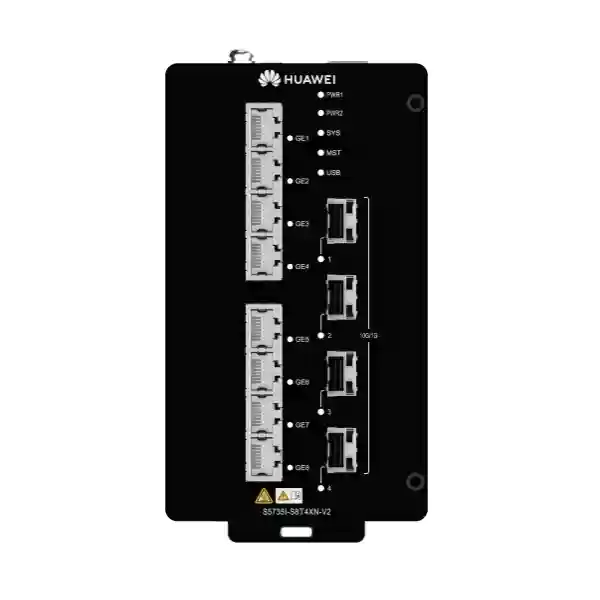
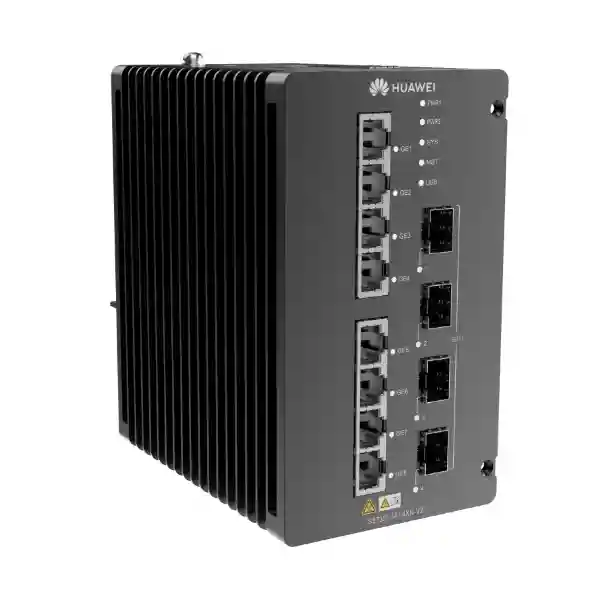
Huawei CloudEngine S5735I-S8T4XN-T-V2 in Dubai, UAE
A compact, fanless DIN-rail Layer 3 industrial switch with eight Gigabit copper access ports, four 10GE SFP+ uplinks, trusted hardware security, industrial environmental tolerance, and rich routing, resiliency and operational tooling for critical edge networks.
Direct answer: what is the S5735I-S8T4XN-T-V2 designed to do?
The Huawei CloudEngine S5735I-S8T4XN-T-V2 is an industrial access and compact aggregation switch in the CloudEngine S5735I-S-V2 family. It is intended for locations where conventional office-access switches may be a poor mechanical or thermal fit: roadside cabinets, factory panels, utility substations, mining or transport environments, video-surveillance aggregation points, building systems, smart-city infrastructure and distributed operational-technology networks. The model provides eight copper Gigabit Ethernet downlinks for endpoints and four 10 Gigabit SFP+ optical uplinks for connecting the industrial edge to an aggregation layer, core switch, data center handoff, metro Ethernet service or a resilient fiber ring.
For buyers in Dubai and the wider UAE, the important distinction is that this is not simply a small office switch placed in a metal enclosure. Huawei positions the S5735I-S-V2 platform as an industrial switch family with an IP40 enclosure, wide environmental tolerances, professional surge protection and fanless natural heat dissipation. The public Huawei product material lists headline operation from -40°C to +75°C for the series, while the detailed thermal table qualifies the allowable upper temperature by cabinet type, airflow and the use of industrial optical modules. That qualification matters in the UAE: a switch installed inside a sun-exposed roadside cabinet, a sealed electrical panel, an air-conditioned telecom room and a ventilated plant enclosure will not experience the same thermal conditions. Engineering should therefore use the detailed temperature-versus-airflow conditions rather than treating +75°C as an unconditional number.
The -T suffix is also significant. Huawei identifies the -T version as incorporating a trusted hardware module that supports a hardware root of trust and measured startup. In practical terms, this gives security-conscious projects a hardware-backed basis for validating the platform’s boot process rather than relying only on software controls after the operating system has started. For critical infrastructure, regulated industry, utilities and industrial networks that require stronger platform-integrity controls, that hardware distinction can be an important reason to specify the S5735I-S8T4XN-T-V2 rather than the otherwise similar S5735I-S8T4XN-V2.
Verified model specification snapshot
| Product model | Huawei CloudEngine S5735I-S8T4XN-T-V2 |
| Access interfaces | 8 × 10/100/1000BASE-T Ethernet |
| High-speed uplinks | 4 × 10GE SFP+ |
| Industrial I/O | DI/DO and RS-485 interfaces |
| Forwarding performance | 72 Mpps |
| Switching capacity | 96 Gbps device switching capability / 520 Gbps system switching capability as expressed by Huawei |
| PoE | Not supported on this T model; select a PoE-capable family variant if endpoint power is required |
| Cooling | Fanless, natural heat dissipation |
| Ingress protection | IP40 |
| Power architecture | DC external or AC adapter; 1+1 power backup supported for the model class |
| Trusted platform capability | HTM trusted hardware supporting hardware root of trust and measured startup |
| Mounting / form factor | DIN-rail industrial form factor, approximately 150 × 86 × 133 mm for the S8T4XN chassis class |
Engineering note: final supported functions, environmental limits, optical-module compatibility and software behavior should be checked against the exact Huawei software release, ordering code and installation guide used for the project.
Port architecture and traffic design
The port mix is one of the clearest reasons to choose this model. Eight 10/100/1000BASE-T ports provide familiar copper connectivity for programmable logic controllers, industrial PCs, security appliances, access controllers, video encoders, building-management gateways, intelligent electronic devices and other Ethernet-connected edge equipment. Four 10GE SFP+ interfaces give the switch substantial uplink headroom relative to its eight 1GE access ports. This asymmetric architecture is useful when the design priority is not a large number of users but strong northbound bandwidth, physical path diversity and the ability to create resilient fiber connections from a compact field cabinet.
A common design mistake is to evaluate industrial switches only by counting copper interfaces. In real projects, the uplink side frequently determines whether a field switch can be integrated cleanly into the wider architecture. A switch serving eight Gigabit devices can theoretically receive an aggregate offered load close to 8 Gbps in one direction, and bursts from surveillance, telemetry or process-data sources can be synchronized. Four 10GE ports allow designers to separate upstream purposes: one pair can be used for redundant aggregation or an Ethernet protection topology, while remaining interfaces can support a secondary path, a local server, a neighboring cabinet or an expansion design. Exact port usage should follow the network’s redundancy method and supported feature set, but the physical flexibility is considerably greater than a basic eight-port switch with one or two 1GE uplinks.
Huawei specifies 72 Mpps forwarding performance and 96 Gbps device switching capability for this model. The company also publishes a 520 Gbps system switching capability value, and its datasheet explicitly distinguishes the value before the slash as the device switching capability and the value after the slash as the system switching capability. For project sizing, the 96 Gbps device figure and 72 Mpps forwarding figure are the more directly useful model-specific numbers. They provide context for packet handling, but they should not be confused with application throughput guarantees because real networks also depend on frame size, ACL use, QoS policy, routing features, control-plane load, optical media, traffic direction and failure-state behavior.
The S5735I-S8T4XN-T-V2 is not a PoE switch. That is a positive design fact, not an omission to hide. If the field devices require power from the Ethernet cable, such as many IP cameras, wireless access points or phones, the project should either provide separate endpoint power or select an appropriate PoE-capable industrial model. Using the non-PoE T model can be advantageous when field equipment is independently powered, because the power design remains focused on switching and the trusted platform requirement rather than on a large PoE budget.
Copper access layer
Use the eight Gigabit RJ45 ports for endpoints that are physically close enough for copper Ethernet and are compatible with the environmental design of the cabinet. In industrial environments, cable segregation, grounding, surge exposure and electromagnetic conditions should be part of the physical-layer design. The switch’s industrial construction does not remove the need for correct structured cabling, shielding choices and separation from high-energy conductors.
10GE optical uplink layer
The four SFP+ slots are well suited to fiber backhaul where distance, electrical isolation, bandwidth or path diversity makes copper impractical. Optical transceivers should be selected by wavelength, fiber type, reach, connector, temperature rating and Huawei compatibility. For outdoor cabinets in the UAE, industrial-temperature optical modules are especially important because thermal limits can depend on the module and enclosure conditions.
Trusted hardware and platform-integrity strategy
The -T version differentiates itself with Huawei’s trusted hardware module, described in the series documentation as supporting a hardware root of trust and measurement startup. A hardware root of trust provides an anchor below the normal network operating system. Rather than beginning the trust decision after software has already loaded, a trusted platform can use protected hardware functions to help establish whether the startup chain is in the expected state. Measured startup records or evaluates boot components as the platform initializes. The exact implementation is vendor-specific, but from an architecture perspective it gives security teams a stronger basis for platform assurance than configuration controls alone.
This matters most where the switch is physically distributed and difficult to supervise. Industrial Ethernet often places switching equipment outside conventional data rooms: roadside enclosures, substations, pump stations, factories, warehouses, rail or transport systems, security sites and unmanned utility locations. Physical access may be controlled but not continuously observed. A trusted hardware design complements the normal layers of access control, AAA, secure management protocols and configuration governance by addressing the integrity of the platform’s own startup process.
The trusted module should be treated as one layer in a broader defense model, not as a substitute for operational controls. A secure deployment should still restrict management-plane reachability, use authenticated administration, maintain known-good software versions, protect credentials, monitor logs, harden unused services, control configuration changes and separate industrial control traffic from general user networks according to the risk model. The switch family supports mechanisms such as 802.1X and MAC authentication, AAA, RADIUS, HWTACACS, SSH 2.0, HTTPS, DHCP snooping, CPU defense, blacklists and whitelists. These controls work at different points in the security architecture and should be selected deliberately rather than enabled indiscriminately.
For UAE organizations operating critical infrastructure, the right procurement question is not simply “does the switch have security features?” It is “which security controls are required by our architecture, which are supported by the exact VRP release we will deploy, and how will they be operated throughout the product lifecycle?” FourTeck can align switch selection with broader network and cybersecurity integration through FourTeck IT Services UAE, including design review, segmentation planning and implementation coordination.
Industrial environmental engineering for Dubai and the UAE
Environmental engineering is central to this product class. Huawei lists the S5735I-S-V2 series with industrial-grade temperature capability, IP40 protection, fanless cooling and surge resistance. The detailed hardware table for the S8T4XN chassis class indicates long-term operation with industrial optical modules from -40°C up to +65°C in a sealed cabinet, higher upper limits in ventilated cabinets, and up to +75°C when the specified forced-air conditions are met. The same series documentation lists 5% to 95% non-condensing relative humidity, storage temperature down to -40°C and up to +85°C, and operation at altitude up to 5000 m. Those are device capabilities; the project still has to engineer the actual cabinet environment so the switch remains inside the qualified envelope.
In Dubai, ambient temperature is only part of the challenge. A cabinet in direct sun can run significantly hotter than shaded ambient air because solar loading heats the enclosure and internal equipment adds its own dissipation. Dust accumulation can also reduce natural convection or clog filters, while coastal or industrial locations can introduce humidity and contaminants. The S5735I-S8T4XN-T-V2’s fanless design removes a common mechanical wear item and avoids pulling air through an internal fan path, but heat still has to leave the chassis through natural convection and the enclosure. DIN-rail spacing, vertical orientation, cabinet volume, ventilation, shade, heat exchangers or air conditioning may be needed depending on the thermal study.
The public datasheet lists IP40 for the switch itself. IP40 indicates protection against solid objects above the defined size threshold but does not indicate water protection. An IP40 switch should therefore not be interpreted as weatherproof equipment that can be mounted in the open. Outdoor use requires a correctly rated external cabinet that protects against rain, washdown, dust, condensation and the local environmental exposure. The cabinet rating, cable glands, drainage, grounding and heat-management strategy are separate engineering decisions.
Surge performance is another practical advantage. Huawei’s detailed table lists ±7 kV common-mode surge protection for the RJ45 service ports of the relevant chassis group. Surge withstand does not eliminate the need for proper earthing, bonding and site-level surge protection. It provides additional resilience at the interface, but a professional installation should consider the entire path from field cable and external protective devices through cabinet bonding and power entry. This is especially relevant when copper runs leave the protected zone of a building or connect equipment exposed to different grounding environments.
Power architecture, redundancy and cabinet integration
Huawei documents the S5735I-S8T4XN-T-V2 class for external DC power or an AC adapter, with 1+1 power supply backup capability. The PAC60S12-AN industrial 60 W AC power module is listed as applicable to the S8T4XN and S8T4XN-T-V2 models. That module accepts a broad AC input range and produces 12 V DC for the switch. In a project, the decision between AC adapter and direct DC should follow the cabinet’s existing power system, redundancy requirement, battery strategy, maintenance model and electrical standards.
Industrial sites often already have a protected DC system. In that case, direct DC can simplify the conversion chain and integrate the switch with UPS-backed or battery-backed infrastructure. Other sites standardize on protected AC distribution, making the industrial AC module the cleaner option. When two power feeds are used for redundancy, they should be designed to avoid common-mode failure. Feeding two inputs from the same unprotected breaker may satisfy physical dual-input cabling while offering limited resilience. Better designs consider source separation, upstream protection, UPS topology and how maintenance is performed without losing both feeds.
Because this exact T model does not provide PoE, the switch’s power budget is substantially easier to engineer than a high-power PoE access switch. Cameras, radios or access devices that need local power must be powered separately. That can be an advantage in automation and utility sites where field endpoints already use dedicated 24 V or 48 V DC supplies and network power is intentionally separated from process equipment. It can also be a disadvantage in compact security deployments where a single PoE cable is operationally simpler. The correct choice is therefore workload-specific rather than universally better.
Cabinet integration should reserve physical space not only for the switch but also for power modules, fiber management, service loops, patching, grounding and the bend radius of optical cables. The S8T4XN chassis class is approximately 150 mm × 86 mm × 133 mm, which is compact, but a dense physical installation that blocks convection can undermine the environmental benefits of the platform. Layout drawings should show airflow clearances and service access instead of treating the device footprint as the entire space requirement.
Layer 2 resiliency
The family supports familiar spanning-tree mechanisms including STP, RSTP and MSTP, plus Huawei Smart Ethernet Protection and ERPS based on ITU-T G.8032. Huawei describes ERPS fast protection switching in the series documentation, making the platform relevant to ring-based industrial and metro-style designs. Use the mechanism that matches the rest of the network rather than combining multiple loop-prevention schemes without a clear convergence plan.
Layer 3 resiliency
The S5735I-S-V2 family includes routing and gateway features such as OSPF, IS-IS, BGP and VRRP. This allows a field switch to participate directly in a routed architecture when the project requires it. Routed industrial edge designs can reduce Layer 2 failure domains, but routing policy, convergence behavior and operational ownership should be planned before enabling dynamic protocols in every cabinet.
Layer 2 and Layer 3 service capability
The S5735I-S-V2 platform is described by Huawei as a standard Layer 3 gigabit industrial switch, which is important for designs that need more than VLAN-based access. At Layer 2, the family supports VLAN segmentation, spanning-tree protection, link aggregation and multicast control functions. At Layer 3, Huawei lists OSPF, IS-IS, BGP and VRRP among the available capabilities, while IPv6 support includes dual-stack operation and protocols such as RIPng, BGP4+ and OSPFv3. The result is a platform that can serve a simple industrial access role or a more autonomous routed-edge role depending on the design.
For high-definition video and multicast-based industrial applications, the series supports multicast protocols including PIM-SM, PIM-DM and PIM-SSM as well as IGMP snooping. Multicast capability is especially relevant to surveillance, digital signage, transport systems, operational dashboards and applications that distribute the same stream to multiple receivers. The presence of multicast features does not automatically solve multicast design problems; querier placement, routing boundaries, receiver behavior, source topology and bandwidth still need to be engineered.
In brownfield networks, the most conservative deployment is often to start with a clean Layer 2 access role and route at a known aggregation point. In larger greenfield industrial networks, a routed access approach can limit broadcast domains and give each cabinet a more deterministic failure boundary. The S5735I-S8T4XN-T-V2 can fit either model. The decision should be made based on operational maturity, topology scale and troubleshooting practices rather than feature availability alone.
Huawei also lists interoperability support such as VBST compatibility with PVST/PVST+/RPVST environments. This can help during mixed-vendor migration, but interoperability should be validated in a lab for the exact behaviors the production network depends on. Features that appear equivalent by name can differ in defaults, timers, edge-port semantics and fault recovery. Where the industrial network is operationally critical, staged testing is less expensive than discovering a topology interaction during a live cutover.
Security controls for access, management and industrial segmentation
Industrial Ethernet security starts by reducing unnecessary trust. The switch family supports 802.1X authentication and MAC-address authentication, allowing identity-aware access models for devices that can authenticate directly and controlled fallback approaches for embedded equipment that cannot. Huawei also lists dynamic policy delivery for VLAN, QoS and ACL parameters. In a well-designed deployment, this can place authenticated endpoints into the correct logical network and apply policy close to the edge rather than relying solely on upstream firewall rules.
DHCP snooping and strict ARP learning are useful for defending common local-segment attacks and configuration errors. DHCP snooping builds bindings that help distinguish legitimate address assignment from rogue DHCP behavior. ARP protection mechanisms can reduce spoofing opportunities. These controls are especially valuable where unmanaged or contractor devices may connect to a field network, but they require disciplined port-role configuration. Incorrectly marking trusted ports or failing to account for relays can create outages, so security hardening should be tested against the actual DHCP and gateway topology.
For administrative access, the platform supports AAA methods including RADIUS and HWTACACS along with SSH 2.0 and HTTPS. The preferred operational model is to centralize administrator identity where possible, limit management protocols to dedicated networks or jump hosts, use role separation and maintain local break-glass credentials under controlled procedures. SNMPv3 should be preferred over earlier SNMP versions when security requirements call for authenticated and encrypted management traffic. The availability of legacy protocols in a feature list does not mean they should be enabled.
Network segmentation should also reflect the difference between business IT and operational technology. PLCs, cameras, building controls, badge systems and general office clients often have different availability, patching and communication requirements. VLANs and routed boundaries on the S5735I can create logical separation, while upstream firewalls can enforce inter-zone policy where deep inspection or centralized security control is required. For UAE customers integrating the industrial switch into a wider security architecture, Firewall Dubai by FourTeck provides a relevant path for coordinating firewall and segmentation requirements with switching design.
One detail worth stating clearly is MACsec. Huawei’s series document identifies MACsec support for specific larger S5735I-S-V2 models, not for the S5735I-S8T4XN-T-V2 in the published feature note. Therefore a project that mandates link-layer MACsec on every downlink or uplink should not assume this model supports it. That requirement should trigger a model-selection review before purchase.
Operations, telemetry and lifecycle management
An industrial switch is successful only if operations teams can see what it is doing, identify degradation and restore service quickly. Huawei lists a broad management set for the S5735I-S-V2 family: SNMP v1/v2c/v3, RMON, system logs and alarms, virtual cable testing, sFlow, NQA, telemetry, iPCA, NETCONF/YANG-based cloud management and web-based management capabilities. The right choice depends on the organization’s toolchain. Traditional NOC environments may rely heavily on SNMP and syslog, while automation-oriented teams may prefer model-driven interfaces and telemetry.
Streaming telemetry can be particularly useful in distributed industrial networks because it provides a more continuous view of operational state than periodic polling alone. When correlated with Huawei iMaster NCE-CampusInsight in supported designs, telemetry can contribute to fault identification and experience analysis. Whether that platform is included in a project should be decided by the management architecture and commercial scope rather than assumed from switch hardware alone.
Huawei also documents Easy Operation functions for deployment and maintenance, including zero-touch concepts, batch configuration and remote upgrades. Some capabilities vary by model and software release. For example, the datasheet notes that USB-based deployment is not supported on the S8T4SN model, while the S8T4XN hardware table lists USB 2.0 for the S8T4XN class. The practical lesson is that rollout procedures should be written against the exact purchased hardware and VRP image rather than copied from another member of the series.
For repeatable UAE rollouts across many cabinets, a strong operational package should include a standard configuration template, management addressing, AAA policy, NTP, syslog destinations, SNMP or telemetry settings, interface descriptions, approved transceiver matrix, backup procedure and a documented software baseline. Device-by-device improvisation is the enemy of maintainability. FourTeck’s main UAE team at FourTeck UAE can coordinate supply and implementation planning around a standardized deployment specification.
iStack, ring design and failure-domain planning
Huawei documents iStack support for the S5735I-S-V2 family, allowing multiple switches to operate as a logical device and simplifying management while providing redundancy. The same datasheet includes an important release note: iStack support is tied to a specified software release, and DI/DO plus RS-485 ports are unavailable when member switches operate in a stack. That caveat is critical for industrial projects because those auxiliary interfaces may be part of the design. If a customer intends to use DI/DO or RS-485 for cabinet alarms, sensors or local control integration, stacking should be validated against that functional requirement rather than selected only for network convenience.
Ring topologies are another common industrial choice because cabinets may follow a road, rail line, utility route or production layout where a closed fiber loop is physically natural. ERPS can provide fast protection in an Ethernet ring, while STP-family protocols provide broader loop prevention. A ring should still be treated as a failure-domain design exercise: the location of the ring protection link, aggregation points, expected convergence time, VLAN scope and behavior during multiple failures all need to be documented. Fast protection is useful only when the upstream architecture and applications can tolerate the resulting path change.
In some projects, routed point-to-point links are preferable to a large Layer 2 ring because they reduce broadcast propagation and make failures easier to localize. With four 10GE SFP+ ports and Layer 3 routing support, the S5735I-S8T4XN-T-V2 gives architects enough uplink flexibility to evaluate both styles. The optimal design depends on operational skills, addressing model, legacy systems and the need for deterministic adjacency.
When resiliency matters, do not stop at switch topology. Fiber paths should be physically diverse where possible. Two logical uplinks routed through the same duct, handhole, patch panel or building riser can fail together. Likewise, dual switch power connected to the same upstream breaker can share a common point of failure. High availability is achieved by removing common failure points across power, fiber, aggregation, management and physical route design.
Industrial surveillance aggregation
Use copper ports for locally powered cameras, encoders or access-control controllers and 10GE fiber uplinks for high-bandwidth backhaul. Because this T model does not provide PoE, camera power must come from local supplies or a different switch. Multicast, VLAN and QoS functions can help organize video traffic, but storage and VMS bandwidth must be sized separately.
Utility and substation edge
The industrial temperature design, DIN-rail form factor, surge resilience and family-level IEC 61850-3 / IEEE 1613 references make the platform relevant to utility environments. Project approval should still verify the exact certification, required substation profile, optical module and power arrangement against the tender specification.
Smart transportation and roadside cabinets
Four 10GE uplinks are useful for resilient fiber rings carrying traffic from roadside controllers, sensors, signage or surveillance. Cabinet thermal design is essential in UAE outdoor conditions. IP40 applies to the switch, so a weather-rated enclosure remains mandatory for exposed installations.
Factory and process network zones
The switch can aggregate PLCs, HMIs, industrial PCs and gateways while applying VLAN, authentication, ACL and routing policy. For deterministic process systems, latency and protocol requirements should be validated against the application; do not assume every industrial Ethernet protocol has identical network behavior.
Sizing methodology: how to decide whether eight GE and four 10GE ports are enough
A proper sizing exercise begins with endpoint count but should not end there. List every device that will connect to the switch today, then add known near-term additions and a controlled expansion margin. Eight access ports can disappear quickly when the cabinet includes multiple PLCs, cameras, local servers, a maintenance port, a firewall and a building or telemetry gateway. If six or seven ports are already committed at design time, the smallest possible switch may not be the cheapest operational choice once field changes begin. Conversely, buying a much larger chassis for a stable four-device cabinet may waste space, power and budget. The S5735I-S8T4XN-T-V2 fits best when the access requirement is genuinely compact but the uplink requirement is strong.
Next calculate bandwidth by traffic class rather than assuming all Gigabit ports run continuously at line rate. A PLC may generate modest cyclic traffic, while a multi-megapixel camera can generate a sustained stream and a local industrial PC may create bursty transfers. Identify steady-state traffic, peak bursts and failure-state traffic. Failure state matters because one uplink may need to carry the traffic normally shared across two paths. The four 10GE interfaces provide substantial capacity, but the uplink topology and oversubscription target should still be documented.
Then size forwarding features. A pure Layer 2 access switch with a few VLANs has different control-plane and operational demands from a device running dynamic routing, multicast routing, extensive ACLs, telemetry and multiple network services. The S5735I platform supports many functions, but a feature list is not a reason to concentrate every possible function into every cabinet. Decide what belongs at the industrial edge and what should remain in the aggregation or security layer. Simpler roles are often easier to troubleshoot during incidents.
Finally, size the environment and power system. Verify the highest expected internal cabinet temperature, optical-module rating, ventilation, humidity control, DC voltage range, redundancy source and surge protection. A network design is incomplete if the logical topology is excellent but the cabinet overheats in August. UAE industrial projects should treat thermal and electrical design as first-class inputs to network sizing.
For multi-country projects, the same technical platform may be deployed under different logistics, certification and support arrangements. FourTeck also supports regional project coordination through FourTeck Africa, which can be relevant when UAE headquarters teams standardize infrastructure for African branches or operational sites.
Optics and fiber planning for the four 10GE SFP+ ports
The SFP+ uplinks are empty interfaces until the correct optical or supported direct-attach media are selected. Procurement should therefore treat transceivers as part of the switch solution, not as an afterthought. Each link needs a documented fiber type, wavelength, connector, reach, expected loss budget, temperature rating and peer compatibility. For short in-building links, multimode optics may be appropriate. For campus, roadside, utility or inter-building routes, single-mode optics are often more practical. Long-distance or special-wavelength designs require a link budget rather than a simple distance guess.
Industrial-temperature operation is especially important. Huawei’s detailed temperature conditions reference industrial optical modules when specifying the wide operating range. Installing a commercial-temperature transceiver into an industrial switch can create a weak point even if the chassis itself remains within rating. The transceiver’s minimum and maximum temperature, optical power, receiver sensitivity and connector cleanliness all influence reliability. Field technicians should have a process for inspecting and cleaning fiber connectors before insertion because contamination can create intermittent loss that looks like a network problem.
When designing redundant uplinks, confirm whether the paths are truly diverse. Two SFP+ ports connected to fibers in the same cable can protect against a transceiver or port failure but not against a cable cut. Two fibers in separate ducts improve physical diversity. If the application requires high availability, document which failure scenarios each redundant element covers. This makes the design defensible and prevents ambiguous expectations during acceptance testing.
Optical spare strategy also matters. A distributed network with many roadside or factory cabinets can be restored faster when operations stock a small number of standardized, known-compatible transceivers. Standardizing link types where practical reduces the number of spare SKUs and lowers the chance of installing the wrong optic during an outage.
Software, feature entitlement and release control
Huawei’s public datasheet provides a broad feature inventory, but production designs should lock those features to an approved software release. Industrial networks often remain in service for many years, and uncontrolled upgrades can introduce operational risk. A project should define the initial VRP release, the process for evaluating maintenance releases, configuration-backup procedures and the rollback method before deployment. Security updates and defect fixes remain important, but change should be governed.
Some functions are explicitly release-dependent. The series document, for example, includes a note about iStack support in a particular software generation. That is a reminder that the hardware data sheet and the software feature matrix are complementary documents. If a tender requires a specific routing feature, telemetry function, stacking behavior or management integration, FourTeck should verify it against the exact software and commercial package proposed for the order.
Commercial licensing and support terms can also vary by region, software generation and solution bundle. The safest procurement method is to list required functions in the bill of materials or technical compliance sheet rather than assume every software feature is included identically in every purchase route. This is especially important for management platforms, analytics, cloud integration or advanced enterprise software that may have separate commercial terms from the switch hardware.
For operational governance, maintain a device register containing serial number, site, cabinet, management IP, installed software release, transceiver types, warranty or support status and backup location. This simple discipline becomes valuable when dozens or hundreds of industrial switches are distributed across remote sites.
UAE deployment topologies
1. Single-cabinet access with dual 10GE uplinks
Eight local endpoints connect to the copper ports, while two SFP+ interfaces provide redundant upstream links to a pair of aggregation switches. The remaining two 10GE ports can be reserved for growth or used for a neighboring cabinet, depending on the topology. This is a strong pattern for factories, warehouses and building-automation sites because it keeps the access layer compact while maintaining high uplink diversity.
2. Industrial fiber ring
Multiple S5735I switches can be arranged along a physical route with fiber links forming a ring. ERPS or another approved protection mechanism handles a single path failure. This topology suits roads, transport corridors, utility networks and perimeter systems where a linear chain would create unacceptable single-link outages. Acceptance testing should include a controlled fiber break to measure real convergence and verify application behavior.
3. Routed industrial edge
Each cabinet forms a small routed domain, and the switch participates in OSPF or another approved routing protocol upstream. This can reduce large Layer 2 domains and improve fault isolation. It requires stronger IP addressing, routing and operations discipline, so it is best suited to teams comfortable with distributed Layer 3 troubleshooting.
4. Secure zone handoff to firewall
The switch aggregates industrial devices by VLAN, then hands selected zones to a firewall or security gateway for inter-zone inspection and policy enforcement. This separates switching and security responsibilities. The design should define whether the switch or firewall owns default gateways, how routing redundancy works and how management traffic is isolated from production traffic.
What this model is not
It is not a PoE access switch. The eight copper ports on the S5735I-S8T4XN-T-V2 do not provide PoE. If endpoint power over Ethernet is mandatory, select a PoE-capable variant or design separate local power.
It is not an outdoor-weatherproof enclosure by itself. IP40 does not provide water protection. Outdoor installations need a suitable external cabinet and environmental design.
It is not a substitute for a firewall. ACLs, authentication and switch security functions are valuable, but they are not equivalent to a dedicated firewall’s application inspection and security services.
It should not be assumed to provide MACsec on this exact model. Huawei’s published series note calls out MACsec for other larger variants. Projects requiring MACsec should select hardware only after explicit compliance verification.
It is not automatically rated to +75°C in every enclosure. The maximum long-term temperature depends on the cabinet and airflow conditions in Huawei’s detailed table. Thermal engineering remains mandatory.
Procurement guidance for Dubai, Abu Dhabi and wider UAE projects
Industrial-switch procurement should be specification-led. The model name alone does not define the complete working system. A quotation should include the exact S5735I-S8T4XN-T-V2 ordering code, the chosen AC or DC power approach, redundant power components if required, SFP+ optics, patch leads, DIN-rail cabinet provisions and any support or management software needed by the project. If the switch is being supplied as part of a larger network, include the aggregation-side optics and interfaces in the same compatibility review.
For tender compliance, map each requirement to evidence: port count, forwarding rate, switching capacity, temperature profile, surge protection, IP rating, routing protocols, authentication methods, management protocols and certification. Where a tender uses language such as “industrial grade” without defining measurable criteria, the compliance response should translate that phrase into objective properties such as temperature range, fanless operation, surge tolerance, environmental standards and mounting format.
Lead time should also be considered. Industrial variants and specialized optics may not have the same stocking pattern as mainstream office switches. Projects with phased rollouts should lock the bill of materials early enough to avoid substituting optics or power components at the last minute. A technically equivalent-looking substitution can change temperature rating, wavelength, reach or power characteristics.
For UAE supply, network integration and broader enterprise infrastructure coordination, organizations can use FourTeck UAE as the primary local route while retaining access to global product and project context through the wider FourTeck organization. The quotation should identify site count, environmental conditions, port usage and resiliency requirements so the proposed bill of materials reflects the real deployment rather than only the switch chassis.
Implementation sequence for a controlled rollout
Design baseline: document endpoint count, VLANs, IP addressing, uplink topology, routing protocol, redundancy method, security controls, management tools, optical distances, cabinet power and thermal conditions. Approve this baseline before equipment staging.
Staging: update to the approved software release, apply the configuration template, set management access, AAA, NTP, logging and monitoring, configure VLAN and routing policy, label interfaces and record serial numbers. Test SFP+ links with the production transceiver type instead of generic lab optics.
Functional testing: confirm endpoint connectivity, VLAN separation, routing, DHCP behavior, multicast if used, management reachability and alarm reporting. For redundant uplinks, fail each link independently. For redundant power, remove each source independently. For ring topologies, open the ring and measure recovery.
Environmental acceptance: verify cabinet temperature under realistic load and local ambient conditions. Confirm clearances, grounding, cable entry, fiber bend radius, power labeling and enclosure seals. Outdoor sites should be inspected for solar exposure, ventilation and water ingress risk.
Operational handover: provide configuration backups, topology diagrams, software versions, passwords or credential-vault references, spare optics, escalation contacts and rollback procedures. A field switch without accurate documentation can take longer to restore than the hardware itself.
This staged method is useful whether the installation contains one switch or hundreds. It turns a hardware purchase into a repeatable operational system and reduces the chance that critical differences appear only after deployment.
Decision recap: when the S5735I-S8T4XN-T-V2 is a strong fit
Choose it for compact industrial edge sites
Eight copper Gigabit interfaces are enough for a small field cabinet, while four 10GE uplinks provide unusually strong backhaul capacity and topology flexibility for the size of the access layer.
Choose it when trusted startup matters
The -T model’s trusted hardware module supports a hardware root of trust and measured startup, useful where the platform itself must be part of the security-assurance design.
Choose it for harsh cabinet conditions
Industrial temperature capability, fanless natural cooling, IP40 construction and surge resilience suit environments that are harder on equipment than a climate-controlled office rack.
Choose another model when PoE is required
This exact model does not supply PoE. If cameras, access points or other endpoints need power over Ethernet, specify a PoE-capable industrial variant instead of adding complexity later.
Quotation input checklist
A technically accurate quotation can be prepared much faster when the project team provides the following information. These inputs also help prevent under-sizing, incompatible optics and incomplete power design.
Number of switches, number of cabinets, city or emirate, indoor or outdoor installation, and whether the rollout is single-site or multi-site.
Device count per cabinet, required copper speed, whether endpoints need PoE, and expected growth over the next three to five years.
Link distance, fiber type, connector type, required redundancy, known peer switch and whether industrial-temperature optics are mandatory.
Available AC or DC input, nominal DC voltage, UPS or battery system, dual-feed requirement and whether power supplies must be included in the bill of materials.
Expected internal cabinet temperature, enclosure type, ventilation or fan airflow, humidity, dust exposure, sun exposure and required IP rating of the external cabinet.
VLAN count, Layer 2 or Layer 3 role, routing protocols, multicast requirements, QoS, redundancy mechanism and any stacking requirement.
802.1X or MAC authentication, AAA server type, ACL requirements, management-plane restrictions, trusted-platform requirement and firewall handoff design.
Preferred NMS, SNMP or telemetry, syslog, NTP, configuration automation, required software baseline and support or warranty expectations.
Final consultation panel: build the complete industrial switching package
The Huawei CloudEngine S5735I-S8T4XN-T-V2 is best specified as part of a complete cabinet and network design. The switch itself provides eight Gigabit copper access ports, four 10GE SFP+ uplinks, Layer 3 capability, industrial environmental tolerance, fanless operation, resilient power options and trusted hardware on the -T variant. The project around it must still define optics, power, environmental control, redundancy, management, security zones and acceptance testing.
For Dubai and UAE deployments, FourTeck can structure the bill of materials around the exact site conditions rather than supplying a bare switch without context. A good technical submission should identify the switch, power method, SFP+ modules, fiber assumptions, software baseline, required security functions and any related firewall or integration components. This reduces ambiguity during installation and gives the project team a clear reference for testing.
Share your cabinet environment, fiber distances, endpoint list and redundancy requirement to obtain a technically aligned proposal. For enterprise infrastructure coordination, visit FourTeck IT Services UAE. For broader company and solution information, visit FourTeck UAE. For projects that extend from UAE headquarters into regional sites, FourTeck Africa can support aligned regional planning.
Before ordering, confirm
✓ No PoE required on these eight copper ports
✓ Required SFP+ wavelength and distance
✓ AC or DC power and redundancy
✓ Cabinet temperature and airflow
✓ Routing, ring or stacking topology
✓ Trusted hardware requirement
✓ Software release and support scope
Technical accuracy note
The specifications on this page are based on Huawei’s published CloudEngine S5735I-S-V2 product information and should be validated against the exact regional ordering code, current VRP release, transceiver compatibility list and installation guide before final design approval. Environmental limits are installation-condition dependent. Product capabilities and commercial packaging may change over time.

Reviews
There are no reviews yet.