
Huawei CloudEngine S5735I-S8T4XN-V2 Industrial Switch in UAE
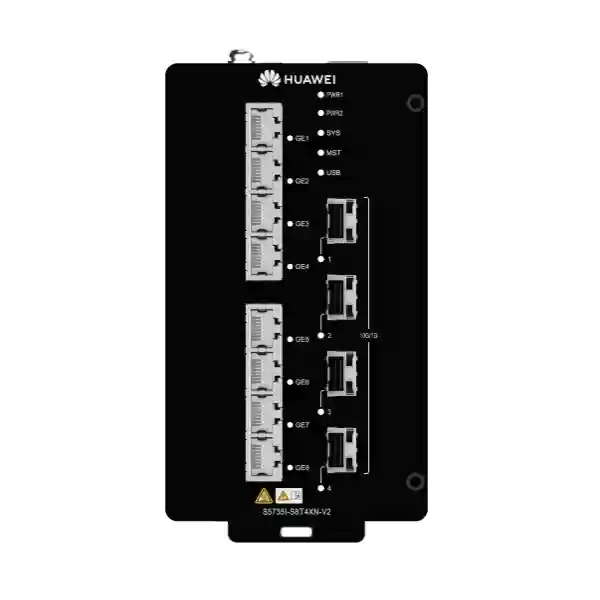
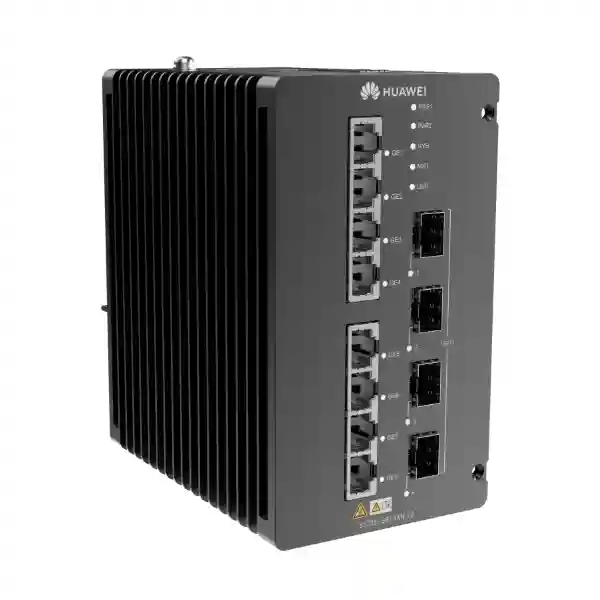
The Huawei CloudEngine S5735I-S8T4XN-V2 is designed for industrial access and aggregation where conventional office switches can be difficult to deploy. It combines eight 10/100/1000BASE-T copper ports, four 10GE SFP+ ports, Layer 3 routing, fanless heat dissipation, rugged environmental specifications, redundant power options and industrial monitoring interfaces in a compact DIN-rail format.
For UAE projects, that combination is particularly relevant to roadside cabinets, factory cells, utility installations, surveillance aggregation points, logistics facilities, outdoor-adjacent enclosures, building-services networks and other edge locations where heat, dust management, surge exposure, fiber distance and service continuity must all be considered together.
Choose this model when you need non-PoE industrial copper access with four high-speed 10GE optical uplinks, Layer 3 features and a fanless DIN-rail chassis.
Do not select it for direct PoE camera, access-point or phone powering. The S5735I-S8T4XN-V2 itself does not provide PoE on its eight copper access ports.
What the S5735I-S8T4XN-V2 is designed to do
Industrial switching requirements are rarely limited to port count. A field switch may need to survive high cabinet temperatures, accept DC power from an automation or transport power system, recover rapidly from an uplink failure, carry deterministic or latency-sensitive industrial traffic, segment control devices from business systems, and extend multiple services over fiber to a control room. The S5735I-S8T4XN-V2 addresses this role as a standard industrial Layer 3 switch rather than as a simple unmanaged Ethernet concentrator.
Its eight copper ports are suitable for PLCs, HMIs, industrial PCs, non-PoE cameras with separate power, access controllers, telemetry gateways, serial-to-Ethernet devices, building controllers and other 10/100/1000 Mbps endpoints. The four 10GE SFP+ ports provide considerably more uplink headroom than a typical small industrial switch with only one or two gigabit fiber ports. This makes the model useful where several edge devices converge and where upstream links may need redundancy, link aggregation or connection to separate distribution layers.
Huawei positions the series for smart manufacturing, mining, transportation, safe-city and electric-power scenarios. In practical UAE designs, the same hardware characteristics can also be relevant to warehouses, ports, substations, district cooling facilities, solar sites, industrial campuses, intelligent transport systems, security networks and remote technical rooms. The key engineering principle is to treat the switch as part of a complete enclosure and power system. Ambient temperature, airflow, optical-module temperature grade, surge protection, grounding, fiber route, DC supply quality and maintenance access all influence whether the installation can achieve the intended reliability.
Verified model hardware profile
| Model | CloudEngine S5735I-S8T4XN-V2 |
| Fixed copper ports | 8 x 10/100/1000BASE-T |
| Fixed optical ports | 4 x 10GE SFP+ |
| Industrial interfaces | 1 x DI/DO, 1 x RS-485 |
| PoE | Not supported |
| Forwarding performance | 72 Mpps |
| Switching capability notation | 96 Gbps device / 520 Gbps system |
| Dimensions | 150 x 86 x 133 mm |
| Chassis weight incl. packaging | 2.11 kg |
| Cooling | Fanless, natural heat dissipation |
| Ingress protection | IP40 |
Why four 10GE uplinks matter
Four SFP+ ports allow an industrial edge design to separate resiliency from capacity. Two ports can be used for protected upstream paths while the remaining ports connect to a local aggregation node, a security appliance, a ring neighbor or a second control-domain network. This is useful when a site cannot tolerate a single fiber cut or single distribution-switch dependency.
The physical presence of 10GE interfaces does not mean every deployment needs 10 Gbps on every uplink. Capacity should be based on actual traffic, oversubscription tolerance and growth. A surveillance cabinet with multiple high-bitrate streams may justify 10GE immediately, while a PLC cell may use 1GE optics initially and reserve SFP+ capability for future expansion, subject to supported transceivers and software.
For long outdoor or campus runs, optical links also provide electrical isolation between buildings and avoid copper Ethernet distance limitations. Fiber planning should still include optical budget, connector loss, splice allowance, wavelength, distance, temperature rating and the supported-module list. In hot UAE cabinets, industrial-grade optics can be as important as the switch itself because the usable system temperature is determined by the weakest component in the enclosure.
UAE heat, cabinet airflow and environmental engineering
The headline industrial temperature range is one of the strongest reasons to evaluate this switch, but it must be interpreted correctly. Huawei lists operation down to -40°C and up to +75°C for the series under defined installation conditions. For this model, the detailed datasheet distinguishes between sealed and ventilated cabinet conditions and expects industrial optical modules when operating at the extended limits. In a sealed cabinet, the long-term upper limit is lower than the maximum headline figure; higher ambient operation requires ventilation, and operation up to +75°C is associated with fan-assisted cabinet airflow of at least 200 LFM.
That distinction matters in Dubai, Abu Dhabi, Sharjah and other UAE locations because an outdoor cabinet can become substantially hotter than the measured shade temperature. Solar loading, dark cabinet finishes, nearby mechanical equipment, blocked louvers and internal power supplies can raise internal air temperature. Therefore, a thermal design should be based on worst-case enclosure temperature rather than on the weather forecast. Where the cabinet is exposed to direct sun, use a sunshield or double-wall enclosure when appropriate, calculate internal heat load, and provide filtered or conditioned ventilation as required by the environment.
The S5735I-S8T4XN-V2 uses natural heat dissipation and has no internal fan modules. This removes a moving component and can reduce maintenance burden, but it does not eliminate the need for cabinet airflow. Fanless simply means the chassis itself does not use fans. Heat still has to leave the metal enclosure and surrounding cabinet. Maintain the vendor-required clearance, avoid stacking heat-producing DIN-rail equipment tightly against the switch, and make sure cable bundles do not obstruct convection paths.
Humidity is specified at 5% to 95% non-condensing. In coastal UAE environments, high humidity and salt contamination can create a different risk from temperature. IP40 protection limits access by solid objects but does not make the switch weatherproof or waterproof. It should therefore be installed inside an enclosure that provides the environmental protection appropriate to the site. If the installation is close to the sea, in a wash-down zone, in a dusty industrial area or exposed to chemical contaminants, the cabinet and filtration strategy should be selected for those conditions rather than relying on the switch’s IP40 chassis rating.
The published storage temperature is -40°C to +85°C, and operating altitude is listed up to 5000 m. For UAE deployments, altitude is rarely the limiting factor, but the specification reinforces the industrial design intent. Temperature derating of optics and other accessories remains important. Procurement should match the transceiver temperature grade and fiber type to the cabinet design instead of purchasing standard office-grade optics solely because the connector and wavelength appear compatible.
Power architecture and redundancy
The S5735I-S8T4XN-V2 can use a 60 W AC power adapter or an external DC supply. Huawei specifies a rated DC input range of 12 V DC to 48 V DC and a maximum input range of approximately 9.6 V DC to 60 V DC for this model. That wide DC range is useful in industrial control panels, transportation cabinets and utility installations where DC power is already present.
The platform supports 1:1 power backup when two suitable power sources or modules are used. Redundant power should be engineered as true path diversity, not merely two leads connected to the same upstream breaker. For critical sites, separate protected DC feeds, independent fusing and clear labeling improve fault isolation. Verify the exact power accessory and terminal arrangement in the bill of materials because AC-adapter and direct-DC deployments have different mechanical and protection requirements.
Published consumption for the S5735I-S8T4XN-V2 is approximately 19.94 W typical and 20.35 W maximum for the device. This relatively modest load helps when sizing small DC systems, but UPS or battery calculations must include conversion losses, upstream devices, optics, heaters, cabinet fans and future expansion. Where a site requires extended runtime, calculate energy in watt-hours and include aging margin rather than multiplying switch wattage by a nominal battery amp-hour figure without accounting for voltage and efficiency.
Surge protection and grounding
Huawei specifies ±7 kV common-mode surge protection on the RJ45 service ports. For the power port when DC power modules are used, the datasheet lists ±2 kV differential-mode and ±1 kV common-mode surge protection. These values are valuable for field deployment, but built-in protection should be treated as one layer within a complete surge and grounding design.
Outdoor copper runs, cables entering from another building, long unshielded routes and equipment connected to different earth potentials can expose Ethernet interfaces to damaging transients. Where possible, use fiber for building-to-building links. For copper circuits that leave the protected equipment zone, coordinate external surge protective devices, bonding and earthing according to the project electrical design.
Avoid creating an isolated network-grounding plan that conflicts with the site’s electrical earthing system. The switch, DIN rail, cabinet, cable shield strategy and surge devices should be considered together. In utility, transport and industrial projects, grounding requirements may be defined by the end customer’s standards and should be reviewed before fabrication of the cabinet.
Layer 2 switching: segmentation, loop protection and operational control
Industrial Ethernet networks often begin as flat Layer 2 designs because field devices need simple connectivity, but unmanaged growth can create large broadcast domains and difficult fault propagation. The S5735I-S8T4XN-V2 provides a substantially richer Layer 2 feature set. The platform supports up to 32K MAC address entries, 4K VLANs and up to 1K VLAN interfaces simultaneously, together with MAC learning and aging, static and blackhole MAC entries, source-MAC filtering, Sub-VLAN, Super-VLAN, MUX VLAN, Voice VLAN, QinQ, enhanced selective QinQ, VLAN stacking and VLAN mapping.
For plant or infrastructure designs, VLANs can separate PLC traffic, operator workstations, CCTV, access control, maintenance laptops, environmental sensors and management interfaces without requiring a separate physical switch for every service. Segmentation should follow security zones and operational ownership rather than arbitrary port groups. For example, cameras and industrial controllers may share the same cabinet but should not necessarily share the same Layer 2 broadcast domain or access-control policy.
Loop protection is especially important in field networks because accidental patching or redundant ring connections can cause broadcast storms. The switch supports STP, RSTP and MSTP as standard spanning-tree mechanisms. Huawei also lists Smart Link, SEP and ERPS based on ITU-T G.8032, along with BPDU protection, root protection and loop protection. ERPS is useful for ring architectures where rapid recovery is required; Huawei describes 10 ms-class protection switching for the series under the relevant design conditions.
Choosing the protection mechanism should be topology-driven. A small star network may need only RSTP and dual uplinks. A linear roadside deployment may benefit from an Ethernet ring. A larger industrial campus may use Layer 3 to limit failure domains between areas. Mixing multiple loop-protection methods without a clear boundary can complicate troubleshooting. The design should identify which protocol owns each redundant path, where the root or ring protection node resides, and how a failure will be tested during commissioning.
Layer 3 routing for compact industrial aggregation
The S5735I-S-V2 platform supports static routing and a broad set of dynamic protocols including RIPv1/v2, RIPng, OSPF, OSPFv3, IS-IS, IS-ISv6, BGP, BGP4+, ECMP, VRRP and VRRP6. That allows this compact DIN-rail switch to participate in routed designs rather than functioning only as a Layer 2 access node.
Huawei lists up to 8192 IPv4 FIB entries and up to 3072 IPv6 FIB entries for the series, plus up to 3072 IPv6 neighbor-discovery entries. Those capacities are far beyond what a typical small cabinet needs, but they make the platform suitable for segmented industrial campuses, transport nodes and distributed utility networks where local routing can reduce broadcast scope and improve failure containment.
A good industrial Layer 3 design does not automatically enable every dynamic protocol. OSPF may be appropriate for an enterprise or infrastructure campus; IS-IS may suit specific provider-style designs; BGP can be useful at defined routing boundaries. Static routes are often sufficient for isolated machine networks. Protocol selection should be based on operational skill, convergence goals, topology size and interoperability with the existing core.
IPv6 readiness without abandoning IPv4
The platform supports IPv4/IPv6 dual stack and IPv6 routing capabilities including RIPng, OSPFv3 and BGP4+. It can therefore be introduced into an IPv4 environment while preserving a migration path for IPv6. This is valuable in long-life infrastructure projects where the switch may remain in service across multiple addressing and application-generation changes.
IPv6 deployment should include security controls from the start. Neighbor discovery, DHCPv6, router advertisements and management access all need explicit policy. Huawei lists ND snooping, DHCPv6 client/relay functions and attack-source tracing features for IPv6-related traffic. These capabilities can support a controlled migration, but they still require a documented addressing plan and management policy.
For brownfield industrial systems, avoid forcing IPv6 onto legacy controllers that do not support it. Use the switch’s dual-stack capability at aggregation and management layers where needed, preserve stable IPv4 segments for legacy equipment, and transition applications according to operational risk rather than as a purely network-driven change.
Industrial protocol forwarding and multicast behavior
Huawei lists forwarding support for widely used industrial protocols such as PROFINET RT, EtherNet/IP, Modbus TCP, OPC UA and GOOSE. It is important to interpret this as network transport capability, not as a promise that the switch replaces an automation controller or protocol gateway. The Ethernet switch carries the traffic and provides segmentation, QoS, resilience and management around it. Application compatibility must still be checked with the PLC, IED, controller, historian or supervisory system vendor.
Many industrial and video systems also use multicast. The S5735I-S-V2 family supports PIM-DM, PIM-SM, PIM-SSM and PIMv6, together with IGMP v1/v2/v3 and IGMP snooping. IGMP fast leave, multicast VLAN functions, per-port multicast statistics and multicast load balancing over trunk member ports are also listed. These features are valuable in surveillance, IPTV, process monitoring and control environments where multicast should reach only the ports that need it.
Multicast design should include querier placement, VLAN scope and receiver behavior. Without proper snooping and querier operation, multicast can degrade into broadcast-like flooding inside a VLAN. For video aggregation, calculate not only average stream bitrate but also peak and simultaneous-viewing behavior. For control traffic, validate latency and packet-loss requirements under congestion rather than assuming multicast support alone guarantees deterministic performance.
QoS, latency and traffic engineering at the edge
The datasheet lists forwarding latency below 4 microseconds for the series, plus eight queues on each port and multiple QoS mechanisms. Supported functions include rate limiting on ingress and egress, packet redirection, port-based traffic policing, two-rate three-color CAR, DRR, strict-priority scheduling, combined DRR+SP scheduling, 802.1p and DSCP remarking, queue-level rate limiting, port traffic shaping and filtering from Layer 2 through Layer 4.
These tools are useful when one switch carries traffic with very different operational importance. A control message, safety-related supervisory flow, VoIP stream, camera feed and bulk maintenance transfer should not necessarily compete on equal terms. A sensible policy classifies traffic at a trusted boundary, preserves or rewrites priority markings as required, reserves priority for truly latency-sensitive applications and prevents bulk traffic from consuming all available bandwidth.
QoS cannot create bandwidth that does not exist. If eight copper devices can collectively generate more traffic than an uplink can carry, congestion policy only determines what is delayed or dropped. Capacity planning therefore comes first. Use QoS to protect application behavior during transient congestion, not as a substitute for adequate uplink bandwidth. The four 10GE ports provide generous design options, but the actual transceiver speed, link aggregation and upstream switch configuration determine usable throughput.
Access security and attack mitigation
Industrial networks increasingly need the same identity and access controls used in enterprise campus networks. The S5735I-S-V2 platform supports IEEE 802.1X authentication, MAC-address authentication, AAA, RADIUS and HWTACACS, plus hierarchical user management and password protection. These features allow network access decisions to be tied to device identity or user policy rather than to the assumption that anything plugged into an industrial port is trusted.
Huawei also lists DHCP snooping, strict ARP learning, IP/MAC/port/VLAN binding, port isolation, port security, sticky MAC, blackhole MAC entries, source-MAC filtering, CPU defense, blacklists and whitelists. These controls address common Layer 2 threats and accidental misconfiguration, including rogue DHCP servers, address spoofing and unauthorized endpoint attachment.
For operational technology, security configuration should be conservative and testable. Authentication or DHCP-snooping changes can interrupt devices that use fixed addressing, nonstandard boot behavior or embedded protocol stacks. Build a device inventory, identify static versus dynamic addressing, stage policies in a lab or maintenance window, and retain an out-of-band recovery method when applying access controls to remote sites.
Important model-specific security note
Do not assume that every feature mentioned for the broader S5735I-S-V2 family applies identically to this exact model. Huawei’s current series datasheet specifically identifies MACsec support for selected larger models in the family, not for the S5735I-S8T4XN-V2. If link-layer encryption with IEEE 802.1AE MACsec is a mandatory requirement, confirm the exact hardware model and software release before purchase rather than treating family-level feature lists as interchangeable.
The same discipline applies to feature licensing and software-version dependencies. Industrial projects are often designed months before commissioning, and firmware or licensing may change between tender and delivery. The bill of materials should therefore identify the required feature set, software train and license entitlement, not only the hardware SKU.
A practical procurement specification should list routing protocols, authentication methods, management integration, stacking requirements, telemetry requirements and any mandatory industrial protocol behavior. That lets the supplier validate the final configuration against the exact ordered software and avoids discovering during site acceptance that a required capability needs a different license or family member.
Management, telemetry and operational visibility
The S5735I-S-V2 platform offers multiple management methods so it can fit traditional and modern operational models. Huawei lists CLI, web-based management, SNMP v1/v2c/v3, RMON, system logs and alarms, NETCONF/YANG-based cloud management, sFlow, NQA, iPCA and telemetry. Virtual cable testing is also supported, helping technicians diagnose copper cabling faults without immediately replacing field devices.
Telemetry can be especially valuable in geographically distributed UAE infrastructure. Instead of relying only on periodic SNMP polling, a controller or analytics platform can collect detailed operational data for trend analysis and faster fault localization. Huawei positions the family for integration with iMaster NCE-Campus and CampusInsight capabilities, with the exact automation and analytics functions tied to software-package level.
For security, prefer encrypted management methods such as SSH v2 and HTTPS, and use SNMPv3 rather than community-string-based versions when the management platform supports it. Place management interfaces in dedicated VLANs or routed management zones, restrict source networks with ACLs, centralize logs and synchronize time. A field switch may be physically inaccessible during an incident, so remote observability is not a convenience feature; it can determine mean time to repair.
Huawei also lists 1588v2 transparent-clock functionality for the series. Where time synchronization is operationally important, confirm end-to-end PTP design, grandmaster architecture, boundary or transparent-clock roles, software release and profile compatibility. Time-sensitive applications should be validated as a complete system rather than from a single line item on the switch datasheet.
iStack and operational simplification
Huawei’s intelligent stacking capability can combine multiple physical switches into a logical device, simplifying management and providing inter-device redundancy. The series documentation notes software-version dependencies for iStack and states that DI/DO and RS-485 interfaces are unavailable when switches operate as stack members. That limitation is important for industrial designs that intend to use those interfaces for cabinet alarms or serial integration.
Stacking should therefore be selected for a clear operational reason. It may reduce the number of logical devices to manage and allow cross-member link aggregation, but it also creates a shared control domain. In a geographically spread ring, independent Layer 3 nodes may provide better fault isolation. In a compact control room, stacking may simplify uplink design and configuration consistency.
Before standardizing on a stack, confirm the running software, stacking medium, supported topology, maximum members, failure behavior, upgrade procedure and interface limitations. Include a test for member loss and master-role change in the commissioning plan rather than assuming logical redundancy automatically guarantees application continuity.
Ring and uplink resilience
The four SFP+ ports allow several resilient patterns: a dual-star with independent distribution switches, an Ethernet ring using ERPS, a pair of aggregated uplinks, or separate links for operational and corporate domains. The correct pattern depends on cable route diversity. Two fibers in the same duct do not protect against a single excavation or fire event even if they terminate on different switch ports.
For high-availability infrastructure, draw the physical route and power dependencies as well as the logical topology. Verify whether both uplinks share the same patch panel, splice enclosure, core switch or UPS. A network diagram that shows only logical links can hide common-mode failure points.
Fast convergence should be measured from the application’s perspective. Protocol recovery may occur in milliseconds, but endpoint ARP, multicast state, routing adjacencies or application sessions can take longer. Site acceptance testing should include representative traffic while a fiber, power source or upstream node is intentionally removed.
Licensing: Basic, Foundation and Advanced operational layers
Huawei supports both feature-based licensing and the N1 software model for the S5735I-S-V2 family. In the N1 model, basic network functions such as Layer 2, IPv4 and IPv6 are available at the basic software level. Foundation packages add functions associated with iMaster NCE-Campus basic network automation, including device management, topology management, discovery and user-access authentication. Advanced packages extend the model toward intelligent operations and analytics such as iPCA and CampusInsight functions.
The right license is therefore driven by the management architecture, not simply by port count. A standalone industrial switch managed locally may need only the networking features included with the device. A distributed campus that uses controller-based provisioning, user authentication and centralized policy may require additional software entitlement. An environment that expects advanced assurance and analytics can require the higher package.
During quotation, specify whether the switch will be managed independently, by an existing Huawei controller, by a third-party SNMP platform or as part of a new CloudCampus deployment. Also state the required subscription or support term. This prevents a hardware-only quote from appearing cheaper while omitting software required by the intended operating model.
Sizing methodology for real industrial projects
Start with endpoint count, but do not stop there. The eight copper access ports define the direct device limit unless another access switch is cascaded. Reserve capacity for maintenance laptops, temporary commissioning devices and planned expansion. If a cabinet already needs seven or eight endpoints on day one, a larger family member may be more economical than adding a second switch later. Port utilization above roughly 70 to 80 percent at initial deployment can leave little room for growth or fault workarounds.
Next calculate bandwidth by traffic class. PLC telemetry may be light but latency-sensitive. CCTV may be bandwidth-heavy and bursty. High-resolution machine vision can consume gigabit rates. Engineering workstations can create short bulk-transfer peaks. Estimate simultaneous traffic toward each uplink, not only per-port link speed. Where traffic exits through one uplink, all eight edge ports share that path. Where links are aggregated, verify hashing behavior because one individual flow may remain limited to a single member link.
Then evaluate failure conditions. If one of two uplinks fails, can the remaining path carry the full critical load without unacceptable loss? If the switch loses one power source, does the second source have independent upstream protection? If a ring breaks at one point, does multicast reconverge correctly? Sizing for normal operation alone can create a design that technically has redundancy but becomes congested or unstable during the exact failure it was intended to survive.
After bandwidth, calculate MAC, routing and multicast scale. Most eight-port industrial deployments will be far below the platform’s 32K MAC and thousands of routing entries. However, a switch used as an aggregation node can learn many remote MAC addresses across trunks or participate in routed campus networks. Document expected table sizes when the switch sits near a large surveillance or building-management domain.
Finally, size the physical installation. Measure DIN-rail width and depth, power-supply space, fiber bend radius, patch-cord clearance and separation from heat-producing equipment. The switch body is approximately 150 x 86 x 133 mm, but the total cabinet envelope is larger once power modules, terminal blocks, cable ducts, SFP+ modules and fiber service loops are included. Cabinet drawings should reserve practical maintenance space rather than using the bare chassis dimensions as the installation footprint.
A complete sizing exercise therefore covers ports, traffic, resilience, tables, licenses, power, heat, optics and cabinet mechanics. This is the difference between selecting a model that merely powers on and engineering a node that remains maintainable through years of operational changes.
Factory cell / machine area
Connect PLCs, HMIs, drives with Ethernet interfaces, industrial PCs and protocol gateways to the GE ports. Use one or two SFP+ links toward the production distribution layer, segment machine and maintenance VLANs, and apply QoS to protect control traffic from engineering transfers. Where the machine is supplied from plant DC, direct DC input can simplify the panel design.
Roadside / transport cabinet
Use copper ports for controllers, sensors and separately powered cameras, with 10GE fiber for ring or dual-star backhaul. Favor optical inter-cabinet links for distance and electrical isolation. Engineer cabinet airflow to the actual internal temperature, provide surge protection and confirm that optics are rated for the same environmental range as the switch.
Utility / energy edge
Use Layer 3 routing to separate operational zones, resilient fiber for upstream connectivity and industrial-protocol forwarding for supported Ethernet-based applications. Where timing or GOOSE-related workflows are required, validate the complete application profile and software release. The presence of protocol forwarding features does not replace utility-specific system testing.
Optics, SFP+ selection and fiber engineering
The four 10GE SFP+ cages give the S5735I-S8T4XN-V2 flexibility, but transceivers are part of the engineered solution and should not be selected only by price. Confirm supported part numbers, speed, wavelength, fiber type, connector type, reach and temperature range. A single-mode 10 km optic is not automatically appropriate for every single-mode link, and a standard-temperature module can become the limiting component in an extended-temperature cabinet.
Calculate optical budget using transmitter power, receiver sensitivity, fiber attenuation, connector loss, splice loss and design margin. In existing sites, inspect patch panels and fiber cleanliness before attributing marginal links to the switch. For redundant designs, ensure the two fiber paths are physically diverse where possible. If both paths share the same duct and splice closure, logical redundancy may still fail from one physical event.
Keep transceiver spares matched to the installed optics and label each fiber by destination, wavelength and service. At remote sites, a correct spare optic and patch lead can shorten restoration time dramatically. Where mixed 1GE and 10GE operation is planned, verify supported module behavior and port configuration in the intended software release before standardizing the bill of materials.
How this model compares inside the S5735I-S-V2 family
The S5735I-S8T4XN-V2 sits in a useful middle position. Compared with the S5735I-S8T4SN-V2, it replaces four GE SFP ports with four 10GE SFP+ ports and increases forwarding capability, making it more suitable where uplink bandwidth is a priority. Compared with PoE-capable models such as the S8U variants, it is simpler when all field devices have independent power and PoE is unnecessary.
If you require more than eight copper endpoints, the 16-port family members may reduce switch count and cabinet complexity. If you require direct PoE or PoE++ for cameras, wireless access points or phones, select a PoE-capable variant rather than adding injectors unless there is a specific design reason. If MACsec is mandatory, verify a model that explicitly supports it. If all uplinks are only 1GE and growth is limited, a lower-uplink model may be sufficient.
The correct choice therefore depends on endpoint power, uplink speed, port count, security requirements and cabinet constraints. The S8T4XN-V2 is strongest when non-PoE edge devices need resilient 10GE-capable fiber aggregation in a compact fanless industrial chassis.
UAE procurement and bill-of-materials planning
A useful quotation should include more than the switch. Specify the required AC adapter or DC arrangement, quantity and type of SFP/SFP+ modules, fiber patch cords, DIN-rail cabinet requirements, surge protection, patching, support entitlement and software licenses. If the switch will be connected to an existing Huawei environment, provide the current software and controller information so compatibility can be checked.
For project documentation, record the exact hardware suffix. Similar Huawei model names can differ in uplink type, PoE support or trusted-platform hardware. The quotation, delivery note, site-acceptance test and as-built documentation should use the full S5735I-S8T4XN-V2 designation instead of shortening it to S5735I or S5735.
FourTeck can support UAE customers with network design discussions, model selection and commercial quotation through the FourTeck UAE site. For environments where the industrial switch forms part of a broader perimeter or segmentation project, the Firewall Dubai portfolio can be reviewed alongside switching requirements.
Deployment and service integration
A switch is only one component of the production network. Configuration standards, IP addressing, VLAN plans, route summarization, AAA, monitoring, backups, firmware governance and change control determine how maintainable the final environment will be. For organizations that need help integrating the switch into existing infrastructure, FourTeck’s UAE IT services offering can be considered for broader deployment support.
Organizations operating multiple countries may also standardize design patterns while adapting power, support and logistics locally. The FourTeck global site provides a wider company reference point for cross-region requirements.
For critical infrastructure, request a pre-deployment design review and a commissioning checklist. The goal is to verify not only that interfaces come up, but that redundancy, routing, authentication, monitoring, alarms and failover behave as intended. A structured handover should include configuration backups, software versions, optic part numbers, physical labeling and escalation contacts.
Technical specification summary
Hardware
8 x 10/100/1000BASE-T, 4 x 10GE SFP+, DI/DO, RS-485, RJ45 console, USB 2.0, 1.1 GHz dual-core CPU, 2 GB RAM and 1 GB flash. Fanless DIN-rail chassis approximately 150 x 86 x 133 mm.
Performance
72 Mpps forwarding, 96 Gbps device switching capability with 520 Gbps system capability notation, forwarding latency below 4 microseconds, 32K MAC table, up to 8192 IPv4 FIB and 3072 IPv6 FIB entries.
Power & Environment
60 W AC adapter or external DC, 1:1 power backup, 12–48 V DC rated input, 9.6–60 V maximum range, about 19.94 W typical consumption, IP40, 5–95% RH non-condensing, extended industrial temperature operation subject to cabinet and optic conditions.
Routing & Resilience
Static routing, RIP/RIPng, OSPF/OSPFv3, IS-IS/IS-ISv6, BGP/BGP4+, ECMP, VRRP/VRRP6, LACP, BFD, STP/RSTP/MSTP, Smart Link, SEP and ERPS/G.8032.
Security
802.1X, MAC authentication, AAA, RADIUS, HWTACACS, DHCP snooping, strict ARP learning, IP/MAC/port/VLAN binding, port isolation, port security, CPU defense, blacklist/whitelist controls and SSH/HTTPS management.
Operations
SNMP, RMON, web NMS, NETCONF/YANG cloud management, logs and alarms, virtual cable test, iPCA, sFlow, NQA, telemetry, 1588v2 TC and controller-based automation options with appropriate licensing.
Engineering caveats that should be written into the design
First, the S5735I-S8T4XN-V2 is a non-PoE model. If endpoints require power over Ethernet, budget separate power or select a PoE-capable family member. Second, the highest published operating-temperature figure depends on cabinet airflow and industrial optical modules; do not assume a sealed sun-exposed box can operate continuously at +75°C. Third, iStack behavior and industrial-interface availability depend on software and operating mode. Fourth, family-level features should not be assumed to apply to every hardware variant, particularly MACsec.
Fifth, SFP+ transceivers are a design item, not an afterthought. The optic temperature rating, wavelength and distance must match the site. Sixth, built-in surge protection does not replace project-level grounding and surge coordination. Seventh, redundant ports are not useful if both fibers share one physical route or terminate on one upstream failure domain. Finally, network resiliency should be validated under traffic during commissioning, because protocol convergence numbers alone do not describe end-to-end application recovery.
These caveats are not disadvantages of the product; they are the practical conditions that turn industrial specifications into reliable installations. A technically accurate quotation should make these dependencies visible so the delivered solution matches the intended environment.
Decision recap: where this model fits best
The Huawei CloudEngine S5735I-S8T4XN-V2 is a strong fit when the design needs eight non-PoE Gigabit copper access ports, four 10GE-capable optical uplinks, fanless DIN-rail installation, industrial temperature tolerance, Layer 3 routing and mature resiliency features in a compact footprint.
It is particularly suitable where fiber backhaul is more important than PoE: control panels, production cells, roadside cabinets, substations, logistics facilities, building-service nodes and edge aggregation points. The model becomes less suitable when the primary requirement is high PoE density, more than eight copper endpoints, mandatory MACsec on this exact hardware, or operation inside an unventilated enclosure beyond the detailed thermal limits.
For final selection, compare the physical cabinet, power system, endpoint list, expected traffic and upstream topology with the model’s capabilities. That engineering check is more reliable than choosing solely from the family name or headline temperature rating.
Quotation input checklist
Plan the S5735I-S8T4XN-V2 as a complete industrial network node
A reliable deployment combines the switch with the correct optics, power design, enclosure, grounding, VLAN and routing plan, security controls, monitoring and acceptance tests. FourTeck can use your endpoint list and topology to prepare a model-specific quotation and identify the accessories that should accompany the switch.
For the fastest technical review, provide the site type, number of endpoints, whether any endpoint needs PoE, fiber distances, expected cabinet temperature, preferred power source, redundancy requirement and existing core-switch or controller platform. This information allows the proposal to distinguish between the S5735I-S8T4XN-V2 and other family models before purchase.
2. Fiber route and optic distance
3. Power and cabinet conditions
4. Routing, security and management requirements

Reviews
There are no reviews yet.