
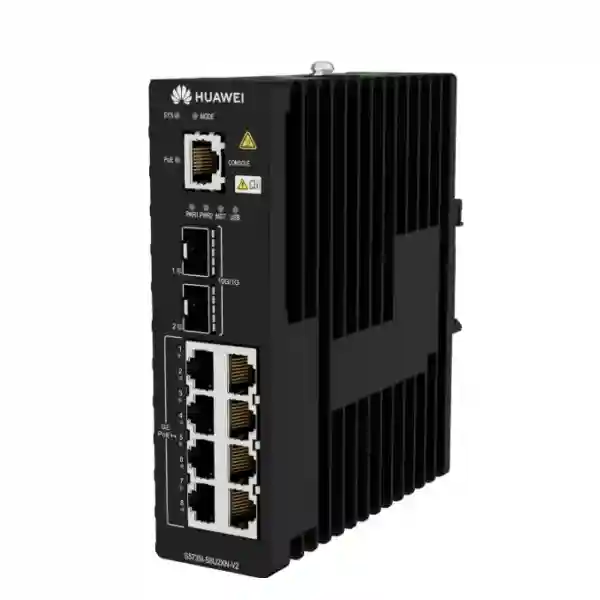
Huawei CloudEngine S5735I-S8U2XN-V2
A compact industrial Layer 3 access switch built for demanding edge networks, combining eight Gigabit Ethernet copper access ports with PoE++, two 10GE SFP+ uplinks, fanless thermal design, redundant power capability, and Huawei enterprise switching software for resilient connectivity in harsh operating environments.
Direct answer
For UAE projects that need a small DIN-rail switch capable of powering edge devices while maintaining 10-gigabit fiber uplinks, the S5735I-S8U2XN-V2 is designed for industrial cabinets rather than office wiring closets.
Its strongest fit is where environmental tolerance, fanless operation, high-power PoE, compact installation, Layer 3 routing, and fiber aggregation matter more than high copper-port density.
What the Huawei CloudEngine S5735I-S8U2XN-V2 is designed to do
The Huawei CloudEngine S5735I-S8U2XN-V2 is part of Huawei’s CloudEngine S5735I-S-V2 industrial switching family. The series is intended for edge and industrial Ethernet environments in which ordinary enterprise access switches may be constrained by cabinet space, heat, dust exposure, vibration-prone locations, unstable power conditions, or the need for DIN-rail mounting. In practical terms, this model bridges operational-technology-style physical environments with enterprise IP networking requirements. It can sit close to cameras, wireless access points, industrial terminals, building systems, roadside equipment, smart-city devices, or utility assets while still offering familiar campus networking features such as VLANs, routing protocols, authentication, quality of service, access control, telemetry, and fiber uplinks.
The model is particularly distinctive because it combines only eight copper access ports with two high-speed optical uplinks and PoE++. That port mix is useful when a project requires a compact field switch rather than a large rack-mounted access switch. An eight-port footprint can reduce unused port capacity at remote cabinets, while the 10GE SFP+ uplinks provide enough headroom to aggregate high-definition video, Wi-Fi traffic, industrial data, and management traffic back to a distribution layer. PoE++ support means the copper access side can serve not only basic IP phones or low-power sensors but also higher-power powered devices, subject to the selected power supply and the overall PoE budget.
For UAE deployments, the product should be evaluated as part of a complete cabinet and power design rather than as a standalone switch. Ambient temperature, cabinet ventilation, solar loading, optics selection, grounding, surge protection, PoE load, redundancy expectations, cable length, fiber type, and the upstream architecture all influence the final result. FourTeck can support that wider design process through the FourTeck UAE network infrastructure team, including model selection, optics planning, compatible power options, and integration with existing enterprise networks.
Core hardware specification for UAE projects
| Model | CloudEngine S5735I-S8U2XN-V2 |
| Copper access ports | 8 × 10/100/1000Base-T Ethernet ports |
| Uplink ports | 2 × 10GE SFP+ ports |
| PoE capability | PoE++ model; available budget depends on power configuration |
| Forwarding performance | 42 Mpps in Huawei’s international S5735I-S-V2 documentation |
| Switching capacity | 56 Gbps device switching capability / 520 Gbps system switching capability in the international datasheet |
| Cooling | Fanless, natural heat dissipation |
| Mounting style | DIN-rail industrial form factor |
| Power architecture | External DC or compatible AC power adapter with 1+1 power backup capability |
| Ingress protection | IP40 in Huawei’s international datasheet |
| Physical size | Approximately 150 × 44 × 133 mm according to the international datasheet table for this model |
Specification figures should always be checked against the exact regional datasheet, software release, power module, and optics selected for the final bill of materials. Huawei publishes some region- and revision-specific figures, so procurement documentation should reference the exact SKU and destination market.
Why the 8-port plus 2×10GE architecture matters
Industrial networks frequently grow in clusters rather than in neat office-floor increments. A roadside cabinet may serve six cameras and one wireless bridge. A warehouse zone may need four access points, two badge readers, one PLC gateway, and one maintenance terminal. A utility enclosure may aggregate a set of Ethernet-enabled devices and backhaul them over fiber to a control building. In those situations, a 24-port or 48-port switch can be physically excessive, power-inefficient, or difficult to mount, while a basic unmanaged DIN switch may not provide the routing, policy, observability, or uplink bandwidth required by enterprise standards. The S5735I-S8U2XN-V2 addresses that middle ground with a compact number of edge ports and two high-speed uplinks.
Two SFP+ ports are especially valuable in industrial designs because they can be used in several ways. One can provide the primary fiber path and the other a redundant path. Both can participate in an aggregated uplink when the architecture and peer device support it. One can connect upstream while the second extends the network to another cabinet. They can also be separated into different logical roles when segmentation or physical path diversity is required. The correct design depends on topology, redundancy protocol, optical distance, and whether the upstream equipment supports the intended configuration.
The access ports operate at 10/100/1000 Mbps, making them compatible with many installed field devices as well as modern Gigabit endpoints. This is useful during phased modernization projects where legacy edge devices coexist with newer cameras, APs, or controllers. Autonegotiation can simplify attachment, but fixed speed and duplex settings may still be needed with certain industrial devices. Engineers should inventory endpoint interfaces before deployment, particularly when connecting legacy automation equipment through media converters or protocol gateways.
PoE++ engineering: power is a design calculation, not just a feature label
Endpoint power classes
PoE++ support expands the range of devices that can be powered directly from the switch. Depending on the negotiated standard and available budget, the platform can serve conventional 802.3af devices, 802.3at PoE+ devices, and high-power 802.3bt endpoints. This matters for modern Wi-Fi access points with multiple radios, pan-tilt-zoom cameras with heaters or infrared illuminators, video endpoints, industrial gateways, and other powered devices whose consumption can exceed traditional PoE limits.
The endpoint’s maximum consumption should be used during planning, not only its typical value. Startup, heater activation, radio load, IR illumination, USB accessories, and environmental conditions may change draw. A design that works on a bench can fail in a hot outdoor cabinet at night when cameras activate illumination and multiple devices approach peak demand.
Power supply selection
Huawei’s international documentation lists compatible external power arrangements for this model and indicates 1+1 power backup capability. The selected supply determines the practical PoE budget. A common compatible Huawei 240 W class supply provides a finite budget that must cover the switch and attached powered devices. Redundancy configuration, DC architecture, environmental derating, and the number of high-power endpoints must therefore be included in the bill of materials.
For procurement, ask for the switch, required power modules, power cords or DC accessories, terminal hardware, SFP/SFP+ optics, patch leads, surge and grounding components, and any enclosure accessories as one engineered set. Treating the switch SKU as the entire solution can lead to missing items during installation.
Fast and perpetual PoE behavior
The S5735I-S-V2 family includes Fast PoE and Perpetual PoE capabilities. Fast PoE is intended to reduce the delay before attached powered devices receive power after a switch power event. Perpetual PoE is designed to maintain power to supported powered devices during certain switch restart or software-upgrade conditions. These functions can be valuable for surveillance and wireless infrastructure because they reduce endpoint disruption associated with network-device maintenance.
These capabilities should still be validated in the planned software version and configuration. Power continuity at the switch does not eliminate upstream outages, endpoint reboot behavior, or external power failures. For critical sites, the complete chain from UPS or DC plant through switch power, uplinks, core connectivity, controller availability, and application services should be tested.
UAE thermal considerations
PoE power becomes heat somewhere in the system. In the UAE, cabinets exposed to direct solar load can be much hotter than the surrounding air. A switch rated for industrial temperatures does not automatically make every optical module, power supply, patch lead, terminal block, and powered device suitable for the same conditions. Cabinet volume, color, orientation, ventilation, filters, shade, heat exchangers, and active airflow can all influence allowable load.
Huawei’s international datasheet distinguishes temperature limits according to cabinet ventilation and optics type. This is a useful reminder to engineer the enclosure rather than simply checking a headline temperature figure. For field cabinets in Dubai, Abu Dhabi, Sharjah, industrial zones, or remote infrastructure sites, thermal modelling and conservative design margins are preferable to operating continuously at component limits.
Industrial environmental design
Huawei positions the S5735I-S-V2 family for extended-temperature industrial applications. The international product page advertises operation across an industrial range reaching from –40°C to +75°C under appropriate conditions, while the detailed datasheet qualifies maximum temperatures according to enclosure airflow, altitude, and optical module type. That distinction is important. A temperature rating is not a single unconditional promise; it is the result of a thermal system that includes the switch, enclosure, air movement, optics, power supply, and installation method.
The fanless architecture removes a common mechanical wear item and avoids moving air through the switch chassis. This can be beneficial in dusty industrial locations and in cabinets where maintenance access is limited. It also makes the device acoustically unobtrusive. However, fanless operation relies on natural convection and correct orientation. The installer must preserve clearance around heat-dissipating surfaces and follow Huawei’s installation guidance. Packing cables tightly around the chassis or mounting heat-generating power devices against it can compromise thermal performance.
IP40 protection indicates resistance to ingress of solid objects above a defined size but does not make the switch weatherproof or waterproof. For outdoor UAE deployments, the device still belongs inside a suitable environmental enclosure with appropriate sealing, cable glands, condensation control, surge protection, grounding, and thermal management. It should not be treated as an exposed outdoor switch simply because it is industrial-grade.
Layer 2 switching functions for deterministic edge networks
At the data-link layer, an industrial access switch must do more than forward Ethernet frames. Segmentation is usually essential because cameras, wireless access points, building-management devices, corporate endpoints, maintenance terminals, and operational systems should not share one unrestricted broadcast domain. The CloudEngine platform supports enterprise VLAN mechanisms that allow a field cabinet to participate in a structured campus or industrial network design. Access ports can place endpoints into defined VLANs, while uplinks can transport multiple VLANs to the upstream distribution layer where routing, firewalling, or policy enforcement occurs.
Loop prevention and resiliency are equally important. Industrial sites often acquire accidental loops during maintenance when technicians patch spare ports together or when redundant physical links are added without a corresponding logical design. Spanning-tree mechanisms can help prevent broadcast storms, but the chosen protocol, root placement, link cost, convergence targets, and interaction with ring or redundancy designs should be established deliberately. A network serving cameras or control systems may have different tolerance for interruption than an ordinary user-access segment.
Link aggregation can be used when the upstream peer and topology support it, combining physical links into a logical bundle for additional bandwidth and resilience. With two 10GE SFP+ interfaces, an engineered aggregation can be attractive where a cabinet generates substantial traffic. Yet aggregation is not automatically the best choice. Physical path diversity, failure domains, upstream switch architecture, and the requirement for geographically separate fibers can make redundant independent uplinks preferable. The correct design is determined by service objectives rather than by the mere availability of two ports.
Multicast handling is also relevant because industrial and surveillance networks can carry one-to-many streams. Huawei documents IGMP snooping and Layer 3 multicast functions across the S5735I-S-V2 family. Proper multicast design prevents streams from flooding ports that do not need them and helps preserve bandwidth. Video distribution, public-address systems, digital signage, and certain operational applications can benefit from this control.
Layer 3 routing at the industrial edge
Huawei describes the S5735I-S-V2 family as Layer 3-capable and lists routing technologies including OSPF, IS-IS, BGP, and VRRP. This expands design choices beyond a simple Layer 2 access switch. A remote industrial zone can, when appropriate, terminate local subnets on the switch, route between infrastructure segments, form dynamic routing adjacencies with upstream nodes, or participate in a resilient first-hop design. Whether those functions should be used at the edge depends on operational practice, security architecture, software licensing, network scale, and the capabilities of the wider campus or industrial backbone.
OSPF is commonly useful inside enterprise or infrastructure networks that need automatic route exchange and path recalculation. IS-IS may be used in service-provider-style or large routed fabrics. BGP provides policy-rich route exchange and can be appropriate in more advanced designs. VRRP supports gateway redundancy when multiple Layer 3 devices cooperate to present a resilient virtual default gateway. The presence of these protocols does not mean every deployment should enable them. Small cabinet installations may be better served by keeping the switch at Layer 2 and centralizing routing at hardened distribution nodes.
Routed access can nevertheless reduce broadcast scope and failure propagation. It can make each cabinet or zone a defined Layer 3 boundary, which improves fault isolation and supports scalable addressing. For larger UAE projects involving campuses, transportation networks, utilities, logistics parks, and smart-city infrastructure, FourTeck can help map these choices into a hierarchical design. Where firewall policy, secure remote access, or segmentation gateways are also required, the Firewall Dubai practice can be incorporated into the architecture so that switching and security are designed as one system rather than separate purchases.
Security controls for field-connected devices
Identity and access policy
Huawei documents MAC address authentication and IEEE 802.1X authentication for the series, along with dynamic application of VLAN, QoS, and ACL policy. These mechanisms help distinguish authorized endpoints from unknown devices and can support policy-based admission rather than relying only on physical port location. Industrial environments require careful rollout because many cameras, controllers, and embedded devices do not support 802.1X supplicants. MAC-based methods or secured static configurations may be needed for those endpoints.
ACL-based segmentation
Access control lists can restrict traffic between device groups, management services, and upstream networks. This is useful when a camera should communicate only with recording servers, or when a building controller should reach a management platform but not user subnets. Switch ACLs are not a replacement for stateful firewalls where application-aware inspection or threat prevention is required, but they can provide an efficient first layer of network policy close to the device.
DoS and attack defense
Huawei’s product documentation lists mechanisms intended to mitigate denial-of-service and user-targeted attacks, including protections against common flood patterns. For exposed edge environments, these controls can reduce the impact of malformed or excessive traffic reaching the switching control plane. Security settings should be customized to the expected endpoint behavior because overly aggressive thresholds can disrupt legitimate bursts from cameras, multicast systems, or maintenance tools.
Management-plane hardening
A field switch should be managed from dedicated addresses or management segments, use authenticated administrative access, restrict source networks, synchronize time, and forward logs to centralized systems. Default credentials and broad management access should not remain in production. Configuration backup, role separation, SNMP security, AAA integration, and approved software versions should be part of commissioning documentation.
Telemetry, monitoring, and operations
Industrial networks are expensive to troubleshoot when equipment is distributed across warehouses, road corridors, utility sites, production areas, substations, campuses, or remote compounds. The S5735I-S-V2 family supports telemetry for real-time device data collection and can cooperate with Huawei management and analytics platforms such as iMaster NCE-CampusInsight, subject to software compatibility and solution design. Telemetry provides a richer operational model than periodic polling alone because it can stream selected performance and state information to collectors for analysis.
For practical operations, the most useful monitoring plan includes interface status, optical diagnostics where supported, error counters, bandwidth utilization, PoE state, endpoint power draw, temperature, CPU and memory health, spanning-tree changes, routing-neighbor status, authentication events, and power-supply alarms. Alarm thresholds should be set according to normal site behavior. A camera cabinet that continuously runs uplinks at 70 percent has a different baseline from a quiet utility enclosure where a sudden 10 Mbps increase may indicate an anomaly.
Configuration management matters just as much as telemetry. Before deployment, establish a naming convention, management addressing plan, NTP source, syslog destination, AAA method, VLAN numbering, interface descriptions, allowed trunk VLANs, security templates, PoE policies, and software baseline. After commissioning, export a validated configuration and keep it with the site documentation. When dozens or hundreds of field switches are deployed, standardized templates reduce troubleshooting time and make replacement far easier.
Operational support can be integrated with FourTeck IT Services UAE for structured deployment, configuration assistance, documentation, network audits, and managed support requirements. This is especially useful for organizations that want the hardware purchase aligned with installation and post-deployment operations.
10GE SFP+ uplink planning
The two SFP+ slots are a major reason to choose this model, but the optical layer requires precise engineering. SFP+ is a form factor, not a guarantee that every transceiver will operate in every environment. The optical module must match fiber type, wavelength, distance, connector type, link budget, temperature class, and Huawei compatibility requirements. A standard commercial-temperature optic inside a hot outdoor cabinet can become the weakest component in an otherwise industrial-grade system.
For short in-building links, multimode fiber with appropriate 10G optics may be efficient. For campus, road, utility, or inter-building runs, single-mode fiber often provides greater reach and planning flexibility. Existing fiber plant should be inspected for connector condition, attenuation, splices, patch-panel quality, and documented route. Bidirectional optics can conserve fiber strands in some scenarios, but they require matched wavelength pairs and strict inventory discipline. Conventional duplex optics are often operationally simpler where two strands are available.
Link budget should include more than the nominal distance. Connector loss, splice loss, patch leads, aging margin, contamination, and temperature effects all consume optical margin. A 10 km transceiver is not automatically appropriate for every link under 10 km; receiver overload on very short links, compatibility constraints, and power levels must be considered. Digital diagnostics from supported optics can help operations teams observe transmit and receive levels, temperature, and module health.
When redundancy is required, the two uplinks should ideally avoid the same physical failure path. Two fibers inside the same duct and terminating on the same upstream line card provide less resilience than links taking diverse paths to separate upstream switches. A resilient design therefore considers the complete route from the DIN cabinet through fiber plant, distribution switches, power sources, and core services.
Surge, grounding, and power resilience in UAE installations
Field Ethernet equipment is more exposed to electrical disturbances than equipment in controlled data rooms. Long copper cables, outdoor cameras, nearby motors, large inductive loads, building power disturbances, and lightning-related transients can introduce surge energy. Huawei’s industrial documentation specifies enhanced surge protection characteristics for the S5735I-S-V2 family, but correct grounding and external protection remain essential. Surge ratings do not eliminate the need for a site earthing design.
The cabinet should provide a reliable protective earth, and shields or surge devices should be bonded according to the electrical design. Copper Ethernet runs leaving a building or cabinet require particular attention. In many cases, fiber uplinks are preferred between buildings because they provide galvanic isolation in addition to bandwidth. Where outdoor copper is unavoidable, the project should use appropriately rated cabling and surge protection at the relevant boundaries.
Power resilience can be approached through the switch’s supported redundant supply architecture, an upstream UPS, a DC plant, or combinations of these. The objective should be explicit: survive a single power-module failure, survive a short utility outage, preserve PoE endpoints during maintenance, or keep critical services online for a defined battery runtime. Each objective produces a different bill of materials. Two power modules fed from the same unprotected socket improve module redundancy but do not provide source diversity.
For remote sites, include remote power monitoring when possible. Knowing that a switch is offline is less useful than knowing whether the cabinet lost mains power, a DC breaker opened, one power module failed, or the switch itself stopped forwarding. Integrating electrical alarms with network telemetry can shorten mean time to repair.
Thermal design for Dubai and UAE outdoor cabinets
UAE outdoor deployments demand more than reading the switch’s maximum operating temperature. Solar gain can raise internal cabinet temperatures significantly above ambient air, especially with dark enclosures in direct sunlight. PoE loads, power supplies, media converters, cellular routers, and other electronics add internal heat. Dust filters restrict airflow as they become loaded. An enclosure that performs adequately in winter commissioning can exceed limits during summer operation.
Start by defining the worst expected ambient temperature and solar exposure. Then calculate internal dissipation from the switch and associated components. Huawei lists approximately 18.3 W maximum device consumption without powered devices for this model in its international datasheet, with substantially higher system consumption when PoE loads are included. The attached powered devices consume energy largely outside the switch chassis, but the PoE conversion and power system still contribute to cabinet heat. Power supplies themselves have conversion losses that become heat inside or near the enclosure.
Next, choose the cabinet strategy: sealed passive enclosure, vented enclosure with filtered airflow, forced ventilation, heat exchanger, or actively cooled cabinet. Sealed cabinets reduce dust ingress but can trap heat. Vented cabinets improve convection but expose filters to dust loading. Forced-air systems expand thermal capability but add fan maintenance. Active cooling provides greater control but increases power, cost, and service complexity. Huawei’s datasheet explicitly gives different allowable maximum temperatures for sealed, vented, and blower-equipped conditions, reinforcing the need to engineer this trade-off.
Optics must be included in the temperature plan. Industrial-grade optical modules may be required when cabinets operate beyond the range of ordinary transceivers. The same applies to patch cords, DC terminal components, surge protectors, batteries, and other accessories. A robust UAE design treats the cabinet as one thermal system and selects every component for the same environmental envelope.
Deployment scenario 1: IP surveillance and perimeter security
Surveillance is a natural fit for an eight-port PoE++ industrial switch. A remote perimeter cabinet can power fixed cameras, PTZ cameras, multisensor cameras, or wireless bridges while aggregating video over 10GE fiber. The high-speed uplink is valuable because modern cameras can generate substantial sustained traffic, particularly at high resolution and frame rate. More importantly, video networks are sensitive to packet loss and prolonged link interruption, so redundant uplinks and controlled multicast or QoS behavior may be required in larger systems.
PoE budgeting should account for camera heaters, wipers, IR illuminators, edge analytics modules, and peak draw. A PTZ camera that normally uses 20 W may require considerably more when multiple functions operate simultaneously. Engineers should sum each camera’s maximum power class and leave margin. If the design approaches the available power budget, either choose a higher-capacity power arrangement, distribute cameras across additional switches, or lower endpoint power requirements.
Security architecture is also important. Cameras should normally be isolated from user networks, with management limited to authorized systems. VLANs, ACLs, authenticated administration, logging, and upstream firewall policy can create that separation. The result is a surveillance network that uses the industrial switch as both a power distribution point and a controlled Ethernet edge.
Deployment scenario 2: Wi-Fi access in warehouses, yards, and industrial campuses
Modern Wi-Fi access points can require PoE+ or PoE++ depending on radio configuration, USB accessories, IoT functions, and feature set. Placing a compact industrial switch near a warehouse zone, loading yard, or outdoor coverage area can reduce copper cable distance and centralize fiber backhaul. The S5735I-S8U2XN-V2 can then power local APs and return traffic over 10GE to the distribution network.
This architecture can be more scalable than running many long copper cables from a distant communications room. Fiber reaches the industrial cabinet, and shorter local copper runs connect APs. The design is especially attractive across large logistics facilities where AP clusters are physically far apart. The two SFP+ ports can support resilient fiber paths or a chained architecture, though chaining should be used cautiously because a failure upstream can isolate multiple downstream zones.
Wireless projects also benefit from telemetry and VLAN segmentation. AP management, corporate SSIDs, guest traffic, voice, scanners, and IoT devices may traverse distinct VLANs. QoS policy can preserve latency-sensitive traffic, while the upstream architecture handles controller or cloud connectivity. Power continuity features can reduce AP downtime during certain switch maintenance events.
Deployment scenario 3: smart building, BMS, and IoT aggregation
Smart buildings increasingly place IP connectivity near mechanical rooms, plant spaces, parking areas, rooftops, and equipment enclosures. These locations can be hotter and dustier than office telecom rooms. A DIN-rail switch integrates naturally with control panels and can aggregate IP-enabled sensors, gateways, controllers, intercoms, cameras, and wireless infrastructure while preserving centralized fiber connectivity.
The network should separate operational systems from general user traffic. Building-management devices often have long service lives and may not support modern endpoint authentication. Segmentation through dedicated VLANs and ACLs, combined with upstream firewall policy, can reduce exposure. Management interfaces should be reachable only from authorized administration networks. Logs and telemetry should be integrated into the organization’s monitoring process so network faults are visible before they become building-system incidents.
Because smart-building systems may remain in service for a decade or longer, documentation is critical. Label every field cable, record switch port assignments, document VLANs and IP addresses, store configuration backups, and maintain an asset list that includes optics and power modules. A future maintenance technician should be able to identify the role of the cabinet without reverse-engineering it on site.
Deployment scenario 4: transportation, roadside, and smart-city infrastructure
Roadside and transportation networks place unique stress on Ethernet infrastructure. Cabinets can experience wide temperature variation, vibration, dust, electrical transients, and limited maintenance access. Network devices may connect cameras, radar, variable-message signs, access-control points, wireless links, emergency communications, or telemetry equipment. The industrial construction and DIN-rail mounting of the S5735I-S8U2XN-V2 make it more appropriate for these locations than standard office switches.
Fiber redundancy should be designed around physical route diversity. In a linear road corridor, it may be possible to construct ring or dual-direction backhaul so that a single fiber cut does not isolate every downstream cabinet. Routing and resiliency protocols need to be selected with convergence time and operational complexity in mind. The switch’s Layer 3 capabilities can support routed designs, while Layer 2 approaches may be simpler for smaller projects.
Remote monitoring is essential because dispatching technicians to roadside assets is expensive and sometimes requires permits or traffic management. Interface alarms, optical levels, power state, temperature, PoE status, and configuration-change logs should be centralized. Spare switches and optics should be held according to the installed population and service-level targets.
Deployment scenario 5: utilities, energy, and industrial plants
Utilities and industrial plants often divide networks into operational zones with strict availability and change-control requirements. A compact Layer 3 industrial switch can provide local Ethernet connectivity for monitoring equipment, IP cameras, access systems, industrial PCs, gateways, and maintenance devices while connecting back to higher-level control or security networks over fiber. The device’s fanless design and environmental tolerance reduce dependence on controlled room conditions.
Network architecture in operational environments should follow the organization’s approved security model. VLAN separation alone is not sufficient for high-consequence zones. Firewalls, controlled conduits, jump hosts, authenticated administration, logging, and documented access procedures may be required. The switch contributes segmentation and access control but must fit into the broader cybersecurity architecture.
Change management is particularly important. Software upgrades, routing changes, or authentication policy modifications should be tested on representative equipment before production rollout. Perpetual PoE can help maintain power to certain endpoints during supported maintenance conditions, but the network path itself may still be interrupted. Critical services require end-to-end failover testing rather than assumptions based on individual features.
Sizing methodology: deciding whether eight access ports are enough
Port count should be based on a five-part calculation: currently connected endpoints, near-term additions, maintenance needs, redundancy strategy, and spare capacity. An enclosure with seven planned devices technically fits an eight-port switch, but that leaves no room for a technician’s laptop, temporary camera, replacement device during migration, or growth. In many projects, keeping at least one or two spare copper ports improves operational flexibility. If the cabinet is expected to grow, a higher-density model from the same industrial family may be more appropriate.
Bandwidth sizing is separate from port count. Estimate the normal and peak traffic of each endpoint, then consider simultaneous operation. Eight cameras at 12 Mbps each generate less than 100 Mbps of video, far below a 10GE uplink. Eight high-performance wireless APs can generate much more, especially under aggregate client load. Industrial systems may have low average traffic but stringent latency or convergence requirements. The goal is not merely avoiding saturation but preserving predictable performance during busy periods and failures.
Power sizing is a third independent dimension. Eight ports do not imply that all eight can deliver the maximum PoE++ wattage simultaneously. The external power configuration sets the budget. Sum endpoint maximum draw, include reserve, and ensure the switch plus powered-device requirement fits the selected supply arrangement. Where every port could host a high-power device, power may become the limiting factor long before Ethernet bandwidth.
Finally, consider uplink resilience. If two 10GE ports are required for redundant upstream connections, neither is available for a local fiber endpoint. If one SFP+ port is reserved for downstream extension, only one remains for upstream connectivity. Port-role planning should be completed before purchase.
How this model compares within the S5735I-S-V2 family
Huawei offers several related S5735I-S-V2 models with different copper, fiber, and PoE combinations. The S5735I-S8U2XN-V2 is optimized for compact PoE++ access with two 10GE uplinks. Other family members provide four 10GE uplinks, non-PoE copper access, more total copper ports, GE SFP interfaces, or combinations intended for higher port density. Choosing within the family is therefore a question of access-port count, PoE requirement, uplink count, power architecture, and cabinet space.
| Design requirement | S5735I-S8U2XN-V2 fit | When to consider another model |
|---|---|---|
| Eight or fewer powered copper endpoints | Strong fit | Choose higher density if growth will exceed eight copper ports. |
| High-power PoE devices | PoE++ supported | Validate total power budget and endpoint classes. |
| Two 10GE fiber uplinks | Native fit | Choose a four-uplink model if additional 10GE interfaces are required. |
| No PoE requirement | Technically possible but unnecessary PoE capability | A non-PoE family variant may be more cost-efficient. |
Software feature validation and licensing
Enterprise switch feature availability can depend on software release, feature package, license model, controller integration, and regional ordering structure. A data sheet may list a capability at family level while a particular project requires a specific software version or subscription to use advanced management or analytics. Procurement should therefore define required functions before requesting the final quote rather than assuming every feature is active by default.
For example, a project that needs dynamic routing should specify exactly which protocols and scale are required. A project that needs centralized campus management should identify the Huawei management platform and desired lifecycle functions. A project relying on telemetry analytics should confirm collector compatibility. Authentication projects should confirm AAA servers, certificate requirements, endpoint support, and fallback behavior. These details affect configuration and sometimes commercial licensing.
FourTeck can prepare a bill of materials around the intended function rather than simply the chassis SKU. That approach reduces the risk of discovering after installation that a required optic, power component, software entitlement, management integration, or accessory was omitted.
Installation and commissioning checklist
1. Mechanical
Confirm DIN-rail type, switch orientation, cabinet clearance, cable bend radius, ventilation path, door clearance, terminal access, grounding point, and separation from high-voltage conductors. Secure the switch so vibration or cable pull cannot loosen it.
2. Power
Verify supply voltage, polarity, fuse or breaker sizing, redundant feed design, UPS/DC source, protective earth, power-module compatibility, PoE budget, and endpoint maximum draw. Label feeds clearly for maintenance.
3. Fiber
Validate optic model, wavelength, fiber type, connector, link distance, optical budget, temperature rating, and receive levels. Clean all connectors before insertion and record final optical readings.
4. Copper
Certify structured cabling where applicable, keep Ethernet within supported distance, use suitable outdoor or industrial cable types, check shield and grounding strategy, and confirm each powered device negotiates expected PoE.
5. Configuration
Load approved software, harden management, configure VLANs, trunks, routing, QoS, authentication, ACLs, logging, NTP, telemetry, interface descriptions, PoE policy, and redundancy features according to the design standard.
6. Acceptance
Test every port, PoE behavior, uplink failover, routing adjacency, management reachability, alarms, logging, endpoint application traffic, and power-loss scenarios. Save the final configuration and update as-built documentation.
Network segmentation example for an eight-port cabinet
Consider a logistics-yard cabinet serving four security cameras, two Wi-Fi access points, one access-control controller, and one spare maintenance port. The switch can place cameras into a surveillance VLAN, AP management into an infrastructure VLAN, wireless client traffic onto tagged VLANs, the access controller into a physical-security VLAN, and the maintenance port into a restricted engineering VLAN. The SFP+ uplinks carry the required VLANs to redundant distribution switches.
At the upstream layer, routing and firewall policy determine which systems can communicate. Camera endpoints may reach only recording and management servers. The access-control controller may reach its application server and NTP. AP management may reach the wireless controller or cloud gateway. The maintenance VLAN may require authenticated access and be disabled when not in use. This approach limits lateral movement and keeps broadcast traffic scoped to the intended service.
If the switch performs local Layer 3 routing, ACLs can control selected flows directly at the cabinet. For higher-security designs, critical inter-zone traffic should still traverse a stateful firewall or security gateway. The important point is that the industrial switch provides enough enterprise networking functionality to fit into a segmented architecture rather than forcing every field device into a single flat subnet.
Quality of service for voice, video, and control traffic
Industrial edge networks often mix traffic with very different behavior. Video streams consume steady bandwidth, voice is sensitive to delay and jitter, control or telemetry packets may be small but time-sensitive, and software updates can create large bursts. Quality of service should therefore reflect business and operational priorities rather than treating all packets equally.
The first step is classification. Traffic can be identified by VLAN, interface, protocol markings, or policy. The network then assigns queues and scheduling behavior appropriate to each class. QoS cannot create bandwidth that does not exist, but it can protect critical flows during congestion. For example, a bulk camera firmware transfer should not cause control traffic or voice signaling to experience excessive delay.
QoS policy must be consistent end to end. Marking traffic on an access switch is ineffective if upstream devices discard or reinterpret the markings. During acceptance testing, generate representative load and verify that latency-sensitive applications continue to perform when uplinks are busy. This is more meaningful than verifying configuration syntax alone.
Reliability planning beyond the switch
A highly reliable switch does not make a network highly reliable unless the surrounding design removes common single points of failure. Start with power. If the application is critical, use independent protected feeds where possible and verify that both supplies do not depend on the same breaker or UPS. Next consider uplinks. Two SFP+ interfaces can provide path redundancy only when fibers and upstream switches are also independent.
Then consider services. If both physical paths lead to one distribution switch, that switch remains a failure point. If routing depends on one DHCP relay, DNS server, controller, recorder, or firewall, the service can still fail even while the network link remains up. Availability planning should map every dependency from the powered endpoint to the application.
Spares and replacement procedures are another reliability tool. For distributed UAE sites, keep a tested spare with compatible software, configuration template, power accessories, and optics. Record the exact cabling and port map so field staff can replace hardware without re-engineering the cabinet. If a replacement switch requires hours of remote coordination, the hardware’s intrinsic reliability has limited operational value.
Finally, test failure scenarios. Disconnect one uplink, remove one power source, reboot the switch under controlled conditions, and verify endpoint recovery. Confirm monitoring generates actionable alarms. Resilience that has never been tested should be treated as a design assumption, not a proven capability.
Procurement guidance for UAE buyers
When requesting a quotation for the Huawei CloudEngine S5735I-S8U2XN-V2, provide the deployment context rather than only the model number. State the number and type of PoE devices, each device’s maximum power requirement, fiber distance, fiber type, number of redundant uplinks, cabinet environment, power source, management platform, required software functions, and desired support term. These details allow the supplier to quote a complete configuration.
Ask the quote to identify the switch chassis, power supplies or adapters, any redundant power components, optical transceivers, fiber patch leads if required, mounting or terminal accessories, software or licenses, support services, and delivery terms. If the project uses an outdoor enclosure, confirm whether the enclosure and environmental controls are part of the scope or supplied separately. If installation is included, define whether structured cabling, fiber termination, testing, labeling, configuration, and as-built documentation are included.
Warranty and support should match the operational importance of the site. A noncritical warehouse zone may tolerate next-business-day replacement, while transportation or utility sites may require local spares and faster response. Software access, entitlement registration, and serial-number tracking should be completed during handover rather than left until the first incident.
For projects that extend beyond the UAE, procurement can be coordinated with FourTeck’s wider regional capabilities, while the UAE scope remains anchored through the local team. The immediate objective is consistent part selection and documented configuration so each site receives the same engineered solution.
Common design mistakes to avoid
Assuming eight PoE++ ports means eight maximum-power loads
The total PoE budget is determined by the power configuration. Calculate actual endpoint power classes and maximum simultaneous demand.
Using commercial optics in extreme cabinets
The switch can tolerate industrial conditions only when the optics and surrounding components are also suitable for the actual temperature range.
Treating IP40 as outdoor waterproofing
The switch still requires a correctly rated enclosure for outdoor exposure, dust control, moisture management, and cable entry.
Creating redundant links without path diversity
Two uplinks in the same duct to the same upstream device may not meet the intended resilience objective.
Ignoring cabinet heat from the whole system
Power modules, PoE conversion, radios, cellular routers, and other electronics all contribute to internal temperature.
Buying hardware before defining software functions
Routing, controller integration, analytics, authentication, and management requirements should be confirmed before the final commercial order.
Engineering note on published performance figures
Huawei publishes different performance figures for this model in different regional or revision-specific materials. For the UAE-oriented configuration described here, FourTeck uses the international S5735I-S-V2 documentation that lists 42 Mpps forwarding performance and 56 Gbps device switching capability with 520 Gbps system switching capability for the S5735I-S8U2XN-V2. Some newer or mainland-China materials show higher system-level figures. This difference is why the exact regional data sheet and ordering code should be attached to project documentation.
Performance should also be interpreted in context. An eight-port Gigabit access switch with two 10GE uplinks is normally deployed for edge aggregation rather than as a large-core packet-processing platform. In most intended deployments, endpoint bandwidth, PoE budget, uplink topology, environmental constraints, and resilience design are more likely to determine the engineering outcome than the headline switching-capacity number.
Lifecycle and maintenance strategy
Industrial Ethernet equipment often remains deployed longer than ordinary office access hardware because replacing field devices can require site access, operational permits, safety coordination, traffic management, or production downtime. A lifecycle plan should therefore be created when the switch is installed, not when it begins to age. Record purchase date, serial number, support entitlement, software release, configuration version, optics, power modules, cabinet location, and the upstream ports to which it connects.
Software maintenance should follow a controlled cadence. Track vendor advisories and supported releases, evaluate security fixes, test upgrades on representative hardware, and maintain rollback procedures. Before any upgrade, back up the configuration and verify remote-console or local-access options. If the switch powers critical endpoints, understand how Fast PoE and Perpetual PoE behave in the exact software version and maintenance scenario.
Physical maintenance should include cabinet inspection, cleaning or replacement of filters, checking door seals, verifying grounding, inspecting cable glands, reviewing optical levels, checking terminal tightness where permitted, and looking for evidence of heat stress or condensation. Fanless switching reduces one maintenance item, but it does not remove the need to maintain the enclosure.
At scale, standardization is the most effective maintenance tool. Use a small number of approved switch models, optics, power supplies, and cabinet designs. Maintain preconfigured spares. Standardize labels, interface descriptions, management addresses, and monitoring templates. This lowers training requirements and makes field replacement faster.
Who should choose the S5735I-S8U2XN-V2?
This model is well aligned with organizations that need enterprise switching features in a compact industrial format. Typical buyers include system integrators building surveillance or smart-city networks, logistics operators expanding warehouse Wi-Fi, utilities deploying field cabinets, manufacturers connecting industrial zones, property groups integrating smart-building systems, transportation operators connecting roadside assets, and enterprises that need hardened network access outside conventional telecom rooms.
It is especially attractive where there are eight or fewer powered copper endpoints, where one or two 10GE fiber uplinks are required, and where the cabinet may experience temperatures or operating conditions beyond those of an office network closet. It is less suitable when a site requires many more copper ports, when no PoE is needed and cost optimization favors a non-PoE model, or when more than two high-speed uplinks are necessary.
The buying decision should therefore follow the topology. Count endpoints, map their power needs, define uplink architecture, verify cabinet conditions, choose optics, and confirm software requirements. If those inputs match the product’s strengths, the S5735I-S8U2XN-V2 provides a compact industrial access layer with substantial enterprise capability.
Frequently asked technical questions
Does the S5735I-S8U2XN-V2 support PoE++?
Yes. Huawei’s international S5735I-S-V2 documentation identifies the S8U2XN-V2 as a PoE++ model. The available total power budget depends on the external power configuration, so the number of simultaneous high-power endpoints must be calculated.
How many 10GE uplinks are available?
The model has two 10GE SFP+ uplink ports. They can be used for primary and secondary uplinks, aggregation, or other supported topology roles.
Is the switch fanless?
Yes. Huawei specifies natural heat dissipation with no fan modules for this model. Correct mounting clearance and enclosure thermal design remain necessary.
Can it be installed outdoors?
It is an industrial switch suitable for harsh-environment cabinets, but it should be installed inside an appropriately rated enclosure. IP40 is not a waterproof outdoor rating.
Does it support Layer 3 routing?
Huawei documents Layer 3 capabilities for the series, including OSPF, IS-IS, BGP, and VRRP. Exact feature availability should be validated for the chosen software release and commercial package.
What temperature can it operate at?
Huawei markets the series for an industrial range extending from –40°C to +75°C, but the detailed datasheet ties upper limits to enclosure ventilation, altitude, and optical-module type. The final cabinet must be engineered against the detailed conditions.
Can both power inputs improve availability?
The model supports a 1+1 power backup architecture with suitable power components. True power resilience also depends on whether those inputs are fed from independent protected sources.
What optics should be ordered?
Optics depend on fiber type, distance, wavelength, temperature range, and Huawei compatibility. Industrial-temperature optics may be necessary for hot field cabinets. The transceiver should be chosen only after the optical path is known.
UAE project integration approach
A successful industrial-switch deployment normally touches multiple disciplines: network design, cybersecurity, low-voltage cabling, electrical power, environmental control, civil or cabinet work, monitoring, and operational support. FourTeck’s role can span from supply-only procurement to a wider engineered solution depending on project scope. The most efficient process is to begin with site counts and requirements, produce a standard cabinet and network design, validate it in a pilot, then roll out the approved design repeatedly.
For multi-site UAE projects, standardization reduces both capital and operating cost. A single approved template can define the switch model, optics, power, cabinet, VLANs, routing, security controls, telemetry, labels, and acceptance tests. Site-specific differences are then limited to addresses, fiber distance, endpoint count, and physical layout. This prevents every location from becoming a custom network.
Where existing infrastructure must be assessed before replacement, an audit can document current switch models, copper and fiber interfaces, endpoint power draw, uplink utilization, IP addressing, VLANs, routes, and software. That information makes it possible to decide whether the S5735I-S8U2XN-V2 can replace the installed device directly or whether the project requires changes to power, optics, or topology.
Decision recap: when this Huawei industrial switch fits
Strong technical fit
Choose this model when the site needs up to eight Gigabit copper endpoints, PoE++ for powered devices, two 10GE fiber uplinks, DIN-rail mounting, fanless operation, Layer 3 features, and industrial environmental tolerance.
Validate before ordering
Confirm total PoE budget, exact power modules, optic type, software feature requirements, environmental cabinet design, uplink topology, support term, and regional ordering code.
Consider another model
Use a different family member if the site needs more than eight copper ports, more than two 10GE uplinks, no PoE, or a substantially different mix of copper and fiber interfaces.
UAE deployment focus
Engineer the enclosure around summer heat, solar gain, dust, optics temperature, PoE load, surge protection, grounding, and service access. The environmental design is as important as the switch specification.
Quotation input checklist
Provide the following information with your RFQ so the quotation can include the correct switch, power, optics, and services rather than a bare chassis.
Number of cabinets, Emirate/location, indoor or outdoor placement, and required delivery schedule.
Device type, quantity, Ethernet speed, maximum PoE wattage, and whether any devices require 60 W or 90 W class power.
Single-mode or multimode fiber, link distance, strand availability, connector type, redundancy requirements, and upstream switch model.
AC or DC source, voltage, UPS availability, dual-feed requirement, desired PoE budget, and cabinet electrical protection.
VLANs, Layer 3 routing, redundancy, QoS, 802.1X, AAA, ACLs, multicast, telemetry, and centralized management requirements.
Supply only, staging, configuration, installation, fiber testing, commissioning, as-built documentation, training, and support expectations.
Plan a complete Huawei industrial switching solution for the UAE
The S5735I-S8U2XN-V2 is most effective when the switch, PoE power, optics, cabinet environment, redundancy, security policy, and operations model are engineered together. FourTeck can help translate endpoint counts and site conditions into a bill of materials and deployment design suitable for Dubai and wider UAE infrastructure projects.
Share your site count, powered-device list, fiber distance, cabinet conditions, preferred redundancy, and software requirements. The response can then identify the appropriate switch quantity, power modules, optics, accessories, configuration scope, and support options without over- or under-sizing the field network.
Before you request a final quote
• Confirm endpoint maximum PoE draw.
• Confirm fiber type and distance.
• Confirm cabinet temperature strategy.
• Confirm primary and backup power sources.
• Confirm routing, security, and management requirements.

Reviews
There are no reviews yet.