
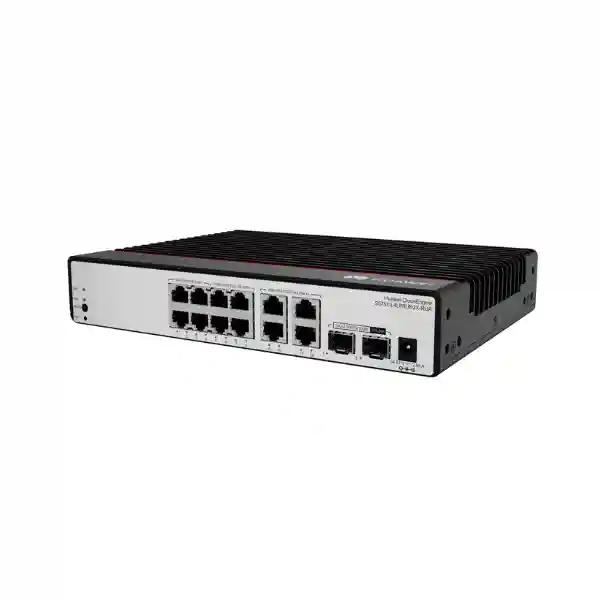
Huawei CloudEngine S5751-L16LP4UN2X-RUA
The Huawei CloudEngine S5751-L16LP4UN2X-RUA is designed for simplified campus access where a central Huawei campus switch extends connectivity to a compact remote unit closer to users and powered endpoints. The model combines 16 Gigabit Ethernet PoE+ downlinks, four 2.5GE-capable PoE++ downlinks and two optical SFP+ uplinks that support up to 10GE. That port mix makes it relevant when a floor, classroom block, hotel zone, clinic area, branch workspace or distributed office needs conventional Gigabit endpoints alongside higher-bandwidth Wi-Fi access points, cameras or other devices that can benefit from multi-gigabit access and higher PoE capability.
What it is
A Huawei CloudEngine S5751-L series remote unit intended to work with compatible Huawei campus central switches in a simplified network architecture.
Why buyers shortlist it
It places Gigabit PoE+, multi-gigabit PoE++ and 10GE-capable optical uplinks into a compact access device for endpoint-heavy areas.
What to confirm first
Confirm the proposed central switch, software release, optics, fiber path, PoE power budget, endpoint power needs and installation method before ordering.
Direct answer: who should consider the Huawei CloudEngine S5751-L16LP4UN2X-RUA?
This model is most relevant to organizations already designing, standardizing or expanding a Huawei campus network and wanting a remote access unit with a mixed Gigabit and 2.5GE PoE edge. Rather than treating it as an isolated unmanaged access switch, buyers should evaluate it as part of Huawei’s simplified campus architecture. In that design, remote units extend access ports from compatible central switches, allowing network teams to reduce the number of independently managed access devices and bring copper ports closer to endpoints. The architectural fit matters as much as the port count.
A strong use case is a building or site with many standard Gigabit endpoints plus a smaller number of higher-bandwidth powered devices. The 16 GE PoE+ ports can serve devices such as IP phones, conventional wireless access points and cameras where the endpoint’s negotiated power and data requirements match the design. The four 2.5GE PoE++ ports can be reserved for endpoints that need more than 1 Gbps or higher PoE capability, including suitable modern Wi-Fi access points. Two SFP+ uplinks provide optical connectivity at supported rates up to 10GE. For a correct bill of materials, FourTeck recommends validating the central-switch model and version, uplink optics, fiber type, required distances, endpoint PoE classes and the selected power adapter arrangement before commercial confirmation.
Verified Huawei specifications
| Item | Huawei CloudEngine S5751-L16LP4UN2X-RUA | Buying relevance |
|---|---|---|
| Downlink ports | 16 × 10/100/1000 Base-T PoE+ plus 4 × 10/100/1000/2.5G Base-T PoE++ | Supports a mixed edge of standard Gigabit and higher-rate powered endpoints. |
| Uplink ports | 2 × 100M/1/2.5/10GE SFP+ | Allows optical uplink design across multiple supported speeds, subject to optics and central-switch compatibility. |
| Forwarding performance | 69 Mpps | Use Huawei’s current published figure rather than conflicting marketplace listings. |
| Switching capacity | 98 Gbps | Relevant when checking the device against expected aggregate edge traffic. |
| Power supply type | Power adapter | Power planning should include the correct adapter and endpoint PoE load. |
| Physical size | 43.6 × 250 × 180 mm (H × W × D), as published by Huawei | Useful when planning desktop or wall placement and service access around cabling. |
Specification note: final compatibility, supported features and behavior depend on the wider Huawei network design and software combination. Confirm the exact central switch, release, optics, cabling and power design for the project before purchase.
PoE planning
Do not size the project only by counting powered ports. Record each endpoint model, expected PoE standard, maximum power draw and whether critical devices must remain powered during network maintenance. Separate ordinary PoE+ endpoints from the devices intended for the four PoE++ multi-gigabit ports.
Optics and fiber
The two SFP+ uplinks can support several link rates, but a working design still requires compatible transceivers, matching fiber type, acceptable optical budget and a supported peer port at the central switch. Include optics in the bill of materials rather than assuming they are bundled.
Central-switch fit
Huawei positions the S5751-L family around a central-switch and remote-unit architecture. Confirm the intended Huawei S5700, S6700 or other supported central platform and required software release before approving quantities for a multi-site rollout.
Architecture and deployment considerations
Huawei describes the S5751-L remote unit concept as part of a simplified campus architecture in which access switching can be organized around central switches and remote units. For a buyer, the practical advantage is not merely fewer configuration screens. The design can change where network intelligence sits, how access ports are expanded and how floor or zone connectivity is cabled. That means procurement should start with a topology, not a model number. Identify the central switching layer, the number of remote units per area, fiber paths, uplink redundancy expectations, access-port demand, PoE load, VLAN and security policy requirements, and the operational process for replacing a remote unit.
The mixed port profile is particularly useful where a site is moving toward Wi-Fi 6 or Wi-Fi 7 access points while retaining many Gigabit endpoints. Multi-gigabit copper can prevent a 1 Gbps access link from becoming an unnecessary bottleneck for capable wireless devices, while PoE++ can support endpoints whose power requirements exceed conventional PoE+. At the same time, not every endpoint needs 2.5GE or PoE++. A well-designed deployment maps higher-value ports to devices that can actually use them and reserves standard GE PoE+ for phones, cameras and other ordinary edge devices.
For network security, remember that an access switch does not replace the firewall. The switch handles campus access and segmentation functions within the supported architecture, while a perimeter or internal firewall can enforce security policies between network zones, the internet, branches or sensitive services. Buyers planning a broader infrastructure refresh can review FourTeck’s perimeter firewall planning guidance and firewall deployment service guidance so switching, VLAN, gateway and security changes are coordinated rather than treated as unrelated purchases.
Buyer checklist before requesting a Huawei S5751-L16LP4UN2X-RUA quote
State the exact Huawei central-switch model and current or planned software release. This is the most important compatibility input.
List phones, cameras, APs, PCs, printers and specialist devices by area so port quantity and port type can be checked.
Provide endpoint models or their PoE class and maximum draw, especially for devices intended for PoE++ ports.
Confirm fiber type, estimated distance, available cores and the required uplink speed so suitable optics can be proposed.
Share the intended location, mounting preference, ventilation conditions, nearby power and cable-entry constraints.
State quantity, destination, required optics, adapters, implementation assistance, documentation and support expectations.
Huawei CloudEngine S5751-L16LP4UN2X-RUA Dubai
For Dubai organizations searching for the Huawei CloudEngine S5751-L16LP4UN2X-RUA, the most useful buying question is not simply whether a 20-downlink-port PoE switch will fit the project. The model belongs to Huawei’s remote-unit approach for simplified campus networks, so the Dubai design should be reviewed around central-switch compatibility, access-point density, floor distribution, optical uplinks and the practical location of powered edge devices. This matters in offices, hotels, schools, clinics, mixed-use buildings, retail spaces and operational sites where network outlets may be spread across several rooms or zones and where conventional access switches can become awkward to place or manage.
A Dubai deployment may have a combination of standard Gigabit endpoints and newer wireless access points. The S5751-L16LP4UN2X-RUA provides 16 Gigabit PoE+ ports and four 2.5GE PoE++ ports, allowing designers to keep ordinary devices on Gigabit while reserving multi-gigabit capacity for endpoints that can use it. Two SFP+ uplinks support optical connectivity up to 10GE. Before ordering, record the AP models, cameras, phones and other PoE devices, then map their data and power requirements to specific ports. This avoids using higher-value ports for devices that do not need them and reduces the risk of discovering a PoE mismatch after installation.
Dubai procurement teams should also ask for a complete bill of materials. The switch itself is only one component. A working design can require the appropriate power adapter, supported optical transceivers, fiber patch leads, copper patching, mounting provisions and compatible central switching. If the campus refresh also changes VLAN gateways, internet security or branch connectivity, coordinate the work with the firewall plan. FourTeck’s Dubai network-security service overview explains the wider support approach, while the main FourTeck UAE technology site provides a broader route for business infrastructure enquiries.
For quotation accuracy in Dubai, include the site type, proposed central switch, software release if known, number of remote units, endpoint count, PoE requirements, desired uplink rate, fiber type and approximate runs. Also identify whether the project is a new build, an expansion or a migration from conventional standalone access switches. FourTeck can then structure the commercial discussion around the required components and deployment scope rather than treating the S5751-L16LP4UN2X-RUA as a standalone box. Availability, delivery timing and warranty handling should be confirmed in the formal quotation for the requested quantity and destination.
Huawei CloudEngine S5751-L16LP4UN2X-RUA UAE
Across the UAE, organizations evaluating the Huawei CloudEngine S5751-L16LP4UN2X-RUA often need consistency across more than one site. A head office in Dubai, a branch in Abu Dhabi, a warehouse in Sharjah or an operational site in another emirate can have different endpoint densities and cabling conditions even when the network standard is the same. The remote-unit architecture is therefore best evaluated as a repeatable design pattern: define the compatible Huawei central switching layer, decide where remote units sit, determine which endpoints require Gigabit PoE+ versus 2.5GE PoE++, and standardize the optics and fiber approach wherever possible.
The port mix of this model gives UAE network teams room to combine mature endpoint types with newer wireless infrastructure. Sixteen 10/100/1000 Base-T PoE+ ports can serve standard access needs, while four 2.5GE Base-T PoE++ ports can be targeted at suitable high-performance access points or other powered endpoints. The two SFP+ uplinks support up to 10GE. The design should still be based on actual traffic, not headline speeds. A site dominated by low-bandwidth phones and cameras has different needs from a collaboration-heavy office with high-density Wi-Fi, large cloud transfers and many concurrent users.
For UAE procurement, ask whether the quotation includes the exact power arrangement, optical modules and any installation accessories. Confirm software interoperability between the central switch and remote units and document the intended uplink topology. If the project also includes internet-edge security, site-to-site VPN or segmentation between business systems, the switching design should be reviewed alongside the firewall design. FourTeck’s compact branch firewall example and small-site firewall example illustrate how edge-security appliances address a different layer of the network than the Huawei access remote unit.
A useful UAE quote request should include the number of sites, quantities per site, central-switch model, expected endpoint types, PoE device models, fiber distance, required uplink speed and whether configuration or deployment support is part of the project. This information helps prevent a common procurement mistake: purchasing a switch because the raw port count looks correct but discovering later that optics, power, architecture or software assumptions do not match the intended rollout. Commercial availability, lead time and project services should be confirmed for the final approved bill of materials.
Huawei CloudEngine S5751-L16LP4UN2X-RUA Uganda
Uganda buyers looking for the Huawei CloudEngine S5751-L16LP4UN2X-RUA may be planning enterprise offices, schools, hospitality environments, clinics, campuses or distributed institutional networks where access switches need to serve many powered endpoints. The model’s combination of 16 GE PoE+ ports, four 2.5GE PoE++ ports and two 10GE-capable SFP+ uplinks makes it useful for projects that mix ordinary IP endpoints with a smaller number of higher-bandwidth access points. However, a correct Uganda design should first establish how the remote unit will connect to a compatible Huawei central switch and whether the planned software release supports the intended simplified campus architecture.
Power quality and physical placement deserve careful attention in Uganda projects. The model uses a power adapter, so network planners should identify stable power at the remote-unit location, suitable surge protection and any UPS requirements based on business criticality. For PoE planning, create an endpoint schedule that separates PoE+ devices from PoE++ devices and records the maximum power draw of each model. Cameras, phones and wireless access points can have very different consumption profiles, and a port being PoE-capable does not remove the need to calculate the total powered load.
Fiber and optics should be quoted as part of the solution rather than left as assumptions. State the fiber type, approximate length, patching method and peer-port type at the central switch. Where the organization is standardizing across multiple Ugandan sites, using the same verified optic families and documenting port assignments can simplify maintenance and spares planning. Businesses can also use the FourTeck Uganda platform for regional technology enquiries while keeping the technical bill of materials tied to the official Huawei compatibility requirements.
When requesting a Uganda quotation, include the delivery city, quantity, central-switch details, endpoint list, PoE requirements, fiber plan and whether implementation support is needed. Avoid basing the purchase on third-party marketplace specifications, because current reseller pages for this exact model can show figures that differ from Huawei’s published values. The safer approach is to use Huawei’s current 69 Mpps forwarding and 98 Gbps switching figures for the model and to validate the complete architecture before purchase. Availability and delivery arrangements should be confirmed at quotation stage rather than assumed.
Huawei CloudEngine S5751-L16LP4UN2X-RUA Kampala
In Kampala, the Huawei CloudEngine S5751-L16LP4UN2X-RUA can be considered for office floors, schools, healthcare facilities, hotels, professional organizations and technology environments where powered endpoints are concentrated across defined zones. City projects often combine legacy Gigabit devices with newer wireless requirements, so the model’s mixed access profile can be practical: 16 Gigabit PoE+ ports for common endpoints and four 2.5GE PoE++ ports for devices that need additional data rate or power, supported by two SFP+ uplinks capable of up to 10GE.
Kampala buyers should plan around the remote-unit role rather than comparing the model only with conventional standalone access switches. Start with the central Huawei campus switch and confirm the supported software combination. Then decide where the remote unit will be physically installed relative to endpoint clusters. In a multi-floor building, for example, the design should account for fiber routing, patching, local adapter power and secure placement while keeping copper runs within accepted cabling limits. In a school or hospitality property, network teams may want to reserve the four 2.5GE PoE++ ports for high-capacity wireless APs while allocating the Gigabit PoE+ ports to cameras, phones or standard APs.
A Kampala quote should also separate hardware procurement from implementation scope. Hardware can include the remote unit, adapter, optics and cabling accessories. Services can include design review, configuration coordination, migration planning, testing and documentation. If the project includes a firewall refresh or new internet edge, avoid scheduling the access-switch cutover independently from gateway and VLAN changes. A coordinated change plan reduces the chance that users are moved to new access ports before routing, DHCP, security policies or internet access are ready.
For purchasing teams, the best request is specific: give the site address or area, quantity, existing Huawei switch model, endpoint quantities, PoE device models, uplink distance, fiber type and target deployment window. If the exact current network is not known, provide photographs or a simple port-and-device inventory rather than guessing. FourTeck can use that information to structure a technically relevant discussion. Final stock, lead time, warranty terms and delivery coordination for Kampala should be confirmed in the quotation.
Huawei CloudEngine S5751-L16LP4UN2X-RUA Arua
Arua projects considering the Huawei CloudEngine S5751-L16LP4UN2X-RUA may place extra emphasis on simple operations, reliable power planning and a bill of materials that can be supported without unnecessary complexity. The remote-unit design can be attractive where an organization wants to extend centrally designed campus access to a distinct building area or endpoint cluster. The switch provides 16 GE PoE+ downlinks, four 2.5GE PoE++ downlinks and two SFP+ uplinks supporting rates up to 10GE, giving planners a way to combine ordinary powered devices with newer multi-gigabit endpoints.
For Arua, document the physical installation environment before purchase. Confirm where the unit and power adapter will sit, how cable entry will be handled, whether the location is protected from dust and accidental interference, and what backup-power strategy is required for critical phones, cameras or wireless APs. A UPS decision should be based on the operating requirement rather than added automatically: a small office and a critical institutional network have different availability needs. Also confirm that the PoE load is within the supported design and that the four PoE++ ports are assigned to devices that can make use of them.
Transport and spares planning can matter for sites outside major distribution hubs. Instead of buying only the remote unit, ask the quotation to identify replaceable or easily misplaced components such as optics, patch cords and power accessories. Standardizing optics and documenting central-switch ports can make future troubleshooting easier. For organizations with multiple Ugandan locations, use the same validated model-and-optic combination where it fits, but do not force identical hardware into sites with materially different port or PoE requirements.
An effective Arua enquiry should therefore include the project type, exact central Huawei switch model, number of users and endpoints, device categories, any 2.5GE AP requirements, fiber distance, fiber type, local power conditions and desired support scope. The S5751-L16LP4UN2X-RUA should be approved only after the architecture is checked, not because a reseller page describes it as a generic 20-port switch. FourTeck can help turn the endpoint inventory into a clearer bill of materials, with final commercial availability and delivery terms confirmed for the destination.
Huawei CloudEngine S5751-L16LP4UN2X-RUA Mbarara
In Mbarara, organizations searching for the Huawei CloudEngine S5751-L16LP4UN2X-RUA may be supporting university, healthcare, hospitality, commercial, professional or multi-building environments where access networks need to serve both data and power. The model is useful when a site requires a larger number of standard Gigabit powered connections together with a smaller pool of higher-rate PoE++ ports. Sixteen GE PoE+ interfaces cover common access requirements, four 2.5GE PoE++ interfaces can serve suitable higher-capacity endpoints, and two SFP+ uplinks provide optical connectivity up to 10GE.
The first design task in Mbarara is to confirm whether a Huawei remote-unit architecture matches the existing network. If the site already uses compatible Huawei campus central switches, the model can be assessed as an extension of that design. If the environment is built on another vendor or expects every access switch to be managed independently, the architectural assumptions need review before procurement. This prevents a purchase that has the correct physical ports but does not align with the site’s operational model.
For wireless-heavy projects, collect the exact AP models and confirm whether they use Gigabit, 2.5GE or another access rate and whether they require PoE+ or PoE++. For surveillance-heavy projects, calculate both port density and powered load, and consider how camera traffic aggregates toward the uplinks. For voice deployments, confirm VLAN and quality-of-service requirements across the broader campus design. The goal is to connect the switch’s verified capabilities to the actual endpoint mix instead of repeating a generic feature list.
Mbarara procurement teams should request a line-item quotation that distinguishes the Huawei remote unit, power adapter, optics, accessories and any installation or configuration services. Include the fiber length, existing rack or wall space and current central switch details. If the site is part of a wider Uganda rollout, share the other locations so common optics, documentation and spares can be considered. Final lead time, warranty handling and delivery coordination should be confirmed for the approved bill of materials rather than assumed from generic online listings.
Huawei CloudEngine S5751-L16LP4UN2X-RUA Gulu
Gulu buyers evaluating the Huawei CloudEngine S5751-L16LP4UN2X-RUA should consider how the remote unit will simplify access for the particular site rather than using a one-size-fits-all branch template. In a campus, education, health, hotel or business environment, endpoint clusters may be spread across wings, floors or nearby buildings. Placing access ports closer to users while connecting back to a compatible Huawei central switching layer can reduce the need to treat every edge device as an independent configuration point, but the central architecture and software compatibility must be verified first.
The physical interface mix supports practical segmentation of endpoint types. Sixteen Gigabit PoE+ ports can be assigned to ordinary powered endpoints, while four 2.5GE PoE++ ports can be reserved for access points or devices that need additional throughput or power. The two SFP+ uplinks can operate at supported rates up to 10GE. For Gulu sites, fiber planning should include route, termination, transceiver type, distance and spare-core availability. It is better to identify these items at quotation stage than to purchase a switch and discover that the uplink materials were never specified.
Operational resilience also deserves attention. Identify whether loss of the remote unit would affect a critical service such as security cameras, nurse stations, administration connectivity or guest Wi-Fi. That determines whether the project needs local spare hardware, spare optics, UPS runtime or a more redundant topology. The switch’s compact dimensions can help with flexible placement, but installation should still provide appropriate access, cable strain relief and environmental protection. The power adapter and PoE load should be included in the electrical plan.
For a useful Gulu quote, send FourTeck a clear endpoint schedule, existing Huawei switch information, number of required remote units, fiber details and service expectations. If the project is an expansion, include the current topology so the proposal can distinguish what remains in place from what changes. A purchasing decision based on official Huawei specifications and verified compatibility is more reliable than one based on marketplace claims. Availability, transport arrangements and implementation scope should be stated in the formal quotation for the Gulu destination.
Huawei CloudEngine S5751-L16LP4UN2X-RUA Kenya
Kenya organizations looking for the Huawei CloudEngine S5751-L16LP4UN2X-RUA may be designing office campuses, education networks, hospitality properties, healthcare environments or distributed enterprises that want a simplified Huawei access layer. The model offers 16 GE PoE+ ports for standard powered endpoints, four 2.5GE PoE++ ports for higher-rate or higher-power devices and two SFP+ uplinks capable of up to 10GE. This combination is particularly relevant when a site is upgrading wireless capacity but still has a substantial installed base of Gigabit phones, cameras, workstations or other networked equipment.
For a Kenya deployment, begin with central-switch compatibility and topology. Huawei’s S5751-L remote units are not best evaluated as arbitrary standalone edge switches. Confirm the central Huawei campus switch family, required software release and how the remote units will be grouped. Then calculate endpoint requirements by location. In high-density Wi-Fi areas, multi-gigabit PoE++ ports may be valuable; in general office zones, the GE PoE+ ports may cover most needs. A port map prepared before purchase makes the design easier to review and reduces surprises during implementation.
Kenyan buyers should also include optics, fiber and power in the commercial request. The two SFP+ uplinks need compatible transceivers and an appropriate fiber path. The power adapter arrangement must support the design, and endpoint PoE draw should be calculated rather than assumed. If the project spans Nairobi and other cities, document whether each site has the same endpoint mix. Standardization is useful only when it reflects actual requirements. Buyers can use the FourTeck Kenya technology platform for local project enquiries and coordinate the switching requirement with related infrastructure needs.
A strong Kenya request for quotation should state the quantity, destination, existing central switch, fiber type and approximate distance, AP models, camera or phone count, expected 2.5GE endpoints and desired service scope. If the purchase is part of a broader security refresh, share firewall and VLAN changes so cutover planning can be coordinated. FourTeck can then discuss the product as part of the network architecture rather than as an isolated SKU. Current availability, commercial terms, warranty handling and delivery schedules should be confirmed when the final bill of materials is approved.
Huawei CloudEngine S5751-L16LP4UN2X-RUA Kuwait
Kuwait businesses and institutions considering the Huawei CloudEngine S5751-L16LP4UN2X-RUA may be seeking a compact access device for offices, hotels, education, healthcare, retail or larger campus environments. The model’s 16 Gigabit PoE+ ports and four 2.5GE PoE++ ports allow the access layer to support both conventional powered endpoints and a smaller group of higher-performance devices, while two SFP+ ports provide optical uplinks up to 10GE. Its value is strongest when it is designed with a compatible Huawei central switching platform as part of the S5751-L remote-unit architecture.
Environmental and installation planning are important in Kuwait. Even when networking equipment is installed indoors, designers should confirm the actual room conditions, ventilation, electrical supply and location of the power adapter. Avoid placing network equipment in spaces exposed to excessive heat, dust or poor access simply because the chassis is compact. For critical sites, decide whether UPS-backed power is required for the remote unit and the powered endpoints it serves. The business impact of losing APs, phones or cameras should guide that decision.
Kuwait buyers should ask for an optics and cabling schedule alongside the switch quotation. Identify the uplink speed, fiber type, approximate route length and central-switch port. For PoE endpoints, list the exact AP, camera or phone models where possible. This lets the design team check whether PoE+ or PoE++ is appropriate and whether the total power requirement aligns with the planned configuration. The FourTeck Kuwait platform can be used for regional enquiries while the technical design remains grounded in Huawei’s official model data.
For organizations operating multiple branches in Kuwait, create a standard deployment pack containing the central-switch reference, remote-unit model, approved optics, port map, naming convention, VLAN plan and endpoint categories. This can make repeat installations easier to review while still allowing site-specific differences. If the network refresh also changes perimeter security, FourTeck’s PoE-capable branch firewall reference provides a separate example of gateway security equipment; it should not be confused with the Huawei campus access role. Final availability and project scope should be confirmed in the quotation.
Huawei CloudEngine S5751-L16LP4UN2X-RUA Ghana
Ghana buyers searching for the Huawei CloudEngine S5751-L16LP4UN2X-RUA may be planning corporate, education, hospitality, healthcare or institutional networks where a combination of PoE endpoint density and modern wireless capacity is required. The switch provides 16 GE PoE+ downlinks, four 2.5GE PoE++ downlinks and two SFP+ optical uplinks supporting up to 10GE. Those specifications are useful, but the purchasing decision should be tied to Huawei’s remote-unit architecture and the compatible central switching environment rather than made from port count alone.
A Ghana campus project should start by mapping users and devices by zone. Standard phones, cameras and many wired devices may fit comfortably on the Gigabit PoE+ ports. High-capacity wireless access points may benefit from the 2.5GE PoE++ interfaces if their own Ethernet and power specifications support those capabilities. Once the endpoint map is prepared, determine whether one remote unit per area provides adequate spare capacity for growth. Buying excessive ports everywhere can waste budget, while designing with no spare capacity can make the next expansion difficult.
Power and optical connectivity should be part of the same planning exercise. The S5751-L16LP4UN2X-RUA uses a power adapter, so the installation point needs suitable protected power. Uplink optics should be matched to the central switch, fiber medium and distance. If a new fiber route is being installed, document termination type and testing requirements. For a multi-building project, record which remote units connect to which central-switch ports so support teams can identify a failed link without tracing the entire site from scratch.
Ghana organizations with wider regional technology needs can use the FourTeck Africa platform as an additional enquiry route. For the product quotation itself, include quantity, destination, central-switch details, fiber lengths, optics preference if known, endpoint list, PoE requirements and any implementation services. Do not rely on reseller listings that publish unverified performance figures. FourTeck can structure the request around Huawei’s current published 69 Mpps forwarding performance and 98 Gbps switching capacity, with commercial availability and support terms confirmed for the project.
Huawei CloudEngine S5751-L16LP4UN2X-RUA Nigeria
Nigeria enterprises evaluating the Huawei CloudEngine S5751-L16LP4UN2X-RUA may need to support dense offices, branches, schools, hotels, healthcare facilities or other campuses where network access must serve many PoE endpoints. The model combines 16 GE PoE+ access ports with four 2.5GE PoE++ ports and two SFP+ uplinks capable of up to 10GE. In practical terms, that allows a network architect to allocate conventional Gigabit ports to ordinary edge devices while reserving multi-gigabit PoE++ capacity for suitable wireless or specialist endpoints.
For Nigeria, reliable deployment planning should include power protection and support logistics. The remote unit uses a power adapter, and the connected PoE devices may be operationally important. Determine whether the installation location requires UPS-backed power, surge protection or spare adapter planning based on the site’s business impact and power conditions. Do not estimate the PoE requirement from device count alone; record the endpoint model and maximum power requirement, then design the total load with sensible margin. A camera-heavy site and a Wi-Fi-heavy site can consume power very differently even with the same number of ports.
The optical uplink design is equally important. State whether the link is single-mode or multimode fiber, the approximate distance and the peer interface on the Huawei central switch. Use transceivers that are supported for the chosen platforms and rate. If remote units will be installed across multiple buildings or branches, standardize the optics and labeling where feasible and keep a clear record of uplink paths. This makes fault isolation easier for local support teams and reduces uncertainty when a component must be replaced.
For quotation, Nigeria buyers should provide destination, quantity, central-switch model, software information if available, endpoint mix, PoE requirements, fiber details and required services. If the switching upgrade is part of a wider perimeter-security program, review the relationship between access VLANs, gateways and firewall policies before cutover. FourTeck’s enterprise firewall portfolio guidance shows the separate gateway-security layer that may need coordination with campus switching. Final stock, delivery and warranty terms should be confirmed in the commercial offer.
Huawei CloudEngine S5751-L16LP4UN2X-RUA Seychelles
Seychelles organizations considering the Huawei CloudEngine S5751-L16LP4UN2X-RUA may include hotels, resorts, offices, education facilities, healthcare organizations and public or commercial sites where network endpoints are distributed across rooms, buildings or service areas. The model’s 16 GE PoE+ ports, four 2.5GE PoE++ ports and two 10GE-capable SFP+ uplinks can support a mixed access layer with standard devices and newer multi-gigabit wireless endpoints. As with other S5751-L remote units, the design should start from compatibility with the intended Huawei central switching platform.
For island deployments, a carefully defined bill of materials can reduce avoidable procurement delays. Include the remote unit, correct power arrangement, optical transceivers, fiber patch leads and any mounting accessories required by the site. Consider whether spare optics or a spare unit are justified by the criticality of the network and the time needed to source replacements. This is especially relevant for hospitality and operational sites where guest services, voice, CCTV or staff connectivity may depend on the same access infrastructure.
Physical environment also matters. Equipment should be installed in an appropriate indoor location with suitable ventilation, protected power, secure access and cable management. Coastal conditions can influence broader infrastructure planning, so avoid placing network hardware in exposed or unsuitable spaces. For uplinks between buildings, confirm the fiber route and termination quality, and document which central-switch ports serve each remote unit. For PoE endpoints, identify AP, camera and phone models so the 2.5GE PoE++ ports can be allocated where they provide real benefit.
A useful Seychelles quotation request should include the island or site destination, quantities, central Huawei switch details, endpoint schedule, PoE requirements, fiber lengths, optics needs and desired support scope. If the project is a new property or renovation, provide the cabling design early so port placement and remote-unit locations can be reviewed before finishes are complete. FourTeck can help organize the product requirement around verified Huawei data and the planned topology. Availability, freight, warranty handling, implementation responsibility and delivery timing should be explicitly confirmed in the quotation rather than inferred from listings for other markets.
Compatibility, integration and security planning
The most important compatibility question is the relationship between the S5751-L16LP4UN2X-RUA and the Huawei central campus switch. Huawei’s current S5751-L documentation describes remote units working with supported central switches and notes software requirements for simplified networking. For procurement, record the exact central-switch model and version before the remote-unit quantity is finalized. If the project is greenfield, select the central platform and remote units together so port counts, uplink capacity and software are designed as one system.
The second compatibility question is the endpoint side. A 2.5GE PoE++ port is valuable only when the attached device supports the relevant Ethernet rate and PoE mode. Verify AP and camera datasheets rather than assuming every new device benefits from PoE++. Similarly, SFP+ uplink capability does not mean every optical module or cable will work. The transceiver, wavelength, fiber type, link distance and central-switch interface must form a supported link. Include these details in the bill of materials.
Finally, place switching and security changes into the same network-change plan. VLANs created at the access layer may terminate on routing or firewall devices. New Wi-Fi networks may need internet access, guest isolation, application controls or access to selected internal services. CCTV networks may require strict segmentation. Voice networks may need QoS and limited service access. FourTeck’s branch firewall planning example and compact firewall planning example can help buyers distinguish the access-switch function from gateway security requirements.
Frequently asked questions
Is the Huawei CloudEngine S5751-L16LP4UN2X-RUA a 20-port access switch?
It has 20 copper downlink ports in total: 16 Gigabit PoE+ ports and four 2.5GE-capable PoE++ ports. It also has two SFP+ uplink ports. However, it should be evaluated as a Huawei remote unit within a compatible simplified campus architecture rather than described only by its physical port count.
What are the official forwarding and switching figures?
Huawei currently publishes 69 Mpps forwarding performance and 98 Gbps switching capacity for the CloudEngine S5751-L16LP4UN2X-RUA. These figures are preferable to conflicting values found on some marketplace listings.
Does it support PoE++?
Yes. Huawei lists the four 10/100/1000/2.5G Base-T downlink ports as PoE++ and the 16 Gigabit Base-T downlinks as PoE+. The total powered design still needs to be checked against endpoint requirements and the selected power arrangement.
Can the uplinks run at 10GE?
Huawei specifies two 100M/1/2.5/10GE SFP+ uplink ports. A complete 10GE link requires a supported transceiver, suitable fiber or cable, and a compatible peer interface on the central switch.
What should I send FourTeck for a quote?
Send the required quantity, destination, central Huawei switch model, software version if known, endpoint count and models, PoE requirements, fiber type and distance, desired uplink speed, optics requirement and any installation, configuration, testing or documentation scope.
Does this switch replace a firewall?
No. It is a campus access remote unit. A firewall addresses security controls at network boundaries or between security zones. Buyers planning both layers should coordinate VLAN, routing, internet, VPN and segmentation requirements in one implementation plan.
Related FourTeck network and security resources
Deployment planning
Coordinate VLAN, gateway and security changes with the FourTeck firewall deployment guide when the project includes a broader network refresh.
Perimeter security
Use the perimeter firewall service page to review the internet-edge role that complements campus switching.
About the support approach
Review FourTeck Firewall Dubai for information about consultation, configuration, migration and support planning.
Compact branch firewall
The Palo Alto Networks PA-410 page shows a compact firewall use case for a separate security layer.
PoE-capable security gateway
The Palo Alto Networks PA-415 page is useful when comparing branch gateway requirements with campus PoE access.
SMB firewall reference
The Sophos XGS 88 page helps small-site buyers separate firewall sizing from access-switch selection.
Enterprise firewall portfolio
The PA-Series overview provides a broader example of enterprise firewall selection criteria for larger environments.
Decision recap
Shortlist the Huawei CloudEngine S5751-L16LP4UN2X-RUA when the project needs a Huawei remote unit with a high proportion of Gigabit PoE+ access, four multi-gigabit PoE++ ports and two 10GE-capable optical uplinks. Do not approve the purchase solely because the number of copper ports matches the endpoint count. Confirm the central-switch and software relationship, then validate optics, fiber, PoE load, installation environment and endpoint capabilities. The right decision is an architecture decision supported by a complete bill of materials.
Compatible Huawei campus core/central switching and a need for distributed PoE access with a small pool of 2.5GE PoE++ endpoints.
Central-switch software, transceiver support, optical path, adapter power, total PoE load and installation conditions.
Remote unit, power arrangement, approved optics, patching accessories and any agreed design, deployment, testing or documentation services.
Quotation checklist and consultation
For the fastest technical review, prepare the exact quantity, country and city, central Huawei switch model, software version if known, endpoint inventory, PoE device models, fiber type and approximate distance, desired uplink rate, installation location and required professional services. For a multi-site project, separate the quantities and endpoint mix by site. This lets the proposed bill of materials reflect real requirements instead of assuming every location is identical.
- Confirm the exact product name: Huawei CloudEngine S5751-L16LP4UN2X-RUA.
- Confirm the Huawei central switch and software relationship.
- List GE PoE+ and 2.5GE PoE++ endpoint requirements separately.
- Specify SFP+ optics, fiber type, distance and target uplink speed.
- State whether installation, configuration, testing, documentation or migration support is required.
- Request confirmation of current commercial availability, lead time and warranty terms for the destination.

Reviews
There are no reviews yet.