
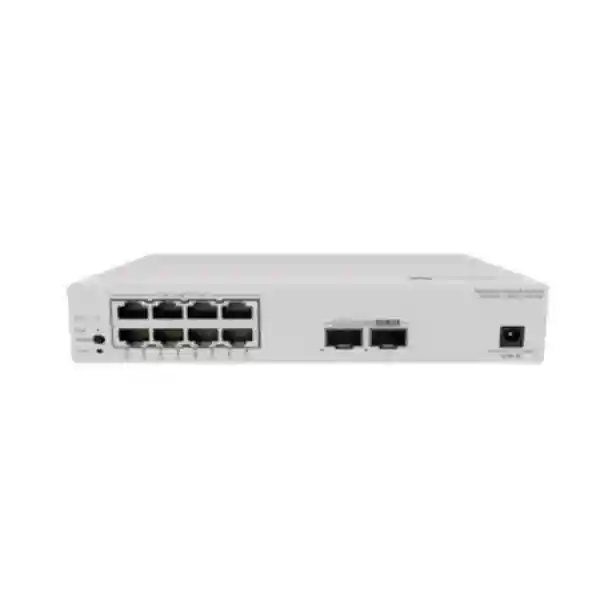
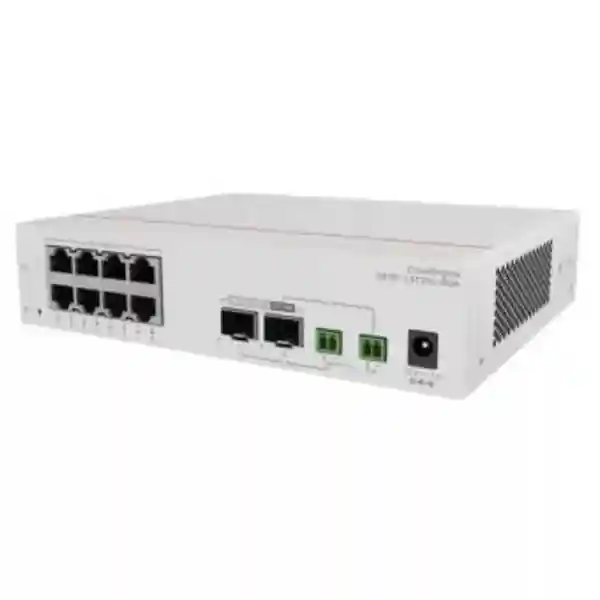
Huawei CloudEngine S5751-L8P2PN2X-RUA
Compact 10GE-uplink PoE+ remote-unit switching for streamlined enterprise campus networks, high-density edge connectivity, multigigabit endpoints, and quiet indoor deployment across Dubai and the wider UAE.
Direct answer
Choose the S5751-L8P2PN2X-RUA when a site needs a small, fanless Huawei remote unit with mixed GE and 2.5GE copper access, PoE+ for powered endpoints, and dual 10GE-capable optical uplinks. Its architecture is intended to extend a compatible Huawei campus switching system while reducing local configuration and operational complexity.
Key hardware facts at a glance
What the S5751-L8P2PN2X-RUA is designed to do
The Huawei CloudEngine S5751-L8P2PN2X-RUA belongs to the S5751-L remote-unit family rather than the conventional category of independently administered access switches. That distinction matters in real campus design. In Huawei’s streamlined architecture, the remote unit operates as an access-port expansion element associated with a compatible central switch. The operational goal is to move intelligence and policy control upward while keeping the endpoint-facing device compact, easy to place, and simpler to replace. For a UAE network team, this can be attractive in buildings with many small connectivity zones where installing and managing a traditional standalone switch in every location would add unnecessary configuration effort.
Huawei positions the S5751-L family for enterprise offices, education, hotels, healthcare, and other campus environments. Those use cases have a common pattern: endpoint density is distributed across rooms, corridors, pods, classrooms, guest areas, service desks, consultation rooms, retail zones, and intermediate spaces rather than concentrated only in a central telecommunications room. A remote-unit topology allows network designers to bring copper ports closer to users while maintaining fiber-based upstream connectivity. This can shorten horizontal copper runs, improve layout flexibility, and make capacity additions more modular.
The model is particularly interesting because it blends three access speeds and several power roles. Six gigabit copper ports provide PoE+ for devices such as IP phones, wireless access points, cameras, door controllers, and other compatible powered devices. Two additional gigabit copper ports are presented without the PoE+ designation, making them useful for non-powered endpoints or infrastructure interconnects. Two multigigabit copper ports support 100M, 1G, and 2.5G while also providing PoE+, which gives the designer a faster edge option for devices that can exceed one gigabit. Above that access layer, two SFP+ ports can operate up to 10GE, providing uplink headroom that is substantially greater than a single traditional 1GE uplink.
Detailed port map and traffic design
| Interface group | Quantity | Supported rate | PoE role | Typical planning use |
|---|---|---|---|---|
| GE copper PoE+ | 6 | 10/100/1000M | PoE+ | Phones, APs, cameras, controllers, powered edge devices |
| GE copper data | 2 | 10/100/1000M | Not designated PoE+ | Printers, workstations, local appliances, non-powered devices |
| Multigig copper PoE+ | 2 | 100M/1G/2.5G | PoE+ | Higher-throughput APs or multigigabit endpoints |
| SFP+ uplink | 2 | 100M/1G/2.5G/10G | Optical uplink | Fiber connection toward central switching infrastructure |
The unusual combination of eight conventional gigabit-class ports plus two 2.5GE-capable copper ports is one of the model’s strongest design characteristics. It permits a mixed endpoint environment without forcing every port to carry the cost and power profile of multigigabit access. A branch office or floor zone may have several ordinary phones and desktop devices that need no more than 1GE, alongside one or two modern wireless access points that can benefit from 2.5GE. The S5751-L8P2PN2X-RUA lets those device classes coexist on a single compact remote unit.
The two uplink interfaces should be planned around traffic concentration rather than simply counted as redundancy. Ten copper endpoints can collectively generate bursts well above one gigabit, especially when Wi-Fi, surveillance, local file transfer, unified communications, and cloud applications operate simultaneously. A 10GE-capable uplink creates substantial aggregation headroom. Where the broader topology and central-switch design support it, uplink link aggregation is also among the documented interface features of the S5751-L series, giving the architect another tool for bandwidth and resilience design. Actual transceiver selection, fiber type, link distance, central-switch port compatibility, and software requirements should be confirmed against the final bill of materials.
Remote-unit architecture: why it changes campus operations
Traditional enterprise access design often creates a three-layer operational model: a core, aggregation or distribution layer, and independently managed access switches. Huawei’s S5751-L concept is built for a more streamlined approach in which the remote unit can act as a port-extension element of a compatible central switch. Huawei describes the remote-unit connection as planning-free and configuration-free in the intended simplified deployment model, with plug-and-play behavior and simplified device replacement. This does not mean that network design disappears. It means that much of the repeated box-by-box access configuration can be reduced when the solution is deployed with the supported central-switch architecture and software release.
For IT teams operating multiple UAE sites, the operational impact can be significant. Repeating VLAN, security, port-role, monitoring, and maintenance logic across numerous small access switches consumes engineering time and creates opportunities for configuration drift. A centralized model aims to standardize how edge ports are presented and managed. When a remote unit fails, the replacement workflow can be simpler than rebuilding a manually configured standalone switch. That is useful in hospitality floors, education blocks, clinics, retail units, office meeting zones, and distributed smart-building areas where local IT support may be limited.
The architecture also helps explain why this product should not be evaluated solely by comparing its feature list with a full-featured standalone Layer 3 access switch. The S5751-L8P2PN2X-RUA is designed around a system relationship. The central switch, remote-unit connectivity method, software compatibility, optical modules, topology, and management platform collectively determine the deployment experience. Huawei notes that compatible CloudEngine S16700, S12700E, S8700, S6700, and S5700 series switches can work with remote modules when running a suitable software release. A procurement decision therefore needs to validate the central switch and software baseline, not just the remote-unit part number.
FourTeck can help design this relationship as part of a broader UAE campus network engagement. For enterprise network planning, switching integration, and structured rollout support, visit FourTeck UAE. For organizations that also need implementation, migration, monitoring, or broader infrastructure services, FourTeck IT Services UAE can be incorporated into the delivery scope.
PoE+ design and power-budget engineering
Power over Ethernet planning should be treated as an engineering calculation, not a checkbox. The S5751-L8P2PN2X-RUA exposes eight PoE+-designated copper interfaces in total: six gigabit ports and two multigigabit ports. Huawei’s ordering information for this model states a 128 W PoE budget with one 220 V AC power adapter. The published maximum consumption at full PoE load is 162.05 W, while the device-only maximum without PoE is listed as 14.60 W and device-plus-adapter maximum without PoE as 17.91 W. Typical power consumption is listed at 16.74 W and static power consumption at 7.15 W. These numbers are valuable for UPS sizing, branch power calculations, cooling estimates, and electrical planning.
The 128 W budget is shared, so the number of powered devices that can be attached depends on their actual and negotiated consumption. Eight endpoints do not automatically receive the maximum possible PoE+ allocation simultaneously. For example, a deployment containing several access points, PTZ cameras, video phones, and building-control devices can draw very different loads even when all devices are technically PoE+ compatible. The correct method is to list each powered device, record its maximum expected draw or negotiated class, add sensible design headroom, and compare the result with the switch’s available PoE budget. High-draw edge devices should be placed intentionally rather than added opportunistically.
PoE planning is also tied to network availability. A remote unit may remain logically reachable, but endpoint services can still fail if the upstream UPS, power adapter, branch circuit, or cabinet power arrangement is undersized. In a UAE office, hotel, school, clinic, or retail branch, it is therefore advisable to include the switch and its powered endpoints in the same availability discussion. If IP telephony, Wi-Fi, access control, or surveillance is operationally critical, the UPS runtime calculation should include the expected PoE load, not just the base switch consumption. Surge protection, earthing, and local electrical standards should be addressed by qualified installation personnel.
Thermal design matters as well. Fanless equipment avoids fan noise and one category of moving-part failure, but the absence of fans does not eliminate heat. Huawei specifies natural heat dissipation and an operating-temperature range of -5°C to +45°C for this model. In the UAE, the practical implication is that the unit belongs in a controlled indoor environment with adequate ventilation and clearance. It should not be treated as an outdoor or unconditioned-rooftop device merely because the ambient range reaches 45°C. Cabinet temperature can exceed room temperature, especially when power supplies, UPS equipment, PoE loads, and other electronics share a small enclosure.
Performance: 49.5 Mpps forwarding and 98 Gbps switching capacity
Huawei publishes 49.5 million packets per second of forwarding performance and 98 Gbps of switching capacity for the international S5751-L8P2PN2X-RUA specification. These figures position the device for full-speed access behavior in its intended remote-unit role rather than for heavy standalone routing workloads. Huawei’s S5751-L documentation states that the remote units support full line-speed forwarding and non-blocking packet forwarding across ports, helping accommodate high-bandwidth services such as high-definition video, large file transfers, cloud applications, collaboration traffic, and multigigabit wireless access.
The practical performance question is not simply whether the switch can pass traffic at wire rate. Network architects should examine the end-to-end path. A 2.5GE wireless access point connected to one of the multigigabit copper ports only realizes that capacity if the cabling is suitable, the endpoint negotiates the expected speed, the uplink has enough bandwidth, the central switch accepts the selected optical link, and upstream security or WAN components are not bottlenecks. Similarly, two 10GE-capable uplinks do not mean every deployment needs 20 Gbps of aggregate uplink capacity. The selected topology should reflect traffic patterns, convergence ratios, resilience requirements, and the performance of connected systems.
For many distributed access zones, a single 10GE uplink provides a strong ratio between edge capacity and upstream bandwidth. However, environments with high concurrent wireless throughput, dense video, workstation imaging, local storage, or east-west traffic may benefit from more conservative oversubscription. Uplink link aggregation, where supported in the complete architecture, can be evaluated for additional bandwidth or resilience. The central switch must also have sufficient interface density and switching capacity to aggregate all remote units without shifting the bottleneck upstream.
Latency-sensitive applications deserve separate attention. Voice, interactive video, virtual desktop traffic, clinical systems, and real-time collaboration can suffer even when average bandwidth utilization appears low. Queue behavior, upstream congestion, QoS policy at the controlling infrastructure, packet loss, and WAN conditions are often more important than headline switching capacity. The S5751-L8P2PN2X-RUA provides a high-speed physical foundation; the overall campus design determines the application experience.
Security and segmentation capabilities
MACsec
Huawei lists MACsec encryption among the S5751-L series security features. In supported end-to-end designs, MACsec can help protect Ethernet traffic on appropriate links. Deployment details, key management, peer compatibility, and software support should be validated for the exact network architecture.
Port isolation
Port isolation is useful when endpoints should share upstream services without freely communicating with each other at the local edge. Guest, IoT, camera, classroom, and building-system deployments can benefit from this additional separation mechanism.
VLAN functions
Huawei documents support for up to 128 VLANs, VLAN management, and port-based VLAN assignment in the S5751-L feature set. This enables practical separation of user, voice, wireless, surveillance, IoT, guest, and management traffic according to the central design.
MAC learning
Automatic MAC address learning and aging are documented Ethernet functions. They support normal Layer 2 forwarding behavior while centralized policy and upstream security architecture determine broader access control.
Security should be designed in layers. A remote unit located close to users or devices can reduce cabling complexity, but it can also be physically closer to public or semi-public areas than a locked main distribution frame. Wall placement, cabinet design, tamper resistance, port access, patch-cord routing, power security, and physical inventory procedures are therefore part of the threat model. In hospitality, education, retail, and healthcare, an unattended communications enclosure should not rely on logical controls alone.
Logical segmentation should follow service requirements rather than merely copying old VLAN numbers. A modern campus may separate employee endpoints, guest wireless, voice, surveillance, access control, building management, printers, AV equipment, digital signage, and operational technology. The S5751-L8P2PN2X-RUA can present the required edge ports, while the compatible central switching and security stack enforces routing, policy, identity, inspection, and monitoring as designed. For organizations integrating segmentation with broader perimeter and security services, FourTeck Firewall Dubai provides a related security-focused engagement path.
Physical design, mounting, environment, and reliability
The S5751-L8P2PN2X-RUA is substantially smaller than a conventional 19-inch full-width access switch. Huawei lists dimensions of 43.6 mm high, 195 mm wide, and 160 mm deep, with an unpackaged weight of about 1.2 kg. The supported installation methods are desk mounting or wall mounting. This makes the unit appropriate for compact wiring points, furniture-integrated network areas, small wall enclosures, service counters, classrooms, consultation areas, hospitality spaces, and other locations where a rack-depth chassis would be excessive.
The switch uses fanless natural heat dissipation. Huawei publishes normal-temperature acoustic figures below 30 dB(A) sound power and below 20 dB(A) sound pressure, describing the device as noise-free with no fans. For quiet user environments this is more than a comfort feature. Fanless design can prevent a local communications device from adding a persistent tonal noise near desks, beds, consultation spaces, meeting rooms, classrooms, or reception counters. It also removes the fan as a moving component, although environmental cleanliness and airflow still matter because passive cooling relies on convection and surface heat transfer.
The operating temperature range is published as -5°C to +45°C, with storage from -40°C to +70°C and relative humidity from 5% to 95% non-condensing. These are equipment limits, not recommended room setpoints. UAE installations should aim for controlled indoor conditions, especially in enclosed cabinets. Direct sunlight, ceiling voids near hot roof spaces, unconditioned utility rooms, dusty workshops, and poorly ventilated furniture cavities can create local temperatures very different from the building thermostat reading. A site survey should assess actual enclosure temperature, air movement, dust exposure, cable density, and power-adapter placement.
Huawei publishes an MTBF figure of 83.69 years and availability above 0.99999 for this model. MTBF is a statistical reliability metric across a population and operating assumptions; it should not be interpreted as an expected individual service life or warranty duration. Real-world lifecycle planning should instead consider software support, hardware warranty, spare strategy, environmental conditions, technology refresh cycles, and the business impact of a failed unit. Because a remote unit is relatively small, keeping an appropriate spare quantity can make replacement logistics straightforward.
The power-port surge specification is listed as ±4 kV differential mode and ±4 kV common mode. Surge figures should be considered one part of electrical resilience, not a substitute for properly designed building protection, earthing, UPS systems, and compliant installation practices. UAE projects should coordinate networking equipment with electrical and MEP teams where branch circuits, UPS feeds, surge protection, and low-voltage spaces are part of a larger fit-out.
UAE deployment scenarios
Enterprise office zones
Place compact remote units near clusters of desks, meeting rooms, collaboration devices, printers, IP phones, and wireless access points. Dual 10GE-capable uplinks provide room to aggregate local traffic without relying on a single gigabit bottleneck.
Hotels and hospitality
Fanless operation and small dimensions suit floor zones, service areas, reception locations, meeting facilities, AV endpoints, cameras, phones, access points, and digital services where noise and space are important.
Education
Classrooms, labs, administration blocks, libraries, and teaching spaces can use distributed remote units to bring powered and non-powered ports closer to learning devices while simplifying access-layer operations.
Healthcare and clinics
Compact silent switching can support consultation rooms, nurse stations, wireless coverage, voice, cameras, administrative terminals, and compatible medical-adjacent network devices where acoustic impact should remain low.
Retail and branches
A remote unit can consolidate POS-adjacent infrastructure, phones, printers, cameras, APs, and back-office endpoints in a small footprint while fiber uplinks extend the branch edge to the central switching design.
Smart-building edge
PoE+ ports can serve compatible controllers, sensors gateways, cameras, and operational endpoints, while VLAN and port-isolation functions help separate device classes within the broader campus security architecture.
The key design question in all six scenarios is distance and concentration. The remote unit is most valuable where bringing fiber closer to the endpoint zone simplifies copper pathways or reduces the need for a conventional access cabinet. It should be placed where power, ventilation, physical security, maintainability, and patching can still be managed professionally. Distributed does not mean hidden or inaccessible; the best installations remain documented, labeled, monitored, and serviceable.
How to size the S5751-L8P2PN2X-RUA correctly
Start with endpoint count, but do not stop there. The device provides ten copper downlink ports, yet only eight are PoE+ designated and only two reach 2.5GE. A good port map assigns each planned endpoint to a specific class before the purchase order is created. Record the endpoint name, device type, required speed, PoE requirement, VLAN or service role, expected peak traffic, patch-cable category, and whether future replacement may demand additional bandwidth. This prevents a project from discovering during commissioning that the two multigigabit ports were needed by three devices or that too many powered endpoints were assumed to draw high wattage simultaneously.
Next, calculate PoE budget. Use the maximum expected draw for each powered device rather than an optimistic idle figure. Sum those values, include design reserve, and compare the result with the 128 W published PoE budget. If the total exceeds the available budget, options include moving a powered endpoint to another switch, selecting a lower-power endpoint, introducing an appropriate injector where design standards permit, or using a higher-capacity access model. Do not assume that the presence of eight PoE+ ports guarantees maximum PoE+ power on all eight at the same time.
Then size uplinks. Estimate aggregate traffic rather than adding access-port line rates mechanically. Office endpoints are often bursty, while Wi-Fi APs, cameras, imaging systems, and local storage may create more sustained load. A single 10GE uplink can be ample for many ten-port edge groups, but the topology may call for dual links for resilience, aggregation, or separate path design. The central switch must offer compatible ports and enough aggregate bandwidth to support all attached remote units.
Finally, verify architecture compatibility. The S5751-L family is intended to work with compatible Huawei central switches in the streamlined remote-unit model. Validate the exact central-switch platform, software release, optical modules, fiber plant, allowed topology, management design, and feature dependencies. Huawei documentation notes support in combination with relevant CloudEngine S16700, S12700E, S8700, S6700, and S5700 family central switches at suitable software levels. The specific deployment should follow the product documentation and tested design for the exact release in use.
For multi-site organizations standardizing across countries, FourTeck can also coordinate broader sourcing and project discussions through FourTeck Global. A standardized BOM, consistent transceiver policy, common labeling scheme, spares allocation, and repeatable commissioning template can reduce variation between sites while leaving room for local electrical, cabling, and compliance requirements.
Cabling and optical uplink planning
The two SFP+ uplinks support 100M, 1GE, 2.5GE, and 10GE link rates, but the physical medium depends on the installed transceiver and the supported central-side interface. The words “SFP+ port” should not be treated as a guarantee that every optical module will work. Network designers must select Huawei-supported or otherwise approved optics for the target distance, fiber type, wavelength, connector, and link rate. The fiber plant must also be tested and documented, especially in new UAE fit-outs where patch panels, splice trays, risers, and cross-connects may pass through multiple contractors before active equipment is commissioned.
For short in-building links, multimode fiber may be appropriate when it matches the selected optical standard and installed plant. Longer campus links may require single-mode optics. The decision should consider existing fiber availability, expected lifecycle, spare strands, insertion loss, connector count, and future migration. Designing only for today’s 1GE or 2.5GE need can be shortsighted when the hardware already supports 10GE uplinks. Where budget allows, a fiber strategy that preserves a clean path to 10GE can reduce later recabling or optic replacement complexity.
Copper cabling to the two 2.5GE ports also deserves attention. Multigigabit Ethernet can often reuse suitable installed twisted-pair cabling, but real link performance depends on category, workmanship, length, bundle conditions, connectors, patch cords, interference, and certification quality. A design should specify the cabling standard and require certification results rather than assuming every legacy copper run will negotiate 2.5GE reliably. PoE adds another variable because conductor resistance and bundle heating can matter in dense cable groups.
Labeling should tie the remote unit, port number, patch-panel position, wall outlet, endpoint, fiber strand, uplink optic, and central-switch port together. In a centralized remote-unit architecture, accurate physical documentation is especially valuable because a fault may be diagnosed centrally while the hardware sits in a distributed room or wall enclosure. Clear records shorten field intervention and reduce the risk of technicians disconnecting the wrong fiber or powered endpoint.
Operations, monitoring, replacement, and lifecycle
Huawei’s remote-unit design emphasizes simplified planning, deployment, and routine operations. In the intended architecture, the remote unit is connected to the central switch and can function as its port-expansion module. Huawei describes the workflow as plug-and-play and notes that a failed device can be replaced with a new unit to simplify recovery. This operating model can reduce the need for field staff to maintain independent configurations for every small access node.
Even with simplified configuration, disciplined operations remain essential. The NOC should maintain an inventory containing serial numbers, locations, parent central switches, uplink ports, fiber identifiers, endpoint maps, PoE allocations, software baselines, installation dates, and spare status. Alerts should distinguish a complete remote-unit outage from a single uplink, access port, PoE endpoint, optic, or power issue. Change management should document VLAN and policy changes at the controlling infrastructure because a centralized architecture can propagate configuration effects across many edge ports.
Spare strategy is straightforward because the device is compact and lightweight. Organizations with many units can hold a small percentage of cold spares at a central UAE location or distribute spares across major sites. The correct ratio depends on business criticality, installed quantity, warranty response time, geographic spread, and whether each site has alternative network paths. A hospital or hotel may choose a different spare policy from a small office because the service impact of losing Wi-Fi, voice, surveillance, or access-control connectivity can differ significantly.
Lifecycle planning should also cover optics and power adapters. A replacement remote unit is only useful if the required uplink module, patch cord, adapter, mounting accessories, and compatible software environment are available. Keeping a validated standard kit can reduce restoration time. During refresh projects, engineers should verify whether the central-switch software still supports the installed remote units and whether new endpoints require more multigigabit or PoE capacity than the original design.
Because Huawei publishes statistical MTBF and high availability figures, it may be tempting to minimize spare planning. That would confuse statistical reliability with operational resilience. Resilience comes from architecture, power, cabling, monitoring, trained procedures, documentation, and replacement logistics. Hardware quality is only one layer.
Comparing nearby S5751-L choices
The S5751-L family includes several models that look similar in naming but target different port and power requirements. The S5751-L8P2X-RUA, for example, provides eight gigabit PoE+ copper ports and two multirate SFP+ uplinks, with 42 Mpps forwarding performance. The S5751-L8P2PN2X-RUA adds two 2.5GE PoE+ copper ports while retaining a mixed set of gigabit ports and increases the published forwarding performance to 49.5 Mpps. This makes the PN2X model more suitable when a small number of endpoints need more than 1GE without requiring a larger multigigabit switch.
The S5751-L8P2PN2HX-RUA is another related model with the same basic copper port pattern and 49.5 Mpps forwarding figure, but its SFP+ uplinks are documented as hybrid optical-electrical interfaces and its power-input options include hybrid-cable power input in addition to adapter-related methods. That can be valuable in designs specifically built around Huawei’s optical-electrical power approach. The S5751-L8P2PN2X-RUA discussed here should not be mistaken for the HX variant. The exact suffix changes the uplink and powering architecture, so procurement teams should preserve the full model string on quotes and purchase orders.
Larger 24-port S5751-L variants can make sense where endpoint density is concentrated in one location. The compact PN2X model is stronger when distributed placement is the objective. A 24-port chassis in a central cabinet may be cheaper per port, but it can require longer copper runs and more traditional access-layer distribution. A remote-unit design can shift cost from large access closets toward fiber distribution and smaller edge nodes. The correct answer depends on the building pathways, endpoint geography, cabinet availability, fiber plant, operational model, and future growth pattern.
A product comparison should therefore use architecture-level criteria rather than a simple port-price table. Compare port speed mix, PoE budget, uplink method, central-switch compatibility, installation space, acoustic limits, power availability, fiber cost, copper pathway length, management effort, spare strategy, and expansion pattern. The cheapest individual switch can become the more expensive network if it forces additional cabinets, electrical work, cooling, copper pathways, or administration.
Bill-of-materials planning for a complete deployment
Ordering only the switch part number is rarely enough. A production-ready BOM should identify the remote unit, correct power adapter, supported optical modules, fiber patch cords, copper patch leads, wall or desk mounting method, labeling materials, upstream central-switch interfaces, licenses or software entitlements where applicable to the broader solution, UPS capacity, cabinet or enclosure needs, and spares. If the design uses redundant uplinks, both optical paths need corresponding central-side ports and fiber strands.
Transceiver compatibility should be explicit. Record the exact optic part number at each end, expected link rate, wavelength, fiber type, connector, and distance. If existing optics are being reused, verify that the central and remote interfaces support the same operating mode. Avoid generic BOM labels such as “10G SFP” because SFP+ optics vary by reach and medium. The quote should allow the installation team to determine exactly what plugs into each port without improvisation.
PoE endpoint information belongs in the BOM workbook as well. List the AP, camera, phone, controller, or other powered-device model and expected maximum power. When multiple device vendors are involved, power requirements can change between revisions. A margin should be reserved for endpoint replacement and firmware behavior. If a later Wi-Fi upgrade increases AP power demand, the switch may still have enough physical ports but no longer have sufficient PoE budget. Lifecycle headroom is therefore a procurement parameter.
For UAE projects, logistics details can also matter: delivery location, staging requirement, serial-number capture, rack-room access, night-work constraints, site induction, labeling convention, cable certification, and handover documentation. FourTeck can scope supply-only orders or a larger implementation engagement depending on the project. The commercial quote should state what is included rather than assuming installation accessories or professional services are bundled with the hardware.
When the remote-unit design is part of a larger campus refresh, the BOM should be assembled as a system rather than switch by switch. This prevents mismatched optic counts, insufficient central-switch ports, missing power accessories, and under-sized UPS capacity. It also makes the tender easier to evaluate because competing quotations can be compared against the same functional architecture.
Commissioning methodology
A disciplined commissioning process begins before the remote unit is powered. Verify the model label, serial number, physical condition, adapter, mounting location, ventilation clearance, and cable routes. Confirm the uplink fiber pair or strand mapping from the remote location to the central switch. Clean and inspect fiber connectors according to standard optical practices before inserting transceivers. On the copper side, confirm that each outlet is labeled and certified to the required performance level, particularly for the two 2.5GE paths.
After power-up, verify device discovery and the intended relationship with the compatible central switch. Confirm software compatibility, remote-unit status, uplink negotiation speed, and any aggregation state. Check that all planned access ports are present and that their role matches the design: six GE PoE+ interfaces, two GE non-PoE interfaces, and two 2.5GE-capable PoE+ interfaces. A port-by-port acceptance sheet prevents accidental use of the wrong port class.
Next validate VLAN and security behavior. Connect representative endpoints from each service class and confirm addressing, upstream reachability, policy enforcement, isolation behavior, and management visibility. Where MACsec is part of the design, test the actual protected link and verify its operational state rather than assuming that listing the feature on a data sheet means it is enabled. Where port isolation is used, verify both allowed upstream communication and blocked lateral communication.
PoE validation should record which devices are powered, their negotiated status, and the aggregate power draw if the management platform exposes it. Reboot or power-cycle representative high-priority endpoints to confirm recovery. For access points, verify that the copper interface negotiates the expected 1G or 2.5G speed. For cameras and phones, check application-level functionality instead of considering link-up alone to be proof of service.
Performance tests should be proportional to the use case. Basic checks include packet loss, latency, uplink speed, and endpoint throughput. High-demand sites may add controlled traffic testing, failover behavior, large file transfers, voice/video calls, or wireless capacity checks. Finally, capture as-built documentation: switch location, serial, central parent, uplink ports, optic types, fiber IDs, access-port assignments, VLAN roles, PoE endpoints, photos, and acceptance results.
A proper handover converts a working installation into a supportable installation. The operations team should know how to identify the remote unit from the central management view, where it is physically installed, which users or services depend on it, how to replace it, and which spare components are compatible.
Technical specification reference
| Product model | CloudEngine S5751-L8P2PN2X-RUA |
| Forwarding performance | 49.5 Mpps |
| Switching capacity | 98 Gbps |
| GE PoE+ downlinks | 6 × 10/100/1000BASE-T PoE+ |
| GE non-PoE downlinks | 2 × 10/100/1000BASE-T |
| Multigig PoE+ downlinks | 2 × 100M/1G/2.5GBASE-T PoE+ |
| Uplinks | 2 × 100M/1G/2.5G/10GE SFP+ |
| PoE budget | 128 W in published ordering description |
| Dimensions | 43.6 × 195 × 160 mm |
| Weight | Approximately 1.2 kg without packaging |
| Mounting | Desk or wall mounting |
| Power supply | Power adapter; ordering description references 1 × 220 V AC adapter |
| Maximum without PoE | 14.60 W device; 17.91 W device + adapter |
| Maximum full PoE load | 162.05 W with stated 128 W PoE condition |
| Typical / static consumption | 16.74 W typical / 7.15 W static |
| Cooling | Fanless, natural heat dissipation |
| Operating temperature | -5°C to +45°C |
| Storage temperature | -40°C to +70°C |
| Relative humidity | 5% to 95%, non-condensing |
| MTBF | 83.69 years statistical figure |
| Documented feature examples | Up to 128 VLANs, VLAN management, uplink link aggregation, MACsec, port isolation, automatic MAC learning and aging, factory reset support |
Procurement considerations for Dubai and the UAE
A technically correct product choice can still become a poor procurement outcome if the quote omits accessories, support assumptions, or compatibility details. Request the full Huawei model suffix in writing: S5751-L8P2PN2X-RUA. This prevents substitution with the L8P2X, L8P2PN2J, or L8P2PN2HX variants, which differ in port or uplink characteristics. The RUA designation should remain part of the model record because Huawei documentation distinguishes international specifications from mainland-China product information.
Ask the supplier to identify what is physically included, especially the power adapter and mounting accessories. If optics are included, require exact part numbers and supported distance. If optics are excluded, make that explicit and add them to the BOM. Confirm whether professional services include staging, software compatibility checks, configuration of the central switch, installation, labeling, testing, documentation, and handover. A low hardware-only quote should not be compared directly with an integrated deployment quote without normalizing the scope.
Warranty and support response are equally important. Determine the warranty path, replacement process, required proof of purchase, and whether spares are held locally. For business-critical environments, evaluate keeping on-site or UAE-based cold spares rather than relying solely on replacement lead time. The remote-unit architecture may simplify hardware swapping, but a replacement still has to reach the site when needed.
Projects should also confirm the existing central-switch estate before buying remote units. If a site currently uses a different vendor or an incompatible Huawei platform, the S5751-L8P2PN2X-RUA may not deliver the intended centralized remote-unit experience without additional infrastructure. In greenfield projects, select the central and remote layers together. In brownfield projects, build a compatibility matrix and migration plan before purchase.
FourTeck can support UAE product sourcing together with design review and implementation planning. The objective is to quote the complete working system rather than an isolated box. This includes validating port requirements, PoE headroom, uplink optics, fiber architecture, central-switch compatibility, installation environment, and handover expectations before finalizing the order.
Frequently asked technical questions
Is the S5751-L8P2PN2X-RUA an eight-port switch?
The model name can be misleading if read casually. Huawei’s published port map shows ten copper downlink interfaces: six GE PoE+ ports, two GE non-PoE ports, and two additional 100M/1G/2.5G PoE+ ports. It also has two multirate SFP+ uplinks.
How many PoE+ ports are available?
Eight copper interfaces are designated PoE+: the six gigabit PoE+ ports plus the two multigigabit PoE+ ports. The other two gigabit copper ports are not listed as PoE+ on this model.
What is the PoE budget?
Huawei’s published ordering description specifies 128 W PoE for the S5751-L8P2PN2X-RUA with its 220 V AC power adapter. Actual endpoint planning should include per-device maximum draw and reserve margin.
Does it support 10GE?
Yes, the two SFP+ uplinks are listed for 100M, 1GE, 2.5GE, and 10GE operation. The copper downlinks reach up to 2.5GE on two ports and up to 1GE on the remaining eight.
Is it fanless?
Yes. Huawei specifies natural heat dissipation with no fans for this model. That supports quiet indoor installation, but adequate ventilation and adherence to the -5°C to +45°C operating range remain necessary.
Can it be wall mounted?
Yes. The published installation methods are desk or wall mounting. Final mounting should preserve access to ports, labels, airflow, and service clearance.
Does it work as a normal independent switch?
Its primary design is as a CloudEngine S5751-L remote unit within Huawei’s streamlined campus architecture. The project should validate the intended central-switch relationship, software version, topology, and management method rather than assuming the same operational model as an arbitrary standalone access switch.
Which central switches can be used?
Huawei states that relevant CloudEngine S16700, S12700E, S8700, S6700, and S5700 series switches can work with remote modules at suitable software releases. Exact model and release compatibility must be checked for the planned deployment.
Why use FourTeck for the S5751-L8P2PN2X-RUA?
A remote-unit switch is best purchased as part of a validated system. FourTeck can help translate floor plans, endpoint schedules, wireless requirements, surveillance needs, PoE loads, fiber routes, central-switch capacity, and operational standards into a deployable BOM. This is particularly important when a compact edge device appears simple but actually depends on uplink optics, compatible software, central switching, power infrastructure, and structured cabling decisions.
The engagement can begin with a supply request or expand into design and implementation. For a small branch, the requirement may be one remote unit, two optics, a power adapter, and a defined port map. For a campus, it may involve dozens of remote units, multiple central switches, fiber distribution, UPS sizing, VLAN standardization, security integration, monitoring, and acceptance testing. A consistent architecture reduces surprises during rollout.
For organizations extending networks beyond the UAE, FourTeck’s broader regional capability can help keep product naming, BOM control, and deployment documentation consistent while adapting to local project conditions. The technical objective remains the same: every quoted component should have a defined function, every port should have a planned role, and every link should be validated end to end.
Decision recap: where this model fits best
Strong fit
Distributed indoor access zones that need a compact and quiet remote unit; mixed 1GE and 2.5GE endpoint connectivity; up to eight PoE+-capable access ports within a 128 W budget; 10GE-capable fiber uplinks; and centralized operation with a compatible Huawei campus switching architecture.
Validate carefully
Projects needing more than two 2.5GE copper ports, very high PoE budgets, outdoor installation, a conventional independently managed access-switch role, or integration with a central switching platform that has not been checked for remote-unit compatibility.
The S5751-L8P2PN2X-RUA is not merely a miniature switch. Its value is the combination of compact distributed placement, PoE+, two multigigabit access ports, two high-speed SFP+ uplinks, fanless operation, and integration into Huawei’s simplified campus model. If those attributes match the site architecture, the device can reduce access-layer footprint while preserving meaningful uplink capacity and endpoint flexibility.
Before purchase, validate five things: the exact endpoint port map, the total PoE requirement, the selected optics and fiber plant, the compatible central-switch platform and software version, and the physical installation environment. When those five areas are documented, the procurement decision becomes far more predictable.
Quotation input checklist
To receive an accurate UAE quotation and avoid missing accessories, prepare the following information for the FourTeck team:
Consult FourTeck UAE before finalizing the BOM
The fastest way to avoid an incomplete Huawei remote-unit order is to validate the whole path from endpoint to central switch. FourTeck can review the required copper ports, PoE load, 2.5GE endpoints, fiber uplinks, optic selection, central-switch compatibility, environmental conditions, and service scope before quotation. This is especially useful for fit-outs and refresh projects where network, electrical, ELV, and wireless requirements overlap.
For a supply-only requirement, provide the model, quantity, optics, and delivery location. For a deployment requirement, add the central-switch details, floor plans or port schedule, fiber distances, endpoint list, VLAN requirements, and installation scope. The resulting quote can then separate hardware, optics, accessories, implementation, and support so that the commercial comparison is technically meaningful.
The Huawei CloudEngine S5751-L8P2PN2X-RUA is a strong architectural building block when the project needs quiet, compact, centrally integrated access with PoE+ and a selective multigigabit edge. The final result depends on matching that hardware capability to the right topology, power design, cabling system, and operational model.

Reviews
There are no reviews yet.