
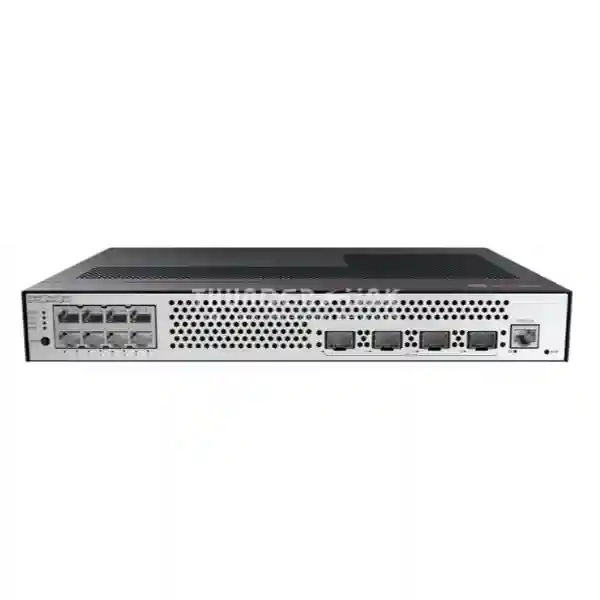
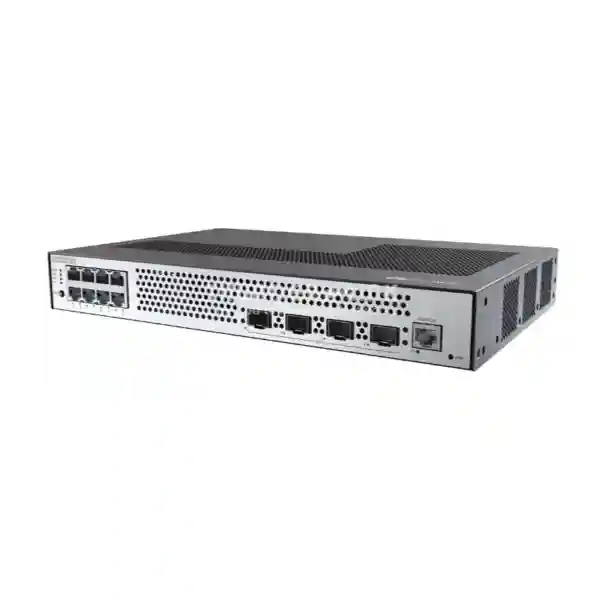
Huawei CloudEngine S5751-L8P4XN-RUA
The Huawei CloudEngine S5751-L8P4XN-RUA is a compact, fanless PoE+ remote-unit switch for Huawei simplified campus networking. It is intended for deployments where access ports can be extended closer to users, IP phones, cameras, and other Ethernet endpoints while the central switching architecture provides unified control. Huawei’s current product material lists eight 10/100/1000BASE-T PoE+ ports, two 10/100/1000/2.5GBASE-T ports, two 10GE SFP+ ports, 49.5 Mpps forwarding performance, 98 Gbps switching capacity, power-adapter operation, and a 128 W PoE budget.
This page is written for procurement teams, network administrators, consultants, project managers, schools, hotels, healthcare organizations, offices, campuses, retail groups, warehouses, and multi-site enterprises comparing the S5751-L8P4XN-RUA for real deployments. It focuses on verified hardware facts, central-switch compatibility questions, PoE planning, fiber uplink design, regional buying concerns, and the information FourTeck needs to prepare a useful quotation. Price, stock, lead time, warranty handling, optics, support entitlement, and exact software compatibility should always be confirmed for the destination and project before purchase.
Choose this model when the design calls for a compact Huawei remote-unit switch with PoE+ access, multigig copper connectivity, 10GE fiber uplinks, fanless operation, and centralized campus architecture. Confirm the intended Huawei central switch and software release before ordering because a remote-unit design should be validated as a complete system, not as an isolated switch purchase.
What the Huawei CloudEngine S5751-L8P4XN-RUA is designed to do
Huawei positions the CloudEngine S5751-L family as remote units in a simplified campus architecture. In that design, the remote unit works with a compatible Huawei central switch and behaves as a port-expansion element rather than being treated only as a conventional independently managed access switch. This architecture can reduce the number of devices that need separate planning, configuration, and routine management at the edge, which is particularly useful where many small access zones must be distributed through offices, classrooms, hotel floors, clinics, retail areas, security-camera zones, or other buildings.
The S5751-L8P4XN-RUA combines eight Gigabit PoE+ access ports with two multigigabit copper ports and two 10GE SFP+ ports. That mix lets designers connect standard endpoints on Gigabit Ethernet, preserve faster copper paths where 2.5G is useful, and uplink over fiber at 10G where the topology and optics support it. Huawei’s ordering information also identifies the model as fanless and specifies a 128 W PoE budget. Fanless operation is attractive in user-adjacent spaces because there are no cooling fans generating normal fan noise, but passive cooling still requires proper airflow, installation clearances, and compliance with the documented environmental range.
The most important buying point is that a remote-unit switch should be evaluated as part of a complete architecture. Ask which Huawei central switch will control it, which software release is required, how remote units are discovered and upgraded, how VLANs and access policy are delivered, what uplink media and optics are approved, how PoE load will be distributed, and whether local or remote power arrangements match the exact model. FourTeck can help collect these requirements and translate them into a bill of materials and deployment checklist before procurement.
Verified S5751-L8P4XN-RUA specifications
| Specification | Huawei published value |
|---|---|
| Access ports | 8 x 10/100/1000BASE-T PoE+ ports |
| Additional copper ports | 2 x 10/100/1000/2.5GBASE-T ports |
| Optical uplinks | 2 x 10GE SFP+ ports; Huawei hardware table indicates 2.5/10GE capability |
| Forwarding performance | 49.5 Mpps |
| Switching capacity | 98 Gbps |
| PoE | PoE+, 128 W published PoE budget |
| Dimensions | 43.6 x 195 x 160 mm |
| Weight | Approx. 1.7 kg without packaging |
| Installation | Desk or wall mounting |
| Power | Power adapter; published adapter output 54 V DC |
| Maximum consumption | 162.05 W at full PoE load; 17.91 W device plus adapter without PoE under Huawei’s published conditions |
| Typical power consumption | 16.74 W under Huawei’s stated test condition |
| Cooling | Fanless, natural heat dissipation |
| Operating temperature | -5°C to +45°C |
| Relative humidity | 5% to 95%, non-condensing |
Specifications can change with product revisions and regional documentation. Confirm the exact hardware, approved power adapter, optics, software release, and contract scope at quotation stage. FourTeck does not treat online specifications as a substitute for a validated bill of materials.
PoE endpoint planning
The published 128 W PoE budget is shared. Add the maximum expected draw of every powered endpoint, allow operating margin, and confirm IEEE class and device requirements. Cameras, IP phones, access points, door controllers, and other powered devices should be checked individually rather than assuming every PoE endpoint has the same demand.
10GE fiber uplink planning
Select optics according to fiber type, distance, connector standard, and Huawei compatibility guidance. A 10GE SFP+ port does not make every transceiver interchangeable. Procurement should identify the exact optic or DAC, patching, fiber route, central-switch interface, and required redundancy before the order is approved.
Central-switch validation
Huawei states that S5751-L remote units work with supported CloudEngine central-switch families in simplified networking. The exact central model and software version matter. Share the proposed Huawei core or central switch, software release, topology, number of remote units, VLAN plan, and management expectations so compatibility can be checked before purchase.
Who should consider this model?
The S5751-L8P4XN-RUA is most relevant where a Huawei campus architecture needs compact edge port expansion with PoE+ and fast uplinks. A floor, classroom block, clinic zone, hotel corridor, retail area, branch office, meeting cluster, camera zone, or industrial office may need a limited number of endpoint ports but still benefit from fiber backhaul and centralized operation. Its wall-or-desk mounting and fanless design can be useful where a full 19-inch access switch is unnecessarily large or where acoustic considerations matter.
It is not automatically the right choice for every network. Buyers who need a conventional independently managed switch, larger port density, PoE++, redundant hot-swap power, rackmount form factor, a different vendor ecosystem, or features not supported by the intended simplified architecture should compare alternatives. FourTeck can help define those requirements first so model selection follows the architecture rather than the other way around.
Buying and deployment checklist
- Confirm the exact product code: Huawei CloudEngine S5751-L8P4XN-RUA.
- Identify the central Huawei switch model and current software version.
- Define how many remote units will connect to each central switch and which uplink topology will be used.
- List every powered endpoint with expected PoE draw and total budget.
- Specify SFP+ optics, fiber type, distance, connector, patch panels, and spares.
- Check power-adapter requirements for the destination country and site electrical environment.
- Confirm mounting method, cable access, airflow, ambient temperature, and physical security.
- Document VLANs, endpoint categories, access policy, management, monitoring, and upgrade approach.
- Request written confirmation of product source, warranty/support terms, availability, lead time, and delivery scope.
- For cross-border projects, include consignee details, destination city, tax/import responsibilities, and required commercial documentation.
FourTeck resources for network and security planning
A remote-unit switch sits inside a broader network, so buyers often need help beyond the switch itself. For UAE infrastructure enquiries, review FourTeck UAE IT and networking solutions. Organizations planning deployments in East Africa can use FourTeck Uganda networking resources and FourTeck Kenya enterprise networking resources. GCC procurement teams can reference FourTeck Kuwait IT solutions, while customers coordinating projects across multiple African markets can use FourTeck IT Solutions Africa.
On the target site, the Firewall Dubai products area helps buyers understand security appliances that may sit upstream of a campus access network, while the perimeter firewall planning guide explains network-edge considerations. For rollout projects, the firewall deployment service page is useful when switch segmentation must align with security zones and routing.
Regional availability, buying intent, and deployment guidance
Huawei CloudEngine S5751-L8P4XN-RUA Dubai
Dubai buyers searching for the Huawei CloudEngine S5751-L8P4XN-RUA are usually comparing more than a part number. The practical questions are whether the model fits the intended Huawei campus architecture, whether compatible optics and a suitable power adapter are included, how much PoE capacity is available for connected devices, and what must be confirmed before a purchase order is released. In a Dubai office tower, hotel, clinic, retail outlet, school, warehouse, or multi-floor commercial site, the compact remote-unit format can be useful when network access needs to be moved closer to users without installing a large access switch in every area. The fanless design can also be attractive in occupied spaces, although the device must still be installed within Huawei’s environmental requirements and with enough natural airflow.
For a Dubai deployment, start with the upstream design. Confirm the CloudEngine central switch, software version, number of planned remote units, fiber route, and whether the two 10GE SFP+ links will be used for primary uplink, resilience, or another supported topology. Then build the endpoint list. Eight PoE+ access ports may connect devices such as IP phones, cameras, or other compliant powered endpoints, but the total 128 W budget should be calculated against real device consumption. The two multigig copper ports add flexibility where a faster local connection is required. If cameras, access points, or voice endpoints are part of the design, procurement should not treat PoE as an unlimited feature; power class, cable quality, and peak device draw all matter.
Commercially, Dubai customers should request a quotation that separates the switch, power adapter, optics, patching, accessories, support or warranty entitlement, delivery, and any installation or configuration services. Stock and lead time can move quickly, so FourTeck should confirm current availability rather than relying on a static web statement. If the remote unit will sit behind an Internet security gateway, buyers can also review the Sophos XGS 88 branch firewall page as an example of how a compact security appliance can be evaluated separately from switching. The two devices serve different roles, but planning them together helps avoid port, VLAN, and topology mismatches. Share the site location, central-switch model, endpoint count, PoE load, fiber distance, and required delivery date when requesting a Dubai quote.
Huawei CloudEngine S5751-L8P4XN-RUA UAE
Across the UAE, searches for the Huawei CloudEngine S5751-L8P4XN-RUA commonly reflect procurement, expansion, and standardization needs. A company may be refreshing an existing Huawei campus, opening branches in Abu Dhabi, Sharjah, Ajman, Ras Al Khaimah, Fujairah, or Umm Al Quwain, or trying to standardize a compact edge design across many sites. The key advantage of approaching the requirement at country level is consistency: the same validated bill of materials, software baseline, optic selection, mounting method, labeling, and handover process can be repeated where the physical topology is similar. The risk is assuming every site is identical. Fiber distance, cabinet conditions, ISP handoff, endpoint count, power quality, and security segmentation may differ significantly from one location to another.
For UAE deployment planning, confirm whether the S5751-L8P4XN-RUA will operate as a Huawei remote unit under a compatible central switch and whether the required release is already installed on the central platform. Huawei documentation describes centralized management and simplified operation for the S5751-L remote-unit family, which can be valuable for organizations with many edge locations. That benefit depends on correct architecture and supported software. Procurement teams should therefore ask engineering to approve the central switch, remote-unit quantity, uplink topology, optics, VLAN requirements, PoE endpoint classes, and power arrangement before commercial approval. The published 98 Gbps switching capacity and 49.5 Mpps forwarding performance are reference values, not substitutes for an application-aware network design.
UAE buyers should also decide whether the quotation needs staging, labeling, asset recording, configuration validation, delivery coordination, onsite installation, remote support, or simply hardware supply. A national rollout often benefits from a standard commissioning checklist so every site records serial numbers, cable identifiers, central-switch association, software level, port purpose, and acceptance-test results. FourTeck can support the requirement through the broader UAE technology channel and can align switching with security-layer planning. The Palo Alto Networks PA-410 product page illustrates the separate considerations for a compact branch firewall, while the S5751-L8P4XN-RUA remains the access-side remote unit. Keeping firewall, switching, wireless, voice, and camera requirements in one topology document helps UAE procurement teams avoid fragmented decisions.
Huawei CloudEngine S5751-L8P4XN-RUA Uganda
Uganda organizations considering the Huawei CloudEngine S5751-L8P4XN-RUA may be planning campus connectivity for offices, schools, hospitals, hospitality sites, banks, warehouses, NGOs, government facilities, or distributed commercial operations. The remote-unit concept is particularly relevant where a central network design must extend access to multiple zones while limiting the number of independently managed edge switches. Before treating that as an operational advantage, buyers should verify the exact Huawei central-switch platform and software version. A remote unit is most useful when it is intentionally designed into the broader CloudEngine campus architecture, with fiber routes, power, PoE endpoints, VLANs, management, and maintenance processes documented in advance.
For Uganda projects, power and physical installation deserve careful attention. The model uses a power adapter and is fanless, so installation should provide a secure mounting location, suitable electrical supply, surge protection strategy appropriate to the site, and ventilation within the published environmental limits. If the unit will power IP phones, cameras, or other PoE endpoints, calculate the aggregate load against the 128 W PoE budget and include power demand in the UPS design if continuity is required. If fiber is used between the remote unit and central switch, specify single-mode or multimode cabling, link distance, connector type, optic model, and spare strategy. Rural or inter-building links may have very different physical requirements from an office-floor deployment in a city.
Commercially, Uganda buyers should ask for a quotation that clearly states hardware source, included adapter, optics, warranty or support terms, destination, taxes or import responsibilities, and any configuration or installation scope. Avoid purchasing a switch first and deciding optics, central compatibility, and PoE load afterward. For local project context, FourTeck’s Uganda technology platform can support networking and related infrastructure enquiries, while this product page provides the technical preparation needed for the S5751-L8P4XN-RUA. Organizations with multiple branches should provide a site schedule showing city, endpoint count, uplink distance, central switch, and target activation date. That makes it easier to distinguish a one-device purchase from a repeatable national design and reduces surprises when equipment reaches the installation team.
Huawei CloudEngine S5751-L8P4XN-RUA Kampala
Kampala customers often face a dense mix of office buildings, schools, medical facilities, hotels, retail centers, financial organizations, NGOs, and multi-tenant commercial spaces. In these environments, the Huawei CloudEngine S5751-L8P4XN-RUA can be evaluated for compact access zones where a full-size switch would be excessive but PoE+ endpoint connectivity and fast fiber uplink are still needed. The first design question is not simply how many Ethernet ports are required. It is whether the building or campus already uses, or plans to use, a compatible Huawei central switch for remote-unit operation. Once that is confirmed, the network team can decide where remote units should sit, how fiber should be routed, and which endpoint groups belong on each unit.
Kampala deployments should map the physical building before finalizing quantities. A clinic may require separate access for cameras, phones, staff workstations, and controlled devices. A hotel may need remote units near guest-room corridors or service areas. A school may need classroom, administration, CCTV, and voice connectivity. Because the S5751-L8P4XN-RUA has eight Gigabit PoE+ access ports, two multigig copper ports, and two 10GE SFP+ ports, it offers several attachment options, but those ports need a deliberate purpose. Document VLAN assignment, PoE demand, port security, uplink redundancy, cable pathways, and whether any endpoint requires more than standard Gigabit access. The fanless enclosure can suit quiet areas, provided heat dissipation and mounting clearances are respected.
When requesting a Kampala quotation, include the building name or district, intended number of units, central-switch model, fiber distance, PoE device list, and whether installation must coordinate with existing structured cabling. If the project includes Internet-edge changes, switching should be aligned with firewall segmentation so staff, guest, camera, voice, and management networks are not accidentally collapsed into a flat LAN. A city deployment also benefits from clear handover documentation because support teams may need to troubleshoot the central switch, remote unit, optical link, PoE endpoint, or firewall separately. FourTeck can help frame the requirement so the commercial quote reflects the whole access design instead of only the remote-unit hardware.
Huawei CloudEngine S5751-L8P4XN-RUA Arua
Arua buyers evaluating the Huawei CloudEngine S5751-L8P4XN-RUA should pay particular attention to site readiness, transport planning, spares, and the ability to support a remote unit after installation. The model can be useful in branch offices, healthcare sites, schools, hospitality properties, logistics facilities, administrative buildings, and other environments where a compact access point must serve PoE devices and user connections while linking back to a central Huawei switching architecture. Because Arua projects may be farther from a primary distribution hub than a capital-city deployment, the bill of materials should be complete before dispatch. Missing optics, patch cords, compatible power accessories, or mounting hardware can cause disproportionate delays once the equipment is already on site.
Technical preparation should begin with the upstream Huawei central switch and software version. Confirm that the planned platform supports the S5751-L remote-unit architecture and determine how remote-unit onboarding, monitoring, and upgrades will be handled. Then verify the access design: the S5751-L8P4XN-RUA provides eight Gigabit PoE+ ports, two multigigabit copper ports, and two 10GE SFP+ ports. For PoE endpoints, list the actual model and expected draw of each phone, camera, or other powered device and keep the total within the published 128 W budget with sensible margin. For optical links, specify fiber type, distance, connector, transceiver, and spare optics if replacement access could be slow.
Procurement for Arua should also include practical acceptance criteria. When the device arrives, check the product code, adapter, physical condition, serial information, and accessories against the purchase order before moving it to site. During commissioning, verify optical link health, remote-unit registration, VLAN delivery, PoE output, endpoint connectivity, and management visibility from the central architecture. If the site depends heavily on continuous connectivity, consider whether a spare unit or spare optics should be kept within the project inventory. FourTeck can prepare a quotation based on the exact destination and scope, but availability and delivery commitments should be confirmed in writing for the order rather than assumed from general regional coverage.
Huawei CloudEngine S5751-L8P4XN-RUA Mbarara
Mbarara organizations may consider the Huawei CloudEngine S5751-L8P4XN-RUA for university facilities, healthcare environments, hospitality sites, commercial buildings, branch offices, agricultural enterprises, warehouses, and distributed business locations where a compact access switch is needed close to endpoints. The model’s value comes from how it participates in Huawei’s simplified campus architecture, so the purchasing decision should start with the network design rather than with price alone. Identify the central CloudEngine switch, software release, expected number of remote units, fiber topology, and management model. If the project is an expansion of an existing Huawei network, collect current configuration and software details before adding hardware.
For Mbarara deployments that include surveillance or voice, PoE planning can be as important as port count. The eight Gigabit access ports support PoE+, and Huawei lists a 128 W total PoE budget for this model. A design that connects eight low-power IP phones has a very different power profile from one that connects cameras with heaters, illuminators, PTZ motors, or other higher-consumption devices. Do not size by connector count alone. Add device maximums, reserve margin, and determine whether UPS-backed continuity is required for the remote unit and its powered devices. The two 2.5G-capable copper ports and two 10GE SFP+ interfaces can support faster local or uplink connectivity, but their use should be documented so installers know exactly which cables and optics belong where.
A strong Mbarara quotation request should include quantity, site type, central switch, required optics, fiber length, endpoint schedule, power expectations, and whether staging or installation assistance is needed. If several sites in western Uganda will use the same architecture, build a standard template with a small allowance for local differences rather than designing each branch from zero. That template can cover labeling, port roles, VLANs, PoE allocation, optic type, acceptance tests, backup documentation, and escalation contacts. FourTeck can help organize the procurement discussion so the S5751-L8P4XN-RUA is supplied as a validated component of the project rather than as an isolated box with unresolved dependencies.
Huawei CloudEngine S5751-L8P4XN-RUA Gulu
Gulu buyers researching the Huawei CloudEngine S5751-L8P4XN-RUA may be planning connectivity for education, healthcare, hospitality, NGO operations, public-sector facilities, branch offices, warehouses, or growing commercial sites. In these environments, a small fanless remote unit can reduce the need for a larger access switch in every room or zone, but only when the central-switch architecture is compatible and the optical and power design is complete. Huawei’s simplified networking model is intended to centralize more of the operation at the upstream switch. That can make distributed access easier to manage, yet it also makes central-switch selection, software version, uplink quality, and documentation more important.
For a Gulu project, consider maintenance logistics at design time. The S5751-L8P4XN-RUA is fanless and wall- or desk-mountable, with a separate power adapter. Decide where the adapter will be secured, how the switch will be protected from accidental disconnection, and whether the site has suitable backup power. For PoE services, the 128 W budget should be matched to actual endpoint consumption. For fiber, carry the optic and patching decision into the purchase order so the installer is not forced to source an unknown transceiver locally at the last minute. Keeping at least one spare optic, and possibly a spare remote unit for a multi-site rollout, can be worth discussing where replacement logistics are a concern.
During commissioning, verify more than basic ping connectivity. Confirm that the remote unit is visible from the central architecture, expected VLANs are delivered, PoE devices power correctly, uplink speed is negotiated as designed, and endpoint traffic follows the required security path. Record serial numbers, switch association, port labels, optic type, cable identifiers, and software details for future support. Gulu procurement teams can use FourTeck to request current pricing and supply options, but they should provide destination, quantity, required delivery window, and any special documentation needs. Written confirmation is especially important for lead time, warranty handling, and cross-border logistics, because these commercial details can vary independently of the published Huawei hardware specification.
Huawei CloudEngine S5751-L8P4XN-RUA Kenya
Kenya buyers searching for the Huawei CloudEngine S5751-L8P4XN-RUA may be planning enterprise campuses, hotels, hospitals, universities, retail chains, logistics hubs, manufacturing sites, branch offices, or multi-building commercial networks. The model is most compelling where the network already uses, or is being designed around, Huawei CloudEngine central switching and the goal is to extend access ports into compact edge locations. The combination of eight Gigabit PoE+ access ports, two multigig copper ports, two 10GE SFP+ interfaces, and fanless operation can suit a variety of edge roles, but a correct design must account for topology and software compatibility before procurement.
Kenya projects frequently span different site types, so standardization should focus on the architecture rather than assuming every branch needs the same quantity. A Nairobi office floor may have dense voice and Wi-Fi requirements, while a warehouse in an industrial area may place greater emphasis on cameras and long cable routes. A hospitality site may need quiet installation near occupied spaces. Build a site survey template that records endpoint count, PoE load, uplink distance, fiber type, mounting location, power and UPS availability, central switch, VLAN plan, and environmental conditions. Then decide how many S5751-L8P4XN-RUA units are needed per site. The 128 W PoE budget must be shared across powered endpoints, so the device schedule should include maximum power demand, not only device quantity.
For procurement, request a complete bill of materials that includes required SFP+ optics or cables, power accessories, spares, and support expectations. If the network security layer is also being refreshed, ensure the switch VLAN design aligns with firewall zones and branch routing. The Barracuda CloudGen Firewall F1000 page shows how a large security gateway is sized around an entirely different role; it should not be confused with an access remote unit, but it illustrates why each network layer needs its own validated requirements. FourTeck Kenya can support local networking discussions, while final availability, delivery, and commercial terms for the Huawei model should be confirmed against the exact destination and quantity.
Huawei CloudEngine S5751-L8P4XN-RUA Kuwait
Kuwait organizations considering the Huawei CloudEngine S5751-L8P4XN-RUA may be evaluating a compact access design for offices, government facilities, education, healthcare, hospitality, retail, logistics, or enterprise campuses. The model’s fanless construction and small form factor can be helpful where network equipment is installed close to users, but environmental control is still essential. Kuwait’s outdoor climate does not change the switch’s published operating limits; the device should be installed in a suitable conditioned indoor environment, protected from excessive heat, dust, moisture, and unstable power. Wall or desk mounting should maintain natural airflow around the chassis because passive cooling depends on the installation environment.
The technical fit should be validated around the Huawei central-switch architecture. Confirm which S5700, S6700, or other supported CloudEngine central platform will control the remote unit and which software release is required. Define whether the two 10GE SFP+ interfaces will use short-reach multimode optics, longer-reach single-mode optics, or another supported medium. Record the distance and connector type. For PoE, list each endpoint and its maximum draw, then compare the total with the published 128 W budget. If a building uses IP phones, cameras, and wireless access points on the same remote unit, the combined demand may be more important than the number of free Ethernet ports.
Kuwait procurement teams should ask suppliers to separate hardware, optics, accessories, warranty or support, delivery, and installation in the quotation. If the purchase is part of a new campus or renovation, coordinate switch delivery with cabling readiness and central-switch configuration so equipment is not stored unnecessarily before commissioning. A pre-deployment staging test can verify model, adapter, optic recognition, software compatibility, and remote-unit onboarding before installation teams move to the site. FourTeck can support Kuwait enquiries through its regional technology platform, but price, stock, lead time, and local commercial terms must be confirmed for the actual order. Provide quantity, site location, central switch, optic requirement, PoE endpoint list, and target deployment date for a useful quote.
Huawei CloudEngine S5751-L8P4XN-RUA Ghana
Ghana customers researching the Huawei CloudEngine S5751-L8P4XN-RUA may be planning networks for corporate offices, banks, schools, universities, healthcare, hotels, retail, logistics, public services, or industrial facilities. A remote-unit architecture can be useful where centralized switching and management need to extend into several smaller access zones, but buyers should first establish whether the central Huawei platform and software release are compatible. The S5751-L8P4XN-RUA is not simply a generic eight-port PoE switch: its role in Huawei simplified campus networking is a core part of the value proposition. That means design validation should precede price comparison.
For Ghana deployments, create a physical and logical plan. Physically, record where the switch will be mounted, how it will be powered, whether backup power is required, and how fiber reaches the central switch. Logically, define endpoint VLANs, security segmentation, management, voice, camera, and user traffic. Huawei lists eight Gigabit PoE+ access ports, two 2.5G-capable copper ports, and two 10GE SFP+ ports. Those interfaces can support a flexible edge design, but only when optics, cable type, and endpoint roles are specified. The 128 W PoE budget should be checked against actual endpoint draw, especially for camera-heavy or wireless-heavy locations where powered-device requirements may exceed a simple phone deployment.
Ghana procurement teams should request written commercial details for product origin, included adapter, support or warranty terms, optics, taxes, delivery destination, and any installation scope. For projects outside Accra or across multiple regions, include site-by-site quantities and target dates so logistics can be planned accurately. If several buildings use the same topology, standardize labels, port maps, optic types, VLAN conventions, and acceptance tests. FourTeck can coordinate technology enquiries for African markets, but stock status and delivery promises should never be assumed without order-specific confirmation. A strong quotation request should therefore include the central-switch model, software level, remote-unit quantity, fiber distances, endpoint schedule, PoE load, and whether configuration, staging, or commissioning assistance is required.
Huawei CloudEngine S5751-L8P4XN-RUA Nigeria
Nigeria buyers searching for the Huawei CloudEngine S5751-L8P4XN-RUA may be comparing options for banks, telecom-adjacent facilities, hotels, schools, healthcare organizations, oil and gas offices, retail chains, logistics operations, government projects, or enterprise campuses. The product can fit compact access areas that need PoE+ for endpoints and fast fiber uplinks back to a central Huawei switching layer. In large Nigerian projects, the operational benefit can come from standardizing remote access zones under a centrally managed architecture, but that benefit depends on a supported central switch, correct software, robust fiber infrastructure, and a consistent deployment process.
Power design deserves explicit attention. The S5751-L8P4XN-RUA uses an external adapter and provides a published 128 W PoE budget. If the site depends on cameras, IP phones, or other powered devices, the UPS design should consider both the remote unit and the attached PoE load. A switch that remains powered while its upstream central switch or optical path is unavailable does not maintain service, so resilience should be considered end to end. For multi-building sites, evaluate fiber routing, spare strands, optic reach, connector standards, and whether dual uplinks are supported and required in the final topology. For branch rollouts, define a common port map and configuration model so technicians can commission devices consistently.
Commercially, Nigeria procurement may involve import, tax, logistics, documentation, and destination-specific delivery considerations. Request a bill of materials that separates the Huawei remote unit, approved optics, power accessories, spare strategy, support entitlement, and professional services. Ask for current lead time rather than relying on a general availability statement. Large quantities should be staged and acceptance-tested before distribution where practical, with serial numbers mapped to destination sites. FourTeck can help structure regional enquiries and prepare an appropriate quote, but every commitment should be tied to the specific project. Include site locations, central-switch model, software version, quantity, fiber distances, PoE endpoint list, and target deployment sequence so commercial and technical teams work from the same information.
Huawei CloudEngine S5751-L8P4XN-RUA Seychelles
Seychelles customers evaluating the Huawei CloudEngine S5751-L8P4XN-RUA may be planning connectivity for resorts, hotels, government facilities, healthcare, education, offices, utilities, retail, or distributed island operations. The compact fanless remote-unit format can be attractive where equipment must fit into small communications spaces close to users and PoE endpoints. However, island logistics make completeness of the bill of materials especially important. A missing transceiver, incompatible optic, incorrect power accessory, or unplanned spare can delay a project far more than it might in a large metropolitan supply market. The switch should therefore be quoted as part of a validated system rather than as a bare model number.
The system design starts with the compatible Huawei central switch and software release. Confirm how the remote unit will connect, how far the fiber runs, which optic type is approved, and whether environmental exposure occurs anywhere along the route. The switch itself should remain within its published indoor operating conditions. In resort or coastal environments, equipment rooms should control heat, humidity, dust, and corrosive exposure rather than assuming normal room conditions. For PoE, compare the published 128 W budget with the total draw of phones, cameras, or other powered devices. If the remote unit is intended for guest, staff, security, or building systems, document VLAN separation and upstream firewall policy so one physical device does not create an unnecessarily flat network.
Seychelles procurement should include a spare and support discussion. For a critical hospitality or infrastructure site, keeping a spare optic, adapter, or even remote unit may be commercially sensible if replacement transport would be slow. Ask the quotation to state included accessories, warranty or support handling, freight responsibility, destination, documentation, and estimated lead time. During commissioning, record optic levels where appropriate, central-switch association, VLANs, PoE status, serial numbers, and endpoint tests. FourTeck can coordinate regional technology enquiries, but the final supply path should be confirmed for the exact island and project. Provide the destination, quantity, central-switch model, optic distance, endpoint list, and target date so the quote can reflect practical island logistics instead of generic regional assumptions.
Compatibility and integration questions to answer before purchase
A buyer may search for “S5751-L8P4XN-RUA compatible central switch,” “Huawei remote unit setup,” “S5751-L8P4XN-RUA 10GE uplink,” “S5751-L8P4XN-RUA PoE budget,” or “S5751-L8P4XN-RUA price.” The compatibility questions are the most important because they determine whether the hardware can be deployed as intended. Ask for the exact supported central-switch family and minimum software version, then compare that information with the equipment already installed. If the central switch needs an upgrade, include change control, maintenance window, backup, rollback, and downstream impact in the deployment plan.
Optics should be confirmed against both ends of the link. Record the SFP+ transceiver model, wavelength, fiber type, maximum link distance, connector, and central-switch interface. Do not mix optical specifications simply because connectors fit mechanically. Copper multigig links also need suitable cabling and endpoint support if 2.5G operation is expected. For PoE, confirm endpoint standards, cable condition, power budget, and whether critical powered devices need UPS-backed service.
Security integration matters as well. Remote units provide access ports, while policy may be enforced centrally and at the network firewall. Determine which VLANs or segments carry users, phones, cameras, guest devices, building systems, and management. Then ensure routing and firewall policy preserve the intended separation. Buyers who need help with upstream security design can review FourTeck’s internal security resources and discuss the complete topology rather than purchasing switching and firewalling as unrelated projects.
Related FourTeck product and service context
The S5751-L8P4XN-RUA belongs to the access side of the network, while firewalls protect traffic between security zones, WANs, and the Internet. Buyers comparing the broader stack can use the FourTeck firewall product catalogue to understand upstream security options. The Sophos XGS 88 is an example of a compact branch security appliance, the Palo Alto Networks PA-410 represents another branch firewall approach, and the Barracuda CloudGen Firewall F1000 Revision B illustrates a high-capacity data-center or regional-edge platform. These are not substitutes for the Huawei remote unit; they are related network layers that may need to interoperate in a complete design.
For planning and lifecycle guidance, review About FourTeck Firewall Dubai, the perimeter firewall design page, and the firewall deployment guide. These pages help procurement teams understand how access switching, segmentation, security gateways, WAN connectivity, and operational handover fit into one project.
Frequently asked questions
What is the Huawei CloudEngine S5751-L8P4XN-RUA?
It is a Huawei CloudEngine S5751-L series remote-unit switch for simplified campus networking. Huawei lists eight Gigabit PoE+ access ports, two multigigabit copper ports, two 10GE SFP+ ports, 49.5 Mpps forwarding performance, 98 Gbps switching capacity, a 128 W PoE budget, power-adapter operation, and fanless cooling.
Does the S5751-L8P4XN-RUA support PoE?
Yes. Huawei’s current ordering information identifies eight 10/100/1000BASE-T access ports as PoE+ and lists a 128 W PoE budget. Confirm each powered endpoint’s requirements and leave design margin rather than assuming all eight ports can simultaneously deliver the maximum possible endpoint draw.
Does it have 10GE uplinks?
Yes. Huawei lists two 10GE SFP+ ports for this model, with the hardware table indicating 2.5/10GE capability. Select optics according to supported Huawei compatibility, fiber type, distance, and the interface at the central switch.
Is the S5751-L8P4XN-RUA fanless?
Yes. Huawei’s ordering information describes it as fanless, and the hardware table describes natural heat dissipation. The lack of fans reduces normal fan noise, but the switch still needs suitable installation clearances and an environment within the documented temperature and humidity range.
Can I use it as a normal standalone switch?
The product is positioned by Huawei as a remote unit in simplified campus networking. The intended architecture and operating mode should be confirmed against current Huawei documentation and the planned central switch. Do not assume conventional standalone management behavior without validating the deployment model.
Which Huawei central switches support it?
Huawei states that S5751-L remote units can work with supported CloudEngine central-switch families and notes software requirements in its product material. Exact model and release compatibility can change, so provide the central-switch model and current software version for confirmation before ordering.
What is the current S5751-L8P4XN-RUA price?
Price depends on market, quantity, supply source, optics, support or warranty terms, taxes, freight, and professional services. Request a current quotation for the destination rather than relying on an old online price or a hardware-only figure that may exclude required accessories.
What should I send FourTeck for a quotation?
Send the product code, quantity, delivery country and city, central-switch model and software version, fiber distance, optic preference if known, PoE endpoint list, required accessories, desired support terms, and whether you need supply only, staging, configuration validation, installation, or project coordination. That information makes the quotation more accurate and reduces follow-up delays.
Decision recap
The S5751-L8P4XN-RUA is a strong candidate when the project specifically needs a Huawei remote-unit architecture, PoE+ access, 2.5G copper flexibility, 10GE SFP+ uplinks, and compact fanless deployment. The purchase should proceed only after the central-switch platform, software, optics, power, PoE budget, topology, and support scope are validated.
Quotation checklist
Prepare quantity, destination, central switch, software release, fiber distance, optic type, endpoint count, PoE load, mounting method, power/UPS requirement, accessories, support term, delivery window, and service scope. Ask the quotation to show assumptions and exclusions clearly.
Consultation panel
FourTeck can help turn a product request into a complete requirement by checking the access design, upstream security context, regional procurement details, and project dependencies. Use the target site’s contact channel for current quote and availability confirmation.
Research and validation notes
Current manufacturer material was reviewed for the model family and exact S5751-L8P4XN-RUA hardware specification. Search patterns were evaluated around exact-model lookup, price, supplier, distributor, PoE, 10GE uplink, compatibility, remote-unit deployment, support, and regional availability. FourTeck regional sites and the target site’s live product, service, about, and contact pages were checked before linking. Competitor and marketplace results were used only to identify buyer questions and content gaps; no competitor wording, unverified price, inventory statement, warranty promise, certification claim, or delivery commitment has been copied into this page.
All twelve required regional headings are included with distinct procurement and deployment guidance. The page uses five approved FourTeck network links, more than seven verified same-site links with product and service context, one sticky sales CTA, inline CSS only, no JavaScript, and no schema or JSON-LD. Product claims are limited to manufacturer-published information or clearly framed buying guidance. Final compatibility, commercial terms, and availability remain subject to project-specific confirmation.

Reviews
There are no reviews yet.