
Huawei enterprise switching • 10GE fibre access • 40GE uplinks
Huawei CloudEngine S6730-S24X6Q
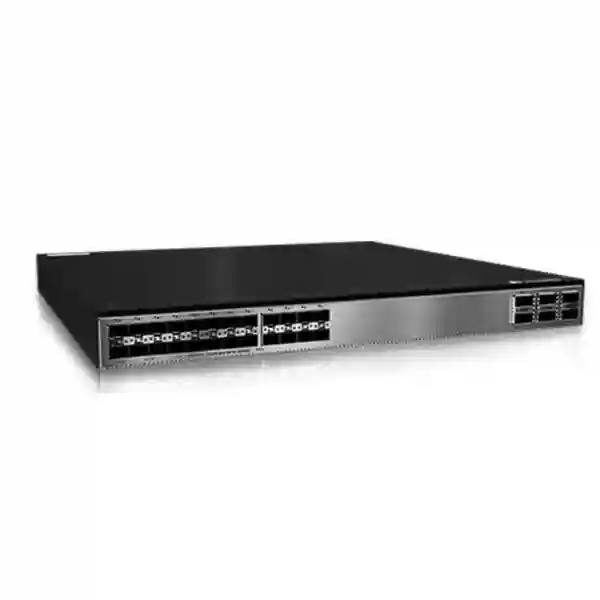
The Huawei CloudEngine S6730-S24X6Q is a fixed-port enterprise switch for organisations that need dense 10 Gigabit Ethernet fibre connectivity, high-speed 40GE uplinks, advanced campus virtualisation features, and a platform that can operate in aggregation, core, or high-density server-access roles. Huawei’s current international product page lists 24 × 10GE SFP+ fixed ports, 6 × 40GE QSFP+ fixed ports, 490 Mpps forwarding performance, and switching capacity of 960 Gbit/s / 2.4 Tbit/s, where Huawei states that the values before and after the slash refer to device and system switching capability respectively.
Direct answer for buyers
Choose the Huawei CloudEngine S6730-S24X6Q when the planned topology genuinely needs multiple 10GE optical connections and 40GE uplinks rather than ordinary 1GE access switching. It is particularly relevant for campus aggregation, compact campus core, high-speed distribution, or server-access designs where fibre density, VLAN and routing design, virtualised network services, and uplink resilience matter. The buying decision should not be based on port count alone. Confirm the intended software release, transceiver type, fibre medium and distance, required 40GE breakout or uplink design, redundant-power approach, rack airflow, management platform, and the exact bill of materials before placing an order.
FourTeck can help turn a model request into a quote-ready requirement. That means checking where each 10GE and 40GE link terminates, what optics are required, whether the switch will act as an access, aggregation, or core device, what routing and VXLAN functions are expected, and how the device will be monitored and supported. Availability, lead time, warranty, included accessories, and software entitlement should be confirmed in the formal quotation instead of assumed from a generic product listing.
Verified Huawei CloudEngine S6730-S24X6Q specifications
High-speed interfaces
Huawei lists 24 × 10GE SFP+ ports and 6 × 40GE QSFP+ ports. Optics, DACs, AOCs, breakout design, fibre type, connector type, and distance requirements must be matched to the actual network.
Published performance
Huawei’s international page publishes 490 Mpps forwarding performance and 960 Gbit/s / 2.4 Tbit/s switching capacity for this model. Real deployment results depend on traffic patterns, features, software, and network design.
Virtualised campus features
Huawei documents VXLAN Layer 2 and Layer 3 gateways, centralised and distributed gateways, BGP-EVPN, and NETCONF-based configuration support, making architecture and software planning important before procurement.
Operations and security
Huawei lists SVF parent-node capabilities, iPCA packet-loss statistics, encrypted communication analytics, threat-trap technology, network-wide security collaboration, and telemetry-supported network operations.
Power, cooling, and rack planning
Huawei’s S6730-S series datasheet lists a maximum power consumption of 249 W for the CloudEngine S6730-S24X6Q at 100% throughput with fans at full speed and a typical value of 135 W under the stated ATIS test condition at 30% traffic load. It also lists air-cooled heat dissipation, pluggable dual fan modules, and front-to-back airflow. These details matter because a switch that is technically suitable can still be a poor installation choice if the rack has conflicting airflow, insufficient power planning, inadequate cooling, or unsuitable UPS capacity.
The same datasheet lists an operating temperature range of -5°C to +45°C at 0–1800 m, with temperature derating at higher altitude and a note that the switch cannot be started below 0°C. Final site engineering should use the current Huawei documentation for the exact hardware revision and software combination being quoted.
Where the S6730-S24X6Q fits
The strongest use case is a network that already has a clear 10GE or 40GE requirement. Examples include an enterprise campus where access switches aggregate into high-speed fibre links, a compact core where multiple distribution blocks converge, or a server environment where hosts, storage-facing equipment, or downstream switches need 10GE optical connectivity. The six 40GE QSFP+ interfaces can support high-capacity uplink design, but the exact topology should be documented before optics are purchased.
For new projects, map every link by speed, media, distance, connector, redundancy role, and peer device. For refresh projects, also record existing VLANs, routing adjacencies, spanning-tree behaviour, link aggregation, management addresses, monitoring systems, and change-window constraints. If VXLAN, BGP-EVPN, or centralised network management is required, include those requirements explicitly in the quotation and implementation scope rather than assuming that a hardware model name alone defines the delivered solution.
Huawei CloudEngine S6730-S24X6Q Dubai
Buyers searching for the Huawei CloudEngine S6730-S24X6Q Dubai typically need more than a switch price. A practical Dubai requirement should identify whether the unit is for a new office campus, a data-room refresh, a high-speed aggregation layer, a server environment, or a resilient core design. The model’s 24 × 10GE SFP+ interfaces make optics planning central to the purchase: confirm whether each link is multimode or single-mode, the fibre distance, the connector and patching standard, and the peer device. The six 40GE QSFP+ ports should likewise be mapped to upstream, downstream, or inter-switch links so the bill of materials reflects the actual topology rather than only the chassis.
Dubai deployments often combine switching with firewalls, wireless infrastructure, IP telephony, servers, and cloud connectivity. The switch therefore needs to be reviewed as part of the whole network. Document VLAN boundaries, routing responsibility, firewall handoff speed, link aggregation, management access, monitoring, and redundancy. If the S6730-S24X6Q will sit behind a security gateway, the firewall and switch interface speeds should be aligned so an expensive 10GE or 40GE switching design is not restricted by an unintended lower-speed bottleneck. FourTeck’s perimeter firewall planning guidance is useful when defining this boundary.
Rack readiness is also important. Confirm front-to-back airflow, available rack depth, power feeds, UPS sizing, grounding, fibre management, and patch-panel capacity. Huawei publishes dual pluggable fans and front-to-back airflow for the model, so cabinet airflow should not be treated as an afterthought. If the project includes a firewall refresh at the same time, review the Dubai firewall deployment planning page to coordinate WAN, LAN, VLAN, and security-policy dependencies.
For a Dubai quotation, provide the switch quantity, required power arrangement, software requirements, 10GE and 40GE optic list, fibre distances, rack location, intended role, peer devices, and required configuration or migration work. FourTeck can then review the requirement through its UAE IT and networking platform. Current availability, delivery timing, warranty, entitlement, and included accessories should be confirmed in writing on the final quotation.
Huawei CloudEngine S6730-S24X6Q UAE
A UAE-wide Huawei CloudEngine S6730-S24X6Q project may cover a single headquarters, multiple emirates, or a standardised campus architecture used across branches. Procurement teams should separate the hardware requirement from the deployment requirement. Hardware selection covers the exact switch model, quantities, power components, optics, cables, and any accessories. Deployment planning covers VLANs, routing, uplink design, management, monitoring, software, migration, testing, documentation, and support responsibilities. Keeping these scopes distinct makes quotations easier to compare and prevents important implementation tasks from being assumed rather than specified.
The S6730-S24X6Q is most compelling where the organisation can use its 10GE fibre density. If most endpoints are ordinary 1GE copper devices, another access-switch class may be more appropriate. By contrast, campuses with fibre-fed access blocks, high-speed server rooms, distribution switches, or converged uplinks can make practical use of the 24 SFP+ interfaces. The 40GE QSFP+ interfaces support higher-capacity interconnection, but engineers should confirm the peer interface type and transceiver compatibility before purchase. Do not assume that every 40GE optic or breakout arrangement is interchangeable across vendors and hardware releases.
For multi-site UAE projects, record a repeatable standard for naming, VLAN allocation, management addressing, NTP, AAA, logging, SNMP or telemetry, configuration backup, and change control. Huawei documents telemetry-related operations capabilities and SVF functions for the S6730-S series, but the actual management design must match the organisation’s selected software and operational processes. Security handoff should also be explicit: define which routing or segmentation functions live on the switch and which remain on the firewall or other security platform.
FourTeck can support the pre-sales discussion by reviewing the intended topology and preparing a quote request around the complete bill of materials. Buyers can also review the FourTeck network-security capability overview when the switching project connects to firewall or segmentation work. Confirm exact regional part details, software entitlement, support terms, lead time, and warranty conditions before approval.
Huawei CloudEngine S6730-S24X6Q Uganda
Organisations evaluating the Huawei CloudEngine S6730-S24X6Q Uganda commonly include universities, financial institutions, government environments, hospitality groups, healthcare networks, large offices, internet-facing service organisations, and businesses with fibre-connected buildings. The first question is whether the network needs a high-density 10GE optical switch at the planned layer. If the unit will aggregate access switches from several floors or buildings, list each uplink speed, fibre path, distance, and redundancy requirement. If it will serve as a compact core, document the routing and security boundaries as well as the number of links expected over the next several years.
Power continuity should be part of the Uganda design. A high-speed switch may remain operationally central even when users are distributed across separate buildings, so include UPS runtime targets, generator transition behaviour, power-feed design, cooling, and spare-component strategy in the deployment plan. Huawei’s published front-to-back airflow and dual pluggable fan arrangement should be matched to the rack layout. Fibre management is equally important: label both ends, document optical budgets, use suitable patch panels, and maintain a port schedule so troubleshooting does not depend on institutional memory.
Where the switch participates in a campus fabric, confirm whether VXLAN, BGP-EVPN, NETCONF, telemetry, or SVF capabilities are required by the intended architecture and software version. These features should have an operational owner and a testing plan. For a conventional Layer 2/Layer 3 aggregation design, document VLANs, routing protocols, link aggregation, spanning-tree expectations, multicast needs, and management access instead of enabling complex features simply because the platform supports them.
Uganda buyers can use the FourTeck Uganda technology platform to frame local networking and infrastructure requirements. For quotation preparation, share the exact quantity, deployment city, rack environment, optic and fibre requirements, existing switch models, migration window, and whether configuration support is needed. Availability and delivery should be confirmed for the requested quantity rather than inferred from a product page.
Huawei CloudEngine S6730-S24X6Q Kampala
For a Huawei CloudEngine S6730-S24X6Q Kampala deployment, the network design often has to accommodate dense business districts, multi-floor buildings, campus links, server rooms, and connections between separate facilities. A useful procurement brief starts with a port map rather than a generic request for one switch. Identify which 10GE ports will connect to access switches, servers, storage-adjacent systems, or other aggregation devices, and which 40GE ports will provide core, backbone, or inter-switch connectivity. This lets the optics list, patching, and capacity plan be reviewed before equipment is ordered.
Kampala organisations upgrading from older Gigabit networks should also confirm whether downstream equipment can actually use 10GE. Replacing only the aggregation switch will not create end-to-end 10GE if access switches, server NICs, firewalls, fibre modules, or cabling remain at lower speeds. Build a dependency list covering peer interfaces, optic standards, fibre type, rack power, UPS, firewall handoffs, and management systems. If a firewall sits between high-speed internal networks and the WAN, compare the firewall’s actual inspected throughput and interface layout with the planned switch links.
Operational readiness matters after installation. Define administrator access, role separation, configuration backup, syslog or telemetry destinations, time synchronisation, monitoring thresholds, interface descriptions, and escalation contacts. For migration, capture the existing VLAN database, trunks, routing, access lists, link aggregation, spanning-tree settings, and any multicast requirements. A rollback plan should state how service returns to the previous topology if validation fails.
When requesting a Kampala quote, include the site type, number of cabinets, planned fibre routes, required optic reach, software expectations, and whether staging or migration assistance is required. The regional Uganda platform can support the wider procurement discussion, while the final quotation should identify what is and is not included. This approach makes the S6730-S24X6Q easier to compare on total deployment fit rather than on a single headline price.
Huawei CloudEngine S6730-S24X6Q Arua
A Huawei CloudEngine S6730-S24X6Q Arua requirement should be evaluated with particular attention to site resilience and supportability. Where an organisation depends on a central communications room for branch operations, education services, healthcare systems, hospitality, logistics, or public-facing applications, the switch may become a critical convergence point. The procurement plan should therefore cover more than the chassis: power protection, cooling, fibre patching, optics, spares strategy, remote management, configuration backup, and documented recovery steps all influence the real operational value of the installation.
The model’s 24 × 10GE SFP+ ports are suitable for fibre-centric designs, but each port should have a defined purpose. If the site currently uses 1GE fibre, clarify which links are being upgraded and whether remote endpoints support the new speed. If 10GE is being introduced between buildings, verify fibre type and distance before selecting optics. The six 40GE QSFP+ ports may be used for backbone or inter-switch capacity, yet they should not be purchased with arbitrary transceivers. Match the media and optics to the peer device, link length, connector type, and vendor support requirements.
For remote administration, decide how engineers will reach the switch during an outage or configuration incident. Management should be separated appropriately from normal user traffic, and credentials, AAA, logging, time synchronisation, and configuration backups should be part of the handover. If WAN reliability is variable, local teams should have basic documented checks for power, link state, optics, fibre patching, and upstream connectivity before an escalation.
Arua buyers should send a quote request with exact quantity, required link speeds, fibre distances, peer equipment, cabinet and power details, and the expected implementation scope. FourTeck can help structure the bill of materials and clarify dependencies before commercial approval. Avoid assuming immediate local stock, a fixed delivery time, or a particular warranty arrangement; those items should be confirmed for the actual order and destination.
Huawei CloudEngine S6730-S24X6Q Mbarara
For Huawei CloudEngine S6730-S24X6Q Mbarara projects, a common design question is how to connect a growing campus, institution, hotel, hospital, business centre, or distributed office without repeatedly replacing the aggregation layer. The S6730-S24X6Q provides a high concentration of 10GE optical interfaces and 40GE uplinks, so it can be considered where fibre growth is already visible in the network plan. Buyers should forecast the number of 10GE links needed at installation, after one year, and after expected building or service expansion, then reserve capacity for redundancy and maintenance.
A good Mbarara bill of materials identifies optics by link rather than buying a generic quantity. Record the source and destination equipment, speed, fibre type, approximate distance, connector, and whether the path uses patch panels or splices. This reduces the chance of receiving optics that fit the port physically but do not match the fibre plant or remote hardware. The same discipline applies to 40GE: define whether a port is a direct 40GE uplink, part of an inter-switch design, or subject to a specific breakout requirement supported by the intended configuration.
The switch’s role in routing should be explicit. If it is an aggregation device, determine where default gateways, route summarisation, access control, multicast, and firewall boundaries live. If it becomes a core device, document routing convergence, redundant paths, maintenance behaviour, and failure domains. Huawei’s VXLAN and BGP-EVPN support can be relevant for more advanced fabrics, but feature availability and design suitability should be confirmed against the selected software and architecture before implementation.
For quotation review, Mbarara customers should include network diagrams or at least a written topology, desired software baseline, optics schedule, rack and UPS information, quantity, deployment scope, and target support responsibilities. A clear request lets FourTeck distinguish hardware supply from installation, configuration, testing, and documentation. This also helps procurement compare offers on equivalent scope rather than comparing a bare switch against a more complete deployment package.
Huawei CloudEngine S6730-S24X6Q Gulu
A Huawei CloudEngine S6730-S24X6Q Gulu deployment can suit an organisation building a fibre-based backbone for multiple departments, buildings, server resources, or high-bandwidth services. The most important early step is to distinguish current demand from aspirational demand. If only a few 10GE links are needed, document why the remaining density is valuable for growth, resilience, or consolidation. If many links are already planned, create a port-allocation schedule before procurement so optics, patch cords, labels, and downstream hardware can be ordered consistently.
Gulu sites should also consider maintenance practicality. A central switch can affect many users when it is rebooted, upgraded, or loses power. Define maintenance windows, redundant network paths where required, UPS runtime, generator support, configuration backups, and change approvals. Huawei publishes front-to-back airflow for this model, so the switch should be installed in a rack with compatible cooling direction and sufficient clearance. Environmental monitoring in the communications room can help teams identify heat or power issues before they become service incidents.
When integrating with firewalls, WAN routers, wireless controllers, servers, or voice systems, confirm the interface speed and VLAN or routing responsibilities at every handoff. A 10GE aggregation design may still be constrained by a 1GE security or WAN edge if the architecture is not reviewed end to end. If the project involves network segmentation, decide whether inter-VLAN routing and policy live on the switch, firewall, or both, and document the expected traffic paths for testing.
Gulu procurement teams should request a formal bill of materials that identifies switch hardware, power components, optics, fibre accessories, software or support items, and services separately. Include the intended site, quantity, topology, existing equipment, and migration expectations. FourTeck can use those inputs to prepare a more precise discussion while current availability, logistics, warranty, and project scheduling remain subject to the final quotation and confirmed scope.
Huawei CloudEngine S6730-S24X6Q Kenya
Customers looking for the Huawei CloudEngine S6730-S24X6Q Kenya are often evaluating high-speed campus, enterprise, telecom-adjacent, education, hospitality, financial-services, data-room, or multi-building networks. The model should be assessed against the actual topology, not simply compared by port count. Its 24 × 10GE SFP+ interfaces are best used where fibre or high-speed server links are already part of the design, while the six 40GE QSFP+ ports provide options for higher-capacity uplinks. Before purchasing, document how many links are required, which are redundant, and what growth is expected.
Kenya projects may involve Nairobi headquarters, regional branches, campuses, warehouses, or remote facilities. A standard configuration template can simplify operations across multiple locations. Define VLAN naming, management addressing, AAA, logging, NTP, monitoring, configuration backup, firmware governance, and interface-description conventions. If different sites use different fibre distances, avoid treating optics as a universal accessory: select them link by link based on the physical path and peer equipment.
Procurement should also distinguish chassis cost from solution cost. The complete project may require transceivers, patch cords, fibre trays, rack work, UPS capacity, staging, software, configuration, migration, testing, training, and documentation. A low hardware-only quote can become more expensive later if these items are omitted. Conversely, an existing Huawei environment may already have compatible operational processes or accessories, so the bill of materials should reflect what is genuinely required rather than duplicating equipment.
Kenya buyers can review the FourTeck Kenya IT and enterprise networking platform when preparing a requirement. Send the exact model, quantity, deployment city, desired software baseline, optics schedule, rack and power information, and service scope. Current stock, lead time, warranty, and support entitlement should be confirmed on the final quotation for the specific order.
Huawei CloudEngine S6730-S24X6Q Kuwait
A Huawei CloudEngine S6730-S24X6Q Kuwait project should combine network-capacity planning with environmental and procurement checks. The model offers dense 10GE optical connectivity and 40GE uplinks, which can suit enterprise campuses, data rooms, large offices, hospitality, government, education, and distributed operations where fibre is used for backbone or aggregation links. Begin by mapping current and future connections so each high-speed port has a business purpose. This prevents overbuying in small networks and underestimating optics or uplinks in larger ones.
Cooling and rack airflow deserve explicit attention. Huawei publishes front-to-back airflow and intelligent fan-speed adjustment for the S6730-S24X6Q. The communication room should provide compatible airflow, clean rack space, suitable power and UPS capacity, and clear cable management. In warm climates, the equipment-room temperature and cooling resilience matter more than the outside temperature. Where a site has maintenance or power-risk concerns, document the expected behaviour during utility interruption, UPS transition, or cooling failure.
Kuwait buyers should also verify the commercial configuration. Ask the quotation to identify the exact hardware, power components, optics, accessories, software or support items, and professional services. Confirm the intended Huawei software release and required features, particularly if the design uses VXLAN, BGP-EVPN, NETCONF automation, SVF, or telemetry. These capabilities should be tied to an architecture and operating model rather than treated as marketing checkboxes.
For local requirement planning, the FourTeck Kuwait technology platform provides a regional contact path. Include quantity, deployment site, network diagram, fibre and optics details, peer devices, rack and power information, and whether staging, installation, configuration, or migration support is required. Availability and delivery timing must be confirmed for the exact order.
Huawei CloudEngine S6730-S24X6Q Ghana
For organisations searching Huawei CloudEngine S6730-S24X6Q Ghana, the decision usually centres on building a reliable high-speed aggregation or backbone layer rather than simply adding more Ethernet ports. Enterprises, universities, hotels, financial organisations, public institutions, service providers, and multi-building businesses can benefit from a structured fibre design when traffic from access switches, servers, wireless infrastructure, voice, CCTV, and business applications converges. The S6730-S24X6Q should therefore be evaluated alongside the traffic plan and network hierarchy.
Start by listing all existing uplinks and their utilisation, then identify which connections genuinely require 10GE or 40GE. This helps establish whether the 24 SFP+ ports provide useful density for the project. For each optical path, note fibre type, distance, patching, peer device, and redundancy. If older multimode or single-mode infrastructure is being reused, verify that the proposed optics and distances are compatible. Do not select transceivers solely because they fit the physical cage.
Operational planning should include configuration backup, monitoring, administrator roles, software maintenance, change control, and spares. If the switch will carry inter-VLAN routing or participate in dynamic routing, document route ownership and failure behaviour. If a firewall controls segmentation, ensure the VLAN and link design provides the necessary traffic path without creating accidental bypasses. For advanced campus architectures, Huawei’s published VXLAN and BGP-EVPN capabilities can be considered after compatibility with the selected software and management design is confirmed.
Ghana buyers should provide FourTeck with a project-level request: quantity, site location, switch role, desired feature set, optics schedule, rack and power environment, current network equipment, and required implementation services. Regional enquiries can also be coordinated through the FourTeck Africa IT infrastructure platform. Final supply terms, warranty, logistics, and delivery commitments should be documented in the quotation.
Huawei CloudEngine S6730-S24X6Q Nigeria
A Huawei CloudEngine S6730-S24X6Q Nigeria deployment may sit at the centre of a large corporate LAN, a campus, a hotel group, financial-services environment, education network, data room, healthcare organisation, logistics operation, or multi-branch infrastructure. Nigeria projects can vary significantly in scale, so the first step is to define the role of the switch. An aggregation switch collecting many access-layer uplinks has different resilience and routing requirements from a server-access switch or a compact core. The quotation and configuration plan should reflect that role explicitly.
For fibre-heavy networks, create an optics schedule before ordering. The S6730-S24X6Q has 24 × 10GE SFP+ interfaces and 6 × 40GE QSFP+ interfaces, but the transceivers and cabling are part of the solution design. Identify distance, fibre mode, connector, peer interface, and whether each link is production, redundant, spare, or migration-related. If the switch is replacing older equipment, compare the current optic types and link distances instead of assuming existing modules should be reused.
Power resilience is another important design input. Network core and aggregation devices should be included in UPS and generator planning alongside firewalls, routers, servers, wireless controllers, and ISP equipment. Document expected runtime and maintenance procedures so a power event does not reveal a hidden single point of failure. Huawei’s published front-to-back airflow should be matched with the cabinet cooling direction, and the communications room should be monitored for temperature and power conditions.
When requesting a Nigeria quote, include quantity, destination, required optics, current topology, routing and VLAN requirements, desired software, rack and power details, and whether staging or configuration support is required. FourTeck can coordinate broader Africa-focused infrastructure discussions through its regional platform. Avoid relying on unverified online statements about stock, warranty, or delivery; insist that these commercial details appear in the final quotation for the exact hardware and destination.
Huawei CloudEngine S6730-S24X6Q Seychelles
For Huawei CloudEngine S6730-S24X6Q Seychelles projects, logistics, spares planning, and remote supportability are often as important as the switch specification. A high-speed fibre switch may be suitable for resorts, enterprise offices, public institutions, education, financial services, service providers, or data-room environments that aggregate multiple network segments. Because replacing or adding components can involve additional logistics, the bill of materials should be more complete at the start: include required optics, fibre accessories, power components, rack needs, and practical spare items where justified by the site’s operational risk.
The network diagram should identify every 10GE and 40GE connection, its peer device, distance, fibre type, and redundancy role. This is particularly useful when links run between separate buildings or across a larger property. If the site uses existing fibre, confirm its suitability for the desired speed and distance. If new fibre is being installed, coordinate the cabling standard, patch-panel design, labelling, test results, and optic selection so the physical and logical network are commissioned together.
Remote operations should be designed before handover. Define secure management access, administrator roles, configuration backup, logging, monitoring, time synchronisation, and how a remote engineer can diagnose link or optic faults. Keep an updated port schedule and network diagram on site as well as in the organisation’s documentation repository. If advanced Huawei features such as VXLAN, BGP-EVPN, NETCONF, SVF, or telemetry are used, document the management dependencies and recovery procedure so a specialised configuration does not become difficult to support later.
A Seychelles quotation request should state the exact quantity, destination island or site, intended switch role, fibre and optic schedule, power and rack conditions, software expectations, and the required level of installation or remote configuration assistance. The final offer should clearly identify supply scope, commercial terms, lead time, warranty handling, and support responsibilities. This helps procurement evaluate the total deployment rather than comparing only the chassis price.
Compatibility and configuration questions to resolve before ordering
- Optics: Which SFP+ and QSFP+ modules, DACs, AOCs, fibre types, connector types, and reaches are required for each link?
- Peer devices: What switch, firewall, router, server NIC, or transport equipment is connected at the far end, and what speeds and optical standards does it support?
- Network role: Is the switch access, server access, aggregation, distribution, core, or part of a fabric? Which Layer 3 responsibilities belong on it?
- Software: Which software release and feature set are required, and what change-control or upgrade policy applies after deployment?
- Resilience: What happens if an uplink, power feed, optic, switch, or upstream firewall fails? Are redundant paths and tested convergence required?
- Operations: Where will logs, telemetry, alarms, configuration backups, NTP, and administrator authentication be managed?
- Physical site: Is rack airflow compatible, is there sufficient power and UPS capacity, and are fibre trays and patching documented?
Related FourTeck network-security resources on this site
High-speed switching usually connects directly to the security edge, so the surrounding firewall design should be checked at the same time. Start from the Firewall Dubai network-security portal for broader solution context. For smaller branch security requirements, the Palo Alto Networks PA-410 product guide shows how interface and firewall-sizing decisions affect downstream switching. The Palo Alto Networks PA-415 guide is useful where branch firewall connectivity and PoE requirements must be considered separately from the aggregation layer.
For another compact security option, review the Sophos XGS 88 firewall guide. Larger Palo Alto environments can use the PA-Series platform overview when aligning security gateways with campus or data-centre switching. These pages are not substitutes for S6730-S24X6Q compatibility validation; they are useful references for documenting the security-device interfaces that connect to the switch.
Frequently asked questions
How many high-speed ports does the Huawei CloudEngine S6730-S24X6Q have?
Huawei’s international product page lists 24 × 10GE SFP+ fixed ports and 6 × 40GE QSFP+ fixed ports. The required transceivers, cables, and fibre design must be matched to the actual deployment.
What forwarding performance does Huawei publish?
Huawei’s current international S6730-S product page lists 490 Mpps for the CloudEngine S6730-S24X6Q and switching capacity of 960 Gbit/s / 2.4 Tbit/s. Use the current regional Huawei documentation for final engineering because published values can differ across product regions or revisions.
Does the switch support VXLAN?
Huawei lists VXLAN Layer 2 and Layer 3 gateways, centralised and distributed gateways, BGP-EVPN, and NETCONF-based configuration. Confirm software release, licensing or entitlement requirements, and architecture compatibility for the proposed project.
Is the S6730-S24X6Q suitable for a campus core?
It can be considered for compact campus core or aggregation roles where its interface density, performance, routing requirements, resilience, and feature set match the design. Core suitability depends on the complete topology, failure-domain requirements, scale, and growth plan rather than the model name alone.
Should optics be included in the quote?
Yes, when the project needs them. Provide a link-by-link optics schedule so the quotation can distinguish switch hardware from SFP+, QSFP+, DAC, AOC, fibre patching, and other accessories. Do not assume generic optics are automatically suitable.
Can FourTeck quote installation and configuration?
Installation, staging, configuration, migration, testing, documentation, and training can be discussed as separate scope items. State what support is required so the quotation identifies services clearly instead of assuming they are bundled with hardware supply.
Quotation checklist
Hardware
Exact model, quantity, required power arrangement, rack requirements, and any spare components.
Optical links
Speed, fibre type, distance, connector, peer device, required SFP+/QSFP+ modules, DACs or AOCs.
Network design
Role, VLANs, routing, link aggregation, redundancy, VXLAN or fabric requirements, and firewall handoffs.
Services
Staging, installation, configuration, migration, testing, documentation, training, and ongoing support expectations.
Decision recap
The Huawei CloudEngine S6730-S24X6Q is a strong candidate when the network genuinely needs dense 10GE fibre access or aggregation and multiple 40GE uplinks. Its value comes from fitting the architecture: correct optics, correct peer devices, adequate power and cooling, a defined software and management model, and a documented resilience plan. Buyers should avoid comparing only the chassis price because transceivers, power, services, and migration requirements can materially affect the complete project.
For a useful quote, send FourTeck the intended country and city, quantity, topology, current switch models, fibre distances, link speeds, firewall or router handoffs, software expectations, rack and UPS information, and the required implementation scope. FourTeck can then clarify the bill of materials and commercial assumptions before purchase.
Consultation and next step
Share the model quantity, deployment location, 10GE and 40GE link schedule, required optics, desired switch role, software expectations, and installation scope. FourTeck can use these details to prepare a focused quotation discussion and identify any missing dependencies before procurement approval.

Reviews
There are no reviews yet.