
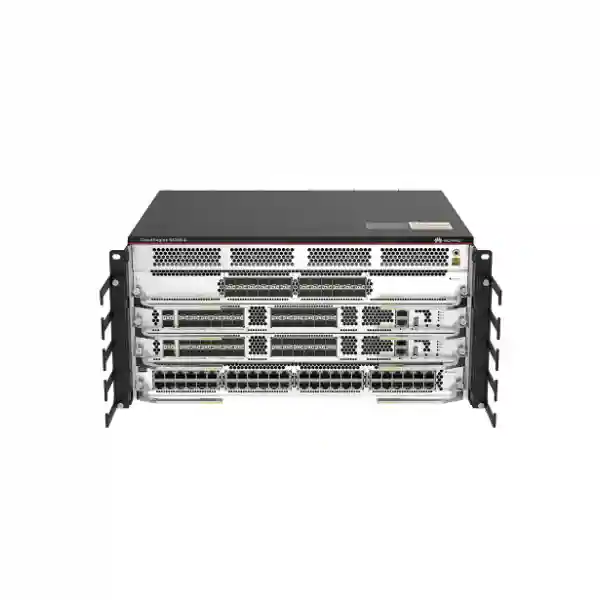
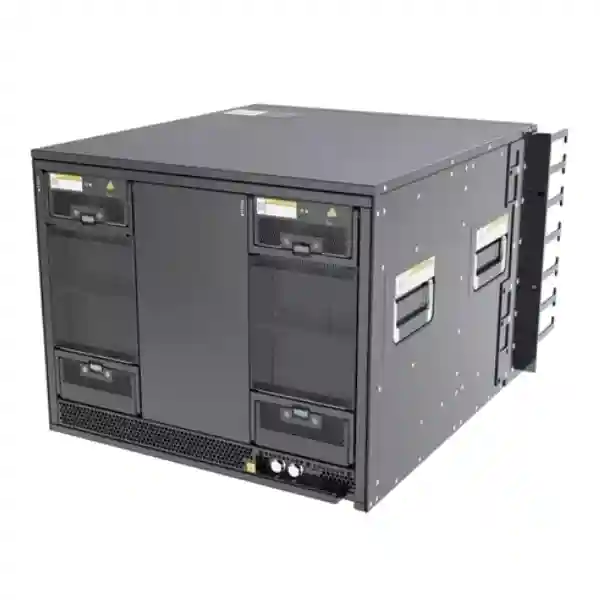
Huawei CloudEngine S8700-4S
The Huawei CloudEngine S8700-4S is a modular chassis switch in the CloudEngine S8700 family, designed for demanding enterprise campus core, aggregation, and high-density access roles. For buyers, the important question is not simply whether the chassis can move large volumes of traffic. A successful S8700-4S project depends on selecting the correct main control boards, service boards, optics, software release, feature licenses, power design, rack space, uplink plan, redundancy model, and management approach as one coordinated bill of materials.
Direct answer: what should a buyer know first?
Choose the Huawei CloudEngine S8700-4S when a modular enterprise campus platform is required and the design benefits from high interface density, resilient control, advanced Layer 2/Layer 3 services, EVPN/VXLAN capabilities, policy-based access control, IPv6 support, and centralized operations. Do not treat the model as a fixed-port appliance. The final capability and commercial price depend heavily on the selected boards, optics, licenses, power modules, software version, and support scope. Huawei’s current S8700 series documentation also identifies the S8700-4S as a non-PoE model: it can support relevant line-card options, but the chassis itself is not intended to deliver PoE power. If powering access points, cameras, or phones from the switching layer is part of the requirement, make that requirement explicit before the BOM is approved.
Verified Huawei CloudEngine S8700-4S platform details
Huawei documentation published for the S8700 family groups several capabilities across the S8700-4 and S8700-4S while also distinguishing the 4S chassis in important hardware details. Because software trains and board support evolve, a procurement-grade design should always match the intended chassis, board part numbers, software release, and license package instead of assuming that every series-level capability is automatically enabled in every configuration.
| Item | Huawei-published detail | Buyer interpretation |
|---|---|---|
| Chassis height | 5U | Reserve appropriate rack units plus sensible cable-management and airflow space. |
| Dimensions | 442 × 475.1 × 219.5 mm | Confirm rack depth, rear clearance, patching and airflow before installation. |
| Weight | About 23 kg base configuration; up to 44.28 kg full configuration | Plan rack loading, handling and mounting method around the quoted configuration. |
| Main control board slots | 2 | A resilient design normally evaluates dual-control architecture and failure behavior. |
| Service board slots | 4, with service ports associated with the control-board design in current documentation | Port count depends on the exact boards selected; validate slot use and expansion headroom. |
| Fan modules | 1 module position listed for the S8700-4/4S form factor | Confirm airflow orientation, environmental limits and replacement strategy in the BOM. |
| System power supplies | 2 for S8700-4S in Huawei’s current series datasheet | Confirm input type, redundancy policy, circuit design and actual module selection. |
| Published switching values | 68.2/307.2 Tbps and 51,200 Mpps in current Huawei series documentation for S8700-4/S8700-4S | Treat headline capacity as a platform figure; validate real port mix, oversubscription assumptions and board performance for the intended design. |
| PoE status | S8700-4S is identified as non-PoE; Huawei notes support for PoE line cards but no PoE power delivery from this model | If endpoint powering is required, design the access layer and power architecture separately and verify the exact supported solution. |
The S8700 family supports a broad set of campus functions including VLAN services, IPv4 and IPv6 routing, VXLAN Layer 2 and Layer 3 gateway roles, BGP-EVPN, NETCONF/YANG configuration, MACsec, NAC with MAC and 802.1X authentication, QoS, multicast, M-LAG, telemetry, NetStream, NQA, WebMaster management, and programmable operations. Feature entitlement and operational scale can depend on software and licensing. Huawei also documents integrated wireless-controller capabilities for the S8700-4/4S family column, with license considerations for larger AP counts. For procurement, these capabilities should be mapped to the project’s actual design rather than purchased on assumption.
Where the S8700-4S fits well
- Enterprise campus core where modularity, routing scale, redundancy and future interface growth matter.
- Aggregation for multiple access switches, wireless networks, CCTV networks, voice systems, servers and branch-facing links.
- Networks adopting VXLAN and EVPN to create segmented virtual networks over a shared physical campus.
- Organizations that require IPv4/IPv6 coexistence, strong access controls, MACsec options, QoS and operational telemetry.
- Projects that need a chassis platform rather than a fixed switch so port types and densities can be tailored through compatible boards.
Questions to resolve before ordering
- What copper, SFP, SFP+, 25GE, 40GE or 100GE port mix is required now and over the planned service life?
- How many uplinks, downstream switches, server links, wireless aggregation links and routed interfaces must be supported?
- Is PoE required anywhere in the same design, and if so which access switches or external power architecture will provide it?
- Which software features, controller functions and management services require licenses for the chosen software release?
- What redundancy, maintenance-window, spares, support and remote-management strategy is expected by the operations team?
How to build a quotation-ready Huawei CloudEngine S8700-4S requirement
Searches for “Huawei CloudEngine S8700-4S price,” “S8700-4S supplier,” or “Huawei S8700-4S datasheet” often begin with the chassis model, but a useful quotation requires more detail. A modular switch can be quoted very differently depending on the line cards, control boards, optics, licenses, support term, spare strategy and deployment services. The fastest path to an accurate commercial response is to convert the network requirement into a structured BOM brief.
1. Port plan
List every required interface speed and medium: copper Ethernet, SFP/SFP+, 25GE, 40GE or 100GE, including expected growth. Separate downstream access ports from inter-switch and server uplinks.
2. Resilience
Define whether dual control, redundant links, M-LAG, dual power feeds, spare optics or hot-swappable service components are required by the business continuity plan.
3. Features and licenses
State whether the design needs EVPN/VXLAN, advanced automation, wireless-controller functions, CampusInsight integration, access control, telemetry or other licensed capabilities.
4. Deployment scope
Include rack readiness, fiber type, optic distances, VLAN and routing design, cutover constraints, configuration scope, testing, documentation, training and post-deployment support.
Pricing should therefore be requested as a current project quotation rather than treated as a permanent online number. Exchange rates, board selection, optics, licensing, warranty or support coverage, freight, taxes and professional services can all change the commercial total. A good quote should make these components visible so procurement can compare like with like.
Regional buying guide
The following sections answer location-specific search intent for buyers looking for the Huawei CloudEngine S8700-4S in Dubai, the wider UAE, Uganda and its major cities, Kenya, Kuwait, Ghana, Nigeria and Seychelles. Each section focuses on deployment and procurement questions relevant to the location without assuming local stock, warehouse presence, delivery times or on-site engineering availability.
Huawei CloudEngine S8700-4S Dubai
For Dubai organizations searching for a Huawei CloudEngine S8700-4S supplier, price, configuration or enterprise campus switch, the most useful starting point is the network role. Dubai projects can range from office headquarters and schools to hospitality, healthcare, warehouses, mixed-use facilities and multi-building campuses. In each case, the core question is how many access layers, wireless users, CCTV streams, voice endpoints, servers and internet-edge systems must converge through the campus backbone. The S8700-4S is most valuable when a modular chassis is justified by interface density, resilience, routing features and future expansion rather than when a small fixed switch could meet the requirement more simply.
A Dubai BOM should specify rack space, fiber pathways, uplink speeds, patch-panel design, optical reach, redundancy, management network and power circuits. Because the S8700-4S is a non-PoE chassis, projects with high-density Wi-Fi, CCTV or IP phones should separate the campus-core requirement from the access-layer power requirement. That distinction prevents a common procurement mistake: assuming a line card with PoE-related capability means the 4S chassis can act as the endpoint power source. Ask the designer to show exactly where PoE is delivered and how those access switches uplink to the S8700-4S.
Dubai buyers also tend to ask for “Huawei S8700-4S price UAE” before the line-card mix is finalized. For a chassis platform, that approach can produce misleading comparisons. A quotation should identify the chassis, control boards, service boards, optics or DAC/AOC choices, power modules, software release, required feature licenses, support entitlement and any implementation service separately. If the network is expected to support EVPN/VXLAN segmentation, IPv6, NAC, MACsec, telemetry or advanced operations, include those outcomes in the request so licensing and software compatibility can be checked at the same time as hardware.
For UAE-wide IT infrastructure context, buyers can review FourTeck UAE enterprise IT and networking solutions and then submit the exact S8700-4S requirement for commercial validation. Before issuing a purchase order, request written confirmation of current availability, lead time, warranty or support coverage, software entitlement and the exact BOM. That makes the Dubai procurement decision auditable and reduces the risk of receiving a chassis that is technically valid but incomplete for the intended campus design.
Huawei CloudEngine S8700-4S UAE
UAE procurement for the Huawei CloudEngine S8700-4S often involves more than one location, such as a headquarters connected to branches, warehouses, schools, clinics, retail sites or operational facilities in different emirates. In that environment, the chassis may be evaluated as a central aggregation or campus-core platform while smaller switches serve the edge. The design should therefore consider not only current port count but also how branches, wireless systems, security appliances, servers and cloud-connected applications will be segmented and routed over the next several years.
A UAE design review should document whether the S8700-4S will provide Layer 3 gateway functions, whether VXLAN and BGP-EVPN are part of the target architecture, what VLAN and VRF segmentation is required, how IPv6 adoption will be handled, and how access-control policies integrate with the existing identity environment. If MACsec is being considered for selected links, identify the exact interfaces and peer devices. If wireless-controller functions or Huawei campus-management tooling are in scope, request the relevant software and license confirmation rather than assuming those functions are included by default.
Power and cooling planning should be tied to the final configuration, not the empty chassis. The S8700-4S is a 5U platform, so rack allocation should include cable-management and maintenance access. Optical transceivers should match fiber type and link distance, and the uplink plan should include a clear failure model. For example, a dual-homed access design may require separate line-card placement, diverse fiber paths and a defined M-LAG or routing approach. These decisions affect both hardware quantity and cutover procedure.
For procurement teams comparing multiple proposals in the UAE, insist on a normalized BOM. Each proposal should state chassis, boards, optics, licenses, software release, support term, installation scope and exclusions. Ask whether configuration, migration, testing and documentation are included or optional. Do not accept an unqualified “in stock” or “ready to deliver” statement without current written confirmation. A well-structured UAE quotation gives technical teams enough detail to verify compatibility and gives finance teams a transparent basis for comparing total project cost rather than headline chassis price.
Huawei CloudEngine S8700-4S Uganda
Organizations searching for Huawei CloudEngine S8700-4S Uganda typically need a dependable enterprise switching platform for a campus, institution, headquarters, data room or multi-building network. The first design task is to determine whether the network truly needs a modular core. Universities, healthcare groups, financial organizations, public institutions, NGOs, hospitality operators and larger businesses can accumulate many access switches, wireless access points, cameras, voice endpoints and server links. A chassis such as the S8700-4S can make sense where those systems need resilient aggregation, high interface density, routing control and a clear expansion path.
Uganda projects should give particular attention to power continuity, rack-room conditions, spares and remote manageability. That does not mean every site has the same infrastructure constraints; it means the network design should explicitly state what happens during utility interruption, generator or UPS transfer, link failure and component replacement. The S8700-4S power design should be matched to the available electrical architecture, and access switches that power phones, cameras or wireless APs should have their own PoE budget and backup-power analysis because the S8700-4S chassis is documented as non-PoE.
Fiber planning matters just as much as the chassis. Record building-to-building distances, fiber type, available strands and desired uplink speed before selecting optics. If the design uses 10GE, 25GE, 40GE or 100GE interfaces, confirm the exact service-board support and software compatibility for the chosen release. Where IT teams want centralized visibility, telemetry, NetStream, NQA, WebMaster or broader campus-management integration, add those requirements to the scope so the necessary licenses and management components can be validated before shipment.
Buyers can review FourTeck Uganda networking and IT solution information while preparing the request. A useful Uganda quotation should identify destination, quantity, full BOM, preferred support term, installation expectations, requested documentation and whether remote or on-site services are needed. Lead time and service coverage should be confirmed in writing for the specific project. This approach is more reliable than comparing chassis-only prices because it makes the operational design, logistics and long-term support expectations visible before procurement approval.
Huawei CloudEngine S8700-4S Kampala
For Kampala buyers, the Huawei CloudEngine S8700-4S is usually relevant when a central site has outgrown small fixed switches or when a new campus is being designed around a resilient aggregation layer. Headquarters, universities, hotels, hospitals, financial offices and multi-tenant business facilities may need to combine high-density Wi-Fi, business applications, surveillance, IP telephony and server connectivity over the same structured network. The S8700-4S can provide the modular core for such a design, but its value depends on a disciplined interface and redundancy plan rather than simply choosing the largest available chassis.
Kampala projects should map every floor, building or equipment room to the core before hardware is ordered. Count access switches, uplink pairs, server connections, WAN or firewall handoffs, management ports and spare capacity. Then define which links need 10GE, 25GE, 40GE or 100GE and whether the underlying fiber supports those speeds and distances. If a site is being upgraded from 1GE uplinks, the design should include a staged migration plan so existing access switches remain usable while higher-speed links are introduced.
A Kampala deployment may also benefit from clear segmentation between staff, guests, CCTV, voice, building systems, servers and management traffic. Huawei’s S8700 platform supports VLAN, routing, NAC, MACsec and VXLAN-related capabilities that can help build this structure, but feature use should be aligned with the actual security policy and operational skill set. The network should not become more complex than the team can maintain. If centralized automation or controller-based management is desired, include training, configuration templates, backup procedures and software entitlement in the project scope.
For purchasing, avoid a quote that contains only “S8700-4S chassis.” A deployment-ready Kampala quote should show board quantities, transceiver models, power modules, licenses, support term and the services required to stage, configure and test the equipment. If the campus has limited maintenance windows, request a documented cutover and rollback plan. If replacement parts or specialist support could take time to reach the site, consider which components justify local spares. These planning choices often have more impact on uptime than the headline switching-capacity figure.
Huawei CloudEngine S8700-4S Arua
A Huawei CloudEngine S8700-4S Arua project should be judged by operational practicality as much as raw capability. Regional institutions, educational facilities, healthcare environments, NGOs, logistics operations and larger commercial sites may need a central switch that can aggregate multiple buildings or departments while supporting future bandwidth growth. If the S8700-4S is selected, the design should reduce avoidable complexity and make remote troubleshooting straightforward for teams that may not have a chassis-switch specialist permanently on site.
Start with a physical inventory: rack dimensions, usable rack units, power circuits, UPS capacity, cooling, fiber routes and patching. The 5U S8700-4S requires proper installation space and should not be treated like a desktop switch. Then list every downstream connection and the bandwidth it needs. A building with cameras, access points, office users and local servers may have very different traffic patterns from a site dominated by cloud applications. The service-board selection should match those real interfaces rather than maximize port density without purpose.
Remote management deserves special attention. Define an out-of-band or protected management approach, configuration backup process, administrator roles, logging destination and escalation path. Huawei’s telemetry, NQA, NetStream and management capabilities can support visibility, but the monitoring design must include where data is collected and who responds to alerts. For resilient sites, specify redundant uplinks and document the expected behavior when a fiber, board, control component or upstream service fails. A tested failure plan is more valuable than redundancy that exists only on a diagram.
Procurement in Arua should also account for logistics and spares before the order is finalized. Confirm expected delivery timing for the full BOM, not only the chassis, and identify any optics, fan or power components that should be kept as project spares. Because the S8700-4S does not provide PoE power, endpoint-power requirements should be assigned to suitable access switches with their own UPS calculation. Ask for configuration documentation and a handover checklist so local IT staff can identify boards, optics, cable labels, software version, licenses and support contacts after installation.
Huawei CloudEngine S8700-4S Mbarara
Businesses and institutions evaluating the Huawei CloudEngine S8700-4S in Mbarara may be planning a new campus backbone, expanding an existing network or consolidating multiple standalone switches into a more manageable architecture. Typical requirements can include office connectivity, Wi-Fi, IP telephony, CCTV, business applications, laboratories, classrooms, clinical systems, warehouses or branch links. The right question is whether those services need a modular core with resilient routing and high-speed aggregation, and if so, which interface mix creates enough capacity without overspending on unused ports.
Design the network from the access edge inward. Count powered endpoints separately from non-powered uplinks because the S8700-4S itself is a non-PoE chassis. If cameras, phones and access points are significant, choose access switches with suitable PoE budgets and connect them to the core over fiber or high-speed copper as appropriate. This separation makes electrical planning clearer and avoids expecting the core chassis to perform an access-layer power role that the 4S model is not designed to provide.
Mbarara sites with multiple buildings should document fiber availability and distance before choosing transceivers. If the project will use redundant fiber paths, identify physically diverse routes where possible and decide whether resilience will be provided through routing, M-LAG or another supported topology. Network segmentation should be planned at the same time. Staff, guests, servers, CCTV, voice, student or clinical devices may require separate policies, and the S8700 platform’s NAC, VLAN, routing and security-related functions can support that structure when properly configured.
For quotation requests, include location, rack readiness, port requirements, preferred software version if standardized, expected license features, optical distances, quantity and support expectations. If the site depends on a small IT team, ask for clear as-built documentation, configuration backups and a practical knowledge-transfer session. If expansion is likely, keep one part of the BOM discussion focused on free slots, spare ports and future uplink speed. Planning those details at purchase time can be more economical than redesigning the campus after every new building or service is added.
Huawei CloudEngine S8700-4S Gulu
For a Huawei CloudEngine S8700-4S Gulu requirement, a useful design process begins with service continuity and manageable growth. Institutions and businesses may need to connect administrative offices, teaching spaces, healthcare areas, accommodation facilities, security systems or remote buildings through a common campus network. A modular chassis can provide room for expansion, but the network should remain easy to operate. The objective is not to activate every advanced feature; it is to select the functions that solve actual availability, segmentation, performance and management needs.
Create a simple dependency map showing what stops working if the campus core is unavailable. This reveals which uplinks need redundancy, which services require separate routing or VLANs, and whether dual control components or spare hardware are justified. Then map the physical paths. Record fiber distances, connector types, available strands and patch locations. Optics must be chosen for the installed cabling and expected speed. A technically correct chassis paired with the wrong transceiver or fiber assumption can delay a project just as easily as an incorrect switch choice.
Operational visibility is another priority. If local teams want to monitor loss, latency, utilization and device health, define the tools that will receive telemetry or flow data and the thresholds that trigger action. Huawei S8700 capabilities such as telemetry, NQA and NetStream can contribute to that strategy. Access control can also be strengthened through NAC and authentication features, but any rollout should include user groups, device exceptions, guest access and a recovery method so security controls do not unexpectedly interrupt essential services.
When requesting pricing in Gulu, ask for a complete bill of materials and a separate service scope. The hardware line should identify chassis, control boards, service boards, power modules, optics and required accessories. The software line should identify licenses and support. The professional-services line should state whether configuration, migration, testing, documentation and training are included. Because the S8700-4S is non-PoE, ensure powered endpoints are budgeted through suitable access switches. Finally, confirm delivery and support timing for the actual destination rather than assuming a regional estimate applies automatically to the project.
Huawei CloudEngine S8700-4S Kenya
Kenyan enterprises searching for the Huawei CloudEngine S8700-4S are often comparing campus-core, aggregation and data-room options for offices, universities, hospitals, hospitality sites, financial environments, industrial facilities and multi-branch organizations. The S8700-4S is relevant where a modular chassis, high-speed uplinks and advanced routing or segmentation are required. Buyers should begin with a logical network design showing access-switch quantities, server or storage connectivity, firewall handoffs, branch links, wireless aggregation and the expected growth in east-west and north-south traffic.
Kenya projects commonly need clear interoperability planning because a new core may be introduced into an existing mixed-vendor network. List all current switches, routing protocols, VLANs, link-aggregation methods, transceiver standards and management tools that must remain in service during migration. If EVPN/VXLAN is a future goal rather than a day-one requirement, specify the software and licensing path now so the platform does not become constrained later. Similarly, if IPv6 is being introduced gradually, document dual-stack routing and security expectations rather than treating IPv6 as an afterthought.
Power, rack and fiber design remain practical buying factors. The 5U chassis requires suitable rack space and handling. The S8700-4S is documented as non-PoE, so wireless APs, phones and cameras should be powered by appropriate access switches or another designed power method. Optical modules must match the installed fiber and link distances, especially where a campus spans several buildings. For redundant designs, include both physical path diversity and logical failover. A second link in the same duct or to the same upstream device may not provide the resilience stakeholders expect.
For country-specific IT context, see FourTeck Kenya enterprise networking information. A Kenya quotation request should contain the destination city, required quantity, port matrix, optics distances, software or feature needs, support term and installation scope. Ask the supplier to state lead time and availability as current quotation information rather than a permanent promise. Procurement teams should compare the complete BOM, warranty or support coverage and implementation responsibilities, because a low chassis-only figure can become expensive if required boards, optics or licenses were omitted.
Huawei CloudEngine S8700-4S Kuwait
For Kuwait organizations considering the Huawei CloudEngine S8700-4S, the chassis is best evaluated as part of the complete campus architecture rather than as an isolated purchase. Corporate headquarters, education campuses, healthcare facilities, hospitality groups, government environments and large commercial networks may require dense fiber aggregation, resilient routing, controlled segmentation and room for future high-speed interfaces. The S8700-4S can address those needs when the selected boards and software are aligned with the intended network role.
Kuwait deployments should pay close attention to equipment-room engineering. The published 5U chassis dimensions need to be checked against cabinet depth, cable bend radius, airflow and service access. Cooling and electrical design should be based on the fully configured BOM, not just chassis documentation. Where dual power feeds or UPS-backed circuits are required, the facilities plan and the network redundancy plan should be reviewed together so maintenance on one side does not unexpectedly remove both protection paths.
If the S8700-4S will aggregate high-density wireless or surveillance networks, remember that it is a non-PoE chassis. Endpoint power should be delivered at the access layer with switches sized for the actual PoE class and total power budget of connected devices. The core then focuses on high-speed forwarding, routing, segmentation and management. For organizations adopting VXLAN, BGP-EVPN, MACsec, NAC or advanced telemetry, request confirmation of the software release, supported board combination and required licenses in the same proposal.
Buyers can review FourTeck Kuwait IT and networking information when preparing a local requirement. A procurement-ready Kuwait RFQ should include the desired delivery location, full port matrix, fiber distances, redundancy objectives, management platform, support term and any configuration or migration services. Ask for explicit confirmation of availability and lead time at quotation stage. Also request a list of exclusions, because optics, patch leads, rack accessories, licenses, installation and support may be priced separately depending on the proposed solution.
Huawei CloudEngine S8700-4S Ghana
A Huawei CloudEngine S8700-4S Ghana project may be driven by campus expansion, bandwidth growth, network consolidation or the need for a more resilient enterprise core. Universities, financial organizations, healthcare providers, hotels, public institutions, industrial sites and large businesses can all reach a point where fixed switches create too many individual management and uplink constraints. A modular platform becomes attractive when it simplifies aggregation and provides a structured path to higher-speed interfaces and more advanced routing or segmentation.
The design should start with traffic sources and destinations. Count access switches, wireless users, surveillance cameras, voice devices, servers, internet gateways and inter-site links. Identify which applications are sensitive to latency or packet loss and where QoS is required. If multicast supports video distribution or other services, include that in the configuration plan. If the organization is preparing for IPv6, specify dual-stack requirements. If business units or tenants need isolation, decide whether conventional VLAN and routing segmentation is sufficient or whether VXLAN and EVPN are part of the target architecture.
Ghana deployments should also make power and support continuity visible in the design. The S8700-4S is a non-PoE chassis, so endpoint-power budgets belong at the access layer. The core should have clearly documented UPS and power-feed requirements, while monitoring and configuration backups should support recovery if hardware or software maintenance is needed. Where the central site is far from the team that normally provides specialist support, remote management, spare optics and clearly labeled cabling can reduce troubleshooting time.
For wider regional infrastructure guidance, buyers can use FourTeck Africa IT solution information while defining the project. A Ghana quotation should state destination, quantity, chassis configuration, line-card and port requirements, optical reach, software features, license needs, support term and installation scope. Ask for current logistics and lead-time information in writing. A complete proposal should make it clear which items are supplied, which services are included, and which accessories or subscriptions remain the customer’s responsibility.
Huawei CloudEngine S8700-4S Nigeria
For Nigerian enterprises, the Huawei CloudEngine S8700-4S can be considered when a campus or headquarters requires modular aggregation, resilient routing, high-density uplinks and advanced network segmentation. Large offices, banks, universities, hospitals, hospitality groups, energy and industrial organizations, service providers and multi-site businesses may need a core that can consolidate many access layers while maintaining predictable management. The design should be sized from measured or estimated traffic and interface needs, not only from user count, because video, wireless, server and inter-site workloads can vary significantly.
A Nigeria BOM should include a detailed port matrix and a power-resilience plan. The S8700-4S power modules, UPS circuits and facility feeds should be selected as part of one design. Powered endpoints remain an access-layer responsibility because Huawei documents the S8700-4S as non-PoE. If the organization has many Wi-Fi access points, cameras or phones, calculate the PoE budget on each access switch and make sure uplinks to the S8700-4S have enough bandwidth and redundancy to carry aggregated traffic during normal operation and link failure.
For multi-building or multi-site environments, fiber and WAN architecture deserve separate review. Define optical distances, fiber type, route diversity and handoff speed. If the organization wants active-active campus designs, M-LAG or routed dual-homing, document the failure behavior and maintenance process before choosing boards. If VXLAN/BGP-EVPN will be used for virtualized campus segmentation, verify the software release and license package. NAC, MACsec, IPv6, telemetry and management integrations should also be included explicitly when they are project requirements.
Commercially, ask for a full landed-project view rather than a chassis-only figure. Confirm the exact hardware list, optics, accessories, software licenses, support term, shipping assumptions, taxes or duties where applicable, configuration services and documentation. Regional resources available through FourTeck Africa can help frame the requirement, but current availability and service coverage should always be confirmed for the specific destination. For high-dependency sites, consider which transceivers, power components or other field-replaceable items justify local spares and include them in the budget instead of waiting for a failure to expose the gap.
Huawei CloudEngine S8700-4S Seychelles
For Seychelles buyers, the Huawei CloudEngine S8700-4S is most relevant where a hotel group, resort, public institution, education environment, healthcare facility, financial organization or larger enterprise needs a resilient campus backbone with room for growth. Island deployments make careful scope definition especially important because an incomplete shipment or missing optic can have a larger schedule impact than it might in a market where replacement items are immediately nearby. The procurement process should therefore prioritize a complete, validated bill of materials and a practical spare strategy.
Start with the physical topology. Record building locations, fiber routes, distances, available strands, rack rooms and environmental conditions. Determine which links require 10GE or higher speeds and whether the current cabling can support them. If the network spans separate buildings or facilities, decide which links need redundancy and whether diverse paths are physically achievable. The S8700-4S should be configured only after those facts are known, because service-board and optic choices follow the cabling and traffic design.
The non-PoE nature of the S8700-4S is also important for hospitality and campus environments, where access points, cameras and IP phones can represent a large power load. Keep those endpoints on suitable PoE access switches and size the access-layer power budget carefully. The core chassis can then aggregate those access switches and provide routing, segmentation, security-related controls and management functions. If centralized monitoring is required, define the remote-management and telemetry path so faults can be diagnosed without relying solely on physical access to the core.
A Seychelles RFQ should include destination island, delivery location, required quantity, hardware BOM, optics, software and licenses, support period, spares, installation scope and documentation needs. Ask the supplier to confirm current freight assumptions, lead time and support options for the exact project. Where a maintenance visit could require travel, remote-access procedures, configuration backups and labeled spare parts become especially valuable. A small amount of disciplined preparation before purchase can reduce the risk of installation delays and make the network easier to operate throughout its service life.
Deployment and migration planning
A chassis switch often becomes a critical point in the network, so installation should be treated as a change project rather than a simple equipment swap. Begin by collecting the existing topology, VLAN database, routing tables, link aggregations, spanning-tree design, ACLs, QoS policies, multicast requirements, management addresses and monitoring integrations. Identify which services must remain available during the change and establish a rollback point. Configuration templates should be reviewed before the maintenance window, while optics and fiber links should be tested wherever possible before production traffic is moved.
If migrating from another Huawei platform or a different vendor, do not copy syntax or policy logic blindly. Translate the intended behavior. For example, determine why a VLAN exists, which gateway should host it, what ACL is protecting it, which routing protocol advertises it, and what application depends on it. Legacy configurations often contain unused objects and exceptions that do not deserve to be carried into a new core. The migration is an opportunity to simplify the network while preserving required services.
After cutover, validate more than basic ping tests. Check routing convergence, link redundancy, expected forwarding paths, voice and video quality, wireless reachability, CCTV streams, server access, internet and firewall handoffs, management access, authentication, logging, NTP, telemetry and backups. Record the final software version, board inventory, serial information, license status, port descriptions and optic details. A clean as-built document gives future support teams a reliable baseline and makes hardware replacement or software upgrade planning much easier.
Huawei CloudEngine S8700-4S FAQ
Is the Huawei CloudEngine S8700-4S a core switch?
It is a modular high-end campus switching platform that can be used for core, aggregation and high-density access roles depending on the network design. The correct role depends on required interfaces, routing, redundancy, scale and software features.
Does the S8700-4S provide PoE?
Huawei’s current S8700 documentation identifies the S8700-4S as a non-PoE model. It notes support for PoE-related line cards but states that the 4S does not provide PoE power. Treat endpoint power as a separate access-layer design requirement.
What is the Huawei S8700-4S price?
There is no single useful project price because the chassis is only one part of the solution. The total depends on control boards, service boards, optics, power modules, software licenses, support, logistics and deployment services. Request a current BOM-based quotation.
Does it support VXLAN and BGP-EVPN?
Huawei documents VXLAN Layer 2 and Layer 3 gateway functions, centralized and distributed gateways, and BGP-EVPN across the S8700 series. Confirm the software release, board combination and license package for the intended configuration.
Can the S8700-4S support IPv6?
Yes. Huawei documents IPv4/IPv6 dual-stack operation and multiple IPv6 routing capabilities in the S8700 family. The deployment should still define addressing, routing, security and monitoring policies before IPv6 is enabled in production.
What should be included in a quote request?
Provide quantity, destination, rack constraints, port matrix, fiber distances, uplink speeds, redundancy requirements, features, management platform, software preference, support term, spares and deployment scope. This gives the supplier enough information to build a meaningful BOM.
How should optics be selected?
Match the transceiver to port type, required speed, fiber type and actual link distance. Also verify that the optic and board combination is supported by the target software release. Do not select optics only by connector appearance.
Can the switch be used in a mixed-vendor network?
It can interoperate through standards-based Ethernet and routing features when both sides are designed and configured compatibly. Validate link aggregation, routing protocols, VLAN tagging, optics, MTU, authentication and any vendor-specific features during planning and testing.
Related S8700 choices to compare
CloudEngine S8700-4
Compare when the project needs the related 4-slot family form factor but has different power and PoE design requirements. Confirm the exact hardware distinctions and supported boards before substituting one model for another.
CloudEngine S8700-6
Consider when additional service-board capacity and a larger chassis are justified by port density, growth or architectural requirements. Compare rack space, power, board count and total project cost.
CloudEngine S8700-10
Evaluate for larger campuses requiring substantially more service-board capacity. The bigger chassis should be chosen because the network needs its scale, not simply because it is the highest model in the family.
Decision recap
The Huawei CloudEngine S8700-4S is a strong fit when the project requires a modular, feature-rich campus core or aggregation platform and the network team is prepared to define the complete configuration. Its value comes from architectural flexibility, high-speed interface options, routing and virtualization capabilities, access-control features and operational tooling. The principal buying risk is under-specification: ordering a chassis without validating boards, optics, licenses, power, software and support.
The next step is to convert the network diagram into a quotation checklist. That produces a proposal that engineering can validate and procurement can compare. For regional projects, add destination, logistics expectations and service scope rather than assuming a standard delivery or support model applies everywhere.
Quotation checklist
- Destination city/country and required quantity
- Port speeds, media and total interface count
- Fiber type, distance and optic requirements
- Redundancy, M-LAG, routing and failover objectives
- VXLAN, EVPN, NAC, MACsec, IPv6 and telemetry needs
- Software release and license expectations
- Power, rack, UPS and cooling constraints
- Support term, spares, configuration and training scope
Prepare a configuration that can be quoted accurately
Send the target location, quantity, network diagram or port matrix, uplink speeds, fiber distances, redundancy objectives, software features and support expectations. FourTeck can use that information to structure a Huawei CloudEngine S8700-4S quotation request around the actual project rather than a generic chassis price. Availability, delivery timing, warranty or support coverage and professional-service scope should be confirmed in the resulting quotation before purchase.

Reviews
There are no reviews yet.