
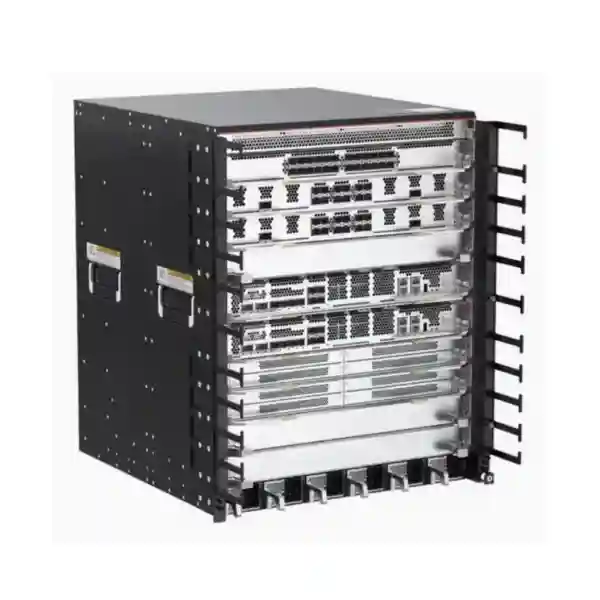
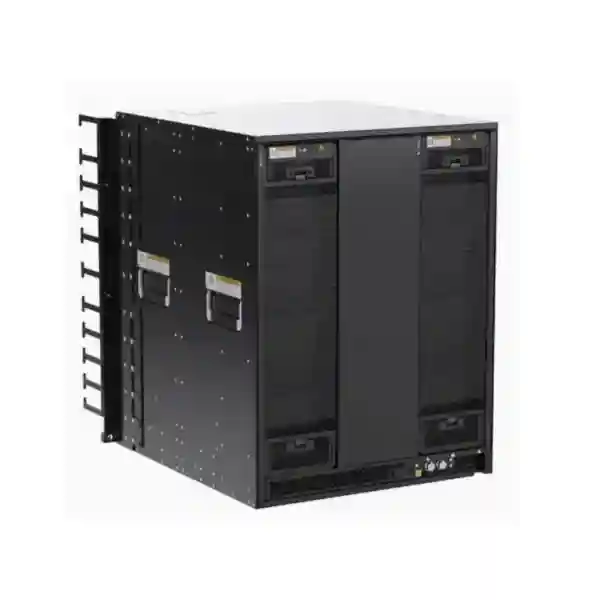
Huawei HiSecEngine USG12000-H6 Firewall for Dubai & UAE Data Centers
The Huawei HiSecEngine USG12000-H6 is built for environments where security inspection, availability and interface scale must keep pace with multi-hundred-gigabit and terabit network designs. Its distributed hardware architecture combines line processing units for high-density connectivity with service processing units dedicated to firewall and security workloads, giving architects a modular way to scale data-center egress, large campus borders, cloud interconnects and high-capacity enterprise gateways.
IPv4 throughput published for 1518/512/64-byte UDP frames. Packet size matters when translating headline bandwidth into production capacity.
Published IPv4 HTTP/1.1 concurrent-connection capability for high-session-count enterprise and data-center environments.
High connection-setup rate helps architectures with microservices, large user populations, bursty Internet services and east-west application flows.
Published NGFW result with firewall, service awareness and IPS enabled under Huawei’s enterprise-mix traffic model.
What the USG12000-H6 is designed to solve
Large organizations do not usually encounter firewall limitations because a single feature is missing. They encounter them when traffic growth, encrypted applications, session churn, high availability, inspection depth and interface density collide at the same point in the topology. The USG12000-H6 addresses that problem with a modular chassis rather than a fixed-port appliance. Line Processing Units, or LPUs, provide the external network interfaces and forward traffic into the chassis. Service Processing Units, or SPUs, perform firewall and security processing. This separation lets the platform support different combinations of connectivity and security capacity while preserving a clear operational model for expansion.
For a Dubai enterprise, that matters when a network is moving from multiple 10GE uplinks to 40GE or 100GE aggregation, when Internet breakout is being consolidated into a pair of core security gateways, or when several business units, tenants or security zones need to share a resilient platform. A design can start with the service-board and interface mix required for today’s traffic and reserve slots for later expansion. That is materially different from replacing a fixed appliance every time the edge moves to the next bandwidth tier.
The H6 should therefore be viewed as an infrastructure platform rather than merely a firewall SKU. It is most appropriate when firewalling is part of a larger architecture that includes routing, VPN termination, IPS, malware prevention, URL control, SSL inspection, threat intelligence, telemetry, centralized management, virtual firewalls and high availability. FourTeck can position the appliance as part of a complete UAE perimeter or data-center security design through the Firewall Dubai security portfolio, with broader infrastructure integration available through FourTeck UAE.
Architecture: distributed processing for high-capacity security
LPUs handle external connectivity
The published H6 interface families include LPUG-U-16CQ24XS, LPUG-U-8CQ24XS and LPUG-U-4CQ24XS cards. These provide combinations of 40G/100G QSFP28 interfaces and 100M/1G/10G SFP+ interfaces. In practical design terms, the chassis can connect to high-speed spine, core, border router and data-center switching layers without requiring a separate low-density security appliance for every link. High-density 10GE ports can be used for aggregated server, campus or service connections, while 40GE/100GE ports serve high-capacity uplinks and core-facing segments.
The value is not simply the maximum port speed. It is the ability to choose interface density that matches the network topology. A data center might prioritize many 100GE paths between border leaves and the firewall pair, whereas a large campus might combine 100GE core uplinks with a larger number of 10GE distribution and service links. Because optical module type, fiber plant, breakout design and upstream switch capabilities affect the actual bill of materials, the LPU choice should be finalized alongside the switching architecture rather than treated as an isolated firewall decision.
SPUs perform security services
Huawei lists SPUG-USG-02, SPUG-USG-03 and SPUG-USG-04 service processing units, with progressively higher service throughput. A fully equipped SPUG-USG-04 is published at 540 Gbps firewall throughput for 1518-byte UDP traffic and lower figures for smaller packets, illustrating why packet size and traffic profile are critical to sizing. The same SPU is published with up to 144 Gbps NGFW throughput for 100 KB HTTP test files and 64 Gbps NGFW throughput using the enterprise-mix model.
This architecture lets security capacity be scaled by board selection instead of only by chassis replacement. The design team can match SPU quantity and model to real inspection requirements. That is particularly important when SSL decryption, IPS, antivirus and application identification are mandatory, because these workloads demand far more processing than basic stateful firewall forwarding. The correct sizing target is therefore not the 2.16 Tbps headline alone; it is the throughput of the exact enabled security stack under a traffic mix that resembles the production network.
Published performance and what each number means
All performance values should be treated as vendor laboratory benchmarks, not guaranteed application throughput. Final sizing should reserve headroom for traffic growth, asymmetric flows, logging, feature combinations, updates, encryption and failover events.
Security inspection stack for enterprise perimeter and data-center use
The USG12000-H6 combines stateful firewall functions with a broad next-generation security stack. Huawei describes integrated firewall, VPN, intrusion prevention, antivirus, bandwidth management, Anti-DDoS and URL filtering, with policy controls that can use security zones, addresses, ports, applications, VLAN information, user context, time ranges and other traffic attributes. This enables a policy model that is much closer to application and business intent than a traditional port-only rule base.
Intrusion prevention
The IPS capability is designed to identify exploitation attempts, web attacks, botnet activity, remote-control behavior and other malicious patterns. Huawei publishes support for more than 25,000 predefined signatures along with user-defined signatures and automated database updates. For enterprise deployment, IPS policy should be tuned by zone and application instead of simply applying the strictest profile everywhere. Critical servers, Internet-facing services, user browsing and trusted inter-data-center flows have different risk and latency tolerances, so the inspection profile should reflect the exposure of each segment.
Antivirus and advanced malware prevention
Huawei documents malware inspection for common web, file-transfer, mail and file-sharing protocols, as well as heuristic techniques intended to identify packed or obfuscated malware and suspicious compound documents. Suspicious content can also be forwarded for sandbox analysis where the wider solution design includes that capability. In production, administrators should define file-size limits, protocol coverage, fail-open or fail-close behavior and exception handling before enabling deep content scanning on high-throughput paths.
URL and DNS security
Huawei states that its cloud URL categorization can reference more than 560 million URLs across more than 130 categories. DNS security can identify malicious domains, command-and-control infrastructure, algorithmically generated domains and phishing or ransomware-related destinations. The operational advantage is the ability to enforce browsing and domain controls centrally at the gateway, while exceptions and business-required destinations are managed under formal change control rather than unmanaged endpoint workarounds.
Anti-DDoS and flood protection
The platform includes mechanisms for detecting and limiting common flood and malformed-packet attacks, including SYN, UDP, ICMP, HTTP, HTTPS, DNS and SIP-related floods. This is valuable as a defensive layer at enterprise and data-center edges, but it should not be confused with upstream volumetric DDoS scrubbing. If the Internet circuit itself can be saturated, the architecture should combine on-premise detection and enforcement with ISP or cloud-based diversion and scrubbing so that malicious traffic is removed before it consumes the access link.
Encrypted traffic inspection: size for the security policy, not the port speed
Modern enterprise traffic is predominantly encrypted, so an architecture that only looks at unencrypted NGFW throughput can be misleading. Huawei publishes 128 Gbps SSL inspection throughput for the H6 under a specified TLS 1.2 test profile with IPS enabled. That number is meaningful because it shows the difference between raw stateful forwarding and cryptographic inspection. Decryption requires certificate handling, key exchange, session establishment, bulk encryption and re-encryption, and then the decrypted payload is passed through security engines such as IPS, antivirus or URL filtering.
The production result will vary with the proportion of TLS traffic, TLS versions, cipher suites, certificate types, handshake rates, connection reuse, object size, application behavior and the exact security services applied after decryption. A network carrying large backup objects over long-lived TLS sessions behaves very differently from a user browsing environment with thousands of short sessions and many small objects. A cloud-native application environment may add even more session churn because microservices and APIs establish large numbers of connections that are individually lightweight but collectively expensive to inspect.
The right design process begins by defining which traffic actually needs decryption. Financial applications, healthcare portals, authentication services, certificate-pinned applications and privacy-sensitive categories may require explicit bypass or specialized handling. Corporate SaaS, general web traffic and unmanaged Internet destinations may require full inspection. Exclusions should be documented and auditable, not simply added whenever an application breaks. That prevents the SSL bypass list from becoming a permanent security blind spot.
For UAE deployments, certificate distribution to managed endpoints should be planned alongside the firewall rollout. Device-management platforms, Active Directory Group Policy, mobile-device management and enterprise endpoint tools can distribute the inspection trust certificate. Guest, contractor, BYOD and IoT networks usually require a different strategy because the organization may not control the trust stores. FourTeck’s UAE IT services team can align endpoint, directory, network and firewall changes so SSL inspection is introduced as an integrated service rather than a standalone box configuration.
High availability and service continuity
Active/standby
An active/standby pair is the conventional design for organizations that want deterministic traffic ownership and simpler failure behavior. One chassis forwards production traffic while the peer maintains the state required to take over. The architecture must still avoid hidden single points of failure: each firewall should connect to independent upstream and downstream devices or virtual-chassis members, use redundant power feeds, and have resilient management and logging paths. The failover objective should be validated with real applications because session synchronization, routing convergence and upstream neighbor behavior all influence the user-visible outage.
For planned maintenance, active/standby allows operations teams to move traffic, upgrade one node, validate it and then repeat the process on the second node. Change windows should include rollback criteria and application testing rather than assuming that protocol state alone proves service health.
Active/active
Huawei also lists active/active high availability. This can help use both platforms concurrently or fit architectures where traffic is naturally distributed across multiple paths, but it increases design complexity. Routing symmetry, state ownership, NAT behavior, session synchronization and failure redistribution must be thoroughly validated. Active/active does not mean the environment can be sized with zero spare capacity. During a node or path failure, the surviving system may need to absorb a much larger share of traffic, so the steady-state load should leave sufficient headroom for degraded-mode operation.
The design decision should be based on operational requirements, traffic patterns and failure domains rather than on the desire to make every device forward traffic at all times. In many mission-critical networks, simpler failure behavior and easier troubleshooting provide more value than maximum day-to-day utilization.
Chassis, power, cooling and data-center planning
The USG12000-H6 is an 8.8U modular chassis with published dimensions of approximately 392.12 mm high by 442 mm wide by 515.5 mm deep, excluding packaging. Huawei lists a base weight of 33.6 kg and a fully configured weight of 68.52 kg. The fully configured mass matters when planning rack rail loading, installation procedures and safe handling. A data-center team should confirm the rack’s static and dynamic load limits and should not treat the chassis as a two-person lift simply because it fits in a standard cabinet.
Huawei publishes a maximum chassis power consumption of 3714 W and maximum heat dissipation of 11,185 BTU/hour. Those are planning numbers, not a prediction that every configuration will constantly draw maximum power. Actual consumption depends on installed LPUs and SPUs, traffic load, power modules and operating conditions. However, using maximum or near-maximum values for electrical and cooling engineering protects the design against later expansion. A security platform that is correctly sized for traffic but placed in a rack without adequate cooling or power redundancy is still a failed design.
The platform supports AC, high-voltage DC and DC power modes. Published AC input is 110/220 V at 50/60 Hz, with an input range of 90 to 290 V AC. HVDC options include 240/336 V nominal and a 190 to 400 V DC input range. DC options include -48 V, -60 V or 48 V, with the stated negative input range extending from -38.4 to -72 V. The actual power architecture ordered for a UAE project must match the facility distribution system, available PDUs, breaker capacity and redundancy design. Each feed should be mapped to an independent upstream electrical path where facility topology permits.
The operating environment is specified for long-term temperatures from -5°C to 45°C at lower altitudes, with storage from -40°C to 70°C and long-term relative humidity from 5% to 95% non-condensing. Dubai’s outside climate does not change the fact that the firewall belongs in a controlled data-center environment. The relevant risk is not outdoor temperature but loss of cooling, hot-aisle recirculation, clogged airflow, insufficient cabinet clearance or an overloaded row. The platform uses front-to-back airflow, so rack placement should preserve the intended cold-aisle to hot-aisle direction and avoid mixing equipment with opposite airflow patterns in the same cabinet.
When the firewall is part of a broader server and data-center refresh, coordinate rack, PDU, optics and cross-connect requirements with the compute estate. FourTeck’s Server Dubai infrastructure practice can align firewall installation with cabinet, power and data-center integration planning.
Routing, segmentation and virtual firewall design
The H6 can operate in transparent, routing and hybrid modes. That flexibility is important during migrations. A transparent deployment can insert inspection into an existing Layer 3 design with fewer routing changes, while a routed deployment allows the firewall to participate directly in network control. Hybrid approaches may be appropriate where some security zones are routed and others must be bridged for compatibility. The right mode should be selected based on failure behavior, troubleshooting visibility, routing ownership and application requirements, not merely on which design is fastest to implement.
Huawei lists IPv4 and IPv6 routing support including protocols such as RIP, OSPF, BGP, IS-IS, RIPng, OSPFv3, BGP4+ and IPv6 IS-IS. For large data centers, BGP is often the most scalable choice for north-south and multi-site routing, while OSPF or IS-IS may be used in enterprise cores depending on the existing architecture. The firewall’s routing table should contain only the information it needs to make deterministic security and forwarding decisions. Importing an entire provider or data-center route table without a clear reason can increase convergence complexity and troubleshooting effort.
The platform also supports SRv6 functions in current software documentation, including SRv6 best-effort forwarding, traffic-engineering policy features and associated fast-reroute mechanisms. Those capabilities are relevant to advanced carrier, cloud and large enterprise designs, but they should be introduced only when the surrounding network already uses an SRv6 architecture and the operating team has the tooling to observe it. Feature support can vary by software version, so a project BOM should explicitly map required routing functions to the target release.
Virtual firewalls allow one physical system to host multiple logically separated security contexts. Huawei publishes 10 virtual systems by default and a maximum of 4095, with licensing increments available for larger counts. This can be valuable for managed services, shared data centers, business-unit isolation, regulated environments or merger scenarios where different policy domains must remain separated. However, a virtual firewall is not automatically the same thing as a completely independent appliance. CPU, memory, interfaces and physical failure domains are still shared, so resource governance and change control must be designed carefully.
When many virtual systems are planned, the design document should define ownership, administrator roles, logging separation, routing boundaries, inter-VSYS traffic, shared services, backup procedures and capacity allocation. Without governance, a large virtual firewall deployment can become harder to operate than a smaller number of physical devices even though the hardware is capable of supporting the scale.
VPN and remote connectivity at large scale
Huawei publishes 672 Gbps of IPsec VPN throughput for the H6 with AES-256 and SHA256 using 1420-byte packets, together with support for up to one million IPsec tunnels. Those specifications make the platform relevant to organizations that aggregate a very large number of branch, cloud, partner or service connections into a central hub. The practical capacity is determined not only by encryption bandwidth but by the number of peers, route scale, tunnel monitoring, key-exchange behavior, failover architecture and the ability of operations teams to manage the topology.
For branch aggregation, dynamic routing over IPsec can simplify large deployments, but route-policy standards should be defined before hundreds or thousands of locations are onboarded. Address overlap, asymmetric routing and uncoordinated NAT are common causes of complex VPN incidents. If multiple business units or acquired companies use overlapping RFC1918 space, the firewall design may need translation zones, VRF or virtual-system separation and a formal address remediation plan.
Huawei also lists SSL VPN throughput of 160 Gbps and a maximum of 60,000 concurrent SSL VPN users, with a smaller default user entitlement. Remote-access licensing, identity integration and endpoint posture requirements should be confirmed in the final commercial configuration. A large theoretical user count is valuable only if the authentication servers, MFA platform, DNS, internal application gateways and Internet links can withstand the same peak login and traffic event.
For business continuity, remote-access capacity should be tested under the scenario it is intended to support. If a company expects thousands of staff to connect simultaneously during a site closure, the test plan should include login bursts, MFA latency, split-tunnel versus full-tunnel bandwidth, DNS behavior, conferencing traffic and endpoint posture checks. Capacity reservations should be based on that event, not normal daily VPN utilization.
Application control, SaaS governance and user-aware policy
Application identification allows policy to follow what traffic actually represents rather than relying only on destination port. Huawei lists more than 6,000 predefined applications, more than 50 categories and more than 20 risk labels. In a mature policy architecture, this means an organization can allow an application category while blocking risky sub-functions, apply bandwidth control to non-critical services, or steer selected SaaS traffic to a preferred Internet path. Signatures and behavior-based identification also help identify applications that use common ports such as TCP 443 and would otherwise appear indistinguishable from normal HTTPS.
Application control should not become a substitute for identity and endpoint governance. A rule that says “allow collaboration applications” is stronger when it is tied to authenticated users, managed devices and known business zones. The H6 supports local portal and SSO-related authentication options, including integrations that can work with RADIUS, HWTACACS, Active Directory and LDAP environments. This enables policy structures that reflect business roles, although the exact identity design should be validated against the organization’s directory topology and software release.
Bandwidth management can set maximums, guarantees and forwarding priorities based on identified applications and users. This is useful when a data-center egress link carries both critical transactional traffic and large recreational or bulk flows. The objective is not to use the firewall as a universal WAN optimizer; it is to protect business-critical applications from avoidable contention and to make policy enforcement consistent with security classification.
SaaS access control and intelligent uplink selection can also support multi-ISP designs. Policy-based routing can consider service or geographical information and link health to select an uplink. That is particularly useful in Dubai deployments where organizations may buy diverse carrier circuits for resilience. The routing policy should still be simple enough to troubleshoot during an outage. Every path-selection rule should have an explicit reason, a health-check method and documented behavior when one ISP becomes partially degraded rather than fully unavailable.
OT, IoT and industrial network considerations
Huawei documents support for industrial and IoT security functions that can identify common industrial protocols such as Modbus, S7, Profinet and OPC, as well as devices such as cameras. That makes the platform relevant to manufacturing, logistics, utilities, transportation, building-management and smart-facility environments where enterprise IT and operational technology networks meet. The security objective in these networks is not simply to block malware; it is to enforce deterministic communication between systems that may be difficult to patch or replace.
An OT deployment should begin with traffic discovery and asset inventory. Industrial devices often communicate in predictable patterns, so policy can be stricter than in a general user network. A programmable controller may need to talk only to a defined engineering station, historian and supervisory server using specific protocols. Cameras may need to reach a video-management system but not browse the Internet. By learning and documenting these flows before enforcement, the firewall can become a segmentation control rather than a source of unexpected downtime.
High availability is especially important in industrial networks because a firewall outage can affect physical processes. The pair should be tested with real control sessions and with the network’s failover mechanisms. Some legacy devices do not tolerate topology changes gracefully, and some industrial protocols maintain long-lived sessions. Maintenance windows should therefore include operations engineers, not only the cybersecurity team.
Industrial security subscriptions and specific feature licenses should be included in the commercial design where those capabilities are required. The procurement team should distinguish between functions included in the base software, subscription-based threat databases and optional industrial security services so the production system is not delivered without the updates required by the approved security architecture.
Management, telemetry and SOC integration
Huawei SecoManager is identified as the centralized platform for configuration, logging, monitoring and reporting in the H6 documentation. Centralized management matters most when multiple firewalls or virtual systems are involved. It gives operations teams a consistent place to review policy, device health and events rather than relying on individual local GUIs. In a regulated or mission-critical environment, the management plane should itself be treated as a protected service with redundancy, restricted administrator access, strong authentication, backup and audit logging.
The firewall also supports telemetry for hardware and traffic information such as fan status, power modules, optical modules, interface statistics, temperature, CPU and memory. Streaming or frequently collected operational data can improve incident detection because teams can see degradation before it becomes a complete failure. For example, rising interface errors, abnormal CPU patterns or an optical transceiver approaching power thresholds may indicate a developing problem even while applications still appear healthy.
SOC integration should use more than one log category. Threat alerts alone do not provide enough context. Session, traffic, policy-match, authentication, configuration-change, system, URL, malware and VPN logs can all support investigation. The design should define which events remain on the management platform, which are forwarded to a SIEM, how long they are retained, what fields are normalized and which alerts create tickets or automated response actions. High-volume environments should estimate daily log ingestion before enabling every verbose log option, because storage and SIEM licensing can become significant operating costs.
Huawei supports interfaces such as RESTful APIs, NETCONF, SNMP, SSH and Syslog for integration with third-party tooling. Automation is valuable for policy validation, asset synchronization and incident response, but write-capable automation should be protected by least-privilege accounts, change controls and rollback logic. A failed automated policy push on a terabit gateway can have a much larger blast radius than a failed change on a small branch firewall.
Licensing and bill-of-materials planning
A production USG12000-H6 order is not just the chassis. The base configuration listed by Huawei for overseas deployments includes the integrated chassis, management processing units and fans, while power supplies are selected separately. Service processing units, line processing units, optical transceivers, licenses, cables and support services must then be matched to the target architecture. That means procurement should be driven by an engineering BOM, not by a single model name on a quotation request.
Huawei lists virtual-system licenses in increments that add 5, 10, 25, 50, 200, 500, 1000, 2000 or 4000 virtual firewalls. Interface capacity and service expansion licenses can also apply to certain boards or performance levels. Threat-protection subscriptions are listed for IPS, antivirus, URL filtering and bundled database updates, while industrial security and other specialized functions have separate licensing options. The exact commercial packaging can change by region and software release, so the final UAE quote should state each entitlement, term and renewal date explicitly.
For budgeting, separate the BOM into five categories: chassis and control components; service-processing capacity; network-interface capacity; optics and cabling; and software or subscription entitlements. Then add implementation, migration, support and spare strategy. A pair of correctly licensed firewalls with insufficient optics or no support coverage is not deployment-ready. Equally, buying every possible license on day one can waste budget if the feature is not in the approved design.
FourTeck’s role is to translate the logical architecture into an orderable UAE BOM. The proposal should identify which items are required for initial go-live, which are optional, and which are reserved for future expansion. That makes later capacity upgrades easier because the organization can see whether growth requires only an additional license, an SPU, an LPU, optics or a larger architectural change.
A practical sizing methodology for UAE projects
Measure current traffic
Collect at least several weeks of interface utilization, packet rates, connection rates, concurrent sessions and application mix. Include business peaks, backups, month-end processes, remote-access events and known seasonal spikes. Average bandwidth is not a sizing metric for a core firewall.
Define inspection depth
List exactly which zones require firewall only, application awareness, IPS, antivirus, URL control, SSL decryption, DLP, DNS security or other services. Use the throughput benchmark that reflects the enabled stack rather than raw Layer 3/4 forwarding.
Model failover load
Calculate how much traffic one chassis must carry when its peer is unavailable or a link fails. Do not size active/active pairs so tightly that loss of one node immediately exceeds the surviving system’s inspected throughput or interface capacity.
Add growth and operational headroom
Reserve capacity for traffic growth, signature updates, additional security services, policy expansion and unplanned events. Headroom also improves software-upgrade and incident-response flexibility because the platform is not operating at its theoretical limit.
A useful engineering output is a capacity table with current peak, 12-month forecast, three-year forecast, failure-mode peak and selected platform capacity for each relevant metric. Include Gbps, packets per second where available, sessions, connections per second, SSL-inspected traffic, VPN traffic and interface requirements. That makes the sizing decision auditable and gives procurement a defensible reason for the chosen SPU and LPU mix.
Migration strategy from an existing firewall
Replacing a core security gateway is a data migration and routing project as much as a hardware installation. Start with a complete export of current objects, policies, NAT rules, VPN definitions, routing tables, identity integrations and certificates. Then classify each rule as required, obsolete, temporary or unknown. Migrating years of accumulated policy without cleanup reproduces technical debt on the new platform and makes validation harder.
Object naming should be normalized before cutover. A large H6 deployment may eventually contain hundreds of thousands of rules or objects across multiple virtual systems, and inconsistent names quickly become an operational problem. Use a naming convention that encodes site, environment, application and object type where practical. Group objects by business function instead of creating duplicate host entries in many policies.
The migration lab should reproduce the most important traffic classes: Internet browsing, inbound publishing, DNS, email, SaaS, site-to-site VPN, remote access, management traffic, monitoring, backup, database and application flows. Test both successful and blocked scenarios. For SSL inspection, include applications known to use certificate pinning or unusual TLS behavior. For IPS and antivirus, verify policy action and log visibility rather than only throughput.
Cutover should include explicit checkpoints: physical link state, routing adjacency, default routes, NAT, DNS, identity mapping, inbound services, VPNs, application health, logging and HA synchronization. The rollback plan must be mechanically possible within the maintenance window. That means preserving old configurations, cabling diagrams and route states until the new pair has passed acceptance testing.
After go-live, do not immediately delete the old environment or declare the migration finished. Run a stabilization period with daily review of threat logs, denied traffic, session counts, CPU, memory, interface errors, SSL bypass events and user-reported application issues. Fine-tuning in the first weeks is expected in a large security migration and should be part of the project plan rather than treated as an exception.
Recommended deployment patterns
Data-center Internet edge
Deploy an HA pair between border routers and the internal data-center fabric. Use 100GE links where traffic and switch architecture justify them, with BGP or static routing based on operational requirements. Apply differentiated security profiles to inbound published services, outbound user or server traffic and inter-cloud connectivity. Keep volumetric DDoS mitigation coordinated with the ISP so the local firewall is not expected to absorb traffic that exceeds circuit capacity.
Large campus egress
Aggregate multiple campus cores or distribution blocks into a resilient H6 pair. Use application control, URL filtering, DNS security, malware prevention and user-aware policy for Internet access. Split guest and BYOD traffic from managed corporate devices, because certificate trust and inspection requirements differ. Integrate identity sources so policy can be tied to user or group context instead of only source subnet.
Multi-tenant or shared services
Use virtual firewalls to create separated policy and routing domains for business units, customers or environments. Define shared-management and shared-service models carefully. Reserve physical and service capacity so one tenant cannot consume resources required by others, and send logs to tenant-specific or centralized SOC destinations according to governance requirements.
Hybrid cloud security hub
Terminate large-scale IPsec connectivity from cloud VPCs/VNets, branches and partners on the H6 while using dynamic routing to exchange prefixes. Apply segmentation and inspection between cloud, on-premise and partner zones. Validate MTU, routing symmetry and tunnel convergence under failover, especially when multiple carriers or cloud gateways participate in the topology.
Operations and lifecycle practices
A high-capacity firewall deserves a lifecycle plan proportionate to its role. Create separate administrator accounts for operations, security engineering and audit functions. Use centralized AAA where appropriate, protect privileged access with MFA or an equivalent strong-control design, and restrict management-plane reachability to dedicated networks or jump hosts. Disable unused management services and maintain a documented break-glass procedure for emergencies.
Policy reviews should be scheduled rather than triggered only by incidents. Use hit counts and traffic analysis to identify unused rules, but do not delete a low-hit policy without confirming whether it protects a rare business process such as quarter-end finance, annual audit or disaster recovery. Every rule should have an owner, purpose and review date. Temporary rules should expire automatically or be tracked in the change-management system.
Software upgrades should be tested against the actual feature set. Read release notes for changes to routing, VPN, HA, SSL inspection, signature engines and management integrations. In an HA pair, upgrade sequencing should preserve rollback and service continuity. After each node is upgraded, verify state synchronization and real application traffic before continuing. A successful boot is not sufficient evidence that the firewall is production-ready.
Maintain a configuration backup after every approved change and store copies outside the device. Also record license files, certificates, private-key handling procedures, device serial information, support contracts, optics inventory and rack diagrams. During a major failure, the ability to rebuild quickly depends on these operational records as much as on hardware redundancy.
Capacity should be reviewed quarterly or whenever major projects are introduced. Watch inspected throughput, packets per second, session scale, new connections per second, SPU utilization, interface utilization, SSL decryption load, logging volume and virtual-system growth. A modular chassis provides expansion options, but only if growth is detected early enough to procure and install the additional components before the existing configuration becomes constrained.
Frequently asked technical questions
Is 2.16 Tbps the expected throughput with all security services enabled?
No. The 2.16 Tbps figure is Huawei’s IPv4 firewall throughput for 1518-byte UDP traffic. Published NGFW, threat-protection and SSL-inspection figures are lower because those services perform deeper processing. Size the platform against the security profile you intend to run.
Can the H6 use 100GE connections?
Yes. Huawei lists LPU options with 40G/100G QSFP28 interfaces plus 100M/1G/10G SFP+ ports. Exact interface count depends on the selected LPU model and licensing. Optics, fiber type and switch-side compatibility must be included in the design.
Does the chassis support high availability?
Huawei lists both active/active and active/standby HA. The surrounding network must also be redundant, and sizing must account for degraded-mode load when one peer or path is unavailable.
How many virtual firewalls are supported?
Huawei publishes 10 virtual systems by default and up to 4095 with the appropriate licensing. Operational segmentation, logging, administrator roles and shared-resource governance should be designed before large-scale virtualization is enabled.
Is the H6 suitable for SSL decryption?
Yes. Huawei publishes 128 Gbps SSL inspection throughput under a defined TLS 1.2 test profile with IPS enabled. Real performance varies with TLS versions, cipher suites, object sizes, handshake rates and subsequent inspection services.
Can it serve as a VPN aggregation platform?
The published scale includes 672 Gbps IPsec throughput and up to one million IPsec tunnels. Very large VPN deployments must also be sized for route scale, authentication, key exchange, logging and operational management.
UAE procurement and implementation considerations
Enterprise firewall procurement in the UAE should begin with the architecture, not with price comparison between chassis names. Confirm the required software release, service-processing capacity, line-card mix, power type, transceivers, subscriptions, management platform, support term and spare strategy. Ask whether the quoted optics are vendor-approved for the selected LPU and whether the order includes all required licenses for the intended interface and performance capacity. A low headline price can become expensive if critical entitlements are missing from the initial BOM.
Lead time is another design variable. Modular chassis, specific 100GE line cards and optical modules may not all have identical availability. If a project has a fixed data-center migration date, procurement should lock the BOM early enough to allow substitutes to be engineered rather than improvised. Any substitute LPU, optic or power configuration should be reviewed against the original bandwidth, redundancy and facility requirements.
Implementation services should include pre-staging, software standardization, license activation, baseline hardening, configuration build, lab validation, rack-and-stack, cabling, routing integration, policy migration, VPN migration, HA testing, logging integration, acceptance testing and as-built documentation. Treating configuration import as the entire service leaves the customer to discover routing, identity and application problems during the maintenance window.
For organizations with sites outside the UAE, the firewall architecture should also consider regional support and connectivity. FourTeck’s broader global infrastructure portfolio can support multi-country standardization while keeping the H6 design aligned to local data-center, carrier and operational requirements.
A final proposal should clearly distinguish hardware warranty, vendor support, subscription services and FourTeck implementation or managed services. Those items solve different problems. Hardware warranty addresses equipment failure; subscriptions maintain security intelligence; vendor support provides product escalation; and local engineering services cover design, migration and operational assistance.
Detailed design checklist before quotation
Traffic and performance
Record current and forecast Internet, data-center, inter-site and cloud throughput. Include packet size distribution where available, peak packets per second, concurrent sessions, new sessions per second, IPsec bandwidth, SSL-inspected bandwidth and the security services enabled on each traffic class.
Interfaces and optics
List every physical link, speed, media type, optic standard, fiber type, connector, switch model and redundancy requirement. State whether 100GE links are native or broken out and confirm compatibility at both ends before ordering.
Security services
Identify IPS, antivirus, URL filtering, DNS security, SSL inspection, DLP, WAF, Anti-DDoS, OT security, sandbox integration and threat feeds. Map each service to the zones where it is required so licensing and performance are sized accurately.
Availability and routing
Choose active/standby or active/active, document upstream and downstream redundancy, define routing protocols, convergence expectations, NAT behavior and session synchronization requirements. Include failure-mode traffic calculations.
Facilities
Confirm rack units, cabinet depth, equipment weight, airflow, power feed type, PDU outlets, breaker capacity, grounding and cooling. Validate both initial and future fully populated configurations.
Operations
Define management IPs, AAA, admin roles, NTP, DNS, syslog, SIEM, telemetry, backups, monitoring, support access, change windows, software lifecycle, documentation standards and escalation contacts.
Decision recap: when the Huawei HiSecEngine USG12000-H6 fits
The H6 is a strong architectural fit when the project requires modular multi-hundred-gigabit security processing, high-density 10GE/40GE/100GE connectivity, very large session scale, large VPN aggregation, virtual firewall segmentation and chassis-level redundancy. It is especially relevant to data-center Internet edges, large campus exits, cloud-security hubs, multi-tenant gateways and environments that expect traffic growth beyond the practical range of fixed-port appliances.
It is not automatically the right choice for every enterprise. A smaller fixed appliance may be operationally simpler for a site that needs only a few gigabits of inspected throughput. The H6 earns its place when modularity, port density, expansion headroom and large-scale security services are genuine requirements. The engineering objective is to match the platform to the workload, not to maximize the model number.
For a technically defensible decision, compare projected inspected throughput, SSL load, session scale, interface density, HA requirements, virtual systems, facility capacity and three-year growth against the selected SPU/LPU combination. That produces a design that can be explained to security, network, data-center and finance stakeholders in the same proposal.
Quotation input checklist
To prepare an accurate Huawei HiSecEngine USG12000-H6 quotation for Dubai or another UAE site, provide the project team with the following information in one worksheet or email. Missing details can be estimated during design, but recording them early shortens the BOM cycle and reduces the risk of ordering the wrong line card, optic or subscription.
Build the H6 configuration around your actual traffic and topology
FourTeck can review your current edge, projected bandwidth, inspection policy, 100GE requirements, HA topology, VPN scale, rack and power environment, then translate those requirements into a chassis, SPU, LPU, optic, license and support BOM. The goal is a production-ready architecture with enough headroom for failover and growth, without paying for unnecessary capacity or discovering missing components during deployment.


Reviews
There are no reviews yet.