
Enterprise Security Platform • Dubai • UAE
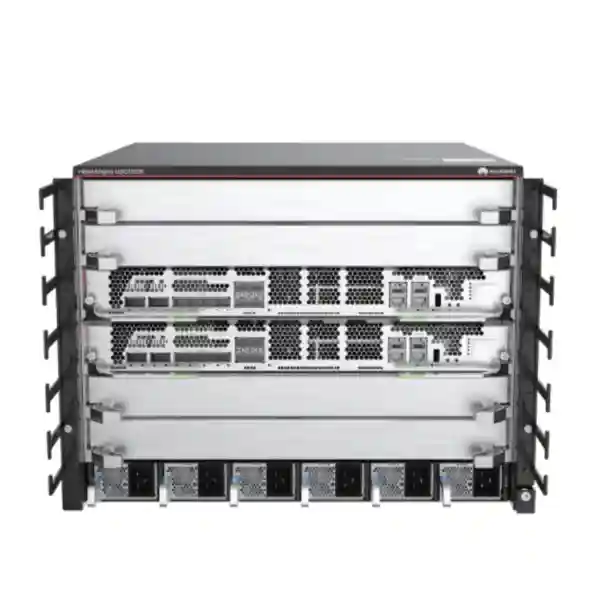
Huawei HiSecEngine USG12004-F Firewall for High-Capacity Enterprise and Data Center Security
The Huawei HiSecEngine USG12004-F is positioned for organizations that have moved beyond branch-firewall requirements and now need a scalable security platform for demanding north-south and east-west traffic, complex segmentation, resilient high-availability operation, multiple security zones, large policy sets, high session concurrency, encrypted traffic, and multi-gigabit or higher network designs. For UAE customers, the practical value of a chassis-class firewall is not simply raw throughput. The platform must fit the real architecture: uplink speeds, application mix, inspection profile, VPN demand, routing topology, availability target, growth horizon, maintenance process, and the operational skills of the team that will run it.
Chassis-Class Scalability
Designed for modular growth, high interface density, and larger enterprise security domains where fixed-port appliances may become operationally restrictive.
Resilient Architecture
Suitable for redundant edge, data-center, campus-core, and critical-service deployments where component, path, and node failures must be considered explicitly.
Security Consolidation
Supports a design approach that brings firewall policy, segmentation, VPN, application control, threat inspection, and centralized operational visibility into one architecture.
UAE Deployment Support
FourTeck can assist with sizing, bill-of-material planning, migration sequencing, rack and power preparation, acceptance testing, and post-cutover support in Dubai and across the UAE.
What the Huawei HiSecEngine USG12004-F Is Designed to Solve
Large networks rarely fail because a firewall lacks a single feature. They fail because capacity, resiliency, interfaces, routing, policy structure, inspection load, operations, and change management were designed separately. The Huawei HiSecEngine USG12004-F belongs to a class of security systems intended to bring those concerns together. Its value is strongest when an organization needs a firewall to behave as part of the core infrastructure rather than as a simple perimeter box.
In a typical Dubai enterprise, the firewall may sit between internet service providers and the internal core, between a data center and a user campus, between production and development networks, in front of public services, between business units, or at a regional aggregation point. At each location the platform may be asked to handle different traffic types. Internet traffic is typically bursty and inspection heavy. East-west data-center traffic may have high session rates, high bandwidth, and lower tolerance for latency. Remote-access and site-to-site VPN workloads add cryptographic overhead. Public application zones require careful inbound policy, address translation, logging, and threat control. Inter-VRF or inter-zone designs introduce routing dependencies and can create very large policy matrices.
The correct way to evaluate the USG12004-F is therefore architectural. Start with traffic paths and business services, not only an appliance datasheet. Document where trust boundaries exist, how much traffic crosses each boundary, how quickly the traffic can grow, which flows need full security inspection, which flows need only stateful policy enforcement, what routing protocols are required, how many interfaces and link speeds are necessary, which services must survive a node failure, and how software upgrades can be executed without unacceptable interruption. This is the framework FourTeck uses when helping customers evaluate a large Huawei security platform.
For broader UAE infrastructure planning, customers can also use FourTeck UAE for enterprise networking and security coordination, while dedicated firewall project enquiries can be aligned through Firewall Dubai. The objective should be one validated architecture and bill of materials rather than disconnected device purchases.
Platform Architecture: Why a Modular Firewall Matters
A modular firewall separates the platform into functional building blocks so that capacity and connectivity can be engineered with more freedom than on a fixed-port appliance. In practical terms, the chassis provides a common system in which processing, interface resources, control functions, power, cooling, and high-availability mechanisms can be sized and maintained according to the deployment. That matters in networks where a firewall is expected to remain in service through multiple access-layer, WAN, data-center, or cloud transformations.
The first design question is the control and forwarding architecture. Large firewalls maintain routing information, session state, security policy, object databases, NAT translations, VPN state, application and threat-inspection context, logs, and management information. The data plane must move traffic at the required rate while applying the policy and security services selected for each flow. The control plane must remain responsive during routing events, high connection churn, configuration changes, log bursts, attack conditions, and failover events. Separating these responsibilities and scaling them appropriately is fundamental to predictable operation.
The second question is interface modularity. Enterprise networks evolve. A security platform installed for a set of 10 Gigabit Ethernet links may later need more high-speed uplinks, additional routed zones, dedicated management or synchronization links, or a revised aggregation model. With a modular system, the interface plan should be treated as part of the lifecycle. Customers should identify required media types, optic standards, breakout requirements, port-channel design, link redundancy, switch compatibility, fiber reach, and the expected interface roadmap. The exact module and port selection must be validated against the current Huawei hardware ordering options because interface boards and supported combinations can vary by software and hardware release.
The third question is resource redundancy. At this class of deployment, high availability means more than deploying two firewalls. The project should examine power feeds, power supplies, supervisors or control components, fan redundancy, switching paths, interface modules, upstream switch pairs, downstream switch pairs, cabling, routing adjacencies, state synchronization, and management access. A pair of security chassis connected to a single upstream switch is not a resilient design. Likewise, dual upstream switches do not protect a service if all application traffic still depends on one physical path or one routing instance.
The fourth question is service scaling. Security services consume different resources. Stateful firewalling, application identification, IPS, antivirus or anti-malware inspection, URL classification, SSL/TLS decryption, IPsec VPN, remote-access VPN, NAT, QoS, traffic logging, and advanced threat controls impose different CPU, memory, acceleration, and session-state demands. The best design avoids assuming that the platform’s highest headline forwarding number equals the capacity available when every security feature is enabled. FourTeck therefore recommends sizing against the actual inspection stack and traffic mix expected in production.
Security Processing and Policy Enforcement
At its foundation, the USG12004-F is used to create controlled security boundaries. A stateful firewall tracks connection state and permits return traffic based on validated session information rather than treating each packet independently. In a large environment, state tracking must be combined with a disciplined zone and policy model. Policy rules should identify the source, destination, service, application context where applicable, user or identity information where supported, security profile, logging behavior, schedule, and action. The design goal is a policy base that can scale without becoming impossible to audit.
Application-aware controls can help teams distinguish business applications from generic port usage. This is especially useful because modern applications commonly use shared web ports and encrypted transports. However, application identification should be deployed with an understanding of traffic visibility. If an application is fully encrypted, classification depth may depend on available metadata or on decryption policy. Some applications use certificate pinning, proprietary transport, QUIC, or dynamic cloud infrastructure. A security policy should therefore be designed around business intent and risk, not around the assumption that every application can always be identified with the same accuracy.
Intrusion prevention adds another layer. IPS engines inspect traffic for exploit behavior, protocol anomalies, and signatures associated with known attacks. The operational challenge is tuning. An overly broad IPS policy can generate excessive events or inspect low-risk traffic that does not need the same protection as internet-facing services. An overly narrow policy may miss important exposures. For large enterprises, it is better to classify protected assets and build profiles around server type, application role, exposure, and change window. Critical internet-facing applications, privileged management networks, user web traffic, and high-volume internal replication may each need different profiles.
URL and web-content controls can support acceptable-use requirements and reduce exposure to malicious or undesirable destinations. For regulated or tightly governed environments, category filtering also helps apply consistent policy across users and business units. The important design concern is identity. If internet access policies are expected to differ by user, department, or role, the project needs a reliable identity source and a clear mapping process. Firewall identity integrations should be tested for login transitions, roaming users, shared workstations, remote-access users, and service accounts.
Malware and content scanning policies must be aligned to file types, protocols, risk level, and performance requirements. Not every high-bandwidth flow should automatically receive identical scanning. For example, large trusted backup streams crossing a segmentation boundary may need stateful enforcement and logging but may not benefit from the same threat profile applied to user web browsing. Conversely, inbound content to public application tiers deserves rigorous inspection, and administrative file transfer paths should be tightly controlled.
Logging is a security function, not an afterthought. A high-capacity firewall can create a large volume of session, threat, system, audit, and VPN events. Before production, determine which events will be logged locally, which will be exported, the destination platform, expected events per second, retention requirements, time synchronization, field mapping, alerting logic, and ownership. If the security operations team uses a SIEM, sample events should be parsed and validated before the cutover. A firewall is only as observable as the logging architecture around it.
North-South Security
Protect internet and WAN boundaries with stateful policy, NAT, application control, VPN services, threat inspection, logging, and routing integrated into a high-capacity perimeter architecture.
East-West Segmentation
Enforce controlled traffic between data-center zones, application tiers, business units, regulated environments, user networks, infrastructure services, and management segments.
VPN and Encrypted Connectivity
Build site-to-site connectivity, secure branch aggregation, partner connections, and remote-access designs while accounting for encryption overhead, tunnel scale, certificate management, and failover behavior.
Core Policy Control
Use the platform as a major enforcement point where routing, security zones, security profiles, audit controls, and centralized operations must remain consistent as the environment expands.
Routing, Switching Integration, and Network Design
A large firewall is often placed where routing decisions are business critical. The network design should define whether the firewall participates actively in dynamic routing, receives a default route, advertises internal prefixes, terminates external routing sessions, or operates in a design that minimizes Layer 3 intelligence on the firewall. Each model can work, but the operational consequences differ. Dynamic routing can provide fast convergence and cleaner path selection, while a simpler static design can reduce protocol complexity. The best choice depends on the topology and the team’s operating model.
For internet edge deployments, dual-carrier designs need careful routing policy. If BGP is used, define which device owns the external routing relationship, what prefixes are advertised, how inbound and outbound path selection is controlled, how route filtering is implemented, and what happens during a partial carrier failure. A link that remains electrically up but cannot reach the wider internet can be more disruptive than a clean interface failure. Health checks, routing policy, and upstream design should therefore be considered together.
For data-center segmentation, the firewall may sit between core switches, aggregation switches, or routed fabrics. In these environments, asymmetric routing is a common cause of problems. Stateful firewalls expect the relevant packets of a connection to traverse a consistent state domain. Equal-cost multipath, active-active switching fabrics, first-hop redundancy protocols, overlay networks, and route redistribution can produce unexpected forward and return paths. The architecture should be validated with packet-path diagrams for normal operation and every significant failure state.
Link aggregation can improve capacity and physical resilience, but it does not automatically improve per-flow throughput because a single flow is normally hashed to one member link. When sizing aggregated interfaces, review the traffic distribution, number of large flows, hashing behavior on both sides, and failure impact. In high-throughput environments, a few elephant flows can create uneven utilization even when the aggregate bundle appears to have sufficient total capacity.
Virtual routing domains, VRFs, or similar logical segmentation mechanisms can reduce the number of physical devices required for isolated business environments. They can also increase operational complexity. Before using multiple routing instances, create clear naming standards, route-leak rules, policy ownership, and troubleshooting procedures. A route that exists in the wrong context can look like a firewall policy problem even when the policy is correct.
Network integration should also include MTU planning. IPsec encapsulation, VLAN tags, tunneling, overlays, provider handoffs, and data-center fabrics can change the effective packet size. A path MTU problem may present as intermittent application failure rather than a clean link outage. The implementation plan should include test traffic of different sizes, TCP MSS behavior where relevant, and monitoring for fragmentation or dropped oversized packets.
High Availability: Designing for Real Failure Modes
For a system such as the HiSecEngine USG12004-F, high availability should be designed from the service backward. Begin by identifying which business services cannot tolerate an extended firewall outage. Then map every dependency between the client and application: access switching, core switching, routing, firewall nodes, ISP circuits, load balancers, DNS, authentication, server networks, storage, and cloud connectivity. This reveals whether the firewall is truly the dominant availability risk or only one component in a larger chain.
A firewall pair typically requires synchronization so that a failover can continue established flows where supported and practical. The design should specify dedicated synchronization paths, management connectivity, heartbeat behavior, interface monitoring, and failover criteria. The synchronization network deserves the same engineering attention as production links. If state replication depends on a congested or fragile path, failover quality may be poor during the exact event when resilience is needed.
Failover testing must include more than manually shutting down one node. Test upstream link loss, downstream link loss, routing-neighbor loss, power-feed loss, switch failure, module or interface failure where safe, and administrative failover. Observe whether sessions survive, whether routing reconverges correctly, whether NAT state behaves as expected, whether VPN tunnels recover, whether monitoring alarms are generated, and whether management access remains available. Document measured interruption time for each scenario.
Maintenance is another availability scenario. An HA design should support safe software upgrades and controlled changes. Before an upgrade, confirm the recommended upgrade path, compatibility of hardware components and licenses, configuration backup, rollback plan, release notes, known limitations, available storage, and the status of the peer node. Teams should avoid treating HA as permission to make untested changes during production hours. A synchronized configuration error can affect both nodes immediately.
FourTeck can align firewall HA planning with broader UAE infrastructure support through FourTeck IT Services UAE, especially where the cutover includes switches, routing, cabling, server dependencies, monitoring, or migration tasks beyond the firewall itself.
Performance Sizing: From Marketing Numbers to Production Capacity
Sizing a high-end firewall requires a workload model. Raw firewall throughput is only one data point. The production requirement should include average throughput, peak throughput, growth factor, packet size distribution, packets per second, connections per second, concurrent sessions, number of security rules, NAT scale, IPsec demand, remote-access users, inspection features, logging rate, routing scale, and interface requirements. When a customer supplies only a total bandwidth number, FourTeck treats that as the beginning of the discussion rather than the final sizing input.
Peak versus average traffic is particularly important. A network averaging 20 percent utilization can still experience brief peaks close to circuit capacity. Security platforms need enough headroom to absorb those peaks while performing inspection. Growth headroom should also reflect business plans. If a data center will add a second internet circuit, new SaaS traffic, more public applications, backup replication, or a larger remote workforce, the firewall should be sized for the expected lifecycle rather than the day-one snapshot.
Packet size affects processing load because forwarding a large number of small packets can be more demanding than moving the same number of bytes in larger packets. Voice signaling, DNS, gaming, security scans, financial applications, and attack traffic can produce different packet profiles than bulk file transfer. DDoS events can also generate high packet rates even when bandwidth is not saturated. A resilient design considers both throughput and packet-processing capability.
Connection rate is another frequent sizing gap. E-commerce sites, mobile applications, APIs, proxy environments, large user populations, and microservices can create very high numbers of short-lived sessions. The firewall must create and remove session state efficiently. Concurrent session scale is different: long-lived connections, VPN tunnels, persistent application sessions, and internal service meshes may create a large table even when new-session rates are moderate.
Threat inspection changes performance. IPS, antivirus scanning, application identification, content filtering, and SSL decryption do not all consume resources in the same way. The correct sizing basis is the combination of services that will be active on the traffic that matters. A policy that performs deep inspection on 30 percent of traffic may produce a very different load from a blanket inspection policy on 100 percent. Segmenting traffic into risk classes can improve both security and performance when done carefully.
SSL/TLS decryption deserves a dedicated sizing exercise because modern web and application traffic is predominantly encrypted. Decryption introduces cryptographic operations and may also expose substantially more payload to security engines. The impact depends on cipher suites, TLS versions, key sizes, session reuse, certificate handling, traffic mix, and the percentage of flows decrypted. Organizations should also define legal, privacy, and technical exclusions. Banking, healthcare, personally sensitive categories, pinned applications, and certificate-authenticated services may need special handling depending on policy and jurisdiction.
VPN sizing should distinguish site-to-site from remote access. Site-to-site designs may have a smaller number of high-bandwidth tunnels, while remote access can involve thousands of users with unpredictable session patterns. Evaluate encryption algorithms, tunnel count, aggregate encrypted throughput, user authentication, certificate services, split-tunneling policy, posture requirements where relevant, DNS handling, and failover behavior. A VPN design also needs enough address space and routing clarity to avoid overlapping subnets.
Finally, keep operational reserve. Running a platform continuously near its practical limit reduces tolerance for traffic growth, attacks, software overhead, logging bursts, or a reduced-capacity HA state. Capacity planning should include the possibility that one node in a pair temporarily carries the production load during maintenance or failure. For critical deployments, the surviving node should have sufficient headroom to operate safely until redundancy is restored.
SSL/TLS Inspection Strategy for Large Networks
Encrypted traffic visibility is now a central firewall design issue. Without decryption, a security system can still make decisions using IP addresses, ports, certificates, Server Name Indication where available, DNS context, connection behavior, and other metadata. However, payload-level threat detection is naturally limited when content remains encrypted. Decryption can restore visibility, but it introduces technical, performance, legal, and user-experience considerations.
Outbound forward-proxy inspection usually requires the organization to establish trust on managed endpoints so that the firewall can present dynamically generated certificates for inspected sites. This means the endpoint certificate chain, browser behavior, certificate pinning, mobile applications, operating systems, and unmanaged devices must be considered. A well-planned deployment starts with a controlled pilot group, measures application failures, defines bypass categories, and expands gradually.
Inbound inspection for published applications uses a different trust model. The firewall may need access to the server certificate and corresponding private key or may integrate into an architecture where decryption occurs elsewhere. The design should account for certificate rotation, secret handling, high availability, certificate formats, key protection, and the division of responsibility between firewall, load balancer, web application firewall, and application teams.
Performance modeling should include the expected percentage of encrypted flows, average connection lifetime, new TLS sessions per second, cipher profile, and inspection features applied after decryption. Modern applications can generate many parallel connections, and cryptographic operations are not represented adequately by raw bandwidth alone. If decryption is a major project requirement, FourTeck recommends validating the intended policy set with representative traffic before final acceptance.
Privacy governance must be explicit. The organization should identify which categories of traffic may be decrypted, who can access logs or reconstructed metadata, what is retained, and how policy exceptions are approved. The firewall project should support governance rather than invent it. Technical capability does not by itself determine what the organization should inspect.
Licensing, Subscriptions, and Lifecycle Planning
Enterprise security platforms often separate base platform capability from subscription-driven security intelligence and support services. The precise license structure should be validated against the current Huawei commercial offering for the selected hardware and software release. At planning stage, the procurement team should identify which capabilities are required at launch, which are optional, subscription duration, renewal dates, support level, and whether centralized management or analytics components have independent licensing.
Threat intelligence and security-content updates matter because IPS signatures, malicious URL classifications, antivirus patterns, reputation information, and application identifiers change over time. A firewall can continue enforcing static policy without some subscriptions, but the effectiveness of dynamic threat controls depends on current intelligence. Renewal management should therefore be treated as an operational control with named ownership and budget visibility.
Support contracts should be selected according to service criticality. A firewall protecting a development lab has a different support requirement from a chassis that sits in front of revenue-generating applications or a regional data center. Consider response targets, hardware replacement options, access to software updates, escalation processes, and whether local spare strategy is warranted. Procurement should also confirm serial-number registration, entitlement activation, and account ownership before the implementation team arrives on site.
Software lifecycle planning is equally important. Security appliances require periodic updates for defect fixes, new features, vulnerability remediation, compatibility, and threat-defense enhancements. The organization should define how new releases are evaluated, what lab or staging process is available, who approves upgrades, what rollback procedure exists, and how configuration backups are protected. Major environments benefit from keeping a release matrix that records platform versions, management-system compatibility, transceiver or module dependencies, and known exceptions.
When the UAE deployment is part of a wider regional expansion, FourTeck can also coordinate multinational planning through FourTeck Africa for projects that connect UAE headquarters with African branches, data centers, or service locations. Commercial structures and availability should always be confirmed for each target country.
Deployment Use Cases for the Huawei HiSecEngine USG12004-F
1. Large Enterprise Internet Edge
In a high-capacity internet-edge role, the platform can enforce outbound user policy, protect inbound services, perform NAT, integrate with dynamic routing, terminate VPNs, apply application controls, and export logs to security operations. The design should include dual ISP handling, public address ownership, inbound publishing, anti-spoofing, DNS dependencies, external monitoring, and the impact of encrypted traffic. If public applications are business critical, document every published service and its exact security path before migration.
2. Data Center Segmentation
The firewall can be used between production, development, database, management, shared-services, backup, and external-access zones. The challenge is usually policy scale and east-west traffic volume. Teams should build an application dependency map before inserting a firewall into an existing flat network. Hidden dependencies such as monitoring, DNS, NTP, backup, patching, authentication, license servers, and middleware are often the reason segmentation projects experience unexpected application failures.
3. Campus Core Security Boundary
Universities, large offices, hospitals, logistics campuses, and industrial organizations may use a core firewall to separate user communities, guest access, servers, building systems, IoT networks, wireless infrastructure, and administrative networks. In these environments, policy clarity can be more important than internet throughput. Use logical zones that reflect ownership and trust, and avoid creating hundreds of micro-zones without an operational model for maintaining them.
4. Regional WAN and Branch Aggregation
A UAE headquarters can aggregate secure connectivity from branches, partners, warehouses, or overseas offices. The central firewall must handle the sum of tunnel traffic and the failure behavior of all remote sites. Route overlap, NAT across VPN, branch internet breakout, centralized inspection, dynamic routing inside tunnels, and authentication should be designed before rollout. Standard templates for branch tunnels greatly reduce support complexity.
5. Service Provider or Shared Security Edge
Organizations that host multiple customers, subsidiaries, or service domains can use a high-capacity platform to enforce separate security contexts and routing boundaries, subject to supported virtualization capabilities and scale. The design should separate administrative ownership, logging, addressing, routing, and change processes so that one tenant or business unit cannot accidentally affect another. Shared platforms require stronger governance than dedicated appliances.
6. Critical Infrastructure Security Zone
Where operational technology, supervisory systems, industrial services, or critical infrastructure connect to enterprise IT, a large firewall can provide controlled segmentation and monitored conduits. These environments require conservative change management and careful protocol understanding. Security inspection should be tested with real application traffic because some legacy or proprietary systems react poorly to unexpected session handling, latency, or protocol normalization.
Policy Architecture for Large Rule Bases
Policy design determines whether the firewall remains manageable three years after installation. Large rule bases become difficult when rules are created ticket by ticket without a naming standard or application model. Start with zones that represent trust boundaries and operational ownership. Then define address-object conventions, service-object conventions, object groups, application groups, security profiles, log settings, and rule naming. A consistent structure makes policy review, automation, and troubleshooting far easier.
Rules should have clear business ownership. Every long-lived rule should be traceable to an application, system, team, or approved requirement. Temporary rules should have expiry dates. Broad rules such as any-to-any should be treated as migration exceptions with a plan to narrow them. If the platform supports rule-hit information, teams can use that data to identify unused entries, but unused does not automatically mean safe to delete. Some disaster-recovery or annual processes may legitimately be quiet for months.
NAT policy should be documented separately from security policy even when the interface presents them together. Record original source, original destination, translated source, translated destination, service translation if any, ingress zone, egress zone, public address owner, and business purpose. This is critical during migrations because an application can fail even when the security rule is correct if its translation behavior changed.
Security profiles should be reusable and risk based. Instead of creating a unique IPS profile for every rule, define a manageable number of profiles such as internet-user strict, public-server strict, partner moderate, trusted-internal baseline, and monitoring exceptions. The actual profile set will vary, but the principle is consistency. Profiles should be version controlled operationally so that a tuning change can be traced to a request or incident.
Change management should include pre-checks and post-checks. Before a policy change, verify objects, routing, NAT, interface status, HA status, and the intended traffic path. After the change, confirm policy hits, application behavior, logs, and any security events. For high-risk changes, define rollback commands or a saved configuration checkpoint before starting.
Migration from an Existing Firewall Platform
Replacing a core firewall is a data migration and network transformation project, not a simple hardware swap. The current firewall contains years of operational knowledge expressed as rules, objects, NAT entries, VPN definitions, routes, certificates, user mappings, exclusions, and workarounds. The first migration task is discovery. Export the current configuration, inventory interfaces and zones, document routes, identify active NAT policies, list VPNs, map public IP addresses, collect certificates, and review utilization data.
The second task is cleanup. A migration is an opportunity to remove obsolete rules and normalize naming, but cleanup must be evidence based. Rule-hit counts, logs, application owners, and network scans can help, yet no single source is complete. Changes should be staged so that cleanup risk does not become indistinguishable from platform migration risk. In many projects, it is safer to migrate a validated baseline first and then optimize policy in controlled phases.
The third task is feature mapping. Different firewall vendors represent zones, services, NAT, application controls, VPNs, virtual systems, routing filters, and security profiles differently. An automated converter can accelerate object translation, but it cannot understand business intent. Engineers should manually review high-risk rules, inbound services, complex NAT, policy-based routing, route redistribution, VPN cryptographic settings, and authentication integrations.
The fourth task is cutover design. Choose whether the firewall will be inserted physically into the same links, whether new switches or VLANs are required, whether IP addresses will move, whether routing neighbors change, and how rollback will work. Pre-stage as much as possible: interfaces, routing, zones, policy, objects, profiles, licensing, logging, monitoring, DNS, NTP, administrator authentication, and backups. A cutover window is not the right time to discover missing entitlements or incompatible optics.
The fifth task is validation. Build an application test matrix with business owners. Test internet browsing, DNS, email, authentication, ERP, CRM, public websites, APIs, cloud services, site-to-site VPN, remote access, voice services, monitoring, backup, software updates, and management tools. Include negative tests as well: verify that prohibited access remains blocked and that threat events are visible to the security operations team.
Finally, retain a defined rollback point. A successful rollback plan specifies who makes the decision, how traffic is returned to the old platform, what configuration changes must be reversed, how routing reconverges, what DNS or public-address changes are involved, and how business owners will be notified. The goal is not to expect failure; it is to prevent uncertainty during a high-pressure maintenance event.
Operations, Monitoring, and Security Governance
Once deployed, the USG12004-F becomes part of the organization’s ongoing security operations. The operations model should define responsibilities for policy administration, routing changes, VPN support, security profile tuning, software upgrades, certificate renewal, backup, log review, incident response, capacity monitoring, and vendor support. In mature environments, these tasks may belong to different teams, which makes role-based access and change workflow especially important.
Monitoring should cover both system health and security posture. System monitoring includes CPU, memory, session count, session-creation rate, interface throughput, interface errors, packet drops, temperature, power state, fan state, HA status, routing neighbors, VPN tunnel status, and storage use. Security monitoring includes threat detections, policy denies, unusual traffic patterns, repeated authentication failures, suspicious outbound connections, command audit, configuration changes, and license or update status.
Thresholds should be meaningful. A CPU alarm at an arbitrary percentage may create noise if short peaks are normal. Conversely, a slowly rising session count may be important long before it reaches a hard limit. Baseline the system during normal business cycles and special periods such as month-end, backups, patch windows, seasonal peaks, and major public events. Trend data is more useful than isolated snapshots for capacity planning.
Configuration backup should be automated and protected. Keep backups after significant changes and before software upgrades. Store them in a location separate from the firewall, control access, and record the software version associated with each backup. If certificates or sensitive keys are included, the backup repository must be secured accordingly. Periodically test restoration procedures in a safe environment if possible.
Administrative access should use named accounts rather than shared credentials. Integrate centralized authentication where appropriate, enforce multi-factor authentication where supported and practical, limit management access to dedicated networks, and log administrator actions. Break-glass local accounts may still be necessary for emergencies, but their use should be controlled and audited.
Policy reviews should be scheduled. Quarterly or semiannual reviews are common starting points, but critical environments may review more frequently. The review should cover obsolete objects, unused rules, temporary exceptions, broad access, expired projects, inactive VPNs, administrator accounts, license status, certificate expiry, logging coverage, and high-risk changes since the previous review.
UAE and Dubai Procurement Considerations
Enterprise firewall procurement in the UAE should begin with an approved technical bill of materials. A chassis product may require the base enclosure, control components, processing resources, interface cards, transceivers, power supplies, power cords, licenses, support, rack accessories, and management or analytics software. Ordering only the chassis model without validating these dependencies can delay an otherwise well-planned project.
Power and rack planning should be completed before delivery. Confirm rack-unit availability, front-to-back airflow, cooling capacity, power-feed type, connector type, redundant power circuits, power distribution units, grounding, cable management, and service clearance. In colocation facilities, power allocation and cross-connect lead times may be as important as hardware delivery dates. Data-center operations teams should receive installation details early.
Transceiver compatibility must be treated as part of the BOM. A physical port alone does not guarantee that an existing optic will be supported. Validate speed, wavelength, fiber type, connector, reach, and supported transceiver matrix on both ends of the link. For long-distance or carrier handoffs, coordinate optical budgets and demarcation requirements. For copper connections, confirm supported speed and cabling category.
Lead time can vary for chassis components and interface modules. Projects with fixed data-center cutover dates should identify long-lead items early and consider whether temporary interfaces or phased activation are possible. Serial-number and entitlement information should be captured in the project record on receipt. Hardware should be inspected for shipping damage, powered on, and validated before the production installation date.
Support coverage should match the location and service requirement. Confirm how replacement hardware is delivered, what information is needed to open a case, who has portal access, and which engineers are authorized to work on the platform. For high-criticality sites, customers may choose to maintain selected local spares depending on the agreed support model and risk assessment.
Commercially, buyers should request a clearly itemized quotation rather than a single opaque line. The quote should separate hardware, licenses, subscriptions, support duration, implementation, migration, training, and any optional services. This makes renewal planning easier and prevents uncertainty about which capabilities are included.
Sizing Workshop: Information FourTeck Needs Before Finalizing a BOM
A reliable Huawei HiSecEngine USG12004-F quotation should be based on a short technical discovery process. The objective is to avoid under-sizing, over-buying, or selecting the wrong interface combination. FourTeck can work from diagrams, traffic reports, existing firewall exports, ISP handoff details, or a structured workshop. The following information creates a strong starting point.
Traffic and Growth
Current average and peak throughput, expected three-year growth, internet bandwidth, internal segmentation bandwidth, packet-rate concerns, seasonal peaks, and any planned circuit upgrades.
Security Services
Required IPS, application control, URL filtering, malware inspection, reputation services, SSL decryption, DNS security, sandbox integration, logging depth, and threat-intelligence requirements.
Interfaces
Port speeds, media types, quantities, LAG requirements, upstream and downstream switch models, ISP handoffs, fiber reach, optic standards, dedicated management, HA, and out-of-band links.
Routing
Static routing, BGP, OSPF, route redistribution, VRFs, policy-based routing, default-route strategy, dual-carrier behavior, asymmetric-route risks, and convergence targets.
VPN
Number of site-to-site tunnels, aggregate encrypted throughput, remote-access users, identity systems, certificate requirements, MFA, client platforms, address pools, and split-tunnel policy.
Availability
Required HA mode, maximum tolerated interruption, dual power, dual switches, circuit diversity, maintenance strategy, data-center constraints, and disaster-recovery expectations.
Implementation Methodology for a Chassis Firewall Project
A structured implementation reduces risk. FourTeck recommends dividing the project into discovery, design, staging, migration, validation, and handover. During discovery, collect technical requirements and existing-state data. During design, produce a target topology, interface map, addressing plan, routing design, zone structure, policy model, NAT plan, VPN design, logging plan, HA design, and rollback method.
Staging should occur before the production window whenever possible. Rack or bench the system, verify hardware recognition, apply the agreed software release, activate licenses, configure management, NTP, DNS, administrators, backups, interfaces, routing, zones, base policy, security profiles, VPNs, logging, monitoring, and HA. Record device serial numbers and hardware inventory. Validate management access from the correct administrative networks and confirm that out-of-band access is available if required.
Pre-cutover testing should include configuration review, HA state, interface negotiation, transceiver status, routing adjacencies in a controlled state, reachability to log servers, authentication services, license servers, update services, and monitoring platforms. If the design includes dynamic routing with production neighbors, use filters or shutdown controls to prevent accidental route advertisement before the maintenance window.
During cutover, execute a written sequence with named owners. Typical steps include freezing unrelated changes, confirming backups, recording pre-change health, moving physical links or VLANs, enabling routing, validating HA, testing critical applications, confirming internet and VPN connectivity, validating inbound services, checking logs, and obtaining business sign-off. Engineers should record actual times and deviations from plan because this information is valuable for future sites.
Post-cutover, monitor closely for several business cycles. Some problems appear only during backups, batch jobs, remote-office opening hours, or scheduled integrations. Review denied traffic, IPS events, application identification, CPU, memory, session count, interface errors, routing changes, and VPN stability. Tune only with evidence and preserve a change record for each adjustment.
Handover should include the approved design, final configuration backup, interface map, routing summary, object and policy standards, support details, license information, certificate inventory, upgrade procedure, monitoring thresholds, and escalation contacts. A short operational workshop can significantly reduce dependency on the implementation engineer after go-live.
Security Hardening Recommendations
The firewall should be hardened as a critical infrastructure component. Management services should be reachable only from approved administrative networks or a dedicated out-of-band path. Disable unused services and interfaces. Use secure management protocols, restrict source addresses, and apply administrator role separation. Where supported, integrate centralized authentication and multi-factor controls so that administrative access is attributable to a named individual.
System time must be reliable. Configure redundant NTP sources and verify synchronization. Accurate time is essential for log correlation, incident response, certificate validation, scheduled policy, and authentication. Security devices with inconsistent time can make a forensic timeline difficult or misleading.
Configuration changes should be auditable. Enable administrative logs and export them to a central system. Restrict who can create administrators, modify logging, change routing, alter VPNs, or edit high-risk policies. For sensitive environments, consider a two-person change process where one engineer implements and another reviews.
Protect the management plane from denial-of-service and scanning where platform capabilities allow. Limit management sessions, use access-control policies, separate management traffic from production flows, and monitor failed login attempts. Do not expose the management interface directly to the public internet unless there is a documented requirement and compensating controls; a secure VPN or dedicated management path is usually preferable.
Review default settings. Default timeout values, logging behavior, allowed management services, cryptographic profiles, VPN algorithms, and security signatures may not match the organization’s policy. Hardening should be explicit rather than assumed. At the same time, avoid changing hundreds of low-level defaults without a reason because that can make future troubleshooting and upgrades harder.
Finally, treat backup, update, and recovery as security controls. Keep known-good configurations, document how to rebuild or replace a failed node, maintain software images as permitted by support terms, and ensure that support entitlement can be accessed during an incident. Resilience is part of security.
Decision Recap: When the USG12004-F Fits the Project
The Huawei HiSecEngine USG12004-F is most relevant when the security platform must operate as high-capacity infrastructure rather than as a simple edge appliance. That typically means the project has several of the following characteristics: multi-gigabit or higher traffic, significant growth expectations, many security zones, demanding session scale, high VPN use, large or complex rule bases, redundant upstream and downstream networks, stringent availability requirements, modular interface needs, or a desire to consolidate multiple security boundaries into a controlled architecture.
A chassis platform may be unnecessary for a small branch or a modest single-circuit internet edge. The value emerges when modularity, resilience, interface flexibility, policy scale, or lifecycle capacity justify the larger design. FourTeck therefore recommends selecting the platform only after a traffic and topology review. The same model can be an excellent fit in one environment and excessive in another depending on inspection scope, redundancy, and growth.
The final selection should be based on the current Huawei ordering guide and software release because supported modules, licenses, capacities, and feature behavior can change. The project BOM should list every chassis component, interface requirement, transceiver, subscription, support service, and implementation dependency required for the target design.
Quotation Input Checklist
Network Details
Provide a topology diagram, current firewall model, ISP bandwidth, LAN or data-center uplink speeds, number of security zones, routing protocols, public IP ranges, planned circuit upgrades, and any asymmetric-path concerns.
Traffic Profile
Provide average and peak bandwidth, peak sessions, new connections per second if known, major application types, encrypted traffic percentage, east-west traffic estimates, backup windows, and expected three-year growth.
Security Requirements
List IPS, application control, web filtering, malware inspection, SSL decryption, VPN, threat intelligence, centralized logging, SIEM integration, authentication, compliance, and reporting requirements.
Hardware and Cabling
List required port counts and speeds, fiber or copper media, optic reach, link aggregation, dual-switch connectivity, rack space, power feeds, PDU details, data-center location, and any existing transceivers proposed for reuse.
Availability and Support
State whether an HA pair is required, target interruption tolerance, desired support level, replacement expectations, maintenance windows, software-upgrade constraints, disaster-recovery requirements, and local spares policy.
Migration Scope
Provide the current configuration where permitted, number of rules and objects, NAT complexity, VPN inventory, certificates, authentication integrations, routing configuration, target cutover date, rollback limits, and business-owner testing contacts.
Final Consultation Panel for UAE Projects
A successful HiSecEngine USG12004-F deployment begins with a validated architecture. FourTeck can help UAE organizations turn business and technical requirements into a deployable firewall design that addresses performance, interfaces, high availability, routing, security inspection, VPN, logging, migration, and operational support as one integrated project.
For the first technical discussion, share the site location, current firewall model, internet and internal bandwidth, required interfaces, HA requirement, security services, number of VPNs or remote users, current routing design, and the expected project timeline. If the exact traffic data is not available, switch and firewall utilization reports can often provide enough evidence to build an initial sizing model.
FourTeck can also coordinate implementation tasks around the firewall, including rack preparation, physical installation, link migration, routing integration, policy conversion, VPN migration, monitoring, acceptance testing, and documentation. The scope can be limited to supply or expanded to a managed implementation depending on the project.
Because chassis configurations are modular and release dependent, the final bill of materials should always be checked against the current supported Huawei hardware, software, interface, and licensing matrix before purchase. This avoids assumptions about ports, modules, transceivers, performance profiles, or entitlement combinations and produces a cleaner handover to the implementation team.
Why FourTeck for Huawei Enterprise Firewall Projects in Dubai
FourTeck approaches large firewall projects from the network architecture outward. The aim is to ensure the selected security platform fits the real traffic paths, switching design, WAN connectivity, data-center architecture, routing policy, business applications, and support model. This is especially important for the HiSecEngine USG12004-F because the usefulness of a modular chassis depends heavily on correct component selection and deployment design.
Customers can engage FourTeck for product supply, sizing review, network and security design, bill-of-material preparation, migration planning, staging, configuration, high-availability setup, routing integration, VPN implementation, policy migration, cutover support, documentation, and post-deployment assistance. Scope is defined according to the environment rather than assumed from the product model alone.
For enterprise customers in Dubai, Abu Dhabi, Sharjah, and other UAE locations, early technical discovery is the fastest way to get an accurate quotation. A short design review can identify whether the USG12004-F is the right platform, which modular components are required, what licensing should be included, and what migration risks must be addressed before a production date is committed.

Reviews
There are no reviews yet.