
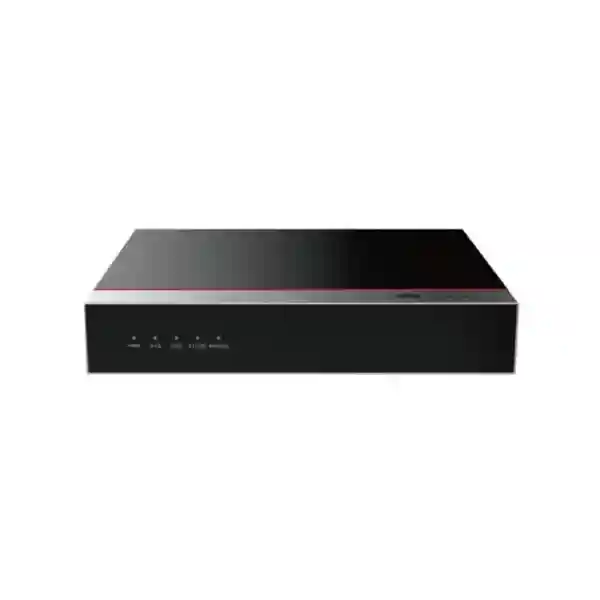
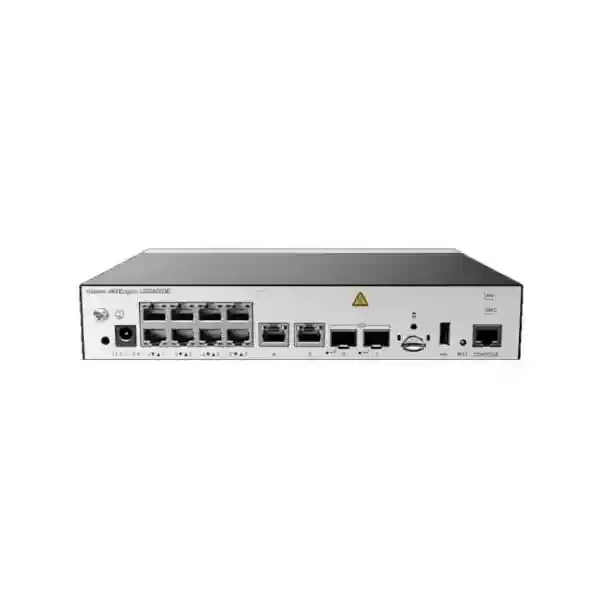
Huawei HiSecEngine USG6000E-S03 AI Firewall
A compact desktop next-generation firewall designed for branch offices, SMEs, retail sites, clinics, schools, professional offices and distributed enterprise locations that need business-grade threat prevention, VPN, application control and multi-gigabit uplinks in a space-efficient appliance.
Direct answer: what is the USG6000E-S03?
The Huawei HiSecEngine USG6000E-S03 is a fixed-interface next-generation firewall intended for small and medium enterprise locations that require significantly more than basic stateful firewalling. It combines perimeter access control, application awareness, intrusion prevention, antivirus inspection, URL filtering, anti-botnet functions, VPN termination, bandwidth controls, routing, traffic steering and high-availability capabilities in a desktop form factor. Huawei documentation for the USG6000E-S family also describes dedicated acceleration engines for forwarding, pattern matching and encryption or decryption, helping the platform maintain practical security performance while multiple services are enabled.
For a Dubai deployment, the most important point is not simply the headline firewall throughput. Modern UAE offices often carry Microsoft 365, cloud ERP, voice, video conferencing, SaaS, guest Wi-Fi, remote-access VPN and site-to-site encrypted traffic at the same time. The USG6000E-S03 is designed to make policy decisions at the application and user level while inspecting threats and maintaining encrypted tunnels, so sizing should focus on the traffic mix that will actually pass through the firewall rather than on a single laboratory forwarding number.
The model is especially relevant where a customer wants a compact appliance with 10 Gigabit optical uplink capability but does not need a full 1U chassis. Its two 10GE SFP+ interfaces can be used for high-speed uplinks, aggregation or resilient connectivity, while ten Gigabit Ethernet interfaces provide practical segmentation choices for LAN, WAN, DMZ, management-adjacent or service networks depending on the final design. FourTeck can align the appliance with switching, WAN and security requirements through the broader Firewall Dubai portfolio.
Two 10GE SFP+ ports plus ten Gigabit Ethernet interfaces provide a strong port density for a desktop firewall and simplify small-site segmentation.
Huawei lists up to 3 Gbit/s IPsec throughput with AES-256 and SHA256 under its stated test conditions, supporting encrypted inter-site connectivity.
Remote-access capability is suitable for branch and SME use, with a base user entitlement that can be expanded according to the ordered license structure.
Policy capacity supports granular segmentation by zone, address, service, application, schedule, region and other context used in enterprise access control.
Technical specification snapshot
Published values can vary between software releases, regional ordering documents and test revisions. Some Huawei USG6000E-S03 datasheets show earlier baseline figures such as 3/3/3 Gbit/s IPv4 throughput and 400,000 concurrent HTTP1.1 connections, while the current Huawei eKit product listing reports 5/5/3 Gbit/s and 500,000. FourTeck recommends validating the exact Huawei ordering part number, software release and license bundle before final technical sign-off.
Hardware architecture, ports and physical deployment
The USG6000E-S03 is unusual in a useful way: it provides enterprise firewall functions and 10 Gigabit optical connectivity in a small desktop chassis. The fixed interface architecture means a designer does not have to plan expansion cards for a typical branch deployment. Two 10GE SFP+ ports can connect to a core or aggregation switch, high-speed ISP handoff or another infrastructure device using the appropriate supported optics or direct-attach method, while ten Gigabit Ethernet ports can be allocated across WAN, LAN, guest, voice, server, management-adjacent and DMZ segments according to the security policy design.
The presence of 10GE ports should not be interpreted as a guarantee that every advanced inspection workflow will operate at 10 Gbit/s. Physical interface speed and security processing throughput are separate design dimensions. A 10GE uplink is valuable because it avoids a physical bottleneck between the firewall and an aggregation switch, supports burst capacity, simplifies migration from 1GE switching and leaves room for internal east-west traffic. Internet security throughput, however, should be sized against the enabled inspection stack, session profile, SSL visibility policy and application mix.
Huawei describes the USG6000E-S architecture as using dedicated acceleration engines for network forwarding, pattern matching and encryption or decryption. Public documentation does not require the buyer to understand a named third-party ASIC to plan the system; the practical consideration is that different workloads are offloaded or accelerated by specialized processing paths. Short-packet forwarding, signature matching and IPsec encryption are especially sensitive to hardware design, and Huawei positions these engines as a way to reduce latency and improve service performance while security functions are active.
Storage is optional through Micro-SD on the S03 platform, with Huawei documentation referencing 64 GB, 128 GB and 512 GB capacities in product specifications, while the hardware installation documentation identifies a Huawei-supported 64 GB Micro-SD option for specific installation guidance. Storage choice matters if local logging or operational data retention is part of the design. For larger environments, central log collection should still be planned so that incident data remains available if the appliance is replaced, reset or isolated.
The desktop enclosure is approximately 250 mm wide, 210 mm deep and 43.6 mm high. The compact size suits branch cabinets and small network rooms, but installation quality still matters. Keep adequate airflow, avoid placing the appliance directly on heat-generating equipment, use a stable power source, document cable paths and leave enough service loop for SFP+ and copper connections. In UAE facilities where communications closets can become warm, dusty or overloaded with adapters, basic environmental discipline can have as much impact on reliability as the firewall configuration itself.
Security inspection: beyond basic stateful firewalling
A stateful firewall tracks sessions and permits or denies traffic according to addresses, ports and connection state. The USG6000E-S03 extends that model by adding service awareness, application identification, IPS, antivirus, URL filtering, anti-botnet detection and policy context. Huawei states that the platform can identify more than 6,000 applications and apply controls at a finer level than a simple TCP or UDP service. This matters because many modern applications share HTTPS transport and cannot be meaningfully governed by port number alone.
Application-aware policy allows a security team to separate business use from risky or bandwidth-intensive behavior. A rule can be designed around user groups, zones, address objects, application categories, schedules and security profiles. The value is operational clarity: instead of opening broad outbound internet access and relying on endpoint controls alone, the firewall becomes a policy enforcement point that understands what type of traffic is being carried and can attach appropriate inspection to it.
For intrusion prevention, Huawei documentation describes coverage across large numbers of Common Vulnerabilities and Exposures, more than 12,000 IPS signatures in the referenced software material, support for custom signatures, web attack detection and controls for botnet, remote-control, Trojan and brute-force behaviors. In practice, an IPS must be tuned. A blanket maximum-security profile can create unnecessary false positives or consume resources, while a minimally configured profile may miss relevant threats. The correct process is to identify the protected services, exposure level, operating systems and business applications, then apply targeted signatures and monitor events before tightening blocks.
Antivirus inspection is intended to identify malicious files that cross permitted sessions. Huawei describes an intelligent heuristic content-based detection engine and support for examining deeply compressed content. Antivirus on the firewall is not a replacement for endpoint detection, email security or application-layer controls. It is another enforcement layer that can catch payloads in transit and improve defense in depth, particularly at branch locations where users, guest networks and unmanaged devices may share the same internet edge.
URL filtering adds category-based control and can be combined with DNS filtering and anti-phishing functions. Huawei documentation references a URL category database exceeding 500 million entries. The database scale is less important than policy design: organizations should define acceptable-use objectives, create exceptions for essential business applications, document bypass procedures and decide how blocked-category events are handled. A controlled branch internet policy is most effective when firewall rules, identity, endpoint policy and user awareness are aligned.
Encrypted traffic, SSL inspection and practical policy design
Why encrypted visibility matters
Most internet applications now use TLS, so a firewall that sees only the outer encrypted session has limited visibility into the content being transferred. Huawei supports inspection workflows for SSL-encrypted traffic so that IPS, antivirus, data filtering and URL controls can operate on eligible sessions. This improves detection depth, but it also increases processing demand and introduces certificate, privacy and application-compatibility considerations.
Selective decryption is usually better
A mature deployment does not blindly decrypt every category. Financial services, health portals, certificate-pinned applications and regulated workflows may require exceptions. Business SaaS may need testing before enforcement. A practical policy typically decrypts high-risk and general web categories where inspection is justified, bypasses sensitive categories where appropriate, and records clear exception ownership.
Plan performance headroom
TLS inspection is computationally heavier than pass-through forwarding. When estimating capacity, include peak busy-hour usage, concurrent encrypted sessions, certificate negotiation rates and inspection profiles. If a branch has a 1 Gbit/s internet service but routinely uses 700–900 Mbit/s at peak with extensive decryption and threat scanning, the design should be validated carefully rather than relying on raw firewall throughput.
Operate the trust chain correctly
Outbound TLS inspection generally requires enterprise endpoints to trust a certificate authority used by the firewall. Certificate deployment, renewal and revocation need ownership. Guest or unmanaged devices should be treated differently from managed corporate endpoints. The firewall rulebase should distinguish these device populations so that inspection is predictable and support teams can troubleshoot browser or application trust errors quickly.
VPN design for UAE headquarters, branches and remote users
The USG6000E-S03 supports IPsec VPN, SSL VPN and GRE, making it flexible enough for several common connectivity patterns. A Dubai office can use route-based or policy-appropriate IPsec connectivity to a headquarters site, a data center, a disaster-recovery location or a supported cloud gateway. The published maximum of up to 2,000 IPsec tunnels is far beyond the requirement of many SME branches, which leaves logical scale for hub-and-spoke, partner, tenant or backup-tunnel designs. The more important limit is aggregate encrypted throughput and operational manageability.
Huawei lists IPsec performance of up to 3 Gbit/s using AES-256 plus SHA256 with 1420-byte packets under its stated test conditions. Real encrypted performance depends on packet size, tunnel count, routing, inspection, NAT, logging and the traffic pattern. A branch with two 500 Mbit/s WAN circuits may not require anything close to 3 Gbit/s of sustained VPN throughput, but the headroom can be valuable during traffic bursts or when a backup circuit becomes active and carries traffic that normally uses the primary path.
SSL VPN provides remote-access connectivity for users who need access to internal applications from outside the office. Huawei currently lists 100 default and up to 500 maximum concurrent SSL VPN users for the USG6000E-S03, with 300 Mbit/s SSL VPN throughput in the product specifications. The design should verify whether the ordered appliance includes the intended user entitlement and whether additional licenses are needed. It should also define authentication, multifactor controls where supported in the surrounding identity workflow, split-tunnel or full-tunnel policy, DNS handling and endpoint access restrictions.
For business continuity, VPN should be tied to WAN failure behavior. If the site has dual ISPs, tunnel design should account for peer reachability, public IP changes, route preferences and failover timing. A tunnel that is technically configured but not tested during an ISP outage is not a reliable contingency plan. FourTeck can combine firewall implementation with broader UAE network services through FourTeck IT Services UAE, including migration planning, routing changes, validation and handover documentation.
Routing, multi-WAN and intelligent uplink selection
The USG6000E-S03 is not limited to transparent firewall insertion. Huawei supports transparent, routed and hybrid working modes, allowing the appliance to fit different migration and topology requirements. Routed mode is common when the firewall acts as the internet edge, default gateway for protected zones, VPN endpoint and policy enforcement device. Transparent mode can be useful when security inspection must be inserted with minimal changes to an existing IP design. Hybrid approaches are relevant when multiple segments have different migration constraints.
Routing protocol support includes RIP, OSPF, BGP, IS-IS and IPv6 equivalents such as RIPng, OSPFv3, BGP4+ and IPv6 IS-IS in Huawei’s feature list. This is valuable when a branch is part of a larger routed enterprise rather than a standalone NAT edge. Dynamic routing can distribute internal networks, advertise VPN reachability and react to upstream path changes. The routing design should remain simpler than necessary, however. A small branch with one LAN and two internet links rarely benefits from an unnecessarily complex BGP design if policy-based routing and health-aware steering meet the requirement.
Huawei’s intelligent uplink selection capabilities can steer traffic using link bandwidth, weight, priority and health status. Service-specific policy-based routing allows critical workloads to prefer one path while lower-priority traffic uses another. For example, an office might send voice and collaboration traffic through a low-latency fiber circuit while directing bulk cloud backup traffic through a secondary broadband link. If the preferred link degrades or fails, health checks and configured steering behavior can move sessions according to policy.
Multi-WAN design should include more than link failover. Engineers should define NAT behavior per circuit, DNS dependencies, inbound publishing requirements, VPN peer addressing, asymmetric routing prevention and session persistence. When two providers are active simultaneously, application sensitivity to source-IP changes must be considered. Banking portals, cloud security platforms and SaaS applications may bind sessions to a public IP, so indiscriminate load balancing can disrupt user experience. Policy-based steering is often preferable to purely random distribution.
High availability and business continuity
Huawei documentation lists both Active/Active and Active/Standby high-availability modes for the USG6000E-S family. High availability is valuable when the cost of an internet or security gateway outage is higher than the cost of a second appliance, but HA must be designed as a system rather than simply purchasing two firewalls. The two devices need compatible software, matching security policy, synchronized operational state where applicable and upstream or downstream connectivity that does not leave a hidden single point of failure.
For many branches, Active/Standby is the easiest operational model. One firewall forwards production traffic and a peer is ready to assume the role during failure. The switch design should provide redundant paths to both appliances, and WAN handoffs must be considered carefully. If the ISP provides only one physical customer handoff, a firewall pair may protect against appliance failure but not against loss of that handoff device. A small Ethernet handoff switch or redundant provider termination may be required depending on the service architecture.
Testing matters. Planned failover should be performed after implementation and after major software upgrades. Engineers should test stateful traffic where supported, site-to-site VPN behavior, DNS resolution, inbound services, remote access and monitoring alarms. A successful failover should be documented with expected convergence times and known application effects. If a business application takes several minutes to recover because its own session logic is sensitive, that behavior should be known before a real outage.
HA also affects maintenance. A properly designed pair can allow software updates or hardware replacement with less interruption, but version compatibility and recommended upgrade sequencing must be followed. Maintenance procedures should include configuration backup, health validation, rollback criteria and a communication plan. In a regulated or customer-facing UAE environment, change control is often as important as the high-availability feature itself.
Security virtualization and segmentation
The USG6000E-S03 supports up to 20 virtual firewalls in Huawei’s published specifications. Security virtualization allows logical firewall contexts to share one physical appliance while maintaining separate policy domains. This can be useful for managed-service environments, multi-department offices, landlord and tenant separation, test environments or organizations that need administrative boundaries without deploying a separate hardware firewall for each logical domain.
Virtual firewalls should not be confused with VLANs. A VLAN separates Layer 2 broadcast domains, while a virtual firewall can provide independent security policy and management separation at the firewall layer. The two concepts may be used together. A building could carry multiple VLANs to the USG6000E-S03 and then place them in different virtual firewall contexts so that policy ownership, logging and VPN behavior are isolated.
Segmentation is valuable even without virtual firewall contexts. The ten GE ports and 10GE uplinks make it practical to separate trusted users, guest Wi-Fi, IP telephony, servers, cameras, building-management systems and DMZ services. Security zones can then enforce least-privilege access. Guest devices may receive internet-only access, cameras may communicate only with recording servers and management stations, and server networks may accept only the specific application flows they require.
A strong branch design avoids a single flat LAN. Flat networks make incident containment difficult because compromised endpoints can reach too many internal assets. The firewall can become an east-west segmentation point for higher-risk zones, while high-volume trusted traffic may remain on Layer 3 switching if performance or topology requires it. The right boundary depends on business risk, traffic volume and switching architecture rather than on a rule that every VLAN must traverse the firewall.
Application control, bandwidth management and user experience
Application identification
Huawei positions the platform to identify thousands of applications and apply control at functional granularity. This allows policy to differentiate business collaboration, cloud storage, remote-control utilities, streaming, social media and other categories even when they share common web ports.
Per-user and per-IP bandwidth
Bandwidth management can set maximum rates, guarantee minimum bandwidth for critical use and change forwarding priority. This is valuable where a smaller branch circuit must carry interactive voice, video, cloud applications and bulk transfers simultaneously.
Business-first traffic policy
QoS and security policy should work together. Allowing an application does not mean it deserves equal bandwidth. Backup, software distribution and personal streaming can be permitted but deprioritized, while voice, ERP and customer-facing services receive stronger guarantees.
Measure before restricting
The safest rollout starts with traffic visibility. Identify which applications consume bandwidth, when peaks occur and which users or subnets generate them. Policies can then target the actual issue rather than imposing broad restrictions that create support calls without improving security.
Sizing methodology for Dubai and UAE deployments
Firewall sizing should start with measured or realistically estimated traffic. Record each internet circuit speed, typical utilization, 95th-percentile peak, expected growth and failover behavior. A branch with two 500 Mbit/s links in active/standby mode has a different requirement from a site that aggregates both links to deliver 1 Gbit/s of simultaneous traffic. If the organization expects a circuit upgrade within the next three years, that planned bandwidth should be included so the firewall does not become the first bottleneck after the ISP upgrade.
Next, estimate how much traffic will receive advanced inspection. If nearly all outbound traffic uses IPS, antivirus, application control and selective TLS decryption, the design should use the advanced security performance range rather than the raw firewall figure. Huawei’s real-world FW + service awareness + IPS + antivirus reference of 650 Mbit/s is therefore more useful for many secure internet-edge scenarios than the headline multi-gigabit forwarding number. If only a subset of traffic receives deep inspection, effective capacity may be higher, but this should be validated against the actual policy set.
Session count is the third dimension. A 100-user professional office can generate a surprisingly large number of concurrent sessions because browsers open multiple connections, collaboration tools keep persistent sessions, cloud storage synchronizes in the background and mobile devices run numerous applications. Huawei’s current listing of up to 500,000 HTTP1.1 concurrent connections and 30,000 new connections per second provides substantial headroom for a small-site appliance, but session spikes from public-facing applications or high-density guest Wi-Fi should still be considered.
Remote access and site-to-site VPN should be sized independently. Count the number of simultaneous remote users, expected per-user bandwidth and the applications they will access. Video meetings through a full-tunnel VPN consume far more bandwidth than an administrator using SSH or RDP. For site-to-site VPN, add the peak encrypted traffic across all tunnels and account for failover. If a private WAN link fails and internet IPsec becomes the backup for multiple services, the encrypted workload may increase sharply at exactly the time the firewall is under operational stress.
Finally, leave headroom. A firewall selected to operate at nearly 100 percent of its expected secure throughput on day one offers little tolerance for traffic growth, new security profiles, software behavior changes or emergency rerouting. Many organizations plan for a comfortable utilization margin rather than treating a datasheet maximum as an operating target. This is particularly important when TLS inspection is introduced gradually after deployment because encrypted-traffic processing can change the real capacity profile.
FourTeck can integrate the firewall into a wider UAE infrastructure design through FourTeck UAE, allowing firewall sizing to be considered alongside switching, Wi-Fi, server access, structured connectivity and operational support rather than as an isolated appliance purchase.
Deployment scenarios
1. Secure branch internet edge
A typical branch design places the USG6000E-S03 between one or two ISP links and the internal switching infrastructure. User, guest, voice, printer and server VLANs terminate on the firewall or on a Layer 3 switch with routed links to the firewall. Security policy controls inter-zone traffic, NAT provides internet access, application control prioritizes business services, IPS and antivirus protect outbound sessions, and URL filtering applies acceptable-use rules. A site-to-site IPsec tunnel connects the branch to headquarters or a data center.
2. Retail and multi-site chain
Retail organizations can use the appliance to separate point-of-sale systems, staff devices, digital signage, guest Wi-Fi, CCTV and management traffic. IPsec can connect stores to a central data center while direct internet access is filtered locally. Centralized management through Huawei SecoManager can help administrators maintain consistent policies across many sites. The USG6000E-S03’s logical tunnel scale is useful even if each store uses only a few tunnels because the platform can fit standardized branch templates across a distributed estate.
3. Clinic or professional office
A clinic, legal office, accounting firm or engineering practice often needs secure remote access, segmented guest wireless, controlled access to cloud applications and strict separation of servers from general users. The firewall can enforce zone-based controls and selective SSL inspection while IPsec or SSL VPN supports remote work. Logging and policy review become important because these environments frequently handle confidential data and must demonstrate reasonable security controls to customers, partners or internal auditors.
4. School or training center
Education networks generate diverse traffic: learning platforms, streaming media, guest devices, staff systems, labs and administrative applications. Application and URL controls can restrict high-risk categories while bandwidth management prevents entertainment traffic from overwhelming lessons or collaboration services. Separate zones can isolate administrative systems from student networks. Policy must be tuned carefully because education users often rely on a wide range of web services that simple category blocking may misclassify.
5. Small data-room perimeter or server segment
The firewall can protect a server or DMZ segment, apply IPS to inbound services and control east-west access between users and application servers. Huawei also lists L4/L7 server load-balancing functions, session persistence options, SSL offloading or encryption and health checks for protocols such as TCP, RADIUS, DNS and HTTP. For production server environments, the firewall should be considered alongside compute, storage and backup architecture; FourTeck’s Server Dubai resources can support that broader planning process.
Licensing and subscription planning
The base appliance and security subscriptions should be treated as separate parts of the bill of materials. Huawei ordering material for the USG6000E-S03 lists subscription options for IPS signature updates, URL remote query services, antivirus updates, threat-protection packages and advanced threat-protection packages. One-year and three-year service terms are referenced in published ordering tables. Exact regional availability can differ, so the quotation should state the appliance part number, subscription type, term and start conditions clearly.
An IPS subscription is important when the organization expects continuously updated intrusion signatures and botnet detection data. Antivirus subscription coverage maintains the signature update service for malicious-file detection. URL services support cloud-based web category query and threat identification. Bundled threat-protection licenses combine services to simplify procurement. The correct bundle depends on policy goals; buying a subscription that the security team never enables wastes budget, while deploying a firewall without the updates required by the intended security design creates a capability gap.
SSL VPN user entitlement also deserves explicit confirmation. Huawei’s current product listing for the USG6000E-S03-AC indicates inclusion of 100 SSL VPN users, while the platform maximum is listed as 500. If a customer expects more than the included entitlement, expansion licenses and compatibility must be confirmed before purchase. User growth should be based on simultaneous remote-access demand, not total employee count. A 500-person organization may only have 80 concurrent VPN users, while a 150-person remote-first business may exceed 100 during busy periods.
Subscription term selection is partly operational. A three-year term can reduce renewal administration and protect continuity of security updates, while a one-year term may fit short-budget cycles or a planned platform refresh. Procurement teams should record renewal dates, license account ownership and the responsible technical contact. Security subscriptions should not be allowed to expire silently because threat databases and cloud-category services are integral to the intended protection model.
When requesting a quote, specify whether the price should include installation, migration, configuration, policy conversion, HA setup, VPN migration, testing, documentation, administrator handover and post-cutover support. Appliance-only comparisons often hide material differences in project scope. A lower hardware price may not be lower total cost if the customer later has to source optics, subscriptions, configuration services and emergency migration support separately.
Operations, management and SecoManager integration
Huawei provides a web-based management interface for the USG6000E-S family that presents device health, alarms, traffic and threat events. For a single small site, local management may be adequate if configuration backups, administrator accounts and log retention are handled correctly. For multiple sites, centralized management becomes far more important because policy consistency and update discipline are difficult to maintain through independent manual changes on every appliance.
Huawei SecoManager is positioned as the centralized security management platform for firewalls and other Huawei security products. Central management can support policy deployment, operational visibility and coordinated handling across sites. The business benefit is not merely a single screen. A centralized workflow can reduce configuration drift, standardize templates, simplify change review and provide a clearer inventory of which branch is running which policy or software level.
Operational access should follow least privilege. Separate named administrator accounts should be used where the platform and organizational policy allow it. Administrative interfaces should be reachable only from trusted management networks or secure remote paths. Password, certificate and authentication policy should align with the organization’s broader identity standards. Emergency access credentials should be stored securely and tested periodically so that recovery does not depend on a former employee’s account.
Logging needs a retention strategy. Local storage can assist troubleshooting, but central collection is preferable for incident investigation and compliance because it survives device replacement and allows correlation across systems. Important events include denied connections, IPS detections, antivirus events, VPN authentication, administrator changes, system alarms and configuration operations. The team should define which logs are actionable and avoid collecting high-volume data without a review process.
Monitoring should include WAN reachability, CPU and memory behavior, session utilization, VPN state, subscription status, HA state where deployed, interface errors and storage health. Alerts should be routed to a team that can act on them. A branch firewall that generates thousands of notifications no one reads is not effectively monitored. Thresholds should be tuned so that recurring harmless events do not hide real service degradation.
Migration from an existing firewall
Replacing an existing firewall is a configuration and dependency project, not a cable swap. Start with a discovery export of interfaces, VLANs, IP addressing, static routes, dynamic routing, NAT, security policies, objects, VPNs, certificates, authentication dependencies, DHCP services and monitoring. Identify rules that are unused or redundant before translating them. Migrating years of obsolete policy into a new firewall preserves technical debt and makes troubleshooting harder.
NAT requires special attention because published services, partner allowlists and SaaS integrations may depend on current public IP addresses. If the ISP circuit remains unchanged, the new firewall may reuse existing addressing, but ARP or handoff behavior should be planned. If public IPs change, external parties may need advance notice. DNS TTL values can be reduced before the cutover when published records must be changed.
VPN migration should be tested peer by peer. Record encryption domains, IKE and IPsec parameters, peer IDs, pre-shared keys or certificates, dead-peer detection, routing and NAT exemptions. Even when both platforms support standard IPsec, defaults can differ. Build a migration worksheet and obtain remote-party contacts before the change window. Waiting until cutover night to discover that a third-party VPN owner is unavailable is a common avoidable failure.
Security policy translation should convert intent rather than syntax. A legacy rule that allows a broad service because the old firewall lacked application awareness may be tightened on the USG6000E-S03. Conversely, overly aggressive application controls should not be enabled during the same cutover unless they have been tested. Separating connectivity migration from security-hardening phases reduces the number of variables when troubleshooting.
The cutover plan should define rollback criteria. Keep the old firewall configuration and cabling plan available until acceptance testing is complete. Test internet access, DNS, business SaaS, site-to-site VPN, remote-access VPN, inbound services, printing, voice, monitoring and critical application paths. Only after the checklist is signed off should the old device be removed from immediate rollback readiness.
UAE procurement and implementation considerations
A UAE firewall purchase should specify the exact model and regional ordering code rather than relying on the family name alone. Huawei has multiple USG6000E-S variants and documentation revisions, and published performance can differ between software releases. The quotation should therefore identify the USG6000E-S03 or USG6000E-S03-AC as applicable, included power components, SSL VPN entitlement, subscription SKUs, service duration and any optics or transceivers required for the 10GE SFP+ ports.
Lead time and project sequencing matter. If a branch opening depends on the firewall, confirm hardware availability before committing to an activation date with the ISP and other contractors. Security subscriptions, support registration and cloud accounts should be prepared before the engineer arrives on site. A device that is physically delivered but cannot retrieve the required updates or be registered under the correct customer account may delay commissioning.
Power and cabling should be checked in advance. The S03 uses an external adapter, so the communications cabinet needs a suitable outlet and space for the adapter without blocking airflow or creating cable strain. SFP+ uplinks require compatible optics and the correct fiber type or DAC cabling. Copper WAN handoffs may use GE ports instead. The final port map should be documented so that a field technician can identify WAN, LAN, HA-adjacent and management connections quickly during maintenance.
For organizations with branches across the UAE, standardization is valuable. A repeatable template can define interface numbering, VLAN names, address objects, VPN naming, logging targets, DNS, NTP, administrator roles, application profiles and security subscriptions. Site-specific differences are then managed as controlled variables rather than each branch being configured from scratch. This simplifies support and reduces the risk of inconsistent security posture.
Implementation scope should include documentation. At minimum, the customer should receive a logical diagram, interface and IP schedule, VPN summary, administrator handover, backup procedure, license record and support escalation details. For critical sites, include a test record and rollback notes. Good documentation reduces recovery time when staff change or when troubleshooting occurs months after the original deployment.
Frequently asked technical questions
Is 5 Gbit/s the speed I will get with all security enabled?
No. The headline IPv4 firewall throughput is a forwarding metric under defined test conditions. Huawei publishes lower figures when service awareness, IPS and antivirus are enabled. For secure internet-edge sizing, use the relevant inspected-traffic metric and leave operational headroom.
Can the firewall handle a 1 Gbit/s internet circuit?
It can be suitable, but suitability depends on the inspection stack. Huawei lists 1 Gbit/s for FW + SA + IPS + antivirus using its stated HTTP profile and 650 Mbit/s for a real-world traffic mix reference. A heavily inspected 1 Gbit/s circuit should therefore be validated carefully.
Does the USG6000E-S03 support 10 Gigabit Ethernet?
Yes. Huawei lists two 10GE SFP+ fixed interfaces in addition to ten GE interfaces. These ports are useful for core or aggregation uplinks, high-speed handoffs and avoiding internal physical-interface bottlenecks.
How many IPsec tunnels are supported?
Huawei publishes a maximum of up to 2,000 IPsec VPN tunnels for the S03. Real designs should also consider encrypted throughput, routing scale and operational complexity rather than tunnel count alone.
Can it be used for remote access?
Yes. SSL VPN is supported, with Huawei listing 300 Mbit/s throughput and current product information indicating 100 default users with expansion up to 500. Confirm the exact entitlement in the final order.
Does it support high availability?
Huawei’s feature documentation lists Active/Active and Active/Standby HA modes for the series. A complete HA design must also remove or document upstream, downstream and power single points of failure.
Is local storage included?
The S03 uses optional Micro-SD storage. Huawei specification material references 64 GB, 128 GB and 512 GB capacities, while hardware documentation provides detailed installation guidance for a supported 64 GB card option.
Can it route dynamically?
Yes. Huawei lists RIP, OSPF, BGP, IS-IS and IPv6 routing variants. Use only the protocols the topology requires and keep branch routing as simple as practical.
Decision recap: when the USG6000E-S03 fits well
The Huawei HiSecEngine USG6000E-S03 is a strong candidate when a site needs enterprise firewall functions in a desktop format, wants 10GE optical uplinks, requires site-to-site and remote-access VPN, and expects application-aware security rather than simple port-based access control. It is particularly well aligned with branches and SME environments where a full rack firewall would be unnecessarily large but consumer or basic SMB appliances do not provide enough policy, routing, VPN or centralized-management capability.
The main sizing caution is security throughput. The appliance can forward several gigabits of basic firewall traffic, but advanced services reduce the practical ceiling. If a customer intends to run IPS, antivirus, application control and extensive TLS inspection across a near-gigabit internet service, the design should be evaluated using inspected-traffic performance and expected growth. This is not a weakness unique to Huawei; deep inspection consumes resources on every NGFW platform. The engineering task is to match the security profile to the workload.
The second decision point is resilience. A single S03 is appropriate where a short outage is acceptable or where a spare and rapid replacement process is sufficient. For sites where the firewall is a critical gateway, two appliances in HA may be justified. The HA project must include redundant switching, WAN handoff planning and tested failover rather than assuming a second firewall alone eliminates all single points of failure.
The third decision point is subscription scope. Buyers should identify which protection services will actually be used, then order the corresponding license duration. IPS, antivirus and URL functions provide the greatest value when update services remain active and operational teams review events. A technically capable firewall with expired subscriptions and no monitoring does not deliver the intended security outcome.
Finally, consider lifecycle fit. If the site expects major bandwidth growth, hundreds of sustained SSL VPN users, very high TLS decryption volume or dense data-center traffic, a larger firewall may provide more long-term headroom. If the requirement is a secure branch with moderate internet bandwidth, multi-WAN, VPN, segmentation and strong application control, the USG6000E-S03 can be an efficient platform with a compact physical footprint.
Quotation input checklist for an accurate UAE proposal
Providing the information below helps FourTeck size the firewall correctly, identify the required Huawei subscriptions and avoid quoting unnecessary items. Even approximate values are useful if the exact network documentation is not yet available.
Internet and WAN
List provider names, circuit speeds, public IP allocation, handoff type, whether each circuit is active or standby, planned upgrades, and any private MPLS or SD-WAN connections. Note whether 10GE SFP+ or copper handoff is required.
Users and devices
Provide office user count, guest volume, VoIP endpoints, cameras, servers, printers, IoT devices and approximate peak concurrent device count. Mention high-density guest or training environments separately.
Security services
Specify whether IPS, antivirus, URL filtering, application control, DNS filtering, anti-botnet and TLS inspection are required. Identify any categories or applications that must bypass SSL decryption for policy or compatibility reasons.
VPN requirements
Count site-to-site peers, expected encrypted bandwidth, partner VPNs and maximum concurrent remote users. Note whether remote users need full-tunnel internet, internal DNS, MFA integration or access only to selected applications.
Segmentation
List current VLANs and security zones such as users, servers, voice, CCTV, guest, Wi-Fi management, printers, building systems and DMZ. Identify which zones need controlled access to one another.
Availability
State the acceptable outage window, whether two firewalls are required, power redundancy available in the room, switch redundancy, WAN redundancy and maintenance-window restrictions.
Existing firewall migration
Provide current firewall brand and model, policy count, NAT rules, routing protocols, VPN count and whether configuration export is available. Mention public-facing services and third-party allowlists that depend on current IP addresses.
Commercial scope
Confirm whether the quotation should cover appliance supply only or include licenses, optics, installation, migration, HA, policy tuning, documentation, training, onsite support and post-cutover assistance.
Structured consultation panel
Confirm the exact BOM
Validate USG6000E-S03 ordering code, included SSL VPN users, power adapter, Micro-SD requirement, 10GE optics, support level and one-year or three-year security subscriptions. This prevents version or entitlement ambiguity after delivery.
Validate secure throughput
Compare peak internet bandwidth with the inspection stack that will actually be enabled. Include IPS, antivirus, application control and TLS decryption policy. Add growth margin and test business-critical applications before enforcing deep inspection broadly.
Plan migration and rollback
Document interfaces, VLANs, routes, NAT, VPNs, objects and certificates. Build the new configuration, conduct peer coordination, define a cutover test list and preserve a working rollback path until the customer accepts the migration.
Operationalize the firewall
Set up backups, management access, NTP, logging, monitoring, subscription tracking and administrator handover. A firewall becomes a reliable security control only when the operational process is defined after the installation engineer leaves.
Why buy through FourTeck?
FourTeck can support the project from product selection through network integration, subscription planning, migration and operational handover. That is useful when the firewall must work with existing switches, Wi-Fi, servers, VPN peers and ISP services rather than being installed as an isolated box. A technically correct proposal should connect the Huawei specification to the customer’s real topology, security policy and service expectations.
Huawei HiSecEngine USG6000E-S03 Dubai: final project guidance
For most buyers, the best way to evaluate the USG6000E-S03 is to map four numbers before requesting the final quote: peak internet throughput, percentage of traffic receiving full threat inspection, number of simultaneous VPN users and expected growth over the deployment lifecycle. Then confirm whether a single appliance or HA pair is required and whether local or centralized management will be used. This creates a technical requirement that can be matched to the Huawei platform instead of selecting a firewall from a headline speed alone.
The model’s combination of compact size, dual 10GE SFP+ ports, ten GE interfaces, IPsec, SSL VPN, application control, IPS, antivirus, URL filtering, routing, multi-WAN steering and virtualization gives it a broad role in branch security. Its strongest fit is a professionally managed SME or enterprise branch that needs granular policy and secure connectivity without the physical footprint of a larger chassis.
Before purchase, confirm the current Huawei software release, exact performance profile, security subscriptions and regional availability because vendor documentation and ordering references can change over time. FourTeck can prepare a UAE-focused bill of materials and deployment scope based on your WAN services, user count, VPN requirements, topology and desired security services.

Reviews
There are no reviews yet.