
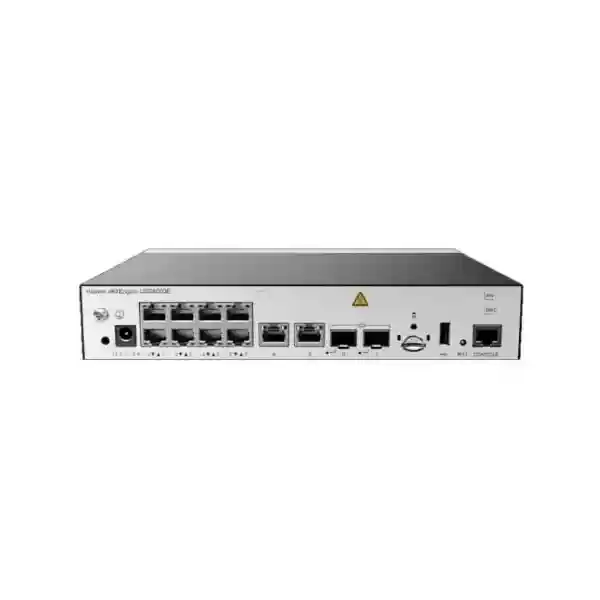
Enterprise Network Security • UAE Deployment
Huawei HiSecEngine USG6000E-S05 Firewall in the UAE
The Huawei HiSecEngine USG6000E-S05 is presented here as a next-generation security gateway for UAE businesses that need to consolidate firewall policy, threat prevention, secure WAN connectivity, remote access, network segmentation, and operational visibility in a single security platform. FourTeck designs and supplies Huawei security solutions for offices, branches, retail estates, education environments, hospitality networks, industrial sites, professional services firms, and distributed enterprises that need controlled Internet access without turning the perimeter into an operational bottleneck.
Direct answer: what is the Huawei HiSecEngine USG6000E-S05 used for?
For a typical UAE project, the USG6000E-S05 is considered when the security gateway must sit between trusted networks and the Internet or between internal security zones, inspect traffic, enforce application-aware access rules, terminate encrypted VPN connectivity, and provide a manageable platform for daily network security operations. It can be designed as a standalone Internet edge firewall, an active/standby security pair, a branch security gateway, a VPN concentrator for smaller sites, or a segmentation firewall protecting servers, users, voice, wireless, cameras, IoT, guest networks, and other logical zones.
Perimeter control
Enforce source, destination, service, user, application, and security-policy decisions between the LAN, DMZ, WAN, cloud-connected segments, and public Internet.
Threat inspection
Apply next-generation inspection services such as intrusion prevention, anti-malware controls, URL filtering, application identification, and other licensed protection functions where required.
Secure connectivity
Build policy-controlled site-to-site IPsec connectivity and remote-access designs, subject to software release, license entitlement, identity architecture, and project requirements.
Operational visibility
Centralize security policies, event review, logs, alarms, object management, and change control so the firewall can be operated as part of a structured security process rather than as an isolated appliance.
Important model verification note for USG6000E-S05 quotations
Huawei publishes extensive documentation for the broader USG6000E and USG6000E-S families, including product documentation sets, installation material, software guidance, security configuration references, licensing documentation, and family-level product overviews. However, the exact USG6000E-S05 variant is not consistently surfaced in publicly indexed Huawei material in the same way as several other USG6000E-S models. For that reason, this page does not copy port counts, session limits, security-throughput values, storage capacity, environmental limits, or power specifications from a different member of the family and relabel them as S05 specifications.
Before a commercial offer is finalized, FourTeck validates the exact Huawei ordering code, regional availability, software train, fixed and optional interface layout, transceiver requirements, AC or other power options, subscription bundle, support term, VPN scale, threat-protection performance, high-availability requirements, and any mandatory accessories. This verification is especially important when a tender uses a shortened model name, when a customer is replacing an older Huawei USG appliance, or when a bill of quantities was prepared from a distributor list rather than a manufacturer part-number sheet. The objective is simple: the device delivered to site must match the required traffic profile and interface design, not merely the family name.
Security architecture and traffic-processing approach
A modern firewall should be evaluated as a traffic-processing system rather than as a box with a single throughput number. Huawei positions the USG6000E family as next-generation security infrastructure capable of combining conventional stateful firewalling with deeper security services. Huawei has also described the family as using acceleration capabilities for security functions such as IPsec, intrusion prevention, and antivirus processing. In practical network design, this matters because the useful performance of a firewall is determined by the combination of services that remain enabled during normal business traffic, not by the highest laboratory figure on a specification sheet.
Every connection crossing a security boundary creates work for the appliance. The firewall must identify the ingress interface or zone, evaluate address and service objects, check routing, track session state, apply NAT when required, evaluate policy order, determine whether application or identity information is available, and potentially send the flow through IPS, anti-malware, URL filtering, content controls, SSL inspection, or logging logic. For long-lived file transfers, the dominant factor may be aggregate bandwidth. For DNS-heavy, web-heavy, API-heavy, point-of-sale, or cloud application traffic, new-session rate and concurrent-session capacity can become equally important. Encrypted traffic introduces an additional design dimension because inspection may require decryption, certificate handling, cryptographic processing, and more memory per flow.
For this reason, FourTeck sizes the USG6000E-S05 project against a real traffic model. We identify Internet circuit speed, peak utilization, expected growth, the percentage of encrypted traffic, number of users and devices, average and burst session creation, branch VPN load, remote-access demand, north-south versus east-west inspection, and the specific security subscriptions that will remain active. A branch with a 500 Mbps circuit can still create more security work than another branch with a 1 Gbps circuit if the first site has thousands of short sessions, heavy SaaS usage, multiple VPN overlays, and full threat inspection. Conversely, a site transferring large engineering files may need higher sustained throughput but a relatively moderate session rate.
The architecture should also be planned for failure conditions. In an HA design, the surviving appliance may need to carry the full traffic load after a peer outage, while also maintaining logs, VPNs, routing adjacencies, and security inspection. A design that runs comfortably only when both devices share load can become unstable when one unit fails. FourTeck therefore treats failover-state capacity as a primary sizing requirement and keeps sufficient headroom for security-signature growth, software upgrades, new SaaS use, additional branch tunnels, and future Internet bandwidth increases.
Firewall policy design: from basic rules to application-aware control
The foundation of the deployment is the security policy. A strong design does not begin with hundreds of permissive rules copied from an old firewall. It begins with a zone model and a clear description of which business systems need to communicate. Typical zones can include corporate users, servers, guest wireless, voice, CCTV, building management, operational technology, management, DMZ, branch WAN, cloud VPN, and Internet. Each zone should have a defined trust role, logging requirement, permitted services, and escalation path for changes.
Traditional firewall rules match IP addresses, ports, and protocols, but those criteria are no longer sufficient for many enterprise networks. Web applications commonly share TCP 443, SaaS platforms change address ranges, and users move between wired and wireless networks. Next-generation application identification can add context so policy decisions can be aligned more closely to the service actually being used. Where supported and licensed, the design can combine network objects with application awareness, user information, URL categories, and security profiles. The policy objective is not to block as much as possible. The objective is to permit what the business needs with the smallest reasonable attack surface and enough logging to explain the decision later.
Rule order deserves careful attention. A broad allow rule placed above a more specific inspection rule can silently bypass intended protection. Similarly, an emergency temporary rule can become permanent if change management is weak. FourTeck recommends a policy structure that separates infrastructure services, published services, user egress, branch connectivity, administrative access, and temporary exceptions. Descriptions should include owner, purpose, change reference, and review date where the platform workflow permits. Address groups should reflect business roles rather than arbitrary naming. For example, a server group named after a service function is more durable than a rule containing ten individual IP addresses with no context.
Policy cleanup should be planned from the beginning. During migration, hit counts and logs can be used to identify stale rules, unused objects, redundant NAT entries, shadowed policies, and unexpected flows. This is one of the highest-value outcomes of a firewall refresh: the project can remove years of accumulated access rather than simply moving it to newer hardware. For UAE enterprises with audit obligations, a documented policy baseline also makes internal review and evidence collection significantly easier.
Threat prevention, IPS, anti-malware, URL filtering and encrypted traffic
A next-generation firewall earns its place in the network when security services are designed as part of policy rather than enabled globally without context. Intrusion prevention can inspect traffic for exploit patterns and protocol anomalies, but the correct profile depends on the exposed service and business tolerance. A public web application, an internal database segment, a user Internet policy, and a site-to-site VPN carrying ERP traffic do not necessarily need identical signatures or actions. Overly aggressive profiles can create avoidable false positives; overly broad exceptions can remove the protection the system was purchased to provide.
Antivirus and malware inspection add another control layer. Their effectiveness depends on content visibility, update status, protocol support, file types, policy scope, and encrypted-traffic handling. The operational team should know what is actually inspected, what is bypassed, how oversize or unsupported objects are treated, and what happens when a cloud reputation or signature service is unreachable. Security design should not rely on a checkbox. It should define expected behavior for normal, suspicious, blocked, and unscannable traffic.
URL filtering can be used for risk reduction, acceptable-use enforcement, and category-based egress policy. In corporate environments, useful goals often include blocking known malicious categories, newly observed risky domains where the service supports such intelligence, anonymizers that violate policy, unwanted remote-access utilities, and selected non-business categories. At the same time, organizations should avoid broad filtering rules that interfere with legitimate research, marketing, development, support, or cloud services. Exception workflows should be documented so business users are not forced into informal workarounds.
Encrypted traffic is the major design challenge. A large share of web and application traffic is protected by TLS, and a firewall cannot inspect encrypted payload content without an explicit decryption architecture. TLS inspection introduces certificate-management tasks, endpoint trust requirements, legal and privacy considerations, application compatibility testing, and measurable performance overhead. Some applications use certificate pinning or mutual authentication and may need controlled bypass. Banking, healthcare, government, identity, or other sensitive categories may also require special treatment according to organizational policy.
FourTeck therefore treats SSL or TLS inspection as a project, not a switch. We identify user groups, managed device coverage, certificate distribution method, bypass categories, application incompatibilities, logging requirements, and capacity impact. Pilot deployment to a controlled user group should precede broad rollout. The resulting policy should be narrow enough to respect business and privacy requirements but broad enough to improve visibility where the security value justifies the operational cost.
Security subscriptions and cloud-connected intelligence should also be matched to the support lifecycle. A firewall without current signatures, reputation data, software maintenance, and operational review gradually becomes less effective even if the hardware continues to pass packets. The quotation should therefore distinguish base appliance entitlement from time-bound security services and support, state the renewal period, and identify which protection functions depend on active subscriptions.
Interfaces, port planning and physical connectivity
Port planning should be based on the final confirmed USG6000E-S05 ordering configuration rather than on a photograph or a specification copied from another USG6000E-S model. The family includes multiple form factors and interface combinations, and Huawei documentation for the broader range shows that models can differ significantly in fixed Ethernet, optical, management, USB, storage, power, and expansion characteristics. FourTeck validates the exact port map before the bill of materials is frozen.
At design stage, every physical port should have a role. WAN links may terminate directly on the firewall or through carrier equipment. LAN uplinks commonly connect to a core or distribution switch using routed interfaces, VLAN trunks, or link aggregation depending on architecture. A dedicated management network is preferable where available. HA heartbeat or synchronization links should follow Huawei design guidance for the chosen release. If optical links are used, the transceiver type, wavelength, fiber mode, connector, distance, and switch-side optic must match. A 10G-capable cage is not useful if the wrong SFP family is ordered or if the far-end switch supports an incompatible optical standard.
VLAN trunking can reduce the number of physical connections but increases the logical importance of a single uplink. Redundant links or aggregation should be considered where switch and firewall support align with the topology. For DMZ designs, the question is whether services should share a trunk with internal zones or use physically distinct links. There is no universal answer; the choice depends on risk, port availability, change control, and upstream switching design.
Cable and rack readiness are also part of firewall engineering. The installation checklist should identify rack units, airflow direction, available depth, cable bend radius, patch-panel labeling, console access, power-feed diversity, UPS-backed outlets, grounding requirements, spare optical modules, and out-of-band recovery access. These details prevent a technically correct security design from failing during the actual cutover.
VPN architecture for branches, partners and remote users
IPsec VPN is one of the most common reasons organizations deploy an enterprise firewall. In a UAE head office, the USG6000E-S05 may be used to connect warehouses, retail locations, construction sites, remote offices, cloud environments, or partner networks. The design must account for encryption profile, routing, address overlap, tunnel monitoring, failover, NAT traversal, dynamic or static peer addressing, and the amount of traffic that will cross each tunnel.
A hub-and-spoke VPN is operationally straightforward when branch traffic must reach centralized services. However, sending branch-to-branch traffic through the head office can consume bandwidth and add latency. A partial-mesh or dynamically built path may be more efficient where the platform and network design support it. For critical links, dual ISPs can be used with route tracking and policy logic so tunnels re-establish through an alternate circuit after failure. The success of failover depends on the complete path, not just the firewall. Carrier CPE, public addressing, upstream NAT, DNS dependencies, and routing timers can all affect recovery.
Cryptographic choices should follow current organizational standards and interoperability requirements. Strong algorithms are only one part of the design; key lifetime, authentication method, certificate handling, perfect forward secrecy choices, IKE version, and peer identity are equally important. Pre-shared keys may be acceptable in small controlled deployments but become difficult to manage at scale. Certificate-based authentication can improve lifecycle control but requires a functioning PKI process.
Remote-access VPN introduces identity considerations. The project should define who can connect, from which device types, what second factor is required, which internal networks are reachable, whether split tunneling is allowed, how posture or endpoint controls are enforced, and how sessions are logged. Remote access should terminate into a restricted zone with explicit policies rather than granting broad internal reach after authentication.
When VPN capacity is specified, FourTeck reviews both encrypted throughput and tunnel scale. A project with two high-bandwidth data-center tunnels has different requirements from a project with hundreds of low-bandwidth branch tunnels. The HA failure case must also be considered because all VPN sessions may need to re-establish on the surviving unit. Where low-latency voice or interactive applications cross VPNs, path quality and traffic engineering can matter as much as raw firewall performance.
Routing, NAT, segmentation and network integration
The firewall must fit into the surrounding network without creating hidden routing dependencies. Small deployments may use a default route toward the ISP and static routes toward internal VLANs. Larger networks can require dynamic routing so the firewall exchanges reachability with core switches, routers, SD-WAN devices, or other security systems. Route design should define administrative preference, redistribution boundaries, default-route origination, summarization, failure detection, and which device owns inter-VLAN routing.
NAT deserves equal attention. Source NAT for user Internet access is usually simple until multiple ISPs, policy-based routing, published services, partner VPNs, and overlapping address spaces appear. Destination NAT or server publishing must be documented together with the corresponding security rule, DNS design, health monitoring, and upstream provider requirements. One-to-one mappings should be reserved and tracked. Hairpin access, where internal users reach an internal service through its public address, should be intentionally designed rather than discovered after cutover.
Segmentation is often the most valuable security improvement in a firewall project. Instead of treating the entire internal LAN as trusted, organizations can place critical servers, administrative systems, backups, management interfaces, cameras, IoT devices, guest wireless, and third-party equipment into separate zones. The firewall then permits only the flows required between those zones. This limits lateral movement and creates useful logs for unexpected communications.
Segmentation must remain operationally practical. If every workstation-to-server flow is forced through a firewall without understanding application dependencies, the result can be a large number of emergency rules and poor user experience. FourTeck uses discovery information, switch VLAN maps, server inventories, application owners, and flow logs to define boundaries. The best segmentation plan is one the IT team can maintain, audit, and explain six months after implementation.
High availability, resilience and failure-domain design
For businesses that cannot tolerate a single firewall outage, two appliances are typically designed as a high-availability pair using capabilities supported by the confirmed model and software release. HA is not simply the purchase of a second unit. It is a system design covering state synchronization, configuration consistency, heartbeat links, interface monitoring, upstream and downstream switching, carrier connectivity, power, routing behavior, and operational procedures.
A common error is to build two firewalls but leave one unmanaged switch, one power feed, one ISP CPE, or one physical uplink as the real single point of failure. FourTeck maps the complete service chain from internal clients to the Internet or remote network. Where practical, each firewall receives resilient connectivity to the switching environment, independent power feeds backed by suitable UPS infrastructure, and clear HA communication paths. ISP redundancy is handled according to the carrier handoff method and public addressing model.
Session behavior during failover must be understood. Some state may synchronize between peers, while certain sessions, tunnels, routing relationships, or inspection contexts may still need to re-establish depending on feature and release behavior. Applications should be tested rather than assuming every connection will survive invisibly. Voice calls, database transactions, remote desktop sessions, and payment traffic have different sensitivity to a brief interruption.
Maintenance is another reason to deploy HA. Software upgrades, hardware replacement, and controlled configuration changes can be performed with lower service impact when the design supports staged failover. However, change procedures must verify peer health before switching traffic. An unnoticed synchronization problem can turn a routine upgrade into an outage. The runbook should include pre-checks, backup, failover command sequence, monitoring, validation, and rollback.
Capacity planning for HA should assume one unit may carry the entire protected load. If a single appliance is already near its resource ceiling during normal operation, the pair has little resilience. FourTeck designs headroom around the surviving-unit scenario, including the expected growth horizon. That approach produces a security platform that remains stable during the very event HA was purchased to handle.
Management, logging, monitoring and operational security
A firewall is only as strong as its operating model. Day-two management should define who can administer the appliance, how credentials are protected, how configuration changes are approved, where logs are retained, how alarms are escalated, and how backups are tested. Administrative access should use dedicated management paths where practical, trusted source restrictions, encrypted management protocols, strong authentication, and role separation. Shared administrator accounts should be avoided because they weaken accountability.
Logging policy should balance usefulness with storage and noise. Denied traffic logs can reveal scanning, policy mistakes, malware activity, and unexpected application dependencies, but logging every packet indiscriminately can overwhelm local storage or SIEM capacity. Security rules protecting critical assets generally deserve session logging. Administrative changes, authentication events, VPN activity, signature detections, system warnings, HA events, routing changes, and update failures should be forwarded to the organization’s monitoring platform when available.
Time synchronization is essential. Firewall logs that differ from server, endpoint, cloud, or identity logs by several minutes can make incident investigation unnecessarily difficult. NTP sources should be redundant and appropriate for the organization. DNS configuration is also operationally important because URL filtering, updates, licensing checks, reputation services, and administrator workflows can depend on reliable name resolution.
Backups should be taken before and after major changes and stored outside the appliance. A backup process is incomplete until restore steps are understood. The runbook should record software version, patch level, licenses, certificates, interface mapping, HA role, routing configuration, external dependencies, and emergency console procedure. Critical certificates must be included in lifecycle planning so an expired management, VPN, or inspection certificate does not create an avoidable outage.
Monitoring should focus on trends, not only red alarms. CPU, memory, session utilization, new-session rate, interface errors, drops, temperature, storage, VPN tunnel stability, signature-update status, and log-forwarding health can reveal problems before users report them. Capacity trends are especially useful when Internet bandwidth is upgraded, a new cloud workload is introduced, or another branch is added.
Organizations that already use centralized security analytics can integrate the firewall logs into their SOC workflow. FourTeck can also align the deployment with wider infrastructure and support services available through FourTeck IT Services UAE, helping customers treat firewall management as one component of a complete operational environment.
Licensing, software release and subscription planning
Security hardware procurement should always separate three concepts: the appliance, software entitlement, and time-bound security or support services. The exact composition depends on the Huawei bundle, channel availability, and region. Functions such as advanced threat intelligence, security signatures, URL categorization, anti-malware updates, cloud-connected reputation, centralized management integration, or vendor support can depend on active licenses or subscriptions. A low initial hardware price is therefore not enough to calculate project cost.
FourTeck prepares the quotation around the service life the customer intends to operate. A one-year subscription may reduce initial expenditure but increases renewal frequency. Multi-year coverage can simplify budgeting and reduce the risk of a security service expiring because renewal was missed. The right term depends on procurement policy, equipment refresh cycles, support requirements, and the certainty of the network roadmap.
Software version is equally important. Huawei’s support documentation for the USG6000E and USG6000E-S families spans multiple releases. Feature availability, interface behavior, supported cryptography, management workflow, high-availability behavior, vulnerability fixes, and upgrade paths can vary by software train. New units should be delivered on an appropriate supported release or upgraded according to a controlled plan after confirming compatibility and release notes.
The project handover should record serial numbers, license identifiers, support dates, software version, subscription expiry dates, and the renewal owner. That small administrative step prevents a common operational problem: nobody knows which security services are active until a signature update fails. For broader procurement and enterprise infrastructure requirements, customers can also use FourTeck UAE as a central contact point for coordinated project sourcing.
How FourTeck sizes the USG6000E-S05 for a real UAE network
Firewall sizing begins with the workload. The first number is the current Internet bandwidth, but it is never the last. We collect committed and burst bandwidth from each ISP, expected upgrade path, number of WAN circuits, branch VPN demand, inter-zone traffic, remote-user requirements, and whether the firewall will inspect only Internet traffic or also internal east-west traffic. A firewall sitting in front of a 1 Gbps Internet circuit can still process several gigabits of aggregate traffic if it also routes between high-volume internal zones.
Next we review security-service intensity. Stateful firewalling has a different cost from full IPS, anti-malware, application identification, URL filtering, and TLS decryption. If a datasheet provides multiple throughput figures, the number closest to the real enabled feature set is the relevant figure. Laboratory performance should be treated as a comparative reference, not as a guarantee that every production network will produce the same result. Packet size, protocol mix, connection duration, encryption, signature set, logging, policy complexity, and software version influence observed performance.
User count is considered, but device and session behavior matter more. A 150-user software company with multiple cloud tools, development environments, test systems, video meetings, and continuous synchronization can create more sessions than a 400-user back office with limited application diversity. IoT and camera networks add persistent flows. Mobile devices move between networks and create repeated connection bursts. Modern browsers open many parallel sessions. Cloud applications can contact numerous domains and CDNs. These patterns explain why a simple users-per-firewall table can be misleading.
We then assess concurrency and new-session rate. Concurrent sessions indicate how many connections the firewall may need to track at once. New sessions per second indicate how quickly the state table changes. Both must have headroom. Peak behavior matters more than daily average. A shift change, software update, cloud backup, system restart, or large meeting can create a short session storm even when average bandwidth remains moderate.
VPN sizing is calculated separately. Site-to-site tunnels can carry backup replication, voice, file services, ERP, CCTV, or management traffic. Remote users can produce highly variable load depending on whether Internet traffic is split tunneled or backhauled. Cryptographic settings can affect performance. If the deployment uses dual WAN failover, the firewall must be able to carry the full expected workload on either path.
Growth planning normally considers the expected refresh horizon. Internet bandwidth in the UAE can be upgraded quickly, and a firewall purchased with no headroom can become the bottleneck long before the hardware is physically obsolete. We account for planned sites, cloud adoption, Wi-Fi expansion, new cameras, remote access, server migrations, and segmentation projects. The goal is not to oversize without reason; it is to avoid a predictable mid-life replacement.
Finally, the proposed USG6000E-S05 ordering configuration is checked against manufacturer documentation and channel availability. If the verified model cannot meet the required interface, performance, scale, power, or support criteria, FourTeck recommends moving to the appropriate Huawei model rather than forcing the requirement onto unsuitable hardware. Customers focused specifically on firewall projects can review related security services at Firewall Dubai by FourTeck.
Deployment topology 1: Internet edge for a single UAE office
A straightforward deployment places the firewall between the ISP handoff and the internal core switch. The WAN interface receives the carrier-provided addressing, while one or more LAN-side interfaces connect to the switching infrastructure. Corporate users, servers, guest wireless, and other networks can be separated into VLANs and security zones. Source NAT provides controlled Internet access, while destination NAT or published-service rules expose only explicitly approved systems.
Even in a small office, the design should avoid a single flat trusted zone. Guest Wi-Fi should not reach corporate endpoints. CCTV and building systems generally need limited outbound access and only specific management flows. Printers and IoT devices can be isolated from server networks. Administrative management can be restricted to IT subnets. This structure gives the firewall meaningful security work rather than using it merely as an expensive NAT router.
If business continuity is important, a secondary ISP can be added. The firewall can monitor path availability and use routing or policy mechanisms supported by the chosen design to shift traffic after failure. Applications that depend on public IP allowlists, inbound NAT, or site-to-site VPNs must be tested on the backup circuit because failover is not complete if Internet browsing works but the business VPN remains down.
Deployment topology 2: head office with multiple branches
In a distributed organization, the head-office firewall often becomes the VPN hub. Branches establish encrypted tunnels over local Internet circuits, and routing sends traffic to centralized applications. Security policy can restrict each branch to only the services it needs. A retail branch may require ERP, payment, DNS, NTP, voice, and management traffic. A warehouse may require inventory, scanners, cameras, and vendor support. Treating every branch as fully trusted creates unnecessary lateral movement risk.
The hub must be sized for aggregate encrypted traffic and tunnel count, including recovery after a branch circuit flap or head-office firewall failover. If many tunnels re-establish simultaneously, the system experiences a burst of cryptographic and session activity. Routing design should prevent asymmetric traffic where packets enter one path and return through another security device, because stateful inspection expects a consistent flow path unless the architecture explicitly supports otherwise.
Branch connectivity can also be integrated with centralized logging and monitoring. Security events from remote sites become visible to the main IT team, which is particularly valuable when branches have no local technical staff. Configuration standards can be documented so new branches are deployed with consistent zone names, VPN parameters, policies, logging, and update settings.
Deployment topology 3: server and DMZ segmentation
A firewall can protect more than the Internet edge. Organizations hosting on-premises applications can place public-facing services in a DMZ and keep database or application tiers in separate internal zones. The front-end server may accept HTTPS from the Internet, but its communication to the application tier can be limited to specific ports. The application tier can reach the database only on the required database service. Administrative protocols can be restricted to management networks. Backup traffic can be permitted only to backup servers.
This layered design improves containment because compromise of a single service does not automatically provide unrestricted access to the rest of the data center. It also creates logs at key trust boundaries. However, the firewall must be sized for the aggregate internal traffic crossing those boundaries. If large backup, storage, or replication flows traverse the firewall, interface capacity and inspection policy should be designed carefully. Some high-volume trusted storage traffic may belong on a separate architecture, while high-risk administrative or application flows benefit strongly from inspection.
The network team should work with application owners to identify service dependencies before enforcing segmentation. DNS, NTP, authentication, monitoring, backup, patching, certificate services, and management tools are often forgotten during the first rule draft. A staged migration using logging and controlled policy tightening reduces downtime risk.
Deployment topology 4: guest, IoT, CCTV and operational networks
Non-user devices deserve dedicated security treatment because they often have long replacement cycles, limited endpoint protection, default service exposure, or third-party maintenance requirements. Cameras may need NTP, DNS, and communication to a recording system but no general Internet access. Building controllers may need vendor cloud access yet should not initiate connections to corporate user networks. Guest devices normally need only Internet access and perhaps captive-portal or DNS services.
The firewall can enforce these boundaries at Layer 3 while switches and wireless infrastructure provide VLAN separation. Policy should be based on required communication paths, not assumptions that every device in a physical building belongs to one trusted LAN. Where a vendor requires remote support, access can be limited by source, destination, service, time window, and VPN authentication rather than leaving permanent inbound exposure.
Segmentation projects frequently reveal undocumented dependencies. A camera recorder may send alerts through an old SMTP server. A building system may use hard-coded DNS. An IoT gateway may contact a vendor cloud region not previously known. These discoveries are valuable: the project replaces implicit trust with documented communication requirements. The firewall becomes a visibility and control point while the organization improves its asset inventory.
UAE procurement, implementation and support considerations
Firewall procurement in the UAE should align technical design with commercial traceability. The quotation should identify the exact manufacturer part number, hardware quantity, power option, included accessories, required optics, license bundle, subscription term, support term, and any implementation service. If the customer requires a particular warranty or vendor support level, that requirement should appear in the bill of materials rather than being assumed.
Lead time can vary by model and distributor stock. A project schedule should not assume immediate availability until the part number is confirmed. If a tender has a fixed cutover date, FourTeck can validate channel availability before finalizing the implementation plan. For replacement projects, keeping the existing firewall operational until the new unit is fully staged is important. The old appliance should not be decommissioned merely because the hardware has arrived.
Staging is one of the highest-value steps. The firewall can be upgraded to the approved software release, licensed, configured with management addressing, objects, base policies, routing, VPN parameters, DNS, NTP, logging, and administrator controls before arriving at the live site. Configuration review can then focus on differences between the lab assumption and the actual carrier or switching environment. This shortens the outage window and reduces pressure on engineers during cutover.
For organizations with multiple UAE sites, standard templates can be created for branches while preserving site-specific addressing, WAN circuits, and local policies. Standardization makes troubleshooting faster and reduces configuration drift. It also makes later audits easier because exceptions become visible. Documentation should include network diagrams, interface maps, VLANs, IP addresses, routing, NAT, VPN peers, policy intent, logging destinations, support contacts, and rollback steps.
Environmental readiness matters in local deployments. Network rooms should provide suitable cooling, clean power, UPS coverage, controlled access, and sufficient rack ventilation. Branch locations sometimes place security devices in small communications cabinets with poor airflow. Heat, dust, and unstable power can reduce reliability even when the firewall itself is correctly configured. The site survey should therefore include physical infrastructure rather than focusing only on IP addressing.
Post-deployment support should include a defined escalation path. The operating team needs to know whether a problem is caused by the firewall, carrier, switch, DNS, endpoint, VPN peer, or application. Good documentation and centralized logs shorten diagnosis. Customers with wider infrastructure requirements can coordinate regional sourcing through FourTeck Global while maintaining a UAE project focus through FourTeck’s local channels.
FourTeck can scope supply-only, installation assistance, migration, policy cleanup, VPN configuration, HA design, logging integration, hardening, and ongoing support as separate work packages. This allows the project to match the customer’s internal engineering capability rather than bundling unnecessary services.
Migration from an existing firewall
A successful migration preserves required connectivity while improving the policy baseline. The first step is discovery. FourTeck collects the current interface map, routing table, NAT rules, VPNs, security policies, address objects, service objects, certificates, DNS settings, NTP, authentication dependencies, logging destinations, administrative access, and any policy-based routing. We also identify carrier information and upstream devices because the firewall configuration alone may not explain how traffic actually reaches the Internet.
Existing rules are then classified. Some can be migrated directly, some should be consolidated into groups, some are obsolete, and some require business validation. A rule permitting any service between large networks may be technically easy to reproduce but is a poor security outcome. Where time allows, logs from the current firewall can show which destinations and services are actually used. Application owners can validate uncertain traffic.
NAT migration requires special care because users may perceive any public-IP change as a firewall failure even when the new appliance is functioning correctly. Published services can depend on DNS records, external allowlists, certificates, SMTP reputation, payment provider configuration, partner tunnels, and SaaS security lists. If the carrier circuit remains the same, retaining existing public addresses can simplify the move. If the circuit or address block changes, external dependencies must be updated in advance.
VPN peers should be inventoried with contacts. Site-to-site tunnels often involve third parties who cannot make changes during the same maintenance window unless coordinated. Cryptographic settings may also need modernization. A migration is an opportunity to replace weak legacy parameters, but changing both sides requires planning. Remote-access users need updated client profiles or portal information before the old platform is disabled.
The cutover plan should include clear entry and exit criteria. Before change begins, backups are taken, console access is confirmed, cables are labeled, new configuration is saved, and rollback hardware is ready. After traffic moves, engineers test Internet browsing, DNS, critical SaaS, email, published services, branch VPNs, remote access, ERP, voice, monitoring, and any business-critical application. Security logs are reviewed to identify denies caused by missing rules.
Rollback is not a sign of failure; it is a planned control. If critical services cannot be restored within the approved maintenance window, traffic can return to the original appliance while the issue is investigated. A project with a tested rollback path is safer than one that assumes every dependency has already been discovered.
Operational hardening checklist after deployment
After the firewall is carrying production traffic, configuration hardening should be validated separately from functional testing. A device can pass application traffic and still expose unnecessary management services, use weak administrator practices, or fail to export logs. Hardening should therefore verify the management plane, control plane, security policies, update state, cryptography, logging, and recovery process.
Administrative access
Restrict management to approved networks, disable unnecessary services, use named accounts, enforce strong authentication, document emergency access, and review administrator privilege levels.
Software and updates
Confirm the approved software release, patches, threat-signature status, subscription connectivity, update schedule, maintenance procedure, and vendor support eligibility.
Policy hygiene
Remove temporary migration rules, review overly broad policies, verify NAT intent, confirm segmentation boundaries, and add descriptions to rules and objects that require operational context.
Logging and time
Validate NTP, log timestamps, remote log delivery, SIEM parsing where used, alert severity, disk utilization, and retention so events remain useful during troubleshooting and incident response.
Resilience
Test HA status, monitored interfaces, peer synchronization, dual power where applicable, ISP failover, VPN recovery, routing convergence, and the ability to administer the surviving unit.
Recovery evidence
Store current configuration backups, software images where permitted, license records, certificates, diagrams, support contacts, serial numbers, and a written recovery procedure outside the appliance.
Hardening is not a one-time event. Quarterly or scheduled reviews can identify stale administrator accounts, expired certificates, unused rules, unsupported software, failing log collectors, or subscriptions approaching renewal. The firewall should evolve with the network rather than remaining frozen at the configuration used on installation day.
Who should consider the Huawei HiSecEngine USG6000E-S05?
The requested USG6000E-S05 model is most relevant when a customer wants a Huawei-based security platform in the USG6000E-S family and the final verified hardware configuration fits the required capacity and interfaces. It can suit organizations standardizing on Huawei networking, businesses replacing older USG appliances, branches that need local security and VPN, and environments where a single appliance must combine routing, firewall policy, NAT, and threat controls.
It should not be selected only because a reseller list describes it as an enterprise firewall. The correct model depends on measurable requirements. If the site needs very high multi-gigabit full-security inspection, large-scale TLS decryption, extremely high VPN density, extensive 10/25/40/100G connectivity, large concurrent-session tables, or data-center-class redundancy, a higher model may be appropriate. Likewise, a very small branch may not need the same hardware as a regional hub.
The strongest purchasing decision starts with traffic and topology. FourTeck can compare the S05 ordering option against adjacent Huawei models after confirming the real requirement. That comparison focuses on verifiable attributes such as usable interfaces, security-service throughput, session scale, VPN scale, physical form factor, power architecture, software support, subscriptions, and total deployment cost. It does not rely on a generic small/medium/large label.
Customers should also consider the operational ecosystem. If the IT team already understands Huawei CLI, GUI, policy concepts, and support processes, continuity can reduce migration risk. If the organization is moving from another vendor, training and documentation should be included in the project. A firewall platform is a multi-year operational decision, so engineer familiarity and support access matter alongside hardware specifications.
Technical questions to answer before requesting a quotation
A precise quotation can be prepared faster when the core network facts are available. The list below is intentionally technical because firewall sizing errors usually come from missing detail rather than from the brand selection itself.
Internet and WAN
How many ISP links exist? What are the committed and burst speeds? Is there static public addressing? Is backup connectivity required? Are there MPLS, leased-line, or SD-WAN paths?
Users and devices
How many employees, servers, phones, access points, cameras, IoT devices, guest devices, and remote users will pass traffic through the firewall during peak periods?
Security services
Will IPS, anti-malware, URL filtering, application control, reputation services, and TLS inspection be enabled? Which traffic can bypass decryption and why?
VPN
How many site-to-site peers are required? What is the aggregate encrypted throughput? How many remote users are expected? Are there third-party peers with fixed cryptographic requirements?
Interfaces
Which copper and fiber speeds are needed? Are VLAN trunks acceptable? Are link aggregation, dedicated DMZ ports, management interfaces, or redundant uplinks required?
Availability
Is a single appliance acceptable, or is HA required? Are there dual power feeds, dual switches, and dual ISPs? What service interruption can the business tolerate?
Management
Will the firewall send logs to SIEM or syslog? Is centralized management required? Which authentication source will administrators and remote users use?
Lifecycle
What subscription term is preferred? What vendor support level is required? Is the project expected to remain in service for three, five, or more years?
Implementation methodology for UAE projects
FourTeck structures firewall work into discovery, design, staging, cutover, validation, and handover. Discovery collects the current-state configuration and business requirements. Design converts those inputs into interfaces, zones, routing, NAT, VPN, security profiles, logging, authentication, and availability decisions. Staging builds as much of the configuration as possible before the maintenance window. Cutover moves the physical and logical traffic path. Validation proves that business services and security controls work. Handover gives the operating team the documentation and knowledge needed to maintain the system.
The design phase should produce a rule matrix before implementation. Each permitted flow has a source, destination, service or application, direction, business owner, security profile, and logging requirement. NAT mappings and public IP usage are recorded. VPN peers include encryption settings and contacts. The interface schedule records device port, switch port, VLAN, address, zone, cable or optic, and redundancy role. This documentation reduces ambiguity during cutover.
Staging includes administrator hardening, software alignment, license activation, base routing, management services, NTP, DNS, objects, rules, VPN templates, and logging. If HA is part of the project, peer formation and synchronization are tested before site installation when practical. Configuration backups are exported before the change window. Engineers verify that console access is available in case network management becomes unreachable.
During cutover, changes are executed from a written sequence. Carrier handoffs and switch links are moved deliberately, not through trial and error. Each test is mapped to a business function. A successful ping is not enough. Users should be able to resolve DNS, browse approved Internet resources, authenticate, reach applications, establish branch VPNs, access published services, place calls where voice depends on the path, and send or receive email as required.
After stabilization, temporary rules are removed, logs are reviewed, alerts are tuned, documentation is updated with actual deployed details, and a final backup is stored. The customer receives the confirmed model and serial information, software release, license records, network diagram, interface map, policy summary, and support path. Optional training can cover routine rule changes, VPN monitoring, log review, backup, and failover procedures.
This implementation approach is applicable whether FourTeck supplies only the firewall or coordinates a broader network refresh. The firewall can be integrated with switching, wireless, servers, voice, and infrastructure projects without treating security as a last-minute add-on.
Common design mistakes to avoid
Buying on raw firewall throughput alone: headline throughput does not represent performance with all required security services enabled. Use the figure that matches the intended inspection profile and keep failover headroom.
Copying specifications from a similar model: adjacent USG6000E-S models may differ in interfaces, power, performance, and scale. Verify the exact S05 ordering code before promising technical values to stakeholders.
Treating internal networks as universally trusted: guest, CCTV, IoT, management, servers, and user networks benefit from explicit segmentation. Internal compromise is easier to contain when the firewall enforces meaningful boundaries.
Ignoring encrypted traffic: much of modern traffic uses TLS. Decide where decryption is required, where it is inappropriate, how certificates will be distributed, and how performance will be affected.
Building HA around a single ISP or switch: two firewalls do not eliminate downtime if every path still depends on one upstream device, power source, or carrier handoff.
Migrating every old rule unchanged: legacy firewall configurations often contain stale, duplicate, temporary, or overly permissive policies. A refresh is an opportunity to improve the security baseline.
Forgetting renewals: threat intelligence, filtering, signatures, and support can depend on subscriptions. Track renewal ownership and dates as part of handover.
Skipping rollback planning: every cutover should have a tested way to return traffic to the previous working state if a critical dependency fails.
Security operations after go-live
The first weeks after deployment are the best time to establish good operational habits. Engineers should review policy denies, top applications, VPN stability, threat detections, resource utilization, and update status. Unexpected denies may reveal missing business dependencies. Unexpected allows may reveal overly broad policies. High session or CPU trends can indicate a sizing issue, an application behavior change, scanning, or a routing loop. Repeated VPN flaps may point to carrier loss, MTU problems, peer configuration, or upstream NAT.
Change management should require enough context that a future engineer can understand why a rule exists. A ticket containing only “open port 443” is not sufficient. It should identify source system, destination system, application owner, business reason, duration, and whether the rule should be reviewed later. Where temporary access is required, expiry dates should be used operationally even if the platform does not automatically remove the rule.
Threat events need triage. Not every IPS hit is a confirmed compromise, and not every allowed connection is benign. Logs should be correlated with endpoint, identity, DNS, and server evidence when available. The firewall is one sensor and one enforcement point in a larger security architecture. Integration with a SIEM or SOC can improve context and reduce the chance that repeated low-level events are ignored.
Periodic rule review is also important. Business applications change, servers are decommissioned, cloud services move, contractors leave, and branch networks are renumbered. Rules that were once legitimate can become unnecessary exposure. A quarterly or semiannual review can identify rules with no recent usage, duplicate objects, broad service groups, disabled policies that can be removed, and exceptions that no longer have an owner.
Performance baselining makes later troubleshooting easier. Record normal CPU, memory, session count, throughput, new sessions per second, VPN count, and interface error rates under typical business load. When a problem occurs, the team can compare current behavior with a known healthy baseline instead of guessing whether the numbers are unusual.
Decision recap: what matters most in a USG6000E-S05 project
The Huawei HiSecEngine USG6000E-S05 should be treated as a security platform to be verified and engineered around the customer’s actual workload. The most important decision is not the model label itself; it is whether the confirmed ordering configuration provides the required security throughput, session capacity, VPN scale, interface mix, software support, and licensing for the intended topology. FourTeck does not substitute technical values from another USG6000E-S model when the exact S05 specification has not been verified.
Verify the hardware
Confirm part number, ports, form factor, power, optics, accessories, environmental requirements, and regional availability before purchase.
Size full security
Use realistic traffic, encryption, IPS, malware, application, URL, VPN, and logging requirements instead of relying on maximum stateful-firewall throughput.
Design resilience
Plan HA, carrier failover, switch redundancy, power, routing, and VPN recovery as one complete service path.
Operate the platform
Build logging, backups, certificate management, renewals, software maintenance, rule review, and administrator controls into the lifecycle from day one.
Quotation input checklist
To receive a technically accurate Huawei HiSecEngine USG6000E-S05 quotation for the UAE, provide the following information where available. Missing items can be discovered during consultation, but the more complete the input, the more precise the bill of materials and service scope will be.
1. Site location and number of branches or remote locations.
2. Primary and secondary Internet circuit bandwidth and handoff type.
3. Current firewall brand, model, software version, and replacement reason.
4. Estimated users, servers, phones, cameras, wireless clients, and IoT devices.
5. Required copper and fiber interface speeds and preferred uplink topology.
6. Number of site-to-site VPNs, remote users, and expected encrypted bandwidth.
7. Required services such as IPS, antivirus, application control, URL filtering, TLS inspection, and reputation intelligence.
8. HA requirement, acceptable downtime, dual-switch availability, and power redundancy.
9. Published servers, public IP blocks, inbound NAT rules, and external allowlist dependencies.
10. Logging, SIEM, syslog, identity, DNS, NTP, authentication, and monitoring integrations.
11. Preferred security-subscription and vendor-support term.
12. Required migration date, maintenance window, documentation, and post-cutover support scope.
Consult FourTeck for a verified Huawei USG6000E-S05 design
If your project specification names the Huawei HiSecEngine USG6000E-S05, FourTeck can validate the exact ordering reference and align it with your UAE network requirements before supply. The consultation can cover interface mapping, Internet edge design, branch VPN, remote access, segmentation, HA, subscriptions, optics, migration, logging, and support. If the confirmed S05 configuration is not the correct capacity for the workload, the recommendation can be adjusted to a more appropriate Huawei model based on measurable technical requirements.
For the fastest technical review, share your Internet speed, user and device count, number of VPN peers, current firewall model, required security services, interface requirements, and whether high availability is mandatory. A current network diagram is useful but not required. FourTeck can work from a bill of quantities, tender specification, old firewall configuration, or a discovery call.
This approach gives the customer a procurement-ready bill of materials and a deployment plan grounded in the network that will actually use the firewall. It also protects the project from the common error of assuming that every product in the USG6000E-S family has the same ports, throughput, or licensing. The final offer can therefore state exactly what is being supplied, how it will be used, and which subscriptions and services are included.

Reviews
There are no reviews yet.