
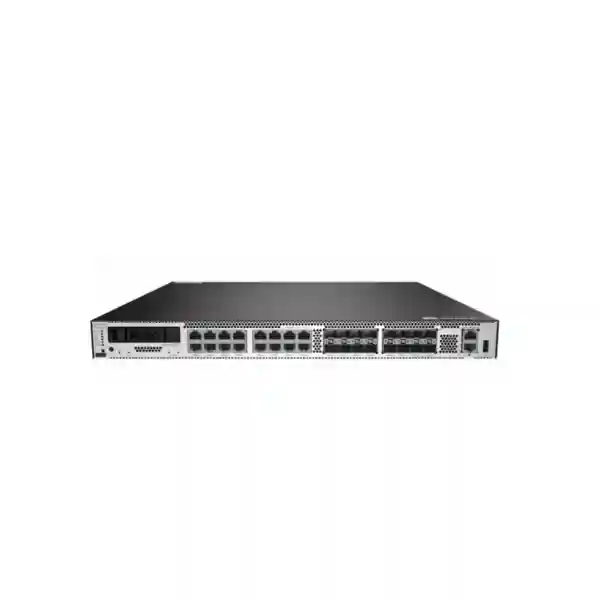
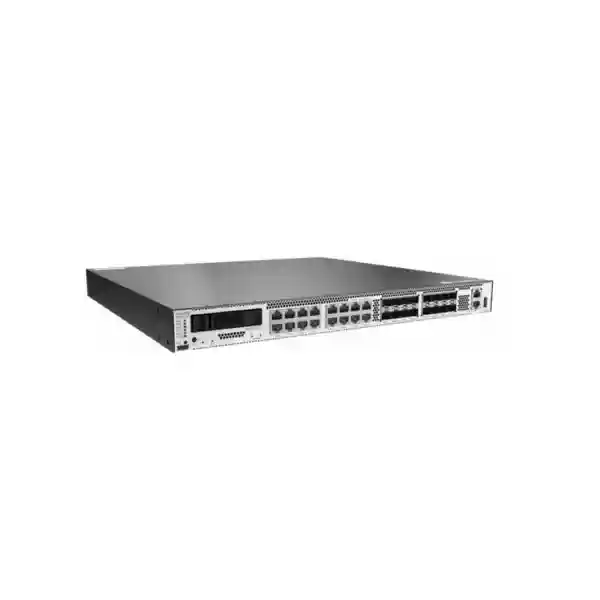
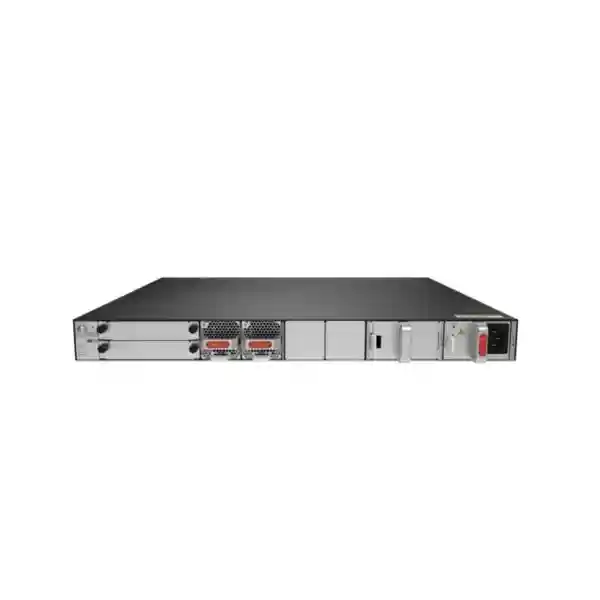
Huawei HiSecEngine USG6000F-E01
A high-density 1U next-generation firewall platform for organizations that need strong branch, campus, internet-edge and multi-service security without spreading policy enforcement across multiple standalone appliances.
Platform format
1U appliance suited to standard enterprise racks, branch aggregation rooms, data closets and compact security stacks.
Unified controls
Firewall, VPN, IPS, antivirus, DLP, Anti-DDoS, URL filtering, application control and bandwidth management are brought into one policy environment.
Optional local storage
Huawei lists optional 2.5-inch SATA storage capacities including 240GB, 480GB, 960GB, 1000GB, 1920GB and 3840GB choices.
Application awareness
Huawei states that the family can identify more than 6,000 applications and apply controls at granular application-function level.
What the USG6000F-E01 is designed to solve
The Huawei HiSecEngine USG6000F-E01 is positioned for small and midsize enterprises and organizations with multiple branches that need a capable security gateway at the perimeter or at a network aggregation point. That positioning is important for UAE buyers because a firewall project is rarely only about internet access. A typical Dubai office may terminate several ISP circuits, connect private WAN or SD-WAN paths, host site-to-site VPNs, separate guest, corporate, server, voice and operational networks, publish selected services, inspect outbound traffic and send security events to a central operational team. A firewall selected only on headline throughput can become difficult to operate if it lacks suitable port density, segmentation flexibility, policy visibility or security-service integration.
The E01 addresses this by combining a relatively dense fixed interface layout with multiple security services. Sixteen copper Gigabit Ethernet ports can serve local handoffs, provider CPE connections, management networks or lower-speed internal segments. Twelve GE SFP interfaces add flexibility for fiber handoffs, while four 10GE SFP+ interfaces give architects options for higher-speed uplinks, core connections or aggregated internal paths. The exact way these ports are used should be based on the physical and logical topology, transceiver compatibility, redundancy model and expected traffic path rather than on a simple one-port-per-zone assumption.
For enterprises moving from separate firewall, VPN and web-control devices, the unified model can reduce policy fragmentation. It also places more emphasis on correct sizing because enabling threat inspection, encrypted traffic processing, application identification and logging changes the workload compared with basic stateful forwarding. FourTeck therefore treats the USG6000F-E01 as a security platform to be designed around real traffic, sessions, services, growth and operational requirements rather than as a commodity router replacement. Organizations evaluating related security infrastructure can review FourTeck’s Firewall Dubai solutions for broader deployment context.
Hardware architecture and accelerated security processing
Huawei describes the USG6000F-E family as using a new software and hardware platform with an Adaptive Security Engine, commonly abbreviated ASE, together with specialized processing resources. The design includes network processing, pattern-matching and cryptographic co-processing engines intended to improve small-packet forwarding, reduce latency and accelerate functions such as application recognition, intrusion prevention and IPsec. This matters because next-generation firewall work is fundamentally different from simple packet forwarding. A stateful firewall must maintain connection context, enforce zone and policy logic, inspect protocol behavior, apply network address translation where required, classify applications and potentially perform signature, content or encrypted-tunnel processing on the same flows.
The role of an adaptive engine is to make security resources available to the workloads that need them rather than treating every traffic path as identical. In practical design terms, an organization may have substantial daytime SaaS and web traffic, predictable backup windows, bursts of voice or collaboration traffic and continuous site-to-site encryption. A platform designed around multiple processing functions can handle these mixed workloads more efficiently than an architecture that relies on a single general-purpose path for all tasks. This does not remove the need for sizing; it changes the questions that should be asked during sizing.
For a Dubai deployment, assess the percentage of traffic that will receive full threat inspection, the proportion of encrypted flows, the number of concurrent users, expected connection establishment rates, IPsec tunnel counts, remote-access patterns, logging intensity, internet circuit speeds and east-west traffic that may traverse the appliance. Also determine whether 10GE ports are used only as physical uplinks or whether sustained aggregate traffic can actually reach multi-gigabit levels. Security architecture should be based on the post-inspection requirement and not simply the sum of ISP contract bandwidths.
It is also useful to distinguish family-level architectural capabilities from model-specific benchmark numbers. Where a current manufacturer page does not publish a precise E01 figure for a specific inspection profile, FourTeck recommends confirming the required performance against the exact software release, enabled security services, licensing package and Huawei sizing documentation before purchase. This avoids treating unrelated laboratory figures as guaranteed production performance.
Interface design: 16 GE RJ45, 12 GE SFP and 4 10GE SFP+
Copper access and service handoffs
The 16 GE RJ45 ports are useful when local provider equipment, legacy switches, management devices or segmented service networks use standard copper Ethernet. They can also reduce the need for an intermediate access switch in compact branch designs, although topology and resilience should dictate the final layout.
Fiber-connected zones
The 12 GE SFP ports can support fiber handoffs where distance, electrical isolation or structured campus cabling favors optical connectivity. Correct transceiver selection, wavelength, fiber type and link budget should be confirmed for each run.
10 Gigabit uplinks
The four 10GE SFP+ ports provide options for core, aggregation, server-zone or high-speed WAN connectivity. They are particularly useful when firewall-on-a-stick designs, VLAN trunks or redundant distribution paths consolidate multiple logical zones over fewer physical links.
Port count should not be interpreted as the number of security zones. Modern designs typically separate physical connectivity from logical segmentation. A single 10GE trunk can carry multiple VLAN interfaces, while dedicated physical ports may be reserved for out-of-band management, high-availability links, DMZ connections or provider diversity. The most maintainable design is usually the one that clearly documents physical links, VLAN tagging, IP addressing, security zones, routing adjacencies and failure behavior.
When two internet providers are used, architects should decide whether each circuit terminates directly on the firewall, on provider-managed CPE, or through an edge switching layer. They should also specify whether inbound services require provider-independent addressing, BGP, static routing, policy-based routing or destination NAT. For internal connectivity, determine whether the firewall will sit between campus core and WAN, between core and internet, or as a segmentation gateway for sensitive networks. Each role changes traffic symmetry and failure-domain considerations.
Optical modules should be selected only after confirming Huawei support, the local fiber plant and the far-end device. Avoid assuming that any generic SFP or SFP+ will be acceptable in a production support context. UAE projects often involve mixed vendor switching estates, so the quote should identify both ends of each optical link and include the correct transceiver quantities, spares and patching assumptions.
Integrated security services and policy convergence
Huawei lists traditional firewalling, VPN, intrusion prevention, antivirus, data loss prevention, bandwidth management, Anti-DDoS, URL filtering and anti-spam capabilities within the USG6000F-E family. The operational value is not simply that multiple features exist; it is that administrators can design a policy architecture where identity, application, network context and threat controls are evaluated together. A security policy that permits a finance user to reach a cloud accounting service, for example, can be treated differently from a general internet rule even when both flows use HTTPS.
In a well-structured deployment, broad network rules are replaced by explicit business intent. Internet access policies can distinguish corporate users, servers, guest networks and infrastructure. Published services can be isolated in DMZ zones. Administrative protocols can be limited to known management networks. VPN traffic can enter dedicated zones and be subjected to the same inspection and segmentation principles as local traffic. Bandwidth controls can protect critical collaboration, ERP or transactional services during congestion. URL and application policies can be tied to acceptable-use requirements rather than implemented as blanket blocking.
The unified approach also supports more consistent change management. Instead of modifying independent ACLs, web gateways and VPN concentrators, a change can be analyzed in the context of its source, destination, application and inspection profile. This makes rule review more meaningful. It also means naming standards, object groups, policy comments, expiration dates and ownership should be designed from the beginning. Poor object hygiene on a feature-rich firewall creates complexity faster than it creates security.
For UAE organizations with audit requirements, policy structure should map to business owners and documented access justifications. High-risk exceptions should be narrowly scoped and time-bound where possible. Logging should record enough context to investigate events without overwhelming storage or SIEM capacity. The target is controlled visibility: collect information that supports detection, investigation and compliance while keeping the operational signal usable.
Application identification and granular control
Huawei states that the family recognizes more than 6,000 applications and can control activity at application-function level. This is important because port-based policies are no longer a reliable description of business traffic. Many applications use TCP 443, dynamically selected endpoints, content delivery networks and shared cloud infrastructure. A rule that merely allows HTTPS cannot explain whether a session is business collaboration, software update traffic, consumer file sharing, remote-control software, streaming media or an unknown application.
Application awareness lets administrators move closer to business intent. A branch office can prioritize sanctioned collaboration platforms, permit approved storage applications, limit recreational streaming during working hours and identify unsanctioned remote-access tools. In regulated environments, application visibility can complement network segmentation by revealing when traffic behavior does not match the expected function of a zone. For example, a printer network generating unusual cloud-storage traffic or a server segment initiating consumer messaging traffic may justify investigation.
Application control should nevertheless be deployed carefully. Classification depends on traffic visibility and signatures, and encrypted traffic may reduce the information available unless appropriate decryption or metadata-based methods are used. Policy teams should first observe normal usage, identify required business applications and understand dependencies before enforcing restrictive controls. Aggressive blocking without an observation phase can disrupt authentication, software updates, embedded services or third-party integrations that are not obvious to users.
FourTeck recommends creating a practical application-control baseline with three layers: explicitly sanctioned business applications, tolerated but controlled applications, and prohibited high-risk categories. Unknown traffic should receive additional attention instead of being silently treated as trusted. Changes should be reviewed after application updates because cloud services can alter infrastructure, protocols and dependencies over time.
Intrusion prevention, web attack protection and threat inspection
The USG6000F-E family includes intrusion prevention designed to detect and block attacks associated with known vulnerabilities, and Huawei also describes protection against web attack patterns such as SQL injection and cross-site scripting. IPS is most effective when treated as an active control tied to asset risk rather than as a generic profile applied identically everywhere. A public-facing web application, an internal user VLAN, a database network and a VoIP segment have different protocols, exposure and failure consequences.
Policy tuning should therefore consider server operating systems, exposed services, application stacks and legitimate traffic patterns. Signatures that are irrelevant to a destination can add noise, while overly aggressive prevention can create avoidable false positives. The deployment process should include a monitoring period, review of triggered signatures, confirmation of business impact and gradual movement from detect to block where appropriate. Critical internet-facing services may justify more conservative change control because an incorrect prevention rule can interrupt customer access.
Web protection at the firewall should complement rather than replace secure software development, patching, endpoint security and a dedicated web application firewall where application-layer requirements justify one. Network IPS can block known exploit patterns and suspicious behavior, but it does not understand every application’s business logic. Security architecture should layer controls so that the perimeter firewall, application platform, identity controls and endpoint protections each address threats at the level they can see best.
For incident response, enable logs that preserve source, destination, policy, application, signature and action context. Forward significant events to the organization’s monitoring platform when available. A useful IPS deployment is one where security staff can distinguish a blocked internet scan from a credible exploit attempt against a critical asset and can trace the policy path that allowed the connection to reach inspection.
Antivirus, sandbox integration and unknown-threat handling
Huawei describes an AI-assisted antivirus content detection engine and the ability to integrate with local or cloud sandbox services for advanced persistent threat defense. The underlying security objective is to inspect files and content crossing the network, identify known malicious patterns and submit suspicious objects to deeper analysis when appropriate. This provides another control layer between external content sources and internal endpoints.
Gateway antivirus is valuable but should not be treated as a substitute for endpoint detection and response. A firewall sees network traffic at a choke point; an endpoint product sees process execution, local files, memory activity and user behavior. Using both creates complementary visibility. If a malicious file is blocked at the gateway, it may never reach the endpoint. If a file arrives through an uninspected path or becomes malicious after execution, endpoint controls provide the next layer of defense.
Sandboxing adds depth for files that cannot be confidently classified by signatures alone. Architects should decide which file types and traffic paths are eligible for sandbox analysis, how verdict latency affects user experience, and what happens if the sandbox service is temporarily unreachable. Privacy and data-handling policies should also be considered before content is submitted to a cloud analysis service. In sectors handling confidential documents, the security team may prefer carefully scoped analysis policies or approved local inspection paths.
Operational teams should monitor malware detections by source user, destination, application and recurrence. Repeated detections from the same endpoint can indicate a compromised device, unsafe browsing pattern or software supply issue. The firewall should support containment decisions by showing which policy allowed the session and whether related traffic appeared elsewhere. The goal is not simply to produce alerts; it is to convert network evidence into a response workflow.
URL filtering, acceptable-use controls and data governance
URL filtering allows internet access policy to reflect business and risk requirements beyond IP addresses. Categories associated with phishing, malware distribution, anonymizers or newly observed domains may warrant restrictive treatment, while general browsing categories can be governed according to organizational policy. In guest networks, controls may prioritize legal and safety requirements; in corporate networks, policy may focus more strongly on reducing attack exposure and preventing bypass of approved services.
Data loss prevention adds another dimension by focusing on information leaving the organization. DLP on a network firewall can examine supported traffic for patterns or content indicators and can help enforce rules around sensitive information. The design should be aligned with a data-classification framework. Without clear definitions of confidential, restricted and public information, DLP rules tend either to be too broad, causing large numbers of false positives, or too narrow, providing limited protection.
UAE deployments should also account for encrypted web traffic. Because a large portion of modern internet traffic is encrypted, content-oriented controls may require appropriate visibility mechanisms to be effective. Any TLS inspection strategy should be approved by legal, privacy and business stakeholders, scoped according to policy, and implemented with certificate lifecycle management. Sensitive categories such as personal banking or healthcare services may require exclusions depending on organizational requirements.
A practical rollout begins with observation and reporting, followed by enforcement against clearly harmful categories, then selective controls for business-risk categories. User notification pages should explain blocked access in a professional manner and provide a process for requesting legitimate exceptions. Exceptions should have owners and review dates rather than remaining permanently open after a one-time request.
VPN architecture for branches, partners and remote users
VPN support is a core capability of the HiSecEngine USG6000F-E family, and Huawei highlights cryptographic acceleration resources that improve IPsec processing. For UAE enterprises, encrypted connectivity can serve several roles: site-to-site links between Dubai headquarters and Abu Dhabi or Northern Emirates branches, secure connectivity to data centers, partner extranet tunnels, backup paths over commodity internet, and remote-user access where supported by the selected software and licensing configuration.
Site-to-site design should begin with route ownership and failover. A tunnel is not useful if both sites advertise overlapping address space, routing is asymmetric, or backup paths cannot converge when the primary circuit fails. Define protected networks, tunnel endpoints, IKE parameters, cryptographic proposals, lifetimes, routing method and monitoring. Where many branches are involved, standardize templates so that changes can be audited and repeated safely.
For business continuity, dual ISP circuits can be combined with multiple tunnels. The correct design depends on whether traffic should fail over, load share or follow application-aware path selection. Test not only tunnel establishment but also how active sessions behave when a circuit fails. DNS, upstream NAT and provider routing can influence failover behavior just as much as the firewall configuration.
Remote access requires a different control model. Strong authentication, preferably integrated with enterprise identity services and multifactor authentication, should be used where supported by the surrounding solution. Remote users should receive only the routes and applications they need, and their traffic should be subject to security policy once it enters the network. Split-tunnel decisions should balance bandwidth, inspection coverage and access to cloud services.
Before finalizing a quote, confirm the expected number of concurrent tunnels and users, authentication integration, certificate requirements and any subscription or client licensing. VPN capacity should be considered alongside threat inspection because both functions consume platform resources under real-world load.
Routing, segmentation and security zones
A next-generation firewall often becomes a routing decision point as well as a security enforcement point. That makes the segmentation design as important as the threat features. A typical enterprise might define zones for users, servers, DMZ systems, guest Wi-Fi, voice, management, CCTV, building systems, partner networks, VPN users and internet uplinks. The principle is to allow only the traffic needed between these zones while preserving operational simplicity.
Not every VLAN needs a firewall hop. If the appliance is inserted into every internal path without a clear threat model, it can create unnecessary dependencies and capacity requirements. Conversely, placing sensitive systems in the same trust zone as general users leaves too much lateral movement available to an attacker. The architecture should identify which boundaries materially reduce risk and enforce those boundaries consistently.
Routing can be static or dynamic depending on network size and resiliency. Whichever method is selected, route symmetry should be verified because stateful firewalls expect to see both directions of a session unless the platform is explicitly designed for an asymmetric scenario. In redundant campus cores, equal-cost paths and first-hop redundancy protocols can unintentionally create asymmetric flow paths after failures if the topology is not modeled carefully.
Object naming should reflect function rather than arbitrary addresses. A policy referencing an object such as ERP-APP-SERVERS is easier to audit than one referencing a list of undocumented IPs. The firewall configuration should be backed by an addressing and segmentation document showing VLAN IDs, prefixes, gateways, zones, routing peers and business owners. FourTeck’s broader IT services practice in the UAE can support projects where firewall deployment is part of a wider network refresh, migration or infrastructure modernization program.
High availability and resilient edge design
Security gateways are critical infrastructure, so a production design should consider what happens when the appliance, an interface, an ISP, a power feed or an upstream switch fails. Huawei’s USG family supports high-availability deployment concepts, and the correct E01 implementation should be validated against the exact software release and selected configuration. In a two-device design, the objective is to keep policy, session state where supported, routing and VPN behavior aligned so that failure does not create a prolonged security or connectivity outage.
High availability is only effective if surrounding infrastructure is also redundant. Two firewalls connected to one access switch and one power circuit still share single points of failure. A stronger design can use separate switch paths, independent power distribution, dual ISP handoffs and redundant internal uplinks. Cabling should be clearly labeled because troubleshooting under outage conditions is significantly easier when engineers can identify active, standby and heartbeat connections immediately.
Failover tests should be included in commissioning. Test device failure, interface failure and provider loss separately because they trigger different mechanisms. Confirm whether NAT sessions survive, how routing reconverges, whether IPsec tunnels re-establish, whether published services remain reachable and how long critical applications take to recover. Capture baseline timings so future maintenance has a reference.
Maintenance procedures should also be designed for the pair. Software upgrades, signature updates and configuration changes need rollback planning. Where the product and release support staggered upgrade workflows, document the approved sequence. High availability should not encourage careless changes; it should provide a controlled way to maintain services while preserving a tested recovery path.
Optional storage, logging and forensic visibility
Huawei lists optional 2.5-inch SATA storage choices for the family in capacities of 240GB, 480GB, 960GB, 1000GB, 1920GB and 3840GB. Local storage can be valuable for retaining logs, reports or security data, but the correct capacity depends on event volume and retention objectives. A firewall that logs every accepted session in a busy network can generate significantly more data than one that records only security-relevant events and administrative changes.
Logging design should start with use cases. Security teams typically need denied connections, threat detections, administrator activity, VPN events, policy changes, system health and selected allowed traffic. Operations teams may need routing, interface and tunnel state. Compliance teams may require specific retention periods. These requirements should be translated into log categories and forwarding rules instead of enabling every log source by default.
For larger deployments, central log collection is usually preferable to relying only on local storage. Centralized systems make it easier to correlate firewall events with authentication, endpoint, server and cloud telemetry. They also preserve evidence if the appliance itself is unavailable or replaced. The firewall should use consistent time synchronization, because investigations become difficult when timestamps drift across systems.
The storage quote should distinguish whether a disk is included, optional or not required for the planned design. Retention calculations should use expected event rates rather than nominal disk capacity alone. Allow overhead for indexing, system files and growth. If detailed traffic analytics are important, consider the reporting and management platform architecture at the same time as the firewall purchase rather than treating it as an afterthought.
Central management, cloud operations and policy lifecycle
Huawei states that the firewall family can automatically register with a cloud management platform for unified management and operations. Centralization is particularly useful for organizations with many branches because policy templates, software baselines, alarm handling and operational visibility can otherwise drift between sites. The exact management service used should be selected according to the organization’s Huawei architecture, geographic requirements, subscription model and security governance.
A good policy lifecycle has five stages: request, review, implementation, validation and retirement. Firewall rules should have a business owner, a technical owner and a reason. Temporary migration rules should include expiration dates. Broad any-to-any access should be treated as an exception requiring explicit justification. Changes should be peer-reviewed and, for critical environments, tied to approved maintenance windows.
Central management can simplify consistent deployment, but templates still need local context. A branch that hosts public services or OT equipment may require different policies from a sales office. Template design should therefore separate global controls from site-specific variables such as WAN addresses, local subnets and service objects. This reduces repetitive configuration without hiding legitimate differences.
Operational dashboards should focus on actionable indicators: device health, interface state, VPN stability, threat events, top applications, resource utilization and policy anomalies. A dashboard that contains hundreds of low-value alarms can create alert fatigue. The operations team should document thresholds, escalation paths and maintenance responsibilities before handover so that alerts lead to a defined action rather than simply accumulating.
Sizing methodology for UAE enterprise deployments
Firewall sizing should be based on a workload model, not a single vendor datasheet number. The first input is traffic volume. Record the current internet, WAN and inter-zone peaks, then estimate growth over the intended service life. If the company plans a cloud migration, increased SaaS use, video collaboration or centralized internet breakout, the future traffic profile can be very different from today’s. Use 95th percentile and burst measurements where available instead of relying on provider contract speeds alone.
The second input is inspection depth. Basic stateful firewall throughput is not equivalent to performance with IPS, antivirus, application control, URL filtering and other content services enabled. Determine which zones require which controls. A guest network may need web filtering and threat protection, while an internal server-to-server policy may require a different inspection profile. If TLS decryption is planned, include the percentage of sessions to be decrypted and the expected mix of certificate and application types.
The third input is connection behavior. Thousands of short web sessions can stress a firewall differently from a smaller number of long-lived flows. Capture concurrent sessions, new connections per second, NAT usage and application mix where possible. VPN adds its own variables: tunnel count, encrypted throughput, remote users, cryptographic algorithms and redundancy. Public services add inbound connection-rate considerations and DDoS exposure.
The fourth input is interface architecture. Even if total internet traffic is modest, the firewall may carry high east-west traffic between segmented internal zones. Conversely, installing 10GE interfaces does not mean the device must sustain line-rate threat inspection across all four ports simultaneously. Map the expected path of each traffic class and identify the aggregate inspection requirement.
Finally, include headroom. A firewall should not operate continuously at a resource ceiling. Capacity is needed for traffic growth, incident spikes, signature updates, failover from a peer and maintenance scenarios. FourTeck uses these inputs to validate whether the USG6000F-E01 fits the requirement or whether a larger or different architecture should be considered. Where the customer requires broader UAE infrastructure planning, FourTeck UAE can coordinate the firewall scope with switching, wireless, server and service requirements.
Deployment scenario 1: Dubai headquarters internet edge
At a Dubai headquarters, the USG6000F-E01 can sit between one or more ISP circuits and the campus core. The fixed port density gives designers several physical options for provider handoffs, internal trunks, DMZ connections and management. In a dual-ISP topology, each provider can terminate on separate interfaces while routing or policy mechanisms determine the active path. Public-facing services can be isolated in DMZ zones and published with destination NAT while outbound corporate traffic receives application, URL and threat inspection.
A headquarters design should consider business continuity from the beginning. If the site hosts customer portals, VPN termination or shared services for branches, firewall downtime can affect many users. Two appliances may therefore be justified, along with redundant internal switching and power. The HA design should be tested against real provider behavior because upstream ARP, routing convergence and NAT state can influence recovery.
The security policy should separate corporate clients, guest Wi-Fi, servers, voice, management and special-purpose systems. Allow rules should be application-aware where feasible and tied to named network objects. Internet access should use profiles appropriate to each user class. Administrative management should be limited to secured networks and approved administrators. Logging should feed the organization’s monitoring process.
For an office moving from a legacy firewall, staged migration reduces risk. Export the existing rule base, remove obsolete objects, identify duplicate policies, map legacy interfaces to new zones, validate NAT and VPN behavior and test critical applications before cutover. A rollback plan should preserve the previous device configuration and cabling map until the new platform has completed an agreed stabilization period.
Deployment scenario 2: multi-branch enterprise
Multi-branch organizations need consistency more than they need identical hardware everywhere. The USG6000F-E01 can function as a central or larger-site firewall while smaller branches use appropriately sized devices. VPN tunnels or routed WAN connectivity can connect sites, and central security teams can standardize policy objects, application controls and logging. The key is to define what is global and what remains local.
Global controls may include administrator access, DNS and NTP destinations, threat profiles, prohibited applications, logging standards and common SaaS rules. Site variables include local prefixes, ISP details, branch-specific servers and guest networks. This model supports repeatable deployment while avoiding a brittle one-size-fits-all configuration. Naming conventions should encode site and function so that a central engineer can understand an object without opening the branch diagram.
WAN resiliency can use multiple internet links, MPLS, private Ethernet or other carrier services depending on the business. Encrypted internet paths can provide backup for private WAN circuits. However, routing should be tested under partial failures: one ISP may remain physically up while upstream connectivity is broken, or a tunnel may be established while the remote application path is unavailable. Health checks should monitor meaningful reachability rather than only interface state.
Central visibility is essential. The operations team should be able to identify which branch is generating threat events, which VPN path is unstable and which applications consume bandwidth. Branch firewalls should follow a defined patch and signature update policy. Local administrators, if any, should have limited roles so that emergency changes do not undermine centralized standards.
Deployment scenario 3: segmented campus, education and hospitality networks
Campuses, schools, training centers, hotels and mixed-use facilities often have many device types sharing the same physical infrastructure. Corporate users, guests, POS systems, CCTV, access control, printers, IoT devices, student networks and building systems have very different trust levels. A firewall positioned at important segmentation boundaries can reduce lateral movement and enforce internet access rules suited to each group.
Guest networks should be isolated from internal resources and typically use dedicated internet policies. Infrastructure devices should communicate only with management servers, DNS, NTP and approved update services. CCTV systems may need access to recording servers and a restricted set of remote-management destinations rather than unrestricted internet access. Administrative systems should be separated from high-churn user or guest networks.
URL and application controls are especially relevant in shared-user environments because acceptable-use requirements can vary. The policy should be documented and communicated rather than implemented as an unexplained list of blocked categories. Bandwidth management can prevent bulk traffic from degrading voice, payment or operational applications. When external service providers need remote access, use dedicated VPN identities, restricted destinations and logged sessions rather than opening management services directly to the internet.
Segmentation projects should start with traffic discovery. Blocking undocumented dependencies can interrupt building systems or embedded devices whose communication patterns are not visible to application owners. A phased approach observes traffic, creates specific allow rules, tests critical functions and then removes broad transitional access. This method converts a flat network into a controlled zone architecture without requiring an unsafe big-bang change.
Deployment scenario 4: server and application security boundary
Some organizations use a next-generation firewall not only at the internet perimeter but also to protect server environments. This can be appropriate when critical applications, databases or administrative networks require stronger controls than standard VLAN ACLs. The four 10GE SFP+ interfaces give the E01 useful options for high-speed aggregation or trunk connections, but the security-service workload must still be sized for the actual east-west traffic that will cross the appliance.
Server segmentation works best when traffic flows are well understood. Users may need HTTPS access to an application tier, the application may need a specific database port, backup systems may require scheduled access, and monitoring platforms may need management protocols. Instead of allowing entire subnets to communicate, policies can reflect these dependencies. This makes unauthorized lateral movement more difficult and improves auditability.
Administrators should also separate management access from application access. SSH, RDP, database administration and hypervisor management should originate from secured administrative networks or jump hosts. Threat inspection can be applied selectively based on protocol and risk. In environments with very high internal throughput, use measurement to determine whether all east-west traffic should traverse the firewall or whether only sensitive boundaries should be inspected.
For data-center projects involving compute or storage refreshes, firewall policy should be coordinated with server migration waves. IP changes, load balancer changes and cloud connectivity can all affect security rules. FourTeck’s regional infrastructure capabilities can be explored through FourTeck Africa when UAE-led organizations also operate sites or projects across African markets and want a consistent multi-country technical approach.
Migration from an existing firewall
Firewall migrations fail most often because hidden dependencies are discovered during cutover. The safest approach is to treat migration as an application and routing project, not just a configuration conversion. Begin by collecting the current interface map, routes, NAT rules, VPN parameters, security policies, address objects, service objects, authentication integrations, certificates, log destinations and management settings. Compare this with actual traffic and remove obvious obsolete rules before translating the policy.
Each existing rule should be categorized as required, temporary, unknown or obsolete. Unknown rules should be investigated with business owners rather than automatically copied. Over years of operation, legacy firewalls often accumulate exceptions whose original purpose has disappeared. Migrating them unchanged reproduces technical debt and can weaken the security posture of the new platform.
NAT requires particular attention. Document public IP ownership, inbound port mappings, outbound source NAT pools, provider-specific translations and any applications that embed IP addresses. VPN migration should include peer coordination because cryptographic proposals, pre-shared keys, certificates and routing may need simultaneous changes at both ends. For remote access, client deployment and authentication testing may require a separate user communication plan.
Build and stage the E01 configuration before the maintenance window. Validate software release, licenses, interfaces, objects, policies, routing, time synchronization, logging and administrative access. Use a test VLAN or lab path for high-risk applications where possible. During cutover, follow a written sequence with clearly assigned roles. After traffic moves, test DNS, internet access, published services, critical SaaS applications, VPNs, voice, email, line-of-business systems and monitoring.
Rollback criteria should be defined in advance. If a critical service cannot be restored within the approved maintenance window, the team should know how to return cables, routes and public addressing to the original platform. Once the new firewall is stable, retire obsolete rules and document the final state rather than leaving transitional access in place indefinitely.
Security hardening after installation
A production firewall should be hardened beyond the minimum needed to pass traffic. Administrative access should be limited to trusted management networks and secure protocols. Default or unused accounts should be removed or disabled according to supported procedures. Administrator roles should follow least privilege, separating routine monitoring from configuration authority where practical. Authentication should integrate with centralized identity services when the environment supports it.
The appliance should use reliable NTP sources so that logs align with other infrastructure. DNS settings, hostname conventions and location information should be standardized. Management services that are not required should be disabled. Remote administration from the public internet should be avoided; use VPN or a secured management path. Certificates used for administration or inspection should be managed with defined renewal procedures.
Security profiles should be reviewed after the observation period. Enable blocking for high-confidence threats, tune noisy signatures and confirm that exceptions are as narrow as possible. Apply URL and application controls according to approved policy. Review NAT and inbound publication rules for unnecessary exposure. Every public service should have an owner and should be monitored for continued business need.
Configuration backups should be automated or scheduled and stored securely outside the device. Backups are valuable only if restoration procedures are understood, so include a recovery test in operational readiness. Software and signature updates should follow an agreed change process. Before major upgrades, read release notes, validate compatibility and ensure rollback options are available.
Finally, establish a quarterly or semiannual rule-review process. Remove expired temporary rules, investigate unused objects, validate privileged access, review administrative accounts and confirm that logging still reaches the intended monitoring systems. Firewall security degrades gradually when no one owns hygiene tasks; a calendar-driven review keeps policy aligned with the current environment.
Operations, monitoring and day-two management
The value of a firewall continues after deployment. Day-two operations should include health monitoring, threat review, capacity tracking, policy maintenance, backup verification and update management. Teams should define which events require immediate response and which belong in periodic reports. Interface-down alarms on an intentionally unused port, for example, should not generate the same urgency as a failed WAN circuit or repeated critical intrusion events.
Capacity monitoring should track CPU, memory, session utilization, interface throughput, tunnel counts and storage consumption where available. Trends matter more than isolated peaks. If utilization grows steadily as users or cloud traffic increase, capacity planning can begin before users experience performance problems. After enabling a new security feature, compare resource baselines so the impact is understood.
Threat operations should focus on patterns. A single blocked scan may be routine internet background noise; repeated exploit attempts against one exposed server or malware callbacks from an internal host deserve deeper investigation. Correlating firewall events with endpoint, identity and server logs improves confidence. Document the escalation path from network operations to security operations and application owners.
Policy change metrics can also reveal risk. A growing number of temporary exceptions, frequent emergency changes or large any-to-any rules may indicate weak application documentation or rushed projects. Use the firewall review process to feed improvements back into network and application architecture. Security policy is not merely a technical artifact; it reflects how well the organization understands its dependencies.
FourTeck can structure handover around topology diagrams, interface schedules, IP plans, VPN details, policy standards, administrator procedures, backup location, support escalation and a list of known exceptions. This gives the customer a maintainable operational baseline instead of an undocumented configuration that only the installer understands.
Licensing and subscription planning
The hardware platform and the security-service entitlement should be evaluated together. Next-generation functions such as threat intelligence, antivirus signatures, URL categorization, sandbox integration or cloud management may depend on licenses or subscriptions associated with the selected Huawei offer. Exact packaging can change by market and software generation, so a quotation should list each entitlement explicitly rather than assuming that every named feature is permanently active with the base appliance.
Start by identifying which services are required on day one. A customer using the device primarily for stateful firewalling and site-to-site VPN has different needs from a customer expecting full IPS, antivirus, URL filtering, application control and advanced threat analysis. If licenses expire, understand whether the feature stops, continues with stale signatures, changes to a limited mode or requires renewal to maintain support. Renewal behavior should be confirmed against the current Huawei commercial terms.
Support coverage is equally important. Enterprise buyers should identify the desired response level, hardware replacement expectations, software access and escalation path. A firewall is often a business-critical edge device, so the cheapest support option may not match the recovery-time objective. High-availability pairs reduce device failure risk but do not eliminate the need for support because a shared software issue or failed component still requires vendor assistance.
The procurement document should therefore separate appliance hardware, storage options, optical transceivers, licenses, subscriptions, support, implementation and training. This makes comparisons between proposals much clearer. A low hardware price can be misleading if essential subscriptions or optics are excluded, while a bundled price may include services the customer does not actually need.
UAE procurement and project considerations
For Dubai and UAE projects, procurement should confirm the exact model, part number, software generation, power requirements, warranty or support entitlement and included accessories. If the design uses fiber, specify each SFP or SFP+ module by link type and quantity. If local storage is required, include the selected capacity. If two appliances are intended for high availability, the quote should clearly show matching units and any required licenses for both devices.
Project planning should also account for rack space, cooling, power distribution, patching and access to the data room. A 1U appliance is compact, but redundant deployment may require additional rack units for associated switches, provider equipment and cable management. Confirm whether the rack uses front-to-back airflow expectations compatible with the equipment and whether power sockets match the supplied cords or local PDU design.
For new offices, carrier installation dates can become the critical path. Firewall staging can begin before the internet circuit is live, but final public IP, routing and VPN tests depend on provider handoff. Obtain carrier details early, including static addressing, gateway information, VLAN tagging, BGP requirements where applicable and whether the provider places a managed router in front of the firewall.
For existing offices, schedule a discovery session with network, server, voice and application stakeholders. Firewalls sit at the intersection of many systems, so an undocumented dependency from a PBX, CCTV recorder or ERP interface can derail a cutover. Collect stakeholder test cases before the maintenance window.
FourTeck’s role can include requirements analysis, bill-of-material validation, staging, migration planning, onsite installation, policy implementation, VPN configuration, testing, documentation and handover. The final scope should specify which tasks are included so that hardware delivery and integration responsibilities remain clear.
How to compare the USG6000F-E01 with another firewall
A meaningful firewall comparison begins with the same workload and feature set. Compare the number and type of physical interfaces, supported transceivers, rack format, storage options, high-availability design and management architecture. Then compare performance under the security services that will actually be enabled. Stateful firewall throughput alone is not a substitute for tested IPS or threat-inspection capacity.
Next compare operational capabilities. Evaluate application visibility, URL categorization, IPS tuning, VPN management, role-based administration, logging, reporting and centralized orchestration. A feature may exist on two platforms but differ substantially in workflow and licensing. Request a demonstration using representative policies instead of relying only on datasheet checkboxes.
Licensing should be normalized over the intended ownership period. Include security subscriptions, support renewals, management platform costs, storage, optics and any remote-access licensing. Compare three- or five-year totals if the organization budgets on that horizon. Also consider the cost of migration, training and existing team expertise. A platform that is technically capable but operationally unfamiliar may require more implementation effort.
Finally, compare ecosystem fit. If the organization already uses Huawei network infrastructure or management systems, integration may simplify operations. In a multi-vendor environment, verify interoperability with switching, routing, authentication, SIEM, endpoint and VPN peers. The best architecture is the one that meets security requirements while remaining supportable by the customer’s operational team.
FourTeck can prepare an apples-to-apples bill of materials and implementation scope when customers are replacing an existing firewall or evaluating multiple enterprise security platforms. This comparison should be based on documented requirements rather than a generic ranking.
Technical implementation sequence
1. Discovery
Collect topology, traffic, ISP, routing, NAT, VPN, application, user, compliance and logging requirements. Confirm rack, power, fiber and support constraints.
2. Architecture
Define physical interfaces, VLANs, zones, IP addressing, routing, HA, VPN, NAT, inspection profiles, logging and management paths.
3. Staging
Install approved software, apply licensing, configure secure management, build objects and policies, load certificates and validate backups before onsite cutover.
4. Cutover
Follow a timed migration plan, move provider and internal links, validate routing, NAT, VPN and critical applications, and keep rollback steps ready.
5. Optimization
Review logs, tune threat profiles, remove transitional access, refine application control and verify performance against the pre-cutover baseline.
6. Handover
Deliver diagrams, configuration notes, backup procedures, administrator guidance, support details, known exceptions and a scheduled policy-review process.
This sequence avoids the common mistake of treating configuration as the first task. Most firewall problems originate in incomplete discovery or unclear ownership. A documented architecture creates a reference for both deployment and future troubleshooting, while staging reduces the number of variables introduced during the maintenance window. The handover phase is equally important because the customer must be able to operate the device after project completion.
Frequently asked technical questions
Is the USG6000F-E01 suitable for a small office?
It can be suitable where the office needs enterprise-grade segmentation, multiple fiber or copper interfaces, 10GE uplinks, VPN and integrated threat services. For a very small site with minimal traffic and simple requirements, a smaller platform may be more economical. Sizing should reflect security workload and growth, not office headcount alone.
Can it connect to fiber ISP handoffs?
The fixed interface set includes GE SFP and 10GE SFP+ ports, so fiber handoffs are possible when the correct supported optical modules and provider specifications are used. Confirm wavelength, fiber type, connector, speed and transceiver support before ordering.
Does it support site-to-site VPN?
VPN is part of the integrated feature set, and Huawei describes cryptographic acceleration for IPsec-related processing. The project should confirm tunnel quantity, encryption settings, routing, authentication and any license requirements for the selected software release.
Can it be used for internal segmentation?
Yes, it can enforce policy between internal zones when placed in the traffic path. The main design question is which boundaries require firewall inspection and whether the appliance is sized for the east-west traffic. Not every VLAN must traverse the firewall.
Is local storage mandatory?
Huawei lists optional 2.5-inch SATA storage options for the family. Whether local storage is required depends on logging, reporting and operational design. Centralized log collection may reduce reliance on large local retention, but local storage can still provide useful resilience and troubleshooting history.
How many applications can the firewall recognize?
Huawei states that the USG6000F-E family recognizes more than 6,000 applications and can apply controls at application-function level. Actual classification and enforcement depend on traffic visibility, signatures and policy configuration.
Should I buy one unit or a high-availability pair?
Use the business recovery requirement to decide. If firewall outage would stop critical business, public services or many branch connections, a redundant design may be justified. An HA pair should be combined with resilient switches, power and carrier paths to remove surrounding single points of failure.
Can FourTeck assist with installation in Dubai?
FourTeck can scope firewall supply and integration services including discovery, bill-of-material review, staging, onsite installation, migration, policy configuration, VPN setup, testing and documentation subject to the agreed project scope.
Design notes for secure internet breakout
Internet breakout design determines how users, branches and cloud services interact with security controls. A centralized model sends branch internet traffic to a headquarters or data center firewall, creating consistent inspection and a single egress point. A distributed model allows each site to use local internet access with local policy enforcement. Hybrid designs may send SaaS traffic directly to the internet while private application traffic follows corporate WAN paths.
The USG6000F-E01 can participate in any of these patterns depending on the broader Huawei and routing architecture. Centralized breakout simplifies public IP and policy management but can consume WAN bandwidth and create dependence on the hub site. Local breakout reduces latency to cloud applications and preserves WAN capacity but requires consistent branch security and logging. The correct model depends on application location, user distribution, connectivity costs and operational maturity.
DNS is a critical part of breakout design. User experience and security can be affected if DNS queries follow a different path from application traffic. Organizations may use internal resolvers, security DNS services or provider resolvers depending on policy. The firewall can enforce which resolvers are permitted and block unauthorized outbound DNS where appropriate. This reduces opportunities for malware to bypass enterprise controls using arbitrary DNS services.
For cloud-heavy organizations, measure SaaS traffic by application rather than only destination IP because large cloud platforms use dynamic and shared addressing. Application identification and URL policies can provide more maintainable controls than long lists of IP objects. Exception handling should still be documented, especially for software update platforms, content delivery networks and third-party APIs that change frequently.
Bandwidth management and application experience
Huawei lists bandwidth management that can operate on identified applications and on user or IP context, including the ability to limit maximum bandwidth, guarantee minimum bandwidth, influence application policy routing and modify forwarding priority. These functions help when critical applications must remain usable during congestion. The goal is not to make every application equally fast; it is to preserve business-critical experience while preventing nonessential traffic from consuming all available capacity.
Start by measuring traffic before applying limits. Identify peak periods, top applications and links where congestion actually occurs. A 1 Gbps internet circuit that never exceeds 300 Mbps does not need extensive shaping, while a smaller branch circuit may require prioritization for voice, ERP and video meetings. Applying bandwidth policy without measurement can create artificial bottlenecks.
Critical applications should be defined narrowly. If every department marks its traffic as high priority, prioritization loses value. Create a small number of service classes with documented criteria. Real-time traffic such as voice may need low latency, while backup traffic can tolerate delay. Bulk updates can be scheduled or rate-limited. Guest traffic can be capped to protect corporate capacity.
After implementation, monitor whether the policy improves application performance. Review queue utilization, dropped traffic and user complaints. Network performance is influenced by LAN switching, Wi-Fi, DNS, server response and internet paths as well as the firewall, so avoid attributing every application issue to the security gateway. A baseline captured before policy changes makes troubleshooting far easier.
Policy design for zero-trust principles
Zero trust is most useful when translated into concrete network rules rather than treated as a product label. On the firewall, this means minimizing implicit trust based only on network location, authenticating users and administrators where practical, limiting access to the applications required for a role, inspecting traffic according to risk and continuously reviewing exceptions. The USG6000F-E01 provides several building blocks for this model through application control, segmentation, VPN, threat inspection and centralized policy capabilities.
Begin with sensitive resources. Identify finance systems, HR applications, management platforms, database networks, backup infrastructure and production servers. Determine who should reach them, from which devices or zones, over which protocols. Create explicit policies and remove broad access once dependencies are confirmed. This is more achievable than attempting to redesign the entire enterprise at once.
Identity should be complemented by device and network context. An authenticated user connecting from a guest network should not automatically receive the same access as one using a managed corporate endpoint on a secured VLAN. Where the surrounding Huawei ecosystem and identity services provide additional context, policy can become more precise. At minimum, separate administrative and user paths and keep privileged access tightly controlled.
Continuous review is the final element. A least-privilege rule that was valid two years ago may no longer be justified after an application migration or team change. Use rule hit data, change records and business-owner reviews to retire unused access. Zero trust is therefore an operating model supported by the firewall, not a one-time configuration switch.
Change control, backup and recovery
Firewall changes can have immediate business impact, so change control should be proportionate to risk. Routine object additions may follow a standard workflow, while internet routing, HA, VPN or software upgrades deserve stronger review. Every change should state the purpose, affected traffic, implementation steps, validation tests and rollback procedure. Emergency changes should be reviewed retrospectively so temporary workarounds do not become permanent.
Configuration backups should be created before significant changes and stored securely outside the appliance. The team should know which software version is required to restore a given backup and whether licenses or certificates need separate handling. If encryption keys or certificate private keys are exported, protect them according to the organization’s key-management policy.
Recovery planning should include hardware replacement. Document management IPs, interface mappings, serial and support information, license retrieval procedure and where the latest approved configuration is stored. In an HA environment, understand whether a replacement unit can synchronize configuration from the surviving peer and what manual steps remain. Test the process during a planned maintenance window if the business impact justifies it.
A simple recovery runbook can save hours during an outage. Include contact details for the ISP, Huawei support or partner, data-center access, application owners and management. Record the physical cable map so a replacement device can be connected correctly. The objective is to make recovery repeatable even if the engineer who originally deployed the firewall is unavailable.
What should be included in a complete quotation?
A complete quotation for the Huawei HiSecEngine USG6000F-E01 should make the technical scope visible. The first line is the exact firewall model and quantity. The second group covers high availability if required, including a matching second unit. The third group contains storage choices, power or accessory items and optical modules. Each SFP or SFP+ should correspond to a documented link so that the customer does not receive incompatible or unnecessary optics.
The software section should list required security subscriptions, management or cloud entitlements and support coverage. Avoid descriptions such as “full license” unless the included features and term are explicitly stated. If the customer requires three years of threat protection, the proposal should show that duration. If remote access or sandbox capabilities require separate entitlements in the chosen offering, those should appear as separate items.
Implementation services should define discovery, staging, policy configuration, migration, VPN work, onsite support, testing and documentation. If after-hours cutover is required, state it. If the project depends on the customer providing ISP information, rack access, existing configuration exports or application test resources, list those assumptions. Clear assumptions prevent project delays and scope disputes.
Training or handover can be tailored to the operations team. A short administrator session may cover login, dashboard interpretation, policy changes, log review, backups and support escalation. For larger environments, deeper operational workshops can cover VPN troubleshooting, HA, application control and incident response. The quote should reflect the level of knowledge transfer expected.
Decision recap: when the USG6000F-E01 is a strong architectural fit
You need diverse fixed connectivity
The combination of 16 GE RJ45, 12 GE SFP and 4 10GE SFP+ interfaces gives architects flexibility for copper, fiber, WAN and high-speed internal links.
You want consolidated security services
Firewall, VPN, IPS, antivirus, DLP, URL filtering, Anti-DDoS, application control and bandwidth management can be designed within a unified policy framework.
You operate multiple zones or sites
The platform can support segmented campus, branch, headquarters and VPN scenarios where centralized policy and application-aware control are important.
You will size by real inspection load
The strongest deployments validate throughput, sessions, VPN, logging and growth against the intended enabled services rather than relying on a single headline number.
The decision should still be based on validated requirements and current Huawei licensing. If the workload exceeds the E01 design envelope or needs features available only in another model, select the platform that fits the measured requirement. FourTeck’s role is to translate business, topology and security requirements into a supportable bill of materials and implementation plan.
Quotation input checklist
Providing the following details allows a more accurate Huawei HiSecEngine USG6000F-E01 quotation and deployment scope. Exact answers are helpful, but estimates are acceptable during early design.
Number and speed of ISPs, copper or fiber handoffs, expected 10GE links, transceiver type if known, public IP details and whether provider routers are present.
Peak internet usage, estimated concurrent users, branch count, major cloud applications, expected growth and any large backup or replication flows.
Required IPS, antivirus, URL filtering, application control, DLP, sandbox, Anti-DDoS and TLS inspection requirements.
Site-to-site tunnels, remote users, authentication method, peer vendors, encryption standards and expected encrypted throughput.
Single appliance or HA pair, dual power availability, redundant switches, dual ISPs and recovery-time expectation.
Central logging or SIEM, local storage requirement, management platform, support term, implementation location and preferred maintenance window.
Plan the USG6000F-E01 around your network, not a generic template
A well-designed firewall project connects hardware capability with the real network: users, applications, internet circuits, WAN links, server zones, security policy, operational skills and growth. The Huawei HiSecEngine USG6000F-E01 provides a flexible interface set and a broad integrated security feature portfolio, but the final value depends on architecture, licensing, policy design and disciplined operations.
FourTeck can help UAE customers validate the model, prepare the bill of materials, plan high availability, select optics, migrate existing policies, configure VPNs, implement segmentation and hand over a documented operating baseline. For organizations that need a wider technology engagement beyond firewall supply, the FourTeck UAE team can coordinate the security scope with network and infrastructure requirements.
Consultation outputs
• Recommended topology
• Appliance and license validation
• Optics and storage BOM
• Migration and cutover plan
• Testing and handover scope
Technical accuracy note
Port counts, 1U form factor, optional 2.5-inch SATA storage capacities, integrated security capabilities and application-recognition positioning in this page are based on Huawei’s current published USG6000F-E family information. Exact performance, licenses, supported optics, software features and commercial bundles can vary by software release, market and selected entitlement. Final procurement should therefore validate the current Huawei bill of materials and release documentation against the customer’s required inspection profile and topology.

Reviews
There are no reviews yet.