
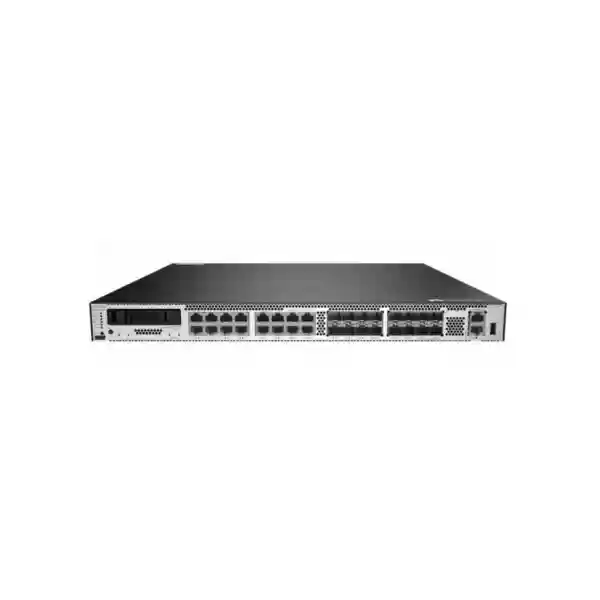
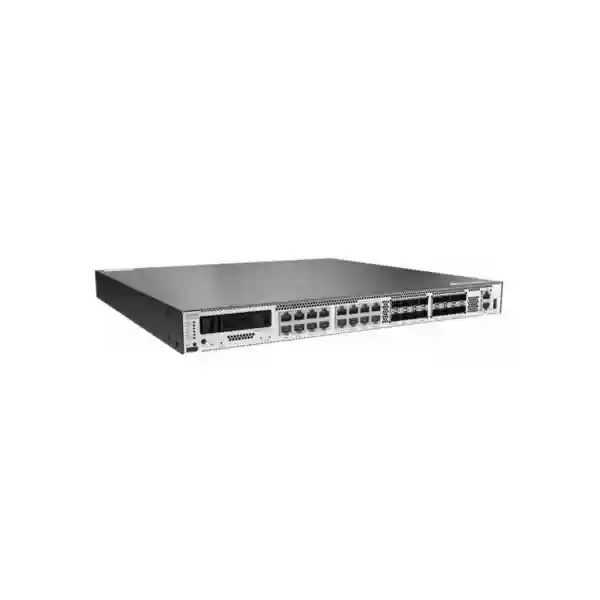
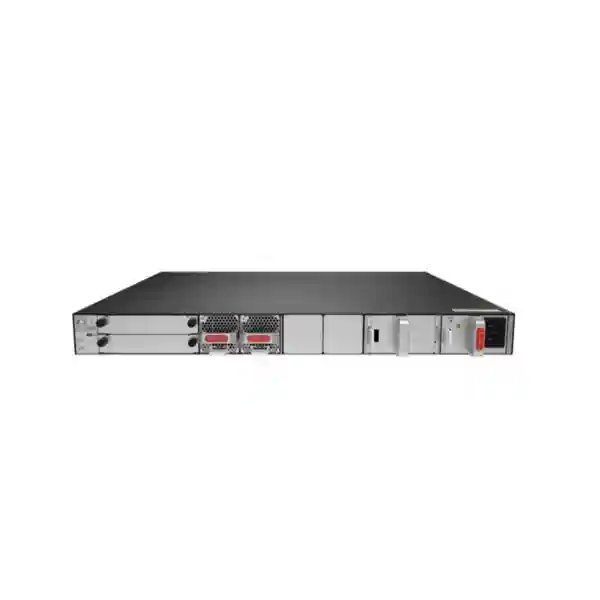
Huawei HiSecEngine USG6000F-E03 Enterprise Firewall
A high-density 1U next-generation security gateway for organizations that need a practical balance of copper access, fiber uplinks, 10 Gigabit Ethernet connectivity, integrated threat prevention, secure VPN services and policy-driven traffic control at the enterprise perimeter.
The USG6000F-E03 is well suited to Dubai and UAE headquarters, multi-branch networks, campus Internet edges and security consolidation projects that require 16 GE RJ45, 12 GE SFP and 4 x 10GE SFP+ interfaces in a compact 1U chassis, with NGFW, VPN, routing, HA and advanced content-security capabilities available from one platform.
What the Huawei HiSecEngine USG6000F-E03 is designed to do
The Huawei HiSecEngine USG6000F-E03 belongs to the USG6000F-E family of enterprise firewalls aimed at organizations that want strong security inspection, high interface density and operational consolidation without moving to a large modular chassis. Huawei positions the family for small and medium enterprises as well as organizations with multiple branches, but the E03’s physical connectivity also makes it relevant for larger distributed environments where a security gateway must aggregate many internal and external links. In practice, the platform can be used as an Internet border firewall, WAN edge security gateway, branch concentration firewall, data-center perimeter control point, campus egress gateway, extranet segmentation firewall or VPN termination point.
A central design theme of the USG6000F-E platform is that security services are integrated rather than delivered as independent appliances. Traditional stateful firewalling, intrusion prevention, antivirus, URL filtering, bandwidth control, Anti-DDoS capabilities, application awareness and VPN functions can be applied from the same policy and operational context. This consolidation is important in UAE projects because many customers are trying to reduce appliance sprawl at branch and headquarters sites while still maintaining clear separation between trusted, untrusted, DMZ, guest, partner and cloud-connected networks.
For organizations evaluating the device through FourTeck Firewall Dubai, the engineering discussion should focus on real traffic composition, inspection features, encrypted-traffic ratios, VPN concurrency, route scale, availability objectives, log-retention requirements and expected three-to-five-year growth. The chassis specification is only the first step; a production firewall is sized by enabled services and peak conditions, not merely by the ISP circuit speed printed on a quotation.
USG6000F-E03 hardware at a glance
Port density and topology flexibility
The fixed port map is one of the strongest practical characteristics of the USG6000F-E03. Sixteen 1 Gigabit Ethernet RJ45 ports can accommodate copper-based ISP handoffs, management segments, DMZ switches, local servers, branch routers, SD-WAN or carrier CPE devices, dedicated out-of-band networks and other devices that still use standard twisted-pair Ethernet. Twelve GE SFP ports make it possible to attach fiber circuits, optical access switches or long-reach intra-campus links without consuming external media converters. Four 10GE SFP+ ports provide a path for higher-capacity uplinks toward a core switch pair, data-center aggregation layer, high-speed WAN handoff or server/security service zone.
This interface mix can simplify migration from an older firewall. Many replacement projects fail to account for physical media during early sizing: the old firewall may use a mixture of copper, single-mode fiber, multimode fiber and provider-specific handoff modules. With the E03, network architects can map each legacy interface into an appropriate GE copper, GE optical or 10GE optical position and then decide whether redundant links should be split across switching domains. The exercise should include transceiver type, optical wavelength, distance, connector standard, VLAN tagging, LACP requirements and whether the carrier delivers a tagged or untagged service.
The 10GE ports are especially useful where a firewall sits between a collapsed core and Internet/WAN edge. Even when the Internet service is below 10 Gbit/s, the internal firewall attachment may carry traffic from multiple VLANs, east-west service zones, inter-VRF flows and VPN traffic simultaneously. Using 10GE at the trusted side avoids a situation where the LAN-facing connection becomes the first bottleneck. It also provides headroom for future bandwidth upgrades without a disruptive chassis replacement, provided the security-service performance and session requirements remain within the selected model’s supported limits.
For deployment planning, port count should not be confused with usable topology count. A physical port may be assigned to a routed Layer 3 interface, switch-facing trunk, HA role, management path or specific security zone. Some projects also require LAGs for resiliency. FourTeck engineers can review the existing switch, ISP and VLAN architecture through the broader FourTeck UAE infrastructure practice so the firewall is designed as part of the network rather than treated as an isolated appliance.
Purpose-built processing and security acceleration
Huawei describes the USG6000F-E family as using dedicated security processing with three acceleration engines for forwarding, encryption and pattern matching. The objective is straightforward: move common packet-forwarding, cryptographic and security-inspection work away from a purely general-purpose processing path so the firewall can sustain enterprise traffic while advanced services are enabled. In Huawei’s current family literature, this architecture is associated with microsecond-class forwarding latency and material acceleration for small-packet forwarding, IPS, antivirus and IPSec workloads.
This matters because next-generation firewall performance is multidimensional. Basic stateful forwarding is only one workload. IPS engines perform signature and protocol analysis. Antivirus engines inspect transferred objects and content. URL filtering may query categorization systems and enforce category policy. Application identification observes protocol behavior beyond TCP or UDP port numbers. VPN services perform encryption, integrity checks and key-management operations. A firewall expected to enable several of these features at the same time needs a processing architecture designed for concurrent security workloads.
A UAE customer should therefore ask for sizing based on the exact feature stack planned for production. If the requirement includes extensive IPS, malware scanning, URL filtering, remote-access VPN, site-to-site IPSec, large numbers of users, heavy SaaS access and high proportions of encrypted traffic, all of those factors should be documented. The correct engineering question is not simply whether a firewall can forward the contracted bandwidth; it is whether the complete security policy can be enforced at busy-hour traffic levels with enough reserve for bursts, failover and business growth.
Integrated next-generation firewall control
The USG6000F-E03 combines traditional firewall policy with application and content awareness. A basic policy still uses familiar constructs such as source and destination addresses, security zones, services and time periods, but the platform can extend enforcement using application identity and security inspection. This is useful where administrators want one rule to describe business intent rather than a collection of port-based exceptions. For example, a finance user group may be permitted specific web applications while risky or unauthorized application categories are restricted, inspected or rate-limited.
Huawei states that the family recognizes more than 6000 applications and can apply control with finer granularity than simple application names. Application awareness can be combined with intrusion prevention and antivirus so access decisions and threat inspection happen in a coordinated workflow. In real deployments, application control should be introduced carefully. The first stage is often visibility: understand which applications, protocols and user populations actually traverse the firewall. The second stage is policy normalization, where obsolete rules are removed and broad permits are narrowed. Only then should restrictive application controls be activated for critical user groups and network zones.
A mature rule base also separates administrative access, infrastructure services, user Internet access, published applications, partner connectivity, backup traffic, voice/video, cloud services and management systems. This improves readability and reduces the risk of accidental over-permission. Object groups should be named consistently, comments should state a business owner or ticket reference, and temporary rules should carry expiration dates. These are operational disciplines rather than product features, but they determine whether an enterprise firewall remains manageable after several years of change.
Organizations that need policy cleanup, migration and network-security implementation as a service can combine appliance procurement with FourTeck IT Services UAE for design, rollout and operational handover.
Intrusion prevention
The platform supports IPS functions for identifying and blocking exploitation attempts, malicious protocol behavior, botnet activity, remote-control traffic and other attack patterns. Huawei also describes protection for web attacks such as SQL injection and cross-site scripting, plus support for custom signatures and brute-force detection. In deployment, IPS profiles should be aligned to exposed services and internal asset types rather than applying every possible signature indiscriminately. Tuning reduces false positives while preserving coverage for the vulnerabilities that matter to the organization.
Antivirus inspection
Huawei provides an intelligent antivirus engine intended to detect malware and large numbers of malware variants. Antivirus inspection is particularly relevant to web downloads, email-related transfers and other file-bearing traffic that crosses trust boundaries. Administrators should pair malware inspection with appropriate SSL/TLS decryption policy where legally and operationally acceptable, because a large share of modern application traffic is encrypted. Endpoint protection remains complementary; gateway antivirus is not a replacement for endpoint detection and response.
URL filtering
URL filtering can apply category-based access rules by user or group, time period and security zone. Huawei’s family information describes a very large remote URL classification database and distributed query services. In enterprise use, URL policies often distinguish malicious, newly observed, anonymizer, remote-access, adult, gambling, high-risk download and productivity categories. Policy design should take local HR, legal and acceptable-use requirements into account and should include an exception workflow for legitimate business sites.
Anti-DDoS controls
The USG6000F-E series supports protection against common volumetric and protocol floods such as SYN and UDP flood patterns. On-premises Anti-DDoS controls are useful for identifying and mitigating certain attack behaviors before they affect internal systems, but they cannot create upstream bandwidth. If an attack saturates the physical Internet circuit, carrier or cloud-based scrubbing may also be required. A resilient design combines local firewall controls, ISP coordination, rate limits and upstream mitigation for critical public services.
VPN capabilities for site-to-site and remote connectivity
The Huawei HiSecEngine USG6000F-E family supports multiple VPN technologies including IPSec VPN, SSL VPN and GRE, with support for established encryption and integrity algorithms. This gives network architects several ways to connect branches, users, data centers and cloud-adjacent networks. For branch-to-headquarters connectivity, route-based IPSec is often preferred because it integrates cleanly with routing and failover. Policy-based designs may still be used in specific interoperability scenarios, particularly when connecting to third-party equipment with constrained configuration models.
A correct IPSec design begins with identity, peer reachability, encryption domains, phase-1 and phase-2 proposals, key-management method, routing behavior and failover. For many sites, manual configuration becomes difficult to govern. Naming conventions, standard crypto profiles, route summarization and centralized change control become essential. If two ISP links are present, failover must be designed at both the underlay and VPN layers so tunnels re-establish predictably when the primary circuit fails.
Remote access introduces different requirements. User authentication, multi-factor authentication integration, endpoint posture, split-tunnel policy, DNS handling, route advertisement and access segmentation should be agreed before the service goes live. A remote user should not receive broad internal access simply because a VPN tunnel was established. Instead, identity should map to least-privilege network resources, ideally segmented by role. Administrative users, vendors, developers, finance teams and general employees usually require different access scopes.
Cryptographic policy must also align with organizational standards. Legacy algorithms may exist for compatibility, but new deployments should use modern, approved algorithm suites supported by all peers. Certificate lifecycle, pre-shared key rotation, administrator access and logging should be documented in the operating procedure rather than left as one-time commissioning details.
Routing, multi-WAN and path selection
Huawei lists broad IPv4 and IPv6 routing support for the USG6000F-E family, including static routing and dynamic protocols such as RIP, OSPF, BGP and IS-IS, with corresponding IPv6 capabilities including OSPFv3 and BGP4+. This means the firewall can participate actively in an enterprise routing architecture rather than operating only as a simple default gateway. That flexibility is important for customers with multiple ISPs, MPLS or carrier Ethernet, cloud connectivity, segmented campuses or redundant core switches.
Business-aware policy routing and multi-egress selection can be used to direct traffic according to application requirements, bandwidth proportions and link health. A typical UAE headquarters might have two Internet circuits from different providers, a private WAN or SD-WAN service and perhaps a direct or partner link to a hosted data center. The firewall can serve as the enforcement point where those paths meet, but path-selection rules must be explicit. Return-path symmetry, NAT behavior, BGP preferences, health checks and session persistence all influence whether failover is clean.
For BGP deployments, administrators should define which routes the firewall is allowed to advertise and accept. Prefix filters, route policies, maximum-prefix safeguards and peer authentication should be treated as baseline controls. OSPF designs should similarly define areas, passive interfaces, authentication and route redistribution boundaries. The security appliance should not become an uncontrolled route-transit point simply because it supports dynamic routing.
High availability and resilient edge design
For business-critical environments, the firewall should normally be designed as a redundant pair rather than a single appliance. Huawei documents active/standby and active/active high-availability options for the USG6000F-E family. The chosen mode depends on topology, traffic symmetry, operational complexity and application requirements. Active/standby is often favored for Internet edge deployments because it provides a straightforward failure model: one unit processes traffic while the peer maintains synchronized state and takes over when a monitored failure occurs.
Firewall redundancy alone does not deliver end-to-end availability. Both units should connect to redundant upstream and downstream network devices where possible. ISP design should avoid a single provider CPE or single fiber path becoming the only route to the Internet. Core switches should be redundant, switch-port channels should be mapped correctly and power feeds should be separated. The optional dual AC power capability on the USG6000F-E03 is useful when racks are supplied by independent PDUs or UPS-backed circuits, but only if cabling preserves that independence.
HA monitoring should be selective. Monitoring every interface can cause unnecessary failovers when a noncritical link is intentionally shut down; monitoring too little can leave the active unit forwarding through a failed path. Engineers should identify the interfaces, routes and service conditions that truly define appliance health. They should also test failover during commissioning, including active sessions, VPN tunnels, routing adjacencies and published applications. A configuration that appears correct on paper is not complete until failure behavior has been observed.
Maintenance planning is equally important. Firmware upgrades, signature updates and configuration changes should be staged in a way that preserves service continuity. The customer should know how long failover takes, which applications are sensitive to session interruption and what rollback process is available if an upgrade or policy change produces unexpected behavior.
Internet perimeter
Place the E03 between redundant ISP or WAN circuits and the campus/core switching layer. Public services can be segmented into DMZ zones while outbound user traffic receives application control, URL filtering, IPS and malware inspection according to policy. NAT, routing and security profiles are centralized at the border.
Multi-branch hub
Terminate IPSec tunnels from branch offices at a headquarters or data-center hub. Routing can advertise branch prefixes while firewall rules restrict inter-branch access. This model is useful when branches require centralized Internet breakout, access to ERP systems or secure connectivity to shared services.
Internal segmentation
Use the firewall between user, server, operational, guest or partner zones where policy enforcement and threat inspection are required. The mixture of GE and 10GE interfaces can connect directly to distribution or core switching layers depending on traffic requirements and redundancy design.
Hybrid-cloud edge
Secure on-premises paths toward hosted infrastructure, colocation facilities or cloud-connected networks using IPSec, BGP or static routing. The appliance can enforce policy between enterprise users and cloud resources while preserving central logging and operational visibility.
Security virtualization and tenant separation
Huawei documents security virtualization across multiple functions on the USG6000F-E family. The practical goal is to let one physical system maintain logically separated security contexts for different tenants, departments or service domains. This can be useful in managed environments, shared campuses, group companies or data centers where centralized hardware is desirable but policy ownership must remain separated.
Virtualization should be planned with the same rigor as physical segmentation. Each logical context needs clearly assigned interfaces or VLANs, address spaces, routes, administrative permissions, logging destinations and security policies. Shared infrastructure such as DNS, authentication, update services and management networks should be documented so that one tenant cannot accidentally gain visibility into another. Capacity should also be budgeted globally because virtual contexts ultimately share the physical appliance resources.
Where strict regulatory or organizational separation requires independent hardware failure domains, separate appliances may still be preferable. Security virtualization is an architectural option, not an automatic substitute for physical separation. The decision should consider operational ownership, audit requirements, blast radius, maintenance windows and capacity growth.
Logging, reporting and operational visibility
A next-generation firewall becomes far more valuable when logs are engineered as an operational data source rather than retained only for troubleshooting. The USG6000F-E family can report across dimensions such as user, IP address, application, time, traffic and threat activity. Huawei also describes cloud-linked capabilities for event analysis, threat handling and periodic security reporting. Whether customers use local management, centralized Huawei services or an external SIEM, the logging design should be established before the firewall goes live.
At minimum, security teams typically need traffic logs for important policy decisions, administrator audit logs, VPN events, routing changes, HA state changes, IPS events, malware events, URL-filter actions and system health alarms. Log volume can grow rapidly, so retention must be matched to storage and compliance requirements. The optional 2.5-inch SATA storage choices listed for the E03 provide flexibility for local storage use cases, but many enterprises will also forward logs to a centralized platform for long-term retention, correlation and incident response.
Time synchronization is critical. Firewall, switch, server, identity and endpoint logs should use authoritative NTP sources so incident timelines can be reconstructed accurately. Device naming, interface descriptions and policy IDs should remain stable enough that SIEM rules do not break after routine configuration changes. Operational dashboards should show blocked threats, top applications, high-bandwidth sources, repeated policy denies, VPN state and system resource trends rather than overwhelming administrators with every raw event.
Local storage choices and what they mean
Huawei lists optional 2.5-inch SATA drive capacities of 240 GB, 480 GB, 960 GB, 1920 GB and 3840 GB for the E01, E03, E05 and E07 family group. Storage selection should be based on what will actually reside on the appliance. A small deployment that forwards logs immediately to a centralized collector may not need the same local capacity as a site expected to retain larger volumes locally for extended troubleshooting or reporting periods.
The correct approach is to estimate events per second, average log size, enabled log categories, peak burst rates and required retention. Logging every allowed session at a high-traffic site can produce substantially more data than logging only security events and selected traffic classes. Compliance policy may require specific records to be retained for longer periods, while other data can be summarized or moved to central storage. Procurement should therefore confirm the exact drive option, supported software version and intended logging architecture rather than adding the largest drive automatically.
Local storage should never be the only copy of audit data when the firewall itself is within the scope of an incident. Central forwarding makes logs available even if the appliance is damaged, replaced or inaccessible. It also enables correlation across firewalls, identity systems, endpoint security, servers and cloud services.
UAE environmental and rack-planning considerations
Huawei specifies a 1U chassis measuring 442 mm wide, 420 mm deep and 43.6 mm high, with an empty weight of approximately 7.2 kg. The family information for the E03 group lists a maximum power figure of 123 W, AC input from 100 V to 240 V and optional dual AC power. These values are useful for rack and UPS planning, but actual site design should include the power consumption of optics, storage options, peer appliances, switches and other equipment sharing the rack.
For UAE deployments, the published operating temperature range of 0°C to 45°C does not mean the appliance should be installed in an uncontrolled hot room. Data rooms should maintain stable cooling, clean airflow and appropriate humidity. The firewall uses front-to-rear airflow, so blanking panels, cable management and switch placement should preserve the same airflow direction. Recirculated hot exhaust can raise inlet temperature even when the room thermostat appears acceptable.
Power redundancy also requires end-to-end design. Two power supplies connected to the same PDU provide protection against one power-module failure but not against the loss of that PDU or upstream UPS. Where the site has dual UPS or A/B rack power, each firewall power supply should be connected to a different feed. In an HA pair, the two appliances should also be distributed across feeds so a single electrical fault does not remove both security gateways.
Dust management is another practical concern in regional facilities. Keep rack doors, filters and cooling paths maintained, avoid placing network security equipment next to unsealed construction zones, and verify that equipment-room maintenance follows the environmental conditions required by the manufacturer.
How to size the USG6000F-E03 correctly
Firewall sizing starts with traffic, but traffic must be described in more detail than a single Mbps or Gbps value. Record the contracted speed of every WAN circuit, real 95th-percentile utilization, peak burst levels, east-west flows crossing the firewall, expected growth and whether traffic shifts to the surviving firewall during maintenance or failover. If a pair is deployed active/standby, one appliance must normally be able to carry the full production load by itself.
Next, profile security services. IPS, antivirus, URL filtering, application control, VPN and decryption have different processing characteristics. The more services applied to a flow, the more important service-enabled performance becomes. Encrypted web traffic should be estimated separately because TLS inspection can change capacity planning materially. Some organizations exempt sensitive categories such as banking or health portals from decryption, while inspecting general SaaS and web access. The final mix should be modeled realistically.
Session scale is another dimension. Hundreds of users can generate large numbers of simultaneous sessions through browsers, mobile applications, collaboration tools, cloud storage clients and background software updates. Public-facing services may also receive high connection rates even if total bandwidth is modest. Record current sessions, new sessions per second where available, NAT usage and growth expectations. Branch aggregation designs should add the session behavior of all connected sites, not just headquarters users.
VPN sizing should document site-to-site tunnel count, remote-user concurrency, cipher expectations and whether all remote traffic returns through the firewall. If the appliance will route dynamically with ISPs or a core, route-table scale and convergence requirements should be captured. If security virtualization is planned, include the number of virtual contexts and how resources will be distributed. Logging volume and retention can affect storage selection and SIEM sizing.
Finally, apply headroom. A firewall chosen to operate at its theoretical limit on day one has no reserve for software updates, unexpected traffic, acquisitions, new cloud services or emergency failover. FourTeck typically treats sizing as an engineering exercise rather than a model-number comparison. For broader regional projects and standardized multinational deployments, customers can also engage FourTeck Global for cross-site planning while maintaining UAE-specific implementation and support coordination.
A practical sizing worksheet
Licensing and subscription planning
A complete firewall quotation needs more than the appliance hardware. Huawei’s documentation identifies a basic software license for the USG6000F-E family and separate subscription-style services for security capabilities such as IPS signature updates and antivirus-related services. Exact commercial bundles, service durations and feature entitlements can vary by region, software release and channel program, so the final bill of materials should be validated against the required functions rather than copied from a generic list.
The first licensing question is which services must be active on day one. If the deployment is a simple segmentation firewall, the requirement may be different from an Internet gateway expected to use IPS, antivirus, URL categorization, cloud-linked threat services and remote access. The second question is term length. One-, three- or multi-year planning affects renewal dates and operational continuity. Security subscriptions should be tracked centrally so signature services do not expire without notice.
Support entitlement should be aligned to business criticality. A branch office that can fail over to another site may accept a different replacement target than a headquarters Internet edge serving thousands of users. Customers should identify required software support, hardware replacement expectations, escalation channels and whether spare hardware is justified for remote or high-risk locations. An HA pair improves service continuity but does not remove the need for active support on both devices.
When requesting pricing, specify appliance quantity, power redundancy, storage capacity, optics, rail or accessory requirements, licenses, subscription term, implementation, migration, configuration backup, testing, documentation and support. This prevents comparison errors where one quotation appears cheaper only because key subscriptions or deployment services are omitted.
Migration from an existing firewall
Replacing an existing firewall is a policy-migration project, not simply a hardware swap. Begin with an export of the current configuration and a live traffic inventory. Identify interfaces, VLANs, zones, routes, NAT rules, VPN tunnels, security policies, address objects, service objects, authentication integrations, certificates, administrator roles, syslog destinations and monitoring dependencies. Remove stale objects and expired temporary rules before translating them to the Huawei platform. Migrating technical debt unchanged creates unnecessary complexity from the first day.
NAT deserves particular attention. Document inbound destination NAT for published services, outbound source NAT pools, no-NAT rules for VPN traffic and any policy-specific translations. If public IP addressing changes during the migration, coordinate DNS TTL reductions and external dependencies in advance. VPN peers may require new public addresses, certificates or pre-shared keys. Partner organizations should be contacted early because third-party change windows are often harder to schedule than the firewall cutover itself.
Create a rule-mapping workbook that shows old rule ID, old objects, translated Huawei objects, target security zone, security profile, business owner and test case. For each published application, define a positive test and a rollback condition. For outbound traffic, validate DNS, web access, SaaS applications, email, collaboration tools and any special protocols. For VPNs, verify routing, encryption, application reachability and failover.
The cutover plan should specify exact cable moves, switch-port changes, routing changes, BGP or OSPF adjacency expectations, ARP behavior, DNS changes and rollback steps. Backout should be time-bounded: if critical verification cannot be completed within the agreed window, restore the original topology rather than continuing an uncontrolled troubleshooting session.
After migration, monitor denied traffic and security events closely for several business cycles. Some rarely used applications may only appear at month-end or during payroll, backups or scheduled partner integrations. Keep the old configuration and migration documentation under change control so any late issue can be traced to its original intent.
Commissioning sequence for a production deployment
1. Hardware acceptance: verify model, serial numbers, power supplies, storage option, optics, accessories and rack compatibility. Record asset details before installation.
2. Base hardening: set secure administrator access, management interfaces, NTP, DNS, logging, backup destinations, password policy and approved management source networks. Disable unnecessary services.
3. Interface and routing build: configure physical interfaces, VLAN subinterfaces, IP addressing, routes, dynamic protocols and link aggregation. Validate basic reachability before applying production security policy.
4. Policy migration: create zones, objects, NAT and firewall rules in controlled batches. Attach IPS, antivirus, URL or application profiles only where required and verify ordering.
5. VPN and identity: build site-to-site tunnels, remote access, authentication integrations and certificates. Test least-privilege access by user role and branch.
6. HA validation: synchronize the pair, test link and appliance failures, confirm route reconvergence, session behavior, VPN recovery and management access to both peers.
7. Handover: deliver as-built documentation, configuration backup, license records, monitoring details, escalation procedures and an operations runbook for common maintenance tasks.
Security policy design for long-term maintainability
A firewall can have powerful inspection features and still be difficult to secure if the policy base is poorly structured. Start with explicit security zones that reflect trust boundaries: Internet, DMZ, corporate users, servers, guests, management, partners, voice, operational technology and VPN users are common examples. Not every environment needs all of them, but the zones should match real administrative and risk boundaries.
Address and service objects should have naming standards. Names such as SRV-ERP-PROD, NET-FINANCE-USERS or SVC-HTTPS are easier to review than arbitrary abbreviations. Dynamic or directory-linked user groups should be used where identity is more meaningful than IP address. Rules should be ordered by specificity and business purpose, with broad cleanup or deny actions at the end. Avoid overlapping rules that permit the same traffic through different logic unless the overlap is intentional and documented.
Security profiles should follow exposure. A public web service may need strong IPS protection for web attacks, while a trusted internal backup network may require a different inspection profile. Applying identical profiles to every flow can create unnecessary processing load and operational noise. Conversely, omitting inspection from high-risk Internet-facing traffic because a rule was copied from an internal policy can create a serious gap. Policy reviews should therefore examine both access control and attached security services.
Change control should capture requester, business reason, source, destination, service, duration, risk, approver and validation result. Temporary vendor access should expire automatically or be reviewed on a defined date. Emergency changes should be reconciled after the incident. Regular recertification with application owners helps remove rules for systems that no longer exist.
For organizations using multiple sites, establish a global policy standard while allowing documented local exceptions. Consistent object names, security profiles and logging practices reduce troubleshooting time when engineers move between Dubai headquarters, UAE branches and overseas locations.
Application control and bandwidth governance
Application identification adds context that port-based rules cannot provide. Modern SaaS products often share TCP 443, and many consumer applications intentionally use common web protocols. By recognizing application behavior, the firewall can apply differentiated policy to business collaboration, cloud storage, remote access, streaming, social media and other traffic even when they use the same transport port.
Huawei also supports bandwidth management based on identified applications, users or IP addresses. Administrators can limit maximum bandwidth, guarantee minimum bandwidth for selected traffic and adjust forwarding priority. This is useful on constrained branch circuits or shared Internet connections. Rather than blocking all nonbusiness traffic, an organization may cap high-volume streaming while protecting ERP, voice, video meetings and critical cloud applications during busy hours.
Traffic shaping should be evidence-driven. Measure current application use, identify congestion periods and set policy based on business requirements. Overly aggressive limits can create user complaints that look like application outages. Conversely, leaving backup, software distribution or recreational streaming unconstrained can degrade latency-sensitive services. Monitoring should show whether the intended traffic class actually receives the expected bandwidth.
In multi-WAN deployments, policy routing can complement bandwidth management. Critical applications may prefer the lowest-latency circuit, while bulk downloads use a secondary link. The design should specify failover behavior so applications still work if their preferred path is unavailable.
IPv6 readiness
The USG6000F-E family supports IPv4 and IPv6 routing capabilities, making it suitable for organizations that operate dual-stack networks or are preparing for IPv6 adoption. IPv6 should not be treated as an automatic extension of an IPv4 security policy. Addressing, neighbor discovery, ICMPv6, router advertisements, DHCPv6, DNS records and dynamic routing require separate planning.
Security policy should explicitly cover IPv6. An organization can have a well-controlled IPv4 perimeter while unintentionally allowing broad IPv6 connectivity if endpoints receive globally routable addresses and firewall rules are incomplete. Monitoring tools, SIEM parsers, vulnerability scanners and asset-management systems should also be checked for IPv6 support.
For gradual adoption, many customers begin by enabling IPv6 on selected WAN, DNS and test segments, then extend it to user and server networks once operational tools are ready. Dynamic routing can use OSPFv3, BGP4+ or IPv6 IS-IS as appropriate to the topology. The firewall policy should preserve the same least-privilege and inspection principles used for IPv4.
Cloud linkage and threat-response operations
Huawei positions the USG6000F-E family as capable of working with its cloud security services for centralized operations and threat response. The concept is to combine local enforcement with broader threat intelligence, analytics and expert workflows. The firewall can remain the traffic control point at the enterprise edge while event information is correlated centrally and updated security information is delivered back to the environment.
For customers, the value of cloud linkage depends on operating model. A small IT team may benefit from centralized analysis and reporting because it reduces the amount of manual event triage required locally. A larger enterprise with its own SOC may instead feed firewall data into an existing SIEM and SOAR environment. Either model can work; the important point is to decide who owns alert monitoring, who validates incidents, who can block an address or isolate a host and what response time is expected.
Threat automation should have guardrails. Automatic blocking of a clearly malicious external source may be appropriate, but automated actions affecting internal business systems require care. Security teams should define confidence thresholds, exception lists, expiration periods and review mechanisms. Every automated action should be logged so analysts can explain why a source was blocked and reverse the action if necessary.
Periodic reports are useful for management only if they connect security events to business context. Reports should highlight significant attacks, recurring vulnerable services, users or systems generating unusual traffic, policy trends, blocked malware and operational health. Raw event counts without prioritization can create the appearance of activity without improving risk decisions.
Procurement considerations for Dubai and the UAE
Enterprise firewall procurement in the UAE should verify exact model and bill of materials before purchase. The USG6000F-E03-AC ordering designation identifies an AC-powered host, but a complete deployment may require a second power supply, chosen storage capacity, optical transceivers, licenses, security subscriptions, support entitlement, rack accessories and professional services. These elements should appear clearly in the quotation.
Lead time can vary by component. An appliance may be available while a specific optic, storage option or redundant power accessory has a different delivery schedule. Projects with a fixed move date, office opening or data-center migration should therefore reserve hardware early enough for staging and configuration before installation day. If an HA pair is required, both units should be staged on the same supported software baseline and have matching required entitlements.
Warranty and support terms should be written into the procurement decision. Confirm the channel source, support coverage, replacement process, software access and renewal path. For regulated or business-critical environments, maintain records of serial numbers, license IDs and support contracts in the customer’s asset-management system. This avoids delays when a support case must be opened outside normal office hours.
Implementation scope should be equally explicit. A hardware-only purchase is different from a full migration. Full deployment may include discovery workshops, HLD/LLD documentation, rack installation, base hardening, policy translation, VPN migration, routing integration, HA setup, testing, cutover support and post-change monitoring. Clarifying scope prevents assumptions on both sides.
FourTeck can provide UAE-focused firewall procurement and integration while coordinating wider infrastructure requirements through its approved regional platforms. Customers planning security refreshes can also align firewall work with switching, server or managed IT projects instead of running several disconnected change programs.
Technical specification summary
| Model | Huawei HiSecEngine USG6000F-E03 |
| Fixed service interfaces | 16 x GE RJ45 + 12 x GE SFP + 4 x 10GE SFP+ |
| USB | 1 x USB 3.0 |
| Bypass card | Supported |
| Form factor | 1U |
| Dimensions | 442 x 420 x 43.6 mm |
| Optional storage | 2.5-inch SATA: 240 GB / 480 GB / 960 GB / 1920 GB / 3840 GB |
| Maximum power figure | 123 W for the E01/E03/E05/E07 group in Huawei’s current family literature |
| AC input | 100–240 V |
| Power redundancy | Optional dual power |
| Weight | Approx. 7.2 kg empty configuration |
| Operating environment | 0°C to 45°C; 5% RH to 95% RH, non-condensing |
| Storage environment | -40°C to 70°C; 5% RH to 95% RH, non-condensing |
Specifications and available licenses can change by software release, region and orderable bundle. Final procurement should validate the exact Huawei bill of materials and supported software version for the intended UAE deployment.
Operational maintenance after go-live
Once the firewall is in production, security value depends on maintenance discipline. Signature services should remain current, but updates should be monitored for completion rather than assumed. Firmware should follow a planned lifecycle with release-note review, configuration backup, HA readiness checks, maintenance windows and rollback steps. Administrators should avoid leaving the platform on an old release indefinitely, but they should also avoid upgrading critical infrastructure without testing compatibility.
Configuration backups should be automated where possible and stored outside the appliance. The backup process should include a known-good version after every approved change. Restore procedures should be tested in a safe environment or documented well enough that an engineer can recover the device during an incident. Access to backups should be restricted because firewall configurations contain topology, addresses, VPN details and security policy information.
Review system health regularly: CPU and memory trends, session utilization, interface errors, dropped packets, storage use, HA synchronization, fan and power status, routing-neighbor state, VPN tunnel stability and license expiration. Capacity problems usually develop gradually before they become outages. Trend data can show whether growth justifies an ISP upgrade, policy optimization or future firewall replacement.
Security policy should be recertified at least periodically and whenever major applications are retired or migrated. Identify unused rules, overly broad objects, disabled rules that can be deleted, temporary access that has expired and security profiles that no longer match risk. Changes to cloud services can also alter destination IPs and domains, so SaaS-related rules may require ongoing adjustment.
Administrator accounts deserve the same care. Use named accounts where supported, enforce strong authentication, restrict management to dedicated networks or VPN access, record admin events and remove accounts promptly when roles change. Shared administrator passwords make audits and incident investigation unnecessarily difficult.
When the USG6000F-E03 is a particularly strong fit
The E03 is particularly attractive when interface flexibility is a major design requirement. A site with multiple copper handoffs, a collection of GE fiber segments and several 10GE connections can consolidate those links without immediately adding media-conversion hardware. It is also a good architectural candidate where the firewall must do more than access control: VPN termination, routing, application visibility, intrusion prevention, antivirus, URL filtering and bandwidth governance can be combined into one policy platform.
It also fits projects where rack space matters. The 1U form factor provides a substantial fixed interface set while leaving room for redundant switches, patching and server equipment. In branch-aggregation designs, the device can centralize many tunnels and policies while participating in dynamic routing. In campus or headquarters environments, 10GE links provide room for aggregate traffic from many VLANs even if external circuits are smaller.
The model should not be selected solely because it has enough ports. If the site has exceptionally high inspected throughput, very large user populations, unusually high session creation rates, extensive TLS decryption, large route tables or rapid growth, a higher model in the family may be more appropriate. Conversely, a small branch with modest bandwidth and few interfaces may not need the E03’s connectivity. Correct sizing is about matching the platform to the workload.
The final decision should therefore combine hardware fit, security features, service-enabled capacity, licenses, operational skills and lifecycle cost. The product page can describe the platform, but the design review determines whether it is the right model for a particular network.
Common deployment questions
Can the E03 connect directly to both copper and fiber networks?
Yes. The fixed interface set includes 16 GE RJ45 copper ports, 12 GE SFP ports and 4 x 10GE SFP+ ports. The exact optical module must be selected for the fiber type, wavelength and distance of each link.
Does it support redundant power?
Huawei lists optional dual AC power for this model group. For actual resilience, connect the two power inputs to independent rack power feeds where the facility supports them.
Can it be deployed as a high-availability pair?
The USG6000F-E family supports HA deployment models including active/standby and active/active. The topology, routing and service design should be reviewed so failover remains deterministic.
Does it support dynamic routing?
Yes. Huawei lists routing capabilities including RIP, OSPF, BGP and IS-IS, with IPv6 counterparts such as OSPFv3 and BGP4+.
Is local storage mandatory?
No. Storage is optional and should be selected according to logging, reporting and operational requirements. Many enterprises forward logs centrally regardless of local storage capacity.
Why structured implementation matters more than a quick install
Enterprise firewalls sit at a point where routing, identity, cryptography, application policy and threat detection intersect. A rushed deployment may work for basic Internet access while leaving hidden weaknesses: asymmetric routing, uninspected zones, broad rules, unmanaged certificates, weak admin access, incomplete logging or untested failover. These issues tend to appear during incidents or maintenance, when recovery time is most valuable.
A structured implementation produces repeatable artifacts. The HLD explains the security zones, links, routing model and HA architecture. The LLD defines addresses, interfaces, VLANs, routes, object standards, VPN settings, logging and management. A migration workbook maps old policy to new policy. A test plan proves business applications. An as-built document records the final configuration state. A support runbook explains routine tasks and escalation paths.
This documentation also makes future upgrades safer. When an ISP changes, a branch is added or a cloud service moves, engineers can see the intended architecture instead of reverse-engineering the firewall. It supports internal audit, change control and faster onboarding of new IT staff.
For customers that want a single vendor relationship for procurement, deployment and continuing infrastructure support, FourTeck can scope the firewall with adjacent network services rather than delivering a standalone box with no integration context.
Decision recap: what to confirm before selecting the USG6000F-E03
Use the USG6000F-E03 shortlist when the network benefits from a compact 1U appliance with a large fixed port mix, enterprise routing, VPN, HA and integrated security services. Before final approval, validate the following points against the real environment rather than relying on a generic specification sheet.
Confirm peak traffic with IPS, antivirus, URL filtering, application control, VPN and any TLS inspection enabled, plus failover and growth headroom.
Map every copper and optical circuit to the 16 GE RJ45, 12 GE SFP and 4 x 10GE SFP+ ports, including optics and redundant links.
Define HA mode, dual power, switching redundancy, ISP diversity, failover monitoring and tested recovery procedures.
Specify required security subscriptions, term length, support entitlement, renewal ownership and signature-update requirements.
Confirm logging, SIEM, NTP, backups, administrator access, policy review, monitoring and maintenance responsibilities.
Check software release support, procurement source, spare strategy, migration window and three-to-five-year capacity expectations.
Quotation input checklist
For the fastest accurate quotation and technical validation, send the project team a compact set of engineering inputs. This avoids repeated clarification and helps ensure the proposal includes the correct appliance, accessories, licenses and services.
Plan your Huawei HiSecEngine USG6000F-E03 deployment with FourTeck
A production firewall project should end with a validated architecture, not only a delivered appliance. FourTeck can review the WAN edge, switching, VPN, security policy, HA, logging, licensing and migration scope so the USG6000F-E03 is matched to the real UAE environment. The result can include procurement, configuration, policy migration, cutover support, testing and operational handover.
Prepare the quotation checklist above and share any current firewall configuration summary, topology diagram and ISP details. That information allows the technical team to identify required optics, licenses, storage, redundant power and migration services before the final bill of materials is issued.


Reviews
There are no reviews yet.