
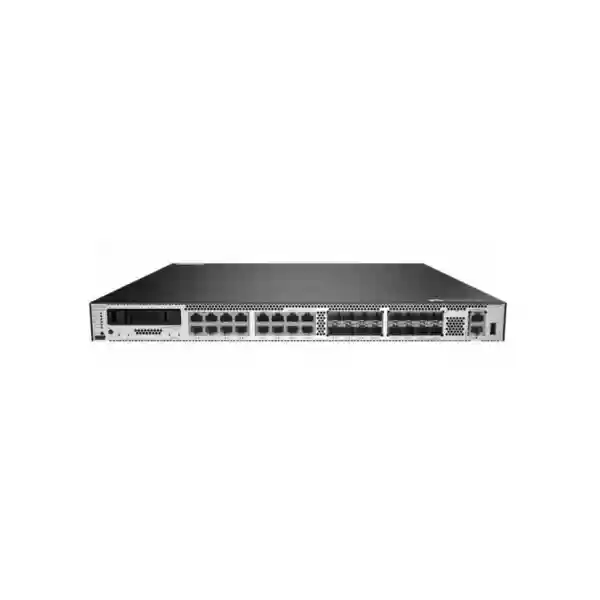
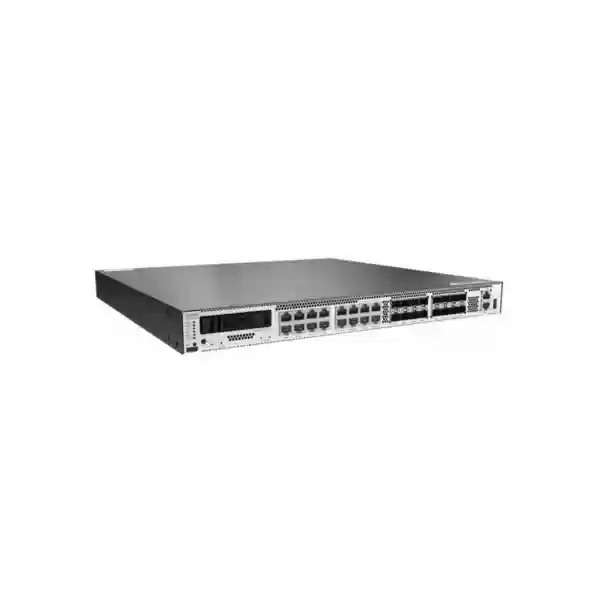
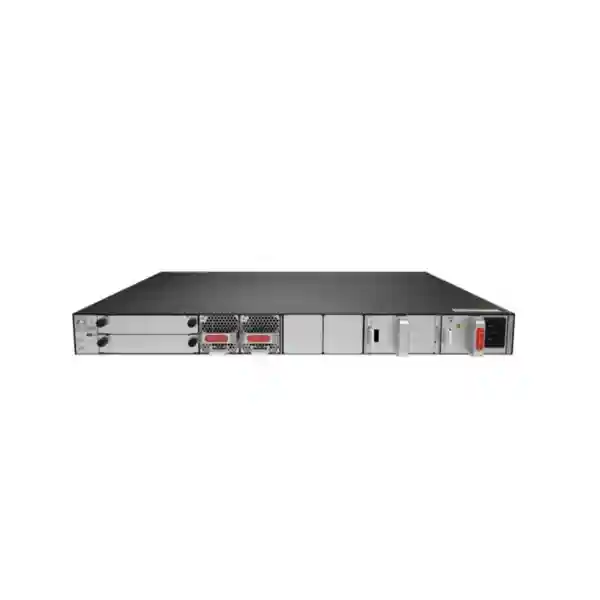
Huawei HiSecEngine USG6000F-E05 Next-Generation Firewall
The Huawei HiSecEngine USG6000F-E05 is a fixed-form-factor enterprise firewall engineered for secure Internet access, branch aggregation, hybrid-cloud connectivity, application-aware control and consolidated threat prevention. For organizations in Dubai, Abu Dhabi and across the UAE, the platform combines high interface density, 10 Gigabit uplinks, integrated security services and flexible VPN functions in a compact 1U chassis.
Verified platform highlights
Secure enterprise edge
Use the USG6000F-E05 as an Internet perimeter firewall with application-aware policy, IPS, antivirus, URL filtering, bandwidth control, VPN and Anti-DDoS functions applied through a unified policy architecture.
Branch and campus aggregation
The combination of copper, GE optical and 10GE optical interfaces supports mixed access environments where legacy WAN handoffs, fiber distribution and high-speed core links need to coexist.
Hybrid-cloud connectivity
IPSec, SSL VPN and routing capabilities can support protected site-to-site connectivity, remote-user access and controlled paths toward hosted workloads, UAE data centers and cloud environments.
Operational consolidation
Organizations can reduce separate security appliances by combining multiple inspection, access-control and VPN functions on one platform, while retaining distinct security zones and policy boundaries.
What the Huawei HiSecEngine USG6000F-E05 is designed to do
The HiSecEngine USG6000F-E family is positioned by Huawei for small and medium organizations and distributed branch environments that need a modern security gateway without moving immediately to a large modular chassis. The E05 sits within that family as a compact fixed firewall platform whose value comes from the relationship between interface density, security acceleration, integrated threat-prevention functions and day-to-day operational simplicity. In practical UAE deployments, it can serve as the boundary between an internal campus and the Internet, as the aggregation point for several branch circuits, as the policy-control point between network zones, or as part of a resilient pair protecting business-critical services.
The design is especially relevant where the network has evolved beyond a basic stateful firewall. Modern enterprise traffic is dominated by web applications, encrypted sessions, software-as-a-service access, cloud APIs, remote workers, branch tunnels and user traffic that can no longer be classified safely by TCP or UDP port alone. The USG6000F-E05 addresses that shift by combining traditional firewalling with application recognition, intrusion prevention, antivirus inspection, URL filtering, VPN services, bandwidth management and protections against common denial-of-service patterns. Rather than treating these as isolated appliances, the platform brings them together within one security policy and one operational context.
For a UAE procurement team, the result is not simply a box with many ports. The important design question is whether the firewall can be integrated into the organization’s full architecture: dual Internet links, MPLS or SD-WAN services, VLAN trunks, server segments, DMZs, guest networks, remote access, branch VPNs, monitoring systems and future bandwidth upgrades. FourTeck approaches the USG6000F-E05 as part of that architecture. We help map the intended traffic paths, inspection requirements, redundancy model, optics, storage, subscriptions and support model before the final bill of materials is locked.
Organizations comparing security platforms can also use FourTeck’s broader UAE resources at FourTeck UAE for infrastructure planning and Firewall Dubai for firewall-focused projects. These links are useful when a firewall requirement is part of a wider switching, wireless, server, voice, security or managed-services initiative rather than an isolated hardware purchase.
Hardware architecture and fixed interface map
Huawei’s current USG6000F-E series material lists the USG6000F-E05 with a dense fixed interface set: 16 Gigabit Ethernet RJ45 service ports, 12 Gigabit Ethernet SFP service ports and four 10 Gigabit Ethernet SFP+ service ports. The same material also lists one USB 3.0 interface and support for a bypass card. This mix makes the appliance particularly flexible in networks that have not standardized on a single physical medium. Copper connections can terminate common Ethernet handoffs or local devices, GE SFP slots can support optical uplinks across buildings or distribution zones, and the 10GE SFP+ ports can provide higher-speed connectivity toward core switching, server aggregation or upstream service edges.
| Component | USG6000F-E05 specification | Deployment significance |
|---|---|---|
| Copper service interfaces | 16 × GE RJ45 | Useful for ISP handoffs, internal segments, management networks and direct copper-connected zones. |
| Optical service interfaces | 12 × GE SFP | Supports fiber-connected distribution, long building runs and electrically isolated links when appropriate optics are selected. |
| High-speed uplinks | 4 × 10GE SFP+ | Provides headroom for high-capacity core, data-center, aggregation or Internet-edge connectivity. |
| USB | 1 × USB 3.0 | Useful for supported maintenance and operational workflows. |
| Bypass expansion | Bypass card supported | Can be relevant to designs that require a planned bypass capability; exact implementation should be validated for the intended topology. |
Port count should not be confused with usable topology by default. A security design still needs explicit decisions about Layer 3 routed interfaces, VLAN subinterfaces, trunks, HA heartbeat links, management, WAN failover and any transparent or bypass requirements. Optics also matter. SFP and SFP+ slots require compatible transceivers matched to fiber type, wavelength, distance and the connected switch or service-provider equipment. A quotation that includes only the firewall chassis can therefore be incomplete if the project requires multiple optical circuits.
In high-availability designs, reserve the interfaces needed for the HA architecture before committing every port to production traffic. The same principle applies to future growth. If all four 10GE ports are consumed on day one by redundant upstream and downstream links, a later requirement for an additional high-speed DMZ or interconnect can force a redesign. FourTeck’s sizing process therefore maps both present circuits and likely 24-to-36-month expansion so the interface plan remains practical after the first installation phase.
Chassis, power, cooling and rack planning
The USG6000F-E05 is a 1U fixed firewall with chassis dimensions listed by Huawei at approximately 442 mm wide, 420 mm deep and 43.6 mm high. The current series material lists an empty configuration weight of about 7.2 kg for the E01 through E07 group and a maximum power consumption of 123 W for those models. AC input is specified at 100–240 V, and dual AC power is available as an optional redundant configuration. Airflow is front-to-back, with a 1+1 fan arrangement. Those physical details matter in UAE data rooms because firewall reliability is influenced by rack depth, airflow discipline, cable management and power design just as much as by policy configuration.
A 420 mm-deep appliance is straightforward for standard enterprise racks, but the deployment should still allow additional rear clearance for power connectors, airflow and cable bend radius. Fiber jumpers should not be sharply bent or forced against a closed rack door. Likewise, dense copper patching across sixteen RJ45 interfaces can become difficult to service if patch panels, horizontal managers and neighboring appliances are not planned together. For branches that use wall-mounted cabinets or compact network enclosures, physical depth should be checked before purchase instead of assuming any 1U device will fit.
UAE sites also deserve careful thermal assessment. Huawei lists an operating temperature range of 0°C to 45°C and operating humidity of 5% to 95% RH non-condensing for this model group. The firewall should therefore be deployed in a properly conditioned technical space, not treated as an appliance that can tolerate uncontrolled ambient heat. In branch locations where cooling is intermittent or where racks share space with heat-producing UPS systems, environmental monitoring is strongly recommended. Front-to-back airflow should remain unobstructed, blanking strategy should prevent hot-air recirculation, and the rack should be positioned so maintenance staff can access both sides safely.
Power resilience should match business criticality. A single AC supply may be adequate for a lower-tier branch, while a head office, data center or revenue-critical site may justify the optional dual-power configuration, separate power distribution units and independent UPS circuits. Redundant firewall nodes do not remove the value of redundant power; they address a different layer of failure. A robust design considers appliance HA, power sources, ISP diversity, switch redundancy and physical path diversity as separate controls that work together.
Security acceleration and packet-processing design
The USG6000F-E series uses a dedicated security-processing approach with acceleration functions for forwarding, encryption and pattern matching. In operational terms, these engines are intended to offload tasks that would otherwise compete heavily for general compute resources. Small-packet forwarding places pressure on packet-per-second processing, IPS and antivirus inspection require rapid content and pattern evaluation, and IPSec requires repeated cryptographic operations. A platform that accelerates these paths can preserve responsiveness more effectively when multiple services are enabled at the same time.
This architecture is important because firewall sizing cannot be based on the raw bandwidth of an Internet line alone. A 2 Gbps circuit carrying large uncomplicated flows is a different workload from a 2 Gbps circuit dominated by short-lived TLS sessions, thousands of SaaS requests, remote-user VPNs and content-security inspection. Session setup rate, packet size, cipher choice, logging volume and enabled security profiles can all influence performance. The dedicated processing design helps, but the correct model must still be selected from measured traffic and realistic future growth rather than a single marketing throughput figure.
Huawei’s current series material describes low-latency forwarding at the family level and states that the acceleration engines improve small-packet, IPS, antivirus and IPSec processing. The safest way to translate those claims into a real project is to treat published benchmark numbers as engineering references, not guaranteed application performance. Production results depend on software version, packet distribution, concurrent features, content mix, encryption state and interface design. FourTeck therefore recommends validating the desired combination of firewall, security awareness, IPS, antivirus, TLS-related controls and VPN features against the current Huawei datasheet and release documentation for the software build being proposed.
For organizations upgrading from older security appliances, the practical benefit is often visible in consolidation. Instead of turning off inspection to protect forwarding performance, the objective is to maintain the intended security policy while carrying modern traffic loads. That outcome requires both capable hardware and disciplined rule design. Unnecessary inspection should not be applied blindly to every flow; trusted backup replication, business APIs, guest browsing, server publishing and remote-access traffic can each require different controls. Policy architecture should be driven by risk and traffic purpose rather than by a one-profile-fits-all template.
Integrated next-generation firewall functions
The USG6000F-E family combines traditional firewall controls with multiple security engines. Huawei lists integrated firewall, VPN, intrusion prevention, antivirus, bandwidth management, Anti-DDoS and URL filtering functions, together with unified policy management. Each capability solves a different part of the attack surface, so a production design should define which controls are applied at which trust boundary.
Stateful firewall and zone policy
Traditional firewalling establishes the baseline: permitted sources, destinations, services, zones and connection state. Application and content controls then add context rather than replacing the need for a clean network policy.
Intrusion prevention
IPS inspects traffic for exploit and malicious patterns associated with known vulnerabilities and attack techniques. Policy tuning should balance coverage, false positives, protected asset value and application compatibility.
Antivirus inspection
Malware inspection adds a content-security layer for supported protocols and file flows. It is most effective when combined with endpoint controls, patching, identity protection and secure application practices rather than treated as a single defensive barrier.
URL filtering
Category and reputation controls can help govern web access, reduce exposure to unwanted destinations and enforce differentiated browsing policy by user, group, time period or zone where the deployment supports those identities and attributes.
Bandwidth management
Application-aware traffic management can prioritize critical workloads, cap nonessential consumption and protect constrained WAN links. Effective QoS starts with an accurate view of business applications and circuit capacity.
Anti-DDoS controls
The platform supports defenses against multiple common flood types. Perimeter controls help with attacks that reach the firewall, while very large volumetric events may still require ISP or upstream scrubbing because a saturated access circuit cannot be repaired by an on-premises device alone.
Application visibility and policy control
Huawei states that the USG6000F-E series can recognize more than 6,000 applications and can apply controls with granularity that extends beyond basic network ports. That matters because many unrelated services now traverse TCP 443. A port-based rule permitting HTTPS cannot by itself distinguish sanctioned enterprise SaaS, consumer file sharing, remote administration, collaboration, streaming, software updates and unknown web applications. Application recognition gives the security policy a richer decision point.
The strongest use of application control is not to build an enormous deny list. Instead, begin with business intent. Identify the applications required by each user population and network segment, define the minimum connectivity they need, decide which unsanctioned categories create material risk, and determine where monitoring is more appropriate than blocking. Finance users, developers, guest users, production servers and building-management devices should rarely share the same application policy. The firewall becomes more valuable when its rules reflect that segmentation.
Application identification can also improve bandwidth decisions. A business may want to guarantee minimum resources for ERP, voice, video meetings and cloud backups while limiting recreational streaming during peak periods. The firewall can enforce policy more intelligently when it understands the application instead of treating all HTTPS traffic identically. However, traffic management should be based on measured demand and user experience. Excessively strict shaping can create hidden operational problems that look like application failures.
In highly encrypted environments, visibility strategy should be designed together with privacy, compliance and endpoint architecture. Some encrypted traffic can be classified using metadata and application signatures, while deeper inspection may require additional controls and certificate planning depending on the use case. Organizations should define legal, privacy and operational boundaries for any decryption program. FourTeck can coordinate the firewall design with identity, endpoint, switching and server teams so that policy decisions are technically feasible and documented.
Intrusion prevention, web attack defense and threat intelligence
Huawei’s current series documentation describes intrusion-prevention capabilities for attacks against known vulnerabilities as well as detection of web attacks such as SQL injection and cross-site scripting. It also references coverage for botnet, remote-control and Trojan-related malicious traffic, brute-force detection and support for custom signatures. These functions are useful at boundaries where vulnerable services or user traffic may encounter hostile Internet activity, but they should be configured as part of a layered vulnerability-management program.
IPS cannot substitute for patching. Its role is to detect or block malicious traffic patterns, provide compensating protection during patch windows and reduce exposure when a vulnerability cannot be remediated immediately. Mature operations connect firewall alerts to asset context: which protected host was targeted, whether the service is actually present, whether the attack succeeded, and what containment action is required. A high-severity signature firing against an unused protocol can mean something different from the same signature targeting an Internet-facing production server.
Signature quality and update discipline therefore matter. Security teams should establish a procedure for keeping security content current, reviewing newly introduced signatures and monitoring exceptions. Blocking every signature at the highest sensitivity can create avoidable business disruption; disabling broad classes of signatures can create blind spots. A better approach is to begin with Huawei-recommended profiles, then tune using observed events and known applications. Exceptions should be narrow, justified and periodically reviewed.
Web applications deserve additional attention because many attacks operate at the application layer and can travel over permitted HTTP or HTTPS sessions. The firewall can provide useful network-based controls, but complex public applications may also require secure coding, WAF capabilities, identity controls, vulnerability scanning and application-specific monitoring. The USG6000F-E05 should be positioned within that defense stack rather than marketed as a replacement for every specialized security control.
VPN architecture for branches, partners and remote users
Huawei lists IPSec VPN, SSL VPN and GRE among the available VPN capabilities of the USG6000F-E series. That creates several options for UAE enterprises connecting branches, hosted systems, cloud gateways and mobile users. Site-to-site IPSec is typically suited to protected network-to-network connectivity. SSL VPN can support controlled user access where the selected client, authentication and licensing model fit the requirement. GRE can be useful in routing designs that need tunnel encapsulation, often in combination with encryption when confidentiality is required.
VPN sizing should account for more than aggregate throughput. The number of tunnels, authentication method, cryptographic algorithms, session behavior, route count, failover expectations and inspection policy all influence design. Branch deployments also need clarity about address overlap. If acquired companies, partners or legacy sites use duplicate RFC1918 subnets, simple route-based tunnels may not be enough; NAT or network renumbering strategies may be required. These issues are easier to resolve before rollout than after dozens of sites are active.
For dual-ISP headquarters, decide how VPN tunnels behave during an upstream failure. Options can include separate tunnels over each provider, dynamic routing, tracked routes or policy-based failover depending on the architecture and peer capabilities. The firewall HA model must also be considered. A site with two firewall nodes but only one ISP circuit still has a carrier single point of failure. A site with two carriers connected through one access switch can still have a switching single point of failure. Resilience is an end-to-end property.
Remote-user VPN design introduces identity and endpoint considerations. Strong authentication, preferably with multi-factor controls where supported by the surrounding identity architecture, should be paired with least-privilege access. Users should receive only the network reachability required for their role. Split-tunnel versus full-tunnel policy should be determined from security, bandwidth and user-experience requirements rather than chosen by habit. Logging should allow administrators to trace user sessions without collecting more data than operationally necessary.
URL filtering, malware defense and secure web access
The USG6000F-E series supports cloud-assisted URL categorization and user or group based web controls. Huawei’s published material describes a cloud URL database exceeding hundreds of millions of entries, with globally distributed classification services. For an administrator, the practical goal is to transform web policy from static hostname blocking into manageable category-based controls that can be combined with identity, security zone and time conditions.
Category controls should still be tested carefully. Business sites can change purpose, newly registered domains may be uncategorized and cloud applications can rely on large networks of supporting domains. A strict category deny can break legitimate workflows when an application pulls content from a CDN, authentication provider or third-party API. Organizations should create a controlled exception process, log the reason for overrides and review them periodically. Permanent broad allow rules are usually less desirable than narrow exceptions tied to a business owner.
Antivirus inspection adds another layer, particularly for supported file transfers and web traffic. Huawei describes an intelligent antivirus engine for the series, including detection coverage for large sets of malware variants. The operational value depends on update status, protocol coverage, encryption visibility and policy placement. Malware defense is most effective when the firewall’s network controls are integrated with endpoint detection, email security, secure DNS, vulnerability management and user awareness.
For UAE organizations with highly regulated data, web controls should be aligned with internal governance and applicable legal requirements. The firewall can enforce technical access policy, but acceptable-use rules and logging practices should be established by the organization. FourTeck can provide the network-security architecture and implementation support, while customers retain ownership of their business policy, data-retention requirements and authorization model.
Optional storage, logging and operational data
Huawei lists optional 2.5-inch SATA storage for the USG6000F-E01 through E07 group, with supported capacities including 240 GB, 480 GB, 960 GB, 1920 GB and 3840 GB in the current series brochure. Local storage can be relevant to logging and operational workflows, but the choice should be made deliberately. A firewall that generates high event volume can consume local space quickly, and local retention alone may not satisfy centralized monitoring, investigation or compliance objectives.
Enterprise deployments commonly forward logs to a SIEM, syslog platform, security analytics service or centralized management system. Doing so protects investigative data from being isolated on the device and enables cross-correlation with identity, endpoint, server and cloud events. The logging design should define which event classes are required, retention targets, timestamp synchronization, transport security and who is authorized to search the data. Excessive debug logging should not be left enabled in production without a reason because it can increase resource consumption and produce large volumes of low-value data.
Time synchronization is particularly important. VPN events, IPS alerts, administrator actions and server logs must share an accurate time reference if an incident timeline is to be reconstructed reliably. NTP design should therefore be part of the commissioning checklist. Device naming, interface descriptions, object naming and rule comments should also follow a consistent standard. Clean operational metadata reduces troubleshooting time and makes policy reviews much easier months after the original deployment team has moved on.
When customers request local disks, FourTeck can include the appropriate storage option in the bill of materials and align it with the required logging strategy. Storage is not automatically necessary for every deployment, and the largest disk is not automatically the best choice. The decision should reflect the role of the firewall, log volume, centralized collection architecture, retention policy and recovery expectations.
High availability and resilient perimeter design
For sites where an Internet or inter-zone outage has a measurable business impact, the USG6000F-E05 is often best considered as part of a redundant design rather than as a single appliance. Firewall high availability can protect against node failure and support maintenance workflows, but only when the surrounding network is designed to avoid creating new single points of failure. Upstream routers, switches, provider circuits, downstream cores, power distribution and physical cabling all belong in the resilience model.
A common enterprise topology uses two firewall nodes with connections to redundant upstream and downstream switches. Link aggregation, VLAN design, dynamic routing or tracked static routes can then be selected according to the customer’s standards. The exact HA feature set, state synchronization behavior and interface requirements should be validated against the Huawei software release selected for deployment. Stateful failover can preserve more continuity than a simple cold standby, but applications may still react differently to path changes, address changes or long-lived encrypted sessions.
Maintenance strategy matters as much as hardware redundancy. A pair of firewalls that has never been failover-tested can give false confidence. Commissioning should include controlled tests for node failure, monitored-link failure, upstream circuit failure and recovery. Administrators should understand which node is active, how configuration synchronization works and what alerts are generated during role changes. Backup and restore procedures should also be tested so that the team is not learning them for the first time during an incident.
FourTeck can prepare both single-node and HA bills of materials so stakeholders can compare availability, budget and operational complexity. The lower upfront cost of a single appliance may be appropriate for a small branch, while a head office, hospital, hotel, industrial facility, school group, financial office or data-center edge may justify a higher-resilience architecture. The decision should be linked to recovery objectives and business impact rather than to firewall model alone.
Security policy engineering: from rulebase to enforceable intent
A capable firewall can still become ineffective if the rulebase is allowed to grow without structure. USG6000F-E05 deployments should begin with a policy model that represents business zones and trust relationships. Typical segments include corporate users, voice, guest wireless, servers, management, backup, Internet-facing services, OT or building systems, and third-party access. Each zone should have a defined purpose, owner and permitted connectivity baseline.
Rule order should be intentional. Specific business rules should be placed before broad catch-all controls, and unused or shadowed rules should be removed after verification. Objects should use consistent naming so administrators can distinguish networks, hosts, services and applications quickly. Temporary rules need expiry dates or review reminders; otherwise emergency exceptions can become permanent security debt. Logging should be enabled where it supports monitoring and investigations, but noisy low-value events should be tuned rather than ignored.
Security profiles should also match traffic purpose. An inbound service published to the Internet may need IPS and strict source controls. Employee browsing may require application control, URL filtering and malware inspection. A site-to-site backup tunnel may need a different profile because performance, trust and protocol behavior differ. Applying the same security stack to every rule can waste resources and complicate troubleshooting without materially improving protection.
Change control should record why each material rule exists, who approved it and how it was tested. In regulated or audited environments, this documentation supports periodic recertification. FourTeck can assist with initial policy migration and cleanup when replacing an older firewall, but customers should identify application owners who can validate whether legacy rules are still required. Blindly copying years of accumulated rules into a new platform transfers old risk and complexity into the new environment.
Routing, multiple WAN links and business-aware path selection
Many UAE organizations now use more than one WAN service: dual Internet providers, MPLS for critical branches, broadband backup, private cloud links or data-center interconnects. The firewall must therefore participate in routing rather than simply pass traffic. Huawei’s USG6000F-E series supports policy-based routing and intelligent path-selection functions that can take link conditions and business traffic into account. The exact routing design should match the operational team’s skills and the complexity of the network.
Static routing remains appropriate for simple sites, but it should be paired with meaningful reachability tracking when failover is required. A physical interface can remain up even when the provider path beyond it is broken. Dynamic routing can provide richer convergence across larger networks, but it also introduces adjacency, filtering and redistribution decisions that need disciplined configuration. Where BGP or an IGP is used, route-policy controls should prevent accidental advertisement or acceptance of unintended prefixes.
Business-aware routing can improve user experience when two links differ in latency, bandwidth or cost. Real-time collaboration may prefer a low-latency circuit, while large backups can use a higher-capacity secondary path. If application-aware policy is used, administrators should document the fallback behavior when an application cannot be identified or when a preferred link becomes unavailable. Predictability during failure is more important than building an overly clever normal-state policy that is difficult to troubleshoot.
Network address translation must be designed together with routing. Source NAT for Internet access, destination NAT for published services and NAT exemptions for VPN traffic can interact. Dual-ISP environments may require different public addresses and return-path controls. A migration plan should account for DNS TTLs, public IP changes, allow lists at partner sites and certificate bindings where relevant. These details often determine whether a firewall cutover is smooth or disruptive.
Sizing methodology for the USG6000F-E05
Firewall sizing should be a workload exercise, not a comparison of one headline number against ISP bandwidth. The USG6000F-E05 belongs to a family with different capacity points built on a common fixed-interface platform. The correct choice depends on the security services that will be enabled and the traffic that will traverse them. FourTeck begins with measured or estimated peak traffic, then applies growth, redundancy and inspection assumptions before confirming whether E05 is the appropriate model.
Peak bandwidth: capture sustained and burst utilization on all relevant WAN, data-center and inter-zone paths. A 1 Gbps Internet connection does not necessarily mean 1 Gbps firewall demand if internal segmentation or VPN traffic also crosses the platform. Conversely, a nominal 5 Gbps circuit may rarely exceed 1.5 Gbps today but still justify additional headroom if a cloud migration or office expansion is planned.
Security service mix: determine which flows need stateful firewalling only and which require application awareness, IPS, antivirus, URL filtering, VPN or other inspection. Security functions consume processing resources differently. The most meaningful sizing reference is the benchmark closest to the intended service combination, not the raw Layer 3 forwarding figure.
Connections and session behavior: websites, APIs, collaboration platforms and microservice applications can create many short sessions even at moderate bandwidth. Large numbers of users or NATed devices can increase session-table demand. Session setup rate, concurrent sessions and protocol mix should therefore be considered alongside throughput.
VPN load: branch tunnels and remote users add cryptographic work and may change packet size. Specify expected tunnel count, aggregate encrypted traffic and chosen algorithms. If business continuity requires the firewall to carry all VPN traffic on a single remaining node during HA failure, size for that degraded state rather than assuming both nodes always share load.
The final capacity target should include growth headroom. Running a security gateway continuously near saturation reduces room for incident spikes, software overhead and future services. FourTeck can help customers compare the E05 with adjacent USG6000F-E models when the sizing exercise shows that a different capacity point will provide a better lifecycle fit.
Branch, headquarters and data-center edge deployment patterns
Large branch or regional office
At a branch, the E05 can terminate Internet access, create VPN connectivity to headquarters, enforce web policy and segment local networks. Copper interfaces suit local handoffs, while SFP and SFP+ interfaces can connect to distribution switches or fiber services. A second ISP can be introduced for resilience.
The branch design should define what happens during tunnel failure: direct Internet breakout, local SaaS access, access to headquarters-hosted applications and DNS dependency all need predictable behavior.
Headquarters Internet edge
At headquarters, an HA pair can sit between redundant edge switching and the campus core. Security zones can separate employees, guests, DMZ services and management networks, while 10GE uplinks provide higher-speed paths into the core.
Headquarters deployments usually need deeper logging, formal change control, multi-ISP routing and more advanced monitoring than a branch, so the operational architecture should be designed before migration day.
Data-center or server-farm perimeter
The E05 can enforce policy between server zones, external networks and partner connections where its validated capacity matches the workload. 10GE interfaces are particularly useful when connecting to aggregation switches or high-speed server networks.
Server-edge deployments should consider east-west flow volume, backup traffic, application publishing, NAT, asymmetric routing and whether a dedicated WAF or data-center firewall architecture is also required.
Multi-tenant or segmented enterprise
Security virtualization capabilities can support separation of policy contexts on a shared physical platform where supported by the selected software and license. This can be useful for business units, managed environments or isolated administrative domains.
Virtualization should be planned around clear ownership, resource allocation, logging and change control so that logical separation remains operationally meaningful.
Migration from an existing firewall
Replacing a firewall is a network change, security change and application change at the same time. The safest migration starts with discovery. Export the existing rulebase, objects, NAT rules, VPN definitions, routes, certificates, administrator accounts, logging targets and interface map. Then classify each item as required, obsolete, duplicated or unknown. This is the best opportunity to reduce technical debt rather than reproduce it on a new platform.
Application owners should validate critical flows. Ask not only which ports are required but which systems communicate, in which direction, under what conditions and who owns the dependency. Public services need DNS and NAT mapping. Partner VPNs may have fixed peer IPs or allow lists. Remote-access users may require new client software. Monitoring systems must be updated for new device addresses and log formats. Authentication integrations should be tested before production cutover.
The cutover method depends on topology. Some environments can stage the E05 in parallel, validate management and policy, then move uplinks during a short change window. Others require coordinated public IP changes or provider routing updates. High-availability pairs add steps for synchronization and failover testing but can improve the long-term maintenance model. In every case, rollback criteria should be defined in advance: what conditions trigger rollback, who makes the decision and how connectivity is restored.
After cutover, monitor traffic and security events closely. Legacy firewalls often contain permissive rules that mask undocumented dependencies; a cleaned-up policy can expose those dependencies during the first hours of production. Controlled temporary exceptions may be needed, but they should be logged and revisited. FourTeck can support migration planning, implementation and post-change verification as part of broader IT Services UAE engagements when customers need engineering beyond product supply.
Licensing, subscriptions and software version planning
A firewall quotation should separate hardware from the software and security services required for the intended design. Huawei documentation for USG6000F-E models indicates that device activation requires the appropriate base software license in relevant software releases. Additional threat-prevention, cloud-security, management or support services may require subscriptions or service entitlements depending on the final feature set and commercial bundle. The exact part numbers should be validated at quotation time because licensing structures can change with software and commercial programs.
Customers should state which features are mandatory rather than asking for a generic “full license.” For example, one site may primarily need stateful firewall, site-to-site VPN and routing, while another needs IPS, antivirus, URL filtering, application control, remote access and cloud-assisted security services. A precise requirement prevents both under-licensing and unnecessary spend.
Software release selection is another engineering decision. Newer code may introduce features, fixes and security updates, but enterprises should also consider interoperability, change policy and support guidance. Before deployment, confirm the recommended Huawei software version, review relevant release notes, validate transceiver compatibility and verify whether existing management tools support that build. In HA environments, upgrade procedures and version sequencing should be documented.
FourTeck can build the bill of materials around the customer’s required functions and support period, then identify optional items separately. That makes commercial review easier because stakeholders can see what is essential for operation, what improves resilience and what adds advanced security or lifecycle coverage. For multinational deployments, customers can also coordinate broader sourcing through FourTeck Global.
UAE deployment considerations
UAE networks often combine regional headquarters, retail or service branches, cloud applications, data centers and Internet connectivity from multiple carriers. That creates practical design requirements around circuit handoffs, optical media, rack conditions, high availability and remote support. The USG6000F-E05’s broad fixed interface mix helps, but the final solution still needs correct transceivers, patching, power and support services.
Site conditions should be confirmed before shipment. Identify rack depth, available rack units, PDU connector types, UPS runtime, cooling, access restrictions and whether equipment is installed in a central data center or smaller branch cabinet. Determine whether ISP circuits arrive as RJ45 copper, single-mode fiber, multimode fiber or through an NTU. Confirm the demarcation speed and auto-negotiation requirements. If the firewall connects to an existing core, collect switch model, port type, VLAN and routing information.
Projects spanning Dubai, Abu Dhabi, Sharjah and other Emirates may also require coordinated change windows across multiple sites. A repeatable branch template can reduce risk, but each site still needs unique addressing, circuit details and local validation. Standardizing object names, VPN parameters, logging targets and monitoring reduces operational cost across the estate.
Procurement should account for lead time on optics, redundant power, storage and subscriptions rather than treating them as post-order accessories. FourTeck can provide a consolidated quotation and technical validation so the delivered hardware matches the approved architecture. The objective is a deployable solution, not merely the firewall chassis.
Operational monitoring and lifecycle management
Once the firewall is live, routine operations determine whether its security value is sustained. Teams should monitor interface errors, resource utilization, session counts, VPN status, HA state, security alerts, license status, signature updates and system logs. Thresholds should be defined before an incident occurs so operators know when utilization is unusual and when capacity planning should begin.
Configuration backups need a schedule and a secure storage location. Backups should be taken before major changes and after approved configuration milestones. Administrator access should use named accounts, role-based privileges and secure management protocols. Shared generic accounts should be minimized because they reduce accountability. Management access should ideally originate from dedicated administrative networks rather than from general user segments.
Security content and software updates should follow change management. Signature updates can be more frequent than system software upgrades, while major firmware changes may require maintenance windows and HA sequencing. Teams should subscribe to relevant vendor advisories and review whether disclosed vulnerabilities affect the deployed version. Unsupported software should not remain in production solely because it is stable; lifecycle risk increases when security fixes are no longer available.
Periodic rule reviews are equally important. Remove rules for retired applications, check temporary exceptions, validate administrator accounts and compare object groups with the current network inventory. Capacity reviews should incorporate both bandwidth growth and service growth. A firewall that had ample headroom when deployed may face new demands after cloud adoption, branch expansion or a decision to enable deeper inspection.
Why the E05 interface mix is useful in real networks
The 16 copper GE ports are valuable in environments where the firewall directly terminates multiple provider handoffs, management networks or local security zones. They can reduce the need to consume optical ports for short copper runs and give engineers flexibility during migration when the legacy network uses physical interfaces rather than VLAN trunks. However, large campus designs should not automatically connect every access segment directly to the firewall. Core and distribution switches remain better suited to high-density Layer 2 aggregation; the firewall should sit at policy boundaries.
The 12 GE SFP ports are useful when segments extend over fiber, when provider equipment presents optical Ethernet, or when electrical isolation and distance favor fiber. They can also simplify multi-building campuses where the firewall connects to distribution switches in separate locations. The exact optic must be selected for link budget and fiber plant. Single-mode and multimode optics are not interchangeable simply because they share the SFP form factor.
The four 10GE SFP+ interfaces offer an important upgrade path. Even when the current Internet circuit is below 10 Gbps, internal core connectivity may need higher capacity because multiple WAN, DMZ and VPN flows converge at the firewall. Two 10GE ports can be allocated to redundant core connections and two to upstream or data-center paths, for example, though the best topology depends on HA and switching design.
Interface abundance also improves migration flexibility. Engineers can stage new and old circuits simultaneously, maintain dedicated management or synchronization links and preserve spare ports for future projects. The key is to document the reserved role of each interface before cabling. A neat physical port map tied to logical zones makes troubleshooting significantly faster.
Common design mistakes to avoid
Sizing only to ISP speed
A 2 Gbps circuit does not prove that a firewall sized at 2 Gbps is sufficient. Security inspection, sessions, VPN, inter-zone traffic and growth must be included.
Ignoring optic requirements
SFP and SFP+ ports are valuable only when the correct transceivers, fiber type, distance and peer compatibility are included in the design and quotation.
Treating HA as complete resilience
Two firewalls do not fix a single ISP, single switch, single PDU or single fiber path. End-to-end redundancy must be mapped across every dependency.
Copying the old rulebase blindly
Legacy rules often contain unused objects, broad permissions and undocumented exceptions. Migration is the right time to validate business need and clean policy.
Assuming every feature is included
Hardware capability and licensed entitlement are separate. Confirm the exact subscriptions and support services needed for the required security functions.
Skipping post-cutover validation
Test routing, NAT, VPN, published services, DNS, logging, HA and business applications after migration. A firewall is not complete when the link lights turn green.
Procurement checklist for a complete bill of materials
A production-ready quotation should cover all components needed to install and operate the firewall. Depending on the topology, the bill of materials may include one or two USG6000F-E05 appliances, base software entitlement, threat-prevention or URL-related subscriptions, support coverage, optional storage, redundant power supplies, GE SFP modules, 10GE SFP+ modules, fiber patch leads, copper patch leads and rack accessories. The exact items depend on the site.
Technical specification summary
| Specification area | Huawei HiSecEngine USG6000F-E05 |
|---|---|
| Form factor | 1U fixed appliance |
| Service interfaces | 16 × GE RJ45 + 12 × GE SFP + 4 × 10GE SFP+ |
| USB | 1 × USB 3.0 |
| Bypass card | Supported |
| Optional external storage | 2.5-inch SATA options listed at 240 GB, 480 GB, 960 GB, 1920 GB and 3840 GB |
| Dimensions | Approx. 442 × 420 × 43.6 mm (W × D × H) |
| Fan architecture | 1+1 |
| Airflow | Front intake, rear exhaust |
| Maximum power consumption | 123 W for the E01–E07 group in Huawei’s current series brochure |
| AC input | 100–240 V |
| AC redundancy | Optional dual power supply |
| Weight | Approx. 7.2 kg empty configuration |
| Operating temperature | 0°C to 45°C |
| Operating humidity | 5% RH to 95% RH, non-condensing |
| Core security functions | Firewall, IPS, antivirus, URL filtering, bandwidth management, Anti-DDoS, application control and VPN |
| VPN capabilities | IPSec VPN, SSL VPN and GRE among supported family functions; exact entitlement and release support should be confirmed for the proposed configuration |
Specifications and feature availability can vary by software release, license, region and hardware configuration. Final project quotations should be validated against the current Huawei ordering guide and release documentation.
Who should consider the Huawei USG6000F-E05?
The E05 is a strong candidate for organizations that need more than an entry-level branch firewall but do not need a large modular security chassis. Typical scenarios include medium offices with several network zones, schools and campus buildings, hospitality properties, healthcare branches, logistics facilities, professional-services firms, retail headquarters, light industrial sites and distributed enterprises consolidating multiple security functions.
It is particularly attractive where physical interface flexibility matters. A site with two copper Internet handoffs, several fiber-connected internal zones and redundant 10GE core links can make practical use of the port mix without immediately adding external media converters. The optional storage and power choices also allow the appliance to be configured according to operational priorities.
The E05 may not be the right model when the required inspected throughput, session scale, VPN demand or future growth exceeds its intended capacity point. In that case, the correct approach is to move up within the Huawei range rather than force the smaller platform into a workload it was not sized to carry. FourTeck’s role is to validate fit before ordering so the selected model meets both technical and commercial objectives.
FourTeck implementation approach
A successful firewall project has four stages: discovery, design, implementation and operational handover. Discovery captures current circuits, addressing, routes, VLANs, applications, existing rules, VPNs, authentication and business constraints. Design converts that information into interface maps, zones, routing, NAT, security policies, HA architecture, logging and licensing. Implementation covers staging, software, baseline hardening, migration and testing. Handover provides the documentation and operational knowledge needed for the customer’s team to run the platform.
FourTeck can support the complete lifecycle or specific stages depending on the customer’s internal capability. Some teams need only validated supply and licensing. Others need a full cutover with rule migration, VPN build, HA testing and post-change monitoring. The scope can be tailored without reducing the importance of the technical prerequisites.
The broader FourTeck portfolio allows the firewall to be coordinated with switching, wireless, server and communication systems instead of treated as an isolated component. That matters when changes to VLANs, routing or rack infrastructure must happen at the same time as the security upgrade.
When the USG6000F-E05 is a sensible architecture choice
Choose the E05 when you need a compact 1U enterprise firewall with a balanced set of copper, GE fiber and 10GE interfaces, integrated next-generation security controls, VPN services and room to build a structured multi-zone perimeter. It fits particularly well when a site has outgrown small branch appliances but still prefers a fixed platform with straightforward rack requirements.
Before purchase, validate inspected traffic, concurrent use, VPN demand, HA requirements, optics, subscriptions and 24-to-36-month growth. Those variables determine whether the E05 is the right capacity point or whether another model in the family should be selected.
Quick fit indicators
✓ Need 10GE uplinks in a compact 1U chassis
✓ Mixed copper and fiber perimeter connections
✓ NGFW, IPS, AV, URL and VPN consolidation
✓ Branch aggregation or medium enterprise edge
✓ Optional HA, storage and resilient power planning
Quotation input checklist
For an accurate UAE quotation and technical recommendation, provide the details below. Even approximate values are useful at the first stage; FourTeck can refine them during discovery.
Plan your Huawei HiSecEngine USG6000F-E05 deployment with FourTeck
FourTeck can prepare a UAE-ready solution covering appliance selection, licensing, transceivers, redundant power, optional storage, HA, migration, VPN design and implementation support. Share your circuit speeds and topology, and our team can turn them into a practical bill of materials and deployment scope.
For broader infrastructure sourcing and regional requirements, visit FourTeck UAE, Firewall Dubai, IT Services UAE, or FourTeck Global.
• Model and capacity validation
• License and subscription mapping
• Optics and interface bill of materials
• HA and VPN architecture
• Migration and commissioning plan


Reviews
There are no reviews yet.