
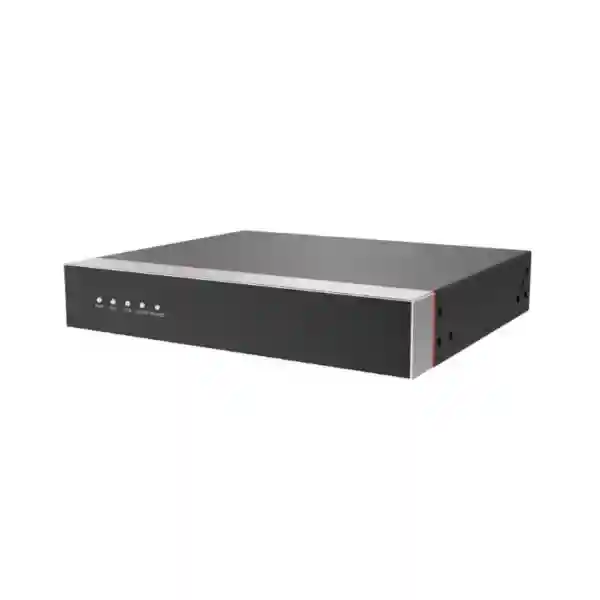
Huawei HiSecEngine USG6510F-D Next-Generation Firewall
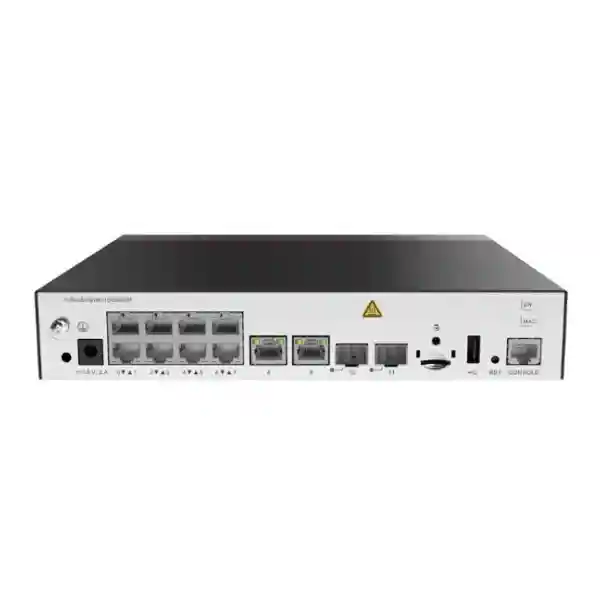
A compact branch and small-enterprise firewall combining multi-gigabit stateful forwarding, VPN, application-aware security, threat inspection, URL controls and secure SD-WAN capabilities in a desktop platform with 10×GE RJ45 and 2×GE SFP interfaces.
For UAE branches that need strong perimeter security without a rack-scale appliance, the USG6510F-D is positioned as a practical desktop NGFW. It is best sized by inspected enterprise traffic, encrypted-session load, VPN demand, application mix and growth margin rather than by headline firewall throughput alone.
What the Huawei HiSecEngine USG6510F-D is designed to do
The Huawei HiSecEngine USG6510F-D belongs to Huawei’s USG6500F family of AI firewalls aimed at small enterprises, branch offices and distributed organizations. In practical network terms, it is intended to sit at an Internet edge, branch WAN boundary, inter-zone security point or managed office perimeter where a business needs more than basic NAT and access control. It combines stateful firewalling with application identification, intrusion prevention, antivirus, URL filtering, bandwidth management, anti-DDoS functions and multiple VPN technologies in one policy-driven platform. This consolidation matters in Dubai and the wider UAE because many business sites operate with limited local IT staffing while still needing secure Internet access, cloud connectivity, remote administration, partner access and resilient WAN design.
The appliance is especially relevant when a branch has a mixture of wired users, access switches, IP telephony, Wi-Fi infrastructure, local servers and cloud applications but does not justify a large 1U or 2U security gateway. With 10 Gigabit Ethernet copper interfaces and two Gigabit Ethernet SFP interfaces, the USG6510F-D can support a flexible combination of LAN zones, uplinks, DMZ networks, ISP handoffs and dedicated management or transit segments. The SFP interfaces are valuable where the service provider or campus backbone presents fiber, while the copper interfaces simplify connection to common Ethernet switching and carrier equipment.
FourTeck approaches the USG6510F-D as an engineering component rather than a generic boxed firewall. For UAE deployments, the important design questions include actual Internet bandwidth, expected peak utilization, number of internal users and devices, encrypted traffic percentage, IPS and antivirus policy depth, SSL inspection requirements, VPN concurrency, SaaS usage, public-facing applications, routing complexity, logging retention and future expansion. A device that looks oversized based on raw firewall throughput can become correctly sized once enterprise-mix threat protection and TLS inspection are considered. Conversely, a branch with mostly trusted site-to-site traffic may have very different resource demands than a site where all outbound web traffic is deeply inspected.
USG6510F-D hardware and physical specification
| Specification | Huawei HiSecEngine USG6510F-D | Deployment interpretation |
|---|---|---|
| Form factor | Desktop | Suitable for branch cabinets, office comms rooms and compact edge installations. |
| Fixed service interfaces | 10×GE RJ45 + 2×GE SFP | Provides copper LAN/WAN flexibility plus fiber handoff options. |
| USB | 1×USB 2.0 | Useful for supported maintenance and operational workflows. |
| Dimensions | 250 × 210 × 43.6 mm | Compact footprint for distributed sites. |
| Weight | Approximately 1.55 kg | Easy to accommodate in small network rooms. |
| Power input | 100–240 V AC, 50/60 Hz | Compatible with standard UAE utility environments when used with appropriate local power accessories. |
| Maximum device consumption | 36 W | Low power profile compared with larger rack firewalls. |
| Operating environment | 0°C to 45°C; 5–95% RH, non-condensing | Requires a suitably cooled, ventilated UAE network environment. |
The desktop construction should not be mistaken for consumer-grade positioning. The interface density is sufficient to build multiple security zones without an immediate dependence on external VLAN trunks, while still allowing trunking where the design calls for it. A branch can, for example, dedicate ports to primary and secondary ISP routers, corporate LAN, guest network, voice, server segment, Wi-Fi infrastructure, CCTV, building systems and a local DMZ. The exact topology depends on segmentation strategy and switch design, but the physical port count gives engineers useful choices during migration from older firewalls.
Performance architecture: why packet size and security services matter
Huawei publishes IPv4 firewall throughput for the USG6510F-D at 6/6/3.6 Gbps for 1518/512/64-byte UDP packets, and the same 6/6/3.6 Gbps pattern for IPv6 using the vendor’s stated packet sizes. These numbers are useful because they show both the high-throughput capability of large frames and the lower result associated with small packets. Small packets increase packet-per-second processing demand, so a firewall can reach a processing limit well before a WAN link reaches its nominal bit rate. This is particularly relevant in mixed environments with voice, transactional traffic, DNS, short web flows, telemetry and applications that generate many concurrent small exchanges.
The USG6500F architecture uses Huawei’s Adaptive Security Engine to allocate processing resources across service modules, combined with network-processor, pattern-matching and encryption/decryption acceleration capabilities across the product family. For the buyer, the important point is not the marketing label but the operational result: forwarding, signature inspection and cryptographic workloads are not treated as identical tasks. A design that needs stateful inspection only will stress different resources than a design with IPS, antivirus, application identification, URL classification and TLS inspection enabled on most traffic.
Huawei’s published enterprise-mix NGFW throughput for the USG6510F-D is 1.2 Gbps, while enterprise-mix threat-protection throughput is 1 Gbps. Those figures are much more relevant than 6 Gbps raw firewall throughput when the proposed configuration enables multiple threat controls. They also illustrate why correct sizing should use the security profile that will actually be deployed. If a Dubai branch has a 1 Gbps Internet circuit today, selecting a firewall solely because its raw stateful throughput exceeds 1 Gbps can leave too little headroom once threat inspection, encrypted traffic, site-to-site tunnels, logging and burst behavior are introduced.
A practical rule for procurement is to treat every vendor throughput figure as a defined lab result, not a promise that every real-world policy set will reproduce it. Production performance varies with software release, feature combination, packet size, number of policies, session distribution, encryption methods, logging rate and traffic composition. FourTeck therefore recommends sizing against the busiest expected inspected traffic period, then adding growth and operational margin. For organizations with a planned WAN upgrade, cloud migration or branch consolidation program, the firewall should be sized against the future steady state rather than the current month’s bandwidth bill.
Published capacity figures at a glance
Published concurrent IPv4 session capacity, giving the appliance substantial state-table depth for a branch-class platform.
Huawei-published HTTP/1.1 new-session rate for the standard test profile.
Published IPsec performance using the vendor’s AES-256 + SHA256 and packet-size test condition.
Maximum published gateway/client-to-gateway tunnel count in the referenced performance profile.
Published SSL VPN throughput for remote-access use cases.
Published default and maximum concurrent SSL-VPN user figures, subject to licensing and current software conditions.
These figures should be validated against the exact current Huawei software release, subscription bundle and commercial bill of materials before order placement. Performance tables can evolve between firmware generations and test methodologies, so final project documentation should record the reference release used for sizing.
Application identification and policy control
Modern perimeter policy cannot rely only on source IP, destination IP and TCP or UDP port. Cloud applications frequently share infrastructure and encryption, while business and non-business functions can appear through the same protocols. Huawei states that the USG6500F family can identify more than 6,000 applications and can apply access control down to application functions. In an enterprise branch, this gives the security team a policy language that is closer to user behavior. Instead of merely allowing HTTPS, the design can distinguish authorized business applications, collaboration tools, storage services, remote access utilities, social platforms and higher-risk traffic categories where identification is available.
Application-aware policy is valuable for organizations that want to reduce shadow IT without trying to block the entire web. A business may permit Microsoft 365, approved CRM platforms, cloud backup and conferencing while restricting consumer file transfer, anonymous proxies or unsanctioned remote-control software. The same application context can be combined with intrusion prevention, antivirus and data-filtering controls to create a more coherent policy. The objective is not to create hundreds of fragile rules; it is to use identity, application and risk context where it materially improves control and observability.
For Dubai companies with multiple branch offices, policy standardization is especially important. A rule set built separately at every site tends to drift over time. Objects are named differently, temporary exceptions remain permanent, and troubleshooting becomes dependent on individual administrators. The USG6500F family supports centralized operational approaches through Huawei management tooling, allowing policy governance to be planned at a broader level. The exact controller and licensing architecture should be selected according to the number of sites, operations model and software release.
FourTeck normally recommends starting with a clean application policy matrix before migration. Each rule should identify business owner, source zone, user or device context where available, destination or service, applications, security profile, logging requirement and expiry or review date for exceptions. That process produces a firewall configuration that is easier to audit than a direct one-to-one conversion of legacy rules. It also helps avoid a common migration problem in which obsolete rules and broad any-to-any permissions are carried forward into the new platform.
Intrusion prevention, web attack defense and vulnerability-oriented controls
The USG6500F security stack includes intrusion prevention designed to detect exploit and attack patterns traversing the firewall. Huawei describes coverage for tens of thousands of CVEs and more than 10,000 IPS signatures across the family, including detection of vulnerability attacks, web attacks such as SQL injection and cross-site scripting, botnet behavior, remote-control activity, Trojan traffic and brute-force attacks. These capabilities are particularly useful at a branch Internet edge where endpoints and local servers may otherwise depend on separate security layers to identify malicious network patterns.
IPS should be tuned to the assets behind the firewall rather than enabled as an undifferentiated block-everything profile. An office with Windows endpoints, IP phones, printers, surveillance devices and a small application server has a different attack surface from a software development branch or a retail outlet. Effective deployment begins by identifying operating systems, services and exposed applications, then applying prevention profiles that prioritize relevant critical vulnerabilities. This reduces noise and limits the risk of blocking legitimate traffic because of signatures unrelated to the protected environment.
Public-facing services deserve separate treatment. If the USG6510F-D protects a local web portal, VPN service, mail gateway or partner integration, inbound policies should be tightly scoped to the minimum required destination addresses and ports. IPS can then inspect allowed traffic for exploit attempts, but it should complement rather than replace secure application configuration, patching, strong authentication and server hardening. Where services are cloud-hosted, branch firewall policy still plays a role in restricting administrative access and controlling outbound communications from local systems.
Operationally, IPS value comes from both blocking and telemetry. Security teams should review high-severity events, repeated sources, destination patterns and policy hits to determine whether an event represents background Internet scanning, a targeted attempt or an internal host already behaving suspiciously. The firewall log stream becomes more useful when correlated with endpoint, identity, DNS and cloud telemetry. FourTeck can assist with the log forwarding and monitoring design through FourTeck IT Services UAE, particularly when a customer wants the firewall to participate in a wider operations or incident-response workflow.
Antivirus and content inspection
Huawei’s Content-based Detection Engine, or CDE, is part of the USG6500F security architecture. The vendor describes an intelligent heuristic antivirus engine designed to detect a very large corpus of virus variants and to inspect files through deep compression nesting, including files compressed through up to 100 layers. The significance is practical: attackers frequently use archives and nested compression to obscure payloads from simple file inspection. A gateway that can inspect deeper file structures can add another control point before content reaches endpoints.
Gateway antivirus should be understood as one layer in a defense-in-depth model. It can detect malicious files carried through inspected protocols and help prevent known and behaviorally suspicious content from crossing the security boundary, but it does not eliminate the need for endpoint security, patch management, email filtering, user awareness and secure backups. Many modern attacks arrive through encrypted connections or cloud applications, so the effectiveness of gateway scanning depends on what traffic is visible to the firewall and which inspection modes are enabled.
This is where encrypted traffic strategy becomes critical. Most business web traffic is TLS protected. If the organization chooses not to decrypt outbound traffic, some content-level detections will have less visibility. If it enables TLS inspection broadly, the firewall must perform additional cryptographic work and the organization must manage certificates, application compatibility, privacy exceptions and regulatory considerations. Huawei publishes SSL inspection throughput separately from raw firewall throughput for this reason. The encrypted-traffic design therefore needs both a security decision and a capacity decision.
A mature policy normally separates categories. Business-critical financial services, health-related portals or pinned-certificate applications may require bypass rules or special handling; unknown file-download sites and general browsing may receive deeper inspection; trusted SaaS services may be treated according to risk and operational requirements. The goal is to gain useful visibility without breaking applications or creating unnecessary privacy exposure. FourTeck can include a staged TLS inspection plan in a UAE deployment, starting with observation and testing before enforcement expands to wider traffic classes.
URL filtering and acceptable-use enforcement
URL filtering converts broad web access into policy based on site categories and organizational rules. For many UAE businesses, this is useful for reducing exposure to phishing, malware distribution, newly observed domains and inappropriate or non-business browsing categories. It can also support bandwidth governance by restricting high-volume or low-value services on corporate links. The purpose should be clearly defined: security categories deserve stronger enforcement, while productivity-oriented restrictions should align with company policy and HR governance.
A common design mistake is to use URL filtering as a substitute for application control. Websites and applications overlap but are not identical. A user can reach the same cloud application through multiple domains, content delivery networks and APIs. Conversely, one website can serve multiple application functions. Strong policy combines URL reputation and category context with application identification, DNS security where available, and endpoint/browser controls. The USG6510F-D can act as a central enforcement point, but policy accuracy improves when the organization defines which layer is responsible for each control.
Exception handling should be formal. When a department asks for access to a blocked category or website, the firewall team should record the business owner, destination, reason, risk acceptance and review date. Temporary allow rules can otherwise accumulate until the filter loses meaning. Where possible, exceptions should target specific destinations or user groups rather than disabling a category globally. Logging should preserve enough context to explain why traffic was blocked without retaining more personal browsing data than the organization needs.
FourTeck can align firewall web policy with a wider UAE network refresh through FourTeck UAE. This is often useful when the branch firewall, switching, wireless and identity controls are being updated together, because consistent segmentation and access policies are easier to achieve when the LAN and security layers are designed as one architecture.
IPsec VPN for site-to-site connectivity
Site-to-site IPsec is one of the most common reasons to deploy a branch firewall. The USG6510F-D supports IPsec VPN and Huawei publishes 2 Gbps of IPsec throughput under a defined AES-256 plus SHA256 test condition, with up to 1,000 IPsec tunnels in the referenced standard profile. Those figures provide substantial headroom for a typical small-enterprise or branch design, but the actual tunnel architecture should be driven by traffic patterns and route design rather than by maximum tunnel count.
A Dubai head office may connect to warehouses, retail stores, clinics, schools, construction offices or regional branches. The architecture can be hub-and-spoke, partial mesh or policy-driven according to the organization’s routing requirements. Hub-and-spoke is operationally simple because branches exchange corporate traffic through a central hub, but it can introduce hairpin latency when branches need to communicate directly. Mesh designs reduce that dependency but increase routing and tunnel complexity. Secure SD-WAN functions can help make path selection more dynamic where multiple uplinks are present.
Cryptographic standards should be selected deliberately. AES-based encryption with modern integrity or authenticated encryption options, strong Diffie-Hellman groups, appropriate key lifetimes and certificate-based authentication where feasible can strengthen the design. Interoperability with third-party firewalls must be tested at the exact proposal settings, especially when the remote site uses different vendors or cloud-native VPN gateways. The design should also define NAT behavior, overlapping subnets, route advertisement, tunnel monitoring and failover criteria.
Performance planning must account for aggregate encrypted traffic across all tunnels. A branch may have only a few tunnels but still push large backup, replication or cloud flows. Conversely, a managed service provider or distributed enterprise may have many low-bandwidth tunnels. The relevant figure is not just tunnel count; it is simultaneous encrypted throughput, packet rate, routing convergence and the security services applied before or after encryption. If IPS and application control are applied to decrypted VPN traffic, those services contribute to the overall processing load.
For mixed Huawei and non-Huawei estates, FourTeck can document crypto proposals, peer parameters, routing dependencies, monitoring and rollback steps before change windows. This reduces troubleshooting time during migration and creates a repeatable method for additional branches. For broader cross-border programs, FourTeck Global provides a reference point for multi-country technology requirements.
SSL VPN for remote users
Remote-access requirements are different from site-to-site VPN. Staff may connect from homes, hotels, customer premises or temporary project offices using networks that the organization does not control. The USG6510F-D supports SSL VPN functions, with Huawei publishing 200 Mbps SSL VPN throughput and a default/maximum concurrent-user figure of 100/300 in its current performance material for this model. The exact entitlement and maximum should be verified against the software version and licenses included in the final quotation.
Remote access should be designed around identity rather than around the tunnel alone. Strong authentication, preferably multifactor authentication through an integrated identity service where supported, reduces the risk of stolen-password access. User groups should map to narrowly defined network permissions. A finance user may need access to an ERP service, while an IT administrator may need management access to a restricted set of infrastructure addresses. Giving every remote user a flat route to the internal LAN creates unnecessary exposure.
The security team should also define endpoint posture expectations. A remote tunnel can protect data in transit but cannot guarantee that the connecting endpoint is healthy. Organizations with higher assurance requirements may combine firewall VPN access with endpoint management, EDR, device certificates and conditional-access processes. Split tunneling should be a conscious decision: routing all traffic through the corporate firewall provides centralized inspection but consumes WAN and firewall capacity; selective split tunneling reduces load but leaves some Internet traffic outside corporate enforcement.
For workforce planning, use real concurrency data rather than employee headcount. A company with 500 employees may have only 60 simultaneous remote users, while a smaller professional-services firm may see most staff online remotely at once. Bandwidth planning should account for application behavior, especially VDI, file transfer, engineering data and voice/video tools. The published 200 Mbps SSL VPN figure is a benchmark condition and should not be treated as guaranteed user experience under every protocol mix.
Secure SD-WAN and multi-uplink design
The USG6500F series supports service-specific policy-based routing and intelligent uplink selection for multi-egress networks. Huawei lists secure SD-WAN throughput of 5 Gbps for the USG6510F-D under its specified 1400/512-byte UDP conditions and up to 200 SD-WAN EVPN tunnels in the current datasheet. These capabilities allow the firewall to participate in branch connectivity designs where traffic should follow the best available path rather than a static default route.
A typical UAE branch may have a primary business Internet circuit and a secondary broadband or 5G-backed external router. The firewall can be designed to monitor path health and select egress according to policy. Voice and interactive applications may prioritize low latency and loss, while backups and software updates may use a lower-cost path. The objective is to align path choice with application requirements rather than simply balancing packets across links.
Resiliency needs careful failure definition. A physical interface can remain up while the upstream Internet path is unusable. Effective WAN monitoring therefore checks reachability or service health beyond the directly connected gateway. Failover timers should be fast enough to protect critical services but not so aggressive that transient packet loss causes constant path flapping. When NAT is involved, failover can also change the public source IP, affecting SaaS allowlists, remote peers and active sessions.
SD-WAN should be planned together with DNS, cloud security and user experience monitoring. Sending traffic through a technically available path that has poor latency to a key SaaS platform can still produce a bad user experience. Where branches connect to central hubs, cloud workloads and local Internet simultaneously, the route and security policy should make those destinations explicit. Direct Internet breakout can reduce latency for SaaS but requires security enforcement at each branch.
The USG6510F-D is therefore well suited to compact dual-WAN branches where firewall and WAN policy should live in the same edge device. For larger sites, higher inspected throughput or extensive 10GbE requirements may justify moving up the USG range. FourTeck can compare the branch traffic profile against higher-capacity models before procurement so the selected device matches both current and planned link speeds.
Segmentation design for offices, retail, hospitality and branch environments
Segmentation is one of the highest-value uses of a next-generation firewall. Many branches still place users, printers, cameras, phones and building systems into broad flat networks because it is easy to deploy. That design makes lateral movement easier for an attacker and makes policy troubleshooting harder. The USG6510F-D can separate traffic into security zones and enforce rules between them, either through physical interfaces or VLAN-based logical interfaces according to the network design.
A practical office design may include corporate users, guest Wi-Fi, voice, server, infrastructure management, CCTV, IoT and DMZ zones. Guest traffic should generally reach the Internet without access to internal networks. Cameras may need access only to the recording platform, DNS and time services. Phones may require call-control services and approved update destinations but not unrestricted lateral access. Management interfaces for switches, access points and servers should be reachable only from administrator networks or secured remote-access paths.
Retail and hospitality sites add point-of-sale, payment, kiosk and guest-service requirements. In those environments, policy boundaries should reflect business functions and compliance obligations. A payment segment should not trust guest Wi-Fi merely because both share the same physical switch stack. A firewall between VLANs can add inspection and explicit policy, but architecture must also consider switching ACLs, wireless policy and identity controls so traffic does not bypass the intended enforcement point.
The USG6510F-D’s twelve fixed service interfaces give engineers flexibility for sites where certain functions benefit from physical separation. However, physical ports should not be consumed simply because they are available. VLAN trunks can simplify growth when the switching design is mature, while dedicated interfaces can reduce dependency on shared trunks for critical uplinks. The right balance depends on fault isolation, change control, bandwidth, cabling and the number of security zones expected during the life of the branch.
Routing, NAT and Internet edge integration
A firewall at the branch perimeter participates directly in routing and address translation, so migration planning must capture more than security rules. Engineers should document current static routes, dynamic routing use, default gateway behavior, ISP addressing, public IP blocks, source NAT pools, destination NAT rules, port forwards and asymmetric paths. Overlooked routing behavior is one of the most common causes of post-migration outages because traffic can match the correct security rule and still fail if return routing is wrong.
Public services should be inventoried before cutover. If a site hosts a web portal, CCTV access gateway, PBX service, mail relay, remote-management portal or partner integration, each public IP and destination NAT rule must be mapped to the new firewall. Where possible, migration is an opportunity to reduce exposed services. Legacy management interfaces that are reachable from the Internet should be moved behind VPN or restricted to trusted sources. Unused public IP mappings should be removed rather than replicated.
Outbound NAT also deserves attention in multi-WAN designs. Some SaaS providers whitelist the organization’s public IP. If traffic fails over to a secondary ISP, the source address changes unless an external routing arrangement preserves it. The organization must identify systems that depend on source-IP trust and decide whether the secondary path should support them. Similarly, IPsec peers tied to one public address may need alternate peer configuration or dynamic mechanisms for failover.
The firewall can support a clean default-deny model only when routing is equally clean. FourTeck’s migration process therefore treats route tables, NAT, VPN and policy as one dependency set. For broader firewall-specific planning and UAE security deployments, customers can also reference Firewall Dubai by FourTeck.
Operations, visibility and policy lifecycle
Huawei emphasizes simplified operations on the USG6500F family, including a web interface designed to visualize device status, alarms, traffic and threat events. For a small IT team, good visibility is not cosmetic. The firewall should make it possible to answer basic operational questions quickly: which link is saturated, which application is consuming bandwidth, which rule blocked a user, whether a VPN tunnel is down, which destination is generating threat alerts, and whether a configuration change preceded an outage.
Policy lifecycle discipline is equally important. Firewall rule bases usually become more permissive over time because business requests arrive faster than old rules are removed. Every change should therefore have a business owner and a reason. Temporary policies should have review dates. Broad rules should be monitored for actual use and tightened where possible. Disabled rules should be removed after a defined retention period once rollback risk has passed. Object naming should follow a standard that identifies site, service and function without creating unreadable abbreviations.
Logging strategy should distinguish operational logs from security logs. Interface state changes, routing events and VPN transitions are important for network troubleshooting. Denied sessions, IPS events, malware detections and application-control violations are security-relevant. Excessive session logging can overwhelm storage and make important events difficult to find, while insufficient logging leaves incident responders without evidence. The log design should define local retention, external forwarding, time synchronization and the systems responsible for long-term analysis.
Configuration backups are another simple but critical control. The organization should retain known-good configurations before and after major changes, document software versions and record license state. A firewall is a high-dependency device; replacing hardware during an incident is much faster when the current configuration, interface map and VPN secrets or certificate procedures are documented securely. Change windows should include a tested rollback method rather than relying on improvised console recovery.
For multi-site environments, central management can improve consistency. Huawei positions its management tools for unified policy and security operations across multiple devices. The precise platform should be chosen based on the number of firewalls, desired automation level, reporting needs and existing Huawei ecosystem. Small deployments may remain manageable per device, while a distributed retail or branch estate gains more from standardized templates, centralized visibility and coordinated policy updates.
High availability and service continuity considerations
The USG6510F-D itself is a compact single-power-supply desktop platform, so service continuity must be designed at the solution level. If an office can tolerate a short outage while hardware is replaced, one appliance with a spare and documented recovery process may be sufficient. If the site is revenue-critical or hosts essential customer services, the architecture should consider firewall redundancy, dual ISPs, resilient switching, UPS protection and diverse power paths where practical.
A redundant firewall pair is not automatically highly available if both devices depend on the same ISP router, the same access switch, the same power strip or the same fiber handoff. Fault domains should be mapped end to end. The design should ask what happens if the firewall fails, what happens if a switch fails, what happens if the ISP circuit fails and what happens if the building loses utility power. Testing should verify not only that a backup path exists but that applications recover as expected.
Session continuity is also application dependent. Some traffic can reconnect almost immediately after a path change. Long-lived TCP sessions, IPsec tunnels, voice calls and stateful cloud connections may reset. A failover design should therefore be tested with representative applications, not only with ping. If the branch uses source-IP-based SaaS controls, secondary Internet paths must be included in those allowlists or the service may remain inaccessible after a technically successful failover.
For projects that require active/standby or other firewall clustering behavior, the supported feature set and topology should be confirmed against the exact Huawei software release being proposed. FourTeck avoids assuming that a feature available elsewhere in a product family is enabled identically on every model and license combination. The final bill of materials and implementation plan should explicitly document the redundancy mechanism, synchronization links, management addressing and failover test procedure.
UAE environmental and installation planning
Dubai and UAE network rooms can expose equipment to high ambient heat if cooling is inadequate. Huawei lists an operating range of 0°C to 45°C and 5% to 95% relative humidity without condensation for the USG6510F-D. That specification does not mean the firewall should be installed in a hot unconditioned closet. Security appliances generate continuous heat and often sit with switches, routers, UPS systems and telecom equipment. A stable air-conditioned environment improves reliability and gives more margin during peak summer conditions or partial cooling failures.
The compact chassis simplifies installation, but it should still be placed securely with clear airflow and service access. Avoid loose placement on top of other hot equipment where cables can pull the unit or block ventilation. If the branch uses a wall cabinet, verify shelf depth, cable bend radius and access to the front and rear interfaces. Copper patching should be labeled by function, and fiber modules should match the required optic type and service-provider handoff.
Power protection deserves attention because an Internet edge firewall is a single point of dependency. A UPS sized for the firewall, ISP termination equipment and essential switching can keep communications available through short utility interruptions. For longer outages, the UPS runtime should align with the organization’s operational plan. The 36 W published maximum consumption of the firewall is modest, but total UPS sizing must include all associated devices and battery aging.
The final installation checklist should record serial numbers, interface labels, firmware version, management IP, uplink details, ISP contact information, support entitlement and configuration backup location. Good documentation turns a branch firewall from an opaque appliance into a maintainable service. This is particularly important when support is provided remotely or when multiple sites are managed by the same operations team.
How to size the USG6510F-D correctly
Firewall sizing should begin with measured traffic. The team should capture peak Internet throughput, average throughput, packet rate if available, concurrent sessions and session creation rate. Bandwidth graphs alone can be misleading because two sites with the same Mbps value may create very different workloads. A browsing-heavy branch can produce many short sessions, while a backup site may push a few long, large flows. The USG6510F-D’s 3 million published concurrent sessions and 40,000 HTTP/1.1 new sessions per second provide generous branch capacity, but sizing should still reflect the real application mix.
Next, determine which security services will be enabled. If the firewall will perform only stateful inspection and IPsec, raw firewall and VPN figures carry more weight. If IPS, antivirus, application control, URL filtering and SSL inspection are applied to most outbound traffic, use the enterprise-mix and threat-protection figures as the more relevant baseline. Huawei’s 1.2 Gbps enterprise-mix NGFW and 1 Gbps enterprise-mix threat-protection results demonstrate the expected difference between packet forwarding and deep security processing.
Encrypted traffic requires special attention. If most Internet traffic is TLS and the organization plans broad decryption, SSL inspection throughput and certificate-processing behavior can become the limiting factor. The team should identify applications that cannot be decrypted, such as some pinned-certificate or regulated services, and estimate what percentage of traffic remains subject to inspection. A pilot deployment or controlled test is ideal for large or latency-sensitive environments.
VPN demand should be split into site-to-site and remote access. A branch with 800 Mbps of encrypted data-center traffic has different requirements from a branch with 150 remote SSL VPN users. Site-to-site IPsec may be limited by encryption workload and WAN speed, while SSL VPN capacity depends on remote user concurrency and application usage. The default and maximum SSL VPN user counts should be checked against the proposed license bundle before procurement.
Growth margin is the final step. If the organization expects a 1 Gbps circuit upgrade, new cloud backup, additional users or branch consolidation in the next two to three years, sizing exactly to current load creates avoidable replacement risk. FourTeck typically recommends a realistic engineering margin rather than an arbitrary percentage. The margin should cover known projects, normal traffic growth, failure-mode traffic shifts and temporary spikes. If the resulting requirement approaches the inspected limits of the USG6510F-D, a larger model should be considered even if the current site appears to fit.
For customers extending similar architectures into African operations, FourTeck Africa provides a regional reference for multi-country network and security planning. Cross-region projects should still account for local carrier behavior, latency, power conditions and support logistics rather than assuming every branch will match the UAE design exactly.
Recommended deployment scenarios
Small enterprise Internet edge
A single office that needs next-generation firewall controls, dual ISP potential, IPsec to cloud or headquarters, guest separation and centralized logging without a rack-scale appliance.
Distributed branch
A branch that needs local Internet breakout, application-based WAN policy, central VPN connectivity and consistent security controls across many locations.
Retail or hospitality site
A site requiring separation of payment, staff, guest, voice, CCTV and IoT networks with restricted east-west access and centrally governed Internet security.
Professional services office
A cloud-heavy office that needs application control, URL filtering, secure remote access and policy visibility for hybrid users and SaaS workloads.
Project or temporary office
A compact location where quick deployment, VPN back to headquarters and manageable policy are more important than high-density 10GbE connectivity.
Segmented services gateway
An internal security role where server, management, user or IoT zones require explicit inspection and policy beyond what basic switching ACLs can provide.
Migration from an existing firewall
Replacing a production firewall is primarily a dependency-mapping exercise. Before building the USG6510F-D, export the existing configuration and document interfaces, VLANs, routing, NAT, VPNs, DHCP services if used, administrative access, authentication, DNS dependencies, certificates and logging destinations. Then compare that documented state with actual traffic and business requirements. Legacy firewalls often contain years of rules that are no longer needed, so migration is an opportunity to reduce technical debt.
Rules should not be translated mechanically if the old and new platforms use different policy concepts. The team should rebuild policy around zones, applications and modern security profiles, then map only necessary legacy behavior. Objects should be normalized and duplicate address groups consolidated. Where an existing rule allows broad services because the old firewall lacked application awareness, the new design can often be more specific. Changes should still be tested carefully to avoid disrupting business applications that rely on undocumented destinations.
VPN migration requires coordination with remote peers. If both sides cannot change simultaneously, temporary parallel tunnels or staged routing may be needed. Public NAT changes may require DNS updates and TTL planning. Authentication integration should be tested before cutover, especially for administrators and remote users. Certificates must be available in the correct format, with private keys handled securely. Any services that depend on the old firewall’s IP address, such as syslog allowlists or monitoring systems, must be updated.
A good cutover plan includes pre-checks, a change sequence, validation tests and explicit rollback triggers. Validation should cover Internet access, DNS, critical SaaS, internal applications, VPNs, inbound public services, voice, guest networks and monitoring. Security policy should be tested with both allowed and intentionally blocked traffic. Engineers should monitor CPU, session counts, link utilization and security logs during the first production peak to confirm that sizing assumptions match reality.
After stabilization, the old firewall configuration should be archived securely and the device removed from service according to the organization’s asset process. Temporary migration rules should be reviewed and removed. Documentation should be updated with the final production state, not the initial design draft. This closeout step is frequently skipped, yet it determines how quickly the next engineer can troubleshoot the site months later.
Licensing and subscription planning
A next-generation firewall’s hardware and software entitlements should be purchased as one operational package. The appliance can provide routing and firewall functions, but threat intelligence, signature updates, content-security services, remote-access scale and management features may depend on specific licenses or subscriptions. The quotation should therefore list not only the hardware model but also the services required for the intended security policy.
Start from the policy design. If the organization wants IPS, antivirus, URL filtering and threat-related services, the required subscription bundle should be identified before order placement. If remote access needs more than the default entitlement, confirm the SSL VPN user license. If centralized management is planned, include the controller or management licensing appropriate to the deployment. Support coverage should match the organization’s replacement and escalation requirements.
Subscription term also matters. A lower initial hardware price can become misleading if essential security services expire after a short period and are not budgeted for renewal. The project should show year-one cost and expected renewal obligations clearly. Procurement teams should understand which functions continue with expired subscriptions, which lose updates, and which may be restricted. Exact behavior depends on Huawei’s current commercial policies and should be confirmed at quotation time.
FourTeck can prepare a bill of materials that separates appliance, licenses, subscriptions, optics, spares and professional services so stakeholders can see what each item supports. This approach is preferable to a generic firewall price because it reduces the risk that the delivered hardware cannot implement the approved security design without an unplanned license purchase.
Security policy design principles for the USG6510F-D
The strongest firewall is still limited by the quality of its policy. A clean design starts with default deny between security zones and then permits documented business flows. Internet access rules should be grouped logically by user or device class, and sensitive destinations should have narrower policy than general browsing. Administrative access to the firewall itself should be isolated from ordinary user networks, protected by strong credentials and restricted to trusted management paths.
Security profiles should reflect risk. High-risk Internet browsing may receive application control, IPS, antivirus, URL filtering and TLS inspection. A trusted internal backup flow may need stateful policy without the same content inspection. Applying every control to every flow can waste resources and create troubleshooting complexity without proportionate benefit. Conversely, disabling inspection globally to maximize benchmark throughput undermines the purpose of a next-generation firewall.
Policy order and object hygiene matter. Specific deny or permit rules should be placed where they are evaluated predictably, while catch-all rules remain at the end. Address objects should represent real systems or groups, not vague names that lose meaning. Service objects should use the minimum required protocols and ports. Application rules should be tested to confirm identification behavior before strict enforcement. Logging should be enabled on high-value and denied traffic with sufficient detail for troubleshooting.
The firewall should also be hardened as an infrastructure device. Management services not required by the organization should be disabled or restricted. Administrator roles should follow least privilege. Configuration changes should be attributable to named administrators where operationally possible. Time synchronization should be reliable so security events correlate with other systems. Firmware and threat-content updates should follow a maintenance process that balances security with stability.
A policy review after thirty to ninety days of production is useful because it replaces assumptions with evidence. Rules that never match may be unnecessary, while unexpected application categories may reveal new business dependencies. The team can then tighten policy and adjust bandwidth or inspection profiles based on observed behavior. Firewall deployment should therefore be treated as an operational lifecycle, not a one-time installation.
Procurement considerations for Dubai and UAE customers
When purchasing the Huawei HiSecEngine USG6510F-D in the UAE, the quotation should identify the exact hardware SKU, power accessories, optics, licenses, subscription terms, support coverage and implementation scope. A model name alone is not enough because two proposals can contain the same chassis while delivering very different operational capability. Buyers should request an itemized bill of materials and a statement of which security functions will be active on day one.
Lead time is another planning factor. Firewalls often sit on the critical path for new offices and circuit migrations. If the security gateway is ordered late, ISP delivery, switch installation and user move-in can all be ready while the Internet edge remains blocked. Procurement should therefore start after high-level sizing, not after every configuration detail is finalized. Optics and spare power accessories should be included early because a missing transceiver can delay a cutover as effectively as missing hardware.
Support logistics should match site criticality. A non-critical branch may accept next-business-day replacement, while a trading, healthcare, hospitality or revenue-generating site may require a stronger spare strategy. Keeping a preconfigured spare locally can be more effective than relying solely on vendor replacement timelines, especially across multiple branches. The spare process should include version control and a method to restore the current configuration securely.
For compliance-sensitive environments, procurement should also confirm any required certification, logging retention, encryption standards and supplier documentation. These requirements vary by industry and organization. The firewall can provide technical controls, but compliance depends on the overall architecture, operational procedures and evidence. FourTeck can provide product and implementation documentation as part of project delivery, while the customer retains responsibility for its specific regulatory interpretation.
Customers evaluating the USG6510F-D as part of a wider network refresh can use the UAE engineering scope to align WAN, switching, wireless, voice and server dependencies. Firewall projects are often where hidden infrastructure issues surface because the gateway touches every network zone. Addressing those dependencies during design reduces the chance that a new firewall is blamed for problems originating elsewhere in the environment.
Technical FAQ: Huawei HiSecEngine USG6510F-D in Dubai
Is the USG6510F-D suitable for a 1 Gbps Internet link?
Potentially yes, but sizing should use the security services that will actually be enabled. Huawei publishes 1 Gbps enterprise-mix threat-protection throughput and 1.2 Gbps enterprise-mix NGFW throughput, so a fully inspected 1 Gbps link can leave limited margin during peaks. Growth, TLS inspection and VPN load should be considered before finalizing the model.
How many interfaces does it have?
The standard USG6510F-D has 10 Gigabit Ethernet RJ45 interfaces and 2 Gigabit Ethernet SFP interfaces, plus one USB 2.0 port. This mix supports typical branch WAN, LAN, DMZ and fiber-uplink requirements.
Does it support site-to-site VPN?
Yes. Huawei lists IPsec VPN among the supported functions and publishes 2 Gbps IPsec performance for this model under defined lab conditions, with up to 1,000 IPsec tunnels in the current referenced profile.
Does it support remote-access VPN?
Yes. SSL VPN is supported. Huawei publishes 200 Mbps SSL VPN throughput and a default/maximum concurrent-user figure of 100/300 for the USG6510F-D, subject to the applicable software and licensing.
Can it perform application control?
Yes. Huawei states that the USG6500F family identifies more than 6,000 applications and supports policy granularity down to application functions, allowing access control to be based on application context rather than ports alone.
What is the maximum power consumption?
Huawei lists a maximum device consumption of 36 W for the USG6510F-D. UPS sizing should still include ISP equipment, switches and battery-aging margin rather than using the firewall figure alone.
Is it rack mounted?
Huawei positions the USG6510F-D as a desktop form-factor appliance measuring 250 × 210 × 43.6 mm. Installation should still provide secure placement, ventilation, labeled cabling and controlled access.
Can FourTeck configure and migrate it?
Yes. FourTeck can scope interface mapping, policy migration, NAT, VPN, segmentation, logging, testing and cutover for UAE environments, with the final service scope defined in the project quotation.
Decision recap: where the USG6510F-D fits best
The Huawei HiSecEngine USG6510F-D is strongest where an organization wants enterprise firewall features in a compact branch platform. Its fixed 10×GE RJ45 plus 2×GE SFP interface layout offers useful segmentation flexibility, while the 6 Gbps published large-packet firewall throughput and 3 million concurrent-session capacity provide substantial stateful performance for its form factor. More importantly for secure production use, Huawei publishes 1.2 Gbps enterprise-mix NGFW throughput and 1 Gbps enterprise-mix threat protection, making it possible to size the model against realistic inspected traffic rather than only headline forwarding.
The appliance is a particularly sensible candidate for branch Internet edges, professional offices, retail locations, hospitality sites, distributed enterprises and compact headquarters where 1GbE access connectivity is sufficient and the organization values VPN, application control, IPS, antivirus, URL filtering and secure multi-uplink policy in one platform. It is less suitable when the design requires extensive 10GbE interfaces, multi-gigabit deep inspection with large growth margin, very high SSL inspection demand or a chassis-level redundancy model beyond what a desktop branch platform is intended to provide.
The buying decision should therefore be based on inspected throughput, session behavior, encrypted traffic, VPN concurrency, uplink design and operational requirements. If those inputs are captured correctly, the USG6510F-D can provide a balanced security edge without oversizing the branch. If the measured requirement is near its inspected limits, moving to a larger Huawei model is usually more economical than operating continuously at the edge of capacity and replacing early.
Quotation input checklist
Traffic and users
Provide current Internet speed, planned upgrade speed, typical peak utilization, user count, device count, main SaaS applications, cloud backup or replication flows and any known high-volume services.
Security services
Identify whether IPS, antivirus, application control, URL filtering, DNS controls, SSL inspection and centralized threat monitoring are required on most Internet traffic or only on selected zones.
VPN requirements
List site-to-site peers, expected aggregate IPsec bandwidth, encryption standards, cloud VPN gateways, number of remote SSL VPN users and any multifactor or directory integration needs.
Interfaces and WAN
Provide ISP handoff type, copper or fiber requirements, number of WAN links, public IP ranges, required SFP optics, internal VLAN count and whether dedicated physical security zones are preferred.
Availability
State acceptable downtime, firewall redundancy expectations, UPS availability, spare strategy, dual-ISP requirements and whether maintenance windows are available outside business hours.
Operations
Confirm log-retention targets, external SIEM or syslog destinations, monitoring requirements, administrator count, centralized management needs, support term and documentation expectations.
FourTeck UAE consultation for Huawei HiSecEngine USG6510F-D
FourTeck can support the complete firewall lifecycle: model sizing, license and subscription mapping, interface and VLAN design, policy migration, NAT, site-to-site IPsec, SSL VPN planning, security-profile configuration, logging, cutover testing and post-deployment review. The engagement can be limited to supply and configuration or expanded into a wider branch network modernization project.
For the fastest technical quotation, share the items in the checklist above along with the current firewall model and a sanitized configuration summary if available. The resulting proposal can then distinguish mandatory components from optional resilience, management and service items, reducing the chance of hidden licensing or capacity gaps after purchase.
Use inspected traffic, encrypted-session load and future WAN speed as the primary sizing inputs. Validate the exact Huawei software and license bundle in the final bill of materials.
Technical figures on this page are based on Huawei-published USG6500F/USG6510F-D product material available at the time of preparation. Vendor performance is measured under defined laboratory conditions and may vary with software release, packet size, enabled security services, encryption, logging, policy complexity and live traffic behavior. Final sizing, feature entitlement and licensing should be confirmed against the current project bill of materials before deployment.

Reviews
There are no reviews yet.