
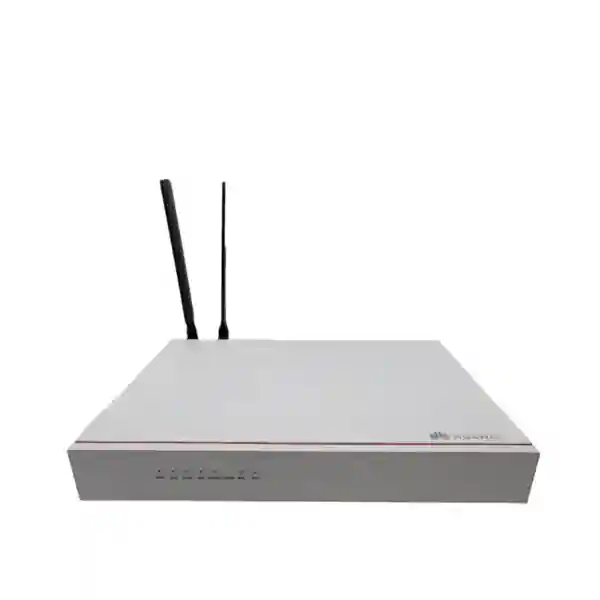
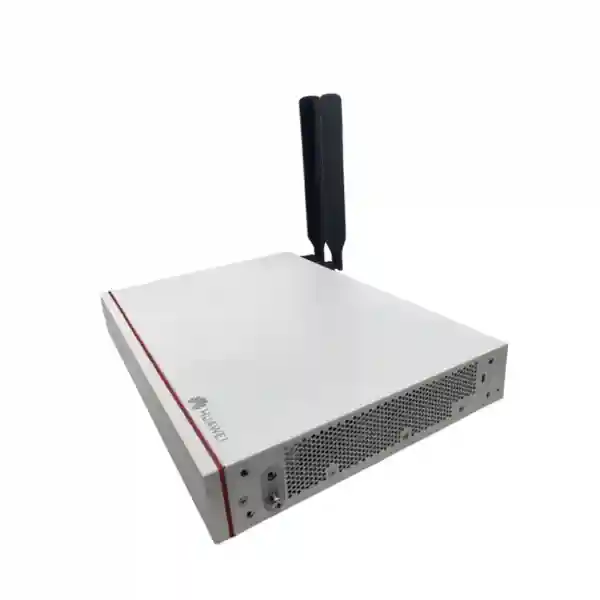
Huawei HiSecEngine USG6510F-DL in Dubai, UAE
A compact security gateway for branches that need enterprise firewall controls, secure WAN connectivity, optical and copper Gigabit interfaces, LTE resilience, VPN services and centralized operational visibility without deploying a large rack appliance.
Desktop form factor · 320 × 220 × 43.6 mm
Firewall, IPS, AV, VPN, URL filtering & SD-WAN
What the USG6510F-DL is designed to solve
The Huawei HiSecEngine USG6510F-DL is best understood as a branch security platform rather than a simple Internet firewall. A modern branch in Dubai or elsewhere in the UAE may have dual WAN services, cloud-hosted business applications, local printers and servers, IP cameras, Wi-Fi access points, remote users, site-to-site VPN requirements and a need for an independent cellular backup path. Deploying separate appliances for each of these functions increases cabling, power consumption, change-management overhead and the number of devices that operations teams must monitor. The USG6510F-DL brings the security and WAN functions into one desktop appliance with a fixed-port design sized for smaller locations.
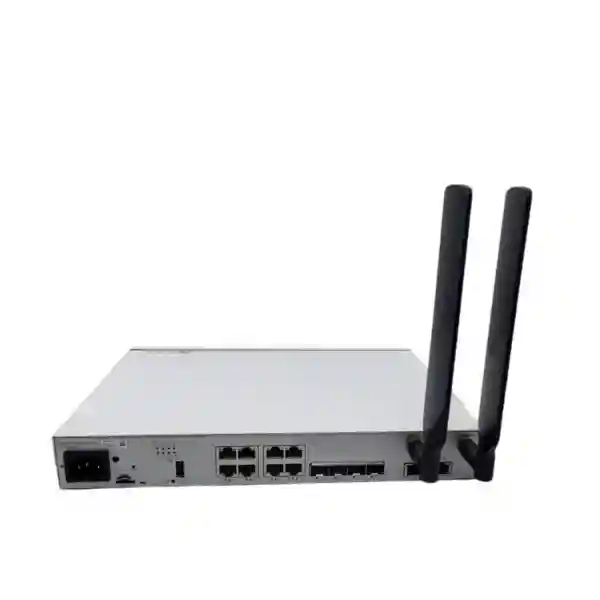
The model combines eight copper Gigabit Ethernet interfaces, four Gigabit SFP interfaces and LTE connectivity, allowing a network architect to separate WAN, LAN, DMZ, management and inter-site links without depending entirely on media converters or an external cellular router. Huawei positions the platform within the HiSecEngine USG6500F family, where firewall policy, application awareness, intrusion prevention, antivirus, URL controls, VPN, routing and SD-WAN capabilities are managed as an integrated system. For organizations standardizing branch security across multiple UAE sites, this matters because the same operational framework can be applied to sales offices, warehouses, clinics, retail branches, education facilities and remote technical locations with different WAN conditions.
Copper, fiber and LTE
Eight GE RJ45 ports support familiar branch LAN and WAN connections, while four GE SFP ports provide flexible fiber handoffs. Integrated LTE adds an alternate access method for failover or sites where fixed connectivity is constrained.
Integrated inspection stack
Stateful firewalling can be combined with application identification, IPS, antivirus, URL filtering, Anti-DDoS, content controls and encrypted-traffic inspection according to the security policy and enabled licenses.
VPN and Secure SD-WAN
IPsec, SSL VPN, GRE and policy-based path selection support branch-to-head-office, branch-to-cloud and remote-user designs. Secure SD-WAN features help steer services according to path quality and business policy.
Huawei USG6510F-DL key specifications
| Specification | USG6510F-DL | Sizing interpretation |
|---|---|---|
| Fixed interfaces | 4 × GE SFP + 8 × GE RJ45 + LTE | Useful for mixed fiber/copper branch designs with independent cellular resilience. |
| Form factor | Desktop | Suited to compact comms rooms, wall shelves and small branch racks. |
| Dimensions | 320 × 220 × 43.6 mm | Plan adequate side/rear ventilation and accessible cable management. |
| IPv4 firewall throughput | 6 / 6 / 3.6 Gbps for 1518 / 512 / 64-byte UDP | Raw forwarding differs from fully inspected application traffic; size from security services actually enabled. |
| IPv6 firewall throughput | 6 / 6 / 3.6 Gbps for 1518 / 512 / 84-byte UDP | Supports dual-stack planning without treating IPv6 as an afterthought. |
| Secure SD-WAN throughput | 5 / 5 Gbps at 1400 / 512-byte UDP | Relevant when branches use encrypted overlays and policy-driven path selection. |
| SD-WAN EVPN tunnels | Up to 200 | Supports substantial branch-overlay scale for a compact appliance. |
| Firewall packet rate | 5.4 Mpps | Important for environments with many small packets rather than only large-file traffic. |
| Firewall latency | 18 µs, 64-byte UDP test | Actual application experience also depends on inspection profiles, WAN latency and upstream services. |
| NGFW throughput | 1.6 Gbps HTTP 100K; about 1 Gbps enterprise mix | A more useful planning reference than raw firewall throughput when IPS and application awareness are active. |
| Threat protection | 1.3 Gbps HTTP 100K; about 800 Mbps enterprise mix | Relevant to security-first sizing where firewall, service awareness, IPS and antivirus are enabled together. |
| Concurrent sessions | Up to 800,000 | Allows many simultaneous flows generated by user devices, cloud apps, IoT and background services. |
| New sessions per second | 40,000/s HTTP1.1 | Useful for bursty branches, busy guest networks and transaction-heavy access patterns. |
| IPsec VPN throughput | 2 Gbps with AES-256 + SHA256, 1420-byte | Supports encrypted site connectivity, subject to tunnel design and real traffic mix. |
| IPsec tunnels | Up to 1,000 | Suitable for hub, branch and partner VPN scenarios when policy scale is also validated. |
| SSL inspection throughput | Up to 0.8 Gbps in current Huawei test data | Encrypted inspection can be the sizing constraint in HTTPS-heavy branches. |
| SSL VPN throughput | 200 Mbps | Validate remote-user concurrency and application mix before final licensing. |
Published performance values are laboratory measurements and can vary by software release, license, packet size, security profile, traffic composition and enabled features. FourTeck recommends sizing from the inspected workload rather than the highest raw firewall figure.
Port architecture: why 4 GE SFP plus 8 GE RJ45 matters
Branch firewalls often become constrained by physical interfaces before they run out of basic packet-processing capacity. The USG6510F-DL provides twelve fixed Gigabit service interfaces split between four SFP slots and eight copper RJ45 ports, giving designers practical separation options. A common UAE branch can dedicate one or two RJ45 ports to primary Internet circuits, one SFP port to a metro-Ethernet or service-provider fiber handoff, several RJ45 ports to inside VLAN trunks or directly attached switches, and another interface to a DMZ or operational-technology segment. Because the SFP interfaces accept optical transceivers appropriate to the supported platform configuration, the firewall can connect to fiber services without an external converter in many designs.
The interface mix also makes migration easier. An office that currently receives copper broadband can be deployed immediately on an RJ45 WAN port while a future dedicated fiber service is terminated on an SFP interface. A warehouse may use fiber between the firewall and a distant distribution switch to avoid copper distance limitations. A clinic may reserve dedicated physical segments for medical systems, guest services and administration. A retail location can separate payment-related infrastructure from public Wi-Fi and staff devices while maintaining an LTE backup path. Physical segmentation is not a substitute for VLANs and security policy, but extra interfaces reduce design compromises and can simplify troubleshooting.
When FourTeck designs a USG6510F-DL deployment, each interface is mapped to a role before configuration begins: WAN, secondary WAN, LTE, LAN transit, DMZ, management, partner link or dedicated server segment. The port map is then aligned with VLAN tagging, zone assignment, routing, NAT and security policy. This prevents a common branch mistake in which ports are configured reactively during installation and the final layout becomes difficult to document or support.
Integrated LTE for business continuity and rapid branch activation
The defining feature of the USG6510F-DL compared with non-LTE variants is the integrated cellular capability. In the UAE, this can be valuable for temporary offices, construction facilities, pop-up retail sites, warehouses awaiting fixed circuits, executive offices that require an independent backup path, and distributed branches where a cable cut should not isolate the location. LTE does not automatically replace a well-designed fixed WAN, but it creates a physically diverse access option that can be incorporated into a failover policy.
A resilient design should define exactly which applications are permitted to use the LTE path. During a primary WAN outage, routing and policy can prioritize business-critical services such as ERP access, cloud identity, VoIP signaling, payment processing, VPN connectivity or remote management while restricting bulk backups, operating-system updates and recreational traffic. This prevents a backup cellular link from being saturated immediately after failover. Health checks should monitor the fixed links, and failback behavior should be chosen carefully so that unstable circuits do not cause repeated route changes.
Cellular performance is affected by operator coverage, signal strength, antenna placement, building materials, congestion and the subscribed service plan. FourTeck therefore treats LTE as part of the site survey rather than an assumed number on a specification sheet. Where the backup path is operationally important, the implementation plan should validate signal conditions, SIM provisioning, APN requirements, NAT behavior, allowed inbound/outbound applications and the monitoring method used by the network operations team.
Firewall performance: raw throughput is only the first number
Huawei publishes IPv4 and IPv6 firewall throughput figures of 6 Gbps for 1518-byte and 512-byte UDP test traffic and 3.6 Gbps for small 64-byte IPv4 or 84-byte IPv6 packets. These figures describe the forwarding capability of the appliance under defined laboratory conditions. They are useful for understanding the hardware class, but they should not be treated as the Internet bandwidth that can always be protected with every advanced security function enabled. Real enterprise traffic includes short and long sessions, encrypted HTTPS, SaaS flows, DNS, video, voice, software updates, file transfers, cloud storage and many concurrent background connections.
For next-generation firewall sizing, the more important references are inspected-traffic measurements. Current Huawei data lists approximately 1.6 Gbps NGFW throughput using the HTTP 100K test method and around 1 Gbps for an enterprise-mix traffic model. Threat-protection throughput is around 1.3 Gbps in the HTTP 100K method and about 800 Mbps for enterprise-mix traffic. These numbers better reflect scenarios where service awareness, IPS and antivirus are combined, although actual results still depend on policy complexity, signatures, software version, logging and traffic composition.
A UAE branch with a 500 Mbps Internet service and heavy HTTPS inspection may require more planning than a site with a 1 Gbps link used mostly for low-risk traffic that bypasses deep inspection. Conversely, a branch with two 500 Mbps WAN circuits may not need 1 Gbps of inspected throughput if traffic is split between direct cloud access and a private WAN with different security profiles. FourTeck therefore sizes the USG6510F-DL from the expected peak protected traffic, not only the purchased ISP bandwidth.
Concurrent sessions: up to 800,000
Session capacity matters because each browser tab, cloud API call, mobile application, IoT device, DNS query and background synchronization task can create flows. A branch with only one hundred employees can still maintain tens of thousands of sessions. The USG6510F-DL provides substantial headroom for an SME appliance, but the correct design also considers session timeout values, NAT use, guest Wi-Fi behavior and automated devices.
New sessions: up to 40,000 per second
New-session rate is especially relevant when many endpoints connect at once, a guest network is busy, applications use large numbers of short transactions, or a branch recovers after an outage. It indicates how quickly the firewall can establish state for fresh connections. Proper security policy, DoS protection and connection limits remain important because high session creation can also be associated with scans or attacks.
Application identification and policy control
Traditional port-based firewall rules are no longer sufficient for most offices because many applications use common web ports such as TCP 443. The HiSecEngine security stack identifies thousands of applications and can apply policy at a more meaningful level than destination port alone. Huawei states that the USG6500F platform can identify more than 6,000 applications and can control access down to application functions in supported scenarios. This makes it possible to create policies around business use rather than assuming that every HTTPS flow is equivalent.
For example, a company may allow approved collaboration and cloud-storage applications while restricting unsanctioned file-sharing services. Guest users can be separated from corporate users and given a simpler Internet-only policy. Administrative staff can access finance systems while operational devices are restricted to specific services. Application awareness can also be combined with intrusion prevention, antivirus and data-filtering functions so that classification and inspection work together.
Good application control depends on policy design. Blocking broad categories without a discovery phase can break legitimate workflows, while permissive rules create visibility without reducing risk. FourTeck normally begins with a traffic inventory and identity/VLAN mapping, then defines which application groups are business-critical, tolerated, monitored or blocked. Logging is configured so that exceptions can be traced to a user, source network, destination, application and policy rule. This approach turns application control into an operational tool rather than a long list of signatures enabled with no business context.
Intrusion prevention for branch and Internet-facing traffic
Huawei describes the USG6500F intrusion-prevention capability as covering more than 10,000 IPS signatures, with support for user-defined signatures and protection against classes of traffic associated with vulnerability exploitation, web attacks, botnets, remote-control activity, Trojan behavior and brute-force attempts. For an enterprise branch, IPS is typically applied to outbound Internet access, inbound published services where applicable, traffic crossing trust boundaries and sometimes east-west flows between sensitive internal zones.
The important design choice is not simply whether IPS is enabled, but which profile is applied to which traffic. A public web server in a DMZ may need a stricter server-focused profile. User browsing can use a profile tuned for client vulnerabilities and common Internet threats. A legacy operational system may require a carefully tested exception because aggressive blocking could interrupt a vendor protocol. Critical signatures should be logged with enough context for incident review, while low-value informational events should not overwhelm the monitoring system.
Signature maintenance is also part of the security lifecycle. An appliance with advanced inspection but expired update services gradually loses coverage against newly disclosed vulnerabilities and changing attack techniques. Procurement should therefore consider the subscription period, renewal process and operational responsibility for monitoring update status. FourTeck can include license and support planning with the appliance quotation so that the security design and the commercial bill of materials stay aligned.
Antivirus, content detection and evasive malware handling
The HiSecEngine platform combines conventional signature-based controls with heuristic and content-detection techniques. Huawei states that its antivirus capability can detect very large families of malware variants and that the content detection engine can inspect deeply compressed files, including files nested through many compression layers. This is relevant because attackers frequently hide malicious payloads inside archives or use layered packaging to avoid simple gateway scanning.
Gateway antivirus should be positioned as one layer of defense. It can stop malicious files before they reach users, but it cannot replace endpoint detection, secure email controls, application hardening, patch management, backups or identity security. In a branch design, the firewall is the point where Internet-bound and Internet-originated file transfer can be inspected consistently, while endpoint tools provide execution-time visibility after a file reaches the device. The two layers are complementary.
Inspection policies should also consider file size limits, encrypted traffic, business applications and user experience. A design that attempts to scan every byte identically can create unnecessary latency or application compatibility issues. FourTeck can separate high-risk traffic from trusted system-to-system flows, apply inspection profiles based on zone and application, and document exceptions so that future administrators understand why a rule exists. The goal is predictable protection with measurable operational impact rather than maximum feature activation without tuning.
SSL inspection: the security benefit and the sizing cost
Most business Internet traffic is encrypted. Without TLS/SSL inspection, a firewall can still use IP reputation, DNS information, certificates, application metadata and traffic behavior, but it may not be able to inspect the content carried inside an encrypted session. SSL inspection allows the security gateway to decrypt permitted traffic, apply security engines and then re-encrypt it. This can improve visibility for web threats, malware delivery and policy enforcement, but it introduces processing overhead and requires careful certificate management.
Current Huawei performance data lists SSL inspection throughput for the USG6510F-DL in a range that is below the appliance’s raw firewall throughput. This difference is normal for security appliances because cryptographic operations and deep content scanning are more intensive than stateful packet forwarding. If a branch has a 1 Gbps Internet circuit and intends to decrypt nearly all web traffic, the SSL inspection figure can become the dominant sizing constraint. If only selected categories and corporate endpoints are decrypted, the effective requirement may be lower.
Deployment also needs a trust model. Corporate endpoints must trust the inspection certificate authority, privacy-sensitive categories may be exempted according to company policy, certificate-pinned applications may need bypass rules, and administrators should define what happens when a site presents an invalid certificate. These decisions require coordination between network, security and endpoint teams. FourTeck can incorporate certificate deployment, decryption policy and exception documentation into the firewall implementation scope.
IPsec VPN for site-to-site and partner connectivity
The USG6510F-DL supports IPsec VPN and Huawei publishes up to 2 Gbps IPsec throughput using AES-256 with SHA256 and a 1420-byte test packet, together with support for up to 1,000 IPsec tunnels in the relevant model class. This gives the compact firewall enough VPN scale for a typical distributed enterprise branch, where the real requirement is normally a handful of tunnels to headquarters, disaster-recovery sites, cloud gateways, partner networks or regional hubs.
Tunnel design should define local and remote encryption domains, routing behavior, IKE and IPsec proposals, key lifetimes, dead-peer detection, NAT traversal and failover. When two WAN links and LTE are available, VPN resilience can be designed so that the encrypted path moves to a surviving uplink. Dynamic routing may be used over tunnels in more advanced topologies, while smaller environments may use static routes and tracked next hops. The preferred approach depends on the number of sites and the operational skill of the support team.
A common migration challenge occurs when the new firewall must interoperate with a different vendor at headquarters. FourTeck can stage the VPN parameters, confirm compatible cryptographic suites, test routes and NAT exemptions, and schedule cutover so the branch does not lose access to line-of-business applications. For regulated or sensitive environments, the design can also document approved encryption algorithms and key-management responsibilities.
SSL VPN for remote users
Huawei lists SSL VPN functionality for the USG6500F family and a 200 Mbps SSL VPN throughput figure for the USG6510F-DL class. SSL VPN can be useful when a branch or small headquarters location must provide secure remote access to internal applications without exposing those services directly to the Internet. It can also serve contractors or administrators who need controlled access from outside the office.
Remote-access design should not be based only on throughput. The number of concurrent users, licensing entitlement, identity source, multi-factor authentication integration, endpoint posture requirements, split-tunnel policy and permitted internal applications are usually more important. A user accessing an ERP application has a different bandwidth profile from an engineer transferring large design files. If all remote traffic is backhauled through the firewall, Internet egress bandwidth must also be considered.
FourTeck can define remote-access address pools, authentication groups, access policies, DNS behavior and logging. The objective is to keep remote users inside least-privilege boundaries: finance users should not automatically receive administrative network access, and a vendor support account should reach only the systems required for its maintenance window. Where the organization already has a dedicated zero-trust or SASE platform, the firewall’s SSL VPN role can be limited or omitted rather than duplicating controls.
Secure SD-WAN and intelligent uplink selection
The USG6510F-DL supports Secure SD-WAN functions that combine encrypted overlay connectivity with path selection. Huawei publishes approximately 5 Gbps Secure SD-WAN throughput for 1400-byte and 512-byte UDP traffic and up to 200 SD-WAN EVPN tunnels in the model family. The practical value is not the tunnel count alone; it is the ability to send different applications over different paths according to business importance, available bandwidth and link health.
Consider a Dubai branch with a dedicated Internet circuit, a lower-cost broadband connection and LTE. Voice and interactive SaaS can prefer the path with the best current latency and packet-loss characteristics. Large cloud backups can use the secondary broadband circuit. Business-critical VPN traffic can fail over to LTE when both fixed paths fail, while nonessential streaming is blocked on the cellular link. This produces more predictable application behavior than a simple default route that changes only when an interface goes down.
SD-WAN also requires consistent monitoring. The firewall must measure path condition, administrators need thresholds that match application sensitivity, and the organization should define how alerts are handled when a circuit degrades but does not completely fail. FourTeck can document link roles, SLA probes, path preferences and failover actions so that the branch behavior is understandable during an incident. For multi-site deployments, these policies can be standardized to reduce per-branch variation.
Primary WAN
Use for normal Internet and cloud access. Monitor gateway reachability and, where appropriate, an upstream target so a provider failure beyond the local modem is detected.
Secondary WAN
Can carry lower-priority applications during normal operation or remain on standby. Route policies can keep SaaS, guest or bulk traffic away from critical VPN capacity.
LTE path
Reserve for critical services during fixed-link failure or rapid site activation. Apply bandwidth-aware policy so automatic updates and large transfers do not consume emergency capacity.
Routing, NAT and network integration
A next-generation firewall at the branch edge normally acts as both a security enforcement point and a Layer 3 routing device. The USG6510F-DL can therefore participate in a design where Internet routes, private WAN routes, VPN networks and internal VLANs converge at the firewall. The routing method should match the scale of the environment. Static routing is simple and reliable for a small office with one LAN and two WAN links, while larger branches may need dynamic routing to exchange prefixes with core switches or WAN overlays.
NAT design is equally important. User Internet traffic typically uses source NAT, while published services may use destination NAT or virtual-server policies. VPN traffic often requires NAT exemptions so private addresses remain visible across the encrypted tunnel. When two ISPs are used, return-path symmetry should be checked so sessions do not leave through one provider and return through another unexpectedly. Policy-based routing can steer specific applications or source networks when standard route selection is insufficient.
FourTeck’s implementation process includes a route table, NAT matrix and zone map. This documentation identifies every inside subnet, public IP, translated service and VPN destination before cutover. It also makes post-deployment troubleshooting faster because the support team can determine whether a failed application is blocked by policy, misrouted, translated incorrectly or unavailable upstream.
Security zones and policy architecture
The most maintainable branch policies are organized around trust boundaries instead of a long sequence of individual IP address rules. Typical zones can include trusted users, servers, voice, guest Wi-Fi, IoT, management, DMZ, WAN and VPN. Each zone has an expected communication pattern. Guest devices may reach the Internet but not internal systems. IoT devices may reach approved cloud services but not user workstations. Management systems can administer network devices while ordinary users cannot.
Policies should be written from specific to general, with explicit business purpose and meaningful names. A rule called “Allow_Any_2” tells the next engineer very little. A rule such as “Finance_to_ERP_HTTPS” describes who communicates, where and for what service. Logging should be enabled where it supports troubleshooting, audit or incident response, but logging every permitted packet indiscriminately can create unnecessary volume. Denied traffic is often especially useful for detecting misconfiguration and reconnaissance.
During migration from an older firewall, FourTeck can review existing rules rather than copying them blindly. Legacy configurations frequently contain temporary entries, disabled rules, obsolete public services and broad “any-any” exceptions created during past troubleshooting. A migration is an opportunity to map rules to current applications, remove unused objects and establish a cleaner baseline. The USG6510F-DL then starts its lifecycle with policy that reflects the current business rather than years of accumulated technical debt.
Identity, user authentication and directory integration
User-aware policy becomes valuable when IP addresses change frequently or several staff roles share the same network. Huawei’s platform supports multiple authentication approaches, including local portal authentication and integrations with common AAA and directory technologies such as RADIUS, HWTACACS, Active Directory and LDAP in supported configurations. This can allow policy and reporting to reference users or groups instead of relying only on device addresses.
For example, administrators can be placed in a privileged access group, contractors in a restricted group, and guest users in an Internet-only group. The firewall can then enforce access according to identity while VLAN and network segmentation provide additional boundaries. Authentication design should include failover behavior: if a directory server becomes unreachable, the business must decide whether users are denied access, allowed through cached/local credentials, or placed into a limited contingency policy.
FourTeck can coordinate directory integration with the customer’s identity team, define service accounts and test authentication before enforcing it broadly. Logging can then associate important events with a username where the integration provides that context, improving incident investigation and compliance reporting. The design should still avoid excessive dependence on a single authentication source for emergency administrative access; secure local break-glass credentials are normally maintained according to the organization’s access-control policy.
Logging, reporting and operational visibility
A firewall is useful only if its decisions can be understood. Traffic logs, threat logs, VPN events, authentication records, system messages and configuration changes provide the evidence required to investigate incidents and troubleshoot application failures. The USG6500F platform supports reporting and multidimensional views covering users, addresses, applications, time, traffic and threats. Organizations can use local visibility for a single appliance or integrate logs into centralized management, SIEM or security operations workflows depending on their environment.
Log retention must be planned. High-volume traffic logging can consume storage quickly, and a branch with busy guest access produces far more events than a small administrative office. The organization should decide which logs must be retained, for how long, and where they will be stored. Security alerts that require action should be separated from routine informational events. Time synchronization is critical; if the firewall, directory, endpoint systems and SIEM disagree on time, incident reconstruction becomes unnecessarily difficult.
FourTeck can configure logging policy, syslog destinations, time services and alerting so the appliance fits into the customer’s existing support model. For organizations without a mature SIEM, a practical baseline is still possible: log administrative changes, VPN events, blocked threats, significant denied traffic and high-risk application activity, then review the data during scheduled maintenance and after incidents.
Management and software lifecycle
Huawei’s support information currently maps the USG6510F-DL to the V600R025C10 software generation, but production deployment should always verify the exact hardware part number, supported release, recommended patch level and feature/license compatibility at the time of installation. Firewall upgrades are not routine desktop software updates: they can affect VPN interoperability, security signatures, management behavior and routing, so they should follow a controlled maintenance process.
A lifecycle plan includes configuration backups, release-note review, pre-upgrade health checks, change windows, rollback preparation and post-upgrade validation. The branch should have an out-of-band recovery path where feasible, especially if the site is remote. For LTE-equipped models, the cellular path can contribute to resilience but should not be assumed to provide management access during every failure mode unless that behavior has been specifically configured and tested.
FourTeck can provide implementation and ongoing IT services in the UAE for customers that need assistance with maintenance windows, configuration reviews, policy changes and incident troubleshooting. Organizations operating multiple vendors can also use a standardized change template so firewall upgrades are coordinated with switches, wireless infrastructure, servers and cloud gateways rather than handled in isolation.
Branch deployment example: Dubai professional office
Consider a 70-user professional office in Dubai with a 500 Mbps primary fiber Internet service, a 300 Mbps secondary broadband circuit, Microsoft 365, a cloud CRM platform, a small local file server, IP phones, managed Wi-Fi, guest access and a site-to-site VPN to headquarters. The USG6510F-DL can terminate both fixed WAN links, provide LTE as a tertiary path, route the internal VLANs and secure the VPN connection. One SFP port can accept the provider’s fiber handoff, RJ45 ports can connect to the secondary CPE and LAN switching, and remaining interfaces can be reserved for DMZ, management or future growth.
Users are separated into corporate, voice, guest and management VLANs. Guest traffic receives Internet access only. Corporate users receive application-aware Internet policy plus IPS and antivirus. The management network can reach switches, access points and the firewall but is blocked from ordinary user access. The site-to-site VPN carries traffic for headquarters applications. Secure SD-WAN policy keeps interactive cloud traffic on the best-performing fixed link, while software updates and large downloads can use the lower-cost path.
If both fixed links fail, LTE activates for priority services. Guest access and large file transfers are restricted during the cellular failover state. The operations team receives an alert and can see which path is active. This is a stronger design than simply connecting every network to one flat LAN and relying on the ISP router, because security, segmentation and continuity are all explicit and documented.
Branch deployment example: warehouse or industrial support site
A warehouse may have fewer office users but more operational devices: barcode terminals, cameras, environmental sensors, access-control systems, label printers, wireless handhelds and local controllers. These devices often have long service lives and inconsistent security capabilities. The USG6510F-DL can separate operational technology, CCTV, corporate users, guest Wi-Fi and management into different zones, then allow only the communications required between them.
Fiber interfaces can be valuable in larger facilities where the firewall connects to a distribution switch across a longer distance or through an electrically noisy area. VPN connectivity can carry ERP and warehouse-management traffic to a data center or cloud environment. LTE provides resilience if a fixed service is damaged during construction work or if the facility is in an area where last-mile diversity is limited.
The sizing focus is different from a professional office. Video traffic may stay local and should not traverse the firewall unnecessarily, while cloud-connected scanners may generate many small flows. Some operational protocols cannot tolerate aggressive inspection. FourTeck therefore maps traffic paths first, identifies which flows actually cross security zones, and applies inspection where it improves risk reduction without destabilizing production systems. Network segmentation and strict outbound controls often deliver more value in these environments than simply turning on every application signature.
How to size the USG6510F-DL correctly
Firewall sizing should begin with traffic and security requirements, not with user count alone. Two offices with one hundred users can behave completely differently. A software company with continuous cloud synchronization, video meetings and development downloads may generate much more encrypted traffic than a small administrative office. A retail branch may have few employees but numerous payment, CCTV, IoT and guest connections. A clinic may have strict segmentation and privacy requirements that increase inspection complexity.
FourTeck typically collects the current Internet bandwidth, peak utilization, expected growth, number of users and devices, concurrent sessions if available, security services to be enabled, percentage of HTTPS traffic to decrypt, VPN requirements, number of WAN circuits, number of VLANs/zones, public services, logging destinations and redundancy expectations. The design then uses the relevant inspected-throughput figure with headroom rather than matching the WAN speed exactly.
As an example, a site with a 600 Mbps circuit and 70% peak utilization may only need around 420 Mbps of sustained protected Internet traffic today, but if all HTTPS traffic is decrypted and the business expects bandwidth to double within two years, the project should consider that future state. If the site already plans a 2 Gbps upgrade, the USG6510F-DL may still route traffic at high raw firewall rates but could become constrained when full threat protection is required. In that case, a higher model should be evaluated before purchase.
Headroom also protects against short bursts, signature growth and future policy complexity. A firewall running continuously near its practical inspection ceiling leaves little space for failover events or business growth. The objective is not to oversize unnecessarily, but to choose a platform whose protected-performance envelope matches the intended lifecycle.
Use raw firewall throughput for
Basic routed/stateful traffic where deep security services are not enabled. It describes the forwarding ceiling under specific packet-size tests, not the performance of every security feature combined.
Use NGFW throughput for
Application-aware policies with intrusion prevention and related inspection. This is closer to normal protected enterprise access than a pure firewall benchmark.
Use threat protection for
Security-first designs where IPS, antivirus and application awareness operate together. Add separate consideration for SSL decryption if most business traffic is HTTPS.
IPv6 readiness and dual-stack security
Many enterprises still operate primarily on IPv4, but IPv6 increasingly appears in ISP services, cloud platforms, mobile networks and endpoint operating systems. A firewall deployment should therefore define IPv6 policy deliberately rather than leaving it enabled by default with minimal visibility. Huawei publishes IPv6 firewall performance for the USG6510F-DL alongside IPv4 performance, indicating that the platform is intended for dual-stack operation.
The security model should mirror IPv4 principles: zones, least-privilege policy, threat inspection, routing controls and logging. Administrators must also consider IPv6-specific addressing, neighbor discovery, router advertisements and the possibility that endpoints communicate over IPv6 even when the organization’s formal security documentation discusses only IPv4. Disabling IPv6 without understanding application dependencies can create support issues, while allowing it without equivalent policy can create a monitoring gap.
FourTeck can include IPv6 readiness in the implementation review, even if the initial deployment uses only IPv4. Address plans, ISP capability, internal switching support and security rules can be documented so the organization has a controlled path to dual-stack services. This avoids a future project in which IPv6 is introduced urgently and the firewall policy must be rebuilt under time pressure.
Anti-DDoS and traffic anomaly controls
The integrated security stack includes Anti-DDoS functions intended to identify and mitigate abnormal traffic patterns at the firewall boundary. These controls can help with scans, floods and protocol anomalies that target the branch edge. They are useful for protecting the appliance and internal services from some classes of attack, but a branch firewall cannot absorb an upstream volumetric attack that exceeds the capacity of the Internet circuit itself.
For public services, the design should combine firewall protections with provider-side or cloud-based DDoS services if the business requires resilience against large attacks. Thresholds also require tuning. A busy DNS resolver, backup system or monitoring platform can legitimately create traffic bursts. Limits that are set too low may block business traffic, while thresholds that are too high provide little value.
FourTeck can establish baseline traffic levels after deployment and adjust anomaly profiles during the stabilization period. Alerts should identify source, destination, protocol and action so administrators can distinguish a genuine attack from a misconfigured internal system. This turns Anti-DDoS from a checkbox into a measurable operational control.
Licensing and subscription planning
The physical appliance is only one part of a next-generation firewall purchase. Advanced security services commonly depend on subscriptions, update entitlements or feature licenses. The exact bill of materials should be matched to the required functions: IPS, antivirus, URL filtering, threat intelligence, advanced services, support coverage and any centralized management components. License combinations can change across software generations and regions, so the quotation should identify the entitlement period and renewal requirement rather than using a vague “full license” description.
The right license depends on the use case. A branch that only terminates an encrypted private WAN and applies basic segmentation may not need the same security subscription as an Internet-heavy branch where users browse directly to cloud applications. Conversely, buying a capable appliance without the subscriptions needed for signature and reputation updates can undermine the reason for selecting a next-generation platform.
FourTeck can prepare a UAE quotation that separates appliance hardware, security subscriptions, support, optics where required, installation and optional managed services. Customers can also discuss broader infrastructure through the FourTeck UAE portfolio when the firewall project includes switching, wireless, servers, endpoint solutions or structured network upgrades.
Optics, cabling and rack integration
Because the USG6510F-DL includes four GE SFP interfaces, the final deployment may require optical transceivers and patch cords. The correct optic depends on fiber type, distance, wavelength, connector type and the hardware’s supported transceiver list. Single-mode and multimode requirements should not be guessed from the SFP form factor alone. A provider may also deliver Ethernet over a managed NTE with copper output, in which case an SFP is unnecessary.
The appliance is a desktop unit measuring approximately 320 × 220 × 43.6 mm. It can be installed on a secure shelf or in an appropriate rack arrangement, but airflow and cable bend radius should be preserved. Power adapters, LTE antennas/cabling where applicable, fiber patch cords and copper patch leads should be labeled and supported so maintenance staff can replace a circuit without disconnecting the wrong interface.
For sites with a broader data-room refresh, FourTeck can coordinate the firewall with switching, patch panels, UPS capacity and server infrastructure in Dubai. This is especially useful when the firewall is part of a new office build, where the security gateway, core switch, wireless controller or management server need to be installed during the same change window.
High availability and resilience considerations
The USG6510F-DL is a compact desktop appliance with a single-power design, so a resilience discussion should distinguish network-path redundancy from appliance redundancy. Dual WAN and LTE can protect against access-circuit failure, but they do not protect against a complete firewall hardware failure or loss of power to the device. Organizations that require uninterrupted branch operation should evaluate whether they need two firewalls, a higher platform with redundant power options, or a documented spare-and-replace procedure.
Power resilience can still be improved with a correctly sized UPS and monitored power environment. The firewall, ISP termination devices and essential LAN switch should be on protected power so a brief mains interruption does not take the branch offline. If the LTE path remains available during a provider outage but the local switch has no UPS, users still cannot reach the network. Continuity therefore depends on the whole branch chain.
FourTeck can classify the site by recovery requirement. A small office may accept hardware replacement within a defined support window. A revenue-critical retail or logistics site may justify a standby appliance or a different model. The quotation should reflect this business requirement instead of assuming that an LTE-capable firewall automatically provides full high availability.
Migration from an existing firewall
Replacing a firewall is not a direct copy-and-paste exercise, especially when moving between vendors. Objects, NAT behavior, security zones, VPN proposals, application signatures and routing syntax are different. FourTeck starts with discovery: current interfaces, public addresses, VLANs, DHCP roles, static and dynamic routes, NAT rules, security policies, VPN tunnels, authentication integrations, log servers and published services are documented before the new configuration is built.
The migration plan then classifies rules as required, obsolete, duplicate or unclear. Business owners may need to validate old exceptions. Public DNS TTLs are reviewed when published services change addresses. VPN peers are coordinated with remote administrators. A backout configuration is retained so the old firewall can be restored if a critical dependency is discovered during the change window.
After cutover, testing should cover Internet browsing, DNS, SaaS applications, email, VoIP, site-to-site VPNs, remote access, inbound published services, printing, management access and failover. Logs are reviewed for unexpected denies. This structured approach reduces the risk of a “successful” firewall replacement that passes a simple ping test but breaks an overnight backup, vendor tunnel or remote monitoring service hours later.
UAE procurement considerations
Organizations buying the Huawei HiSecEngine USG6510F-DL in Dubai should confirm the exact commercial part number, power specification, supported LTE variant, included accessories, software entitlement, security subscriptions, support term and delivery requirement before issuing a purchase order. Product family names can appear similar while hardware bundles and license packages differ, so a model-only quotation is not sufficient for a controlled enterprise purchase.
Lead time can also affect project design. If a branch opening date is fixed, optics, rack accessories, SIM provisioning, public IP allocation and ISP handoff should be ordered alongside the firewall. A security appliance delivered on time is not useful if the fiber circuit is delayed or the required SFP is missing. For replacement projects, the existing configuration should be collected while the old support contract and administrator credentials are still available.
FourTeck’s Firewall Dubai team can prepare a solution quotation that aligns hardware, subscriptions and implementation scope. For multi-country standardization, customers can also coordinate through FourTeck Global while keeping the UAE branch design consistent with corporate standards.
Where the USG6510F-DL fits — and where a larger model may be better
The USG6510F-DL is a strong fit when a site needs a compact desktop firewall, multiple Gigabit interfaces, integrated LTE, meaningful session capacity and next-generation inspection at branch-scale traffic rates. It is particularly attractive where cellular failover is a requirement and where the combination of optical and copper ports reduces the need for extra edge devices. The model can support substantial raw firewall and VPN performance for its physical size.
A higher model should be considered when the protected traffic requirement approaches or exceeds the USG6510F-DL’s NGFW or threat-protection envelope, when encrypted inspection will be applied to sustained multi-gigabit traffic, when 10 Gigabit interfaces are required, when appliance-level high availability is mandatory, or when future WAN upgrades would make the branch outgrow the platform early in its lifecycle. The USG6530F-DL family, for example, adds 10GE connectivity and higher performance, but the right choice depends on the actual design rather than a simple model hierarchy.
Choosing a firewall is therefore a balance between current traffic, future bandwidth, security depth, physical interfaces, resilience and budget. FourTeck can compare the USG6510F-DL against adjacent Huawei models using the same traffic assumptions so the decision is based on measured requirements. This avoids both under-sizing, which creates performance pressure, and unnecessary over-sizing, which consumes budget without operational benefit.
Operational hardening checklist after installation
A production firewall should be hardened before handover. Default or temporary credentials must be replaced, management access should be restricted to trusted administrator networks, secure management protocols should be enforced, unused services should be disabled, time synchronization should be configured and configuration backups should be stored securely. Administrative roles should follow least privilege so routine monitoring does not require full configuration rights.
The security policy should have an explicit default-deny behavior between sensitive zones, and broad temporary rules created during migration should have owners and expiry dates. IPS, antivirus and URL-filtering updates should be checked. VPN certificates or pre-shared keys should be documented in an access-controlled location. Monitoring should alert on WAN failure, LTE activation, VPN down events, high resource use and significant security events.
Handover should include a network diagram, port map, VLAN and zone list, IP addressing, routing summary, NAT table, security-policy export, VPN inventory, subscription dates and support contacts. This documentation is not administrative overhead; it is what allows a different engineer to respond quickly during an incident. FourTeck can provide the as-built information as part of a professional deployment scope.
Performance and security design assumptions to validate before ordering
Published specifications are measured under defined laboratory methods. Production performance can change with software release, packet size, application mix, the number of policy rules, logging, NAT, VPN encryption, SSL decryption and enabled security engines. Therefore the safest procurement process is to identify the business workload first and then confirm that the appliance has sufficient headroom for that workload.
For a typical branch, the most important questions are: What is the maximum combined WAN bandwidth? What percentage of traffic requires IPS and antivirus? Will HTTPS traffic be decrypted? How many users and devices connect during the busiest period? How many site-to-site and remote-access VPN users are expected? Is LTE only an emergency path or also a normal service path? Are there public servers in a DMZ? Will the firewall route internal VLANs? How much growth is expected over three to five years?
Once those answers are available, FourTeck can recommend a configuration and license set. This is more reliable than selecting a firewall from the ISP speed alone. It also creates a documented sizing rationale that can be revisited when the organization upgrades Internet service or adds new cloud applications.
Why buy Huawei HiSecEngine USG6510F-DL from FourTeck UAE
A firewall project includes design, hardware, licensing, migration and ongoing operations. FourTeck approaches the USG6510F-DL as a network-security solution rather than a boxed product. The engagement can include requirement discovery, sizing, port and VLAN design, WAN failover policy, LTE planning, VPN configuration, security profiles, NAT, logging, migration and post-cutover validation. Customers can choose product supply only or request a broader implementation scope.
For Dubai deployments, FourTeck can coordinate the firewall with the rest of the branch infrastructure so the appliance is not configured in isolation. This matters when WAN circuits, switching, Wi-Fi, servers and cloud services all change in the same project. A single topology document can then show the complete path from ISP edge to firewall, distribution switch, access networks and business applications.
The objective is a configuration that a customer’s own IT team can operate after handover. Rules, objects and interfaces are named consistently, changes are documented and key failure scenarios are tested. Organizations that prefer continuing assistance can add support or managed-service options based on their operational model.
Decision recap: is the USG6510F-DL the right branch firewall?
Strong fit
Choose the USG6510F-DL when you need a compact desktop gateway with 4 GE SFP, 8 GE RJ45 and LTE, plus integrated firewall, IPS, antivirus, application control, URL filtering, VPN and Secure SD-WAN. It is well suited to SME offices and distributed branches where protected traffic remains within branch-scale next-generation inspection levels.
Re-evaluate sizing
Consider a larger platform if the site requires sustained multi-gigabit threat inspection, extensive TLS decryption at high bandwidth, 10GE service interfaces, higher branch aggregation capacity, dual power options or stricter appliance-level high availability. Future ISP upgrades should be included in the decision rather than treated as a later problem.
Quotation input checklist
For an accurate Huawei HiSecEngine USG6510F-DL quotation and deployment proposal in Dubai or elsewhere in the UAE, provide the following information. Even partial answers help FourTeck distinguish a hardware-only requirement from a complete branch-security project.
Primary and backup ISP speeds, handoff type, public IP details, expected LTE use and any planned bandwidth upgrades.
Peak users, guest devices, servers, cameras, IoT or operational equipment and expected site growth.
IPS, antivirus, URL filtering, application control, SSL inspection, Anti-DDoS, content controls and logging expectations.
Number of site-to-site tunnels, remote users, peer vendors, encryption requirements and failover behavior.
VLANs, security zones, DMZ servers, internal routing, DHCP requirements and switch uplink media.
Product supply only, remote configuration, on-site installation, migration, testing, documentation, training or ongoing support.
Plan your Huawei USG6510F-DL deployment with FourTeck
FourTeck can provide the Huawei HiSecEngine USG6510F-DL for Dubai and UAE projects with compatible licensing, optical modules where required, implementation and support. For branch deployments, the strongest results come from sizing the firewall around inspected traffic, WAN failover and actual policy requirements before hardware is ordered.
Share your WAN speeds, user count, VPN needs and required security services to receive a solution proposal. If the USG6510F-DL is not the correct capacity for the project, FourTeck can compare adjacent Huawei firewall models using the same design assumptions so you can select the appropriate platform with clear technical reasoning.
LTE & WAN resilience
VPN & SD-WAN design
Security subscriptions
Migration & cutover
UAE implementation support

Reviews
There are no reviews yet.