
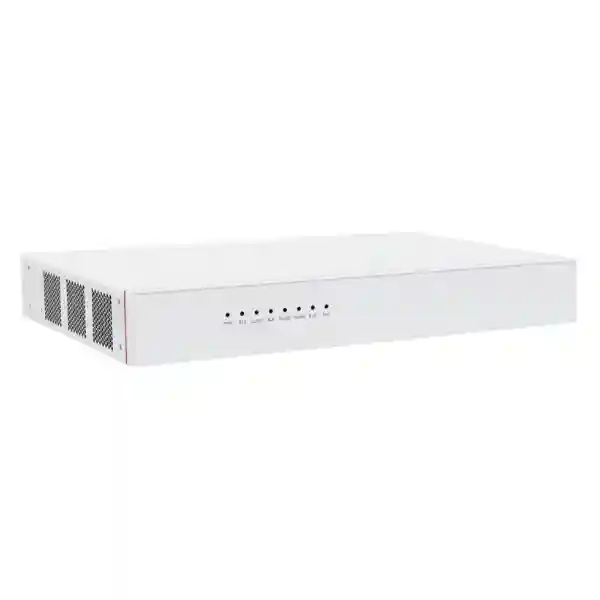
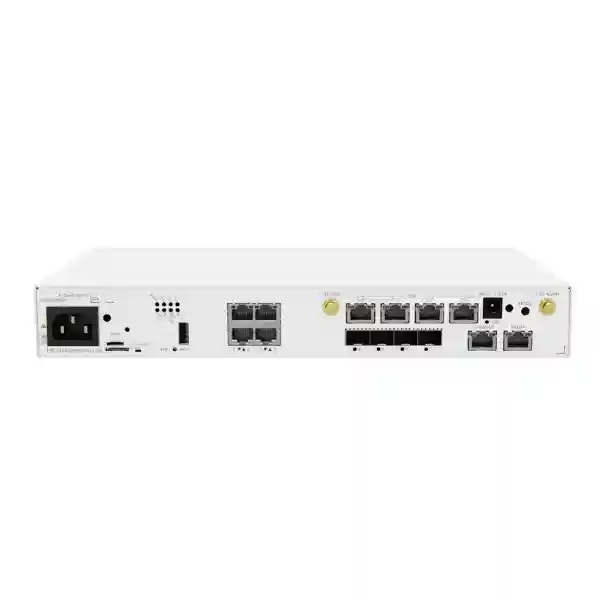
Huawei HiSecEngine USG6510F-DPL
A compact all-in-one intelligent security gateway combining next-generation firewall protection, VPN, application control, intrusion prevention, antivirus, secure SD-WAN, LTE connectivity and PoE support for modern branch and distributed enterprise deployments.
Designed for organizations that want to reduce edge complexity without treating security as a secondary function, the USG6510F-DPL brings WAN connectivity, security inspection and branch service consolidation into a desktop appliance suitable for offices, retail sites, clinics, hospitality locations, small campuses, warehouses and remote facilities across the UAE.
What the USG6510F-DPL is designed to solve
Branch security projects are rarely limited to the question of how many gigabits a firewall can forward. The practical challenge is to provide secure Internet breakout, controlled access to cloud applications, protected connectivity back to data centers or cloud workloads, segmentation between users and devices, visibility into application behavior, resilience when a primary WAN fails, and manageable operations for sites that may have little or no local IT staff. The Huawei HiSecEngine USG6510F-DPL is positioned for exactly this class of deployment. It is not a large chassis firewall intended to aggregate a major data center, and it is not merely a broadband router with basic access-control lists. It is a compact security platform intended to bring multiple security and connectivity functions together at the network edge.
For a UAE organization with tens or hundreds of branches, the architectural value of consolidation can be substantial. A single edge appliance can enforce security policy, identify applications, inspect traffic for known threats, provide encrypted site-to-site connectivity, deliver remote-access services where licensed and configured, make policy-based path decisions, and provide LTE as an additional uplink option. In the DPL variant, selected copper interfaces can also supply PoE, which can reduce the number of separate power injectors or small access switches required in tightly scoped sites. That is especially useful where a firewall may need to support an access point, IP phone, camera or another powered endpoint near the edge cabinet, although total PoE design must always be checked against the model’s supported power budget and the attached devices’ requirements.
FourTeck approaches the USG6510F-DPL as an enterprise edge component rather than as a standalone box. The recommended design process starts with traffic flows, user counts, security services, encryption requirements, WAN links, application mix and growth expectations. Buyers can review broader enterprise infrastructure options through FourTeck UAE, while firewall-specific consultation and deployment planning are available through Firewall Dubai. This approach helps ensure the selected appliance is sized for inspected traffic rather than headline firewall throughput alone.
Hardware architecture, interfaces and physical format
Gigabit Ethernet copper connectivity for LAN, WAN or segmented edge roles according to the final interface plan.
Flexible optical Gigabit Ethernet interfaces for fiber handoffs, building links or service-provider presentation.
Useful for backup connectivity, rapid branch turn-up and path diversity where mobile coverage is appropriate.
The DPL platform supports four PoE interfaces, allowing selected powered devices to be integrated into compact branch designs.
Huawei specifies the USG6510F-DPL in a desktop form factor measuring approximately 320 × 220 × 43.6 mm. The published weight is about 2.6 kg. That compact footprint is significant because many branch sites do not have full-depth data-center racks. The device can fit into a small communications area, secure shelf, wall cabinet or suitably ventilated branch IT space, subject to the installation guidance and local environmental requirements. It uses a single AC power supply input covering the common 100 V to 240 V, 50/60 Hz range. Huawei lists the appliance’s maximum power consumption at 35.7 W for the machine itself, while the DPL ordering description also identifies PoE/PoE+/PoE++ support with up to 150 W maximum power-supply capability for PoE. In a real design, PoE load planning should therefore be treated separately from the firewall’s base consumption and should include device class, simultaneous draw, cable quality and startup behavior.
A USB 2.0 interface is provided, and Huawei documentation identifies an optional 64 GB microSD card. Storage can be relevant to logging and local operational workflows, but retention requirements should be assessed carefully. Enterprises with compliance, forensic, security-operations or long-term reporting requirements will normally forward logs to centralized systems rather than rely exclusively on local appliance storage. The exact supported log architecture depends on software version, licensing and the organization’s management platform.
The combination of copper, fiber, LTE and PoE creates useful design flexibility. The firewall can terminate a fiber carrier handoff while serving copper LAN segments, reserve LTE for backup, and power a small number of local devices. Alternatively, the SFP interfaces can connect to an aggregation switch while the copper ports terminate dedicated security zones such as guest Wi-Fi, point-of-sale, voice, camera, facilities or management networks. The important point is that interface count does not equal recommended topology by itself. VLAN design, failure domains, security zones, routing policy, inspection requirements and switch architecture should determine how the physical ports are used.
Performance: interpreting Huawei’s published numbers correctly
Huawei publishes several performance figures for the USG6510F-DPL because a modern firewall does not have one single meaningful throughput number. Plain stateful firewall forwarding is the least demanding use case. Application identification, intrusion prevention, antivirus, content scanning, encrypted VPN, TLS inspection and enterprise traffic mixes consume additional resources. A procurement decision should therefore be based on the services that will actually be enabled at peak load rather than on the largest number in the table.
| Metric | Published figure | Planning interpretation |
|---|---|---|
| IPv4 firewall throughput | 6 / 6 / 3.6 Gbps | Measured at 1518 / 512 / 64-byte UDP packet sizes; small packets reduce throughput. |
| IPv6 firewall throughput | 6 / 6 / 3.6 Gbps | Useful when dual-stack or IPv6-heavy networks are part of the branch roadmap. |
| Packets per second | 5.4 Mpps | Important for transaction-heavy traffic patterns with many smaller packets. |
| FW + SA throughput | 1.8 Gbps | A better reference than raw firewall throughput when application-aware controls are active. |
| NGFW throughput, HTTP 100K | 1.6 Gbps | Relevant to protected Internet traffic under the stated test profile. |
| NGFW throughput, enterprise mix | 1 Gbps | Often the more conservative planning reference for varied real-world applications. |
| Threat protection, HTTP 100K | 1.3 Gbps | Represents deeper protection than stateful firewalling alone. |
| Threat protection, enterprise mix | 800 Mbps | A practical baseline for branches using multiple inspection engines simultaneously. |
| Concurrent sessions | 800,000 | Capacity for aggregate state tracking; session behavior still matters. |
| IPv6 concurrent sessions | 200,000 | Check dual-stack design if IPv6 adoption is significant. |
| New sessions per second | 40,000/s HTTP 1.1 | Useful for web, SaaS, guest Wi-Fi and other connection-intensive environments. |
| IPsec VPN throughput | 2 Gbps | Published with AES-256 + SHA256 and 1420-byte packets. |
| Maximum IPsec tunnels | 1,000 | Suitable for large branch-overlay counts when the complete design remains within other system limits. |
These are vendor laboratory results under defined test conditions, not guaranteed application throughput for every network. Real performance changes with packet size, session rate, enabled inspection engines, policy complexity, logging intensity, TLS cipher suites, traffic direction, application composition, VPN overhead, software release and other factors. For a branch with a 1 Gbps Internet circuit, for example, the fact that raw firewall throughput is substantially higher does not automatically mean the appliance has unlimited headroom. If most traffic is decrypted, scanned, classified and logged, the relevant design reference moves toward the deeper-inspection figures.
Good sizing also includes future growth. If a site currently averages 250 Mbps but has periodic peaks near 700 Mbps, and the business expects new cloud workloads, video collaboration, Wi-Fi 6/7 refreshes or additional guest traffic, sizing only for today’s average will create an avoidable upgrade cycle. FourTeck typically considers peak inspected throughput, session concurrency, session creation rate, VPN traffic, encrypted-traffic ratio and expected three-year growth before recommending a final appliance position.
Integrated next-generation security controls
The value of the HiSecEngine platform is the integration of network control and security inspection. Huawei describes the USG6500F family as combining traditional firewall functions with VPN, intrusion prevention, antivirus, bandwidth management, Anti-DDoS capabilities and URL filtering under unified policy management. This makes the USG6510F-DPL appropriate for organizations that want one policy enforcement point at the branch edge rather than a collection of disconnected appliances.
Application identification extends policy beyond IP addresses and ports. Huawei states that the platform can identify more than 6,000 applications and support control granularity down to application functions. In practice, that allows security policy to reflect business intent. An organization can distinguish approved collaboration applications from unknown remote-access tools, prioritize sanctioned SaaS traffic, restrict risky application functions, or apply inspection selectively based on users, zones and applications rather than simply permitting TCP 443 to the Internet. Because much modern traffic uses common encrypted ports, this application-aware layer is important for policy relevance.
Intrusion prevention is intended to detect exploit traffic, web attacks, botnet activity, remote-control behavior, Trojan traffic and brute-force patterns. Huawei documents more than 10,000 IPS signatures in the product family and support for user-defined signatures, along with coverage of a broad set of CVEs. Signature count is not the only meaningful measure of an IPS; update quality, detection accuracy, false-positive handling, evasion resistance and operational tuning matter equally. A production rollout should therefore begin with risk-aligned profiles, staged enforcement and logging review rather than turning every possible signature into an unconditional block on day one.
Antivirus functions complement IPS by examining file-borne threats. Huawei describes an intelligent heuristic antivirus engine capable of detecting very large numbers of virus variants and inspecting files nested through deep compression layers. For branches that handle email attachments, downloads, web uploads or file transfers, this can add another layer of defense. It should not be treated as a replacement for endpoint protection, however. Network antivirus, endpoint detection and response, secure email, identity controls and backups solve different parts of the threat model and are strongest when deployed as complementary controls.
URL filtering and DNS-related controls can help enforce acceptable-use policies, block known malicious destinations and reduce exposure to phishing or inappropriate categories. Policy design should remain business-led: finance, guest, engineering, operations and executive networks may require different access patterns. The objective is not maximum blocking; it is controlled access with clear exceptions, ownership, logging and review.
VPN architecture for branches, hybrid work and partner connectivity
The USG6510F-DPL supports IPsec VPN, SSL VPN and GRE capabilities within the USG6500F feature set. Huawei publishes up to 2 Gbps IPsec throughput for the USG6510F-DPL under an AES-256 + SHA256, 1420-byte test profile and a maximum of 1,000 IPsec tunnels. This makes the platform suitable for branch-to-headquarters, branch-to-data-center, branch-to-cloud and selected partner connectivity patterns, provided the full topology and inspection requirements fit within the appliance’s resources.
For hub-and-spoke estates, the branch firewall can establish encrypted tunnels to central security gateways or data-center firewalls. For distributed cloud architectures, tunnels may terminate in multiple regions or virtual gateways, with routing policy steering applications toward the appropriate destination. A dual-uplink branch can also use separate transport paths for resilience. Tunnel count alone is not a sizing method: each tunnel can carry very different levels of traffic, and encryption throughput, route scale, failover behavior and policy complexity must all be considered.
Remote-access design requires additional discipline. Huawei ordering material for the USG6510F-DPL identifies an AC host bundle including SSL VPN entitlement for 100 users, while separate function licenses are available for other concurrent-user quantities. The exact entitlement delivered with a quotation should always be checked against the requested SKU, software version and regional commercial bundle. An enterprise should define whether remote users need full-tunnel access, split tunneling, application-specific access, multifactor authentication integration, device posture checks, role mapping and logging into a central SOC platform. Licensing without an access architecture is incomplete.
Cryptography policy should align with organizational standards. Huawei documents support for common algorithms including AES and SHA families as well as additional algorithm sets. The final configuration should disable legacy algorithms where they are not required, use strong key exchange parameters, rotate credentials, restrict management planes and maintain clear ownership of VPN lifecycle. For regulated organizations, the cryptographic profile should be validated against the specific compliance framework rather than assumed from generic feature support.
Performance planning for encrypted networks must account for both directions of traffic and for security services applied before or after decryption. If a branch has a 1 Gbps private link and a 1 Gbps Internet circuit, peak encrypted traffic can be very different from average utilization. A design workshop should document which applications stay local, which traverse tunnels, which are inspected, and what happens during failover when one link temporarily carries the load of two.
Secure SD-WAN and intelligent uplink selection
Huawei publishes Secure SD-WAN throughput of up to 5 Gbps for the USG6510F-DPL under the stated packet profiles and supports service-specific policy-based routing with intelligent uplink selection. The platform can make path decisions using factors such as bandwidth ratio and link health in multi-egress designs. This is particularly useful for UAE branches that combine business broadband, dedicated Internet access, MPLS, Ethernet services or LTE backup.
A traditional failover design simply sends all traffic over a secondary link when the primary circuit fails. SD-WAN-oriented policy can be more selective. Voice and video can prefer the path with the best quality metrics, business-critical ERP traffic can use a private circuit or protected overlay, SaaS traffic can break out locally when policy allows, and large software updates can use a lower-cost path. LTE can be reserved for emergency use or specific services when wired circuits are unavailable. The exact functions available depend on software release and design, but the core architectural benefit is policy-driven path control rather than static routing alone.
Link health is only useful when thresholds match application requirements. A circuit can be technically up while experiencing enough latency, jitter or loss to make collaboration unusable. Monitoring should therefore be tied to service objectives. For example, a branch can define stricter quality thresholds for real-time traffic than for general web browsing. It can also prevent backup LTE consumption by limiting which applications are permitted over cellular during a wired outage.
The published SD-WAN EVPN scale for the platform family includes up to 200 tunnels. As with IPsec tunnel scale, the number should be interpreted in the context of the complete design. Route scale, overlay topology, centralized control, traffic volume and inspection services all influence practical sizing. Organizations planning hundreds of branches should evaluate whether the USG6510F-DPL is a spoke device, a regional aggregation point or part of a broader hierarchy. It is usually more appropriate as a branch-edge platform than as a massive central hub.
A secure SD-WAN rollout should be managed as both a networking and cybersecurity program. Path policies, firewall rules, DNS behavior, segmentation, VPN overlays, logging, configuration templates and change control must be designed together. Splitting responsibility between teams without a shared policy model can create routing paths that bypass intended inspection or security policies that unintentionally break application failover.
LTE and PoE: why the DPL variant is useful at the branch edge
The DPL suffix is important because this variant combines LTE connectivity with PoE-capable copper interfaces. In many branch projects, these features remove small but troublesome dependencies. LTE can provide day-one connectivity before a fixed circuit is installed, emergency connectivity after a carrier outage, or a physically diverse path for essential applications. PoE can reduce local power adapters for a small number of edge devices. Together, these capabilities make the appliance particularly relevant to temporary offices, retail outlets, clinics, construction administration sites, hospitality spaces, kiosks, remote warehouses and other locations where simplicity matters.
LTE should be designed with realistic radio expectations. Actual cellular performance depends on operator coverage, indoor signal strength, antenna placement, building materials, network congestion, SIM plan, radio band and local service availability. The firewall can provide LTE capability, but it cannot guarantee a specific mobile throughput in every site. For critical deployments, an on-site survey or at least predeployment coverage validation is recommended. Data-plan limits also matter. A branch that fails over unrestricted cloud backup, software updates and video traffic to LTE can consume a large allowance quickly, so policy should prioritize essential traffic during cellular operation.
PoE planning likewise requires more than counting ports. Huawei lists support for four PoE interfaces and indicates support for PoE, PoE+ and PoE++ in the USG6510F-DPL host description, with a maximum PoE power-supply capability of 150 W. Attached endpoints must be checked for their IEEE power class, actual draw and boot-time demand. Cable length and quality also affect delivery. If a branch requires eight access points, a large camera estate or multiple high-power devices, a dedicated managed PoE switch will generally be the better architecture. The firewall’s PoE function is most valuable when the powered-device count is small and operational simplicity is a priority.
One practical pattern is to power an access point and an IP phone while using the remaining interfaces for local LAN, guest, management or IoT zones. Another is to power a small number of cameras at a temporary site. The security design should still isolate these device classes with VLANs and policies; PoE is only a power-delivery function, not a segmentation mechanism. For larger LANs, FourTeck can align the firewall with switching, wireless and infrastructure services through FourTeck IT Services UAE.
Typical UAE deployment topologies
Retail or branch office
Primary Internet terminates on the firewall, LTE is retained as backup, and separate VLANs are used for corporate users, guest Wi-Fi, POS or payment-related systems, voice and management. Security policies permit only required flows between zones. IPsec connects the branch to headquarters or cloud resources. Application control and URL filtering protect Internet breakout while logs are forwarded centrally.
Clinic or professional office
User devices, clinical or operational systems, guest devices and building systems are segmented. Sensitive applications use encrypted connectivity to central services. Internet access is inspected according to risk. LTE provides continuity for essential services, while PoE can support a small access point or phone footprint if power and port counts are suitable.
Warehouse or logistics site
Operational handhelds, scanners, cameras, office users, Wi-Fi infrastructure and IoT systems are separated. Policy controls which operational networks can reach ERP or warehouse systems. The firewall can steer corporate and cloud traffic across different WAN paths, while LTE provides contingency connectivity for priority applications.
Hospitality or serviced location
Guest traffic is isolated from property systems and staff networks. Application-aware controls help manage bandwidth and reduce abuse. VPN connectivity protects central management flows. Because guest traffic can create large numbers of short-lived sessions, session-rate and inspected-throughput sizing should be considered carefully.
Temporary or rapid-deployment site
LTE can provide immediate WAN connectivity while a fixed service is pending. Once the permanent circuit is delivered, LTE becomes backup. A compact PoE requirement can be served directly where appropriate, reducing separate equipment. Templates and centralized management can accelerate consistent turn-up across repeated sites.
Small campus security edge
The firewall sits upstream of managed switches and wireless infrastructure, enforcing north-south policy and selected inter-zone controls. Fiber SFP interfaces connect to aggregation equipment. Larger switching estates remain on dedicated switches, while the firewall focuses on secure routing, inspection, VPN and WAN services.
Sizing methodology: how to decide whether USG6510F-DPL is the right model
A reliable firewall selection begins with measured or estimated workload, not with employee count alone. Two branches with 100 employees can behave completely differently. A call center may create high session rates and continuous encrypted SaaS traffic. An engineering office may transfer large files and use cloud CAD services. A retail location may have only a few staff but maintain POS, cameras, guest Wi-Fi and multiple tunnels. The USG6510F-DPL should therefore be evaluated against a structured set of variables.
First, establish peak WAN demand. Record the speed of every Internet, private WAN and LTE path. Use observed 95th-percentile and peak utilization where monitoring exists. If the branch will upgrade from 300 Mbps to 1 Gbps during the firewall’s expected service life, size for the planned circuit, not the current contract.
Second, estimate the inspected percentage. Determine how much traffic will use only stateful firewalling and how much will also use IPS, antivirus, application control, URL filtering or other advanced services. A 1 Gbps link with 20 percent inspected traffic is a very different workload from a 1 Gbps link where nearly every Internet session is subject to multiple engines.
Third, account for encrypted traffic. Modern application traffic is predominantly encrypted. If TLS inspection is part of the security architecture, it can become one of the strongest sizing factors because the firewall must decrypt, inspect and re-encrypt sessions. Certificate deployment, application compatibility and privacy rules also affect how broadly decryption can be used.
Fourth, examine session behavior. Concurrent sessions measure how many states are maintained at once, while new sessions per second measure connection churn. Guest Wi-Fi, large NAT populations, content-delivery traffic, microservice-heavy applications and some security-camera platforms can generate high session counts or rapid turnover even when bandwidth appears moderate. Huawei publishes 800,000 concurrent sessions and 40,000 new HTTP 1.1 sessions per second for the model family entry, providing substantial branch-scale capacity, but planning should still be based on the real application pattern.
Fifth, add VPN and failover load. During a primary-link failure, traffic may shift to another circuit and change inspection patterns. A site that normally splits Internet and private traffic across two links may temporarily send everything across one. IPsec throughput must support that degraded-mode design if business continuity requires full service during failover.
Sixth, include growth and operational headroom. Running any security appliance continuously near its ceiling makes upgrades, policy changes and traffic spikes harder to absorb. Reasonable headroom improves lifecycle flexibility. Growth assumptions should include user count, bandwidth upgrades, more SaaS use, additional branches, new security engines and future segmentation.
If the resulting requirement exceeds the comfortable operating envelope of the USG6510F-DPL, the correct response is to move to a larger platform rather than disable security features simply to preserve throughput. Conversely, if the requirement is far below the model’s capability and LTE or PoE are not needed, a different model may produce a better commercial fit. FourTeck can compare the branch requirement against adjacent firewall options and the broader global portfolio available through FourTeck Global.
Segmentation and policy design
A firewall delivers the most value when the network is segmented according to business and risk boundaries. Installing the USG6510F-DPL at the Internet edge and placing every internal device in one trusted network wastes much of the policy capability. A better branch design identifies zones such as corporate users, servers, voice, wireless infrastructure, guests, payment systems, cameras, building-management devices, printers, management interfaces and vendor access. Not every site needs all of these zones, but every site should avoid unnecessary trust.
Policies should be written around permitted business flows. A guest network usually needs Internet access but no access to internal resources. Cameras may need to reach a recorder, time source and management service but should not initiate arbitrary connections to office users. IP phones may require call-control, provisioning and DNS services. Administrative interfaces should be reachable only from defined management networks or secure jump hosts. Application control can further refine policies where a broad web port would otherwise allow too much functionality.
Rule order and naming standards matter operationally. A branch with 40 well-documented rules can be safer than one with 200 overlapping rules whose owners are unknown. Each rule should identify purpose, source, destination, service or application, action, inspection profile, logging behavior and business owner. Temporary rules need expiry dates. Broad any-to-any policies should be exceptional and documented. Where a migration requires temporary permissive access, logging should be used to identify the real flows so the rule can be tightened quickly.
NAT policy also deserves design attention. Internet source NAT, published services, partner connectivity and overlapping address spaces can become difficult to troubleshoot when translation rules grow organically. Addressing standards should be consistent across branches, and public services should be minimized where possible. Remote administration of the firewall itself should not be exposed casually to the Internet; management access should use trusted paths, strong authentication and restricted source networks.
A standardized branch policy template reduces both risk and deployment time. Common zones, naming conventions, objects, logging profiles and baseline controls can be templated, while only site-specific addresses and exceptions vary. This is especially valuable when rolling out dozens of UAE branches or a wider regional network.
Application control, web protection and user experience
Security controls must protect the business without making normal applications unreliable. Application identification helps security teams move from a network-port view to an application view. Instead of permitting all HTTPS traffic equally, policies can recognize categories and specific applications, apply bandwidth rules, log selected functions and restrict unsanctioned services. This is useful in organizations that want to permit collaboration platforms while restricting personal file-sharing, anonymous proxies or unapproved remote-control utilities.
Web protection should be layered. URL filtering can block malicious or prohibited categories. DNS-related filtering can reduce access to known harmful domains. IPS can identify exploit attempts within allowed sessions. Antivirus can scan supported file transfers. Where encrypted inspection is deployed, additional visibility becomes possible, but decryption policy must be carefully scoped. Some financial, healthcare, identity or certificate-pinned applications may need exceptions. The correct goal is not to decrypt everything regardless of consequence; it is to inspect traffic where security benefit, legal requirements and application compatibility justify it.
Bandwidth management can protect business-critical applications during congestion. A branch with a shared 500 Mbps circuit can prioritize voice, collaboration and transaction traffic while limiting guest streaming or large background transfers. During LTE failover, an even stricter profile may be appropriate. The firewall can then preserve core operations while nonessential services are throttled or temporarily blocked.
User experience should be monitored after policy changes. Security teams should track blocks, latency complaints, application failures, false positives and help-desk tickets. A staged deployment often works best: begin with visibility, identify traffic, apply enforcement to clearly risky categories, and then tighten policy as confidence grows. This approach avoids turning a powerful inspection engine into an operational bottleneck because of poorly understood application dependencies.
Operational visibility, logging and security monitoring
A branch firewall should produce information that security and network teams can act on. Huawei positions the USG6500F family with multidimensional reporting across users, IP addresses, content, applications, time, traffic and threats. These views help answer practical questions: which applications consume bandwidth, which users trigger security events, which destinations are blocked, whether a branch is experiencing scanning or malware activity, and whether one WAN path is overloaded.
Local dashboards are useful for troubleshooting, but enterprise operations usually need centralized retention. Logs should be forwarded to a security information and event management platform, centralized log collector, SOC service or other approved system. This protects historical data if the appliance fails and enables correlation across endpoints, identity systems, cloud applications and other network devices. Retention length should be based on organizational policy and regulatory requirements rather than on the amount of local flash available.
Alerting should focus on actionable events. If every low-severity scan creates an urgent ticket, analysts will ignore the queue. High-value alerts include repeated authentication failures, malware detections, IPS events against important assets, unusual outbound connections, configuration changes, tunnel failures, WAN health degradation and security-service update failures. Alert rules should distinguish a one-off Internet probe from sustained malicious behavior targeting a protected service.
Configuration management is equally important. Backups should be created after approved changes and stored securely. Administrator roles should follow least privilege. Shared admin credentials should be avoided where individual accountability is required. Firmware and signature updates should follow a maintenance process that considers release notes, known issues, rollback options and branch criticality. Automatic updates can be useful for threat intelligence, while major software releases typically deserve change-control review.
For a distributed estate, operational consistency is more valuable than one-off optimization. Standard templates, common object names, centralized monitoring, documented exception handling and periodic rule review reduce troubleshooting time and make audits easier. The USG6510F-DPL provides the branch enforcement point; the management process determines whether that enforcement remains reliable over years of changes.
Licensing and subscription planning
Hardware capability and security-service entitlement are separate parts of a firewall project. Huawei lists Foundation and Advanced licensing structures for the USG6510F-DPL and associated support-and-subscription items, together with specific licenses for services such as SSL VPN user counts, threat protection database updates and cloud-related deployment or protection functions. The exact commercial packaging can change by software release, market and quotation, so procurement should validate the bill of materials rather than infer entitlements from the appliance name alone.
The first licensing question is which inspection services the organization expects to use. A firewall purchased only with base routing and stateful inspection capability may not deliver the threat-prevention outcome expected by security teams. Conversely, paying for every available service without an operational plan can create unused cost. The requirement should specify IPS, antivirus, URL filtering, application control, cloud security integration, remote access, centralized management and support expectations explicitly.
The second question is term length. One-year subscriptions provide flexibility but require frequent renewal administration. Multi-year terms can simplify lifecycle planning where available and commercially appropriate. Renewal dates should be tracked centrally because expired threat-intelligence or signature subscriptions can reduce protection even if the appliance continues forwarding traffic.
The third question is support level. Branch firewalls often sit on the critical path to cloud services, voice, POS, ERP and remote access. Hardware replacement, software entitlement, technical support access and escalation procedures should match the business impact of failure. Organizations with many sites may also want spare-unit strategy or rapid replacement planning rather than relying on ad hoc procurement after an incident.
FourTeck quotations can be structured around the requested term, security bundle, SSL VPN quantity, support coverage and deployment services. The goal is to make the commercial configuration traceable to the technical design so there are no surprises when a feature is enabled during implementation.
High availability, resilience and failure-domain planning
The USG6510F-DPL uses a single power supply, so resilience planning should not assume internal power redundancy. If the branch requires high availability, availability must be designed at the system level. That can involve dual firewalls where supported and architecturally appropriate, redundant WAN circuits, UPS protection, resilient switching, LTE backup, configuration backups and documented recovery procedures. The correct pattern depends on how costly an outage would be.
For a small office where a short outage is acceptable, one firewall with a UPS and LTE backup may provide a reasonable balance of cost and continuity. For a transaction-heavy branch or clinic, two firewalls and redundant access paths may be justified. For a temporary site, spare-device strategy and template-based replacement may be simpler than a live high-availability pair. Resilience should therefore be tied to recovery-time and recovery-point expectations rather than copied from a generic diagram.
WAN diversity is also more than ordering two circuits. If both services enter the building through the same duct, terminate on the same carrier aggregation or share the same upstream failure domain, they may fail together. LTE can add physical diversity, but cellular infrastructure has its own dependencies. Critical sites should understand the actual path diversity offered by service providers and test failover periodically.
Power protection matters in the UAE as it does in any branch environment. A firewall, modem, switch and access point should be connected to appropriately sized UPS capacity if the business expects service continuity through short interruptions. PoE loads must be included in UPS sizing because powered endpoints may significantly increase total draw. During a power event, the business may choose to preserve only essential devices rather than every PoE endpoint.
Finally, failure testing should be part of acceptance. Disconnect the primary WAN, verify the backup path, confirm critical applications continue, check that VPNs re-establish, validate DNS behavior and ensure alerts reach the operations team. A resilience feature that has never been tested is only a design assumption.
Migration from an existing firewall
Replacing an existing firewall is not a matter of copying every rule line by line. Old configurations often contain obsolete objects, temporary rules, duplicated NAT entries and undocumented exceptions. A migration to the Huawei HiSecEngine USG6510F-DPL is an opportunity to clean the policy set while preserving required application behavior.
The first phase is discovery. Export the current rule base, interface plan, routing table, NAT rules, VPN settings, DHCP services, DNS settings, public IP assignments, certificates and management configuration. Capture traffic and utilization data if possible. Identify business owners for published services and partner tunnels. Unknown rules should be investigated rather than silently migrated.
The second phase is translation. Vendor policy models differ, so objects and rules must be mapped into Huawei constructs. Application-aware policies can replace some port-only rules. Security profiles should be built according to the desired inspection level, not copied from an old platform that may have used different detection engines. VPN cryptography should be updated where legacy settings are no longer necessary.
The third phase is staging. Configure interfaces, management access, routing, core security zones, VPNs and logging before the change window. Where practical, validate the configuration in a lab or preproduction network. Confirm that optics, LTE components, SIMs, cables and PoE endpoints are compatible and available. Ensure the rollback configuration and old firewall remain accessible until acceptance is complete.
The fourth phase is cutover. Move WAN and LAN connections according to a documented sequence, validate basic connectivity, test DNS, verify critical applications, confirm site-to-site tunnels, check Internet access, test published services and review logs for unexpected blocks. Do not wait for users to report problems before examining denied traffic. A structured test script makes the process faster and more reliable.
The fifth phase is optimization. After several days of normal operation, review policies, identify unused temporary rules, tune IPS false positives, verify bandwidth policies and confirm logging. Migration is complete only when the new platform is stable, documented and supportable by the operations team.
UAE procurement, deployment and lifecycle considerations
A firewall purchase in Dubai, Abu Dhabi, Sharjah or another UAE emirate should be planned around more than hardware availability. The bill of materials may include the appliance, security subscriptions, support coverage, LTE-related components, SFP transceivers, patch leads, rack or shelf arrangements, UPS capacity, PoE cabling, installation services and configuration work. Missing a small dependency such as the correct optic can delay an otherwise complete deployment.
Carrier handoff details should be confirmed before installation. Some providers deliver copper Ethernet, others present fiber, and some managed WAN services use a provider router. The USG6510F-DPL’s combination of GE SFP and GE RJ45 interfaces provides flexibility, but the chosen transceiver type, wavelength, connector and fiber mode must match the service handoff. Where a provider device remains in place, routing and NAT responsibilities need to be agreed to avoid double NAT or asymmetric paths.
For LTE, confirm the operator, SIM type, data plan, supported radio environment and expected antenna placement. Building interiors, basements and metal-clad facilities can have weak signal even when outdoor coverage is strong. If LTE is business-critical, validate it at the actual installation point before depending on it for failover.
Lifecycle planning should identify who owns renewals, firmware maintenance, security-signature updates, configuration backup, log retention and incident response. A firewall that is well configured on day one can become risky over time if subscriptions expire or policies accumulate without review. Change management and quarterly or semiannual policy reviews can keep the branch edge aligned with business needs.
For organizations with regional operations beyond the UAE, the same design principles can be standardized while adapting carrier services and compliance requirements by country. The advantage of a common branch architecture is repeatability: site templates, naming, monitoring, escalation and security baselines can be reused, while site-specific addressing and WAN services remain flexible.
Security architecture beyond the firewall
The USG6510F-DPL is an important control point, but it should not be expected to solve every security problem. Strong branch security combines multiple layers: identity, endpoint protection, secure configuration, network segmentation, patching, backup, email security, cloud controls, monitoring and user awareness. The firewall enforces network boundaries and provides visibility, but compromised credentials can still be abused through allowed applications and vulnerable endpoints can still be attacked from trusted zones if segmentation is weak.
Identity integration can improve policy by associating traffic with users or groups where supported by the wider environment. This allows controls to reflect job roles instead of relying only on IP addresses. Endpoint security can detect malicious behavior that network inspection cannot see, particularly when traffic remains encrypted end to end. Central logging can correlate firewall events with authentication, EDR and cloud audit data to create a more complete incident picture.
Backups are another critical layer. Ransomware resilience depends heavily on protected, tested recovery copies. Network antivirus and IPS can reduce exposure, but they cannot guarantee that no malicious code reaches a device. Organizations should maintain offline, immutable or otherwise protected backups appropriate to their risk model and test restoration procedures regularly.
Segmentation reduces blast radius when preventive controls fail. If a user laptop becomes compromised, it should not automatically have unrestricted access to cameras, payment devices, server-management interfaces or building systems. The firewall can help enforce inter-zone policy, while switches and wireless controllers maintain local segmentation. For high-performance east-west traffic, additional internal security controls may be appropriate.
A mature design therefore treats the USG6510F-DPL as a branch security platform inside a larger security architecture. Its integrated capabilities can simplify the edge, but operational discipline and complementary controls determine overall resilience.
Technical planning notes for architects and network engineers
When designing the USG6510F-DPL into a production network, treat every major traffic class explicitly. Draw the topology with WAN circuits, firewall zones, VLANs, switches, wireless controllers or access points, servers, cloud connections, IP phones, cameras and management systems. Mark which flows are encrypted, which are inspected, which need quality-of-service treatment, and which must continue during failover. This diagram becomes the basis for both firewall policy and acceptance testing.
Route design should be simple where possible. Static routes may be adequate for small sites, while dynamic routing can be appropriate where there are multiple paths or larger overlays. Avoid unnecessary redistribution between protocols, and define route preference clearly so failback behavior is predictable. Asymmetric routing can interfere with stateful inspection, so upstream and downstream paths must be coordinated.
MTU and fragmentation deserve attention in VPN deployments. Encapsulation adds overhead. If application packets are already near the path MTU, IPsec can produce fragmentation or performance problems. Proper interface MTU, MSS adjustment where appropriate, and path testing can prevent difficult intermittent issues. This is particularly important across broadband, cellular and provider-managed networks where the underlying MTU may differ.
DNS behavior should be documented. Decide whether branch clients use local DNS forwarders, central corporate resolvers, secure cloud resolvers or provider DNS. Ensure the chosen path continues to work during failover. If DNS filtering is part of the security design, exception processes should be defined for legitimate domains that are incorrectly categorized.
Time synchronization is essential for logs, VPN certificates and incident investigation. Firewalls, switches, servers and authentication systems should use consistent NTP sources. A five-minute time difference between systems can make event correlation unnecessarily difficult.
Management-plane design should be separated from user traffic where practical. Restrict administrative services to defined interfaces and source networks. Use encrypted protocols, strong administrator authentication and role-based permissions. Export configuration backups after approved changes. Monitor configuration-change events so unauthorized modifications can be detected quickly.
Finally, document assumptions. If a performance model assumes 30 percent TLS inspection, 20 percent annual growth and a 1 Gbps primary circuit, record those values. Future engineers can then understand why the model was chosen and know when a change in traffic or service design justifies reassessment.
Frequently asked technical questions
Is 6 Gbps the speed I will get with all security enabled?
No. The 6 Gbps figure is raw firewall throughput under Huawei’s defined packet tests. Advanced inspection reduces throughput. Huawei separately publishes 1.6 Gbps NGFW throughput using an HTTP 100K profile, 1 Gbps NGFW throughput for an enterprise mix, 1.3 Gbps threat-protection throughput under HTTP 100K, and 800 Mbps for an enterprise mix. The correct sizing figure depends on which services are enabled and the real traffic mix.
Can it support a 1 Gbps Internet circuit?
Potentially yes, but the answer depends on inspection depth, encryption, traffic mix and headroom. A branch with light inspection may have considerable capacity. A branch that performs broad threat inspection and TLS decryption should be assessed against advanced-security performance, not the raw firewall figure. Peak load and future growth are part of the decision.
Does the USG6510F-DPL include LTE?
Yes, Huawei lists LTE as part of the fixed-interface configuration for the DPL variant. Actual cellular performance depends on the mobile operator, signal conditions, radio environment, antenna placement and service plan. LTE is often used as backup or temporary primary connectivity.
How many PoE ports are supported?
Huawei lists support for four PoE ports on the USG6510F-DPL. The host description supports PoE, PoE+ and PoE++ and identifies a maximum PoE power-supply capability of 150 W. Device power class and total budget should be checked before connecting access points, phones, cameras or other endpoints.
Can it replace a PoE switch?
Only in small, carefully scoped designs. Four PoE-capable ports can be convenient for a few edge devices, but a branch with many access points, phones or cameras should normally use a dedicated managed PoE switch for port density, switching features, power budget and operational flexibility.
What is the IPsec capacity?
Huawei publishes 2 Gbps IPsec throughput using AES-256 + SHA256 with 1420-byte packets and up to 1,000 IPsec tunnels for this model entry. Real VPN performance varies with packet size, encryption profile, routing, concurrent inspection and application behavior.
Does it support SSL VPN?
Yes. Huawei lists SSL VPN capability and function licenses for concurrent user quantities. The commercial bundle and default entitlement should be verified in the quotation. Remote-access design should also cover authentication, role mapping, split-tunnel policy, endpoint requirements and logging.
Is it suitable for a data center?
The USG6510F-DPL is primarily a compact branch or edge platform. It may protect a small server environment, but large data centers usually require higher throughput, interface density, redundancy and session scale. The deployment should be matched to measured requirements rather than to the label alone.
What fiber interfaces are available?
The DPL variant provides four Gigabit Ethernet SFP interfaces. Optics are selected according to the carrier or LAN fiber requirement. Wavelength, fiber type, connector and distance must match the far-end equipment.
How should logs be retained?
Local storage can support appliance operation, and an optional 64 GB microSD card is listed. For enterprise retention, however, logs should normally be forwarded to a central platform or SIEM according to the organization’s retention, investigation and compliance requirements.
Can it manage guest Wi-Fi traffic?
Yes, it can provide the routed security boundary for guest networks, apply policy, URL filtering, application controls and bandwidth management, and isolate guest traffic from corporate zones. Wireless access points and controllers remain separate parts of the WLAN architecture unless the specific design uses supported integrated workflows.
What should be tested before go-live?
Validate WAN and LAN routing, DNS, DHCP where used, NAT, core applications, VPNs, policy enforcement, Internet access, security logging, management access, LTE failover, PoE endpoints, alerting and rollback. Test from each security zone instead of assuming that one successful ping proves the site is ready.
Decision recap: when the USG6510F-DPL is a strong fit
The Huawei HiSecEngine USG6510F-DPL is most compelling when a branch requires several capabilities in one compact appliance: Gigabit copper and fiber interfaces, LTE backup or temporary WAN service, a small PoE requirement, application-aware firewalling, intrusion prevention, antivirus, URL controls, VPN and SD-WAN-oriented path selection. It offers substantial branch-scale session capacity and a published security-performance profile that can support demanding offices when the traffic mix fits within the inspected-throughput envelope.
It is particularly attractive where equipment count matters. A small site may be able to avoid a separate LTE router and a few PoE injectors while still maintaining enterprise security policy. The appliance also suits standardized multi-branch rollouts because the same architecture can be repeated with consistent zones, VPNs, logs and management practices.
It is less suitable when the site needs many 10 Gigabit interfaces, very high TLS inspection performance, large PoE port density, internal power-supply redundancy or data-center-scale aggregation. In those cases, selecting a larger firewall or adding dedicated switching and WAN components is better than forcing the compact appliance into a role outside its intended scale.
The final decision should therefore compare the expected peak inspected traffic, VPN load, concurrent sessions, WAN speed, interface types, PoE demand, LTE requirement, security subscriptions and availability target. Those inputs produce a defensible sizing decision and a bill of materials that can be deployed without last-minute architectural compromises.
Quotation input checklist
Connectivity
Primary and secondary WAN speeds; carrier handoff type; copper or fiber; required SFP type; LTE operator and SIM plan; public IP requirements; MPLS or private WAN presence.
Security services
Required IPS, antivirus, URL filtering, application control, DNS protection, SSL inspection, Anti-DDoS functions, cloud integration and subscription term.
VPN and access
Number of site-to-site tunnels; estimated encrypted throughput; remote SSL VPN users; authentication method; cloud VPN destinations; partner connections and cryptography standards.
LAN and PoE
Number of VLANs and zones; switch architecture; devices requiring PoE; each endpoint’s power class; wireless access point count; voice, camera, IoT and management segments.
Operations
Central logging or SIEM destination; configuration backup process; maintenance windows; administrator model; monitoring integration; desired support response and renewal ownership.
Availability
Single or redundant firewall design; UPS requirements; acceptable downtime; spare strategy; dual-carrier diversity; failover behavior and applications that must remain available.
Consultation and deployment support from FourTeck UAE
FourTeck can support the Huawei HiSecEngine USG6510F-DPL as part of a complete UAE branch-security project, including model sizing, bill-of-material validation, interface and optic planning, subscription selection, VPN design, segmentation, policy migration, installation, testing and operational handover. The objective is to match the firewall to the site’s real security and connectivity requirements rather than simply ship hardware.
For a fast quotation, provide the WAN speeds, number of users and devices, expected VPN load, security services to be enabled, LTE requirement, number and type of PoE endpoints, and whether the deployment needs high availability. Existing firewall configuration exports or topology diagrams can also help identify migration dependencies.
A well-scoped deployment should finish with documented interfaces, zones, policies, VPNs, administrator access, logging destinations, failover behavior, support details and renewal dates. That documentation turns the firewall from a one-time installation into a maintainable security control that can support the branch throughout its lifecycle.

Reviews
There are no reviews yet.