
Enterprise Network Security • Dubai & UAE
Huawei HiSecEngine USG6515E Firewall for Secure UAE Enterprise Networks
The Huawei HiSecEngine USG6515E is a USG6000E-series enterprise firewall and VPN gateway designed for organizations that need dense Gigabit connectivity, 10 Gigabit uplinks, policy-based segmentation, secure Internet edge services, site-to-site VPN, remote-access security, threat inspection and resilient operation in a compact rack form factor. For Dubai organizations, the practical value of the USG6515E is not simply the number printed on a throughput chart; it is the ability to combine security services, routing, WAN connectivity and operational controls in one platform while preserving predictable application performance.
Direct answer
Choose the USG6515E when your branch, campus, headquarters or distributed enterprise needs a security gateway with a large number of physical Ethernet interfaces, 10GE upstream capability, integrated firewall and VPN functions, and room to segment multiple internal, DMZ and WAN zones without immediately adding an external aggregation device.
Best-fit environments
Typical deployments include UAE corporate headquarters, multi-floor offices, education networks, retail and hospitality hubs, logistics facilities, healthcare branches, manufacturing campuses and regional offices that require secure connectivity between Internet, MPLS, private WAN, cloud and internal network segments.
FourTeck delivery scope
FourTeck can assist with product supply, bill-of-material validation, security license alignment, rack and power planning, migration from an existing firewall, HA design, routing, VPN deployment, policy conversion, logging integration, cutover testing and ongoing UAE support.
What the Huawei HiSecEngine USG6515E is designed to do
In an enterprise security architecture, the firewall is not just an Internet blocking device. It is the policy enforcement point that decides which users, devices, servers, applications and remote locations are allowed to communicate, under what conditions, and with what inspection. The USG6515E is positioned for organizations that need this enforcement at a busy branch or enterprise edge where port density and traffic diversity matter. The appliance can sit between a service-provider handoff and the internal network, between multiple WAN circuits and a campus core, or between internal trust zones such as users, servers, voice systems, wireless networks and operational technology segments.
Huawei classifies the model within the USG6000E family of firewall and VPN gateway products. In practical design terms, the platform supports a security architecture that can combine stateful firewalling, application-aware policy, intrusion prevention, anti-malware functions, URL control, VPN services, user authentication, routing and high-availability capabilities. The exact feature set available to a specific customer depends on software release, license bundle and subscription entitlement, so a correct quotation should never assume that every security service is included in the base hardware price. FourTeck therefore treats hardware, software, support and subscription requirements as separate design inputs and maps them to the actual intended traffic flows before issuing a bill of materials.
For Dubai deployments, this matters because organizations often have more than one connectivity service at the perimeter. A typical office may use a primary business Internet link, a backup broadband circuit, a private MPLS or SD-WAN connection, one or more site-to-site IPsec tunnels, cloud access, remote-user VPN and dedicated segments for servers, Wi-Fi, IP phones, CCTV, access control and guest users. The USG6515E provides sufficient physical interface diversity to keep many of these networks physically or logically separated while still centralizing security policy on one platform.
The key engineering principle is to size the firewall for the security services that will actually be enabled, not only for raw Layer 3 forwarding. Encrypted inspection, IPS, application identification, anti-virus scanning, logging, VPN encryption and large policy databases consume processing resources. An appliance that looks oversized for plain firewall throughput may be correctly sized once TLS-heavy SaaS traffic, site-to-site encryption and multiple security profiles are taken into account. For this reason, FourTeck recommends reviewing peak Internet bandwidth, internal east-west flows crossing the firewall, expected growth, average session count, new-session bursts, VPN traffic, SSL inspection scope and high-availability design before selecting the final configuration.
Verified physical interface architecture
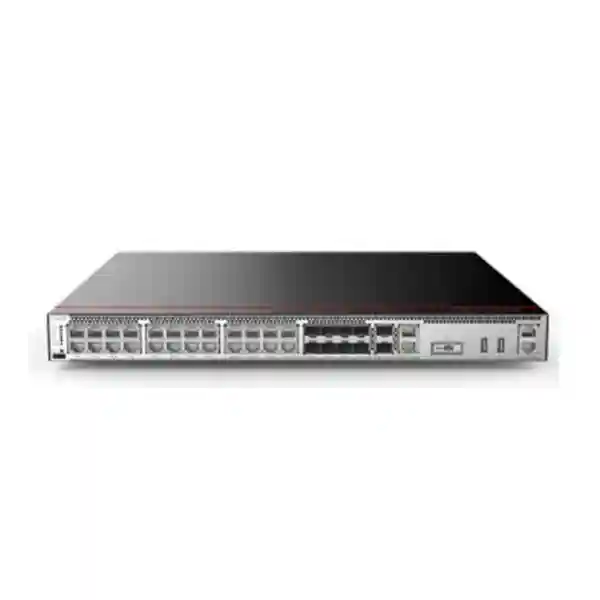
The USG6515E hardware layout is especially useful for deployments where the firewall must terminate several networks directly. Huawei hardware documentation for the model identifies a fixed service-port mix consisting of 2 × 10GE SFP+ interfaces, 8 × GE combo interfaces and 16 × GE RJ45 interfaces, plus 2 × GE WAN interfaces. Combo interfaces provide deployment flexibility because a combo pair allows the engineer to use either the electrical or optical member according to the site design, subject to the platform’s port behavior and configuration rules. The 10GE SFP+ ports are valuable for uplinks toward a high-speed core switch, distribution switch, data-center aggregation layer or other network infrastructure where a 1GbE handoff would become a bottleneck.
| Interface group | Count | Media | Typical UAE deployment use |
|---|---|---|---|
| High-speed service | 2 | 10GE SFP+ | Core/distribution uplinks, high-capacity server zone, aggregated trunks |
| Flexible Gigabit service | 8 | GE combo | Copper or fiber zone connections, DMZ, access/distribution links |
| Copper Gigabit service | 16 | GE RJ45 | LAN zones, management networks, branch links, dedicated device segments |
| WAN | 2 | GE | Primary and secondary provider circuits or dedicated routed WAN handoffs |
Port count alone does not define the final topology. Engineers should decide whether links will be routed or switched, whether VLAN trunks are preferable to dedicated physical interfaces, which zones require optical reach, which links need LACP or redundancy, and whether a physically isolated management path is required by the customer’s security policy. Transceiver type, fiber mode, connector standard and optical distance must also be matched to the connected switch and cabling plant. FourTeck validates these dependencies before delivery so that the firewall arrives with the correct optics and patching assumptions rather than leaving critical connectivity details for the installation window.
Security processing: from stateful firewalling to threat prevention
At the basic level, a stateful firewall tracks conversations rather than evaluating each packet in isolation. It understands whether traffic belongs to an established session, which direction initiated the connection, and whether the packet is consistent with policy and connection state. This is the foundation for secure perimeter control, but modern enterprise networks require richer context. Business traffic is increasingly web-based, encrypted and delivered from cloud platforms. The same TCP port can carry approved applications, unsanctioned services and malicious traffic. A useful enterprise policy therefore combines traditional network criteria such as source, destination, protocol and port with application, user, schedule, URL category, security profile and logging requirements where supported by the selected software and subscription package.
The USG6515E can be deployed as the central enforcement point for these controls. An organization can create separate security zones for corporate users, servers, guest wireless, IP telephony, CCTV, facilities systems, partner networks and Internet connections. Policy can then be expressed as explicit business rules. For example, a corporate user zone may be allowed to reach approved SaaS services and selected internal applications while guest users are restricted to Internet access only. CCTV devices may be permitted to communicate with network video recorders and management servers but denied direct access to general corporate subnets. A public web server in a DMZ may accept HTTPS from the Internet while being allowed to reach only a tightly controlled application or database service behind the firewall.
Intrusion prevention adds another inspection layer. Instead of merely allowing or blocking a connection based on address and application, IPS evaluates traffic for exploit patterns, protocol anomalies and indicators associated with known attack techniques. In production, an IPS policy must be tuned to the organization’s applications, risk tolerance and change process. Enabling every signature in the most aggressive prevention mode without testing can create unnecessary false positives or application disruption. A disciplined deployment starts with relevant protections, logging and observation, then moves selected signatures to blocking after the baseline is understood. Critical Internet-facing services can use stricter profiles than low-risk internal traffic.
Anti-malware and content-security functions should be treated similarly. Their value depends on traffic visibility and subscription status. If most user traffic is encrypted, the firewall may only see limited metadata unless TLS decryption is enabled for selected flows. Decryption can improve threat detection but introduces technical, privacy, legal and certificate-distribution considerations. UAE organizations should define which traffic categories may be decrypted, which destinations should be bypassed, how user trust stores will receive the enterprise CA certificate, and what performance headroom is required. Sensitive applications such as banking, healthcare or certificate-pinned services may need bypass rules depending on the customer’s policy and applicable obligations.
Application control and URL filtering help convert acceptable-use rules into enforceable network policy. The objective should not be broad blocking for its own sake; it should be reduction of risk and unnecessary exposure. Business-required collaboration, cloud storage, remote administration and developer tools can be allowed for the groups that need them while high-risk or non-business categories are restricted according to policy. Security profiles should be logged with enough detail to support investigation without overwhelming the logging platform with low-value events. FourTeck’s implementation approach maps each control to a business requirement, identifies any license dependency, and validates the policy against real application traffic before the configuration is considered complete.
Segmentation
Use security zones and explicit inter-zone policy to separate users, servers, guests, voice, cameras, building systems and partner networks. Good segmentation limits lateral movement and reduces the number of assets exposed if a device or account is compromised.
Threat inspection
Apply IPS, anti-malware, application identification and web controls according to risk. Inspection should be deliberately profiled, licensed and performance-tested instead of being enabled indiscriminately on every flow.
Encryption
Secure branch connectivity and remote access with VPN services appropriate to the topology. Account for encryption overhead, tunnel quantity, routing behavior, failover and certificate lifecycle when designing production VPN.
Resilience
For critical sites, design high availability, redundant upstream/downstream paths and independent power where possible. Firewall redundancy is most effective when surrounding switches, circuits and routing are also designed to avoid single points of failure.
VPN architecture for branches, remote users and partner connectivity
IPsec VPN remains one of the most common requirements for a firewall deployed in Dubai because UAE organizations often connect headquarters to branches, warehouses, stores, project offices or cloud environments over public Internet links. A site-to-site VPN design should begin with routing and addressing. Overlapping private subnets create avoidable complexity, especially after mergers, acquisitions or rapid branch expansion. Where possible, each location should use a unique summarized address block so routing is predictable and policy remains readable. If overlaps cannot be removed, the design may require policy-based NAT or other translation techniques, but these increase operational burden and should be documented carefully.
The next choice is route-based versus policy-based VPN behavior. Route-based architectures are generally easier to integrate with dynamic routing and multi-site topologies because the encrypted path is represented as a logical interface or routed construct. Policy-based designs can be appropriate for simpler peer requirements. The correct choice depends on peer compatibility, routing requirements, failover behavior and the number of protected networks. Cryptographic parameters should be selected according to the security policy of both organizations, and older weak algorithms should be avoided where modern alternatives are supported by all peers.
VPN resilience deserves the same attention as the initial tunnel establishment. If a site has two Internet links, engineers should define whether both can terminate VPN, how the peer detects failure, what routes change during failover and whether return traffic remains symmetric. Stateful devices can drop traffic when forward and return paths use different firewalls or different tunnels unexpectedly. Health checks, routing metrics, dead-peer detection, tunnel monitoring and dynamic routing can help, but they must be coordinated rather than configured independently.
Remote-access VPN introduces identity and endpoint considerations. The firewall may authenticate users locally or through enterprise identity services depending on supported integration and customer design. Authentication should preferably be linked to centralized identity management so access can be removed promptly when employment or role changes. Multi-factor authentication should be considered where the customer’s environment and chosen solution support it. VPN address pools must not overlap internal networks, split-tunnel decisions should be driven by security and user-experience requirements, and DNS behavior should be tested for internal applications. Logging should record authentication events, assigned addresses, connection times and relevant policy actions to support troubleshooting and incident response.
A common sizing mistake is to compare encrypted link bandwidth directly with raw firewall throughput. VPN traffic adds cryptographic processing, and a busy hub firewall may terminate dozens or hundreds of tunnels while also performing application control, IPS and logging. The design should therefore estimate concurrent encrypted traffic, not just the number of configured tunnels. For a regional hub, it is also important to consider the combined traffic of all branches during synchronized business periods, software updates, cloud backup windows and failover events. FourTeck can model these conditions when recommending whether the USG6515E has sufficient headroom for the planned lifecycle.
Sizing the USG6515E correctly: the engineering method
Firewall selection should be based on a workload model. Marketing throughput values are useful reference points, but production traffic rarely matches one synthetic benchmark. Packet size, protocol mix, session churn, security services, encryption, logging, software release and policy complexity influence observed performance. A well-sized firewall maintains adequate CPU and memory headroom during normal peaks and can absorb temporary demand increases without forcing emergency hardware replacement.
Start with bandwidth. Measure the current peak on each Internet and WAN circuit rather than using the subscribed capacity alone. Then add planned upgrades and a growth factor that reflects the expected service life. If the firewall will route traffic between internal zones, include those flows as well; a 1Gbps Internet connection does not mean the firewall only processes 1Gbps if users are simultaneously accessing server, backup or DMZ networks through it. Next, estimate the percentage of traffic that will receive advanced inspection. If only Internet user traffic receives IPS and application control while internal backup traffic receives basic stateful policy, the workload is different from a design that applies deep inspection to every inter-zone flow.
Session scale is the second major dimension. Some applications create many short-lived connections even when bandwidth is modest. Web browsing, cloud APIs, DNS-heavy services, software update platforms and large Wi-Fi environments can generate high new-session rates. A firewall that has comfortable bandwidth headroom can still become stressed by connection churn if session design is ignored. Collect existing firewall telemetry when migrating, including peak concurrent sessions, new sessions per second, NAT usage and policy hit counts. Where no historical data exists, estimate based on user count, device count, application profile and access patterns, then apply conservative headroom.
Encrypted inspection should be modeled separately because TLS traffic dominates modern networks. If the customer intends to decrypt outbound web sessions, identify the percentage of traffic in scope, expected certificate-management approach and bypass categories. Test business-critical applications because certificate pinning or mutual TLS can require exceptions. VPN encryption is another workload, particularly for hub sites. Add the expected branch and remote-access traffic to the inspection model, including peak failover scenarios.
High availability can change capacity planning. In an active/standby design, each individual firewall should usually be able to carry the required production load on its own because failover leaves one unit forwarding traffic. Do not add the capacity of two appliances together unless the supported active/active design and traffic distribution have been engineered specifically for that purpose. Similar logic applies to dual Internet circuits: if each link can receive the full traffic load after a carrier failure, the firewall must be sized for the failover peak rather than the normal split.
Finally, reserve headroom for software growth, additional policies, new applications and future subscriptions. The goal is not to run an appliance permanently at its maximum theoretical capacity. For a business-critical UAE deployment, sizing should target stable operation during busy periods, maintenance events and foreseeable growth. FourTeck can review current topology diagrams, existing firewall exports, bandwidth graphs and business plans to convert these inputs into a defensible platform and license recommendation.
Routing, WAN integration and multi-provider design
A modern firewall frequently participates in routing rather than operating as a simple transparent security bridge. Huawei’s USG6000E platform family supports common enterprise routing capabilities, and the appropriate protocol choice should match the network scale. Static routes can be sufficient for a small office with one or two upstream paths. OSPF can simplify route exchange with a campus core or data-center network. BGP may be required for service-provider connectivity, multi-homing or larger WAN designs. The security team and network team should agree on route ownership, summarization, redistribution and failure behavior before cutover because many firewall incidents are actually routing incidents expressed as security symptoms.
For two Internet links, policy-based routing or SD-WAN-style path selection may be used where supported and licensed, but administrators should define the objective clearly. Some organizations want simple primary/backup failover. Others want load sharing, application steering or link-quality decisions. Business-critical services may need a stable public source IP, which affects whether they can move between providers. Inbound services are more difficult because DNS, public prefixes and NAT may depend on the active carrier. A design that balances outbound user traffic easily may still require careful planning for inbound VPN, published servers or partner allowlists.
Internal routing is equally important. If the firewall is the default gateway for many VLANs, every inter-VLAN flow can be inspected, which strengthens segmentation but also increases firewall workload. If the core switch routes user-to-server traffic locally, the firewall sees less east-west traffic but policy enforcement is concentrated at selected boundaries. There is no universal answer. A security-sensitive environment may prefer more firewall-routed segmentation, while a high-throughput campus may keep broad internal routing on the core and direct only sensitive zones through the firewall. The USG6515E’s dense interface layout makes both approaches practical when designed carefully.
FourTeck’s network engineering scope can extend beyond the firewall itself. Through the FourTeck UAE main site and specialist IT Services UAE practice, customers can align firewall routing with switch VLAN design, WAN handoffs, server networks, wireless segmentation and monitoring. This reduces the risk of deploying a technically correct firewall configuration into an inconsistent wider network.
High availability and failure-domain design
For headquarters, revenue-generating branches and critical service locations, a firewall should not be the only resilient component in an otherwise redundant network. A high-availability pair can protect against appliance failure and can simplify software maintenance, but only if the surrounding design supports failover. Each firewall should have appropriate connectivity to upstream and downstream switches, and the topology should avoid placing both firewalls behind the same single access switch, power strip or carrier device where possible. The exact supported HA modes and interfaces should be validated against the selected Huawei software release and license before implementation.
State synchronization is particularly important. During failover, users expect established sessions to continue where the platform and protocol permit. The HA design must therefore include reliable heartbeat and synchronization connectivity, correct peer configuration, compatible software levels and deterministic link monitoring. Administrators should define what constitutes a failure. Loss of a single downstream link should not always trigger full firewall failover if traffic can use an alternate path on the same node. Conversely, loss of a critical Internet path may need to influence routing without forcing device ownership to change.
Maintenance planning should be part of the HA design. A pair is valuable only if upgrades and failover are tested. Before production handover, FourTeck recommends a controlled test plan that includes planned failover, power interruption on one node, uplink failure, downstream path failure, VPN recovery, routing convergence and validation of NAT/public services. Monitoring systems should alert on degraded HA state so the organization does not unknowingly run on a single node for weeks after a hidden fault.
Power is another failure domain. The USG6515E deployment should be mapped to the site’s UPS, rack PDU and circuit design. If both firewall nodes use the same UPS outlet path, electrical redundancy may be weaker than the network diagram suggests. UAE data rooms often have excellent facility power, but local rack distribution, maintenance practices and cabling still determine real resilience. The recommended design documents power feeds, switch dependencies, provider devices and HA behavior together rather than treating the firewall as an isolated box.
Policy architecture: building a firewall rulebase that remains manageable
A firewall can have excellent hardware and still become difficult to operate if the policy structure is undisciplined. The rulebase should represent business intent in a way that another engineer can understand months later. Begin with a zone model. Group networks according to trust and function rather than creating a separate zone for every VLAN without reason. Common zones include Internet, corporate users, servers, DMZ, guest, voice, management, CCTV/IoT, partner and VPN. Each zone boundary should have a clear policy objective.
Rules should be as specific as operationally practical. Broad any-to-any rules are easy to create but difficult to defend during audits or incident response. Use address objects, groups and service definitions with meaningful names. Where application-aware control is available, combine network and application criteria rather than relying solely on destination ports. Add descriptions that record the business owner, purpose and change reference. Time-limited access should have an explicit expiry process. Temporary rules are a major source of long-term policy growth when no one returns to remove them.
Rule order matters because many firewalls use first-match logic. Place specific exceptions before broader rules, but avoid a rulebase composed of hundreds of overlapping special cases. Analyze hit counts to identify unused or shadowed rules. When migrating from another vendor, do not mechanically convert every historical entry. Use the migration as an opportunity to identify obsolete networks, duplicate objects and services that no longer exist. However, cleanup should be coordinated with application owners because an apparently unused rule may support a periodic process that does not appear during a short observation window.
NAT policy should be documented separately from access control even when the interface presents them together. Outbound source NAT, inbound destination NAT, static one-to-one mappings and VPN exemptions all affect how traffic appears to upstream and downstream systems. Published services require careful coordination between public DNS, provider addressing, NAT, security rules and server listening configuration. If the organization changes Internet providers during the firewall migration, public IP changes can introduce application dependencies unrelated to the firewall itself.
Logging should be selective and useful. Denied inbound Internet scans can generate enormous event volume, while a small number of privileged management or VPN events may be far more important. Define what must be retained locally, what should be sent to a syslog/SIEM platform and what alerts require immediate action. The security policy should capture enough context for investigations without generating noise that analysts ignore. For customers who need wider cybersecurity and managed network assistance, FourTeck can combine the firewall project with services available through Firewall Dubai.
Identity-aware control
Where the selected Huawei release and integration design support enterprise identity services, user or group information can help express policy in business terms. The implementation must consider directory reachability, authentication latency, failover, group changes and the behavior of shared or non-user devices that cannot be associated reliably with a person.
Virtualized security domains
Virtual firewall capabilities can be useful when one physical appliance must provide isolated administrative or policy contexts for different departments, tenants or service environments. Capacity, licensing and operational responsibilities should be checked before choosing virtualization instead of separate physical devices.
IPv4 and IPv6
Enterprise security policy should account for both protocol families where IPv6 is present. Blocking or ignoring IPv6 without understanding endpoint behavior can leave visibility gaps. Routing, firewall rules, VPN, DNS and monitoring should be reviewed together during an IPv6-enabled deployment.
Operational telemetry
CPU, memory, session usage, interface errors, link utilization, policy hits, VPN state and security events should be monitored continuously. Baseline data helps administrators distinguish normal demand from resource pressure and provides evidence for future bandwidth or hardware upgrades.
UAE deployment patterns for the USG6515E
Corporate headquarters edge: A common Dubai design places the USG6515E pair between dual Internet provider handoffs and a redundant campus core. Two 10GE links can connect toward the core or aggregation layer while dedicated GE interfaces serve WAN, management, DMZ or provider devices. User VLANs may be routed on the core, with default traffic sent to the firewall, while sensitive server and guest segments are routed through firewall zones. Site-to-site IPsec connects remote offices, and remote-access VPN supports authorized users outside the campus.
Multi-branch hub: A regional organization can use the USG6515E at its hub site to terminate many branch VPNs. Branches may use different Internet providers and dynamic public addresses, so the hub design should account for peer identification, route advertisement and tunnel monitoring. The central firewall can enforce common security policy before traffic reaches shared ERP, file, identity or application services. If branches access SaaS directly rather than backhauling Internet traffic, the hub sizing model changes because it mainly handles private application and management traffic.
Data-center or server-room segmentation: Organizations with a moderate local server estate can use the firewall to separate public DMZ, application, database, management and backup networks. The 10GE interfaces are useful where server traffic or virtualization hosts require more than Gigabit connectivity. However, very high-volume east-west traffic may be better kept on the switching fabric unless security policy requires deep inspection between those zones. The architecture should be driven by measurable flows and risk rather than a rule that all internal traffic must always cross the firewall.
Hospitality and retail aggregation: Hotels, restaurant groups and retail operators may need to separate point-of-sale systems, guest Wi-Fi, staff devices, cameras, building systems and vendor connections. The firewall can enforce segmentation and provide secure site connectivity while the switching and wireless infrastructure handles access. Third-party vendor VPN should terminate into a restricted zone with access only to the systems they support, not the full internal network.
Education campus: Schools, colleges and training organizations typically have high device counts and bursty web traffic. Student, staff, guest, lab, server and administrative systems should be separated. Web filtering and application policy may be important, but performance must be sized for high concurrency and encrypted traffic. Authentication integrations should be tested at scale, especially during morning login peaks or exam periods.
Industrial and logistics sites: Warehouses, factories and logistics campuses often contain operational technology, handheld scanners, cameras, access control, printers and IoT devices alongside normal office IT. The security design should minimize direct communication between device classes, restrict outbound Internet access for embedded equipment, and use jump hosts or controlled vendor access for maintenance. Network changes should be coordinated with operations teams because some industrial systems are sensitive to latency, session interruption or unexpected protocol inspection.
Example port-planning methodology
A useful way to exploit the USG6515E’s interface density is to assign ports according to failure domain and trust boundary, not simply because ports are available. Consider a headquarters with two Internet providers, two core switches, a dedicated DMZ switch pair, a management switch and an MPLS router. The engineer might reserve the two GE WAN ports for carrier handoffs, use both 10GE SFP+ ports toward the campus core, dedicate GE combo ports to fiber-connected DMZ or distribution devices, and use copper GE ports for management, HA-related connectivity or local routed zones. If link aggregation or redundant switch paths are required, the available interface plan must account for the additional physical members.
The port map should document interface name, cable type, transceiver part, connected device, switch port, VLAN or routed subnet, zone, IP address, MTU and operational purpose. This becomes invaluable during troubleshooting. Without a port map, engineers may know that an interface is up but not whether it is connected to the intended provider or switch path. The map should be updated after commissioning to capture the actual installed state rather than remaining a theoretical design artifact.
Fiber optics require particular care. An SFP or SFP+ module must match the speed, wavelength, fiber type and reach of the remote side. Single-mode and multimode optics are not interchangeable simply because the connector fits. BiDi optics require paired wavelengths. Direct-attach cables have specific distance limitations. Where a customer has an existing switch standard, using compatible approved optics reduces troubleshooting complexity. FourTeck can include transceiver selection in the BOM when the connected equipment and fiber details are known.
Finally, reserve ports for growth where practical. Filling every interface on day one removes flexibility for a future ISP, test network, temporary migration link or new security zone. If the design already consumes nearly every port, consider whether a VLAN trunk to a resilient switch pair is more scalable than one physical interface per subnet. The firewall should enforce policy, while the switching layer should provide port fan-out efficiently.
Licensing, subscriptions and support planning
Enterprise firewall quotations can be confusing when hardware and security services are treated as one item. The physical appliance provides the platform, but advanced threat intelligence, signature updates, URL categorization, anti-malware or other subscription-driven services may require separate licenses or bundles. Software support and entitlement can also determine access to updates and technical assistance. The exact commercial packaging can change over the product lifecycle, so FourTeck validates the current Huawei ordering structure at quotation time rather than publishing a static bundle claim that may become outdated.
Customers should define which services are mandatory before requesting the final price. If the requirement is only stateful firewalling, NAT, routing and IPsec, the licensing profile may be different from an organization that expects full IPS, application control, URL filtering and malware protection. If a security service is considered a core requirement, it should be included in the initial BOM and not left as an assumption to be discovered after installation. Renewal dates should also be tracked centrally so critical protections do not lapse unnoticed.
Support terms should align with business criticality. A firewall protecting a 24×7 facility may need stronger response commitments and spares planning than a small office that can tolerate a maintenance window. In an HA deployment, hardware redundancy reduces risk but does not eliminate the need for support because a failed node still requires replacement before the environment returns to full resilience. Organizations should also maintain configuration backups, documentation and secure administrative access procedures so a replacement appliance can be restored efficiently.
For broader technology procurement and multi-vendor projects, FourTeck’s global technology site can be used alongside the UAE resources. The project goal remains the same: deliver a complete, supportable configuration that matches the customer’s network rather than supplying a chassis with unspecified dependencies.
Migration from an existing firewall to Huawei USG6515E
A successful migration begins with discovery. Export the current firewall configuration and collect interface status, routing tables, NAT rules, VPN definitions, address objects, service objects, security profiles, authentication settings and logs. Compare the configured rules with actual traffic. Identify obsolete interfaces, unused subnets, disabled VPNs and historical objects that should not be carried into the new system. At the same time, document business-critical services that must work immediately after cutover: ERP, email, SaaS, DNS, identity, payment services, remote access, partner VPN and any public-facing applications.
The new configuration should then be built around the target architecture, not the syntax of the old firewall. Vendor platforms represent NAT, zones, VPN and security profiles differently. A literal rule-by-rule conversion can preserve old design problems. Instead, map each existing rule to a documented business requirement and recreate it using Huawei constructs. Where exact feature equivalence is uncertain, test in a lab or maintenance window rather than assuming behavior.
Routing cutover requires careful sequencing. If the firewall IP addresses remain the same, ARP and neighbor caches on adjacent devices may need to refresh. If addresses change, switches, routers, servers or provider devices may require corresponding updates. Dynamic routing peers should be preconfigured and tested where possible. VPN peers controlled by third parties need coordination because they may need new public IPs, proposals or peer identifiers. Public DNS changes should consider TTL well in advance of the migration date.
A rollback plan is mandatory for business-critical changes. Define the condition that triggers rollback, who makes the decision, and exactly how connectivity will be restored. Keep the old firewall configuration and cabling map available. If physical rack space permits, pre-stage both old and new devices so reversion does not depend on rebuilding the previous state. The cutover team should include network, security, application and service-owner contacts who can validate key functions quickly.
Post-cutover validation should be systematic. Check Internet access, DNS, DHCP relay if applicable, internal applications, public services, site-to-site VPN, remote access, routing neighbors, NAT, logging, threat security status and HA. Review interface errors and resource utilization. Then monitor the environment during the next normal business peak, not only during the quiet maintenance window. Performance problems may appear only when users return and session counts rise.
Hardening and secure administration
The firewall management plane should be treated as a privileged security system. Administrative access should be permitted only from defined management networks or secure VPN paths. Public Internet management should be avoided unless there is a compelling controlled use case. Use named administrator accounts where supported so changes are attributable to individuals, and integrate centralized authentication when it improves governance without creating a single point of failure. Strong authentication, least privilege and regular account review are more important than simply changing the default management port.
Disable unnecessary management services and restrict management protocols to secure versions. Time synchronization should point to trusted NTP sources because accurate timestamps are essential for event correlation. DNS should use controlled resolvers. SNMP, syslog and other monitoring integrations should be configured deliberately and protected appropriately. Backup files contain sensitive network and policy information, so they should be stored securely with access control rather than left on engineer laptops or open file shares.
Software maintenance is part of security. Firmware upgrades should be reviewed for security fixes, defect corrections and compatibility with licensed services. Do not upgrade a production firewall simply because a newer version exists; follow the vendor’s recommended path, release notes and known-issue guidance. For HA pairs, confirm the supported upgrade sequence and rollback options. Critical configurations should be backed up before any change, and the team should verify that the backup can be restored.
Change management should record who requested a policy change, why it is needed, what systems it affects, how it was tested and when it should be reviewed. This does not require heavy bureaucracy for every small office, but even a simple ticket reference in the rule description dramatically improves future troubleshooting. Security devices accumulate complexity over time; disciplined documentation is the cheapest way to keep that complexity manageable.
Performance expectations: avoid misleading one-number comparisons
Firewall performance specifications are usually measured under defined laboratory conditions. Different vendors and even different test profiles from the same vendor may use different packet sizes, traffic mixes, session counts and enabled features. A raw firewall throughput number should therefore not be compared directly with an IPS, threat-protection or SSL-inspection number. The numbers describe different workloads. When comparing the USG6515E with another platform, compare equivalent test conditions and, where possible, validate the intended feature stack under representative traffic.
Small packets are harder to process at a given bandwidth because the firewall must handle more packets per second. A 10Gbps stream of large packets produces far fewer packets per second than 10Gbps of minimum-size packets. Real networks contain a mix of packet sizes. Voice, DNS and transactional traffic can create different processing patterns from bulk file transfer. Security inspection adds additional work because the firewall may need to identify applications, parse protocols, compare content with signatures and record events.
Concurrent session capacity matters for large user populations, but the new-session rate can be equally important. A firewall may support a large number of established connections yet still experience pressure if thousands of new connections arrive every second during a busy period or a scanning event. NAT can also consume state resources. Administrators should monitor session utilization and use real telemetry to refine capacity forecasts after deployment.
For procurement, the safest approach is to give the supplier a workload statement: Internet speed today and in three years, number of users and devices, security services required, number of VPN peers, remote users, internal routed traffic, expected HA mode and any TLS inspection requirement. FourTeck can then determine whether the USG6515E is the right fit or whether a different model should be proposed. This protects the customer from both undersizing and unnecessary overspending.
Monitoring, logging and lifecycle operations
The firewall should be observable from day one. At minimum, monitoring should cover interface state, bandwidth utilization, packet errors, CPU, memory, concurrent sessions, new-session rate where available, VPN state, HA status, license/subscription state and system alarms. Security monitoring should include denied traffic trends, IPS events, malware detections, administrative logins and policy changes. The exact logging level depends on the organization’s retention requirements and the capacity of its logging platform.
Baselines make monitoring meaningful. A CPU value of 60 percent may be normal for one site and abnormal for another. Record normal business-hour utilization, overnight backups and monthly peak patterns. After a major change such as enabling TLS inspection or adding a branch, compare the new baseline with the old one. Capacity management becomes evidence-based rather than reactive.
Configuration backups should be automated or performed on a defined schedule and after significant changes. Store copies outside the firewall with access control. Keep network diagrams, license records, support contracts and emergency contacts in the same operational documentation set. If the primary administrator is unavailable during an incident, another engineer should be able to understand the topology and recover service without relying on undocumented knowledge.
Regular policy review is part of lifecycle management. Remove expired temporary access, confirm VPN peers still belong to active locations or partners, review administrator accounts and check whether unused rules can be retired. Audit public services and NAT mappings because old published systems are common sources of unnecessary exposure. A firewall is not a set-and-forget device; its security value depends on the quality of ongoing operation.
Procurement considerations for Dubai and the UAE
A UAE firewall project should define more than a model name. The quotation should state the exact appliance variant, power option, required security subscriptions, support term, optics, cables, rack accessories and implementation scope. If two units are required for HA, confirm that both hardware and relevant licenses are included. If the design uses SFP or SFP+ connectivity, confirm the transceiver quantity and type. If the customer expects remote-access VPN for a particular user count or advanced threat services, ensure those entitlements are explicitly represented rather than assumed.
Lead time can affect migration planning. Organizations replacing an aging or unsupported firewall should avoid scheduling the cutover before the full BOM is physically available and inspected. For critical projects, stage the hardware, update to the approved software release, apply licenses and build the baseline configuration before arriving at site. This reduces the amount of work performed under a production outage window.
Warranty and support registration details should match the end customer and deployment requirements. Serial numbers should be recorded at handover. The customer should receive configuration backups, network diagrams and a documented list of subscriptions with expiry dates. If the project includes managed services, responsibilities for monitoring, policy changes, incident escalation and software maintenance should be clear.
FourTeck can support customers across solution discovery, supply and integration. The Firewall Dubai specialist site focuses on security platforms and implementation, while FourTeck UAE covers wider enterprise technology. These resources can be combined for projects that include switching, wireless, servers, structured cabling or managed IT services alongside the firewall.
Common design mistakes to avoid
Sizing only for ISP bandwidth: This ignores internal routed traffic, VPN encryption, inspection and session load. Build a workload model instead.
Assuming every advanced feature is included: Security services may depend on licenses and subscriptions. Validate the exact bundle for the chosen software and commercial package.
Building HA without redundant surroundings: Two firewalls connected through one switch or one power path do not eliminate the real single point of failure.
Migrating historical rules unchanged: Old rulebases often contain obsolete objects and exceptions. Recreate policy around current business requirements while preserving necessary access.
Ignoring encrypted traffic: Modern networks are predominantly TLS-based. Decide whether the firewall will decrypt selected traffic and size accordingly.
Leaving management exposed: Restrict administrative access to secure management networks or VPN and use named, controlled accounts.
Skipping post-cutover monitoring: A firewall can appear healthy in a maintenance window and become constrained when normal users return. Review resource and session trends during real business peaks.
Frequently asked technical questions
Is the Huawei USG6515E suitable for a 10GbE core?
The model includes two 10GE SFP+ service interfaces, so it can connect to a 10GbE-capable core or distribution layer. Whether it is the right platform for sustained multi-gigabit inspected traffic depends on the actual security services, packet profile, sessions, VPN and software release. Interface speed is not the same as guaranteed threat-inspection throughput.
Can it connect directly to multiple LAN segments?
Yes. Its combination of 10GE, GE combo and GE RJ45 service ports provides substantial physical connectivity. Many deployments still use VLAN trunks to switches for scalability, but dedicated physical interfaces are useful for isolation, provider handoffs, DMZ networks or simple branch designs.
Can the USG6515E be deployed in HA?
The USG6000E family supports high-availability designs. The exact mode and configuration should be validated against the intended software release. For production HA, plan synchronization, heartbeat links, switch redundancy, provider behavior, power, routing and failover testing as one architecture.
Does the base appliance automatically include IPS, antivirus and URL filtering subscriptions?
Do not assume that advanced security subscriptions are automatically included. Commercial bundles and license packaging must be checked at quotation time. The BOM should explicitly state the security services and support term required by the customer.
Can it terminate site-to-site IPsec VPN?
The platform is positioned as a firewall and VPN gateway and is suitable for enterprise site-to-site VPN designs. Final sizing should consider encrypted traffic volume, tunnel scale, routing, failover and the other inspection features running at the same time.
What should we provide for an accurate quote?
Provide Internet and WAN speeds, number of users and sites, required security services, VPN requirements, HA requirement, existing firewall model, interface/media needs, expected growth, support term and any compliance or logging requirements. A topology diagram and current firewall utilization data improve the accuracy of the recommendation.
Is it appropriate for small offices?
It can be, but the interface density and enterprise positioning may exceed the needs of a very small site. The correct choice depends on required security services, link speed, VPN, growth and standardization. FourTeck can compare the workload with adjacent models rather than recommending a larger appliance by default.
Why implementation quality matters as much as hardware selection
An enterprise firewall project succeeds when the platform is correctly integrated into the network, not when the box is simply powered on. Policy must match business traffic. Routing must converge predictably. VPN peers must be coordinated. Logging must reach the monitoring platform. Administrators need secure access. Backups, diagrams and renewal records must exist. HA must be tested. Users should not discover after cutover that an overlooked DNS, NTP, printing, voice or SaaS dependency has been blocked.
FourTeck approaches the USG6515E as part of the customer’s overall network architecture. The implementation can include discovery, design, staging, license activation, configuration, migration, validation and handover. When the surrounding switching, Wi-Fi, WAN or server infrastructure also requires changes, the project can be coordinated through the broader FourTeck IT Services UAE portfolio rather than treating every layer as an unrelated task.
For organizations operating beyond the UAE, consistent design standards are especially valuable. A hub firewall in Dubai may connect sites across the Middle East, Africa or other regions. Standardized address plans, VPN templates, logging, change control and documentation reduce support complexity as the network grows. The objective is not only to secure today’s connections but to create an operating model that can absorb additional sites, applications and providers without redesigning the environment each time.
Decision recap: when the USG6515E is a strong candidate
You need dense physical connectivity
The combination of 2 × 10GE SFP+, 8 × GE combo, 16 × GE RJ45 and 2 × GE WAN interfaces supports complex edge and segmentation topologies without relying entirely on external fan-out.
You need integrated security and VPN
The platform can consolidate firewall policy, routing, VPN and advanced security functions, subject to software and licensing, making it suitable for enterprise edge consolidation.
You expect network growth
Multiple interface types and enterprise routing options give room for additional zones, providers, branch tunnels and segmented services when the platform is sized with adequate performance headroom.
You require resilient operations
A properly engineered HA deployment can improve availability, especially when paired with redundant switches, power and WAN paths and backed by tested failover procedures.
Quotation input checklist
For an accurate Huawei HiSecEngine USG6515E quotation in Dubai, provide the following information. These inputs allow FourTeck to validate appliance fit, subscriptions, optics and services without relying on generic assumptions.
Plan a Huawei USG6515E deployment with FourTeck UAE
If you are evaluating the Huawei HiSecEngine USG6515E for a Dubai office, UAE headquarters, branch hub or segmented enterprise network, FourTeck can turn the requirement into a complete deployment plan. Share your bandwidth, topology, user count, security services, VPN needs and redundancy requirements. Our team can review whether the USG6515E is appropriately sized, define the required subscription and support components, map the physical interfaces, prepare the migration approach and build the implementation scope.
The strongest firewall project is the one in which hardware, licensing, routing, policy, logging, optics, support and change management are decided together. This avoids the common gap between a product purchase and a production-ready security solution. FourTeck can support either supply-only procurement or a full integration engagement, depending on your internal engineering resources and desired ownership model.
Contact FourTeck with your existing firewall model and current Internet/WAN speeds to start a practical sizing discussion. For wider infrastructure requirements, the same project can be coordinated with switching, wireless, server and IT support services so the security edge is designed as part of the complete network rather than as an isolated appliance.

Reviews
There are no reviews yet.