
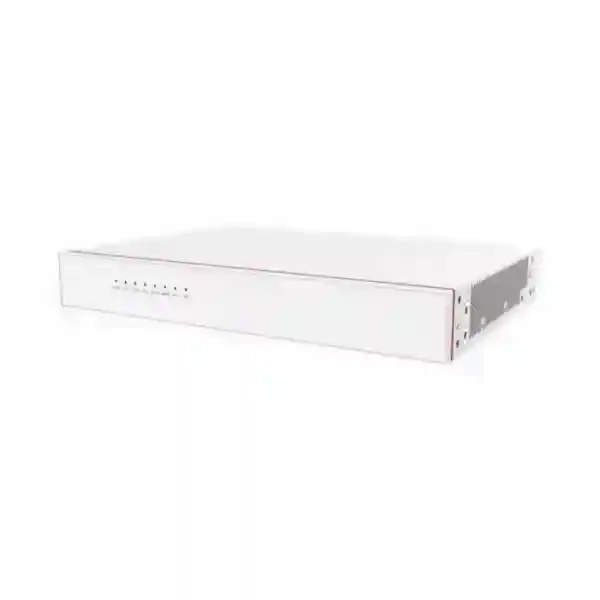
Huawei HiSecEngine USG6530F-DL Next-Generation Firewall for Dubai, UAE
A compact, high-capacity security gateway that combines 10GE connectivity, LTE resilience, secure SD-WAN, VPN, application-aware policy enforcement and multi-layer threat prevention for modern branch and distributed enterprise networks.
Designed for sites that need firewalling, WAN control, VPN and threat prevention in one compact security appliance.
Two 10GE SFP+ interfaces support high-speed aggregation, internet handoff, inter-VLAN routing or connection to a core/distribution layer.
LTE connectivity can be used in appropriate deployments as an alternate path for branch continuity, rapid turn-up or out-of-band connectivity planning.
Unified policy management helps reduce the number of separate edge appliances and simplifies consistent security enforcement across sites.
What is the Huawei HiSecEngine USG6530F-DL?
The Huawei HiSecEngine USG6530F-DL is a desktop-class next-generation firewall and intelligent security gateway in Huawei’s HiSecEngine USG6500F family. It is positioned for branch offices and distributed business locations that need more than simple stateful firewalling. The platform consolidates network security, secure WAN access and application-aware controls so a single device can protect internet access, private WAN connectivity, cloud-bound traffic, site-to-site VPNs, remote user access and segmented internal networks. For organizations in Dubai and the wider UAE, this consolidation is useful where offices, stores, clinics, warehouses, hospitality sites, schools, workshops and service locations must operate with limited on-site IT resources while still following centrally defined security standards.
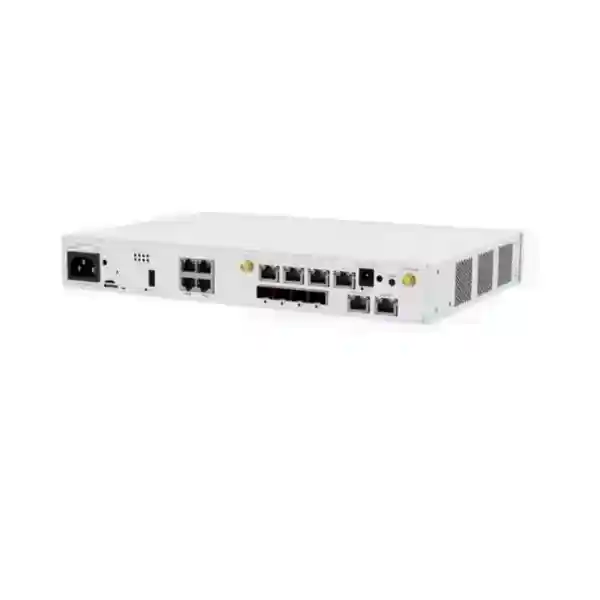
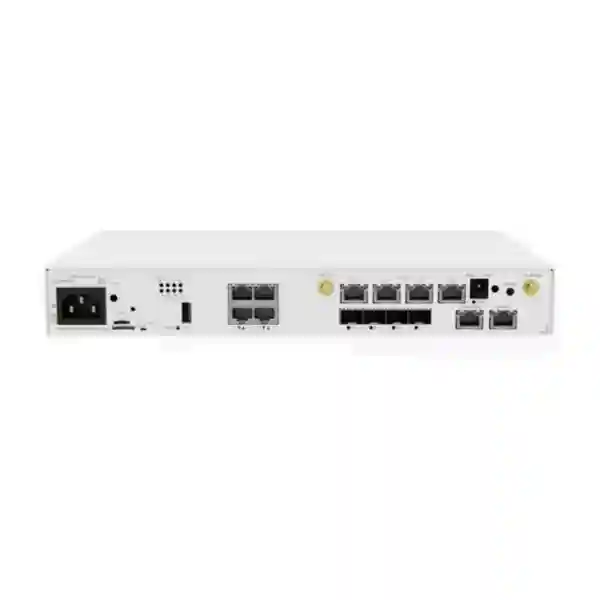
The USG6530F-DL combines two 10GE SFP+ interfaces, two GE SFP interfaces, eight GE RJ45 interfaces and integrated LTE capability. This interface mix gives network architects several options when designing the WAN edge. The 10GE ports can connect to a high-speed internet service, metro Ethernet, aggregation switch, data-center handoff or internal core. The GE optical and copper ports can be assigned to WAN, LAN, DMZ, management, server, voice, guest, CCTV or other security zones according to policy. LTE can be incorporated into continuity plans where mobile coverage, operator support and the selected service plan are suitable for the intended workload.
The platform is not only an access router with firewall rules. Huawei positions the family around integrated protection that includes firewall, VPN, intrusion prevention, antivirus, bandwidth management, anti-DDoS functions, URL filtering and application identification and control. The value is operational: instead of deploying one device for routing, another for VPN, separate appliances for filtering and independent tools for WAN steering, a branch can use a common policy framework. This can reduce configuration drift and make security changes easier to replicate across multiple sites.
For UAE projects, FourTeck can help map the appliance to the actual traffic profile rather than selecting it only from headline firewall throughput. That sizing process should consider encrypted traffic, concurrent sessions, new sessions per second, SSL inspection, VPN demand, security profiles, SaaS usage, voice and video flows, number of users, number of VLANs, expected growth and the performance effect of enabling multiple inspection engines simultaneously. Current Huawei documentation should always be checked against the software release and license package being quoted, because published performance values and entitlement models can evolve between revisions.
Core hardware and interface architecture
| Item | USG6530F-DL detail | Deployment relevance |
|---|---|---|
| 10GE optical | 2 × 10GE SFP+ | High-speed uplink, aggregation or core connection. |
| GE optical | 2 × GE SFP | Optical WAN, provider handoff or fiber LAN segment. |
| GE copper | 8 × GE RJ45 | Flexible LAN/WAN/DMZ and directly attached device connectivity. |
| LTE | Integrated LTE capability | Backup WAN, rapid site activation or resilience use cases where supported. |
| USB | 1 × USB 2.0 | Operational and maintenance workflows depending on software support. |
| Dimensions | Approx. 320 × 220 × 43.6 mm | Compact footprint for branches, cabinets and communications rooms. |
| Weight | Approx. 2.34 kg | Easy to place in smaller site environments. |
| Operating environment | 0°C to 45°C; 5% to 95% RH, non-condensing | Install in a properly cooled, clean network space with adequate airflow. |
Interface allocation is software-defined by deployment design. Port count should not be treated as a substitute for a switching architecture: larger offices should normally connect the firewall to managed access or distribution switches, with VLANs and security zones structured around business requirements rather than attaching every endpoint directly to the firewall.
Performance characteristics and how to read them
Firewall datasheets contain multiple performance figures because no single number describes production behavior. A large-packet UDP firewall benchmark measures a different workload from enterprise web traffic inspected by IPS, antivirus and application engines. SSL decryption introduces additional cryptographic work. IPsec throughput depends on cipher selection, packet size, tunnel count and traffic symmetry. New sessions per second matters for transactional workloads and highly dynamic internet traffic, while concurrent session capacity indicates how many active flows can remain tracked at once. For a realistic design, each of these dimensions should be compared with the customer’s peak load and growth plan.
In Huawei’s current HiSecEngine USG6500F family documentation, the USG6530F-DL is listed with IPv4 and IPv6 firewall throughput figures reaching 12/12/3.6 Gbps for the documented packet sizes in the current release table, secure SD-WAN throughput around 6/6 Gbps, firewall packet processing around 5.4 Mpps and firewall latency around 18 microseconds under the specified benchmark conditions. The same family documentation lists approximately 2.2 Gbps for FW plus application-aware security, about 1.8 Gbps NGFW throughput with the stated HTTP benchmark, and threat protection values that vary with the test profile. These numbers are laboratory reference points, not a promise that every enabled production policy will operate at the highest figure simultaneously.
For VPN-heavy sites, current Huawei documentation lists IPsec VPN throughput of approximately 3.7 Gbps using the specified AES-256 and SHA-256 benchmark and a maximum of up to 2,000 IPsec VPN tunnels for the USG6530F-DL class. SSL VPN throughput is listed around 300 Mbps, with concurrent SSL VPN users shown as a default entitlement that can scale to a higher documented maximum depending on licensing. SSL inspection throughput is a separate metric and can change between software revisions; therefore, projects with broad TLS decryption requirements should size specifically for encrypted traffic rather than simply using raw firewall capacity.
Session performance is also important in busy branches. Huawei documentation for the platform family shows hundreds of thousands of concurrent sessions and tens of thousands of new sessions per second. That makes the appliance suitable for locations with many clients opening numerous web, cloud and collaboration connections, provided security inspection, WAN bandwidth and policy design are sized appropriately. Session tables can be consumed quickly by guest Wi-Fi, mobile devices, browser-heavy SaaS use, video collaboration, software updates, IoT devices and modern applications that maintain many simultaneous connections.
FourTeck recommends designing to the security-enabled operating point rather than the largest raw throughput value. A site with a 1 Gbps internet circuit may still need a higher-capacity firewall if most traffic is TLS encrypted, IPS is enabled on broad policies, site-to-site VPNs carry backup or replication traffic, users rely heavily on Microsoft 365 or cloud applications, and the business expects bandwidth upgrades during the appliance lifecycle. Conversely, a smaller branch may not benefit from over-sizing if the traffic pattern is simple and growth is limited. The correct decision comes from workload analysis.
Raw firewall performance
Useful for understanding forwarding headroom, but it does not represent the same workload as full threat prevention or SSL decryption.
NGFW and threat protection
More relevant when IPS, application control, antivirus and other inspection profiles are attached to internet-bound security policies.
Encrypted traffic
Plan separately for SSL inspection and IPsec/SSL VPN because cryptographic processing changes the effective capacity envelope.
Sessions and burst rate
Important for high-client-count sites, guest access, cloud applications and transactional workloads that create many short-lived connections.
Integrated next-generation firewall protection
The primary role of the USG6530F-DL is to enforce security policy between trust zones, WAN connections, cloud destinations, partner links and public services. Stateful inspection tracks the context of permitted connections so return traffic can be handled according to session state rather than simple stateless access lists. Administrators can build rules around source and destination networks, services, users, applications and security profiles. This allows the branch edge to move beyond traditional port-based filtering and apply controls that reflect actual business activity.
Application identification is particularly important because many modern services use common web ports. Blocking or allowing TCP 443 alone does not distinguish a collaboration platform from personal file sharing, remote administration, social media, tunneling tools or other application categories. Huawei states that the HiSecEngine platform can identify thousands of applications and apply granular controls. In a corporate environment, this can help prioritize business traffic, restrict high-risk or non-business services, reduce unauthorized data movement and produce better visibility into what is traversing the edge.
Intrusion prevention adds another layer by evaluating traffic for exploit patterns and malicious behavior. Huawei’s current product materials describe a large IPS signature set and defense coverage for common vulnerability exploitation, web attacks, botnet activity, remote-control traffic, Trojan behavior and brute-force attempts. IPS policies should be tuned to the actual environment. Applying every available signature at maximum sensitivity to every flow can create unnecessary overhead and false positives. A more mature deployment maps inspection profiles to server roles, user zones, internet access and exposure risk, then monitors events during a stabilization period before tightening enforcement.
Antivirus and content inspection provide file-oriented protection. Huawei describes heuristic detection and the ability to inspect deeply compressed content. This is useful at the network edge because malicious files can arrive through web downloads, mail-related traffic, cloud applications and compromised websites. Network antivirus should complement, not replace, endpoint security. Encrypted sessions may need decryption before content can be inspected, and organizations must account for privacy, regulatory, technical and certificate-management considerations when implementing SSL inspection.
URL filtering and web controls help organizations govern categories of internet destinations. Typical policy objectives include blocking known malicious domains, reducing exposure to risky content, enforcing acceptable-use requirements and controlling categories that consume excessive bandwidth. URL controls are most effective when combined with DNS security, endpoint controls, identity context and application inspection. For UAE organizations with multiple sites, consistent category policy can be centrally designed and then adapted where business units have legitimate exceptions.
Secure SD-WAN and intelligent uplink selection
A branch firewall increasingly serves as a WAN control point, not only a security boundary. The USG6530F-DL supports secure SD-WAN capabilities that can steer traffic based on application requirements, link health and defined policy. This is useful for UAE businesses operating multiple branches with combinations of dedicated internet access, broadband, MPLS, metro Ethernet and LTE. Instead of statically routing all traffic through one circuit until it fails, administrators can design policies that use multiple paths more intelligently.
For example, voice and interactive video can be sent over the path with acceptable latency, jitter and packet loss, while software updates and bulk file transfers use a lower-cost path. A critical SaaS application can be assigned a preferred route but fail over when health probes detect degradation. Branch-to-head-office traffic can use secure tunnels, while approved cloud applications can break out locally to reduce backhaul. The exact topology depends on security requirements, application architecture and whether central inspection is mandatory for specific data flows.
Huawei documentation lists secure SD-WAN throughput around 6 Gbps for the USG6530F-DL in current benchmark conditions and support for up to 200 SD-WAN EVPN tunnels in the published family table. These numbers provide useful design boundaries, but the operational architecture should also account for tunnel overhead, routing scale, QoS, packet loss, ISP variability and the number of active sites. A branch with two 1 Gbps links may be straightforward, while a hub terminating many spokes requires additional analysis even if the raw bandwidth is moderate.
The LTE interface can complement SD-WAN and resilient routing strategies. It can be reserved for emergency traffic, used during fiber outages or help bring a site online before a fixed service is available. Traffic policies can limit which applications use LTE so a backup data plan is not consumed by large updates or non-essential video. The practical result is a branch design that prioritizes business continuity rather than treating failover as an all-or-nothing event.
VPN architecture for UAE branches and remote connectivity
Site-to-site IPsec VPN is a core requirement for organizations connecting Dubai offices to headquarters, data centers, cloud environments or regional branches. The USG6530F-DL supports IPsec and can terminate a large number of tunnels relative to typical branch requirements. This makes it suitable not only for a single point-to-point link but also for businesses that need multiple tunnels for redundant hubs, partner networks, disaster-recovery sites, cloud virtual networks or segmented routing domains.
The current family datasheet lists approximately 3.7 Gbps IPsec VPN throughput under its specified AES-256 plus SHA-256 benchmark and up to 2,000 IPsec tunnels for the USG6530F-DL class. Real throughput will depend on packet size, selected cryptographic algorithms, tunnel count, traffic distribution, routing, security profiles and software release. When tunnels carry file replication, backup or large database synchronization, sustained throughput matters. When they carry many application sessions from several branches, session scale and latency may be equally important.
Remote-access SSL VPN is a different use case. It allows users or administrators to connect securely from outside the corporate network, subject to authentication and policy. Huawei lists approximately 300 Mbps SSL VPN throughput for this model family and a default concurrent user entitlement that can be expanded to a higher supported maximum with appropriate licensing. Project design should verify the exact license part numbers, maximum user count and client compatibility required for the target software release before purchase.
VPN security depends on more than tunnel establishment. FourTeck recommends strong cryptographic proposals, certificate-based authentication where practical, MFA integration where supported by the chosen access workflow, restrictive policy between tunnel zones, logging, anti-spoofing controls and route design that avoids accidental exposure. For site-to-site connectivity, each tunnel should have a documented business owner, network range, routing method, encryption profile and failover behavior. For remote access, groups should receive only the resources needed for their role.
A well-designed VPN environment also plans for operational failure modes. If the primary ISP fails, will the tunnel re-establish through a secondary circuit? If LTE becomes active, should every tunnel come up or only critical ones? If public IP addressing changes, is dynamic peer identification required? If cloud workloads move to another region, can routes be updated centrally without visiting every branch? These questions should be answered during design, not during an outage.
Typical Dubai and UAE deployment scenarios
Corporate branch office
Protect user internet access, segment staff and guest networks, create IPsec connectivity to headquarters, prioritize collaboration traffic and use LTE as a controlled backup path.
Retail or multi-site operations
Separate POS, staff, CCTV, digital signage and guest Wi-Fi zones while maintaining secure tunnels to central applications and consistent security policies across many locations.
Warehouse and logistics site
Secure handheld terminals, scanners, ERP access, Wi-Fi infrastructure, camera networks and partner connectivity with application-aware policy and resilient WAN options.
Hospitality or serviced facility
Keep guest access isolated from corporate systems, protect back-office applications, control bandwidth and maintain secure connectivity to centralized services.
Education or training location
Manage high client counts, filter internet categories, segment labs and administrative systems, and enforce application controls during peak academic usage.
Project or temporary office
Use LTE or available broadband for rapid activation, then transition to fixed connectivity while retaining the same firewall policy, VPN and monitoring framework.
Segmentation, zones and branch security policy design
The most effective way to deploy a branch firewall is to treat internal traffic with the same discipline as internet traffic. A flat LAN where users, servers, cameras, printers, access control systems and guest devices share one trust zone creates unnecessary risk. The USG6530F-DL can participate in a segmented design in which VLANs are mapped to security zones and policies explicitly define which applications can cross between them. The firewall does not need to route every local VLAN in every design, but it should control the boundaries that matter from a security and compliance perspective.
A typical office might use separate zones for corporate users, management devices, voice, servers, guest Wi-Fi, CCTV, IoT, public services and VPN. The corporate user zone could access approved SaaS services and internal applications. The guest zone could reach only the internet and be prevented from initiating connections to private address space. The CCTV zone could communicate only with the recorder, management station and necessary time or update services. The management zone could be restricted to authorized administrators. Each rule should be documented with a purpose, owner and review date.
This approach supports the principle of least privilege. It also improves incident containment. If an IoT device is compromised, segmentation can prevent it from freely scanning accounting systems or domain controllers. If a guest device is infected, it should not be able to connect to internal services. If a server must be exposed to the internet, placing it in a dedicated DMZ and tightly controlling both inbound and outbound flows limits the impact of compromise.
Policy ordering and object hygiene are equally important. Broad rules such as any-to-any should be avoided except where they are deliberately used during a controlled migration window. Address groups and service groups should use meaningful names. Temporary rules should have expiration dates. NAT policies should be tied to documented public addresses and services. Security profiles should be applied consistently to the traffic types they are intended to inspect. Logs should be enabled at a level that supports troubleshooting and security investigations without overwhelming storage or management systems.
FourTeck can assist customers that need a firewall policy redesign as part of a hardware refresh. Migrating rules from an older appliance is not always a one-to-one translation exercise. Legacy configurations often contain obsolete objects, duplicate rules, unused VPNs, expired exceptions and permissive access that accumulated over years. Cleaning the policy before migration reduces risk and creates a more maintainable starting point.
High availability, continuity and failure-domain planning
Branch resilience begins by identifying which failures are tolerable. A site may be able to operate for several hours without guest Wi-Fi but not without access to ERP or payment systems. A second ISP may be more important than a second firewall at a small branch, while a regional hub may require both device redundancy and diverse WAN paths. The USG6530F-DL can fit into continuity designs, but the complete architecture must consider power, switching, carrier diversity, cabling, transceivers and upstream services.
LTE can reduce one common branch risk: total dependence on a single fixed circuit. A mobile backup path can keep selected critical traffic operational during a fiber cut or provider outage. The policy should define which flows are allowed when LTE is active. Business applications, DNS, authentication and management may be prioritized, while guest access, streaming and large backups are suppressed. Monitoring should alert administrators when failover occurs because a branch can continue operating on backup connectivity without users realizing that the primary service has failed.
Power is another failure domain. The firewall, access switches, ISP termination equipment and any LTE accessories required for connectivity should be connected to an appropriately sized UPS if the business expects continuity through short outages. A firewall on UPS power cannot provide connectivity if the optical network terminal or access switch loses power. The communications cabinet should also have adequate ventilation because thermal stress can reduce reliability.
When firewall high availability is required, the target software release and supported HA modes should be validated as part of the bill of materials. Interface mapping, heartbeat links, switch connections, state synchronization behavior, routing convergence and ISP handoff design all influence the result. Redundancy should remove single points of failure rather than simply duplicate appliances while leaving both connected to one switch, one power strip and one carrier device.
Change management is equally important to continuity. Configuration backups, tested rollback plans, maintenance windows and remote console access can prevent routine changes from becoming long outages. FourTeck can include documentation and post-change verification steps in deployment services so the customer retains a repeatable operational process after the initial installation.
SSL inspection and encrypted traffic planning
Most enterprise internet traffic is encrypted. That protects users from interception, but it also limits the visibility of network security engines unless the firewall is configured to decrypt appropriate sessions. SSL inspection allows selected TLS traffic to be opened, inspected and re-encrypted according to policy. This can improve detection of malware, exploits and prohibited applications hidden inside HTTPS, but it must be implemented carefully.
First, SSL inspection has a performance cost. The firewall must perform cryptographic operations in addition to application classification, IPS and antivirus scanning. The current USG6530F-DL family documentation includes a separate SSL inspection throughput benchmark; this is lower than raw firewall throughput because the workload is substantially different. If a customer expects to decrypt most outbound web traffic, sizing should be based on inspected bandwidth and peak connection rates rather than the WAN circuit speed alone.
Second, certificate distribution and endpoint trust must be managed. Corporate endpoints generally need to trust the enterprise inspection certificate so users do not receive browser warnings. Unmanaged devices, guest users and certificate-pinned applications may require bypass rules. Sensitive categories such as financial, healthcare or personally private services may also be excluded based on organization policy, applicable law and business requirements.
Third, decryption policy should be phased. A practical rollout starts with visibility and a limited pilot group, identifies applications that fail under inspection, documents exceptions and then expands coverage. Logging should show which traffic is decrypted, bypassed or blocked. This produces a maintainable security control rather than an opaque rule that disrupts users.
Application control, QoS and bandwidth governance
Application visibility is valuable because bandwidth is a business resource. A branch internet circuit may simultaneously carry Teams or Zoom meetings, cloud ERP, web browsing, software updates, backups, CCTV uploads and guest traffic. Without classification and policy, bulk or recreational use can affect latency-sensitive business applications. The USG6530F-DL’s application-aware controls and bandwidth management features can help prioritize, limit or block traffic based on business importance.
A useful policy framework starts by defining classes rather than individual applications. Critical real-time traffic can include voice and interactive video. Business-critical transactional traffic can include ERP, CRM and point-of-sale systems. Standard productivity can include normal web and collaboration traffic. Bulk traffic can include backups, software distribution and large file transfers. Guest and entertainment traffic can receive lower priority. The specific classification depends on the organization; not every video stream is recreational, and not every large file transfer is non-essential.
QoS should be aligned across the network. Marking packets at the firewall is useful only if switches, WAN services and remote sites handle those markings consistently. When traffic crosses the public internet, end-to-end QoS cannot be guaranteed, so SD-WAN path selection and local bandwidth reservation may be more effective. For private circuits, the provider’s supported classes of service should be mapped to the internal policy.
Bandwidth controls can also protect LTE backup. During failover, the available capacity and data allowance may be much lower than the primary fiber service. A dedicated backup policy can permit only critical applications and cap secondary services. This reduces the chance that background updates consume the mobile link immediately after failover.
Application controls should be reviewed over time because cloud services change frequently. A policy created today may not identify new collaboration features, domains or content-delivery paths introduced later. Keeping the firewall’s signature and intelligence services current is part of maintaining application visibility.
Threat prevention and operational response
Security controls are most useful when they feed an operational response process. Blocking an exploit is valuable; understanding that a server is being targeted repeatedly is more valuable because it may trigger patching, isolation or investigation. The USG6530F-DL can generate logs and security events from firewall policy, IPS, antivirus, application controls, VPN activity and other functions. These events should be collected in a way that supports both daily troubleshooting and incident response.
A small organization may begin with local logs and alerting, while a larger enterprise may integrate the firewall with centralized security management, syslog infrastructure or a SIEM. The important design questions are retention, time synchronization, event severity, ownership and escalation. If an IPS signature blocks a high-confidence exploit against a public server, who receives the alert? If a branch begins communicating with a known malicious destination, is the event visible centrally? If an administrator changes a security rule, can the change be traced?
Threat prevention also requires current intelligence. Signature-based protections rely on updates, and application identification evolves as services change. Subscription and update entitlements should therefore be treated as part of the security architecture rather than an optional maintenance detail. A firewall that remains powered on for years without current threat intelligence does not provide the same risk reduction as a maintained platform.
Patch management is equally important. Security gateways are high-value assets exposed to untrusted networks, so software updates should be evaluated and applied through a controlled process. Organizations should review vendor security advisories, validate release notes, back up configurations and plan maintenance windows. When the firewall is part of a critical branch, upgrade procedures should include rollback steps and post-upgrade tests for routing, VPN, NAT, application access and logging.
FourTeck can help customers build a practical operational runbook alongside the deployment. This can include contact points, configuration backup procedures, common troubleshooting commands, WAN failover tests, VPN verification steps, license renewal records and escalation information. The objective is to make the security platform supportable by the customer’s IT team after handover.
Sizing methodology: how FourTeck evaluates the USG6530F-DL
Current and planned circuits
We record primary, secondary and backup link speeds, expected upgrades, traffic symmetry and whether multiple WANs can be active at the same time.
Inspection depth
IPS, antivirus, application control, URL filtering and SSL decryption create a different performance profile than basic firewalling.
Sessions and connection rate
We estimate users, guest clients, phones, cameras, servers, IoT devices and high-connection applications rather than counting employees alone.
Site-to-site and remote access
Tunnel count, encryption profile, replication traffic, remote user concurrency and failover behavior are included in the sizing model.
Copper, fiber and 10GE
We map carrier handoffs, switch uplinks, DMZs, transceivers and cabling so the quoted hardware matches the physical network.
Headroom for the next phase
We include realistic growth for bandwidth, cloud adoption, new branches and security inspection so the device is not undersized soon after purchase.
Licensing, subscriptions and bill-of-material accuracy
A firewall quotation is incomplete if it lists only the chassis. The required security functions may depend on subscription bundles, software packages, support entitlements or capacity licenses. The exact commercial structure can change between software releases and sales regions, so the final bill of materials should be checked against Huawei’s current ordering guidance and the customer’s desired feature set.
FourTeck’s quotation process therefore begins with required outcomes: basic firewall and routing, secure SD-WAN, IPS, antivirus, URL filtering, application control, SSL inspection, VPN, remote access, advanced threat services and support duration. From there, the license set can be mapped to the chosen appliance and project term. This avoids two common problems: buying security subscriptions that will never be used, or purchasing hardware that cannot deliver the intended feature set because a required entitlement was omitted.
Performance licensing also deserves attention. Huawei documentation for some software generations distinguishes standard and enhanced performance entitlements. Current published tables can differ from older datasheets, so procurement teams should not combine a throughput figure from one document with a license package from another. The correct approach is to validate the exact model, software release, regional ordering code, subscription and performance entitlement together.
Remote-access capacity can also be license-sensitive. A specification may show both a default and a maximum concurrent user count. The maximum should not be assumed to be included in the base purchase. If the project requires hundreds of remote users, the quotation should explicitly state the user license quantity and supported maximum for the selected release.
Support is part of lifecycle planning. Critical branch firewalls should have access to vendor software updates, security intelligence, technical assistance and replacement processes appropriate to the business. Organizations with many branches may choose a standardized renewal date to simplify administration. FourTeck can help align hardware, license and support terms so the customer has a clear renewal schedule instead of scattered expiry dates.
Physical installation and environmental considerations
The USG6530F-DL uses a compact desktop-class chassis approximately 320 mm wide, 220 mm deep and 43.6 mm high. Huawei hardware documentation lists a weight of roughly 2.34 kg. The small footprint is useful in branch communications rooms where a full-depth data-center rack is not available, but the device should still be installed professionally. It must have adequate airflow, stable power and clean cable routing, and it should not be placed in an enclosed cabinet that traps heat.
Published operating conditions include approximately 0°C to 45°C and 5% to 95% relative humidity, non-condensing. Dubai network rooms can become significantly warmer than normal office spaces if air conditioning fails or cabinets are positioned near windows, ceilings or plant areas. Environmental monitoring is therefore a practical safeguard for critical sites. The firewall should not be treated as an appliance that can be left in an unventilated electrical cupboard simply because it is small.
Power planning should include the firewall, WAN termination equipment, switching and any supporting LTE or optical components. Huawei documentation lists AC power input support and low overall appliance power consumption relative to larger rack-mount systems. A UPS should be selected based on the total connected load and desired runtime rather than the firewall alone. Surge protection and proper grounding should follow local electrical practice and the installation environment.
Fiber interfaces require compatible transceivers and correct fiber type. The bill of materials should specify SFP or SFP+ modules, wavelength, connector type and distance. A provider handoff may use single-mode fiber while a nearby switch uplink uses multimode. Mixing optics without checking link specifications can delay commissioning. For 10GE copper connectivity through external media conversion, the design should confirm support and power requirements rather than assuming every handoff can attach directly.
Cable labeling is a small but important operational detail. WAN1, WAN2, core uplinks, HA connections, console, LTE antennas and management ports should be labeled consistently with the network diagram. During an outage, clear labeling reduces the risk of disconnecting the wrong path and shortens remote troubleshooting calls.
Migration from an existing firewall
Replacing a firewall is a network change, security change and application change at the same time. The migration plan should therefore inventory more than rules. It should capture interfaces, VLANs, routing, public IP addresses, NAT, DHCP services, DNS dependencies, VPN peers, certificates, authentication sources, monitoring, syslog destinations, QoS, policy objects, schedules and any special handling for voice, CCTV, ERP, payment systems or cloud services.
FourTeck generally recommends building a clean configuration rather than blindly replicating every legacy object. Existing rules are reviewed for use, ownership and necessity. Duplicate objects can be consolidated, expired VPNs removed and overly broad rules tightened where the customer approves. This reduces technical debt and gives the new firewall a clearer baseline.
A cutover plan should define the exact physical cable moves and logical changes. If the WAN uses a static public IP, provider parameters must be verified in advance. If PPPoE, DHCP or a carrier-managed handoff is involved, credentials and service details must be available. If the existing firewall is the default gateway for many VLANs, the new interface addressing must match or a coordinated routing change is required.
Post-cutover testing should cover internet access, DNS, critical SaaS applications, internal server access, inbound published services, site-to-site VPNs, remote access, VoIP, monitoring, logging, guest Wi-Fi and failover. The old firewall should remain available for rollback until the acceptance tests are complete and the customer confirms stability.
Management, policy governance and multi-site operations
A firewall becomes difficult to operate when every change depends on one person remembering how the configuration was built. The USG6530F-DL should be deployed with a governance model that defines administrator roles, naming conventions, change records, backup frequency and monitoring responsibilities. Even a single branch benefits from this discipline; a multi-site enterprise requires it.
Administrators should use named accounts rather than shared credentials where the management system supports it. Roles should separate day-to-day monitoring from high-impact configuration changes when organizational structure permits. Management access should be restricted to trusted networks or secure VPN paths, not exposed broadly to the internet. If remote management is necessary, it should use hardened protocols, source restrictions and strong authentication.
Policy naming is one of the simplest ways to improve long-term maintainability. A rule name such as BR01-USERS-TO-INTERNET-BUSINESS gives more context than RULE-17. Address groups should identify the business function they represent. VPN objects should include the remote site or partner name. Comments should explain why a rule exists and who requested it. These practices reduce troubleshooting time and make security reviews more meaningful.
For organizations operating several offices across the UAE or across regional markets, centralized design is important. Security policies should be standardized where possible, with controlled exceptions for local requirements. Internet egress architecture, branch VPN templates, segmentation and logging can follow a common model. This makes it easier to deploy new sites and compare behavior across locations.
Customers planning broader network projects can explore FourTeck’s UAE technology solutions for integrated infrastructure planning, while organizations needing firewall-focused consultation can use the dedicated Firewall Dubai resource. These service paths are useful when the firewall is part of a larger switching, Wi-Fi, server, voice or cloud connectivity project rather than a standalone replacement.
Security design for cloud and SaaS-centric branches
Modern branches may have few local servers but still generate significant traffic. Microsoft 365, Google Workspace, CRM platforms, cloud ERP, video conferencing, cloud storage, endpoint management and security agents can all create persistent internet sessions. Traditional designs that backhaul all traffic through headquarters may increase latency and consume WAN capacity unnecessarily. A secure local breakout model can improve user experience if the branch firewall applies the required inspection and policy locally.
The USG6530F-DL’s application awareness and secure SD-WAN functions can support this architecture by identifying business applications, steering them over appropriate links and enforcing security before traffic reaches the internet. Critical private applications can continue to use IPsec tunnels to headquarters or cloud virtual networks. This hybrid model allows each traffic class to take the path that best matches security, performance and cost requirements.
Cloud connectivity should also account for DNS behavior. Many SaaS platforms use distributed content delivery and dynamic addressing. Static IP-based rules may not be practical for every service. Application identification, URL categories and vendor-recommended domain lists may be more effective. Any exception that bypasses SSL inspection or other controls should be documented because cloud providers can change infrastructure without notice.
For cloud-hosted private applications, route design is important. The branch may connect to a cloud VPN gateway, SD-WAN hub or data center that provides onward connectivity. Redundant tunnels can terminate in different availability zones or regions. The firewall’s route selection should prevent asymmetric traffic that could cause session drops. Health checks should validate application reachability, not only whether an ISP gateway responds.
When the firewall is part of a broader cloud migration, FourTeck’s UAE IT services practice can help align edge security with endpoint, server, cloud and support requirements so the branch design is not isolated from the rest of the IT environment.
UAE procurement and project considerations
Buying a firewall in the UAE involves more than selecting a model number. The quotation should identify the exact hardware variant, included accessories, power components, transceivers, antenna items where applicable, security subscriptions, support term and installation services. It should also state any assumptions about existing switches, racks, WAN circuits and public IP addressing. A precise bill of materials reduces variation between vendor quotations and prevents unexpected add-ons during commissioning.
Lead time matters when a new branch opening depends on the firewall. If hardware delivery and the carrier installation are on different schedules, LTE can sometimes be considered as an interim access method where technically and commercially appropriate. However, LTE should not automatically be treated as a substitute for the planned fixed service. Bandwidth, data usage, signal quality, carrier NAT and public IP requirements must be checked.
Organizations with offices beyond the UAE may want a consistent security standard across countries while purchasing locally or regionally. The same firewall family can provide a common architecture, but local carrier options, licensing availability and support arrangements can differ. FourTeck can coordinate regional requirements and customers evaluating wider deployments can reference FourTeck Africa for multi-country infrastructure planning where relevant.
Documentation should be treated as a project deliverable. A good handover includes the final network diagram, interface table, IP plan, VLAN and zone mapping, WAN details, VPN peers, policy summary, administrator access procedure, backup process, license inventory and support contacts. Without this information, a branch can become dependent on the installer who happened to configure it.
FourTeck can provide supply-only quotations when the customer has its own engineering team, or scoped deployment services for configuration, migration, testing and handover. The project model can also include post-deployment support, periodic policy reviews or broader managed IT services depending on the customer’s operating model.
Detailed technical planning checklist
WAN information
ISP name, circuit type, bandwidth, public IP block, gateway, VLAN tagging, PPPoE or DHCP details, secondary circuit and failover objective.
LAN and VLAN design
User, server, guest, voice, CCTV, IoT, management and DMZ subnets; gateway placement; inter-VLAN policy; DHCP responsibility and switch trunks.
Security services
IPS, antivirus, web filtering, application control, anti-DDoS functions, SSL inspection scope, exclusions, logging and alerting requirements.
VPN requirements
Remote peer IPs, private networks, routing, encryption domains, certificates, pre-shared keys, remote-user count and authentication method.
Physical connectivity
Copper versus fiber, optic type, connector, cable distance, 10GE requirements, cabinet depth, UPS, cooling and LTE antenna placement.
Operational ownership
Administrator roles, backup destination, monitoring platform, syslog or SIEM integration, support escalation, change windows and renewal ownership.
Why 10GE matters even at a smaller branch
A branch may have a 500 Mbps or 1 Gbps internet circuit and still benefit from 10GE interfaces. The reason is that the firewall often sits between several high-speed internal segments as well as the WAN. A 10GE connection to the core switch can carry multiple VLANs without forcing all inter-zone traffic through a 1 Gbps bottleneck. This is useful when the firewall protects server, backup or CCTV segments in addition to internet access.
10GE also gives headroom for future ISP upgrades. Businesses in Dubai frequently move from basic broadband to dedicated fiber or higher-capacity services as cloud usage grows. Replacing a firewall only because the physical interface cannot accept the upgraded handoff creates unnecessary disruption. The USG6530F-DL’s two 10GE SFP+ ports allow designs with a high-speed WAN and high-speed LAN, or two 10GE paths for other topology requirements.
The availability of 10GE does not mean every traffic path can sustain 10 Gbps with every security service enabled. Throughput must still be evaluated by workload, as described earlier. The interface simply removes one physical-layer limitation. If an organization expects multi-gigabit inspected internet access, larger firewall models may be more appropriate depending on the security stack and growth target.
Transceiver selection is therefore part of the design. A 10GE SFP+ port may connect over short-range multimode fiber, long-range single-mode fiber or other supported media using the correct optic. Compatibility should be checked against the Huawei hardware and accessory list. The switch at the other end must use a matching standard.
LTE use cases beyond simple failover
Integrated LTE is commonly discussed as an emergency backup, but it can serve several other operational purposes. New branches sometimes need connectivity before the carrier’s fixed circuit is delivered. A temporary LTE path can allow engineers to commission switching, wireless, VPN and cloud access in advance. Once the primary link is active, the LTE path can be retained as a backup.
LTE can also provide an independent management path. If a routing error or ISP failure disrupts the primary WAN, administrators may still be able to reach the branch through a separately controlled mobile connection, subject to carrier addressing and security design. This can reduce the need for an on-site visit when a configuration change accidentally affects the main uplink.
For mobile or temporary operations, LTE may become the primary path, but performance depends heavily on coverage, network congestion, antenna placement, carrier policy and data plan. A speed test performed once during installation is not enough to guarantee long-term service quality. Continuous monitoring of latency, loss and throughput helps determine whether LTE is suitable for interactive applications or should be restricted to essential transactional traffic.
Security remains important on mobile links. The WAN should be treated as untrusted, and private connectivity should use secure tunnels where required. Carrier-grade NAT may prevent inbound connections, so remote management and VPN design must account for the addressing model. Public or static mobile IP services should be validated with the carrier if the project needs them.
Firewall policy examples for a typical branch
A practical policy model can illustrate how the USG6530F-DL might be used. Corporate users may be allowed to reach the internet through application control, IPS, antivirus and URL filtering. SSL inspection can be applied to managed devices, with documented bypasses for services that cannot be decrypted. Guest Wi-Fi can use a separate zone with internet-only access, bandwidth limits and no route to private networks. Voice devices can reach only call-control, DNS, NTP and approved update destinations. CCTV cameras can communicate with the recorder and management platform but not directly browse the internet.
A server zone can use stricter inbound and outbound rules. Internal users may reach only the required application ports. Servers that need updates can access selected internet destinations through inspected policies. Public services can be placed in a DMZ and published with destination NAT, IPS and application-specific restrictions. Administrative interfaces should not be exposed through the same public rules used for applications.
VPN traffic can be segmented by peer. A tunnel to headquarters may have broader access than a partner VPN. A third-party support tunnel can be restricted to specific systems and active only during approved windows. Remote users can receive access based on group membership rather than being placed directly on the internal LAN. These distinctions make incident containment and audit review easier.
The exact policy depends on the customer’s applications, but the design principle is consistent: allow what is required, attach the appropriate security profiles, log meaningful events, review exceptions and avoid treating internal or VPN traffic as automatically trusted.
Operations after deployment
A firewall project is not finished when traffic starts passing. During the first days after cutover, administrators should review denied traffic, IPS events, application identification, VPN stability, interface utilization, CPU and memory trends, WAN failover behavior and user reports. This tuning period helps identify legitimate applications that were not included in the original policy and confirms that the security profiles are not causing unexpected disruption.
Configuration backups should be taken after acceptance and after significant changes. The backup should be stored outside the appliance in a location accessible during a failure. Documentation should record the software version and license state associated with each backup because restoring an old configuration to a different release may require additional steps.
Monthly or quarterly reviews can identify unused rules, expired temporary access, failed login attempts, abnormal bandwidth use and subscription status. Larger environments can automate much of this through centralized management and SIEM workflows. Smaller businesses can still benefit from a simple checklist performed consistently.
Before renewing a support or security subscription, the customer should review whether the appliance is still appropriately sized. If internet bandwidth has doubled, SSL inspection has expanded or new branches now terminate VPNs at the site, renewal may also be the right time to evaluate a capacity upgrade. Conversely, if the workload remains stable, maintaining the existing platform may be more cost-effective than replacing it prematurely.
FourTeck can support ongoing network operations as part of a wider infrastructure engagement. Customers looking for integrated support across network, server and user environments can combine firewall deployment with FourTeck IT services in the UAE, while the firewall-specific portal remains the quickest path for product-focused queries.
Technical specification summary for quotation planning
Specifications are benchmark references published for the HiSecEngine USG6500F family and can depend on software release, license level, packet size, enabled security functions and test methodology. Final procurement should verify the exact Huawei datasheet and ordering information associated with the quoted SKU and subscription package.
Frequently asked technical questions
Is the USG6530F-DL suitable for a 1 Gbps internet circuit?
It can be, but the answer depends on enabled inspection. Raw firewall capacity is far higher than 1 Gbps, while NGFW, threat prevention and SSL inspection have lower benchmark ceilings. A 1 Gbps site with extensive TLS decryption, high session counts and substantial VPN traffic should be sized on the inspected workload, not only the circuit speed.
Can LTE be used as an automatic backup?
Yes, LTE can be incorporated into a failover design where the carrier service, SIM, signal quality and software configuration support the intended use. Traffic policies should determine which applications use the backup path to control capacity and cost.
Does the firewall support 10GE?
Yes. The USG6530F-DL includes two 10GE SFP+ interfaces in addition to two GE SFP and eight GE RJ45 interfaces. Appropriate optical modules and cabling must be selected for the connected equipment and distance.
How many IPsec tunnels can it support?
Huawei’s current family documentation lists up to 2,000 IPsec VPN tunnels for the USG6530F-DL class. A real design should also evaluate aggregate VPN bandwidth, routing scale and concurrent workload rather than relying on tunnel count alone.
Can it replace a separate router and firewall?
In many branches it can consolidate routing, firewall, VPN, SD-WAN and security inspection functions. Whether that is the best architecture depends on carrier requirements, routing complexity, high availability and organizational policy.
Is SSL inspection included in sizing?
It should be evaluated separately because encrypted traffic inspection consumes more resources than basic forwarding. The scope of decryption, number of clients, TLS session rate and security profiles all affect practical capacity.
What is needed for remote-access VPN?
The design should define user count, authentication, client compatibility, access policy, certificates and licensing. Published specifications show both default and maximum concurrent SSL VPN user levels, so the quotation must include any capacity upgrade required.
Can FourTeck migrate rules from another vendor?
Yes, migration can be scoped from an existing firewall, but the preferred process is to review and rationalize legacy rules instead of copying obsolete or overly permissive policy unchanged.
Decision recap: when the USG6530F-DL is a strong fit
The Huawei HiSecEngine USG6530F-DL is a strong candidate when a branch or distributed site needs multi-gigabit firewall headroom, high-speed 10GE uplinks, integrated LTE, secure SD-WAN, substantial IPsec capacity and a full NGFW security stack in a compact platform. Its interface mix is particularly useful for sites transitioning from 1GE to higher-speed core or carrier connectivity while retaining flexible copper ports for conventional branch networking.
Good fit characteristics
Branch or mid-sized site, several security zones, multiple WAN paths, heavy cloud use, site-to-site VPN, need for application control, planned bandwidth growth, preference for consolidated security and networking.
Re-evaluate model size when
The site requires sustained multi-gigabit SSL decryption, very high remote-access concurrency, large-scale hub VPN termination, extensive east-west inspection, high-availability architecture with greater interface density or rapid growth beyond the platform’s security-enabled performance envelope.
Quotation input checklist
Providing the following information allows FourTeck to build a more accurate Huawei HiSecEngine USG6530F-DL quotation and avoid missing licenses or accessories.
Plan the USG6530F-DL around your actual network, not a generic bundle
Share your WAN speeds, site count, user/device volume, VPN needs, existing firewall and required security services. FourTeck can prepare a scoped Huawei configuration covering hardware, licensing, optics, migration, deployment and support. For broader infrastructure work, visit FourTeck UAE; for firewall-focused projects, use the dedicated consultation channel below.

Reviews
There are no reviews yet.