
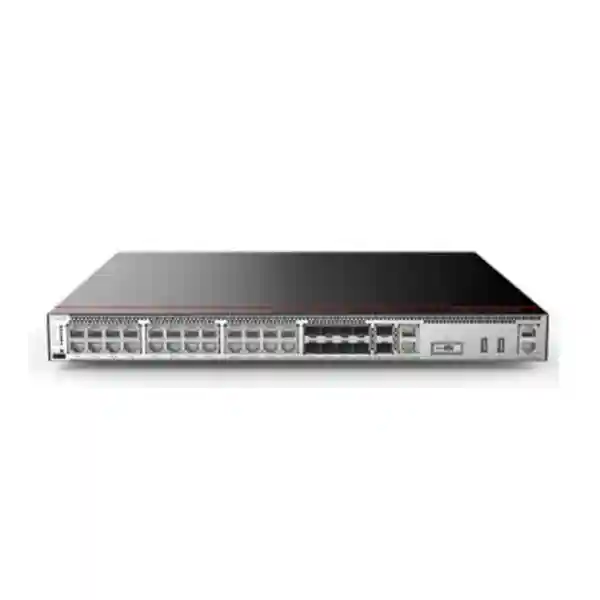
Huawei HiSecEngine USG6550E Firewall in UAE
The Huawei HiSecEngine USG6550E is a fixed-configuration 1U next-generation firewall built for organizations that need dense Gigabit access connectivity, 10GE uplinks, large concurrent-session capacity, encrypted site-to-site connectivity and integrated threat-control services in a single security gateway. For UAE enterprises, the platform is particularly relevant to headquarters, multi-building campuses, industrial networks, education environments, hospitality groups, distributed retail, private-cloud edges and regional hubs where the firewall must act as both a resilient traffic enforcement point and a scalable VPN termination device.
2 × 10GE SFP+
8 × GE Combo
16 × GE RJ45
2 × GE WAN
Optional M.2 SSD
1+1 power redundancy capable
What the Huawei HiSecEngine USG6550E is designed to do
The USG6550E belongs to Huawei’s enterprise firewall portfolio and combines stateful firewalling with next-generation inspection functions, VPN services, application awareness, content-security controls and centralized policy operations. In practical architecture terms, it is intended to replace a collection of separate perimeter functions with a consolidated enforcement point that understands users, applications, sessions and security policies rather than filtering traffic only by source address, destination address and port. That matters in modern UAE networks because traffic patterns are no longer dominated by a small number of predictable client/server services. SaaS applications, hybrid cloud access, encrypted web sessions, remote users, branch VPNs, voice platforms, guest networks, contractor devices and machine-to-machine connections can all share the same physical links.
A well-designed USG6550E deployment therefore starts with policy architecture, not with a simple throughput number. The firewall should be mapped to security zones, routing domains, trust boundaries, WAN circuits, VPN communities, server segments and operational ownership. FourTeck engineers can position the appliance at an Internet edge, between campus zones, in front of a server environment, as a regional VPN concentrator or as a high-availability pair. The correct design depends on the protected traffic mix, expected encrypted throughput, inspection profile, session scale, availability objectives and the number of physical and logical interfaces required over the lifetime of the deployment.
Hardware platform and rack integration
Huawei identifies the USG6550E-AC as a rack or workbench appliance with a 1U chassis. The published typical chassis dimensions are approximately 43.6 mm high, 442 mm wide and 420 mm deep, with a maximum depth of about 453 mm when protruding components are included. This is important during UAE data-room planning because the firewall needs a cabinet depth of 600 mm or greater, front clearance for cabling and optics, and rear clearance for airflow and service access. The nominal device weight is around 5.71 kg without packaging, allowing installation in standard enterprise racks without unusual mechanical requirements.
Internally, the platform uses a four-core CPU, DDR4 ECC memory, onboard flash and optional M.2 local storage. The optional storage can be valuable when local event retention, reporting, log capture or operational diagnostics are required near the enforcement point. Organizations should still treat the firewall as part of a broader logging architecture and forward important security, audit and availability records to approved centralized platforms. Local disk improves continuity and troubleshooting but does not replace a properly designed SIEM, syslog, monitoring or compliance-retention service.
Power, cooling and UAE equipment-room planning
The USG6550E-AC is supplied with an AC power module and can support a second module for 1+1 power redundancy. Huawei’s hardware documentation lists a rated input of 100 to 240 V at 50/60 Hz, with a wider input range of 90 to 264 V. Typical platform consumption is approximately 32.4 W and maximum consumption is approximately 46.4 W in the published hardware specification. These values help designers estimate PDU loading and UPS runtime, but actual facility planning should include the complete rack, optics, switches, servers, environmental monitoring equipment and redundant power path rather than considering the firewall in isolation.
Cooling is front-to-back through a pluggable fan module with automatic fan-speed adjustment. The published long-term operating temperature range is 0°C to 45°C and relative humidity is 5% to 95% non-condensing. In Dubai and other UAE locations, the environmental requirement is especially important because external climate conditions can be severe even when the data room itself is controlled. A firewall should never be installed in an unconditioned communications closet simply because its electrical load is modest. Stable cooling, clean power, correct grounding, dust management and documented rack airflow are part of security availability engineering.
Why the interface density matters in real network designs
Firewall sizing is frequently discussed only in terms of Gbit/s, but physical interface topology can determine whether a platform is operationally clean or unnecessarily dependent on external switching. The USG6550E’s 16 fixed copper GE interfaces make it possible to attach several routed or security-zone segments directly when that is appropriate, while the eight combo interfaces provide the choice of copper or 1GE fiber for links to separate racks, floors, buildings or provider equipment. The pair of 10GE SFP+ ports can then be reserved for high-capacity northbound or southbound paths. This gives architects a flexible mix without needing an expansion chassis.
The important design discipline is to avoid treating every physical port as an independent security boundary by default. Many large environments are better served by 802.1Q trunking into resilient switching infrastructure, with logical VLAN interfaces on the firewall and physical links aggregated or duplicated for availability. Other environments, especially regulated OT, payment, lab, guest or management segments, may benefit from clear physical separation. FourTeck can map the interface plan to the organization’s trust model, cabling environment, switching capability, change-control practices and recovery procedures so that the resulting design is easy to operate under pressure.
Combo ports require additional attention because each logical combo interface can operate either through its RJ45 side or its SFP side, not both at the same time. The working medium should therefore be documented on rack elevations, logical diagrams, implementation runbooks and disaster-recovery notes. This sounds like a small operational detail, but clear port documentation reduces avoidable incidents during hardware replacement, migration or emergency re-cabling.
Performance: read the numbers in context
Published performance data for the USG6550E generation includes IPv4 firewall throughput of up to 4 Gbit/s for 1518-byte and 512-byte UDP frames, while the 64-byte figure is lower because small packets create a higher packet-processing load. The same published matrix lists around 2.5 Gbit/s for firewall plus service awareness, approximately 2.1 Gbit/s with firewall, service awareness and IPS enabled, approximately 2.0 Gbit/s when antivirus is added, and approximately 1.6 Gbit/s for the defined full-protection test profile. A real-world mixed-traffic figure in the older matrix is lower again. These distinctions are essential because no enterprise should size a next-generation firewall using the largest headline firewall-throughput number alone.
Security inspection consumes resources because the platform must do more than forward packets. It reconstructs sessions, identifies applications, evaluates policy, inspects content, checks signatures, applies reputation or URL rules, decrypts approved encrypted traffic when SSL inspection is configured, logs events and sometimes performs NAT or VPN encryption simultaneously. The relationship between advertised firewall throughput and actual protected throughput will therefore depend on enabled features, traffic direction, object complexity, logging rate, packet size, TLS behavior, application mix and the proportion of sessions that require deep inspection.
For a UAE organization purchasing this platform today, FourTeck recommends calculating sustained inspected traffic, expected peak traffic, growth margin and failure-state capacity separately. If two firewalls are deployed in active/standby high availability, each unit should be capable of carrying the required production load after a failover. If the design includes Internet breakout for cloud-heavy users, the sizing exercise should specifically model HTTPS inspection and SaaS traffic rather than extrapolating from unencrypted forwarding figures.
Session scale and connection rate
The USG6550E generation is documented for up to 4,000,000 concurrent TCP sessions and roughly 78,000 new sessions per second in the published test matrix. Session scale is important for networks with many users, browser tabs, mobile applications, API calls, IoT devices, cloud services and short-lived outbound connections. A site with moderate bandwidth can still create a very high session count if thousands of endpoints continuously open connections to distributed Internet services.
When designing policy, engineers should examine session behavior per user, NAT requirements, server workloads and peak connection bursts. Web portals, load-test environments, software-update systems, proxy infrastructures and public-facing applications can generate unusually aggressive connection rates. Capacity planning should also reserve operational headroom so that an unexpected burst or incident does not immediately push the platform to its design ceiling.
Encrypted VPN capacity
The older USG6550E data sheet lists approximately 3 Gbit/s of IPsec VPN throughput under its stated AES-256 and SHA256 test conditions, with up to 4,000 gateway-to-gateway or client-to-gateway IPsec tunnels. This makes the appliance suitable for regional hub designs where encrypted connectivity from many offices, stores, depots or remote facilities terminates at a central UAE location, provided the actual traffic mix and license requirements are confirmed.
VPN performance should be evaluated alongside WAN diversity and routing. A resilient design may use two Internet providers, private WAN plus Internet, policy-based routing, dynamic routing over tunnels or separate VPN communities for partners and internal branches. Cryptographic policy, key lifetimes, authentication, route control, monitoring and failover tests should be standardized so that branch connectivity remains predictable during provider outages or maintenance.
SSL inspection and the practical limits of encrypted security
Encrypted traffic inspection is one of the most demanding functions on a next-generation firewall. The published USG6550E matrix lists SSL inspection performance around 450 Mbit/s under its defined TLS 1.2 test profile with IPS enabled. That figure is much lower than the basic firewall forwarding number because TLS inspection requires the firewall to establish, decrypt, inspect and re-encrypt approved connections. Modern websites and cloud applications also vary substantially in cipher suites, object counts, session reuse and content behavior, so a laboratory metric is only a starting point.
A good UAE deployment therefore uses selective decryption policy instead of assuming that every encrypted flow must be inspected. Organizations should define categories that must be decrypted, categories that should be exempted for privacy or technical compatibility, certificate handling, endpoint trust deployment, exception procedures and monitoring for failed handshakes. Some applications implement certificate pinning or other behaviors that make interception difficult, while sensitive categories may be excluded according to organizational policy and legal requirements.
The operational question is not simply whether the appliance supports SSL inspection. The question is whether the proposed decryption scope can be sustained at peak load while preserving user experience and maintaining acceptable firewall utilization. FourTeck can help define a staged rollout in which selected user groups, URL categories and application classes are enabled first, observed for compatibility, and expanded only after performance and policy results are understood.
Application awareness and policy control
Traditional access-control lists identify traffic through IP addresses, protocols and ports. That model is still useful, but it becomes less effective when many unrelated applications share HTTPS, use content-delivery networks, move between cloud endpoints or establish dynamic connections. A next-generation firewall adds application identification so security policy can be expressed closer to business intent. Instead of allowing a broad destination and service simply because it uses TCP 443, administrators can combine application awareness, user information, URL classification, threat inspection and network context.
For enterprise operations, application-aware policies should remain structured and explainable. The cleanest rule bases typically start with infrastructure services, remote administration, published applications, inter-zone business services, branch connectivity, privileged users, standard user Internet access and guest traffic. Broad temporary rules should have owners and expiration dates. Exceptions should identify the business reason, not only the technical object names. Logging should be deliberate so that critical events are retained without creating an unmanageable flood of low-value records.
Policy quality directly affects performance and incident response. Duplicate objects, stale rules, shadowed policies and unbounded groups make troubleshooting slower and can leave access paths active long after the original requirement ends. FourTeck can use a migration workshop to translate legacy rules into a normalized zone and object model before the final cutover, reducing the temptation to reproduce years of firewall history without review.
Intrusion prevention, malware controls and layered defense
The value of IPS and antivirus functions is not that a firewall becomes the only security control. Their value is that malicious traffic can be detected or blocked at a strategic network boundary before it reaches a vulnerable endpoint or server segment. Intrusion prevention signatures can identify exploit patterns and known attack behavior, while antivirus inspection can evaluate supported file and content flows. URL and reputation services can further reduce exposure to known malicious destinations. These functions are strongest when combined with endpoint protection, secure configuration, identity controls, email security, patching and centralized detection.
Profiles should be assigned according to zone and application risk. An Internet-to-server policy normally deserves a different inspection strategy from a trusted backup network, guest Internet access or a branch-to-data-center business flow. Overly aggressive profiles can create compatibility issues, while overly broad bypasses reduce the value of the platform. The right approach is to classify traffic, enable the controls that are technically relevant, monitor results and refine exclusions with change control.
Signature currency is also operationally critical. Organizations should confirm the subscription and update services required for the intended features, define how updates are received, monitor update failures and include the firewall in vulnerability and configuration-management processes. A security appliance with stale intelligence can continue forwarding traffic perfectly while silently losing defensive value. Licensing, support and update status should therefore be visible on the same operational dashboard as CPU, memory, sessions, interface utilization and HA state.
URL filtering and web governance
URL filtering can be used to enforce acceptable-use policy, reduce access to high-risk categories and create differentiated web controls for employees, guests, contractors or special-purpose devices. Effective deployments avoid simplistic global blocking lists. They consider business requirements, category accuracy, exception ownership, SSL inspection dependencies and the possibility that legitimate applications rely on cloud services distributed across many domains.
For UAE enterprises with multiple business units, policy inheritance and exception governance are often more important than the number of URL categories. A structured model can define a common corporate baseline while allowing controlled differences for education, hospitality, retail, engineering, healthcare-adjacent operations or public-access networks. Exceptions should be logged and reviewed so the rules remain aligned with current business activity.
Bandwidth management and service protection
Application recognition can also support bandwidth management. The objective is not merely to throttle recreational traffic; it is to protect the performance of critical services when links are congested. Voice, video meetings, ERP access, cloud storage, software distribution, backups and guest traffic can create competing demands, especially on branch and remote-site links. Policies can be designed to guarantee or prioritize business-critical flows while constraining categories that would otherwise consume excessive capacity.
Traffic engineering works best when it is coordinated with WAN design. The firewall should not attempt to compensate for persistently undersized circuits. FourTeck can help correlate interface utilization, application demand, business hours, link failover behavior and QoS expectations so bandwidth controls complement, rather than conceal, the underlying connectivity design.
High availability for business-critical UAE sites
A single firewall can protect traffic effectively, but it remains a single device in the forwarding path. Business-critical environments should evaluate dual-firewall high availability, redundant power and redundant upstream/downstream connectivity. The USG6550E platform includes HA indicators and supports dual-system hot-backup concepts in the Huawei software architecture. A resilient design should define heartbeat links, monitored interfaces, failover triggers, session behavior, routing convergence and management procedures rather than stopping at the statement that two appliances are present.
Redundancy is only useful when failure domains are separated. If both firewalls use the same PDU, same access switch, same carrier device or same single patch path, hardware duplication may not protect the service that the business actually depends on. UAE projects should map power A/B feeds, switch pairs, provider demarcation points, transceiver paths and rack locations. Where possible, firewall links should connect to independent switching members or resilient stacks according to the network architecture.
Failover must also be tested. A commissioning plan should include loss of an Internet circuit, loss of a LAN uplink, firewall restart, power-module failure, HA link interruption and controlled software maintenance. The results should be documented with expected alarms and operator actions. This turns redundancy from a diagram feature into a verified operational capability.
Internet edge deployment
At an enterprise Internet edge, the USG6550E can sit between provider circuits and internal switching, enforcing outbound user policy, inbound publishing policy, NAT, VPN termination and threat inspection. A clean architecture separates Internet-facing interfaces, DMZ segments, internal transit networks and management traffic. Public servers should not normally share the same trust zone as internal user systems. Remote-access services should be isolated from privileged administration, and published applications should be constrained to the minimum required destinations and ports.
When dual Internet circuits are used, designers should define whether the goal is active/backup continuity, load sharing, application steering or provider diversity for inbound services. The firewall can participate in routing decisions, but DNS, public addressing, upstream NAT, provider BGP arrangements and application behavior may also affect failover. The design must therefore cover the full service path rather than only the firewall configuration.
For organizations moving heavily toward SaaS and public cloud, outbound traffic can become the dominant firewall load. Security inspection of Microsoft 365, collaboration services, browser traffic and cloud applications can consume more resources than traditional on-premises server access. Sizing should use measured Internet utilization and application distribution from the existing environment wherever possible, then add realistic growth and failure-state margin.
Campus and internal segmentation deployment
The firewall can also be deployed inside the network to separate business zones that require stronger control than VLAN boundaries alone. Examples include user networks versus server farms, office IT versus operational technology, corporate users versus guest networks, administration versus student access, production versus development, or shared-service networks versus tenant environments. Internal segmentation becomes particularly valuable when an organization wants to limit lateral movement after an endpoint compromise.
East-west firewalling changes the traffic model. The appliance may see many short internal transactions, directory queries, database sessions, backups, file transfers and application calls that previously bypassed the perimeter firewall. It is therefore important to measure expected internal throughput and session rates, not simply reuse an Internet-edge sizing assumption. Some internal flows may need lighter inspection profiles because they are already protected by other controls, while high-risk crossings may require stronger IPS and application enforcement.
Segmentation projects also require careful dependency mapping. A firewall can reveal hidden application relationships that were never formally documented because everything previously shared a large trusted network. FourTeck can stage the transition using visibility, logging, temporary monitor policies and controlled enforcement so essential services are identified before restrictive rules are activated.
Branch and regional VPN hub
With support for thousands of IPsec tunnels in the published product matrix, the USG6550E can function as a central VPN termination point for distributed branches. The design should standardize encryption proposals, authentication, tunnel addressing, routing, monitoring and branch templates. If many remote locations connect to one UAE hub, the firewall must be sized for aggregate encrypted throughput and peak session behavior rather than the bandwidth of any single branch.
Regional organizations should also plan secondary-hub behavior. A branch may need to fail over from Dubai to another data center, from private WAN to Internet VPN, or from one ISP to another. Route preference, tunnel timers and security policy must produce a deterministic result so troubleshooting is practical during an outage.
Remote access and administrative separation
The published USG6550E matrix lists SSL VPN throughput around 450 Mbit/s and up to 1,000 concurrent SSL VPN users, with a lower default entitlement in older licensing models. Exact license availability should be checked for the software and commercial bundle being supplied. Remote-access capacity must be evaluated using the applications users actually consume, because file transfer, VDI, engineering data and video can have very different bandwidth profiles.
Privileged administration should be separated from general remote access wherever possible. Administrator VPN users can be placed in a dedicated policy group with access only to management systems, jump hosts and approved interfaces. Strong identity controls, MFA where supported in the surrounding solution, session logging and change accountability should be part of the operational design.
Routing, NAT and network integration
A firewall is simultaneously a security device and a network device. Poor routing design can therefore undermine otherwise correct security policy. The USG6550E should be integrated into a documented Layer 3 topology with clear ownership of default routes, internal prefixes, WAN routes, dynamic routing adjacencies where used, policy routing and NAT rules. Static routing may be sufficient for simple Internet edges, while larger campuses and hub networks can require dynamic exchange with core switches or routers.
NAT design deserves its own review. Source NAT for user Internet access, destination NAT for published applications, policy NAT for partner connectivity and no-NAT exceptions for VPN traffic can overlap in complicated environments. Object naming and rule order should make intended behavior obvious. Public address pools should be documented with provider ownership and reverse-DNS dependencies. Where an application embeds IP addresses or relies on nonstandard protocols, pre-cutover testing is essential.
The two 10GE SFP+ interfaces can be valuable when the firewall connects to modern core switching, but the security processing budget still governs useful inspected throughput. A 10GE physical port does not mean the firewall can inspect 10 Gbit/s of every feature mix. Interface speed provides headroom for bursts and topology flexibility; platform capacity determines how much protected workload can be processed under the selected services.
Licensing and subscription planning
Security capability and commercial entitlement are separate considerations. The hardware platform may support firewall, VPN, IPS, antivirus, URL filtering and other services, but the exact features available in a production deployment depend on software version, licenses, subscriptions and support status. Buyers should confirm the bill of materials rather than assume that every advertised service is permanently enabled by the appliance itself. This is especially important when purchasing older-generation enterprise hardware, replacement units or stock sourced for an existing standardized estate.
A useful quotation should therefore identify the base appliance, power-supply requirement, storage requirement, optics, rack accessories if applicable, support coverage, security subscriptions, VPN user entitlements and any centralized management components. Subscription term should align with the organization’s procurement cycle so that signature, reputation or URL services do not lapse unexpectedly. Renewal ownership should be assigned to a named team and tracked before expiry.
FourTeck can assist with a license requirement matrix during pre-sales design. The objective is to connect each requested business function to the exact entitlement required, then remove unnecessary items and identify dependencies. This approach is more reliable than purchasing a generic bundle without verifying whether it covers the planned inspection profiles, user scale and operational tooling.
Management, monitoring and operational visibility
The USG6550E provides a dedicated out-of-band management interface in addition to console access. Out-of-band administration is strongly recommended for production environments because it separates management traffic from service forwarding and provides a cleaner recovery path during routing or policy incidents. The management network should itself be controlled, monitored and limited to approved administration hosts. Direct exposure of firewall management interfaces to public networks should be avoided.
Operational monitoring should include device health, interface status, bandwidth, packet drops, CPU, memory, session count, new-session rate, VPN tunnel state, signature-update status, license status, HA state and system alarms. Security monitoring should add blocked attacks, malware events, URL violations, authentication failures and abnormal traffic patterns. Centralized syslog or SIEM ingestion allows correlation with switches, servers, identity systems and endpoints.
Dashboards should be designed around operator decisions. A large number of graphs is less useful than a small set that answers whether the firewall is healthy, whether capacity is approaching a limit, whether a provider or VPN is down, whether threat activity has changed materially and whether critical updates are current. FourTeck can document a monitoring baseline during handover so operations teams know what normal behavior looks like before an incident occurs.
Security-policy migration from an existing firewall
Replacing an existing firewall is rarely a simple configuration conversion. Legacy rule bases often contain obsolete address objects, duplicated services, temporary exceptions that became permanent, broad any-to-any policies and NAT behavior that is understood only by a small number of administrators. A successful migration should use the replacement project as an opportunity to rationalize the policy model without introducing unnecessary cutover risk.
FourTeck can begin by collecting the current routing table, interfaces, zones, VLANs, objects, policies, NAT rules, VPNs, certificates, administrative access rules and logging settings. These are mapped to the target Huawei architecture. Rules can then be categorized as retain, modify, consolidate, monitor or remove. High-risk changes should be separated from the platform cutover wherever possible so that troubleshooting remains bounded.
The implementation plan should specify pre-change backups, validation commands, expected link states, routing checks, test users, application owners, rollback criteria and maintenance-window responsibilities. After cutover, engineers verify critical applications, Internet access, published services, DNS, VPNs, authentication, monitoring, log forwarding and HA. This disciplined approach reduces the chance that a small undocumented dependency becomes a lengthy business outage.
Sizing methodology for UAE enterprises
A practical sizing exercise begins with measured traffic. Collect peak and 95th-percentile Internet utilization, internal transit traffic if segmentation is planned, VPN throughput, concurrent sessions and user counts from the current environment. Then classify which traffic will receive firewall-only processing, IPS, antivirus, URL filtering or SSL decryption. The resulting feature mix is more useful than the access-circuit speed alone. For example, a 1 Gbit/s Internet circuit with full TLS inspection can be more demanding than a larger private WAN carrying trusted routed traffic.
Next, apply growth and failure-state assumptions. Organizations should account for new sites, cloud adoption, additional remote workers, higher-resolution collaboration, software distribution and new business applications. If redundant firewalls are deployed, one device may need to handle the complete traffic load during maintenance or failure. If dual WAN links are normally balanced, the surviving path may concentrate traffic onto one interface and one security-processing path.
Finally, validate non-throughput limits: number of interfaces, VPN tunnels, remote-access users, security policies, virtual firewalls if used, local storage, routing requirements and license entitlements. A platform can have enough Gbit/s but still be unsuitable if the design exceeds a control-plane, object or feature limit. FourTeck can build the sizing worksheet around the customer’s actual topology so procurement is tied to measurable requirements rather than generic product positioning.
For existing USG6550E estates, lifecycle planning should also be included. Organizations that require exact hardware continuity for spares or standardized configurations may have different priorities from greenfield buyers. A greenfield project should compare current-generation Huawei options as part of due diligence, whereas a replacement project may prioritize compatibility, operational familiarity and rapid restoration.
Headquarters
Use the USG6550E as a primary Internet and WAN security gateway where dense GE connectivity, high session scale, VPN aggregation and clear internal/DMZ zoning are required. Validate SSL inspection demand carefully.
Campus edge
Connect resilient core switching through the 10GE SFP+ interfaces and use logical segmentation for users, servers, guests and operational networks. Measure east-west traffic before enabling deep inspection broadly.
Regional VPN hub
Terminate encrypted connectivity from branches, retail sites or warehouses while centralizing security policy. Size using aggregate encrypted bandwidth, concurrent tunnels, session rate and secondary-hub behavior.
Server perimeter
Protect application tiers or an on-premises server zone with IPS, access control and application-specific rules. Coordinate with load balancers, reverse proxies, server VLANs, backup traffic and centralized monitoring.
Important compatibility and lifecycle checks
The USG6550E is an established Huawei enterprise firewall model rather than the newest member of the current USG6500E naming set. That distinction matters for procurement. Buyers should verify the exact part number, hardware revision, software release, entitlement status, support position, available subscriptions, optics compatibility and intended role before placing an order. Specifications from newer models such as the USG6555E should not be substituted for the USG6550E simply because the names are similar.
Huawei’s hardware documentation identifies the USG6550E AC host under part number 02352CBQ and notes first software support from V600R006C00. Existing deployments may run later V600R007 family releases depending on their lifecycle and entitlement. Software selection should be based on Huawei compatibility guidance, the installed hardware, required features and operational change policy. Firmware should never be upgraded solely because a newer image exists; the change should be backed by release-note review, compatibility checks, backup, maintenance planning and rollback readiness.
FourTeck can help customers separate two common purchase cases: sustaining an existing standardized USG6550E estate and designing a new security platform. In the first case, exact model continuity may be the primary objective. In the second, the customer should also assess current-generation alternatives against the same performance, port, licensing and lifecycle requirements.
Optics, cabling and link engineering
The two 10GE interfaces use SFP+ optics and the eight combo interfaces can use copper or supported 1GE SFP optics. Transceiver selection should match distance, fiber type, connector type, provider handoff and Huawei compatibility requirements. Short internal rack connections may use supported direct-attach or short-range optical options where applicable, while building-to-building links may require single-mode optics. Optical power budget and patch-panel losses should be considered for longer paths.
Cabling should be labeled at both ends using interface names that match the configuration and documentation. The dedicated WAN ports, service GE ports, combo ports and management interface have different operational roles, so labels such as ISP1, ISP2, CORE-A, CORE-B, OOB-MGMT, DMZ and HA are more useful than generic patch-cord numbers. This becomes especially important during failover incidents when engineers may be working from a remote call with onsite staff.
For fiber links, spare optics and known-good patch cords can reduce recovery time. For high-availability pairs, equivalent optics and cabling should be used on both appliances unless there is a documented reason for asymmetry. The implementation pack should capture optic part numbers, wavelengths, link partners and expected light levels so physical-layer faults can be distinguished quickly from routing or policy issues.
Logging, local storage and evidence retention
The USG6550E hardware supports optional M.2 storage, with Huawei hardware documentation listing 240 GB and 960 GB options for the referenced chassis generation. Local storage can support logs and reports in real time, which is useful when the central logging path is temporarily unavailable or when administrators need recent event data during troubleshooting. However, security evidence should not exist only on the firewall because a device failure, replacement or deliberate compromise could remove the records needed for investigation.
Central log design should define which events are collected, where they are sent, how long they are retained and who can access them. Firewall permits, denials, VPN authentication, configuration changes, administrator logins, IPS events, malware detections, URL actions, HA events and system alarms may all have value, but indiscriminate logging can consume storage and analyst attention. The best policy captures enough detail to support incident response, troubleshooting and compliance without creating excessive noise.
Time synchronization is foundational. Firewall, switches, servers, identity platforms and SIEM systems should use consistent trusted time sources so events from different systems can be correlated accurately. A deployment checklist should verify NTP behavior before production cutover, not after the first incident investigation.
Administrative hardening and change control
The management plane should be treated as a high-value security zone. Administrative access should be restricted to specific management networks, protected with strong credentials and organizational authentication controls where supported, and logged centrally. Default or shared administrator practices should be replaced with named accounts and role separation whenever the operating model allows. Remote administration through untrusted networks should use secure access paths rather than exposing management interfaces broadly.
Configuration backups should be taken before and after significant changes, stored securely and tested for usability. A backup file is only useful when operators understand the restoration procedure and have access to the required software, keys and credentials. Firewall changes should use a ticket or approval process that records business purpose, affected services, implementation steps, validation, rollback and ownership.
Emergency changes require discipline as well. During an outage, administrators may be tempted to add broad temporary rules and leave them in place. A better runbook uses time-bounded emergency objects, explicit comments and a mandatory post-incident review. This keeps the rule base from accumulating hidden risk every time the organization resolves a production problem.
Deployment approach from staging to handover
A production firewall should be staged before it is inserted into the live traffic path. Staging includes hardware inspection, serial and part-number validation, software verification, license activation, administrator hardening, time and DNS configuration, management addressing, interface naming, base routing, security-zone creation, logging, update configuration and initial policy. For HA pairs, synchronization and failover should be validated before the devices reach the final maintenance window.
The cutover plan then maps each existing cable and service to the new interface, identifies dependencies and defines the exact order of operations. Critical services should have named testers. Internet access, DNS, voice, mail, ERP, published applications, branch VPNs, remote access, cloud applications, monitoring and backup traffic may all need explicit validation. Engineers should record the expected state so a problem can be isolated quickly to physical link, routing, NAT, policy, inspection or application behavior.
Handover should include configuration backups, network diagrams, interface schedules, license records, support details, monitoring thresholds, known exceptions and a list of operational procedures. FourTeck’s wider UAE IT services capability can be aligned with implementation and ongoing infrastructure requirements where customers want a coordinated support model rather than an isolated hardware delivery.
UAE procurement and project considerations
Enterprise firewall procurement should capture technical and commercial requirements in the same bill of materials. The core appliance is only one line. Customers may also require a secondary power module, M.2 storage, SFP or SFP+ optics, patching, rack materials, support, subscriptions, implementation, migration assistance, onsite service, spare hardware and training. Omitting one dependency can delay deployment even when the firewall itself is available.
Project teams should also define whether the firewall is a replacement, expansion or greenfield installation. Replacement projects need configuration discovery and rollback planning. Expansion projects need routing, HA and policy integration with existing devices. Greenfield projects need address planning, zoning, identity integration, logging architecture and baseline policy creation. Lead time for optics or support entitlement may differ from the base appliance, so the delivery plan should be tracked as a system rather than by a single SKU.
FourTeck’s UAE enterprise technology team can assist with sourcing and solution design, while the Firewall Dubai practice focuses specifically on firewall selection, security architecture and deployment. Organizations combining security refreshes with data-center upgrades can also coordinate related infrastructure through Server Dubai so rack, switching, server and firewall dependencies are planned together.
Detailed technical specification summary
| Product | Huawei HiSecEngine USG6550E / USG6550E-AC |
| Huawei part reference | 02352CBQ for the referenced AC host |
| Form factor | 1U rack / workbench installation |
| Fixed GE electrical | 16 × 10/100/1000M RJ45 |
| GE Combo | 8 × RJ45/SFP combo logical ports |
| 10GE | 2 × SFP+ optical interfaces |
| WAN | 2 × 10/100/1000M RJ45 WAN ports |
| Management | Dedicated RJ45 out-of-band management + RJ45 console |
| USB | USB 2.0 and USB 3.0 Type-A ports |
| Optional storage | M.2 SSD; Huawei hardware documentation references 240 GB / 960 GB options |
| Published IPv4 firewall throughput | 4 / 4 / 1.5 Gbit/s for 1518 / 512 / 64-byte UDP test sizes |
| Published full protection | Approximately 1.6 Gbit/s under the defined older data-sheet profile; mixed real-world profile lower |
| Concurrent sessions | Up to 4,000,000 in published test matrix |
| New sessions / second | Approximately 78,000 in published test matrix |
| IPsec VPN | Approximately 3 Gbit/s; up to 4,000 tunnels in published matrix |
| SSL inspection | Approximately 450 Mbit/s under stated older TLS test conditions |
| SSL VPN | Approximately 450 Mbit/s; up to 1,000 concurrent users in published matrix, subject to entitlement |
| Typical / maximum power | Approximately 32.4 W typical / 46.4 W maximum in Huawei hardware specification |
| Operating temperature | 0°C to 45°C long-term |
| Redundant power | Second AC module supported for 1+1 redundancy |
Performance values depend on test conditions, software, enabled security services, packet size and deployment environment. Final sizing should use the current project requirements and the exact hardware/software bundle being supplied.
When the USG6550E is a strong fit
The platform is a strong fit when an organization specifically needs the USG6550E for compatibility, standardized operations, installed-base expansion or replacement and the required subscriptions and support are available. It is also attractive where many physical GE connections are useful, where a 1U fixed appliance is preferred over modular hardware, where IPsec hub capacity is important, or where 10GE uplinks are needed even though the inspected workload itself is in the lower multi-gigabit range.
The firewall is less suitable when a greenfield project requires substantially higher sustained threat-protection or TLS inspection throughput, large growth over the next several years, very high-speed data-center east-west security, unusually large remote-access populations or a lifecycle position that mandates the newest active product family. In those cases, the requirement should be re-sized against current Huawei firewall models rather than stretching the USG6550E beyond its intended envelope.
This is why FourTeck treats the model number as the beginning of a design discussion, not the end. The correct product is the one that meets the protected traffic profile, topology, availability, license, lifecycle and operational requirements with adequate margin. Where the USG6550E is requested for an existing deployment, we can preserve that requirement while still checking the surrounding dependencies that determine whether the replacement or expansion will work as expected.
Operational runbook recommendations
Day-two operations determine the long-term value of a firewall. The runbook should define daily or automated checks for HA status, failed interfaces, VPN outages, license alarms, update failures and unusual resource utilization. Weekly reviews can examine top applications, blocked threats, session growth, configuration changes and recurring link instability. Monthly reviews can address policy cleanup, subscription status, capacity trend, software advisories and backup verification.
Incident procedures should separate common fault domains. If users lose Internet access, operators should check interface state, default route, provider reachability, DNS, NAT and policy in a predictable order. If one branch VPN fails, they should validate peer reachability, IKE negotiation, phase-two parameters, routes and selectors before changing unrelated firewall policy. If throughput drops, they should compare CPU, session rate, inspection profile, packet drops and upstream link behavior before concluding that the appliance is undersized.
A well-structured runbook also records emergency contacts, support contract details, device serials, software versions, spare optics, console access procedure and maintenance prerequisites. These details become extremely valuable when an issue occurs outside normal working hours and the responding engineer did not design the original environment.
Security architecture beyond the firewall
No firewall should be expected to compensate for weak endpoint security, exposed administrator accounts, missing patches or flat internal networks. The USG6550E is most effective as one layer within a broader enterprise security architecture. Identity controls determine who is allowed to connect; endpoint tools protect hosts; secure configuration reduces attack surface; network segmentation limits movement; backup systems protect recovery; and monitoring platforms correlate activity across the environment.
The firewall provides strategic enforcement between these trust zones. It can block unwanted connections, apply application policy, inspect threats, terminate VPNs and produce network-level telemetry. That position makes it highly valuable, but also means its own administration and availability are critical. Management access should follow least privilege, changes should be reviewed, and backups should be protected just like other sensitive security configuration.
For UAE organizations building a multi-year security roadmap, the firewall refresh can be used as a foundation for clearer zoning, stronger logging and better change governance. Even if the first project is simply replacing an existing unit, designing the interfaces and policies with future segmentation in mind can make later improvements easier and less disruptive.
Why buy through an engineering-led supplier
Enterprise firewalls are not commodity switches where the only question is port count. A correct purchase requires confirmation of model, software, licensing, security subscriptions, power, storage, optics, capacity and support. An engineering-led supplier can identify gaps before the equipment arrives. This is especially important with an established model such as the USG6550E because organizations may be buying for compatibility with an existing estate, and the commercial package must align with the operational state already in production.
FourTeck can work from a customer topology diagram, existing firewall export, interface schedule, traffic report or simple requirements workshop. From there, the project can be scoped for supply only, staged configuration, migration, onsite cutover, HA implementation, VPN configuration, policy review or managed assistance. The deliverable should match the customer’s internal capability rather than forcing every project into the same service bundle.
For organizations with formal procurement, we can help turn technical requirements into a quotation checklist that procurement teams can compare consistently. That reduces the risk of evaluating offers that appear similar but exclude power redundancy, optics, subscriptions, support or deployment services.
Decision recap for the Huawei HiSecEngine USG6550E
A dense mix of 16 GE copper ports, 8 GE combo ports, two 10GE SFP+ ports and two GE WAN ports gives useful flexibility for campus, edge and regional hub designs.
Do not use 4 Gbit/s firewall throughput as the universal sizing number. IPS, antivirus, full protection and SSL decryption materially change effective capacity.
For critical sites, use HA, redundant power paths, resilient switching and dual WAN where appropriate, then test the actual failure scenarios during commissioning.
Confirm the exact hardware revision, software, subscriptions, support and remote-access entitlement. Do not substitute specifications from newer similarly named Huawei models.
Quotation input checklist
Internet edge, campus segmentation, server perimeter, VPN hub, replacement spare or another defined role.
Carrier, bandwidth, handoff type, public IP block, redundancy requirement and expected failover behavior.
Current peak traffic, growth target, expected IPS/AV use and percentage of HTTPS traffic requiring SSL inspection.
Required copper, fiber, 10GE, VLAN trunks, DMZ, management and HA connections plus optic distances.
Number of branch tunnels, aggregate encrypted bandwidth, remote users, partner connections and secondary hub needs.
Single appliance or HA pair, dual power requirement, rack location, UPS/PDU diversity and maintenance expectations.
IPS, antivirus, URL filtering, application control, logging, update services and any centralized management requirement.
Current firewall model, policy count, NAT complexity, VPNs, routing, maintenance window, testing and rollback responsibility.
Plan the USG6550E as a complete security system, not a box purchase
Send FourTeck your current firewall model, WAN bandwidth, number of users and branches, required security services, interface requirements and availability target. We can translate those details into a bill of materials and deployment scope covering the firewall, redundant power, storage, optics, licenses, subscriptions, migration and support.
For existing Huawei estates, include the current software release and any licensing or support identifiers available to your team. For greenfield projects, include a topology diagram or list of security zones so the sizing discussion can consider routing, inspection and segmentation from the start. This structured approach helps ensure the quoted USG6550E configuration is technically aligned with the network it will protect.
• Internet/WAN speeds
• Peak traffic and users
• Required VPN tunnels/users
• SSL inspection scope
• HA and power requirements
• Optics and fiber distances
• Migration and support scope


Reviews
There are no reviews yet.