
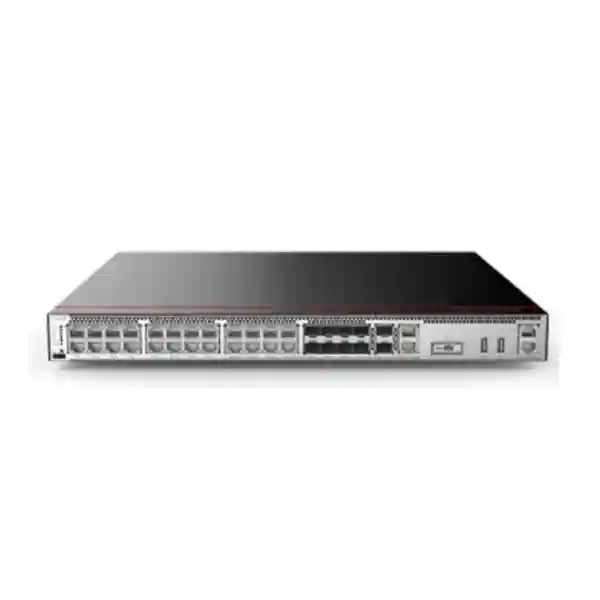
Huawei HiSecEngine USG6560E Firewall in Dubai, UAE
The Huawei HiSecEngine USG6560E is a rack-mount enterprise security gateway built for organizations that need high session capacity, 10 Gigabit uplinks, integrated next-generation firewall inspection, secure site-to-site connectivity, remote-access services, application visibility, policy control and high-availability design in one platform. For UAE businesses, the appliance is particularly relevant to Internet-edge modernization, branch aggregation, campus perimeter security, server-segment protection and multi-site VPN projects where predictable throughput and interface density matter as much as security depth.
FourTeck approaches the USG6560E as an engineering project rather than a box-only purchase. Correct sizing requires examining real traffic, encrypted traffic percentage, security services, concurrent sessions, SSL inspection requirements, VPN encryption, WAN diversity, logging, retention, redundancy and the expected growth period. The result should be a firewall design that remains usable after IPS, antivirus, URL filtering, application awareness and operational reporting are enabled—not a design based only on headline Layer 3 forwarding numbers.
Published IPv4 firewall figure for 1518-byte and 512-byte UDP test traffic; production sizing must account for enabled inspection services and traffic mix.
A strong baseline for busy enterprise edges, large user populations and application environments with many simultaneous flows.
Documented AES-256 plus SHA-256 throughput using 1420-byte packets, suitable for evaluating encrypted branch and partner connectivity.
Supports higher-speed uplinks toward core switching, aggregation, server zones or high-capacity service-provider handoffs.
Direct Answer: What Is the Huawei HiSecEngine USG6560E?
The Huawei HiSecEngine USG6560E is an enterprise next-generation firewall from the USG6000E generation. It combines stateful firewalling, application identification, intrusion prevention, antivirus, URL filtering, data filtering, anti-DDoS controls, user authentication, VPN, routing, bandwidth management, logging and high-availability functions on a 1U appliance. The hardware platform provides a dense fixed port arrangement—2 × 10GE SFP+, 8 × GE Combo, 16 × GE RJ45 and 2 × GE WAN—plus dedicated management and console access, USB connectivity and optional local SSD storage. Its architecture was designed to accelerate pattern matching and cryptographic workloads so that security inspection and IPSec services can be handled more efficiently than on a general-purpose forwarding platform alone.
For a Dubai or wider UAE deployment, the USG6560E can function as an Internet-edge firewall, branch or regional aggregation security gateway, VPN concentrator, inter-zone segmentation firewall, server-edge control point or secure gateway between corporate networks and external partners. It is not automatically the right size for every business. A 6 Gbit/s headline firewall number does not mean 6 Gbit/s of fully inspected traffic under every service combination. Huawei’s documented full-protection figures are materially lower when service awareness, intrusion prevention, antivirus and URL filtering operate together. That distinction is essential when replacing an older firewall or sizing for a high-speed UAE broadband or leased-line connection.
FourTeck therefore treats the USG6560E specification as the starting point. The project design should map each security service to the customer’s actual traffic pattern, identify what portion of traffic is TLS encrypted, calculate current and future session load, define IPSec and SSL VPN needs, determine whether active/standby or active/active resilience is appropriate, and validate optics, transceivers, cabling and upstream switching. This engineering-first method helps avoid purchasing a firewall that looks adequate on paper but becomes the bottleneck after inspection profiles are enabled.
Published USG6560E Performance Baseline
| Metric | USG6560E Published Value | Engineering Interpretation |
|---|---|---|
| IPv4 firewall throughput | 6 / 6 / 1.5 Gbit/s for 1518 / 512 / 64-byte UDP | Packet size changes the achievable packet-processing rate; small packets are more demanding. |
| IPv6 firewall throughput | 6 / 6 / 1.6 Gbit/s for 1518 / 512 / 84-byte UDP | Useful where dual-stack networks or public IPv6 services are part of the migration plan. |
| Firewall packet rate | 2.25 Mpps | Important for workloads containing many small packets rather than only large file transfers. |
| Firewall + service awareness | 3 Gbit/s | Shows the effect of adding application/service classification to firewall processing. |
| Firewall + service awareness + IPS | 2.2 Gbit/s | A more realistic checkpoint for enterprises that intend to inspect attacks rather than permit basic stateful forwarding only. |
| Firewall + SA + IPS + antivirus | 2.2 Gbit/s | Relevant when layered threat prevention is enabled for Internet-bound and inbound traffic. |
| Full protection | 1.7 Gbit/s | Published test combines firewall, service awareness, IPS, antivirus and URL filtering. |
| Full protection, enterprise mix | 0.9 Gbit/s | A critical figure for sizing because mixed enterprise traffic behaves differently from fixed-size benchmark streams. |
| Concurrent sessions | 4,000,000 | Supports busy user populations, branch aggregation and service environments with high simultaneous flow counts. |
| New sessions per second | 80,000 | A sizing factor for transactional applications, web farms and environments creating many short-lived connections. |
| IPSec VPN throughput | 3 Gbit/s | Published with AES-256 + SHA-256 and 1420-byte traffic; real designs must include encapsulation, latency and traffic distribution. |
| Maximum IPSec tunnels | 4,000 gateway-to-gateway and 4,000 client-to-gateway | Useful for large partner, branch and remote connectivity designs, subject to license and software validation. |
| SSL inspection throughput | 500 Mbit/s | A major constraint when deep inspection of encrypted web traffic is required across a large user population. |
| SSL VPN throughput | 480 Mbit/s | Remote-access designs should consider user concurrency, application behavior and Internet latency in addition to raw throughput. |
These figures are engineering reference points, not guaranteed production results. Huawei documentation states that performance testing is conducted under defined laboratory conditions and that actual results vary with the deployment environment. Service combinations, traffic profile, TLS use, object sizes, enabled signatures, policy complexity and logging behavior all influence practical capacity.
Hardware Architecture and Interface Density
The USG6560E uses a 1U chassis measuring approximately 44 × 442 × 420 mm in product literature. That compact rack footprint makes it straightforward to place at the perimeter of a server room, campus distribution layer or branch aggregation cabinet while retaining enough fixed interfaces to avoid dependence on add-on port cards for common deployments. The fixed interface set is particularly notable: two 10GE SFP+ ports, eight GE Combo interfaces, sixteen additional GE Ethernet interfaces and two GE WAN interfaces. A Combo interface gives the network designer flexibility to use either an electrical or optical physical presentation for the corresponding logical interface, which is useful where some zones terminate on copper access switching and others arrive through fiber distribution.
The two 10GE SFP+ ports are valuable for uplinks toward a campus core, data-center aggregation switch, virtualized server environment or higher-speed provider handoff. They can also be incorporated into redundant northbound and southbound designs where traffic must cross the firewall without forcing high-volume internal flows through 1 Gigabit bottlenecks. In practice, however, interface speed and inspection speed should not be confused. A 10GE port can carry a 10 Gigabit physical link, but the inspection stack and active security services determine how much protected application traffic can be processed. FourTeck therefore separates physical topology planning from security-capacity planning.
The platform also includes a dedicated GE RJ45 management interface and console access for out-of-band administration. This matters during commissioning and incident recovery. A proper enterprise design should keep management access logically separated from user traffic, apply access controls to the management plane, use a restricted administrator network, synchronize time with trusted NTP sources and forward logs to the organization’s logging or security-monitoring system. USB connectivity can support operational tasks, while optional local M.2 SSD storage—documented in 64 GB or 240 GB options for the platform generation—can be used where local storage functions are required.
For reliability planning, product documentation lists single AC power as the basic arrangement with optional dual AC power modules, enabling a 1+1 redundancy approach. In a UAE data room, redundant power is only fully useful when each firewall power module is connected to separate protected power paths, such as independent UPS-backed PDUs. Connecting both power supplies to the same outlet strip eliminates much of the resilience benefit. The same principle applies to upstream switches, provider circuits and HA peers: redundancy should remove common points of failure rather than duplicate components behind the same dependency.
2 × 10GE SFP+
Use for high-capacity uplinks, fiber aggregation, core connectivity, server-side trunks or designs where a 10 Gigabit physical handoff is required.
8 × GE Combo
Offers deployment flexibility between supported copper and optical Gigabit connectivity without consuming separate dedicated port groups for each media type.
16 × GE RJ45
Provides dense copper connectivity for DMZs, internal zones, access switches, partner links, management systems and segmented enterprise services.
2 × GE WAN
Can simplify dual-provider or dedicated WAN connectivity where carrier or edge devices deliver standard Gigabit Ethernet handoffs.
Why the Security Acceleration Architecture Matters
The USG6560E generation was built around an architecture that uses network processing resources based on ARM technology and provides acceleration for pattern matching and encryption/decryption workloads. Those two workload classes are central to next-generation firewall performance. Pattern matching is used extensively by intrusion prevention, application identification, content controls and malware-related inspection. Cryptographic processing is required by IPSec, SSL VPN and encrypted-traffic workflows. When these functions are handled efficiently, the security gateway can maintain more predictable service while performing inspection that would otherwise consume a large share of general processing resources.
For procurement teams, “hardware acceleration” should not be treated as a marketing checkbox. Its practical value appears when multiple services run simultaneously. A stateful firewall only needs to evaluate connection state and policy. An NGFW policy may also classify the application, authenticate the user, decrypt eligible TLS traffic, inspect it against IPS signatures, scan content for malware, evaluate URL category, apply bandwidth rules, log the event and possibly route the session through a chosen uplink. Each additional operation adds processing cost. This is why security-throughput figures, SSL inspection throughput and session capacity provide a more useful design view than raw forwarding alone.
The USG6560E is therefore best evaluated against a defined service stack. A customer using only basic firewalling and IPSec will have a very different capacity profile from a customer enabling antivirus, IPS, URL filtering, application control and TLS inspection for most Internet traffic. FourTeck’s sizing process documents those differences before the bill of materials is finalized, reducing the risk of discovering capacity constraints after deployment.
Integrated Firewall and Policy Control
At its foundation, the USG6560E is a stateful firewall that organizes interfaces into security zones and controls sessions according to policy. The platform can build policies using attributes such as source and destination addresses, service or protocol, security zones, time ranges, application information, user identity, URL categories and other contextual criteria supported by the software release and license set. This allows an enterprise to move away from broad “inside-to-outside permit” rules toward policies that express business intent: finance users may access defined SaaS platforms, guest networks may reach the Internet but not internal resources, server zones may accept only published services, and administrators may access infrastructure only from dedicated management networks.
Good policy design is as important as appliance capacity. Over time, firewall rulebases often accumulate temporary exceptions, duplicate objects, overlapping networks and “any” services. This increases operational risk and makes incident investigation slower. A USG6560E rollout is an opportunity to normalize objects, map rules to owners, remove obsolete access, define naming conventions and create a repeatable change-control process. During migration, FourTeck can translate existing policy intent while also identifying areas where old rules should be validated rather than copied blindly.
The platform supports transparent, routed and hybrid deployment modes, so it can be integrated into both new designs and existing networks. Routed mode is common where the firewall terminates Layer 3 networks and participates in routing. Transparent mode is useful when security inspection must be introduced without a major addressing redesign. Hybrid approaches can combine behaviors for complex environments. The selected mode affects troubleshooting, HA design, routing convergence and cutover planning, so it should be agreed early in the implementation.
Application Identification and Control
Traditional firewalls identify traffic mainly by IP address and transport port, but modern applications routinely use shared web ports, dynamic endpoints and cloud-hosted infrastructure. The USG6560E platform adds application awareness so policies can be tied more closely to the service being used. Huawei documentation for this generation describes identification of more than 6,000 applications and access-control granularity down to application functions. The operational benefit is visibility: administrators can understand which applications consume bandwidth, which cloud services are active, where risky or unsanctioned applications appear and whether business-critical tools receive the expected network priority.
Application control becomes more effective when combined with identity, IPS, antivirus and URL filtering rather than deployed as an isolated feature. For example, a policy can allow a collaboration platform for corporate users while restricting unrelated high-bandwidth consumer applications during business hours. Another policy can permit a cloud storage service but subject uploads to content controls. Branch locations can receive a common application policy while local exceptions remain tightly scoped. This consistency is valuable for UAE organizations with offices in Dubai, Abu Dhabi, Sharjah or other emirates because operational rules can be standardized without requiring each branch to develop independent security logic.
Application identification is not a replacement for capacity planning. Classification itself consumes resources, and deeper inspection may be needed to distinguish applications that share encrypted channels. Teams should determine which traffic really requires detailed identification and where exclusions are justified for privacy, performance or certificate-pinning reasons. A well-designed policy stack prioritizes visibility where it adds measurable security or operational value.
Intrusion Prevention
IPS examines traffic for exploit patterns and attack behavior associated with known vulnerabilities. Effective use requires current signatures, tuned policies, sensible severity handling and change management so that high-value protections can block while lower-confidence events are monitored and validated.
Antivirus
Gateway antivirus adds another inspection layer for supported transferred content. It should complement endpoint security and email/web protections rather than be treated as a replacement for them, because threats can enter through many channels beyond the perimeter firewall.
URL Filtering
Category-based web controls help organizations apply acceptable-use rules, limit known-risk destinations and create differentiated browsing policies for corporate, guest, education, operations or contractor networks.
Anti-DDoS Controls
Built-in controls can mitigate common flood and malformed-traffic patterns at the enterprise edge. Large volumetric attacks may still require upstream ISP or dedicated DDoS mitigation because traffic that saturates the carrier circuit cannot be solved only by an on-premises appliance.
Intrusion Prevention for Enterprise Traffic
The intrusion prevention capability is designed to detect and block vulnerability exploitation and malicious traffic using continuously maintained threat intelligence and signature databases. For an enterprise deployment, the important question is not simply whether IPS exists but how it is applied. Internet-facing server policies, outbound user traffic, partner connections and internal segmentation paths have different risk profiles. Applying the same aggressive IPS profile everywhere can create unnecessary false positives, while using only passive detection on exposed services may fail to stop known exploitation. A proper policy uses the business function of each zone to determine the inspection depth and blocking behavior.
IPS tuning should begin with asset context. If a DMZ hosts Windows web servers, signatures relevant to those services deserve more attention than attack categories that cannot affect the environment. If industrial or specialized systems are present, change windows and sensitivity to connection resets must be considered. Where possible, start with a controlled observation phase, review high-severity detections, confirm normal application behavior and then move validated protections into blocking mode. This reduces disruption while still improving the prevention posture.
Updates are also critical. Buying an IPS subscription and leaving update connectivity unverified can create a false sense of protection. The implementation checklist should confirm DNS resolution, Internet reachability for update services, time synchronization, subscription state and update scheduling. Change records should document major profile adjustments so that future troubleshooting can distinguish application changes from security-policy changes.
Antivirus, URL Filtering and Content Controls
Gateway antivirus provides content-level scanning for supported traffic and file types. Huawei documentation for the USG6560E generation describes large signature databases and frequent update cycles. In a practical security architecture, gateway scanning reduces exposure to known malware crossing inspected channels, but it should operate alongside endpoint detection and response, secure email, identity protection and backup controls. Encrypted traffic complicates the picture because the firewall cannot inspect the payload of a TLS session unless that session is decrypted or another telemetry method provides useful detection signals.
URL filtering adds policy based on website classification rather than only destination IP address. This is useful because large web services frequently change infrastructure or share hosting platforms. A category policy can block known malicious or inappropriate categories, restrict newly observed risk classes, and permit business categories while retaining audit visibility. Different user groups can receive different profiles. A contractor VLAN may receive a narrow Internet policy, while corporate users receive a broader policy governed by identity and business role.
Data filtering and data-leak prevention capabilities can inspect supported file content and types. These controls are most effective when the organization first identifies what data it is trying to protect. Without a classification model, broad content rules can generate excessive noise. For UAE enterprises handling customer records, financial documents, engineering information or internal contracts, the firewall can contribute to layered data controls, but the rules should align with endpoint permissions, cloud storage policies, email security and business processes.
Encrypted Traffic and SSL Inspection
Most modern web traffic is encrypted, which means an NGFW can often see the destination, certificate information and connection metadata but not the application payload unless TLS inspection is performed. The USG6560E’s documented SSL inspection throughput is 500 Mbit/s under the vendor’s defined test conditions. That number is substantially lower than the raw firewall figure and is one of the most important sizing checkpoints for organizations planning broad HTTPS decryption. If an office has a 1 Gbit/s Internet circuit and intends to decrypt nearly all user browsing, the SSL inspection requirement may determine the practical ceiling before basic firewall throughput does.
TLS inspection also requires certificate and endpoint planning. For outbound inspection, corporate endpoints generally need to trust the enterprise inspection certificate so that the firewall can establish controlled intermediary TLS sessions without generating browser errors. BYOD, contractor devices, unmanaged endpoints and certificate-pinned applications may require exclusions or separate network treatment. Sensitive categories such as banking, healthcare portals or personally private services may also be excluded according to organizational policy and legal guidance. These exceptions should be explicit and documented rather than created reactively when users report failures.
The operational workflow should include certificate expiry monitoring, backup of keys according to security policy, testing of major browser and application updates, and capacity monitoring after deployment. TLS versions and cipher use evolve over time, so a design that worked at initial rollout should be reviewed periodically. The aim is not to decrypt everything indiscriminately; the aim is to inspect the traffic where the security benefit justifies the operational and privacy impact.
Huawei documentation also describes cooperation with broader security analytics for identifying threats in encrypted traffic without always decrypting the payload. Such capabilities can add useful context, but they do not eliminate the need to understand what the local appliance can inspect directly. FourTeck’s design process separates metadata-based detection, decryption-based inspection and upstream/downstream telemetry so that expectations remain realistic.
IPSec VPN for Branches, Partners and Hybrid Connectivity
The USG6560E supports IPSec VPN for encrypted site-to-site and client-to-gateway use cases, with a published 3 Gbit/s IPSec performance figure under a defined AES-256 and SHA-256 test profile. For UAE organizations connecting headquarters with branches, warehouses, retail locations, remote offices or partner networks, IPSec can provide secure overlays across Internet or carrier services. The platform supports large tunnel counts, making it suitable for aggregation scenarios where many smaller sites terminate on a central firewall pair.
Good VPN design begins with routing and failure behavior. A tunnel that comes up is not enough; the design must define which networks are reachable, how overlapping subnets are handled, how traffic fails over when one ISP is lost, and whether dynamic routing should operate through the encrypted overlay. Where branches have two Internet links, engineers should decide whether to build parallel tunnels, use route tracking, use policy-based selection or integrate the firewall with a wider SD-WAN architecture. Monitoring must distinguish tunnel state from end-to-end application reachability because a tunnel can remain established while the remote LAN or service is unavailable.
Cryptographic settings must also be standardized. Legacy algorithms should not be retained merely because they were present in an old configuration. During migration, peer capabilities should be inventoried and proposals updated to current organizational standards. Key lifetimes, authentication, certificate use, pre-shared key handling, perfect forward secrecy and logging should be documented. For partner VPNs, each tunnel should have an owner and business purpose so that unused connections can be removed rather than becoming permanent unmanaged access paths.
SSL VPN and Remote User Access
The platform supports SSL VPN remote access, with documentation listing 100 concurrent users as a default level and up to 1,000 for the USG6560E generation, subject to the appropriate licensing and software support. Published SSL VPN throughput is 480 Mbit/s under defined conditions. Remote-access sizing should not be based on the user count alone. Ten engineers moving large design files can consume more throughput than hundreds of users accessing lightweight business applications. Authentication methods, MFA integration, endpoint posture, split tunneling, DNS handling and application access models also shape the design.
A secure deployment should prefer identity-based least privilege. Remote users should receive only the networks and applications required for their role instead of broad access to the internal address space. Administrative access should use separate profiles, stronger authentication and tighter source controls. Logging should record successful and failed authentication, assigned addresses, session duration and policy decisions. Remote DNS should resolve internal applications correctly without accidentally leaking corporate name queries to public resolvers.
Capacity planning should consider emergency scenarios as well as normal usage. A company may have only a small daily remote workforce but need several hundred users to connect during a business-continuity event. Licensing, authentication infrastructure, Internet bandwidth and backend application capacity all need to support that peak. FourTeck can include these conditions in the quotation checklist so the remote-access service is sized to the actual continuity requirement rather than to an average weekday.
Routing, Multi-WAN and Uplink Selection
The USG6560E supports enterprise routing functions including static routing and dynamic protocols such as OSPF, BGP, IS-IS and their IPv6-related variants depending on software configuration. This allows the firewall to participate directly in a routed campus, connect to multiple service providers, advertise protected networks and exchange reachability with internal cores. Whether the firewall should run dynamic routing is a design decision. Small sites may benefit from simple static routes, while larger headquarters environments often need dynamic convergence and clearer failure handling.
Multi-WAN environments require more than two default routes. The design should define preferred links by application, health-check targets, failback behavior, NAT rules, inbound service publishing and asymmetric-routing avoidance. If public services are hosted behind the firewall, ISP failover may require DNS or BGP changes beyond the firewall itself. If SaaS traffic should prefer a low-latency DIA circuit while backup traffic uses another provider, application-aware policy-based routing can be part of the solution.
Huawei documentation describes intelligent uplink selection and service-specific policy-based routing based on factors such as bandwidth ratio and link health. These capabilities can help use multiple Internet circuits more effectively, but they should be tested against the customer’s real provider behavior. Health probes must detect meaningful service failure rather than only local interface state. A provider Ethernet handoff can remain electrically up even when upstream Internet reachability has failed.
High Availability: Active/Standby and Active/Active
The USG6560E generation supports high-availability architectures including active/standby and active/active modes. For most enterprise Internet-edge projects, active/standby is attractive because it provides a clear primary forwarding path and simpler operational expectations. A paired firewall design can synchronize relevant state so that a hardware or path failure moves traffic to the peer with reduced disruption. Active/active can be appropriate in specific topologies but requires more careful traffic symmetry, session ownership and upstream/downstream design.
HA must be engineered across the whole path. Two firewalls connected to one access switch and one ISP router do not create end-to-end resilience. A robust design considers separate upstream switch members, redundant core paths, independent HA interconnects where required, dual power feeds, diverse ISP connections and monitoring of critical dependencies. The failover test plan should simulate power loss, interface failure, upstream route loss and peer failure. The objective is to validate business service continuity, not only to see the secondary firewall change state.
Maintenance procedures also benefit from HA. Firmware upgrades, hardware replacement and policy changes can often be handled with lower disruption when a healthy peer carries traffic. However, redundancy does not replace backups. Before significant changes, administrators should export configuration, document software versions, record license status and verify rollback options. Planned maintenance should include a clear decision point for returning traffic to the original node if unexpected behavior appears.
User Authentication and Identity-Aware Security
The firewall supports multiple authentication methods such as local authentication, RADIUS, HWTACACS, Active Directory and LDAP integration, depending on the deployed software and environment. Identity integration allows policy to move beyond device addresses. Instead of permitting an IP subnet simply because it belongs to an office floor, the security team can create rules that align access with user groups or organizational roles. This is especially useful in environments with DHCP, shared workspaces, wireless mobility and hybrid users where IP addresses alone are poor indicators of business identity.
Identity-aware controls should be designed for failure conditions. If the directory or authentication server is unavailable, administrators need to know whether existing sessions continue, whether new users fail closed, and how emergency access is handled. Service accounts and infrastructure devices may require address-based policies because they do not participate in interactive authentication. The design should also avoid putting excessive authentication dependencies in front of critical infrastructure services such as DNS, NTP or directory replication.
Administrative identity deserves separate treatment from user access. Firewall administrators should have named accounts, role-based privileges, centralized authentication where appropriate and a controlled break-glass mechanism. Shared administrator credentials undermine auditability. Management access should be restricted by source network, encrypted protocols should be used, and configuration changes should be logged so that operations teams can trace what changed and when.
Security Virtualization and Segmentation
The USG6560E documentation lists support for up to 100 virtual firewalls for the model generation. Security virtualization can separate policies, administrative domains and security services on one physical platform. This is useful for managed environments, multi-department networks, shared infrastructure or organizations that need clear separation between operational units. It can also support staged consolidation where multiple smaller security contexts are brought onto a centralized appliance pair.
Virtualization does not create unlimited hardware capacity. All virtual contexts ultimately share CPU, memory, interfaces and inspection resources. A design with many low-traffic virtual firewalls may operate comfortably, while a small number of high-throughput contexts can consume most of the platform. Capacity planning should therefore assign expected bandwidth, session counts, policy complexity and logging requirements to each virtual domain. Governance is equally important: administrators need to know who owns each context and who is authorized to modify shared interfaces or system-level settings.
For straightforward corporate segmentation, separate security zones and VLAN interfaces may be simpler than full virtual-firewall separation. Virtualization is most valuable when there is a strong operational or administrative need for tenant-like boundaries. FourTeck can help determine whether virtual firewalls, conventional zones or separate physical appliances provide the cleanest design for the project.
Logging, Reporting and Centralized Operations
A firewall only provides lasting security value if its events are reviewed and its health is monitored. The USG6560E supports logging and can integrate with centralized systems using common management and telemetry methods such as Syslog, SNMP, SSH and NETCONF-related interfaces depending on the target architecture. Huawei’s ecosystem for the platform generation also includes centralized configuration, logging, monitoring and reporting products. The choice of platform should reflect the customer’s existing operations model rather than forcing a parallel monitoring stack without a clear need.
Logging volume can be significant. If every accepted session is logged at high detail, storage and SIEM ingestion may grow rapidly. Policies should define which events need full logging, which threat events need immediate alerting and which routine traffic can be summarized. Time synchronization is non-negotiable because incident timelines become difficult to reconstruct when firewalls, servers and identity systems disagree on time. NTP should be redundant and restricted to trusted sources.
Optional local SSD storage can support local functions, but organizations should not rely only on the firewall itself as the long-term evidence store. A hardware failure or compromise can make local logs unavailable. Important events should be forwarded to a separate system with retention aligned to operational, contractual and regulatory requirements. Log access should itself be controlled because firewall records can reveal internal addressing, user names, destinations and security incidents.
Operational dashboards should focus on actionable indicators: interface utilization, CPU and memory trends, session count, session setup rate, dropped traffic, IPS and malware events, VPN state, HA status, update status and certificate expiry. Trend data is especially useful because it shows when the device is approaching a capacity threshold before users experience outages.
Deployment Scenario 1: UAE Headquarters Internet Edge
A common use case is a Dubai or UAE headquarters with one or two Internet circuits, a core switch stack, corporate user VLANs, guest wireless, voice systems, servers and cloud applications. The USG6560E can sit between the internal core and provider edge, applying security policies to north-south traffic. Ten-Gigabit SFP+ interfaces can connect to the core even when the Internet circuits themselves are 1 Gigabit, preventing the firewall-to-core link from becoming an unnecessary constraint and allowing multiple internal zones to aggregate efficiently.
In this scenario, security policies should separate corporate users, guest networks, server DMZs, IT management and any specialized operational systems. Outbound corporate traffic may use application control, IPS, antivirus and URL filtering. Guest traffic may receive simpler controls and strict isolation from internal networks. Published inbound services should have dedicated NAT and security rules, with IPS tuned to the server applications. Administrative access to the firewall should come only from a management network.
If two ISPs are present, health tracking should verify real upstream reachability and not merely interface status. If the site hosts public applications, the failover plan must account for public addressing and DNS. If remote branches terminate IPSec tunnels on the same firewall pair, failover testing must include tunnel re-establishment and route convergence. This scenario illustrates why the firewall is part of a system design rather than an isolated product.
Deployment Scenario 2: Branch Aggregation and VPN Hub
Organizations with many branches can use the USG6560E as a central IPSec termination point. Retail chains, logistics operators, education groups, healthcare networks and distributed service companies often need to connect dozens or hundreds of sites to central applications. The firewall’s session capacity and documented VPN tunnel scale provide room for this architecture, but the design must account for aggregate encrypted throughput and traffic patterns. If every branch sends Internet traffic through headquarters, the hub must process both branch-to-data-center and branch-to-Internet flows. Local Internet breakout at branches changes that requirement substantially.
The hub design should standardize branch address plans and avoid overlapping networks. Repeated 192.168.1.0/24 subnets at many sites create routing and NAT complexity. Where renumbering is impossible, translation can be used, but it increases operational overhead. Dynamic routing across tunnels may simplify large deployments, while smaller networks may use static summaries. Each branch should have a clear failover model, especially if dual broadband, LTE backup or secondary leased circuits are available.
Monitoring should report branch tunnel health, packet loss, latency and application reachability. A green tunnel icon does not prove that users can reach the ERP, voice service or cloud gateway. FourTeck can integrate branch validation into the commissioning checklist so that the outcome is measured from the application perspective.
Deployment Scenario 3: Internal Segmentation Firewall
The USG6560E can also be positioned inside the network to control east-west traffic between user, server, management and specialized zones. Internal segmentation reduces the blast radius of compromised endpoints by requiring sensitive traffic to cross policy boundaries. For example, user networks may access application front ends but not database servers; printers may reach print services but not administrative systems; building-management devices may be restricted to defined controllers; backup networks may communicate only with protected storage and servers.
Internal segmentation can generate higher throughput than Internet-edge use because traffic between local systems may run at LAN speed. This is where the difference between 10GE physical interfaces and security inspection capacity becomes especially important. If several multi-gigabit east-west flows are expected, engineers must decide which traffic needs deep inspection and whether the platform has enough security throughput for the aggregate. Sometimes a larger firewall family is more appropriate even when the Internet circuit is modest.
The design should also minimize asymmetric routing. If a session enters the firewall in one direction but the return path bypasses it, stateful inspection may fail. Core routing, VRFs, VLAN gateways and HA topology must therefore be designed together. A migration plan can move one segment at a time through the firewall, reducing cutover risk while allowing policy validation.
How FourTeck Sizes the USG6560E
Sizing begins with measured traffic, not only contracted circuit bandwidth. A 1 Gbit/s Internet line may average 200 Mbit/s but burst near full capacity during backups, software distribution or cloud synchronization. Conversely, a 2 Gbit/s circuit may rarely exceed 400 Mbit/s. Firewall capacity should cover business-relevant peaks with headroom, but the chosen headroom must be economically sensible. FourTeck asks for interface graphs, peak usage, session counts and growth expectations where available.
The second step is the service stack. Basic stateful inspection uses less capacity than IPS plus antivirus plus URL filtering. TLS decryption introduces another major workload and is usually sized separately. Remote-access VPN and site-to-site encryption consume cryptographic resources. Logging and policy complexity can also affect operations. We therefore create a target profile such as: 1 Gbit/s Internet, 65 percent encrypted web traffic, IPS on corporate browsing, antivirus on supported downloads, URL filtering, 150 Mbps branch VPN traffic, 120 remote users during peak periods and 30 percent growth over three years. That profile is far more useful than asking whether a firewall “supports 6 Gbps.”
The third step is session behavior. Environments with many SaaS applications, mobile devices, web APIs or transactional services can create large numbers of short-lived sessions even when bandwidth is moderate. The USG6560E’s 4 million concurrent-session and 80,000 new-session-per-second figures provide a substantial baseline, but actual counters from the existing firewall help validate whether session scale is likely to be a constraint.
Finally, the design includes failure conditions. If two firewalls run in HA, either unit may need to carry the full production load during maintenance or failure. If two Internet lines normally share traffic, one surviving circuit may receive all sessions when the other fails. Capacity must therefore be checked against degraded-mode operation, not only the normal balanced state.
A Practical Throughput Sizing Example
Consider a UAE headquarters with a 1 Gbit/s primary Internet circuit and a 500 Mbit/s secondary circuit. Normal peak traffic reaches 700 Mbit/s. The security policy enables application identification, IPS, antivirus and URL filtering for corporate traffic. Approximately 75 percent of sessions are encrypted, but the organization plans to decrypt only a selected subset representing about 250 Mbit/s at peak. There are 600 users, 45 branches connected through IPSec, and up to 180 remote-access users during a continuity event.
For this customer, the raw 6 Gbit/s firewall figure is not the key number. The documented enterprise-mix full-protection figure of 0.9 Gbit/s is closer to the intended service stack, and the 500 Mbit/s SSL inspection figure is relevant because selective decryption may peak at 250 Mbit/s. The 3 Gbit/s IPSec capability appears comfortable for the branch load if aggregate encrypted traffic remains moderate. Session scale is also likely to be adequate if measured current values are well below the documented limit. However, the design should still preserve growth headroom and account for all traffic moving to one firewall during HA operation.
If the same organization instead planned to decrypt 1 Gbit/s of HTTPS and inspect that traffic deeply, the SSL inspection figure would immediately change the recommendation. A larger or newer platform could be more suitable. This example demonstrates why FourTeck does not select firewalls from Internet speed alone.
Licensing and Security Subscription Planning
The USG6560E hardware can provide routing, stateful firewall and VPN capabilities, while advanced security functions and update services may depend on licenses or subscriptions. Historical ordering information for the model generation includes subscriptions for IPS updates, URL filtering updates, antivirus updates, threat-protection bundles, cloud sandbox inspection, flow-probe functionality and expanded SSL VPN user counts. Because product packaging, regional entitlement and support availability can change over time, the exact bill of materials should be validated against the required feature set at quotation time.
The safest approach is to list required outcomes rather than ask only for “full license.” For example: IPS with signature updates for three years, antivirus update service, URL category service, 500 concurrent SSL VPN users, required cloud analysis integration and vendor support coverage. FourTeck can then map those requirements to the applicable part numbers and subscription terms. This avoids both under-licensing and purchasing services that the organization does not plan to use.
Renewal dates should be recorded in the asset-management system. Security services that depend on current threat data lose value when subscriptions expire. Administrators should receive alerts well before renewal and confirm update status periodically. License planning should also align with HA; both members of a redundant pair must have the required entitlements for the intended design.
Storage, Local Reporting and Log Retention
The USG6560E hardware generation supports optional M.2 SSD storage, historically documented in 64 GB and 240 GB capacities for the relevant platform. Local storage can support device-level reporting, logging and related operational functions depending on software configuration. For projects that require onboard retention, the SSD should be included deliberately in the bill of materials rather than assumed to be present in the base chassis.
Storage sizing depends on event volume. An Internet edge serving hundreds of users can generate large numbers of session, URL, IPS and VPN records. Retention needs are usually better met by centralized logging because it provides more capacity, search, correlation and resilience. Local storage remains useful for short-term troubleshooting and appliance functions, but long-term security operations benefit from forwarding logs to a SIEM, syslog cluster or centralized Huawei management environment.
If an SSD is installed, operations teams should monitor its status and follow vendor procedures for replacement. Hardware service processes should include configuration backups and verification that critical logs are already exported. The firewall should never be the only repository for evidence required during an incident investigation.
Migration from an Existing Firewall
A firewall replacement is not simply a configuration copy. Different vendors represent objects, NAT, zones, application controls and VPN proposals differently. The first migration task is to inventory the current environment: interfaces, VLANs, routes, address objects, service objects, NAT rules, security policies, VPNs, authentication integrations, public certificates, logging destinations and management access. The team should also identify rules that have not been used recently and temporary exceptions that may no longer be required.
Policies should then be translated by business intent. A rule named “TEMP-ALLOW-ANY” may technically permit traffic, but copying it to the new firewall preserves an unknown risk. The migration workshop should determine who owns the rule, what application it supports, which sources and destinations are actually needed and whether the access can be narrowed. This creates a cleaner rulebase and reduces troubleshooting after cutover.
The cutover plan should include a port map, cable labels, old-to-new interface mapping, routing changes, NAT validation, VPN peer coordination and rollback steps. Public DNS or ISP routing changes may need external coordination. If an HA pair is being deployed, both nodes should be configured and synchronized before traffic moves. During the maintenance window, engineers should validate Internet browsing, DNS, SaaS access, inbound publishing, partner VPNs, branch connectivity, remote access, email flow and critical business applications.
After cutover, monitoring should continue through the next business peak. Some issues appear only when large user groups return, scheduled backups run or less common applications are used. A structured post-migration review captures those findings and closes temporary rules created during troubleshooting.
UAE Data Room and Environmental Considerations
The USG6560E is a 1U rack appliance intended for controlled equipment environments. Product documentation lists an operating temperature range of 0°C to 45°C and relative humidity from 5 percent to 95 percent non-condensing. In UAE installations, the device should be placed in an air-conditioned communications or server room with stable airflow and clean power. The fact that the published operating range reaches 45°C does not make sustained high-temperature operation desirable; cooling margin supports component life and gives the site time to respond to an air-conditioning problem.
Rack planning should preserve front-to-rear airflow and prevent cable bundles from blocking ventilation. Fiber jumpers connected to SFP+ interfaces need correct bend radius and clear labeling. Copper patch leads should be organized so that technicians can replace a power supply, SSD or cable without disturbing unrelated circuits. A proper protective ground connection is an important installation requirement, particularly in environments where electrical disturbances or grounding quality may vary.
Power design should include UPS capacity, PDU load and the desired redundancy model. If dual power supplies are installed, separate UPS-backed feeds are preferable. The monitoring platform should alert on power-module, fan and temperature faults. Environmental sensors in the rack or room can provide an additional early warning if cooling fails outside business hours.
Security Operations After Deployment
A successful firewall project continues after go-live. The first operational routine is health monitoring: CPU, memory, sessions, session setup rate, interface utilization, packet drops, HA state, VPN status, update status and storage health. Thresholds should be based on trends rather than a single momentary spike. If session usage grows steadily each quarter, the team should plan capacity before the platform reaches a critical level.
The second routine is policy review. New projects create firewall requests, but retired systems do not always trigger rule removal. Quarterly or semiannual reviews can identify disabled applications, expired contractors, obsolete partner VPNs and temporary access that should be removed. Policy owners should confirm continued business need. A cleaner rulebase improves security and makes troubleshooting faster.
The third routine is threat-service maintenance. IPS, antivirus and URL databases must update successfully. Administrators should investigate repeated update failures instead of assuming the service is current. Security profiles may also need tuning as applications evolve. A rule that was appropriate two years ago may be too broad today.
Finally, configuration backup and recovery should be tested. Backups should be stored securely outside the appliance, with access limited to authorized administrators. The organization should know how to restore a replacement unit, reapply licenses, recover certificates and return the firewall to service after hardware failure. Documented recovery turns redundancy and support contracts into practical resilience.
When the USG6560E Is a Strong Fit
The USG6560E can be a strong fit where an organization needs a 1U enterprise firewall with dense Gigabit connectivity, 10GE uplinks, millions of concurrent sessions, multi-gigabit basic firewall performance, IPSec VPN acceleration and integrated NGFW services. It is especially relevant when the network has multiple internal zones, a substantial number of branch VPNs or a requirement to consolidate routing and security at the edge. Its interface density can reduce the need for external media conversion in mixed copper and fiber environments.
The model should be evaluated more carefully when the project requires sustained multi-gigabit full-threat inspection, broad high-speed SSL decryption, very high remote-access throughput or a long lifecycle tied to the newest security architecture. In those cases, current-generation alternatives may provide more performance headroom or newer software capabilities. FourTeck can compare the project requirement with available Huawei options before finalizing the purchase.
The correct decision is therefore workload-based. A product can be technically capable yet still be the wrong choice if the inspection profile exceeds its practical throughput. Conversely, a larger platform can be unnecessary if the site’s measured load is modest and growth is controlled. The quotation process should establish the evidence for sizing and record the assumptions so future upgrades can be planned against real data.
Procurement, Availability and Lifecycle Validation
The USG6560E belongs to an established Huawei USG6000E platform generation. When sourcing this model in 2026, customers should validate hardware availability, support entitlement, recommended software release, subscription availability and replacement options as part of the quotation. Availability in reseller channels does not by itself establish the vendor’s lifecycle status or the suitability of the device for a new long-term project. FourTeck therefore treats lifecycle verification as a procurement checkpoint rather than making assumptions from stock listings.
The quote should identify whether the requirement is for a new deployment, expansion of an existing standardized fleet, spare replacement or like-for-like refresh. Those use cases can lead to different recommendations. An organization with dozens of USG6560E units may value configuration consistency and spare compatibility, while a greenfield customer may prefer to evaluate a newer platform family. Support duration and security-service renewability are particularly important when the expected service life is three to five years.
FourTeck can support UAE customers with the commercial and technical checks around the firewall itself. For broader network and infrastructure sourcing, customers can also review FourTeck UAE for local technology solutions, FourTeck Global for cross-market requirements, and FourTeck IT Services UAE for implementation and managed infrastructure support.
Implementation Methodology for Dubai and UAE Customers
FourTeck’s recommended implementation sequence starts with discovery. Engineers document current WAN circuits, routing, VLANs, firewall rules, public services, VPNs, authentication systems, logging platforms and critical applications. Existing utilization data is collected where possible. This baseline allows the new design to be mapped to real operational requirements instead of assumptions.
The design phase converts those findings into an interface map, zone model, routing plan, HA topology, NAT structure, VPN design and security-service profile. It also identifies optics, patching, rack power, management addressing and logging destinations. A migration matrix links each old rule or function to its new equivalent. High-risk changes—such as provider routing, public IP movement or certificate replacement—are flagged for dedicated testing.
During staging, the firewall is upgraded to the approved software level, licensed, hardened and configured before the maintenance window. Administrative access is restricted, time and DNS are configured, threat updates are tested, HA synchronization is verified and monitoring is connected. Policies are loaded in logical groups so engineers can validate them systematically.
Cutover follows a documented sequence with named responsibility for each action. Critical applications are tested first, then user Internet access, remote connectivity, partner VPNs and less common services. A rollback point is defined in advance. After stabilization, temporary migration objects are removed, final configuration is backed up and the customer receives updated network documentation.
For customers seeking specialized firewall supply and deployment assistance, the FourTeck Firewall Dubai team can align product selection, licensing, implementation and support requirements into one project scope.
Technical Design Questions to Resolve Before Ordering
Before a USG6560E is ordered, the project team should answer a structured set of questions. What is the current peak Internet traffic, and what growth is expected over the next thirty-six months? How much traffic will use IPS, antivirus, application control and URL filtering? What percentage of user traffic is TLS encrypted, and how much of it will actually be decrypted? How many concurrent sessions and new sessions per second does the existing firewall observe at peak? How many branch and partner IPSec tunnels are active today, and what is their aggregate bandwidth?
The team should also identify remote-access requirements. How many normal daily users connect, and what is the business-continuity peak? Is MFA required? Will remote users receive full-tunnel or split-tunnel access? Which applications should be reachable? Does the identity system support RADIUS, LDAP or another method appropriate for the design?
Physical design questions matter too. Are the upstream and downstream connections copper or fiber? Which SFP/SFP+ optics are required? Is there enough rack depth and ventilation? Is dual power needed, and are separate UPS-backed feeds available? Will a local SSD be required? How will management access be isolated? Which system receives logs and alerts?
Finally, the customer should define the desired support horizon and lifecycle. If the project is a new deployment expected to operate for several years, confirm that the platform, subscriptions and software support match that period. If the purchase is a spare for an existing estate, compatibility and fast replacement may be the dominant criteria.
Frequently Asked Technical Questions
Does the USG6560E have 10 Gigabit interfaces?
Yes. The documented fixed interface set includes two 10GE SFP+ ports. These are useful for high-speed uplinks, but the security-services throughput of the appliance still governs how much inspected traffic can be processed.
What is the firewall throughput?
Huawei documentation lists 6 Gbit/s for both 1518-byte and 512-byte IPv4 UDP firewall tests and 1.5 Gbit/s for 64-byte traffic. Full-protection throughput is lower because IPS, antivirus, service awareness and URL filtering add inspection workload.
Can it handle a 1 Gbit/s Internet connection?
Potentially, but the answer depends on enabled services. A 1 Gbit/s basic firewall workload is different from 1 Gbit/s of full threat inspection or 1 Gbit/s of SSL decryption. The published enterprise-mix full-protection figure and SSL inspection figure should be compared with the planned policy stack and growth requirement.
How many sessions can it support?
The documented capacity is 4 million concurrent HTTP 1.1 sessions with up to 80,000 new sessions per second under the vendor’s test methodology. Production values depend on traffic and configuration.
Does it support high availability?
Yes. The generation supports active/standby and active/active HA designs. A resilient project should also remove common failures in switching, ISP paths and power.
Does it support IPSec and SSL VPN?
Yes. Published performance includes 3 Gbit/s IPSec VPN and 480 Mbit/s SSL VPN under defined test conditions. User-count expansion and some services may require licenses.
Is an SSD included?
Local M.2 SSD storage is an optional element on this hardware generation. The exact supplied configuration should be confirmed in the quotation if local storage is required.
Decision Recap: Match the Platform to the Workload
The Huawei HiSecEngine USG6560E combines substantial session scale, dense 1GE connectivity, two 10GE SFP+ interfaces, IPSec acceleration and integrated security services in a 1U enterprise appliance. Its published firewall throughput reaches 6 Gbit/s under large and medium packet benchmark conditions, while security-enabled throughput is lower and therefore more meaningful for NGFW projects. The documented 4 million concurrent sessions and 80,000 new sessions per second provide a strong base for busy enterprise edges, while 3 Gbit/s IPSec throughput supports branch and partner VPN architectures.
The most important limitation to understand is the difference between connectivity speed and inspection capacity. Two 10GE interfaces do not mean 20 Gbit/s of deep security inspection. Full-protection and SSL inspection figures must be aligned with the real policy stack. For customers that need selective SSL decryption and sub-gigabit to low-gigabit inspected Internet traffic, the platform may align well when supported by the lifecycle and licensing plan. For customers that require sustained multi-gigabit TLS inspection or major long-term growth, a higher-capacity current-generation firewall should also be evaluated.
A purchasing decision should therefore be supported by traffic evidence, service requirements and support-horizon validation. FourTeck can build the sizing worksheet, confirm the interface and licensing bill of materials, define HA and routing topology and prepare a migration plan before the appliance is installed.
Quotation Input Checklist
- Primary and backup Internet/WAN circuit speeds
- Measured peak and average traffic
- Current concurrent and new-session rates
- Required IPS, antivirus and URL filtering services
- Estimated SSL/TLS inspection volume
- Number of site-to-site IPSec tunnels
- Remote-access VPN users and peak concurrency
- HA requirement: standalone, active/standby or other
- Copper/fiber interface and optic requirements
- Local storage and log-retention requirement
- Preferred subscription term and support duration
- Target installation emirate and maintenance window
What FourTeck Can Scope
- USG6560E hardware and accessory configuration
- IPS, antivirus, URL filtering and VPN licensing
- SFP/SFP+ optic and cabling requirements
- Active/standby high-availability design
- Dual-ISP routing and failover
- Policy migration and cleanup
- IPSec branch and partner VPN migration
- Remote-access architecture
- Logging and monitoring integration
- Rack, power and deployment prerequisites
- Testing, rollback and handover documentation
- UAE onsite or coordinated remote implementation
Consult FourTeck for Huawei HiSecEngine USG6560E in Dubai
Send FourTeck your existing firewall model, Internet speeds, enabled security services, VPN count, user count and expected growth. The engineering team can use those details to determine whether the USG6560E aligns with the workload, what licenses and accessories are required, and whether a higher-capacity or newer Huawei platform should be considered. The objective is a usable production design with documented assumptions, not simply a model recommendation.
For related firewall solutions, visit Firewall Dubai by FourTeck. For broader infrastructure integration, FourTeck IT Services UAE can support network, server, cloud and operational requirements that sit around the security gateway.
Technical Accuracy and Quotation Note
Performance figures on this page are based on documented Huawei USG6560E generation specifications and vendor-defined test conditions. Real throughput can vary with packet size, traffic composition, software release, enabled security services, policy complexity, encryption, signature sets, logging and network design. Exact hardware availability, software support, licensing, subscriptions, accessories and recommended firmware should be confirmed for the UAE project at the time of quotation.
FourTeck recommends validating the final configuration against measured customer traffic and the expected service lifecycle before purchase.

Reviews
There are no reviews yet.