
Enterprise Network Security • Dubai & UAE
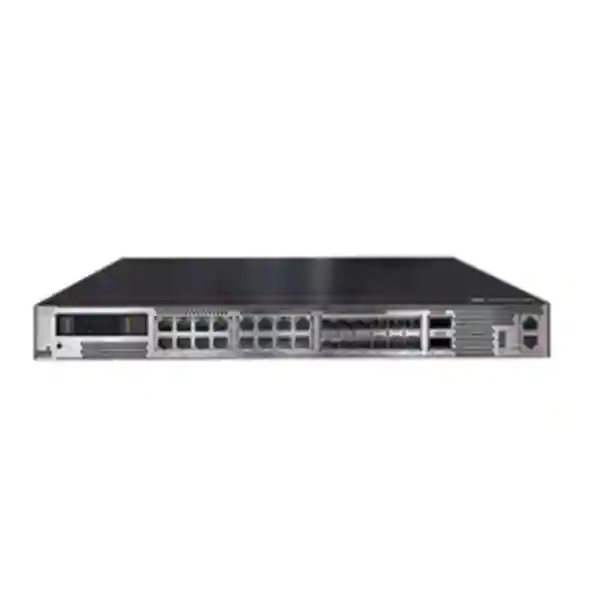
Huawei HiSecEngine USG6630E Next-Generation Firewall
The Huawei HiSecEngine USG6630E is a fixed-configuration 1U firewall platform positioned for enterprise borders, small and midsize data-center edges, high-capacity Internet gateways, encrypted WANs and security consolidation projects. It is designed to combine high packet-processing capacity with application-aware security, intrusion prevention, antivirus, URL control, encrypted-traffic inspection, VPN services, traffic management, routing and high availability in one appliance. For organizations in Dubai and across the UAE, the platform is particularly relevant where 10GE and 40GE uplinks, millions of concurrent sessions, large IPsec deployments and multiple security zones must be handled without moving immediately to a modular chassis architecture.
Direct answer: what is the Huawei HiSecEngine USG6630E?
The USG6630E is an enterprise-class Huawei HiSecEngine/USG6000E family next-generation firewall built for environments that need more than basic stateful access control. In practical terms, it is intended to sit at a high-speed trust boundary and make policy decisions based not only on source, destination, protocol and port, but also on application identity, user context, security intelligence and content inspection. It can be deployed at an Internet edge, between data-center zones, in front of server networks, at a large campus perimeter, or as the VPN headend for branches and remote users.
Huawei’s published USG6600E documentation describes integrated protection that combines firewall, VPN, intrusion prevention, antivirus, data leak prevention, bandwidth management, anti-DDoS functions, URL filtering and related security services. The platform also supports security policy management, routing protocols, high-availability modes and security virtualization. This breadth matters in real projects because a firewall at this performance tier often becomes a service aggregation point. The design therefore has to consider not only raw forwarding speed but also the performance impact of IPS, antivirus, SSL inspection, logging, VPN encryption, application identification and policy scale.
For a Dubai or UAE deployment, FourTeck treats the USG6630E as a solution component rather than a box-only purchase. Before ordering, the required hardware power variant, interface media, optical transceivers, security subscriptions, SSL VPN user count, virtual firewall count, storage option, high-availability topology and support term should be aligned with the actual network. This avoids two common procurement errors: buying enough physical port capacity but too little licensed security capability, or selecting a security subscription and VPN scale that does not match the traffic profile the appliance will inspect.
Verified performance profile and sizing context
| Metric | USG6630E published figure |
|---|---|
| IPv4 firewall throughput | 30/30/30 Gbit/s for 1518/512/64-byte UDP test frames |
| IPv6 firewall throughput | 30/30/8 Gbit/s for 1518/512/84-byte UDP test frames |
| Packet forwarding | 45 Mpps firewall throughput |
| Firewall latency | 15 microseconds under the documented 64-byte UDP test condition |
| FW + service awareness | 17 Gbit/s |
| FW + service awareness + IPS | 13 Gbit/s |
| FW + SA + IPS + antivirus | 12 Gbit/s |
| Full protection throughput | 10 Gbit/s laboratory figure; 6 Gbit/s documented real-world enterprise-mix figure |
| Concurrent TCP sessions | Up to 12,000,000 |
| New TCP sessions per second | Up to 400,000 |
| IPsec VPN throughput | 20 Gbit/s under the documented AES-256 + SHA256, 1420-byte test |
| Maximum IPsec tunnels | 15,000 gateway-to-gateway and 15,000 client-to-gateway |
| SSL inspection throughput | 7 Gbit/s under Huawei’s stated TLS/IPS test conditions |
| SSL VPN throughput | 2.8 Gbit/s under the documented TLS test |
| SSL VPN users | 100 default / up to 5,000 maximum with appropriate licensing |
| Firewall policies | Up to 40,000 |
| Virtual firewalls | Up to 500, subject to licensing and deployment design |
Performance values should be read as engineering reference points, not as guaranteed application throughput. Huawei states that its performance testing is conducted under defined laboratory conditions and that actual results vary with deployment. File size, packet size, policy complexity, enabled inspection engines, encryption level, SSL certificate handling, traffic direction, logging, application mix, threat-signature activity and session churn all change observed capacity. A sizing exercise should therefore start with protected throughput and traffic behavior rather than selecting the appliance solely from the 30 Gbit/s stateful firewall headline.
Interface architecture: 40GE, 10GE and Gigabit Ethernet for dense edge designs
One of the strongest practical characteristics of the USG6630E is that it combines multiple interface speeds in a 1U fixed appliance. Huawei’s ordering information for the USG6630E identifies a host configuration with two 40GE QSFP+ ports, twelve 10GE SFP+ ports and twelve GE RJ45 ports. This layout allows the device to connect directly to core switches, aggregation switches, service-provider handoffs and server or management networks without requiring a separate expansion chassis. For many UAE enterprise sites, that can simplify rack planning where a firewall must terminate several high-speed zones while still providing copper connectivity for management, out-of-band services or lower-speed segments.
The two 40GE interfaces are useful when the firewall is inserted between a data-center core and aggregation layer, when a high-bandwidth east-west security boundary is required, or when several 10GE services are aggregated upstream. The twelve 10GE SFP+ interfaces provide substantial flexibility for redundant Internet handoffs, DMZs, server farms, WAN routers, leaf switches and dedicated security-service networks. The twelve copper GE ports can serve operationally important low-bandwidth connections, although port assignment should follow a documented zone and redundancy plan rather than using the interface count as an invitation to build an unnecessarily flat topology.
Optics must be planned as part of the firewall bill of materials. The presence of SFP+ or QSFP+ cages does not mean every required transceiver, DAC cable, AOC, fiber patch lead or breakout assembly is automatically included. The quote should state the exact media type, speed, reach, connector and quantity needed on each side of the link. Where the firewall is connected to third-party switching equipment, confirm transceiver interoperability and the supported physical configuration before deployment. In high-availability pairs, duplicate the required optics and cabling for both nodes rather than pricing only the active appliance.
Port density also has a design implication: interface capacity can be much higher than protected throughput. A chassis may expose many tens of gigabits of physical interfaces while the enabled security stack has a lower inspection ceiling. For example, full-protection and SSL-inspection figures are materially below the headline stateful firewall throughput. This is normal for next-generation firewalls, but it means a proper design maps each security zone to expected traffic, inspection depth and failure-state behavior. Link speed should not be confused with sustainable threat-prevention throughput.
Hardware acceleration and packet-processing approach
Huawei documents hardware-assisted capabilities for pattern matching and encryption/decryption service processing across the USG6600E family. In practical engineering terms, these acceleration functions are intended to reduce the processing penalty associated with content security, IPsec and encrypted traffic. The important procurement point is not an unverified chip name or marketing label; it is the measured service throughput delivered when specific inspection engines are active. FourTeck therefore sizes the USG6630E from Huawei’s published service combinations and the customer’s traffic profile instead of inventing unsupported ASIC specifications.
Pattern-matching acceleration is particularly relevant to IPS and antivirus workloads because those engines evaluate traffic against large and continuously updated signature sets. The more traffic that must be decoded, reassembled, classified and inspected, the more important deterministic acceleration becomes. Encryption/decryption acceleration similarly matters for IPsec VPN, SSL VPN and TLS inspection. An organization can have a relatively modest Internet circuit but still create a heavy firewall workload if most business traffic is encrypted, because the device may need to terminate, inspect and re-encrypt sessions while also applying policy and threat detection.
The capacity figures show why workload decomposition matters. Huawei rates the USG6630E at 30 Gbit/s for stateful IPv4 firewalling under specified packet sizes, but 13 Gbit/s with firewall, service awareness and IPS, 12 Gbit/s when antivirus is added to that combination, 10 Gbit/s for the documented full-protection test, and 6 Gbit/s for a real-world enterprise-mix full-protection model. SSL inspection is listed at 7 Gbit/s under its defined test. These values give architects multiple sizing reference points and emphasize that a firewall selected for a 10 Gbit/s WAN should not automatically be assumed to inspect a full 10 Gbit/s of every security service under every traffic mix.
For production design, reserve capacity for traffic bursts, signature growth, future bandwidth upgrades, HA failover, additional security features and operational events such as malware outbreaks or large software updates. If two Internet links normally share traffic across two independent paths but both can fail over through one appliance, size the firewall for the credible single-node failure state. This headroom-oriented approach is more robust than buying exactly to today’s average Mbps figure and discovering that the security stack becomes constrained during peak usage or after new inspection policies are enabled.
Integrated security services
Stateful firewall and policy
Traffic can be controlled using security zones, address objects, protocols, application context, time ranges and additional policy conditions. Large policy scale supports complex enterprise segmentation, but rule-base design should still prioritize readability, ownership and periodic cleanup.
Intrusion prevention
IPS applies vulnerability and attack signatures to inspected flows. Its value depends on current signatures, suitable profiles, false-positive management, correct zone placement and sufficient performance headroom for the traffic that must be examined.
Antivirus and file security
Antivirus inspection adds another content-control layer for supported traffic types. It should be considered together with endpoint security, email protection, sandboxing and application control rather than treated as a replacement for those controls.
URL and application control
The platform supports application identification and URL categorization so policy can reflect business use rather than relying only on ports. Huawei documents recognition of more than 6,000 applications for the family and cloud URL intelligence at significant scale.
These controls become most useful when they are designed as a coordinated policy stack. A rule that permits HTTPS to the Internet, for example, can be associated with application identification, URL category controls, IPS, antivirus and logging. The security team can then distinguish business SaaS traffic from unsanctioned tools, apply different bandwidth or inspection profiles, and capture events for review. This is more precise than maintaining separate access lists for every service and attempting to infer application identity from destination ports alone.
Security consolidation should still be balanced with operational clarity. Not every VLAN needs the same inspection depth. Public-facing DMZ servers may require strict inbound IPS and tightly scoped access, employee browsing may need application and URL controls, backup traffic may need capacity protection, and private inter-data-center replication may require a different profile. The USG6630E provides a broad set of controls, but a high-quality deployment uses those controls selectively based on risk, traffic behavior and business function instead of enabling every engine on every flow.
Application identification, URL policy and bandwidth management
Modern enterprise traffic is dominated by applications that share common ports, especially TCP 443. A traditional firewall rule that allows HTTPS therefore provides little visibility into what application is actually being used. Huawei’s USG6600E software features include application identification and control, with published recognition of more than 6,000 applications. This application awareness can be combined with IPS, antivirus and data filtering, allowing policies to distinguish classes of traffic even when those classes use the same transport ports.
URL filtering complements application control by adding destination categorization. Huawei documentation for the family references more than 130 URL categories and access to a cloud database containing more than 120 million URLs. In an enterprise policy, categories can be used to restrict known high-risk destinations, separate acceptable business access from non-business browsing, or apply differentiated inspection. DNS filtering and SafeSearch-related controls are also documented features. The operational value depends on maintaining subscriptions and reviewing exceptions, because URL and application databases evolve continuously.
Bandwidth management is not only a convenience feature. At a congested Internet edge, it can protect critical applications from bulk transfers, unmanaged cloud synchronization, software distribution or non-business traffic. Huawei describes per-user and per-IP bandwidth management as well as application-aware controls for minimum and maximum bandwidth and forwarding priority. A UAE enterprise with multiple WAN links can combine this with policy-based routing and intelligent uplink selection to keep important applications on the appropriate path while preserving backup connectivity.
A good policy architecture starts with visibility before enforcement. During migration, organizations can initially identify applications and measure their volume, then build control rules around confirmed business requirements. This reduces the risk of blocking legitimate services that use unexpected cloud endpoints. Logging should be tuned so that enough data is retained for troubleshooting and incident response without creating unnecessary storage or SIEM load. Where local storage is required for logs or operational functions, the USG6600E family supports optional 2.5-inch storage options, and the exact media choice should be confirmed with the selected hardware configuration.
VPN capability: branch connectivity, remote access and encrypted WAN design
The USG6630E is suitable for organizations that need the firewall to operate as a high-capacity VPN gateway in addition to inspecting Internet traffic. Huawei rates the model for 20 Gbit/s of IPsec VPN throughput under the documented AES-256 and SHA256 test with 1420-byte packets. It also supports up to 15,000 gateway-to-gateway IPsec tunnels and 15,000 client-to-gateway tunnels. These figures make the platform relevant to hub-and-spoke WANs, partner connectivity, encrypted data-center interconnects and large distributed branch environments, provided the design also accounts for routing, failover and security inspection requirements.
Huawei’s software feature set includes IPsec VPN, SSL VPN, L2TP VPN, MPLS VPN and GRE, along with DSVPN capabilities. DSVPN can be useful in dynamic branch environments because it is designed to simplify VPN establishment where branch public addresses change and direct branch-to-branch communication may be desirable. The correct choice depends on the WAN architecture. Static IPsec may be preferable for a small number of fixed sites, while a more dynamic design can reduce configuration overhead for a large branch estate.
Remote access should be sized independently from site-to-site VPN. Huawei lists 2.8 Gbit/s SSL VPN throughput for the USG6630E and a default-to-maximum concurrent user range of 100 to 5,000. The maximum user count requires the appropriate license increments. Procurement teams should therefore specify the number of simultaneous remote users, not merely the total employee count. A company with 5,000 staff may need only 800 concurrent remote sessions, while a smaller organization with shift changes or business-continuity requirements may need a higher concurrency ratio.
VPN design also affects high availability. Tunnel peers, routing adjacencies, certificate handling, address pools and remote-user authentication must continue to operate during firewall failover. Before production cutover, test failover with real tunnels and business applications instead of relying only on an HA status indicator. Where the USG6630E is used as a national or regional VPN concentrator, consider redundant ISP circuits, diverse physical paths and upstream routing behavior so that the firewall pair is not made highly available while a single carrier handoff remains a single point of failure.
SSL inspection and encrypted traffic planning
Most Internet and SaaS traffic is encrypted, so firewall sizing that ignores TLS inspection can be misleading. Huawei publishes an SSL inspection figure of 7 Gbit/s for the USG6630E under its specified TLS 1.2, AES128-GCM-SHA256 and IPS-enabled test conditions. This value is a useful benchmark, but production TLS workloads vary substantially. Certificate chains, cipher suites, session resumption, file sizes, user behavior, SaaS endpoints and application-specific exceptions all influence throughput and CPU or acceleration utilization.
An SSL inspection project is also a trust and endpoint-management project. Outbound decryption generally requires enterprise endpoints to trust the firewall’s inspection certificate authority. Certificate deployment should be completed through managed endpoint tooling, and bypass categories must be defined for services that should not be decrypted because of privacy, contractual or technical requirements. Applications that use certificate pinning can fail when intercepted. The implementation plan should therefore include discovery, a pilot group, exception handling, application-owner signoff and monitoring before broad enforcement.
From a capacity perspective, separate encrypted traffic into categories. Some HTTPS flows may be inspected fully; some may be bypassed based on policy; VPN traffic may be encrypted differently; and east-west traffic may not traverse the Internet firewall at all. Estimate the peak inspected TLS load rather than using total interface bandwidth as a proxy. If the current peak is close to the documented SSL inspection ceiling, leave room for growth or consider a higher platform tier. HA pairs should also be sized so one unit can sustain the required protected workload during maintenance or failure.
Finally, log and monitor SSL inspection outcomes. A successful project needs visibility into handshake failures, unsupported ciphers, certificate errors, bypass reasons, application exceptions and security detections inside decrypted traffic. Without this operational layer, decryption can create intermittent user issues that are difficult to diagnose. The USG6630E provides the platform capability, but reliable encrypted-traffic inspection depends equally on PKI planning, endpoint trust, application testing and a disciplined exception process.
High availability, routing and resilient enterprise borders
Huawei documents Active/Active and Active/Standby high-availability modes for the USG6600E family. The right choice depends on topology, traffic symmetry, state synchronization, routing design and operational preference. Active/Standby is frequently easier to reason about because one device handles forwarding while the peer is prepared to take over. Active/Active can provide different traffic-distribution options, but it requires careful consideration of session paths and failure behavior. In either case, redundancy is only meaningful when the surrounding switches, WAN links, power feeds and upstream providers are also designed to survive faults.
Routing capabilities include protocols and features such as RIP, OSPF, BGP, IS-IS and their IPv6 equivalents, together with policy-based routing. This allows the firewall to participate directly in complex enterprise and service-provider edge designs rather than relying entirely on static routes. For multi-ISP environments, dynamic routing can improve failover control, but it also increases the importance of change management. Route policies, prefix filters, local preference, MED decisions and default-route behavior should be documented alongside firewall rules so that security and reachability remain aligned.
Physical HA design should use separate switch paths where possible. Connecting both firewalls to one top-of-rack switch creates a switch-level single point of failure even if the firewall pair itself is redundant. Power design should likewise map each appliance and each redundant power input to the appropriate UPS or PDU feeds. Huawei provides AC and DC USG6630E host variants, so the selected part number must match the site’s electrical design. Do not assume that an AC quote can be installed in a DC telecom rack without changing the hardware selection.
Testing is part of high availability, not an optional post-installation activity. A commissioning plan should include firewall-node failure, interface failure, upstream link loss, route withdrawal, VPN recovery, session behavior, management access, logging continuity and power-feed failure. The goal is to verify the intended business outcome rather than merely confirm that an HA status command changes state. For critical Dubai data centers and UAE headquarters, schedule these tests with application owners so that real service behavior is validated before the design is accepted.
Security virtualization and multi-tenant segmentation
The USG6630E supports virtual firewall capabilities, with Huawei publishing a maximum of 500 virtual firewalls for the model. Virtual systems are useful when one physical appliance must provide logically separated policy domains for business units, tenants, environments or administrative teams. A managed service provider may use virtual systems to isolate customers, while an enterprise may separate corporate, OT, guest, development and subsidiary networks. Each virtual context can be managed with its own policy structure while the underlying appliance, interfaces and hardware resources remain shared.
The maximum scale should not be interpreted as the recommended design target for every environment. A system with hundreds of virtual firewalls creates operational complexity around resource allocation, change control, logging, routing and troubleshooting. The right number depends on the administrative model and traffic characteristics. In many enterprises, a smaller number of clearly defined security zones and virtual systems is easier to govern. Virtualization should solve a real separation or delegation requirement rather than becoming a substitute for good network architecture.
Licensing is an important part of this feature. Huawei’s ordering guide lists virtual-system license increments including 10, 20, 50, 100, 200, 500 and 1000 Vsys quantities across the family. The USG6630E platform maximum must still be respected, so a quote should match the desired deployment rather than simply selecting the largest available generic license code. If virtual firewalls are part of a growth plan, document the initial count, expected three-year count, per-tenant resource assumptions and management ownership.
For segmentation projects, define which controls are global and which are tenant-specific. Routing, shared uplinks, DNS, authentication and logging services may cross logical boundaries even when policies are separated. Security teams should decide how administrators receive permissions, how logs are tagged, how configuration backups are stored and how emergency changes are handled. The technical ability to create virtual systems is only one layer; the governance model determines whether the result remains secure and supportable over time.
Licensing model and subscription planning
A complete USG6630E proposal should separate base hardware capability from licensed functions and update services. Huawei ordering material lists model-specific subscriptions for IPS, antivirus and URL filtering, as well as bundled threat-protection subscriptions for the USG6630E. It also lists incremental licenses for SSL VPN concurrent users and virtual firewall counts. Because these items control different functions, the procurement team should not assume that one security subscription automatically includes every optional user or virtualization entitlement.
For threat prevention, the key question is which inspection services must remain current. IPS effectiveness depends on updated attack signatures. Antivirus relies on current malware intelligence. URL filtering depends on an actively maintained categorization database. If these controls are part of the security policy, subscription expiration can materially affect their operational value. A three-year subscription may simplify budget planning and align with hardware support, while a one-year term can be appropriate for a shorter project or phased migration. The quote should state the exact subscription duration and renewal responsibility.
SSL VPN licensing should be based on simultaneous remote users. The platform includes a default concurrent-user quantity, and licenses can expand the supported count up to the platform maximum. During sizing, consider peak remote work, disaster-recovery scenarios, privileged administrator access and third-party users. Business continuity often creates a higher remote-access peak than normal daily operations, so the license target should reflect the credible emergency scenario rather than only the average number of daily VPN sessions.
Virtual firewall licensing should similarly reflect actual administrative domains. If the design requires 18 virtual systems, a 20-Vsys increment is more logical than purchasing a much larger quantity without a defined use case. Conversely, if the organization expects rapid tenant growth, licensing headroom may reduce future procurement steps. Align the license quantity with the platform’s supported maximum and with operational capacity for policy management and monitoring.
FourTeck can structure the UAE quotation around the specific hardware host, power option, threat subscription term, VPN users, Vsys requirement, storage, optics and support coverage. Customers can review related enterprise security options on FourTeck Firewall Dubai while broader infrastructure sourcing and solution integration are available through FourTeck UAE.
Storage, logging and operational visibility
Huawei documentation for the USG6600E family identifies optional 2.5-inch local storage, including a 240 GB SSD option and a 1 TB HDD option depending on supported configuration. Storage should be selected according to the intended logging and operational design rather than treated as an automatic requirement. Some organizations forward nearly all security logs to a centralized SIEM or log platform and use local storage mainly for short-term retention. Others require longer appliance-local event history for troubleshooting or compliance workflows.
Log volume can grow quickly on a high-capacity firewall. Session logs, IPS events, antivirus detections, URL records, application data, VPN events, administrator actions and system messages can produce very different retention requirements. Before choosing storage, estimate events per second, daily data volume, desired retention period and the fields that must be exported. Excessively verbose logging can overwhelm collectors and obscure important security events, while overly sparse logging can make incident reconstruction impossible.
The platform supports third-party management integration through mechanisms such as SNMP, SSH, Syslog, RESTful interfaces and NETCONF according to Huawei documentation. This is useful for integrating the firewall into monitoring, automation and security-operations workflows. Interface status, HA health, resource usage, VPN state, routing changes and security detections can be correlated with the rest of the enterprise. Automation should be introduced carefully, with authentication, role separation and configuration backup controls in place.
Operational visibility is also about dashboards and workflow. Monitoring teams need actionable thresholds for session utilization, interface errors, packet drops, CPU or acceleration load, storage health, subscription status and security-engine updates. A well-sized firewall that is poorly monitored can still become a business risk. FourTeck’s UAE infrastructure and support teams can integrate the security layer with wider network operations; related managed and project capabilities are available through FourTeck IT Services UAE.
Physical platform, rack planning and environmental considerations
The USG6630E is a 1U appliance, making it suitable for enterprise racks where port density and security throughput must be delivered without consuming multiple rack units. Huawei’s USG6600E documentation lists a family chassis dimension of approximately 44 × 442 × 420 mm for the relevant 1U models. Rack planning should still account for rail or mounting hardware, cable bend radius, fiber management, front-to-rear airflow requirements, service clearance and neighboring equipment. Dense 10GE and 40GE cabling can become difficult to maintain if patching is not planned from the beginning.
Power selection deserves particular attention. Huawei ordering information identifies both AC and DC USG6630E host variants. The hardware should match the site’s electrical standard and redundancy design. In a typical enterprise data center, dual power feeds may be mapped to independent PDUs backed by separate UPS paths. In a telecom-style facility, the DC variant may be required. The quote should therefore name the power type explicitly rather than describing the product simply as a USG6630E.
Huawei’s published environmental data for the family specifies operation up to 45°C without the optional HDD and a lower maximum when an HDD is installed, together with non-condensing humidity limits. These values are engineering limits, not targets for normal room operation. UAE deployments should maintain proper data-center cooling and avoid treating high ambient tolerance as a substitute for environmental control. Dust, blocked airflow, hot-air recirculation and poorly organized cabling can all reduce equipment reliability even when nominal room temperature appears acceptable.
For high-availability installations, two appliances double more than just rack-unit consumption. They also require duplicate power feeds, optics, patching, switch ports and often dedicated HA links. Documentation should label each cable and identify the connected device and port. A rack elevation, port map and power map make future maintenance significantly easier. If one firewall must be removed for service, engineers should be able to trace its connections without disturbing the active peer.
Spare strategy should reflect business criticality. A large enterprise may hold spare optics and patch leads locally even if it relies on vendor support for the firewall chassis. Critical projects should verify replacement logistics, support response terms and local escalation contacts during procurement. Hardware availability is only one part of resilience; the organization also needs current configuration backups, documented recovery procedures and staff who can restore service when a component is replaced.
Deployment topology 1: enterprise Internet edge
At a headquarters or large campus Internet edge, the USG6630E can be placed between WAN or ISP routers and the internal core or distribution layer. A common design uses two firewalls as an HA pair with redundant upstream carrier paths and redundant downstream switching. Internet-facing services can be placed in dedicated DMZ zones, employee browsing can use separate policies, and guest or contractor traffic can be isolated from corporate networks. Application control, URL filtering, IPS, antivirus and SSL inspection can then be applied according to each zone’s risk profile.
For dual-ISP environments, policy-based routing or dynamic routing may be used to control path selection. The design should decide whether both links are active, whether one is backup only, how return-path symmetry is maintained and how inbound services fail over. If public prefixes are advertised with BGP, the firewall and edge-router responsibilities need to be clearly defined. If the firewall itself participates in BGP, route policy becomes part of the security configuration and should be included in change control.
Security policy should be built from business flows rather than by migrating every old rule unchanged. Legacy firewalls often accumulate broad services, unused objects and duplicated rules. A replacement project is an opportunity to classify applications, validate owners and remove obsolete access. Start with critical services, define source and destination zones, specify required applications or ports, assign the appropriate inspection profile and confirm logging requirements. Rules without an owner or business purpose should not automatically be carried into the new platform.
Capacity validation should use peak Internet traffic plus expected growth, then overlay the security services enabled for that traffic. A 5 Gbit/s Internet connection with extensive TLS inspection may create a very different firewall workload from a 5 Gbit/s private WAN using mostly trusted encrypted tunnels. If the enterprise expects to upgrade carrier circuits during the firewall’s lifecycle, size to the planned bandwidth rather than only today’s contracted rate. This avoids an early hardware replacement caused by a network upgrade that was already on the roadmap.
Deployment topology 2: data-center perimeter and internal segmentation
The USG6630E’s combination of 40GE and 10GE connectivity makes it suitable for many small and medium data-center perimeter designs. It can separate external networks from application zones, protect server farms, terminate VPNs, or create policy boundaries between production, development and management environments. Where traffic volumes are within the platform’s protected-throughput envelope, a fixed 1U design can be simpler and more cost-efficient than a modular chassis while still supporting high-speed links.
Internal segmentation requires different thinking from Internet-edge security. East-west flows can be numerous, latency-sensitive and bursty. Database, virtualization, backup and storage traffic may involve large transfers that do not need the same inspection profile as user web browsing. The firewall should be inserted at boundaries where there is a clear security benefit. Forcing every internal packet through deep inspection without a threat model can create cost and complexity without proportionate risk reduction.
Virtual firewalls can help when multiple tenants or business units share the physical platform. However, interface and throughput resources remain finite. A tenant model should define per-zone bandwidth expectations, policy ownership and logging destinations. If one tenant can generate a very large burst, consider how that affects shared capacity. Resource governance is especially important in hosted environments where the firewall is expected to provide predictable service to multiple customers.
High-availability design at a data-center perimeter should be coordinated with switching technologies such as MLAG, stacking or redundant core pairs. The firewall topology should avoid loops and asymmetric paths that break stateful inspection. Maintenance workflows need to cover both network and security devices: taking down a core switch, for example, must not unintentionally isolate the standby firewall’s only path. Lab validation or staged testing is valuable before production cutover.
For organizations with wider regional infrastructure needs beyond the UAE, FourTeck also operates through its broader international presence at FourTeck Global. Cross-site projects can be planned with consistent firewall policy structure, VPN naming, logging standards and documentation so that the Dubai deployment does not become an isolated configuration that is difficult to operate alongside other locations.
Deployment topology 3: branch aggregation and secure hybrid WAN
Organizations with many UAE or regional branches can use the USG6630E as a centralized VPN and security headend. Its IPsec performance and tunnel scale make it capable of terminating large numbers of site-to-site connections while also enforcing security policy between branch networks, shared services and Internet destinations. A central design can simplify policy management, but it increases dependence on the headend, so HA, carrier diversity and monitoring become essential.
Branch architecture should determine whether Internet traffic backhauls to the central firewall or breaks out locally. Full backhaul provides centralized inspection and simpler policy but consumes WAN capacity and adds latency. Local Internet breakout can improve SaaS performance but requires security controls at branch sites. A hybrid design may backhaul sensitive applications while allowing approved cloud services to exit locally. The USG6630E can play the central role, but the branch platform and routing strategy must be selected as part of the same architecture.
Dynamic routing over IPsec can improve failover and simplify multi-subnet sites. In a large environment, avoid manually maintained static routes for hundreds of prefixes if a controlled dynamic protocol is more suitable. Route summarization, filtering and consistent address planning can reduce complexity. Security policy should reference stable network objects and business zones rather than brittle one-off rules for every subnet where possible.
Operationally, tunnel monitoring should include more than up/down state. Track latency, packet loss, rekey failures, route availability and application reachability. A tunnel can be technically established while the business service behind it remains unavailable. Where branches use broadband or mobile links, monitor path quality and build thresholds that distinguish transient carrier behavior from firewall faults. This helps support teams diagnose incidents without unnecessary configuration changes on the security platform.
Security policy engineering and migration methodology
Replacing an existing firewall with a USG6630E is not just a syntax-conversion task. Mature firewall rule bases contain years of exceptions, temporary access, duplicate objects and policies created for applications that may no longer exist. Directly translating that history can reproduce old risks on the new platform. A structured migration begins with discovery: export the current configuration, collect hit counts and logs, identify business owners, map interfaces and zones, list NAT rules, document VPNs, and record routing dependencies.
Next, normalize objects and services. Multiple address objects that represent the same network should be consolidated where doing so does not affect ownership. Service groups should use meaningful names. Policies should be arranged by business function or security zone rather than by the order in which historical requests arrived. Rules that are disabled, unused or impossible to justify should be reviewed before migration. This is also the time to introduce application-aware policy if the previous firewall relied only on ports.
NAT design needs explicit attention. Static NAT, source NAT, destination NAT, policy NAT and hairpin requirements can interact with routing and security rules. Public services should have documented owners, external addresses, internal targets, required ports and certificate dependencies. During cutover, DNS TTLs and upstream routing changes may affect how quickly traffic reaches the new firewall. A rollback plan should therefore include both firewall configuration and external network changes.
The migration test plan should be application-based. Instead of merely pinging subnets, test user login, web access, file transfer, database sessions, VoIP signaling where relevant, VPN connectivity, inbound published services, monitoring, backups and third-party integrations. Verify logs for each important flow so that the support team knows how to troubleshoot after go-live. Where SSL inspection is introduced as a new feature, deploy it in phases rather than combining every policy change into the same cutover window.
Finally, preserve a clean as-built package. It should include the final configuration backup, network diagram, interface map, HA details, routing summary, VPN inventory, license list, subscription expiry dates, administrator roles, logging destinations and recovery procedure. This documentation reduces operational dependency on individual engineers and makes future audits or expansion projects substantially easier.
Sizing the USG6630E correctly for UAE workloads
A practical sizing exercise begins with traffic measurements. Collect at least several weeks of interface utilization where possible, including business peaks, backup windows, month-end processing and major software-distribution events. Record the 95th percentile and the true short-term peaks. Separate Internet, site-to-site VPN, remote access, data-center, guest and internal segmentation traffic. The firewall may process several of these simultaneously, and some flows may traverse the appliance more than once depending on topology.
Then classify inspection depth. Traffic that receives only stateful firewalling can be compared with the 30 Gbit/s IPv4 firewall reference. Traffic using service awareness and IPS should be compared with the lower combined-service figure. Full security stacks should be compared with the 10 Gbit/s laboratory full-protection result and, more conservatively, the documented 6 Gbit/s real-world enterprise-mix figure. TLS decryption should be evaluated against the 7 Gbit/s SSL inspection result. These figures cannot simply be added together because workloads share appliance resources, but they provide useful boundaries for engineering judgment.
Session behavior is the next dimension. A web proxy, e-commerce environment or large user campus can create high connection churn even when bandwidth is moderate. The USG6630E supports up to 12 million concurrent TCP sessions and up to 400,000 new TCP sessions per second in Huawei’s published specifications. Compare these limits with observed or estimated connection rates, especially if the firewall protects public services that can experience bursts. DDoS events can generate extreme session behavior, so upstream mitigation and rate controls should be part of the security design.
Growth and failover headroom complete the calculation. If the organization expects Internet bandwidth to double within three years, size for the planned state. If two firewalls operate as an HA pair, one device may need to carry the full workload during maintenance. If the deployment also terminates thousands of VPN tunnels, include encryption load and route scale. The goal is not to keep the appliance at the edge of its datasheet limit; it is to maintain predictable service with space for growth, security updates and failure scenarios.
FourTeck can use this information to validate whether the USG6630E is the appropriate model or whether a lower or higher platform tier better matches the requirement. Product selection should be based on measured workload and security policy, not on model naming alone.
UAE procurement and quotation considerations
A firewall quote should be specific enough that technical and purchasing teams know exactly what will arrive. For the USG6630E, begin with the host variant and power type. Confirm whether the deployment requires AC or DC. Then list every optical transceiver, DAC or AOC needed for the 10GE and 40GE links. If the appliance will use optional local storage, specify the media. For an HA pair, confirm that quantities are doubled where required and that both nodes have equivalent security subscriptions.
Next, define license terms. Specify IPS, antivirus, URL filtering or threat-protection subscriptions and their duration. State SSL VPN concurrent-user requirements and Vsys quantities. If the customer expects future expansion, document which licenses can be added later and which hardware limits cannot be exceeded. Include support coverage, service duration and escalation route. A quote that only says “USG6630E firewall” is not sufficient for an enterprise deployment because several critical design choices sit outside the base model name.
For Dubai delivery, also confirm the destination site, rack readiness, access procedures, maintenance-window constraints and whether installation is included. Data-center sites may require advance engineer registration, insurance documents, method statements or change tickets. If migration services are part of the scope, define whether FourTeck is expected to convert the existing rule base, configure routing, migrate VPNs, perform HA testing, integrate logging and provide post-cutover support.
UAE enterprises frequently operate multiple offices or data-center sites, so standardization can reduce long-term cost. Use consistent object naming, VPN templates, logging destinations, admin roles and documentation across locations. If a second site will be built later, plan IP addressing and interface assignments now. This makes future rollout faster and avoids configuration divergence.
Commercial evaluation should compare complete solution scope, not just chassis price. Hardware, subscriptions, optics, support, migration effort, training and renewal costs all contribute to lifecycle cost. The technically correct solution is the one that matches the required protected traffic and operational model with clear licensing and support, rather than the lowest initial line item with important components omitted.
Operations, maintenance and lifecycle management
After deployment, the firewall enters a lifecycle that includes software maintenance, signature updates, certificate management, policy changes, backups and periodic resilience testing. Assign ownership for each of these tasks. Security subscriptions should be tracked with renewal dates well before expiry. Firmware changes should be evaluated against release notes and deployed through a controlled process with configuration backups and rollback procedures. Critical updates may need accelerated deployment, but emergency change should still preserve accountability.
Policy review should be scheduled rather than left indefinitely. Use hit counts and business-owner confirmation to identify unused rules. Expired temporary access should be removed. Broad source or destination objects should be narrowed where feasible. Administrators should review any rule that bypasses SSL inspection or threat prevention to confirm that the exception is still necessary. Over time, this housekeeping reduces attack surface and keeps the rule base understandable.
Configuration backups should be automated where supported and stored outside the appliance. A backup is only useful if the organization knows how to restore it to replacement hardware. Periodic recovery drills can confirm that software version, licenses, certificates and configuration dependencies are available. Document encryption keys and secrets through an approved secure process rather than embedding them in ordinary project files.
Monitoring should include hardware health, HA state, interface errors, route changes, VPN status, session utilization, security-engine updates and storage. Alert thresholds should be actionable. A warning that triggers continuously without a defined response becomes noise and may hide a real incident. Integrate firewall events into the organization’s incident-response workflow so that IPS, malware or suspicious application detections reach the right team with enough context to investigate.
Lifecycle planning should also consider future bandwidth. When carrier upgrades are proposed, security capacity must be reviewed before the new circuit goes live. A 10 Gbit/s Internet upgrade can change whether the existing inspection profile remains within comfortable headroom. Treat the firewall as part of network-capacity planning, not as a static appliance whose sizing is reconsidered only at end of support.
Technical specification summary
Interfaces
USG6630E host ordering information lists 2 × 40GE QSFP+, 12 × 10GE SFP+ and 12 × GE RJ45. Validate the exact hardware part number and optics for the intended design.
Form factor
1U fixed-configuration appliance. The family documentation lists approximately 44 × 442 × 420 mm chassis dimensions for the relevant 1U platform.
Storage
Optional 2.5-inch local storage is documented for the family, including 240 GB SSD and 1 TB HDD options subject to supported configuration and environmental limits.
Power options
USG6630E ordering material includes AC and DC host variants. Select the variant that matches the rack and power architecture, especially for HA pairs.
Security scale
Up to 40,000 firewall policies, up to 500 virtual firewalls and up to 12 million concurrent TCP sessions according to the published model specifications.
VPN scale
20 Gbit/s IPsec test throughput, up to 15,000 site-to-site IPsec tunnels, up to 15,000 client-to-gateway tunnels and SSL VPN licensing scalable to the platform maximum.
Specification figures are tied to Huawei’s documented software and laboratory conditions. Always validate the current software release, support status, part number, license entitlement and test assumptions for the exact quoted system before purchase or upgrade.
When the USG6630E is a strong architectural fit
The platform is a strong fit when an organization needs enterprise firewalling in a compact 1U form factor, has multi-gigabit protected traffic, requires 10GE or 40GE connectivity, terminates large numbers of VPN sessions, and values integrated IPS, antivirus, application control, URL filtering and high availability. It is also suitable when multiple logical security domains or virtual firewalls are required and the traffic profile remains inside the appliance’s protected-throughput and session envelope.
It may be inappropriate if the expected long-term full-protection or TLS-inspection workload approaches or exceeds the documented security-service capacity, if the environment requires substantially more high-speed interfaces than the fixed chassis provides, or if future growth is likely to demand a modular architecture. In such cases, selecting a larger platform at the design stage can be more efficient than replacing the firewall soon after deployment.
The decision should be made from measured traffic, security policy, availability requirements, licensing and three-to-five-year growth. FourTeck can review these inputs and build a bill of materials that covers the firewall chassis, optics, security subscriptions, VPN licensing, virtual systems, storage and implementation scope.
Implementation workflow for a controlled cutover
1. Discovery and baseline: document current links, peak traffic, session rates, routing, NAT, VPNs, authentication, published services, logging and security subscriptions. Identify application owners and maintenance-window constraints.
2. Detailed design: map interfaces and zones, define HA mode, select routing protocols, design address objects and service groups, choose inspection profiles, define SSL decryption scope, identify management networks and confirm upstream/downstream redundancy.
3. Bill of materials: select the correct AC or DC host variant, quantity, optics, cables, storage, subscription duration, SSL VPN users, Vsys entitlement and support coverage. Verify that all quantities are duplicated appropriately for HA.
4. Build and staging: load the approved software version, register licenses, configure management access, build zones and interfaces, create routing and policies, configure VPNs, establish logging and perform a configuration review before connecting production traffic.
5. Pre-cutover testing: validate HA, routing adjacency, management, logging, VPN establishment, certificate trust and representative application flows in a lab or isolated staging window where possible.
6. Production migration: follow a timed runbook with decision points, monitoring and rollback criteria. Track DNS, upstream routes and NAT dependencies. Confirm critical services immediately after each migration step.
7. Stabilization: monitor traffic, security events, application failures, TLS exceptions, interface errors and resource utilization. Fine-tune policies only through controlled changes so that the root cause of any issue remains clear.
8. Handover: deliver the as-built diagrams, configuration backup, license inventory, support contacts, renewal dates, test results and operating procedures. Schedule a post-implementation review after normal traffic patterns have been observed.
Decision recap
Capacity
Use protected throughput, SSL inspection, session rate and VPN load as the primary sizing dimensions. Do not size from interface speed or stateful throughput alone.
Connectivity
Confirm the exact 40GE, 10GE and GE port assignment, required optics, cable types and switch compatibility for both members of an HA pair.
Licensing
Specify threat-protection term, SSL VPN concurrency, Vsys count and support coverage. Renewal planning is part of the security design.
Resilience
Design firewalls, switches, carriers and power as one failure domain. Test real application behavior during failover before acceptance.
Quotation input checklist
Providing the following information allows FourTeck to prepare a more accurate USG6630E proposal and reduces revision cycles. Exact answers are not required for every field; where data is unavailable, traffic captures and existing firewall statistics can be used during sizing.
Current and planned Internet/WAN bandwidth, observed peak Mbps/Gbps, expected growth and whether links operate active/active or active/standby.
IPS, antivirus, URL filtering, application control, SSL decryption, anti-DDoS, data filtering and any sandbox or security-platform integration requirements.
Number of branch tunnels, remote-user concurrency, encryption standards, authentication source, address pools and business-continuity remote-access target.
Required 1GE/10GE/40GE links, fiber type, approximate distance, connector standard and whether DAC/AOC cabling is preferred for in-rack connections.
Single appliance or HA pair, upstream/downstream switch topology, carrier diversity, AC or DC power requirement, UPS/PDU arrangement and maintenance expectations.
SIEM/syslog destination, SNMP or automation integration, admin authentication, support term, preferred subscription duration, local storage and documentation requirements.
Consultation panel: build the USG6630E as a complete UAE security solution
A production-ready Huawei HiSecEngine USG6630E deployment is a combination of hardware, optics, subscriptions, routing, policy, VPN design, logging, high availability and operational process. FourTeck can help translate business requirements into a complete bill of materials and implementation scope for Dubai and the wider UAE. The objective is to ensure that the quoted system has enough protected throughput, the correct interfaces and power configuration, the required licenses and a support model that matches the criticality of the network.
For an initial design review, provide the circuit speeds, current firewall model, approximate user count, number of sites, VPN requirements, expected security services and whether an HA pair is required. If the existing environment is already operational, export interface utilization and session statistics from the current firewall. Those measurements make capacity recommendations significantly more reliable than user counts alone.
The resulting proposal can include supply, licensing, optics, staging, configuration, migration, cutover assistance, HA testing, documentation and post-deployment support. This creates a single technical scope that purchasing teams can evaluate without hidden dependencies appearing after the hardware has been ordered.
Request Huawei HiSecEngine USG6630E pricing and technical validation in Dubai
Share your required throughput, interface count, subscription term, VPN users and HA requirement. FourTeck can prepare a solution-aligned quotation rather than a chassis-only price, helping ensure that optics, licensing and support are matched to the intended deployment.
All performance figures on this page are engineering references based on Huawei-published specifications and defined test conditions. Actual production throughput depends on software version, enabled services, traffic mix, packet sizes, encryption, logging, policy complexity and deployment topology. Confirm the current part number, license entitlement and supported software release for the final ordered configuration.


Reviews
There are no reviews yet.