
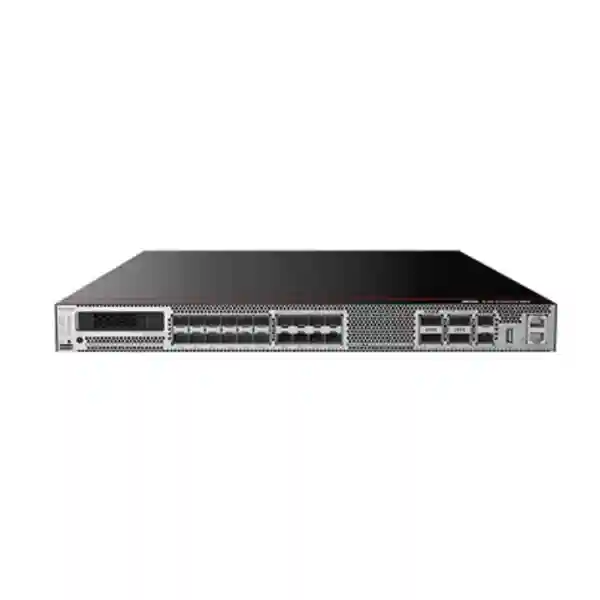
Huawei HiSecEngine USG6712F Firewall
A technical planning page for organizations evaluating the Huawei HiSecEngine USG6712F for high-throughput perimeter security, data-center segmentation, campus edge protection, encrypted inter-site connectivity, application-aware policy enforcement, and resilient enterprise security operations in the United Arab Emirates.
FourTeck can support architecture, BOM validation, transceiver planning, subscription selection, migration, implementation, testing, documentation, and operational handover. This page intentionally separates verified family-level capabilities from model-specific assumptions so procurement teams can obtain a technically defensible quotation.
Use this platform category when the requirement combines enterprise firewalling with deep security inspection, high-speed optical uplinks, VPN, segmentation, threat protection, centralized management, and high availability.
Before purchase, confirm the exact Huawei model code, appliance BOM, supported software train, interface inventory, performance license, security subscriptions, optics, power modules, and support service on the supplier quotation.
Important model verification note for the USG6712F name
The product name requested for this page is Huawei HiSecEngine USG6712F. For a production procurement exercise, the exact model string must be treated as a BOM validation item rather than assumed from a neighboring model. Huawei’s currently indexed public product material identifies USG6712E and USG6716E in the USG6700E family, while current USG6700F family pages publicly identify models such as USG6710F, USG6715F, and USG6725F. That distinction matters because a single character in a Huawei firewall model can imply a different hardware generation, forwarding architecture, interface map, software support matrix, lifecycle position, and subscription entitlement. FourTeck therefore recommends checking the official Huawei quotation, part number, hardware label, and software compatibility table before any final commitment.
This verification step is especially important when a model name arrives from a tender spreadsheet, reseller inventory list, distributor shorthand, migration document, or copied bill of materials. In enterprise firewall projects, the commercial model name alone is not enough. Engineers should obtain the exact chassis part number, power-supply option, fan configuration, storage option if applicable, included interface modules, transceiver requirements, base license, security-content subscriptions, management platform dependencies, support duration, and software version. These details determine whether the proposed system will actually meet the required throughput, inspection depth, port density, redundancy target, and operational lifecycle.
The remainder of this page explains how to design and evaluate a Huawei HiSecEngine deployment around the requested USG6712F name without inventing unverified model-specific numbers. Where family-level functions are discussed, they should be validated against the exact offered appliance. This is the right approach for UAE enterprise buyers because it avoids a common procurement failure: selecting a firewall from a headline throughput figure while overlooking real traffic mix, TLS inspection, application-control depth, session growth, optics, redundancy, and subscription requirements.
Where a Huawei HiSecEngine platform fits in an enterprise security architecture
Internet Edge
Protect north-south traffic between enterprise networks and Internet service providers. The design typically combines stateful firewalling, network address translation, application controls, intrusion prevention, anti-malware inspection, URL policy, reputation functions, VPN termination, and event logging. The firewall should be sized for the security services that will actually remain enabled during peak business hours, not only for raw packet forwarding.
Data-Center Segmentation
Use security zones, VLAN interfaces, routed interfaces, policy control, and threat inspection to separate server tiers, shared services, user zones, partner connections, cloud interconnects, and management networks. East-west inspection introduces different session and latency characteristics from Internet edge traffic, so the sizing model should reflect internal application behavior rather than WAN bandwidth alone.
Campus & Core Security
A high-capacity firewall can enforce identity, application, network, and service policies between campus segments, core services, wireless networks, guest networks, IoT environments, and critical infrastructure zones. The architecture should minimize asymmetric routing and provide deterministic failover paths so that stateful inspection does not become a source of service instability.
Multi-Site VPN Hub
Enterprises with branches across the UAE, GCC, Africa, or global offices can centralize IPsec connectivity, partner tunnels, remote access, or overlay security at the main hub. Sizing must account for encryption algorithm, packet size, tunnel count, route scale, traffic burst behavior, inspection after decryption, and high-availability tunnel recovery.
A good firewall architecture begins by asking what traffic must cross the device, which security services will inspect that traffic, what failure domains exist, and what growth is expected during the equipment lifecycle. A high-speed appliance can still be undersized if it faces millions of short-lived sessions, intensive TLS decryption, a large set of signatures, sustained VPN encryption, high logging rates, or a requirement to inspect traffic in both directions across multiple internal zones. Conversely, an oversized platform can become commercially inefficient if the physical port plan, subscription model, and redundancy design are not aligned with the actual environment.
Hardware architecture, acceleration, and packet-processing considerations
Huawei positions the HiSecEngine USG6700F family around new hardware and software architectures with multiple security-dedicated acceleration engines. In practical engineering terms, acceleration matters because an enterprise firewall performs several different workloads at once. It parses packet headers, tracks state, identifies applications, evaluates policies, performs routing or switching decisions, encrypts and decrypts traffic, scans content, evaluates signatures, logs security events, and may inspect encrypted sessions. A platform designed with dedicated processing resources can avoid forcing every function through one general-purpose path. The resulting architecture is intended to preserve predictable performance when multiple services are enabled.
For a USG6712F proposal, the key question is not simply whether the appliance belongs to a high-performance family. The design team should map every requirement to the processing plane that handles it. Firewall forwarding should be reviewed separately from next-generation firewall inspection. Intrusion prevention should be reviewed separately from anti-malware or web filtering. IPsec VPN throughput should be reviewed with the intended encryption suite. TLS inspection should be reviewed with realistic certificate sizes, cipher suites, connection rates, and server behavior. An engineering quotation should therefore state the traffic profile and inspection policy used for sizing rather than quote only the largest number on a datasheet.
Packet size also matters. Large UDP frames can produce impressive raw throughput because the appliance processes fewer packets per second for a given bandwidth. Real enterprise traffic contains small and medium packets, TCP handshakes, ACKs, DNS, API calls, voice signaling, SaaS sessions, short web transactions, file transfers, backups, database connections, telemetry, and encrypted application flows. The lower the average packet size and the higher the session churn, the more pressure is placed on packet-processing and state-table resources. This is why professional firewall sizing uses several dimensions: Gbps, packets per second, concurrent sessions, new sessions per second, SSL inspection, threat-protection throughput, VPN capacity, policy scale, route scale, and logging volume.
The hardware design must also consider serviceability. Confirm power-module redundancy, fan redundancy, airflow direction, rack depth, rail-kit requirements, appliance weight, maximum power draw, heat output, electrical feed diversity, and environmental operating range. In a UAE data center, temperature is normally controlled, but heat rejection and rack power remain important because security appliances often sit in dense network rows beside switches and routers. Dual power supplies should terminate on independent rack PDUs where possible. High availability should not be defeated by connecting both firewalls or both PSUs to the same electrical failure domain.
Interface planning: optics, breakout, aggregation, and port-role design
High-capacity HiSecEngine platforms are frequently deployed with 10, 25, 40, or 100 Gigabit Ethernet connectivity. Huawei’s published USG6700F family pages show combinations of high-speed optical interfaces across current F-series models, while the USG6712E public specification shows a dense optical interface design in the earlier E-series generation. That family context is useful for architecture planning, but the exact USG6712F port map must be confirmed on the offered BOM. Do not assume that an adjacent model has identical QSFP, QSFP28, SFP+, HA, management, USB, storage, or console interfaces.
Start with a port-role matrix. Record every connection required on day one and every likely connection expected during the equipment lifecycle. Typical roles include ISP handoffs, WAN routers, core switches, leaf-spine fabric links, DMZ switches, partner networks, management networks, HA control links, HA data links, logging collectors, out-of-band management, backup links, and test or migration ports. For each role, record speed, media type, duplex, LACP requirement, VLAN mode, routed or switched mode, MTU, optic type, fiber type, connector, distance, redundancy, and expected utilization.
Optics should be engineered as carefully as the firewall itself. A 100GE port may use different optical standards depending on distance and fiber plant. A 40GE interface can have different breakout options from a native 10GE bank. Multimode and single-mode optics are not interchangeable. Third-party transceivers can create support questions if they are not on the approved compatibility list. Likewise, switch-side port mode must match the firewall-side configuration. A quotation should identify the exact transceiver SKU and quantity, including spares for critical links. Patch cords, MPO or LC connectivity, fiber polarity, and rack-to-rack routing should be included in the implementation checklist.
Link aggregation can increase resiliency and distribute traffic, but it must be designed around stateful firewall behavior. The upstream switch pair may use MLAG, stacking, clustering, or a virtual chassis technology. The firewall HA pair may appear as separate control planes while maintaining synchronized sessions. Engineers need to understand how LACP behaves during failover, whether the switching environment can preserve adjacency, how gratuitous ARP or neighbor advertisements are handled, and whether asymmetric paths can occur. A technically correct diagram should show not only physical links but also logical port channels, VLAN trunks, routing adjacencies, and failure transitions.
For help integrating the firewall with campus, data-center, and WAN infrastructure, FourTeck customers can coordinate broader implementation services through FourTeck IT Services UAE. The objective is to validate the entire forwarding path rather than treat the firewall as an isolated appliance.
Security stack: firewall policy, application control, IPS, antivirus, URL filtering, and anti-DDoS
Huawei’s current HiSecEngine USG6700F family material describes integrated firewall, VPN, intrusion prevention, antivirus, bandwidth management, anti-DDoS, and URL filtering capabilities. It also describes application identification at a scale of more than 6,000 applications on the listed family. Those capabilities illustrate the security model enterprises should expect from a modern next-generation firewall: policy decisions can be based on more than source IP, destination IP, and TCP or UDP port. Application context, user or identity context, URL category, threat intelligence, content signatures, and connection behavior can all influence whether traffic is allowed, denied, shaped, logged, or inspected.
Stateful firewalling remains the foundation. The policy base should follow least privilege and should be structured so administrators can understand why a rule exists. Every production rule should have an owner, business purpose, source scope, destination scope, service definition, application requirement where applicable, logging policy, review date, and change reference. Temporary rules should have expiry controls. Broad any-to-any access should be eliminated or justified. Shared service objects should be normalized to avoid duplicate definitions that make later audits difficult.
Application identification adds useful visibility when standard ports no longer reflect application behavior. Modern SaaS, collaboration, remote administration, cloud storage, social media, tunneling tools, developer platforms, and encrypted services can share TCP 443. An application-aware policy can differentiate categories or functions that would otherwise look identical at the transport layer. However, application control should be rolled out carefully. Blocking too aggressively without observing real enterprise behavior can interrupt legitimate workflows. A sensible migration strategy begins with visibility, then progressively enforces high-confidence rules based on business ownership and security risk.
Intrusion prevention systems evaluate traffic against signatures and behavioral indicators associated with vulnerabilities, exploitation attempts, protocol abuse, malware delivery, scanning, command-and-control, and other attack patterns. The most important operational requirement is not merely enabling IPS; it is selecting a policy that matches the protected environment. Data-center workloads may require a different signature profile from user Internet browsing. Public-facing servers may warrant stricter protection and virtual patching. False positives should be investigated rather than globally disabling detection. Signature update reachability, update schedules, license validity, and event logging should be monitored continuously.
Antivirus and content inspection add another layer by scanning supported traffic for malicious files or patterns. When much of the enterprise traffic is encrypted, the effectiveness of content inspection depends on whether TLS decryption is legally, technically, and operationally appropriate. Decryption introduces certificate management, privacy, performance, compatibility, and exception-handling requirements. Financial applications, healthcare services, certificate-pinned mobile apps, software update channels, and regulated data flows may require exemptions. The firewall sizing should therefore include the actual percentage of traffic intended for decryption instead of assuming either zero or one hundred percent.
URL filtering can enforce acceptable-use policy, reduce exposure to malicious or newly registered destinations, and prevent access to known high-risk categories. The policy should be aligned with company HR and security governance and should include a documented method for requesting recategorization or temporary access. DNS security, IP reputation, web filtering, and application control work best as complementary layers rather than independent checkboxes.
Anti-DDoS controls at the firewall can mitigate certain volumetric or protocol attacks, but architects should understand the location of the bottleneck. If an attack saturates the ISP circuit before reaching the firewall, on-premises controls cannot recover upstream bandwidth. For Internet-facing services with significant DDoS exposure, combine firewall protections with ISP scrubbing, cloud-based DDoS services, rate controls, load balancing, resilient DNS, and incident procedures. The firewall is a critical control point, but it is not a substitute for upstream capacity and attack diversion.
A mature policy architecture documents which security engine applies to which traffic class. Internet egress, inbound published services, partner links, remote access, data-center east-west flows, backup replication, voice traffic, management traffic, and cloud connectivity may each need different inspection depth. This selective design improves both security and performance because expensive inspection is focused where it provides measurable value.
How to size the Huawei HiSecEngine USG6712F correctly
Firewall sizing should be based on measured traffic and a three-to-five-year growth model. Begin with real telemetry from the current firewall, routers, NetFlow or IPFIX collectors, core switches, WAN monitors, and Internet circuits. Record average and 95th-percentile throughput in both directions, peak packets per second, concurrent sessions, new sessions per second, VPN throughput, SSL/TLS connection rates, and traffic by application or destination category. Where the existing appliance cannot provide reliable statistics, temporary flow monitoring or switch counters can provide a baseline.
Next, model the security services that will be enabled. Raw firewall throughput is useful only when the planned policy uses little or no deep inspection. If the new design requires application identification, IPS, antivirus, URL filtering, file inspection, TLS decryption, sandbox integration, or data filtering, use the relevant next-generation or threat-protection performance metric. The safest design compares multiple published metrics and then applies a practical headroom factor. Headroom covers traffic bursts, signature growth, feature expansion, future bandwidth upgrades, emergency routing changes, failover conditions, and software overhead.
High availability changes capacity planning. In an active/standby pair, each firewall should normally be capable of carrying the full production load after a peer failure. Do not add the throughput of two standby-paired appliances and call it cluster capacity unless the specific architecture genuinely supports active/active load distribution for the relevant services. Even in active/active deployments, failure of one node can concentrate traffic on the survivor, so N+1 or N+N resilience should be considered. The design target is not maximum utilization in healthy conditions; it is acceptable utilization during the most important failure scenario.
Session scale deserves separate attention. A data center hosting APIs, web applications, VDI, containerized services, microservices, DNS, or high-volume proxy traffic may have modest bandwidth but extreme session creation. A branch VPN hub can also experience large spikes when offices reconnect after an outage. Compare both maximum concurrent sessions and new sessions per second against realistic traffic. If NAT is used heavily, review address and port allocation behavior, session timers, and exhaustion risk.
TLS inspection requires its own model. Performance depends on protocol version, key exchange, cipher suites, certificate size, session reuse, object size, connection duration, and client/server behavior. A platform that handles large encrypted downloads efficiently may behave differently under many short HTTPS transactions. Conduct a proof of concept when TLS inspection is central to the security design. The proof should use representative applications, not synthetic traffic alone.
VPN sizing should specify encryption and authentication algorithms. AES-256 with modern integrity protection places different load characteristics from older suites, and organizations may have compliance requirements that eliminate weaker options. Record the number of site-to-site tunnels, remote users, expected throughput per tunnel, number of routed prefixes, rekey frequency, and whether decrypted traffic receives additional security inspection. IPsec performance published for large packets should not be treated as equivalent to mixed enterprise traffic without validation.
Log volume is another commonly overlooked dimension. Enabling session-start and session-end logs on broad policies can generate large amounts of telemetry. IPS, antivirus, URL filtering, and application events add more. Decide where logs will be stored, how long they must be retained, whether they must be forwarded to a SIEM, what events require alerting, and how clock synchronization will be maintained. If local storage is an option on the final appliance, determine whether it is required for resilience or merely temporary buffering.
A FourTeck quotation can be built around this sizing method rather than an arbitrary model tier. Visit Firewall Dubai by FourTeck for regional firewall project coordination. The final selection should be supported by a documented capacity table so stakeholders know why the chosen model, subscriptions, optics, and support package were specified.
VPN architecture for UAE branches, remote offices, partners, and cloud connectivity
Huawei enterprise firewalls support common VPN use cases such as IPsec, SSL VPN, and GRE within the appropriate product and software capabilities. A USG6712F design should begin by dividing VPN requirements into four groups: site-to-site corporate connectivity, third-party or partner connectivity, remote-user access, and cloud or data-center interconnects. Each group has different trust assumptions, routing models, authentication requirements, and operational ownership.
For site-to-site IPsec, use modern encryption suites and standardize tunnel templates. Define primary and backup peers, tunnel monitoring, routing behavior, MTU and MSS handling, failover timers, and route preference. Dynamic routing over tunnels can simplify large environments, but it also requires careful filtering so a branch cannot accidentally advertise unexpected prefixes. Static routing remains appropriate for smaller estates. When dual ISPs are present, confirm whether the design needs active/standby tunnels, active/active path steering, or application-aware failover.
Partner VPNs should terminate in dedicated zones with tightly scoped policies. Do not place external partners into the same trust zone as internal branches. Restrict reachable destinations and services, log access, and review rules periodically. If overlapping IP addresses exist, policy NAT or dedicated translation domains may be required. The change process should specify who owns each tunnel, who can request new routes, and how key rotation is coordinated.
Remote-access VPN design should address identity and endpoint posture in addition to encryption. Strong authentication, preferably MFA where supported by the identity architecture, helps reduce credential risk. Split tunneling should be a deliberate policy decision because it affects bandwidth, monitoring, and exposure. Full tunneling provides centralized inspection but consumes more Internet and firewall capacity. Endpoint DNS behavior, local subnet access, software distribution, and user support processes should be tested before a large rollout.
Cloud connectivity can use IPsec to public cloud VPN gateways, transit hubs, virtual routers, or security services. Architectures with Azure, AWS, Oracle Cloud, or other platforms should account for cloud-side tunnel limits, BGP requirements, route propagation, asymmetric routing, and high-availability zones. The on-premises firewall may need multiple tunnels per cloud region to achieve resiliency. Cloud VPN performance is constrained by both sides of the connection, so the fastest firewall cannot exceed the cloud gateway or WAN path capability.
For multi-country operations, FourTeck’s broader infrastructure resources are available through the FourTeck global site. Cross-border designs should also consider carrier availability, latency, data residency requirements, and local support logistics in each region.
Data-center segmentation and east-west security
A high-performance firewall often provides the most security value when it controls traffic between important internal zones, not only at the Internet perimeter. In a traditional three-tier data center, zones might include web servers, application servers, databases, shared services, management networks, backup systems, storage, virtualization management, development environments, and partner-facing segments. In a modern hybrid environment, additional zones may include Kubernetes clusters, container registries, API gateways, cloud interconnects, virtual desktop infrastructure, identity services, SIEM components, and security management platforms.
Segmentation design starts with application dependency mapping. A policy cannot be truly restrictive until the network team understands which systems communicate, over which ports, in which direction, and under which service identity. Use flow data, existing firewall logs, application documentation, packet captures where appropriate, and owner interviews. Avoid converting an old flat network directly into dozens of zones without dependency analysis; that typically produces emergency rule requests and broad temporary exceptions that become permanent.
The firewall can enforce layer-3 segmentation using routed interfaces or VLAN interfaces, depending on the topology. The choice should align with the switching fabric. Some data centers prefer the firewall as a routed security boundary between VRFs or VLAN groups. Others insert it selectively around critical applications. Transparent or layer-2 designs may be useful where changing IP addressing is impractical, but they can complicate troubleshooting if the forwarding path is not well documented. The objective is to create security boundaries that are operationally understandable and resistant to bypass.
East-west inspection can generate high traffic volumes because backups, storage replication, virtualization motion, database synchronization, and application replication often remain inside the data center. Not all of that traffic benefits from identical deep inspection. Use risk-based policy. Management access, user-to-server flows, partner-to-application traffic, and exposed service paths may receive full security inspection. High-volume replication between controlled systems may use narrower policy and selective inspection after risk review. This reduces unnecessary load while preserving meaningful enforcement.
Microsegmentation inside hypervisors or container platforms can complement the physical firewall. The appliance then protects macro-segments, north-south traffic, and inter-domain boundaries while host-based or workload-level controls provide finer enforcement. This layered model avoids forcing every local workload packet through a physical appliance while still maintaining strong central checkpoints.
Routing design is critical. Stateful devices expect the forward and return path of a session to be visible to the same logical firewall context. Equal-cost routing, asymmetric leaf-spine paths, policy-based routing, direct server return, multi-homing, or dynamic route changes can break this assumption. Before deployment, document routing tables, next hops, failover behavior, ECMP, VRFs, and the interaction between firewall clustering and the switching fabric.
High availability, state synchronization, and failure-domain design
Enterprise firewalls protecting critical services should normally be deployed as a resilient pair unless the risk assessment accepts single-appliance failure. High availability is more than adding a second chassis. The design must remove shared failure points across power, cabling, switches, upstream routers, ISPs, management access, and software maintenance. A pair connected to one top-of-rack switch and one PDU is not truly resilient even if the firewall protocol itself supports failover.
State synchronization allows the standby or peer firewall to continue established sessions after a failover, subject to product and feature support. The HA design should identify dedicated heartbeat links, session synchronization links, management paths, and any data-plane links used for clustering. The physical port requirements must be included in the interface matrix because HA links consume ports and optics that might otherwise be assumed available for production traffic.
Failover detection should balance speed and stability. Extremely aggressive timers can cause unnecessary failovers during transient congestion or interface events. Slow timers increase outage duration during real failures. Monitor the most meaningful failure signals: appliance health, data-plane interfaces, upstream path reachability, and critical links. In some topologies, interface state alone is insufficient because a switch port can remain up while the upstream WAN has failed. Route tracking or path monitoring can improve decision quality.
Maintenance strategy also matters. A firewall pair should allow planned software upgrades, hardware replacement, or policy changes with minimal business disruption. Before assuming in-service upgrade behavior, confirm the exact software release and HA upgrade procedure. Major version jumps can involve configuration migrations, reboot cycles, signature compatibility, or changes to default behavior. Create a rollback plan and export validated backups before maintenance.
Test high availability before production acceptance. Disconnect a monitored data link, remove an upstream switch path, reboot the active node, simulate power loss, and verify that critical applications, VPNs, routing adjacencies, NAT mappings, and monitoring recover as expected. Measure convergence rather than writing “HA tested” in a generic checklist. Record packet loss and session behavior for representative applications.
The final topology should show two firewalls, dual power feeds, redundant switching, upstream resiliency, and independent management access wherever the site design allows it. This diagram becomes a valuable operational tool during incidents because engineers can quickly understand which failures should trigger firewall failover and which failures must be handled by routing or switching.
Security operations, centralized management, logging, and automation
Huawei describes simplified operations and maintenance as a key characteristic of the HiSecEngine portfolio, including visibility of device status, alarms, traffic, and threat events. For an enterprise deployment, the operational design should go further by defining who manages the firewall, how changes are approved, how events reach the security operations center, how configurations are backed up, and how software and signature updates are governed.
Start with administrative access control. Use named accounts rather than shared credentials. Apply role-based privilege so operations teams can view status without necessarily changing policy. Restrict management access to dedicated networks and approved jump hosts. Use secure protocols such as SSH and HTTPS, disable unnecessary services, and synchronize time using authenticated or controlled NTP sources. Time consistency is essential because firewall logs are often correlated with identity, endpoint, application, and SIEM events during investigations.
Configuration management should include versioned backups and change references. Export configurations after approved changes and store them securely. Document object naming conventions, policy numbering conventions, zone naming, address groups, service objects, and comments. A well-structured rule base reduces outage risk because engineers can understand intent quickly. The best policy is not the shortest; it is the policy whose purpose can be proven and maintained.
Logging architecture should identify which events are locally retained, which are forwarded, and which trigger alerts. At minimum, review system events, HA changes, administrator logins, configuration changes, interface status, routing events, VPN events, deny logs where useful, threat detections, malware events, URL policy hits, and application anomalies. Avoid indiscriminate logging that overwhelms storage and hides important events. Use filtering and severity mapping so the SOC sees actionable signals.
Automation and open interfaces can improve consistency in large environments. Huawei family documentation references integration options such as NETCONF as well as standard management protocols. Use automation first for repeatable, low-risk tasks: inventory collection, configuration backup, policy reporting, object validation, compliance checks, and monitoring. Changes that affect traffic should pass through testing and approval pipelines. API access itself must be secured with dedicated accounts, limited privileges, protected secrets, and management-plane filtering.
For UAE projects that combine firewall deployment with broader enterprise infrastructure, explore FourTeck UAE for integrated network, security, and infrastructure engagement. The goal is a supportable operating model rather than a one-time appliance installation.
Migration from an existing firewall: discovery, translation, validation, and cutover
Replacing an existing firewall is a data migration project as much as a hardware installation. The current configuration contains years of business logic: network objects, NAT rules, site-to-site VPNs, remote-access settings, routing, security policies, application exceptions, published services, certificates, authentication dependencies, logging destinations, monitoring integrations, and operational workarounds. A successful migration extracts this logic, cleans it, translates it into the Huawei policy model, and validates behavior before the production cutover.
Discovery begins with backups and exports from the existing platform. Collect the running configuration, policy usage statistics, object databases, NAT tables, VPN definitions, route tables, interface addressing, VLANs, certificates, admin roles, authentication settings, software version, subscriptions, and recent logs. Capture screenshots or reports for complex features that may not export cleanly. Interview network and application owners to identify rules that look unused but remain business-critical during month-end processing, disaster recovery, or seasonal events.
Rule cleanup should happen before translation. Remove expired temporary rules, duplicate objects, shadowed policies, disabled entries that are no longer required, obsolete VPN peers, and unused services after owner approval. Normalize address objects and service names. Group related applications where it improves readability. Preserve audit evidence for deleted rules so governance teams can explain the change. Migrating years of clutter into a new firewall wastes an opportunity to reduce risk.
NAT migration requires special care because vendors represent source NAT, destination NAT, static translations, identity NAT, policy NAT, and port translations differently. Build a NAT matrix that describes original source, translated source, original destination, translated destination, service translation, ingress interface, egress interface, and related security policy. Test public services from external networks and test internal access scenarios such as hairpin connections if they are required.
VPN migration should include both configuration and peer coordination. Some third parties restrict change windows, whitelist peer IP addresses, or require new pre-shared keys. Obtain contacts before the migration weekend. For certificate-based VPNs, verify certificate chains, private keys, expiry dates, and supported algorithms. For routing over VPN, validate prefix lists and route advertisements. Keep old tunnels available until the new path is proven where topology allows parallel operation.
Testing should be application-focused. A ping proves only basic reachability and often bypasses the true business transaction. Build a test sheet covering DNS, directory authentication, ERP, databases, web applications, APIs, email relay, file services, backup, monitoring, voice, remote access, partner systems, Internet access, public websites, inbound publishing, cloud services, and management tools. Assign an owner to each test and capture the expected result.
The cutover plan should identify every cable move, interface shutdown, route change, ARP or neighbor-cache action, policy activation step, DNS dependency, VPN trigger, and rollback point. Record pre-change counters and post-change counters. Use a command bridge with clear technical ownership. Keep stakeholders informed through predefined checkpoints rather than ad hoc messages. A rollback should be possible before the maintenance window becomes unrecoverable.
After cutover, monitor deny logs, session rates, CPU, memory, interface utilization, VPN status, HA synchronization, route stability, threat events, and application complaints. Optimization continues after service restoration because some application dependencies appear only under real user load. Schedule a post-implementation review to close temporary rules, document deviations, update diagrams, and finalize the as-built configuration.
UAE deployment and procurement considerations
Enterprise security procurement in Dubai and the wider UAE should combine technical suitability with commercial and operational assurance. Confirm whether the appliance is sourced through an authorized distribution channel, whether the serial number is eligible for vendor support, whether the quoted subscriptions are new and correctly term-matched, and whether the support service begins on shipment, activation, or another defined date. Grey-market hardware can create problems when support entitlement or regional service is required.
Ask for a complete BOM rather than a single appliance price. The BOM should list chassis, power modules, fans, rails, storage if applicable, interface modules if applicable, transceivers, DAC or AOC cables, licenses, security subscriptions, management software dependencies, support services, professional services, and spares. Record quantities explicitly. Many project delays occur because a firewall arrives without the correct optic, rail kit, secondary power supply, or license activation information.
Support coverage should reflect business criticality. A data-center firewall protecting core applications may justify 24×7 support and rapid replacement, while a non-critical lab unit may not. Clarify replacement logistics in the UAE, escalation routes, remote technical assistance, software entitlement, and whether the support contract covers the exact software release planned for deployment. Keep purchase documentation and entitlement records in the operational handover pack.
Cybersecurity compliance requirements differ by organization and sector. UAE entities may need to align with internal governance, customer mandates, sector frameworks, privacy obligations, or government-related controls. The firewall should support the required technical controls, but compliance is achieved through configuration, process, evidence, and governance rather than product ownership alone. Define log retention, access control, change approval, vulnerability management, incident response, and periodic rule review in the project scope.
Data residency can influence cloud-managed security and logging designs. If threat intelligence, telemetry, centralized management, or log analytics use cloud services, the customer should review where information is processed or stored, what categories of data are transmitted, and what contractual controls apply. This review should occur before activation, especially for regulated or sensitive environments.
Physical installation in UAE facilities should follow the data-center standard for rack position, airflow, power diversity, grounding, cable management, labeling, and access control. Record rack unit, front and rear clearance, PDU outlet type, A/B power feeds, console access, management-switch ports, and cross-connect IDs. Label both ends of every production and HA cable. Store spare optics in a controlled location and document their part numbers.
Project scheduling should allow time for licensing, stakeholder approval, change control, partner VPN coordination, certificate preparation, and test planning. Firewall cutovers are often delayed not by configuration work but by waiting for application owners, ISP changes, third-party peers, or maintenance approvals. Build these dependencies into the implementation plan from the beginning.
A strong commercial offer should therefore answer six questions: What exact appliance is being supplied? What security functionality is licensed? What accessories and optics are included? What support entitlement applies? What implementation work is included? What evidence will be delivered at handover? When those answers are explicit, procurement and engineering teams can evaluate the proposal on the same basis.
Technical design checklist before requesting a quotation
Traffic & Capacity
Provide current WAN and Internet bandwidth, peak throughput, average packet size if known, concurrent sessions, new sessions per second, expected growth, public server traffic, east-west traffic, and the percentage requiring deep inspection or decryption.
Interfaces & Optics
List every required 1G, 10G, 25G, 40G, and 100G connection, fiber type, distance, connector, switch model, LACP requirement, HA links, management links, spare ports, and future uplink plans.
Security Services
Identify firewalling, IPS, antivirus, application control, URL filtering, anti-DDoS, TLS inspection, VPN, bandwidth controls, data filtering, sandboxing, reputation services, and any integrations with SOC platforms.
VPN & Routing
Record site-to-site tunnels, remote users, partner tunnels, encryption suites, BGP or OSPF requirements, route count, VRFs, cloud VPNs, dual ISP behavior, SD-WAN dependencies, NAT, and overlapping addresses.
High Availability
Specify active/standby or other required mode, dual power, redundant switches, redundant ISPs, session synchronization, failover targets, maintenance expectations, rack separation if applicable, and acceptance tests.
Operations & Support
Define support term, response level, log destination, SIEM integration, admin authentication, backup process, NTP, monitoring, software update policy, policy review cadence, documentation, training, and handover requirements.
Decision recap: when this class of firewall is a strong fit
The Huawei HiSecEngine USG6712F name, as supplied for this page, should be evaluated as a high-capacity enterprise firewall requirement that needs formal model and BOM validation. The broader HiSecEngine architecture is relevant when an organization needs more than simple stateful filtering: high-speed optical connectivity, application-aware control, intrusion prevention, malware defense, URL policy, VPN, segmentation, anti-DDoS functions, security operations visibility, and resilient deployment across demanding enterprise traffic.
The platform class is particularly suitable for data centers, headquarters, large campuses, regional hubs, service-provider edge roles, and environments with substantial encrypted or application-rich traffic. It can also fit consolidation projects where multiple older firewalls are being replaced by a smaller number of higher-capacity systems. The strongest business case appears when the organization values policy centralization, high port speed, operational visibility, reduced appliance sprawl, and the ability to scale security inspection without redesigning the network every time bandwidth increases.
It may be unnecessary for a small office with low traffic, a limited number of users, and no high-speed uplink requirement. In that case, a smaller firewall can deliver the required security at lower cost and power consumption. Sizing should therefore remain requirement-led rather than model-led. The correct firewall is the smallest platform that safely meets security, performance, growth, resiliency, and support requirements with adequate operational margin.
The purchasing decision should be made only after the exact USG6712F identification is confirmed in an official Huawei or authorized-channel quotation. This confirmation should include hardware part number, interface map, performance data, subscriptions, software version, lifecycle position, support entitlement, optics compatibility, and HA requirements. That procurement discipline protects the project from assumptions based on a similar model name.
Quotation input checklist
Dubai, Abu Dhabi, Sharjah, other UAE emirates, data center, headquarters, branch hub, campus, DR site, or mixed environment.
Current and future ISP bandwidth, data-center traffic, inter-VLAN traffic, VPN load, cloud connectivity, and required headroom.
IPS, antivirus, application control, URL filtering, TLS inspection, anti-DDoS, remote access, and any compliance-driven controls.
Required speeds, copper or fiber, optics, link aggregation, redundant switching, HA links, management, and spare capacity.
Number of IPsec peers, cloud tunnels, partner tunnels, remote users, encryption standards, dynamic routing, and dual-ISP behavior.
One-year, three-year, or longer subscription term, desired hardware replacement SLA, and project implementation requirements.
FourTeck consultation for Huawei firewall projects in Dubai and UAE
FourTeck can help convert a model request into a complete technical BOM and deployment plan. The engagement can include product verification, capacity sizing, high-availability topology, interface and optics mapping, VPN design, routing integration, segmentation policy, migration from an existing firewall, implementation, testing, documentation, and operational handover. This is particularly valuable for the requested USG6712F name because the exact model should be validated before hardware-specific specifications are committed to a customer-facing quotation.
For the fastest technical response, provide the current firewall model, Internet bandwidth, number of users, critical applications, expected inspection services, VPN count, remote-user count, high-availability requirement, switch models, required uplink speeds, fiber distances, and preferred support term. If an existing Huawei or third-party BOM already exists, include it for line-by-line validation. FourTeck can then separate confirmed components from optional upgrades and identify missing optics, licenses, power modules, or support services before order placement.
The final deliverable should be a procurement-ready package rather than a generic product list: exact appliance part number, subscriptions, support entitlement, optics, HA quantity, implementation scope, assumptions, exclusions, and acceptance criteria. That structure gives procurement, security, network operations, and management a common reference for approval.

Reviews
There are no reviews yet.