
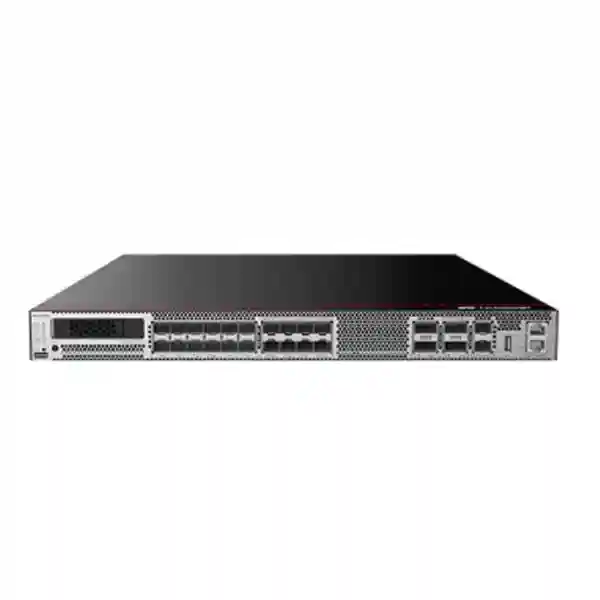
Huawei HiSecEngine USG6716E Next-Generation Firewall
The Huawei HiSecEngine USG6716E is built for organisations that need a compact 1U security appliance with data-center-class interface density, very high firewall throughput, large session capacity and integrated threat protection. It is particularly relevant for UAE enterprises consolidating multiple Internet links, private WANs, data-center uplinks, cloud connectivity, remote-access VPN and east-west security functions onto a resilient security platform.
FourTeck supplies and designs Huawei firewall solutions for projects in Dubai and throughout the United Arab Emirates. Our engineering approach starts with real traffic, encrypted-traffic ratios, application mix, session concurrency, routing requirements, HA objectives and growth forecasts rather than selecting an appliance from headline throughput alone.
Direct answer: where the USG6716E fits
The USG6716E is best treated as a high-capacity perimeter and aggregation security platform rather than a simple branch firewall. Its fixed high-speed interface mix includes two 100GE QSFP28 ports, two 40GE QSFP+ ports, twenty 10GE SFP+ ports, two additional 10GE SFP+ interfaces intended for high-availability connectivity, and USB 3.0. The combination gives architects enough physical bandwidth to connect multiple upstream carriers, core or spine switches, server or service networks, DMZ segments and HA peers without immediately introducing a separate port-expansion chassis.
For Dubai data centers and enterprise campuses, the appliance is useful when the design must preserve headroom above day-one Internet bandwidth. The most important point is that firewall throughput and security-services throughput are not the same metric. Huawei publishes IPv4 firewall performance up to 160 Gbit/s for larger packet sizes, while full-protection performance is lower because IPS, antivirus, application awareness and other inspection engines perform more work per session. In the manufacturer-published figures associated with this model, FW plus service awareness is rated at 60 Gbit/s, FW plus service awareness plus IPS at 40 Gbit/s, FW plus service awareness plus IPS plus antivirus at 38 Gbit/s, full protection at 36 Gbit/s, and a real-world full-protection profile at 18 Gbit/s. These distinctions are central to correct sizing.
A UAE project should therefore be sized using the expected protected traffic rate, encrypted-traffic ratio, average and peak connection rates, application distribution, east-west versus north-south flows, and the security services that will actually be enabled. A design that needs 20 Gbit/s of inspected production traffic with significant TLS decryption should not be evaluated the same way as a project requiring 20 Gbit/s of mostly uninspected routed firewall traffic.
High-speed perimeter
Use 100GE or 40GE uplinks toward core switching and multiple 10GE links for ISP handoffs, routed DMZs, service networks or downstream distribution. This is especially useful when a firewall must sit between a high-capacity campus core and diverse WAN or Internet circuits.
Large session scale
The published capacity of up to 50 million concurrent TCP sessions and up to 1.6 million new TCP sessions per second targets busy environments with many users, servers, applications, remote locations or short-lived web and API sessions.
Integrated protection
The platform brings firewalling, VPN, IPS, antivirus, data-leak prevention, bandwidth management, anti-DDoS functions, URL filtering and anti-spam capabilities into a unified policy framework, subject to software version and licensing.
Resilient architecture
Transparent, routed and hybrid deployment modes plus Active/Active and Active/Standby HA choices allow the appliance to be integrated into existing networks without forcing the same topology for every project.
Interface architecture: why 100GE, 40GE and 10GE matter
The USG6716E interface architecture is one of the strongest reasons to consider it for a high-bandwidth enterprise perimeter. Two 100GE QSFP28 interfaces can connect directly to modern aggregation, core or data-center switches where a firewall must not become the physical bottleneck. Two 40GE QSFP+ interfaces provide additional high-capacity options for legacy core environments, migration phases or redundant service-side connections. Twenty 10GE SFP+ interfaces create substantial flexibility for physical segmentation, multiple upstream providers, separate DMZs, MPLS or private WAN handoffs, dedicated cloud-connectivity circuits, server-farm zones and controlled partner networks.
The presence of dedicated 10GE HA interfaces is also important in resilient designs. High availability is not just a checkbox in a firewall quotation; the state-synchronisation path and heartbeat path must be engineered so that failover events do not compete with normal production traffic or become constrained by slower interfaces. The final HA implementation depends on software release, selected deployment mode and topology, but the hardware gives architects appropriate high-speed connectivity for peer coordination.
When selecting optics, do not assume every QSFP28, QSFP+ or SFP+ module is automatically supported. A production bill of materials should map each link to media type, reach, fibre grade, connector, patching arrangement and supported transceiver part. For 100GE, clarify whether the connection requires short-reach multimode, long-reach single-mode, direct-attach cabling or an intermediate optical distribution system. For 10GE, verify whether a carrier presents optical Ethernet directly, hands off copper through another device, or terminates into a router before the firewall.
A clean Dubai deployment typically documents every firewall port before installation: logical interface name, physical port, optic type, remote device, VLAN or routed subnet, zone assignment, IP addressing, LACP or redundancy status, expected bandwidth and monitoring owner. This prevents last-minute confusion during maintenance windows and makes post-deployment troubleshooting much faster.
Security services and inspection model
The USG6716E is designed to do more than permit or deny traffic based on IP addresses and ports. The platform combines conventional firewall functions with application identification, IPS, antivirus, URL filtering, anti-DDoS functions, bandwidth management, data-leak prevention and VPN services. In practical operations, these engines allow security policy to be based on who is communicating, which application is in use, where the destination falls in a category structure, whether the flow matches known exploit behaviour, and whether the organisation permits that application function on that network segment.
Application-aware control is especially useful where many modern services use standard web ports. A port-based rule that allows TCP/443 can expose a very broad range of applications. Application identification gives policy designers more context and can make it possible to distinguish business-approved software from unapproved file-sharing, tunnelling, remote-control or entertainment applications, depending on the signature set and software version. Huawei describes support for more than 6,000 applications on the USG6700E family, with control granularity that can extend to functions within selected applications.
IPS adds another layer by examining traffic for exploit signatures, protocol anomalies and other malicious patterns. The correct operational approach is to begin with a policy profile aligned to the exposed services and risk level, then tune it using logs and business context. Enabling every signature in the most aggressive blocking mode is not automatically the best security design. Critical public services, legacy systems and specialised industrial or healthcare applications may require staged enforcement and exception handling after validation.
Antivirus and content inspection can provide additional malware defence for supported protocols and traffic types. Huawei also describes AI-assisted detection capabilities within the broader product family. These features should be understood as components of layered defence rather than substitutes for endpoint security, email security, identity controls, vulnerability management or backups. At the perimeter, the firewall can reduce exposure and detect malicious traffic; inside the organisation, endpoint and application controls remain necessary because threats can arrive through encrypted SaaS, removable media, compromised credentials or trusted partner channels.
URL filtering supports policy based on categories, reputation and cloud intelligence services when the appropriate subscriptions are active. For UAE businesses, this can help separate acceptable-use controls from pure threat prevention. Security teams should define which categories are blocked for risk, which are restricted for productivity or policy reasons, and which require exceptions. Exceptions should have ownership, justification and review dates so the rule base remains auditable.
TLS inspection and encrypted-traffic sizing
Encrypted traffic is usually the decisive sizing factor for a modern next-generation firewall. The USG6716E has a published SSL inspection throughput figure of 18 Gbit/s under Huawei’s stated test conditions, which is considerably lower than the maximum basic firewall throughput. This is expected: TLS decryption and re-encryption consume substantial processing resources, and the security engines then inspect the decrypted content before forwarding it.
A realistic design therefore separates total traffic from decryptable traffic. Suppose a campus has two 10 Gbit/s Internet circuits and expects 12 Gbit/s aggregate peak utilisation after growth. If 80 percent of this traffic is TLS, the theoretical encrypted share is 9.6 Gbit/s before considering burstiness, exclusions, unsupported cipher scenarios, application behaviour and the extra cost of IPS or antivirus. The architect should not treat the 18 Gbit/s SSL number as a guaranteed production capacity. Instead, apply engineering headroom and validate the intended service stack against the exact software version and traffic profile.
TLS decryption also has policy and privacy implications. Many organisations exclude banking, healthcare, certificate-pinned applications and other sensitive categories from decryption. The certificate authority used for outbound inspection must be deployed correctly to managed endpoints. Unmanaged devices may require a different policy because users will otherwise see certificate warnings. For inbound inspection of published servers, private keys, certificate rotation and server ownership must be coordinated with the application team.
The best pre-sales input is a traffic sample or monitoring report showing peak bandwidth by hour, top applications, protocol mix, average packet size, connection rates and the percentage of TLS. FourTeck can use these values to develop a more defensible firewall sizing model than a simple rule based on Internet circuit bandwidth.
Session scale, connection rate and application behaviour
Huawei publishes up to 50 million concurrent TCP sessions and up to 1.6 million new TCP sessions per second for the USG6716E. These figures matter for large user populations, high-volume web services, carrier-like edge environments, university or hospitality networks, large VDI estates, API-heavy applications and any environment where many short-lived connections are created continuously.
Bandwidth alone cannot describe this workload. Ten gigabits per second generated by a small number of long-lived file transfers is very different from ten gigabits per second generated by millions of browser, DNS, API and microservice connections. Each session consumes state-table resources, policy evaluation effort, logging operations and potentially inspection resources. Connection-rate spikes can occur during application restarts, software updates, large events or when many endpoints reconnect after an outage.
Before selecting this model for a high-scale environment, collect peak concurrent sessions, new sessions per second, NAT translation counts and average session duration from the existing firewall or traffic analytics platform. If the current device is overloaded, avoid relying only on its observed maximum because that ceiling may simply show what the old device can handle. Use server, load-balancer, WAN and application telemetry to estimate the actual demand.
The high session specifications give the USG6716E substantial capacity, but a production design should still reserve margin for growth, attack conditions and failover. In an HA pair, one device may need to carry the complete production load during maintenance or a hardware failure. The correct question is not whether two devices together can support the average; it is whether one surviving device can safely support the required peak with all intended security services active.
IPsec VPN for branch, cloud and site-to-site connectivity
The USG6716E is also suited to large VPN aggregation roles. Huawei publishes IPsec throughput up to 120 Gbit/s using a defined AES-256 plus SHA-256 test profile and up to 120,000 gateway-to-gateway tunnels as well as up to 120,000 client-to-gateway tunnels. These values create headroom for enterprises connecting many branches, warehouses, retail locations, construction sites, managed customers or cloud environments through encrypted overlays.
Site-to-site design should begin with route architecture. Static routes may be sufficient for a small number of predictable tunnels, but large deployments often benefit from dynamic routing, route summarisation and consistent address planning. Huawei documents routing support including RIP, OSPF, BGP, IS-IS and IPv6 equivalents on the platform family. The actual combination used in a VPN design depends on software capabilities, security policy and interoperability with peer equipment.
For hybrid cloud, the firewall can terminate encrypted connections toward cloud gateways or partner environments, but the overall design must consider the cloud provider’s own tunnel limits, BGP timers, route counts and availability zones. If a cloud connection is business-critical, deploy redundant tunnels over diverse paths and test failover rather than assuming dynamic routing alone guarantees application continuity.
Cryptographic policy should be standardised. Define approved IKE versions, encryption algorithms, integrity algorithms, Diffie-Hellman groups, certificate or pre-shared-key policy, lifetime values and rekey behaviour. When third-party peers use different vendor defaults, explicit configuration avoids negotiation failures. Document every tunnel owner, protected network and escalation path so the operations team can distinguish a firewall issue from an ISP, cloud or remote-peer problem.
SSL VPN and remote-access design
For remote users, Huawei publishes SSL VPN throughput up to 12 Gbit/s and support for 100 users by default with scaling up to 30,000 concurrent SSL VPN users through the appropriate licensing model. Exact entitlements should be confirmed at quotation time because remote-access capacity is not only a hardware question; software features, licence quantities, authentication integrations and endpoint requirements all affect the final solution.
A remote-access design should begin with user identity. Integrating with enterprise directories, RADIUS, LDAP, HWTACACS or supported identity systems creates stronger lifecycle control than maintaining isolated local accounts. Multi-factor authentication should be considered for externally reachable access. Group-based policies can then limit which applications, networks and administration interfaces each user category can reach.
Split tunnelling is another design decision. Sending all remote traffic through the firewall simplifies central inspection and can protect users on untrusted networks, but it consumes more Internet bandwidth and security-processing capacity. Split tunnelling reduces central bandwidth but moves some security enforcement to endpoints and SaaS controls. The correct approach depends on regulatory obligations, user distribution, endpoint posture and application architecture.
Remote-access planning should also include DNS behaviour, IPv4 and IPv6 handling, address pools, overlapping home subnets, endpoint software deployment, certificate lifecycle, password-reset processes and support procedures. A scalable VPN service is as much an identity and operations project as a firewall configuration task.
High availability: Active/Standby and Active/Active considerations
Huawei documents Active/Standby and Active/Active HA modes for the platform. The hardware’s dedicated high-speed HA interfaces support resilient designs, but the topology around the pair determines whether failover is truly seamless. Upstream and downstream switches, routing adjacencies, VLANs, LACP relationships, NAT state, VPN state and asymmetric traffic must all be considered.
Active/Standby is often operationally simpler. One appliance forwards the production traffic while the peer synchronises state and is ready to assume the workload. The design must ensure that the standby unit can handle the full peak traffic rate after failover. Both units should have equivalent licensing, compatible software and identical relevant interface connectivity. Maintenance procedures should include pre-checks, controlled failover, application validation, log validation and a rollback path.
Active/Active can improve utilisation in some architectures, but it introduces additional path and state considerations. The exact supported topologies should be verified for the target software release. Engineers must understand which sessions are owned by which node, how routing keeps return traffic on a valid path and what happens when one node fails. An Active/Active label does not automatically mean every packet can traverse either device without design constraints.
Physical resilience should extend beyond the firewall pair. Use separate power feeds where practical, diverse switch connections, redundant carrier paths and independent management access. A pair of firewalls connected to a single upstream switch, one power distribution unit or one fibre path can still have a single point of failure. The availability objective should be defined end to end.
Routed mode
Best when the firewall should participate directly in IP routing, terminate subnets, advertise or learn routes, perform NAT and provide clear Layer 3 boundaries. This is common at Internet edges and WAN hubs.
Transparent mode
Useful when security inspection must be inserted with minimal change to the existing IP architecture. It can reduce migration complexity, but management, HA and troubleshooting still require deliberate design.
Hybrid mode
Combines routed and transparent behaviours for projects that have mixed migration needs or multiple security zones with different integration requirements. Validate design rules for the chosen software release.
Routing, segmentation and policy architecture
The USG6716E can participate in enterprise routing designs rather than acting as a simple bump in the wire. Huawei documentation for the platform lists RIP, OSPF, BGP, IS-IS and IPv6 equivalents. This allows the firewall to exchange routes with campus cores, WAN routers, data-center fabrics and service-provider edge devices. Dynamic routing can simplify failover, but it should be designed so security zones and policies remain understandable.
A strong segmentation model normally maps business trust boundaries to firewall zones. Typical examples include Internet, corporate user networks, data-center server networks, management, voice, guest, OT or IoT, partner extranet, backup, cloud and DMZ zones. The exact number should reflect genuine security boundaries rather than creating dozens of zones without operational purpose. Policy should then allow only necessary communication between those zones.
Avoid building security rules only around source and destination subnets when application and identity context is available. A more maintainable policy can combine source zone, user or user group, destination object, application, service, URL category, schedule and security profile. Each rule should have a clear name, business owner, purpose and review process. Temporary rules should include expiry dates.
NAT design also deserves careful attention. Document one-to-one static NAT, dynamic source NAT, destination NAT for published services and any policy-based NAT exceptions. Where multiple ISPs are present, consider how source addresses, DNS records and inbound routes behave during failover. An application may remain reachable at Layer 3 but still fail if its public DNS, certificate or upstream security policy points only to the failed circuit.
In virtualised environments, multiple virtual firewalls can create logical separation on the same physical appliance. Huawei publishes support up to 1,000 virtual firewalls for the model family, subject to licensing and release support. Virtualisation is useful for managed-service, tenant, department or environment separation, but resources, administration rights and change control must be planned to prevent one logical instance from undermining another’s availability.
Performance sizing methodology for UAE projects
Correct firewall sizing should be documented, repeatable and conservative. Start with the highest expected aggregate throughput during the design period, not today’s average. If current Internet bandwidth is 8 Gbit/s but committed upgrades will increase it to 20 Gbit/s within two years, the design baseline should include the 20 Gbit/s target plus internal flows that traverse the firewall. Then identify how much traffic will receive IPS, antivirus, application control, URL filtering, SSL decryption or other intensive services.
Next, evaluate packet size. High throughput with large packets does not guarantee the same performance with small packets. Huawei publishes separate values for 1518-byte, 512-byte and 64-byte IPv4 firewall traffic. The smallest-packet figure is 100 Gbit/s while the larger packet values reach 160 Gbit/s. Environments such as voice, DNS, transactional systems or attack traffic can have a higher proportion of small packets, increasing packet-per-second demand.
Third, analyse sessions. Record peak concurrent sessions and new sessions per second. Add growth and failover headroom. A common enterprise design target is to ensure that a single HA member can sustain the peak production load during an outage. The exact margin varies by risk tolerance, but running a security gateway permanently near its maximum tested capacity leaves little room for traffic bursts, attack events, software changes or inspection updates.
Fourth, estimate TLS decryption demand. Separate inbound and outbound decryption because certificate management and application behaviour differ. Identify applications excluded from inspection and calculate the remaining decryptable bandwidth. If the decrypted volume approaches the published SSL inspection capacity, the design requires careful validation and possibly a larger platform or a distributed inspection architecture.
Fifth, review interface demand. The USG6716E may have enough aggregate throughput, but the design can still fail if the required physical interfaces, optics or logical port topology are wrong. Map every carrier and core connection to a supported interface and reserve ports for future growth. If a planned 100GE uplink requires a particular optic or fibre reach, include that item in the quotation rather than treating optics as an installation detail.
Finally, assess operational services. Heavy logging, frequent policy changes, large URL policies, extensive VPNs and virtual-system usage can influence real-world capacity and support requirements. The best sizing output is a short engineering record showing assumptions, measured data, selected services, headroom and the reasons the appliance was chosen.
Licensing and subscription planning
A firewall quotation is incomplete if it lists only the base hardware. The services that create next-generation protection usually depend on feature licences, subscription services or support entitlements. For the USG6716E, buyers should confirm the exact package needed for IPS signatures, antivirus, URL filtering, cloud intelligence, remote-access users, virtual firewalls and any centralised management or analytics platform included in the intended design.
Licensing should be mapped to business requirements instead of copying an old bill of materials. If the organisation needs 2,500 remote users, confirm the required SSL VPN user entitlement and growth target. If multiple business units require isolated administration, confirm virtual-firewall licensing. If advanced threat prevention is mandatory, verify the subscription term and renewal process. If the device is procured with only base firewall functions, headline descriptions of IPS or URL filtering do not guarantee those services will be active without the corresponding entitlement.
Support is equally important. Confirm hardware replacement coverage, software update access, technical support level and contract duration. For critical Dubai deployments, align support coverage with the service’s business hours and recovery objectives. A 24×7 perimeter gateway serving e-commerce or cloud applications may justify a different support tier from an internal lab appliance.
FourTeck can structure the bill of materials around hardware, power modules, storage if needed, optics, subscriptions, remote-access licences, support and professional services. This reduces the risk of receiving the appliance without a transceiver, entitlement or support component required for production go-live.
Power, rack, cooling and physical deployment
Although network engineers often focus on throughput first, physical deployment details determine whether the appliance can be installed cleanly. The USG6716E uses a 1U rack form factor, making it suitable for standard enterprise and data-center racks. Confirm rack depth, rail or mounting requirements, front and rear clearance, cable management and airflow direction before the maintenance window.
High-throughput security appliances generate significant heat. Cooling should be assessed at the rack level rather than assuming the data center’s general temperature is sufficient. Keep intake and exhaust paths clear, avoid dense cable bundles that block airflow, and ensure adjacent equipment follows a compatible airflow plan. If optional storage is installed, note that environmental limits can differ from configurations without a drive.
Power resilience should match the HA strategy. If dual power supplies are used, connect them to independent power distribution units where available. In a two-firewall cluster, avoid putting both appliances on the same single upstream power source. Document power-cord types, rack PDU outlets and the electrical feed before delivery.
Out-of-band management is strongly recommended for critical sites. During routing failures or policy mistakes, the production interfaces may be unreachable even when the firewall is operating. A dedicated management path, console access plan and secure jump-host process can significantly shorten recovery time.
Operational visibility and policy lifecycle
The USG6716E platform provides traffic, threat and policy visibility that can support day-to-day operations when logging is designed properly. Security teams should decide which events are stored locally, forwarded to a central log platform, exported to a SIEM or analysed through a vendor management platform. Logging every allowed session at maximum detail may create unnecessary volume; logging too little can leave investigators without evidence. The policy should match audit requirements and incident-response needs.
Threat logs should be integrated into an escalation process. A high-severity IPS event is useful only if someone reviews it, confirms whether the destination was vulnerable, checks endpoint telemetry and takes containment action where required. Automated correlation and cloud intelligence can reduce analyst workload, but ownership and response procedures still need to be defined.
Policy review should be scheduled. Over time, unused rules, temporary exceptions, obsolete NAT mappings and retired VPNs accumulate. A quarterly or semi-annual review can remove stale objects and reduce ambiguity. Changes should use peer review for high-risk rules, and production deployments should retain a tested rollback method.
Migration from an existing firewall
Replacing a production firewall is a data-migration and network-change project, not simply a hardware swap. Begin by exporting the existing rule base, NAT policies, VPNs, objects, routes, interface configuration, certificates and logging settings. Classify each item as migrate, redesign or retire. Copying years of unused rules onto a new platform wastes the opportunity to simplify policy and can reproduce hidden security gaps.
Create an interface mapping that shows how every old physical and logical interface maps to the USG6716E. Resolve differences in VLAN tagging, aggregate links, MTU, routing metrics and naming before cutover. Where possible, pre-stage the new firewalls in a lab or staging rack with representative configurations and test connectivity between critical zones.
VPN migration requires coordination with remote peers. If pre-shared keys, certificates, public IP addresses or crypto proposals change, schedule updates with branch, partner and cloud administrators. For public services, check DNS TTL values and external monitoring so a change in public addressing does not create avoidable downtime.
During cutover, use an application validation checklist instead of a single ping test. Verify Internet browsing, DNS, email, remote access, business SaaS, published services, branch VPNs, cloud routes, voice, monitoring and administrative access. Compare traffic counters and logs to expected patterns. Keep the previous firewall available for rollback until the validation window is complete.
After migration, monitor for dropped sessions, asymmetric routing, unexpected NAT behaviour and unclassified applications. New security profiles may expose previously unseen threats or application dependencies. A short hypercare period with engineers and application owners helps tune policy without weakening controls unnecessarily.
Common UAE deployment scenarios
Head-office Internet edge
Dual ISP circuits terminate through a redundant firewall pair. The firewall handles NAT, IPS, application control, URL filtering, remote access and routing toward the campus core. High-speed ports preserve growth for upgraded carrier links.
Data-center north-south security
100GE or 40GE connections integrate with core or leaf-spine switching while multiple 10GE interfaces separate DMZ, public services, management and private application zones.
Large VPN aggregation hub
IPsec tunnels connect branches, sites, partners or cloud networks. Dynamic routing and standardised cryptographic profiles support scale, while HA protects against single-appliance failure.
Shared-services security gateway
Multiple departments or tenants can be logically separated with virtual firewall capabilities, role-based operations and controlled service access, depending on the selected software and licences.
How the USG6716E compares with lower-capacity design choices
The reason to deploy a platform at the USG6716E level is not simply to purchase the highest throughput number available. A smaller firewall can be sufficient when Internet bandwidth, session scale and inspection requirements are modest. The USG6716E becomes more compelling where there is a combination of high bandwidth, high connection rates, many high-speed interfaces, substantial VPN aggregation, multiple security zones and a requirement to preserve growth headroom without changing platforms again soon.
For example, an organisation with a single 1 Gbit/s Internet circuit, fewer than 500 users and no data-center segmentation may not need a 160 Gbit/s firewall. By contrast, a regional headquarters with multiple 10 Gbit/s carrier links, 25 Gbit/s or 40 Gbit/s internal trunks, thousands of users, public applications, branch VPNs and TLS inspection can benefit from the additional scale even if today’s average traffic is well below the maximum.
The design should also consider lifecycle economics. Replacing a firewall often involves maintenance windows, rule migration, VPN coordination, new optics, testing and operational retraining. Choosing adequate headroom can be cost-effective if bandwidth is expected to grow rapidly. Oversizing without evidence, however, ties budget to unused capacity. FourTeck’s role is to align the hardware class to measured and forecast demand.
Customers evaluating alternatives can review broader enterprise networking and cybersecurity options through the FourTeck UAE technology portfolio and consult the specialist Firewall Dubai practice for security-focused design assistance.
Professional services for deployment and optimisation
A production-ready firewall project typically includes discovery, detailed design, staging, migration, testing, documentation and support transition. FourTeck can help organisations convert the hardware specification into an operational service by validating network topology, HA paths, routing, NAT, security zones, VPN architecture, identity integration and logging requirements before implementation.
During staging, engineers can build interface and zone configuration, baseline routing, HA, objects, policy structures, NAT, administrator roles and management access. Security profiles are then aligned with the organisation’s risk policy. Where a migration is involved, rules can be reviewed to remove obsolete entries rather than transferring every legacy object blindly.
Testing should cover failure conditions as well as normal traffic. HA failover, ISP failure, routing adjacency loss, VPN recovery, certificate expiry scenarios and management access should be exercised where practical. Monitoring and logging integration should be verified before handover so operations teams are not discovering visibility gaps after an incident.
Customers who need wider infrastructure support can combine firewall deployment with FourTeck IT services in the UAE. Multi-country organisations can also reference the FourTeck global site when coordinating broader regional projects.
Security policy engineering for long-term maintainability
The quality of a firewall deployment is often determined less by the hardware than by the rule base. A high-capacity appliance can still be difficult to operate if policies are duplicated, objects are unnamed, temporary exceptions never expire and NAT rules have no documented owner. The USG6716E’s scale supports tens of thousands of policies, but operational discipline should aim for clarity rather than maximum count.
Start with a naming standard. Address objects, service objects, application groups, zones, VPNs and policies should reveal their purpose without requiring engineers to open every item. Use groups for common services and networks, but avoid very large generic groups that hide the real exposure. Policy descriptions should include a ticket reference or owner for exceptions.
Place highly specific rules before broad rules and separate administrative access from user traffic. Management interfaces should not be reachable from ordinary user networks unless there is a deliberate requirement. Where possible, restrict administration to a hardened management network with multi-factor access and jump hosts.
Security profiles should be attached according to risk. Public server traffic may need a different IPS profile from outbound office browsing. DNS, email, web applications and remote-management protocols each have different threat patterns. This is one reason a single universal security profile is rarely optimal for a large organisation.
After go-live, create reports for unused policies, top denied flows, high-risk applications, malware events, IPS detections and VPN failures. These reports turn the firewall from a static configuration into an operational security control that can be improved over time.
Application control and bandwidth management
Application identification becomes more valuable as networks move away from fixed port-to-application relationships. Web conferencing, storage, collaboration, social media, SaaS, remote administration and custom applications can all use TLS. Huawei’s application-control capabilities can identify thousands of applications and in supported cases distinguish particular functions, allowing policy to focus on business intent.
Bandwidth management can then prioritise critical business traffic or limit applications that would otherwise consume excessive capacity. Huawei describes controls such as maximum bandwidth limits, minimum bandwidth guarantees, policy-based routing and changes to application forwarding priorities. For a UAE headquarters with expensive international connectivity or multiple WAN paths, these tools can help protect voice, ERP, VDI or other critical services during congestion.
QoS policy must still be designed end to end. A firewall can mark or prioritise traffic, but upstream routers, switches and carrier networks must preserve the intended class behaviour. If the ISP ignores customer markings, local prioritisation may protect only the internal egress queue. Document where each class is enforced and how it is measured.
Avoid using application blocking as the only control for risky cloud services. If an application is business-approved, combine firewall policy with identity governance, data-loss prevention, endpoint controls and SaaS configuration. The firewall is strongest when it participates in a layered policy rather than carrying the entire burden alone.
Threat prevention and response workflow
A modern firewall should feed the incident-response process. When the USG6716E detects exploit attempts, malware or suspicious applications, the event should be enriched with source, destination, user context, policy, application and time. Central logging allows analysts to correlate the firewall alert with endpoint, server, DNS and identity telemetry.
For inbound attacks against public services, confirm whether the packet reached the server, whether the server version was vulnerable and whether the application generated suspicious activity afterward. For outbound detections, determine whether the endpoint is compromised, whether credentials need to be reset and whether similar traffic is occurring from other hosts. Blocking the single network flow is only the first response step.
Security signatures should be updated according to a controlled schedule. Critical signature updates can provide protection before patching is complete, but overly aggressive changes can also affect legitimate applications. Maintain a process for urgent updates, normal update windows and emergency exceptions. Test business-critical protocols where practical.
Threat intelligence and AI-assisted detection can improve recognition of malicious variants, but security teams should interpret alerts within context. No detection system provides certainty for every event. A mature response process combines automated prevention with analyst verification and endpoint or server evidence.
Procurement checklist for Huawei HiSecEngine USG6716E in Dubai
A precise quotation should specify the complete solution rather than a generic model name. The following items should be confirmed before a purchase order is finalised:
Design assumptions that should be verified before ordering
Some technical requirements can only be finalised after the project team confirms the target software release and bill of materials. Firewall platforms evolve through software updates, licensing changes and regional sales policies. For this reason, exact feature availability, supported cipher suites, management integrations, maximum objects, logging behaviour, virtual-system entitlements and transceiver support should be checked against the release that will actually be deployed.
The published performance figures also need to be interpreted under their defined test conditions. Traffic in a laboratory is repeatable, while production traffic contains mixed packets, mixed applications, unpredictable bursts, encryption, asymmetric routes and policy complexity. Security engines may receive signature updates that change inspection behaviour. The appliance should therefore be selected with engineering margin, not operated continuously at a theoretical maximum.
UAE organisations should also align deployment with their internal cybersecurity governance and any applicable regulatory obligations. Logging retention, administrator access, remote access, encryption, data handling and change control may be governed by company standards or sector-specific requirements. The firewall can enforce technical controls, but governance determines what those controls must be.
For critical infrastructure, perform an acceptance test after installation. Verify software version, licensing, HA status, routing, VPNs, security updates, time synchronisation, DNS, logging, backups, admin accounts, certificate status, monitoring and configuration export. The test record becomes a useful baseline for future troubleshooting and audits.
Why choose FourTeck for a USG6716E project
FourTeck approaches enterprise firewall projects as network-security engineering engagements rather than catalogue sales. The starting point is the topology and application requirement: Internet circuits, private WAN, cloud connections, data-center networks, public services, VPN users, user populations, expected growth and recovery objectives. From there, the design identifies security zones, interfaces, transceivers, HA topology, routing, NAT, VPNs, subscriptions and support.
This approach is particularly important with a platform such as the Huawei HiSecEngine USG6716E because its 100GE and 40GE interfaces, high session scale and 160 Gbit/s firewall performance can serve many different roles. The same appliance could be used as a high-capacity Internet edge, a data-center security gateway, a VPN concentrator or a shared services firewall. The configuration and licensing for each role can be very different.
A clear statement of work should define what is included: hardware supply, rack installation, configuration, migration, after-hours cutover, policy conversion, VPN coordination, testing, documentation, knowledge transfer and post-change support. Defining these responsibilities up front reduces project risk and gives stakeholders a realistic view of the path to production.
Frequently asked technical questions
Is 160 Gbit/s the throughput with every security service enabled?
No. The 160 Gbit/s value is the published IPv4 firewall throughput for defined packet sizes and test conditions. Huawei publishes separate lower values for service awareness, IPS, antivirus, full protection and SSL inspection. Size against the services you will actually enable.
Can the USG6716E be deployed in an HA pair?
Yes. Huawei documents Active/Standby and Active/Active high-availability modes for the platform. The surrounding switch, routing and link topology must still be designed for resilient failover.
Does it support 100GE interfaces?
Yes. The fixed interface set includes two 100GE QSFP28 ports in addition to two 40GE QSFP+ ports and twenty 10GE SFP+ ports, giving the appliance substantial physical connectivity for enterprise and data-center designs.
How many concurrent sessions can it handle?
Huawei publishes up to 50 million concurrent TCP sessions and up to 1.6 million new TCP sessions per second. Production design should still include growth and failover margin.
Is local storage available?
Huawei references optional 2.5-inch local storage choices including a 240 GB SSD and a 1 TB HDD for the platform. The exact option should be confirmed in the current regional bill of materials.
What should be included in a UAE quotation?
At minimum, confirm the exact appliance, power supplies, optics, support, security subscriptions, VPN or virtual-firewall licences, optional storage, implementation services and the required delivery location. An HA deployment generally requires two matched appliances and a complete set of duplicated supporting components.
Decision recap: when the USG6716E is a strong fit
Choose the Huawei HiSecEngine USG6716E when the project requires a compact 1U appliance with very high firewall throughput, high session scale, integrated next-generation protection and native high-speed interfaces. It is especially well suited to data-center and enterprise perimeters where 10GE links are already common and 40GE or 100GE connectivity is required for uplinks or future growth.
Quotation input checklist
For a precise Huawei HiSecEngine USG6716E Dubai quotation, provide the following information. Even approximate values help the engineering team identify the correct licensing, optics and professional-services scope.
Plan the USG6716E around your real network, not only the datasheet
A high-end firewall delivers its value when the interfaces, licences, security profiles, HA design and operations model are aligned with actual business traffic. FourTeck can review your current topology, carrier links, protected bandwidth, TLS inspection goals, VPN scale and growth plan, then build a complete UAE-ready bill of materials and implementation approach.
For enterprise projects, share an existing network diagram, current firewall model, interface list and basic traffic statistics. This is usually enough to start a sizing conversation and identify any gaps that need measurement before procurement.

Reviews
There are no reviews yet.