
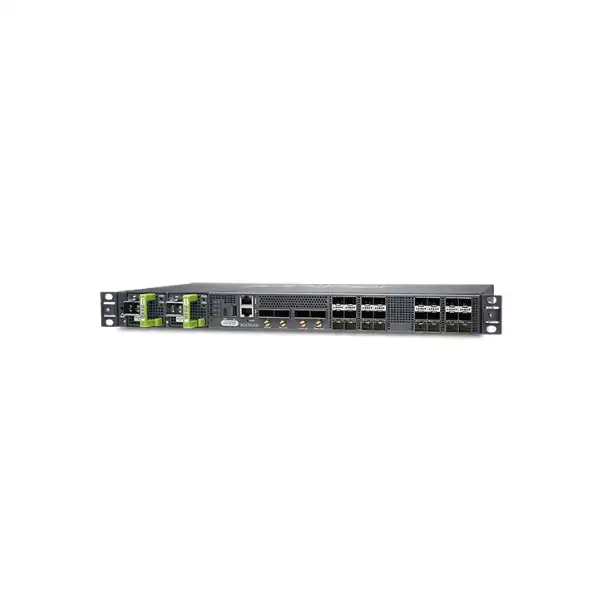
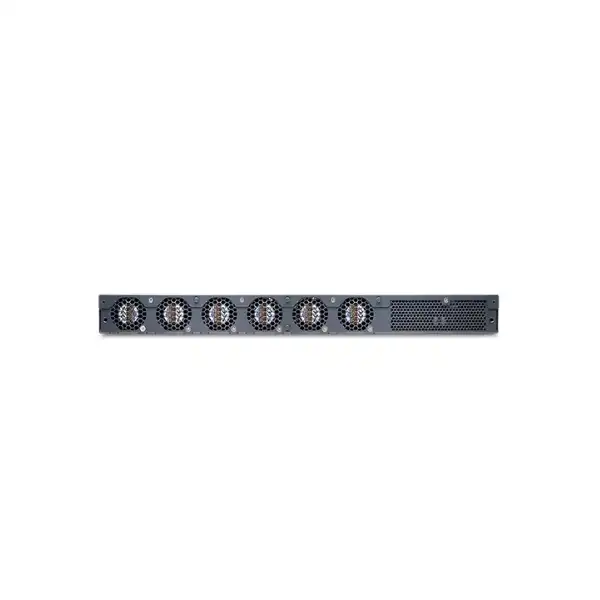
Juniper ACX7024X Cloud Metro Router in Dubai
The Juniper ACX7024X is a high-scale, commercial-temperature 1U multiservice router for metro access, enterprise WAN, customer edge, service-provider access, and pre-aggregation. It combines 360 Gbps of system throughput with 24 multirate 1/10/25GbE SFP28 interfaces, four 100GbE QSFP28 interfaces, Junos OS Evolved, an 8-core processor, and 64 GB of memory. For UAE buyers, the most important purchasing questions are not simply port count and throughput: they include environmental suitability, optical reach, licensing tier, timing architecture, route scale, redundancy expectations, and the exact AC or DC hardware variant.
Direct answer: what is the Juniper ACX7024X?
What it is: The ACX7024X is a fixed 1U Juniper Cloud Metro router running Junos OS Evolved. It is positioned for high-scale access and edge roles rather than as a general office branch router.
Main use: It is designed for service-provider and enterprise WAN access, customer edge, metro access, CPE, mobile transport, and pre-aggregation where mixed 1/10/25GbE access connectivity must feed higher-speed 100GbE uplinks.
Who should consider it: Operators, carriers, wholesale providers, large enterprises, utilities, campuses, and organizations building resilient routed metro or WAN services with MPLS, EVPN, segment routing, precision timing, and automation requirements.
Most important factor to confirm: Validate environmental limits, exact route and service scale, optics, software entitlement, timing requirements, and power variant before ordering. FourTeck can help convert those requirements into a bill of materials and deployment-ready quotation.
Why the ACX7024X is a specific high-scale option in the ACX7000 family
Juniper positions the ACX7000 family around Cloud Metro architectures: compact, service-rich routing platforms intended to bring provider-grade routing, transport, timing, automation, and operational consistency closer to access locations. The ACX7024X is especially interesting because its physical interface layout looks very similar to the ACX7024, yet the internal scale profile is different. Both models deliver 360 Gbps of system throughput and both expose 24 multirate SFP28 ports plus four QSFP28 ports. The important difference is that the ACX7024X uses an 8-core processor with 64 GB of memory, while the non-X ACX7024 is specified with a 4-core processor and 16 GB. Juniper describes the X model as the higher-scale choice with greater forwarding-table scale and faster lookups.
That distinction matters to a buyer because raw interface bandwidth is only one part of router suitability. A device can have the right port speeds yet still be the wrong choice if the planned number of routes, VPNs, service instances, control-plane sessions, telemetry streams, or automation workflows exceeds the intended operating envelope. The ACX7024X gives organizations that like the compact 1U, shallow-depth ACX7024 physical design a stronger control-plane and scale foundation without moving immediately to a larger platform. It is therefore useful for dense access points, customer-edge locations, enterprise WAN sites, mobile transport nodes, and pre-aggregation sites where scale expectations are more demanding than a basic access deployment.
At the same time, the X suffix does not mean that every characteristic is “more rugged” or universally superior. The ACX7024X is a commercial-temperature platform specified for operation from 0°C to 40°C, whereas the ACX7024 is the industrial-temperature model with a substantially broader operating range. For Dubai and UAE deployments, this is a major design point. An ACX7024X can be an excellent fit in a controlled data room, telecom room, conditioned cabinet, POP, or enterprise facility where inlet temperature remains within specification. It should not be selected simply because it has more memory if the intended site is an exposed roadside cabinet, unconditioned shelter, harsh industrial location, or another environment where ambient temperature can exceed the X model’s operating limit.
This is why FourTeck treats ACX7024X selection as a workload-and-environment decision rather than a model-name decision. A correct quotation should identify the service role, projected route and VPN growth, access and uplink speeds, environmental conditions, power source, desired resilience, synchronization needs, optics, software entitlement, and operational tooling. If a commercial-temperature rack environment is guaranteed and higher scale is valuable, the ACX7024X can be the more appropriate sibling. If temperature tolerance dominates the design, the ACX7024 deserves direct comparison even though its processor and memory are smaller.
ACX7024X verified hardware specifications
| Specification | Juniper ACX7024X | Buyer relevance |
|---|---|---|
| Form factor | Fixed 1U | Compact access or edge deployment in standard 19-inch racks. |
| System throughput | 360 Gbps | Must be assessed against real bidirectional traffic design and service mix, not just aggregate port faceplate capacity. |
| Access interfaces | 24 × 1GbE/10GbE/25GbE SFP28 | Supports mixed-speed migration and port-by-port bandwidth selection with compatible optics or cabling. |
| High-speed interfaces | 4 × 100GbE QSFP28; 40GbE operation is also listed for these ports | Suitable for uplinks, rings, core-facing connectivity, or higher-speed interconnects when the selected optic and software configuration support the design. |
| Processor | Intel 8-core | A defining X-model advantage for control-plane and high-scale requirements. |
| Memory | 64 GB DRAM | Four times the memory listed for ACX7024, supporting Juniper’s higher-scale positioning of ACX7024X. |
| Dimensions | 19 × 1.75 × 9.6 in (about 48.2 × 4.4 × 24.4 cm) | Shallow chassis depth helps in space-constrained metro and enterprise racks. Depth with field-replaceable units is listed around 10.63 in. |
| Maximum configured weight | 12.5 lb / about 5.67 kg | Relevant for rack planning and remote-site handling. |
| Operating temperature | 0°C to 40°C commercial-temperature rating | A critical UAE design limit. Use a conditioned environment and compare ACX7024 for industrial-temperature sites. |
| Operating humidity | 5% to 90% RH, noncondensing | Environmental controls must prevent condensation and remain inside platform limits. |
| Power | AC and -48 to -60 VDC variants; approximately 97 W typical and 150 W maximum without optics | The exact power variant and optical power budget should be selected as part of the bill of materials. |
| Cooling | Six fixed fans, 5+1 redundancy, front-to-back airflow | Rack airflow orientation and inlet temperature must be planned rather than assumed. |
| Operating system | Junos OS Evolved | Software release, feature support, automation integration, and entitlement must be aligned to the production design. |
Port design: 24 multirate access ports plus four 100GbE uplinks
The faceplate architecture is one of the ACX7024X’s strongest practical characteristics. Twenty-four SFP28 interfaces can be configured at 1GbE, 10GbE, or 25GbE, while four QSFP28 interfaces provide higher-speed connectivity up to 100GbE. This permits a network team to use the same compact platform across several access patterns: existing 1GbE handoffs can remain in service, 10GbE can cover common enterprise and provider access circuits, 25GbE can support higher-bandwidth aggregation or server-facing requirements, and 100GbE ports can connect toward an aggregation layer or metro core. Because speed is selectable per supported port rather than forcing one uniform access rate, migration can be phased instead of requiring an all-at-once redesign.
Port flexibility does not remove the need for a detailed optical plan. SFP28 and QSFP28 describe interface form factors and maximum native port classes, not the actual reach, wavelength, fibre type, connector, or optical budget for a specific link. A Dubai data-centre interconnect, a metro fibre path between buildings, a carrier handoff inside a POP, and a short in-rack connection may all use different transceiver choices even when the Ethernet speed is the same. Before a quotation is finalized, the buyer should provide link speed, fibre type, approximate distance, connector or patch-panel details, whether wavelength-division multiplexing is involved, and whether Juniper-qualified optics are mandatory for the organization’s support policy.
It is also important to distinguish interface capacity from system throughput. The faceplate can present more nominal aggregate port capacity than the 360 Gbps system-throughput rating if every port is considered at its maximum advertised speed. That does not automatically make the platform unsuitable; access networks commonly rely on statistical multiplexing and do not expect every edge interface to run at line rate simultaneously. It does mean that the traffic engineering assumption must be explicit. For a heavily utilized aggregation node where sustained traffic could approach the sum of many 25GbE access links plus multiple 100GbE uplinks, a higher-throughput ACX platform should be evaluated rather than treating port count as proof of nonblocking capacity.
Mixed-speed migration
Keep 1GbE or 10GbE services where appropriate while introducing 25GbE on selected ports. This can reduce disruptive forklift upgrades at access sites.
100GbE uplink strategy
The four QSFP28 ports are natural candidates for metro uplinks, ring connectivity, or core-facing paths. Redundancy and oversubscription should be designed around actual service traffic.
Optics are a separate decision
Transceiver speed, reach, fibre, wavelength, power and support qualification must match each circuit. The chassis specification alone cannot determine the correct optic.
Routing, VPN and Cloud Metro capabilities
The ACX7024X is more than a fast Ethernet handoff box. Juniper’s ACX7000 common feature set includes broad Layer 2 and Layer 3 routing functions, MPLS services, EVPN, segment routing, quality of service, timing, operations and automation capabilities. In practical terms, that allows one platform to participate in modern routed underlays while also presenting business services, mobile transport, wholesale Ethernet, or enterprise WAN functions at the edge. Typical protocol families across the ACX7000 portfolio include IPv4 and IPv6, OSPF, IS-IS, BGP, multiprotocol BGP, equal-cost multipath, BFD, VRRP, MPLS, L2VPN, L3VPN, VPLS, EVPN-based services, segment routing, traffic-engineering functions, and operational telemetry. Exact feature availability and scale should always be checked against the chosen Junos OS Evolved release and the model-specific support table before production design approval.
For service providers, EVPN and MPLS support can help consolidate services onto a consistent routed infrastructure. EVPN can provide scalable Layer 2 or Layer 3 VPN services over MPLS or VXLAN environments, while traditional MPLS mechanisms remain available for networks with established LDP, RSVP, L2VPN, L3VPN, or VPLS designs. Segment routing and SRv6 provide additional options for traffic steering and simplification in architectures that are moving away from older label-distribution or tunnel-signalling approaches. The value is not that every network should enable every protocol. It is that an ACX7024X can fit into a mature provider network without forcing the buyer into a single transport model.
Enterprise teams can use the same capabilities differently. A large organization may place the ACX7024X at a WAN edge or regional aggregation site where it terminates multiple carrier circuits, separates services with routing instances, carries IPv4 and IPv6, supports resilient routing with BGP or an IGP, and connects upstream over 100GbE. In a campus or large facility, the device can provide routed aggregation when the requirement is closer to service-provider engineering than to conventional campus switching. For wholesale providers, multirate access ports can terminate diverse customer handoffs while MPLS or EVPN carries traffic into an aggregation or core layer.
Quality of service is especially important in metro and mobile designs because capacity alone does not protect latency-sensitive traffic. The ACX7000 feature set includes classification, rewrite, hierarchical QoS, multilevel priority queuing, congestion-management mechanisms, policers, and shapers. A buyer should map these features to the actual service model: number of classes, committed and peak rates, scheduler hierarchy, per-customer requirements, queue depth expectations, and congestion points. A router that is nominally fast enough can still deliver a poor service if its QoS policy is copied from another platform without validating scheduler behavior and scale.
One limitation deserves explicit attention: MACsec is not listed as supported on the ACX7024X in Juniper’s current ACX7000 common feature matrix. If link-layer encryption using IEEE 802.1AE is a mandatory requirement on the router itself, another ACX7000 model with MACsec support should be considered. This is a good example of why a feature-family overview is not sufficient for procurement. The model-specific exceptions matter, and FourTeck can help compare ACX7024X against alternatives when encryption, environmental tolerance, port density, or throughput changes the shortlist.
Precision timing for mobile transport and synchronized networks
One reason the ACX7024X is relevant to mobile and carrier access networks is its timing capability. The platform supports synchronization functions including Synchronous Ethernet and Precision Time Protocol, and Juniper documents Class C timing support in the ACX7024/ACX7024X line. Physical synchronization interfaces include a timing RJ-45/TOD interface, 1 PPS and 10 MHz input/output connections, and support for external GNSS through the documented interface arrangement. These features matter in 4G and 5G transport because frequency and phase alignment can be a service requirement rather than an optional monitoring function.
Juniper also documents Assisted Partial Timing Support on ACX7024 and ACX7024X. In that architecture the router can use GNSS as a primary reference and packet-based PTP as a backup source, operating as a telecom boundary clock for assisted partial timing. This can help an operator design timing resilience where a GNSS reference is present but loss of satellite lock must not immediately disrupt downstream synchronization. The exact profile, stream scale, fallback behavior, holdover target, software release, and upstream timing design should be validated in detail; timing engineering is sensitive to network topology, asymmetry, oscillator behavior, packet delay variation, and the chosen ITU-T profile.
For a UAE deployment, the practical questions are straightforward. Is the router only transporting Ethernet and IP, or must it actively participate in frequency and phase distribution? Is GNSS reception available at the site? Where will the antenna be installed, and what cabling or lightning-protection requirements apply? Is the upstream PTP source inside the same operator domain? Which PTP profile is required? Are downstream radios, baseband systems, or other endpoints expecting a specific clock class? The answers determine whether timing interfaces and licenses are central to the bill of materials or simply unused platform capabilities.
Buyers should also avoid assuming that timing support automatically makes every installation “5G ready.” Mobile transport readiness is an end-to-end property. The router must be combined with correct synchronization sources, optics, transport engineering, QoS, redundancy, latency targets, monitoring, and operational procedures. ACX7024X provides the tools for this role, but the architecture around it determines whether the timing service meets the mobile network’s actual requirement.
Junos OS Evolved, automation and operational visibility
The ACX7024X runs Junos OS Evolved, which provides the software foundation shared across current ACX7000 platforms. For teams already operating Juniper routing, this can reduce the operational gap between access, metro, and larger routing layers because familiar routing concepts, configuration hierarchy, telemetry, and automation interfaces remain available. For organizations new to Juniper, the key point is that ACX7024X is intended to be operated as an automation-capable network element rather than a standalone appliance that is configured once and forgotten.
Juniper documents support for zero-touch provisioning, NETCONF, YANG models, OpenConfig, telemetry, and Python-based operational tooling across the ACX7000 feature family. Those capabilities are valuable when a provider deploys many identical access nodes because the cost of manual configuration grows quickly with node count. A template-driven onboarding process can standardize base configuration, management access, routing policy, interface naming, telemetry, and compliance checks. Streaming operational data can then feed assurance systems so engineers can detect changes in reachability, link utilization, errors, timing health, or service state without relying only on periodic CLI checks.
Juniper’s current management documentation lists both Juniper Routing Director and Juniper Routing Assurance as management applications for ACX7024 and ACX7024X. These products have evolved from earlier Paragon naming, so buyers should confirm current licensing, product names, deployment model, and integration scope at quotation time. Routing Director can support onboarding, configuration, and monitoring workflows, while assurance tooling can add broader operational analysis. The router can also be managed directly through Junos OS Evolved CLI and programmatic interfaces, so adoption of an orchestration platform is an architectural choice rather than a prerequisite for basic device operation.
Automation should be designed around source-of-truth and change-control practices. A team that pushes configuration automatically without authoritative inventory, intended-state definitions, version control, rollback processes, and validation may simply automate inconsistency faster. For a new ACX7024X deployment, it is useful to define which system owns interface addressing, BGP policy, routing instances, customer service attributes, optics inventory, software version, and maintenance status. This becomes especially important when the router is used for wholesale or managed services where a configuration error can affect many customer circuits.
Operational visibility should also be sized. Telemetry streams, routing adjacencies, route scale, service instances, logs, and management integrations all consume system resources. The ACX7024X’s 8-core CPU and 64 GB memory are part of why it is the high-scale sibling of ACX7024, but the exact supported limits are still release-dependent. A serious design should compare the projected control-plane and service scale to current Juniper scale documentation rather than extrapolating from hardware memory alone.
Licensing and software entitlement: what to confirm before purchase
Licensing is one of the areas where procurement can go wrong even when the hardware model is correct. Juniper’s ACX licensing framework supports subscription and perpetual options, and the licensing documentation describes Advanced and Premium tiers for ACX features, along with bandwidth-based license families and separate entitlements for some software products. Juniper also states that ACX devices can operate without installing a license key and may expose features even when a key is not entered, but customers are still required to comply with the applicable purchase and license agreement. In other words, technical availability in the CLI should never be used as evidence that a commercial entitlement is unnecessary.
For ACX7024 and ACX7024X, historical/current licensing references identify Advanced licensing for features such as Layer 2 functions, Layer 2 and Layer 3 VPN services, timing, hierarchical QoS, and telemetry, while Premium extends entitlement to higher/full platform feature scale and other capabilities. Because licensing models and SKU names can change across software generations, the safest purchasing approach is to specify the required functions rather than asking only for “a license.” Tell FourTeck whether the router will use L2VPN, L3VPN, EVPN, MPLS, timing, advanced QoS, telemetry, high route scale, orchestration, or other feature sets, and whether the organization prefers subscription or perpetual commercial terms where available.
Junos OS Evolved is the supported operating system for the ACX7024X and is part of the platform software foundation. That does not mean every future software release should be installed automatically. Production networks normally qualify a release against required protocols, known issues, interoperability, operational tools, security policy, and change windows. For an existing Juniper environment, the target version may be selected to align with neighboring routers and standardized management tooling. For a new environment, it may be selected based on the latest supported train that has the needed features and stability profile.
Automation and assurance products should be quoted separately where they are required. Juniper’s management portfolio has changed naming over time, with Routing Director and Routing Assurance representing current tooling for onboarding, configuration, monitoring, and assurance workflows. Subscription terms, capacities, support level, and deployment architecture should be confirmed rather than assumed to be included with the chassis. The same principle applies to support services: define the required vendor support level, replacement target, software access, and local operational support in the commercial scope.
Do not buy the ACX7024X chassis first and plan licensing, optics, timing accessories, software version, or support later. A correct bill of materials is built from the intended service design so that hardware, software entitlement, transceivers, power variant, management tooling, and support terms are aligned from day one.
Dubai and UAE deployment considerations
The most important local consideration for ACX7024X is environmental control. Juniper specifies a 0°C to 40°C operating range for this commercial-temperature model. In a properly air-conditioned data centre, telecom room, enterprise equipment room, or climate-controlled POP, that range can be straightforward to maintain. In an outdoor cabinet, warehouse edge, utility enclosure, rooftop shelter, roadside telecom cabinet, or poorly conditioned room in the UAE, inlet temperature can become the deciding factor. The router should be engineered around the temperature at its air intake under worst expected site conditions, not the thermostat setting in another part of the building.
Airflow is front-to-back with six fixed fans and 5+1 fan redundancy. Rack design should therefore avoid placing equipment with incompatible airflow directions immediately adjacent when that creates recirculation. Cable management must also preserve the intake and exhaust paths. Juniper lists approximately 24 inches of maintenance clearance in its hardware specification information, which is useful for planning servicing access. The chassis itself is shallow at roughly 9.6 inches deep, or about 10.63 inches when the replaceable components are considered, so it can fit racks where deep aggregation routers would be inconvenient.
Power selection is another site-specific choice. AC and DC ACX7024X variants are available, with DC input specified in the -48 VDC to -60 VDC range and AC input across a broad mains range. Telecom POPs may prefer -48 VDC plant, while enterprise and data-centre rooms may prefer AC. Dual-power-supply configurations should be connected to genuinely independent power feeds where the resilience design calls for it; plugging both supplies into the same PDU or upstream circuit does not provide end-to-end power diversity. UPS autonomy, generator support, rectifier capacity, grounding, and breaker allocation should be included in the site readiness check.
Published power figures are approximately 97 W typical and 150 W maximum for the chassis without optics, with actual consumption dependent on operating conditions. Optics add their own power and thermal load, especially when higher-power long-reach modules are used. This is why rack power and cooling calculations should include the exact planned transceivers rather than using only the base chassis number. A dense rack of compact devices can still create a meaningful heat load even when each individual router appears efficient.
Fibre planning in Dubai and across the Emirates should account for operator demarcation, cross-connect responsibility, patch-panel type, connector cleanliness, wavelength plan, route distance, and any passive optical elements. A 100GbE link between racks in the same data hall is a different optical problem from a 100GbE metro link across dark fibre. If a carrier supplies the handoff, the quotation should identify whether FourTeck is supplying only the router-side optic or the complete optical path. When coherent or high-power optics are contemplated, compatibility and thermal guidance should be checked against Juniper documentation for the exact module.
Finally, installation scope should be explicit. Hardware delivery is different from rack-and-stack, software commissioning, migration, acceptance testing, and ongoing support. For a production WAN or service-provider site, an implementation plan may include preconfiguration, rack installation, power validation, optics insertion, software baseline verification, management access, routing adjacency establishment, service migration, timing validation where required, traffic testing, rollback checkpoints, documentation, and handover. Defining those tasks before the equipment arrives reduces the risk of a technically correct router sitting idle because the surrounding implementation details were never assigned.
Where the ACX7024X fits best
Service-provider metro access
Use the multirate SFP28 ports for customer or access-facing circuits and the 100GbE QSFP28 interfaces toward aggregation. MPLS, EVPN, segment routing, QoS, telemetry, and timing functions make the platform suitable for provider engineering rather than simple Layer 2 handoff.
Enterprise WAN edge
Large enterprises can use the ACX7024X where many Ethernet handoffs, BGP or IGP routing, VPN segmentation, high route scale, and 100GbE upstream connectivity are required. It is more appropriate for network-engineering teams than for small branches seeking a simple all-in-one WAN appliance.
Mobile backhaul and transport
Precision timing, PTP, SyncE, external GNSS support, strong QoS, and high-speed Ethernet interfaces make the platform relevant to 4G/5G transport. The timing architecture and environment must be validated end to end rather than inferred from feature support alone.
Wholesale and managed connectivity
Providers delivering Ethernet or IP services to multiple customers can use routing instances, VPN technologies, QoS and telemetry to separate and operate services. Projected customer count and service scale should be checked against current Juniper scale limits.
Pre-aggregation
The shallow 1U chassis is attractive where several lower-speed access links need to be gathered before traffic reaches a larger metro router. The 360 Gbps throughput ceiling must be compared with the expected simultaneous load so oversubscription remains intentional.
Compact controlled-environment POPs
The 9.6-inch chassis depth can be valuable in constrained racks. The trade-off is the 0°C to 40°C commercial-temperature operating limit, so the facility must provide dependable environmental control.
When the ACX7024X may be the wrong choice
A balanced product decision includes the reasons not to buy. The ACX7024X may be unsuitable when the installation requires industrial-temperature operation beyond 40°C, when sustained forwarding demand exceeds what a 360 Gbps platform should carry, when substantially more 100GbE or higher-speed interfaces are required, when native MACsec on the router is mandatory, or when the project needs a different physical form factor. In these cases, another ACX7000 model or a different Juniper routing platform should be evaluated rather than forcing the ACX7024X into a role it was not designed to fill.
The ACX7024 should be compared directly when environmental tolerance matters more than control-plane scale. It has the same published 360 Gbps throughput and the same 24 SFP28 plus four QSFP28 interface layout, but it is the industrial-temperature sibling. Its processor and memory are smaller, so the route and service scale requirements must be checked carefully. In a hot remote shelter, roadside cabinet, industrial facility, or other location with temperature extremes, the ACX7024 may be the more defensible physical platform despite the ACX7024X’s stronger CPU and memory.
Larger ACX7000 systems should be evaluated when the site is moving beyond access or modest pre-aggregation into dense aggregation, when a larger number of high-speed ports is needed, when 400GbE becomes part of the architecture, or when additional hardware capabilities such as MACsec are mandatory. There is no benefit in choosing a compact router if the expected growth will require replacement shortly after deployment. A three-to-five-year traffic and service forecast can reveal whether ACX7024X is a stable fit or merely the minimum model that works today.
Conversely, a smaller or simpler platform may be more appropriate if the project only needs a few branch WAN interfaces, firewalling, SD-WAN, Wi-Fi, or integrated security services. The ACX7024X is a carrier-class routing platform, not a substitute for a branch firewall or universal CPE in every scenario. Its value appears when routed metro scale, provider protocols, multirate density, timing, service separation, and automation are real design requirements.
ACX7024X sizing: the questions that determine whether 360 Gbps is enough
Sizing should begin with service behavior, not the number printed on the product page. The 360 Gbps system-throughput figure needs context: How many access ports will be active? At what speeds? What is the expected busy-hour utilization? How much traffic is local versus forwarded upstream? Are there multiple uplinks in an active/active topology or one primary and one standby? Will the router aggregate customer circuits with bursty traffic, or carry a smaller number of consistently saturated transport links? These details determine whether oversubscription is sensible and whether the platform has enough forwarding headroom for growth.
Control-plane scale should be estimated independently from traffic throughput. A high-scale enterprise WAN may receive large BGP routing tables, maintain many peers, host multiple routing instances, and export substantial telemetry even when average data-plane traffic is modest. A service provider may have fewer global routes but far more customer VPNs and service instances. The ACX7024X’s 8-core processor and 64 GB memory make it the stronger scale choice relative to ACX7024, but they do not remove software-specific limits. Current Juniper release documentation should be used to validate route counts, VPN scale, EVPN scale, MAC-table requirements, policer or scheduler counts, and telemetry design.
Resilience also affects sizing. If two ACX7024X routers are deployed as a redundant pair, determine whether each router must carry 100% of the production load during failure or whether the network can accept reduced capacity. A design that runs both units near their comfortable maximum in normal operation may have insufficient headroom when one fails. Similarly, if 100GbE uplinks are distributed across diverse paths, routing and traffic engineering should ensure failure does not push more traffic through the remaining link set than the chassis or upstream network can sustain.
Optics can become a capacity constraint outside the router itself. Long-reach links may have optical budgets, dispersion, wavelength availability, or patch-panel losses that limit usable paths. If 100GbE uplinks run across metro fibre, the chosen transceiver type and link engineering can be as important as the router port. For short links, DAC or shorter-reach optics may be simpler and lower power. FourTeck can quote the chassis and optics together when the link details are provided, which helps avoid the common problem of receiving a router with empty ports and no validated connectivity plan.
A useful sizing output is therefore a short engineering statement: expected access-port mix, normal and failure-state traffic, uplink topology, route and VPN scale, timing role, software features, optics, environment, and growth target. That statement gives procurement a defensible reason for choosing ACX7024X instead of selecting it only because its model number appears in an existing bill of materials.
ACX7024X vs ACX7024: practical comparison
| Decision area | ACX7024X | ACX7024 | Selection logic |
|---|---|---|---|
| Throughput | 360 Gbps | 360 Gbps | No difference in published system throughput. |
| Ports | 24 × 1/10/25GbE + 4 × 100GbE | 24 × 1/10/25GbE + 4 × 100GbE | Port layout alone does not justify choosing one over the other. |
| CPU | 8-core | 4-core | ACX7024X is positioned for higher scale and stronger control-plane requirements. |
| Memory | 64 GB | 16 GB | The X model has four times the listed memory. |
| Environment | 0°C to 40°C commercial temperature | -40°C to +65°C industrial temperature | ACX7024 is the stronger choice for harsh or uncontrolled temperature environments. |
| Best-fit emphasis | High-scale provider and enterprise WAN, CPE, CE, access and pre-aggregation | Metro access and aggregation where industrial temperature is important | Choose by scale and environment, not by suffix alone. |
Implementation journey from quotation to production
Document whether the router is WAN edge, customer edge, metro access, mobile transport, wholesale handoff, or pre-aggregation. Record traffic, route, VPN, timing and resilience requirements.
Confirm the site stays within 0°C to 40°C, check rack depth and airflow, choose AC or -48/-60 VDC, define redundant feeds, and calculate optical power and thermal load.
Map every SFP28 and QSFP28 link by speed, reach, fibre type, wavelength, connector and peer device. Verify transceiver qualification before ordering.
Translate required MPLS, EVPN, VPN, timing, QoS, telemetry and scale into the appropriate current Juniper licensing tier and term. Add management software only where required.
Set the approved Junos OS Evolved version, management plane, routing policy, interfaces, services, telemetry and security controls. Validate interoperability in a lab or staging workflow where risk warrants it.
Move services in controlled steps, verify routing, forwarding, QoS and timing, monitor telemetry and errors, retain a rollback path, then complete documentation and operational handover.
Procurement checklist for an accurate ACX7024X quotation
A request that says only “Juniper ACX7024X price in Dubai” is enough to start a conversation, but not enough to build a reliable production bill of materials. The following details improve quotation accuracy and reduce redesign after purchase.
Frequently asked questions about Juniper ACX7024X
What is the throughput of the ACX7024X?
Juniper specifies 360 Gbps system throughput. This should be compared with the expected aggregate traffic pattern, including normal and failure states. The device has a flexible faceplate with many ports, so do not assume that the sum of every port’s nominal line rate can be driven simultaneously without considering the system-throughput ceiling.
How many Ethernet ports does it provide?
The ACX7024X provides 24 SFP28 ports that support 1GbE, 10GbE, and 25GbE speeds plus four QSFP28 ports for high-speed connectivity up to 100GbE. Juniper also lists 40GbE operation in the maximum port-capacity table. The actual link requires the correct compatible optic or cable.
What is the difference between ACX7024X and ACX7024?
Both have 360 Gbps throughput and the same published port layout. ACX7024X has an 8-core CPU and 64 GB memory, compared with a 4-core CPU and 16 GB on ACX7024, making the X model the higher-scale option. The trade-off is environment: ACX7024X is rated 0°C to 40°C, while ACX7024 is industrial-temperature rated from -40°C to +65°C.
Does ACX7024X run standard Junos?
The supported operating system is Junos OS Evolved. Buyers should select a production software release according to Juniper support, required feature set, interoperability, and their organization’s qualification policy rather than assuming the newest release is automatically the best release for every network.
Does it support MPLS and EVPN?
Yes. The ACX7000 feature family includes MPLS services, L2VPN, L3VPN, VPLS, EVPN and segment-routing capabilities. Exact feature combinations, release support, scale and commercial entitlement should be validated for the intended Junos OS Evolved version before the design is approved.
Does ACX7024X support SRv6?
Juniper lists segment routing for IPv4 and IPv6, including SRv6, as part of the ACX7000 family’s next-generation capabilities. The exact production design should still be checked against the software release, intended topology, required segment-routing functions, route scale and operational tooling.
Does the ACX7024X support MACsec?
No, MACsec is not listed as supported on ACX7024X in Juniper’s current ACX7000 family feature matrix. If router-integrated IEEE 802.1AE encryption is mandatory, evaluate another ACX7000 model that explicitly supports MACsec or use an architecture that provides encryption elsewhere.
Is ACX7024X suitable for 5G mobile transport?
It is designed with mobile transport in mind and supports precision timing functions such as PTP, SyncE, Class C timing, and external GNSS-based synchronization workflows. Suitability still depends on the operator’s required timing profile, traffic engineering, QoS, redundancy, optical design and environmental conditions.
Can it be installed outdoors in Dubai?
The ACX7024X itself is a commercial-temperature platform rated for operation from 0°C to 40°C. It should therefore be installed only where the equipment inlet temperature and other environmental conditions remain within specification. For unconditioned or harsh-temperature sites, compare the industrial-temperature ACX7024 or another appropriately rated platform.
What power options are available?
Juniper lists AC and DC variants. DC input is specified from -48 VDC through -60 VDC, while AC versions accept a broad mains input range. The quotation should identify the exact hardware variant, supply redundancy and the facility-side power design rather than treating the power module as an afterthought.
How much power does it consume?
Published figures are approximately 97 W typical and 150 W maximum without optics, with real consumption varying by operating conditions and transceiver choice. Rack power and cooling calculations should add the consumption and heat load of the exact optics used, particularly for longer-reach or higher-power modules.
Are transceivers included with the router?
Optics should be treated as separate line items unless a quotation explicitly bundles them. The correct SFP/SFP28/QSFP28 module depends on Ethernet speed, fibre medium, reach, connector, wavelength plan and support requirements. FourTeck can include validated optics in the same bill of materials when link details are supplied.
Does it support automation?
Yes. The ACX7000 software feature set includes zero-touch provisioning, NETCONF, YANG, OpenConfig, telemetry and scripting capabilities. Juniper also lists Routing Director and Routing Assurance as supported management applications for ACX7024 and ACX7024X. Commercial licensing and integration scope should be confirmed separately.
Do I need a software license for every feature?
Juniper uses ACX commercial licensing tiers and offers subscription and perpetual models for supported license families. The chassis may technically expose features without an installed key, but the organization must still own the appropriate entitlement under Juniper’s commercial terms. Required functions should be mapped to the current license SKU set at quote time.
Can the ACX7024X be used as a normal enterprise router?
Yes, particularly for enterprise WAN edge or aggregation where high route scale, multirate Ethernet, BGP, MPLS/EVPN, 100GbE uplinks and automation are valuable. It is usually excessive for small branches that primarily need integrated firewall, SD-WAN or wireless functions, because those are different product categories.
How should I choose between one router and a redundant pair?
Start with the service availability requirement. A single chassis is simpler and less expensive but creates a device-level failure point. A pair can improve resilience when power feeds, uplinks, routing and physical paths are also diverse. The design should confirm whether one surviving router can carry the complete production load during maintenance or failure.
What information does FourTeck need to quote ACX7024X in Dubai?
Provide quantity, AC or DC power preference, interface-speed mix, optical distances, uplink topology, route and VPN scale, timing requirements, software features, license term, environmental conditions, support level, and whether installation or migration services are required. Even partial information is useful; missing items can be resolved during consultation.
Decision recap: is the Juniper ACX7024X the right fit?
What FourTeck needs from you
For a precise Juniper ACX7024X Dubai quotation, send the information you already know. FourTeck can help resolve the rest during the design review.
Plan your ACX7024X deployment with the right hardware, optics and software scope
FourTeck can prepare a Dubai/UAE quotation for the Juniper ACX7024X that reflects the actual network design rather than a chassis-only price. Share your port mix, link distances, route and service scale, environmental conditions, timing needs, licensing preference and installation scope so the proposed bill of materials is complete and supportable.

Reviews
There are no reviews yet.