
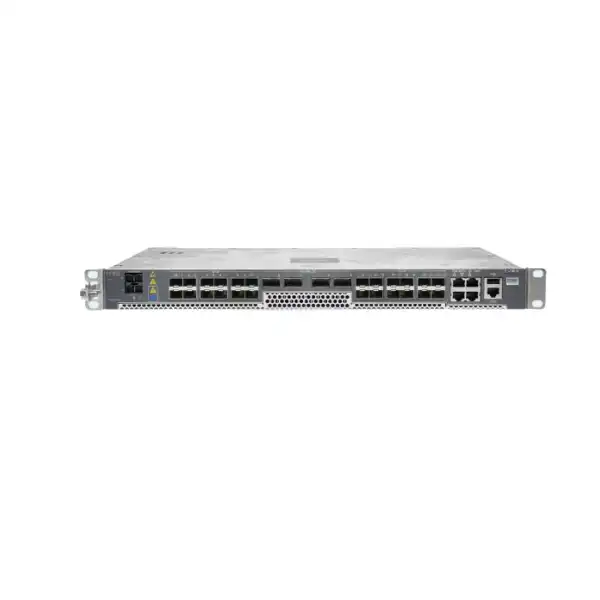
Juniper ACX710 Universal Metro Router in Dubai
A compact, hardened 1U metro router for operators that need dense 1GbE/10GbE service interfaces, flexible 40GbE/100GbE uplinks, IP/MPLS and EVPN capabilities, precision synchronization and a familiar Junos OS operating model at access and aggregation sites.
Direct answer: what is the Juniper ACX710 and who is it for?
The Juniper ACX710 is a fixed, hardened Universal Metro Router in a 1U chassis. It extends Ethernet, IP and MPLS services toward metro access and aggregation locations while providing dense 1GbE/10GbE connectivity and four high-speed QSFP28 interfaces that can operate at 100GbE, 40GbE or be channelized for 25GbE or 10GbE connections.
Its main roles are metro Ethernet access and aggregation, mobile backhaul, utility and transport networks, distributed access architectures, residential-fibre aggregation and enterprise or service-provider sites that need a compact IP/MPLS edge platform with timing, QoS and operations-and-maintenance capabilities.
Consider the ACX710 when 320 Gbps of platform capacity, 24 SFP/SFP+ ports and four 100GbE-capable uplinks match the intended access or aggregation design, especially where rack depth, environmental tolerance, precision timing or Junos operational consistency matter.
The critical checks are port-speed mix, optics and breakout compatibility, total traffic profile, timing requirements, DC power availability, Junos release and feature support, resilience expectations, and whether the project would benefit from a newer higher-capacity ACX7000-family platform instead.
FourTeck can help translate the site design into a practical bill of materials for Dubai and UAE deployments, including router quantity, supported transceivers, breakout cables, DC power considerations, software and support requirements, migration scope and the need to compare neighbouring Juniper models.
ACX710 product identity and position in a metro network
The ACX710 is not a general-purpose branch router dressed up for carrier use. Its design is centered on metro access and aggregation, where a provider or infrastructure operator often needs many lower-speed Ethernet handoffs, a smaller number of high-speed uplinks, traffic engineering, service separation, resilient routing, timing and strong operational visibility in a compact chassis. Juniper positions the platform as a hardened ACX Series system that carries Junos OS into locations close to subscribers, radio sites, access nodes and distributed service edges.
That distinction matters in procurement because a buyer may see “24 ports plus four uplinks” and compare the ACX710 with a data-centre switch. The similarity stops at the physical port count. The value of the ACX710 is in the combination of routing, MPLS, Ethernet VPN services, timing, OAM, QoS and operational controls designed for provider-style transport. A conventional switch can be less expensive per Ethernet port, but it may not provide the required service edge functions, synchronization interfaces or routing behaviour. Conversely, if a project only needs local Layer 2 switching inside a climate-controlled office, an ACX710 could be unnecessary complexity.
Juniper identifies the unit as a fixed 1U platform with 320 Gbps switching capacity. It provides twenty-four SFP/SFP+ service ports and four QSFP28 ports. The SFP/SFP+ group supports 1GbE and 10GbE, while the QSFP28 interfaces provide a flexible high-speed side of the design: each can be configured for a single 100GbE link, a single 40GbE link, four 25GbE links or four 10GbE links when the corresponding supported optics, cables and channelization configuration are used. That flexibility can be valuable where one access site has a mixed migration path rather than an immediate move to all-100GbE uplinks.
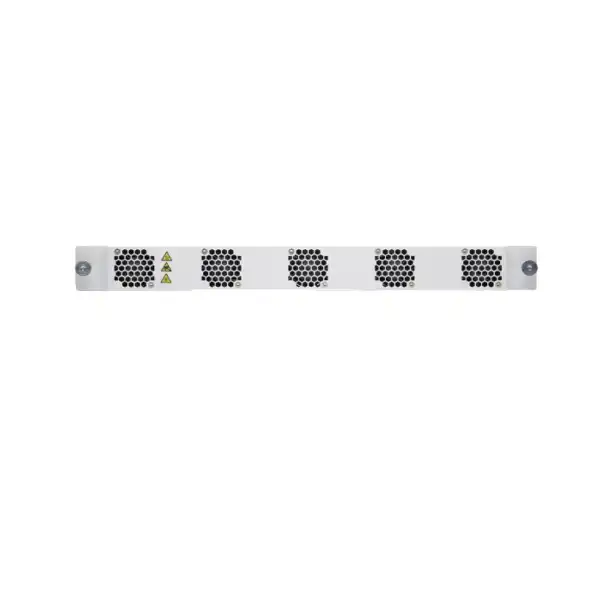
The chassis is also unusually shallow compared with many high-capacity aggregation routers. At about 31.5 cm deep and 1U high, it can suit space-constrained telecom racks, cabinets and distributed facilities where full data-centre depth is undesirable. The operating range stated by Juniper extends from -40°C to 65°C, and the cooling design is filterless with front-to-back airflow and a field-replaceable fan tray. Those characteristics can reduce maintenance demands associated with access sites, although the entire installed environment still needs appropriate enclosure design, ventilation, dust control, grounding and power engineering.
One naming point deserves special attention: ACX710 and ACX7100 are different product lines. The ACX710 is a 320 Gbps compact metro access/aggregation system. ACX7100 models belong to Juniper’s newer Cloud Metro family and reach multi-terabit capacities with much denser 100GbE and 400GbE options. Buyers who require 400GbE, materially higher system throughput or a modern cloud-metro architecture should compare those systems rather than assuming the similar names indicate the same hardware generation.
Verified hardware specifications that affect an ACX710 design
| Specification | ACX710 value | Buyer relevance |
|---|---|---|
| Switching capacity | 320 Gbps | Use this as a platform-level design limit, not as a promise that every possible port combination can run at line rate simultaneously under every feature profile. Traffic direction, service mix and feature use should be reviewed. |
| Access/service interfaces | 24 × SFP/SFP+ supporting 1GbE/10GbE | Useful for dense customer, access-node, radio or aggregation handoffs. Exact optic type and lower-speed tri-rate behaviour depend on supported transceivers and port group. |
| High-speed interfaces | 4 × QSFP28 | Each port can be used as 100GbE, 40GbE, 4 × 25GbE or 4 × 10GbE with appropriate media and configuration, enabling flexible uplink and fan-out designs. |
| Dimensions | 44.28 × 4.36 × 31.5 cm; 1U | The short depth helps in distributed access locations, but rack rail fit, rear clearance, cable bend radius and airflow path still need to be checked. |
| Weight | Approximately 8 kg | Relevant to rack planning and cabinet load, especially in wall, outdoor or transport enclosures with several devices. |
| Power | -48 VDC, dual feed | This is a telecom-style DC platform. Sites built around AC power require deliberate DC plant planning rather than assuming an IEC AC power input is available. |
| Power consumption | Typical 150 W; maximum 225 W | Use maximum draw for power and thermal planning, then include optics, site conversion losses and engineering headroom where applicable. |
| Operating temperature | -40°C to 65°C | Supports demanding access environments, but does not eliminate the need to engineer the enclosure, ventilation, power plant and surrounding equipment for the same ambient conditions. |
| Humidity | 5% to 95% RH, non-condensing | Cabinet design must prevent condensation even where regional humidity is high. |
| Airflow | Front-to-back, filterless; field-replaceable fan tray | Rack orientation and adjacent equipment should maintain the intended airflow path. A filterless router still depends on a suitably controlled cabinet environment. |
Port architecture: where the ACX710 is flexible and where planning is required
The ACX710’s port arrangement is one of its strongest reasons to exist. Twenty-four SFP/SFP+ interfaces give the platform a dense bank of service-facing connections, while four QSFP28 interfaces provide substantially faster uplink capacity or breakout options. That lets a design team combine many 1GbE or 10GbE endpoints with a smaller number of 40GbE or 100GbE aggregation links without moving immediately to a larger chassis.
The high-speed ports are not limited to a single operating mode. Juniper documents support for one 100GbE connection, one 40GbE connection, four 25GbE channels or four 10GbE channels per QSFP28 port. This creates several useful migration patterns. A site might begin with 4 × 10GbE breakout toward downstream nodes, move selected links to 25GbE where supported, and later consolidate traffic into 100GbE uplinks. Another deployment might use one or two 100GbE links for ring or core connectivity while preserving the remaining QSFP28 ports for protection, expansion or fan-out.
Breakout capability should not be treated as a free increase in system capacity. It changes the number and speed of logical interfaces, but the overall 320 Gbps platform capacity remains the key sizing reference. A topology that creates many physical channels can therefore be port-rich while still requiring careful traffic engineering. For a metro access node, this may be entirely appropriate because customer or radio access links rarely peak at the same instant. For a heavy aggregation node with sustained east-west or north-south traffic, the same oversubscription assumption may be unacceptable.
Optics are another design dependency. SFP, SFP+, QSFP+, QSFP28 and breakout assemblies vary by wavelength, fibre type, reach, connector and Juniper compatibility. A bill of materials should therefore identify the actual link budget and media requirement for every connection rather than ordering “10G optics” or “100G optics” generically. Short-reach multimode inside a facility, single-mode metro links, long-reach transport, direct-attach copper and breakout cabling are materially different choices. Supported-transceiver information should be checked against Juniper’s current hardware compatibility data before purchase.
The hardware guide also documents differences in lower-speed behaviour within the bank of twenty-four service ports when tri-rate SFP optics are used. That is the kind of detail that can matter during migration from legacy 100 Mbps or 1GbE equipment. A project with older access devices should map each legacy speed and optic requirement to the exact physical ports rather than assuming every SFP position behaves identically at every low speed.
For purchasing, the practical output should be a port map: what connects to ports 0–23, which QSFP28 interfaces operate at which speed, which are channelized, which optic or cable is installed at each end, how much spare capacity remains, and what the failover path looks like. That small design exercise prevents many avoidable quotation errors and makes future expansion far easier to understand.
Routing, MPLS and Ethernet service capabilities
The ACX710 is designed to sit where Ethernet access services meet routed and MPLS transport. Juniper lists IPv4 and IPv6 routing, BGP-4 and MP-BGP, IS-IS, OSPFv2/v3 and VRRP, along with a broad set of MPLS and traffic-engineering technologies. The importance of that combination is architectural: a provider can place service intelligence closer to the access edge rather than building a simple Layer 2 island that depends on a distant router for every control function.
IP routing foundation
BGP, MP-BGP, IS-IS, OSPFv2/v3, VRRP and IPv4/IPv6 support allow the ACX710 to participate in provider or enterprise routing domains rather than operating only as a bridge. The correct protocol set depends on the surrounding network, route scale, policy model and Junos release.
MPLS and fast convergence
Juniper documents LDP, T-LDP, RSVP-TE with fast reroute, segment routing, PCEP, BGP-LU and loop-free alternate mechanisms. These features support engineered transport and recovery designs, but interoperability and scale should be validated against the chosen Junos release and network architecture.
Layer 2 and Layer 3 VPN services
The platform supports L3 MPLS VPNs, 6VPE, VPWS for E-Line, VPLS for E-LAN and EVPN. This makes it useful where access infrastructure must carry multiple customer or service domains with controlled separation across an IP/MPLS metro.
Ethernet service functions
802.1Q VLANs, 802.1ad Q-in-Q, LACP, integrated routing and bridging, storm protection and LLDP support common carrier-Ethernet and enterprise handoff designs. Juniper also lists MEF Carrier Ethernet compliance in the ACX710 feature set.
EVPN deserves separate attention because it can simplify how Layer 2 and Layer 3 services are signalled across a routed fabric. The presence of EVPN support does not mean every EVPN design seen on newer high-end routers is automatically available with identical scale or feature behaviour on the ACX710. Service providers should define the exact EVPN use case—such as VPWS, bridging, multihoming or integrated routing—then verify support and scale in Juniper Feature Explorer and the intended Junos release.
Traffic engineering features are similarly valuable only when they match the operational model. RSVP-TE, segment routing, PCEP and fast-reroute mechanisms solve different problems. A network that already standardizes on segment routing may value an access node that can participate directly. An older MPLS network may continue using LDP and RSVP-TE. A greenfield enterprise metro may not need the entire service-provider toolkit at all. The correct question is therefore not “does the ACX710 support MPLS?” but “which control plane, protection model, service types and operational tooling will be used end to end?”
This is one reason an ACX710 quotation should follow architecture, not precede it. The hardware can support a broad range of services, but the economic and operational value depends on choosing only the features needed for the project and ensuring they are supported together in the target software release.
Precision timing and synchronization for mobile and utility networks
Timing is a defining ACX710 capability and one of the clearest differences between this platform and a conventional Ethernet switch. Juniper documents Class-C timing, Precision Time Protocol, Network Time Protocol, synchronous Ethernet with Ethernet Synchronization Message Channel, and a Stratum 3E clock. The chassis also includes dedicated timing interfaces: an RJ-45 1PPS plus time-of-day port and an RJ-48C BITS interface for 2.048 MHz and E1/T1 clock input or output.
These features are relevant where the network is carrying services that depend on controlled frequency, phase or time alignment. Mobile backhaul is the most obvious case. LTE, LTE-Advanced and 5G transport can impose synchronization requirements that are not satisfied merely by moving packets quickly. The router must participate correctly in the chosen timing architecture, and the upstream reference, downstream consumers, boundary-clock behaviour, SyncE chain and failure modes all matter.
A timing-capable router is not by itself a complete timing solution. The design still needs an authoritative clock source, defined quality levels, redundancy, holdover expectations, cabling and connector planning, monitoring, and a clear statement of which device is master, boundary or slave in the timing chain. If PTP is delivered across an IP/MPLS network, packet delay variation and queueing behaviour must also be considered. If SyncE is used for frequency, ESMC quality levels and the physical Ethernet path become part of the design.
Utilities and transportation networks can benefit for similar reasons. Precise timing may support deterministic event correlation, communications between substations or field systems, and operational monitoring. However, sector-specific requirements can be stricter than the feature name alone suggests. Buyers should map the exact timing profile and regulatory or operational standard to the router’s supported software before deployment.
For Dubai projects, the practical procurement question is whether timing is simply “nice to have” or part of the service acceptance criteria. If timing is mandatory, it should appear in the design documents and test plan, not only in the product description. That affects software validation, external clock interfaces, optics, topology, redundancy and commissioning effort.
QoS, OAM and service assurance: turning bandwidth into a controllable service
Metro networks are rarely judged only by whether a link is up. Operators need to control congestion, protect high-priority traffic, detect faults and measure service performance. The ACX710 combines quality-of-service mechanisms with operations-and-maintenance tools that can support that operational model.
Queueing and shaping
Juniper lists strict queueing, weighted fair queueing, priority-weighted fair queueing, ingress policing, per-port egress shaping, RED and weighted RED. These tools can differentiate critical traffic from best-effort services and reduce the impact of congestion when the policy is designed carefully.
Service markings
Support for 802.1p, MPLS EXP bits and differentiated services lets the platform map packet markings into forwarding treatment across Ethernet and MPLS domains. A consistent end-to-end class model is more important than any single queueing feature.
Fault and performance OAM
IEEE 802.1ag connectivity fault management, ITU-T Y.1731, RFC 2544 reflector functions, MPLS ping/traceroute, BFD for IPv4/IPv6 and TWAMP give operators multiple ways to verify reachability, convergence and performance.
QoS configuration should start from commercial service definitions. If the network sells or guarantees several classes—voice, mobile signalling, business VPN, internet access and management traffic, for example—the router needs a mapping from incoming markings to forwarding classes, queue scheduling, shaping rates, policers and egress rewrite rules. Those choices also interact with link speed. A policy built for a 10GbE handoff cannot simply be copied to a 1GbE interface without reviewing burst behaviour and queue allocation.
OAM features are most useful when incorporated into normal operations. BFD can accelerate failure detection for routing sessions. Y.1731 and 802.1ag can help monitor Ethernet services. TWAMP can provide active performance measurements. MPLS ping and traceroute help validate label-switched paths. An implementation plan should decide which tools are enabled, where monitoring data is collected, how alarms are correlated and what thresholds trigger operational action. Otherwise, a capable router can still produce a poorly observable service.
Junos OS operations, automation and secure management
The ACX710 runs Junos OS, which is strategically important for organisations that already operate Juniper routing, switching or security infrastructure. A common operating system can reduce the number of syntax models, configuration conventions and automation interfaces that engineering teams must maintain. It can also make the access layer easier to integrate with established change-control and telemetry workflows.
Juniper documents CLI, SNMPv2/v3, NETCONF, YANG models, syslog and zero-touch provisioning for the ACX710. These interfaces support both traditional device-by-device administration and automated workflows. NETCONF/YANG can be particularly useful where network state is managed from an orchestrator or configuration pipeline rather than through manual CLI sessions. Zero-touch provisioning can reduce on-site configuration effort for repeated access-node rollouts, provided the bootstrap network and security process are designed correctly.
Security controls include secure boot, access-control lists, RADIUS, TACACS+, LDAP, TLS, SSH and reverse-path forwarding, among other functions. Their presence does not remove the need for a management-plane security architecture. The out-of-band management port should normally be placed in an appropriately protected management network, administrative access should use role and authentication controls, configuration backups should be maintained, and monitoring should include both system events and security-relevant changes.
Software release selection is an important procurement dependency. A hardware feature may exist on the platform while a specific protocol enhancement, scale value, bug fix or interoperability behaviour differs across Junos releases. Production deployment should therefore use Juniper’s current documentation, Feature Explorer and release notes to confirm the exact release that supports the intended design. This is especially important for EVPN variants, segment routing, timing profiles and automation integrations, where feature maturity can evolve over time.
Support entitlement and software access should also be considered part of the platform, not an afterthought. Buyers should define the required support response, software upgrade rights, lifecycle expectations and operational ownership before finalizing the quote. A metro router installed at many remote sites can create a significant support burden if software and replacement processes are not planned from the beginning.
Physical deployment, DC power and environmental engineering
The ACX710’s hardened specification is attractive for remote and edge locations, but successful deployment still depends on the surrounding site. Juniper lists -48 VDC dual-feed power, typical consumption of approximately 150 W and a maximum of 225 W. This means the power design should be approached as telecom DC infrastructure rather than as a normal office appliance installation.
A dual-feed input can support resilient power when the site provides independent A and B DC feeds. The advantage is lost if both feeds originate from the same unprotected converter, fuse block or battery string. The project should document source voltage range, breaker and fuse sizing, cable gauge, grounding, battery autonomy, rectifier capacity and any DC distribution units. If the location supplies only AC mains, an engineered DC conversion or telecom power system is required; the ACX710 should not be quoted as though a generic power cord solves that dependency.
Thermal planning deserves equal attention. Juniper specifies an operating range from -40°C to 65°C and 5% to 95% non-condensing humidity. Those numbers describe the router’s supported environment, not the entire cabinet. Optics, DC power equipment, patching hardware and neighbouring devices may have different limits. In outdoor or semi-conditioned sites in the UAE, solar loading and internal cabinet temperature can materially exceed ambient air temperature. Enclosure design must therefore consider heat rejection, airflow, sun exposure, dust, moisture and the environmental limits of every component.
The router uses front-to-back airflow and a filterless design with a field-replaceable fan tray. Filterless operation can reduce routine filter maintenance, but it does not mean “dust-proof.” Air quality and cabinet protection remain important, particularly in exposed sites. Equipment immediately in front of or behind the ACX710 should not block intake or exhaust. Cable management should preserve the airflow path while maintaining safe fibre bend radius.
The chassis measures roughly 44.28 cm wide, 4.36 cm high and 31.5 cm deep, with a weight around 8 kg. The short depth helps in access racks, but the usable cabinet depth must include connectors, cable loops and maintenance clearance, not only the metal chassis. A shallow enclosure can become impractical if QSFP breakout assemblies or fibre management require additional rear or front space.
Installation planning should therefore produce a site checklist covering rack compatibility, mounting orientation, grounding, two DC feeds, fuse or breaker protection, available thermal capacity, front-to-back airflow, fibre routing, timing cabling, management access and console access. A hardened router still needs a professionally engineered site around it.
Where the ACX710 fits well — and where another router may be better
Good fit: metro access
Twenty-four 1/10GbE service ports plus flexible 100GbE-class uplinks make sense for access nodes aggregating multiple customers, cells, cabinets or distributed systems into a routed metro.
Good fit: mobile backhaul
The combination of hardened hardware, 10/100GbE connectivity, MPLS services, QoS and Class-C timing capabilities directly addresses important radio-access transport requirements.
Good fit: utilities and transport
Environmental tolerance, timing interfaces, service separation and strong OAM can suit infrastructure networks that extend beyond conventional office conditions.
Compare alternatives: high aggregation load
If the node needs sustained multi-terabit throughput, dense 100GbE, 400GbE or substantially more future headroom, compare newer ACX7000-family platforms rather than forcing the ACX710 into an aggregation role beyond its capacity.
Compare alternatives: simple LAN switching
If the requirement is only local Ethernet switching with no MPLS, timing, metro OAM or provider service model, a conventional access or aggregation switch may be simpler and more economical.
Sizing should be based on traffic and topology rather than port count alone. Begin with committed and peak bandwidth on every service-facing interface, then model the uplinks and protection state. If twenty-four 10GbE ports are installed, their theoretical aggregate far exceeds the platform’s 320 Gbps capacity when both directions and all interfaces are considered. That does not automatically make the design invalid; oversubscription is normal in many access networks. It simply means the oversubscription ratio must be intentional and acceptable for the service mix.
Resilience is another selection boundary. Dual DC feeds help with power continuity, while routing and MPLS protocols provide network-level protection options. But some projects require redundant control planes, redundant chassis, hitless hardware failover or modular field-replaceable components beyond what a compact fixed router can provide. In those cases, the right answer may be two ACX710 units in a resilient topology, or a different Juniper platform with a higher level of chassis redundancy.
The most balanced purchasing decision therefore starts with role definition: Is this an access node, a small aggregation node, a cell-site router, a utility edge, a customer-service edge or a general enterprise router? The closer the required role is to hardened 1/10GbE access with a handful of 100GbE-capable uplinks and provider-grade services, the stronger the ACX710 fit becomes.
Practical ACX710 use cases in Dubai and the UAE
Metro Ethernet service access
An operator can use the twenty-four 1/10GbE ports for business or access-node handoffs and the QSFP28 ports for protected uplinks into a metro ring or aggregation pair. MPLS VPN, VPWS, VPLS and EVPN capabilities allow services to remain logically separated across a shared transport network.
4G/5G transport
At a mobile aggregation or backhaul site, the ACX710 combines high-density 10GbE, 100GbE uplinks, QoS and precision timing. The detailed design should define PTP/SyncE roles, service classes, radio-site protection and expected growth toward higher-capacity transport.
Utility communications
The hardened temperature range, DC power, timing interfaces and routed service capabilities can suit utility field networks where substations or distributed sites need deterministic management and resilient IP/MPLS connectivity.
Distributed enterprise aggregation
Large organisations operating many remote campuses, industrial zones or infrastructure sites may use the ACX710 when enterprise WAN requirements resemble service-provider transport—especially where MPLS, EVPN, strong OAM or harsh-site tolerance are more important than data-centre switching features.
Access evolution and breakout migration
QSFP28 channelization supports staged bandwidth changes. A site can preserve the same router while moving selected high-speed links between 10, 25, 40 and 100GbE modes, provided compatible optics and system capacity remain appropriate.
Residential fibre or DAA transport
Juniper identifies residential fibre, Unified PON and cable distributed access architectures among ACX710 use cases. The router can aggregate access traffic into IP/MPLS metro transport while maintaining service separation and operational visibility.
Optics, cabling and compatibility: the most common quotation dependency
The base router does not describe the whole deployment. Fibre optics and breakout cables often determine whether the planned physical topology actually works. The ACX710 uses SFP/SFP+ interfaces on the twenty-four lower-speed ports and QSFP28-class interfaces on the four high-speed ports. Selecting the transceiver requires matching speed, reach, wavelength, fibre type, connector, peer capability and Juniper support status.
For a short in-building connection, a buyer might use multimode optics or an appropriate direct-attach assembly. A metro link may require single-mode optics with a defined reach. Longer links can introduce optical-budget calculations, patch-panel losses and dispersion considerations. If the far-end platform uses a different vendor, standards compatibility helps, but operational acceptance should still be tested because DOM behaviour, FEC requirements, wavelength coding and vendor qualification can affect deployment.
Breakout designs require even more specificity. A QSFP28 port configured as four 25GbE channels needs a supported 100G-to-4×25G breakout arrangement and matching far-end interfaces. A 40GbE port broken into four 10GbE channels uses a different operating mode. The router configuration must match the physical cable, and the logical interface naming and channelization need to be reflected in the network design and monitoring system.
Spares policy is worth deciding during procurement. Remote access sites can take longer to reach than central data centres, and optics are frequent failure or change points. Keeping a small stock of approved transceivers and breakout assemblies may reduce restoration time. The spare list should be based on actual deployed optic types rather than a generic percentage of total ports.
For existing networks, compatibility checking should include more than the fibre layer. The target Junos release must interoperate with surrounding routing protocols, MPLS labels and EVPN signalling; QoS markings must map correctly across domains; timing must have a coherent reference chain; and management systems must support the device model and software release. A router can be physically compatible yet still require substantial integration work.
When FourTeck prepares an ACX710 quote, providing a simple link schedule—source, destination, speed, media, distance, redundancy and connector type—allows optics to be quoted far more accurately than ordering the chassis first and deciding the optical layer later.
Licensing, software and support: confirm before the purchase order
A complete ACX710 project includes more than the physical router. Junos feature availability can depend on software release, entitlement and the commercial terms attached to the product. Juniper’s documentation should be checked for the exact features the design requires, and the quotation should identify any software or support items separately from hardware.
The safest approach is to produce a feature checklist from the intended architecture. Examples include EVPN service type, MPLS traffic engineering, segment routing, timing profile, specific OAM methods, multicast behaviour, NETCONF/YANG automation and any scale requirements. Each item can then be validated against the intended Junos release instead of assuming that a feature listed broadly for the platform behaves identically in every release.
Support level matters because metro routers are often deployed in revenue-affecting paths. The required response time, replacement process, software access and lifecycle horizon should align with the site criticality. A router serving a single non-critical test location can tolerate a different support model from a device aggregating many business customers or radio sites.
FourTeck can help buyers structure the bill of materials so hardware, optics, power accessories, software and support are reviewed together. The aim is not to add unnecessary items; it is to avoid a situation where the router arrives but the project cannot proceed because an optic, breakout cable, entitlement or support dependency was omitted.
A practical deployment and migration sequence
Define the service role
Document whether the router is an access node, aggregation node, cell-site transport router or utility edge. List service types, customer handoffs, routing protocols, timing needs and protection objectives.
Build the port and traffic map
Assign each 1/10GbE service interface and each QSFP28 uplink. Include breakout channels, peak bandwidth, oversubscription, protection path and expected three- to five-year growth.
Validate media and timing
Select supported optics and cables for every link. If PTP, SyncE, 1PPS/TOD or BITS is required, define the reference hierarchy and associated physical connections.
Confirm software support
Check the required Junos release, protocol features, EVPN/MPLS functions, OAM, automation and interoperability. Record any configuration prerequisites or release-specific caveats.
Prepare the site
Verify rack depth, grounding, two -48 VDC feeds, thermal capacity, airflow, fibre management, out-of-band management, console access and environmental conditions before the maintenance window.
Stage and test
Load the approved Junos version, apply baseline security and management, test routing and service templates, validate optics and timing, and capture a known-good configuration before field installation.
Migrate with acceptance criteria
Move services according to a rollback plan and verify reachability, routing convergence, loss, latency, QoS treatment, OAM, timing lock and management visibility before closing the change.
ACX710 compared with higher-capacity Juniper Cloud Metro options
The most important comparison is not between the ACX710 and an arbitrary router with a similar number of ports. It is between the ACX710 and a platform sized for the next layer of the metro network. Juniper’s ACX7100 models, for example, are multi-terabit systems with 400GbE capability and much higher port density. That makes them candidates for major aggregation, dense 100GbE deployments and cloud-metro architectures where the 320 Gbps ceiling of the ACX710 would be restrictive.
| Decision area | ACX710 | Consider a newer ACX7000-family platform when… |
|---|---|---|
| Capacity | 320 Gbps | The node requires multi-terabit throughput, materially higher future headroom or sustained aggregation beyond the ACX710’s intended role. |
| High-speed interfaces | Four 100GbE-capable QSFP28 ports | Dense 100GbE or 400GbE is a central requirement rather than an uplink exception. |
| Footprint and environment | Shallow 1U hardened design | A deeper or larger platform is acceptable in exchange for substantially higher capacity and newer interface speeds. |
| Network role | Metro access and compact aggregation | The router will serve as a major aggregation or cloud-metro node where scale, telemetry and 400GbE growth dominate the design. |
There is also a cost and complexity trade-off. Buying far more capacity than the site will use can raise capital cost, optics cost, power draw and operational complexity. The ACX710 can remain a sensible choice when the access role is stable, 100GbE uplinks are sufficient and the shallow hardened format solves a real site constraint. A newer platform is more compelling when capacity growth is already visible in the project forecast.
The selection should therefore be made from a traffic forecast and architecture diagram. Similar product names are not enough to establish equivalence.
Frequently asked buyer questions about the Juniper ACX710
Does the ACX710 provide 100GbE?
Yes. It has four QSFP28 ports that can operate as 100GbE interfaces. Juniper also documents 40GbE operation and channelization into four 25GbE or four 10GbE interfaces per high-speed port when supported optics or breakout cables and the correct configuration are used. The total platform capacity remains 320 Gbps, so the physical port modes should be reviewed against expected traffic.
How many 10GbE ports are available?
The router provides twenty-four SFP/SFP+ service ports that support 1GbE or 10GbE. Additional 10GbE channels can be created from the QSFP high-speed ports through supported 40GbE-to-4×10GbE breakout operation. A design should specify which ports are native service interfaces and which are breakout channels because cabling and configuration differ.
Is the ACX710 suitable for 5G backhaul?
Juniper positions the ACX710 for 4G and 5G service delivery and documents Class-C timing, PTP, SyncE and dedicated timing interfaces. Suitability for a specific mobile network still depends on the operator’s timing profile, bandwidth, protection architecture, QoS policy and capacity forecast. Those requirements should be validated before selecting the hardware.
Can it run EVPN and MPLS services?
Yes. Juniper lists EVPN, L3 MPLS VPNs, VPWS, VPLS, LDP, RSVP-TE, segment routing and several related routing and traffic-engineering technologies for the platform. The exact EVPN use case and software feature combination should be checked against the intended Junos release because support details can vary by release and feature.
Does it use AC or DC power?
The ACX710 is documented as a -48 VDC platform with dual feed. A site that only has AC mains should include a suitable telecom DC power solution. Power design should also cover grounding, protection, battery or UPS strategy, cable sizing and resilience between the two feeds.
Is it suitable for hot or remote sites?
Juniper specifies operation from -40°C to 65°C and 5% to 95% non-condensing humidity, with front-to-back filterless airflow. This makes it more suitable for demanding access environments than many office-oriented devices. The cabinet still needs to keep every component within its limits and prevent condensation, dust ingress and blocked airflow.
Are optics included?
Optics and breakout cables should be treated as separate bill-of-material items unless a specific commercial bundle explicitly states otherwise. The exact transceiver depends on speed, fibre type, distance, connector and far-end compatibility. Supported Juniper transceivers should be verified before ordering.
What should be monitored after deployment?
At minimum, monitor interface errors and utilization, routing and MPLS session state, optical levels, CPU and memory, fan and environmental alarms, DC feed state, timing lock where applicable, QoS drops and OAM performance. Syslog, SNMP and automation interfaces can feed the organisation’s existing monitoring stack.
When should I choose something larger?
Choose or compare a larger platform when the traffic model approaches the ACX710’s capacity, when many 100GbE interfaces are required, when 400GbE is part of the plan, or when the node will perform high-capacity aggregation rather than access. Juniper’s ACX7000 family is the more natural comparison for multi-terabit Cloud Metro roles.
Can FourTeck quote installation as well as hardware?
FourTeck can scope the commercial requirement around the router, optics, cabling, software, support and deployment services. Installation effort depends on rack and DC readiness, configuration complexity, migration windows, timing integration, testing requirements and whether the project is a new deployment or replacement of live equipment.
Decision recap before selecting the ACX710
What FourTeck needs for an accurate ACX710 quotation
Number of routers, locations and whether any units are required as cold or hot spares.
Required 1GbE, 10GbE, 25GbE, 40GbE and 100GbE connections, including breakout requirements.
Fibre type, approximate link distance, connector type and far-end device for each optical connection.
Peak throughput, protection topology, expected oversubscription and growth horizon.
Routing, MPLS, EVPN, QoS, multicast, OAM and automation features required by the design.
Whether PTP, SyncE, 1PPS/TOD or BITS will be used and where the reference clock comes from.
Available -48 VDC feeds, rack depth, environmental conditions and any enclosure constraints.
Required support level, configuration assistance, staging, installation, migration window and acceptance testing.
Plan the Juniper ACX710 around your actual metro requirement
The ACX710 can be an efficient and technically strong metro access router when its 320 Gbps capacity, 24 × 1/10GbE service ports, four flexible QSFP28 uplinks, timing capabilities and DC-powered hardened form factor match the site. The most reliable quotation starts with the traffic map, optics, timing, software features, resilience and installation conditions—not the chassis alone.

Reviews
There are no reviews yet.