
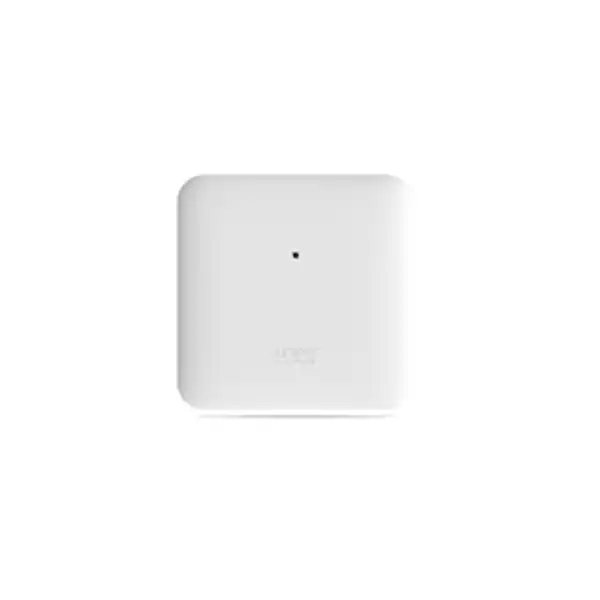
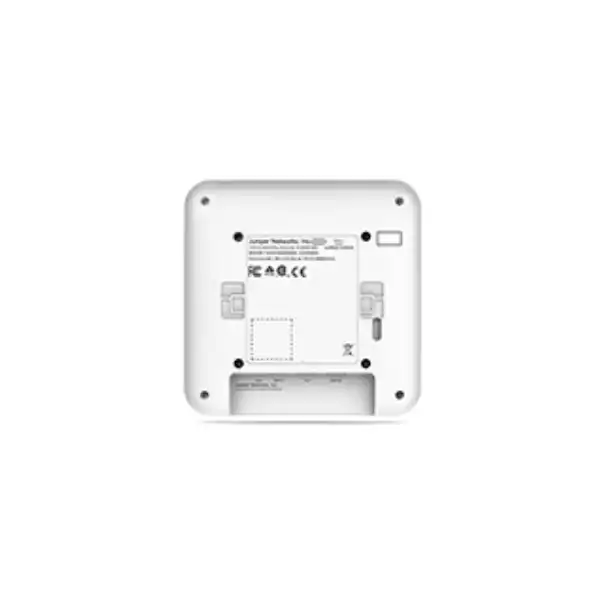
Juniper AP45 Access Point Dubai
A high-performance indoor Wi-Fi 6E access point for enterprises that need tri-band capacity, 4×4:4 radio performance, multigigabit uplink capability, Juniper Mist cloud operations and advanced location services.
Direct answer for buyers considering the Juniper AP45
What exactly is it? The Juniper AP45 is an indoor enterprise Wi-Fi 6E access point in Juniper’s Mist-managed wireless portfolio. It supports simultaneous 2.4 GHz, 5 GHz and 6 GHz operation and uses four-spatial-stream radio architecture on the main bands, with an additional radio dedicated to functions such as scanning, radio resource management and wireless security monitoring.
What is it mainly used for? It is intended for business wireless networks where client density, application demand, channel availability, operational visibility and future use of the 6 GHz band justify a high-performance enterprise access point rather than an entry-level model.
Who should consider it? Enterprises, large offices, education environments, healthcare facilities, hospitality venues, collaboration-heavy workplaces and other indoor sites with modern Wi-Fi 6E clients or a roadmap toward 6 GHz can evaluate the AP45.
What is the most important factor to confirm? Do not choose the AP45 only from the radio headline. Confirm the complete design: regional ordering SKU, local regulatory use of 6 GHz, client capabilities, AP count, RF placement, 802.3bt PoE for full functionality, multigigabit switch capacity, cable quality and the required Juniper Mist subscription.
What can FourTeck help determine? FourTeck can help align the AP45 hardware, subscription term, switching, PoE budget, mounting, cabling and deployment scope with the actual Dubai site requirement so the quotation reflects a usable solution rather than an isolated access point.
Why the AP45 is a distinct enterprise access point
The Juniper AP45 sits in the high-performance part of Juniper’s enterprise wireless range. Its most important architectural difference is not merely that it carries a Wi-Fi 6E label. The model combines simultaneous 2.4 GHz, 5 GHz and 6 GHz service with four spatial streams on each primary band, a dedicated scanning radio, integrated virtual Bluetooth Low Energy capability and cloud-based operations through the Juniper Mist platform. For a buyer, that combination changes the design questions. A basic access point selection can sometimes be made by looking at coverage and user count alone. The AP45 deserves a broader review because its value depends on whether the surrounding wired network, power system, client estate and software subscriptions allow its capabilities to be used properly.
Juniper specifies maximum data rates of up to 1,148 Mbps on 2.4 GHz, up to 2,400 Mbps on 5 GHz and up to 4,800 Mbps on 6 GHz. Those figures are physical-layer maxima rather than promises of application throughput. Real user performance is influenced by channel width, client radio capability, interference, signal level, airtime competition, protocol overhead, backhaul capacity, internet bandwidth and application behavior. This distinction matters in procurement. A design that expects every connected laptop to experience the combined headline rate will be unrealistic. A better use of the specification is to understand that AP45 offers substantial radio capacity and supports modern high-throughput channel options when compatible clients and local spectrum rules allow them.
The fourth radio also has practical significance. It can perform scanning and support radio resource management and wireless security functions without requiring the serving radios to spend as much time away from client traffic. In operational terms, this helps the network observe RF conditions while the primary bands remain focused on access. Juniper’s Mist architecture then uses wireless telemetry to provide visibility and automation. For an IT team that wants to move from reactive troubleshooting toward measurable service levels and cloud-led operations, the access point therefore contributes both RF capacity and data for the management platform.
The AP45 should still be treated as one component of a system. Its business value is highest when the WLAN design, switch layer, PoE budget, subscription model, authentication services, cabling and operational processes are planned together. This page therefore focuses on the decisions surrounding the hardware rather than simply repeating a feature list.
Core Juniper AP45 specifications
| Specification | AP45 detail | Buyer relevance |
|---|---|---|
| Deployment | Indoor | Use an outdoor-rated Juniper model for exposed outdoor areas rather than assuming the AP45 can be weatherproofed. |
| Wi-Fi standard | IEEE 802.11ax, Wi-Fi 6E with 6 GHz support | 6 GHz benefits require compatible clients and deployment under applicable local regulatory rules. |
| 2.4 GHz radio | 4×4:4, up to 1,148 Mbps | Useful for legacy and IoT coverage, but 2.4 GHz generally has fewer non-overlapping channels and more interference pressure than higher bands. |
| 5 GHz radio | 4×4:4, up to 2,400 Mbps | Likely to remain a major service band during mixed-client transitions because of broad enterprise client compatibility. |
| 6 GHz radio | 4×4:4, up to 4,800 Mbps | Creates access to newer spectrum and wider channels for compatible devices, but range and wall penetration must be planned carefully. |
| Scanning radio | Dedicated fourth radio | Supports spectrum observation, RRM, security scanning, synthetic client and location-related functions without making every monitoring task depend on client-serving radios. |
| Primary uplink | 100/1000/2500/5000Base-T RJ45, PoE powered device | A multigigabit access switch can prevent a 1 GbE wired edge from becoming the obvious bottleneck where traffic demand is high. |
| Secondary Ethernet | 10/100/1000Base-T RJ45; optional PoE PSE mode under supported power conditions | Can support selected downstream requirements, but the use case and total power design must be confirmed before relying on it. |
| Full-function power | 802.3bt; Juniper lists 29.3 W for full functionality | The switch PoE class and total chassis budget should be checked across all APs rather than only per-port availability. |
| Bluetooth | Bluetooth 5.1 with 16-element directional vBLE antenna array and omnidirectional Bluetooth antenna | Relevant when indoor location, user engagement or asset visibility is part of the business requirement. |
| Dimensions | 230 mm x 230 mm x 50 mm | Useful for ceiling, wall, enclosure and aesthetic planning. |
| Weight | Approximately 2.01 kg for AP45 internal-antenna model | Mounting substrate and bracket selection should support the device safely. |
| Operating environment | 0°C to 40°C for the internal-antenna model; 10% to 90% relative humidity, non-condensing; up to 3,048 m altitude | Indoor air-conditioning, ceiling void temperature and local installation conditions should be checked, especially in hot climates. |
Understanding tri-band Wi-Fi 6E in a real AP45 design
Wi-Fi 6E extends the 802.11ax generation into the 6 GHz band. For a business buyer, the key attraction is access to additional spectrum that can reduce dependence on the crowded 2.4 GHz and 5 GHz bands. The AP45 can serve clients across all three bands. That gives a wireless designer more options for distributing capable devices, creating channel reuse and separating modern high-throughput endpoints from older devices. The benefit is particularly meaningful in environments with recent laptops, premium smartphones and modern collaboration devices that actually include 6 GHz radios.
The 6 GHz band should not be treated as a simple replacement for 5 GHz. Propagation changes with frequency, and higher-frequency signals usually experience greater path loss through distance and building materials. A placement plan built for 5 GHz may therefore not provide equivalent 6 GHz coverage at every edge. If an organization wants 6 GHz to be a primary performance layer, the RF survey and AP spacing should be evaluated against the expected 6 GHz client experience, not only against a legacy 2.4 GHz coverage threshold. This is especially important in offices with dense partitioning, reinforced walls, specialist glass, storage areas or irregular floor layouts.
Channel width is another design variable. Wi-Fi 6E can enable wide channels where local spectrum and RF conditions support them, but the widest possible setting is not always the best enterprise choice. Wider channels can raise peak throughput for suitable clients, yet they also consume more spectrum per radio. In a large multi-AP deployment, an RF designer may deliberately use narrower channels to create more reusable channels, limit co-channel contention and produce consistent capacity across the floor. The right plan depends on AP density, client density, application requirements and regulatory availability.
The AP45’s 4×4:4 architecture gives the infrastructure a robust radio foundation, but most individual client devices do not use four spatial streams. Many laptops and phones operate as 2×2 clients, and some specialized devices use even less. The enterprise value of a 4×4 access point therefore comes from system capacity, receive diversity, multi-user operation and the ability to serve a varied client population, not from assuming that every device will negotiate the access point’s maximum number of streams. Capacity planning should be based on the real client mix.
2.4 GHz role
2.4 GHz remains valuable because it supports a very broad installed base of devices and generally offers stronger reach through obstacles than higher bands. In enterprise networks it often carries IoT devices, scanners, handheld equipment and older endpoints that have no 5 GHz or 6 GHz capability. AP45 provides a 4×4:4 2.4 GHz radio, but an enterprise deployment still needs disciplined channel planning because the band has limited clean channel space and can be affected by non-Wi-Fi interference.
Do not interpret the presence of a high-capability 2.4 GHz radio as a reason to place all clients on that band. The better design is usually to encourage capable endpoints toward 5 GHz or 6 GHz while preserving 2.4 GHz for coverage and devices that genuinely need it.
5 GHz role
5 GHz is likely to remain central in many AP45 deployments because it supports a mature population of Wi-Fi 5 and Wi-Fi 6 devices. During a transition to 6 GHz, the 5 GHz layer often carries the largest mix of enterprise clients. AP45’s 4×4:4 5 GHz radio therefore matters even when 6 GHz is the procurement driver.
A good design balances channel width, AP transmit power and cell overlap so roaming clients can move predictably without creating excessive co-channel contention. Site-specific RF measurement remains more reliable than copying settings from another building.
6 GHz role
6 GHz is the strategic differentiator. It offers a newer spectrum environment for supported clients and can support high-capacity designs with wide channels. This can be valuable for collaboration spaces, high-throughput users and dense modern offices. However, client compatibility must be confirmed before the organization pays for capacity that its endpoints cannot yet use.
The 6 GHz layer should be validated against local regulatory requirements, client operating systems, driver versions and security configuration. A technically capable client can still fail to use 6 GHz if its software, policy or WLAN configuration is not ready.
Power design is not optional: 802.3bt is required for full AP45 functionality
One of the most important AP45 procurement details is power. Juniper documents reduced operating modes when the access point receives less than 802.3bt power. With 802.3af, the unit enters a highly restricted state intended primarily to connect to the cloud and indicate that more power is required. With 802.3at, the access point can operate with reduced radio functionality and without some features. Full tri-radio 4×4 operation, scanning, BLE, both Ethernet interfaces, downstream PSE capability and USB require 802.3bt according to Juniper’s published power options.
This means a switch port showing ‘PoE’ is not enough information for a design. The exact PoE standard, per-port capability and total switch PoE budget must be checked. A switch may technically support 802.3bt on some ports yet still lack enough total power to run every AP45 at the required level when dozens of units are connected. The design should account for all powered endpoints, including phones, cameras and other devices sharing the same switch budget.
Power planning should also include resilience. If APs are attached to access switches backed by UPS systems, the required runtime should be calculated using the realistic aggregate load. A high-availability WLAN loses much of its business value if the switching layer or power infrastructure shuts down immediately during a building power disturbance. The correct approach is therefore to calculate AP quantity, maximum or planned draw, other PoE endpoints, switch power supplies and UPS capacity together.
For an AP45 quotation, tell FourTeck the existing or proposed switch models and how many AP45 units will attach to each switch. That makes it possible to identify whether new 802.3bt-capable switching, additional power supplies or a revised port distribution should be considered.
Multigigabit Ethernet, cabling and wired-side capacity
The AP45 primary Ethernet interface supports 100/1000/2500/5000Base-T. This is important because a high-capacity tri-band access point can generate more aggregate wireless traffic than a traditional 1 GbE uplink comfortably carries in demanding conditions. That does not mean every AP45 must always be connected at 5 GbE. It means the wired design should be based on expected traffic rather than assuming that a 1 GbE port is sufficient simply because older access points used one.
A multigigabit switch port provides the strongest alignment with AP45 capability, but the existing horizontal cabling still needs to be assessed. Cable category, link length, patching quality, termination workmanship and electromagnetic conditions can affect negotiated speed and stability. In an existing building, a survey should distinguish between the category printed on a cable jacket and the actual performance of the installed channel. Old patch leads, poor terminations and undocumented intermediate connections can cause a multigigabit link to downshift or become unreliable.
The switching layer also has to handle aggregate traffic from multiple APs. Ten AP45 units connected at multigigabit rates can create far more potential access-layer traffic than an older design. Uplinks from the access switch toward distribution or core, switch backplane capacity, firewall throughput and internet bandwidth should be reviewed in relation to application demand. The wireless network is only one segment of the client path. A modern access point cannot compensate for an undersized WAN circuit or heavily constrained firewall.
The second Ethernet port can be useful in selected architectures and Juniper documents optional PSE output under the required power condition. Treat that capability as a design feature, not an invitation to connect arbitrary equipment. Confirm the downstream device, power requirement, network segmentation and support model. If a downstream endpoint is business critical, decide whether independent switch connectivity would offer better fault isolation.
For greenfield projects, it is often efficient to plan AP45, multigigabit access switching and structured cabling as one workstream. For upgrades, the most economical path may be to retain usable cabling while replacing only switches that cannot supply the required PoE or wired rate. A tested bill of materials reduces surprises during installation.
Juniper Mist cloud management and mandatory Wi-Fi Assurance subscription
The AP45 is designed to operate as part of the Juniper Mist cloud-managed wireless architecture. Juniper states that Mist Wi-Fi Assurance is a mandatory subscription when using Juniper access points. This is a key commercial dependency. A buyer comparing AP45 hardware prices should therefore compare complete solution cost, including the required subscription term, rather than treating cloud licensing as an optional future add-on.
Wi-Fi Assurance provides day-to-day WLAN operational functions such as radio resource management, service-level visibility, policy features, guest access capabilities and diagnostic information. The platform is intended to give network teams measurable insight into wireless experience rather than relying only on AP up/down status. In a large deployment, that can reduce the time needed to isolate whether a user complaint relates to RF coverage, association, authentication, DHCP, DNS, roaming or another point in the service path.
Juniper offers subscription terms and additional Mist services beyond the mandatory wireless assurance layer. Depending on the business objective, organizations can also evaluate services associated with access assurance, asset visibility, user engagement, analytics and Marvis capabilities. These should not be added mechanically. Each additional subscription should correspond to a real operational or business requirement. For example, an enterprise buying AP45 primarily for high-capacity WLAN access may not need the same location-services package as a hospital tracking mobile assets or a venue providing app-based wayfinding.
Subscription planning should include term alignment and renewal governance. If hundreds of APs are deployed across several sites, inconsistent expiry dates can create administrative complexity. Organizations may prefer a common term or a purchasing approach aligned to financial planning. If the environment already uses Juniper Mist, new AP45 units should be considered in relation to the existing organization, subscriptions and site structure rather than creating a parallel management design unnecessarily.
Before requesting a quote, confirm the required number of APs, current Mist entitlement if any, desired subscription term, expected location-service features and whether the project includes wired assurance or access-control objectives. That information materially affects the commercial scope.
Dedicated scanning radio and operational visibility
AP45 includes a dedicated fourth radio used for functions including tri-band wireless intrusion detection and prevention scanning, spectrum analysis, radio resource management, synthetic client activity and location analytics. The value of a separate scanning radio is operational separation. In designs where serving radios must periodically leave their channels to perform monitoring, client traffic can be affected. A dedicated scanner gives the platform a persistent view of the RF environment while the main radios continue serving clients.
For a network operations team, this improves the quality and continuity of telemetry available for troubleshooting and optimization. The Mist platform can use measurements from the WLAN to help identify anomalies and service-level problems. This does not eliminate the need for sound RF engineering. Cloud analytics cannot overcome poor AP placement, blocked signals, insufficient AP density or inadequate switching. What it can do is improve the evidence available after deployment and make recurring operational problems easier to classify.
Security monitoring is another reason the dedicated radio matters. Wireless environments are dynamic: neighboring networks appear, channels change, unauthorized devices may be introduced and non-Wi-Fi interference can develop. Continuous scanning provides information that can support wireless security operations. The exact policy response should match the organization’s governance. Some businesses want extensive alerting and active prevention controls; others prioritize visibility and investigation to avoid unintended disruption.
When comparing AP45 against a lower-cost access point, include this operational architecture in the decision. If the enterprise has a small office with low wireless complexity, a premium scanning architecture may not justify the cost. In a high-density site with strict service expectations, it can be a meaningful part of the total operations model.
vBLE location services: useful when there is a defined business case
The AP45 integrates Bluetooth 5.1 and a 16-element directional virtual Bluetooth Low Energy antenna array. Juniper positions vBLE as a way to support location-oriented services such as asset visibility and wayfinding without deploying a traditional grid of battery-powered BLE beacons for every directional signal. The cloud can control virtual beacons created by the access point’s antenna array. For organizations that need indoor location capabilities, this makes the AP45 more than a Wi-Fi access device.
Location services should begin with a use case rather than with the technology. A hospital may want to find categories of mobile equipment. A large office may want employee or visitor wayfinding through a mobile application. A warehouse-like indoor space may want to understand asset movement. A retail or hospitality environment may be interested in engagement and traffic patterns. Each scenario requires different mobile application, tag, privacy, analytics and integration choices. The access point provides an infrastructure capability, but the complete solution can include subscriptions, tags, software development, APIs and operational processes.
Buyers should also separate Wi-Fi coverage design from location design. AP placement that is sufficient for network connectivity is not automatically optimal for precise location behavior. If location services are important, the proposed AP geometry should be validated with that requirement in mind. Ceiling height, wall layout, room size, antenna orientation and neighboring AP positions may influence accuracy and consistency.
Privacy and governance matter as much as technical capability. User engagement and location analytics can involve data about movement or device presence. Organizations should define what is collected, why it is collected, how long it is retained and which teams can access it. The AP45 can enable powerful location functions, but their value is strongest when the business objective and governance model are clear before deployment.
Where the Juniper AP45 can fit well
High-density offices
Modern offices with collaboration-heavy users, dense meeting areas and many Wi-Fi 6/6E endpoints can use AP45’s tri-band capacity to create additional airtime options. The RF plan should account for meeting-room peaks, roaming corridors, device concurrency and floor construction rather than simply dividing floor area by a generic coverage number.
Education and training
Classrooms and training rooms can create synchronized traffic peaks when many users join applications at the same time. AP45 can be appropriate when capacity and telemetry are priorities, but the design needs to include room occupancy, device ratio per learner, content type and wired uplink capacity.
Healthcare environments
Hospitals and clinics may value reliable wireless, operational visibility and location-related capabilities. The solution must account for medical-device compatibility, segmented security, roaming behavior, clinical application requirements, installation restrictions and any policy governing location data.
Hospitality and venues
Hotels, conference facilities and indoor event spaces can see highly variable occupancy. AP45 may suit premium guest and staff WLAN designs where 6 GHz, service-level visibility and location services are useful. Capacity should be modeled for peak events, not average daily occupancy.
Technology and engineering sites
Organizations with current high-end laptops, large wireless file transfers, cloud development workflows or dense test devices can gain more immediate value from 6 GHz. A multigigabit wired edge is especially relevant when the WLAN is expected to carry sustained internal traffic rather than mainly internet access.
Dubai deployment considerations for the AP45
Dubai projects combine modern building infrastructure with practical environmental and procurement considerations. The AP45 is an indoor access point, so it should be installed in controlled internal spaces that meet its operating conditions. Ceiling voids near hot roofs, unconditioned service areas, loading zones and locations exposed to dust or outdoor humidity deserve separate review. An area can be physically inside a building yet still exceed the environment intended for an indoor enterprise AP. If an access point must serve an exposed outdoor terrace, yard, rooftop or external approach, an outdoor-rated product should be considered instead.
Building materials can also have a strong effect on RF behavior. Reinforced concrete, fire-rated structures, metalized glass, stone finishes, elevators, service cores and dense mechanical spaces can weaken or reflect signals. A floor plan alone cannot reveal every attenuation point. New sites benefit from predictive RF design followed by validation; existing sites can benefit from measurements of the current environment. When 6 GHz is a major objective, measurements and placement decisions should reflect that band rather than assuming 2.4 GHz coverage predicts the same experience.
Regional SKU selection must be correct. Juniper publishes different ordering identifiers for United States and worldwide versions, and customers are responsible for using regional products in authorized locations. A Dubai order should therefore use the appropriate regional model supplied through the correct channel. Do not import a region-specific access point simply because its hardware price appears attractive. Regulatory domain behavior, support and warranty expectations should remain aligned with the installation country.
For business buyers, logistics should be tied to project sequencing. AP hardware, Mist subscriptions, PoE switches, optics if required for switch uplinks, patch leads, mounting adapters, rack power and installation services may have different lead times. A complete bill of materials reduces the risk of access points arriving before the site can power or manage them. For renovation projects, coordinate cabling and ceiling works so AP positions are available before final finishing where possible.
FourTeck can structure an AP45 quote around the actual Dubai site: quantity, floors, AP positions, switch closets, existing cabling, current Juniper environment, subscription term and installation requirement. That information is more useful than a simple request for a unit price because it exposes dependencies before procurement.
Mounting and physical installation
Juniper documents multiple AP45 mounting options. The access point ships with a universal APBR-U bracket, and additional adapters are available for specific ceiling rails or threaded-rod arrangements. This matters because ceiling construction varies considerably between offices, hotels, schools and industrial buildings. The AP should not be ordered without considering how it will be fixed safely at the intended location.
The universal bracket supports common wall, ceiling and junction-box installations. For recessed T-rail, channel rail or other specialized mounting structures, an additional adapter may be required. The installer should inspect the actual ceiling system rather than relying only on architectural drawings, especially in retrofit projects where tiles, rails or bulkheads may have changed. If the AP is suspended below a high ceiling, threaded-rod accessories may be more suitable than attaching the device at roof height where signal geometry is poor.
Installation orientation can affect RF behavior and location services. The AP45 internal-antenna model is designed with its integrated antenna pattern in mind, so mounting should follow Juniper guidance. Hiding an AP above a dense metal ceiling or inside an enclosure for aesthetic reasons can degrade performance even when the device remains technically connected. If aesthetics are strict, the design team should coordinate RF requirements with interior design rather than concealing the AP after the survey is complete.
Cable access is another practical concern. Juniper recommends claiming the access point before mounting because the claim code is on the rear and can become difficult to reach after installation. A rollout process can therefore stage inventory, record serial information, claim devices to the Mist organization, label them by intended site position and then hand them to installers. This reduces the chance of physically installed units later needing to be removed for identification.
For large deployments, installation quality should be standardized. Use consistent labels, cable test records, switch-port documentation and AP names that match floor plans. These simple practices make cloud troubleshooting more useful because a device identified in Mist can be traced quickly to a physical location and switch port.
Client compatibility and the importance of endpoint readiness
AP45 is backward compatible with earlier mainstream Wi-Fi standards including 802.11a, b, g, n and ac, so an enterprise does not need every device to be Wi-Fi 6E before installing it. However, the strongest reason to pay for a tri-band Wi-Fi 6E platform is a client estate that can increasingly use its newer features. A procurement review should therefore examine endpoint capability by department, device type and expected refresh cycle.
A laptop being marketed as ‘Wi-Fi 6’ does not automatically mean it supports 6 GHz. Wi-Fi 6 can operate in 2.4 GHz and 5 GHz, while Wi-Fi 6E specifically extends operation to 6 GHz. Check wireless adapter model, operating system support and driver status. Enterprise device-management policies can also influence band use. For a large fleet, testing representative models is more reliable than depending on generic product family labels.
Security configuration can also affect 6 GHz connectivity. Modern security requirements for 6 GHz differ from legacy WLAN practices, so organizations with old authentication assumptions should validate their SSID design before rollout. The wireless team should coordinate with identity, certificate, NAC and endpoint-management teams if enterprise authentication is used. A technically advanced AP cannot solve missing certificates, old client drivers or authentication infrastructure that has not been prepared for the target WLAN policy.
Older 2.4 GHz-only IoT devices need special attention. They may require WPA2-era compatibility, narrow channels or particular multicast behavior. Mixing them into the same policy as modern corporate clients can create unnecessary complexity. Many enterprises use separate SSIDs, VLANs or policy roles for IoT, but the exact approach should match the security architecture. The goal is to let AP45 support legacy devices without allowing those devices to dictate the performance and security settings of every user.
During a proof of concept, test not only peak speed but also association, authentication, roaming, voice or video behavior, sleep/resume, captive portal flow where applicable and performance in edge-of-cell locations. Client experience is a system property, and endpoint behavior is one of the largest variables in wireless networks.
Designing for high density instead of simply adding more access points
High density is an airtime and channel-reuse problem, not just a coverage problem. A floor can show excellent signal from several APs and still perform poorly if too many clients compete on the same channels or if cell sizes are unnecessarily large. AP45 gives the designer more tools through tri-band operation and substantial radio capability, but disciplined RF planning remains essential.
Start with expected active clients, not only registered users. A 100-seat meeting room may contain 200 or more Wi-Fi devices because attendees carry laptops and phones. During a hybrid meeting, many of those devices can transmit video, synchronize cloud files or receive software updates. The design should consider concurrency and application behavior. Conversely, a 300-person office with staggered attendance may have far lower simultaneous demand than its headcount suggests.
AP placement should also reflect where people use the network. A corridor-centered layout can produce broad signal coverage while leaving dense meeting rooms dependent on APs outside the space. In high-density environments, placing capacity close to demand usually provides better control of cell size and airtime. Walls can sometimes help create RF separation between rooms, although materials vary. The correct pattern should be modeled and validated rather than assumed.
Transmit power is another lever. Maximum power on every AP can increase overlap and contention. Enterprise WLAN design often uses controlled power levels that balance coverage, roaming and channel reuse. The dedicated scanning radio and Mist RRM functions can help operationally, but initial placement still sets the physical limits of the system. Automation cannot relocate an AP that was installed in a poor position.
6 GHz can significantly expand the capacity toolkit because it introduces additional spectrum for compatible clients. Yet during a transition period many endpoints will remain on 5 GHz. A high-density design should therefore confirm that the 5 GHz layer remains healthy even while 6 GHz is introduced. The migration succeeds when modern clients gain new capacity without degrading service for the installed base.
If the requirement is a convention hall, auditorium or other extremely dense venue, request a site-specific high-density design rather than estimating AP count from standard office ratios. Antenna behavior, mounting height, audience geometry and application demand can be substantially different.
Security planning around the AP45
Wireless security depends on configuration and the surrounding identity architecture, not only on the access point model. AP45 includes a dedicated scanning radio that can contribute to wireless security monitoring, and the Juniper Mist platform provides policy and operational controls. The WLAN design should still define authentication method, encryption policy, guest access, device onboarding, network segmentation, administrator roles and incident handling.
Corporate user WLANs commonly integrate with enterprise identity systems, while guests, IoT and contractor devices may require different onboarding methods. Separating these populations logically can reduce risk and simplify troubleshooting. Where certificate-based authentication is used, certificate issuance and renewal processes become part of wireless reliability. A user who cannot obtain a valid certificate experiences the issue as ‘Wi-Fi not working,’ even though RF service is healthy.
The dedicated scanning capability can help the network observe neighboring radios and potential rogue behavior, but enforcement policies should be chosen carefully. In multi-tenant buildings, many nearby SSIDs may be legitimate networks operated by other companies. Security teams should distinguish visibility from automatic assumptions about malicious activity. If active countermeasures are considered, they should comply with policy and applicable regulations.
Cloud administration should follow least-privilege principles. Assign administrators only the access they need, protect management identities and define ownership of configuration changes. Large wireless outages are sometimes caused by human configuration errors rather than hardware failure. Change control, templates, staged rollout and rollback planning can therefore provide as much operational protection as a hardware feature.
For buyers migrating from a controller-based WLAN, security requirements should be documented before recreating SSIDs in Mist. This prevents legacy configurations from being copied without reviewing whether they still represent current policy.
Migration from an existing wireless platform
Replacing an existing WLAN with AP45 is rarely a simple one-for-one hardware swap. Old access points may have been placed for different frequency bands, different client densities and different antenna patterns. A strong migration starts by treating the current layout as evidence, not as a fixed design. Existing complaint data, heat maps, switch locations and cable routes are useful inputs, but the new AP plan should be validated against current requirements.
Inventory existing SSIDs, authentication methods, VLANs, captive portals, firewall dependencies, DHCP scopes, DNS services, RADIUS servers, certificates and guest workflows. Decide which configurations should be migrated, consolidated or retired. Old WLANs often accumulate temporary SSIDs that become permanent. A platform change is a good opportunity to reduce unnecessary broadcast overhead and simplify policy.
Physical coexistence should also be planned. During phased migration, old and new APs may operate in the same building. If both systems transmit at full planned power on overlapping channels, they can interfere with each other. A staged RF approach may be required. Floors can be migrated by zone, with old AP radios adjusted or disabled as corresponding AP45 units become active. The exact sequence should preserve business service while avoiding two uncontrolled WLAN layers competing for airtime.
Client transition should be tested. If SSID names and credentials remain the same, devices may connect automatically, but roaming and security behavior still need validation. If a new security model is introduced, endpoint profiles may need to be distributed in advance. Managed laptops and phones can often receive configuration through device-management tools, while unmanaged or IoT devices may require manual steps.
Licensing and cloud onboarding need their own migration plan. AP45 devices must be claimed into the correct Mist organization and assigned to sites. Naming, tags and configuration templates should be agreed before hundreds of devices are imported. A clean logical structure makes later operations much easier.
Finally, define acceptance criteria. Signal coverage, service-level metrics, application tests, roaming, internet access, internal resource access and representative client behavior should be checked. A migration is complete when the business service is validated, not merely when every access point shows online in the dashboard.
AP45, AP45E and nearby alternatives
The AP45 uses internal antennas. Juniper also offers the AP45E external-antenna version. The radio platform is closely related, but the external-antenna model is intended for designs where antenna selection and placement need additional control. External antennas can be useful in specialized indoor environments, yet they add engineering requirements: compatible antenna type, connector use, cable loss, mounting, regulatory limits and physical installation all need to be correct. For a standard office with conventional ceiling placement, the internal-antenna AP45 is usually simpler to deploy and operate.
Juniper’s portfolio also includes lower-complexity Wi-Fi 6E access points such as AP34 and other models. A smaller model may be more economical for low-density rooms, branches or areas where 4×4 capacity and vBLE are not necessary. The right comparison is not ‘which AP is better’ in isolation. It is whether the premium hardware capability will be used in the target space. A mixed-model deployment can sometimes be sensible: higher-capacity APs in dense areas and appropriate lower-tier APs in lighter-demand zones, provided the operational architecture supports the combination cleanly.
If the requirement is outdoor coverage, AP45 should not be used merely because it has strong radio specifications. Juniper has outdoor-rated access points designed for exposure. Likewise, wall-plate or hospitality room designs may benefit from form factors intended for in-room installation rather than ceiling-mounted high-performance APs.
A buyer should evaluate an alternative when the AP45’s full capability creates unnecessary cost, when the environment needs external antennas, when the site is outdoor, when the switch infrastructure cannot economically support the required power, or when client demand does not justify tri-band 4×4 service. Conversely, AP45 becomes attractive when high-density performance, 6 GHz capacity, multigigabit backhaul, advanced telemetry and vBLE capabilities align with the project.
For a large bill of materials, model choice can be made by zone rather than by building. FourTeck can review floor types, expected occupancy and client demand to determine whether a uniform AP45 rollout or a mixed Juniper AP design is more appropriate.
Operational planning after deployment
A modern WLAN should be operated as a service, not as a collection of radios. After AP45 deployment, define who owns wireless health, who receives alerts, how incidents are triaged and how configuration changes are approved. Mist can provide extensive telemetry, but the organization still needs operational responsibility. Clear ownership prevents dashboards from becoming passive displays that nobody acts on.
Baseline the environment after installation. Record normal client counts, channel utilization, application behavior, switch uplink rates and known high-demand periods. Baselines help teams distinguish a real degradation from normal daily variation. For example, a sudden rise in channel utilization during a scheduled event may be expected, while the same pattern every morning on one floor may indicate an RF or client issue.
Firmware management should follow a controlled process. Cloud-managed systems make upgrades easier to orchestrate, but critical environments may still prefer pilot groups or staged maintenance windows. Test representative client types after significant changes. Wireless firmware, client drivers and operating-system updates interact, so a problem appearing after an AP upgrade is not always caused solely by the AP.
Keep wired-side monitoring in the same operational view. If an AP45 negotiates at a lower Ethernet rate than expected or loses the required PoE level, wireless performance can be affected even though RF parameters look healthy. Switch logs, cable test data, PoE status and port errors should be part of troubleshooting. For repeated issues, identify whether the root cause is radio, client, authentication, IP services, switch, WAN or application.
Configuration hygiene matters over the lifecycle. Retire unused SSIDs, remove obsolete administrator accounts, document policy changes and review subscription renewal dates. Good operations preserve the value of the original AP45 design long after installation day.
When the AP45 may not be the right choice
The AP45 should not be selected automatically simply because it is a high-performance Juniper access point. A small office with light wireless demand and mostly older clients may not gain enough benefit from tri-band 4×4 hardware to justify its cost and power requirements. A lower-tier Juniper model could meet the requirement more economically while retaining the same broader cloud-management approach.
It is also not the correct device for outdoor exposure. If the AP must be installed where temperature, moisture or dust exceed its indoor specification, use an outdoor-rated model. Attempting to solve this with an improvised enclosure can distort RF behavior, complicate thermal management and create maintenance problems.
AP45 can also be a poor fit when the wired infrastructure cannot support the required PoE and replacing the switch would be disproportionate to the business need. Reduced power modes exist, but buying a premium AP and permanently operating it with reduced capabilities may not be sensible. The better decision could be to upgrade switching as part of the wireless project or choose an access point whose power profile aligns with the existing environment.
If an organization expects external directional antennas, unusual warehouse aisles or specialized RF patterns, the AP45E or another product may be more appropriate. Likewise, if the requirement is an in-room wall-plate form factor with integrated user ports, a different model family should be considered.
Balanced procurement means matching capability to need. The most defensible AP45 deployment is one where its 6 GHz capacity, radio architecture, scanning capability, multigigabit connectivity and Mist ecosystem solve identifiable business or operational requirements.
Practical AP45 sizing inputs
There is no responsible universal rule such as ‘one AP45 per X square metres’ that can replace RF and capacity design. Floor area is only one input. Two sites of the same size can require different AP counts because of wall construction, occupancy, application demand, ceiling height, client types and interference. A quotation that starts with the right inputs will be more accurate than one based on a simplistic area ratio.
People and devices
Provide peak people count, expected devices per person, IoT endpoints and temporary guest peaks. Active concurrent devices matter more than total inventory alone.
Applications
Identify voice, video, cloud collaboration, VDI, large file transfer, scanning, healthcare or industrial traffic. Application mix changes airtime and latency expectations.
Building fabric
Floor plans, wall types, ceiling heights, glass, service cores and metal structures help predict attenuation and determine where validation is needed.
Client capability
Estimate the share of 2.4 GHz-only, 5 GHz, Wi-Fi 6 and Wi-Fi 6E clients. This shows how quickly the 6 GHz layer will deliver practical value.
Wired infrastructure
List current switch models, free ports, PoE capability, uplinks and cabling. These inputs determine whether AP45 can be deployed at full functionality without wired upgrades.
Business tolerance
Define critical areas, redundancy expectations, acceptable outage windows and support coverage. A design for a guest lounge differs from one for clinical or production workflows.
Once these inputs are available, predictive design can estimate AP placement, after which installation and validation confirm the real RF environment. Changes discovered during the survey should be fed back into switching and cabling plans before final rollout.
Implementation journey for a controlled AP45 rollout
Collect floor plans, user counts, client types, application requirements, current wireless issues, switch models, cabling information, internet capacity and business-critical zones. The objective is to define the service that the WLAN must deliver, not merely the number of access points to purchase.
Model AP locations and band behavior, paying particular attention to 6 GHz coverage where it is a project priority. Review channel width, expected AP density and areas with unusual attenuation or high occupancy.
Confirm 802.3bt power, switch PoE budget, multigigabit ports, uplink capacity and cable-channel quality. Decide whether existing switches can be retained or whether the wireless project should include an access-layer refresh.
Plan Wi-Fi Assurance licensing, organization and site structure, administrator roles, naming and templates. Claim APs before physical installation when practical so inventory is linked cleanly to intended locations.
Install a representative group of AP45 units and test corporate, guest and IoT client types. Validate 2.4, 5 and 6 GHz behavior, authentication, roaming, application performance and management visibility.
Deploy by logical zones with documented cable and switch ports. If an old WLAN remains active during migration, coordinate RF changes so the two systems do not create unnecessary interference.
Measure coverage and service in representative locations, including dense rooms and edge areas. Confirm negotiated Ethernet rates and power levels as well as wireless metrics. Fix placement or configuration issues before closing the project.
Provide diagrams, AP inventory, switch mappings, licensing records, administrator ownership and escalation procedures. A well-documented handover turns the AP45 deployment into a manageable service rather than a one-time installation.
Procurement details that can change the final quotation
An AP45 quotation is influenced by more than quantity. The internal-antenna AP45 and external-antenna AP45E are different purchasing decisions. Regional ordering code must be correct. Wi-Fi Assurance subscription term must be included. Specialized mounting adapters may be required. Existing switches may or may not supply 802.3bt and multigigabit connectivity. Installation can require new cable runs, testing or after-hours work. These dependencies should be established before comparing supplier totals.
Ask whether the price includes the required Juniper subscriptions or only hardware. A low hardware-only figure can look attractive until mandatory software entitlement is added later. Similarly, confirm whether mounting hardware beyond the universal bracket is needed. Ceiling systems can require adapters that are inexpensive individually but important when hundreds of APs are being installed.
For switch upgrades, consider port count and power at the same time. Buying a switch with enough multigigabit ports but insufficient PoE budget creates another bottleneck. Review uplinks to the distribution layer as well. A multigigabit edge requires appropriate upstream bandwidth to deliver value under load.
Support expectations should be stated. Some organizations need business-hours support, while others operate 24/7 and require faster incident escalation. Spare strategy can also be considered. A large campus may hold a small number of spare APs and brackets for rapid replacement. The number should be based on site criticality and logistics rather than arbitrary percentage.
If the project is a migration, include professional services where necessary. WLAN configuration, RADIUS integration, SSID migration, survey, switch configuration, cabling and validation are distinct tasks. A line-item quote helps the buyer understand which work is included and avoids assuming that hardware delivery automatically includes deployment.
FourTeck can prepare a commercial scope using the exact AP quantity, required license term, switch status, mounting environment and installation requirement. This allows hardware and dependencies to be evaluated together.
Frequently asked buyer questions about Juniper AP45
Is the AP45 Wi-Fi 6 or Wi-Fi 6E?
It is a Wi-Fi 6E access point based on IEEE 802.11ax and can operate in the 6 GHz band in addition to 2.4 GHz and 5 GHz. Some Juniper pages describe the underlying standard as Wi-Fi 6, while the product overview and hardware documentation identify the AP45 as Wi-Fi 6E because of its 6 GHz support.
Does every client get 4.8 Gbps?
No. The 4.8 Gbps figure is a maximum PHY data rate for the 6 GHz radio under supported conditions. Client capability, spatial streams, channel width, signal, interference, airtime competition and protocol overhead affect actual throughput. Many common clients use fewer spatial streams than the AP.
Does AP45 require a wireless controller appliance?
The AP45 is managed through the Juniper Mist cloud architecture rather than a traditional on-premises WLAN controller model. The wider network can still include Mist Edge or other components when a particular architecture requires them, but standard AP operations are cloud managed.
Is a Mist subscription required?
Yes. Juniper states that Mist Wi-Fi Assurance is a mandatory subscription when using Juniper access points. Subscription term and any additional services should therefore be included in the project budget.
Can the AP45 run from 802.3at PoE?
It can operate in a reduced mode with 802.3at, but Juniper specifies 802.3bt for full functionality. If the objective is full tri-radio 4×4 service plus all supported interfaces and features, the access switch should be designed for 802.3bt.
Do I need a multigigabit switch?
The primary AP45 interface supports up to 5 GbE, so multigigabit switching provides the best alignment with its aggregate wireless capacity. Whether it is mandatory for a particular site depends on expected traffic. A low-demand environment may not saturate 1 GbE, but high-performance designs should evaluate the wired bottleneck explicitly.
What is the difference between AP45 and AP45E?
AP45 uses internal antennas, while AP45E supports external antennas. The external model is relevant when the RF design requires specialized antenna patterns or placement. It also introduces additional antenna-selection and installation considerations.
Can AP45 be installed outdoors?
No. Juniper categorizes AP45 as an indoor access point. Outdoor or environmentally exposed locations should use an appropriately rated model rather than an improvised enclosure around AP45.
Does it support older Wi-Fi clients?
Yes. Juniper lists backward compatibility with 802.11a/b/g/n/ac. Older clients will not gain 6 GHz functionality, so the installed client mix should still influence the value calculation.
What is the purpose of the fourth radio?
The dedicated fourth radio is used for functions such as WIDS/WIPS scanning, spectrum analysis, RRM, synthetic client tasks and location analytics. This gives the platform monitoring capability without relying entirely on client-serving radios for scanning duties.
Does the AP45 include Bluetooth location capability?
Yes. It includes Bluetooth 5.1 and a 16-element directional vBLE antenna array. Using location services in a complete business solution can require the relevant Mist service, application integration, tags or other components depending on the objective.
How many AP45 units do I need?
The number should be determined from RF coverage, client density, application demand, building materials, 6 GHz objectives and redundancy expectations. Floor area alone is not a reliable sizing method. A predictive design and post-install validation provide a better basis.
Decision recap before ordering AP45
What FourTeck needs for an accurate AP45 quotation
The following information helps turn an AP45 request into a complete, comparable project scope. Not every field is mandatory for an initial quote, but the more that is known, the lower the risk of missing licenses, switches or installation items.
Approximate units, floors, buildings and rollout phases.
Peak people, devices per user, IoT endpoints and high-density rooms.
PoE standard, available ports, multigigabit capability and uplink type.
Existing cable category, test status, new runs and patching constraints.
New deployment or existing Mist organization, preferred term and additional service needs.
Ceiling type, wall mounting, threaded rods, recessed rails or specialist locations.
Existing WLAN vendor, SSIDs, authentication, VLANs, guest services and cutover expectations.
Supply only, configuration, survey, installation, testing, migration and ongoing support requirement.
Build the Juniper AP45 solution around your real Dubai site
AP45 is most valuable when its Wi-Fi 6E radio capacity, 802.3bt power, multigigabit uplink, Mist subscription and RF placement are designed as one system. Share your floor plan, AP quantity, user density, current switches and preferred subscription term with FourTeck for a quotation that accounts for the dependencies that matter before deployment.

Reviews
There are no reviews yet.