
Juniper cSRX Container Firewall Dubai
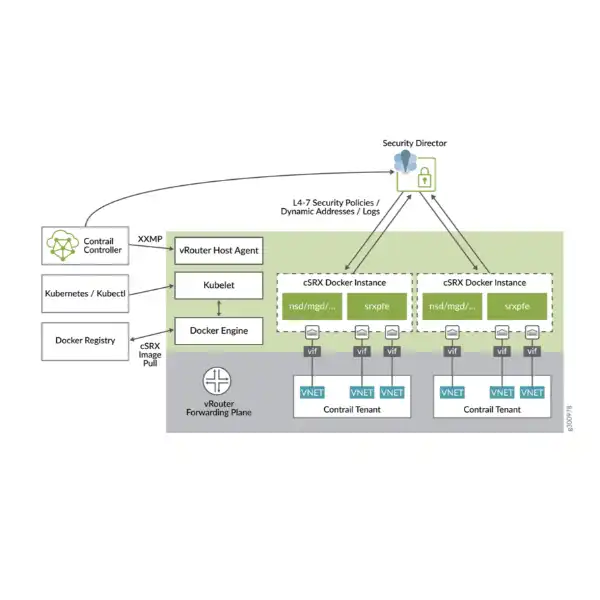
Juniper cSRX is a containerized security platform designed to extend SRX policy enforcement and advanced threat protection into Kubernetes, microservices and other cloud-native environments. It is a strong fit when the security team needs finer east-west control, application-aware inspection and familiar Junos operational methods without introducing a full virtual-machine firewall at every enforcement point.
Direct answer: what is Juniper cSRX and when should you consider it?
Juniper cSRX Container Firewall is the containerized member of the SRX security family. It is built for organizations that need firewall and advanced security functions close to containerized applications, including environments orchestrated with Kubernetes. Its primary purpose is to inspect and control traffic around microservices and application segments, applying security policy at Layers 4 through 7 while supporting capabilities such as intrusion prevention, application identification and control, NAT, logging and identity-aware policy where the selected Junos release and license tier support them.
The best candidates are enterprises, cloud service teams, telecom environments, DevSecOps groups and security architects already operating container platforms or moving important applications from virtual machines into microservices. It is particularly relevant when east-west traffic cannot be treated as implicitly trusted, when security policy must follow workloads more closely, or when a business wants a Junos-oriented security operating model across physical, virtual and containerized enforcement points.
The most important factor to confirm is not simply the product name. Buyers must validate the complete deployment combination: cSRX release, supported host operating system, container runtime, Kubernetes or orchestration version, networking method, interface requirements, host CPU and memory, DPDK or veth mode, licensing tier and expected traffic profile. Published throughput figures are laboratory maximums under defined conditions and should not be treated as a guaranteed production result.
FourTeck can help translate those dependencies into a deployable bill of materials and implementation plan for Dubai or wider UAE environments, including license duration, technical prerequisites, migration design, management integration and support expectations.
Why cSRX exists in the Juniper security portfolio
Traditional security architecture assumed that applications lived behind relatively stable server segments, virtual machine networks or physical data-center boundaries. Container platforms change that model. Application components can be smaller, more numerous and more dynamic; workloads may be rescheduled; service instances can appear and disappear quickly; and traffic that was once contained inside a single application server may now cross several microservices. That creates a security design problem: perimeter inspection alone may not provide enough control over traffic that moves laterally inside the application environment.
cSRX addresses this requirement by packaging Juniper firewall functions in a container form factor. This lets architects place security enforcement more naturally within cloud-native infrastructure rather than forcing every inspection point to consume the resources and lifecycle of a conventional firewall appliance or a full virtual-machine firewall. The practical attraction is architectural consistency. Security teams familiar with SRX policy concepts can extend similar principles into environments operated by platform engineering teams, while automation teams can interact with a software-defined security component rather than a rack-mounted device.
That does not mean cSRX replaces every SRX platform. A physical SRX remains appropriate when the enforcement point is a branch, campus edge, WAN edge, high-capacity data-center boundary or another location where purpose-built hardware, physical interfaces and appliance-level resilience are required. vSRX remains a natural option when the application environment is virtual-machine based or when a conventional virtual firewall model better matches the cloud architecture. cSRX is most compelling when the workload itself is containerized and the security function needs to participate directly in the container or Kubernetes design.
For a buyer, this portfolio position matters because choosing cSRX should be an architectural decision, not a branding decision. The right question is whether a container-native enforcement point improves segmentation, visibility, operational speed or security consistency in the target environment. If the answer is yes, cSRX can be a highly focused fit. If the requirement is simply an internet gateway for a traditional office network, a physical or virtual SRX model will normally deserve comparison.
Key capabilities and the business outcome behind each one
Layer 4–7 policy control
cSRX is designed to enforce security policy beyond simple IP reachability. In a container environment this helps teams distinguish permitted application communication from traffic that is technically routable but should not be trusted. The result is tighter control around application segments and service-to-service flows.
Microsegmentation
Microsegmentation creates smaller trust boundaries instead of treating an entire application cluster as one trusted zone. cSRX can be positioned as an enforcement point for containerized workloads, helping limit lateral movement and making security rules more closely reflect application architecture.
Intrusion prevention
With the appropriate subscription tier, intrusion prevention can inspect traffic for known exploit and attack patterns. This is valuable for applications that cannot be patched immediately, but IPS should complement vulnerability management rather than become a reason to delay remediation.
Application visibility and control
AppSecure functions can identify and control application traffic rather than relying only on ports and protocols. That gives security operations better context when reviewing traffic and helps policies reflect the actual application behavior expected between services.
NAT and routing functions
cSRX supports common NAT use cases and basic Layer 3 forwarding behavior. This can simplify service insertion where address translation is required, but routing expectations must be validated because cSRX is not intended to replicate every routing function of every physical SRX platform.
Automation-friendly management
Junos CLI and NETCONF support make cSRX suitable for infrastructure automation and centralized operations. This matters in container environments because manual configuration is rarely sustainable when workloads scale, roll out frequently or move between nodes.
Published cSRX performance figures: useful reference, not a sizing guarantee
Juniper’s cSRX datasheet publishes reference performance for a configuration using two virtual CPUs and 4 GB of memory. The document lists up to 11.9 Gbps firewall throughput for large 1514-byte packets, up to 2.9 Gbps for IMIX traffic, up to 11.2 Gbps for application visibility and control, up to 10.6 Gbps with recommended IPS signatures, 49,000 application-firewall connections per second and up to 512,000 concurrent sessions. These figures are valuable because they show the order of magnitude Juniper has tested, but they come with an important condition: the datasheet states that performance depends on the underlying hardware, Junos release and deployment design, and the cited results were measured under ideal conditions on bare metal with DPDK enabled.
| Published metric | Juniper reference value | Buyer interpretation |
|---|---|---|
| Virtual CPU / memory | 2 vCPU / 4 GB RAM in the published datasheet reference | Confirm the supported cSRX flavor for the intended Junos release and host platform; newer releases document additional larger flavors. |
| Firewall throughput, large packet | Up to 11.9 Gbps | Do not use this number alone for production sizing; packet size, host CPU, NIC path and security services materially affect observed performance. |
| Firewall throughput, IMIX | Up to 2.9 Gbps | IMIX is often more representative of mixed packet sizes and highlights why packet profile matters. |
| Application visibility and control | Up to 11.2 Gbps | Feature use, traffic type and licensing should be mapped to the real workload before committing capacity. |
| IPS with recommended signatures | Up to 10.6 Gbps | IPS inspection depth, enabled signatures, host resources and traffic characteristics can change production results. |
| Concurrent sessions | Up to 512,000 | Session count is only one scaling dimension; connection rate and inspection features must be considered together. |
For procurement in Dubai, the safer approach is to size from observed or estimated peak traffic, packet profile, concurrent sessions, connection rate, enabled inspection features, growth expectations and the specific server design. A proof of concept is especially useful when the cSRX will protect latency-sensitive applications, high-volume east-west traffic or workloads with unusual packet characteristics.
Current platform requirements and why release alignment matters
cSRX is software, so compatibility is part of the product. Juniper documentation for current releases lists supported host operating systems and interface modes, and those combinations evolve as Junos and host platforms change. For example, Juniper currently documents support for host platforms including specific releases of Red Hat Enterprise Linux, Ubuntu, SUSE, Fedora and FreeBSD, alongside multiple DPDK and veth operating modes. The documented DPDK flavor list in newer releases expands beyond the older 2-vCPU/4-GB reference and includes larger CPU and memory combinations. This is useful for scaling, but it also means an old architecture diagram or previous deployment guide should not be treated as proof that a current combination is supported.
The practical procurement rule is simple: align four versions before buying or deploying—cSRX/Junos release, host operating system, container runtime, and orchestration platform. Then validate NIC and acceleration requirements. A configuration can be conceptually valid yet operationally unsupported if one component sits outside Juniper’s tested matrix. That can complicate troubleshooting and vendor support even if the container starts successfully.
Juniper’s Kubernetes guidance reflects the wider change in the Kubernetes ecosystem away from the historical Docker runtime integration. Current cSRX documentation discusses CRI-O or Podman for Kubernetes-oriented deployments and compatibility with environments such as OpenShift and modern Red Hat Enterprise Linux. A buyer working from older Docker-centric material should therefore confirm whether the intended implementation follows the current supported model rather than assuming a legacy method remains the preferred path.
FourTeck’s role in a quotation can include capturing these dependencies in writing so the commercial item is tied to an implementable architecture. This is more valuable than a software-only quote that leaves the platform team to discover version conflicts later.
Interfaces, traffic paths and service insertion
A container firewall only protects traffic that is actually steered through it. This makes interface and service-insertion design one of the most important parts of a cSRX project. Juniper documents one out-of-band management interface and up to sixteen in-band interfaces for cSRX. The number alone does not determine the design; architects still need to decide which traffic classes enter each interface, how zones map to those interfaces, whether traffic is routed or handled in a secure-wire style, and how Kubernetes or the surrounding networking stack directs flows through the cSRX instance.
For north-south traffic, cSRX may be positioned so application traffic entering or leaving a workload segment crosses a security policy boundary. For east-west traffic, the goal is often microsegmentation between application tiers, namespaces, service groups or other logical zones. The architecture should avoid accidental bypass paths. If the platform can route traffic around the security container, a perfectly configured policy may still provide little protection because the intended flows never reach it.
DPDK can improve packet-processing efficiency by changing how traffic reaches the application and by making better use of high-performance user-space packet processing. However, DPDK introduces its own host, NIC and driver requirements. Juniper documentation lists supported Intel NIC families and SR-IOV or PCI-pass-through combinations for specific releases. Where DPDK is not appropriate, veth driver modes may fit the host environment better. The tradeoff is not simply fast versus slow: it is a balance between performance, operational complexity, portability, orchestration, hardware compatibility and supportability.
A useful design workshop therefore starts with a traffic-flow diagram, not a product SKU. Map the protected applications, trust boundaries, ingress and egress points, expected bypass behavior, management path, high-availability path and failure behavior. Once those flows are understood, cSRX interfaces and host networking can be designed to enforce the intended policy rather than merely existing beside the application.
cSRX licensing: Standard, Advanced 1 and Advanced 2
Juniper currently documents cSRX as a subscription-licensed product. The published Flex three-tier model includes Standard, Advanced 1 and Advanced 2 subscriptions with one-, three- and five-year terms. The precise entitlement matters because the container can be technically deployable while a desired security service still depends on the correct subscription.
| License tier | Examples of documented entitlement | Typical buying logic |
|---|---|---|
| Standard | Core cSRX entitlement and standard firewall use case | Consider when the requirement centers on firewall policy and the advanced threat subscriptions are not needed. |
| Advanced 1 | Includes documented entitlements for IDP signatures and AppID signatures | Appropriate when application identification and intrusion-prevention functionality are part of the security design. |
| Advanced 2 | Adds documented content-security entitlements such as anti-spam, antivirus and enhanced web filtering to the advanced feature set | Consider when the protected traffic and policy require the broader content-security stack. |
The subscription tier should follow the security policy, not the other way around. Start by identifying what needs to be detected, blocked, classified or logged. If the project requires only stateful firewall rules and segmentation, paying for additional security services may not create value. If the requirement includes IPS or application-aware policy, selecting a lower tier can create a functionality gap that appears only during implementation.
License duration is a commercial decision with operational consequences. One-year terms preserve flexibility but create more frequent renewals. Three- or five-year terms can simplify budgeting and entitlement continuity when the platform is expected to remain strategic. The final quote should make the tier, term, quantity and any related support items unambiguous so the technical team knows exactly what entitlement will be available on deployment day.
Security services in practical terms
A next-generation firewall feature list can become abstract, so it is more useful to connect each capability to a concrete application risk. Basic security policy controls which zones, addresses, applications or identities can communicate. In a microservices environment, this can prevent a compromised front-end service from reaching a database service that it never needs to contact. The policy is most effective when it follows the application’s expected communication graph rather than simply reproducing broad legacy network rules.
Application identification adds context where ports are insufficient. Modern applications often use common transport ports such as TCP 443, so port-based rules alone can permit more traffic than intended. AppID and related controls can help distinguish the application behavior riding over those ports. This can make policy more expressive, but administrators still need to validate how encrypted traffic, custom applications and continuously changing application signatures affect classification accuracy.
Intrusion detection and prevention examines traffic for known malicious patterns and exploit techniques. It can reduce risk when vulnerable services are exposed, particularly during the period between vulnerability discovery and full patch deployment. Yet IPS does not remove the need for secure development, patch management and vulnerability remediation. Security teams should tune signatures, review false-positive behavior and monitor resource use rather than enabling every possible signature without context.
Content-security functions broaden inspection beyond network sessions and application identification. Depending on the chosen license tier and supported release, these can include antivirus, anti-spam and web-filtering functions. They make most sense when the cSRX sits on a traffic path where that content inspection is relevant. A microsegmentation firewall protecting tightly controlled service-to-service API calls may require a different feature mix from a gateway inspecting user-oriented web traffic.
The important buying lesson is that cSRX is not one fixed feature package. It is a security platform whose useful functionality depends on topology, release, license and policy. A technically accurate quotation should therefore be accompanied by a short statement of the required security outcomes.
Kubernetes deployment considerations
Kubernetes gives platform teams a consistent way to deploy, scale and manage containerized applications, but a security container must still integrate correctly with cluster networking. Juniper’s cSRX deployment guidance covers installation in Kubernetes and documents prerequisites such as preparing the cluster, using supported container runtimes, validating Linux server requirements and downloading the correct cSRX software image. Those steps sound straightforward, but production deployment introduces several design questions that should be answered before rollout.
First, determine the security insertion model. Will cSRX protect selected applications, selected namespaces, an ingress path, an egress path, or a broader shared segment? That decision controls how traffic is steered and how many cSRX instances may be required. Second, decide how cSRX lifecycle should align with application lifecycle. A firewall that scales independently of application pods may be easier to operate in some environments, while tightly coupled security instances may provide more granular isolation in others.
Third, decide how configuration state is managed. Container platforms encourage declarative automation, while network security historically relies on controlled configuration with strong change governance. cSRX can be managed through Junos-oriented methods and automation interfaces, but the operating model should define the source of truth, review process, secrets handling, rollback method and audit trail. A platform engineer should not unknowingly overwrite a security policy change, and a security engineer should not apply a manual change that disappears on the next automated rollout.
Fourth, plan upgrades. Juniper provides procedures for image rollout and rollback in Kubernetes. The architecture should consider how many instances can be replaced at once, how traffic drains during an update, what happens to active sessions, and how policy compatibility is tested before the new image reaches production. A security upgrade is not just a container image refresh; it is a controlled network-function change that may affect packet forwarding.
Finally, define observability. Logs, security events, performance metrics and orchestration status should converge into an operational view that tells teams both whether the cSRX container is healthy and whether it is enforcing the intended security policy. Without that visibility, Kubernetes may report a running pod while the security operations team still lacks evidence that protected traffic is flowing and being inspected correctly.
Sizing cSRX for a real workload
Sizing begins with traffic, but not only bandwidth. Two applications can both peak at 2 Gbps and place very different loads on a firewall. One may carry large, long-lived flows with relatively few new connections. Another may generate a high rate of short API connections with small packets. A third may require extensive IPS and application inspection. Those patterns influence CPU usage, packet-processing cost, session-table pressure and latency in different ways.
Collect at least five workload dimensions: peak and sustained throughput, packet-size distribution, concurrent sessions, new connections per second and the security services that will be enabled. Then add growth assumptions. If the application is expected to double traffic after a regional rollout, the design should not size exactly to today’s peak. If the environment can scale cSRX horizontally, define what triggers additional instances and how traffic is redistributed. If scale-out is operationally difficult, a larger supported flavor may be preferable.
Host resources matter because cSRX consumes CPU and memory from the underlying platform. Contention with application workloads can create unpredictable security performance, especially on shared worker nodes. Resource reservations, CPU pinning or other host-level controls may therefore be part of the design depending on the chosen mode. DPDK deployments add NIC and CPU-path considerations that should be validated early, particularly when performance targets are ambitious.
Latency is another dimension. A firewall adds inspection work to the traffic path. The acceptable impact depends on the application. Transaction systems, real-time services and east-west service calls may have tighter latency budgets than ordinary web browsing. A proof of concept should therefore test not only maximum throughput but also latency at realistic utilization, failover behavior and inspection settings.
For a Dubai quotation, FourTeck can use the workload information to distinguish between a simple license request and a complete design requirement. That helps avoid a quote that is commercially correct but technically underspecified.
Management, automation and operational ownership
cSRX uses familiar Junos concepts, which can reduce the learning gap for organizations already operating SRX firewalls. Juniper documents CLI and NETCONF management, along with centralized management options in the broader Juniper security ecosystem. That familiarity can be a major advantage: security zones, policy logic, logging conventions and operational troubleshooting can remain closer to existing network-security practice even though the enforcement point runs as a container.
The challenge is organizational. Container platforms are usually owned by DevOps, platform engineering or cloud teams, while firewalls are controlled by network security. A successful cSRX deployment needs a clear boundary between platform lifecycle and security policy lifecycle. Platform teams may own the Kubernetes manifests, node placement and runtime health. Security teams may own zones, policies, signatures and logging. Automation teams may own the pipeline that converts approved policy intent into configuration. When those responsibilities are not explicit, changes can become slow or risky.
NETCONF makes cSRX suitable for structured automation, but automation should include validation and rollback. Security configuration errors can interrupt application communication just as easily as a bad network route. A mature pipeline can test syntax, compare intended changes, perform staged rollout, verify health and retain a known-good configuration. This is especially important for microservices because a single broad policy change can affect many application dependencies at once.
Logging should also be designed, not left as an afterthought. Juniper documents system logs and real-time logs for cSRX in supported releases. Buyers should decide where logs will be sent, how long they are retained, which events feed a SIEM, how timestamps are synchronized, and what alerts indicate a genuine security incident versus a routine application deployment. Logging volume can be significant when policies are granular, so storage and ingestion cost may become part of the wider project budget.
The strongest operating model is one where the container platform can move quickly without bypassing security governance, and the security team can enforce policy without manually becoming a bottleneck for every application release.
Important limitations to check before selecting cSRX
cSRX includes many SRX capabilities, but it is not a feature-for-feature substitute for every physical SRX platform. Juniper maintains documentation that lists supported, unsupported and qualified features for cSRX. This is particularly important for teams migrating an existing SRX policy set into a container environment. A configuration that works on a hardware appliance may reference interfaces, routing functions, diagnostics, link aggregation or other platform-specific features that do not map directly to cSRX.
Current Juniper documentation, for example, identifies limitations or non-applicable areas that include certain application-layer gateways, some diagnostics, dynamic DNS, selected Ethernet link-aggregation functions and other capabilities. The exact list depends on the Junos release, so the migration process should compare required features against Juniper Feature Explorer and the cSRX requirements page instead of assuming compatibility from CLI similarity.
Routing expectations deserve special attention. cSRX is intended primarily as a container security function, not as a universal software replacement for every routing role performed by larger SRX appliances. If the existing firewall is also a complex routing edge, VPN concentrator, WAN device or physical interface aggregation point, a different architecture may be more appropriate. One option is to keep those functions on a physical or virtual SRX and use cSRX for closer application segmentation.
The same principle applies to high availability. Juniper describes service-chain and scaling approaches, but the failure domain in Kubernetes differs from a traditional hardware chassis cluster. Buyers should define what happens if a container fails, a worker node fails, the CNI experiences a problem, an image upgrade is rolled back or the orchestration control plane becomes unavailable. Availability should be tested end to end, not inferred from the fact that multiple cSRX instances exist.
These limitations are not weaknesses when cSRX is used for the problem it was designed to solve. They simply reinforce the need to treat it as a container-native security function with its own operating assumptions.
cSRX versus vSRX versus physical SRX
| Decision area | cSRX | vSRX | Physical SRX |
|---|---|---|---|
| Natural deployment target | Containers, Kubernetes and cloud-native application segments | Virtualized and public-cloud environments where a VM firewall fits the architecture | Branches, campuses, data centers and edges requiring appliance form factor and physical connectivity |
| Lifecycle model | Container image and orchestrated lifecycle | Virtual machine lifecycle | Hardware appliance lifecycle |
| Primary strength | Lightweight security close to microservices and container workloads | Flexible virtual firewall placement with broader VM/cloud deployment patterns | Purpose-built interfaces, appliance performance options and traditional network edge roles |
| When to compare another option | When the workload is not containerized or needs unsupported routing/interface features | When container-native insertion is preferable or physical connectivity is required | When software-defined placement and rapid scaling matter more than appliance characteristics |
The comparison is less about raw performance and more about where the enforcement point lives. cSRX puts a Juniper security function into the container operating model. vSRX puts it into a virtual-machine operating model. Physical SRX puts it into an appliance operating model. Many enterprises will legitimately use all three at different layers: physical SRX at an internet or campus boundary, vSRX in a cloud virtual network, and cSRX around sensitive microservices.
For buyers in Dubai, a mixed architecture can also reduce migration risk. Instead of forcing a single platform to perform every role, security controls can be placed where each form factor is strongest while management and policy conventions remain within the Juniper ecosystem.
Common cSRX use cases
Microservices segmentation
Separate application tiers or service groups so a compromise in one service does not automatically provide unrestricted reachability to other services. Policy can be based on the actual communication requirement rather than broad subnet trust.
Kubernetes application protection
Insert firewall inspection around selected Kubernetes workloads where platform-native network controls alone do not provide the desired Layer 7 visibility, threat prevention or Junos policy integration.
DevSecOps policy automation
Use APIs and automation to make approved security policy part of repeatable application deployment. This can reduce manual configuration while retaining security governance and auditability.
Cloud-native east-west inspection
Inspect lateral traffic that may never cross a traditional perimeter firewall. This use case is particularly valuable where internal application movement represents a meaningful part of the threat model.
Service-chain security
Participate in software-defined service chains so traffic crosses security inspection as part of a broader network-function sequence. The value depends on the orchestration platform and traffic-steering design.
Consistent SRX policy operations
Extend familiar Junos security concepts into container environments, helping organizations that already operate SRX firewalls keep a more consistent policy and management approach across form factors.
Designing microsegmentation that remains manageable
Microsegmentation is easy to describe and difficult to operate at scale. If every microservice receives an individual policy with no reusable structure, the rule base can become as complex as the application itself. The goal should be meaningful security boundaries, not the maximum possible number of firewall rules. Start by identifying business services, data sensitivity, trust levels and known application dependencies. Then group flows into policy constructs that security and application teams can both understand.
A payment service, for example, may need to communicate with an order service and a specific database endpoint but not with development tooling or unrelated internal applications. A reporting service may need read-only access to a data tier but no path back to internet-facing services. These relationships can become security policies that limit lateral movement while preserving required application behavior. The cSRX provides the enforcement capability; the quality of the segmentation still depends on accurate application knowledge.
Discovery is therefore important before enforcement. In an existing environment, gather flow data and application dependency information so legitimate communication is not blocked by an overly narrow first policy. Consider a staged approach: observe traffic, define expected flows, implement policy with appropriate logging, review exceptions, and progressively tighten controls. This reduces the risk of a security change becoming an application outage.
Naming and ownership also matter. A rule that says “allow app-zone-A to db-zone-B” is easier to govern if those names correspond to documented application owners and purposes. Include change records or tags in the operational process so stale rules can be identified when applications are retired. Container environments can change quickly, and security policy that never gets cleaned up will eventually accumulate unnecessary access.
A well-designed cSRX microsegmentation project should therefore improve both security and explainability. Engineers should be able to answer why a flow is allowed, who owns it, which application depends on it and what would happen if the rule were removed.
High availability, scaling and failure behavior
Container platforms encourage horizontal scale and automated recovery, but firewall state makes resilience more nuanced than simply restarting a stateless application pod. Active connections have session state, and traffic must be steered consistently through the intended security instance. The availability design should define how cSRX instances are distributed, how new flows are balanced, how failed instances are detected and what happens to existing sessions during a failure.
At the orchestration layer, Kubernetes can reschedule workloads and scale deployments. At the network layer, the service-insertion mechanism must continue sending traffic through healthy cSRX instances. If those layers are designed independently, a container may be healthy while the traffic path is broken, or the traffic path may continue sending flows toward an instance that is no longer able to inspect them. Health checks should therefore measure a meaningful dataplane condition rather than only process existence.
Scaling decisions should also account for policy and session distribution. Adding more instances increases available processing capacity only if traffic can be redistributed effectively. If one large application flow remains pinned to one instance, horizontal scale may not improve that flow’s performance. Conversely, a large number of independent microservice flows can often benefit more naturally from scale-out. The exact behavior depends on the service-chain and networking design.
Maintenance is part of high availability. Define how an instance is drained before upgrade, how policy consistency is verified across the pool, and how rollback occurs if a new image introduces unexpected behavior. Use maintenance windows appropriate to application criticality even when the platform supports rolling upgrades; “cloud native” should not be interpreted as “risk free.”
For critical UAE workloads, resilience testing should include worker-node loss, cSRX process failure, network-path failure, orchestration restart and configuration rollback. The target is not merely to demonstrate that a new container appears; it is to demonstrate that protected application traffic continues or recovers within the business’s acceptable interruption window.
Migration from an existing firewall or legacy application environment
Moving security policy into cSRX often happens as part of a larger application modernization program. A monolithic application may be decomposed into services, a virtual-machine environment may move to Kubernetes, or a data center may adopt software-defined networking. In each case, copying the old firewall rule base directly into cSRX is usually the wrong goal. The old rules reflect the old topology. The migration should preserve business access requirements while redesigning trust boundaries for the new application architecture.
Begin with policy discovery. Identify current source and destination networks, applications, ports, NAT rules, identity requirements, logging, threat-prevention profiles and exceptions. Mark which rules are still required and which exist only because the legacy environment had broader network zones. Then map those flows to the new container topology. Some rules may disappear because a service no longer exists; others may become more granular because separate microservices can now be isolated.
Feature compatibility should be checked at the same time. Junos syntax similarity can make migration look easy, but cSRX’s feature support is specific to its container form factor. Any dependency on physical interfaces, certain link aggregation, specialized routing, diagnostics or unsupported functions should be redesigned rather than blindly converted. Juniper’s feature documentation should be reviewed against the exact target release.
Next, decide whether migration will be parallel or cutover based. A parallel design can place cSRX in a test or staging traffic path, validate application behavior and gradually move services. A direct cutover may be acceptable for smaller environments but requires strong rollback planning. In both cases, capture baseline performance and application health before the change so post-migration issues can be distinguished from pre-existing problems.
The final migration plan should contain policy mapping, feature-gap decisions, traffic-steering changes, test cases, rollback steps, operational ownership and success criteria. That turns cSRX deployment into a controlled security transformation rather than a software installation exercise.
Security policy design for zero-trust principles
Juniper’s SRX policy model follows a deny-unless-permitted approach: traffic is not allowed to pass merely because two systems can reach each other at the network layer. That principle fits well with zero-trust architecture, but meaningful zero trust requires more than changing a default policy. The access rules should be based on what a workload needs to perform its role, with the narrowest practical scope and enough logging to validate the decision.
For container environments, identity can exist at several layers. Network addresses may be dynamic; Kubernetes labels and service identities may describe application intent; enterprise identity systems may describe users or service accounts. cSRX policy design should use the identity information actually available and supported in the chosen integration rather than assuming a static IP address is the only way to identify a workload. Where dynamic identity cannot be mapped reliably, architecture may need stable service boundaries or orchestration-aware automation that updates policy as workloads change.
Least privilege must be balanced with maintainability. A rule can be technically precise but operationally fragile if application teams change dependencies every week. Create policy abstractions that match stable business functions where possible. For example, a policy allowing an application tier to reach a defined database service may be more durable than a list of individual pod addresses. Automation can then resolve changing infrastructure details while the approved security intent remains understandable.
Verification closes the loop. Review denied traffic for legitimate dependencies, investigate unexpected allowed traffic, and periodically remove stale policies. A zero-trust design is strongest when it is continuously validated against real application behavior rather than considered complete after the initial deployment.
cSRX can provide the enforcement and visibility layer for this model inside container environments, while broader identity, endpoint, application and data controls complete the security architecture.
Logging, SIEM integration and incident response
The security value of a firewall is partly determined by what the operations team can learn from it. cSRX logging should therefore be planned with the same care as policy. Decide which events are needed for incident response, compliance, troubleshooting and capacity planning. Session logs can show who communicated with what. Threat logs can identify signatures or security services that triggered. System logs can reveal operational changes or failures. Excessive logging, however, can increase storage and SIEM cost without improving detection.
Start with use cases. If the SOC needs to investigate lateral movement, log flows that cross important segmentation boundaries. If the environment must demonstrate control over administrative access, retain policy and management events. If the application team frequently troubleshoots blocked dependencies, capture enough deny information to identify the source, destination, policy and reason. Then set retention according to business and regulatory requirements rather than an arbitrary default.
Time synchronization is fundamental. In an incident, cSRX events may need to be correlated with Kubernetes audit logs, application logs, identity events and cloud platform records. If clocks are inconsistent, an investigation can become unnecessarily difficult. Standardize NTP and timezone handling across the platform and confirm that log forwarding preserves timestamps correctly.
Incident-response procedures should also account for the container lifecycle. A cSRX instance may be replaced during normal orchestration, so volatile local information may disappear unless logs are forwarded externally. Central collection should be treated as part of production readiness. The team should also know how to isolate an affected application segment, update policy safely, preserve evidence and roll back emergency changes after containment.
These operational details often determine whether the organization experiences cSRX as an effective security control or merely as another software component generating data.
Performance tuning and DPDK considerations
Juniper’s published high-end cSRX performance references use DPDK, which is important context for buyers comparing datasheet numbers with a standard container deployment. DPDK changes packet handling by moving important processing into user space and reducing overhead associated with conventional kernel networking paths. The approach can deliver substantial throughput benefits, but it requires deliberate host preparation and compatible hardware.
Juniper’s current documentation lists specific Intel NIC families and SR-IOV or PCI pass-through combinations for DPDK on particular releases. That means a generic server specification is not enough when a performance-sensitive project depends on DPDK. Confirm the exact NIC model, firmware, driver, virtualization setting, IOMMU requirements where relevant, NUMA placement and host operating system. The server may have enough CPU and memory yet still fail to deliver the expected packet path because the NIC configuration is unsuitable.
CPU topology can also matter. Packet-processing workloads often benefit from predictable CPU allocation rather than competing with unrelated applications. In a Kubernetes cluster, resource requests and limits should be designed so the cSRX receives the host resources it expects. If DPDK uses dedicated cores or specific memory arrangements, those requirements must be reflected in node design and scheduling policy.
Not every environment needs DPDK. A moderate-throughput microsegmentation use case may prioritize portability, operational simplicity or standard CNI integration over maximum packet rate. In that situation, a supported veth mode can be a better engineering decision. The correct question is not “Can we enable DPDK?” but “Does the business requirement justify the additional infrastructure constraints?”
A performance proof of concept should test both the packet path and the security policy. Measure throughput, latency, CPU consumption, packet loss and session behavior with the intended inspection features enabled. A firewall benchmark without the required security services can overstate the capacity available in production.
Procurement considerations for Dubai and UAE organizations
Software-defined security changes what a buyer needs from a quotation. With a physical appliance, the hardware model often captures much of the scope. With cSRX, the commercial item must be matched to a technical deployment that includes subscription tier, term, quantity, support, software access and host compatibility. A quote that simply says “cSRX” can leave important assumptions unresolved.
Start with the license requirement. Decide whether Standard, Advanced 1 or Advanced 2 aligns with the security services. Then choose the subscription term. Confirm how many cSRX instances or entitlements are required for the architecture, including production, disaster recovery, staging or scale-out needs where applicable. If the design will run across multiple clusters or environments, distinguish those quantities explicitly.
Next, document the technical environment even if the host infrastructure is purchased separately. Record Kubernetes or orchestration version, runtime, operating system, CPU architecture, available resources, NIC model, DPDK requirement, CNI or network design and management platform. This information helps identify compatibility issues before the license order is placed. It also gives the implementation team a baseline for acceptance testing.
Support expectations should be explicit. Determine whether the customer needs vendor support only, local implementation assistance, policy migration, integration with existing SRX management, logging/SIEM onboarding, high-availability testing, documentation, administrator handover or ongoing managed support. Software projects often fail commercially when the quote assumes a simple license delivery but the buyer expects a complete production deployment.
For UAE projects with formal procurement, FourTeck can structure the scope so technical prerequisites and commercial deliverables are visible before approval. That reduces the chance of purchasing an entitlement that cannot be deployed in the intended environment without additional design work.
Implementation journey from evaluation to production
Define the protected workload
List applications, namespaces, service groups, traffic directions, sensitivity and business criticality. Identify why cSRX is being introduced and what risk it is expected to reduce.
Validate platform compatibility
Match the chosen Junos/cSRX release with the supported host operating system, runtime, Kubernetes platform, interface mode and NIC requirements. Resolve version gaps before procurement.
Design traffic insertion
Draw the actual traffic path and confirm which flows must cross cSRX. Include bypass prevention, management access, scale-out behavior and failure conditions.
Select license tier
Map required security functions to the appropriate subscription, choose the term, and confirm quantities for production, resilience and non-production environments.
Build and test
Deploy a controlled instance, validate forwarding, policy, logs, inspection services, throughput, latency, orchestration behavior and rollback.
Operationalize
Integrate configuration governance, monitoring, SIEM, upgrade procedures, backup, support escalation and documentation before expanding the deployment.
Questions security architects should answer before deployment
What traffic must be inspected?
Define north-south and east-west paths. If the organization cannot identify which flows should traverse cSRX, the deployment may add complexity without creating a clear security boundary.
Which security services are mandatory?
Separate required functions such as firewall policy, AppID and IPS from optional capabilities. This directly affects subscription tier, performance testing and policy design.
How will traffic reach the firewall?
Validate the CNI, routing, service chaining or interface method. Security controls are ineffective if alternative paths allow protected flows to bypass inspection.
What is the failure mode?
Decide whether traffic should fail closed or follow another controlled path, how quickly an instance is replaced, and what application interruption is acceptable.
Who owns configuration?
Assign responsibility across platform, network and security teams. Define the source of truth and the approved automation path so manual and automated changes do not conflict.
How will success be measured?
Set measurable outcomes such as reduced lateral access, successful policy enforcement, acceptable latency, target throughput, complete logging and predictable recovery during failure tests.
When cSRX may not be the right choice
cSRX should not be selected solely because the organization uses the word cloud. If the protected workloads are traditional virtual machines and the network team already has a mature virtual firewall design, vSRX may be simpler. If the enforcement point requires physical WAN circuits, extensive appliance interfaces or a conventional branch gateway, a physical SRX can be more appropriate. If the application needs only basic Kubernetes network-policy segmentation and no additional next-generation firewall inspection, the complexity of a full cSRX deployment may not be justified.
The product may also be a poor fit when the organization cannot operationally support it. A cSRX environment combines container orchestration, network security, host networking and automation. If no team owns the intersection of those disciplines, deployment can create troubleshooting gaps. In that case, the project may need operational design and training before production rollout.
Very high throughput or specialized routing requirements can be another reason to compare alternatives. While cSRX can deliver significant performance under supported conditions, physical SRX platforms are purpose-built for network-edge roles and may provide capabilities that are more natural for large-scale routing or interface-heavy environments. vSRX can also provide a different software-based performance and deployment profile where virtual machines are acceptable.
A balanced recommendation therefore starts with workload form factor, traffic path, feature requirement and operations. cSRX is strongest when those factors point toward a lightweight container-native security function rather than when buyers try to force it into a role better served by another SRX form factor.
Practical proof-of-concept plan
A cSRX proof of concept should answer specific buying questions. Begin with a representative application rather than a synthetic empty cluster. Choose a service whose dependencies are known and whose traffic volume is meaningful but safe to test. Build the target runtime and host combination that is expected in production, because testing on a different platform can hide compatibility or performance issues.
Validate basic forwarding first. Confirm management access, interface mapping, zones, routing or secure-wire behavior, and packet flow through cSRX. Then implement a small set of security policies and verify both allowed and denied traffic. Next, enable the licensed advanced services required for production, such as AppID or IPS. Repeat the traffic tests so performance and application behavior are measured with the actual inspection stack enabled.
Measure throughput, latency, connection rate, CPU, memory and packet drops. Record results at several utilization levels rather than only at the maximum. A system that reaches a high peak while operating at 95 percent CPU may have little production headroom. Include at least one failure test: restart the cSRX container, remove a worker node or simulate the relevant dataplane failure and measure what happens to application traffic.
Test lifecycle operations as well. Perform an image upgrade and rollback in the same manner planned for production. Verify configuration persistence and policy consistency. Confirm logs arrive at the SIEM or logging platform with usable timestamps and fields. Ask the operations team to troubleshoot an intentionally blocked flow to prove that the runbooks and visibility are sufficient.
The proof of concept is complete when it produces evidence for a decision: supported platform, acceptable performance, correct policy behavior, manageable operations, recoverable failure and clear license requirements. That evidence can then support the final procurement scope.
Day-two operations and lifecycle planning
Production security begins after deployment. cSRX requires the same lifecycle discipline as other security platforms, but containerization changes the mechanics. Teams need a process for monitoring Junos releases, security advisories, supported host combinations and subscription validity. The Kubernetes or container platform may also have its own upgrade cadence, so changes on either side can affect compatibility.
Create a release-management matrix that records the approved cSRX image, Junos version, host operating system, runtime, Kubernetes version, CNI, NIC/driver combination and automation tooling. Before any component is upgraded, verify support for the new combination. This prevents a platform team from advancing Kubernetes or the host OS into a state that the security software has not yet validated.
Policy hygiene should be scheduled. Review rules for unused objects, temporary exceptions, expired projects and overly broad access. Application teams should participate because only they can confirm whether a dependency is still required. Threat-prevention profiles should also be reviewed so signatures remain appropriate to the protected applications and false-positive handling is documented.
Capacity monitoring should track trends rather than wait for a threshold breach. Observe CPU, memory, throughput, sessions and connection rate during normal and peak periods. If the architecture supports horizontal scale, test the scaling mechanism before capacity becomes urgent. If a larger supported flavor will be needed, confirm host resources and licensing implications in advance.
Finally, keep runbooks current. Troubleshooting a container firewall often crosses multiple tools: Kubernetes, Linux networking, Junos, CNI, SIEM and application monitoring. A runbook that identifies ownership and diagnostic steps can significantly reduce outage duration when the failure is not obvious.
Frequently asked buyer questions
Is cSRX a hardware firewall?
No. cSRX is a containerized firewall software platform. The underlying compute, operating system, runtime and networking environment are therefore part of the deployment design and performance outcome.
Does cSRX run in Kubernetes?
Yes. Juniper provides Kubernetes deployment guidance and current documentation for supported container runtimes. Exact Kubernetes, runtime and host versions should be verified against the selected cSRX release.
Does cSRX support IPS?
Juniper documents intrusion detection and prevention support, with subscription entitlements depending on the selected license tier. The Advanced 1 and Advanced 2 tiers document IDP signature entitlement.
Can cSRX perform NAT?
Juniper documentation lists support for source, destination, static and other NAT functions. The exact use case should still be validated against the selected release and traffic design.
How many interfaces can cSRX use?
Current Juniper requirements documentation states that a cSRX container supports one out-of-band management interface and sixteen in-band interfaces. Interface mode and host networking compatibility remain deployment-specific.
Is the published 11.9 Gbps guaranteed?
No. Juniper labels the figure as an up-to result from a defined test setup, and notes that actual performance varies with underlying hardware, Junos release and deployment. Production sizing should use representative testing.
Can cSRX replace vSRX?
Sometimes, but not automatically. cSRX is optimized for container environments, whereas vSRX fits virtual-machine and cloud designs. The correct choice depends on workload form factor, routing, performance and operational requirements.
Can cSRX use Junos automation?
Yes. Juniper documents CLI and NETCONF management, which allows cSRX configuration to participate in structured network automation and centralized security operations.
Which cSRX license should we buy?
Choose from the documented subscription tiers based on required features. Standard suits core firewall use, while Advanced 1 and Advanced 2 add documented security-service entitlements. Confirm exact current SKUs before ordering.
Decision recap: the six points that determine a successful cSRX purchase
Use cSRX when the security enforcement point belongs inside a containerized or Kubernetes-oriented architecture. Compare vSRX or physical SRX when the workload or network edge is better aligned to those models.
Use traffic profile, session rate, enabled services, host resources and growth assumptions. Treat datasheet performance as a reference rather than a guaranteed production result.
Align cSRX/Junos release, operating system, runtime, Kubernetes platform, CNI, NIC and DPDK or veth mode before procurement.
Map required firewall, AppID, IPS and content-security functions to Standard, Advanced 1 or Advanced 2, then choose an appropriate term.
Confirm every protected flow actually crosses cSRX and define failure, scaling, management and bypass behavior.
Establish configuration ownership, logging, SIEM integration, upgrades, rollback, support escalation and capacity monitoring before production rollout.
What FourTeck needs for an accurate cSRX quotation
A precise quote is easier when the commercial team receives a concise technical brief. The following inputs allow the license, deployment scope and support requirements to be matched to the intended architecture instead of relying on assumptions.
Plan a Juniper cSRX deployment that matches your actual container environment
The value of cSRX comes from placing the right security services on the right application traffic path with a supported platform combination and the correct subscription. FourTeck can help Dubai and UAE organizations turn workload requirements into a practical cSRX quotation covering licensing, compatibility, sizing, migration, management integration and implementation scope.

Reviews
There are no reviews yet.