
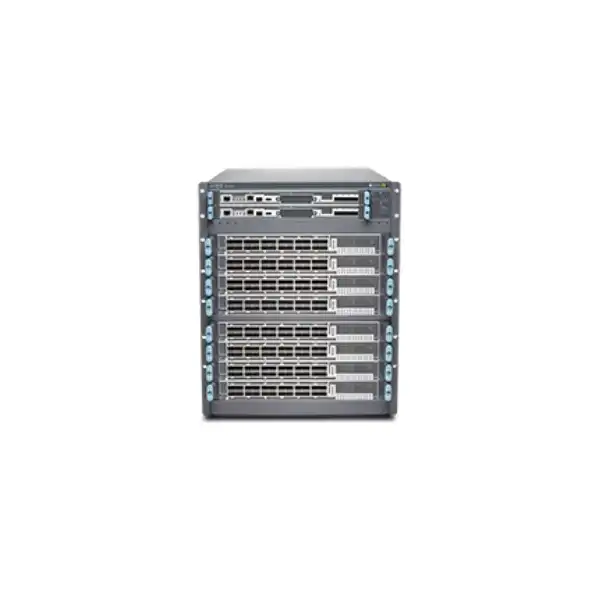
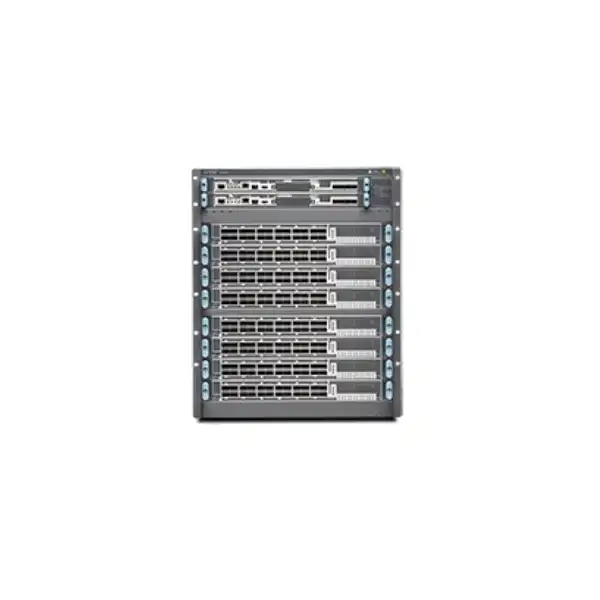
Juniper MX10008 Universal Routing Platform Dubai
A modular eight-slot MX Series platform for operators that need dense 100GbE and 400GbE connectivity, scalable IP/MPLS services, high routing scale and a resilient chassis architecture without committing every future capacity decision on day one.
Direct answer for buyers evaluating the MX10008
What exactly is it?
The Juniper MX10008 is a modular Universal Routing Platform in the MX10000 family. The chassis is 13 rack units high and provides eight horizontal line-card slots. Depending on the selected line cards, fabric generation, power and cooling components, it can be built for lower-speed legacy access through dense 100GbE and 400GbE services and can scale to 76.8 Tbps using current 9.6-Tbps-per-slot technology.
What is it mainly used for?
Typical roles include IP edge, Internet peering, data-center gateway, cloud edge, Layer 3 aggregation, business edge, broadband or multiservice edge, video distribution and other high-capacity IP/MPLS designs. The chassis is valuable when one platform must support large interface counts, routing scale and service growth while keeping control, forwarding and field-replaceable components modular.
Who should consider it?
Service providers, cloud operators, large enterprises, data-center operators, carriers and organizations consolidating multiple edge functions should consider the MX10008 when capacity, resiliency and service density justify a modular chassis. It is not automatically the right answer for a small branch, modest enterprise WAN edge or deployment where a compact fixed-form router can meet capacity and port needs more economically.
What is the most important factor to confirm?
Confirm the intended line-card mix and the fabric, power, fan and software dependencies that go with it. A chassis assembled for earlier line cards may not be suitable for the highest-capacity cards without infrastructure changes. The power budget, rack depth, airflow direction, optics, cabling and license tier should be designed as one system rather than quoted as unrelated parts.
What can FourTeck help determine?
FourTeck can translate the required port speeds, traffic profile, routing scale, redundancy target, power environment, software features, growth horizon and support expectations into an MX10008 bill of materials for Dubai or another UAE location. That includes the base or premium chassis approach, Routing Engines, switch fabric boards, line cards, optics, power supplies, fan generation, rack planning, software licensing, installation scope and support requirements.
Why the Juniper MX10008 is a different class of router
The MX10008 is designed around a problem that appears when an edge or aggregation role grows beyond the practical limits of fixed-configuration routing. At that scale, the buyer is no longer choosing only a port count. The decision covers forwarding silicon, fabric bandwidth, route scale, service scale, optics, power density, cooling, maintenance processes, software lifecycle and the ability to expand without replacing an entire platform. The eight-slot MX10008 addresses that problem through a chassis in which line cards, switch fabric, Routing and Control Boards, power supplies and cooling components can be selected and serviced independently.
Juniper positions the MX10000 modular line for cloud and service-provider environments, but the same architecture can be relevant to large enterprises that operate major Internet edges, carrier interconnects, data-center gateways or national and regional WAN aggregation. The value is not simply a headline throughput number. A modular platform creates room to start with the interfaces needed today and add capacity later, provided the original design leaves the correct fabric, power, cooling and software path for those upgrades.
The current MX10008 hardware architecture can reach 9.6 Tbps per slot and 76.8 Tbps across eight slots. Earlier generations of line cards continue to matter because many real installations mix service types and speeds rather than filling every slot with the newest 400GbE card. That flexibility is useful, but it creates an important procurement discipline: the exact part numbers matter. An MX10008 chassis name by itself does not describe the capacity, interface density, resilience or power profile of the final router.
For a Dubai buyer, this distinction is especially relevant when a quotation is expected to be deployment-ready. A chassis-only price can appear attractive while leaving out line cards, optics, cable-management hardware, licenses or the power and cooling generation required by the chosen forwarding cards. A useful quotation therefore starts with the network role and desired port map and works backward into a compatible bill of materials.
MX10008 platform position and sizing logic
Choose MX10008 when slot headroom matters
Eight slots give more expansion space than a smaller modular chassis. This can be decisive when the design includes several independent peering groups, multiple 400GbE data-center uplinks, service-edge interfaces and dedicated capacity for future growth. More slots can also make maintenance planning easier because capacity can be distributed instead of concentrated into the minimum number of cards.
Evaluate a smaller platform when density is unnecessary
If the required interfaces and route scale fit comfortably in a smaller MX platform, the 13-RU MX10008 can create avoidable rack, power and cooling overhead. The right comparison is not only maximum throughput. Compare the number and type of ports, redundancy requirement, expected three-to-five-year growth, service features and operational preference for fixed versus modular hardware.
Design for the future card generation at purchase time
A lower-bandwidth first phase may use older compatible line cards, but the intended upgrade destination should still influence the initial chassis configuration. High-capacity Trio 6 cards rely on newer switch fabric and supported power and fan combinations. Planning that path at the beginning reduces the risk that a later capacity project becomes a chassis-infrastructure replacement project.
Architecture: control, forwarding and switch fabric
The MX10008 separates the control plane from packet forwarding. Routing and Control Boards contain the Routing Engine functions responsible for routing protocols, system management, interface control and the broader Junos OS control plane. Packet Forwarding Engines are located on the line cards, where traffic is processed at high speed. The line cards connect through dedicated fabric paths provided by Switch Fabric Boards. This separation is central to the chassis design because it allows control, forwarding and switching capacity to be upgraded or maintained as distinct subsystems.
The chassis provides two RCB positions. A base configuration can run with one RCB, while a redundant configuration uses two so that one can operate as primary and the other as backup. With the appropriate Junos high-availability configuration, a backup Routing Engine can take over control responsibilities during a failure or planned maintenance event. For networks with strict service-level objectives, the second RCB is normally part of the resilience discussion rather than an optional convenience.
Switch fabric selection requires more attention because Juniper has more than one fabric generation for the platform. The JNP10008-SF supports earlier cards such as MX10K-LC2101 and MX10K-LC480. The JNP10008-SF2 expands compatibility to newer high-throughput options. For a buyer planning LC4800, LC4802 or LC9600-class capacity, the fabric generation should be explicitly listed in the quotation. Mixing assumptions from different hardware generations is a common way to produce an apparently complete bill of materials that will not deliver the intended forwarding capacity.
The latest high-capacity cards use Juniper Trio 6 silicon. The LC9600 reaches up to 9.6 Tbps of line-rate throughput, giving one card enough capacity to populate 24 interfaces at 400GbE. The LC4800 and LC4802 operate at up to 4.8 Tbps and provide alternative port combinations that can be better suited to designs where a mix of 100GbE and 400GbE is more useful than maximum 400GbE density. Earlier LC480 and LC2101 cards remain relevant for lower-speed or mixed-generation deployments.
For network architects, the practical implication is that the MX10008 should be sized as a fabric-plus-card system. A port can only perform as expected when the card, switch fabric, Routing Engine, power subsystem, cooling generation, Junos release and optics are mutually supported. FourTeck can use the required interface map to identify this dependency chain before purchase instead of discovering it during staging.
Line-card choices: where most MX10008 designs are decided
MX10K-LC9600
The LC9600 is the maximum-capacity current card for the MX10008, offering up to 9.6 Tbps of line-rate throughput from 24 QSFP-DD ports capable of 400GbE operation. It uses twelve Packet Forwarding Engines, each providing up to 800 Gbps.
This card is appropriate when 400GbE density and slot efficiency are primary goals. It requires the newer JNP10008-SF2 fabric and supported newer-generation power and cooling components. A design using LC9600 should therefore be treated as a complete high-power infrastructure design, not a simple card addition to an unspecified older chassis.
JNP10K-LC4800
The LC4800 provides up to 4.8 Tbps and combines forty SFP56-DD ports that can support 100GbE with four QSFP56-DD ports for 400GbE. That port mix can be attractive for aggregation or edge designs where many 100GbE connections must coexist with a smaller number of 400GbE uplinks.
It interoperates with other supported MX10008 card types but depends on the SF2 fabric and compatible newer fan and power generations. In practical procurement terms, its lower card throughput compared with LC9600 does not mean it can be treated as a legacy card; it still belongs to the newer infrastructure path.
JNP10K-LC4802
The LC4802 also provides up to 4.8 Tbps but uses a different physical port arrangement from the LC4800. It is relevant when the desired 100GbE and 400GbE mix maps more cleanly to its interface design. Like the LC4800, it is designed for the newer fabric and power/cooling environment.
The important buyer decision is not whether 4.8 Tbps is enough in the abstract; it is whether the card’s exact ports, supported breakout behavior, optics, Junos release and traffic engineering plan match the intended network. Port-by-port requirements should be supplied before quotation.
MX10K-LC2101
The LC2101 provides up to 2.4 Tbps of card bandwidth and supports 100GbE, 40GbE and lower-speed interface options. It can remain useful in networks that need established interface types or are expanding an installed MX10008 environment without immediately migrating every slot to the newest high-density cards.
Because the card can be used across different generations of platform infrastructure, a replacement or expansion order should still identify the exact switch fabric and Junos environment. Interoperability does not eliminate the need to check supported combinations.
MX10K-LC480
The LC480 is a 480-Gbps card oriented to 10GbE and 1GbE connectivity. In a new greenfield design it is unlikely to be chosen for maximum capacity, but it can have a clear role where lower-speed service handoffs, existing optics, customer connections or migration constraints must be preserved.
Its presence is one reason the MX10008 should not be described only by 400GbE density. A modular edge can contain several generations of interfaces, and the economic value can come from maintaining those services while newer uplinks are introduced gradually.
The line-card list also explains why a quotation should specify more than “MX10008 with 100G and 400G.” Two designs with the same total bandwidth can use different card counts, optics, breakout strategies, fabrics, power budgets and licensing. Those differences affect price, rack power, spare strategy and the amount of capacity retained for future expansion.
Interfaces, bandwidth and real-world capacity planning
The maximum 76.8-Tbps chassis figure is useful for understanding the platform ceiling, but it should not be used as the only sizing metric. A real edge router is constrained by the selected line cards and by how ports are consumed. An operator might need hundreds of 100GbE handoffs, a smaller number of 400GbE transit links, lower-speed service ports and spare capacity for maintenance. The optimal card layout is therefore a port-allocation exercise as much as a throughput calculation.
For Internet peering, the design should separate required physical interfaces from projected traffic. A 100GbE or 400GbE port may operate far below line rate today but still be justified because the peer uses that handoff speed or because headroom is needed for bursts and growth. Conversely, populating the chassis with maximum-density cards can be unnecessarily expensive if the routing role is limited by external circuits rather than internal forwarding capacity.
Breakout support also matters. Some MX10008 configurations can use breakout cables or optics to divide a high-speed physical port into multiple lower-speed logical interfaces. That can improve density but increases the need for precise optic, cable and software validation. The quotation should identify whether each uplink is native 400GbE, native 100GbE, a breakout application, a short-reach data-center link, a long-reach carrier link or a connection that needs a particular coherent or third-party optical strategy.
The system also supports large IP and MPLS forwarding scale. Juniper documentation for the platform describes millions of forwarding entries and very large routing information bases. This matters for networks that receive multiple full Internet tables, maintain extensive VPN services or combine core and edge functions. The correct route-scale design still depends on software release, features, resiliency settings and the actual mix of protocols, so route counts should be reviewed as part of the architecture rather than assumed from a single maximum number.
A good sizing worksheet therefore includes peak and average traffic by link, required port speed, number of links, expected routing table size, MPLS or VPN scale, QoS needs, encrypted traffic requirements, redundancy model and at least one realistic growth horizon. That information produces a much more defensible MX10008 configuration than choosing cards solely from the maximum throughput shown on a product sheet.
Resiliency and high availability
Control-plane resilience
Two Routing and Control Boards allow primary and backup control functions. Junos high-availability capabilities such as graceful Routing Engine switchover and nonstop active routing are designed to reduce service impact when the control plane changes state. The software design must be configured and tested; redundant hardware alone does not create a validated failover process.
Fabric resilience
The chassis uses multiple Switch Fabric Boards, with base and redundant population patterns varying by fabric generation and line-card mix. The number of fabric boards required for full capacity and the degree of N+1 or greater redundancy should be checked against the chosen cards. Removing or losing a fabric element can affect available switching bandwidth even when traffic continues to forward.
Power and cooling resilience
MX10008 supports multiple power supplies and redundant cooling elements. A production design should map these to independent facility feeds where possible and should calculate the failure case, not only the normal case. The question is whether the router can remain within power and thermal limits after losing a feed, supply or fan component under expected load.
Operational resilience
Junos supports features such as unified in-service software upgrade on supported configurations, but maintenance success depends on release compatibility, feature state and operational procedure. Before a major deployment, operators should validate upgrade and failover behavior in staging or a lab representative of the production hardware and software mix.
Junos OS, routing services and automation
The MX10008 runs Junos OS and inherits the operational model used across much of the Juniper MX Series. For organizations already operating MX routers, this can reduce the learning curve because configuration style, routing protocols, policy concepts, telemetry and many troubleshooting practices remain familiar even though the underlying chassis is significantly more powerful. Consistency is particularly valuable in large networks where operational risk often comes from platform differences rather than raw forwarding limits.
The platform is intended for full-scale IP and MPLS routing and can support edge services such as BGP peering, Layer 3 VPNs, Layer 2 services, EVPN, traffic engineering and Segment Routing capabilities where supported by the selected software and licenses. These features make the chassis suitable for roles ranging from a pure IP transit edge to a multiservice provider edge that terminates or transports customer services. The exact combination should be checked in Juniper Feature Explorer for the planned Junos release and hardware components.
Automation and telemetry are also part of the design value. Large routers create operational data at a scale where manual polling alone is increasingly limiting. Junos offers programmability and streaming telemetry options that can feed network-management, analytics or automation systems. Buyers should decide early whether the router will be managed primarily through CLI, centralized configuration platforms, NETCONF, APIs, telemetry pipelines or a broader service-provider automation framework, because this affects security policy, management-network design and acceptance testing.
For high-capacity data-center and carrier interconnects, timing and security features can also be relevant. The MX10000 architecture supports advanced timing capabilities and MACsec on supported interfaces and configurations. Juniper also documents inline IPsec support in the forwarding architecture for selected use cases. These functions can be valuable when encryption or synchronization must occur directly at the routing layer, but they should be treated as designed features with license and hardware dependencies rather than assumed defaults.
A procurement request should therefore include the software services that matter, not only the protocol names. For BGP, specify route scale, policy complexity and high-availability expectations. For EVPN or VPN services, state instance scale and encapsulation. For MACsec or IPsec, state aggregate encrypted bandwidth and interface speeds. For telemetry, identify collectors and desired data. This level of detail allows the software and license selection to support the intended production behavior.
Licensing: do not treat software as an afterthought
Juniper MX Series products support both subscription and perpetual licensing models, with Advanced and Premium feature tiers and bandwidth-related SKUs for modular platforms. For MX10004 and MX10008, current license tables identify bandwidth SKUs associated with specific line-card capacities, including LC480, LC4800, LC4802 and LC9600 families. Scale-on-demand options are also documented for newer high-capacity cards.
This means the hardware bill of materials and the software entitlement should be designed together. A line card capable of 9.6 Tbps does not make every software feature, service scale or licensed bandwidth automatically available in the desired commercial model. The quote should show which licenses are perpetual, which are subscriptions, the subscription term, the bandwidth unit and any additional features such as MACsec that require separate licensing.
Advanced and Premium tiers also differ in supported service scale. A network that needs large numbers of L3VPN instances, extensive multicast VPN scale or specific premium features should not assume that a lower tier will be sufficient merely because basic routing works. The safest approach is to turn the requirements into a feature list and then map each feature to the chosen tier and Junos release.
For a Dubai quotation, include whether the organization prefers a capital purchase with perpetual entitlements, a subscription model aligned to an operating budget, or a scale-on-demand path that starts below full licensed capacity. The commercial model can influence the initial cost significantly, so comparing license structures may be as important as comparing line-card quantities.
Key specifications for MX10008 planning
| Specification | Planning value |
|---|---|
| Chassis height | 13 RU modular chassis. |
| Line-card slots | Eight horizontal line-card slots. |
| Maximum current system capacity | Up to 76.8 Tbps with current 9.6-Tbps-per-slot hardware. |
| High-speed interface support | Platform family supports multi-rate 1GbE, 10GbE, 25GbE, 40GbE, 50GbE, 100GbE and 400GbE depending on line card and software. |
| Mounting | Four-post rack installation. |
| Chassis width | Approximately 17.4 in. chassis width, with mounting flanges for a standard 19-in. rack. |
| Chassis depth | Approximately 32 in. chassis depth; overall installed depth varies with power hardware, cables and EMI door. |
| Maximum published weight | Published platform specifications list up to about 330 lb excluding line cards and about 582.6 lb with eight line cards for a fully populated chassis example. |
| Airflow | Front-to-back cooling. |
| Operating environment | Published specifications include 0°C to 46°C at sea level, with 5% to 90% noncondensing relative humidity for normal operation. |
| Power options | AC, DC and supported high-voltage variants depending on chassis generation and component choice. Exact feeds and supply count must be calculated from the selected bill of materials. |
| Operating system | Junos OS, with hardware support depending on release. |
Specification values should be matched to the exact chassis, power-supply, fan, line-card and Junos release being quoted. Component revisions can change total depth, weight, power budget and compatibility.
Power planning for a high-density MX10008
Power is one of the most consequential MX10008 design inputs because line cards vary widely in consumption. Juniper publishes component-level power requirements for switch fabrics, Routing and Control Boards, fan trays and line cards. Newer high-capacity cards require substantially more power than older lower-speed cards, and high-performance fan trays also have their own material power draw. A generic “fully loaded” number is therefore useful for facilities planning but insufficient for an actual branch-circuit design.
The correct method is to calculate the selected configuration. Start with the exact chassis components and fan generation, add the power requirement of each RCB, every switch fabric board and each installed line card, then determine how many power supplies are required at the facility voltage and redundancy target. The calculation should also test the failure case. If one supply or one feed is lost, the remaining supplies must still support the intended operating state without forcing line cards offline.
Power supply generation is also tied to line-card compatibility. An organization adding high-capacity Trio 6 line cards to an installed chassis may need newer AC or DC supplies. That can affect upstream breakers, PDUs, connectors and available rack power. Before an upgrade is approved, capture the serial or hardware revision of the existing chassis and inventory the current PSUs, fan trays, controllers and fabric boards.
In Dubai data centers, facility power is often provisioned carefully by rack. A single MX10008 can be a significant electrical load, especially when multiple 400GbE cards are installed. The network team should coordinate the final bill of materials with the facility team instead of treating power as an installation-day detail. This includes feed diversity, connector type, power-cord routing, PDU capacity and the cooling load produced by the router.
A FourTeck configuration review can include the maximum component budget and the proposed operational budget, but the final facility design should still follow the relevant Juniper hardware guide and the data-center operator’s electrical standards. The goal is a configuration that remains supported and stable under both normal and degraded power conditions.
Cooling, rack space and installation readiness
The MX10008 uses front-to-back airflow. Cool air enters from the front through the line-card and control-board area, and hot air exits at the rear through the cooling system. This direction must agree with the data-center hot-aisle/cold-aisle design. Placing equipment with opposing airflow immediately around the router can recirculate hot exhaust and reduce cooling efficiency.
Juniper requires a four-post rack and publishes clearance guidance for both airflow and service access. The chassis itself is deep, and installed depth increases when rear power hardware, cables or an EMI door are included. That matters in cabinets with shallow rear doors or dense PDUs. A rack can be wide enough for a 19-in. device yet still be unsuitable because of depth, load rating or service clearance.
Weight is another practical issue. The chassis is heavy even before line cards are added, and a fully configured system can exceed a quarter of a metric ton. Juniper recommends using a mechanical lift for installation. The rack should be anchored as required and rated for the combined equipment load. In multi-chassis racks, equipment placement should also consider center of gravity, floor loading and the ability to remove field-replaceable components safely.
Maintenance clearance should be planned, not improvised. Fans and power supplies are serviced from the rear while line cards and control boards are accessed from the front. Cable bundles must be routed so that a card can be removed without disconnecting unrelated services. High-density 100GbE and 400GbE optics can create substantial fiber counts, making cable-management hardware and labeling part of the deployment architecture.
Before delivery, the site team should confirm rack position, RU allocation, depth, front and rear clearance, grounding, available power feeds, PDU sockets, airflow direction and cable pathways. Completing this work before the router arrives reduces the chance that expensive hardware remains staged outside the rack while facility changes are arranged.
Deployment scenarios that fit the MX10008
Internet peering edge
Large networks can use the MX10008 to terminate multiple high-speed transit and peering sessions while maintaining large BGP tables and detailed routing policy. Eight slots provide room to separate peer groups, transit providers and internal-facing links. The key design questions are route scale, prefix-policy complexity, number of full tables, DDoS diversion architecture, interface diversity and expected 100GbE-to-400GbE migration.
Data-center gateway
The platform can operate as a high-capacity gateway between data-center fabrics, WANs and external networks. Dense 100GbE and 400GbE ports are useful when leaf-spine fabrics aggregate enormous east-west traffic into fewer north-south paths. EVPN, MPLS and IP routing features can support different interconnect architectures, but the chosen design should define where route exchange, policy, encryption and fault domains begin and end.
Service-provider aggregation
In metro and regional aggregation, the MX10008 can consolidate large numbers of access or downstream edge links onto higher-speed core-facing interfaces. The modular design is helpful when service handoffs include a mixture of 10GbE, 100GbE and 400GbE. QoS, MPLS, VPN services, protection mechanisms and timing can be more important than raw port count, so the service profile should drive card and license selection.
Business or multiservice edge
Operators delivering many enterprise services can use the chassis to combine routing scale with service separation and policy. A multiservice design may need L3VPN, Layer 2 services, BFD, EVPN, QoS, filtering, telemetry and service OAM simultaneously. Capacity planning must therefore account for service and table scale, not merely aggregate throughput.
Cloud edge and regional gateway
A cloud operator can use MX10008 as a regional external gateway where large internal fabrics meet carriers, Internet exchanges, private interconnects and customer networks. The eight-slot chassis provides an expansion path as regional traffic grows. Automation and telemetry can reduce operational friction when dozens or hundreds of external sessions and service policies must be managed consistently.
High-capacity enterprise core edge
A very large enterprise may justify MX10008 where several data centers, carrier WANs, cloud interconnects and Internet edges converge. The platform is most compelling when the organization genuinely needs modular growth and carrier-class routing features. If only a small set of 100GbE interfaces is required, a compact MX alternative may offer a more efficient footprint.
Migration from an existing edge router
Replacing a major edge router is rarely a simple hardware swap. The existing device usually carries routing policy accumulated over many years, interface descriptions, customer circuits, filters, communities, QoS classes, monitoring hooks, telemetry, authentication, management access and failure procedures. A successful MX10008 migration separates these into functional groups and validates each group before traffic is moved.
The first stage is inventory. Record every physical and logical interface, optic type, link speed, VLAN, LAG, MTU, routing protocol, neighbor, VRF, VPN instance, filter, policer, QoS profile and management dependency. Then identify which items can move unchanged and which need redesign because the new line card, Junos release or topology uses a different capability. This is also the right time to remove abandoned configuration rather than reproducing technical debt on a new platform.
The second stage is capacity validation. Compare current peak traffic and route counts with the proposed card placement. If several existing 100GbE links are expected to become 400GbE soon, reserve the appropriate ports and fabric capacity now. If an old router carries many 10GbE customer links, decide whether those connections should remain directly on MX10008, move to an aggregation layer or be converted through a new access architecture. The most expensive chassis is not automatically the best place to terminate every low-speed circuit.
The third stage is configuration and high-availability testing. Build routing policies, security controls, management access, telemetry and monitoring before the cutover. Validate Routing Engine failover, fabric alarms, power-feed loss and the expected behavior when a line card is taken offline. For Internet edges, test route-policy changes with particular care because an incorrect import or export rule can have a much larger impact than a physical interface error.
The final stage is cutover sequencing. Move traffic in manageable groups where topology permits, preserve a rollback path and monitor both control-plane and data-plane behavior after each step. For multi-site designs, it may be safer to introduce MX10008 at one location first, run it through an operational period, then standardize the configuration for later sites. A staged approach often produces better long-term consistency than a simultaneous fleet replacement.
FourTeck can scope hardware supply separately from configuration, staging, installation or migration services. That separation is useful when an organization has its own Juniper engineering team but needs a precise BOM and regional logistics, or when it wants one supplier to coordinate the physical and logical deployment.
Optics, cables and port-level compatibility
Optics are not a secondary accessory in a router of this density. A fully populated MX10008 can represent hundreds of high-speed optical interfaces, and the optic choice affects reach, fiber type, power, thermal load, cabling and cost. Every port should be mapped to a physical link requirement before optics are quoted.
For each connection, identify speed, fiber type, wavelength or standard, approximate distance, connector, peer-device optic and whether the link is inside the same facility, between buildings or across a carrier network. Short-reach multimode, single-mode data-center optics, long-reach optics and coherent transport have very different requirements. Do not assume that a QSFP form factor alone guarantees interoperability.
Breakout designs require additional precision. A single 400GbE-capable port may be divided into lower-speed lanes only when the line card, Junos release, optic or cable and peer device support the required breakout. The resulting interface numbering and operational procedures should be documented. Breakout can save ports, but it can also increase cabling complexity and fault-isolation time if labels and patching are not disciplined.
A quotation can therefore separate chassis hardware from optical BOM. This gives the buyer a clear view of router cost and link-specific transceiver cost, and makes it easier to change a reach requirement without disturbing the rest of the platform configuration.
Security and operational controls
At the scale targeted by MX10008, security policy must cover both traffic through the router and access to the router itself. The management plane should use dedicated network paths where possible, with controlled administrative access, authenticated users, centralized logging, time synchronization and configuration backup. Out-of-band management is particularly valuable during routing incidents because it preserves access when the production data plane is unstable.
The forwarding plane can apply filters, routing policy and service controls appropriate to the deployment. Internet-edge designs commonly require prefix filtering, bogon handling, maximum-prefix protections, route-policy validation and mechanisms for traffic diversion or blackholing during attacks. MPLS and VPN designs need clear separation between customer routes and infrastructure routes. These are architectural controls rather than box features; they must be designed in the surrounding network.
MACsec can be relevant for protecting Ethernet links where supported hardware and licensing are selected. Inline IPsec capabilities may address other encrypted transport requirements. Because cryptographic features can affect license requirements and interface planning, the expected encrypted bandwidth should be stated in the design. “Encryption required” is not enough information for an accurate bill of materials.
Finally, operational security includes software lifecycle. Junos releases should be selected according to Juniper support guidance, required features and hardware support. New line cards may require newer software than an existing chassis currently runs. Upgrade sequencing should therefore be part of an expansion project, especially where the network depends on high-availability functions during the software change.
When the MX10008 may be the wrong choice
The MX10008 is powerful, but a technically impressive platform can still be a poor procurement decision if the network does not need its scale. A 13-RU modular chassis requires substantial rack space, power and cooling. If the design calls for only a handful of 10GbE or 100GbE interfaces and modest routing scale, a compact MX platform may provide the required Junos features with lower facility overhead.
It may also be oversized when the organization has no realistic expansion path. Buying eight slots for a site expected to remain at one or two cards throughout its lifetime can increase capital and operational cost without creating useful resilience. In that case, the comparison should include smaller modular or fixed-form platforms and the option to scale horizontally with multiple devices rather than vertically in one chassis.
Conversely, choosing a smaller router only because the initial traffic is modest can be equally short-sighted when port counts are expected to grow quickly or when 400GbE interconnects are already planned. The right decision is based on future topology, not current utilization alone. A three-to-five-year port and traffic model is usually enough to make the trade-off clearer.
FourTeck can compare the MX10008 with nearby Juniper MX options once the required interfaces, route scale and growth horizon are known. The goal should be the smallest platform that meets resilience and expansion requirements without forcing a premature replacement.
Procurement details that materially affect the quotation
An MX10008 order should be treated as a configured system. Juniper base and premium chassis configurations include different quantities of Routing and Control Boards, switch fabric boards and power components, while line cards are ordered separately. Cable-management hardware and optics may also be separate. A buyer comparing two supplier quotes should normalize the component list before comparing totals.
Ask each quotation to state the exact chassis configuration, RCB part numbers, switch fabric model and quantity, fan tray and controller generation, power-supply model and quantity, every line card, bandwidth and feature licenses, optics, power cords, rack kit, cable management, support contract and any installation or configuration service. If one proposal lists only a chassis SKU while another contains a complete redundant build, their headline prices are not comparable.
Support is another decision. A high-capacity edge router can carry enough traffic that hardware replacement time becomes a business risk. Select a support level aligned with the site’s spare strategy and restoration objective. Some operators keep spare optics and power supplies locally but rely on vendor support for major cards; others maintain a full critical-spares pool across regional sites. The architecture should define what happens after each likely component failure.
For upgrades to an existing MX10008, provide the current chassis serial details and an inventory from Junos showing RCBs, SFBs, line cards, fans and power supplies. That lets the proposed new component be checked against the installed generation. Without this information, a quote for a new line card can be technically incomplete even if the card itself is correct.
For a new Dubai deployment, include the delivery location, required lead-time expectations, whether installation is in a customer facility or colocation site, and whether site access or rack-and-stack must be coordinated. Regional logistics do not change the platform specifications, but they do affect how a complete project should be scheduled and costed.
Practical MX10008 implementation journey
Frequently asked buyer questions
How much capacity does the MX10008 support?
Current Juniper specifications list up to 76.8 Tbps of system capacity, based on up to 9.6 Tbps per slot across eight slots. Actual deployed capacity depends on the installed line cards, switch fabric, power and cooling generation, software and port configuration. An older or mixed-generation chassis can have a much lower installed forwarding capacity and still be an MX10008.
Does the chassis include line cards?
Line cards are not simply assumed to be part of every base or redundant chassis configuration and should be listed separately in a complete bill of materials. The card selection determines physical ports and much of the system power profile. A quote that does not identify line cards is not enough to determine what network services the router can connect.
Can MX10008 support both 100GbE and 400GbE?
Yes. The MX10000 modular architecture supports 100GbE and 400GbE with appropriate line cards, and some newer cards combine both speeds. The exact port density, form factor and breakout options depend on the selected card. Optics and Junos support should be checked at the specific part-number level.
What is required for the LC9600?
The MX10K-LC9600 uses the newer JNP10008-SF2 switch fabric and supported newer-generation power supplies and fan systems. A chassis built around first-generation fabric and cooling should be reviewed before LC9600 is ordered. The supported Junos release must also be confirmed.
What is the difference between base and premium configurations?
In general, base configurations are oriented to a minimum operating population, while premium or redundant configurations add components such as a second RCB, additional switch fabric and additional power supplies. Exact included part numbers have changed across hardware generations, so the quotation should list every included component rather than relying on the word “premium” alone.
How many MX10008 chassis can fit in a rack?
The 13-RU height makes three chassis physically possible in a sufficiently tall standard rack, and Juniper documentation discusses three-chassis rack arrangements. Physical RU space is only one constraint. Combined weight, power delivery, cooling and service clearance must also be validated before planning several chassis in one rack.
Is MX10008 suitable for Internet peering?
Yes. Juniper identifies Layer 3 peering as a supported deployment role, and the platform offers the port density and route scale expected at large Internet edges. The design should still account for full-table count, policy, DDoS response, interface diversity, RPKI or route-validation architecture and high-availability requirements.
Can it be used as a data-center gateway?
Yes. The platform is commonly positioned for data-center gateway and cloud edge functions. Dense 100GbE and 400GbE interfaces can connect large fabrics to WAN, peering and interconnect networks. The routing architecture should define EVPN, MPLS, BGP, security and failure domains clearly so the gateway does not become an uncontrolled concentration point.
Does the MX10008 support redundant Routing Engines?
Yes. The chassis has two Routing and Control Board positions and can operate with primary and backup control functions. High-availability features such as graceful Routing Engine switchover and nonstop active routing can be used where supported and configured. Operational testing remains important because hardware redundancy must be paired with correct software state.
What power supply should be ordered?
There is no single correct answer without the line-card and facility design. MX10008 has multiple AC, DC and high-voltage power-supply generations. High-capacity cards require specific supported supplies and cooling systems. A component-level calculation should determine the supply model, quantity and feed arrangement.
Does licensing depend on bandwidth?
For modular MX platforms, Juniper documents bandwidth-oriented Flex Licensing SKUs and full-bandwidth licenses tied to line-card families. Advanced and Premium tiers can add different feature and scale entitlements. The required license therefore depends on card bandwidth, desired features, term and commercial model.
Are optics included?
Do not assume so. Optics should be specified per interface according to speed, reach, fiber type, connector and peer compatibility. High-speed optics can represent a substantial portion of the total project value, so a clear optical BOM makes quotations easier to compare.
What rack preparation is needed?
Use a suitable four-post rack with adequate load rating and depth. Plan front-to-back airflow, grounding, front and rear service clearance, PDU capacity and cable routing. Because the chassis is heavy, Juniper recommends a mechanical lift for installation. The rack should be secured according to facility requirements.
Can old and new line cards coexist?
Several MX10008 line-card generations can interoperate, but support depends on the switch fabric, power, cooling and Junos release. Mixed-generation deployments are possible and can be useful during migration, but every combination should be validated against current Juniper hardware compatibility documentation.
How should we size spare capacity?
Reserve capacity based on likely port growth and failure scenarios. Spare slots are useful, but spare ports on existing cards can be equally important. If a line card fails, the architecture may need enough alternate capacity to move critical links. A five-year projection should include new circuits, speed upgrades and maintenance headroom.
Is a 76.8-Tbps configuration always the best value?
No. Maximum chassis throughput is only appropriate when the network needs that density. A lower-capacity configuration can be more economical while preserving the same chassis expansion path. The best value is the configuration that meets the port map, service scale, resilience and growth requirements without paying for unused infrastructure.
What information is needed for a Dubai quote?
Provide the intended network role, interface speeds and quantities, optic reach, estimated traffic, routing or service scale, redundancy target, required software features, license preference, AC or DC facility power, rack environment, support level, delivery location and whether installation or migration services are needed. Existing-chassis upgrades should also include a hardware inventory.
Decision recap: six items that determine the right MX10008 build
What FourTeck needs for an accurate MX10008 quotation
Peering, aggregation, data-center gateway, enterprise edge, multiservice edge or mixed use.
Quantity and speed of every required interface, including breakout and spare capacity.
Fiber type, distance, connector and peer-side requirements for each link.
Peak traffic, growth forecast, route count, VPN or service scale and resilience objectives.
Protocols, EVPN/MPLS, QoS, MACsec, IPsec, telemetry, automation and license preference.
AC or DC power, rack depth and rating, PDU feeds, airflow and deployment location.
Preferred Juniper support level, local spares strategy and restoration target.
Existing router, current hardware inventory, configuration complexity and desired cutover assistance.
Configure the Juniper MX10008 for your Dubai network
A useful MX10008 proposal should tell you exactly which chassis, control boards, fabric, line cards, optics, licenses, power supplies and cooling components are required and why. Share your port map, traffic profile and resilience target with FourTeck to build a configuration that fits the current network while leaving a practical expansion path.

Reviews
There are no reviews yet.