
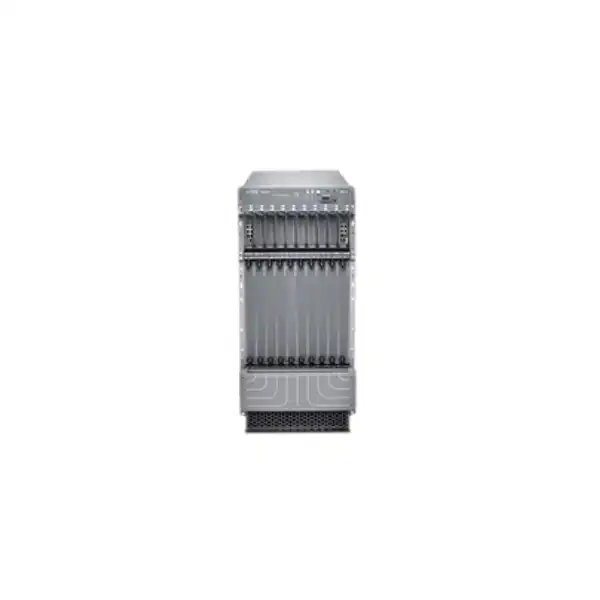
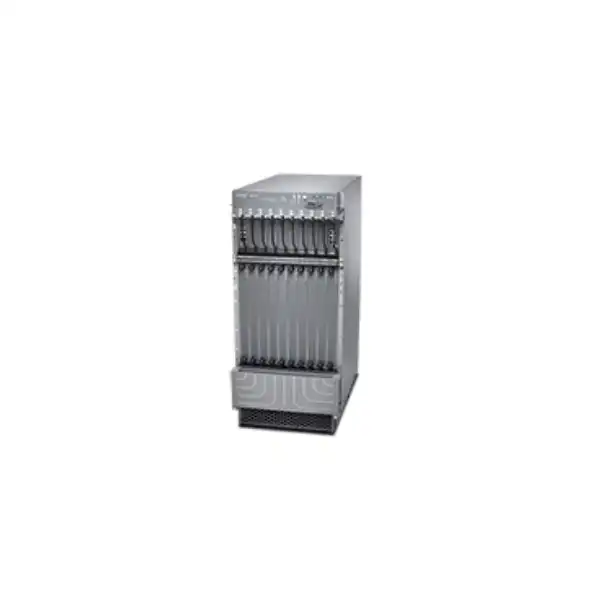
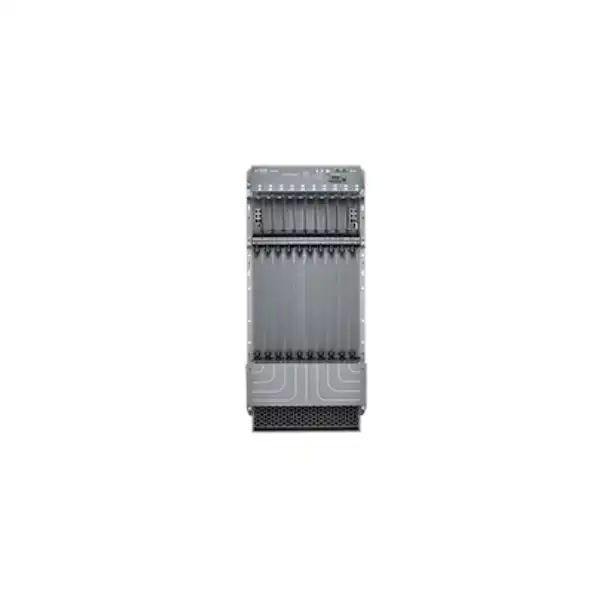
Juniper MX2008 Universal Routing Platform Dubai
A high-capacity MX Series chassis for operators that need dense routing, resilient service delivery and a modular path from established 10/40/100GbE deployments toward newer multirate designs. The buying decision is not only the chassis: fabric generation, MPCs, MICs, optics, Routing Engine redundancy, power architecture, Junos release and feature licensing must be defined as one engineered system.
Direct answer: what is the Juniper MX2008?
The MX2008 is an Ethernet-optimized, modular Juniper MX Series Universal Routing Platform that combines carrier-class routing and switching in a large chassis. It is designed for service-provider core, converged core and edge, business edge, broadband, peering, data-center interconnect and other environments where scale, service richness and resiliency matter more than compact branch-router simplicity.
Its role is to aggregate and route very large volumes of Ethernet and IP traffic while supporting sophisticated service-provider and enterprise edge functions. Typical projects include Internet peering, high-capacity WAN or DCI aggregation, broadband service edges, provider-edge routing, mobile transport and large multiservice network consolidation.
Telecom operators, cloud and hosting providers, large data centers, government or critical-infrastructure networks, and enterprises with carrier-scale routing requirements are the natural audience. Organizations needing only a few high-speed uplinks should normally compare smaller MX platforms before committing rack space, power and operational budget to MX2008.
Confirm the complete hardware generation and service design rather than buying by chassis name alone. Published MX2008 capacity figures have changed with newer fabric and line-card support, so the exact SFB generation, MPC type, port mix, optics, Junos release, licensing and redundancy level must match the performance claim used in the proposal.
FourTeck can translate required 10/40/100/200/400GbE connectivity, expected traffic, service features, rack conditions, power feeds, redundancy objectives and migration constraints into a bill-of-materials discussion, then identify the parts and support items that need confirmation before an accurate UAE quotation.
Why MX2008 is a different purchasing decision from a fixed router
The Juniper MX2008 is not a fixed appliance with a single port list and one universal throughput number. It is a chassis platform whose useful behavior is created by a combination of Routing and Control Boards, Switch Fabric Boards, Modular Port Concentrators, optional Modular Interface Cards, transceivers, power modules and Junos software. That modularity is one of its strongest advantages because an operator can align the physical interface mix and forwarding resources with a specific network role. It is also the reason an MX2008 quote should be engineered rather than assembled from a chassis SKU and a generic quantity of optics.
Juniper currently describes the MX2008 as supporting up to 40 Tbps of throughput with dense multirate interfaces for 100GbE, 200GbE and 400GbE in a single chassis. Juniper’s current hardware compatibility information likewise lists 40,000 Gbps routing capacity. Some MX2000 product literature also contains an earlier 16 Tbps system-throughput figure tied to 1.6 Tbps per slot and specific MPC generations. These figures should not be treated as contradictory marketing claims that can be averaged together. They indicate that hardware generation and configuration matter. A buyer should therefore require the proposed BOM to identify the fabric and line cards that underpin the promised capacity, rather than accepting a bare statement that every MX2008 deployment operates identically.
This configuration-led approach also protects the project from interface mismatch. A network may need hundreds of 10GbE handoffs today, dense 100GbE aggregation for a new peering architecture, or a staged shift toward 400GbE. Those are different line-card decisions even when the chassis is the same. The optical reach, fiber type, breakout requirement, MACsec expectation, subscriber features, timing functions and service scale can further affect the correct module choice. The safest procurement sequence is to start with traffic and service requirements, then map those requirements to supported MPC/MIC combinations and only afterward finalize the chassis bundle, spares and support.
For UAE data-center and telecom environments, the physical layer of that decision is equally significant. A fully loaded MX2008 is a heavy 24U system with substantial power and cooling requirements. Rack loading, cabinet depth, front-to-back airflow, cable radius, grounding and available maintenance clearance should be checked before delivery. A technically correct routing design can still become a difficult deployment if the facility plan assumes the dimensions and power characteristics of a smaller edge platform.
Current hardware identity and chassis facts
| Item | MX2008 buyer-relevant detail |
|---|---|
| Platform type | Modular Universal Routing Platform running Junos OS. |
| Chassis size | 24 rack units. Current Juniper Hardware Explorer lists approximately 42 in high, 19 in wide and 30.9 in deep for the chassis, with approximately 40.15 in depth when FRUs are considered. |
| Weight | Approximately 261 lb / 118.37 kg as a spare chassis and up to about 915 lb / 415.04 kg fully loaded, so installation must account for rack loading and handling. |
| Line-card capacity | 10 dedicated module slots. Juniper’s platform overview states a maximum of 10 MPCs and up to two MICs per compatible MPC, with up to 20 MICs in a fully populated applicable configuration. |
| Control plane | Base and premium hardware bundles differ in Routing Engine count. Current Hardware Explorer lists one RE for base variants and two REs for premium variants, making redundancy a deliberate purchasing choice. |
| Switch fabric | Current Hardware Explorer lists seven SFBs for base variants and eight for premium variants. Juniper documentation describes eight SFB positions with 7+1 redundancy in a fully redundant design. |
| Cooling | Front-to-back airflow, two fan trays, hot-removable/hot-insertable fan-tray support according to current Hardware Explorer. |
| Power hardware | Nine PSM positions and two PDMs are documented for the platform. AC, DC and high-voltage options exist, but power-module and PDM types must be selected as a compatible system rather than mixed arbitrarily. |
| Operating environment | Current Hardware Explorer lists 0°C to 40°C operating temperature, 5% to 90% noncondensing operating humidity and operating altitude up to 10,000 ft / 3,048 m. |
| Capacity | Current Juniper hardware information lists 40 Tbps routing capacity, but the achievable port and service design remains dependent on the installed fabric, MPC generation, optics, software and feature set. |
Understanding the 40 Tbps figure before you put it into a design
Throughput numbers are useful only when the architecture behind them is understood. The current Juniper MX2008 router overview and Hardware Explorer both present 40 Tbps for the platform. That makes MX2008 relevant to very high-capacity aggregation and edge designs, but it should not be interpreted as a promise that every installed line card, every legacy fabric combination or every service-heavy traffic profile can consume 40 Tbps in exactly the same way. Modular routing platforms evolve over long product lives, and Juniper has supported multiple generations of forwarding hardware within the MX family.
Older MX2000 literature described MX2008 as a 16 Tbps system with 1.6 Tbps per slot and documented high densities for MPC9E-based 10GbE, 40GbE and 100GbE deployments. Newer MX2008 platform documentation identifies 40 Tbps and adds support language for dense 100GbE, 200GbE and 400GbE multirate interfaces. The practical lesson is not simply that the newer number replaces the older one. The lesson is that an installed-base chassis, a refurbished chassis, a legacy bill of materials and a current high-capacity build can have materially different capabilities even though the front label says MX2008.
When FourTeck develops a quote, the requested throughput should therefore be attached to a traffic model. Useful inputs include aggregate bidirectional traffic, expected per-slot load, projected three-to-five-year growth, percentage of traffic needing services, interface speeds, number of peers, subscriber or VPN scale, encryption requirements and resilience design. This makes it possible to determine whether the constraint is chassis fabric, a line card, port density, optics availability, software scale, feature licensing or simply the uplink architecture around the router.
This distinction also prevents overspending. If a requirement is dominated by a modest number of high-speed interfaces rather than many modular service interfaces, a smaller or newer fixed/compact MX platform may satisfy the requirement with less rack, power and operational overhead. Conversely, if the network needs many slots, a broad mix of media, carrier-grade redundancy and extensive reuse of MX modular hardware, MX2008 can make sense even when headline throughput is not the only selection criterion.
Ten line-card slots: where MX2008 flexibility really comes from
MPC selection
Modular Port Concentrators provide the forwarding resources and interface framework. Different MPC generations support different port types, bandwidth, feature sets and power profiles. A quote should name the exact MPC part numbers rather than saying only that the chassis has ten slots.
MIC flexibility
Compatible MICs provide physical interfaces for supported MPCs. Juniper documents up to two MICs in applicable MPCs and allows different supported media types in the same router. That can be valuable during migrations where old and new interface types need to coexist temporarily.
Adapter-card dependencies
Some MPC generations require an adapter card in MX2008 while certain later MPC families do not. This affects slot mechanics, power, BOM structure and replacement planning. The exact line-card installation rules should be checked against the current MX interface-module reference.
Optics are part of the design
The physical port does not determine the optical solution by itself. Reach, fiber plant, wavelength plan, breakout method, connector type and environmental requirements decide the supported transceiver or cable. Optics should be validated per the selected MPC/MIC and Junos support matrix.
Spares strategy
A ten-slot carrier chassis may be operationally more valuable when critical field-replaceable units and optics are standardized. Buyers should decide whether spare MPCs, MICs, optics, fan components, power modules or Routing Engine-related hardware belong in the initial procurement or an operational spares pool.
A common mistake is to design only for day-one ports. The ten-slot architecture is better used when the team also maps slot headroom, likely upgrade paths and failure-domain behavior. For example, distributing critical links across multiple line cards can improve resilience compared with concentrating every important service on one high-density card. Similarly, leaving intentional capacity for growth can be more economical than planning an immediate chassis expansion under operational pressure. These are architecture decisions, not catalogue decisions.
Routing Engine and control-plane redundancy
The MX2008 host subsystem integrates Routing Engine and control-board functions through Routing and Control Boards. Current Juniper Hardware Explorer differentiates base and premium variants by Routing Engine count: base AC/DC entries list one Routing Engine, while premium AC/DC entries list two. This distinction should appear clearly on any serious quotation because a chassis intended for high-availability service-provider duty is normally evaluated differently from a lab, staging or lower-criticality deployment.
Juniper lists supported MX2008 Routing Engine models including REMX2008-X8-64G and REMX2008-X8-128G in current hardware information, while detailed documentation also records an LT variant. Software support begins at different Junos releases for different Routing Engines. That means a replacement or upgrade project cannot safely assume that every MX2008 Routing Engine is interchangeable under the currently installed Junos image. The exact hardware revision, current software release and target release should be checked together.
For a production design, dual Routing Engines are primarily about control-plane availability and maintenance flexibility. They do not eliminate the need to engineer protocol convergence, line-card redundancy, link aggregation, upstream diversity or dual-chassis architecture. High availability is layered: a redundant control plane helps if one Routing Engine fails, but it does not protect a site against chassis-level failure, a shared rack power event, an upstream fiber cut or a configuration error propagated to both control planes.
Organizations planning maintenance windows should also evaluate Junos features such as graceful routing behavior, nonstop mechanisms and in-service upgrade capabilities in the context of the exact hardware and software combination. Juniper documentation highlights Unified ISSU and Junos Continuity as availability tools, but operational qualification is still required. A change process should specify supported upgrade paths, rollback procedures, protocol expectations and whether the installed feature set is compatible with the intended hitless or minimally disruptive method.
Switch fabric: why SFB generation belongs in the BOM
The Switch Fabric Boards connect forwarding elements across the chassis, so fabric generation is central to the capacity discussion. Juniper’s current MX2008 platform overview describes eight Switch Fabric Boards providing 7+1 redundancy, while Hardware Explorer lists seven SFBs in base variants and eight in premium variants. A buyer should interpret that as a configuration distinction, not merely a quantity difference. The redundancy target and the line-card generation expected to run at full performance should determine the fabric build.
Juniper also documents the MX2008 SFB2, which differs mechanically from the native MX2000 SFB2 while serving the MX2008 platform. Up to eight SFB2 boards can be installed. In practical procurement terms, a proposal should state whether it is based on the relevant enhanced fabric generation, how many fabric boards are included, what redundancy level is intended, and whether the proposed line cards rely on that fabric generation for their advertised performance.
This is especially important for buyers expanding an existing chassis. An operational MX2008 purchased years ago may contain a different fabric generation and different MPCs from a current design. Adding a modern high-speed card can therefore require more than inserting the card into an empty slot. Software, fabric, power, cooling, adapters and optics may all need review. An expansion assessment should begin with chassis inventory output, including part numbers and revisions for Routing Engines, SFBs, MPCs, MICs and power hardware.
For greenfield projects, documenting fabric generation from day one makes future support simpler. It helps operations teams understand why a specific throughput target is valid, supports spare-part planning, and reduces the risk that a replacement module is selected because it physically fits while not matching the engineered performance or software baseline.
Power planning for Dubai and UAE facilities
The MX2008 should be treated as data-center infrastructure, not as an appliance that can be connected to an ordinary rack PDU without engineering review. Juniper documents nine power supply modules and two power distribution modules for the chassis, with multiple supported input architectures including AC, -48 VDC, 240 V China DC and high-voltage AC/DC options. Current Hardware Explorer lists 1+1 PDM redundancy, and Juniper’s platform documentation describes nine PSMs with an 8+1 redundancy design in a fully provisioned configuration.
The specific electrical values depend on the power system. For example, Juniper documents a -48 VDC range of -40 VDC to -72 VDC for the DC PSM family. It also documents high-voltage universal power options with AC operating range of 180 to 305 VAC and DC range of 190 to 410 VDC. These numbers are not an instruction to choose whichever feed is convenient. They show that MX2008 supports several facility architectures, each with its own PDM/PSM requirements, cabling, breaker sizing and redundancy model.
Juniper specifically warns against mixing incompatible power-module or PDM types within one system. That matters when sourcing spares or expanding a used chassis. A replacement PSM should be matched to the installed power architecture rather than selected solely because it is labelled for the MX2000 family. The facility team should verify feed type, available circuits, breaker capacity, cable specification, grounding and whether A/B feeds meet the intended failure design.
Actual consumption is configuration dependent. A chassis with high-power line cards and many optics can draw materially more power than a lightly populated unit. Juniper publishes component-level power requirements for fabrics, fan trays, adapter cards, Routing and Control Boards, MPCs, MICs and optics. For an accurate deployment plan, the bill of materials should therefore be run through the appropriate Juniper power-calculation method rather than using a single chassis-wide number copied from an unrelated configuration.
In Dubai, facility cooling margin deserves equal attention. The current Hardware Explorer operating range is 0°C to 40°C, with front-to-back airflow. That specification concerns the inlet environment at the equipment, not outdoor weather. Data-center hot-aisle/cold-aisle design, containment, rack blanking, fan health and sensible heat removal must keep the router within its supported operating range under normal and degraded cooling conditions.
Physical installation: rack space, depth, weight and service clearance
A 24U chassis consumes more than half the vertical capacity of a conventional 42U rack before adjacent patch panels, optical shelves or other network devices are considered. Current Juniper Hardware Explorer data lists the MX2008 at 42 inches / 106.68 cm high and 19 inches / 48.26 cm wide. Chassis depth is listed at 30.9 inches / 78.486 cm, while depth with FRUs is approximately 40.15 inches / 102 cm. The difference between bare chassis depth and installed service depth is important for cabinet selection, rear-door clearance and cable routing.
The current maximum fully loaded weight is about 915 lb / 415.04 kg. This is far beyond what should be handled casually by a small installation team. Site preparation should confirm rack load rating, floor loading where relevant, delivery path, lift and handling method, and whether cabinet rails and mounting hardware are appropriate. The operational plan should also account for how individual FRUs will be accessed after the rack is populated.
Juniper Hardware Explorer lists 36 inches / 91.44 cm of maintenance clearance. A cramped cabinet row that technically accommodates the chassis depth may still be unsuitable if technicians cannot remove cards, manage fiber, service fan trays or access power components safely. Cable-management parts are available for the MX2000 family, and their geometry should be included when checking clearances and bend radii.
Airflow is front to back. That sounds simple, but it imposes discipline on rack orientation and aisle design. Installing the router against the facility’s intended airflow direction can increase inlet temperature or recirculation. Blank panels, neighboring exhaust, perforated-door area and cable congestion can all influence the real thermal environment. If the project uses a third-party cabinet, the rack vendor’s usable dimensions should be compared against Juniper’s installation guide, not only against nominal 19-inch rack standards.
For migration projects, physical staging can be a bigger constraint than final steady-state design. Running an old chassis and a new or upgraded MX2008 side by side may temporarily double rack, power and optics requirements. Planning that overlap in advance allows traffic migration and rollback without improvising facility capacity during the maintenance window.
Interface strategy: 10GbE, 40GbE, 100GbE and newer multirate growth
MX2008 has had a long service life, so its value often lies in supporting multiple interface generations within one operational framework. Earlier MX2000 designs used line cards such as MPC9E to deliver dense 10GbE, 40GbE and 100GbE configurations. Juniper’s current MX2008 overview now describes dense multirate support for 100GbE, 200GbE and 400GbE. That makes the chassis potentially useful for staged network evolution, but only when the selected hardware combination is validated for the target Junos release and service features.
A port-count requirement should be translated into actual optical and traffic requirements. Ten 100GbE LR4 links to metro sites are different from forty 100GbE short-reach connections inside one facility. A 400GbE interface used as a native long-haul wavelength is different from a 400GbE port broken into multiple lower-speed lanes. Fiber type, connectorization, supported breakout modes, transceiver coding, forward-error-correction requirements and the far-end platform all influence whether a nominal interface speed becomes a working link.
The service running over the interface matters too. A pure IP transit port may have different feature requirements from a MACsec-protected data-center interconnect, a subscriber-facing broadband interface, an MPLS provider edge or a timing-sensitive mobile transport link. Juniper has documented integrated MACsec on certain MX2000 MPC generations, but support is line-card and port dependent. It should therefore be verified per proposed MPC rather than generalized to every physical port in the chassis.
For brownfield networks, existing optics deserve close scrutiny. Reusing a transceiver can reduce project cost, but compatibility should be checked against the exact new port rather than inferred from speed alone. DOM support, wavelength, reach, temperature class, breakout behavior and qualification status may differ. A migration bill of materials should identify which optics are confirmed reusable, which require replacement and which are required temporarily for parallel running.
FourTeck can structure the interface requirement as a port matrix: current port, target speed, media, reach, peer device, redundancy role, breakout need, encryption need and expected traffic. That matrix is usually more useful than a single request such as “need 20 x 100G” because it exposes dependencies early enough to correct the BOM before installation.
Junos OS, automation and operational consistency
The MX2008 runs Junos OS, which is one of the reasons existing Juniper operators may prefer it over introducing a separate routing platform. A common operating system can reduce the learning curve for configuration hierarchy, routing policy, protocol operations, logging, automation and troubleshooting. It can also help standardize change control across multiple MX models. That consistency, however, does not mean that every feature is available on every hardware combination or every Junos release.
Before purchasing hardware for an existing network, the target Junos version should be chosen deliberately. The chosen Routing Engine, SFB generation, MPCs, MICs and optics need to be supported together. If the production environment is pinned to an older release for application or certification reasons, newer hardware may require an upgrade. Conversely, moving to a newer release can introduce its own qualification work for routing protocols, automation scripts, management platforms and operational procedures.
Juniper highlights streaming telemetry on MX2008. Telemetry can provide granular data for utilization, congestion, buffer occupancy and other performance indicators, which is useful in high-capacity environments where periodic SNMP polling alone may not provide enough detail. A telemetry project still needs a collection architecture, retention policy, monitoring platform and thresholds that correspond to service objectives. The router’s ability to stream data is only one part of observability.
Automation should likewise be scoped around the operational environment. Teams may use NETCONF, APIs, configuration templates or higher-level orchestration depending on their standards. The right question is not whether MX2008 is “automatable,” but whether the intended Junos release and management stack support the organization’s workflows for provisioning, compliance checking, configuration backup, software upgrade and incident response.
For a migration from another vendor, operational consistency may be more important than raw forwarding capacity. Routing policy syntax, BGP behavior, MPLS services, QoS classification, interface naming, alarm handling and troubleshooting commands all affect the change. A useful project scope includes configuration translation, lab validation, acceptance criteria, rollback and post-cutover monitoring rather than treating the router as a drop-in physical replacement.
Resiliency: build failure domains, not just redundant parts
Control plane
Premium variants can be built with two Routing Engines. This supports a redundant control-plane design, but software compatibility and failover behavior must be validated for the chosen Junos release.
Switch fabric
A full design uses eight SFB positions with 7+1 redundancy. Base configurations may include seven, so proposal language should state whether fabric redundancy is included.
Power feeds
Two PDMs and multiple PSMs allow resilient power architectures. The facility must provide genuinely independent feeds if the design objective includes protection from upstream electrical failure.
Cooling
Two fan trays and temperature monitoring provide a resilient cooling subsystem, but blocked airflow or inadequate room cooling can still affect the whole chassis.
Chassis-level design
Juniper documents Virtual Chassis and multichassis resiliency options for MX. Where site availability requires protection from total chassis failure, dual-router architecture and physically diverse connectivity should be assessed.
Operational failure
Redundant hardware cannot compensate for every software, configuration or process error. Change control, staged rollout, configuration validation and out-of-band access remain part of a high-availability design.
The important principle is that “redundant” is not a single checkbox. A router can have duplicate Routing Engines yet still depend on one rack, one upstream fiber pathway or one configuration domain. Critical UAE deployments should define the failure events they need to survive: a PSU fault, one utility feed loss, a fabric failure, line-card failure, Routing Engine failure, software upgrade, rack outage, fiber cut or full site event. The architecture can then assign an appropriate protection mechanism to each event rather than assuming the chassis alone provides end-to-end availability.
Where the MX2008 fits well
The MX2008 is strongest when its modularity, service richness and high-capacity chassis design solve a real operational problem. Service providers can use it where many customers or services converge onto a resilient edge. Large data centers and cloud operators may consider it for Internet peering, WAN aggregation or DCI roles that require significant interface density and mature routing features. Enterprises with very large MPLS, BGP or multiservice edge requirements can also use it where a conventional fixed router would force too many compromises in port mix or redundancy.
Broadband and subscriber environments are another established MX use case. These projects are not sized simply by aggregate bandwidth. Subscriber count, session behavior, policy functions, lawful-intercept requirements where applicable, logging, address management and service features can influence the forwarding and control-plane design. A platform that looks lightly loaded by Gbps may still be heavily constrained by a different scale dimension. Conversely, a design with high raw traffic but relatively simple forwarding may need fewer service resources.
Provider-edge and VPN consolidation can also favor a modular MX chassis. The value comes from combining routing scale, multiple interface types, QoS, MPLS service functions and operational familiarity in one system. When consolidating services, failure-domain analysis becomes more important because more business traffic depends on the same chassis. Redundant control and fabric components, line-card distribution and dual-site or dual-chassis architecture should be aligned with the commercial impact of an outage.
Peering and transit networks may value the ability to run many high-speed interfaces and large routing tables while integrating telemetry and policy control. Here the buyer should specify full-route expectations, number of BGP sessions, route-policy complexity, RPKI or security architecture, traffic-engineering requirements and DDoS response model. The router is part of a larger edge system that can include route servers, scrubbing services, optical transport and monitoring.
A final strong fit is brownfield MX modernization where the operator already owns compatible skills, tools and perhaps reusable modules or optics. Reuse can improve economics, but it should be confirmed at part-number level. The project should never assume that “MX Series compatible” automatically means compatible with the desired MX2008 fabric generation and Junos software.
When MX2008 may be more platform than you need
A serious recommendation should also explain when not to choose MX2008. The first warning sign is low interface count combined with modest service requirements. A 24U chassis that can weigh more than 400 kg fully loaded introduces facility, power and maintenance overhead that may be unnecessary for a site needing only a handful of 100GbE or 400GbE links. Smaller MX platforms can offer high forwarding capacity in dramatically less rack space.
The second warning sign is a project that values current-generation density and energy efficiency more than modular reuse. Newer compact or modular platforms may offer a better ratio of capacity to rack units or watts for certain pure-IP roles. The correct comparison should use the actual port and feature requirement rather than choosing MX2008 because it is a physically large carrier chassis.
The third warning sign is uncertain lifecycle strategy. Any long-lived platform should be evaluated against the buyer’s required support horizon, Junos roadmap, replacement-part strategy and standards. The correct question is not whether MX2008 exists in Juniper’s documentation today; it is whether the exact hardware generations in the proposed BOM align with the organization’s support and lifecycle policy for the intended deployment period.
The fourth warning sign is a network that does not have the operational maturity for a chassis platform. Large modular routers reward disciplined inventory management, configuration control, software qualification, spares planning and facility operations. An organization that needs a simple appliance with minimal engineering overhead may achieve a better outcome with a smaller platform even if MX2008 has more theoretical capacity.
FourTeck’s role in this scenario is not to force the larger model. A good shortlist can include MX2008 plus one or more smaller or newer alternatives, with comparison based on interfaces, throughput, feature support, redundancy, rack space, power, upgrade path and total operational fit.
MX2008 versus MX2010 and MX2020: compare architecture, not just names
Within the MX2000 family, the model number alone does not tell the whole story because hardware evolution has changed what different chassis can support. MX2010 is a larger 10-slot chassis, while MX2020 provides 20 slots and substantially more rack footprint. Juniper’s MX2000 datasheet historically positions MX2020 at 80 Tbps, MX2010 at 40 Tbps and MX2008 at 16 Tbps for a particular generation of fabric and line cards. Current MX2008 hardware documentation now lists 40 Tbps. This is exactly why buyers should compare the intended BOM and release level rather than a static family table detached from configuration context.
MX2020 is naturally relevant when slot count and very large aggregate capacity dominate. Twenty slots can reduce the number of chassis needed for extremely dense environments, but the physical, power and failure-domain implications of concentrating more traffic into one system should be evaluated. MX2010 historically offered a middle chassis size, though current capacity comparisons must again be tied to supported fabric and MPC combinations.
MX2008 can be attractive when ten slots are sufficient and the 24U footprint is preferable to a taller MX2000 chassis. For an operator with a rack-space constraint, that difference can matter. For an operator whose primary goal is 400GbE density with minimal rack space, however, a newer MX10000-family or compact MX platform may deserve comparison depending on service requirements.
A replacement project should also consider migration cost. Moving from an existing MX2008 to another MX2000 chassis may preserve more operational patterns or modular investments than moving to a different architecture, but not every MPC or accessory is automatically reusable. Conversely, moving to a newer architecture may reduce power or rack footprint while requiring new line cards, optics or automation changes. Total project cost is therefore hardware plus migration effort, not only chassis acquisition price.
The most useful comparison table for a buyer is customized: required ports now, required ports in three years, service features, required redundancy, rack units, maximum acceptable power, existing reusable hardware, Junos target, support horizon and migration window. Once those inputs are known, the model decision becomes much clearer.
Licensing and software feature scope
Licensing on MX platforms can depend on the line-card generation, software features and commercial model. Juniper documentation notes Flex licensing for certain newer MPCs, while other hardware and software combinations may follow different entitlement structures. For that reason, the phrase “Junos included” is not enough to define whether the requested service functions are commercially and technically available.
The buyer should list required functions in plain operational terms: Internet edge routing, MPLS L3VPN, EVPN, subscriber management, CGNAT or services integration where applicable, MACsec, timing, telemetry, advanced routing scale, automation and any feature that depends on a particular license tier or package. FourTeck can then map those requirements to the correct hardware and licensing discussion. This avoids paying for capabilities that are not needed and, more importantly, avoids discovering after installation that a required function needs an entitlement that was not in the purchase order.
Subscription term also matters to budget planning. If a feature uses a term-based license, the procurement team should record term length, renewal responsibility and what happens operationally when the term expires. If the environment has strict change windows, renewal timing becomes an operational dependency as well as a finance task.
For existing MX2008 deployments, license transferability or entitlement status should be checked before assuming an old license follows replacement hardware. Refurbished or secondary-market equipment requires particular care because hardware possession and software entitlement are separate questions. A complete quotation should therefore identify hardware, software, support and subscription components clearly enough that the buyer understands what is perpetual, what is term-based and what is support-dependent.
Migration planning: from existing core or edge to MX2008
A migration is successful when services move predictably, not when the new chassis merely powers on. The first task is discovery. Export the current interface inventory, routing protocols, VRFs, VLANs, MPLS services, QoS policies, route policies, subscriber functions, authentication, logging, NTP, management access and monitoring dependencies. Add physical information such as optics, patching, fiber routes, rack positions and power feeds. This creates a baseline against which the MX2008 design can be validated.
The second task is equivalence mapping. Every existing function should have a target implementation or an explicit decision to retire it. Vendor-to-vendor migrations require especially careful policy translation because syntax may differ while business intent remains the same. Juniper-to-Juniper migrations can still expose differences in interface naming, feature support by MPC generation, Junos behavior or license requirements.
The third task is lab validation or staged testing. Critical routing policies, BGP communities, MPLS labels, QoS behavior, MTU, link aggregation, convergence and management access should be tested with the intended Junos release. High-speed optics should be validated against the actual peer devices where possible. If MACsec or timing is required, those functions deserve explicit acceptance tests rather than assumptions based on port speed.
The fourth task is a cutover plan that separates physical work from routing-state change. Pre-cabling, pre-loading configuration, validating out-of-band access and establishing management telemetry before production traffic moves can reduce uncertainty. The plan should define traffic batches, verification checkpoints, stop conditions and rollback triggers. A large router migration is safer when the team can prove each stage before continuing.
The fifth task is post-cutover observation. Interface errors, optical levels, BGP convergence, routing-table size, CPU and memory, line-card utilization, queue drops, latency and service-specific KPIs should be compared with the baseline. Telemetry is useful here because it can reveal microbursts or congestion patterns that coarse polling misses.
If the old platform remains available for rollback, temporary power, rack and fiber requirements must be included in the implementation design. In many data centers, this transitional capacity is the hidden constraint. Planning it early is usually cheaper than discovering on migration night that there is no suitable spare circuit or patch path.
Operational monitoring and telemetry
At MX2008 scale, monitoring should distinguish between chassis health, control-plane health, forwarding capacity and service experience. Chassis monitoring includes power modules, PDM status, fan trays, temperature sensors, fabric state and field-replaceable unit alarms. Control-plane monitoring includes Routing Engine CPU, memory, process health, route counts, protocol sessions and redundancy state. Forwarding monitoring includes per-port utilization, errors, queue behavior and line-card resource use.
Junos telemetry can stream detailed operational data and is particularly valuable where interfaces carry hundreds of gigabits per second. A five-minute average can make a port look healthy while short bursts create queue loss. Streaming data gives the monitoring system more opportunity to detect those patterns, but it also creates data-volume and retention questions. The monitoring architecture should decide which metrics need high frequency, which can be aggregated, and which events require immediate alerting.
Alarm design should correspond to action. An alert that no operator understands or can act on becomes noise. For example, temperature warnings should be tied to facility response and chassis inspection procedures; power-module failures should identify whether redundancy is still intact; interface optical warnings should point to likely fiber or transceiver investigation. The monitoring platform should make the remaining redundancy margin visible rather than merely reporting that one component failed.
Capacity reporting should use trends, not snapshots. MX2008 is often purchased for growth, so the operations team should track slot utilization, port occupancy, bandwidth, route scale and feature consumption over time. That turns the platform’s modular headroom into a managed resource and provides procurement with advance warning when additional MPCs, optics or a second chassis will be needed.
Security considerations for an Internet or service edge
A high-capacity router is part of the security boundary even when it is not deployed as a firewall. Control-plane protection, routing-policy hygiene, management isolation, secure administrative access, logging and software maintenance all contribute to the security posture. Internet-facing BGP designs should define prefix filters, route limits, community handling, RPKI validation strategy where used, and response procedures for route leaks or unexpected announcements.
Management access should be separated from production traffic where the architecture permits. Out-of-band connectivity is particularly valuable on a chassis platform because it allows operators to troubleshoot routing or forwarding problems without depending on the affected data plane. Authentication should integrate with the organization’s identity and privilege model, and administrative actions should be logged to external systems.
MACsec can be relevant for high-speed inter-site or data-center links where Layer 2 encryption is required. Juniper has documented integrated MACsec support on specific MX2000 line-card generations and interfaces. The design must verify the exact MPC, interface speed, peer compatibility, key-management approach and any license dependency. It should not assume that every MX2008 port supports MACsec merely because the chassis family supports it in some configurations.
DDoS strategy should likewise be architecture-specific. A high-capacity router can participate in filtering, flowspec, traffic engineering or diversion workflows, but attack mitigation often involves external detection, scrubbing services or dedicated security systems. The proposal should distinguish what MX2008 is expected to do locally from what is handled by upstream providers or security platforms.
Finally, software lifecycle is a security requirement. The target Junos release should be selected with feature support, hardware compatibility, maintenance policy and security advisories in mind. An upgrade process should be documented before the platform becomes difficult to schedule for maintenance.
Procurement risks that a detailed MX2008 quotation should remove
Chassis-only ambiguity
A chassis line item does not reveal RE count, fabric redundancy, PSM/PDM arrangement, MPCs, MICs or optics. The BOM should identify the system that will actually be delivered.
Capacity ambiguity
Because MX2008 documentation spans multiple hardware generations, the proposal should tie throughput and port-density claims to the selected fabric and line cards.
Power mismatch
AC, DC and universal power components are not interchangeable at random. The facility feed and exact PDM/PSM family must be aligned.
Optics assumptions
Port speed is not enough to select a transceiver. Reach, fiber, wavelength, peer device, breakout and supported-optics matrix must be confirmed.
Software or license gap
The requested feature may depend on a specific Junos release, MPC or entitlement. The quote should identify software assumptions rather than treating all MX features as universal.
Support and lifecycle gap
Support level, hardware age, entitlement status and spare strategy should match the organization’s service horizon, especially for secondary-market or installed-base expansion projects.
New, expansion, refresh or refurbished: define the commercial scenario
The phrase “MX2008 required” can describe several very different purchasing scenarios. A greenfield build starts from performance and feature requirements and can select the most appropriate currently supported hardware generation. An expansion project begins with an existing chassis and must preserve compatibility with installed fabric, Routing Engines and software. A refresh project may reuse some components while replacing others. A refurbished-hardware request introduces additional questions about condition, entitlement, supportability and exact hardware revision.
For greenfield procurement, the buyer should compare MX2008 against current alternatives before committing. The decision should be justified by modularity, slot count, feature requirements, installed-base consistency or another concrete advantage. A new deployment should not select a large chassis simply because a historical design standard names it.
For expansion, the first deliverable should be an inventory. Chassis model, SFB part numbers, Routing Engine models, existing MPCs/MICs, PDM/PSM types, Junos release, license status and available slots all matter. A photograph of the front panel is helpful but not sufficient. CLI hardware inventory and part numbers are more reliable for compatibility planning.
For refresh projects, identify which operational problem is driving the work. If the issue is port exhaustion, new MPCs may solve it. If the issue is throughput, fabric and line-card generation may matter. If the issue is software lifecycle or support policy, a broader platform migration may be more appropriate. If the issue is power or rack density, adding more hardware to the existing chassis may move in the wrong direction.
For refurbished sourcing, buyers should request condition grading, serial and part-number detail, hardware revision where available, included accessories, testing scope, warranty terms and a clear statement of software/support responsibility. An attractive chassis price can become expensive if the required power, control, fabric or interface components are missing.
A practical MX2008 sizing workflow
List Internet, MPLS, EVPN, DCI, broadband, business edge, peering, timing, encryption and management requirements. Service intent determines more than bandwidth alone.
Count interfaces by speed, media, reach, peer, protection role and growth. Include temporary migration ports and breakout requirements.
Estimate peak and sustained load, oversubscription tolerance, per-slot distribution and three-to-five-year growth. Identify service-heavy flows that may change resource needs.
Choose SFB, MPC/MIC and Routing Engine combinations that support the required capacity, ports, features and Junos release.
Decide control-plane, fabric, power, line-card, link and chassis-level protection according to the failure events the service must survive.
Confirm rack units, depth, weight, maintenance clearance, airflow, cooling, grounding and power-feed capacity before delivery.
This workflow produces a configuration that can be defended technically and commercially. It also makes alternative evaluation easier: if another platform can meet the same service, port, traffic and resilience requirements with less complexity, that becomes visible before purchase.
Support, spares and lifecycle planning
Carrier-grade hardware is usually purchased as part of an operational system that must remain maintainable for years. Support should therefore be selected according to business impact, not added automatically at the end. Response expectations, replacement logistics, software access, technical assistance and escalation requirements vary between organizations. A core or peering router carrying critical services may justify a different support model from an MX2008 used in a lab or noncritical aggregation role.
Spares planning should identify components whose failure would create unacceptable risk even if the chassis has redundancy. Optics are an obvious example because they are inexpensive relative to a router but can interrupt a service if an uncommon reach or wavelength is not available locally. Line cards, power modules and fan-related components may also belong in the spares strategy depending on support replacement times and installed base.
Hardware standardization can reduce the spare burden. If several MX2008 systems use the same line-card and optics families, a shared spares pool can cover more failure scenarios. Mixed generations may be operationally necessary, but the inventory system should record which spare is compatible with which chassis and Junos baseline.
Lifecycle planning should include software as well as hardware. The organization should know which Junos train is qualified, how often upgrades are reviewed, how security advisories are assessed and what triggers a major platform refresh. If the business requires a support horizon beyond the practical life of the chosen components, that is a reason to compare alternatives before purchasing more installed-base hardware.
For UAE operations, local logistics can influence the spares decision. A part that is technically replaceable in hours may take longer to source if it is not held regionally. Critical operators often balance vendor support with selected on-site or local spares so that the recovery plan reflects real supply-chain time rather than theoretical replacement capability.
Buyer questions FourTeck recommends answering before quote approval
What traffic must the chassis carry?
State current peak, expected growth and traffic distribution. Aggregate Gbps without growth or slot distribution is not enough for a modular design.
Which interface speeds and reaches are needed?
List 10/40/100/200/400GbE requirements, fiber type, distance, breakout and far-end device so optics and line cards can be validated together.
Which services must be enabled?
Specify BGP, MPLS, EVPN, VPN, broadband, encryption, timing, telemetry and other functions that may affect hardware, software or licensing.
What failure events must be survived?
Define whether protection is needed for RE, fabric, PSU, feed, line card, link, chassis, rack or site failure. Each requires a different mechanism.
What facility power is available?
Identify AC/DC architecture, redundant feeds, breaker capacity, rack PDUs, grounding and cooling margin. Power hardware should be selected to match the site.
Is this new or an expansion?
For installed-base work, provide chassis inventory, SFBs, REs, MPCs/MICs, power type, Junos version and available slots so compatibility can be checked.
Frequently asked questions about Juniper MX2008 in Dubai
Is the MX2008 a 16 Tbps or 40 Tbps router?
Current Juniper MX2008 documentation and Hardware Explorer list 40 Tbps. Earlier MX2000 literature described a 16 Tbps configuration. The practical interpretation is that hardware generation matters. A quote should identify the specific switch fabric and MPC configuration used to support its capacity claim.
How many line-card slots does MX2008 have?
It has 10 dedicated module slots. Juniper states that up to 10 MPCs can be installed, subject to hardware support rules, and compatible MPCs can accept MICs where applicable.
Does MX2008 support redundant Routing Engines?
Yes, a redundant control-plane configuration is available. Current Hardware Explorer distinguishes base variants with one Routing Engine from premium variants with two. The required redundancy level should be specified in the BOM.
What rack space is required?
MX2008 is a 24U chassis. Planning should also include the approximately 40.15-inch depth with FRUs, cable management and the maintenance clearance specified by Juniper.
Can it use AC or DC power?
Yes. Juniper documents AC, DC and high-voltage options. The selected PDM and PSM family must match the site’s electrical architecture, and incompatible power types must not be mixed within the system.
What is the supported operating temperature?
Current Juniper Hardware Explorer lists 0°C through 40°C. Data-center design must maintain supported equipment inlet conditions regardless of Dubai’s outdoor climate.
Does MX2008 support 400GbE?
Current Juniper MX2008 overview documentation describes dense multirate support including 100GbE, 200GbE and 400GbE. Exact port availability depends on the supported MPC, fabric generation, optics and Junos release.
Can existing MX optics or line cards be reused?
Possibly, but reuse should be verified by exact part number. Compatibility depends on chassis support, fabric generation, adapter requirements, software release and the intended feature set. Physical fit alone is not enough.
Is installation service recommended?
For production deployments, professional planning is advisable because the chassis is heavy, power-intensive and modular. Installation scope can include rack readiness, power validation, hardware assembly, software baseline, configuration, migration and acceptance testing.
How should I request a quote?
Provide the service role, traffic target, interface count and speeds, optics reach, redundancy requirement, power type, Junos target, license needs, deployment location, installation scope and whether the request is a new build or an expansion of an existing MX2008.
UAE deployment considerations beyond the router itself
Enterprise and service-provider projects in the UAE often involve multiple delivery domains: the equipment vendor, distributor or reseller, data-center operator, fiber provider, systems integrator, security team and internal network operations team. The MX2008 configuration should be coordinated with all of them because a dependency outside the router can become the critical path. A line card may be available while the required long-reach optics are not; the rack may be reserved while the correct power feeds are still pending; the configuration may be complete while cross-connects are not delivered.
For data-center deployments, confirm rack ID, usable rack units, cabinet depth, floor loading policy, A/B feed details, breaker capacity, plug or termination requirements, grounding, airflow orientation and cross-connect demarcation. If the router spans multiple carriers or meet-me rooms, document fiber routes and optical budgets. If the site enforces change windows or escorted access, those operational constraints belong in the project plan.
For telecom or campus facilities, grounding and DC power architecture may differ from commercial data centers. The MX2008’s available -48 VDC and other power options can be relevant, but the exact power design should be reviewed by qualified facility personnel. The router specification should not be used as a substitute for electrical engineering or site safety requirements.
For multi-emirate or regional networks, spare placement and remote-hands capability can affect resilience. A redundant chassis design at one site does not solve slow replacement logistics at another. Operators can classify sites by criticality and decide which FRUs or optics deserve local spares, which can be held centrally, and which rely on vendor replacement service.
Documentation should be delivered with the project: final BOM, rack elevation, power map, port map, optic inventory, software version, licenses, configuration backup, acceptance results and support references. That package reduces future troubleshooting time and makes later expansion safer.
Implementation journey for a production MX2008
Capture network role, traffic, services, existing hardware, site constraints and business availability requirements.
Select redundancy model, slot plan, fabric, MPC/MIC mix, optics, Routing Engines, software and power architecture.
Check current Juniper hardware and software support for every critical component and target feature.
Confirm rack, lifting method, clearance, power feeds, grounding, airflow, cooling and cabling paths.
Assemble hardware, load approved Junos software, apply base configuration and validate management access.
Verify routing, policies, interfaces, optics, QoS, redundancy and any encryption or timing functions.
Move traffic in controlled stages with clear verification and rollback criteria.
Deliver inventory, configuration, monitoring, support references and operational documentation.
How to evaluate total cost instead of chassis price
MX2008 total cost includes more than the chassis. The first layer is the configured hardware: Routing Engines, SFBs, MPCs, MICs, adapter cards where required, PDMs, PSMs, fan components, cable-management hardware and optics. The second layer is software and licensing. The third is support and spares. The fourth is facility cost: rack space, power, cooling and cross-connects. The fifth is engineering: design, staging, migration, testing and operations.
This full-cost view can change the platform decision. A chassis with lower acquisition cost may need more power or more complex migration. A newer platform may cost more per chassis but reduce rack usage and simplify the interface architecture. Reusing existing MX modules may lower purchase cost but increase lifecycle or compatibility risk. None of these outcomes is universally right; they should be compared against the project’s time horizon.
Capacity headroom also has economic value. Buying just enough ports for day one can lead to emergency expansion, while buying excessive unused capacity ties up budget and power. A reasonable growth model identifies the expected date when additional slots or interfaces will be needed and compares incremental expansion with initial overprovisioning.
Operational labor matters too. If the existing team already operates Junos and MX at scale, MX2008 may integrate into established monitoring, automation and troubleshooting practices. Introducing a different platform may require training and tooling changes. Conversely, if the organization is actively simplifying its network, continuing a large modular platform may preserve complexity the business wants to remove.
A useful commercial proposal can therefore separate mandatory day-one components, recommended resilience components, optional growth items, spares, licenses, support and services. That makes budget trade-offs visible without weakening the technical design.
Decision recap: the six points that determine whether MX2008 is the right fit
Choose MX2008 when ten modular slots, carrier-class services and large-scale resilience justify a 24U chassis. Compare smaller or newer MX options when rack and power efficiency dominate.
Use current 40 Tbps documentation only with a validated hardware generation. Tie performance to the selected fabric, MPCs, interfaces and service profile.
Validate Routing Engines, SFBs, MPCs, MICs, adapters, optics and Junos release as a complete supported combination.
Define actual required features and license terms. Do not assume every MX capability is automatically included with the chassis.
Confirm 24U rack space, heavy chassis handling, depth with FRUs, maintenance clearance, front-to-back airflow, cooling and correct redundant power architecture.
Plan staging, software, configuration, migration, validation, rollback, monitoring and documentation. A successful chassis purchase is only the start of the deployment.
What FourTeck needs from you for an accurate MX2008 quotation
The most useful quote request is short but specific. You do not need to design every Juniper part yourself; provide the operational inputs below and FourTeck can use them to structure the configuration discussion.
New build, expansion, replacement or refurbished requirement.
Core, PE, business edge, broadband edge, peering, DCI, aggregation or another service role.
Current peak, projected growth and any per-slot or per-service constraints.
Speeds, quantities, media, reach, peer devices, breakout and redundancy.
BGP, MPLS, EVPN, VPN, subscriber, MACsec, timing, telemetry and other requirements.
Single or dual RE, fabric redundancy, dual feeds, link/chassis protection and site resilience.
AC/DC type, A/B feeds, rack space, cabinet depth and cooling constraints.
Current or target Junos release, support policy and automation/management requirements.
For expansion: RE, SFB, MPC, MIC, power and optics part numbers plus available slots.
Supply only, rack-and-stack, configuration, migration, testing, documentation and support.
Configure the Juniper MX2008 around your actual UAE network
Send FourTeck your port requirements, traffic target, service features, redundancy preference, power type and deployment scope. We can help turn those inputs into a configuration discussion that identifies the correct chassis variant, Routing Engine count, fabric, MPC/MIC mix, optics, licensing and implementation dependencies before commercial approval.

Reviews
There are no reviews yet.