
Juniper MX301 Universal Routing Platform in Dubai, UAE
A compact, high-capacity MX Series router for organizations that need up to 1.6 Tbps of forwarding, flexible 1GbE-to-400GbE connectivity, multiservice edge functions and Junos OS operations in a single rack unit. The MX301 is especially relevant where rack space, power efficiency, service scale and high-speed edge connectivity must be balanced without moving immediately to a larger chassis.
Direct answer: what is the Juniper MX301?
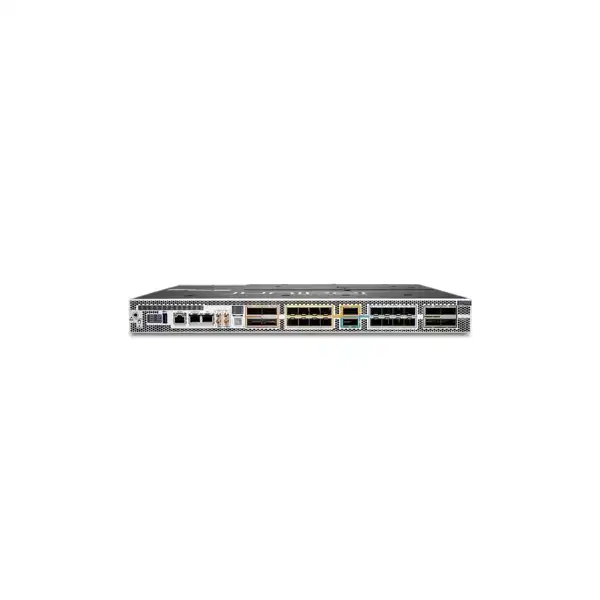
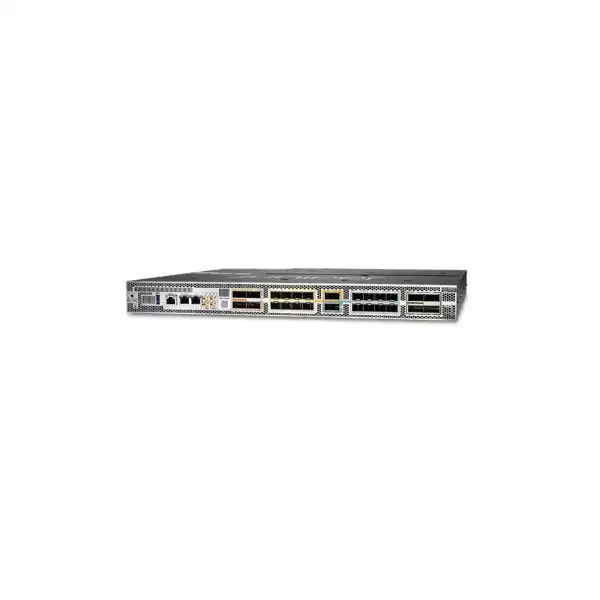
The Juniper MX301 Universal Routing Platform is a fixed-configuration, 1RU MX Series edge router built for dense, high-throughput routing and multiservice applications. It provides up to 1.6 Tbps of throughput and 26 front-panel WAN ports capable of operating at supported speeds from 1GbE through 400GbE, depending on port type, channelization and optics.
Its main role is to aggregate and route substantial volumes of enterprise, service-provider, metro, cloud-edge, broadband, mobile-backhaul or AI-edge traffic while preserving the service features and operational familiarity associated with Junos OS and the MX family. Organizations that have outgrown lower-capacity fixed routers, need 400GbE uplinks, want dense multirate edge connectivity, or need a compact platform for distributed points of presence should consider it.
The most important item to confirm before ordering is not simply the headline throughput. Buyers should validate the exact port-speed mix, channelization, transceivers, optical reach, software feature requirements, routing and service scale, power-feed type and rack environment for the intended design. Physical port count and maximum system throughput do not mean every theoretical combination can be used without regard to port-group rules or supported optics.
FourTeck can help translate a Dubai or UAE network requirement into an MX301 bill of materials by checking the intended interface map, optics and cabling, power variant, management approach, software and cloud-management requirements, migration dependencies, support expectations and whether the MX301, MX301-M, MX304 or another platform is the better-sized option.
Why the MX301 occupies an important position in the MX family
The MX301 is best understood as a compact, fixed high-scale edge platform rather than as a small branch router or a miniature modular chassis. Its 1RU enclosure places significant routing capacity into a shallow rack footprint, while its integrated port architecture avoids the line-card planning associated with larger modular systems. That combination matters in carrier hotels, enterprise data centres, metro aggregation sites, distributed edge facilities and network rooms where rack space is expensive but bandwidth demand is no longer modest.
Juniper positions the MX301 for enterprise WAN edge, service-provider edge, broadband, mobile backhaul, small cloud edge and AI-related edge aggregation. These are not interchangeable workloads. An enterprise may value resilient internet and private-WAN routing with high-speed handoffs; a service provider may care more about subscriber and service scale; a cloud or AI edge may prioritize deterministic high-throughput transport, telemetry and 100/400GbE connectivity. The value of the platform therefore depends on matching the hardware to the service model rather than buying purely on total throughput.
The MX301 also represents a substantial step beyond the older MX204 in forwarding capacity and port flexibility. Juniper documents 1.6 Tbps for the MX301 compared with 400 Gbps for the MX204, together with broader high-speed interface options and line-rate MACsec capability across WAN ports. This does not automatically make every MX204 deployment a migration candidate. A stable site with modest traffic and no need for the MX301’s capacity or 400GbE options may not benefit from replacement. The practical migration case becomes stronger when growth, port scarcity, service scale, security requirements, operational standardization or lifecycle planning create a clear business reason.
Above the MX301, the MX304 offers a materially larger capacity point: Juniper lists 4.8 Tbps in a 2RU platform with significantly higher interface density. That makes MX304 a useful comparison when a design already approaches MX301’s capacity ceiling, requires substantially more high-speed ports, or needs additional headroom for consolidation. The MX301 is compelling when 1.6 Tbps and its fixed port arrangement are sufficient and one rack unit is a meaningful advantage.
Core hardware and platform specifications
| Specification | MX301 detail | Buyer relevance |
|---|---|---|
| System throughput | Up to 1.6 Tbps | Size traffic engineering against realistic service mixes, encryption, oversubscription policy and future growth rather than headline bandwidth alone. |
| Form factor | Fixed 1RU chassis | Useful where rack units are constrained, but fixed interfaces mean port planning must be done before purchase. |
| WAN ports | 26 physical WAN ports across QSFP56-DD, QSFP28 and SFP-family positions | The exact speed and breakout plan should be validated against Juniper’s supported port combinations and optical modules. |
| Supported interface speeds | 1, 10, 25, 40, 50, 100 and 400GbE, depending on port and configuration | Allows one chassis to bridge legacy and high-speed edge links, but not every physical port supports every speed in the same way. |
| System memory | 128 GB DRAM | One of the distinctions from MX301-M, which has 64 GB and targets more moderate routing and service scale. |
| Storage | Two 200 GB SSDs, 400 GB total documented platform storage | Supports the operating environment and operational needs; storage should not be treated as user application storage. |
| Power supplies | Two 850 W AC, DC or HVAC/DC PSUs with 1+1 redundancy | Select one compatible PSU type for the site and plan independent feeds where resilience is required; mixed PSU types are not the intended design. |
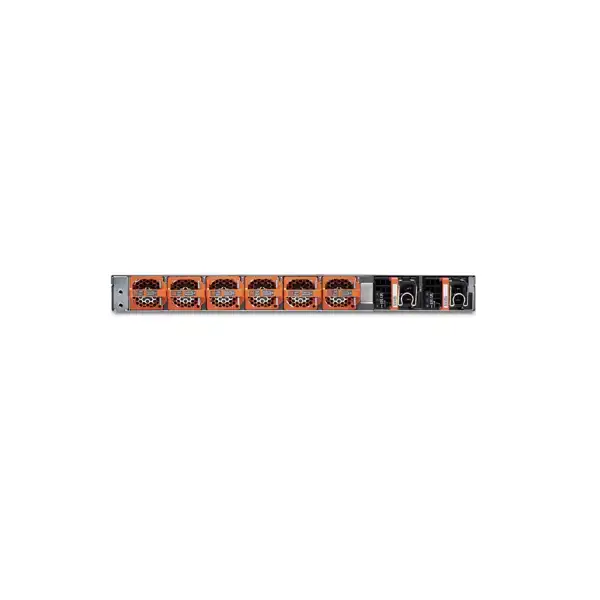
| Cooling | Six hot-replaceable fan modules, 5+1 redundancy, front-to-back airflow | Rack airflow direction and rear clearance matter in dense equipment rooms. |
| Dimensions | Approximately 44 cm wide × 45 cm deep × 4.45 cm high | Confirm rack depth, cable bend radius and service clearance, especially with high-density optics and rear power feeds. |
| Operating system | Junos OS | Provides operational continuity for organizations already running Juniper MX environments and automation around Junos. |
Specifications should be read as platform capabilities, not as a substitute for a final design. The exact usable interface map, transceiver support, software release, feature support and service scale should be confirmed against the intended deployment.
Understanding the 26-port interface architecture
The MX301’s front panel contains 26 WAN ports divided across high-speed QSFP and SFP-family positions. Four QSFP56-DD ports can support 400GbE and selected breakout modes. Six QSFP28 ports support up to 100GbE, while sixteen SFP-family ports support multirate operation up to 50GbE. This gives the platform a useful mix for aggregation designs that combine many lower-speed access or handoff circuits with a smaller number of high-capacity uplinks.
A common planning mistake is to take a port-density headline and assume it can be achieved in every operational combination. Juniper organizes the WAN ports into groups with bandwidth limits, and individual ports have different supported speed and channelization capabilities. That means the bill of materials should be based on an explicit interface map: for example, how many native 10GbE handoffs are needed, how many 25GbE or 50GbE links are required, which interfaces need 100GbE, whether 400GbE uplinks are planned, and whether breakout optics or cables are appropriate. The answer determines not only transceiver quantities but also which physical ports should be reserved.
Optical reach is a separate decision from port speed. A 100GbE requirement between adjacent racks may use a different optical or direct-attach approach from a 100GbE metro link. Likewise, a 400GbE data-centre interconnect can have very different transceiver, fibre plant, connector, attenuation and patching requirements from an in-rack deployment. Buyers should provide media type, distance, fibre mode, connector expectations and the far-end device for each important link.
The sixteen SFP-family ports are especially useful for mixed-speed migration because they support 1GbE, 10GbE, 25GbE and 50GbE operation in supported configurations. That can reduce the need for a separate low-speed aggregation device when an edge site has a combination of older circuits and newer Ethernet services. However, transceiver support is model- and release-specific, so a validated optics list remains essential.
For procurement, the useful question is therefore not “How many ports does the MX301 have?” but “Can the MX301 support our exact port-speed, breakout and optics matrix while staying within the platform’s group and throughput constraints?” FourTeck can structure that matrix before quotation so the router, optics, patching and migration plan are aligned.
Where the MX301 can fit in a Dubai or UAE network
Enterprise WAN edge
Large enterprises can use the MX301 where multiple internet, MPLS, cloud, data-centre or partner links converge and a conventional branch router no longer provides sufficient interface density or forwarding headroom. Its multirate ports help when circuit speeds are evolving at different rates. The design should still account for routing table size, policy complexity, VPN requirements, security architecture and failover behavior.
Metro and service aggregation
A compact 1RU router with 1.6 Tbps capacity can suit metro aggregation points where rack space is limited and multiple customer or access links must be collected into higher-speed uplinks. The suitability depends on the service model, queueing and QoS requirements, subscriber or service scale, redundancy architecture and the exact traffic engineering assumptions.
Cloud and data-centre edge
Organizations building a private-cloud edge, interconnect point or regional data-centre presence may use the MX301 to combine high-speed external connectivity with Junos routing policy, telemetry and automation. When the design requires many 100GbE or several 400GbE connections, the interface map should be compared carefully with MX304 density before committing to the smaller chassis.
Mobile and transport edge
The platform’s high-speed routing, timing connectivity and compact footprint make it relevant to transport and mobile-backhaul designs. External timing interfaces include 1PPS, 10 MHz and time-of-day connectivity. A real deployment needs confirmation of the exact synchronization architecture, Junos feature support, upstream timing source and operational requirements rather than assuming that the presence of timing connectors alone completes the solution.
AI edge aggregation
Juniper positions the MX301 for edge inference and AI-related traffic aggregation where high throughput, deterministic transport, telemetry and 100/400GbE connectivity matter. The router is part of the network fabric rather than an AI compute device: its job is to move and control traffic between compute clusters, services, users and upstream networks while fitting the routing and security architecture.
Distributed points of presence
The MX301 can be attractive when an operator wants MX feature consistency at many smaller locations without dedicating multiple rack units at each site. In a distributed design, operational automation, remote management, spares strategy, power-feed availability and environmental conditions can be as important as raw port capacity because every additional site increases ongoing operational complexity.
Routing, services and the importance of Junos OS fit
The MX301 runs Junos OS and participates in the broader MX operational model. For existing Juniper customers, this can reduce the amount of platform-specific retraining compared with introducing an unrelated routing stack. Configuration structure, policy concepts, operational commands, automation interfaces and observability practices can often be integrated with established Junos workflows. That continuity may be one of the strongest reasons to choose an MX platform even when competing hardware has similar raw forwarding figures.
At the same time, “runs Junos OS” should not be interpreted as “every feature available on every MX platform is automatically available in every release and scale.” Feature support can depend on the specific hardware, software release, license, interface type and service configuration. A procurement process should therefore translate requirements into explicit features: routing protocols, MPLS functions, EVPN or VPN services, subscriber capabilities, class of service, telemetry, timing, encryption, automation and management. Each requirement can then be checked against the targeted Junos release and entitlement model.
This approach is particularly important for migrations. A configuration copied from an older MX router may contain features, interface assumptions, policers, queues, scripts or operational dependencies that behave differently on a newer platform. Migration design should separate what is functionally required from what merely exists in the historical configuration. That creates an opportunity to simplify legacy constructs, remove obsolete dependencies and test critical behaviors in a controlled sequence.
Organizations with mature automation should also validate API, telemetry and orchestration dependencies before cutover. The MX301 can be managed through Junos OS CLI and can be onboarded into Juniper Routing Director and Juniper Routing Assurance, but the desired management model, subscriptions and integration workflow should be determined before production rollout. A router purchase becomes easier to operate when the management architecture is part of the original design rather than an afterthought.
Security capabilities: where MACsec and IPsec matter
The MX301 includes hardware-supported security capabilities relevant to high-speed transport, including MACsec and IPsec functionality. Juniper highlights line-rate MACsec capability on the platform’s WAN ports and positions the router for secure Layer 2 and Layer 3 transport. A Trusted Platform Module is also part of the platform’s security architecture. These capabilities are meaningful for enterprises, carriers and regulated environments that need to protect data crossing shared or physically exposed infrastructure.
MACsec is most relevant when the requirement is to encrypt Ethernet links between compatible endpoints. It can be attractive for data-centre interconnects, metro Ethernet handoffs or other point-to-point designs where protecting Layer 2 traffic is important. However, a secure design requires more than confirming that the router supports MACsec. Buyers should validate the far-end device, supported cipher and key-management behavior, interface speed, optics, operational monitoring, failover expectations and whether the desired use is supported in the chosen software release.
IPsec addresses a different set of use cases by protecting Layer 3 traffic and can support secure routed connectivity over untrusted networks. As with MACsec, tunnel scale, throughput, routing interaction, key management and service design should be sized for the intended deployment. The existence of encryption acceleration does not remove the need for careful traffic engineering or security architecture.
For UAE organizations handling sensitive traffic, encryption requirements may also be shaped by internal security policy, customer commitments, industry regulations and network segmentation standards. The MX301 can provide security building blocks, but it is not a substitute for a broader firewall, identity, monitoring and incident-response architecture where those controls are required.
The procurement implication is simple: specify whether encryption is needed, at which layer, on which links, at what speed, with what peer devices and under what operational policy. That turns “secure router” from a marketing label into a verifiable technical requirement.
Power, cooling and rack planning for UAE deployments
Redundant power architecture
The MX301 uses two 850 W power supplies and supports 1+1 redundancy. AC, DC and HVAC/DC variants are available. The correct variant should be chosen for the site’s electrical design, and each redundant supply should be connected according to the intended resilience model. PSU types and airflow directions should not be mixed.
Front-to-back airflow
Six rear fan modules provide front-to-back cooling with 5+1 fan redundancy. Equipment placement should preserve cool-air intake at the front and unrestricted exhaust at the rear. In a dense rack, cable bundles, power distribution and neighboring equipment airflow should be planned as one thermal system.
Environmental limits
Juniper documents operating conditions that vary with optics and environmental assumptions. UAE installations should not rely on ambient room temperature alone; cooling failure scenarios, rack inlet temperature, altitude, dust control, equipment-room HVAC and optical-module thermal behavior should be considered.
Rack depth and service access
The chassis is about 45 cm deep before allowing for field-replaceable units, connectors and cable bend radius. A shallow 1RU device can still require meaningful front and rear service clearance when populated with QSFP-DD optics, fibre jumpers, dual power feeds and management cabling.
For a production deployment in Dubai, the rack survey should confirm available rack units, rail compatibility, grounding, power feed type, redundant PDU paths, breaker capacity, airflow direction, cooling headroom, cable routing and access for hot-swappable components. These checks cost far less than discovering a power or airflow mismatch during installation.
Management, onboarding, telemetry and operations
The MX301 can be configured directly through the Junos OS CLI and also participates in Juniper’s newer routing-management environment. Juniper documents onboarding and monitoring through Juniper Routing Director and Juniper Routing Assurance. For organizations moving toward centralized operations or AI-assisted assurance, this creates options beyond traditional device-by-device CLI management.
The hardware includes a dedicated RJ-45 management interface for out-of-band management, a serial console interface and USB connectivity for operational tasks. Out-of-band management deserves deliberate design because it is the access path used when production routing is impaired. The management network should have its own reachability, authentication, logging and security controls, and it should not depend entirely on the same forwarding path that the router is meant to protect.
Cloud-based assurance is not simply a switch that should be enabled because it exists. Buyers should define what they want from the management stack: inventory, health visibility, configuration workflows, telemetry, anomaly detection, service-level insights, automated actions or integration with existing NMS and ITSM tooling. Juniper Routing Assurance uses subscriptions, and MX301 is included in the supported device list for its Class 2 subscription category. Subscription duration and optional add-ons should therefore be discussed alongside the hardware purchase if cloud assurance is part of the operating model.
Organizations that already operate Junos through Ansible, scripts, orchestration platforms or API-based workflows should test the exact software release and automation modules used in production. The technical objective is not to prove that an API exists; it is to confirm that the entire operational workflow—provisioning, change control, rollback, monitoring, alerting, backup and compliance—works reliably on the targeted platform.
FourTeck can include management design questions in the pre-sales checklist so that the quotation reflects whether the customer wants hardware-only supply, cloud-management subscriptions, implementation assistance or a more complete migration and operational handover.
Software licensing and subscription planning
Licensing should be treated as a design input, not a paperwork step at the end of procurement. Juniper’s MX portfolio supports different software licensing approaches, including subscription and perpetual models, and specific features can be associated with particular license entitlements. Because the exact requirement depends on the services being deployed, buyers should avoid assuming that the base hardware purchase automatically includes every advanced function they may want to use.
Start with the service list. Identify the routing, VPN, subscriber, encryption, automation, telemetry and management functions that are operationally required. Then map those functions to the exact MX301 software release and current Juniper licensing rules. This is especially important when replacing an existing MX device because historic entitlements do not always translate into a new hardware purchase in the way a customer expects.
Cloud management is another separate commercial decision. Juniper Routing Assurance is subscription-based and supports MX301. Standard subscriptions and add-on capabilities are offered in multi-year terms, so organizations should decide whether the router will be managed through that environment and what contract term aligns with their lifecycle and budgeting model. If Routing Assurance is not part of the architecture, the router remains manageable through Junos OS and other supported operational tools.
The safest quotation process lists software and subscriptions explicitly rather than using ambiguous phrases such as “all licenses included.” A good bill of materials should identify the hardware, power variant, optics, any required software entitlements, cloud-management subscriptions if selected, support term and implementation services. That makes renewals visible and reduces the risk of discovering a missing entitlement after installation.
Where exact license selection is uncertain, the requirement should be validated against the current Juniper licensing documentation and the feature set to be deployed. Licensing evolves over product and software lifecycles, so current confirmation is more reliable than reusing an old bill of materials.
MX301 vs MX301-M vs MX304: practical selection logic
| Decision area | MX301 | MX301-M | MX304 |
|---|---|---|---|
| Primary positioning | High-scale compact fixed edge | Same forwarding platform for more moderate routing/service scale | Higher-capacity 2RU compact MX platform |
| Throughput | Up to 1.6 Tbps | Up to 1.6 Tbps | Up to 4.8 Tbps |
| Memory | 128 GB DRAM | 64 GB DRAM | Different platform; size by MX304 specifications and service requirements |
| Rack footprint | 1RU | 1RU | 2RU |
| When to evaluate | Choose when 128 GB memory and higher routing/service scale are justified within a 1.6 Tbps fixed design. | Evaluate when forwarding needs are similar but service and route scale are more moderate. | Evaluate when 1.6 Tbps or MX301 port density is too restrictive and 4.8 Tbps class capacity is appropriate. |
MX301 and MX301-M share the same basic form factor, interfaces, forwarding performance and Junos OS feature set according to Juniper. Their most visible distinction is system memory and the resulting positioning for routing and service scale. This makes MX301-M a meaningful alternative when the 128 GB memory of MX301 is not required. The right choice should be based on actual control-plane and service-scale needs rather than assuming the higher-memory model is always superior.
MX304 is a different decision. Its 4.8 Tbps system capacity and greater interface density target larger aggregation points and higher-growth designs. If an architecture requires many 100GbE interfaces, multiple 400GbE links or substantial headroom above 1.6 Tbps, moving up early can prevent a near-term chassis replacement. Conversely, buying MX304 for a site whose realistic requirements fit comfortably inside MX301 can consume unnecessary rack space, power and budget. Capacity planning should therefore include at least a three-year traffic and interface forecast.
Sizing the MX301 correctly
Router sizing should combine forwarding demand, interface demand, control-plane scale, service scale and resilience. Looking at only one of these dimensions can produce an apparently powerful platform that does not fit the real topology. For example, a design might consume relatively little aggregate bandwidth but need more physical high-speed interfaces than the MX301 provides. Another design might fit the port count but require routing, subscriber or service scale that should be validated carefully against the intended software release and feature set.
Begin with current traffic. Record normal and peak throughput in each direction, growth trends, application changes and any known upcoming circuits. Then model failure scenarios. In a dual-router design, each router may need to absorb a much larger share of the traffic when its peer is unavailable. A platform that appears comfortably sized during normal load can become constrained during maintenance or failure if resilience is not included in the capacity calculation.
Next, define the interface matrix. Count each speed separately, identify breakout requirements and reserve realistic growth ports. Map carrier handoffs and internal uplinks to physical interfaces and note optical reach. This step often reveals practical constraints earlier than aggregate bandwidth modelling. A router with 1.6 Tbps of throughput still has a finite number of specific port types and group bandwidth allocations.
Control-plane sizing then considers route tables, routing protocols, peers, policies, convergence expectations and service state. The MX301’s 128 GB DRAM is intentionally positioned for higher routing and service scale than MX301-M’s 64 GB, but buyers should validate the exact scale relevant to their network rather than treating memory capacity as a generic guarantee.
Finally, factor in encryption, telemetry, QoS, subscriber services, tunnelling, automation and logging requirements. These can materially affect the service architecture even when the base forwarding rate is unchanged. A well-sized design documents both the expected steady state and the conditions under which the platform would need to be upgraded or complemented by another router.
FourTeck can use traffic statistics, port requirements, peer counts, service descriptions and growth expectations to help determine whether MX301 is appropriately sized or whether MX301-M, MX304 or another platform should be evaluated instead.
Deployment and migration journey
Discovery and requirement capture
Document circuits, port speeds, optics, routing protocols, service types, current traffic, route and subscriber scale, management tools, security requirements, rack environment, power feeds, support expectations and target dates. Existing configurations are useful evidence, but they should be reviewed rather than copied blindly.
Hardware and interface design
Translate the requirements into MX301 ports, supported speed combinations, transceivers, breakout assemblies, fibre or copper media, power supplies, rack accessories and spare strategy. Confirm the far-end compatibility of every critical optical link and avoid assuming that a generic module will be accepted.
Software and entitlement validation
Choose a Junos release that supports the required features and aligns with organizational standards. Verify software licenses, encryption needs and Routing Assurance subscriptions where applicable. Capture any automation, telemetry or monitoring dependencies that must be tested.
Staging and acceptance testing
Install the target software, baseline configuration and management controls in a controlled environment. Test routing adjacencies, policy, failover, optics, monitoring, logging, encryption and automation. Validate rollback procedures before touching production services.
Cutover and verification
Move services according to an agreed change plan, monitor interface errors, route convergence, traffic levels, CPU and memory behavior, alarms, telemetry and customer-impact indicators. Keep clear acceptance criteria so the team knows whether to proceed, hold or roll back.
Operational handover
Update diagrams, inventory, support records, backup procedures, monitoring thresholds, spare-parts plans and recovery documentation. A migration is complete only when operations teams can diagnose and restore the service without depending on informal project knowledge.
High availability: what the hardware does and does not provide
The MX301 provides useful component-level resilience. It uses two power supplies with 1+1 redundancy and six fan modules with 5+1 redundancy; these field-replaceable components can be serviced without treating every component failure as a router outage. This reduces avoidable maintenance risk in environments where the physical platform must remain available.
However, redundant PSUs and fans do not make a single router equivalent to a fully redundant network edge. The MX301 is a fixed 1RU system with a single routing-engine architecture, so organizations requiring device-level redundancy should design two routers or another appropriate resilient topology. Carrier diversity, separate power paths, distinct upstreams, routing convergence, gateway redundancy and physical separation may all be needed depending on the business impact of failure.
A dual-MX301 design should be capacity-tested under failure. If each device normally carries half the traffic, the surviving router may need to handle nearly the full service load after a peer failure. Interface allocation should also avoid creating hidden single points of failure, such as both routers relying on one upstream switch, one optical transport shelf or one power distribution unit.
Operational redundancy matters as well. Out-of-band management, configuration backups, validated replacement procedures, spare optics and support coverage all affect recovery time. A theoretically redundant network can still suffer a long outage if the team cannot reach the equipment, identify the failed component or obtain the required replacement quickly.
For critical UAE deployments, the right discussion is therefore broader than “Does MX301 have redundant power?” It is “What failures must the service survive, how quickly must it recover, and which components, links, sites and operational processes need duplication to achieve that target?”
Timing and synchronization considerations
The MX301 includes dedicated timing connectivity that can matter in mobile backhaul, transport and other synchronized network designs. The front panel provides 1PPS and 10 MHz external clocking connections as well as a time-of-day port. Juniper also documents the ability to connect the device to external timing equipment. These physical interfaces make the router suitable for architectures where accurate network timing must be exchanged with external sources or downstream systems.
A timing-capable platform still needs a timing design. The network architect should identify the primary time source, backup source, desired synchronization protocol, expected holdover behavior, failure alarms, cable type, connector requirements and downstream clients. If PTP or SyncE is part of the service, exact support should be checked for the chosen Junos release and interface configuration. In mobile networks, timing accuracy can be a service requirement rather than a convenience, so assumptions should be tested rather than inferred from the presence of clock ports.
Timing also has operational implications. Monitoring should distinguish between basic packet forwarding health and synchronization quality. A router can continue passing traffic while the timing service is degraded. The NOC therefore needs visibility into clock source state, synchronization alarms and any metrics that indicate the system has moved to a backup or degraded mode.
When requesting an MX301 quotation for a timing-sensitive project, include the timing source, target application, required connectors, protocol requirements, redundancy approach and any external grandmaster or synchronization equipment. That allows the router and surrounding components to be validated as one system.
Procurement details that should be settled before ordering
Exact hardware configuration
The documented MX301 base configuration uses the MX301 chassis with 128 GB DRAM and is supplied with the selected pair of AC, DC or HVAC/DC power supplies plus six fan modules. Confirm the actual orderable part numbers and regional availability at quotation time.
Optics and cabling
List every link speed, media type, distance, fibre mode, connector and far-end platform. Decide whether breakouts, direct-attach cables, active optical cables or discrete transceivers are required. High-speed optics can represent a substantial portion of project cost.
Software and cloud subscriptions
Specify the features to be used and whether Juniper Routing Assurance or other subscription services are required. Align subscription duration with the support and lifecycle plan so the commercial model is visible from the start.
Support coverage
Choose support based on business impact and replacement expectations, not only purchase price. Critical network edges may justify faster hardware replacement and stronger technical support than lab, backup or non-production deployments.
Installation scope
Clarify whether the purchase covers supply only, rack installation, cabling, software loading, configuration, migration, change-window support, testing, documentation and knowledge transfer. These are separate activities and should be reflected explicitly in the scope.
Spares and lifecycle
Determine whether local spare optics, power supplies or a full spare router are justified by recovery objectives. For multi-site rollouts, standardizing a small number of configurations can simplify inventory, operations and replacement logistics.
When the MX301 may not be the right choice
A balanced product decision includes reasons not to buy. The MX301 may be oversized for sites that only need modest branch routing, a few 1/10GbE circuits and limited service scale. In that situation, a smaller platform can reduce capital cost, power consumption and operational complexity while still meeting the requirement. Buying a 1.6 Tbps router simply because it is newer does not create value if the network cannot use its capabilities.
At the other end of the spectrum, the MX301 may be too small for a consolidation point that expects rapid growth toward multiple terabits, needs more 100GbE or 400GbE ports than the fixed front panel can provide, or requires a broader expansion path. Juniper’s MX304 is a logical comparison because it raises capacity to 4.8 Tbps in 2RU and offers much greater interface density. Moving to the larger platform can be more economical than deploying MX301 and replacing it soon afterward.
The fixed architecture can also be a constraint when a buyer expects to add specialized interface modules later. The MX301’s strength is that the needed ports are integrated in a compact chassis; the tradeoff is that expansion happens through the supported fixed port combinations rather than by inserting arbitrary new line cards. If future interface types or densities are uncertain, modularity may deserve more weight in platform selection.
Finally, organizations that do not already operate Junos should include operational readiness in the decision. The platform can still be a strong technical fit, but the project may need Junos skills, management integration, configuration standards and support processes. Those costs are legitimate parts of total ownership and should be considered alongside hardware specifications.
The best product is therefore the smallest architecture that comfortably meets current requirements, failure-state requirements and credible growth without creating a near-term replacement. FourTeck can compare alternatives when the requirement sits near either edge of the MX301’s practical fit.
Buyer questions about the Juniper MX301
Is 1.6 Tbps the same as usable traffic in every design?
No. It is the platform’s maximum throughput specification. Real designs must account for interface-group rules, port combinations, resilience, traffic direction, service configuration and growth. The correct engineering question is whether the intended topology fits within the supported platform limits under both normal and failure conditions.
Can MX301 use 400GbE?
Yes. The platform includes four QSFP56-DD positions capable of 400GbE operation in supported configurations. Optical module, fibre type, reach, Junos release and far-end compatibility should be validated for the exact 400GbE link being deployed.
What is the difference between MX301 and MX301-M?
Juniper documents the same form factor, interfaces, forwarding performance and Junos feature set, but MX301 has 128 GB DRAM while MX301-M has 64 GB. MX301 is intended for higher routing and service scale; MX301-M targets more moderate scale requirements.
Does the MX301 have redundant power?
Yes. Two 850 W power supplies support 1+1 redundancy, with AC, DC and HVAC/DC variants. The site should use the appropriate matching PSU type and resilient power feeds. Redundant power does not remove the need for router-level redundancy if the service must survive a complete device failure.
Can it be managed through Juniper cloud tools?
Juniper documents onboarding and monitoring through Routing Director and Routing Assurance in addition to Junos OS CLI. Routing Assurance is subscription-based, so management requirements should be included in the commercial design rather than assumed to be part of the hardware price.
Does it support out-of-band management?
Yes. The MX301 includes a dedicated RJ-45 management port supporting 10/100/1000 Mbps, together with console access. A resilient out-of-band network is recommended for critical deployments so administrators can reach the router when production forwarding paths are impaired.
Are transceivers included automatically?
The required optics should be treated as separate design items unless a quotation explicitly states otherwise. The correct modules depend on interface speed, reach, fibre type, connector, breakout method and peer-device compatibility. A precise optics list is one of the most important parts of the bill of materials.
Is MX301 appropriate for branch offices?
Juniper includes large branch and enterprise-edge scenarios among possible uses, but the platform is far more capable than a typical branch router. It is most sensible when the branch is genuinely large, requires dense high-speed connectivity, significant routing or service scale, or acts as a major regional aggregation point.
Dubai and UAE availability, planning and quotation guidance
For Dubai and UAE projects, availability should be discussed in terms of the complete usable configuration rather than only the router chassis. A technically complete order may include the base MX301 hardware, the correct power-supply variant, compatible power cords, rack mounting components, optical transceivers, breakout or direct-attach cables, fibre patching, software entitlements, Routing Assurance subscriptions if required, vendor support and implementation services. Lead time can differ between these components, so the project schedule should be built around the longest critical item.
Local installation planning should also include the facility. Confirm rack type and depth, available power feeds, grounding, PDU sockets, circuit capacity, cooling, front-to-back airflow, cable routing, meet-me-room or carrier handoff details, and the path between the router and optical distribution frame. In data centres, cross-connect lead time can be independent of hardware delivery and should be included in the change plan.
If the MX301 is replacing an existing router, provide the current platform, interface inventory, routing design, required maintenance window and rollback constraints. If it is part of a new build, provide expected circuits, bandwidth, peers, services, route scale, redundancy goals and three-year growth. These inputs allow the bill of materials and implementation scope to be tied to a real architecture.
FourTeck can support product selection and quotation preparation for Dubai and wider UAE requirements. The objective is to identify the appropriate model and supporting items before purchase, not merely to supply a chassis. Where MX301 is too large or too small, alternative Juniper platforms can be considered so the design remains balanced.
Pricing is normally configuration-dependent because optics, software, subscriptions, support and installation scope vary substantially from project to project. A meaningful quotation therefore requires at least the quantity, port-speed map, optics distances, power preference, software feature requirements, support term and deployment scope.
Technical due-diligence checklist for network teams
Before approving an MX301 purchase, the network team should be able to answer a set of practical questions. These questions prevent the project from being driven by a headline capacity number and help expose dependencies early enough to change the design without disrupting delivery.
What is current peak throughput? What is the three-year forecast? What load must one router carry if its peer fails? Are there bursts or traffic classes that require special headroom?
How many 1G, 10G, 25G, 40G, 50G, 100G and 400G links are needed at launch and later? Which require breakout? Which ports must remain free for growth?
What are the distances, fibre types and connectors? What is the far-end platform? Are the chosen optics supported on both ends and in the intended channelization?
How many routes, peers, policies, VPNs, subscribers or service objects are expected? Does the requirement justify MX301’s 128 GB DRAM rather than MX301-M’s more moderate scale positioning?
Which routing, MPLS, EVPN, QoS, subscriber, encryption, timing, telemetry and automation functions are mandatory? Are they supported in the selected Junos release and entitlement?
Will the router use CLI, Routing Director, Routing Assurance or existing orchestration? Is out-of-band access available? Are monitoring, backup and incident procedures ready?
Is there sufficient rack depth and front/rear clearance? Are redundant power feeds available? Is airflow compatible? Are grounding and cooling appropriate for the populated optical load?
Does the quotation include required optics, cables, software, cloud subscriptions, support, installation, migration and documentation? Which renewals will occur after the initial purchase?
If these questions are answered before the purchase order, implementation becomes much more predictable. If several answers are still unknown, the project is better served by a short design exercise than by guessing the bill of materials.
Operational lifecycle and support considerations
A router at the centre of WAN, metro or service-provider connectivity will normally remain in operation for years. Procurement should therefore look beyond the installation date. Lifecycle planning includes software maintenance, security updates, feature changes, support contracts, spare strategy, capacity monitoring, configuration governance and eventual migration. The value of a platform is partly determined by how predictably it can be operated through this lifecycle.
Software release selection deserves particular care for a newer platform such as MX301. Juniper introduced MX301 support with Junos OS 25.4R1, and newer releases can add features, platform refinements and additional hardware variants such as MX301-M. Production teams should choose releases based on required features, support guidance, organizational standards and validated interoperability rather than assuming the newest release should always be deployed immediately.
Change management should preserve tested rollback methods. Before major upgrades, capture configuration backups, validate storage and recovery procedures, review release notes, confirm transceiver support and test critical service functions. For redundant designs, upgrades can often be staged to reduce service risk, but routing convergence and traffic movement must be observed carefully.
Spares policy should reflect recovery objectives. A dual-router site with vendor replacement coverage may tolerate a different local spares level from a remote point of presence with limited access. Optical modules are common failure and change points, so keeping selected critical transceivers locally can be practical. In a large rollout, standardizing optics and power variants can reduce the number of spare types needed.
Capacity should be reviewed periodically rather than only when users report congestion. Track interface utilization, traffic distribution, route and service growth, error rates, optics health, CPU and memory trends, and management alarms. The point is to identify when the platform is approaching an architectural limit early enough to plan expansion rather than react during an outage or urgent service launch.
Decision recap: the six checks that determine MX301 fit
What FourTeck needs for an accurate MX301 quotation
A short technical brief is enough to begin. The more complete the inputs, the more accurately the hardware, optics, software and services can be aligned with the requirement.
Number of routers, Dubai/UAE site, single-site or multi-site rollout.
Required speeds, quantities, breakout needs and carrier or LAN handoffs.
Fibre type, approximate distance, connector and far-end equipment for each critical link.
Current peak bandwidth, expected growth and failover traffic assumptions.
Protocols, route scale, VPNs, subscriber services, QoS, encryption and timing needs.
AC, DC or HVAC/DC requirement and whether dual independent feeds are available.
CLI, Routing Director, Routing Assurance, existing NMS, telemetry or automation requirements.
Desired support term, installation, migration, testing, documentation and handover scope.
Plan the Juniper MX301 around your real network, not just the chassis
The MX301 combines 1.6 Tbps of compact routing capacity, flexible 1G-to-400G interfaces, high-scale memory, resilient power and cooling, Junos operations and modern management options in one rack unit. Its value is highest when the port map, service scale, software entitlements, optics, rack environment and growth plan are verified before purchase. FourTeck can help UAE buyers turn those requirements into a practical bill of materials and deployment scope.

Reviews
There are no reviews yet.