
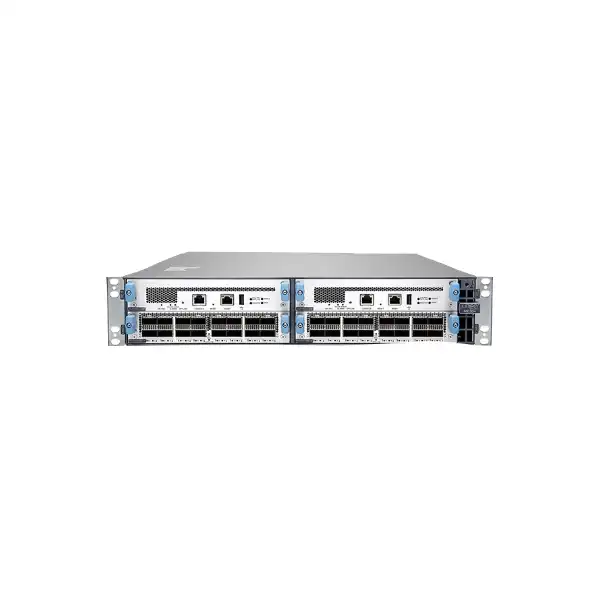
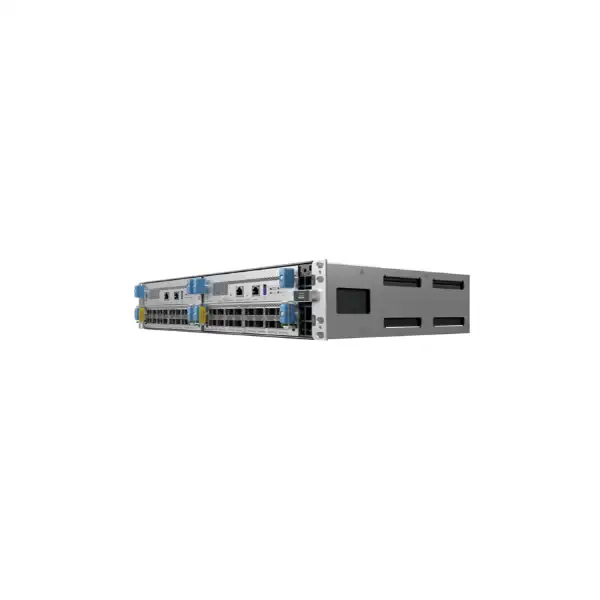
Juniper MX304 Universal Routing Platform
A compact 2RU edge platform for operators that need multi-terabit routing, dense 100GbE and 400GbE connectivity, Junos operational consistency, service-provider features and a clear growth path without moving immediately to a much larger chassis.
Direct answer: what the MX304 is and who should shortlist it
The Juniper MX304 is a 2RU modular Universal Routing Platform in the MX Series. It uses Juniper Trio 6 forwarding silicon and Junos OS, with one or two Routing Engines and up to three LMICs depending on the chosen resilience and capacity design.
Typical roles include provider edge, IP/MPLS, internet peering, route reflection, metro aggregation, mobile backhaul, enterprise WAN, data-center gateway and data-center interconnection where dense high-speed interfaces and service scale are required.
Service providers, cloud operators, large enterprises, carriers and organizations operating space-constrained edge locations should consider MX304 when 100G or 400G growth, multiservice capability and Junos operational continuity are strategic requirements.
Confirm the target throughput, port-speed mix, optics, redundancy model and software feature requirements. A three-LMIC 4.8 Tbps design uses the shared RE1/LMIC2 slot, so the highest interface density and dual Routing Engine hardware redundancy are not the same physical configuration.
FourTeck can map the required chassis variant, RE count, LMICs, transceivers, power system, software release, licensing, rack and airflow requirements, migration scope and UAE delivery or installation requirements into a practical bill of materials.
Why the MX304 occupies an important position in the Juniper MX family
The MX304 is not simply a faster fixed router. Its value comes from combining a compact two-rack-unit chassis with the multiservice behavior expected from the Juniper MX portfolio. For operators that have standardized on Junos OS, that means a platform capable of supporting modern high-speed Ethernet while retaining familiar routing, MPLS, service, automation and operational workflows. This matters in networks where an edge node is expected to do more than forward packets. A provider edge router may need to terminate business VPNs, participate in BGP, carry MPLS labels, enforce hierarchical quality of service, expose telemetry, support timing, encrypt selected links with MACsec and integrate with automation systems. The MX304 was designed for that class of workload rather than for a narrow top-of-rack switching role.
The physical size is equally significant. Many metro sites, carrier hotels, colocation racks and enterprise edge facilities have strict space and power constraints. A 2RU platform with multi-terabit capacity can reduce the number of boxes required for a given collection of high-speed circuits, simplify cabling and leave rack space available for security appliances, optical transport equipment, servers or future network expansion. The compact form factor should not, however, be interpreted as a reason to skip infrastructure planning. The actual electrical load depends on the installed Routing Engines, LMICs, optics, fan demand and ambient temperature, and the chassis uses front-to-back airflow. Rack depth, rear clearance, circuit sizing and thermal headroom therefore remain part of a proper MX304 design.
The platform is particularly relevant when an organization has outgrown a smaller edge system but does not yet need the slot count, physical footprint or architectural scale of a large modular core chassis. The purchasing decision should therefore be based on the expected three-to-five-year interface and service plan, not merely on current throughput. An MX304 bought only for today’s port count can be oversized; an MX304 bought with no allowance for redundancy, optics power or growth can still become constrained. The best design starts with traffic, service and resilience requirements and then uses the MX304 hardware options to satisfy them.
Core MX304 specifications buyers should verify
| Specification | MX304 detail | Buyer relevance |
|---|---|---|
| System capacity | Up to 4.8 Tbps | Size against sustained and burst traffic, service overhead, growth and failure scenarios rather than headline capacity alone. |
| Form factor | 2 rack units | Useful for colocation and metro sites, but rack depth, cable management and maintenance clearance still need checking. |
| Forwarding silicon | Juniper Trio 6 | Supports the multiservice and programmable edge architecture that differentiates MX from simpler Ethernet aggregation devices. |
| LMIC capacity | 1.6 Tbps per LMIC; up to three LMICs | The third LMIC occupies the shared RE1/LMIC2 slot, which directly affects the redundancy design. |
| Maximum line-rate density | Up to 12×400GbE, 48×100GbE, 96×50GbE, 24×40GbE, or 96×25/10/1GbE depending on supported modes | Actual port availability depends on LMIC port rules, channelization, optics and Junos support. |
| Routing Engines | One or two pluggable REs | Dual REs provide control-plane redundancy; single RE permits a third LMIC for maximum system capacity. |
| Power options | AC, DC, or high-voltage AC/DC variants | Select the correct power architecture for the site and do not assume power-supply types can be freely mixed in normal operation. |
| Cooling | Front-to-back airflow with three fan modules | Match rack airflow and hot/cold aisle design to avoid recirculation and elevated fan power. |
| Operating system | Junos OS | Feature availability, LMIC serviceability, optics support and operational behavior can depend on the selected Junos release. |
Understanding the 4.8 Tbps architecture before you specify a chassis
The MX304 reaches its headline 4.8 Tbps system capacity through three 1.6 Tbps LMICs. Each supported MX304-LMIC16 line card uses a Trio 6 YT ASIC and can provide sixteen 100GbE ports, four 400GbE ports, or supported combinations and lower-speed modes. That modularity allows a designer to build an edge node around the actual access, aggregation and uplink mix instead of purchasing a fixed collection of interfaces. It also introduces an important physical design choice: the chassis has two dedicated LMIC slots, while the third LMIC can occupy the shared RE1/LMIC2 position. A configuration with three LMICs therefore prioritizes maximum forwarding and interface density over a second Routing Engine in that shared slot.
For many production edge environments, two LMICs plus dual Routing Engines may be the more appropriate configuration because 3.2 Tbps of line-card forwarding capacity is already substantial and dual control-plane hardware supports a stronger maintenance and failure model. In other environments—such as dense aggregation or peering locations where the design already uses node-level redundancy across two separate routers—a single Routing Engine with three LMICs may make sense. There is no universal answer. The correct choice depends on how the network achieves availability: within the chassis, across a redundant router pair, or through both methods.
This is why port count should never be treated independently from topology. A buyer asking for twelve 400GbE ports is implicitly asking for three LMICs and therefore needs to understand the Routing Engine implication. A buyer requiring two Routing Engines should size against two installed LMICs and verify that the resulting port density is enough for current services, failover paths and planned growth. FourTeck can translate a logical topology into a chassis-level configuration so the hardware bill reflects the intended resilience design rather than only the number of physical links.
LMIC port behavior, 100G and 400G density, and why optics planning matters
The MX304-LMIC16 is a field-replaceable 1.6 Tbps line card with a multi-rate port design. At the broadest level, each LMIC can support up to sixteen 100GbE interfaces or four 400GbE interfaces. The 400GbE-capable physical positions are specific ports rather than every connector being independently available for 400G. Juniper documentation identifies ports 0, 6, 8 and 14 for 400GbE operation on an LMIC. Other ports support 100G, and selected odd-numbered ports provide lower-speed channelization and operating modes. This distinction is important when a network uses a mixed set of 400G backbone links, 100G peers and lower-rate breakout connections.
Optics are not a generic accessory line item. The transceiver type determines reach, fibre type, connector requirements, optical power behavior and—in some cases—the power demand presented to the port. The MX304 LMIC documentation differentiates ports that can support higher-power 100G optics from ports with a lower transceiver power allowance. Therefore a design that looks correct on a simple port-count spreadsheet can fail if a particular optical module is assigned to a port that does not support its power profile. The Hardware Compatibility Tool and the software release must be checked for the specific transceiver part number and intended interface mode.
For 400GbE, the precise requirement may range from short-reach data-center optics to long-reach coherent or metro interconnect designs. The router platform, optical standard, fibre plant, dispersion budget, link distance, patching architecture and remote device all participate in the decision. Buyers should provide both endpoints and approximate link lengths during quotation so the correct optics can be selected. When an existing 100G or 400G optical design is being reused, providing the installed transceiver part numbers is even better because compatibility can be assessed directly.
Breakout and channelization introduce another layer. Lower-speed logical interfaces may require specific cabling and port-mode configuration, and using breakout on one physical position can affect adjacent-port availability or the way a port group is operated. A deployment plan should therefore document port number, speed, optic or cable, remote endpoint and expected service for every important connection. This level of detail reduces last-minute problems during installation and makes future maintenance far easier.
Where MX304 fits: six practical deployment roles
Provider edge and business services
MX304 can act as a PE platform where IP/MPLS services, Layer 2 and Layer 3 VPNs, QoS and customer-facing high-speed interfaces converge. It is well suited when service density must increase without moving to a larger chassis footprint.
Internet peering
Dense 100G and 400G interfaces, high control-plane resources and Junos BGP capabilities make the platform relevant for peering locations, exchanges and transit edges where many external routes and high-volume links must be managed.
Data-center gateway and DCI
The MX304 can provide L2/L3 gateway and interconnect functions for data centers, with support for routing, MPLS, GRE and VXLAN-related architectures depending on the software design. The key sizing inputs are north-south traffic, inter-site bandwidth and failure-path capacity.
Mobile backhaul and transport edge
Integrated timing capabilities and high-speed Ethernet make MX304 suitable for transport-oriented designs where synchronization, service separation, deterministic QoS and resilient routing are part of the requirement.
Large enterprise WAN edge
Enterprises with multiple 100G data-center, cloud or carrier links can use MX304 where conventional branch or campus routers no longer provide enough interface density, routing scale or lifecycle headroom.
Aggregation in constrained facilities
The 2RU footprint is attractive in carrier hotels, remote facilities and racks where power and space are expensive. The design still needs realistic thermal, circuit and cable-management planning, particularly with multiple high-power optics.
Routing Engine design: redundancy, control-plane scale and operational consequences
The MX304 supports the JNP304-RE Routing Engine. Juniper documents an Intel Icelake-based multicore CPU design, 128 GB of DDR4 memory in the default four-DIMM configuration, redundant SSD storage, a management Ethernet interface, console access, USB, TPM 2.0 and secure-boot capabilities. These characteristics matter because a modern service-provider edge router has substantial control-plane responsibilities. It may hold large BGP routing tables, run multiple routing protocols, process management and telemetry sessions, maintain service state and support automation workflows while the forwarding plane continues to handle traffic in Trio silicon.
A second Routing Engine is mainly about availability and maintenance behavior, not forwarding capacity. With two REs, the operator can design for control-plane redundancy and reduce the risk associated with a single control processor. Exact graceful switchover behavior depends on the configured Junos features and protocols, so redundancy should be tested as part of the acceptance plan rather than assumed from hardware presence alone. Software upgrades, routing-engine switchover procedures and operational runbooks should all be aligned to the service-level objective of the site.
The shared RE1/LMIC2 slot is the key procurement consideration. A buyer cannot simply request two Routing Engines and three LMICs in the same MX304 chassis because that physical position serves either the second RE or the third LMIC. If the design needs both maximum port density and control-plane hardware redundancy, the answer may be two MX304 routers, each sized with the appropriate line cards, rather than trying to obtain both outcomes inside one chassis. This can be a stronger architecture anyway because chassis-level failures, maintenance windows and fibre-path diversity can then be addressed at the node level.
For smaller deployments, a single RE may be entirely acceptable when the router itself participates in a redundant pair and the service design tolerates a chassis maintenance event. For highly critical single-node roles, dual REs may take priority even if that means limiting the chassis to two LMICs. The commercial quote should reflect this architecture explicitly so there is no ambiguity over whether the proposed MX304 is a BASE-style one-RE design or a redundant two-RE design.
Power design is part of capacity planning, not a final installation detail
MX304 supports AC, DC and high-voltage AC/DC power-supply families. The chassis contains two power-supply positions and can operate with 1+1 PSU redundancy. Juniper’s hardware guidance makes an important distinction: a redundant power-supply arrangement is not the same as dual feed redundancy at every level of the design. The site electrical architecture, branch circuits, PDU layout and failure assumptions therefore need to be reviewed rather than reducing the question to “two PSUs are installed.” For a Dubai data center or telecom facility, the selected power type must match the available rack feeds and local electrical implementation.
The power required by the router changes with configuration and ambient conditions. Routing Engines, LMICs, fans and transceiver power all contribute. Juniper publishes example chassis power figures that increase at higher ambient temperatures because fan demand rises and components operate under a different thermal profile. A fully populated three-LMIC system can therefore require substantially more input capacity than a two-LMIC redundant-RE system. The quotation stage should identify the intended LMIC count and representative optics so electrical planning is based on a realistic configuration.
Power-supply type mixing also has restrictions. AC and DC supplies are not intended to be mixed in a running chassis, and high-voltage variants have their own transition rules. This is relevant for spare strategy: the spare PSU in stock must match the deployed power architecture. A generic “MX304 spare power supply” line is not precise enough for operational inventory.
The safest procurement workflow is to treat electrical design as a bill-of-materials input. Provide the rack power type, expected supply voltage, number of independent circuits, PDU outlet type and desired redundancy behavior. FourTeck can then align the chassis power modules and cords with the planned environment instead of correcting mismatches after equipment has arrived on site.
Cooling, rack depth and physical installation in UAE facilities
The published chassis height is 3.5 inches, corresponding to 2RU, and the nominal chassis width is approximately 17.3 inches. Depth figures vary depending on whether a specification describes the bare chassis or the installed system with cable-management brackets and component handles, so rack planning should use the hardware installation guide rather than only a marketing datasheet dimension. This is a practical issue in older telecom cabinets, wall-adjacent racks and dense colocation environments where rear clearance may be limited.
MX304 uses front-to-back airflow. The cold-air source should therefore reach the front intake without obstruction, and hot exhaust should be directed into the rack’s hot-air path. Mixing airflow directions with neighbouring equipment can cause recirculation, especially in partially enclosed cabinets. Dubai and UAE facilities commonly operate in well-controlled data-center environments, but ambient conditions during commissioning, maintenance or reduced-cooling events still deserve attention. Juniper specifies operation up to 46°C at sea level, yet designing close to an upper environmental limit is not the same as providing healthy thermal margin.
Three fan modules provide the cooling subsystem. Fan power increases as temperature rises, which is another reason to consider thermal design alongside electrical capacity. Air filters and front access also require maintenance planning. The rack should allow technicians to replace field-replaceable parts and clean or service filter components without disturbing neighbouring equipment or sharply bending fibre jumpers.
Installation should also account for the physical loading of the chassis. A fully configured MX304 is a two-person handling task in many environments, and the rack must be secured and compatible with the mounting method. Juniper supports 2-post and 4-post rack mounting, but the chosen rail and bracket arrangement should match the actual cabinet. Before dispatch, confirm rack type, free rack units, usable depth, front and rear access, airflow direction, earthing point, cable path and whether the equipment is being installed above or below other heavy devices.
Availability engineering: what “redundant” really means on an MX304 deployment
Control plane
Two Routing Engines can provide control-plane hardware redundancy, but the second RE consumes the slot that could otherwise host LMIC2. Protocol configuration and switchover behavior still need design and testing.
Power
Two power supplies support 1+1 PSU redundancy. The surrounding electrical design must still consider circuits, PDUs, supply type and what happens if an upstream feed or rack PDU fails.
Cooling
Multiple fan modules improve hardware resilience, yet correct airflow and filter maintenance remain essential. A redundant fan architecture does not compensate for poor rack ventilation.
Network links
Critical uplinks should be distributed across appropriate ports and, where the design warrants it, across LMICs, peer devices, fibre paths and upstream routers to avoid a single physical failure domain.
Chassis-level resilience
For the strongest availability model, use two independent MX304 nodes and design routing convergence around the pair. This protects against maintenance and faults that cannot be solved by internal component redundancy.
Operations
Junos configuration, software release, protocol timers, graceful restart behavior, monitoring and change procedures determine whether the hardware redundancy produces the desired service outcome in practice.
Junos OS, automation and telemetry considerations
MX304 runs Junos OS, which is a major reason organizations with an existing Juniper routing estate may prefer it over a platform that introduces a new operating model. Junos separates control-plane processes and provides a consistent approach to routing policy, interface configuration, operational commands and automation across many MX deployments. That consistency can reduce migration risk because engineers can reuse established configuration standards, monitoring logic and troubleshooting practices. It does not eliminate the need to validate feature behavior on the exact MX304 release.
Software version is especially important for hardware lifecycle behavior. Juniper documents that MX304 LMICs become hot-removable and hot-insertable starting with Junos OS 24.4R1. That is an operationally meaningful improvement for sites where line-card maintenance must be performed without powering off the forwarding complex. If a deployment relies on that serviceability characteristic, the planned Junos release must support it and the operating procedure should be tested before production use. Similar release dependencies can exist for optics, protocols, licensing and advanced features.
Telemetry is another area where the MX architecture adds buyer value. Junos Telemetry Interface can stream detailed platform and forwarding information to external collectors through modern telemetry mechanisms. For a network operations team, this enables higher-frequency visibility into utilization and platform health compared with a design that relies only on periodic polling. The usefulness of telemetry depends on the surrounding tools, retention strategy and alerting logic, so a router purchase should be connected to the monitoring architecture rather than treated as a standalone hardware event.
Automation can include native Junos interfaces, scripting, NETCONF, APIs, orchestration frameworks and Juniper automation products depending on the environment. The right question is not whether the MX304 is “automatable”; it is which source of truth, approval workflow and configuration-delivery method the organization will use. A service provider may integrate the router into a provisioning system, while an enterprise may use a more controlled infrastructure-as-code workflow. Both should define rollback, audit and credential handling before day-one deployment.
When asking for a quotation, include the intended Junos baseline and any required automation or assurance platform if known. This helps identify software, subscription or support dependencies early and avoids discovering after installation that a desired operational feature requires a different entitlement or software train.
MACsec, IPsec and timing: useful capabilities with design conditions
The MX304 supports inline MACsec on its LMIC ports, providing link-layer encryption for supported Ethernet connections without requiring a separate external encryption appliance in the traffic path. This can be valuable for data-center interconnects, carrier handoffs, metro links and other environments where confidentiality is required on the physical Ethernet segment. MACsec design still requires both ends of the link to support compatible standards, key-management behavior and operational configuration. The presence of MACsec in the forwarding hardware should therefore be treated as a capability, not a complete security design.
Juniper also describes IPsec ESP tunnel-mode processing in the MX304 forwarding architecture with supported AES-GCM options. IPsec and MACsec solve different problems: MACsec protects an Ethernet link or Layer 2 adjacency, while IPsec protects IP traffic across a routed path. Selecting between them depends on topology, trust boundaries, interoperability and service architecture. A buyer should identify which traffic must be protected, where encryption should start and terminate, expected throughput, packet-size profile and whether the remote endpoint is another Juniper device or a third-party platform.
Timing support makes the MX304 relevant to mobile transport and other synchronization-sensitive networks. The LMIC16 documentation includes IEEE 1588 Class-C PTP support, while the chassis provides dedicated timing interfaces. Timing projects should never be scoped by router model alone. The source clocks, PTP profile, boundary or transparent clock behavior, physical timing inputs, holdover requirements and end-to-end error budget must be defined. A router that supports the required timing technology can still be deployed incorrectly if the clock architecture is not engineered.
These capabilities often affect software, licensing and interoperability testing. When MACsec, IPsec or PTP is part of the reason for purchasing MX304, include it explicitly in the quotation request. FourTeck can then verify the required hardware and software context and make sure optics, releases and endpoint assumptions are checked before the order is finalized.
Licensing and subscriptions: define the service requirement before choosing entitlements
Juniper identifies Agile licensing support for the MX304 LMIC software feature set. In practice, the exact licenses or subscriptions required depend on what the router will do, the Junos release, the purchasing program and the support model. Buyers should avoid assuming that every advanced routing, service, automation or assurance capability is permanently included simply because the hardware can technically perform it. A clean procurement process separates base hardware, software entitlement, subscription features and support services into identifiable lines.
Start with the service architecture. Document whether the platform will be used for basic IP routing, full internet BGP, MPLS transport, Layer 2 or Layer 3 VPNs, subscriber services, advanced QoS, telemetry, automation, security functions, timing or other features. Then map those requirements to the intended Junos release and commercial licensing model. This sequence prevents both under-licensing and unnecessary entitlements.
License term is also a commercial planning input. If a feature is subscription-based, align the term with the organization’s support lifecycle and budget cycle. A short license on a platform expected to serve for several years can create an avoidable renewal event; a long commitment can be inefficient if the design is still experimental. For service providers, the expected subscriber or service growth may also affect how licensing should be planned over time.
A FourTeck MX304 quotation can be built around the feature set rather than a guessed license list. Provide the routing and service requirements, any existing Juniper contracts, desired support level and preferred term. The resulting bill of materials can then distinguish hardware needed on day one from optional or future software capabilities, making commercial review clearer for both technical and procurement teams.
Sizing the MX304 for real traffic instead of headline bandwidth
A 4.8 Tbps system-capacity figure is useful, but it is not a complete sizing method. The starting point should be the interface map and traffic matrix. Identify every planned access, peering, backbone and interconnect link, its nominal speed, expected average utilization, peak utilization and growth rate. Then model failure conditions. If traffic from one upstream link will move to another after a circuit failure, the surviving path must have enough capacity for the redistributed load. A platform that is comfortable during normal operation can become congested during maintenance or fault events if this is ignored.
Service scale also matters. The number of BGP routes, VPNs, logical interfaces, queues, policies and telemetry streams can be just as important as raw bits per second. The Trio architecture is designed for multiservice operation, but any specific scale target should be checked against current Junos documentation and the proposed configuration. Avoid copying scale numbers from a different MX model or from an older software release because feature interactions and supported limits can differ.
Queueing is particularly relevant at the edge. Juniper documents flexible queuing modes on the LMIC, with very high queue counts available, but a useful QoS design starts with service classes, customer commitments, congestion points and scheduler hierarchy. Buying a powerful router does not automatically improve service quality if the policy model is not defined. For wholesale, business VPN or mobile transport services, the queue hierarchy should be part of solution design before configuration templates are created.
Port fragmentation is another practical sizing factor. A chassis may have enough total throughput but not enough interfaces of the required type in the required positions once 400G ports, 100G high-power optics and breakout rules are applied. The port map should be validated against the LMIC documentation, not only against the maximum chassis density.
Finally, define a growth trigger. The MX304 may be the right platform if it can accommodate foreseeable increases without consuming all useful ports on day one. If the design already requires nearly every LMIC, nearly every 400G position and maximum control-plane resources at launch, a larger platform or a two-node scale-out architecture may provide a healthier lifecycle. If the requirement is only a few moderate-speed links with limited services, a smaller MX platform may be economically preferable.
MX304 configuration paths: choose the architecture, not just the chassis
Dual RE + two LMICs
This configuration emphasizes control-plane redundancy and provides up to 3.2 Tbps of installed LMIC forwarding capacity. It is attractive for high-availability provider edge, peering or enterprise gateway roles where two LMICs provide enough port density.
Best question to ask: Is 3.2 Tbps and the available two-LMIC port map sufficient through the expected lifecycle?
Single RE + three LMICs
This configuration enables the full 4.8 Tbps system capacity and maximum port density by using the shared RE1/LMIC2 slot for a third LMIC. It can fit designs where node-level redundancy is provided by a second router.
Best question to ask: Is the loss of an internal second RE acceptable within the overall network resilience model?
Two-router resilient pair
Two MX304 systems can distribute interfaces, peers and services across independent failure domains. Each node can then be sized for either dual-RE resilience or higher LMIC density depending on the availability target and traffic split.
Best question to ask: Can either surviving router carry critical traffic during maintenance or failure?
Migration from an existing edge router: a structured path reduces service risk
Replacing an edge router is not a simple chassis swap. The old platform embodies years of routing policy, customer services, addressing, QoS behavior, management integrations and operational assumptions. A successful MX304 migration starts by collecting the existing configuration and translating it into requirements rather than copying syntax blindly. Identify routing protocols, autonomous system numbers, route policies, communities, prefix limits, MPLS labels, VPN instances, VLANs, subinterfaces, MTU values, LAGs, QoS classes, filters, management ACLs, NTP, DNS, TACACS or RADIUS, SNMP, telemetry and logging.
Next, separate what must remain identical from what should be modernized. For example, a route policy may need to preserve commercial intent but can be implemented using cleaner groups and naming. A legacy 10G trunk may be replaced by 100G with breakout, or several physical links may be consolidated. Monitoring can move from polling-only workflows toward streaming telemetry. The MX304 project is an opportunity to remove obsolete configuration, but every change increases the number of variables during cutover, so modernization should be controlled.
Physical migration planning is equally important. Confirm whether existing optics can be reused, whether fibre polarity and connector types match, whether new 100G or 400G links need different patching, and whether the rack has suitable power feeds. If links move from a legacy platform to MX304 one at a time, the intermediate routing state must be understood. If the migration uses a parallel build, temporary interconnects may be required between old and new routers so services can be transferred in stages.
Testing should include more than ping. Validate routing adjacency, route count, policy behavior, failover, MTU, QoS, MACsec or IPsec if used, management access, telemetry, alarms, optics levels, link errors and application traffic. For a peering router, verify accepted and advertised routes against policy. For an MPLS edge, verify label-switched paths and VPN reachability. For a DCI gateway, test the relevant overlay or tunnel functions.
Finally, prepare a rollback trigger and rollback sequence. A migration window becomes safer when the team knows exactly which measurements define success and which conditions require reversal. FourTeck can scope supply-only, staging, configuration assistance or on-site migration support depending on how much of the implementation the customer wants to retain internally.
Operational lifecycle: spares, software, support and field replacement
An enterprise or carrier router should be purchased with its operational lifecycle in mind. The MX304 contains several field-replaceable elements, including Routing Engines, LMICs, power supplies and fan modules. A spare strategy should be based on service criticality, local stock, vendor support response time and the number of identical units deployed. A network with ten MX304 systems may justify on-site common spares; a single unit in a fully redundant design may rely more heavily on a support contract and node-level failover.
Software lifecycle planning is just as important as hardware spares. Junos releases receive features, fixes and platform enhancements over time. The LMIC hot-insertion capability introduced in later Junos releases is an example of why release choice affects operations. Networks should maintain a tested software baseline, review release notes, track security advisories and schedule upgrades before a release becomes operationally inconvenient. The newest release is not automatically the best production release for every customer; stability, feature support and interoperability matter.
Optics deserve their own lifecycle plan. High-speed transceivers are active components and may fail independently of the router. Keep an inventory of installed optic part numbers, link destinations and spare compatibility. If the network uses several optical reaches or technologies, label spares clearly so technicians do not insert an incompatible module during an incident. Optical diagnostics and alarms should be integrated into monitoring to detect degradation before a hard failure.
Support entitlement affects access to software, replacement services and technical assistance depending on the purchased program. The right level depends on whether the router supports revenue-generating services, internal business systems or a lab. Procurement should ensure that the device serial numbers, support contract and customer account are correctly linked after delivery.
Operational documentation should include the rack location, power feed mapping, port map, optics, software release, license entitlements, routing role, backup configuration, emergency contacts and replacement procedure. This information often determines recovery speed more than the difference between two similar hardware options.
When the MX304 may be the wrong choice
Requirement is much smaller
If the site needs only a limited number of moderate-speed interfaces and modest service scale, the MX304 may add unnecessary capital cost, power and complexity. A smaller MX platform should be compared.
Need exceeds three LMICs
If day-one or near-term growth requires more interfaces or capacity than a three-LMIC chassis can provide, a larger modular system or a scale-out design may offer a more sustainable expansion path.
Dual RE and maximum port density are both mandatory
The shared RE1/LMIC2 position means one chassis cannot simultaneously hold two REs and three LMICs. If both outcomes are non-negotiable, redesign the node architecture rather than forcing the bill of materials.
Facility cannot support the environment
Insufficient rack depth, incompatible airflow, inadequate power or restricted fibre management can make the platform unsuitable for a particular cabinet even when the logical network fit is excellent.
MX304 versus smaller and larger alternatives
The best alternative depends on why MX304 is being considered. If the requirement is a compact Junos edge router but 4.8 Tbps of capacity is excessive, Juniper’s smaller MX options deserve review. For example, the MX301 is positioned at 1.6 Tbps in a 1RU form factor, while the long-established MX204 class serves lower-capacity compact edge roles. A smaller platform may reduce acquisition cost and power while still meeting a straightforward peering, WAN or service-edge requirement.
The trade-off is headroom. Moving to a smaller chassis can reduce interface density, modular flexibility or long-term capacity. A network currently using several 100G links may outgrow a 1.6 Tbps design sooner than expected if 400G uplinks are introduced. The port map and growth rate therefore matter more than rack-unit count in isolation.
At the other end, larger MX chassis platforms are appropriate when the node needs substantially more slots, much higher aggregate capacity, additional redundancy options or a long runway for interface expansion. Those systems also require more rack space, power, cooling and upfront investment. The MX304’s value is strongest where the operator wants true MX multiservice edge capability at high density but can keep the node within the architectural bounds of a 2RU chassis.
A scale-out comparison is also worthwhile. Two MX304 routers may provide better fault isolation and geographic flexibility than one much larger chassis, depending on the network. Conversely, a single larger modular chassis can simplify management and provide centralized expansion in a core facility. There is no universally superior topology; the decision should be tied to failure domains, operational practices and growth.
For a useful comparison, provide current traffic, desired port speeds, number of peers or service interfaces, redundancy objective, available rack space and expected expansion. FourTeck can compare the MX304 against adjacent Juniper MX options on those criteria rather than recommending a model simply because its headline capacity is higher.
Procurement checklist for a complete MX304 bill of materials
State whether you need one or two Routing Engines and whether maximum three-LMIC density is required. This single choice affects both resilience and forwarding capacity.
List each 400G, 100G, 50G, 40G, 25G, 10G or 1G requirement, including breakout needs and whether ports are customer-facing, backbone, peering or management links.
Provide link distances, fibre type, remote endpoint and preferred optical standard. Identify existing Juniper or third-party transceivers if reuse is being considered.
Specify AC, DC or high-voltage requirements, available circuits and redundancy expectations so the correct power modules and cords are quoted.
List the needed routing, MPLS, VPN, QoS, automation, telemetry, security and timing functions so entitlements can be matched to the intended Junos release.
Define whether the requirement is supply only, staging, remote configuration, on-site installation, migration assistance, acceptance testing, training or ongoing support.
Detailed buyer questions and answers
Does every MX304 deliver 4.8 Tbps?
The chassis architecture supports up to 4.8 Tbps when three 1.6 Tbps LMICs are installed. A two-LMIC design provides 3.2 Tbps of installed LMIC forwarding capacity. The actual purchased configuration must therefore be checked rather than assuming the maximum chassis value applies to every bill of materials.
Can I have two Routing Engines and three LMICs?
No. The third LMIC uses the shared RE1/LMIC2 slot. A dual-RE chassis therefore operates with two LMIC positions. If your design needs maximum interface density and strong node redundancy, consider using two routers and distribute services across them.
How many 400GbE ports can the MX304 support?
The maximum chassis density is twelve 400GbE ports with three appropriate LMICs, because each LMIC supports four 400G positions. A dual-RE system with two LMICs would provide up to eight 400G positions. Confirm optics and software support for the exact interface design.
Can the same LMIC mix 100G and 400G?
Yes, supported combinations are possible, but the usable port map depends on physical port positions and configured speed modes. The four 400G-capable positions are specific, so the intended mixed-speed design should be validated before optics are ordered.
Does MX304 support lower speeds than 100G?
Yes. Juniper publishes support for 1G, 10G, 25G, 40G and 50G chassis densities as well as 100G and 400G, with lower-speed operation depending on LMIC port modes, channelization and compatible optics or cabling. Check the exact port rules for the planned software release.
Are transceivers included?
Do not assume that the required service optics are included with the base platform. High-speed optical modules should be selected from the compatible transceiver list according to speed, reach, fibre and endpoint requirements and included explicitly in the commercial bill of materials.
Can LMICs be replaced without shutting down the router?
Juniper documents LMIC hot removal and insertion starting with Junos OS 24.4R1. Earlier releases have different procedures. If hot serviceability is operationally important, confirm the exact software baseline and maintenance steps before relying on that behavior.
Is MACsec available on MX304?
Yes, the MX304 LMIC architecture supports inline MACsec on its ports. The complete design still requires compatible peer equipment, key management, software configuration and a clear decision about whether link-layer MACsec or network-layer IPsec is the appropriate security mechanism.
Is MX304 suitable for mobile transport?
It can be. The platform supports high-speed Ethernet, multiservice routing and timing capabilities including IEEE 1588 Class-C support on the LMIC. The end-to-end synchronization design, PTP profile and clock architecture should still be engineered for the specific mobile network.
What power should I order in Dubai?
The answer depends on the facility. MX304 supports AC, DC and high-voltage AC/DC power variants. Provide the rack’s actual supply type, voltage, PDU arrangement and redundancy objective so the appropriate power modules and cords can be specified for the UAE site.
Can MX304 replace an older MX edge router directly?
It can often take over the logical role, but a direct configuration copy is not recommended without review. Interface types, optics, port numbering, feature support, software syntax, scale, QoS and service dependencies should be mapped and tested as part of a controlled migration.
What information produces the fastest accurate quotation?
Provide quantity, RE redundancy preference, required LMIC count, a port-and-optics schedule, rack power type, software features, license term, support level, delivery location and whether installation or migration services are needed. A network diagram is especially useful for complex designs.
Designing for 400G growth without creating a fragile port map
A common reason to consider MX304 is the transition from 100G aggregation toward 400G backbone or interconnect links. The best migration path is usually staged. Instead of filling every 100G port immediately, reserve the physical positions and LMIC capacity needed for future 400G circuits. Because only designated ports on the LMIC operate at 400G, those positions should be protected from assignments that would make later conversion difficult.
The optical roadmap should be planned at the same time. A short-reach 400G data-center link, a metro 400G interconnect and a long-distance coherent design have different transceiver, fibre and operational requirements. If future 400G is expected but the exact optical technology is not yet known, at least reserve the correct router port positions and rack power headroom. High-power optics can affect the thermal and electrical profile, and the LMIC has port-specific transceiver power allowances for certain 100G positions.
Traffic engineering also changes at 400G. A single 400G failure can move a large amount of traffic to remaining links, so the network needs enough alternate capacity and routing convergence to handle that event. Simply replacing four 100G circuits with one 400G circuit may reduce physical diversity even if nominal capacity is identical. Consider whether multiple paths, LAG design, ECMP or diverse upstream peers provide a better failure model.
Operational visibility should scale with link speed. At hundreds of gigabits per second, short congestion bursts can carry substantial data. Streaming telemetry, queue monitoring, optics diagnostics and interface error tracking are useful for identifying problems that average utilization graphs may hide. Baseline performance before the migration so the post-change network can be compared against known conditions.
A well-designed MX304 deployment therefore treats 400G as an architectural change rather than a faster plug. Port placement, optics, power, fibre, redundancy, monitoring and failure capacity all belong in the plan. This is precisely where a detailed port schedule is more valuable than a generic request for “400G support.”
Management-network, security and access-control planning
The Routing Engine provides dedicated management and console connectivity, allowing the MX304 to participate in an out-of-band management design. For production infrastructure, an out-of-band path is strongly preferable to relying exclusively on the same forwarding network being managed. If a routing incident affects the data plane or routing protocols, engineers still need a reliable way to reach the console or management interface.
Management access should be restricted using network controls and Junos configuration. Define which management subnets can reach SSH, NETCONF, telemetry and other services. Central authentication through TACACS+ or RADIUS may be appropriate, with a carefully controlled local fallback account for emergencies. Logging should be sent to centralized systems, and time synchronization should be configured so events can be correlated across routers, firewalls and servers.
The Routing Engine’s TPM and secure-boot capabilities strengthen the hardware trust foundation, but platform security still depends heavily on operations. Keep Junos updated within the approved software policy, disable unnecessary services, use strong authentication, protect configuration backups and monitor failed login attempts. If automation credentials are used, store them in a secrets-management system rather than scripts or plain text files.
For remote sites, console-server access and environmental monitoring can materially reduce incident resolution time. In a UAE-wide network, travel between facilities may take longer than remote troubleshooting, so resilient management paths are operationally valuable. Document console-server port mappings and verify them during acceptance testing rather than discovering incorrect cabling during an outage.
A secure management design should be included in the implementation scope even if the commercial purchase is primarily hardware. The router’s performance and redundancy are only useful when engineers can safely observe, configure and recover the device throughout its lifecycle.
A practical MX304 deployment journey
Describe whether MX304 will be PE, peering, DCI, aggregation, mobile backhaul or enterprise WAN edge, and identify the services it must carry.
List link speeds, optics, breakout, destinations and growth. Validate 400G positions and high-power optic requirements against the LMIC rules.
Decide between dual RE with two LMICs, single RE with three LMICs, or a multi-router architecture that distributes the failure domain.
Check rack depth, 2RU space, airflow, maintenance clearance, grounding, power type, circuit capacity and fibre routes.
Select a Junos release that supports the required hardware, optics, features and maintenance behavior, then map necessary licenses and support.
Load software, apply base configuration, test ports and optics, validate routing policy, management, telemetry and failover before site cutover.
What to verify during staging and acceptance testing
A new MX304 should be validated as a system, not merely checked for power-on status. Start with inventory. Record the chassis serial number, Routing Engine count, LMIC part numbers, power-supply type, fan status, installed optics and Junos version. Confirm that the received configuration matches the approved bill of materials. If a component substitution occurred during supply, verify that it is technically and commercially acceptable before deployment.
Next, check platform health. Review chassis alarms, environmental readings, power status, fan operation, Routing Engine state and storage. Bring each planned interface online with its intended optic or cable, then record transmit and receive optical levels where applicable. High-speed optics that appear operational can still have poor margin because of dirty connectors, incorrect patching or excessive loss, so optical diagnostics belong in acceptance records.
Control-plane testing should verify routing protocols, route policy, route counts and management access. For BGP, confirm expected peers, received routes, advertised prefixes and filtering. For IS-IS or OSPF, verify adjacency and topology behavior. For MPLS or VPN services, check label distribution, tunnel state and customer reachability. If route reflection is part of the role, test the appropriate address families and policies.
Resilience testing is essential. Fail an uplink, disable a peer, test a power supply, and—when the configuration supports it—test Routing Engine switchover according to the maintenance procedure. Measure traffic impact rather than only observing that the protocol eventually reconverges. If two MX304 routers form a pair, test loss of one entire node and verify that the surviving node has sufficient capacity.
Operations acceptance should cover telemetry, syslog, SNMP if used, NTP, AAA, configuration backup and alarm forwarding. Confirm that monitoring systems identify the router by a useful hostname and site label and that alerts reach the correct team. These tasks are easy to postpone during a rushed installation and difficult to reconstruct during an incident.
Finally, retain a signed or approved acceptance record containing software version, configuration checksum or backup reference, port map, optics levels, route counts and test outcomes. That baseline becomes valuable when troubleshooting future changes because engineers can compare current behavior with the known-good commissioning state.
UAE quotation and delivery planning for the Juniper MX304
For customers in Dubai and across the UAE, an accurate MX304 quotation should be treated as a configured solution rather than a single generic router line. The chassis variant, number of Routing Engines, LMIC count, power system, software, licensing, transceivers, cables, support and professional services can materially change the final bill of materials. Two quotes both labelled “MX304” can therefore describe very different operational capabilities.
The quickest way to obtain a useful proposal is to send a short requirements package. Include the delivery emirate and site, target installation date, quantity, intended network role, required port speeds and approximate link distances. If you already have a network diagram, add it. For migration projects, include the existing router model and a sanitized interface or port summary. For new deployments, describe upstream carriers, peer routers and data-center switches that will connect to the MX304.
Availability can vary by chassis, line card, optics and support entitlement, so procurement should avoid assuming that all items have the same lead time. High-speed optical modules in particular may have different availability from the router chassis. If the project has a fixed cutover date, identify acceptable equivalent optical reaches or alternative staging strategies early. Never substitute an optic merely because it fits the connector; platform support, wavelength, reach and remote-end compatibility must be verified.
Customers should also decide whether they need hardware supply only or a broader deployment service. FourTeck can scope rack installation, base configuration, software preparation, migration assistance and acceptance testing where required. Organizations with experienced Junos engineers may prefer to handle configuration internally while using FourTeck for validated hardware and optics procurement. Others may want a more complete turn-key engagement.
Commercially, ask for the quotation to identify major components clearly. Separating chassis, REs, LMICs, optics, power-related items, software or license entitlements, support and services makes the proposal easier to review and later simplifies asset management. It also ensures that an apparent price difference between two proposals can be traced to a technical difference rather than remaining hidden inside a single bundle.
Decision recap: six points that determine whether MX304 is the right fit
Use traffic and failure-path forecasts to determine whether two LMICs are enough or the full three-LMIC 4.8 Tbps design is justified.
Decide whether resilience comes from dual Routing Engines, a redundant router pair, or both. The shared RE1/LMIC2 slot makes this a fundamental architecture choice.
Validate 400G positions, 100G optic power, breakout requirements, fibre type and remote endpoint compatibility before purchasing transceivers.
Choose a Junos release and entitlements that support the required routing, services, telemetry, security, timing and maintenance workflow.
Confirm 2RU rack space, usable depth, front-to-back airflow, electrical supply, grounding, circuit headroom and fibre-management clearance.
Align support, spares, software upgrades, optics inventory and monitoring with the criticality of the router’s network role.
What FourTeck needs from you for an accurate MX304 quotation
Number of routers and the Dubai or UAE location where equipment will be delivered or installed.
Single or dual RE preference, whether routers are deployed in pairs, and the acceptable service impact during a component or node failure.
Counts of 400G, 100G and lower-speed links, including breakout requirements and expected growth.
Approximate link length, fibre type, connectors and remote equipment for each important optical circuit.
BGP, MPLS, VPN, QoS, peering, DCI, MACsec, IPsec, timing, telemetry or automation requirements.
AC, DC or high-voltage supply, circuit arrangement, rack type, available depth and airflow constraints.
Preferred support level, software entitlement context, contract term and any existing Juniper support relationship.
Supply only, staging, remote configuration, rack-and-stack, migration, testing or post-cutover support.
Build the right Juniper MX304 configuration for your UAE network
The MX304 is strongest when its chassis architecture, LMIC count, Routing Engine redundancy, optics, power and Junos software are selected as one integrated design. Send FourTeck your port schedule, topology and site requirements so the quotation reflects the way the router will actually be deployed—not only the model name.

Reviews
There are no reviews yet.