
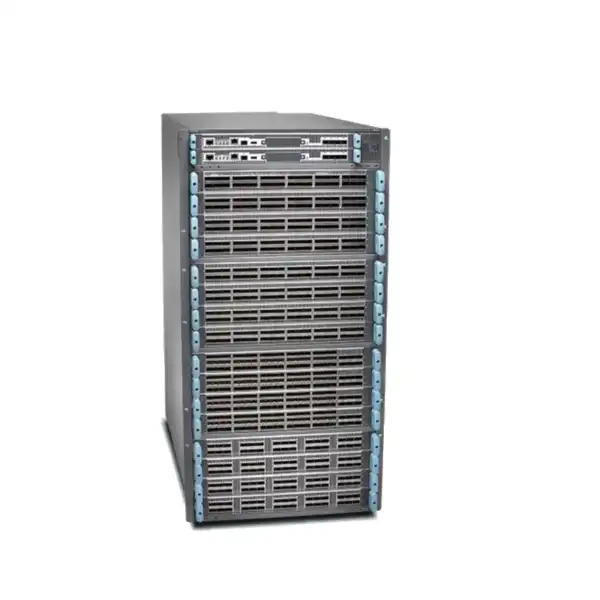
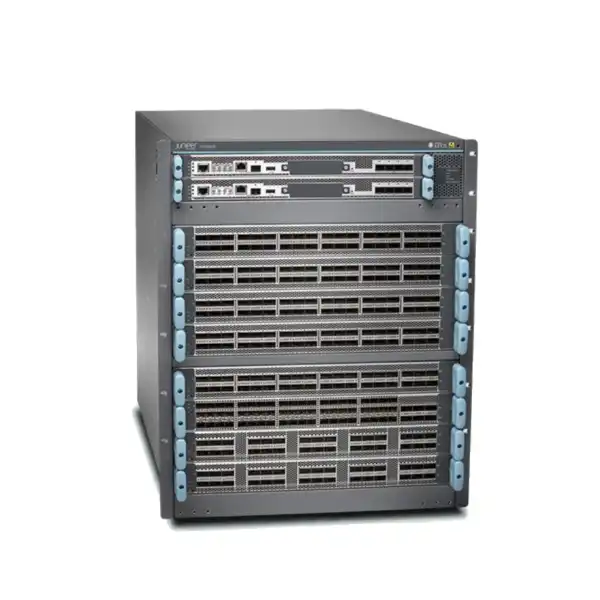
Juniper PTX10016 Packet Transport Router Dubai
The PTX10016 is Juniper’s 16-slot modular packet transport chassis for very high-capacity WAN core, peering, cloud edge, data-center interconnect and service-provider routing. It is not a single fixed-port appliance: the final performance, port mix, software path, redundancy level, power demand and commercial configuration depend on the selected switch fabric, control boards, line cards, optics and support choices.
Direct answer: what is the Juniper PTX10016 and who is it for?
What exactly is it?
The PTX10016 is a modular Juniper packet transport router with sixteen horizontal line-card slots. The chassis can be built around different generations of switch fabric and line cards, so buyers should think of it as a scalable routing system rather than as one fixed specification. Current Juniper PTX10000 positioning places the 16-slot platform at the top of the PTX10004, PTX10008 and PTX10016 modular family by chassis scale.
What is it mainly used for?
Typical roles include service-provider core and backbone routing, Internet peering, cloud and data-center edge, high-capacity data-center interconnect, metro and WAN aggregation, and other designs that need dense 100GbE, 400GbE or 800GbE connectivity with large growth headroom.
Who should consider it?
It makes sense for operators whose traffic model justifies a 21RU modular chassis and whose network architecture benefits from high line-card density, modular replacement, deep routing scale and multiple high-speed generations. Smaller sites or environments with modest port counts may achieve a better commercial and operational fit from a smaller PTX platform.
What matters most before ordering?
Confirm the required switch-fabric and line-card generation first. Older JNP10016-SF systems and newer high-capacity fabric generations have different control-board, line-card, software, fan and power dependencies. A chassis name by itself is not enough to create an accurate bill of materials.
What can FourTeck determine?
FourTeck can translate your port map, traffic forecast, redundancy requirement, rack power, fibre distances, software preference and migration scope into a more precise PTX10016 configuration for quotation in Dubai and the wider UAE.
PTX10016 platform overview for serious network buyers
A PTX10016 purchase is normally part of a network architecture decision, not a simple hardware replacement. The chassis is designed to aggregate a large number of high-speed interfaces while preserving modularity across line cards, routing and control functions, switch fabric, power and cooling. That modular architecture is valuable when a network is expected to grow over several capacity steps, because the operator can plan the chassis around current demand and future line-card population rather than replacing an entire fixed router whenever port density changes.
The chassis provides sixteen front-facing line-card positions. Routing and Control Boards occupy dedicated control slots, while the switch-fabric boards are internal to the chassis and connect across the line-card positions. Power supplies and fan trays are installed from the rear. This physical separation matters during design reviews because the front of the rack must accommodate line-card cabling and service access, while the rear requires power-feed design, cooling clearance and maintenance access. A technically correct BOM can still fail operationally if the rack, depth, cable path or rear service area is not planned in advance.
Juniper currently publishes a PTX10016 system-capacity range from 230.4 Tbps to 460.8 Tbps depending on the fabric generation. Slot capacity can span 4.8 Tbps, 14.4 Tbps and 28.8 Tbps classes. Those figures should not be read as a promise that every installed combination automatically reaches the highest number. The selected line card, switch fabric, software train and system configuration must be mutually supported. This is particularly important when a buyer is expanding an installed PTX10016 rather than ordering a fully new system.
The practical procurement question is therefore not merely “How fast is PTX10016?” It is “Which PTX10016 architecture gives the required interface density and routing behaviour with the correct resilience, power, software and migration path?” For a greenfield 800GbE build, the answer can be different from a brownfield chassis expansion that already contains an earlier switch-fabric generation and 100GbE line cards.
Key published PTX10016 specifications
| Specification | PTX10016 guidance |
|---|---|
| Chassis | 16-slot modular packet transport router, approximately 21RU class. |
| System capacity | Juniper currently lists 230.4 Tbps to 460.8 Tbps for PTX10016, with the upper figure tied to newer fabric/line-card capability. |
| Per-slot capacity classes | 4.8 Tbps, 14.4 Tbps and 28.8 Tbps classes depending on line-card and fabric generation. |
| Line-card slots | 16 horizontal front slots, numbered 0 through 15. |
| Dimensions | Approximately 17.4 × 36.65 × 35 in. (44.2 × 93.09 × 88.90 cm); Juniper lists about 42.4 in. depth with the EMI door. |
| Maximum weight | Up to approximately 706 lb (320 kg), depending on configuration. |
| Rack mounting | Front rack mount in a standard 19-inch equipment rack using the appropriate Juniper rack-mount hardware. Mechanical lifting is strongly relevant because of chassis weight. |
| Cooling direction | Front-to-back chassis airflow with dual fan trays and dual fan-tray controllers. |
| Power options | AC, DC and supported high-voltage AC/DC options are available through compatible power-supply models. The chassis can accept up to ten power supplies. |
| Operating environment | Published operating temperature varies with altitude, with 0–46°C at sea level and 0–40°C at 6000 ft; operating relative humidity is 5–90% noncondensing. |
Specification values are platform-level guidance. Exact supported combinations must be checked against the chosen fabric, line card, control board, power system and Junos software release before ordering.
Understand the switch-fabric generation before selecting line cards
Earlier JNP10016-SF architecture
The original JNP10016-SF switch interface board is associated with the classic Junos OS path and earlier line-card families such as PTX10K-LC1101, LC1102, LC1104, LC1105 and QFX10000-60S-6Q. Juniper documentation describes 14.4 Tbps switching capacity in one direction for this fabric board and 96 Tbps routing capacity when six boards are installed in the documented configuration.
This architecture can remain relevant where an operator has an installed base, established optics and port requirements that align with those line cards. It should not be treated as interchangeable with later fabric generations, especially during expansion planning.
Higher-capacity evolved architecture
Juniper introduced newer PTX10016 configurations with JNP10016-SF3 and Junos OS Evolved, supporting line cards such as PTX10K-LC1201-36CD and PTX10K-LC1202-36MR. Current PTX10000 product positioning has continued beyond that generation and lists PTX10016 scale up to 460.8 Tbps with SF5 fabric and Express 5-based line cards, including 28.8 Tbps per-slot capability.
For a new high-density 400GbE or 800GbE deployment, the desired port map should be mapped to the currently orderable fabric and line-card combination rather than assuming that a chassis originally built for an older generation can accept every newer component.
Line-card choices: translate bandwidth requirements into physical ports
The PTX10016 earns much of its value from line-card flexibility, but this is also where procurement errors can become expensive. A requirement such as “we need 400G core capacity” does not uniquely determine a line card. The buyer must define how many native ports are required, whether breakout is expected, what optical form factors are used, whether MACsec must operate inline, whether coherent optical transport is part of the design, and which software and fabric generation will support the chosen card.
PTX10K-LC1101
A 30-port 100GbE/40GbE line card associated with the JNP10016-SF fabric generation. It remains relevant in installed systems where 100GbE density is the primary requirement and the surrounding chassis architecture matches this card.
PTX10K-LC1102
A 36-port 40GbE-oriented card in which a subset of ports can support 100Gbps or 40Gbps operation. It is an older-generation choice and should be evaluated in the context of existing port requirements and installed fabric rather than as a default for new high-speed builds.
PTX10K-LC1104 coherent DWDM
This six-port coherent line card integrates optics and supports flexible modulation at 100, 150 and 200 Gbps, with MACsec capability. It can be important in architectures where packet routing and coherent optical reach are intentionally converged, but there are platform and quantity limitations that should be checked before design approval.
PTX10K-LC1105
A 30-port 100GbE/40GbE line card with MACsec. This can suit older-fabric systems where inline link encryption is required without moving the whole chassis to a later line-card family.
PTX10K-LC1201-36CD
A 36-port QSFP56-DD line card designed for 400GbE operation and supported with JNP10016-SF3 and Junos OS Evolved. Juniper documents breakout/channelization options down to 200, 100, 50, 25 and 10GbE, allowing one high-capacity card to serve mixed downstream requirements when the cabling and transceiver design supports them.
Express 5 / 800GbE generation
Juniper’s current PTX10000 positioning includes Express 5-based line cards with 28.8 Tbps per-slot capability and native 800GbE density. Published options include 36 ports of 800GbE per line card and breakout designs that can increase 400GbE or 100GbE logical port counts. Exact ordering compatibility should be validated against the current PTX10016 fabric and software support matrix at quotation time.
The commercial consequence is straightforward: quote the line-card layer from a real interface schedule. Include the quantity of each speed, media type, expected breakout mode, encryption requirement, oversubscription policy, optical reach and growth reserve. This avoids buying a high-capacity card that cannot be used efficiently because the optics, breakout cabling or current fabric architecture does not match the intended design.
100GbE, 400GbE and 800GbE planning on one modular platform
A large operator rarely upgrades every link at the same time. One reason to consider a modular chassis such as PTX10016 is that the network can carry different capacity generations while the physical chassis remains part of a longer-term architecture. The important qualification is that different port generations cannot be assumed to coexist arbitrarily. Line-card compatibility follows the switch-fabric and software support matrix, so migration stages should be designed as supported hardware states rather than as informal mixtures.
For 100GbE-heavy networks, port density, optic type and FIB/routing requirements may matter more than the theoretical maximum chassis bandwidth. A provider with many 100G peer links might prefer a configuration that delivers the required physical port count and MACsec capability with spare slots available for growth. By contrast, a 400GbE data-center interconnect design may focus on 36-port high-density cards, breakout flexibility and power-per-card. An 800GbE architecture will shift the decision again toward the latest fabric and line-card generation, larger per-slot bandwidth, higher rack power planning and the availability of appropriate QDD800 optics or breakout arrangements.
The PTX10016 therefore supports capacity evolution best when the migration roadmap is known. A three-year design should identify which links are expected to remain 100G, which will move to 400G, whether 800G will be introduced, and whether the chassis is expected to host those changes in place. If the selected initial configuration blocks the future line-card generation, a staged chassis migration may be more sensible than forcing a brownfield upgrade that creates incompatible hardware islands.
FourTeck can use this roadmap during quotation so the proposed system is not sized only for today’s ports. The goal is not to maximize the hardware on day one; it is to preserve a technically supported expansion path while controlling unused capital, rack power and optics cost.
Routing, control and software architecture
The PTX10016 separates packet forwarding from system control. Routing and Control Boards contain the Routing Engine and manage system control functions. Juniper chassis configurations can be supplied with a single RCB in base designs or two RCBs in redundant designs. For production core routing, many buyers prefer redundant control because maintenance and control-plane fault tolerance are more important than minimizing the initial BOM. However, the exact RCB model must align with the fabric generation and operating-system path.
This distinction is especially relevant because Juniper documentation identifies different operating-system paths for different PTX10016 architectures. JNP10016-SF systems are associated with Junos OS, while JNP10016-SF3 systems require Junos OS Evolved from the documented supported release baseline. Newer hardware generations should be checked against the current Junos OS Evolved compatibility matrix. A buyer migrating from an earlier PTX installation should therefore include software operations in the hardware project instead of treating the chassis swap as a purely physical change.
Feature validation also belongs in the software workstream. Core protocols, segment routing, MPLS, telemetry, security functions, timing features and operational tooling should be matched to the exact planned Junos release. Platform marketing can indicate broad capabilities, but production sign-off should use the feature explorer, current release notes and hardware compatibility documentation for the exact combination of chassis, fabric, control board and line card.
For procurement, this means the quote should identify the intended software train and support entitlement as clearly as the hardware. Doing so reduces the risk of receiving components that are physically installable but cannot be activated on the approved network software version.
Where PTX10016 fits in real network architectures
Service-provider core
The 16-slot chassis can concentrate large backbone capacity in a modular system. Buyers should size not only aggregate throughput but also route scale, convergence requirements, control-plane redundancy, per-slot bandwidth and maintenance domains. A core deployment normally values predictable expansion and component replacement as much as headline capacity.
Internet peering and edge
Dense high-speed ports, routing scale and flexible 100G/400G/800G options can make PTX10016 attractive for major peering sites. The port schedule should distinguish transit, private-network interconnect, exchange-fabric and internal core links so optics, breakout and policy requirements are correctly mapped.
Data-center interconnect
For DCI, the design may emphasize high-density 400GbE/800GbE interfaces, MACsec, coherent optical options or handoff to a separate optical layer. Fibre distance, encryption, optical loss budget and the boundary between packet and optical responsibilities should be documented before choosing a line card.
Cloud and AI data-center WAN
Large east-west traffic volumes and rapid uplink growth can push WAN edge platforms toward 400G and 800G. PTX10016 can provide a modular high-density aggregation point, but the power envelope, rack cooling, optics availability and expected traffic growth should be modeled carefully because a heavily populated chassis is a substantial infrastructure load.
Metro and WAN aggregation
The chassis can aggregate many regional links into a smaller number of core-facing high-speed interfaces. In this role, the buying decision often depends on how quickly edge bandwidth will grow and whether a 16-slot system offers worthwhile concentration compared with distributed smaller routers.
Large enterprise backbone
Only very large enterprises normally justify this class of router. Candidates include organizations operating private backbone, large multi-data-center fabrics or carrier-scale connectivity. Enterprises with fewer high-speed ports should compare the operational simplicity and power profile of smaller PTX systems before standardizing on PTX10016.
Capacity sizing: use traffic engineering, not the chassis maximum
A published 230.4 or 460.8 Tbps system figure is useful for understanding platform scale, but it is not a substitute for a traffic model. Real sizing begins with the number of physical and logical interfaces, expected peak utilization, traffic directionality, failover paths, maintenance states and growth horizon. If an architecture is designed so that traffic from a failed link or card must be absorbed elsewhere, the surviving path should be modeled at the required service level rather than simply dividing total chassis capacity by the number of slots.
Start with a port inventory by speed and role. Separate customer-facing, peer, transit, core, DCI and management links. Add the planned migration year for each interface. Then map those links to candidate line cards and breakout modes. This immediately reveals whether the system is limited by raw bandwidth, front-panel port count, optical form factor, slot availability, fabric compatibility or power. In many practical designs, the limiting factor is not the theoretical forwarding number; it is the mix of required interfaces on supported line cards.
Next, model failure scenarios. If one line card, one upstream bundle, one fabric component or one entire chassis becomes unavailable, determine what utilization appears on the surviving resources. A design that operates at very high steady-state utilization may have insufficient headroom during maintenance. For critical networks, keep enough spare capacity to perform planned work without violating performance objectives.
Finally, include growth. A chassis with open slots can be a useful asset only if the future cards are compatible with the chosen architecture and the facility has sufficient power and cooling. If future capacity requires a fabric migration, new control boards and new power supplies, the cost profile is different from simply adding another line card. That difference should appear in the business case before the initial order is approved.
For quotation, FourTeck can work from a simple port-and-growth worksheet: current links, target links, desired speeds, optical reaches, resiliency requirements, expected expansion and preferred support period. That information is much more useful than a request for “one PTX10016” because it defines what the chassis must actually do.
Power architecture is a first-class design requirement
PTX10016 supports multiple power-supply families covering AC, DC and supported high-voltage feed options. The rear of the chassis provides up to ten power-supply slots. Juniper documents base configurations with fewer installed supplies and redundant configurations with the maximum complement, while newer fabric generations have specific power-supply compatibility requirements. This means the facility feed design should be developed together with the hardware BOM rather than after the router arrives.
Power demand depends on the installed components. High-capacity line cards, fan trays, control boards and switch-fabric boards all contribute to the required budget. Juniper publishes component-level power planning and recommends maintaining appropriate redundant power capacity; for certain configurations, a newly inserted line card will not be powered on if the available budget is insufficient. A procurement team should therefore request a configuration-specific power calculation rather than relying solely on the maximum chassis rating or on an empty-chassis figure.
Feed topology also matters. A resilient design usually separates sources so a single upstream power event does not remove all usable power capacity. In UAE data centers, the available 200–240V AC, -48V DC or high-voltage feed arrangement should be matched to the selected PSU model, local facility standards and approved power cords or lugs. The chassis must be properly earthed before power is applied.
Do not mix power-supply models casually. Juniper documentation defines specific migration exceptions and compatibility rules. If an existing PTX10016 is being upgraded from one PSU family to another, the sequence should be checked against the hardware guide and the live system’s fabric generation. The quote should identify the exact PSU part numbers, quantity, feed type and redundancy intent so there is no ambiguity during installation.
Cooling, airflow and UAE data-center conditions
The PTX10016 uses front-to-back airflow. Its cooling system includes two fan trays and two fan-tray controllers, and the power supplies also contribute airflow. Juniper documents different fan-tray models for different platform generations; for example, newer evolved configurations use the higher-fan-count FAN2 assembly. Correct fan and controller pairing must therefore be treated as a compatibility requirement, not a cosmetic spare choice.
Cooling design is particularly important in Dubai and the UAE because equipment rooms must handle high ambient external conditions even though the router itself is expected to operate within the controlled data-center envelope. Juniper publishes a maximum operating temperature of 46°C at sea level, with lower limits at altitude, and 5–90% noncondensing relative humidity. Good facility design should normally operate with considerable margin rather than treating the maximum environmental number as a normal target.
Do not block front intake or rear exhaust paths with dense cable bundles. A fully populated PTX10016 can carry a large quantity of fibre, so cable managers, patching strategy and rack-door clearance matter to thermal performance as well as serviceability. When coherent optics or high-density 400G/800G modules are used, the surrounding thermal load of the rack should also be considered.
Juniper warns that the chassis can shut down hardware when adequate cooling cannot be maintained. Maintenance procedures also require attention because both fan trays should not be removed simultaneously from a running chassis. For production deployments, spare-fan strategy and technician access should be included in the operational plan.
Rack, depth, weight and installation planning
At approximately 36.65 inches high and 35 inches deep before the full EMI-door depth is considered, PTX10016 is a substantial chassis. Juniper lists a maximum configured weight around 706 lb (320 kg), which changes the installation discussion from routine rack mounting to planned mechanical handling. The hardware guide specifically warns that manual mounting is not recommended because of the chassis weight.
The rack must be appropriate for the chassis and the approved mounting kit. Confirm usable rack depth, rail compatibility, front and rear door clearance, floor loading, rack stability and the location of adjacent equipment. Because Juniper publishes two PTX10016 chassis per rack as a platform density figure, the facility team may be tempted to plan around that maximum. In practice, rack power, thermal density, cable volume and service access may justify a different arrangement.
Installation sequencing is also important. A typical process includes unpacking, mechanical mounting, line-card installation, protective earthing, power connection, management or console connection, initial configuration and then production network cabling. Staging the chassis before it enters a live row can reduce time spent in the data hall, but the staging environment must have suitable power and safe lifting capability.
For a UAE project, provide FourTeck with the rack type, available RU, rack depth, power-feed specification, patch-panel location and installation access rules. If the site has controlled delivery windows, loading-dock restrictions or mandatory data-center method statements, those project constraints should be raised before scheduling installation.
Resilience: decide what must survive a failure
Control-plane resilience
Base chassis configurations can have one Routing and Control Board, while redundant configurations use two. For a core router, a second RCB is commonly evaluated to reduce the operational impact of a control-board failure or maintenance event. The exact board model must match the fabric and software architecture.
Power resilience
The number and feed placement of power supplies should support the intended redundancy model under the real component load. Redundancy should be validated at the loaded chassis level, not simply by counting PSU modules.
Fabric behaviour
Switch-fabric redundancy differs by generation. Juniper documentation for JNP10016-SF3 states that all six SIBs must be active for full throughput and that this fabric design does not provide a spare fabric board in the same way an operator might assume. Capacity under component failure should therefore be included in traffic engineering.
Chassis-level resilience
Even a highly redundant single chassis remains one physical failure domain. Networks with stringent availability requirements often pair routers and distribute links, peers, power sources and traffic paths between them. The right question is which failures the service must tolerate, not simply whether the chassis contains redundant parts.
MACsec, timing and secure interconnect considerations
Current PTX10000 positioning highlights inline MACsec support at high interface speeds, and several PTX10016 line-card generations include MACsec-capable designs. This can be valuable for data-center interconnect, provider backbone or cloud edge links where encryption at the Ethernet layer is required without inserting a separate encryption appliance. However, the buyer should confirm MACsec support on the exact line card, port mode and Junos release rather than assuming that every historical PTX10016 interface has identical capability.
The Routing and Control Board architecture also includes timing-related interfaces such as Precision Time Protocol ports. Timing requirements can be important in service-provider and mobile transport environments, but they should be defined as a separate design input: required profile, clock source, redundancy, network role and software support. A generic statement that a platform “supports PTP” is not enough for an operational timing design.
For secure DCI, determine whether encryption is expected at Layer 2 with MACsec, within higher-layer tunnels, or in the optical system. That choice affects line cards, optics, operational visibility and troubleshooting boundaries. FourTeck can include these requirements in the hardware validation so the selected card family matches the intended security architecture rather than adding encryption as an afterthought.
Optics and breakout cables are part of the design, not accessories to choose later
A high-capacity line card only becomes usable when the correct transceivers, fibres, breakout cables and patching are available. For each interface, define the target speed, fibre type, approximate distance, connector standard, optical budget, peer-device optic and whether the link is direct, patched through an optical distribution frame, or transported through a DWDM system. These details determine whether a short-reach, long-reach, coherent or breakout solution is appropriate.
Breakout capability can create substantial port-density benefits. For example, Juniper documents line cards that can channelize high-speed QSFP-DD ports into lower-speed interfaces. But a breakout is not simply a software command. It may require a specific cable or optic, compatible peer-side interfaces, supported channelization on the chosen port and an operational numbering scheme that the network team understands. The quote should identify breakout components explicitly.
Optics are also a major portion of project cost. Buying the chassis first and selecting transceivers later can make budgeting inaccurate, especially at 400G and 800G. A complete request should distinguish every optical reach category and quantity, then reserve spares according to the network’s maintenance policy.
Where third-party optics are considered, support policy, firmware interoperability and operational risk should be reviewed carefully. For mission-critical core routing, many buyers prefer an optic strategy that aligns with their vendor-support and sparing model rather than treating all modules as interchangeable commodities.
Junos operations, automation and observability
The operating model matters because PTX10016 is likely to sit in a critical part of the network. Before migration, determine how the router will be provisioned, monitored, backed up and upgraded. If the existing environment uses classic Junos OS and the proposed hardware requires Junos OS Evolved, configuration and operational workflows should be assessed for differences. Automation pipelines, configuration templates, telemetry collectors, authentication methods and change-control tooling should be tested against the target release.
Telemetry and logging design should cover the signals needed to operate a high-capacity chassis: interface errors, optics diagnostics, line-card health, power margin, fan status, temperatures, routing protocol state, forwarding resources, packet drops and fabric health. The platform itself can expose extensive operational data, but collecting everything without a monitoring plan creates noise. Define which metrics trigger action, which are retained for capacity planning and which are required for incident investigation.
Software lifecycle is another procurement dependency. The selected release should be supported on every planned component and should align with the organization’s maintenance window and qualification process. A replacement hardware component may have a minimum software requirement, so spare strategy should account for version compatibility. For regulated or tightly controlled networks, record the approved release in the deployment BOM and change documentation.
Migration planning from an existing core router
Capture the current state
Record interface speeds, optics, LAGs, routing protocols, route scale, policies, MPLS or segment-routing functions, timing, QoS, MACsec, management addresses, automation dependencies and monitoring hooks. Include physical patching and power feeds.
Build the target port map
Assign every required link to a supported PTX10016 port and line-card type. Identify where breakout is used and where optics must change. Leave a deliberate reserve for growth and maintenance.
Check hardware and software compatibility
Confirm chassis generation, switch fabric, RCBs, line cards, fan assemblies, PSU models, Junos release and optics. Do not rely on physical fit as proof of software support.
Pre-stage configuration and tests
Load the approved software, baseline configuration, management integration and monitoring before the change window where possible. Validate optics and links in a controlled state.
Migrate in recoverable steps
Move traffic according to a documented sequence with rollback points. Check routing convergence, optics health, interface counters and capacity after each major stage rather than waiting until the end.
Observe before decommissioning
Maintain heightened monitoring after migration and confirm capacity, routing stability, environmental readings and alarm state. Do not remove the previous platform until the agreed fallback period has ended.
Brownfield expansion: what to check before adding a card to an existing PTX10016
Existing PTX10016 owners should identify the installed chassis configuration before ordering any expansion component. Gather the current switch-fabric model, Routing and Control Board model, fan tray and controller type, power-supply model, Junos version and all installed line cards. The serial number and operational CLI output can help establish the actual hardware state, which may differ from the original procurement record after years of upgrades.
Check power headroom next. A new line card may materially increase demand, and Juniper’s power-management behaviour can prevent a card from powering on if the chassis does not have sufficient available capacity while preserving required redundancy. A card that appears compatible in a line-card matrix can therefore still require additional power supplies or a PSU-family migration.
Then verify software support. Some line cards have minimum Junos or Junos OS Evolved releases. If an upgrade is required, evaluate its effect on other hardware and network features before the hardware installation. Treat software qualification, not delivery date, as the gating milestone.
Finally, examine the fibre plant and cable manager. Adding many high-density interfaces to a mature chassis can create front-panel congestion even when slots are available. Patch capacity, connector type, bend radius and access to adjacent cards should be reviewed to keep future maintenance practical.
When PTX10016 may be the right choice — and when a smaller platform deserves comparison
PTX10016 is compelling when the network genuinely benefits from sixteen modular slots, very high aggregate capacity and a long growth runway. Large service-provider cores, dense peering sites, major DCI hubs and cloud-scale WAN nodes can justify that footprint because a smaller chassis would require multiple systems, consume additional interconnect ports or reduce expansion flexibility.
It may be oversized when the requirement is a small number of 400G or 800G links with limited near-term growth. In that situation, the PTX10004, PTX10008 or a fixed PTX10000 platform may offer a better balance of rack space, power, initial capital and operational simplicity. The correct comparison should consider total required ports and failure domains, not only throughput. Two smaller routers may sometimes provide a better resilience architecture than one very large chassis, while a single PTX10016 may simplify aggregation at a location where port count is the dominant constraint.
The 4-slot PTX10004 and 8-slot PTX10008 belong to the same modular family and can use related line-card technologies, making them natural alternatives for sites that need the same feature class at lower chassis scale. Current Juniper specifications list up to 115.2 Tbps for PTX10004 and up to 230.4 Tbps for PTX10008 with the newest fabric generation, compared with up to 460.8 Tbps for PTX10016. This creates a clear sizing ladder.
A good procurement outcome is therefore not necessarily the largest available chassis. It is the platform that provides enough supported interface capacity, redundancy and growth without imposing unnecessary facility and lifecycle cost. FourTeck can compare the three modular chassis sizes using your real port map and growth model.
Procurement checklist for a complete PTX10016 quotation
A chassis-only quote is rarely enough for deployment. The following inputs help turn a product enquiry into an orderable and installable configuration.
Dubai and UAE availability: what affects lead time and quotation accuracy
For a modular router of this class, availability should be discussed at component level. The chassis, switch-fabric boards, Routing and Control Boards, line cards, power supplies, fan assemblies, optics, breakout cables, rack kit and support entitlement may have different supply timelines. A statement that the “PTX10016 is available” is not sufficient unless the complete required BOM is available in a mutually compatible configuration.
Accurate UAE quotation also depends on the exact speed and optic mix. High-speed transceivers can represent a significant portion of total project value, and availability can vary by optical reach and form factor. If the project has a fixed commissioning date, identify critical optics and line cards early rather than treating them as late-stage accessories.
Commercial scope should clarify whether pricing includes delivery to Dubai or another emirate, installation, rack mounting, configuration, migration assistance, onsite testing, support registration, spares and post-cutover support. The definition of “supply” can vary significantly on a core-router project, so the quote should separate hardware from professional services where appropriate.
FourTeck can prepare the requirement around a UAE deployment location and the buyer’s target date. Final lead time and commercial terms remain subject to the exact approved configuration and current channel availability at the time of quotation.
Lifecycle, support and spares strategy
A PTX10016 is usually expected to remain in service for years, often across multiple software and interface generations. Lifecycle planning should therefore cover more than the initial warranty. Determine the intended support term, software-update entitlement, fault-response requirement and replacement strategy for field-replaceable units. Critical networks may hold local spares for components whose failure would otherwise create an unacceptable recovery delay.
Spares must be compatible with the deployed generation. A fan tray, control board, power supply or line card that belongs to another PTX10016 architecture may not be a valid emergency replacement. Label spare stock with the intended chassis generation and periodically check that it remains aligned with the software release used in production.
Software lifecycle deserves equal attention. When moving to a release that supports newer hardware, confirm that required routing features, automation integrations and operational tools are also qualified. Conversely, maintaining an older release for application reasons may limit new card options. Hardware refresh and software lifecycle should be planned together.
For procurement records, keep the final approved BOM, serial numbers, support contract details, software baseline, optic inventory and rack location in one asset record. That information makes later expansion, RMA and maintenance substantially easier.
Frequently asked buyer questions about the Juniper PTX10016
Is PTX10016 a 400G router or an 800G router?
It can participate in both generations depending on the installed fabric and line cards. Earlier configurations were built around 100G and 400G evolution, while current PTX10000 positioning includes Express 5-based 800GbE line cards. The correct answer for an individual chassis depends on its hardware generation and software support.
What is the maximum PTX10016 system capacity?
Juniper’s current PTX10000 specifications list PTX10016 from 230.4 Tbps up to 460.8 Tbps with newer SF5 fabric. That is a platform maximum and should be tied to the exact line-card/fabric combination rather than applied to every PTX10016 deployment.
How many line cards does the chassis take?
The PTX10016 has sixteen front line-card slots, numbered 0 through 15. The usable card type in those slots is controlled by the installed switch fabric and supported software architecture.
Can I mix older and newer PTX10016 line cards?
Not freely. Juniper explicitly states that line cards supported by JNP10016-SF and line cards supported by JNP10016-SF3 must not be mixed in the same chassis. Newer generations also need current compatibility validation. Identify the existing fabric before buying an expansion card.
Does PTX10016 use Junos OS or Junos OS Evolved?
Both software paths appear across PTX10016 generations. JNP10016-SF configurations use Junos OS, while JNP10016-SF3 configurations are documented for Junos OS Evolved from Release 21.2R2 onward. The current software matrix should be checked for newer fabrics and cards.
Are line cards included with the chassis?
Do not assume so. Juniper hardware documentation notes that line cards and cable-management components are not automatically part of the base or redundant chassis configurations and must be ordered separately as required. A complete quote should itemize them.
How many power supplies can PTX10016 use?
The chassis has ten rear power-supply positions. The number installed depends on configuration and redundancy. Component load, fabric generation and power-feed design should determine the final count rather than simply filling or leaving slots by convention.
Can I mix different power-supply models?
Juniper generally instructs operators not to mix PSU models in a running chassis except for documented transition scenarios. Because power-supply compatibility also varies with switch-fabric generation, a planned PSU migration should follow the specific hardware guide for the installed system.
What rack size is required?
The chassis is approximately 21RU and designed for standard 19-inch rack mounting with the appropriate Juniper kit. Depth, door clearance, cable management, floor load and power density should be validated before delivery.
Can technicians lift it manually?
A fully configured PTX10016 can approach 320 kg, and Juniper’s installation guidance warns that manual mounting is not recommended. Plan suitable lifting equipment, rack stability and a controlled installation procedure.
Does it support front-to-back airflow?
Yes. The chassis uses front-to-back cooling with dual fan trays and controllers. Correct airflow clearance and the right fan generation are essential for supported operation.
Is MACsec available?
MACsec capability is available on multiple PTX10016 generations and is emphasized on current high-speed PTX10000 line cards. Confirm the exact line card, port mode and software release for the intended encrypted links.
Can PTX10016 be used for coherent DCI?
Certain older PTX10016 line cards provide built-in coherent DWDM capability, and current architectures can also connect to external coherent optical solutions. The design should decide whether packet and optical functions are converged or separated, then select hardware accordingly.
Should every slot be populated from day one?
Usually not unless the traffic requirement already justifies it. Leaving supported expansion headroom can reduce initial cost, but future cards, power and software should be considered now so those empty slots remain genuinely usable later.
What information is needed for pricing?
Provide required port speeds and quantities, optics and distances, current or desired fabric generation, redundancy, software path, power feed, rack location, support term, installation scope and target date. These inputs allow a substantially more accurate BOM than the chassis model alone.
Is PTX10016 always better than PTX10008?
No. PTX10016 offers twice the line-card slot count, but PTX10008 can be more efficient when eight slots provide enough capacity and growth. Compare rack space, power, failure-domain design, port count and expansion requirements rather than selecting by maximum throughput alone.
Can FourTeck assist with installation in Dubai?
FourTeck can scope supply, configuration and deployment assistance based on the project requirement. Installation planning should cover mechanical mounting, earthing, power, optics, management connectivity, software baseline, migration sequence and validation testing.
A practical design example: 400GbE growth without overbuying on day one
Consider a regional network that needs twenty-four 400GbE core and DCI interfaces today and expects that number to exceed sixty within three years. The team also needs a smaller population of 100GbE peer connections and wants MACsec on selected data-center links. A PTX10016 could provide substantial growth room, but the configuration should not begin by filling all sixteen slots. The first task is to select a fabric and line-card generation capable of meeting the future 400G requirement and any planned 800G transition.
Next, determine whether the 100G links can be supported through breakout from high-density 400G/800G cards without creating an operationally awkward cable plant. If those 100G connections are long-reach or require specific optic types, native 100G ports or approved adapters may be more practical. The design should also reserve enough capacity that one card can be maintained without pushing the remaining links beyond the network’s utilization threshold.
Power and cooling should then be calculated using the planned initial cards plus the three-year population, not only the shipment configuration. The rack may be able to host the chassis physically but not have enough future power density to support the expansion. Solving that facility constraint before purchase can be more valuable than optimizing the first hardware quote.
This example illustrates why the PTX10016 should be purchased as an architecture. The chassis offers room to grow, but that room produces business value only when the fabric, software, power and optical strategy preserve the intended expansion path.
Decision recap before you approve a PTX10016 order
What FourTeck needs from you for an accurate Dubai quotation
You do not need to know every Juniper part number before asking for a quote. Send the operational requirement, and the BOM can be built around it. The most useful inputs are:
Build the right Juniper PTX10016 configuration for your UAE network
The PTX10016 can scale from established 100GbE and 400GbE architectures to current 800GbE-class designs, but the value comes from selecting a supported system rather than a collection of individual parts. Share your interface plan, growth target, existing hardware, power environment and deployment scope. FourTeck can help structure a Dubai/UAE quotation around the chassis, fabric, control boards, line cards, optics, power, support and installation requirements that actually match the network.

Reviews
There are no reviews yet.