
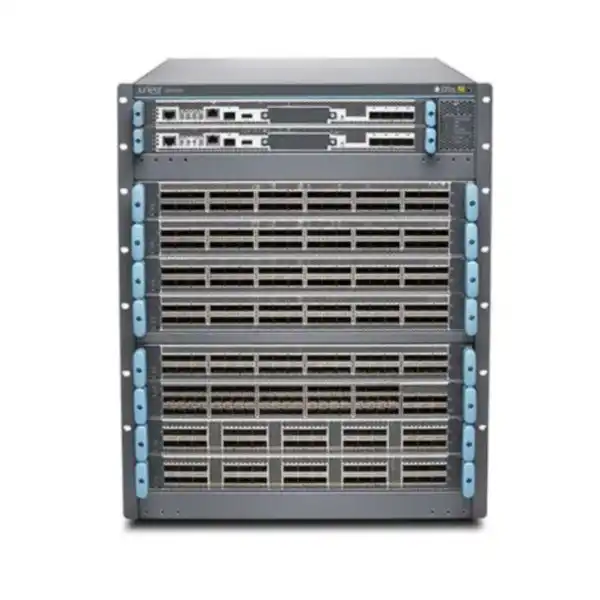
Juniper QFX10008 Data Center Switch in Dubai
The Juniper QFX10008 is an eight-slot, 13U modular Ethernet switch designed for demanding data center spine, campus core and routing roles. With up to 48 Tbps of system throughput, 16 Bpps forwarding, modular 10/40/100/200GbE interface choices and a resilient chassis architecture, it is intended for networks that need scale, flexibility and operational continuity rather than a simple fixed-port switch.
Direct answer: what is the QFX10008 and where does it fit?
The Juniper QFX10008 is a modular Ethernet switch in the QFX10000 family. It is mainly used where a network requires a high-capacity spine, core or aggregation layer with interchangeable line cards, deep buffering, extensive Layer 2 and Layer 3 services, and redundant system components. Typical buyers include enterprise data centers, cloud operators, large campuses, service environments and organizations building IP fabrics or EVPN-VXLAN networks.
The most important factor to confirm is not simply whether the chassis has enough headline throughput. A QFX10008 purchase is a system design decision: the chassis bundle, line-card type and quantity, required port speeds, optics or DAC/AOC connectivity, power input, redundancy, Junos feature requirements, automation platform and target topology all influence the correct bill of materials. A chassis can be technically powerful yet still be the wrong fit if its line-card mix, power plan or migration path does not match the existing environment.
FourTeck can help translate the intended topology and port plan into a practical Dubai/UAE quotation, including the difference between base and redundant chassis bundles, compatible line-card families, transceiver requirements, installation considerations and whether a smaller fixed QFX platform or the larger QFX10016 deserves comparison.
QFX10008 platform identity and family position
The QFX10008 is the eight-slot member of Juniper’s QFX10000 modular switching family. It uses a 13U chassis and supports up to eight horizontal line cards. The larger QFX10016 extends the same modular concept to a 21U chassis with up to sixteen line cards. That family relationship matters because the QFX10008 should normally be evaluated as a modular platform rather than as a fixed configuration. Its port density, interface speeds and exact role depend on which line cards are installed, while the chassis contributes the control, fabric, cooling and power architecture that allows those interfaces to operate as one switching system.
Juniper lists a maximum switching capacity of 48 Tbps and forwarding capacity of 16 billion packets per second for the QFX10008. Each chassis supports a maximum fabric bandwidth of 7.2 Tbps per slot. At the family level, the platform is based on Juniper Q5 silicon and uses a virtual output queue architecture intended to reduce head-of-line blocking while supporting deep buffering. These characteristics are relevant in data centers where many ingress ports can simultaneously target fewer egress paths, because burst absorption and predictable fabric behavior can matter as much as nominal port speed.
For a Dubai buyer, the family position also shapes commercial planning. An organization that needs only a modest number of 40GbE or 100GbE ports may not need a 13U modular chassis. Conversely, an environment expecting substantial port growth, multiple interface generations, high availability and long-lived core infrastructure can justify the physical size and modularity. The best choice therefore comes from a capacity plan, not from comparing model names alone.
Verified QFX10008 hardware specifications
| Specification | QFX10008 value | Buyer relevance |
|---|---|---|
| Form factor | 13U modular chassis | Requires meaningful rack-space, lifting, airflow and power planning. |
| Line-card capacity | Up to 8 line cards | Port density varies according to installed cards rather than chassis alone. |
| Switching capacity | Up to 48 Tbps | Provides the platform ceiling; actual design still depends on card and traffic architecture. |
| Forwarding capacity | Up to 16 Bpps | Important for packet-rate-heavy workloads and small-packet traffic. |
| Maximum bandwidth per slot | 7.2 Tbps per slot | Helps validate high-density line-card use and future interface planning. |
| Maximum 10GbE density | 1,152 ports | Achievable only through suitable line cards and breakout choices. |
| Maximum 40GbE density | 288 ports | Useful for legacy or mixed-generation aggregation fabrics. |
| Maximum 100GbE density | 240 ports | A key metric for spine designs connecting many high-speed leaf switches. |
| Dimensions | 17.4 x 22.55 x 32 in (44.2 x 57.3 x 81.3 cm) | Depth should be checked against the target rack, cable-management plan and service clearance. |
| System MAC addresses | Up to 1,000,000 | Relevant to large Layer 2 domains and EVPN scale assessments. |
| VLAN IDs | 4,093 | Supports conventional enterprise and data center segmentation designs. |
| Jumbo frames | Up to 9,216 bytes | MTU must be validated end to end across hosts, leaves, spines, firewalls and storage paths. |
Published scale values are platform capabilities, not a promise that every software release, feature combination or line-card mix exposes every maximum simultaneously. For production design, confirm the intended Junos release and feature set against the relevant support and scale documentation.
Line-card choices determine what the chassis actually becomes
The QFX10008 does not have one fixed front-panel port layout. Its eight slots accept QFX10000 family line cards, and the selected combination determines whether the chassis behaves primarily as a dense 10GbE aggregation switch, a 40GbE/100GbE spine, a MACsec-enabled interconnect platform or a mixed-generation core. This is one of the most important procurement distinctions because a chassis-only comparison can hide a substantial difference in usable ports, optics, cost and migration flexibility.
QFX10000-36Q
Provides 36 ports of 40GbE QSFP+ or 12 ports capable of 100GbE using QSFP28. The 40GbE interfaces can also support 4x10GbE breakout where the deployment requires higher counts of 10GbE connectivity. This card can be useful in networks transitioning from 10/40GbE toward 100GbE, but the intended breakout map should be documented before optics and cabling are purchased.
QFX10000-30C
Provides 30 ports of 100GbE QSFP28 or 40GbE QSFP+. It is a direct fit for high-density 100GbE fabrics when encryption at the interface is not the deciding requirement. Buyers should map every planned leaf, DCI or service connection to a port and media type so the line-card count follows the actual topology rather than a simple aggregate-port estimate.
QFX10000-30C-M
Provides 30 ports of 100GbE/40GbE with MACsec capability. This card is relevant when link-layer encryption is required on high-speed interconnects. MACsec should be treated as a design requirement, not merely an optional feature: the peer device, cipher support, key-management method and target topology must all be compatible.
QFX10000-60S-6Q
Provides 60 ports of 1/10GbE SFP/SFP+ plus six 40GbE QSFP+ or two 100GbE QSFP28 ports. It can suit aggregation roles where many lower-speed links must coexist with a smaller number of higher-speed uplinks. Media type, transceiver reach and the mix of copper-versus-fiber handoffs should be confirmed separately.
QFX10K-12C-DWDM
A coherent DWDM option providing six 200GbE ports and MACsec capability, designed for optical transport use cases where coherent interfaces can simplify data center interconnect architecture. This is a specialized choice; optical design, span characteristics, channel plan and interoperability need explicit engineering validation before quotation.
Why the switch fabric architecture matters
Inside the QFX10008, switch fabric modules form the central non-blocking matrix that interconnects the line cards. The platform supports six fabric cards and can be operated with N+1 fabric redundancy. Juniper specifies 7.2 Tbps throughput per slot. The horizontal line cards connect to vertical fabric cards using an orthogonal architecture that avoids a conventional midplane, a design intended to simplify the path to higher-speed fabric evolution while reducing a traditional central interconnect dependency.
For buyers, this means the chassis should be thought of as a distributed switching system rather than eight independent interface boards. Data entering one line card may leave through another, so internal fabric behavior, queueing and redundancy are central to how the platform handles east-west traffic. Juniper’s virtual output queue design aims to manage contention without head-of-line blocking, while deep buffers are intended to absorb bursts that appear in oversubscribed or asymmetric traffic patterns.
This architecture is especially relevant when the QFX10008 is placed at the spine of a leaf-spine fabric. A spine may simultaneously receive traffic from many leaf switches, and congestion can occur even when individual links are fast. Capacity planning should therefore examine oversubscription ratios, expected flow distribution, microbursts, storage traffic, replication traffic and failure scenarios—not only the sum of nominal interface speeds.
Data center fabric roles: IP fabric, EVPN-VXLAN and traditional designs
The QFX10008 can participate in several network architectures, which gives it value beyond a single topology. In a Layer 3 IP fabric, the switch commonly serves as a spine connecting leaf switches through routed point-to-point links. Equal-cost multipath routing can distribute traffic across multiple paths, and the fabric can be designed so that the loss of a link or spine does not isolate a rack. This style keeps the underlay simple and scalable, but the route design, addressing plan, BGP policy and operational model must be engineered before hardware quantities are fixed.
In an EVPN-VXLAN fabric, the physical IP underlay carries an overlay that can extend Layer 2 and Layer 3 services in a controlled way. The QFX10008 supports EVPN-VXLAN use cases and can act within fabrics that need scalable tenant segmentation, workload mobility and distributed routing. EVPN-VXLAN should not be treated as a checkbox. The project needs decisions about route types, VTEP placement, anycast gateway behavior, multi-homing, external connectivity, route targets, MTU, failure domains and how existing VLANs will be migrated.
The platform can also support MC-LAG-based Layer 2 and Layer 3 designs where operational familiarity or application constraints favor more traditional dual-chassis architectures. MC-LAG may be appropriate in some brownfield environments, but buyers planning a larger modernization should compare its operational model with EVPN multi-homing and routed fabric approaches. The right answer depends on existing dependencies, automation goals and the pace at which legacy Layer 2 domains can be reduced.
For Dubai enterprise deployments, this architectural flexibility can be useful during phased migration. A network does not have to move every workload to a new overlay on day one. However, phased coexistence can create its own complexity, so the migration sequence, temporary gateways, routing adjacencies and rollback path should be documented before the maintenance window.
High availability: design the chassis for the failure modes you care about
Control redundancy
QFX10008 ordering bundles are available in base and redundant forms. Redundant chassis bundles include two control boards, while base bundles include one. For a production core or spine where maintenance or control-plane component failure must not force a chassis outage, the redundant configuration is normally the more appropriate starting point.
Fabric redundancy
The chassis can use six switch fabric cards for N+1 redundancy. Because all line-card traffic crosses the internal fabric, fabric redundancy should be aligned with the service-level objective and expected behavior during a fabric module failure or replacement.
Power redundancy
The QFX10008 has six power-supply bays. Redundant AC bundles include six 2,700W power supplies; base AC bundles include three. DC and high-voltage DC variants also exist. The number of installed supplies, feed diversity and facility power design must match the target resiliency model.
Cooling resilience
The platform uses two fan-tray subsystems with redundant fans. Cooling design is not simply an appliance detail: rack airflow, room cooling, cable placement and service access all affect whether a high-density chassis can run reliably under sustained load.
A redundant chassis does not by itself create a redundant network. For a critical spine or core, buyers should also plan device-level redundancy across separate chassis, diverse uplinks, routing behavior during failures, maintenance procedures and potentially separate power distribution paths. The design objective is to avoid a single failure—whether component, cable, PDU, rack or software event—from causing an unacceptable outage.
Power and facility planning deserve early attention
The QFX10008 is a data center chassis, and its facility requirements should be reviewed before a purchase order is placed. Juniper’s platform documentation lists AC, DC and high-voltage DC chassis variants, and notes that AC and DC power supplies cannot be mixed in the same chassis. The QFX10008 has six power-supply bays. A redundant AC bundle is supplied with six 2,700W AC power supplies, while a base AC bundle includes three. A redundant DC bundle uses six 2,500W DC power supplies.
The published product specification lists 1,517W power consumption for the QFX10008, but facility design should not be based on a single headline consumption value. Actual demand can depend on installed line cards, optics, traffic conditions and system configuration, while circuit sizing must account for the power-supply architecture and redundancy objective. The rack’s available feeds, connector types, breaker capacity, PDU outlet availability and A/B feed design should be checked against the exact ordered bundle.
A Dubai data center may also have strict rack power-density and cooling allocations. The 13U footprint, 32-inch depth and chassis weight with modules installed can affect cabinet suitability, installation method and hot-aisle/cold-aisle planning. Treat these as part of procurement rather than post-delivery installation details.
Optics, cables and reach: the line card is only half the link
Every high-speed port requires a physical connectivity decision. A QSFP28 port may use a short-reach multimode optic, a long-reach single-mode optic, a passive direct-attach cable, an active optical cable or another supported module depending on the link. Juniper lists, for example, 100GBASE-SR4 options for short multimode runs and 100GBASE-LR4 options for longer single-mode links. The correct choice depends on distance, fiber type, connector infrastructure, patch-panel design and compatibility at both endpoints.
Breakout adds another layer. A 40GbE port operating as four 10GbE links is not merely a software setting; it requires suitable breakout cabling and a clear mapping between physical lanes and logical ports. During migration, this can be valuable because one line card can aggregate older 10GbE equipment while preserving a path to native higher-speed use. But it also increases cable count and troubleshooting complexity, so labeling and documentation become more important.
For 100GbE links, the transceiver choice should be made together with the fiber plant. SR4 uses parallel multimode fiber, while LR4 uses serial single-mode fiber. A buyer who orders optics before validating the installed cabling can end up with incompatible connectors or reach. When connecting to third-party switches, servers, routers or transport systems, both sides of the link should be checked for supported standards, FEC requirements and any vendor-specific qualification constraints.
Coherent DWDM connectivity is even more specialized. If the QFX10K-12C-DWDM line card is being considered, the design should include optical span loss, channel plan, amplification, dispersion considerations where relevant and interoperability with the wider optical system. The commercial bill of materials should follow the optical engineering rather than precede it.
Junos OS, automation and operational tooling
The QFX10008 runs Junos OS on its control boards. For organizations already using Juniper routing or switching, this can provide a familiar operational model for configuration, routing policy, telemetry, troubleshooting and software lifecycle management. Junos capabilities on the QFX10000 family include standard network automation tools such as zero-touch provisioning, commit/rollback workflows, event and operational scripts, and Python-based automation. The practical value depends on how those tools fit the organization’s change-control model.
Juniper also positions Apstra intent-based networking software for management and automation of data center fabrics, including Day 0 design, Day 1 deployment and Day 2 operations with closed-loop assurance. Apstra can be relevant where the buyer wants repeatable EVPN-VXLAN deployment, multi-vendor fabric management or automated validation against an intended state. It should be scoped separately from the switch hardware because software entitlement, deployment architecture, support and integration with existing operations platforms affect the final solution.
Automation does not eliminate the need for a clear source of truth. Before provisioning a modular spine, the project team should define interface naming, IP addressing, AS numbers, routing policy, VLAN/VNI mapping, VRFs, external connectivity, maintenance conventions and device ownership. Those design choices can then be represented in templates or intent models. Automating an unclear design only makes inconsistent configuration arrive faster.
Software release selection is another procurement dependency. Features and scale can vary by Junos release, and a feature that exists on the platform may have caveats or specific hardware requirements. The planned release should be validated against the selected line cards, required protocols, automation tooling and any interoperability certification before production deployment.
Routing, switching and scale considerations
The QFX10008 is designed to perform both Layer 2 switching and Layer 3 routing at data center scale. Juniper publishes support for up to one million MAC addresses, 4,093 VLAN IDs, 510,000 ARP entries in the documented scale set, up to 1,000 LAGs and up to 1,000 VXLAN tunnels. Hardware compatibility information also lists large IPv4 and IPv6 host-route capacities. These values indicate the class of deployment the system can address, but they should not be interpreted as simultaneous guaranteed maxima under every feature combination.
A buyer should start with the control-plane and forwarding-table requirements that actually exist. A large public-cloud edge may care about routing table scale, while a private enterprise fabric may be constrained more by tenant count, EVPN routes, ARP/ND scale or endpoint MAC addresses. A service-provider environment may prioritize MPLS VPN scale and policy resources. The useful exercise is to quantify current values, expected growth and worst-case convergence events, then compare those against the supported scale for the selected release.
Packet size also matters. A 16 Bpps forwarding ceiling describes packet-processing capability, while 48 Tbps describes bit throughput. Small packets drive packets-per-second load faster than large packets. Security appliances, telemetry collectors, high-frequency transaction systems and certain network-service chains can create traffic profiles that differ substantially from bulk storage or backup flows. Capacity planning should therefore consider both bits per second and packets per second.
Jumbo-frame support up to 9,216 bytes can benefit storage, virtualization or tunneling environments, but the MTU must be consistent end to end. VXLAN adds encapsulation overhead, so underlay interfaces may require a larger MTU than tenant payloads. A mismatch can produce difficult-to-diagnose fragmentation or black-hole behavior even when every device individually supports jumbo frames.
Sizing the QFX10008 for a spine-and-leaf fabric
Sizing begins with the number and speed of leaf uplinks. Suppose each leaf switch presents multiple 100GbE uplinks to the spine layer. The QFX10008 line-card quantity is then driven by how many leaves connect to each spine, how many links each leaf uses, and whether capacity is reserved for growth. If every leaf connects to every spine, adding another spine changes both resilience and the number of available equal-cost paths. The goal is to choose a topology whose failure state still meets the minimum east-west and north-south bandwidth requirement.
Oversubscription should be explicit. A 3:1 design may be acceptable for general compute where all servers rarely transmit at line rate simultaneously, while storage, AI clusters or high-performance analytics can justify much lower oversubscription. Application teams should be asked about replication, backup windows, live migration and burst patterns. A network that looks comfortably sized under average utilization may still experience queue pressure during synchronized jobs.
Growth is best handled by preserving both slot and port headroom. Filling all eight slots on day one may maximize immediate density, but it leaves no simple line-card expansion path. Conversely, buying a large chassis with minimal utilization can be inefficient. A balanced design usually preserves enough spare capacity for known projects while keeping the initial configuration economically sensible.
Failure-domain planning should be part of sizing. If one spine is unavailable, the remaining fabric must carry redistributed traffic. If one line card fails, only some leaf links may be affected, but traffic can shift to other paths. The sizing model should therefore include steady-state, single-link failure, line-card failure and chassis failure conditions rather than a single nominal throughput figure.
Deployment planning from rack survey to production cutover
Survey the physical environment
Confirm rack units, depth, mounting hardware, service clearance, cable pathways, airflow direction, available A/B power feeds, PDU connectors and cooling allocation. A 13U modular chassis should not arrive before the cabinet and facility requirements are validated.
Freeze the port and media plan
Map every planned connection to a line-card port, speed, transceiver type, fiber or copper medium, destination device and redundancy path. Include spare ports and any planned breakout interfaces.
Validate software and features
Select the target Junos release and confirm the required protocols, EVPN-VXLAN functions, MACsec needs, automation stack and management integrations. Record any license or subscription dependencies.
Build and stage
Install chassis components, update software, load baseline configuration, validate control and fabric redundancy, test optics, confirm routing adjacencies and verify telemetry before the switch enters the production change window.
Migrate in controlled phases
Move defined groups of links or services, monitor counters and routing state, validate application reachability, and retain a documented rollback procedure. Large fabric migrations are safer when each stage has a measurable acceptance condition.
Operationalize the platform
Complete monitoring, backups, spare strategy, support escalation paths, software maintenance procedures and runbooks. A successful cutover is the beginning of the operating lifecycle, not the end of the project.
Migration from an existing core or spine
Replacing or augmenting an existing data center core requires more than matching port counts. The first task is dependency discovery. Document all routing adjacencies, VLAN trunks, link aggregation groups, firewall handoffs, WAN or DCI circuits, out-of-band management paths, monitoring integrations, static routes, first-hop gateway functions and any applications that rely on Layer 2 adjacency. Unrecorded dependencies are a common source of migration risk because they appear only when traffic moves.
A parallel build is preferable when space and cabling permit. The QFX10008 can be staged with its intended software, routing policy, line cards and optics before production links are moved. New and old networks can then be interconnected through controlled routed or Layer 2 boundaries. This supports phased service migration and gives the operations team time to validate telemetry, routing convergence and failure behavior.
When the target architecture introduces EVPN-VXLAN, avoid combining too many transformations in a single maintenance window. Hardware replacement, routing protocol changes, address renumbering, VLAN cleanup and application migration can each be manageable; executing them all simultaneously makes rollback difficult. A phased plan might first establish the new underlay, then introduce overlay services, then migrate workloads in groups, then remove temporary interconnects.
The rollback plan should identify exactly which links, routing sessions and gateway functions can return to the legacy platform if validation fails. Configuration backups alone are not a rollback procedure. Teams need physical patching instructions, traffic-drain steps, acceptance tests and named decision points for proceeding or reverting.
Security and segmentation considerations
The QFX10008’s role in a network can place it close to critical east-west and north-south traffic, so security architecture should be defined alongside connectivity. EVPN-VXLAN can support tenant and application segmentation using VRFs and VNIs, while routing policy and firewall integration can control traffic between security zones. The switch itself is not a replacement for a firewall, but its routing and segmentation capabilities determine where security enforcement points can be placed efficiently.
MACsec-capable line cards can encrypt Ethernet links at line rate on supported interfaces. This can be valuable for links that traverse shared facilities, data center interconnects or locations where physical path confidentiality is required. MACsec protects the link between compatible endpoints; it does not provide end-to-end application encryption across arbitrary routed hops. Buyers should define which links require encryption and confirm peer compatibility before specifying the MACsec line card.
Management-plane security deserves equal attention. Out-of-band management networks, role-based access, AAA integration, secure management protocols, logging, software-image control and configuration backup should be included in the deployment baseline. Production network devices should not depend solely on in-band access through the same data path they are responsible for restoring during an incident.
Segmentation scale should also be checked against the chosen architecture. A few VRFs for departments are very different from thousands of tenant overlays. The design should document expected tenant counts, prefixes, endpoint scale and policy requirements so the switching platform is assessed against the actual security model.
Monitoring, telemetry and Day 2 operations
A high-capacity spine can carry enormous traffic volumes while still showing low average utilization. Useful monitoring therefore needs more than interface up/down state. Operations teams should collect interface counters, errors, discards, queue behavior, optics diagnostics, routing-neighbor state, CPU and memory health, fabric status, fan and power health, environmental readings, configuration changes and software alarms. Telemetry should be retained long enough to compare normal baselines with incident periods.
Queue drops deserve special attention. Deep buffers can absorb bursts, but no buffer is infinite. Repeated egress congestion can indicate an oversubscribed topology, an application traffic pattern, hashing imbalance or a failed path that has concentrated traffic onto fewer links. Alert thresholds should distinguish transient bursts from sustained congestion so the operations team is not overwhelmed by noise.
Optical diagnostics can identify deteriorating links before they fail outright. Transmit power, receive power and module alarms should be monitored where supported. A high-speed link that flaps intermittently can destabilize routing and trigger traffic movement across the fabric, so physical-layer health belongs in network availability monitoring.
For EVPN-VXLAN environments, monitoring should include both underlay and overlay state. A fabric may have healthy physical links while a route-target, VNI or control-plane issue affects only specific tenants. Intent-based assurance tools can help correlate intended connectivity with observed state, but clear operational ownership and escalation runbooks remain necessary.
Licensing, subscriptions and support: what to confirm before ordering
Enterprise switching quotations can include hardware, software entitlements, subscriptions and support as separate commercial elements. Juniper offers Flex Licensing across its portfolio, and automation platforms such as Apstra are scoped independently from the physical chassis. The exact license requirement depends on the protocols, advanced features and management architecture being deployed. It is therefore safer to start with the required feature set than to assume a generic license tier.
Support should be aligned with the operational criticality of the switch. A data center spine failure can affect a large proportion of the network, so organizations commonly evaluate response time, replacement logistics, software entitlement and technical support coverage together. The support plan should also consider how many spare optics or field-replaceable components are held locally and whether the architecture can continue operating while replacement parts are delivered.
Software lifecycle is another dependency. The network team should identify the target Junos train, preferred maintenance cadence, vulnerability-response process and upgrade method. In a redundant design, maintenance procedures should be tested so software changes do not unexpectedly create a large outage. The ability to roll back a configuration is useful, but rollback of a software upgrade may have different requirements.
For a Dubai quotation, provide the desired support term and service expectation along with the hardware list. This reduces the risk that two quotations appear similar but include materially different support or software coverage.
Where the QFX10008 is a strong fit
High-density 100GbE spine
A fabric with many leaf switches can use the QFX10008 as a modular spine where high 100GbE density, deep buffering and multiple equal-cost paths are required. The modular chassis allows port growth without replacing the entire platform, provided spare slots and fabric capacity have been planned.
Mixed-generation data center core
Organizations migrating from 10/40GbE toward 100GbE can combine line cards and breakout options to support old and new connectivity during a transition. This is useful when a complete forklift upgrade is not practical and services must move in phases.
Large campus core
A large campus with substantial routing, aggregation and service requirements may benefit from the platform’s modularity and high availability. The comparison should include whether data center-specific features are actually needed and whether a different Juniper chassis family better matches campus interface requirements.
Data center interconnect edge
MACsec and coherent DWDM line-card options can make the QFX10008 relevant to selected DCI designs. The optical transport architecture, encryption requirement and failure model should be validated in detail because these use cases are more specialized than ordinary in-building switching.
When the QFX10008 may be more switch than you need
The QFX10008 should not be selected merely because it is powerful. A 13U modular chassis consumes significant rack space and requires a more involved power, cooling and component plan than a fixed switch. If the requirement is a small number of 100GbE links, a fixed QFX platform can provide a simpler bill of materials and lower physical overhead. The QFX10002 family, for example, offers fixed-configuration high-density switching in a much smaller 2U form factor and deserves comparison where modular expansion is not required.
At the other end of the scale, a design that already expects to consume close to eight line cards may justify comparing the QFX10016. The larger chassis provides up to sixteen line-card slots and up to 96 Tbps system throughput. Buying the QFX10008 only to reach full slot utilization immediately can limit future expansion and force an earlier second-chassis purchase. Two smaller chassis may still be preferable for failure-domain reasons, but that should be a conscious architectural choice.
The strongest business case for the QFX10008 appears when the buyer values modular interface flexibility, high availability, large fabric capacity and a growth path within the eight-slot footprint. If those requirements are absent, a simpler platform may be more efficient.
QFX10008 versus QFX10016 versus a fixed QFX10002 approach
| Decision point | QFX10008 | QFX10016 | Fixed QFX10002 family |
|---|---|---|---|
| Form factor | 13U modular | 21U modular | 2U fixed |
| Line-card slots | Up to 8 | Up to 16 | No modular line-card slots |
| System throughput | Up to 48 Tbps | Up to 96 Tbps | Varies by fixed model |
| Best fit | Modular spine/core requiring substantial but not maximum chassis scale | Very large modular spine/core with greater slot growth | High-density fixed deployments where modular expansion is unnecessary |
| Primary trade-off | Balances modularity and chassis size | More scale but larger physical footprint | Simpler and compact, but less modular flexibility |
The comparison should be performed against a real port-growth model. A modular chassis can be economical when it avoids repeated forklift replacements, but only if the organization expects to use the available expansion and values the associated redundancy. Fixed switches can also be deployed as multiple independent spines, which may improve failure-domain separation. Architecture and lifecycle cost should therefore be evaluated together.
Detailed buyer questions to answer before requesting a quotation
A precise QFX10008 quotation depends on more information than quantity. The following questions materially affect hardware and service selection. They are worth answering before the bill of materials is finalized because every answer can change the line-card count, optics, power bundle, support package or deployment scope.
How many ports are required now and in three years?
Separate the requirement by 10GbE, 40GbE, 100GbE and any 200GbE coherent needs. Include spare capacity rather than assuming every port can be consumed immediately.
Which links need MACsec?
Identify the exact encrypted paths and peer devices. This determines whether MACsec-enabled line cards are required and avoids paying for encryption capability on links that do not use it.
What fiber plant already exists?
Record multimode versus single-mode fiber, connector types, path lengths, patch panels and any existing optical standards. Transceiver selection should follow this physical reality.
Is the topology IP fabric, EVPN-VXLAN, MC-LAG or mixed?
Architecture influences port count, software requirements, migration strategy, operational tooling and the design of redundant paths.
What redundancy level is required?
Decide whether the chassis needs dual control boards, six fabric modules, full power-supply redundancy and diverse facility feeds, then separately define chassis-level network redundancy.
What support and implementation scope is expected?
Clarify hardware-only supply versus staging, configuration, installation, migration, testing, documentation, post-cutover support and ongoing software or automation services.
Procurement details that can change the final bill of materials
Juniper publishes several QFX10008 chassis orderable variants. Examples include base and redundant AC configurations, high-voltage DC-capable configurations and a redundant DC configuration. A base AC chassis is listed with one control board, three 2,700W AC power supplies, two fan trays, two fan-tray controllers and five switch fabric cards. A redundant AC chassis is listed with two control boards, six 2,700W AC power supplies, two fan trays, two fan-tray controllers and six switch fabric cards. These bundles have materially different resilience characteristics even though both use the same QFX10008 chassis.
Line cards are separate decisions. A buyer requiring 240 ports of 100GbE, for example, is at the published maximum density and would consume a full complement of suitable 30-port 100GbE line cards. A smaller spine may use fewer cards and preserve expansion slots. If breakout from 40GbE to 10GbE is planned, the cable count and physical port mapping should be included in the BoM rather than left as a post-installation assumption.
Optics can represent a substantial portion of total project cost. The quotation should distinguish which links use short-reach optics, long-reach optics, DACs, AOCs or coherent interfaces. Spare transceivers should be considered for critical link types, especially where a failed optic could otherwise wait on logistics.
Rack accessories, patch cords, fiber cassettes, cable managers, console access equipment and out-of-band management connectivity may also be necessary even though they are not part of the switch chassis. These items should be captured during the site survey so the installation team is not blocked by small but essential components.
Finally, support and software should be separated clearly in the commercial document. The buyer should be able to see the hardware configuration, support term, subscriptions, professional services and any optional spares as distinct line items. This makes competing quotations easier to compare on an equivalent basis.
Performance dependencies that headline specifications do not explain
A 48 Tbps switching specification is useful, but application experience depends on traffic distribution. A fabric with balanced flows across many egress links may operate very differently from one where a large number of sources converge on a single destination. Hashing, equal-cost path count, elephant flows, incast patterns and link failures all influence where congestion appears.
Buffers help absorb bursts but introduce a trade-off: larger queues can protect throughput while also increasing latency if congestion persists. Queue monitoring and QoS policy should therefore match the application. Storage traffic, real-time communications and general server traffic can have different tolerance for loss and delay. The goal is not simply to use the biggest buffer; it is to engineer predictable behavior under contention.
Routing convergence is another dimension. In a leaf-spine fabric, losing a link or device changes the available ECMP paths. The routing protocol timers, BFD configuration where used, control-plane scale and application sensitivity determine how the network experiences that event. A design test should include failure injection rather than only steady-state throughput tests.
Feature combinations can consume hardware resources differently. Access-control filters, route tables, tunnel entries and policy scale all draw from finite platform resources. Production sizing should therefore use the feature scale relevant to the intended Junos release and configuration, especially in networks that approach published maxima.
Data center interconnect and MACsec use cases
When two data centers need high-capacity connectivity, the QFX10008 can participate at the interconnect edge using high-speed Ethernet, MACsec-capable line cards or coherent DWDM interfaces. The correct design depends on whether the transport provider hands off standard Ethernet, whether dark fiber or wavelength services are available, and where encryption must begin and end.
MACsec provides link-layer encryption on supported interfaces, which can protect traffic across a physical or provider-managed Ethernet segment. It is especially relevant where the organization wants line-rate confidentiality without introducing a separate encryption appliance into every high-speed path. However, MACsec interoperability and key-management design must be validated with the far-end device. A MACsec-capable port on one side is insufficient if the other endpoint cannot negotiate compatible parameters.
Coherent DWDM can reduce dependence on separate transponders in suitable optical environments, but it places more optical engineering responsibility into the switch design. The project must know span length, attenuation, wavelength plan and transport constraints. In a carrier-managed wavelength service, the provider’s handoff specification may make a conventional client optic the better choice.
At the routing layer, DCI design should decide whether sites exchange EVPN routes, conventional BGP prefixes, stretched Layer 2 segments or application-specific connectivity. Large stretched Layer 2 domains can increase failure coupling between sites, so they should be used deliberately rather than as a default convenience.
Operational resilience and maintenance planning
Modular hardware makes many components field-replaceable and hot-swappable, but maintenance still needs a controlled procedure. Before replacing a line card, fabric module, control board, fan tray or power supply, the operations team should understand which traffic paths depend on that component and what alarms or temporary capacity reduction will occur. A hot-swappable part is designed for replacement without powering down the chassis; it does not mean every replacement is operationally invisible.
Software maintenance should be rehearsed in a representative environment where possible. Upgrade sequencing, routing adjacency behavior, control-plane switchover and automation-platform compatibility can all affect service. The maintenance plan should define pre-checks and post-checks: routing table health, EVPN session state, interface errors, fabric status, power and fan alarms, and application path validation.
Spares strategy should reflect the business impact of a failure. For a redundant spine pair, the network may tolerate one entire chassis being unavailable for a limited period, which can reduce the need to stock every component locally. In a more concentrated architecture, local spares may be justified. Optics often deserve particular attention because they fail independently of the chassis and are easy to replace if a compatible spare is available.
Configuration and inventory documentation should identify chassis serials, installed line cards, optics, software versions, licenses, support contracts and physical cable endpoints. This information shortens incident response and makes future expansion much easier than rediscovering the platform years after deployment.
Dubai and UAE deployment considerations
For organizations sourcing the Juniper QFX10008 in Dubai or elsewhere in the UAE, the technical design should be completed before commercial comparison. International model availability, power-supply variants, optics lead times and support service levels can affect project schedules. A quote that only lists the chassis may look attractive but can omit the line cards, transceivers, software and support needed for a usable production system.
Facility readiness is equally important. Dubai data centers commonly use structured hot-aisle/cold-aisle designs and controlled rack-power allocations. The QFX10008’s 13U height and approximately 32-inch depth should be checked against the nominated rack, including rear clearance for power and cabling. The power-feed type must match the ordered chassis variant, and dual-feed redundancy should be confirmed with the facility rather than assumed.
Projects that connect multiple UAE sites should distinguish metro DCI requirements from in-building switching. Fiber availability, service-provider handoffs, route design and encryption requirements can change the line-card and optics selection. If coherent DWDM is being considered, transport design should be performed as an optical project rather than added late to a normal Ethernet BoM.
FourTeck can help consolidate these inputs into one practical quotation scope: exact chassis bundle, line cards, optics, redundancy, software, support, staging, installation and migration. This reduces the chance of receiving hardware that is individually correct but incomplete as a deployable solution.
Common specification mistakes to avoid
Treating 48 Tbps as usable port capacity without a line-card plan
The chassis switching ceiling does not define the front-panel interfaces. Port density comes from installed line cards, and every line card has its own speed and breakout characteristics.
Ordering optics independently from the fiber plant
SR, LR, DAC, AOC and coherent options serve different distances and media. The physical path should be known before transceivers are finalized.
Assuming a base chassis provides the same resilience as a redundant bundle
Base and redundant QFX10008 orderable configurations contain different quantities of control boards, power supplies and fabric cards. The bundle must match the availability requirement.
Ignoring rack and power constraints until delivery
A 13U modular chassis with multiple power supplies and dense optics requires planned rack space, service clearance, PDU capacity and cooling.
Planning only for normal operation
Capacity should be tested under link, card or chassis failure because traffic redistributes onto fewer paths. A design that works only when every component is healthy can be under-sized.
Frequently asked questions about the Juniper QFX10008
How many line cards does the QFX10008 support?
It supports up to eight QFX10000 line cards in a 13U chassis. The selected cards determine the front-panel port speeds and total port density.
What is the maximum throughput?
Juniper specifies up to 48 Tbps system throughput and up to 16 Bpps forwarding capacity for the QFX10008. Actual deployment performance still depends on traffic patterns, line cards, software features and topology.
Can the QFX10008 be used for EVPN-VXLAN?
Yes. Juniper positions the QFX10000 family for IP fabric and EVPN-VXLAN architectures as well as Layer 2/Layer 3 networks. The exact design and feature support should be validated against the intended Junos release.
Does it support 100GbE?
Yes. Multiple line-card options support 100GbE QSFP28 interfaces, and the platform can reach a published maximum density of 240 100GbE ports with an appropriate full line-card configuration.
Does the QFX10008 support MACsec?
MACsec is available through specific line cards, including the QFX10000-30C-M and coherent DWDM option. The peer device and intended encryption design must also support compatible MACsec operation.
Can 40GbE ports break out to 10GbE?
On supported line cards such as the QFX10000-36Q, 40GbE QSFP+ ports can be configured for four 10GbE connections using appropriate breakout cables. The physical and logical port map should be designed in advance.
Is the QFX10008 suitable for a campus core?
It can support demanding campus core and routing environments, but buyers should compare its modular data center-oriented capabilities with other chassis options if the campus requirement is dominated by different access or service features.
What is the difference between base and redundant chassis bundles?
A base bundle uses fewer central components, while redundant bundles include dual control boards and larger power/fabric complements. Production cores and spines should be evaluated against the required maintenance and failure tolerance.
Does the chassis include all optics?
No assumption should be made that transceivers are included. Optics, DACs, AOCs and breakout cables should be listed explicitly according to each link’s speed, reach and media type.
Should I compare the QFX10016?
Yes if the design is likely to consume most QFX10008 slots quickly or requires materially more than 48 Tbps of chassis capacity. The larger chassis provides up to sixteen line-card slots and 96 Tbps throughput but also uses more rack space.
Should I compare a fixed QFX10002?
Yes if the required port count is modest, modular expansion is unnecessary, or rack efficiency is a higher priority. Fixed platforms can simplify deployment while still delivering high-speed data center switching.
Can FourTeck help with configuration rather than chassis-only supply?
Yes. A useful consultation can include the intended topology, line-card mix, optics, redundancy, rack and power requirements, software, support, staging, installation and migration scope so the quotation represents a deployable system.
A practical design example: building a resilient 100GbE spine
Consider an enterprise that has standardized new leaf switches on 100GbE uplinks. The design uses two independent spine switches, and every leaf has one or more 100GbE links to each spine. The QFX10008 can be attractive because the 30-port 100GbE line cards allow density to grow in 30-port increments, while the chassis retains modular control, fabric, power and cooling components.
The first calculation is the number of leaf-facing links per spine. If the current estate requires 72 100GbE links per spine, three 30-port cards provide 90 interfaces and leave capacity for eighteen additional links. That does not mean three cards are automatically correct: some ports may be reserved for DCI, service edges or future leafs, and the failure design may require specific distribution of links across cards. Spreading important leaf connections across multiple line cards can reduce the impact of a single card failure.
The second calculation is bandwidth under failure. If one spine is removed for maintenance, all traffic that normally uses two spines may shift toward the remaining paths. The leaf uplinks and remaining spine capacity must support that temporary load within the application’s tolerance. If one 30-port line card fails, only the links on that card disappear, but routing will redistribute affected flows. The resulting concentration on the remaining interfaces should be modeled.
The third consideration is optics. Leaf switches in the same row may use short-reach optics or direct cables, while links to a different data hall may require single-mode LR optics. Every port in the design should therefore have a media profile. Buying ninety identical transceivers just because the card has ninety ports can waste budget if the physical paths differ.
The fourth consideration is the network architecture. An IP underlay can use eBGP or another routing design between leafs and spines, while EVPN distributes overlay reachability. The AS-number plan, route policies and MTU should be established before configuration templates are created. If Apstra is used, the intended topology and policy can be modeled centrally, but the physical inventory and cabling still have to match the design.
This example illustrates why the QFX10008 is best bought through an engineering-led process. The exact same chassis can be underutilized, correctly sized or insufficient depending on the surrounding fabric. Port count, failure behavior, optics and growth all belong in the same decision.
A practical brownfield example: preserving 10/40GbE while moving to 100GbE
Many established data centers do not move directly from one interface generation to another. An existing environment may have server aggregation at 10GbE, uplinks at 40GbE and new leaf switches at 100GbE. The modular QFX10008 can accommodate this transition by combining cards that support different speeds, rather than forcing the entire core to use one fixed port profile.
The QFX10000-36Q can support native 40GbE and selected 100GbE connectivity, while 40GbE ports can break out to four 10GbE links. The QFX10000-30C provides dense 40/100GbE capability. The QFX10000-60S-6Q adds a large number of 1/10GbE ports together with higher-speed uplinks. A mixed-card chassis can therefore support legacy equipment during a staged migration while new racks adopt faster interfaces.
The risk is that temporary compatibility becomes permanent complexity. A good migration plan assigns an end state to each legacy connection and reserves specific cards or ports for the transitional period. This makes it possible to retire lower-speed cards later, reclaim slots and simplify the cable plant. Without that plan, a modular chassis can accumulate years of ad hoc connections that make future change harder.
Breakout cables should be documented carefully because they increase the number of logical interfaces associated with one physical QSFP port. Port descriptions should identify the far-end device, rack and service. Where possible, monitoring systems should inherit the same naming convention so a failed logical lane can be traced quickly to the correct physical breakout.
The business advantage is continuity: existing assets can remain connected while modernization proceeds. The engineering objective is to use that flexibility without allowing the transitional architecture to become the new unmanaged baseline.
What to test before production acceptance
Acceptance testing should be tied to the intended service rather than limited to checking that interfaces come up. Begin with hardware health: verify both control boards where installed, fabric modules, fan trays, power supplies, line-card status and environmental readings. Confirm that every optic is recognized and that received optical levels are within expected limits.
Next validate forwarding. Test representative VLANs, routed prefixes, EVPN VNIs, VRFs and external paths. If jumbo frames are required, send appropriately sized traffic across the complete application path. If MACsec is used, verify encryption state and behavior during peer or key changes. For breakout links, test each lane individually.
Failure tests should include at least one redundant component event that is safe to exercise in staging. Depending on design, this may include disabling a spine link, removing an ECMP path, testing a control-board switchover or verifying behavior after a fabric module is taken out of service. The objective is to observe that traffic reconverges as designed and monitoring raises useful alerts.
Operational testing matters too. Confirm that the configuration can be backed up and restored, logs reach the monitoring system, AAA works, NTP is synchronized, automation tools can access the device securely and out-of-band management remains reachable if production routing is unavailable. These checks turn a hardware installation into an operable service.
Finally, record a baseline. Save software versions, routing counts, interface error counters, optical readings and system health after successful commissioning. A clean baseline is one of the most useful references when troubleshooting later changes.
Lifecycle and expansion planning
A modular chassis is usually purchased with a multi-year horizon, so expansion should be considered before the first rack installation. Reserve enough line-card slots for projects that are already funded or likely, and document which slots are intentionally left free. The same applies to power: additional line cards and optics can change system demand, so facility headroom should be consistent with the intended end-state configuration.
Software lifecycle planning should include both feature evolution and hardware support. New Junos releases may add capabilities, modify behavior or retire older functions. Upgrade planning should therefore review release notes, feature compatibility and operational risk rather than treating software as a static component of the original purchase.
Optics are another lifecycle area. A data center may transition from multimode to single-mode fiber, from 40GbE to 100GbE, or from client optics to coherent DCI. Keeping an accurate record of installed transceiver types and fiber paths makes later upgrades significantly easier. Spare optics should be reviewed as the fleet changes so the organization does not retain only spares for interfaces it no longer uses.
Capacity reviews should be based on trends and failure-state utilization. If the normal fabric runs at 35 percent but reaches 75 percent whenever one spine is unavailable, the growth margin is smaller than the average graph suggests. Similarly, if only one line-card slot remains free and a planned project needs two, expansion may require a second chassis or redesign earlier than expected.
A good lifecycle plan turns modularity into actual investment protection. Without documented growth assumptions, spare capacity can be consumed randomly and the platform can reach an architectural limit long before its headline performance ceiling.
Decision recap: is the Juniper QFX10008 right for your project?
Model fit
Choose the QFX10008 when an eight-slot modular chassis provides the right balance of density, growth and rack footprint. Compare QFX10016 for materially larger slot requirements and fixed QFX models for smaller deployments.
Capacity
Validate port count, interface speed, throughput, packet rate, oversubscription and failure-state bandwidth. Preserve deliberate slot and port headroom for growth.
Compatibility
Match line cards, optics, breakout cables, peer devices, fiber plant, MTU, routing protocols, Junos release and any MACsec requirements as one end-to-end system.
Resilience
Select base or redundant chassis components according to the service objective, then add chassis-level network redundancy, diverse links and facility power paths where required.
Operations
Plan software lifecycle, monitoring, telemetry, automation, backups, support and spares before production. The platform’s scale is useful only when the operating model can manage it reliably.
Procurement
Request a complete BoM that separates chassis bundle, line cards, optics, software, support and services. This makes technical and commercial comparisons far more accurate.
What FourTeck needs from you for an accurate QFX10008 quotation
The following inputs are usually enough to move from a generic product inquiry to a useful configuration discussion. Exact answers are ideal, but estimates are still helpful if the project is at an early stage.
Number of QFX10008 chassis and the Dubai/UAE installation locations.
Current and planned counts for 10, 40, 100 and any 200GbE interfaces.
Spine-leaf, campus core, DCI, MC-LAG, EVPN-VXLAN or another architecture.
Fiber type, link distances, connector infrastructure and any breakout requirements.
Base versus redundant chassis, A/B power feeds and chassis-level network resilience.
Any MACsec links, segmentation requirements or external firewall handoffs.
Required Junos features, Apstra use, telemetry and management integrations.
Supply only, staging, installation, migration, testing, documentation and support term.
Build the QFX10008 configuration around your real fabric requirements
A useful Juniper QFX10008 quotation should identify the exact chassis bundle, line cards, optics, power model, redundancy, software, support and deployment scope. Share your port plan, topology and site requirements with FourTeck to compare the QFX10008 against the alternatives and create a bill of materials that is ready for implementation rather than just a chassis purchase.

Reviews
There are no reviews yet.