
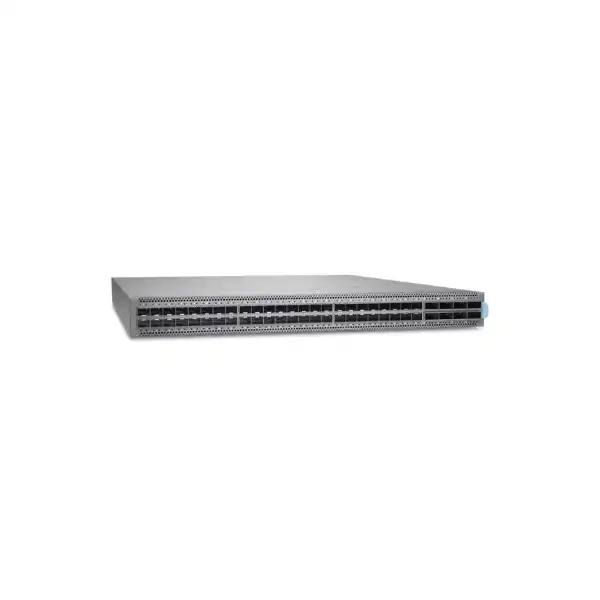
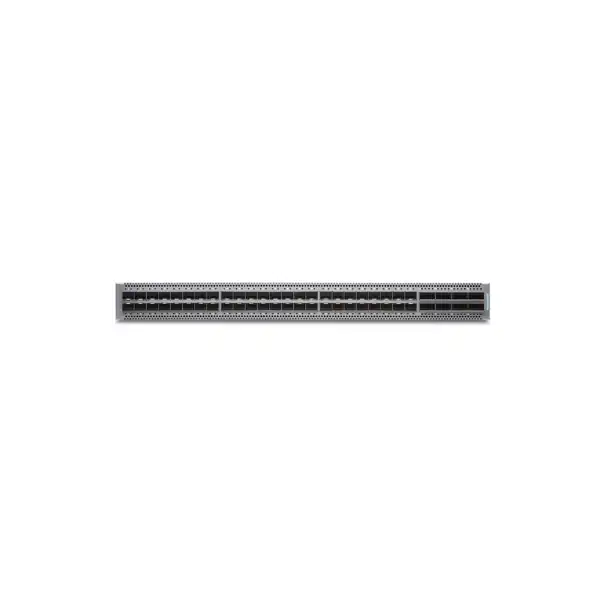
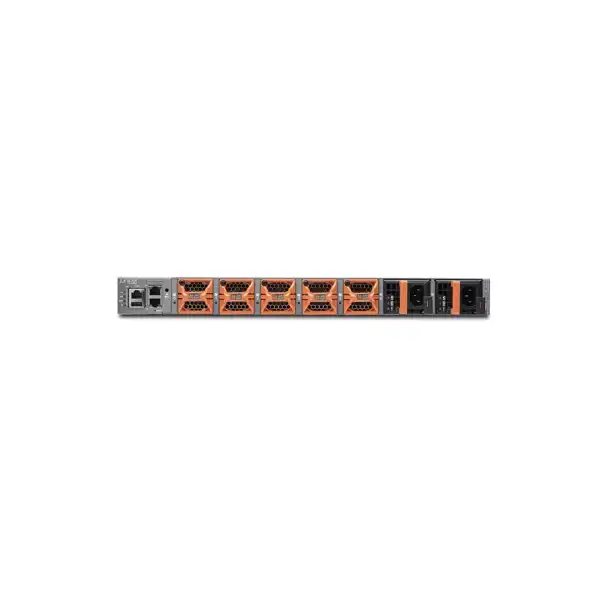
Juniper QFX5120-48Y Data Center Switch Dubai
The Juniper QFX5120-48Y is a compact 1U high-density switch built for modern data center leaf, top-of-rack and enterprise distribution roles. Its 48 tri-speed 1/10/25GbE SFP-family ports and eight 40/100GbE QSFP-family ports make it particularly relevant when servers, storage nodes, firewalls or downstream switches need 10GbE or 25GbE access with substantial 100GbE fabric capacity.
Direct answer for buyers evaluating the QFX5120-48Y
What exactly is it? The QFX5120-48Y is a Juniper Networks fixed 1U Ethernet switch in the QFX5120 family. It combines 48 front-panel ports capable of 1GbE, 10GbE or 25GbE operation with eight ports capable of 40GbE or 100GbE operation, giving it the port profile expected of a high-density leaf or distribution switch rather than a conventional office access switch.
What is it mainly used for? Typical roles include top-of-rack server access, leaf switching in an IP fabric, high-speed aggregation, EVPN-VXLAN leaf functions, and campus distribution where fibre-based 10/25GbE downlinks and 40/100GbE uplinks are appropriate.
Who should consider it? Organizations standardizing on Junos OS, upgrading server access from 10GbE toward 25GbE, or building a 100GbE leaf-spine fabric are the strongest candidates. It is also relevant to virtualization, private cloud, storage and colocation environments that need dense fibre or DAC connectivity.
What must be confirmed first? Confirm the exact hardware ordering variant, airflow direction, AC or DC power, required optics or DACs, breakout plan, software features and current Junos compatibility before purchase.
What can FourTeck determine? FourTeck can help translate port counts, link distances, rack layout, fabric design, licensing and migration requirements into a precise Dubai/UAE quotation.
Why the QFX5120-48Y has a distinct place in the QFX5120 family
The QFX5120 family covers several related but materially different port profiles. The QFX5120-48Y is the model aimed most directly at dense 25GbE server or fibre-facing access with 100GbE uplinks. That distinction matters because a QFX5120-48T is built around 1/10GbE RJ-45 copper access, while the QFX5120-32C is a higher-density 40/100GbE platform that can fit spine or high-speed aggregation roles. The QFX5120-48YM resembles the 48Y port layout but adds hardware-based MACsec capability across its ports. A buyer should therefore treat “QFX5120” as a family name, not as a complete specification.
For a new data center rack, the 48Y is attractive when server interfaces are moving toward SFP28 25GbE or when an existing 10GbE SFP+ estate must remain usable during a staged migration. The same front-panel access ports support 1GbE, 10GbE and 25GbE media classes, while the eight high-speed ports provide 40GbE or 100GbE connectivity toward a spine, core, aggregation layer or other network block. That combination can reduce the need to maintain separate switch types solely for 10GbE and 25GbE server generations.
The design is not universally suitable. If the access requirement is primarily RJ-45 copper, PoE for phones or wireless access points, or large numbers of 100GbE endpoints rather than 25GbE endpoints, another model or product family should be evaluated. Similarly, a project that explicitly requires line-rate MACsec on the switch ports should compare the QFX5120-48YM rather than assume that the 48Y provides the same encryption hardware. Making that model distinction at the quotation stage prevents expensive changes after optics, cabling and rack components have already been selected.
Juniper QFX5120-48Y key specifications
| Specification | QFX5120-48Y detail | Buyer relevance |
|---|---|---|
| Form factor | Fixed 1U | Fits dense top-of-rack and distribution deployments. |
| Access ports | 48 × 1/10/25GbE using SFP, SFP+ or SFP28 media as supported | Supports mixed server generations and staged 10-to-25GbE upgrades. |
| High-speed ports | 8 × 40/100GbE QSFP+/QSFP28 | Provides substantial uplink or fabric bandwidth. |
| Switching performance | Up to 2 Tbps unidirectional / 4 Tbps bidirectional and 2 Bpps | Appropriate for high-throughput leaf and aggregation use. |
| Latency | As low as 800 ns in published platform specifications | Useful for latency-sensitive east-west data center traffic. |
| Processor and memory | 2.2 GHz quad-core Intel CPU, 16 GB memory, 50 GB SSD | Supports Junos control-plane, automation and operational functions. |
| Dimensions | Approx. 4.37 × 44.09 × 52.02 cm (H × W × D) | Rack depth and cable clearance must be checked. |
| Weight | Approx. 10.75 kg fully loaded | Relevant to rack loading and installation handling. |
| Airflow options | Front-to-back or back-to-front variants | Must match hot-aisle/cold-aisle rack design. |
| Power variants | AC and DC hardware ordering options | Power type must be selected at procurement, not assumed later. |
Published scale, power and feature values can vary by software release, traffic profile, optics population and documentation revision. For production design, confirm the exact hardware SKU, current Junos release support and required feature scale against Juniper documentation for the intended deployment.
Port architecture: where 48 × 25GbE and 8 × 100GbE becomes useful
Server-facing flexibility
The 48 access ports can operate at 1GbE, 10GbE or 25GbE with supported SFP-family media. This is valuable when racks contain multiple server generations. A virtualization host with a 25GbE NIC can use SFP28, an older appliance can remain at 10GbE through SFP+ or a DAC, and lower-speed fibre devices can be accommodated where supported. The design gives an operator room to migrate link speeds without replacing the entire leaf switch.
100GbE fabric connectivity
Eight 100GbE-capable ports provide the uplink density expected in a leaf-spine architecture. They can connect to redundant spine switches, upstream aggregation devices, inter-rack links or high-bandwidth network services. The design can also support 40GbE where that remains necessary, allowing a controlled transition from older 40GbE fabrics to 100GbE rather than requiring an immediate all-at-once redesign.
Breakout capability
The QSFP28 ports can be channelized for 4 × 25GbE operation and the 40GbE QSFP+ mode can be broken into 4 × 10GbE, subject to supported media and configuration. This can increase interface density to as many as 80 10GbE or 25GbE ports in the supported breakout scenario. Breakouts are useful for special rack layouts, but they change cable counts, port numbering, operational documentation and oversubscription assumptions, so the design should be planned before optics are ordered.
Port count alone does not tell the whole story. A deployment also needs a clean mapping from each server, storage target, firewall, load balancer or downstream switch to the required speed, connector type, media reach and redundancy pattern. For example, two servers may both be described as “25GbE”, yet one may use short DAC connections inside the rack while another needs multimode fibre across rows. The switch can support both types when appropriate transceivers and cables are selected, but the bill of materials is different. FourTeck therefore treats the port map as part of the quotation input rather than assuming that the chassis price alone represents the complete deployment cost.
Data center leaf and top-of-rack use
The most natural role for the QFX5120-48Y is as a leaf or top-of-rack switch. In this position, the 48 access ports connect servers, hypervisors, storage nodes or service appliances, while the 100GbE ports connect northbound to one or more spine switches. This architecture is common in modern data centers because it creates predictable hop counts and distributes switching capacity across many leaf devices rather than concentrating all server access into a few large chassis.
A leaf design should be sized from actual traffic patterns rather than from interface speed labels alone. Forty-eight servers with 25GbE NICs do not necessarily transmit 25Gbps continuously, and an 800Gbps aggregate uplink capability may be more than adequate for many environments. On the other hand, dense virtualization, distributed storage, backup windows, AI-adjacent data movement or replication can produce very high east-west utilization. The correct oversubscription target depends on workload behavior, not on a generic ratio. The published access-to-aggregation relationship for this platform is useful as a starting point, but production planning should include peak traffic, growth and failure conditions.
Redundancy changes the calculation. If a leaf is dual-homed to two spines, the design must decide how much traffic should remain supportable after one spine link or one entire spine is unavailable. A network that looks comfortably provisioned during normal operation may become constrained if half the fabric uplink capacity disappears. A good design checks both normal and degraded-state capacity, especially for applications with strict latency or replication requirements.
The physical layout is equally important. DACs are often practical inside a rack because they are compact and economical at short reaches, while optical links are commonly used between racks, rows or rooms. The QFX5120-48Y’s SFP28 and QSFP28 orientation supports that data center cabling model well, but the exact transceiver support matrix should be checked against the Junos release and link distance. A technically correct switch can still create deployment delays when the wrong fibre type, optic wavelength, polarity or breakout harness is ordered.
EVPN-VXLAN and routed fabric considerations
Juniper positions the QFX5120 platform for EVPN-VXLAN data center fabrics as well as traditional Layer 2 and Layer 3 switching. In an EVPN-VXLAN design, the underlay usually provides IP reachability between fabric nodes, while EVPN distributes endpoint and routing information and VXLAN carries tenant or segment traffic across the fabric. This separation can make the network more scalable and operationally consistent than extending many physical VLANs through a conventional spanning-tree domain.
For the QFX5120-48Y, the practical question is not simply whether “VXLAN is supported.” The design needs to define the leaf’s role. It may act as a VXLAN tunnel endpoint, provide Layer 2 gateway functions, provide Layer 3 gateway functions, or participate in an edge-routed or centrally routed topology depending on the architecture. Each option affects control-plane scale, IP addressing, routing policy, failure behavior and how host gateways are placed. The correct design also determines which Junos features and license tier are required.
EVPN multi-homing is another important buyer consideration. Many critical servers, appliances and downstream switches use two physical connections for resilience. In an EVPN architecture, Ethernet Segment Identifier-based link aggregation can provide active-active multi-homing without depending on a single logical chassis. That can be attractive for scalable fabrics, but it requires compatible configuration on the attached device and careful planning of LACP, VLAN membership, routing behavior and failure testing.
Organizations migrating from traditional VLAN trunks should not treat EVPN-VXLAN as a simple feature checkbox. The migration touches addressing, routing, DHCP relay, gateway placement, monitoring, operational procedures and troubleshooting workflows. The switch is capable of participating in the architecture, but the project needs a design that matches the existing application dependencies. Some workloads may still depend on Layer 2 adjacency or appliance insertion patterns that influence how quickly the fabric can be modernized.
A practical procurement process therefore separates hardware capability from architecture readiness. The QFX5120-48Y can be a strong leaf choice, but the final bill of materials should be based on the desired topology, number of leaves and spines, required uplink speeds, redundancy model, software feature tier and optical reach. This prevents a common mistake: buying the right chassis but the wrong combination of licenses, transceivers and cables for the intended fabric.
Junos OS operations, automation and change control
The QFX5120-48Y runs Junos OS, which is significant for organizations already operating Juniper routers, switches or security platforms. A consistent operating model can reduce the number of command structures, configuration concepts and operational tools that engineers must maintain. Junos uses a structured configuration database with commit and rollback behavior, allowing changes to be reviewed and applied as a transaction instead of line-by-line immediate execution. This is valuable in data center environments where a configuration error can affect many workloads at once.
Automation is also part of the platform story. Juniper documents Python support and zero-touch provisioning capabilities on the QFX5120 family. For a single switch, automation may appear optional. For twenty, fifty or hundreds of leaf ports across multiple racks, repeatable configuration becomes much more important. Standardized templates can reduce VLAN mismatches, incorrect routing policy, inconsistent interface descriptions and human error. Automation also supports faster replacement of failed hardware because the desired configuration can be reapplied systematically.
Operational tooling should be planned alongside the hardware. Engineers need a method to collect interface counters, optical diagnostics, routing state, EVPN information, alarms, logs and configuration changes. In a high-speed fabric, microbursts and congestion can be more difficult to diagnose than simple sustained utilization. Monitoring should therefore include both link health and the behavior of the fabric control plane. The exact telemetry and analytics stack may be Juniper-based, third-party or a combination, but it should be defined before go-live.
Junos release selection is a procurement and deployment dependency. Organizations often standardize on a specific recommended release train for operational stability, and feature availability can vary by release. A new function introduced in a recent Junos version may not exist in an older enterprise standard. Conversely, upgrading only to obtain one feature can create compatibility or maintenance implications. Before the switch is shipped into a production rack, confirm the target Junos release, supported optics, required licenses and any feature-specific release requirements.
Resilience, power supplies, fans and airflow
Power redundancy
The QFX5120-48Y platform supports two hot-pluggable, load-sharing power supplies, and Juniper hardware documentation indicates that the switch variants ship with two power supplies installed. AC and DC hardware variants are available. The power type is therefore an ordering decision, not a detail to postpone until installation. Production racks should normally provide independent power feeds where the facility design supports them so that each PSU can be connected to a different protected source.
Hot-swappable fans
Fan modules are field-replaceable and can be serviced without powering off the switch when the system is otherwise healthy. The 48Y uses five fan modules in the standard platform arrangement. Redundancy helps reduce maintenance impact, but it does not eliminate the need to respond quickly to alarms. A failed fan in a high-temperature rack can reduce thermal margin, especially when optics and surrounding equipment add heat.
Airflow direction
Juniper offers airflow-in and airflow-out variants so the switch can align with cold-aisle and hot-aisle practices. This selection must match the rack. Mixing fans or power supplies with incompatible airflow directions can generate alarms and undermine the cooling strategy. In Dubai, where external ambient conditions can be extreme, the switch should be installed in a properly conditioned data center environment within the manufacturer’s operating limits rather than treated as equipment for an unconditioned room.
The current Juniper data sheet lists an operating temperature range of 0°C to 40°C and operating relative humidity of 5% to 90% noncondensing. Those figures describe the equipment environment, not outdoor weather. Data center cooling, rack inlet temperature, blanking panels, cable management and hot-air containment all influence whether the switch experiences the intended conditions. When the rack already contains dense servers or storage, thermal planning should include the combined heat load rather than looking at the switch in isolation.
Power budgeting: do not size from a single wattage figure
Published power figures for enterprise switches can vary between documentation revisions because test conditions, optics population and traffic assumptions differ. A current QFX5120 data sheet lists the QFX5120-48Y at up to 283 W maximum under its stated test conditions and approximately 155 W typical under a different stated condition that excludes transceivers. Other product specification pages have published different values. This is not a reason to guess. It is a reason to size rack power from the exact hardware documentation and actual optic population used in the project.
Transceivers matter because every optical module consumes power and generates heat. A switch populated with many 25GbE and 100GbE optical modules can draw materially more at the rack level than the bare-switch number suggests. DACs generally have a different power profile from optical transceivers. Long-reach optics can also differ from short-reach parts. A complete rack power calculation should include both switch PSUs, optics, servers and any adjacent network appliances, then check the load against PDU capacity and redundancy policy.
For procurement, it is more useful to ask “What is the expected and worst-case rack load with our media plan?” than to ask for a single generic wattage. That question produces a better electrical design and avoids oversizing or undersizing UPS and PDU resources. It also helps the facilities team understand the effect of adding a second switch for redundancy or expanding from partial to full port population later.
Optics, DACs and breakout cables: a major part of the real bill of materials
A QFX5120-48Y chassis by itself does not create 25GbE or 100GbE links. Each connection needs supported media: optical transceivers with the correct fibre plant, direct-attach copper for suitable short reaches, or breakout assemblies where one QSFP-family port is divided into multiple lower-speed lanes. These components can represent a significant part of total project cost, especially when many ports require optical modules.
The first decision is reach. Connections inside the same rack may be well served by supported DACs when the physical layout permits. Links between adjacent racks may use DAC or optical depending on distance and cabling policy. Longer data hall, campus or building links generally require optical media. The second decision is fibre type. Multimode and single-mode designs use different optics and cabling, and the existing patch panels must match. The third decision is connector and polarity. A correct optical standard can still fail at installation if the patch path is not documented properly.
Breakout cables deserve special attention. The eight 100GbE QSFP28 ports can be broken into four 25GbE interfaces, and 40GbE QSFP+ mode can be channelized into four 10GbE interfaces. Breakout can be useful when a rack has more than 48 lower-speed endpoints or when some high-speed ports need to connect appliances that use SFP28 rather than QSFP28. But breakout consumes high-speed ports that might otherwise be used as fabric uplinks, so it changes the capacity model.
A detailed port map should therefore identify each switch port or port group, intended speed, peer device, cable type, expected distance and redundancy role. This map enables accurate quantities for SFP28, QSFP28, DAC, AOC or breakout assemblies. It also exposes mismatches early. For example, a firewall might offer 25GbE SFP28 but support only specific FEC behavior or transceiver types; a storage system might require a particular link mode; a spine may have 100GbE ports but limited breakout support. Compatibility must be checked end to end.
FourTeck can quote the switch together with an optics and cabling plan when the buyer provides the peer-device models and approximate link distances. This is more reliable than selecting optics only from the switch side. The transceiver must be supported by the QFX5120-48Y, but it must also match the peer device, wavelength, fibre type and cabling path. For production links, both ends and the physical channel should be treated as one engineered connection.
Software licensing: confirm features before ordering
Juniper uses software licensing tiers for QFX platforms, and the exact entitlement needed depends on the features deployed. For the QFX5120-48Y, the current Flex three-tier model distinguishes between base capabilities and higher tiers. Routing features such as BGP, IS-IS, OSPF and VRRP are included in the entry tier listed for this class, while functions such as EVPN-VXLAN, ESI-LAG, VXLAN, certain multicast capabilities and additional services are associated with a higher tier. Premium service-provider features such as some MPLS functions sit above that.
This means a buyer should not assume that the chassis price automatically includes every feature mentioned in a family data sheet. The hardware can be technically capable of a function while the planned software entitlement determines whether that feature is licensed for use. Licensing should therefore be mapped from the architecture. A straightforward Layer 3 leaf may require a different entitlement from an EVPN-VXLAN fabric leaf, and an MPLS-oriented deployment can have another requirement again.
License term also matters. Some Juniper software is available in subscription periods or perpetual forms depending on the SKU and commercial program. The most economical choice depends on project duration, refresh cycle, accounting preferences and support strategy. A three-year project should not automatically buy a five-year term without a reason, while a long-lived core fabric may justify a different commercial approach.
The QFX5120-48Y should also be distinguished from the QFX5120-48YM when MACsec is required. Juniper specifically positions the 48YM for hardware-based AES-256 MACsec across its ports. Buyers needing link-layer encryption should compare that model and the appropriate software entitlement rather than assuming the standard 48Y offers identical hardware. This is a model-selection issue, not merely a configuration change.
For a quotation, FourTeck can align the hardware with the intended Junos feature set, subscription term and deployment architecture. The most useful inputs are whether the switch will run conventional Layer 2/3, EVPN-VXLAN, ESI-LAG, advanced multicast, MPLS or other licensed functions, plus the desired license duration. That produces a bill of materials that can be reviewed technically before procurement approval.
Campus distribution use: where the 48Y can fit outside the data center
Although the QFX5120-48Y is strongly associated with data center leaf switching, Juniper also positions it for campus distribution. The key is the port profile. In a modern campus, access switches or building blocks may connect upward at 10GbE or 25GbE over fibre, while the distribution layer connects to a core at 40GbE or 100GbE. In that scenario, the 48Y can aggregate many high-speed fibre links in 1U while providing substantial northbound bandwidth.
It is not a typical edge access switch for office desks. The front-panel ports are SFP-family interfaces, not a bank of PoE RJ-45 ports intended for phones, cameras and wireless access points. If the requirement is powered edge access, a different access-switch family should be used and the QFX5120-48Y, if selected, would sit higher in the hierarchy. This distinction helps avoid purchasing an expensive high-density fibre platform for a job better served by a PoE access switch.
Campus EVPN-VXLAN designs can also use a common standards-based fabric model across distribution and core layers. The value is operational consistency: segmentation, routing and endpoint information can be carried through a fabric rather than managed as large traditional Layer 2 domains. However, campus migrations often have additional dependencies such as voice VLANs, NAC systems, wireless controllers, multicast services and legacy devices. These should be included in design testing.
For Dubai campuses with multiple buildings or data rooms, fibre reach and environmental conditions become central. The switch belongs in a suitable conditioned communications room or data center, and the optical design must account for actual fibre distance and type between buildings. Where the campus fibre plant is older, testing may be necessary before choosing higher-speed optics. A 100GbE-capable switch cannot compensate for a fibre path that does not meet the selected optic’s requirements.
Sizing the QFX5120-48Y for a real deployment
A good sizing exercise starts with endpoints, not with the switch name. List every server, storage system, firewall, load balancer, hypervisor host, appliance or downstream switch that will connect. Record the required link speed, number of physical links, redundancy model and media type. Then add planned growth. If the rack has 36 dual-connected servers, for example, a single 48-port switch cannot provide both redundant links; a pair of leaf switches is normally required, with one connection from each endpoint to each leaf where the server supports that topology.
Next calculate northbound capacity. Forty-eight 25GbE access ports represent 1.2 Tbps of theoretical access bandwidth before considering breakout. Eight 100GbE ports represent 800Gbps of high-speed interface capacity. In many workloads that is a practical leaf ratio because servers rarely transmit at line rate simultaneously. But the correct ratio varies. Distributed storage can create sustained east-west traffic, backup jobs can fill links in predictable windows, and large virtualized hosts can aggregate many workloads onto a single NIC pair. Measure current traffic where possible and model the failure of one uplink or one spine.
Control-plane scale is another dimension. Published platform figures include large MAC, route, ARP and VLAN capacities, but real limits can vary with software release and feature combination. EVPN routes, IPv4 and IPv6 routes, multicast state, ACL entries and other hardware resources can share forwarding-table capacity. Large multi-tenant fabrics should validate the expected endpoint and route scale against the exact Junos release and design profile rather than relying on a single headline number.
Finally, size operations. A fabric with many QFX5120 leaves needs IP address planning, out-of-band management, logging, time synchronization, configuration backup and monitoring. The management network should be designed separately from the production data plane so engineers retain access during a fabric fault. Automation templates should include management configuration, AAA, SNMP or telemetry settings, NTP, syslog and secure access controls as well as interface and routing configuration.
When these inputs are collected, model selection becomes much clearer. The QFX5120-48Y fits especially well when the endpoint density is around the 48-port SFP28 range and 100GbE northbound links meet the fabric target. If the project primarily needs 100GbE access or spine capacity, the QFX5120-32C or newer higher-capacity platforms deserve comparison. If access is mostly RJ-45 10GbE, the QFX5120-48T is closer to the requirement. Matching port profile to workload usually saves more money than selecting the highest headline capacity.
Deployment planning from rack survey to production handover
Confirm the physical environment
Check rack depth, free rack units, front and rear clearance, cable-management space, PDU type, available power feeds and airflow direction. Confirm whether the site uses hot-aisle/cold-aisle containment and select the corresponding switch variant. Record the rack inlet temperature policy and ensure the room remains within the manufacturer’s environmental range.
Create the port and media map
Map every endpoint to a switch port and identify speed, optic or DAC type, distance, fibre type and redundancy. Mark which 100GbE interfaces are reserved for spines and which, if any, will be broken out. Include spare ports for growth and avoid consuming all uplink capacity for breakouts without reviewing the oversubscription impact.
Define Layer 2/Layer 3 architecture
Decide whether the switch will operate as traditional access/distribution, a routed leaf, an EVPN-VXLAN VTEP, an ESI-LAG endpoint or another role. Document routing protocols, gateway placement, VLAN/VNI mapping, MTU, multicast behavior and failure design. This step drives software entitlement and configuration complexity.
Choose Junos and licenses
Select a supported Junos release consistent with organizational standards and verify all required features and optics. Confirm the Flex license tier and term. If a specific advanced capability drives the purchase, validate it in the target release rather than assuming that family-level documentation applies identically to every software version.
Stage and test
Apply baseline configuration, management access, AAA, logging, NTP and monitoring before production cutover. Validate optics, link speeds, FEC where applicable, LACP, routing adjacencies and EVPN state. Test planned failure cases including uplink loss, spine loss and power-feed loss where the environment allows controlled testing.
Document and hand over
Record serial numbers, hardware SKUs, Junos version, license entitlements, optic types, port mappings, cable IDs, management addresses, backup configuration and rollback plan. Operational teams should know how to recognize fan, PSU, optic and fabric faults. Good documentation reduces recovery time long after the installation team has left the site.
Migration from 10GbE to 25GbE
One of the QFX5120-48Y’s strongest practical advantages is that its access ports are not limited to a single server speed. Organizations can continue running supported 10GbE SFP+ links while introducing 25GbE SFP28 for new hosts. This allows a staged migration that follows server refresh cycles rather than forcing simultaneous replacement of NICs, cables and switches across the entire rack.
The migration should still be engineered. A 25GbE link may use different optics or DAC assemblies from the old 10GbE connection. Host NIC drivers, firmware, FEC behavior and operating-system settings should be validated. Bonding or LACP configuration should be reviewed so both links in a redundant pair use the intended speed and policy. Where a virtualized host carries storage and application traffic on the same NICs, queueing and quality-of-service policy may also need adjustment.
Uplink capacity should be revisited as servers move to 25GbE. A rack that previously had forty 10GbE servers might have been comfortable on 2 × 100GbE uplinks. Replacing those hosts with 25GbE NICs can increase possible east-west and north-south traffic even if application behavior remains similar. The migration plan should compare measured traffic before and after the upgrade, then decide whether additional 100GbE uplinks are required.
A staged approach also gives the operations team time to adapt. The first 25GbE servers can be introduced into a test or lower-risk rack, monitored for optics and link stability, and then expanded. If EVPN-VXLAN is being introduced at the same time, it may be preferable to separate physical-speed migration from fabric-control-plane migration unless there is a strong reason to combine them. Fewer simultaneous changes make troubleshooting clearer.
The 48Y therefore works well as a bridge between generations, but only when the project preserves enough 100GbE fabric capacity and media compatibility for the final state. The goal should be a coherent end architecture, not an indefinite mixture of temporary cabling and ad hoc breakout ports. A documented target port map keeps the transition controlled.
Compatibility checks that reduce purchasing risk
Transceiver support
Verify the exact SFP, SFP+, SFP28, QSFP+ or QSFP28 part against Juniper’s current hardware compatibility information and the target Junos release. Generic electrical form factor does not guarantee vendor support, alarm-free operation or full diagnostics.
Peer-device behavior
Confirm the server NIC, firewall, spine or storage device supports the selected speed, FEC and media type. A link must be valid on both ends. When using breakout, the peer must also support the resulting lane speed and cable arrangement.
Junos release
Features evolve across Junos releases. If the design relies on a specific EVPN option, multicast function, telemetry capability or hardware behavior, check the release notes and feature documentation for that exact software train.
Rack and airflow
Confirm 1U space, depth, rail or rack-kit requirements, cable clearance and airflow direction. The switch and its power supplies/fans must use a consistent airflow orientation that matches the rack’s cooling design.
Power feeds
Select AC or DC hardware correctly and verify the site’s PDU connectors, voltage, feed redundancy and capacity. Two PSUs provide the best resilience when each is connected to an independent protected feed.
When to compare another QFX5120 model
| Model | Primary port profile | Consider it when |
|---|---|---|
| QFX5120-48Y | 48 × 1/10/25GbE + 8 × 40/100GbE | You need dense SFP28 access with 100GbE uplinks for leaf or distribution. |
| QFX5120-48YM | Similar 48 × 1/10/25GbE + 8 × 40/100GbE layout with MACsec-focused hardware | The design explicitly requires hardware-based MACsec encryption on switch links. |
| QFX5120-48T | 48 × 1/10GbE RJ-45 + 6 × 40/100GbE | The access layer is primarily copper 10GbE rather than SFP28 25GbE. |
| QFX5120-32C | 32 × 40/100GbE | The design needs denser 100GbE spine, aggregation or breakout capacity. |
A model comparison should be driven by the final port map and security requirements rather than by family naming. If most endpoints are 25GbE, the 48Y is generally more natural than the 48T. If encryption at Layer 2 is a mandatory design requirement, the 48YM deserves attention. If the switch is expected to act mainly as a spine with many 100GbE links, the 32C or a newer high-capacity platform may be a more efficient fit. FourTeck can include these alternatives in the quotation review when the requirement is still being finalized.
Procurement details that should appear in the quotation
For the QFX5120-48Y, the hardware ordering code matters because Juniper offers AC and DC versions and both airflow-in and airflow-out variants. Examples in Juniper ordering information include QFX5120-48Y-AFI2 and QFX5120-48Y-AFO2 for AC configurations with different airflow directions, plus DC variants. The exact part number should be confirmed against the current ordering guide at the time of purchase because product codes and commercial availability can change.
The quotation should also separate chassis hardware from optics, DACs, breakout cables, rack accessories, software licenses and support services. This makes it easier for a technical approver to see whether every required component is included. It also prevents a low initial switch price from hiding missing parts that will be needed before installation. For a multi-rack project, even small omissions can multiply into significant delays and added cost.
Support is another decision. Enterprise data center switches often need vendor support aligned with the criticality of the environment. Buyers should confirm the current Juniper support options available for the exact SKU and desired response level. If the switch is being purchased for an existing QFX estate, align support dates where practical so renewals are easier to administer. If the platform is entering a new project, verify current lifecycle status and the organization’s expected refresh horizon before committing to a large deployment.
Import, lead time and local delivery in the UAE may also influence the chosen variant. A technically equivalent airflow version is not interchangeable if it conflicts with the rack cooling plan. Similarly, substituting an AC model for a DC design can create site work that was not budgeted. FourTeck can help check the exact requirement before order placement and identify acceptable alternatives only when they preserve the technical design.
A complete purchase request should therefore state quantity, exact model, power type, airflow, optics and cable quantities, license tier and term, support requirement, installation scope and delivery location. For larger fabrics, include the number of racks and the intended leaf-spine topology so spare strategy and uplink quantities can be reviewed as a system rather than as isolated switches.
Dubai and UAE deployment considerations
Dubai buyers commonly deploy data center switches in enterprise server rooms, carrier-neutral facilities, cloud environments, disaster-recovery sites and campus distribution rooms. The QFX5120-48Y can fit these environments when the rack is properly conditioned, powered and cabled. The local climate makes environmental discipline particularly important: the switch’s specified operating temperature applies to the equipment inlet environment, so cooling and hot-air management must be designed independently of outdoor conditions.
For colocated environments, confirm the rack’s power-feed type, maximum circuit load, allowed optics and cross-connect model. A 100GbE interconnection to another rack or carrier may require a specific optical standard and facility-approved patching path. For enterprise-owned data centers, check whether the existing fibre plant supports the desired 25GbE and 100GbE links. Older multimode cabling may have distance limitations at higher speeds, and single-mode deployments need the appropriate optic pair.
Delivery planning should include staging time. A high-density switch is best received, inventoried, powered, upgraded to the approved Junos release and tested before the production change window. Optics can be validated against the intended interfaces and configurations can be prebuilt. This reduces the risk of discovering a missing transceiver, incorrect airflow direction or unsupported software feature during an overnight migration.
FourTeck can support the commercial and technical preparation for UAE deployments by helping determine the exact switch variant, media, licenses and implementation scope. For organizations with multiple sites, the same process can be applied consistently across racks while allowing each site’s power and fibre conditions to remain explicit.
Common buyer questions about the Juniper QFX5120-48Y
Is the QFX5120-48Y a 25GbE switch or a 100GbE switch?
It is best described as a 25GbE access/leaf switch with 100GbE uplink capability. Forty-eight ports support 1/10/25GbE, while eight ports support 40/100GbE. Because the QSFP28 ports can also be used for breakout, the platform can accommodate additional 25GbE interfaces in specific designs. Whether those high-speed ports are used for uplinks, breakouts or another role should be decided from the fabric topology.
Can it connect older 10GbE servers?
Yes, the 48 access ports support 10GbE SFP+ as well as 25GbE SFP28 and 1GbE SFP operation with supported media. This makes the switch useful during a phased migration. The server NIC, transceiver or DAC, FEC and Junos compatibility still need to be checked. A mixed-speed rack is technically feasible, but the port map should be documented so operational teams know which links run at which speed.
Does the QFX5120-48Y support EVPN-VXLAN?
The QFX5120 family supports EVPN-VXLAN and can provide Layer 2 and Layer 3 VXLAN gateway functions in supported designs. Licensing and software release matter. Current Juniper Flex licensing places EVPN-VXLAN and related features above the entry tier for this device class, so the intended fabric architecture should be stated when requesting a quote. The switch’s role as VTEP, gateway or conventional routed leaf should also be defined during design.
Does the standard 48Y include MACsec on all ports?
Do not assume so. Juniper specifically identifies the QFX5120-48YM as the MACsec-capable variant with AES-256 hardware encryption across ports. If link-layer encryption is a requirement, compare the 48YM and its applicable license rather than treating the 48Y and 48YM as interchangeable. This model distinction should be resolved before purchase because it affects hardware, power profile and commercial configuration.
Can the 100GbE ports be split into 25GbE ports?
Yes, the eight QSFP28 ports support 4 × 25GbE breakout in supported configurations, which can increase the total 25GbE interface count to as many as 80. The equivalent 40GbE mode can be broken into 4 × 10GbE. Breakout uses special cables or optics and changes the logical interface layout. It also consumes ports that might otherwise provide 100GbE fabric capacity, so the design should preserve enough uplinks for redundancy and expected traffic.
Does it provide PoE for phones or access points?
No. The QFX5120-48Y is not a PoE access switch. Its primary front-panel interfaces are SFP-family network ports for fibre or supported direct-attach connectivity. If the requirement is to power wireless access points, IP phones, cameras or other edge devices, use an appropriate PoE access-switch family and place the QFX5120-48Y, if needed, in a higher-speed aggregation or distribution role.
What is the difference between airflow-in and airflow-out?
The variants move cooling air in opposite directions so the switch can align with the rack’s hot-aisle/cold-aisle design. Juniper describes front-to-back airflow as airflow out and back-to-front as airflow in in current product literature. Power supplies and fans should use matching airflow direction. Choosing the wrong variant can disrupt rack cooling and may generate system alarms if mixed components are installed.
Are optics included with the switch?
A project should not assume that the required server and uplink optics are included. Transceivers, DACs, AOCs and breakout cables are normally selected according to the link design. Quantities depend on how many ports are populated, required distances, fibre type and peer-device compatibility. An accurate quotation should list these components separately so the buyer can see the complete connectivity bill of materials.
What power option should a Dubai data center choose?
The answer depends on the facility. Many enterprise racks use AC PDUs, while telecom or specialized environments may use DC. The QFX5120-48Y has hardware variants for both. Confirm available voltage, connector and redundant feed design with the facilities or colocation provider. Power type and airflow should be ordered correctly from the start because they are fundamental hardware configuration choices.
How many switches are normally needed per rack?
Critical server racks often use two leaf switches for redundancy, with each dual-homed server connected to both. The exact number depends on endpoint count, port density, rack architecture and failure policy. A single 48Y can be suitable in nonredundant or specialized designs, but business-critical environments should model the impact of losing one switch and determine whether a paired leaf arrangement is required.
Can it be used as a spine?
The 48Y is primarily positioned as a leaf/access or distribution platform because only eight ports are native 40/100GbE. In a small collapsed design those high-speed ports may serve broader aggregation roles, but a dedicated spine often benefits from a platform with many more 100GbE interfaces, such as the QFX5120-32C or newer spine-focused models. Spine selection should be based on the number of leaves, required fabric links and growth.
What should be checked before replacing an existing QFX or other vendor switch?
Inventory VLANs, routing protocols, MLAG or EVPN relationships, optics, MTU, LACP, spanning-tree settings, management access, monitoring, ACLs, multicast, gateway interfaces and cabling. Compare those functions with the target Junos design and license. A physical port-for-port replacement is rarely enough in a production network because configuration behavior and control-plane details differ across platforms.
What the QFX5120-48Y may not be the right choice for
Balanced product selection includes situations where another switch is more appropriate. The QFX5120-48Y is not designed as a PoE edge-access platform, so it should not be selected for a floor where the main requirement is to power hundreds of access points, phones or cameras. It is also not the most efficient model when all server links are RJ-45 copper 10GbE; the 48T or another copper platform may fit better.
If the network needs large numbers of 100GbE ports, using the eight high-speed interfaces on the 48Y can become restrictive. A spine or aggregation design may need 16, 24 or more fabric-facing links, making a 32-port 100GbE platform or newer high-capacity switch a better use of rack space. Similarly, if 400GbE is a near-term requirement, the project should compare newer QFX families rather than purchase a platform whose native design is centered on 25GbE and 100GbE.
If hardware-based MACsec encryption is mandatory, the standard 48Y should not be substituted for the 48YM without a technical review. If the environment requires unusual temperature or ruggedization characteristics, the standard data center operating envelope may also be unsuitable. And if the project relies on a feature introduced in a specific newer Junos release, software compatibility must be checked before hardware is committed.
These limitations do not reduce the 48Y’s value in its intended role. They define that role more clearly: dense 10/25GbE SFP-family access, 40/100GbE uplinks, Junos-based data center or campus distribution, and fabric architectures where that port profile aligns with the workload. A precise shortlist is better than an automatic recommendation.
Operational checklist after installation
Once the QFX5120-48Y is installed, the first operational priority is baseline visibility. Record normal CPU, memory, interface utilization, error counters, temperatures and power-supply status under a representative workload. Capture optical receive/transmit levels for fibre links and keep the values with the port documentation. A later degradation is much easier to diagnose when engineers can compare it with a known-good baseline.
Configuration backups and change control should be automated where possible. Junos commit and rollback features are useful, but they do not replace off-device configuration backups. A central repository makes it easier to rebuild a failed switch, audit changes and compare production devices. For a fabric, configuration templates should separate common policy from rack-specific interface and addressing data so updates can be applied consistently.
Alarms should feed the organization’s monitoring system. Fan, PSU and temperature alerts require quick response because redundancy provides time to repair, not permission to ignore failures. Interface flaps, CRC errors, optical power changes and routing adjacency instability should also be monitored. High-speed links can appear healthy at the protocol level while intermittent physical errors degrade application performance.
Capacity reviews should occur before the switch is full. Track access port population and uplink utilization, then compare them with growth plans. If breakout consumes several QSFP28 ports, keep visibility on how many 100GbE fabric interfaces remain. When a rack approaches the point where failure-state bandwidth is no longer comfortable, plan expansion before adding more hosts.
Finally, maintain software and lifecycle discipline. Review Juniper advisories, recommended Junos releases, security updates and hardware lifecycle information according to the organization’s maintenance policy. Test upgrades in a representative environment when possible, especially for EVPN-VXLAN fabrics. Data center stability comes from repeatable operations as much as from switch hardware.
Decision recap for Dubai buyers
What FourTeck needs for an accurate QFX5120-48Y quotation
The fastest route to a technically complete quotation is to provide the requirement as a short design brief. Even when some details are unknown, the items below let FourTeck identify what must be confirmed rather than guessing.
Number of switches, Dubai/UAE delivery location, and whether the project covers one rack or multiple sites.
AC or DC requirement plus airflow-in or airflow-out orientation based on the rack’s cold/hot aisle design.
Number of 1GbE, 10GbE and 25GbE endpoints, peer-device models and whether links are single or redundant.
Number of 40/100GbE uplinks, spine model, and any QSFP breakout requirement.
Approximate link lengths, fibre type where known, and whether DACs are preferred inside racks.
Traditional switching/routing, EVPN-VXLAN, ESI-LAG, advanced multicast, MPLS or other required features.
Preferred subscription duration or perpetual requirement, plus vendor support expectations.
Supply only, staging, configuration, migration, installation, testing, documentation or knowledge transfer as required.
Plan the Juniper QFX5120-48Y as a complete fabric component, not just a chassis
The QFX5120-48Y is most valuable when its 25GbE access density, 100GbE uplinks, Junos software, licensing and physical media are aligned with a clear leaf, top-of-rack or distribution design. Share your server speeds, rack count, uplink topology, optics distances, airflow and software requirements with FourTeck so the quotation can include the correct hardware variant and supporting components from the start.

Reviews
There are no reviews yet.