
Dubai & UAE procurement guidance
Juniper QFX5130-48C Data Center Switch in Dubai
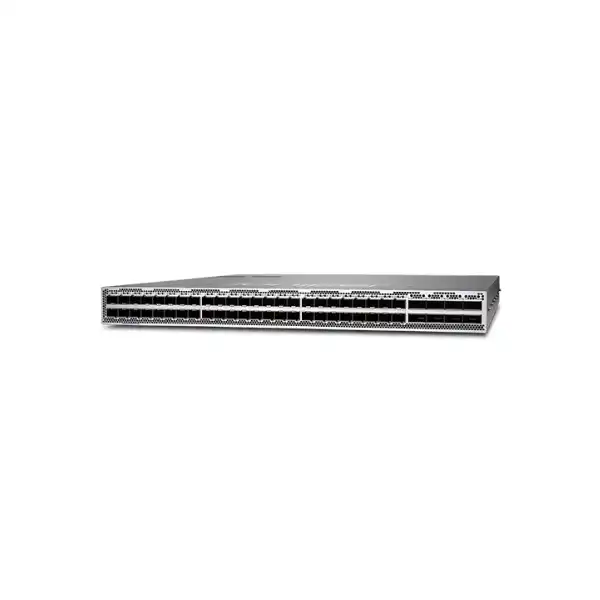
A high-density fixed 1U switch built around forty-eight SFP56-DD server-facing ports and eight QSFP-DD uplink ports, suited to modern leaf-and-spine fabrics where 100GbE downlinks, 400GbE-class uplinks, EVPN-VXLAN and Junos OS Evolved are central design requirements.
Direct answer for UAE data center buyers
Where the QFX5130-48C fits in a modern data center
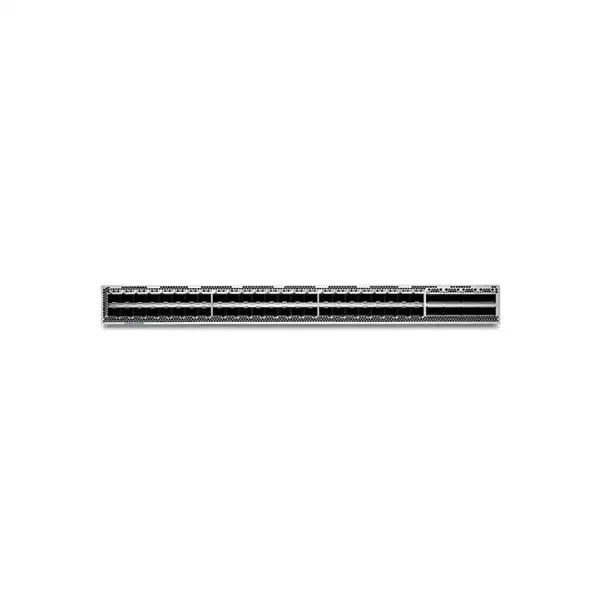
The QFX5130-48C is best understood as a high-density 100GbE-oriented fixed switch rather than a generic top-of-rack platform. Its front panel combines forty-eight SFP56-DD ports intended for high-speed server-facing connectivity with eight QSFP-DD ports that can operate at higher speeds for aggregation or spine-facing links. That physical mix makes the model especially relevant when the data center is moving beyond 10GbE and 25GbE as the dominant server access speed and wants a compact platform that can accommodate a substantial number of 100GbE endpoints without consuming multiple rack units.
For an enterprise buyer in Dubai, the attraction is not simply the headline number of ports. The important question is how the port geometry maps to the actual fabric. A typical leaf design needs enough downlinks for servers or appliances, sufficient uplink bandwidth toward the spine, and enough flexibility to handle a transition period in which not every endpoint runs at the same speed. The QFX5130-48C supports multiple speeds on its SFP56-DD and QSFP-DD interfaces, so it can serve a mixed migration plan provided the selected transceivers, cables, breakout assemblies and Junos release are supported for the intended combination.
It also occupies a specific position inside the QFX5130 family. The QFX5130-32CD and QFX5130E-32CD emphasize 32 native 400GbE QSFP-DD ports and higher aggregate switching capacity, while the QFX5130-48C emphasizes a large count of 100GbE server-facing ports plus eight 400GbE-class uplinks. The QFX5130-48CM is physically similar to the 48C but adds MACsec capability. These distinctions matter because a buyer can easily choose the wrong family member if the purchase is based only on the QFX5130 name.
A strong selection process therefore starts with traffic architecture rather than model preference. Count the physical endpoints, determine which ones require native 100GbE, identify any 25/50GbE migration links, calculate the oversubscription ratio that is acceptable for the workload, then establish how many 200GbE or 400GbE uplinks are required. Once that fabric math is clear, the QFX5130-48C can be assessed on technical fit rather than on a single specification.
Fast model-position checklist
- Choose the 48C when dense 100GbE access is the dominant requirement.
- Compare the 48CM when MACsec is a design requirement.
- Compare 32CD/32CD-E when the architecture needs a larger number of native 400GbE ports.
- Confirm optics and breakout compatibility rather than assuming every physically compatible module is supported.
- Select airflow and power variants to match the rack and facility standards before purchase.
- Size the fabric from traffic and growth assumptions, not merely from current port count.
Juniper QFX5130-48C key specifications
The table below concentrates on values that directly affect design, rack planning, interface selection and procurement. Software behavior and feature support can depend on Junos OS Evolved release, licensing and the exact deployment architecture, so those elements should be validated as part of the solution rather than inferred from the hardware alone.
| Specification | QFX5130-48C detail |
|---|---|
| Form factor | Fixed 1U spine/leaf switch; the 48C variant is specified without MACsec. |
| Network access ports | 48 × SFP56-DD ports supporting 100/50/25/10GbE operating modes, subject to supported optics/cabling and configuration. |
| High-speed uplink ports | 8 × QSFP-DD ports supporting 400/200/100/40GbE operating modes, with supported channelization options. |
| Additional 10GbE ports | 2 × SFP+ 10GbE ports. |
| System throughput | Up to 8 Tbps unidirectional / 16 Tbps bidirectional. |
| Forwarding capacity | Up to 2.7 billion packets per second. |
| Buffer capacity | 82 MB. |
| MAC addresses | Up to 96,000. |
| IPv4 routes | Up to 700,000 IPv4 unicast/multicast routes. |
| IPv6 routes | Up to 360,000 IPv6 unicast/multicast routes. |
| VLANs | Up to 4,000. |
| ARP entries | Up to 32,000. |
| Dimensions | Approximately 17.28 × 1.72 × 20.5 in. (43.8 × 4.3 × 52.07 cm). |
| Operating system | Junos OS Evolved. |
| Fabric overlay | EVPN-VXLAN support is part of the platform capabilities; the exact design should be validated against the intended software release and feature set. |
Port architecture, speeds and breakout planning
The QFX5130-48C’s biggest design advantage is the separation between a large block of server-facing SFP56-DD ports and a smaller block of very high-speed QSFP-DD interfaces. On ports 0 through 47, the platform can operate at 100GbE, 50GbE, 25GbE or 10GbE depending on the supported transceiver or cable and the configured mode. Ports 48 through 55 provide the QSFP-DD uplink block, with operating modes including 400GbE, 200GbE, 100GbE and 40GbE. Two additional 10GbE SFP+ interfaces are also present. This allows a single 1U switch to connect a substantial number of high-speed endpoints while retaining multiple high-bandwidth paths toward the rest of the fabric.
Breakout support expands the design space but should be planned carefully. The QSFP-DD ports support channelization options including four 100GbE channels, two 200GbE channels, eight 50GbE channels, four 25GbE channels and four 10GbE channels in supported configurations. The SFP56-DD ports can support 2 × 50GbE channelization. Juniper also publishes maximum port-count examples for the platform, including configurations that can reach 72 ports of 100/50/25GbE plus the two 10GbE ports, depending on how the available interfaces are channelized. The important procurement lesson is that a breakout specification is not merely a logical configuration choice: it changes the required cable assemblies, transceivers, patching plan, port labels and sometimes the practical rack-cabling density.
A 100GbE server port can be delivered through different physical media depending on distance and server NIC support. Direct-attach copper can be attractive inside a rack for short distances, active optical cables can simplify some point-to-point runs, and pluggable optical modules are usually required for structured fibre systems or longer reach. The correct option depends on the transceiver compatibility matrix, reach, fibre type, connector standard, patch-panel design and the exact NIC or peer-switch interface. It is therefore unsafe to treat the switch chassis and optics as independent purchasing decisions.
For a new UAE build, develop a port schedule before requesting the final commercial quote. Each planned port should have a role, target speed, media type, reach, peer device, redundancy status and whether it is native or a breakout lane. This prevents common mistakes such as ordering a 400GbE optic where a breakout cable is required, mixing incompatible fibre types, or discovering after installation that the rack contains more 25GbE legacy endpoints than the original design assumed.
SFP56-DD access block
Use the 48-port block where the primary requirement is server or appliance connectivity at 100/50/25/10GbE. Validate the exact module or cable with Juniper’s hardware compatibility information and the peer interface.
QSFP-DD uplink block
Use the eight high-speed ports for 400/200/100/40GbE links, including spine-facing uplinks and supported breakout designs. The oversubscription ratio should be calculated from the planned traffic profile rather than guessed from port count.
Optics are part of the design
Specify reach, fibre type, connector, power class, temperature expectations and interoperability requirements with the switch order. High-speed optical compatibility is an engineering dependency, not a last-minute accessory choice.
Throughput, forwarding scale and what the numbers mean
The QFX5130-48C is specified for up to 8 Tbps of unidirectional switching capacity, corresponding to 16 Tbps when the vendor states bidirectional throughput, and up to 2.7 billion packets per second. Those figures establish the raw forwarding class of the platform, but they do not by themselves determine how a real fabric will behave. Data center performance depends on the traffic matrix, packet-size distribution, congestion points, oversubscription ratio, queue policy, endpoint behavior and how links are bundled or distributed across the topology.
The platform’s 82 MB buffer is another design input. The QFX5130 family does not position itself as a deep-buffer switch; instead, it uses data center quality-of-service mechanisms such as priority-based flow control and explicit congestion notification for workloads that require managed congestion behavior. That matters in environments carrying storage, HPC or other burst-sensitive traffic. A buyer should not equate a high switching-capacity figure with unlimited absorption of microbursts. If the workload is especially sensitive to transient congestion, validate the queue design, PFC/ECN strategy, NIC behavior and traffic engineering model rather than relying on a generic “nonblocking” assumption.
Forwarding scale should also be read in context. Juniper lists up to 96,000 MAC addresses, 700,000 IPv4 routes, 360,000 IPv6 routes, 4,000 VLANs and 32,000 ARP entries for the QFX5130-48C/48CM class. These are generous figures for many leaf-and-spine environments, but very large multi-tenant, service-provider or route-heavy designs should still compare their projected control-plane and forwarding-table requirements against validated release-specific scale guidance. The simple count of physical ports rarely exposes these limits, which is why capacity planning should include route, MAC, VLAN, EVPN and endpoint growth.
For a practical procurement exercise, state the expected number of racks, leaf switches, connected hosts, VLANs or VNIs, routed prefixes, tenant segments and uplinks. That gives the solution designer enough information to decide whether the QFX5130-48C scale is comfortably above the requirement or whether a different architecture is more appropriate.
EVPN-VXLAN, Junos OS Evolved and fabric operations
The QFX5130-48C runs Junos OS Evolved and supports EVPN-VXLAN, making it relevant to organizations building an IP underlay with an overlay fabric for scalable Layer 2 and Layer 3 services. EVPN uses BGP control-plane signaling while VXLAN provides the data-plane encapsulation across the IP fabric. The combination is widely used to avoid the operational and scaling constraints of extending traditional Layer 2 domains across large data centers. The switch can therefore participate in designs where endpoint reachability, virtual networks and routed services are distributed across a leaf-and-spine topology.
However, “supports EVPN-VXLAN” is not a complete design statement. The fabric still needs decisions around underlay routing, loopback addressing, ASN strategy, route-reflector placement, VTEP behavior, VLAN-to-VNI mapping, anycast gateway design, multihoming, policy, telemetry and day-two operations. Some deployments are straightforward single-site fabrics; others involve inter-data-center connectivity, border-leaf roles, external routing, firewall service insertion or automation systems. The hardware model should be evaluated within that whole operating model.
Juniper also documents onboarding of QFX5130 devices with Apstra, and the QFX5130-48C appears in Juniper Mist supported-hardware information. These management options can be important when the goal is to reduce configuration drift and move from device-by-device CLI operations toward intent-based or cloud-assisted operations. They should not be assumed to eliminate design work. The team still needs to define the desired topology, supported software versions, credentials, management reachability, out-of-band networking, change-control procedures and how automated intent integrates with existing monitoring and ticketing processes.
Organizations already standardized on Junos can benefit from operational consistency, while teams migrating from another switching platform should budget time for command-model differences, automation updates, template conversion and training. For a brownfield migration, it is often better to construct the new EVPN-VXLAN fabric in parallel, validate reachability and routing policy, move workloads in controlled groups, and maintain an explicit rollback plan rather than attempting a single large cutover.
When requesting a quotation, it is useful to state whether the project expects traditional Junos CLI management, Apstra-based fabric management, Mist cloud workflows, or integration with existing automation. That information affects licensing discussions, deployment services, staging effort and the acceptance test plan.
Quality of service, congestion and storage/HPC considerations
High-performance computing, AI infrastructure, distributed storage and east-west application traffic can generate bursts that are very different from ordinary office network traffic. The QFX5130 family is designed around high-speed Ethernet forwarding with QoS mechanisms rather than a deep-buffer architecture. Juniper specifically highlights priority-based flow control using DSCP and explicit congestion notification as tools for managing workloads such as storage traffic. That makes configuration quality important: a poorly designed lossless or near-lossless policy can spread congestion rather than solve it.
For storage designs, identify the protocol and endpoint behavior first. An Ethernet switch cannot compensate for incompatible or poorly tuned hosts. NIC queue settings, PFC priorities, ECN marking thresholds, link utilization, application burst patterns and congestion-control behavior all influence results. If the environment carries RoCE or another traffic class with strict latency or loss expectations, the switching policy needs to be designed with the server and storage teams rather than as a standalone network configuration.
The same applies to HPC and research networks. Aggregate bandwidth is important, but so are flow distribution, topology symmetry and uplink planning. A leaf with forty-eight 100GbE-capable access interfaces can theoretically attach an enormous amount of endpoint bandwidth, yet the real oversubscription depends on how many of those ports are populated, at what speeds, and how the eight high-speed uplinks are configured. Eight 400GbE uplinks provide substantial fabric bandwidth, but a deployment should calculate the intended ratio under expected simultaneous load rather than using the maximum port capability as the workload assumption.
The practical buyer question is therefore not “Is 8 Tbps enough?” but “Does this switch provide the right combination of endpoint speed, uplink bandwidth, buffer behavior and congestion tooling for our traffic pattern?” A useful proof-of-concept can include representative packet sizes, east-west flows, failure tests and congestion events. That gives far more confidence than a throughput number viewed in isolation.
MACsec requirement: a critical 48C versus 48CM decision
One of the most important model-specific limitations is that Juniper identifies the QFX5130-48C as the version without MACsec, while the QFX5130-48CM is the corresponding fixed 1U model with MACsec. This distinction should be addressed at the beginning of a procurement cycle because it is not a feature that can be safely assumed from the family name or added through a generic software option after the wrong hardware has been purchased.
MACsec provides link-layer encryption on supported Ethernet interfaces and is often requested for data center interconnect, high-security campus-to-data-center links, regulated environments or architectures in which traffic must remain encrypted on physical network segments. Whether it is mandatory depends on the organization’s security architecture. Some designs rely on higher-layer encryption such as IPsec or application encryption; others specifically require IEEE 802.1AE MACsec on Ethernet links. The switch selection must follow the security control, not the other way around.
If the design does not require MACsec, the QFX5130-48C can be a logical choice and avoids paying for a capability that may not be needed. If the security team requires MACsec on relevant links, compare the QFX5130-48CM and validate the exact throughput, supported interfaces, software release and key-management approach for the intended design. Juniper lists MACsec throughput separately for the 48CM, so encryption requirements should be incorporated into performance sizing rather than treated as a purely administrative checkbox.
For UAE projects, include the security requirement in the bill-of-material discussion. A short statement such as “MACsec required on spine uplinks” or “No MACsec requirement; encryption handled elsewhere” can prevent a costly chassis mismatch and makes the 48C-versus-48CM choice explicit.
Do not overlook this
QFX5130-48C: fixed 1U variant without MACsec.
QFX5130-48CM: related variant with MACsec capability.
If encryption at Layer 2 is part of the specification, state it before quotation and confirm interface-level support for the intended design.
Power, cooling and airflow selection for Dubai data centers
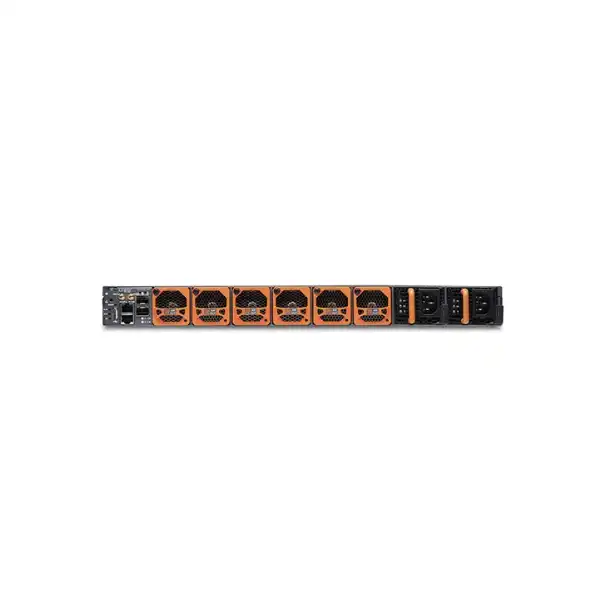
Power and airflow are not secondary purchasing details on the QFX5130-48C. Juniper offers AC and DC hardware variants and both front-to-back and back-to-front airflow directions. The ordering information distinguishes AFO models for front-to-back airflow and AFI models for back-to-front airflow. The standard AC configurations include redundant fans and two AC power supplies, while DC variants use the corresponding DC power supplies. Juniper’s hardware compatibility information lists 1+1 PSU redundancy for these variants.
For the AC model, Juniper publishes a typical power figure of approximately 219 W and a maximum of 609 W under the vendor’s stated test conditions. For DC, the published figures are approximately 238 W typical and 587 W maximum. The typical and maximum measurements are not equivalent planning numbers: the maximum is useful for circuit and worst-case thermal considerations, while actual consumption varies with workload, optics and operating conditions. Optical modules also contribute to rack power and heat, which becomes significant in a dense 100/400GbE deployment.
Airflow must match the hot-aisle/cold-aisle scheme. Installing a switch with airflow opposite to the rest of the rack can recirculate hot exhaust and reduce thermal margin even when the data hall itself is well controlled. Both the AFO and AFI QFX5130-48C variants are specified for an operating temperature range up to 40°C under the published conditions, but data center planning should preserve margin below the hardware limit. Dubai’s outdoor climate does not directly determine equipment temperature inside a conditioned facility, yet it increases the importance of dependable cooling infrastructure, containment, monitoring and an accurate rack heat-load calculation.
High-power coherent optics deserve additional attention. Juniper positions the QFX5130 line for use with 400G-ZR and 400G-ZR-M optics in relevant edge and data center interconnect scenarios, but the exact module, airflow direction, temperature condition and software support must be checked. The platform datasheet includes environmental qualifications for these optics, so a long-reach DCI design should not reuse the thermal assumptions of a short-reach DAC design.
A good UAE bill of materials therefore specifies rack airflow direction, power feed type, redundancy expectation, plug and PDU requirements, expected optics, and whether the switch will sit in a conventional leaf rack, a high-density HPC cabinet or a DCI edge position. That level of detail helps avoid mismatched power supplies and cooling orientation after delivery.
Rack installation, cabling and management interfaces
The QFX5130-48C occupies one rack unit and is approximately 20.5 inches deep, but a successful installation requires more than checking the rack-unit count. Juniper’s hardware guidance describes installation in a four-post rack or cabinet. The deployment team should verify rail compatibility, front and rear clearance, cable bend radius, access to hot-swappable components, grounding, PDU location and whether high-density fibre or breakout cabling will obstruct service access.
The management panel is on the rear of the QFX5130-48C/48CM and includes a dedicated RJ-45 management port, an RJ-45 console port, a USB Type-A slot, chassis status LEDs, a reset control, two SFP+ ports, power supplies, fans and timing interfaces for 10 MHz and 1 PPS clock signals. The presence of these interfaces is useful in environments that need out-of-band management and timing integration, but they also influence physical rack design because operations staff may need rear access for console, management, USB or timing connections.
The management network should be designed before staging. Assign management IP addressing, define AAA or local access procedures, establish DNS and NTP where required, confirm software images, and decide whether onboarding will use manual Junos workflows, Apstra, Mist or another automation layer. If console servers are part of the standard rack design, include the correct console cabling in the project materials rather than assuming it is available on site.
High-density front-panel cabling benefits from disciplined labeling. A 1U switch carrying dozens of 100GbE-class links and multiple 400GbE uplinks can become difficult to service if fibre jumpers, DACs and breakout legs are not mapped accurately. Label each cable at both ends with the local port, remote device and remote port. For breakouts, use a naming convention that identifies the parent physical interface and individual lane. This makes troubleshooting much faster during failures and prevents accidental removal of the wrong breakout leg.
Finally, treat optics insertion, ESD protection, grounding and cable management as part of the acceptance procedure. High-speed Ethernet links are sensitive to physical-layer cleanliness and correct module selection, so installation quality has a direct effect on error rates and operational stability.
Optics, DACs, AOCs and compatibility decisions
Optical and cable selection is one of the largest sources of avoidable risk in a 100/400GbE project. The QFX5130-48C provides physical cages that support a broad range of speed modes, but the correct media must be supported by the switch, match the configured speed, reach the intended distance, use the correct fibre or copper medium, and interoperate with the peer interface. A module that physically fits a cage is not automatically a validated choice.
For short server links, direct-attach copper may minimize transceiver count and power. Active optical cables can provide a pre-terminated optical connection where structured patching is not required. Pluggable optical transceivers become important when the connection uses patch panels, longer distances or specific fibre infrastructure. At 100GbE and 400GbE, connector format and lane mapping also matter; MPO/MTP-based multimode designs, duplex single-mode designs and coherent optical links have very different patching and operational characteristics.
Breakout designs require special care. A single QSFP-DD interface can be channelized into multiple lower-speed logical links in supported combinations. That can be attractive for migration or for increasing port density, but the physical assembly must map correctly to the breakout mode. The server NIC or peer switch also needs the intended speed and FEC behavior. During design, document the parent port, each breakout lane, cable part number, remote port and expected configuration. Without that record, troubleshooting a failed lane can become unnecessarily difficult.
For DCI, Juniper highlights support for high-power 400G-ZR and 400G-ZR-M optics within the QFX5130 line, which can allow a switching platform to participate directly in certain coherent optical applications. This is a specialized design area. Reach, optical budget, DWDM plan, coherent module support, thermal constraints, forward-error correction, link partner behavior and operational responsibility must be reviewed. Do not extrapolate a coherent DCI bill of materials from a short-reach 400GbE data-center link.
FourTeck can use a port schedule to align the chassis with the required optics and cabling. For each link, provide the two endpoint models, interface type, target speed, approximate distance, fibre/copper type and whether the link is native or broken out. That information is more useful for an accurate quote than simply asking for “48 optics” alongside the switch.
Software subscriptions, feature entitlement and lifecycle planning
The hardware is only one part of a production data center switch purchase. Juniper’s ordering information for the QFX5130 family includes base software with hardware configurations and separate software subscription options for advanced capabilities. Exact entitlement depends on the feature package, term and commercial program in effect at the time of purchase. Because software licensing can evolve, the safest approach is to specify the required operational capabilities and ask for a quote that explicitly lists the included software, subscription level and term rather than assuming the chassis price represents the complete solution.
Start by identifying what the switch must do. Requirements may include EVPN-VXLAN, advanced routing, automation, telemetry, fabric management, support services or other functions whose commercial entitlement needs verification. Then determine how the organization wants to operate the environment: pure Junos OS Evolved CLI, Junos automation, Apstra intent-based management, Mist workflows, or an integration with an existing orchestration platform. The licensing discussion should follow that operating model.
Support coverage is equally important. Data center switches usually serve critical infrastructure, so the procurement team should decide the desired support term, response expectations, software access and hardware-replacement requirements. The best support choice depends on the organization’s spare strategy and operational tolerance. A site with on-site cold spares may accept a different service level than a single-device deployment where a hardware failure would create an immediate capacity problem.
Lifecycle planning should also include the Junos release strategy. Newer releases can introduce features, hardware support and fixes, but production environments typically require a controlled qualification process. Establish the target version, review release notes, check feature dependencies and ensure the chosen optics and management systems are supported by that release. If the switch joins an existing Juniper fabric, version interoperability and upgrade sequencing need to be part of the change plan.
For quotation accuracy, provide the expected subscription term, desired support term, management method and any named features that are mandatory. This lets the commercial configuration be built around the real requirement rather than a generic chassis-only order.
Available QFX5130-48C hardware variants
The exact part number matters because power type and airflow direction are encoded in the QFX5130-48C hardware variants. A data center purchase should therefore name the required variant rather than using only the family model.
| Part number | Power | Airflow | Buyer relevance |
|---|---|---|---|
| QFX5130-48C-AFO | AC | Front-to-back | Common fit where rack cold air enters at the port side and exhaust exits the rear, subject to site layout. |
| QFX5130-48C-AFI | AC | Back-to-front | Use where the facility’s rack orientation requires the reverse airflow direction. |
| QFX5130-48C-D-AFO | DC | Front-to-back | For facilities using DC feeds while retaining front-to-back cooling orientation. |
| QFX5130-48C-D-AFI | DC | Back-to-front | For DC-powered racks that require back-to-front airflow. |
| QFX5130-48C-CHAS | Chassis only | Depends on separately selected components | Use only when the bill of materials deliberately includes the correct compatible power supplies and fan assemblies separately. |
Sizing a QFX5130-48C leaf fabric
Sizing begins with endpoint demand. Count the servers, storage nodes, appliances and other devices that must connect to each leaf pair. For every endpoint, record the number of NIC links, target speed and redundancy model. A dual-homed server with two 100GbE links consumes a different set of physical ports and uplink bandwidth than a single-homed server with one 25GbE connection. The 48 SFP56-DD interfaces are highly flexible, but the design should reserve capacity for growth and maintenance rather than plan every port at full utilization on day one.
Next calculate uplink requirements. Eight QSFP-DD ports provide multiple ways to connect to spine switches. A leaf could use a subset of the ports at 400GbE, more links at lower rates, or supported breakouts depending on topology. The objective is not always zero oversubscription. Many enterprise workloads operate efficiently with an intentional ratio, while HPC, AI or storage fabrics may require far more aggressive uplink provisioning. Define the expected concurrent east-west load, then calculate the downlink-to-uplink ratio using the actual active port speeds rather than the theoretical maximum of every interface.
Redundancy architecture changes the calculation. In a common dual-leaf design, endpoints are connected to two switches, and the fabric must continue operating after a leaf, link or spine failure. That means the surviving paths need enough headroom to carry degraded-state traffic. A design that looks comfortable under normal operation can become congested during a maintenance or fault event if uplink capacity was calculated only for steady state.
Control-plane scale is another dimension. Estimate MAC addresses, IP routes, VLANs, ARP/ND entries, EVPN routes and tenant segmentation. Compare those numbers with the published platform scale and preserve margin. Large virtualized environments can create far more logical endpoints than the physical server count suggests, especially when network virtualization, containers or multi-tenant services are involved.
Finally, include growth. If the facility expects to move from 25GbE to 100GbE server NICs during the next hardware refresh, the QFX5130-48C can provide a useful migration path, but optics, cabling and uplink capacity must evolve with it. A three-year port and traffic forecast is often more useful than a snapshot of current demand.
Deployment and migration journey
Document port speeds, endpoint counts, uplink ratios, routing scale, EVPN-VXLAN needs, MACsec requirement, management platform, support term and growth assumptions. This prevents the hardware decision from being detached from the fabric architecture.
Select the exact AC/DC and AFO/AFI chassis, power cords or DC requirements, supported transceivers, DAC/AOC assemblies, breakout cables, rack accessories, software subscriptions and support coverage.
Confirm hardware inventory, software release, base configuration, management reachability, authentication, NTP/DNS where applicable, automation integration and interface naming before moving the device into a production rack.
Mount in the four-post rack, verify airflow direction, connect redundant power, establish grounding, connect out-of-band management, install supported optics and label every native or breakout link at both ends.
Check underlay adjacencies, EVPN control plane, VXLAN reachability, routing policy, ECMP paths, LAGs or multihoming behavior, QoS policy, telemetry and failover. Test the actual data path rather than relying only on interface-up state.
Move endpoints or racks according to a documented sequence, monitor errors and utilization, retain a rollback path, and verify application behavior after each stage. For brownfield environments, parallel migration usually reduces operational risk.
A useful acceptance test should include link-speed verification, FEC status where relevant, optical levels, interface errors, routing convergence, EVPN state, workload reachability, uplink failure, power-supply status, fan status and management access. Where storage or HPC traffic is involved, include congestion and QoS validation under representative load. The result should be a documented baseline that operations can compare against later.
Use cases that can justify the QFX5130-48C
100GbE server leaf
The most direct fit is a leaf rack with a large population of servers using 100GbE-class NICs. Forty-eight SFP56-DD ports provide dense access while the eight QSFP-DD ports provide high-capacity paths to spine switches. It is especially relevant when rack space is constrained and the migration path includes 25/50/100GbE endpoints.
High-performance computing
Research and compute clusters can use the platform where high interface density, predictable east-west bandwidth and modern congestion mechanisms are important. The design still needs workload-specific assessment of oversubscription, queueing, PFC/ECN behavior, topology and endpoint tuning.
Cloud and service-provider fabric
EVPN-VXLAN, BGP-based routing and large route/MAC scale can suit multi-rack cloud or provider environments. Architects should validate tenant scale, route policy, management automation and external connectivity rather than choosing from port density alone.
Storage Ethernet
The switch can participate in high-speed storage networks where supported QoS and congestion-control techniques are configured with the endpoint stack. Because the platform uses an 82 MB buffer rather than a deep-buffer design, storage architects should validate burst behavior and loss-management strategy.
Data center interconnect edge
Juniper positions the QFX5130 line for edge/DCI scenarios including supported high-power 400G-ZR/ZR-M optics. A coherent DCI design requires explicit validation of optics, reach, thermal conditions, FEC, line system or dark-fibre architecture and security requirements.
25/50GbE migration toward 100GbE
The multi-rate access ports can support a phased transition where not every endpoint is upgraded at once. The benefit is strongest when the project has a clear optics and breakout plan, enough uplink headroom and a realistic server-refresh schedule.
When the QFX5130-48C may not be the right choice
A technically capable switch is not automatically the correct switch for every data center. The QFX5130-48C can be oversized for an environment whose server access will remain primarily 1/10/25GbE and where 100GbE density is not expected during the platform’s useful life. In that case, a lower-density or lower-speed switch may reduce optics cost, power and unnecessary capacity while still meeting application needs.
It can also be the wrong family member when native 400GbE density is the primary requirement. The QFX5130-32CD/32CD-E class provides 32 native 400GbE QSFP-DD ports and higher switching capacity, making it a more natural comparison for spine roles or architectures built around many 400GbE interfaces. Conversely, if the project’s defining requirement is forty-eight 100GbE server-facing links, the 48C geometry can be more efficient.
Security can rule the 48C out as well. If mandatory controls specify MACsec on the links served by this switch, the 48CM should be evaluated because the 48C is the non-MACsec model. Do not attempt to solve a hardware capability gap with vague assumptions about software licensing.
Buffer behavior can also influence selection. Workloads that explicitly require a deep-buffer architecture should be evaluated against platforms designed for that behavior rather than assuming QoS tuning changes the underlying buffer model. Similarly, if the network requires a specific third-party network operating system or hardware abstraction environment, confirm support before purchase; the QFX5130-48C is positioned around Junos OS Evolved and Juniper’s associated operational ecosystem.
The best shortlist compares architecture, not brand names. A model should remain on the list only when its port mix, scale, software, security, optics, thermal profile, management and commercial support align with the project.
QFX5130-48C vs QFX5130-48CM vs QFX5130-32CD
| Decision area | QFX5130-48C | QFX5130-48CM | QFX5130-32CD |
|---|---|---|---|
| Primary port emphasis | 48 × 100GbE-class SFP56-DD plus 8 × 400GbE-class QSFP-DD | Same general 48 + 8 high-density geometry | 32 × 400GbE QSFP-DD |
| Switching capacity | 8 Tbps | 8 Tbps | 12.8 Tbps |
| MACsec | No | Yes, subject to supported design and throughput | Evaluate separately against the exact security requirement |
| Best comparison trigger | Dense 100GbE server access without MACsec requirement | Dense 100GbE access where MACsec is required | Higher native 400GbE port density or higher aggregate switching capacity |
| Form factor | 1U fixed | 1U fixed | 1U fixed |
This comparison is intentionally architectural rather than exhaustive. The right model depends on how many ports are needed at each speed, whether MACsec is mandatory, the target oversubscription ratio, routing/EVPN scale, optics strategy, software features and lifecycle plan. A buyer should also compare commercial availability and support options at the time of quotation.
Procurement guidance for Dubai and UAE projects
A useful procurement request for the Juniper QFX5130-48C should be specific enough that the supplier can configure the complete solution. Start with quantity and the precise deployment role. “Two switches for a dual-leaf rack” conveys more design information than “need two QFX5130-48C units.” Add the target server port count, the speeds that must be supported on day one, the expected future speed mix and the number and speed of spine uplinks.
State the power and airflow requirement explicitly. If the facility uses AC feeds and front-to-back airflow, the AFO AC variant is a likely hardware direction; if the rack requires back-to-front airflow, the AFI variant should be selected. DC facilities require the corresponding DC model. Confirm local PDU standards, power cords and whether dual independent power feeds are available. The presence of redundant power supplies is most valuable when they are actually connected to independent upstream power sources.
Optics should be itemized per link type. For example, the server-access section of the quote might distinguish short-reach DACs from optical 100GbE links, while the spine-facing section lists the required 400GbE optics or cable assemblies. Breakout connections should be identified separately. If the project reuses existing transceivers, provide exact part numbers so compatibility can be checked instead of assuming reuse is possible.
Commercial software and support need their own line items. Define the preferred subscription term, support duration and any fabric-management requirements. If Apstra or Mist is expected, state that in the request. If the organization only needs the switch hardware with a specific Junos feature set, say so and list the required functions. This reduces the chance of receiving a price that appears attractive but omits the entitlement needed for the production design.
Finally, identify service scope. Some buyers need supply only; others need staging, configuration, rack installation, migration support, acceptance testing and documentation. These are different projects and should be quoted accordingly. For brownfield environments, sharing the existing topology and peer-device models can expose compatibility or migration dependencies before equipment reaches the site.
FourTeck can structure the quote around these inputs so the bill of materials reflects the actual data center rather than a chassis-only request. Stock status, lead time and pricing should be confirmed at the time of quotation because they can change with supply and project quantity.
Operational resilience and day-two management
Data center availability depends on architecture more than on any single switch feature. The QFX5130-48C provides redundant power-supply and fan designs in standard configurations, but service continuity also requires redundant upstream paths, appropriate multihoming or LAG design, resilient routing and a maintenance strategy that allows components or software to be serviced without creating an unacceptable application outage.
At the fabric level, design for the loss of a link, a spine, a leaf and a power feed. Verify that the surviving paths have enough capacity to carry expected traffic. ECMP and EVPN can provide powerful redundancy mechanisms, but the implementation must be tested with real routing policy and application flows. Failure validation should include both control-plane convergence and data-plane behavior because a routing adjacency can recover while an application remains affected by asymmetric paths, stateful services or external firewall dependencies.
Monitoring should capture interface utilization, errors, discards, optical levels, queue behavior, CPU and memory status, power supplies, fans, temperature and routing protocol health. For EVPN-VXLAN, operations also need visibility into BGP EVPN sessions, VTEP reachability, MAC/IP advertisement and tunnel state. High-speed fabrics can move a large amount of traffic before a human notices a problem, so telemetry and alert thresholds should be designed during deployment rather than after the first incident.
Configuration management is another resilience tool. Whether the organization uses Apstra, Mist, Junos automation or a separate configuration-management system, maintain a known intended state and an audit trail of changes. Device-level manual edits made outside the standard workflow can create inconsistencies that are difficult to diagnose across a fabric. If emergency CLI changes are allowed, define how they are reconciled back into the authoritative configuration source.
Keep spare and replacement strategy aligned with business impact. For critical sites, a local spare switch or spare optics may be justified even with vendor support. For less critical environments, enhanced support coverage may provide an acceptable balance. The correct answer depends on recovery-time objectives, not on a generic recommendation.
Security and network policy considerations
Security for a QFX5130-48C deployment should be designed across management, control plane and data plane. Begin with management isolation. The dedicated RJ-45 management port enables an out-of-band network that can remain reachable even when production routing is disrupted. Protect that management path with controlled administrative access, centralized authentication where appropriate, secure protocols and logging. Console access should be physically and procedurally protected because it can bypass parts of the normal network access path.
Control-plane security includes routing authentication and policy, filtering of management traffic, protection of BGP sessions, careful route import/export and safeguards against accidental route leakage. In an EVPN-VXLAN fabric, tenant segmentation and external routing policy should be defined explicitly. A fabric can be technically converged while still violating security intent if route targets, VLAN/VNI mappings or border policies are incorrect.
The data plane may require ACLs, segmentation and external security services. Juniper publishes firewall-filter scale for other members of the QFX5130 family and release-specific feature documentation for the platform; the exact filter behavior and scale required for a 48C design should be verified against the intended Junos version. Avoid treating the switch as a replacement for a firewall unless the architecture explicitly calls for switch-based filtering within its supported capabilities.
The most important hardware security consideration remains MACsec. If link-layer encryption is a required control, the 48C is not the correct assumption because it is the non-MACsec variant. Evaluate the 48CM or another platform that meets the exact encryption requirement. For DCI, also determine whether encryption is provided by MACsec, IPsec, optical-layer encryption or an application layer, and ensure that the chosen mechanism meets the organization’s threat model and compliance obligations.
Security acceptance testing should therefore include management access, authentication, logging, routing policy, segmentation, filter behavior and any required encryption. Treat these as measurable outcomes rather than as configuration checklist items.
Frequently asked buyer questions
Is the QFX5130-48C mainly a leaf or a spine switch?
Juniper positions it as a fixed spine/leaf platform, but its 48 × 100GbE-class access ports plus eight high-speed QSFP-DD uplinks make it particularly natural for dense leaf designs. Whether it serves as leaf or spine depends on the required port geometry and topology.
Does it have forty-eight 400GbE ports?
No. The 48C has forty-eight SFP56-DD ports oriented to 100GbE-class access and eight QSFP-DD ports for 400GbE-class uplinks. Buyers needing many more native 400GbE ports should compare a model such as the QFX5130-32CD.
Can the 100GbE access ports run at lower speeds?
Yes. Juniper documents 100/50/25/10GbE modes on the SFP-DD access ports. The exact cable or optic, channelization and software support should be validated for the intended peer devices.
Does the QFX5130-48C support MACsec?
The 48C is the non-MACsec variant. If MACsec is required, evaluate the QFX5130-48CM and confirm the exact interface, performance and software requirements for the encrypted links.
What software does it run?
The QFX5130-48C runs Junos OS Evolved. It can also be used in Juniper operational ecosystems that include Apstra onboarding and supported Mist workflows, subject to the chosen design and licensing.
Does it support EVPN-VXLAN?
Yes. EVPN-VXLAN is a supported overlay architecture for the QFX5130 family. Production design still requires release-specific validation of the required features, scale, automation and interoperability.
How much power should be planned?
Juniper publishes approximately 219 W typical and 609 W maximum for AC QFX5130-48C/48CM systems under stated test conditions, and approximately 238 W typical / 587 W maximum for DC. Include optics and facility margin in the actual rack power calculation.
Which airflow version should we order?
Order AFO for front-to-back airflow or AFI for back-to-front airflow according to the rack’s hot-aisle/cold-aisle orientation. Do not select the direction by preference; match the facility design.
Can we reuse existing 100GbE or 400GbE optics?
Possibly, but reuse should be validated by exact transceiver part number, link speed, reach, fibre type, peer device and Juniper compatibility information. Physical fit alone is not enough evidence.
Is 82 MB of buffer suitable for storage traffic?
Suitability depends on the storage protocol and congestion design. The QFX5130 uses QoS tools such as PFC and ECN rather than a deep-buffer approach. Validate the complete host, NIC, queue and traffic behavior for storage or HPC workloads.
Can FourTeck provide only the switch chassis?
A chassis-only quote can be prepared when that is genuinely the requirement, but most production deployments also need the correct power/airflow variant, optics or cables, software entitlement and support. Supplying the intended topology allows a more complete bill of materials.
What information is needed for an accurate UAE quote?
Provide quantity, access-port speeds, uplink speeds, optics/reach, airflow, AC or DC power, MACsec requirement, software or management needs, support term and whether installation or migration services are required.
Decision recap
The QFX5130-48C is most compelling when the project genuinely needs a dense 100GbE-oriented leaf platform with high-speed 400GbE-class uplinks. The chassis is only one layer of the decision; the final design is shaped by optics, airflow, power, routing scale, fabric architecture, QoS requirements, management software and security policy.
What FourTeck needs for an accurate QFX5130-48C quotation
A complete quotation is easier to produce when the request includes the design inputs that determine the actual bill of materials. The following information is particularly useful for this model.
Number of switches and whether each will serve as leaf, spine, border, DCI edge or another role.
Number of 100/50/25/10GbE endpoints, NIC redundancy and expected growth.
Required 400/200/100/40GbE uplinks, desired oversubscription ratio and spine topology.
DAC, AOC, multimode or single-mode fibre; approximate distance; breakout needs; peer devices.
AC or DC feed plus AFO front-to-back or AFI back-to-front airflow.
Whether MACsec is required on any links; this can change the model recommendation to 48CM.
Junos feature requirements, Apstra or Mist use, subscription term and automation expectations.
Support duration, staging, rack installation, migration assistance, testing and documentation scope.
Plan the Juniper QFX5130-48C around your real fabric
For a reliable Dubai or UAE deployment, match the QFX5130-48C to the server-speed roadmap, uplink ratio, optics, airflow, power, EVPN-VXLAN architecture and security requirements before the bill of materials is finalized. FourTeck can help turn those engineering inputs into a practical supply, licensing and deployment quotation without assuming that one hardware configuration fits every data center.

Reviews
There are no reviews yet.