
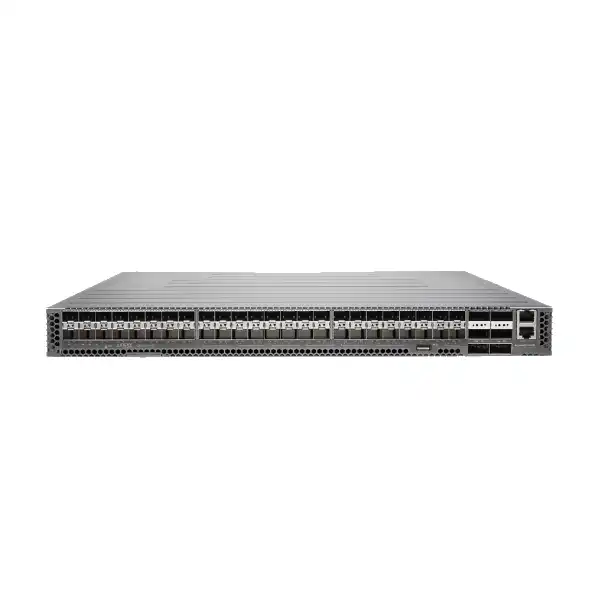
Juniper QFX5200 Data Center Switch Dubai
The Juniper QFX5200 family is built for line-rate, low-latency 10/25/40/50/100GbE data center fabrics. The purchasing decision is not simply “QFX5200 or not”: buyers must identify the correct model, port personality, breakout plan, Junos software entitlement, optics, airflow, power design and lifecycle position before a bill of materials is finalized.
Direct answer: what is the Juniper QFX5200 and who should consider it?
What exactly is it?
QFX5200 is a Juniper Networks family of fixed 1U data center switches. The family includes models with different physical interfaces and software characteristics, so “QFX5200” should be treated as a platform family rather than as one universal port configuration.
What is it mainly used for?
Its principal role is high-speed data center switching in IP fabrics. Depending on the model and port plan, it can operate as an access, leaf, aggregation or lean-spine platform and can support modern routed-fabric designs including EVPN-VXLAN when the required software features and design conditions are met.
Who should consider it?
Enterprises, service providers, hosting environments, private clouds and data center operators that need dense 10/25GbE server connectivity or 40/100GbE fabric connectivity should evaluate the QFX5200 where its speed mix, scale and lifecycle align with the intended deployment.
What is the most important factor to confirm?
Confirm the exact chassis model and port-speed plan first. A QFX5200-32C built around QSFP28 interfaces has a very different cabling and breakout strategy from a QFX5200-48Y built around forty-eight SFP28 access interfaces and six QSFP28 uplinks.
What can FourTeck help determine?
FourTeck can help translate the network requirement into a complete quotation: chassis variant, software licensing, optics or DAC/AOC media, breakout cables, airflow orientation, power supply type, rack accessories, support term and any implementation or migration services required in Dubai or elsewhere in the UAE.
Understanding the QFX5200 family before you buy
The QFX5200 occupies an important position in Juniper’s high-speed data center switching portfolio because it was designed around compact 1U form factors, low latency and a choice of port configurations that suit both server-facing and fabric-facing roles. That versatility is useful, but it also creates the most common procurement mistake: treating every QFX5200 reference as though it describes the same switch. It does not. The QFX5200-32C is based on thirty-two QSFP28-class interfaces and can be configured for 100GbE, 50GbE, 40GbE, 25GbE or 10GbE use depending on interface mode and breakout. The QFX5200-48Y instead provides forty-eight SFP28 ports for native 10/25GbE access plus six QSFP28 ports for 40/100GbE connectivity. The physical interfaces therefore lead to different rack cabling, transceiver counts, breakout strategies and oversubscription choices.
For a buyer, the right starting point is the traffic architecture rather than the headline throughput. Count the number of server, storage, firewall, load-balancer and inter-switch links that must terminate on each switch. Identify which endpoints are 10GbE, which are 25GbE, and which fabric links need 40GbE or 100GbE. Then establish whether the design uses direct single-lane optics, multi-lane QSFP optics, DACs, AOCs or breakout harnesses. A switch with ample theoretical capacity can still be the wrong operational fit if its connector types force an awkward cabling design or consume more breakout assemblies than the rack standard permits.
The QFX5200 also belongs in a software-defined fabric conversation, not merely a port-count conversation. Junos OS provides the control and management framework, while features used in routed fabrics, EVPN, VXLAN, BGP, IS-IS, MPLS and advanced automation can depend on the hardware variant, software release and license tier. Juniper’s licensing model has evolved over the platform’s lifetime, which means a quotation should be checked against the current licensing rules rather than copied from a historical bill of materials. This is especially important when replacing an older QFX unit, purchasing a spare for an installed base, or mixing a new procurement with software entitlements already owned by the customer.
Lifecycle is another model-specific decision. Juniper’s current public lifecycle information lists the QFX5200-48Y chassis as an end-of-life product with support milestones, while the mainstream QFX5200-32C remains represented in current QFX licensing documentation. That does not automatically make a 48Y unusable in an existing environment, but it changes the purchasing question from “is this a good port layout?” to “is this the right platform for the required operating horizon, support policy and spare strategy?” New greenfield deployments should always compare the desired QFX5200 configuration with current-generation Juniper alternatives before the design is frozen.
QFX5200-32C vs QFX5200-48Y: practical model selection
| Decision point | QFX5200-32C | QFX5200-48Y |
|---|---|---|
| Form factor / role | Fixed 1U platform suitable for access, aggregation or lean-spine designs where a QSFP28-centric interface strategy is appropriate. | Fixed 1U access/leaf design aimed at environments that want native SFP28 server-facing 10/25GbE ports with higher-speed QSFP28 uplinks. |
| Primary front-panel interfaces | 32 QSFP+/QSFP28 sockets. Port mode and breakout determine whether these become 10, 25, 40, 50 or 100GbE logical interfaces. | 48 SFP28 ports for 10/25GbE plus six QSFP28 ports for 40/100GbE. The SFP28 access ports are configured for 25GbE in groups of four. |
| System throughput | Up to 6.4 Tbps bidirectional system throughput according to Juniper’s current platform specifications. | 3.6 Tbps bidirectional system throughput. |
| Maximum published Ethernet densities | Up to 128 x 10/25GbE through breakout, 32 x 40/100GbE, or 64 x 50GbE, subject to supported channelization and media. | 48 x 10/25GbE plus six 40/100GbE ports. The six QSFP28 ports can also support 4 x 10GbE breakout when operated as 40GbE. |
| Published buffer capacity | 16 MB. | 22 MB. |
| Typical buying pattern | Strong fit where the design values 100GbE density, high breakout flexibility or a compact aggregation/lean-spine role. | Historically attractive for direct 10/25GbE server access, but lifecycle status must be considered for any new purchase. |
| Lifecycle consideration | Check the exact orderable SKU, software entitlement and current Juniper support position at quotation time. | The QFX5200-48Y chassis is listed by Juniper as EOL; confirm support horizon, spares and replacement strategy before committing it to a new design. |
The table is a selection guide, not a substitute for a bill-of-materials review. Interface mode, Junos release, optics qualification, licensing and the exact hardware SKU must be checked together because a nominal port count does not tell you whether every desired speed combination can be used simultaneously.
Port architecture, channelization and breakout planning
Port planning is where the QFX5200-32C earns much of its flexibility. Its thirty-two QSFP28 sockets can operate at multiple speeds, and supported breakout modes allow a single high-speed physical port to become multiple lower-speed logical interfaces. Juniper documents automatic channelization on the QFX5200-32C in supported Junos releases based on cable type: a 40GbE port can be broken into four independent 10GbE interfaces, a 100GbE port can be broken into two 50GbE interfaces, and a 100GbE port can be broken into four 25GbE interfaces. This makes the switch useful when a rack contains a mix of 10GbE and 25GbE servers today but needs a path toward denser 100GbE fabric connectivity.
Breakout density, however, should not be interpreted as “all server ports are equivalent.” Each breakout consumes a parent QSFP28 port and introduces a physical harness or multi-lane cabling plan. That affects cable management, labeling, sparing, optics procurement and troubleshooting. A 4 x 25GbE breakout is operationally different from four native SFP28 interfaces even though both produce four 25GbE logical links. Data center teams that standardize on front-to-rear cable routing, patch panels or pre-terminated fiber need to decide whether a breakout-heavy rack is acceptable. For short server connections, qualified DAC or AOC assemblies may simplify the design. For structured fiber, the optical module and fan-out architecture must be validated against distance, fiber type and connector standards.
The QFX5200-48Y takes the opposite approach. Its forty-eight SFP28 ports are intended to provide straightforward 10/25GbE access connectivity, while six QSFP28 interfaces supply 40/100GbE uplinks. Juniper documents that the SFP28 ports default to 10GbE and must be configured in groups of four for 25GbE operation. That group-of-four behavior matters during incremental migrations. If a rack contains a mixture of 10GbE and 25GbE endpoints, the port allocation should be mapped before installation so each four-port group is assigned a compatible speed policy. The six QSFP28 ports auto-detect supported transceiver speed, and when configured as 40GbE they can be channelized to four independent 10GbE links.
A quotation therefore needs more than “32-port” or “48-port” switch language. A useful port schedule should show endpoint name, current NIC speed, target NIC speed, media type, connector type, cable distance, redundancy path and the switch port or breakout lane to be used. This small engineering step prevents late surprises such as purchasing the right switch with the wrong optical format, using an unsupported breakout pattern, or discovering that a planned 25GbE migration conflicts with the four-port grouping on the 48Y.
Performance: throughput, latency, buffering and what the numbers mean
Juniper publishes up to 6.4 Tbps bidirectional system throughput for the QFX5200-32C and 3.6 Tbps for the QFX5200-48Y. The current product specifications also list latency of 750 nanoseconds and buffer capacities of 16 MB for the 32C and 22 MB for the 48Y. These are useful platform indicators, but they should not be used as a single-number sizing method. Data center application behavior depends on traffic patterns, packet sizes, burst characteristics, oversubscription, uplink topology, routing scale, queue configuration and the way traffic is distributed across fabric paths.
For east-west server traffic, the most important architectural question is usually whether the leaf-to-spine bandwidth is proportionate to the aggregate server-facing bandwidth. A rack with forty-eight 25GbE servers can present far more theoretical edge capacity than a small number of 100GbE uplinks can carry simultaneously. That may be perfectly acceptable if application traffic is bursty and statistically multiplexed, or it may be unacceptable for storage, analytics or AI-adjacent workloads that sustain large east-west flows. Oversubscription should therefore be an explicit design choice rather than an accidental consequence of port availability.
Buffer size deserves similar context. More buffer is not automatically better, and a smaller shared buffer is not automatically a problem. What matters is whether the switching architecture and quality-of-service policy can handle the traffic profile without unacceptable loss or latency. Microbursts can occur when multiple high-speed inputs converge on a smaller egress, especially during incast patterns or when 100GbE fabric links feed slower server interfaces. Teams operating latency-sensitive applications should review queue design, ECN or congestion-management strategy where applicable, lossless requirements for storage traffic, and the behavior of the end hosts rather than assuming the switch alone solves congestion.
The practical procurement implication is straightforward: use published throughput and latency to confirm platform class, then validate the real design with a port-level traffic model. FourTeck can work from the number of racks, server links, expected uplink count, redundancy model and anticipated growth to determine whether a QFX5200 design has a reasonable oversubscription profile or whether a newer or higher-capacity platform should be evaluated.
Leaf-spine, IP fabric and EVPN-VXLAN design considerations
The QFX5200 was designed for large IP fabrics, and that makes it well suited to leaf-and-spine topologies where predictable hop count and horizontal scale are more important than a traditional three-tier campus switching hierarchy. In a typical leaf-spine design, every leaf connects to every spine, endpoints attach to leaf switches, and routing distributes traffic across multiple equal-cost paths. This architecture can reduce dependence on large Layer 2 fault domains and can make scale-out growth more systematic: add leaf capacity for more endpoints, add spine capacity when fabric bandwidth needs to increase, and preserve the routed underlay design.
EVPN-VXLAN can add an overlay that separates tenant or application segmentation from the physical IP underlay. The QFX5200 platform supports EVPN-VXLAN capabilities, but feature use must be checked against the exact model, Junos release and license entitlement. Buyers should avoid a common shortcut: specifying “EVPN-VXLAN required” without documenting what the overlay is expected to do. The design may need Layer 2 stretch, distributed anycast gateways, multihoming, tenant routing, inter-VRF policy, route reflection, external connectivity, or integration with an orchestration system. Each requirement affects the configuration and sometimes the software feature tier.
The underlay deserves equal attention. BGP is frequently used for scalable data center IP fabrics, while other routing approaches may be appropriate in existing Junos environments. Route scale, addressing, autonomous-system strategy, equal-cost multipath behavior and failure detection all influence operational quality. If the fabric connects to firewalls, WAN routers, DCI platforms or service-provider networks, the boundary between the EVPN fabric and external routing domains should be designed explicitly. This is especially important when the QFX5200 is used as an aggregation or lean-spine device rather than only as a simple top-of-rack leaf.
Multi-homing and resilience should also be defined before hardware quantities are finalized. A dual-homed server or appliance can connect to two leaf switches to avoid a single-switch dependency, but the method used to provide active-active or active-standby behavior must match endpoint capabilities and the chosen fabric architecture. Junos supports technologies such as MC-LAG and EVPN multihoming on appropriate platforms and software levels, but the correct choice depends on whether the environment is moving toward an EVPN-native design or maintaining a legacy aggregation model.
For Dubai data center deployments, the key commercial lesson is that a high-speed switch quotation should include the fabric role. A request that states “two QFX5200 switches” is incomplete unless it also says whether they are a leaf pair, an aggregation pair, spines, standalone devices or replacement units. The role determines the optics, uplink count, licensing, support design and implementation effort much more accurately than the chassis name alone.
Junos OS, feature licensing and software entitlement
Software entitlement is a procurement item, not an administrative detail to handle after the switch arrives. Juniper documents that QFX Series platforms support both subscription and perpetual licensing models, and the exact feature set depends on platform class and license tier. Current QFX licensing documentation places the QFX5200-32C in the QFX5K Class 2 group and defines Advanced and Premium feature tiers above standard software. Juniper also notes that the presence of a feature in a license tier does not guarantee that every hardware model supports that feature, so the hardware datasheet and Feature Explorer remain part of the validation process.
The QFX5200 has also existed through older licensing frameworks. Historical QFX5200 documentation describes Junos Base Software, Advanced Software and Premium Software entitlements for the QFX5200-32C, with advanced routing and fabric features such as BGP, IS-IS and VXLAN positioned above base capabilities and MPLS-related features associated with higher tiers. Current commercial quoting should not assume that an older license part number or entitlement rule still applies unchanged. The correct approach is to state the required network features and let the current license mapping be validated against the exact chassis and Junos version.
This matters most in EVPN-VXLAN, Virtual Chassis and advanced routing deployments. A switch may boot and provide basic management while the intended production feature requires an additional right-to-use entitlement. Juniper’s licensing documentation specifically notes that Virtual Chassis is a licensed feature on supported QFX platforms and that the QFX5200-32C supports up to three members. Where advanced or premium licenses are used in a Virtual Chassis, license consistency across members must be considered. A spare switch should therefore be procured with the same entitlement strategy as the production members rather than treated as bare hardware only.
Junos release selection is equally important. Hardware support, feature behavior, bug fixes and interoperability can vary by release. Production teams often standardize on an organization-approved Junos train rather than simply installing the newest image available. When a QFX5200 is being added to an existing fabric, the new device should be checked against the fabric’s approved release, routing protocol behavior, EVPN features, automation templates and operational tooling. When the project is a migration, the target release should be part of the implementation plan so configuration conversion and maintenance windows are not left until the installation date.
Define features first
List BGP, EVPN, VXLAN, MPLS, Virtual Chassis, telemetry and any other required functions before selecting the license tier.
Map to current licensing
Use the current Juniper licensing model for the exact hardware SKU and software release; do not reuse an old BOM without validation.
Align support and software
Choose hardware support, software support and entitlement terms that match the required operating horizon and internal change policy.
Virtual Chassis, standalone operation and resilience
The QFX5200-32C can operate as a standalone switch and, on supported Junos releases, can participate in an all-QFX5200-32C Virtual Chassis with up to three members. That capability can simplify management in some environments by presenting multiple physical units as a coordinated logical system. However, Virtual Chassis should be selected because it improves the operational model, not merely because it is available. A data center fabric built around independent routed leaf switches may deliberately avoid chassis-like control-plane coupling, while an existing Juniper environment may value the simpler management and familiar redundancy model of Virtual Chassis.
If Virtual Chassis is required, confirm the software release, cabling method, member roles, license requirements and failure behavior before ordering. The physical links consumed for inter-member connectivity affect the remaining port budget. The management design must also account for how software upgrades, member replacement and configuration rollback will be handled. For a three-member configuration, spare strategy becomes more important because a replacement should be compatible with the installed software and entitlement model.
Resilience at the hardware level includes redundant power and cooling. Juniper documents QFX5200 configurations with redundant power supplies and redundant fan modules. Full power redundancy requires both power supplies and, ideally, connection to independent power feeds so one upstream electrical failure does not remove both supplies simultaneously. Cooling direction must be consistent across the chassis, fans and power supplies. Mixing opposing airflow components is not supported and can compromise thermal behavior.
For highly available applications, switch-level redundancy must be considered together with endpoint and fabric redundancy. Two redundant power supplies do not protect against a complete switch failure, a software issue or a maintenance event. Dual-homing important servers and appliances across two independent leaf devices, building redundant spine paths and validating convergence behavior are the architectural controls that complement the QFX5200’s internal component redundancy.
Optics, DACs, AOCs and cabling: where many quotations go wrong
The switch chassis is only one part of a working QFX5200 deployment. Every production link needs a compatible media choice, and the correct answer depends on speed, distance, fiber plant, connector type and whether the link is a direct point-to-point cable or passes through structured cabling. A 100GbE QSFP28 uplink between adjacent racks may be served by a qualified DAC or AOC, while a longer link across a data hall may need optical transceivers and the appropriate multimode or single-mode fiber. A 4 x 25GbE breakout introduces an additional fan-out decision that must match both the switch’s parent QSFP28 interface and the four destination interfaces.
Do not specify optics only by speed. “100G optic” is incomplete because 100GbE transceivers exist for different reaches, wavelengths, fiber types and connector arrangements. The same applies to 25GbE. The required reach should be measured or obtained from the structured-cabling design. If an existing patch panel is used, connector type and fiber grade need verification. For single-mode links, the optical budget and transceiver standard should be checked. For multimode links, confirm the fiber generation and supported distance. Mixing an otherwise correct switch with an unsuitable optic can produce a link that never comes up or works unreliably at the target distance.
Breakout cabling deserves special documentation because four logical links share one parent physical interface. Each lane should be labeled at both ends, and the configuration should reflect the supported channelization mode. Spare strategy also changes: a site may need spare parent transceivers, spare fan-out cables and potentially spare endpoint optics rather than only one-for-one transceivers. In a large rack deployment, the number of breakout harnesses can affect tray capacity and serviceability, so the physical layout should be reviewed before the switch count is finalized.
Qualified media is especially important in support-sensitive environments. Juniper publishes supported transceiver and cable information for QFX platforms, and that should be used as the compatibility reference at the time of purchase. Third-party optics may be commercially attractive, but support policy, DOM behavior, coding, interoperability and warranty implications need to be understood by the customer. Where predictable vendor support is a priority, matching Juniper-qualified optics or cables to the exact switch SKU and Junos release reduces avoidable risk.
For an accurate FourTeck quotation, provide the quantity of each link speed, the approximate length of every cable run, the fiber or copper preference, the connector type at both ends and whether breakout is permitted. With those inputs, the switch and media bill of materials can be engineered as one system rather than purchased as unrelated line items.
Power, airflow, cooling and rack readiness
A QFX5200 installation should be planned as a data center appliance, not treated like a small office access switch. Juniper’s current specification page lists typical power consumption of approximately 195 W for the QFX5200-32C under its stated test conditions, with a maximum of 312 W. The QFX5200-48Y has a higher published typical and maximum figure on the current specification page. Actual consumption varies with operating conditions, optics and traffic, so rack power planning should be based on the exact SKU, power-supply type and the intended transceiver population rather than a marketing average.
Airflow orientation is critical. QFX5200 switches can be ordered for ports-to-FRUs or FRUs-to-ports airflow, and the fan modules and power supplies must match that direction. Juniper explicitly warns against mixing Airflow In and Airflow Out fans and power supplies in one chassis. In a hot-aisle/cold-aisle data center, the chosen direction should align with the rack standard so the switch takes in cool air and exhausts into the intended hot side. Ordering the wrong airflow variant can create an installation problem that is expensive to correct after the equipment arrives.
Rack service clearance also matters. Juniper’s site guidance calls for adequate space at the front and rear of the chassis and cites at least 24 inches of clearance in front and behind for service access, with larger front clearance recommended under NEBS guidance. Cabling must not obstruct fan modules or power-supply replacement. The 1U form factor reduces vertical rack consumption, but the chassis depth, cable bend radius and rear power connections still need to be checked against cabinet depth and PDU placement.
For redundant power, use both power supplies and connect them to independent feeds where the facility provides A/B power. The electrical design should confirm AC or DC requirements, plug and receptacle type, PDU capacity and local data center standards. In the UAE, these details are especially important when equipment is being installed in a colocation facility because the rack may already have defined PDU outlets, power budgets and airflow rules. A technically correct switch can still be rejected at installation if the power cords or airflow orientation do not match the assigned rack.
Installation and commissioning journey
Validate the bill of materials
Confirm the exact chassis SKU, airflow direction, AC or DC power supplies, software entitlement, support service, rack kit, console accessories, transceivers, DAC/AOC cables and breakout assemblies. Check that every network link in the design has a physical media line item.
Prepare the rack and power
Verify rack depth, front and rear clearance, mounting hardware, cable pathways, PDU outlets, A/B power feeds, grounding requirements and hot-aisle/cold-aisle orientation. Reserve switch RU positions where cable length and service access are practical.
Stage software and management
Decide the approved Junos release, management IP addressing, authentication method, NTP, DNS, syslog, SNMP or telemetry integration, configuration backup process and access-control policy before production traffic is connected.
Build and validate the fabric configuration
Apply interface breakout, VLAN or routed-port definitions, underlay routing, EVPN-VXLAN settings where used, QoS, redundancy and monitoring configuration. Validate the design against a peer-reviewed template rather than configuring each switch ad hoc.
Test before service migration
Check optics levels, interface errors, LLDP neighbors, routing adjacencies, ECMP paths, VLAN/VNI reachability, gateway behavior, redundancy failover, logging and management access. Baseline interface counters before production traffic begins.
Document the as-built environment
Record serial numbers, support entitlements, rack positions, port maps, optic types, cable IDs, Junos version, configuration backups, license status and change references. Good documentation shortens recovery time when a component eventually needs replacement.
Management, automation, telemetry and day-two operations
The operational value of a data center switch extends far beyond initial forwarding performance. QFX5200 devices are managed through Junos OS using the command-line interface over console or out-of-band management, and they can participate in broader Juniper automation and monitoring workflows. Zero Touch Provisioning is supported, making it possible to reduce manual staging when a deployment uses a controlled provisioning system. Juniper documentation also references management and monitoring through Juniper Routing Director, formerly Paragon Automation, for supported environments.
For a small deployment, administrators may be comfortable with direct Junos CLI management. At larger scale, consistency becomes more important than individual command proficiency. Configuration templates, version control, automated compliance checks and standardized interface descriptions reduce drift between leaf switches. The QFX5200 should fit the organization’s automation model: NETCONF, APIs, configuration-management tools, telemetry collectors and external orchestration may all be relevant depending on the environment. The specific feature support should be validated against the selected Junos release.
Monitoring should be planned before the network is busy. At minimum, operations teams need visibility into interface state, optical health, error counters, discards, queue behavior, CPU and memory, temperature, fan and power-supply alarms, routing-neighbor state and fabric reachability. Syslog should be centralized and time synchronized. If telemetry is used, define which metrics are actually actionable rather than streaming data without an alerting or capacity-planning objective. Baseline measurements from the commissioning period provide a useful reference when application teams later report latency or packet-loss symptoms.
Change control also deserves a design. Junos supports candidate configuration and commit workflows that can improve change safety, but a production process still needs pre-checks, peer review, rollback planning and post-change validation. In EVPN-VXLAN fabrics, a local interface change can affect overlay reachability or routing advertisements, so maintenance procedures should include fabric-level checks rather than only confirming that the changed port is up.
When FourTeck scopes QFX5200 implementation services, it is useful to know the customer’s preferred management platform, authentication source, monitoring stack, backup system, automation tooling and change-control requirements. Those inputs determine whether the project is simply hardware installation or a deeper integration into the customer’s operational environment.
Migration planning: replacing an existing switch or building a new fabric
A greenfield QFX5200 deployment and a brownfield replacement are different projects. In a greenfield fabric, the team can select IP addressing, routing protocol, overlay design, link speeds and cabling standards together. In a brownfield migration, the new switch must initially coexist with existing VLANs, trunks, routing peers, spanning-tree assumptions, firewalls, storage networks and monitoring systems. The safest plan starts by documenting the current state rather than copying the old configuration line by line.
For a top-of-rack replacement, build a complete port map of the existing switch. Record interface speed, VLAN membership, LAG membership, native VLAN behavior, MTU, QoS policy, endpoint description, optic type and redundancy partner. If the new design moves from 10GbE to 25GbE, verify that server NICs and optics support the target speed and that driver or firmware updates are not required. If the migration introduces breakout interfaces, ensure the cabling plan is reflected in both the switch configuration and physical labels.
For a fabric migration, routing relationships are more important. Identify BGP or OSPF peers, route policies, default-route sources, EVPN route types, anycast gateway behavior, external Layer 3 connections and route-leaking requirements. If the QFX5200 will be introduced gradually, define where the boundary sits between old and new fabrics during each stage. Temporary interconnects can become hidden single points of failure if their capacity and redundancy are not designed explicitly.
Maintenance windows should be based on dependency groups rather than on switch count alone. Moving a dual-homed cluster may require coordination with server teams, storage teams and application owners even when the physical cable change takes only a few minutes. A rollback plan should state which cables return to which old ports, what configuration must be restored, and which validation checks determine whether the migration proceeds or reverses. For remote data center work, out-of-band access is essential so a control-plane error does not remove the only management path.
Existing licenses and support contracts also need review. A replacement unit may not inherit an old entitlement automatically, and a chassis swap through RMA can follow different licensing procedures from a net-new purchase. Support dates matter when migrating toward a platform with lifecycle milestones. If the customer is specifically considering a QFX5200-48Y because it matches an installed base, the short-term operational convenience should be weighed against the remaining support horizon and the cost of another migration later.
FourTeck can quote migration as a separate scope from hardware supply. A useful statement of work defines discovery, design review, staging, configuration, rack installation, cable move, validation, rollback criteria, documentation and post-change support. This makes the commercial scope measurable and prevents assumptions about what “installation included” is supposed to cover.
Where the QFX5200 can fit well
100GbE-centric leaf or aggregation
The QFX5200-32C is a natural candidate when a design needs a compact 1U switch with many 40/100GbE interfaces. Its QSFP28-centric layout can serve high-speed appliances, storage systems, fabric links or breakout-based server access. The model is particularly relevant when the port plan needs flexibility between 100GbE uplinks and multiple 25GbE lanes.
Dense 25GbE server access
A QFX5200-32C can provide high 25GbE density through breakout, while the QFX5200-48Y historically provided native SFP28 access ports. For new projects, compare the operational simplicity of native SFP28 against the 48Y lifecycle status and consider current Juniper leaf platforms where a long support horizon is required.
EVPN-VXLAN fabric
The QFX5200 supports EVPN-VXLAN use cases and can participate in standards-based data center fabrics. The commercial requirement should identify overlay functions, routing protocols and management integration so the license tier and Junos release are selected deliberately.
High-speed appliance connectivity
Firewalls, load balancers, routers and storage appliances often need 40/100GbE connections with deterministic low latency. The QFX5200-32C can be considered where interface compatibility and traffic scale fit, with redundancy designed across separate switches rather than relying only on internal component redundancy.
Installed-base expansion or spares
Organizations already operating QFX5200 may value configuration familiarity and compatibility when adding capacity or keeping strategic spares. Exact hardware revision, airflow, software version, licensing and support status should match the installed estate so a spare can be introduced without creating an emergency compatibility project.
Metro or routed aggregation use
Juniper positions the QFX5200 for large IP fabrics and also references metro use cases. Suitability depends on the routing, optics, resiliency and service requirements. If the project needs deeper carrier features, long-haul optics or a longer current-generation lifecycle, a purpose-selected routing or newer QFX platform may be more appropriate.
When a different switch should be evaluated
The QFX5200 should not be recommended automatically because the model name appears in an existing design or request for quotation. A newer platform may be a better choice when the project requires a longer lifecycle horizon, native 400GbE connectivity, greater port density at newer interface speeds, a different power profile, newer silicon capabilities or a software feature that is better supported on a current-generation device. This is especially relevant for greenfield data centers expected to operate for many years without a major switching refresh.
The QFX5200-48Y deserves particular caution for new procurement because Juniper lists the chassis as end of life. It may still be relevant for maintaining an installed estate or meeting a short-term compatibility requirement, but an organization should understand the support end date, spare availability and migration implications before treating it as a strategic new platform. The fact that a unit can be sourced commercially does not mean it has the same lifecycle value as a currently orderable replacement platform.
A smaller switch can also be the better decision. If the rack has only a modest number of 10/25GbE endpoints and very limited east-west traffic, buying high 100GbE density may create unused capacity without operational benefit. Conversely, if a rack is projected to grow rapidly or if AI, analytics or storage workloads will drive 100/200/400GbE server and fabric links, the QFX5200 may become a transitional bottleneck even if it satisfies today’s minimum requirement.
FourTeck’s role in a product discussion is therefore to help validate fit, not to force the named switch into every project. A good quotation can show the requested QFX5200 configuration alongside a technically relevant alternative when lifecycle, capacity or port-speed requirements suggest that a comparison would reduce long-term risk.
Lifecycle and support planning for UAE buyers
Lifecycle status should be checked at SKU level. Juniper’s public QFX hardware milestones page records the QFX5200-48Y-CHAS as end of life, with an end-of-support milestone of 15 October 2026. That date is especially important for a purchase being considered in 2026 because it means the remaining vendor-support window is short. If the requirement is to replace a failed 48Y in an existing fabric, the purchase may still be operationally justified as a bridge, but the organization should plan its successor architecture at the same time.
The same lifecycle page separately lists SONiC-oriented QFX5200-32C SKUs with an end-of-life announcement, which should not be confused with every Junos-based QFX5200-32C SKU. This illustrates why exact part numbers matter. A family name can contain multiple software or packaging variants with different lifecycle milestones. FourTeck should validate the precise requested SKU and current manufacturer status as part of quotation preparation.
Support requirements depend on business impact. A lab or development switch may tolerate return-to-factory replacement and best-effort response. A production leaf supporting revenue systems may require a more aggressive hardware replacement service, software support and access to vendor engineering. When a platform approaches end of support, internal sparing becomes more important because external replacement options may become constrained. Organizations should also keep compatible optics, fan modules or power supplies in mind when building a spare strategy for older hardware.
For a long-horizon UAE data center project, ask for both the hardware lifecycle position and the proposed support term in the quotation. That makes it possible to compare options on operational lifetime rather than only initial purchase price. An apparently inexpensive legacy unit can become expensive if the organization has to redesign the rack and migrate again within a short period.
What should be included in a complete QFX5200 bill of materials?
1. Exact chassis and airflow
Specify QFX5200-32C or QFX5200-48Y, the orderable chassis variant, ports-to-FRUs or FRUs-to-ports airflow, and any AC/DC distinction required by the rack.
2. Software entitlement
Map required functions such as BGP, EVPN, VXLAN, MPLS or Virtual Chassis to the current Juniper software and licensing model for the exact hardware.
3. Optics and cables
Include every QSFP28, QSFP+, SFP28 or SFP+ transceiver, DAC, AOC, breakout cable and patch lead required by the port schedule, plus sensible spares where uptime demands them.
4. Rack and console accessories
Confirm the model-appropriate rack-mount kit and any console adapters required by the customer’s operating procedure. Juniper notes that certain console adapter cables may need to be ordered separately.
5. Support and services
Choose manufacturer support coverage and define whether FourTeck services include staging, software upgrade, configuration, rack installation, migration, testing, documentation or post-change assistance.
The BOM should also state quantity, delivery location and any customer standards that affect compatibility. A “switch only” quote can be useful for a spare chassis, but a new deployment usually needs the complete system view. The procurement team should be able to trace every line item to a technical requirement: a port, feature, rack constraint, support objective or implementation task.
Detailed procurement checklist for Dubai and UAE projects
Start with the exact physical requirement. State how many QFX5200 switches are needed, whether the quantity includes cold spares, and where each unit will be installed. For multi-site projects, list the location of each chassis because different sites may use different rack standards, power feeds or cabling. If the switch is a replacement, provide the current model and, if possible, the existing part number. That allows a compatibility review instead of assuming that two switches with similar port counts can be swapped without design changes.
Next, provide the endpoint schedule. Count 10GbE, 25GbE, 40GbE, 50GbE and 100GbE connections. Identify which links require breakout and which must remain native interfaces. For each connection, document approximate cable distance and media preference. This is the information needed to determine QSFP28, SFP28, DAC, AOC and fiber requirements accurately. If the project has a structured-cabling contractor, their fiber type and connector plan should be included in the review.
Then define the logical features. State whether the switch is performing only Layer 2 access, Layer 3 routing, BGP underlay, EVPN-VXLAN overlay, inter-VRF routing, multicast, Virtual Chassis, MPLS, telemetry or other advanced functions. Do not rely on a generic phrase such as “full license.” Modern Juniper licensing is tiered, and the correct entitlement should be tied to the actual feature requirement. This approach also avoids paying for functionality the design does not use.
Record the operational standards: approved Junos version, authentication method, management subnet, logging platform, monitoring tools, configuration backup system and automation framework. If FourTeck will stage the switch, these details determine what can be completed before delivery. If the customer will configure the switch internally, the quote can focus on supply, support and optional installation.
Finally, define the desired support horizon and lifecycle tolerance. If a QFX5200-48Y is requested, decide whether the project is an installed-base repair or a net-new strategic deployment. If the latter, compare a current-generation alternative because the 48Y’s vendor support window is near its documented end. For the QFX5200-32C, verify the exact SKU and current support status at the time of quotation, especially if the requirement relates to a special software distribution or disaggregated variant.
A detailed request may look longer than a one-line RFQ, but it usually shortens the sales cycle. The supplier can return a technically coherent BOM, while the customer can compare competing quotes on the same assumptions. That is far more useful than choosing the lowest chassis price and discovering later that software, optics, cables or support were omitted.
Technical specification guide
| Specification | QFX5200-32C | QFX5200-48Y |
|---|---|---|
| Rack size | 1U fixed switch | 1U fixed switch |
| Dimensions | 17.36 x 1.72 x 20.48 in. (44.09 x 4.37 x 52.02 cm) | 17.36 x 1.70 x 20.28 in. (44.09 x 4.31 x 51.5 cm) on Juniper’s current specification page |
| System throughput | Up to 6.4 Tbps bidirectional | 3.6 Tbps bidirectional |
| Main interface layout | 32 x QSFP+/QSFP28 sockets | 48 x SFP+/SFP28 plus 6 x QSFP+/QSFP28 |
| Maximum 10GbE density | 128 via supported breakout | 48 native SFP28-class access ports; QSFP28 uplinks can provide additional 4 x 10GbE breakouts in supported 40GbE mode |
| Maximum 25GbE density | 128 via supported breakout | 48 |
| Maximum 40GbE density | 32 | 6 |
| Maximum 50GbE density | 64 | Not listed as a 50GbE port-density mode |
| Maximum 100GbE density | 32 | 6 |
| Buffer | 16 MB | 22 MB |
| MAC addresses | 136,000 published | 136,000 published |
| VLANs | 4,096 | 4,096 |
| Published latency | 750 ns | 750 ns |
| Operating system | Junos OS for the QFX5200-32C. A separate 32C-L variant historically used Junos OS Evolved and has different feature behavior. | Junos OS |
| Airflow | Ports-to-FRUs or FRUs-to-ports options; fan and PSU airflow must match | Ports-to-FRUs or FRUs-to-ports options; fan and PSU airflow must match |
| Redundancy | Redundant fan modules and power-supply capability | Redundant fan modules and power-supply capability |
Published values can vary between documentation revisions and test conditions. Final purchasing decisions should be checked against the exact Juniper orderable SKU, current datasheet, transceiver compatibility matrix, selected Junos release and support terms in force at the time of quotation.
Storage and loss-sensitive traffic considerations
The QFX5200 datasheet describes Fibre Channel over Ethernet transit functionality, including data-center-bridging mechanisms such as priority-based flow control and DCBX. That can be relevant when Ethernet is expected to carry loss-sensitive storage traffic, but a switch feature alone does not create a complete lossless fabric. The end-to-end path, server adapters, storage arrays, QoS classification and congestion behavior all need compatible configuration.
Before using a QFX5200 for storage, identify the storage protocol and its vendor requirements. Traditional FCoE has different dependencies from iSCSI, NVMe/TCP or ordinary file services. Determine whether the storage vendor mandates specific Ethernet features, maximum hop counts, MTU, pause behavior or validated switch software. If converged traffic shares links with general application traffic, the QoS design should prevent one class from creating unacceptable loss or latency for another.
Buffer and congestion design become especially important where high-speed ingress converges onto lower-speed storage targets or where multiple hosts generate synchronized bursts. Teams should review queue allocation, PFC scope where used, ECN behavior where relevant and the risk of congestion spreading through the network. A lossless configuration applied too broadly can introduce head-of-line blocking or pause propagation, so it should be designed with the storage architecture rather than enabled globally as a default.
For procurement, provide the storage vendor and model, server NIC type, intended Ethernet speed, redundancy method and cabling distance. FourTeck can then treat storage connectivity as a compatibility requirement rather than assuming that any 25GbE or 100GbE Ethernet link is automatically suitable for the workload.
Security and segmentation in a QFX5200 fabric
A data center switch is not a substitute for a next-generation firewall, but it plays an important role in how security zones and application segments are transported. In a traditional Layer 2 design, VLANs may define broadcast domains that are routed through centralized security devices. In an EVPN-VXLAN architecture, VNIs and VRFs can provide scalable segmentation while routing policy and firewalls enforce communication boundaries. The QFX5200 can participate in those architectures when the required Junos features and licenses are present.
The design should distinguish segmentation from inspection. Separating two application tiers into different VRFs can prevent accidental route leakage, but it does not by itself provide application-layer threat prevention. If traffic must be inspected, the fabric needs a deliberate service-insertion or routing path through the appropriate firewall. High-speed 100GbE switching can expose an undersized firewall quickly, so security appliance capacity should be included in the east-west traffic model.
Management security matters as well. Use a dedicated management network where possible, restrict administrative access, integrate authentication with the organization’s identity controls, protect configuration backups and centralize logs. Disable unused services and document local fallback credentials under the customer’s security policy. The out-of-band management path should remain available during routing changes so administrators do not lose control of the switch when the production fabric is being modified.
When a QFX5200 is proposed for a regulated or security-sensitive environment, the quotation should identify any required hardening, AAA integration, logging, management segmentation and configuration compliance tasks. Those services are distinct from basic rack-and-stack installation and should be scoped accordingly.
Capacity planning and growth strategy
Good QFX5200 sizing starts with the three-year traffic and port plan, not only today’s rack inventory. Count occupied ports, planned server additions, expected NIC upgrades and the number of uplinks needed to maintain the target oversubscription ratio. A rack that is half full today may exhaust 25GbE access ports before the next budget cycle. Conversely, buying the maximum possible breakout density without a realistic growth case can create cabling complexity that never produces business value.
Fabric growth should be modeled separately from server-port growth. Adding more leaf switches increases the number of spine-facing links, so the spine tier must have enough physical ports to connect every leaf according to the architecture. If QFX5200-32C units are used as lean spines, calculate how many leaves each spine can support at the chosen uplink speed while preserving redundancy. If the expected fabric eventually requires more 100GbE ports than the spine can provide, it may be better to select a higher-density current-generation spine from the beginning.
The speed roadmap also matters. Many enterprise racks moved from 10GbE to 25GbE because 25GbE provides more efficient use of switch and server lanes. Newer compute clusters may now demand 100GbE, 200GbE or 400GbE connectivity. If the workload roadmap includes high-performance analytics, AI infrastructure or high-throughput storage, the QFX5200’s 100GbE ceiling should be evaluated in the context of that expected growth. A platform can be technically sufficient on day one while still creating an early forklift upgrade.
FourTeck can use a simple capacity worksheet—current endpoints, target speed, annual growth, required uplinks and expected replacement horizon—to compare the requested QFX5200 with nearby alternatives. The objective is not to maximize switch size; it is to choose a platform whose usable life matches the customer’s planning horizon.
Frequently asked buyer questions
Is the Juniper QFX5200 a single switch model?
No. QFX5200 is a family name. The QFX5200-32C and QFX5200-48Y use different physical interface layouts, throughput figures, channelization behavior and lifecycle positions. A purchase request should always name the exact model or ask the supplier to select it from a defined port schedule.
How many 100GbE ports does the QFX5200-32C provide?
The QFX5200-32C provides thirty-two QSFP28-class front-panel ports and Juniper lists a maximum density of thirty-two 100GbE ports. Those interfaces can also be operated at other supported speeds or broken out, which is why a port plan should be created before optics are ordered.
Can the QFX5200-32C provide 25GbE server ports?
Yes. Juniper documents 4 x 25GbE breakout from supported 100GbE QSFP28 interfaces, allowing a published maximum density of up to 128 25GbE logical ports. The physical design uses breakout media, so cable management and compatibility need to be included in the BOM.
What is different about the QFX5200-48Y?
The 48Y has forty-eight SFP28 ports for 10/25GbE access and six QSFP28 ports for 40/100GbE uplinks. Its SFP28 ports are configured for 25GbE in groups of four. Juniper lists the QFX5200-48Y chassis as EOL, so lifecycle must be part of any new purchasing decision.
Does the QFX5200 support EVPN-VXLAN?
The QFX5200 platform supports EVPN-VXLAN use cases. The exact feature availability and licensing should be checked against the selected hardware variant and Junos release. A complete requirement should also state whether the project needs multihoming, distributed gateways, tenant routing or only basic VXLAN transport.
Is Junos licensing required?
Licensing depends on the feature set and current Juniper commercial model. Juniper’s current QFX documentation supports standard, Advanced and Premium licensing concepts, while legacy QFX5200 documentation used older base/advanced/premium mappings. The safest approach is to specify required features and map them to current entitlements at quote time.
Can QFX5200 switches form a Virtual Chassis?
The QFX5200-32C supports an all-QFX5200-32C Virtual Chassis of up to three members on supported Junos releases. Juniper’s current licensing documentation notes that Virtual Chassis is licensed on supported QFX platforms, so both topology and entitlement should be reviewed before deployment.
Are optics included with the switch?
Do not assume the required network optics are included. The BOM should list the transceivers, DACs, AOCs and breakout cables needed for every production link. The right media depends on speed, distance, fiber type, connector standard and the port mode configured on the switch.
Does airflow direction matter?
Yes. QFX5200 units are available with different airflow directions, and fans plus power supplies must match the chassis airflow. The direction should align with the data center’s hot-aisle/cold-aisle design. Ordering the wrong airflow can cause a serious rack-integration problem.
What power redundancy is available?
Juniper documents redundant power-supply capability. Full power redundancy requires two supplies, and good data center practice is to connect them to separate A/B feeds when available. The exact AC or DC supply and cord type must match the rack’s electrical design.
Is the QFX5200 suitable for a new data center in 2026?
It can be suitable when the QFX5200-32C’s 10/25/40/50/100GbE capabilities, software features and lifecycle meet the project horizon. A new design should still compare current-generation Juniper platforms, especially if the roadmap includes 200/400GbE. The QFX5200-48Y should be treated more cautiously because of its documented EOL status.
What information is needed for a Dubai quotation?
Provide the exact model if known, quantity, port speeds, cable distances, optics preference, airflow direction, AC/DC requirement, software features, support term, delivery location and installation scope. If the exact model is not known, provide the endpoint and fabric requirements so FourTeck can recommend the appropriate configuration.
Can FourTeck supply only the hardware?
A hardware-only request can be quoted when the customer already has an engineered BOM. For new deployments, it is usually safer to review the optics, software, support and rack requirements at the same time. Optional staging, installation and migration services can be scoped separately according to customer responsibility.
UAE availability, delivery and quotation expectations
Availability should be confirmed at the time of quotation because enterprise switching supply can vary by exact SKU, airflow direction, power type, support bundle and lifecycle status. FourTeck should not present a generic “QFX5200 in stock” statement as though every model and accessory were interchangeable. A customer that needs a QFX5200-32C with a particular airflow direction, software tier and set of 100GbE optics has a different supply requirement from a customer seeking a QFX5200-48Y replacement chassis for an installed network.
Delivery planning is also linked to project readiness. If equipment is going directly to a Dubai or UAE data center, provide the site receiving rules, contact details and any requirement for serial-number registration before delivery. For staged deployments, the hardware may be delivered first to a configuration location where Junos version, licensing, management settings and baseline configuration can be checked before the final rack visit. This reduces the risk of discovering a software or compatibility issue inside a restricted maintenance window.
Quotation validity should be reviewed alongside lifecycle. Legacy or EOL hardware can have shorter price validity and more variable lead times than current platforms. Support services may also have ordering restrictions as a product approaches the end of support. For that reason, an RFQ for the QFX5200-48Y should clearly state whether third-party or refurbished sourcing is acceptable if new manufacturer-supported inventory is not available; if only authorized current support is acceptable, a successor platform may need to be proposed instead.
FourTeck can structure the response so the buyer sees hardware, software, optics, support and implementation as separate commercial components. That makes substitutions visible and allows the technical team to approve the architecture while procurement compares cost and delivery terms.
Decision recap: six points to settle before ordering
Exact model fit
Choose the 32C or 48Y from the actual interface requirement, not only the family name. Treat the 48Y lifecycle status as a major factor for new deployments.
Port and breakout plan
Map every 10/25/40/50/100GbE link, including parent QSFP28 ports and breakout lanes. Verify grouping restrictions and supported channelization.
Software and licensing
List required routing, EVPN-VXLAN, Virtual Chassis, MPLS and automation features, then map them to the current Juniper licensing model.
Optics and cabling
Match each port to qualified media, distance and fiber type. Include all DAC/AOC assemblies, transceivers, breakout cables and sensible spares.
Rack, power and airflow
Confirm the physical rack, service clearance, hot/cold aisle direction, fan/PSU airflow match, AC/DC supply and independent power feeds.
Support and migration horizon
Select support that matches business impact and ensure the platform’s remaining lifecycle justifies the expected operating period.
What FourTeck needs from you for an accurate QFX5200 quotation
You do not need to know every Juniper part number. The most useful input is a clear technical requirement. Send the information below and the quotation can be built around the intended design rather than around assumptions.
QFX5200-32C, QFX5200-48Y, or describe whether the switch is a leaf, spine, aggregation or replacement unit.
Number of production switches, spare units and the Dubai/UAE delivery or installation site.
Required 10/25/40/50/100GbE links, expected uplinks, breakout preference and growth forecast.
DAC, AOC or fiber preference, cable lengths, fiber type, patch-panel details and connector standards.
BGP, EVPN, VXLAN, MPLS, Virtual Chassis, telemetry, automation and any existing Junos standard.
Airflow direction, AC or DC power, rack standard, A/B feeds and any colocation installation rules.
Required hardware replacement response, software support and expected operating horizon.
Hardware supply only, staging, rack installation, configuration, migration, testing, documentation or post-change support.
Build the QFX5200 quotation around the fabric you actually need
A reliable QFX5200 purchase combines the correct chassis with an engineered port map, compatible optics, current software entitlement, matching airflow and power, an appropriate support horizon and a realistic migration plan. Share your rack count, endpoint speeds and fabric role, and FourTeck can help identify whether the QFX5200-32C fits the requirement or whether a current-generation alternative should be compared before procurement.

Reviews
There are no reviews yet.