
High-density data center fabric switching for Dubai and UAE
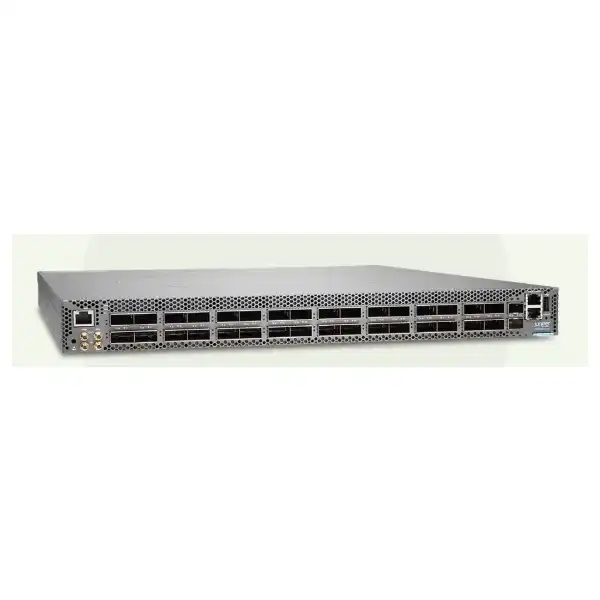
Juniper QFX5220 Data Center Switch
The QFX5220 family is built for organizations that need dense 100GbE and 400GbE connectivity, predictable low-latency forwarding and a Junos OS Evolved platform for modern IP fabrics. The principal buying decision is not simply “QFX5220 or not”; it is whether the 32-port 400GbE-oriented QFX5220-32CD or the 128-port 100GbE-oriented QFX5220-128C matches the intended leaf, spine, lean-spine, server-access or routed-fabric role.
Direct answer: what is the QFX5220 and when should you consider it?
What exactly is it? The Juniper QFX5220 is a fixed-configuration data center switching family with two principal models: QFX5220-32CD and QFX5220-128C. It is positioned for high-speed IP fabrics and supports Layer 2, Layer 3 and MPLS functions under Junos OS Evolved.
What is it mainly used for? Typical roles include spine-and-leaf data center fabrics, 100GbE server access, 400GbE inter-switch connectivity, high-radix 100GbE aggregation, routed data center fabrics and selected metro or MPLS use cases.
Who should consider it? Enterprises, service providers, cloud operators and high-performance environments planning a substantial 100GbE or 400GbE fabric, especially where deterministic port density and a fixed-form-factor architecture are preferred.
What is the most important factor to confirm? Confirm the exact model and port-speed plan first. A QFX5220-32CD purchase is materially different from a QFX5220-128C purchase in rack space, connector type, airflow choices, optics, cable strategy and fabric topology.
What can FourTeck help determine? FourTeck can map the required port count, breakout requirements, transceiver reach, fiber type, power feed, airflow direction, Junos release, automation approach, rack constraints, support expectations and deployment scope into a quotation-ready bill of materials.
Important procurement principle: treat the chassis, optics, breakout cables, power/airflow choice, software expectations and support plan as one design decision rather than separate line items.
Where the QFX5220 fits in a modern data center
A data center switch at this performance level is normally selected around fabric architecture rather than conventional access-switch logic. The QFX5220 is designed for networks in which east-west traffic, distributed applications, storage flows and clustered compute can place sustained demand on the switching fabric. In those environments, buyers generally care about three things at the same time: interface density, nonblocking forwarding capacity and operational consistency. The QFX5220 family addresses those needs with fixed high-speed port configurations and Junos OS Evolved, but the value of the platform depends on choosing the correct model for the intended tier.
The QFX5220-32CD is the more natural choice when 400GbE is a central design requirement. Its 32 QSFP56-DD high-speed ports can support 400GbE links and can also be used in lower-speed configurations when supported optics, cabling and software configuration are selected. This makes the 1U model useful where rack density matters and where a spine switch must terminate multiple high-capacity links. It can also participate in designs that use 100GbE toward servers or leaf switches while reserving 400GbE for inter-tier connections. The exact port-channelization behavior should be validated against the intended transceivers and the Junos release because a connector that physically fits does not by itself guarantee that the desired speed comes up with default configuration.
The QFX5220-128C is built around a different density objective. It offers 128 QSFP28 ports in a 4U chassis, making it attractive where a very large number of 100GbE connections must be concentrated into a single fixed system. Juniper positions it as a high-radix 100GbE lean-spine option for aggregating 10GbE and 25GbE top-of-rack environments through 100GbE fabric links. The chassis occupies more rack space than the 32CD, but it can reduce the number of separate spine devices required in a topology that values high 100GbE radix.
A useful buying rule is to start with the logical fabric, not the chassis name. Count leafs, uplinks per leaf, desired oversubscription, redundancy domains, planned 100/400GbE migrations, optics reach and failure boundaries. Only after that should the design be mapped to QFX5220-32CD or QFX5220-128C. This sequence reduces the risk of buying enough aggregate bandwidth but the wrong port geometry.
QFX5220-32CD versus QFX5220-128C
| Specification | QFX5220-32CD | QFX5220-128C | Buyer relevance |
|---|---|---|---|
| Form factor | Fixed 1U | Fixed 4U | Affects rack density, service access, heat load and rack-level planning. |
| Primary high-speed port density | 32 × QSFP56-DD, up to 400GbE per port | 128 × QSFP28, up to 100GbE per port | The model choice should follow the required link count and speed mix. |
| Bidirectional system throughput | Up to 25.6 Tbps | Up to 25.6 Tbps | Both serve very high-capacity fabric roles, but distribute that capacity across different port geometries. |
| Forwarding capacity | Up to 8 billion packets per second | Up to 8 billion packets per second | Important for packet-rate-intensive workloads, not only bulk throughput. |
| In-band network ports | 2 × 10GbE SFP+ | 2 × 10GbE SFP+ | Plan management and operational connectivity separately from production fabric ports. |
| Dimensions | 17.26 × 1.72 × 21.1 in. (43.8 × 4.3 × 53.59 cm) | 17.26 × 6.88 × 29 in. (43.8 × 17.47 × 73.66 cm) | Depth and service clearance are especially important in existing cabinets. |
| Approximate configured chassis weight | 24.5 lb (11.11 kg) | 98 lb (44.44 kg) | Relevant to rack loading, installation staffing and safe handling. |
| Operating system | Junos OS Evolved | Junos OS Evolved | Align features, automation tooling and operational standards with the approved Junos release. |
| Power architecture | Two hot-pluggable AC/DC supplies; redundant operation when fully populated | Four hot-pluggable AC/DC supplies; redundant operation when fully populated | Confirm feed type, PDU outlets, cord type and A/B power design. |
| Cooling | Airflow variants include ports-to-FRUs and FRUs-to-ports | Ports-to-FRUs airflow | Airflow direction must match hot-aisle/cold-aisle design and adjacent equipment. |
Specification values should be checked against the exact orderable hardware variant and current Juniper documentation at quotation time. Vendor web specifications and individual data-sheet revisions can occasionally present different values for items such as packet buffer or latency; those fields should not be assumed from a family name alone.
400GbE, 100GbE and port-speed planning
The strongest reason to evaluate the QFX5220-32CD is its 400GbE-oriented QSFP56-DD interface set. A buyer planning a next-generation spine should, however, avoid treating “32 × 400GbE” as the complete port plan. Modern data center ports are often channelized or used at lower speeds, and the real bill of materials depends on the endpoints, optic standards and breakout topology. A single 400GbE-capable faceplate position can represent one 400GbE fabric link, a 100GbE link with a compatible QSFP28 optic, or a breakout arrangement when the specific cable, optic and software support it. That means every port should be mapped to an endpoint before the optics quote is finalized.
Juniper hardware guidance for the QFX5220-32CD notes that ports 0 through 31 default to 400Gbps. A QSFP-DD device can therefore link at the default 400Gbps behavior, while lower-speed transceivers may require explicit configuration before the link comes up. This is an important commissioning detail: installing a physically compatible 100GbE optic and seeing link-down does not automatically indicate a bad optic. The speed configuration and channelization state need to be correct. The two additional SFP+ network ports are 10GbE-only rather than general 1GbE management substitutes.
For the QFX5220-128C, the design center is dense 100GbE. That can be attractive in a large leaf-spine topology because 128 high-speed ports give architects many options for connecting leaf switches, routers or other 100GbE peers without spreading the same radix across multiple smaller spine boxes. The tradeoff is that a 4U 128C chassis creates a different physical, power and fault-domain profile than several 1U systems. A topology review should therefore consider not only how many ports are needed today but also the blast radius of a device failure, the desired number of equal-cost paths, maintenance boundaries and the amount of spare capacity reserved for expansion.
For UAE projects involving a mixture of single-mode fiber, multimode fiber, active optical cables and direct-attach copper, the optics schedule should be treated as a technical design document. Record every source port, destination port, speed, distance, fiber type, connector, breakout direction and required wavelength family. This eliminates one of the most common causes of high-speed switching delays: receiving the correct chassis but an incomplete or incompatible optical BOM.
Fabric architecture: leaf, spine and lean-spine decisions
QFX5220 as a spine
A spine role is a natural fit when the objective is to provide many equal-cost high-speed paths between leaf switches. The 32CD can serve 400GbE-oriented fabrics where fewer, faster inter-switch links are preferred. The 128C can serve a high-radix 100GbE spine where the number of attached leafs is the dominant requirement. Calculate radix from uplinks per leaf and resiliency targets rather than simply dividing total ports by leaf count.
QFX5220 as a leaf
The 32CD can also be considered in high-bandwidth leaf designs, including environments where 100GbE server access and 400GbE uplinks are appropriate. This is more specialized than a conventional 10/25GbE top-of-rack pattern. Confirm the server NIC speeds, breakout design, buffer expectations and uplink ratio before selecting it as a general-purpose leaf.
QFX5220-128C as lean spine
The 128C is particularly interesting when a network has many 10/25GbE top-of-rack switches whose uplinks are 100GbE. Its 128-port 100GbE density can simplify an aggregation layer, but designers should assess whether concentrating so many links in one chassis aligns with their preferred failure-domain and maintenance model.
A robust fabric design should also define the underlay and overlay responsibilities. The QFX5220 can operate in Layer 3 IP fabrics and can participate in EVPN-VXLAN designs, including use as a top-of-rack or spine device depending on gateway architecture. In a centralized gateway model, the leaf/spine responsibilities differ from a distributed gateway architecture in which routing is pushed toward leaf nodes. The physical switch selection should therefore be evaluated together with control-plane design, route scale, VLAN/VNI requirements, multicast behavior and operational tooling.
Junos OS Evolved and operational architecture
Both QFX5220 models run Junos OS Evolved. This matters because the platform should be treated as part of an operating system and automation ecosystem, not as an isolated Ethernet appliance. Junos OS Evolved uses a native Linux foundation and a modular software architecture in which network functions and processes are designed to operate independently. For operations teams, the practical value is the ability to integrate the device into standardized configuration, telemetry, event handling and lifecycle processes rather than managing high-speed switches manually as one-off devices.
Juniper documentation lists zero-touch provisioning, operations and event scripts, automatic rollback and Python scripting among the automation capabilities available on the QFX5220 family. These are most valuable when the surrounding process is disciplined. Zero-touch provisioning, for example, requires a plan for bootstrap configuration, address assignment, image selection, credential handling and the intended source of truth. Automatic rollback is useful when configuration changes are made safely, but it is not a substitute for change control, pre-checks and validated post-change tests.
Data Center Director, formerly Juniper Apstra, can also be relevant where intent-based fabric design, continuous validation, lifecycle management and telemetry-driven troubleshooting are part of the operational model. Whether that management layer is required for a specific QFX5220 purchase depends on the project architecture and licensing. It should be scoped during design rather than assumed to be included simply because the switching hardware supports integration.
Software release selection deserves the same discipline as optic selection. Vendor feature support evolves by release, and an enterprise may have a preferred long-lived release, validated image or interoperability matrix. The switch should be quoted with an agreed target Junos OS Evolved release and a clear plan for staging, upgrade, rollback and configuration validation. This is particularly important when the fabric depends on EVPN-VXLAN, MPLS, RoCEv2 or advanced telemetry features whose exact implementation can vary by software version.
Layer 2, Layer 3, EVPN-VXLAN and MPLS capabilities
The QFX5220 family supports a broad Layer 2 and Layer 3 feature set intended for data center and routed-fabric operation. At Layer 2, buyers should think in terms of VLAN scale, link aggregation, spanning-tree requirements and how much of the environment will remain bridged. In a modern leaf-spine architecture, excessive Layer 2 extension is often avoided in favor of routed underlays and overlays, but existing applications, clustering technologies or service insertion may still require specific Layer 2 behavior. The deployment plan should identify those requirements explicitly.
For EVPN-VXLAN designs, the switch can participate in architectures that separate physical IP reachability from tenant or segment overlays. This can provide more scalable multi-tenant segmentation and reduce dependence on large spanning-tree domains. The important purchasing point is that “supports EVPN-VXLAN” is not the end of the design. You still need to define whether gateways are centralized or distributed, where route reflectors live, what VLAN-to-VNI model is used, how anycast gateways are implemented, what multicast or ingress-replication behavior is required and how route-target policy is controlled.
Juniper also documents MPLS capabilities on the QFX5220, including Layer 3 VPN, RSVP traffic engineering and LDP. This can matter for service provider networks, metro deployments or enterprise environments that already operate MPLS. The switch can be considered for low-latency label-switching or provider-edge functions in appropriate scale ranges, but a buyer should validate the exact feature and scale combination needed. An MPLS feature appearing in a family data sheet does not mean every possible service-provider topology or table size is appropriate for the platform.
Routing scale must be assessed with the chosen architecture. Juniper’s current public specifications list large IPv4 and IPv6 route capacities, but real-world headroom depends on how forwarding resources are allocated among routes, neighbors, MAC entries and other tables. For a heavily routed fabric, especially one carrying many external or tenant routes, sizing should use the actual route-policy and table-growth expectations rather than a single maximum number in isolation.
RoCEv2, storage traffic and loss-sensitive Ethernet
The QFX5220 can also be relevant in data center environments carrying storage or RDMA traffic. Juniper documents RoCEv2 transit functionality along with data center bridging features such as priority-based flow control and DCBX. This positions the platform for converged Ethernet designs in which application traffic and storage-oriented flows share switching infrastructure. The capability is significant, but deploying RoCEv2 successfully requires more than enabling a feature on the switch.
A loss-sensitive Ethernet design must be engineered end to end. Server NIC settings, queue assignments, DSCP or priority markings, PFC classes, ECN behavior, congestion management and link-speed consistency all affect results. A switch can support the necessary mechanisms yet still perform poorly if endpoints and adjacent network devices use inconsistent policies. For that reason, buyers should provide server-adapter models, storage-system requirements and the intended traffic classes before treating the QFX5220 as part of a production RoCEv2 design.
Buffer expectations also need care. Public Juniper sources have shown differing buffer figures for certain QFX5220 models across product web pages and data-sheet revisions. That is a reason to confirm the exact hardware revision and authoritative specification during quotation rather than relying on an old comparison sheet. More importantly, total packet-buffer size alone does not predict application performance. Queue architecture, congestion behavior, traffic burst characteristics and topology often matter more than one headline buffer number.
For storage-heavy projects in Dubai, the technical discovery should include expected east-west throughput, number of storage nodes, NIC speeds, traffic burst patterns, oversubscription tolerance, jumbo-frame requirements if used, lossless class policy and whether the same fabric will also carry ordinary application traffic. Those inputs allow the switching design to be evaluated against the actual workload instead of a generic “data center” label.
Optics, DACs, AOCs and breakout cables
Short-reach rack links
Direct-attach copper can be economical for short distances when the exact switch port and peer device support the chosen cable. Cable gauge, bend radius and rack routing must still be considered, especially with dense 100/400GbE front panels.
Active optical cables
AOCs can simplify some short-to-medium in-row or inter-rack links by combining the optical engine and cable. They must be ordered in the correct length and speed, and long fixed cable assemblies can complicate moves or pathway changes.
Pluggable optical modules
Pluggable optics are preferred where structured fiber, longer reach or serviceability matters. Match wavelength standard, fiber type, connector and peer-side optic. Do not mix standards merely because nominal speed and form factor appear compatible.
Breakout designs
Breakout can increase usable endpoint count, but it changes logical interface numbering, cable direction and operational documentation. Confirm whether the intended parent port supports the required breakout mode in the target Junos release.
For QFX5220-32CD projects, the optic choice is particularly important because QSFP56-DD 400GbE ports can be used in several ways. A design might use native 400GbE optics for spine links, 100GbE QSFP28 optics for selected connections and supported breakout assemblies for lower-speed endpoints. Each combination has different power draw, reach and cabling implications. If a data center is being upgraded in stages, the BOM should distinguish optics needed for day-one operation from optics reserved for later migration. This helps avoid tying budget to modules that will remain unused during the first phase.
Compatibility should be validated against Juniper’s current Hardware Compatibility Tool or equivalent official documentation. High-speed Ethernet ecosystems change quickly, and an optic that is electrically standard may still require a specific software release, firmware behavior or qualified part number. When third-party optics are being considered for commercial reasons, the support and troubleshooting implications should be understood before deployment.
Power, airflow and rack engineering
High-capacity data center switches impose physical requirements that are easy to underestimate during procurement. The QFX5220-32CD is compact at 1U, but a fully connected 400GbE switch can create a dense bundle of high-speed cables and a meaningful rack-level power load. The QFX5220-128C is much larger at 4U and substantially heavier, so installation planning should consider lifting, rail access, cable-management clearance and service access from the start.
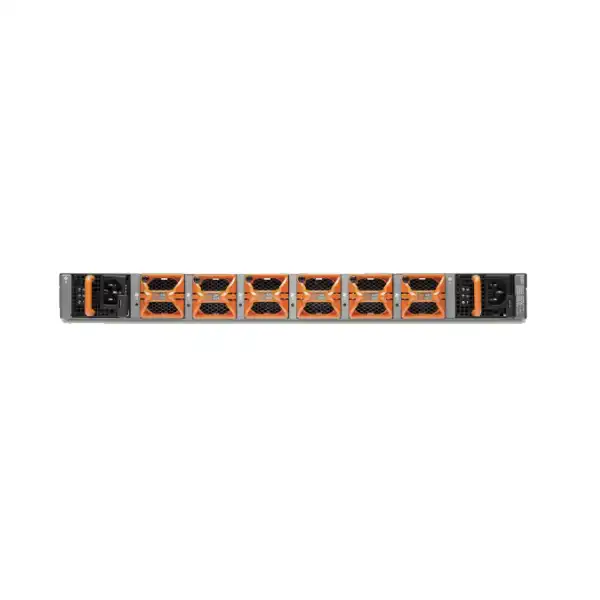
Juniper offers AC and DC power options. The 32CD uses two hot-pluggable power supplies, while the 128C uses four. Redundant power design should map individual supplies to independent A and B feeds where the facility supports dual power paths. It is not enough to order redundant PSUs if both connect to the same PDU, breaker or upstream source. During quotation, provide the data center’s feed type, voltage, receptacle/PDU arrangement and preferred power cord standard so the delivered equipment can be installed without last-minute adapters.
Airflow direction is equally important. The QFX5220-32CD has airflow variants that support ports-to-FRUs or FRUs-to-ports designs, while the 128C is documented with ports-to-FRUs airflow. In a hot-aisle/cold-aisle facility, the selected airflow must match rack orientation and adjacent equipment. Mixing opposite airflow patterns can recirculate hot exhaust into intake zones and reduce thermal margin. Airflow should therefore be captured as an explicit BOM attribute, not left as a warehouse choice.
Power consumption should be sized using the exact hardware and optic population, with facility headroom rather than a typical-load assumption. Juniper’s public product specifications provide typical and maximum load figures for the models, but transceiver mix, environmental conditions and software state can affect actual consumption. For UPS and PDU planning, use the manufacturer’s current maximum design values and local facility engineering rules. FourTeck can help translate the selected model and optics list into the information your facilities team needs for power and cooling review.
Latency and performance: reading the numbers correctly
Low latency is one of the QFX5220 family’s selling points, but latency figures should always be interpreted in context. Juniper materials have published model-specific cut-through latency figures as well as broader family-level figures on different product pages. This is normal in enterprise networking because measurement method, packet size, software release and forwarding mode can influence the reported value. A procurement document should therefore avoid promising one universal latency number unless the test conditions are defined.
For most enterprise data center buyers, the practical question is whether the switch adds meaningful delay relative to the rest of the application path. In a multi-tier fabric, server NIC queues, host networking, security service insertion, congestion and application processing can contribute far more latency than the switch itself. The QFX5220’s cut-through architecture is valuable, but a complete low-latency design should measure end-to-end behavior under representative load rather than selecting hardware from a single nanosecond value.
Packet rate matters alongside bandwidth. The family is specified for up to 8 billion packets per second, which helps explain why it is intended for large fabrics rather than only for a handful of high-throughput links. Workloads with many small packets can stress forwarding resources very differently from bulk flows with large frames. If the application is packet-rate intensive, the test plan should include realistic packet distributions and concurrency rather than only an iperf-style throughput check.
Performance assurance also depends on oversubscription. A fabric with 400GbE uplinks can still congest if aggregate server traffic exceeds the available northbound or east-west capacity. A sound QFX5220 design records the offered load from each leaf, desired oversubscription ratio, failure-state capacity and expansion target. This produces a topology that remains predictable when a link or spine is offline for maintenance, rather than a design that is nonblocking only when every component is healthy.
High availability and failure-domain planning
Redundant power supplies and fans protect against component failures inside a switch, but data center availability is determined by the full fabric design. A QFX5220 used as a spine should normally be deployed in a topology with multiple spine nodes so that leaf switches retain alternate equal-cost paths during maintenance or failure. The exact number of spines depends on port density, required aggregate bandwidth and the capacity that must remain after a device or link failure.
The QFX5220-128C deserves particular attention because its very high 100GbE radix can concentrate many leaf uplinks into one chassis. This can reduce device count and simplify cabling, but it also makes each chassis a larger failure domain. Some organizations will prefer the operational simplicity of fewer high-radix spines; others will deliberately choose more smaller devices so that maintenance events affect a smaller percentage of total fabric capacity. Neither approach is universally correct.
At the link level, LAG and ECMP design should be aligned with the application and topology. Multi-homing, server teaming and link aggregation can improve resilience, but they also introduce hashing behavior that must be understood. A single elephant flow may not be able to use the sum of all member links, while many independent flows can distribute well. This is especially relevant when buyers equate four 100GbE links with a single 400GbE link without considering traffic distribution.
Operational resilience includes software and configuration processes. Staged changes, commit confirmation, rollback procedures, configuration backups, telemetry and pre/post checks reduce the risk that a human change takes down a fabric. Junos OS Evolved provides automation capabilities that support this discipline, but the controls must be built into the operating model. During implementation, agree who owns configuration templates, who approves changes, how out-of-band access is provided and how a failed switch can be restored quickly.
Sizing the QFX5220 for a Dubai data center project
A useful sizing exercise starts with endpoints rather than switch ports. List every leaf, server cluster, storage system, border device and external router that will attach to the fabric. Record its day-one interface speed and expected upgrade path. For each leaf, define the number of uplinks and the capacity that must remain after one uplink or one spine fails. This reveals the required spine radix and often makes the 32CD-versus-128C decision straightforward.
Next, model traffic. East-west workloads such as virtualization, containers, distributed databases, AI data processing and storage replication can create very different traffic profiles. A fabric designed for north-south internet traffic may have an unsuitable oversubscription ratio when applications begin moving large datasets between racks. Estimate normal peak traffic, failure-state peak traffic and planned growth. If estimates are uncertain, provide multiple scenarios so that the design can show the cost and capacity impact of each.
Then map the physical network. Identify cabinet locations, cable pathways, maximum link lengths, fiber plant type, patch-panel connectors, available rack depth and PDU capacity. A 400GbE design can require optics with very different reach and connector systems from an existing 10/25GbE network. If the current structured cabling cannot support the desired optic, that is a project dependency that should be identified before equipment arrives.
Finally, define the operating model: EVPN-VXLAN or pure Layer 3 fabric, MPLS requirements if any, automation tooling, source of truth, monitoring, syslog/telemetry collection, AAA, time synchronization, software baseline and support expectations. These choices influence commissioning effort and may affect licensing or software planning. They also determine whether the project is simply a hardware supply or a complete design, migration and implementation engagement.
FourTeck can use these inputs to build a more accurate quotation. The objective is not to maximize hardware count; it is to produce a fabric that has enough capacity and resilience without buying expensive 400GbE resources that the architecture cannot use.
Licensing, subscriptions and software dependencies
Enterprise switch procurement often goes wrong when buyers assume that every function mentioned in a product family description is included perpetually with the chassis. The QFX5220 has a broad software feature set, but the commercial entitlement for advanced management, orchestration, support services or specific software packages can depend on the configuration and Juniper’s current licensing model. A quote should therefore state what software entitlement is included, what is optional and what subscription term applies to any additional platform.
Apstra Data Center Director is a good example. The QFX5220 can be managed as part of an intent-based data center fabric, but that does not mean a Data Center Director deployment should be assumed in every hardware purchase. Some customers may already operate the platform; others may use Ansible, native Junos automation or a different network-management stack. The correct commercial scope depends on how the switch will be operated.
Software support also intersects with optics and feature validation. A transceiver, breakout mode or protocol capability can require a minimum Junos OS Evolved release. If the organization must remain on a particular release for standardization or change-control reasons, the hardware and feature matrix should be checked against that release before purchase. The same principle applies to network-management integrations and telemetry collectors.
When requesting a quotation, include the desired support duration, required response level, existing Juniper contracts if relevant, preferred software baseline and whether implementation services are needed. This allows the commercial proposal to separate chassis cost from support, management and deployment services rather than hiding software dependencies in assumptions.
Migration from 10/25/40/100GbE environments
Many QFX5220 projects are not greenfield builds. They are migrations from earlier 10GbE, 25GbE, 40GbE or 100GbE fabrics. The first decision is whether the existing fabric will be replaced in one maintenance window, expanded in parallel or migrated rack by rack. Parallel migration generally lowers risk because old and new fabrics can coexist while workloads move, but it requires temporary interconnection, extra optics and enough rack/power capacity to run both environments during the transition.
A common 25GbE-to-100/400GbE transition retains existing server-facing leaf switches and upgrades the spine first. In that pattern, the QFX5220-128C can provide high-radix 100GbE aggregation, while the 32CD can serve a 400GbE-capable spine for leaf platforms that support 400GbE uplinks. Which is more appropriate depends on the current leaf model and the speed at which those leafs will themselves be replaced.
Migration planning must include addressing and control plane, not just cabling. If the old network uses large VLAN domains and the new fabric uses EVPN-VXLAN, gateways may need to move from centralized devices to distributed leafs. Routing adjacencies, default-gateway behavior, first-hop redundancy, multicast handling, firewall insertion and load balancer connectivity can all change. These elements should be tested in a lab or pilot rack before production cutover.
Optics reuse is another major cost question. Existing 100GbE QSFP28 optics may be reusable in some QFX5220-32CD use cases, but compatibility, software support, reach standard and peer-side behavior must be verified. Existing 40GbE or breakout cables may also have supported uses, but they should not be assumed to work simply because the connector family looks similar. The migration BOM should classify every optic as reuse, replace or verify.
A disciplined migration plan also defines rollback. For each wave, identify the old path that can be restored, the maximum acceptable outage, configuration checkpoints, validation tests and the person authorized to decide rollback versus troubleshooting. This operational detail is often more important to business risk than the nominal switching throughput.
Installation and commissioning approach
1. Pre-stage
Validate serials and BOM, inspect hardware, confirm airflow and power variants, stage the approved Junos OS Evolved image, apply base configuration and verify management reachability before the device enters the production rack.
2. Rack and cable
Install rails safely, connect redundant feeds to independent sources, label every fabric and management link, verify fiber polarity and confirm that cable routing does not block airflow or service access.
3. Bring up underlay
Bring up physical links and routing adjacencies in a controlled sequence. Confirm negotiated speed, error counters, optical levels, MTU, ECMP behavior and route exchange before enabling overlay services.
4. Validate overlays and policy
For EVPN-VXLAN or MPLS designs, test route distribution, tenant segmentation, gateway behavior, failover and policy boundaries. Confirm that expected routes are present and unexpected ones are rejected.
5. Test failure states
Disable links and, where approved, a fabric node to validate convergence and remaining capacity. Redundancy that has never been tested is only an assumption.
6. Hand over operations
Document port maps, software versions, backups, monitoring targets, escalation path, support entitlement and recovery procedures. Update the source of truth immediately after commissioning.
For a large data center switch, commissioning should include measured acceptance criteria rather than a simple “links are up” check. Useful criteria include zero unexpected optical alarms, clean interface counters under test load, correct routing adjacency count, expected EVPN or MPLS control-plane state, verified management reachability, redundant PSU status, fan health, NTP synchronization, logging, AAA and telemetry. If the project includes live migration, add application-level checks such as storage replication, cluster health and north-south service reachability.
Management, telemetry and day-two operations
A QFX5220 fabric should be designed for day-two operations before the first switch is installed. At minimum, the operations plan should define configuration backup, syslog destination, SNMP or streaming telemetry approach, time synchronization, authentication, role-based access and how alarms are integrated into the organization’s monitoring platform. High-speed fabrics can move from healthy to congested quickly, so visibility into link errors, queue behavior, route changes and optic health is essential.
Streaming telemetry can provide more timely state information than periodic polling, especially for fast-changing counters. The exact telemetry collectors and data models should be selected according to the existing operations stack. Buyers should avoid adopting a monitoring architecture solely because the switch supports it. The right tool is the one that integrates into incident response, capacity planning and change workflows.
Configuration consistency is another priority. A leaf-spine fabric can contain many devices with nearly identical roles, which makes it well suited to templating and automation. Standardize interface descriptions, BGP policy, loopback addressing, QoS profiles, NTP, DNS, AAA, management VRFs and telemetry configuration. Parameterize only the values that truly differ per device. This reduces accidental drift and makes troubleshooting easier because a deviation becomes visible.
Operational documentation should include a port-to-peer map that is understandable without logging into the switch. With 128 high-speed ports on the QFX5220-128C, clear labeling is not optional. Record peer device, peer port, optic type, circuit/fiber identifier, intended speed and LAG or ECMP role. The same information should be kept in the network source of truth so that automation and physical documentation remain synchronized.
Security and segmentation considerations
Data center switching is part of the security architecture even when the switch is not acting as a firewall. EVPN-VXLAN, VRFs, routing policy and VLAN/VNI segmentation determine which workloads can reach each other and which traffic must traverse a security enforcement point. A QFX5220 design should therefore be reviewed with the security team rather than treated as a purely network-engineering purchase.
Management-plane security deserves particular attention. Use dedicated management addressing, centralized authentication, role separation, secure protocols and restricted source networks. Avoid exposing switch administration interfaces broadly across production user networks. Log configuration changes and authentication events to a centralized system that is independent of the switching fabric where possible.
Control-plane policy is another layer. BGP sessions, EVPN route exchange and any external routing connections should use explicit neighbor definitions and route policies. In a multi-tenant environment, route-target import/export policy should be reviewed as carefully as firewall rules because a control-plane mistake can create unintended reachability even when individual VLAN configurations look correct.
The QFX5220 can support complex routed and virtualized environments, but complexity increases the need for configuration assurance. Intent-based management, automated validation or rigorous peer review can reduce the risk of a route leak or inconsistent tenant policy. The security design should specify who is allowed to change fabric policy, how emergency access is controlled and how changes are audited.
When the QFX5220 may be a strong fit
400GbE spine growth
The 32CD fits organizations moving beyond 100GbE spine links and wanting a compact 1U platform with native 400GbE-oriented port density.
High-radix 100GbE aggregation
The 128C fits designs where many 100GbE fabric connections must be aggregated and a 4U high-radix spine is acceptable.
Junos-standardized operations
Organizations already using Junos practices, automation and support processes can benefit from consistent operations across the data center network.
EVPN-VXLAN or routed fabrics
The family is relevant when the architecture calls for scalable Layer 3 underlays and modern overlay segmentation rather than large legacy Layer 2 domains.
MPLS or metro use cases
Advanced MPLS features can make the platform relevant beyond enterprise leaf-spine designs when the required scale and feature combination is validated.
When another switch should be evaluated
The QFX5220 is powerful, but it is not automatically the best choice for every data center. If most server ports are 1/10/25GbE and the project does not need 100/400GbE density, a lower-tier top-of-rack platform may provide a better port mix and cost structure. Using a 400GbE-capable spine does not compensate for an access layer whose actual requirements are dominated by copper or low-speed optical ports.
If a project requires modular line cards, in-chassis control-plane redundancy beyond the fixed-platform model, or extremely large routing scale, a modular chassis or router family may be more appropriate. Fixed switches deliver excellent density and can create resilient scale-out fabrics, but they rely on architectural redundancy across devices rather than a large chassis backplane with multiple supervisors.
If 100GbE is the long-term ceiling and port count is modest, the QFX5220-32CD may provide more 400GbE capability than the design will use. A QFX5210 or other QFX platform may be worth comparing where 100GbE density and economics are the dominant criteria. Conversely, if the design already anticipates widespread 400GbE leaf uplinks or faster future generations, the architect should evaluate whether the QFX5220 is the correct lifecycle point or whether a newer platform family offers a better migration path.
The goal of comparison is to avoid buying on model prestige. FourTeck can compare the QFX5220 against nearby Juniper options based on port count, link speed, feature set, rack space, support horizon and total optics cost. In many high-speed projects, optics and cabling can represent a significant part of the budget, so chassis price alone is not a reliable basis for choosing between families.
Procurement details that affect the final quotation
A QFX5220 quotation should identify the exact orderable chassis variant, not merely “QFX5220.” For the 32CD, airflow direction is a critical ordering attribute. The power type and regional cord set also need to be selected. For the 128C, the four-power-supply configuration and larger chassis create different PDU and installation requirements. If a reseller quote omits these details, the buyer may not know whether the proposed hardware matches the facility.
The optics list should be separate and explicit. State quantities for each 400GbE, 100GbE, 40GbE or breakout component, including cable length where applicable. If spare optics are required, list them separately so day-one installed quantity is clear. If the buyer is providing existing optics, identify them by part number and mark them “customer supplied, compatibility to be verified” rather than silently excluding them.
Support coverage should identify term and service level. Buyers should know whether the quote includes only standard warranty, a Juniper support contract, software entitlement or implementation services. Hardware replacement response and technical-support access can be important in a production fabric where a single spine failure may consume a large portion of failure-state capacity.
Implementation scope should also be separated from product supply. A basic installation may cover rack, stack, power and initial configuration; a complete deployment may include architecture review, low-level design, configuration templates, EVPN-VXLAN or MPLS build, migration, testing, documentation and handover. Defining those tasks prevents both sides from assuming that “installation” includes work that was never priced.
For Dubai and wider UAE projects, provide the deployment site, required delivery timeline, site-access constraints and whether work must occur in a scheduled maintenance window. These details affect logistics and engineering scheduling even though they do not change the switch specification.
Technical specification notes buyers should verify
| Area | What current Juniper documentation indicates | What to verify for the order |
|---|---|---|
| High-speed interfaces | 32CD: 32 QSFP56-DD ports up to 400GbE. 128C: 128 QSFP28 ports up to 100GbE. | Exact speed and breakout plan per port. |
| Operating system | Junos OS Evolved. | Approved release and required feature support. |
| Power | AC or DC options with hot-pluggable redundant supplies. | Feed type, cords, PDU compatibility and A/B distribution. |
| Airflow | 32CD supports airflow variants; 128C is documented with ports-to-FRUs airflow. | Rack hot-aisle/cold-aisle orientation. |
| Latency | Juniper materials publish low cut-through latency, with model-specific figures in the data sheet. | Use current model-specific methodology if latency is contractually important. |
| Packet buffer | Public Juniper sources have shown different values for the 32CD across revisions. | Confirm the current authoritative hardware specification for the exact SKU. |
| Automation/management | ZTP, scripts, telemetry and integration with Data Center Director are supported capabilities. | Commercial entitlement, operational tooling and implementation scope. |
This verification step is especially important for long-lived enterprise designs. Product families can remain available across multiple software and hardware documentation revisions, and an older PDF saved during an early design phase may not match the final orderable variant. FourTeck should validate the BOM against current manufacturer sources at the time of purchase.
Practical use cases in UAE environments
Large enterprise private clouds are one practical fit. A private cloud may have dozens of server racks, each with redundant top-of-rack switches and multiple 100GbE uplinks. In that case, the spine must provide enough radix for all leafs while retaining capacity during maintenance. The QFX5220-128C may be attractive where 100GbE is the primary fabric speed, while the 32CD may suit a design moving to 400GbE spine links to reduce the number of physical uplinks per leaf.
Service provider infrastructure is another fit. Providers often need high port density, MPLS capabilities, deterministic operational behavior and automation across many network elements. A QFX5220 can be considered for data center or selected metro roles when its routing and MPLS scale fits the service design. The exact role should be validated against route counts, VPN scale, label requirements and traffic-engineering policy rather than treating “MPLS support” as an unlimited router specification.
High-performance compute and data-intensive workloads can benefit from the family’s throughput and low-latency forwarding. Those environments may also use RoCEv2 or storage-over-Ethernet patterns, making queue and congestion design important. The QFX5220 should be evaluated together with server NIC behavior and workload characteristics rather than in isolation.
Large colocation or multi-tenant facilities can use EVPN-VXLAN and VRF segmentation to separate workloads while maintaining a common physical fabric. Here, operational assurance matters as much as raw bandwidth. Intent-based management and continuous validation may be valuable when the organization makes frequent tenant or service changes.
For each of these use cases, the same purchasing principle applies: first define the topology, speeds, redundancy and operations; then choose the QFX5220 model and accessories. This avoids using a high-end switch as a generic answer to a problem that may actually be about cabling, routing design or software operations.
Frequently asked buyer questions
Is the QFX5220 one switch or a family?
It is a family with two materially different models. The QFX5220-32CD is a 1U platform with 32 QSFP56-DD high-speed ports aimed at 400GbE-capable designs. The QFX5220-128C is a 4U platform with 128 QSFP28 ports aimed at dense 100GbE fabrics. A quote that says only “QFX5220” is incomplete for procurement.
Does the QFX5220 support 400GbE?
The QFX5220-32CD supports up to 400GbE on its QSFP56-DD ports. The QFX5220-128C is a 100GbE-oriented QSFP28 platform. If native 400GbE links are required, the 32CD is the relevant model within this family.
Can the 32CD use 100GbE optics?
Juniper hardware documentation lists support for 100GbE QSFP28 transceivers on the QFX5220-32CD high-speed ports, but lower-speed use may require explicit port-speed configuration because those ports default to 400Gbps. Confirm optic qualification and software support for the intended module.
Does it run classic Junos OS?
The QFX5220 is documented for Junos OS Evolved. Organizations with existing Junos operations should still review image management, feature behavior and automation because Junos OS Evolved has its own architecture and release lifecycle.
Is EVPN-VXLAN supported?
Yes, the family is used in EVPN-VXLAN data center architectures. The deployment should still define gateway placement, route-reflector design, VLAN/VNI mapping and software release. “EVPN-VXLAN supported” is a capability statement, not a complete fabric design.
Can it carry RoCEv2 traffic?
Juniper documents RoCEv2 transit and data center bridging functionality. Successful deployment depends on endpoint and network-wide configuration of congestion and loss-management mechanisms, so the switch should be one part of an end-to-end design.
Are transceivers included?
Do not assume the required optics, DACs, AOCs or breakout cables are included with a chassis quote. They should be specified as separate BOM items according to speed, reach, fiber type and peer compatibility.
What should be checked before placing an order?
At minimum: exact model, airflow, AC/DC power, rack depth, port-speed map, optics, breakout design, target Junos release, management approach, support entitlement and installation scope. For live migrations, include a cutover and rollback plan.
Dubai and UAE sourcing considerations
For a UAE deployment, product availability should be treated as a project variable rather than a permanent claim. Enterprise switches are often supplied through authorized distribution channels, and lead time can depend on exact airflow, power, support and optic options. FourTeck can quote the configuration requested at the time of inquiry and identify whether any component has a different lead time from the base chassis.
Regional logistics matter because a complete fabric BOM may include dozens or hundreds of optics and cable assemblies. It is useful to stage the full shipment, check quantities and label components before the installation window. A single missing breakout cable can block several downstream ports, while one wrong airflow variant can prevent a switch from being accepted into a rack.
If the project spans multiple UAE sites, standardize the orderable model and spare strategy where possible. Common optics, PSUs and software baselines simplify support. However, do not force one airflow or cord configuration across facilities that have different rack orientations or power infrastructure. Standardization should reduce operational variance without ignoring physical differences between sites.
For budgetary requests, provide an expected quantity and deployment quarter. For an executable purchase, provide exact model preference, fabric diagram or port schedule, optic reaches, power/airflow requirement and support term. The second level of detail produces a much more reliable quotation and reduces revisions after purchase approval.
Lifecycle, support and long-term capacity planning
A data center spine is usually expected to serve for several years, so lifecycle planning should look beyond the day-one port count. Estimate when 25GbE servers will become 100GbE, when leaf uplinks may move from 100GbE to 400GbE and whether the number of racks will grow. The QFX5220-32CD can provide a strong bridge into 400GbE fabrics, but a design should reserve enough ports that expansion does not require immediate spine replacement.
Spare strategy should match the operational model. Some organizations keep a cold spare switch on site; others rely on manufacturer replacement support and design the fabric to run safely while a failed node is replaced. With a 128-port spine, the commercial value of a cold spare can look high, but the operational consequence of a prolonged outage may be higher. The correct choice depends on remaining fabric capacity, replacement SLA and business tolerance for degraded redundancy.
Software lifecycle is equally important. Maintain an approved Junos OS Evolved release policy, track security and bug-fix advisories, and plan regular maintenance rather than leaving the fabric on the original shipping image indefinitely. Before upgrades, validate feature dependencies, optic support and interoperability with adjacent Juniper or third-party systems.
Documentation should survive staff changes. Keep the low-level design, configurations, cable maps, license records, support contract details and recovery procedure in a controlled repository. A high-performance fabric is only truly supportable when the organization can understand and restore it without relying on one engineer’s memory.
Buyer decision recap
Model fit
Choose 32CD when 400GbE capability and 1U density drive the design; choose 128C when high-radix 100GbE aggregation is the main requirement.
Port plan
Map every high-speed port to a peer, speed, optic, distance and breakout mode. Physical connector compatibility is not enough.
Fabric capacity
Size for normal and failure states, not only aggregate headline throughput. Count uplinks, ECMP paths and growth reserve.
Physical compatibility
Confirm rack depth, airflow, AC/DC feed, PDU outlets, cord type and cable-management space before delivery.
Software and operations
Agree the Junos OS Evolved release, automation method, telemetry, AAA, support term and any Data Center Director requirement.
Migration scope
Define coexistence, cutover, rollback, optics reuse and validation when the QFX5220 is replacing an existing fabric.
What FourTeck needs for an accurate QFX5220 quotation
Exact requirement: QFX5220-32CD, QFX5220-128C or request for model selection.
Quantity: production units, lab units and desired spare count.
Port map: number of 400/100/40/25/10GbE links and breakout requirements.
Optic reach: DAC/AOC/fiber, approximate distance, multimode or single-mode and connector type.
Facility details: rack depth, airflow direction, AC or DC power and PDU/cord requirement.
Architecture: Layer 3, EVPN-VXLAN, MPLS, RoCEv2 or mixed requirement.
Software/management: target Junos OS Evolved release, automation stack and any Data Center Director scope.
Services: supply only, staging, installation, configuration, migration, testing, documentation and support term.
If a full low-level design is not yet available, a simple fabric sketch plus leaf count, uplinks per leaf and target speeds is enough to begin. FourTeck can use that information to identify the key design questions before a final BOM is issued.
Build the right QFX5220 fabric, not just the right switch
A successful Juniper QFX5220 deployment depends on the relationship between model, ports, optics, power, airflow, software and fabric architecture. FourTeck can help convert your rack count, uplink plan and business growth requirements into a quotation-ready configuration for Dubai or other UAE sites, with the dependencies made visible before purchase.

Reviews
There are no reviews yet.