
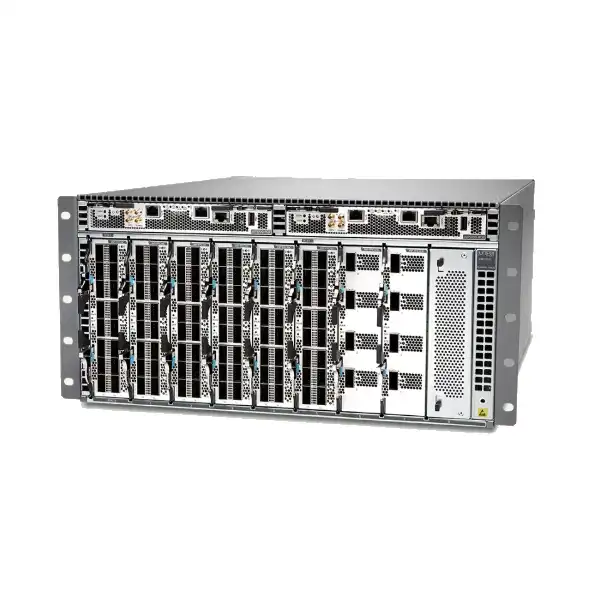
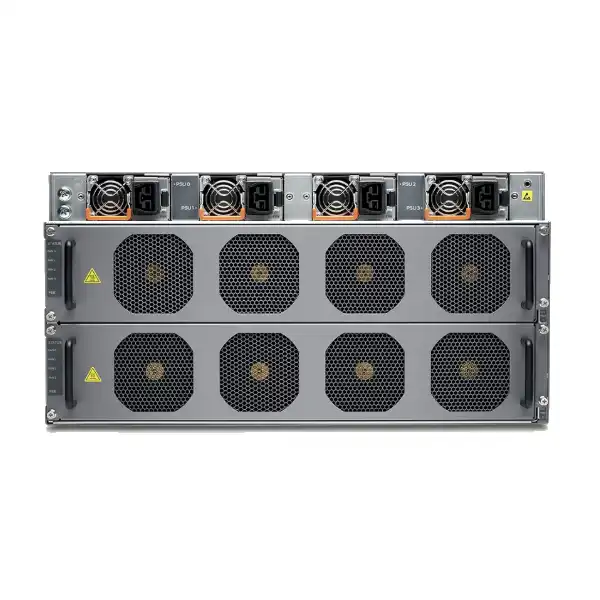
Juniper QFX5700 Data Center Switch Dubai
A modular 5U, high-density switching platform for organizations building or expanding 100GbE and 400GbE data center fabrics, EVPN-VXLAN architectures, high-capacity aggregation layers, and data center interconnect environments in Dubai and across the UAE.
Direct answer: what is the Juniper QFX5700 and who is it for?
The Juniper QFX5700 is a modular, fabric-less data center and aggregation switch built around high-density Ethernet connectivity. Its role is not simply to provide a large number of ports; it is intended for network designs where a buyer needs substantial forwarding capacity, multiple interface speeds, redundant field-replaceable components, and a platform that can participate in modern Layer 2, Layer 3, and EVPN-VXLAN architectures. It is especially relevant for enterprise data centers, service-provider environments, cloud infrastructure, high-performance computing networks, large campus cores, data center border roles, and organizations moving from 10GbE or 25GbE server access toward 100GbE and 400GbE fabric links.
The most important factor to confirm is the exact port and feature design. QFX5700 is a chassis platform, so the commercial and technical result depends on the selected line cards, optics or direct-attach cables, breakout requirements, software feature licensing, power supplies, rack plan, airflow, and the Junos OS Evolved release used for the intended feature set. A chassis specified without this context can be materially under-equipped or unnecessarily expensive.
FourTeck can help translate an existing topology, migration requirement, or new data center design into a practical QFX5700 bill of materials for Dubai and UAE deployment. That process should include present port demand, three-to-five-year growth expectations, uplink ratios, oversubscription targets, routing scale, EVPN-VXLAN design, encryption requirements, optics distances, power feeds, redundancy policy, support coverage, and installation scope.
Where the QFX5700 fits in a modern data center network
The QFX5700 sits in the part of the network where port density, throughput, resiliency, and topology flexibility matter more than simple edge access. In a traditional three-tier data center it can serve as a high-capacity aggregation or core platform. In a leaf-spine fabric it is commonly evaluated for spine, border, or high-density leaf duties depending on the selected line cards and attached systems. Juniper also positions the platform for EVPN-VXLAN fabric, data center interconnect and secure interconnect use cases. This breadth is important because the correct configuration changes depending on where route scale, tunnel termination, security, and east-west traffic are handled.
A spine design tends to prioritize a large number of uniform high-speed links, predictable latency, routing scale, and a port layout that keeps cabling easy to operate. A border role may place more emphasis on routing policy, external connectivity, MACsec, telemetry, and integration with firewalls or WAN infrastructure. A high-density leaf use case can require a more mixed set of 10GbE, 25GbE, 50GbE, 100GbE and 400GbE interfaces. QFX5700 supports all of these speeds across different line-card types, but the designer needs to map physical ports to the application instead of treating every theoretical density as simultaneously available.
This is one reason the QFX5700 should be purchased as a designed system rather than as a standalone chassis. The buyer must decide which functions are expected on the platform, what the adjacent switches and servers support, which optical reaches are required, whether breakout cables are acceptable, and how much headroom the fabric needs. When these decisions are captured early, the modular chassis can provide a useful growth path; when they are left until installation, they can create avoidable optics, licensing, power, and port-allocation problems.
Core platform specifications buyers should understand
| Specification | QFX5700 detail | Why it matters to the buyer |
|---|---|---|
| Form factor | 5U modular chassis | Rack space, weight, lift requirements, cable management and maintenance clearance must be planned before delivery. |
| System capacity | Up to 12.8 Tbps unidirectional / 25.6 Tbps bidirectional | Supports high-capacity fabric roles, but real topology capacity still depends on port mix, oversubscription and traffic patterns. |
| Forwarding capacity | 5.3 Bpps | Relevant when evaluating packet-rate intensive workloads rather than looking only at bandwidth. |
| Native 400GbE density | Up to 32 × 400GbE | Useful for high-radix spine connectivity and very high-capacity inter-switch links. |
| Other published densities | Up to 64 × 200GbE using breakout, 128 × 100GbE, or up to 144 ports at selected lower speeds | Lets designers combine transition speeds, but line-card and slot rules must be checked for the actual configuration. |
| Operating system | Junos OS Evolved | Feature support should be validated against the chosen software release and operational tooling. |
| Packet buffer | 132 MB total packet buffer | Traffic engineering, congestion behaviour and workload burstiness should be considered in architecture design. |
| MAC addresses | Up to 160,000 | Relevant for large Layer 2 domains and overlay designs where endpoint scale is significant. |
| IPv4 / IPv6 route scale | Up to about 1.24 million IPv4 routes and 610,000 IPv6 routes | Important for border, large fabric and service-provider roles that carry significant routing state. |
| Airflow | Front-to-back cooling | Rack hot-aisle/cold-aisle orientation must be compatible with the chassis airflow direction. |
The published capacity numbers are platform maxima, not a substitute for a bill of materials. A configuration built from 400GbE line cards has different cabling, optics cost, power and density characteristics from a configuration designed to terminate many 25GbE or 50GbE server links. The routing scale is also not the only sizing metric. Buyers should look at VLAN count, LAG design, ACL requirements, tunnel scale, encryption, multicast behaviour, buffering, operational model, and the software features required by the target topology.
Line-card choices: the decision that defines the QFX5700
QFX5K-FPC-4CD
This line card provides four high-speed ports and is the principal option for native 400GbE connectivity. Each port can support QSFP56-DD for 400GbE, and the card can also support lower-speed operating modes and breakout arrangements where supported. A full eight-card arrangement provides the platform’s headline 32-port 400GbE density.
It is a natural fit for spine links, high-capacity inter-switch connectivity, and deployments that want a direct path to 400GbE. The design team should still confirm optic types, breakout compatibility, peer capabilities and the software release required for the planned mode.
QFX5K-FPC-16C
The 16-port high-speed line card is oriented toward 100GbE and 40GbE requirements, with supported channelization for lower speeds. It can be useful where the fabric has a large population of 100GbE links, where existing QSFP28 investment must be retained, or where the buyer is planning a gradual transition toward higher-speed uplinks.
This is often a practical bridge between established 100GbE designs and newer 400GbE architecture. The exact breakout plan matters because logical port counts and optics change the operational and cabling model.
QFX5K-FPC-20Y
This 20-port line card targets SFP-based 10GbE, 25GbE and 50GbE connectivity. It is useful for server-facing or mixed-speed designs that need many lower-speed endpoints rather than only 100GbE or 400GbE interfaces. Juniper documents slot-dependent active-port behaviour: even-numbered supported slots can use all 20 ports while odd-numbered supported slots expose fewer active ports.
That slot rule is a procurement detail with real consequences. Buyers should plan the chassis population and expected logical port count before ordering line cards, especially when trying to reach the highest lower-speed density.
The QFX5700 chassis supports FPC positions 0 through 7 for active line cards. The modular design allows a buyer to mix line-card types, but that flexibility should be used deliberately. Mixed configurations can reduce replacement pressure during a migration, yet they also create more optics types, cable types and operational combinations to manage. A greenfield fabric may benefit from a simpler, more uniform port strategy, while a brownfield migration may justify a mixed population to connect existing infrastructure without a wholesale endpoint refresh.
400GbE, 200GbE, 100GbE and breakout planning
High-speed Ethernet density is one of the main reasons to evaluate the QFX5700, but the headline numbers can be misunderstood if breakout behavior is not planned carefully. A 400GbE port is not automatically equivalent to four independent 100GbE ports in every operational context. The switch, line card, optic or cable, peer device, port configuration and software must all support the selected breakout mode. The physical cabling is also different: a native 400GbE optical link may use a single QSFP56-DD optic at each end, while a breakout connection may use a structured breakout cable or an optical arrangement designed to present multiple lower-speed lanes.
For a spine-and-leaf network, breakout can increase radix and help connect a larger number of lower-speed leaf uplinks. It can also complicate documentation and troubleshooting because one physical cage maps to several logical interfaces. When a single breakout member fails, the operational impact differs from a full physical-port failure. Cable labeling, monitoring conventions and change procedures should therefore reflect the logical interface structure. A consistent breakout policy across a fabric can make operations much easier.
The 200GbE density published for QFX5700 is achieved through breakout. Buyers planning 200GbE server or fabric connections should verify the intended breakout technology and peer compatibility rather than assuming a native 200GbE connector layout identical to the 400GbE presentation. The same principle applies to 25GbE and 10GbE breakout from appropriate higher-speed ports.
Optics selection also affects reach, power, thermal behavior, loss budget and cost. Short-reach multimode, single-mode, DAC, AOC and longer-reach optical requirements are not interchangeable. An accurate quotation should identify the number of links at each speed, expected distance, fibre type, connector type, patching method and whether third-party optics are acceptable under the organization’s support policy. Using Juniper’s current hardware compatibility information for the exact QFX5700 line card and software release is preferable to relying on a generic QSFP or SFP assumption.
EVPN-VXLAN fabric design with the QFX5700
The QFX5700 supports advanced Layer 2, Layer 3 and EVPN-VXLAN capabilities, making it relevant for modern data center fabrics where the physical underlay and logical overlay are separated. In an EVPN-VXLAN architecture, the underlay provides IP reachability between network nodes, while VXLAN creates overlay segments and EVPN distributes endpoint and reachability information through BGP. This model can improve scale and operational consistency compared with stretching large Layer 2 domains across a conventional core.
The QFX5700 can participate in different fabric roles, but the architecture determines how much state and how many functions the switch needs to carry. An edge-routed bridging design can place gateway functions closer to endpoints, while a bridged-overlay approach has different tunnel-termination and routing implications. A border leaf can connect the fabric to external routers, firewalls, WAN services or another data center. These choices affect route scale, VLAN and VNI design, anycast gateway behavior, BGP policy, multicast or ingress-replication strategy, and failure-domain planning.
For buyers migrating from a traditional VLAN-based data center, the first design question should not be “how many VXLANs can the switch support?” The better question is what operating model the organization wants. That includes how networks are provisioned, how endpoint moves are handled, how policy is expressed, how troubleshooting is performed, and whether automation tooling will become the source of truth. The switch hardware provides the forwarding foundation, but the fabric design and operational process determine whether the environment becomes simpler or merely more complex.
A QFX5700 quotation for an EVPN-VXLAN project should therefore be tied to the intended architecture. FourTeck may need a topology diagram, leaf and spine counts, uplink speeds, expected VNI and VLAN scale, external routing requirements, server attachment patterns, multi-homing requirements, firewall integration points, data center interconnect method, and management platform. That information helps ensure the selected hardware and software features match the intended design rather than just the physical port count.
Junos OS Evolved and operations
Modular software architecture
QFX5700 runs Junos OS Evolved. Juniper describes the software as a Linux-based architecture in which functional components are modular. Buyers should validate the exact release for the required features and operational standards, particularly in controlled enterprise environments where software qualification is part of change management.
Zero-touch provisioning
Zero-touch provisioning can reduce repetitive manual staging when many devices are deployed. It is most effective when DHCP, provisioning services, configuration templates, identity, and network access are planned before installation. ZTP should be treated as part of an automation workflow, not as a substitute for configuration governance.
Automation interfaces
Juniper positions the platform for automation with tools and frameworks that can include Python, Ansible, Terraform and related network automation methods. The practical benefit depends on the organization’s source-of-truth, approval, testing and rollback practices. Automation should reduce drift rather than multiply uncontrolled configuration changes.
Apstra fabric operations
Juniper Apstra can provide intent-based fabric deployment and assurance for IP and EVPN fabrics. Buyers considering Apstra should scope it as an operational platform with its own licensing, integration and lifecycle requirements rather than assuming it is automatically included with the chassis purchase.
Operational readiness matters because a high-capacity switch can amplify both good and bad processes. Before migration, teams should confirm configuration standards, routing policy, naming, logging, telemetry, NTP, authentication, authorization, backup, image-management, rollback and out-of-band access. If the QFX5700 is replacing a legacy chassis, the migration should compare behaviors rather than copying configuration line by line. Interface naming, VLAN semantics, routing defaults, spanning-tree roles, MLAG or multi-homing design, QoS, ACL behavior and monitoring integrations may need to be redesigned for the target architecture.
Licensing: define features before you price the hardware
QFX Series licensing can include standard software functionality plus additional Advanced or Premium feature tiers, offered in subscription and perpetual forms depending on the current Juniper licensing model and SKU. The QFX5700 is listed in Juniper’s QFX licensing documentation as a Class 3 platform. Feature inclusion varies by tier, software release and device support, so the safest commercial approach is to identify the exact functions first and map them to current license SKUs during quotation.
This is particularly important when the design uses features that are not part of the base entitlement. MACsec is a good example: Juniper lists dedicated MACsec licensing for QFX5700, and the hardware capability can also depend on the installed line card and interface mode. A project that requires encrypted data center interconnect should therefore specify which ports need MACsec, at what speeds, over what distance, and whether both ends of the link support the desired encryption design.
Support services are another separate commercial decision. Hardware support, software support and subscription features may follow different terms. Buyers should state the required response level, support duration, replacement expectations and whether the environment is production-critical. A low-risk lab purchase can have a very different support model from a core data center fabric carrying business-critical services.
For a clean procurement record, the quotation should show the chassis, control components, line cards, power supplies, fan or cooling components where separately ordered, optics, cables, licenses, support and professional services as distinct items. This makes it easier to validate what is included, compare alternatives, and plan renewals. It also reduces the chance of discovering after installation that a key software function or optical component was not included in the original order.
Power, cooling and rack planning for Dubai data centers
The QFX5700 is a substantial modular platform. Juniper specifies a 5U chassis measuring approximately 48.2 cm wide, 22.2 cm high and 81.5 cm deep, with a fully populated weight around 69.8 kg. The cable management system can increase the occupied rack space. These figures make installation planning important: rack depth, rail compatibility, front and rear clearances, floor loading, equipment-lift access and serviceability should all be checked before delivery.
Power design should be based on the actual bill of materials rather than a single generic wattage. Juniper specifies redundant hot-pluggable AC or DC power supplies and publishes power figures that vary by configuration and operating condition. The current product specification lists a platform maximum power draw above 3 kW and typical draw in the high-2-kW range for a fully configured reference case. Individual line cards and optics add their own consumption. A data center should calculate the expected steady-state load, redundancy mode, feed capacity, PDU connector requirements and thermal output from the intended configuration.
Cooling follows front-to-back airflow. In a Dubai or UAE facility, the external climate does not directly determine chassis inlet temperature because the switch should operate in a controlled data center environment, but it can increase the importance of reliable cooling infrastructure, environmental monitoring and capacity planning. Juniper specifies an operating temperature range of 0°C to 40°C and non-condensing humidity limits. The switch should be installed in a clean, well-ventilated, temperature-controlled restricted-access area.
Cable management deserves the same attention as power. Thirty-two 400GbE links can represent a manageable set of large cables, while a lower-speed breakout-heavy design can create many more physical and logical connections. Patch-panel placement, bend radius, transceiver accessibility, labeling and maintenance paths should be designed before the chassis is populated. Dense front-panel cabling can make line-card replacement difficult if the routing is improvised.
Because of the chassis weight, Juniper recommends using a mechanical lift for rack mounting. That detail should be included in the installation plan and method statement. For a live data center project, the implementation team should also define rack isolation, ESD procedures, grounding, feed sequencing, cable testing, acceptance criteria and rollback steps. A modular chassis reduces certain maintenance risks through replaceable components, but it does not remove the need for controlled physical deployment.
Resiliency and field-replaceable design
The QFX5700 is designed with redundant and field-replaceable elements that support data center availability objectives. The platform can use multiple hot-pluggable power supplies and provides fan redundancy. Its FPCs are hot-removable and hot-insertable field-replaceable units. Dual routing and control components and forwarding-engine resources contribute to the modular design. These characteristics are valuable, but chassis-level redundancy must not be confused with end-to-end service resilience.
A single highly redundant switch can still be a single failure domain if every server, firewall or downstream switch depends on it. Critical deployments typically evaluate two-device fabrics, multi-homing, redundant uplinks, diverse power feeds, separate rack or room placement, and routing behavior during maintenance. The correct high-availability design depends on whether the QFX5700 is acting as a spine, border, aggregation switch, campus core or server leaf.
Operational failure scenarios should be tested as part of acceptance. Teams can validate loss of an uplink, line card, power feed, routing adjacency, peer device or control process and measure convergence against the application requirement. This gives a more meaningful picture than simply checking that the chassis has redundant parts. If the network carries latency-sensitive storage, financial, telecom or real-time traffic, convergence expectations should be documented before production cutover.
Spare strategy also matters. A modular platform can simplify replacement, yet the organization must decide whether it will hold local spare optics, line cards, power units or entire switches, or rely on the contracted support response. In the UAE, this decision should consider business criticality, support entitlement, approved maintenance windows and the cost of downtime. Procurement should capture these expectations at the same time as the initial hardware order.
Routing scale, ACLs, VLANs and buffer considerations
The QFX5700 publishes significant control-plane and forwarding scale, including up to approximately 1.24 million IPv4 routes, 610,000 IPv6 routes, 160,000 MAC addresses and large firewall-filter resources. These values make the platform suitable for demanding network roles, but the buyer should avoid treating every number as independently achievable in every software profile. Large route tables, tunnel termination, ACL consumption, host routes, multicast entries and overlay state can interact with hardware resource allocation.
A border design carrying many external routes should estimate actual BGP table requirements, VRF counts, policy complexity and growth. An EVPN fabric should estimate endpoint scale, MAC/IP route count, VNI count and the expected number of attached tenants or segments. A campus core may care more about VLAN, ACL, route and aggregation requirements. The same chassis can therefore be appropriate for different environments, but the sizing worksheet should reflect the exact use case.
The published total packet buffer is 132 MB. Buffer size alone does not determine application performance. Traffic patterns, link-speed transitions, congestion duration, QoS policy, oversubscription and burst behavior all matter. For example, a 100GbE ingress flow converging on a congested lower-speed egress can create a different buffering challenge from an evenly distributed spine fabric. Storage and HPC networks may have additional sensitivity to microbursts and loss. Buyers with specialized workloads should validate architecture against Juniper design guidance and, where necessary, test representative traffic.
ACL and firewall-filter scale should also be planned for actual policy use. A data center that pushes extensive security segmentation into the switching fabric may consume more filter resources than a design where most security policy is enforced on dedicated firewalls. Similarly, telemetry, mirroring and monitoring use cases can consume ports or resources. A complete design records these operational functions instead of assuming forwarding capacity is the only important dimension.
MACsec and secure data center interconnect
The QFX5700 can support inline MACsec on supported line cards and ports, creating an option for encrypting Ethernet links between compatible devices. This can be useful for data center interconnect, metro links, shared-facility connections, or internal networks where link-layer encryption is part of the security design. However, MACsec is not a checkbox that should be added at the end of procurement.
First, the line-card hardware must support the intended MACsec use. Second, Juniper licensing documentation lists MACsec as a separately licensed feature for QFX5700. Third, the peer device, interface speed, optic type and software release must be compatible. Fourth, key management and operational ownership need to be defined. If a project requires encryption at 100GbE or 400GbE, the design should identify exactly which interfaces are encrypted and whether those interfaces remain within the required latency, throughput and failover targets.
MACsec also solves a specific problem: link-layer protection. It does not replace firewall policy, IPsec where required, application encryption, identity controls or a broader zero-trust architecture. Its value is strongest when the threat model includes interception or unauthorized access to the physical transport path and the organization wants encryption below the IP layer without changing application addressing.
For a secure DCI quotation, FourTeck should know the number of encrypted links, their speeds, physical distance, fibre type, peer platforms, redundancy design, required software feature tier, support term and whether the interconnect is point-to-point or part of a larger routed topology. Those inputs help separate a valid MACsec solution from a generic “encrypted switch” request.
Use cases that can justify the QFX5700
400GbE spine
Large leaf-spine fabrics can use the QFX5700 as a high-radix spine when many 100GbE or 400GbE leaf uplinks must converge. The modular design allows the spine to grow by adding line cards, although spare slot strategy and oversubscription should be planned from day one.
EVPN-VXLAN fabric
Organizations standardizing on routed underlays and EVPN-VXLAN overlays can use QFX5700 in spine, border or high-density roles. The value depends on how well the platform is integrated with routing policy, automation, fabric management and endpoint multi-homing.
Data center interconnect
High route scale, 100GbE/400GbE interfaces and optional MACsec capabilities can make the platform relevant for DCI border functions. The transport service, optic reach, encryption requirement and failure-domain design remain key inputs.
HPC and dense east-west traffic
High-performance environments often need large east-west bandwidth and low-latency paths. QFX5700 can provide high port density, but workload-specific buffer, congestion and telemetry requirements should be validated before selection.
Large campus core or distribution
The platform can also be evaluated for high-capacity campus roles where modularity and routing scale are required. Buyers should compare this use against fixed-form-factor alternatives if port growth is predictable and space or power efficiency is more important than modular expansion.
Firewall cluster attachment
High-speed security clusters can be connected into a fabric through QFX5700 when many routed or VLAN interfaces and substantial aggregate throughput are required. The design must still match firewall interface speeds, HA topology, routing and segmentation requirements.
When the QFX5700 may be more than you need
A modular 5U chassis is not automatically the best choice for every 100GbE or 400GbE requirement. Smaller data centers, predictable spine designs, edge sites and environments with limited rack or power capacity may be better served by fixed-form-factor QFX switches. Juniper’s QFX5130 family, for example, includes 1U fixed systems with high-density 400GbE capability. A fixed switch can reduce space, simplify sparing and lower the entry cost when the required port count is known and does not need chassis-style growth.
The QFX5700 becomes more compelling when modularity itself solves a problem: the buyer expects the interface mix to evolve, wants to add capacity without replacing the entire system, needs a mixture of SFP-based and QSFP-based speeds, or values chassis-class field replacement and scale. If a project only needs a few 400GbE uplinks and a modest number of 100GbE ports, the operational and power overhead of a large chassis may not be justified.
There is also a lifecycle consideration. A network designed around many breakouts and mixed-generation optics can preserve investment, but it can also create a long-lived operational burden. In some cases, selecting a smaller number of consistent interface speeds produces a simpler fabric even if the initial hardware utilization is lower. The right decision balances capital cost, rack space, power, expansion, spare strategy, cabling complexity and the expected service life of the design.
FourTeck can compare the QFX5700 against a fixed QFX alternative when the requirements are clear. The comparison should use required ports after growth, not current ports alone, and should include support, optics, power and rack consumption. That avoids comparing only headline chassis prices while ignoring the total deployed design.
Migration from an existing data center core or spine
Replacing a core or spine switch is not only a hardware swap. The migration should start with a discovery of the current physical topology, logical interfaces, VLANs, routing protocols, route policies, ACLs, QoS, LAGs, multi-chassis mechanisms, monitoring, AAA, management addressing, NTP, syslog, SNMP or streaming telemetry, automation hooks and out-of-band access. Every existing feature should be categorized as required, obsolete, redesigned or replaced by a different mechanism in the target architecture.
Port mapping is usually the most visible part of the migration, but optics compatibility can be equally important. Existing 10GbE, 25GbE, 40GbE and 100GbE transceivers may not map cleanly to the selected QFX5700 line cards, or an existing cabling plant may limit the reach or connector type. Breakout changes can also alter patch-panel requirements. A migration spreadsheet should map old interface, service, peer, speed, optic, VLAN or routed function, new interface and test owner.
Routing migration requires careful control of adjacency and preference. If the old and new cores are temporarily live at the same time, route redistribution, default gateways, BGP attributes, OSPF or IS-IS metrics and first-hop redundancy behavior can create unexpected traffic paths. For EVPN-VXLAN migration, teams may also need to consider how legacy VLANs are introduced into the new overlay and how endpoints move between old and new domains.
A phased migration is often safer than a single large cutover. The new QFX5700 environment can be staged, software-qualified, base-configured and tested before production circuits move. A limited set of non-critical links can then validate monitoring and failover. Remaining services can move in planned groups with clear rollback criteria. Post-migration validation should check not only interface state but application reachability, routing tables, MAC learning, latency, packet loss, monitoring alarms and security policy.
For a Dubai project, the implementation scope should state whether installation and migration are performed during business hours, after hours, or inside a formal maintenance window; whether building or data center access requires permits; whether remote vendor escalation is available; and what rollback equipment remains in place. These logistical details affect project risk and service cost as much as the switch configuration itself.
Optics, DACs, AOCs and cabling dependencies
The QFX5700’s value depends heavily on the media connected to it. A 400GbE port without the correct optic or cable is not deployable, and optics can represent a significant part of the project budget. The media plan should therefore be prepared at the same time as the line-card plan. Each link should be classified by speed, distance, fibre type, connector, breakout requirement, peer equipment and redundancy role.
Direct-attach copper can be cost-effective for very short rack or adjacent-rack links, but distance and cable bulk are limiting factors. Active optical cables can simplify short optical runs by providing a pre-terminated assembly, while pluggable optics offer more flexibility for structured cabling and longer reaches. Multimode and single-mode optics have different cabling requirements. Longer-reach and coherent applications are specialized and should be validated against the exact QFX5700 hardware compatibility information.
The optical power budget must match the complete path, including patch panels, connectors, splices and fibre length. For existing facilities, the fibre plant should be documented and, where necessary, tested. A link that previously carried 10GbE or 40GbE does not automatically support the desired 100GbE or 400GbE optic. Connector polarity, lane mapping and fibre quality can become more important at higher speeds.
Third-party optics can affect operational policy and support outcomes. Some organizations standardize on vendor-coded optics for support simplicity, while others permit qualified alternatives to control cost. The decision should be explicit. If non-Juniper optics are considered, the buyer should understand how fault isolation and support escalation will be handled.
For a precise quotation, FourTeck should receive either a port-to-port link list or enough information to create one. A useful list includes source device, destination device, speed, distance, cable path, connector type and whether breakout is required. This makes the optics cost visible and prevents a chassis quote from appearing complete when the physical connectivity has not actually been priced.
Procurement and bill-of-material planning
The QFX5700 should be ordered from a requirements-based bill of materials. The chassis part is only one element. Depending on the specific base bundle and region, the final order can include routing and control components, forwarding hardware, AC or DC power supplies, power cords, fan trays, line cards, transceivers, breakout cables, patch leads, mounting hardware, licenses, subscriptions, support and installation services. The quotation must reflect the actual deployment rather than a generic platform description.
Quantity planning should include redundancy. A dual-spine fabric, for example, needs two independently configured systems, and the optics count normally doubles across paired uplinks. Spare transceivers are often more useful than a spare chassis because optics are numerous and can fail individually. Conversely, a mission-critical modular core may justify spare FRUs or enhanced hardware replacement terms. These decisions should be tied to the organization’s recovery objectives.
Power-cord and PDU compatibility should be confirmed before shipping. AC and DC environments have different feed requirements, and the connector choice must match the data center standard. Some facilities require dual independent power sources, specific rack PDUs, color-coded feeds or locked connectors. A technically correct switch can still be delayed if the power accessories do not fit the site.
Support term should align with expected service life. If the project is funded for five years, a one-year support plan may create an unplanned renewal. If the organization has centralized Juniper support agreements, the new hardware may need to be aligned with those terms. Software subscriptions have their own renewal implications and should be tracked separately.
Finally, the procurement record should preserve the final accepted topology and configuration assumptions. Future engineers need to know why certain line cards, optics and licenses were selected. A clear design pack reduces the risk of incompatible expansion purchases two years later and makes lifecycle refresh easier to plan.
Installation and commissioning journey
1. Site readiness
Confirm rack units, rack depth, rails, maintenance clearance, grounding, cooling, PDU feeds, circuit capacity, cable pathways and lift access. Validate that the installation area is clean, dry, controlled and suitable for front-to-back airflow.
2. Hardware assembly
Rack the chassis using appropriate lifting equipment, install the required line cards and field-replaceable components, connect protective earth, attach power feeds and organize cable management before dense network cabling is introduced.
3. Base software configuration
Apply the approved Junos OS Evolved release and establish management addressing, authentication, time synchronization, DNS where required, logging, telemetry, configuration backup and out-of-band access. Confirm the platform inventory and health before connecting production links.
4. Interface and fabric configuration
Configure native and breakout port speeds, LAGs, routed interfaces, VLANs, EVPN-VXLAN functions, routing protocols, QoS, ACLs and any encryption features according to the design. Verify optics DOM data and physical error counters.
5. Resiliency testing
Test link loss, peer loss, power-feed events, routing convergence, line-card behavior and monitoring alarms. Measure service impact against the acceptance plan rather than assuming component redundancy guarantees application continuity.
6. Handover
Record serials, licenses, software versions, support details, port maps, optics, cable labels, configuration backups, monitoring dashboards and escalation contacts. A complete handover turns the installed switch into an operable production platform.
Management, monitoring and troubleshooting considerations
High-speed fabrics require observability. Interface counters, optical diagnostics, queue statistics, routing adjacency health, EVPN state, MAC movement, CPU and memory status, fan and power alarms, environmental sensors and configuration changes should be collected into the organization’s monitoring workflow. A switch carrying tens of terabits per second can experience microbursts or short convergence events that traditional five-minute polling may not capture.
Telemetry strategy should match operational maturity. Some organizations use conventional SNMP and syslog, while others adopt streaming telemetry and intent-based assurance. The QFX5700 can be integrated into Juniper automation and fabric-management environments, including Apstra for supported data center workflows. The key is to decide which platform is authoritative for configuration and which tools are authoritative for health and compliance.
Troubleshooting runbooks should distinguish physical, logical and control-plane problems. A physical issue may appear as optical power degradation, CRC errors or link flaps. A logical issue may involve incorrect VLAN membership, breakout mapping or LAG configuration. A control-plane issue may involve BGP sessions, EVPN route exchange, route policy, timer settings or software behavior. Keeping these layers separate accelerates diagnosis.
Configuration backups and change control are equally important. Network automation can make changes quickly, which means a bad template can also propagate quickly. Production teams should test templates, use version control, peer review material changes and retain rollback options. Where Apstra or another intent platform is used, the operational process should define when engineers make changes through the controller and when direct CLI access is appropriate.
Monitoring should extend to support entitlement and lifecycle. Teams need alerts for subscription renewals, support expiration, software maintenance windows and security advisories. Treating these as part of operations prevents a technically healthy switch from becoming unsupported or losing access to licensed functionality at an inconvenient time.
Sizing questions that should be answered before quotation
How many physical links are required now?
Count by speed and media type. A total port number without speed distribution is not enough to choose line cards.
How much growth is expected?
Estimate expansion over the expected service life. Modular capacity is valuable when the future port mix can be added without replacing the chassis.
What is the topology role?
Spine, border, aggregation, leaf, DCI and campus core roles drive different route, tunnel, port and resiliency requirements.
What software features are mandatory?
Identify EVPN-VXLAN, BGP, MPLS, MACsec, telemetry, automation and management requirements so current licenses can be mapped correctly.
What are the link distances?
Optic type and cost depend on distance, fibre plant and connectors. Every high-speed link should be associated with an actual physical path.
What availability target applies?
Dual switches, dual feeds, multi-homing, spare strategy and support response should be designed around business impact rather than hardware preference.
Practical buyer questions and answers
Is the QFX5700 only a 400GbE switch?
No. 400GbE is one of its headline capabilities, but the platform supports a broad set of speeds through different FPCs, including 10GbE, 25GbE, 40GbE, 50GbE, 100GbE and 200GbE breakout arrangements. The correct line-card mix should be selected according to the target endpoints and fabric links.
Can all eight slots use the 20-port lower-speed line card at full 20-port density?
Not at the same active-port count. Juniper documents that the QFX5K-FPC-20Y can use all 20 ports in supported even-numbered slots, while supported odd-numbered slots expose only the first 16 ports. This is why chassis population should be planned before calculating the final lower-speed port total.
Does the chassis include every required optic and license?
A platform-level product name does not define the complete commercial bundle. Optics, cables, licenses, support and even certain hardware elements depend on the selected base configuration and project. The quotation should list each required component explicitly.
Can QFX5700 be used with Juniper Apstra?
Juniper positions the QFX5700 for Apstra-managed IP and EVPN fabrics. The management design, supported software versions and Apstra licensing should be validated as a separate part of the project.
Is MACsec available?
MACsec is supported with appropriate QFX5700 hardware and software, and Juniper lists a separate MACsec license for the platform. The exact line card, interface speed and peer must be checked before designing an encrypted link.
Can the platform replace an existing core without changing the design?
It can replace the physical role, but a direct configuration copy is rarely the best approach. The migration should validate routing, VLANs, LAGs, ACLs, QoS, spanning-tree behavior, monitoring, automation and resiliency against Junos OS Evolved and the intended architecture.
What should a buyer provide for an accurate quote?
At minimum: chassis quantity, role, required port count by speed, breakout plan, optics distances, AC or DC power, redundancy requirement, software features, support term and installation or migration scope. A topology diagram improves accuracy considerably.
QFX5700 versus a fixed 400GbE switch
| Decision area | QFX5700 modular chassis | Fixed-form-factor 400GbE switch |
|---|---|---|
| Growth model | Add or change line cards as port needs evolve. | Scale by adding another fixed switch or replacing the unit. |
| Port-mix flexibility | Strong when mixed 10/25/50/100/400GbE requirements must coexist. | Usually optimized for a more defined port layout. |
| Rack footprint | 5U chassis, plus cable-management considerations. | Often 1U for high-density fixed platforms. |
| Maintenance | Field-replaceable line cards and modular components. | Simple unit replacement, but fewer internal modular choices. |
| Best fit | Large, changing, mixed-speed or chassis-oriented deployments. | Predictable port counts, smaller footprints, simpler repeatable fabrics. |
This comparison is not a claim that one architecture is universally better. The QFX5700’s modularity is valuable only when the project uses it. If all required ports fit comfortably within a fixed switch and the expansion model is to add identical switches, a fixed platform can be cleaner. If the project expects substantial interface-mix changes or wants chassis-style serviceability and expansion, QFX5700 can provide a stronger lifecycle fit.
Important limitations and dependencies
The QFX5700’s broad published capabilities should be interpreted within the exact hardware and software context. Interface speeds depend on line-card type. Some lower-speed port counts depend on which chassis slots are used. Breakout modes depend on the relevant line card, cabling and peer. MACsec depends on supported hardware and licensing. EVPN-VXLAN and advanced routing features depend on software support and entitlement. Optics must be selected from compatible modules for the required reach and software release.
Environmental and mechanical limits also matter. The chassis is deep, heavy and designed for controlled rack installations. It uses front-to-back airflow and should not be placed into a rack whose cooling direction conflicts with that design. The installation area should provide adequate power, grounding and ventilation, and the rack should have suitable service clearances.
The platform is powerful, but it is not a firewall replacement. ACLs and filtering can enforce network policy in the switching fabric, but stateful application security, threat prevention and remote-access functions belong on security systems designed for those purposes. Similarly, MACsec encrypts Ethernet links but does not replace application-layer or IP-layer security where those are required.
Capacity claims such as 25.6 Tbps bidirectional and published route scale describe platform capability under defined conditions. A production network should still be sized for oversubscription, convergence, failure modes, buffers, QoS and expected growth. Specialized workloads such as loss-sensitive storage or AI/HPC can justify performance testing rather than relying only on general data sheet values.
Finally, software and commercial terms evolve. Current license SKUs, supported optics, Junos OS Evolved releases, support availability and lifecycle information should be verified at quotation time. A technically accurate design today should still use the latest vendor information before the purchase order is placed.
Dubai and UAE deployment considerations
Organizations in Dubai often deploy high-density switching into enterprise data centers, colocation facilities, cloud interconnect environments, service-provider networks, financial platforms, hospitality groups, large campus estates and government or critical-infrastructure environments. The technical design principles are the same as elsewhere, but local deployment can introduce practical requirements around data center access, structured cabling, support response, onsite installation, approved power standards and maintenance windows.
For a colocation deployment, the buyer should provide the rack specification, available power feeds, maximum per-rack load, cross-connect media, meet-me-room distances and remote-hands procedures. For an enterprise server room, the project may need to validate rack depth, cooling capacity, grounding, access controls and whether the room can safely host a 5U chassis of this weight. For a campus core, backbone fibre paths and building-to-building distances become central to optics selection.
Support planning should reflect the business impact of a core switch failure. Organizations that cannot tolerate extended downtime may require stronger vendor support, local spares or a dual-chassis architecture. The exact choice depends on whether the QFX5700 is one node within a redundant Clos fabric or a concentrated core serving many downstream systems.
Delivery timing should also distinguish chassis hardware from optics and license availability. A quote should not imply immediate stock unless confirmed for the exact SKUs. Large modular systems are commonly assembled from several components, so lead time can be determined by the slowest required item. A precise bill of materials allows availability to be checked at part-number level when the buyer is ready to order.
FourTeck’s useful role is to convert the business requirement into that complete technical and commercial list. Providing the desired topology, port counts, distances and support expectations at the start makes the quotation more accurate and reduces back-and-forth during procurement.
Decision recap for the Juniper QFX5700
Model fit
Choose QFX5700 when modularity, high port density and a changing interface mix justify a 5U chassis rather than a fixed switch.
Port design
Map every required speed to the correct FPC and account for slot-specific port behavior and breakout rules.
Optics
Specify reach, fibre type, connector and peer device for each link. Optics should be part of the original bill of materials.
Licensing
Identify EVPN, routing, MACsec and other advanced feature requirements before selecting current Juniper license SKUs.
Facility readiness
Confirm rack depth, 5U space, lift access, front-to-back airflow, grounding, feed capacity and PDU compatibility.
Lifecycle
Align support, software release strategy, spare policy and expansion plan with the expected production service life.
What FourTeck needs for an accurate QFX5700 quotation
Plan the QFX5700 as a complete fabric solution, not just a chassis
The Juniper QFX5700 can provide a strong platform for high-capacity Dubai and UAE data center networks when its modularity, 400GbE scale and Junos OS Evolved feature set match the architecture. The best result comes from defining the topology, line cards, optics, licensing, power, redundancy and migration plan together. Share your port and fabric requirements with FourTeck to prepare a configuration-oriented quotation and identify whether QFX5700 or a smaller fixed QFX platform is the better fit.

Reviews
There are no reviews yet.