
Virtual Firewall • Cloud Security • Junos OS
Juniper vSRX Virtual Firewall Dubai
A software-defined SRX firewall for organisations that need consistent security policy, routing, VPN and advanced threat controls across private virtual infrastructure and public cloud. The right vSRX design depends on workload traffic, packet profile, enabled security services, vCPU allocation, memory, cloud architecture, licensing tier and resilience requirements.
Direct answer: what is Juniper vSRX?
Juniper vSRX is a virtual firewall based on the SRX security platform and Junos OS. It runs as a virtual machine or cloud instance rather than as a dedicated physical appliance, allowing security teams to place firewall, routing, NAT, site-to-site VPN and licensed next-generation security functions close to virtual workloads.
Main use: protecting virtual data-centre segments, cloud VPC or VNet traffic, internet-facing workloads, inter-zone traffic, hybrid-cloud connectivity and virtual network edges where a physical SRX appliance is not the preferred form factor.
Who should consider it: enterprises, service providers and organisations already using Junos or SRX policy models, as well as teams that need a virtual firewall with strong routing and VPN functions in VMware, KVM or supported public clouds.
Most important factor to confirm: size the instance for the real security workload, not only headline firewall throughput. IMIX traffic, IPsec, application visibility, IPS, session scale and cloud or hypervisor limits can produce very different requirements.
What FourTeck can help determine: platform fit, vCPU and memory profile, license tier and term, high-availability approach, interface layout, migration plan, support requirement and the information needed for an accurate UAE quotation.
Why vSRX exists in the Juniper security portfolio
A physical firewall is not always positioned where the traffic is. Modern business applications can sit in a VMware cluster, KVM-based private cloud, AWS VPC, Microsoft Azure virtual network, Google Cloud VPC or a combination of environments. If inspection has to occur inside those environments, backhauling every flow through a physical security appliance can add network complexity, latency and operational overhead. vSRX brings the SRX security model into the virtual layer so routing and security policy can be placed nearer to the protected workloads.
The product is especially relevant to organisations that want security consistency between physical and virtual estates. Because vSRX is built on Junos OS, security and network teams familiar with SRX concepts do not have to adopt a completely unrelated operating model merely because an application moves to cloud infrastructure. That continuity can matter when a business uses common routing protocols, NAT policy, IPsec design, security zones, logging practices and automation across multiple locations.
Virtualisation does not remove the need for architecture. A vSRX instance still consumes compute and memory, still needs well-planned interfaces and routes, and still depends on the capabilities of the underlying cloud or hypervisor. Its value is flexibility: the firewall can become part of a virtual network design without requiring a rack-mounted appliance at every enforcement point.
Core capabilities and the buyer outcome behind each one
Stateful firewall and zones
Use security zones and policy to control traffic between network segments and application tiers. For buyers, the key question is where the enforcement boundaries should sit: north-south internet traffic, east-west workload traffic, hybrid-cloud links or all three.
Routing and NAT
vSRX supports core routing and NAT functions, which allows it to act as both a security enforcement point and an integrated network edge. This can simplify a design, but the routing topology must be agreed before interfaces and route tables are built.
IPsec VPN
Site-to-site VPN is part of the standard feature foundation. Practical sizing must account for encrypted throughput and tunnel count rather than assuming plain firewall performance will be representative of a VPN-heavy deployment.
Application visibility and IPS
Advanced license tiers add application security and intrusion-prevention capabilities. Enabling inspection changes both licensing and performance requirements, so the quotation should reflect the security services that will actually run in production.
Cloud deployment flexibility
Juniper publishes vSRX options for AWS, Microsoft Azure, Google Cloud, IBM Cloud and Oracle Cloud in addition to private virtualisation. Deployment mechanics differ between environments, so image choice, marketplace model and interface architecture should be validated per target cloud.
Published VMware and KVM performance profiles
Juniper’s published vSRX datasheet shows several common resource profiles. These laboratory figures are useful for comparing profiles, but they are not a substitute for workload-specific sizing. Packet size, CPU generation, hypervisor design, security services, encryption, NIC design and surrounding infrastructure affect real results.
| Metric | 2 vCPU | 5 vCPU | 9 vCPU | 17 vCPU |
|---|---|---|---|---|
| Memory | 4 GB | 8 GB | 16 GB | 32/64 GB |
| VMware firewall, 1514B | 16.6 Gbps | 51.6 Gbps | 121.8 Gbps | 200 Gbps |
| VMware firewall, IMIX | 4 Gbps | 12.8 Gbps | 31.1 Gbps | 56 Gbps |
| KVM firewall, 1514B | 17.8 Gbps | 51.5 Gbps | 128.8 Gbps | 200 Gbps |
| KVM firewall, IMIX | 4.1 Gbps | 13 Gbps | 33.6 Gbps | 55.3 Gbps |
| Maximum concurrent sessions | 512,000 | 2 million | 4 million | 12/28 million |
The same datasheet reports different figures for IPsec, application visibility and IPS. A design carrying encrypted or inspected traffic should therefore be sized against those workloads rather than against the 1514-byte firewall figure alone.
Sizing vSRX correctly: start with traffic behaviour, not a headline number
Virtual firewall sizing is often approached too simply. A buyer sees a maximum firewall-throughput number and chooses the smallest resource profile that appears to exceed the internet circuit speed. That can under-size the system because traffic in production is not a stream of large, easy-to-process packets. Real networks contain mixed packet sizes, short-lived connections, long sessions, encrypted tunnels, application identification and security inspection. The more services the firewall performs per packet or per session, the more compute the instance needs.
A more useful starting point is to separate four dimensions: sustained throughput, peak throughput, connection creation rate and concurrent session count. A web application behind a load balancer may create many short connections even when total bandwidth is moderate. A backup or replication network may move high bandwidth with relatively few sessions. A remote-site aggregation point may be dominated by IPsec. A data-centre segmentation firewall may need large session tables and application control even if external internet usage is not high.
The resource profile also needs operational headroom. Sizing a production firewall to run continuously at its practical ceiling leaves little room for traffic bursts, signature updates, policy growth, new applications or cloud scaling events. For critical workloads, it is better to agree an acceptable utilisation range and growth horizon, then validate the proposed vCPU and memory allocation against the selected Junos release, hypervisor or cloud instance type and enabled services.
FourTeck’s sizing discussion should therefore include average and peak throughput, approximate packet mix if known, number of protected networks, session count, new connections per second, IPsec requirements, expected application-security use, IPS usage, content-security requirements, deployment platform and resilience architecture. When those inputs are unknown, traffic monitoring from the existing firewall or cloud environment can provide a better basis than an arbitrary vCPU choice.
Licensing is part of the architecture
Current Juniper licensing documentation describes vSRX subscription tiers built around vCPU counts and security packages. Standard covers the core firewall and networking foundation, while Advanced and Premium tiers add higher-order security capabilities. The licensing model matters because the same virtual machine size can represent very different security outcomes depending on the subscribed feature set.
For example, a buyer who needs firewall, NAT, BGP, OSPF, site-to-site VPN and core management has a different requirement from a buyer who also needs IPS, application security, cloud-based antivirus, web filtering or Juniper ATP Cloud. Those services should be identified before a commercial SKU is selected. Choosing a license solely by instance size can leave the deployed firewall without the security features expected by the project team.
Juniper’s current vSRX licensing documentation lists one-, three- and five-year subscription terms for multiple vCPU profiles and license tiers. It also distinguishes current subscription licensing from legacy bandwidth-based licensing. This distinction is important during migrations because an existing entitlement may not map directly to a new deployment. Perpetual licenses have portability limitations, and public-cloud licensing may use PAYG or BYOL models depending on the marketplace and architecture.
For procurement, provide FourTeck with the required vCPU profile, desired security tier, subscription term, cloud or private-virtualisation platform, number of instances and whether high availability requires two separately licensed nodes. If an existing license is expected to be reused, its exact entitlement and portability must be checked before the project assumes there will be no new software cost.
Understanding the current license tiers
Standard
Designed for core firewall and secure routing use. Juniper lists firewall, NAT, BGP, OSPF, DHCP, GRE, IPv4/IPv6, J-Flow, on-box logging, site-to-site VPN, static routing, management and related foundation capabilities in the Standard tier.
Advanced
Advanced tiers build on the core platform with next-generation controls. Depending on the exact Advanced package, buyers can add IPS, application security and content-security functions such as antivirus, web filtering, antispam and content filtering.
Premium
Premium tiers combine higher security packages with Juniper ATP Cloud use cases. The exact Premium level should be chosen around required advanced services rather than treated as a generic “best” license.
The practical conclusion is simple: licensing should be mapped to a written security requirement. If the project specification says “next-generation firewall,” translate that phrase into the actual controls required, such as application identification, intrusion prevention, antivirus, URL filtering and advanced threat protection. That translation prevents both under-buying and unnecessary subscription spend.
VMware deployment: where vSRX fits and what to check
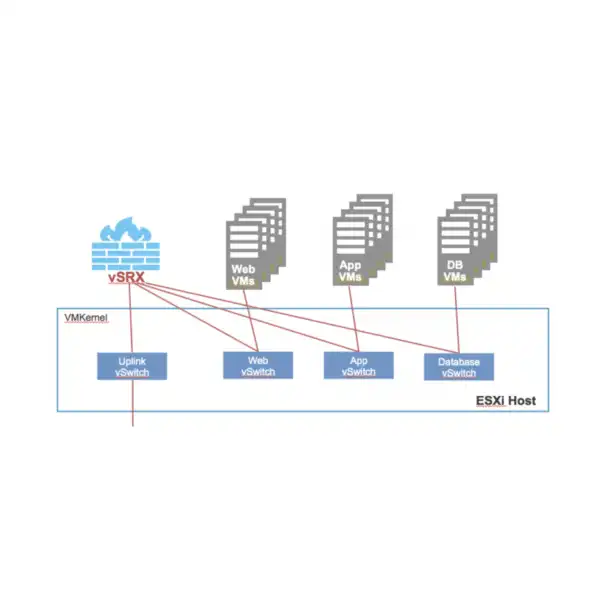
In VMware environments, vSRX is deployed as a virtual appliance and connected to the appropriate virtual switches or port groups. This makes it suitable for protecting virtual server networks without forcing every inspected flow to leave the virtual infrastructure. The design can place vSRX at a virtual data-centre edge, between application tiers, or on a route path that connects virtual workloads to upstream physical infrastructure.
The critical dependency is not merely whether VMware is present. The project needs a supported vSRX software image and Junos release, an approved ESXi environment, adequate CPU and memory reservation strategy, sufficient virtual interfaces, appropriate virtual-switch design and enough physical uplink capacity. The firewall can only forward traffic that the surrounding virtual network presents correctly. A routing mistake in the virtual switch or an incorrect VLAN/port-group mapping can make a correctly configured vSRX appear faulty.
Performance planning should also consider host contention. A virtual firewall shares the physical server with the hypervisor and potentially other workloads, so the host’s CPU generation, NUMA design, oversubscription and NIC architecture can affect latency and throughput. For high-performance deployments, treat compute placement as part of the security architecture. Allocating the documented vCPU count does not guarantee that the physical host will deliver equivalent processing capacity under contention.
Before installation, document the management network, trust and untrust networks, any DMZ or transit segments, required VLANs, IP addressing, routes, gateway locations, expected failure behaviour and how the vSRX connects to upstream switches or routers. This makes the virtual-network side of the installation auditable and dramatically reduces troubleshooting time during cutover.
KVM deployment: open virtualisation with explicit host requirements
Juniper provides a KVM deployment path using a QCOW2 image. The current installation guidance uses standard KVM, QEMU, libvirt and either virt-manager or virt-install. A basic installation example starts with 2 vCPUs, 4096 MB of RAM and a 16 GB virtual disk, then connects the management and traffic interfaces through virtio networking. These are deployment mechanics, not a recommendation that every production firewall should use the minimum profile.
For KVM buyers, host preparation matters. The Linux host or OpenStack compute node must meet the supported requirements for the target Junos release. CPU capabilities, virtualisation flags and network acceleration influence performance. Juniper guidance notes options such as CPU flags for better cryptographic throughput and provides platform-specific recommendations for nested virtualisation. These dependencies should be reviewed before a production change window, particularly when the host platform is older or heavily customised.
Networking design is equally important. The first interface is commonly used for management, with additional virtual networks connected for transit or protected traffic. Production deployments may need multiple VLANs, bonded physical NICs, separate management paths and controlled routing between virtual bridges or Open vSwitch constructs. The selected architecture should make the traffic path obvious to both network and server teams.
KVM can be an excellent fit for organisations that already operate Linux virtualisation and want more control over the host stack. It also means the customer owns more of the integration responsibility. A successful quotation therefore includes not only the vSRX subscription but also the expected installation, host validation, network integration and post-deployment testing effort.
Public cloud deployment: treat each cloud as a different network environment
Juniper lists vSRX for Amazon Web Services, Microsoft Azure, Google Cloud Platform, IBM Cloud and Oracle Cloud. This breadth is useful for multi-cloud organisations, but it should not be interpreted as meaning every deployment is architecturally identical. Public-cloud networking has provider-specific interface limits, route tables, availability-zone concepts, load balancers, instance families, accelerated networking options, source/destination checks or forwarding settings, marketplace images and licensing workflows.
The security design should therefore start with a cloud diagram rather than a hardware-style port map. Identify the VPC or VNet boundaries, subnets, route tables, internet gateways, private connectivity, VPN or direct-connect paths, application load balancers, management access and the desired inspection points. Then decide whether the vSRX is protecting north-south traffic, east-west traffic, hybrid connectivity or a centralised transit architecture. Each pattern has different routing and resiliency implications.
Marketplace procurement also changes the commercial model. Juniper supports PAYG and BYOL approaches in public cloud. PAYG can be convenient for elasticity and short-lived environments because software cost is consumed through the cloud marketplace. BYOL can fit organisations that want a separately purchased Juniper subscription and clearer entitlement control. The preferred model depends on commercial policy, duration, cloud spend strategy and the need to move between environments.
For UAE projects, provide the exact cloud provider, target region, expected instance count, desired availability-zone design, traffic paths, expected throughput and security services. This allows the proposed vSRX architecture to be evaluated in the context of the cloud platform rather than treated as a generic virtual appliance.
AWS considerations
Juniper’s AWS deployment documentation lists a minimum vSRX system profile of 2 vCPUs, 4 GB memory, 16 GB disk and three virtual NICs for the documented AWS deployment path. That minimum helps establish a baseline, but production sizing should use a supported AWS instance type matched to the required throughput and feature profile. The compute family, networking capabilities and availability-zone layout can be just as important as the nominal vCPU count.
AWS designs also need to account for routing behaviour around the firewall. Depending on the architecture, vSRX may sit behind internet-facing routing, protect application subnets, inspect traffic to other VPCs, or terminate VPN connections. Route tables must deliberately steer traffic through the inspection interfaces. If a return route bypasses the firewall, stateful sessions can fail even though the security policy appears correct.
Management access should be separated from application forwarding wherever practical. Use controlled administrative source addresses, secure key-based access and cloud security groups that expose only required management services. Juniper documentation for AWS describes SSH key-based access and specific preconfiguration behaviour, but the final operational model should align with the customer’s identity, logging and privileged-access standards.
High availability requires cloud-aware planning. Do not assume that a physical SRX chassis-cluster design can simply be reproduced without adaptation. The design should be checked against the current Juniper deployment guide and AWS networking features for the selected Junos release, then validated with failover tests before production traffic is migrated.
Microsoft Azure considerations
In Azure, the firewall becomes part of a virtual-network architecture that may include hub-and-spoke VNets, user-defined routes, load balancers, VPN or ExpressRoute connectivity and multiple availability zones. The first architectural question is where inspection should occur. A central hub can simplify policy governance for many spokes, while dedicated vSRX instances can provide stronger separation for specific applications or business units.
User-defined routes are central to deterministic forwarding. Traffic must be directed to the correct vSRX interface, and the reverse path must be compatible with the stateful policy model. When application owners create new subnets or peering relationships, the security routing design must be updated accordingly. This is why cloud firewall operations should include change control for network routes, not only firewall policy.
The chosen Azure VM size must be supported for the vSRX image and Junos release in use. Availability, accelerated networking and interface capacity vary by instance family. Buyers should avoid selecting a VM purely because its vCPU count resembles a private-cloud profile. Confirm the current Juniper deployment requirements and Azure capabilities for the target region before finalising the bill of materials.
If the project is migrating from a physical SRX in a UAE office or data centre, decide whether Azure becomes an extension of the same routing domain or a separately controlled security zone. That decision affects route exchange, VPN architecture, policy naming, logging and how incidents are investigated across the hybrid environment.
Google Cloud considerations
Juniper provides a vSRX deployment path through Google Cloud Marketplace and documents the networking preparation required for the virtual machine. The deployment uses Google VPC networks and subnets, and IP forwarding must be enabled for the firewall instance to forward transit traffic. This is a good example of why cloud prerequisites have to be designed before the firewall image is launched.
A basic GCP design often separates management from trusted and untrusted forwarding networks. In more complex estates, the vSRX may protect shared services, connect on-premises networks to cloud workloads or enforce policy between application environments. Route priorities, VPC peering behaviour and cloud-native load-balancing design can all influence the practical inspection path.
Marketplace options can include licensed or BYOL variants depending on the offer. The commercial decision should be aligned with the deployment lifecycle. A proof of concept, disaster-recovery environment and permanent production edge may reasonably use different purchasing models. What matters is that the entitlement, software image and resource profile remain consistent with the expected security services.
Before a production rollout, test not only connectivity but also failover, logging, route recovery and application behaviour under inspection. Cloud networking can fail in ways that look like firewall-policy problems, so a documented baseline of routes, interfaces and health checks is essential for support.
What next-generation security changes in the sizing model
Application security
Application identification and control analyse traffic beyond basic IP addresses and ports. This improves policy precision, but inspection consumes additional resources and depends on current signatures and the exact licensed package.
Intrusion prevention
IPS compares traffic with attack signatures and security logic. Published IPS throughput is lower than basic firewall throughput, so environments using IPS broadly should size around inspected traffic rather than raw forwarding capacity.
Content security
Higher license tiers can add antivirus, web filtering, antispam and content filtering. These features influence license selection, policy design and performance expectations, especially on internet-facing user traffic.
ATP Cloud
Premium use cases can integrate Juniper ATP Cloud. A buyer should define whether advanced threat analysis is part of the required security outcome before selecting the license tier and operating model.
A common procurement mistake is to compare firewall platforms using only maximum throughput while the actual requirement is full next-generation inspection. A better comparison lists every feature that will be enabled, the percentage of traffic subject to each control and the traffic profile to which the published security figure applies. This keeps the shortlist technically meaningful.
Routing, VPN and segmentation are not secondary features
Many virtual-firewall projects are really network projects with a security enforcement point in the middle. vSRX includes routing functions such as BGP and OSPF in the standard foundation, which makes it suitable for dynamic integration with data-centre, branch and cloud routing. This can reduce dependence on separate virtual routers, but it also means routing policy needs the same review discipline as firewall policy.
For hybrid-cloud use, BGP may be used to exchange routes with VPN or private-connectivity services, while static routing may be sufficient for smaller environments. The correct choice depends on scale, failover expectations and the number of prefixes. Dynamic routing can improve convergence but introduces protocol adjacency, route filtering and path-selection decisions that must be documented.
Site-to-site VPN is also a core use case. When vSRX terminates many IPsec tunnels, the encryption workload can become the dominant sizing factor. Juniper’s published performance tables show that IPsec throughput differs materially from basic firewall throughput across resource profiles. Therefore, a branch-hub design with hundreds of tunnels should be reviewed differently from a simple internet edge handling mostly unencrypted traffic.
Segmentation policy should be designed around business trust boundaries rather than around the number of available interfaces. A virtual firewall can inspect many logical networks, but adding interfaces and zones without a clear policy model increases operational complexity. Define the security zones, permitted flows, route ownership and logging requirements first; then translate that model into vSRX interfaces and policies.
High availability: define the failure you are trying to survive
High availability should not be reduced to “deploy two firewalls.” In a virtual environment, failures can occur at several layers: the vSRX process, the virtual machine, the hypervisor host, the physical NIC, the top-of-rack switch, the cloud availability zone, a route table, a load balancer or the underlying provider service. The HA architecture should address the failures that matter to the application rather than only duplicate the firewall software.
Private-cloud deployments may use chassis-cluster capabilities where supported, but host placement becomes important. Two vSRX nodes on the same physical host do not protect against host failure. Anti-affinity, separate uplinks and appropriate upstream network design can be necessary to create genuine resilience. State synchronisation and failover links also need sufficient connectivity and predictable latency.
Public-cloud resilience may rely on provider-specific routing, load-balancing or automation mechanisms. The exact method can vary by cloud and Junos release, so the implementation must follow current Juniper guidance for the selected platform. A design that works in AWS should not be copied into Azure or GCP without review.
Testing is part of HA. The project plan should include controlled failure of an active node, loss of a network path and restoration of the failed component. Record failover time, session impact, route convergence, monitoring alarms and operational steps. A pair of firewalls that has never been failover-tested is not yet a verified resilient service.
Management, automation and operational ownership
The vSRX Standard feature set includes management through J-Web, CLI and NETCONF. For organisations already operating Junos, this supports familiar configuration practices and automation patterns. At larger scale, centralised security management and consistent configuration control become more important than the ability to log in to each firewall individually.
Operational ownership should be decided during design. Cloud teams may control VPC or VNet routes and marketplace resources, while network-security teams control Junos policy and VPNs. Server teams may own VMware or KVM hosts. If responsibility boundaries are not explicit, incidents can stall because each team sees only part of the forwarding path. A runbook should identify who owns the hypervisor or cloud instance, virtual interfaces, routing, firewall policy, licensing, logging and backups.
Automation is especially useful when multiple vSRX instances are deployed. Standardised templates reduce configuration drift, and NETCONF or other supported automation methods can make repeatable changes easier to audit. However, automation should not hide architecture. The configuration source should still reflect clearly defined zones, address objects, services, routing policy and logging requirements.
For a UAE enterprise operating 24×7 services, monitoring integration is equally important. Decide where system logs, security events and performance metrics will be collected, how licensing status will be monitored, what thresholds trigger investigation and how failed updates or signature downloads are handled. Those operational details determine whether the virtual firewall remains reliable after the initial installation team leaves.
Logging and visibility: design for investigation, not just compliance
A firewall can permit or deny traffic correctly and still leave the organisation unable to explain an incident if logging was treated as an afterthought. vSRX supports on-box logging as part of its standard foundation, and it can participate in broader Juniper or third-party monitoring designs. The right destination depends on log volume, retention requirements, security operations tooling and whether the deployment is private cloud or public cloud.
Define which events need to be logged. Logging every permitted session can produce large volumes in busy environments, while logging only denies can remove important evidence. Security teams commonly need policy matches, threat events, VPN status, administrative changes and system health. Application-control or IPS deployments generate additional event types that should be incorporated into SIEM rules and dashboards.
Time synchronisation and device identity are basic but essential. If multiple virtual firewalls use inconsistent timestamps or unclear hostnames, correlating events across cloud logs, servers and network devices becomes difficult. Naming conventions should indicate environment, role, location or cloud region without becoming so long that operators cannot read them.
Log transport itself should be resilient. If an outage that affects the firewall also prevents security logs from reaching the collector, the incident record can be incomplete. For critical systems, validate logging during failover tests and confirm that central tools recognise both members of an HA design.
Migration from physical SRX or another firewall platform
A vSRX project is often triggered by a data-centre migration, application move to cloud or consolidation of security platforms. The safest migration starts by separating what can be translated directly from what needs redesign. Address objects, service definitions and many security policies can often be mapped conceptually. Interface names, routing adjacency, NAT behaviour, HA design and cloud route control are more likely to change because the surrounding network is different.
Avoid importing old policy blindly. Legacy firewalls frequently contain obsolete address objects, disabled rules, temporary exceptions and broad permits that were never removed. A migration is an opportunity to identify active flows, policy owners and business justification. Cleaning policy before cutover reduces both attack surface and troubleshooting complexity.
If the source platform is already Junos, the operational model may be familiar, but hardware-specific assumptions still need review. A physical SRX may use dedicated ports, link aggregation, hardware acceleration and particular cluster links. In a virtual environment, those functions map to hypervisor or cloud constructs. The configuration should therefore be adapted to the target architecture rather than copied line by line.
A practical migration plan includes inventory, traffic analysis, target design, policy conversion, lab validation, pre-staging, rollback preparation, cutover, application testing and post-change monitoring. For internet-facing services, coordinate DNS, public IP, NAT and load-balancer changes carefully. For hybrid VPNs, confirm both sides of each tunnel before the maintenance window.
A practical vSRX deployment journey
Document protected networks, source and destination zones, expected routing, internet or private connectivity, NAT requirements and the exact places where traffic must cross the firewall.
Collect peak throughput, IMIX or packet behaviour if available, connection rate, session count, VPN traffic, security inspection percentage and growth expectations.
Confirm VMware, KVM or the target public cloud, then match the supported Junos release, image format, cloud offer and host or instance requirements.
Map required security functions to Standard, Advanced or Premium licensing, choose subscription term and determine BYOL or marketplace purchasing where relevant.
Place redundant instances across meaningful failure domains, validate state and route behaviour, and define how traffic is redirected when one node or path fails.
Test routing, NAT, policy, VPNs, logging, management access, application flows, security inspection, performance and failover with a documented rollback path.
Procurement details that affect quotation accuracy
Virtual firewalls are software products, but an accurate quotation still needs more than the product name. “Juniper vSRX” can refer to different resource profiles, security tiers, subscription terms and deployment models. A price request that omits these variables may result in a quotation that cannot be compared fairly with another vendor or even with another Juniper option.
Start with the number of production instances and whether non-production, disaster-recovery or lab instances are also required. High availability normally means two active components need to be considered commercially, even if only one forwards production traffic at a given moment. For cloud deployments, state whether marketplace billing or BYOL is preferred. For private cloud, specify the virtualisation platform and target resource profile.
Next, define the security package. Do not request “full security” without stating the controls. Specify IPS, application security, antivirus, web filtering, antispam, content filtering and ATP Cloud requirements as applicable. Select a subscription term that matches the organisation’s budget cycle and expected platform life. Longer terms can simplify renewal planning but should still match the planned architecture.
Finally, separate product licensing from professional services. Installation, policy migration, VPN migration, high-availability setup, cloud routing, after-hours cutover, testing, documentation and knowledge transfer can each require different effort. A clearly scoped service line lets the buyer see where the project cost comes from and prevents unrealistic expectations that software entitlement includes all implementation work.
Where vSRX is a strong fit
Virtual data-centre edge
vSRX can protect VMware or KVM workloads at a virtual edge while retaining Junos routing and security policy. This is useful when traffic is generated and consumed inside the virtual estate and does not naturally cross a physical firewall.
Hybrid-cloud connectivity
A vSRX can combine routing, IPsec and security policy at the boundary between cloud workloads and on-premises networks. This can be attractive to organisations already operating SRX at branch or data-centre locations.
Cloud workload protection
Public-cloud marketplace availability allows Juniper policy to be extended into supported cloud providers. The deployment can protect application subnets, internet edges or central transit paths depending on the cloud design.
Service provider virtualisation
Service providers that need software-defined security functions can use vSRX as a virtual network function, subject to the orchestration, performance and licensing requirements of the chosen platform.
When vSRX may not be the best answer
vSRX is not automatically the best firewall simply because the application is virtual. A physical SRX may be more appropriate when the enforcement point is already at a physical WAN or internet edge, dedicated interfaces and appliance-level performance are preferred, or the organisation does not want the operational dependency of a hypervisor or cloud instance. The comparison should be based on traffic location and operational model.
A containerised architecture can also point toward a different Juniper option. Juniper cSRX is designed for containerised environments and can be more natural when security must follow microservices or Kubernetes-style deployment patterns. vSRX remains a virtual machine, so it carries a different lifecycle and resource footprint than a container firewall.
Small environments may also be over-engineered by a complex virtual-firewall design. If only a few networks need protection and all traffic already traverses an existing SRX appliance with adequate capacity, inserting an additional vSRX can create more routing and policy administration without a meaningful security benefit.
At the other extreme, very high-throughput or latency-sensitive designs need careful validation of the virtualisation stack. Published vSRX figures are strong, but the surrounding CPU, NIC, hypervisor or cloud instance must support the target. When the performance requirement is close to platform limits, compare vSRX with higher-capacity physical SRX options or an architecture that distributes inspection across multiple instances.
vSRX, physical SRX and cSRX: choosing the form factor
| Choice | Best aligned to | Main dependency |
|---|---|---|
| vSRX | Virtual machines, private cloud and supported public-cloud security points | Compute profile, virtual networking, cloud or hypervisor architecture and subscription licensing |
| Physical SRX | Physical WAN, campus, branch, data-centre or internet edges requiring appliance interfaces | Hardware model, port types, power, rack space, hardware lifecycle and software subscriptions |
| cSRX | Containerised and microservices environments | Container platform, orchestration design, image lifecycle and container-focused licensing |
The form-factor decision is architectural rather than purely commercial. If the enforcement point changes when an application moves, the firewall form factor may need to change with it. If the traffic continues to cross a physical edge, a physical SRX can remain the cleaner option. If the workload is container-native, evaluate cSRX rather than forcing a VM into a container-centric design.
Performance validation and proof-of-concept testing
For a critical application or a design close to the expected capacity of a selected profile, a proof of concept can be more valuable than debating theoretical figures. Build the target vSRX resource allocation on hardware or cloud instances representative of production, then generate traffic that resembles the real workload. Include IMIX or application traffic, encryption and security inspection where those functions are in scope.
Monitor CPU, memory, session count, packet loss, latency and application response during the test. A firewall may technically forward the target throughput while operating too close to its resource ceiling for comfortable production use. The purpose of testing is to identify sustainable performance with headroom, not merely to achieve a one-time peak number.
The surrounding infrastructure must be measured too. A bottleneck in a vSwitch, physical NIC, cloud instance network limit or traffic generator can make the vSRX appear slower than it is. Conversely, a synthetic large-packet test may make a profile appear much faster than an application environment dominated by small packets and new connections. Record the traffic method so results can be interpreted correctly.
A good POC also tests operations. Validate configuration backup, upgrade method, license activation, log export, monitoring, HA failover, route recovery and administrative access. Performance matters, but a production firewall must also be maintainable and recoverable.
Security policy design for cloud and virtual environments
Cloud migrations frequently reproduce old flat network models inside new infrastructure. vSRX can provide stronger segmentation, but only if policy is based on meaningful trust boundaries. Start by grouping systems according to business role, data sensitivity, environment and required communication. Production applications, management systems, internet-facing services, databases, development environments and shared services often justify separate treatment.
Build policies around specific flows rather than broad subnet-to-subnet permits. Application owners should identify source, destination, service and business purpose. Where application security is licensed, the policy can incorporate higher-level application awareness in addition to ports. This helps reduce the gap between “port 443 is open” and “the intended application is allowed.”
Cloud-native controls such as security groups or network security groups do not necessarily replace the firewall. They can provide distributed baseline enforcement while vSRX supplies central routing, inspection, VPN and consistent security policy. The design should define which layer owns which control so operators do not create contradictory rule sets.
Policy lifecycle matters after go-live. Every rule should have an owner, purpose and review process. Temporary migration permits should carry an expiry plan. Logging should support both troubleshooting and security monitoring. A technically capable firewall delivers its best value when the policy remains understandable six months after deployment.
UAE deployment and support considerations
For Dubai and UAE organisations, the commercial process should account for where the virtual firewall will run and who will operate it. A vSRX hosted in a UAE data centre has different infrastructure dependencies from a vSRX deployed in a public-cloud region. The software subscription may be similar, but the surrounding compute, network connectivity, change control and support responsibilities are not.
If the vSRX protects business-critical applications, define support coverage before cutover. Decide whether the customer requires only software entitlement, Juniper support, local implementation assistance, after-hours migration, ongoing managed support or a combination. Document who opens vendor cases, who has access to Juniper support portals and where configuration backups are stored.
Data residency and logging should also be discussed in the context of the customer’s own regulatory and governance requirements. The firewall itself does not determine compliance. Log destinations, cloud regions, management systems, threat-intelligence services and operational access can all influence the wider compliance posture. Legal or regulatory conclusions should be made against the organisation’s applicable obligations, not assumed from the firewall product name.
FourTeck can scope the vSRX as a software purchase, deployment project or migration engagement. The most useful first step is a short architecture review covering platform, traffic, security services, resilience and operational ownership.
Upgrade and lifecycle planning
A virtual firewall can be easier to redeploy than a physical appliance, but it still requires lifecycle planning. Junos releases change over time, cloud marketplace images are updated, hypervisor versions evolve and licensing models can be revised. The project should therefore record the exact deployed image, Junos release, license entitlement and platform compatibility at go-live.
Before an upgrade, review Juniper release notes and the supported upgrade path for the current version. Do not assume a direct jump between any two releases is supported. In HA designs, plan how nodes will be upgraded without leaving the application unprotected, and verify whether state or feature behaviour changes across versions.
Cloud environments add another dependency: the instance family or marketplace offer used at deployment time may not remain the preferred choice indefinitely. Periodic architecture reviews can identify opportunities to move to newer compute with better network performance or to adjust vCPU allocation as workloads grow. BYOL portability and entitlement rules should be checked before moving licenses between environments.
Operational documentation should include a renewal date and license owner. Security subscriptions that expire unexpectedly can affect advanced services even when basic forwarding continues. Treat software renewal as part of service continuity, not as a finance-only event.
Common design mistakes to avoid
Choosing by internet circuit speed alone: the firewall may inspect internal east-west traffic, VPN traffic or inter-cloud traffic that exceeds the internet link. Size for all routed and inspected flows that cross the vSRX.
Ignoring IMIX and security services: large-packet firewall figures are not representative of every workload. Use the relevant published figure and validate with traffic that resembles production.
Assuming all licenses include the same security: Standard, Advanced and Premium packages enable different capabilities. Translate project requirements into features before selecting a SKU.
Placing both HA nodes in one failure domain: redundancy requires separation at the hypervisor, host, network or availability-zone level that corresponds to the outage you want to survive.
Treating cloud routes as someone else’s problem: a stateful firewall depends on correct forward and return paths. Cloud networking and security policy must be designed together.
Migrating every old rule: legacy policy should be reviewed for relevance and ownership. Reducing unnecessary rules improves security and makes the new vSRX easier to operate.
Frequently asked buyer questions
Is Juniper vSRX a hardware firewall?
No. vSRX is a virtual firewall that runs as a VM or cloud instance. It delivers SRX/Junos security and networking functions without requiring a dedicated physical SRX appliance at the enforcement point.
Can vSRX run on VMware?
Yes. Juniper provides a VMware deployment path and publishes VMware performance profiles. Confirm the supported ESXi version, Junos release, resource profile and virtual-network design for the intended deployment.
Can vSRX run on KVM?
Yes. Juniper provides QCOW2-based KVM installation guidance using KVM/QEMU and libvirt. Production performance depends on the host CPU, networking, virtualisation settings and allocated resources.
Which public clouds support vSRX?
Juniper lists vSRX for AWS, Microsoft Azure, Google Cloud, IBM Cloud and Oracle Cloud. Availability of specific images, instance types and marketplace licensing should be checked for the selected cloud and region.
How many vCPUs should we buy?
That depends on the traffic profile and enabled services. Current Juniper performance tables commonly show 2, 5, 9 and 17 vCPU profiles. Size against IMIX, IPS, VPN, sessions and connections per second rather than only large-packet firewall throughput.
Does Standard licensing include VPN?
Juniper’s current vSRX license documentation lists site-to-site VPN in the Standard feature foundation together with firewall, NAT, routing and management capabilities.
Do we need Advanced or Premium licensing?
Only if the project requires the additional security functions included in those tiers. Define IPS, application security, antivirus, filtering and ATP requirements first, then select the tier that covers them.
Can we use BYOL in public cloud?
Juniper supports BYOL in public-cloud licensing scenarios and also documents PAYG models. The exact marketplace offer should be confirmed for the target cloud and deployment.
Can an old perpetual vSRX license move to cloud?
Do not assume so. Current Juniper licensing guidance states that perpetual licenses are not portable to cloud environments and are tied to the specific node or platform. Existing entitlements must be checked before migration.
Is vSRX suitable for high availability?
Yes, but the architecture depends on platform. Private-cloud clustering and public-cloud failover use different surrounding network mechanisms. Validate the current Juniper-supported method for the chosen environment and Junos release.
What information does FourTeck need for a quote?
Provide platform, number of instances, vCPU preference or traffic data, required security features, subscription term, HA requirement, cloud licensing model, migration scope and support or installation requirements.
Can FourTeck help with migration?
Yes. A migration scope can include architecture review, policy conversion, routing and VPN design, installation, HA configuration, cutover testing, rollback planning and operational handover, depending on the project.
Planning a Juniper vSRX purchase in Dubai
A useful purchase conversation starts with the deployment outcome. If the goal is “protect our new Azure production environment,” FourTeck needs to know the number of VNets, hub-and-spoke architecture, internet exposure, hybrid connectivity, expected traffic, security services and resilience requirement. If the goal is “replace a physical firewall in VMware,” the discussion shifts toward virtual switching, host resources, route migration, policy conversion and HA placement.
The product name alone does not identify the commercial SKU because vSRX is licensed in multiple resource and feature combinations. That is why a lower initial quote can be misleading if it omits IPS, application security or the second node needed for resilience. Compare quotes using a common statement of requirements and ensure subscription duration is identical.
For projects with uncertain performance needs, provide current firewall monitoring data or cloud flow information. Even a short sample of peak throughput, sessions and VPN usage can materially improve sizing. When security services are changing during the migration, add headroom because the new vSRX may inspect more traffic than the old platform.
The result should be a bill of materials and implementation scope that clearly state what is included, what is assumed and what the customer must provide. This reduces procurement risk and makes technical acceptance easier after deployment.
Decision recap before you order
Use vSRX when the enforcement point belongs inside virtual or public-cloud infrastructure. Compare physical SRX or cSRX when the traffic path or application form factor points elsewhere.
Select vCPU and memory using real traffic, IMIX, encryption, IPS, sessions and connection rate. Keep operational headroom for growth and policy expansion.
Translate required security services into Standard, Advanced or Premium licensing, then select the correct subscription term and cloud purchasing model.
Confirm the intended Junos release, hypervisor or cloud platform, image, instance family, network interfaces and surrounding virtual-network design.
Plan routing, NAT, VPN, policy, logging, management, migration, testing and rollback. The virtual appliance is only one component of a working security service.
Design HA around meaningful failure domains and test failover in the actual cloud or virtualisation platform before depending on it in production.
What FourTeck needs from the buyer
VMware, KVM, AWS, Azure, GCP, IBM Cloud or Oracle Cloud.
Production, HA, disaster recovery, lab and non-production counts.
Average and peak throughput, sessions, connection rate and growth.
Firewall, IPS, application security, antivirus, web filtering and ATP needs.
Site-to-site tunnels, BGP or OSPF, static routes and hybrid connectivity.
Preferred one-, three- or five-year term where applicable.
Existing firewall, rule count, NAT, VPNs, cutover window and rollback needs.
Supply only, installation, migration, after-hours work, documentation or ongoing support.
If not all values are known, send the available architecture diagram and current firewall statistics. FourTeck can use those inputs to identify the gaps that matter for sizing and quotation rather than asking for unnecessary detail.
Plan the right Juniper vSRX architecture for your UAE environment
Share the target platform, traffic profile, required security services and availability objective. FourTeck can help translate those requirements into the appropriate vSRX resource profile, subscription tier, licensing term, network design and implementation scope for Dubai and UAE deployments.

Reviews
There are no reviews yet.