

MikroTik CRS812 DDQ in Dubai, UAE
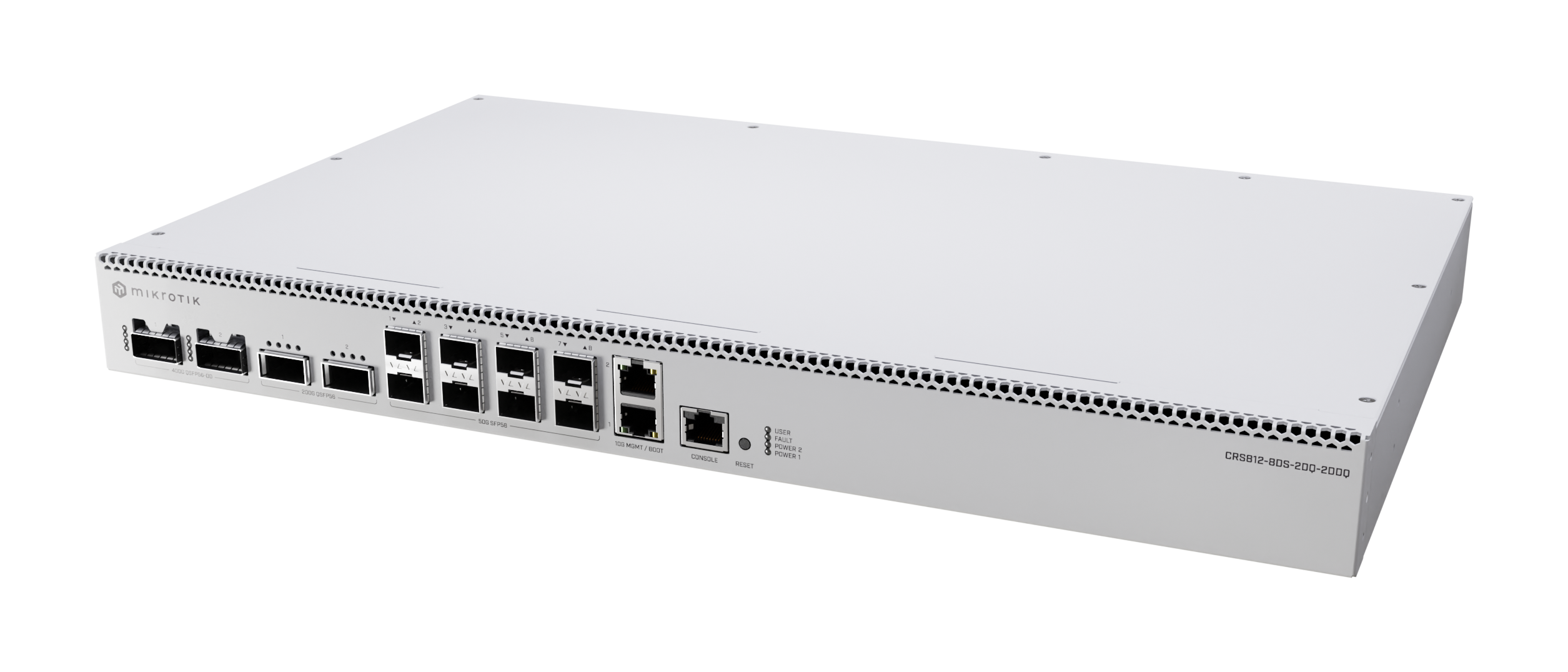
A compact 1U Cloud Router Switch for businesses building high-bandwidth aggregation, data-centre leaf, campus-core, storage, media and compute networks. The CRS812 combines 10G copper connectivity with SFP56, QSFP56 and QSFP56-DD interfaces so buyers can introduce 50G, 200G and 400G capacity without replacing every existing connection at once.
Before requesting a quotation
Share the required quantities, interface speeds, transceiver distances, breakout plans, connected server or spine platforms, rack location, power feeds and whether FourTeck should include configuration or installation assistance.
Direct answer for network buyers
The MikroTik CRS812 DDQ, product code CRS812-8DS-2DQ-2DDQ-RM, is a high-capacity managed switch for organisations that need dense 50G server or access connectivity plus 200G and 400G uplinks. It is primarily used in data-centre leaf, aggregation, campus-core, storage, AI, media and service-provider networks. Buyers should consider it when their traffic is predominantly switched in hardware and when RouterOS management fits their operational model. Before proceeding, confirm optical or DAC compatibility, breakout requirements, cable reach, rack and power design, required Layer 2 and Layer 3 features, expected routed traffic, redundancy objectives and the complete accessory bill of materials.
What the CRS812 DDQ does
It provides a high-speed switching fabric that can connect multiple generations of infrastructure in one rack. Two copper Ethernet ports support management or conventional Ethernet connections, eight SFP56 cages provide up to 50G per port, two QSFP56 cages provide up to 200G each, and two QSFP56-DD cages provide up to 400G each. This mix allows an organisation to aggregate high-speed servers, storage systems, compute nodes, access switches or lower-speed network segments into a smaller number of high-capacity uplinks.
The platform runs RouterOS v7, giving administrators a familiar environment for VLANs, bridges, routing, traffic control, monitoring and automation. The practical value depends heavily on using hardware-supported features and a design that keeps high-volume traffic in the switching silicon rather than unnecessarily sending it through the general-purpose CPU.
Who should consider it
The switch suits data-centre operators, cloud and hosting teams, enterprises refreshing a campus core, laboratories, broadcasters, post-production facilities, AI and machine-learning teams, storage administrators, internet service providers and integrators building compact high-throughput networks. It can also be relevant to organisations that want a controlled migration path from 10G or 25G toward 50G, 100G, 200G and 400G.
It is less suitable when the project requires a large number of standard RJ45 access ports, extensive PoE delivery, a silent office switch, or routing workloads that are not supported by hardware offload and must be processed primarily by the CPU. Those requirements should be reviewed before the model is selected.
Business challenges this switch can help address
Bandwidth concentration
Multiple 25G or 50G endpoints can overwhelm conventional 100G uplinks. The CRS812 provides 200G and 400G interfaces that can concentrate traffic while retaining several lower-speed connection choices.
Mixed network generations
The port range helps bridge existing 10G equipment with newer 50G, 100G, 200G and 400G systems. This can reduce the need for an all-at-once infrastructure replacement, provided optics and link modes are validated.
Rack-space pressure
A 1U form factor places a substantial amount of switching bandwidth in one rack unit. This is useful where top-of-rack space is limited and cabling needs to remain local and structured.
Operational consistency
Teams already using MikroTik can manage the switch through RouterOS, WebFig, WinBox or command-line methods. Configuration standards, backups and monitoring still need to be planned professionally.
Product-fit matrix
| Requirement | Suitable when | Confirm before ordering |
|---|---|---|
| 400G uplinks | Spine, storage or compute systems use supported QSFP56-DD connectivity. | Module type, fibre standard, reach, FEC and remote-port compatibility. |
| High-density 50G | Servers, appliances or access switches require up to eight SFP56 links. | NIC speed, transceiver coding, media type and cable distance. |
| Breakout deployment | A QSFP port must fan out to several lower-speed links. | Supported breakout mode, cable mapping and RouterOS interface configuration. |
| Layer 3 switching | Required routes and features can be processed through supported hardware offload. | Feature support, route scale, ACLs, queues and expected traffic profile. |
| Resilient rack operation | Dual AC feeds and serviceable fans match the facility design. | PDU layout, airflow, spare strategy and environmental monitoring. |
Verified technical information
The table below reflects the manufacturer’s product page and documentation for the exact CRS812-8DS-2DQ-2DDQ-RM model. Specifications, RouterOS behaviour and compatibility guidance can change with firmware releases, hardware revisions or regional policy, so the final bill of materials should be checked at quotation stage.
| Brand | MikroTik |
|---|---|
| Product name | CRS812 DDQ |
| Product code | CRS812-8DS-2DQ-2DDQ-RM |
| Product type | 1U rackmount Cloud Router Switch |
| CPU | AL52400, quad-core ARM 64-bit, nominal 2 GHz |
| Switch chip | Marvell 98DX7335 |
| Memory and storage | 4 GB RAM and 512 MB NAND storage |
| Copper Ethernet | 2 ports supporting 10M, 100M, 1G and 10G operation |
| SFP56 interfaces | 8 × 50G SFP56 cages; supported lower speeds depend on module and configuration |
| QSFP56 interfaces | 2 × ports supporting up to 200G |
| QSFP56-DD interfaces | 2 × ports supporting up to 400G |
| Breakout support | QSFP56 and QSFP-DD ports support breakout modes to lower speeds; exact mode and cabling must be confirmed |
| Operating system | RouterOS v7, license level 6 |
| Console | RJ45 serial console |
| Power | Two hot-swap IEC AC power supplies, 100–240 V AC, 50/60 Hz |
| Cooling | Four hot-swap fans |
| Power consumption | Up to 81 W without attachments and 134 W maximum |
| Operating temperature | Tested from -10°C to +50°C |
| Included items | Two IEC power cords, rackmount ears, rear support ears and fastening set |
| Availability | Contact FourTeck for current UAE availability, accessory selection and vendor lead-time guidance |
Compatibility and dependency notice
High-speed Ethernet purchasing is not complete when only the switch chassis is selected. Every link requires a compatible media plan. The port form factor, electrical or optical standard, wavelength, fibre type, connector, distance, Forward Error Correction setting and remote device support must agree. A QSFP or SFP cage accepting a module physically does not by itself guarantee a working link. Breakout connections also depend on supported lane mapping, cable construction and configuration at both ends.
RouterOS features should be checked against the intended design. Hardware switching can deliver very high throughput, while CPU-processed services may have different performance characteristics. Confirm VLAN design, Layer 3 hardware offload, access-control requirements, QoS, telemetry, link aggregation, redundancy and management integration before the implementation plan is approved.
A practical purchase and deployment journey
Map traffic flows
Document endpoints, current and projected speeds, oversubscription targets, east-west traffic, uplink destinations and resilience requirements.
Build the media plan
Choose DACs or optics for each link, confirm distances, connector types, fibre plant, breakout structure and compatibility with remote equipment.
Validate the design
Review VLANs, Layer 3 boundaries, hardware-offload support, security controls, management access, monitoring and failure behaviour.
Quote the complete BOM
Include the switch, optics, cables, spares, rack requirements, power coordination, configuration, testing and documentation rather than pricing the chassis alone.
High-speed port flexibility for staged upgrades
The strongest purchasing argument for the CRS812 DDQ is not simply that it has a 400G label. Its practical value comes from the combination of interface classes in one system. Many organisations do not move from 10G directly to 400G across every endpoint. They may have a storage array with 100G interfaces, compute nodes at 25G or 50G, a pair of 200G uplinks, and management or utility systems still using conventional Ethernet. A mixed-speed switch can support that transition when the exact link modes and modules are compatible.
The eight SFP56 cages can serve dense 50G connectivity and may operate at supported lower rates. The QSFP56 and QSFP56-DD ports support multiple line rates and breakout options according to the manufacturer’s documentation. Buyers should resist treating every possible speed as automatically available with any cable. The correct cable assembly or optical module, RouterOS settings and remote interface capabilities remain essential.
For a data-centre leaf design, the SFP56 ports may connect servers or storage targets while the 400G interfaces provide spine uplinks. In a campus design, lower-speed links can aggregate distribution switches while higher-capacity ports connect the core or data centre. In a service-provider environment, the switch can aggregate customer, access or transport connections. Each design must account for oversubscription, failure domains, buffering expectations, routing behaviour and operational support.
RouterOS management and hardware-aware design
RouterOS v7 gives the CRS812 a broad configuration framework. Administrators can build bridges and VLANs, establish routing, create access policies, manage interfaces, collect operational information and automate tasks. Familiarity with RouterOS can simplify adoption for organisations already running MikroTik equipment, but high-capacity switching requires disciplined design rather than default configuration.
The switch chip is responsible for handling traffic at very high rates. Network architects should therefore identify which functions remain in hardware and which require CPU processing. A feature that is available in the operating system may not provide line-rate performance in every combination. Firewall rules, queues, encapsulation, routing features and monitoring choices can affect how packets are processed. Testing with representative traffic is advisable for demanding production environments.
Management access should be separated from production traffic where practical. Use secure administrative protocols, strong credentials, controlled source addresses, configuration backups and a documented recovery method. Firmware and RouterOS updates should follow an approved change process. The device includes serial-console and recovery options, but these are most useful when the rack layout and access procedures are prepared in advance.
Power, cooling and operational resilience
The CRS812 includes two hot-swap AC power supplies and four hot-swap cooling fans. These features support serviceability and dual-feed rack designs, but they do not create full system redundancy by themselves. Each power supply should be connected to an appropriate independent PDU or power source where the facility design requires resilience. Circuit capacity, cable routing, rack airflow and environmental monitoring should be reviewed as part of deployment.
The manufacturer states a maximum power consumption of 134 W and up to 81 W without attachments. Optical transceivers and active cables can add heat and power demand. A rack that is already close to its cooling limit may require assessment before high-speed optics are added. Front-to-back airflow, blanking panels, cable management and clearance around the chassis all influence reliable operation.
Hot-swap components reduce the need to shut down the switch for certain maintenance tasks, but organisations should still establish a spare-parts strategy and clear replacement procedures. Fan alarms, temperature metrics, power status and interface errors should feed into monitoring. The operational plan should also cover configuration backup, software rollback, replacement-unit provisioning and escalation paths.
Ideal business environments and use cases
Data-centre leaf switching
Connect high-speed servers and storage through 50G interfaces while using 200G or 400G uplinks toward a spine layer. Validate oversubscription, routing architecture and failure-domain design.
AI and compute clusters
Support dense east-west traffic between compute nodes where Ethernet is the chosen fabric. Confirm NIC compatibility, congestion behaviour and application sensitivity before production rollout.
Media and post-production
Aggregate editing stations, render nodes and shared storage that move large files or high-bitrate streams. The end-to-end storage and client design must sustain the required throughput.
Campus-core refresh
Bridge existing 10G distribution with newer 50G and higher-capacity uplinks. Check fibre routes, redundancy, protocol design and operational migration windows.
Service-provider aggregation
Combine multiple access or customer-facing links into larger transport connections. Routing scale, QoS policy, telemetry and service assurance must be evaluated carefully.
Test and research laboratories
Create flexible multi-speed environments for interoperability, throughput and platform testing. Keep a controlled matrix of supported optics, cables, firmware and port modes.
Integration and operational considerations
A CRS812 deployment should be designed as part of the full network rather than as an isolated appliance. Confirm how it will exchange routes, where default gateways will reside, whether MLAG-like or alternative redundancy methods are required, how spanning-tree domains will be controlled and how failures will be detected. Where link aggregation is used, validate hashing and traffic distribution for the actual workload.
Monitoring should include port status, optical diagnostics where available, error counters, temperature, fan state, power state, CPU and memory usage, route or neighbour state, and configuration changes. Syslog, SNMP and other RouterOS-supported tools can be integrated according to the organisation’s monitoring platform. Access to management services should be restricted and logged.
High-speed links can expose bottlenecks elsewhere. A 400G uplink does not guarantee 400G application performance if server buses, storage arrays, NIC drivers, host CPU, packet size, file systems or remote networks are slower. Performance expectations should be converted into measurable test cases before acceptance.
Buyer questions to resolve before ordering
Procurement checklist
☐ Exact model: CRS812-8DS-2DQ-2DDQ-RM
☐ Required quantity and target delivery window
☐ Rack location, available depth and airflow direction
☐ Copper, SFP56, QSFP56 and QSFP56-DD port allocation
☐ Optics, DACs, AOCs or breakout assemblies for every link
☐ Fibre type, connector, wavelength and distance
☐ Remote device make, model, NIC and supported line rate
☐ VLAN, routing, ACL and QoS requirements
☐ Dual-power-feed and PDU plan
☐ Monitoring, logging and configuration-backup approach
☐ Installation and rack-mounting scope
☐ RouterOS configuration and migration scope
☐ Acceptance tests and documentation deliverables
☐ Spare optics, cables, fans or power-supply strategy
How FourTeck can assist
FourTeck can help translate a speed requirement into a practical bill of materials. That may include reviewing the network diagram, matching port types to connected equipment, identifying required optics or direct-attach cables, confirming breakout needs, discussing RouterOS configuration scope, and coordinating installation or testing requirements.
For quotation accuracy, provide the destination, quantity, expected line rates, cable distances, remote interface types, rack and power details, existing VLAN or routing design and any support expectations. FourTeck can also discuss related business networking products, configuration and infrastructure services, and project coordination through the FourTeck contact team.
UAE availability guidance
Contact FourTeck to confirm current UAE availability. Supply can depend on quantity, accessory selection, vendor allocation and lead time. Delivery and project coordination can be discussed after the exact requirement is confirmed. Where installation, configuration, migration or testing is required, include that scope in the quotation so responsibilities and deliverables are clear.
Dubai, Abu Dhabi, Sharjah and Ajman coverage
Businesses in Dubai, Abu Dhabi, Sharjah and Ajman can contact FourTeck for requirement review, quotation coordination, compatible accessory guidance and discussion of installation or configuration needs. The appropriate delivery or project plan depends on the confirmed product quantity, site access, rack readiness, fibre and cabling requirements, change window and technical scope. For multi-site organisations, share the location and port requirements for each site rather than treating the project as one standard bundle. This helps separate common equipment from site-specific optics, cable lengths, power arrangements and implementation tasks.
GCC Availability
FourTeck can assist organisations planning CRS812 DDQ deployments across GCC markets with requirement review, model confirmation, quotation coordination, accessory planning and configuration-scope discussion. Projects in the United Arab Emirates, Saudi Arabia, Kuwait, Qatar, Bahrain or Oman may have different procurement, delivery, licensing, site-access and service conditions. Product availability, transceiver selection, delivery schedules, installation visits and vendor lead times can vary according to country, quantity and the exact bill of materials. Buyers should share the destination country, required number of switches, port-speed plan, optical distances, preferred deployment schedule and any installation or support expectations. For regional projects, FourTeck can help standardise the design while documenting country-specific power, cabling, rack and fulfilment dependencies. Organisations in Kuwait may also review FourTeck Kuwait technology guidance as part of wider project planning.
Africa Availability
For projects in Africa, FourTeck can help buyers evaluate whether the MikroTik CRS812 DDQ fits the network design and prepare a requirement-based equipment and service scope. Availability and fulfilment can depend on destination, quantity, supported power and regulatory conditions, optics, cable distances, vendor lead time, shipping arrangements and local site readiness. Organisations should provide the destination country, exact quantity, required interface speeds, deployment target, preferred schedule and whether remote or onsite support is expected. FourTeck can discuss suitable procurement coordination for East, West, Central and Southern African projects without assuming that one delivery or installation model applies everywhere. Buyers in selected markets may use FourTeck Kenya, FourTeck Uganda or the wider FourTeck Africa technology portal for regional enquiry guidance.
Related products, accessories and services
400G direct-attach cables
Short-reach QSFP-DD direct-attach options may suit same-rack connections. Confirm length, connector type and remote-port compatibility.
400G optical modules
Optical links require matching standards, fibre type, connector, reach and remote transceiver support. Do not select solely by port form factor.
Breakout cable assemblies
Breakout designs can connect one high-speed cage to several lower-speed endpoints. Validate lane mapping and supported RouterOS configuration.
Network design assistance
Use design support to review oversubscription, VLANs, routing, resilience, traffic control, management and acceptance criteria.
Why businesses contact FourTeck
High-speed switching projects often fail at the details: the wrong optic, unsupported breakout, insufficient rack power, unclear configuration ownership or unrealistic application-throughput expectations. Businesses contact FourTeck for practical assistance with requirement clarification, exact-model confirmation, bill-of-material review, compatibility questions, quotation coordination, installation planning and RouterOS configuration scope. The objective is to place the switch within a complete and supportable design rather than treating it as a standalone purchase.
FourTeck can also help buyers compare the CRS812 with nearby switching approaches where port density, routing performance, noise, power, management platform or budget may lead to a different choice. Product selection remains requirement dependent. For broader company information, visit the FourTeck business technology overview.
Frequently asked questions
What is the full MikroTik CRS812 DDQ model number?
The exact product code is CRS812-8DS-2DQ-2DDQ-RM. Use this code in quotations and compatibility checks to avoid confusion with other CRS models.
Does the CRS812 DDQ include 400G ports?
Yes. It has two QSFP56-DD cages supporting up to 400G. A compatible cable or optical module is still required, and the remote device must support the selected link standard.
Can the high-speed ports run at lower speeds?
The manufacturer documents multiple lower-speed modes and breakout support on the QSFP56 and QSFP-DD ports. Exact operation depends on the port, module, cable, lane mapping and RouterOS configuration.
Is RouterOS included?
The device is supplied with RouterOS v7 and a level 6 license. Additional software or service requirements should be checked separately for the intended deployment.
Is it suitable as a data-centre leaf switch?
It can suit leaf deployments where its port mix, hardware-supported features, scale, resilience approach and RouterOS operations align with the design. Validate the full architecture before purchase.
Are transceivers and DAC cables included?
The standard included-parts list covers power cords and rack-mounting hardware, not a complete set of network transceivers or cables. Specify those items in the bill of materials.
Does it have redundant power?
It includes two hot-swap AC power supplies. To benefit from this design, connect them according to the facility’s independent power-feed and PDU plan.
Can FourTeck configure the switch?
Configuration support can be discussed for VLANs, management, routing, access controls, monitoring and migration. The exact deliverables should be written into the quotation.
How do I request a Dubai quotation?
Share the exact model, quantity, required interface speeds, optics or cable distances, connected equipment, installation location and any configuration or support scope with FourTeck.
Plan the complete CRS812 DDQ requirement
Request a requirement-based quotation covering the switch, optics, cables, breakout assemblies, rack and power considerations, RouterOS configuration, testing and delivery coordination. Current UAE availability and lead time should be confirmed against the final bill of materials.
