

Configurable 2.4 GHz RouterBOARD platform
MikroTik RB912UAG-2HPnD in Dubai, UAE
The RB912UAG-2HPnD is a compact, high-power 2.4 GHz RouterBOARD for integrators who need RouterOS, Gigabit Ethernet, passive PoE and expansion through miniPCIe, USB and a modem SIM slot. It is best approached as a configurable board-level platform whose enclosure, antennas, expansion card, power design and software configuration must be matched to the project.
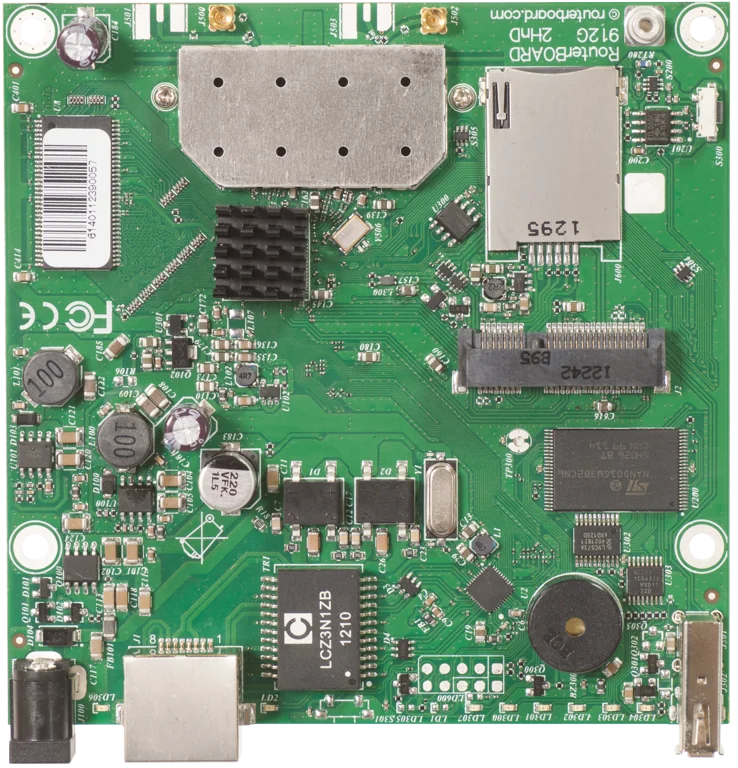
Board-level product. Enclosure, antennas and project-specific accessories should be confirmed separately.
Direct answer for buyers
The MikroTik RB912UAG-2HPnD is a small RouterBOARD with an integrated high-power 2.4 GHz 802.11b/g/n radio, one Gigabit Ethernet port and expansion interfaces for specialist wireless or mobile-connectivity projects. It is mainly used by integrators building customised access points, CPE devices, wireless links or compact network nodes. Buyers should consider it when they need RouterOS flexibility and board-level integration rather than a finished desktop access point. Before proceeding, confirm the enclosure, antenna system, passive PoE supply, local radio rules, miniPCIe compatibility, SIM purpose, USB requirements, RouterOS configuration and whether a newer platform would better suit the expected lifecycle and performance target.
What this board does
The RB912UAG-2HPnD combines routing, switching, wireless and management functions on one compact board. Its integrated radio supports 2.4 GHz 802.11b/g/n operation with two chains and a maximum stated wireless data rate of 300 Mbit/s. RouterOS provides the configuration environment for bridging, routing, firewalling, wireless profiles, VLANs, queues, monitoring and other network functions. The board also offers a miniPCIe slot, USB Type-A port and a modem-oriented Mini SIM slot, enabling project-specific expansion where compatible hardware and software support are confirmed.
Who it is designed for
This model is more suitable for wireless internet service providers, OEM-style builders, system integrators, remote-site engineers, industrial networking teams and technically managed organisations than for buyers seeking a simple consumer router. It can support tailored installations in cabinets, outdoor enclosures, masts, kiosks and controlled equipment spaces, provided power, cooling, weather protection, grounding, surge protection, antennas and cabling are correctly engineered. It is also relevant for replacement or continuity projects where the same model is already standardised and configuration consistency matters.
Business challenges the RB912UAG-2HPnD can address
Custom wireless edge
Some projects need a radio board that can be integrated into a purpose-built enclosure with a chosen antenna system. This model gives an integrator control over physical packaging and RouterOS configuration instead of imposing a fixed consumer form factor.
Single-cable power and data
Passive PoE input allows Ethernet data and power to share one cable when the voltage, injector, cable length and loss budget are properly matched. This can simplify mounting in locations where a nearby AC outlet is unavailable.
Flexible radio or modem expansion
The miniPCIe slot can support selected wireless, mobile or LoRa-related expansion scenarios. Compatibility is not automatic: the exact card, antenna leads, power draw, RouterOS support and regional frequency rules must be checked before procurement.
Managed network functions
RouterOS allows the same hardware to take on different roles, including a bridge, routed CPE, access point or controlled network edge. Actual performance depends on configuration complexity, packet size, filtering, queues and enabled services.
Core capability band
Dual-chain 802.11b/g/n wireless for carefully planned 2.4 GHz applications.
One copper Gigabit interface for uplink, local connection or passive PoE input.
Preinstalled licensed operating system for networking and wireless configuration.
MiniPCIe, USB and a modem SIM slot support selected project extensions.
Product-fit matrix
| Requirement | Suitable when | Confirm before ordering |
|---|---|---|
| Custom 2.4 GHz access point | A board-level RouterOS platform and external antenna design are required. | Antenna gain, connectors, enclosure, channel plan and legal transmit limits. |
| Wireless CPE or link endpoint | The link budget and interference conditions support 2.4 GHz operation. | Distance, Fresnel clearance, antenna type, expected throughput and mounting. |
| Cellular expansion | A compatible miniPCIe modem and RouterOS support are established. | Modem model, SIM format, antenna leads, regional bands and power draw. |
| Replacement project | An installed base already uses this exact board and configuration. | Hardware revision, backup compatibility, RouterOS version and accessories. |
| Modern high-density office Wi-Fi | Generally not the first choice for a new high-density indoor design. | Consider dual-band or newer-generation alternatives and managed AP features. |
Verified technical information
The following values match MikroTik information for the exact RB912UAG-2HPnD board. They should still be checked against the unit label, current manufacturer documentation and the proposed bill of materials before purchase.
| Brand | MikroTik |
|---|---|
| Product code | RB912UAG-2HPnD |
| Product type | Wireless RouterBOARD |
| Architecture and CPU | MIPSBE, AR9342, one core at 600 MHz |
| Memory and storage | 64 MB RAM and 128 MB NAND storage |
| Operating system | RouterOS, Level 4 license |
| Wireless | 2.4 GHz, 802.11b/g/n, two chains, stated maximum data rate 300 Mbit/s |
| Ethernet | One 10/100/1000 Ethernet port |
| Expansion | One miniPCIe slot, one USB Type-A port, one Mini SIM slot for modem use |
| USB capability | USB power reset supported; maximum USB current stated as 1 A |
| Power input | DC jack or passive PoE input, 8–30 V |
| Maximum power consumption | 13.5 W |
| Cooling | Passive |
| Dimensions | 105 × 105 mm |
| Tested ambient temperature | −40°C to 70°C; final installation depends on enclosure and system design |
| Monitoring | PCB temperature monitor, voltage monitor and beeper |
| Protection and approvals | Manufacturer states built-in 16 kV ESD protection on Ethernet and MMCX ports; FCC and IC certifications listed |
| Ingress protection | IP00 — no environmental enclosure protection |
| Availability | Contact FourTeck for current UAE model and quantity availability |
Compatibility and dependency notice
The SIM slot does not create mobile connectivity by itself. A compatible miniPCIe modem, supported RouterOS package or driver path, suitable cellular antennas and a valid operator SIM are required. Likewise, a miniPCIe wireless card is an optional component rather than part of every board purchase. Antenna pigtails, MMCX connections, enclosure feed-throughs, surge protection, grounding materials, PoE injector and power adapter should be itemised in the quotation where needed.
Wireless frequency availability and transmit power are region dependent. The installer is responsible for legal channel selection, power limits and professional installation. A configuration that is technically possible in RouterOS may still be unsuitable or prohibited in a specific country or deployment environment.
A practical purchase and deployment journey
Define the role
Clarify whether the board will operate as an access point, CPE, bridge, router, telemetry node or cellular-enabled edge.
Build the bill of materials
Select enclosure, antennas, pigtails, modem or radio card, PoE equipment, cabling, mounting and surge protection.
Validate compatibility
Check RouterOS support, frequency bands, power draw, physical fit, SIM format and environmental conditions.
Configure and test
Upgrade appropriately, secure management, load the approved configuration and test radio, Ethernet, failover and monitoring.
Install and document
Mount professionally, record cable and antenna details, save backups and document access, recovery and support procedures.
Capability focus: 2.4 GHz wireless design
The integrated radio is useful where 2.4 GHz propagation, compatibility with older clients or a specific link design makes sense. The band can travel through obstacles more effectively than higher frequencies in some settings, but it is also commonly congested by Wi-Fi, Bluetooth and other unlicensed devices. A sound deployment therefore starts with a spectrum and site assessment rather than relying on maximum radio power.
The two-chain 802.11n design can support multiple-input multiple-output operation when two suitable antenna paths are used. Antenna polarisation, cable loss, connector quality, spacing and alignment directly affect results. The published 300 Mbit/s figure is a radio link rate under compatible conditions, not a guaranteed application throughput. Real traffic performance will be lower and will vary with channel width, signal quality, interference, protocol overhead, routing rules and connected-client capabilities.
For point-to-point or point-to-multipoint work, the link budget should include transmit power, antenna gain, cable losses, path loss, fade margin and regulatory limits. For local access, channel reuse and client density may matter more than raw transmit power. FourTeck can help frame the requirement, but a qualified installer should validate the RF plan at the actual site.
Capability focus: RouterOS control and operational discipline
RouterOS turns the board into a flexible networking platform, but flexibility also creates design responsibility. Administrators can define bridges, IP addressing, DHCP, firewall filters, NAT, VLANs, queues, routing, wireless security, monitoring and remote-management controls. The configuration should be limited to the functions actually required because every additional service increases operational complexity and may affect performance.
A production deployment should include a documented administrative-access policy, strong credentials, restricted management sources, disabled unused services, current supported software, configuration backups and a tested recovery procedure. Remote access should not be exposed casually to the public internet. Where centralised operations are required, the design should specify how logs, alerts, configuration changes and software updates will be managed.
Performance figures published by a manufacturer are laboratory results based on defined packet sizes and rule sets. An RB912UAG-2HPnD performing basic bridging can behave very differently from the same board running many filter rules, queues, tunnels or routing functions. Buyers should describe the expected traffic profile and configuration so that the board is not selected solely from headline port speed.
Capability focus: expansion for specialised connectivity
The miniPCIe slot is one of the model’s defining features. It allows the board to participate in projects that need an additional radio interface, mobile modem or another supported module. The practical outcome depends entirely on the selected card. A card may require specific RouterOS support, dedicated antennas, pigtails, SIM access, power headroom and physical clearance inside the enclosure.
The USB Type-A interface can serve selected peripherals and supports USB power reset, which can be valuable when a modem or accessory must be power-cycled remotely. The stated maximum USB current is 1 A, but the overall power design must still account for the board, radio load and attached device. Cable quality and voltage drop become especially important in passive PoE installations.
Because this product originated in an earlier wireless generation, not every modern modem or card should be assumed compatible. Confirm the exact manufacturer part number, interface type, RouterOS version, supported bands and user reports from authoritative documentation before purchase. For new projects with demanding LTE, 5G or high-throughput requirements, a more recent integrated platform may provide a simpler lifecycle and support path.
Ideal business environments and use cases
Wireless service-provider edge
A managed CPE or compact access node where the operator already has RouterOS skills, an approved enclosure design and a defined antenna standard.
Industrial or utility cabinet
A network board installed inside a correctly rated cabinet to connect monitoring equipment, controllers or remote assets under a documented power and environmental design.
Temporary project connectivity
A configurable node for events, construction or field operations when enclosure, spectrum, power and secure remote access are professionally managed.
Legacy standardisation
A replacement or spare for an established fleet where retaining the exact board reduces redesign effort and the operational team understands its limits.
Special-purpose wireless build
A prototype or controlled deployment that benefits from miniPCIe expansion, RouterOS scripting, USB power reset or custom packaging.
Not a universal office AP
New high-density offices, hotels and education sites generally need newer dual-band or multi-band managed access points with a more complete enclosure and support model.
Integration and operational considerations
The board has one Ethernet port, so network topology must be planned carefully. If multiple wired devices must connect locally, an external switch may be required. If VLAN trunking is used, the switch, RouterOS bridge settings and upstream network must share the same tagging design. Passive PoE should never be connected to equipment that is not designed for the chosen voltage and pin arrangement.
An outdoor or dusty installation cannot rely on the board alone because its listed ingress-protection rating is IP00. The enclosure should be selected for temperature, dust, water, UV exposure, condensation and cable-entry conditions. Heat dissipation must be considered even though the board is passively cooled. Grounding, surge protection and shielded cabling may be necessary, particularly on masts or long outdoor cable runs.
Antenna connectors and pigtails must match the board and enclosure feed-throughs. Poor-quality adapters can introduce loss and instability. Where a cellular modem is added, the antenna system must cover the operator’s bands and provide appropriate separation from the 2.4 GHz antenna system.
Operationally, the team should define who owns RouterOS updates, configuration backups, password custody, incident recovery and replacement stock. This board can be reliable in a well-engineered design, but it should not be treated as a self-contained appliance requiring no integration work.
Buyer questions to resolve before ordering
The role determines radio mode, RouterOS configuration, enclosure, antenna and performance expectations.
Check interference, legal channels, client compatibility, link distance and capacity requirements.
Confirm gain, polarisation, beamwidth, cable length, pigtails and enclosure feed-throughs.
Provide the exact card part number and verify RouterOS, physical and electrical compatibility.
Specify DC jack or passive PoE, voltage, injector, cable length and surge-protection method.
IP00 means the enclosure and installation provide all practical environmental protection.
Procurement checklist
✓ Exact model: RB912UAG-2HPnD, not a nearby BaseBox or 5 GHz variant
✓ Required quantity and preferred project schedule
✓ Intended radio mode and expected throughput
✓ 2.4 GHz channel and regulatory plan
✓ Antenna type, gain, connectors and pigtails
✓ Enclosure rating, mounting and cable glands
✓ Passive PoE voltage, injector and power budget
✓ MiniPCIe card or modem part number
✓ SIM format, operator and supported bands
✓ USB peripheral and current requirement
✓ RouterOS configuration, security and backup scope
✓ Installation, grounding and surge-protection responsibility
✓ Warranty guidance and current UAE availability confirmation
How FourTeck can support the requirement
FourTeck can help translate a general request for the RB912UAG-2HPnD into a clearer bill of materials. This may include confirming the exact board, expected quantity, antenna approach, enclosure requirement, passive PoE accessories, miniPCIe module, pigtails and installation scope. Where the buyer is replacing an existing unit, sharing a photo of the label, current configuration export and installed accessories can reduce model-selection errors.
Configuration assistance can be scoped around the actual network role. Typical discussions include bridge or routed mode, VLAN handling, IP addressing, DHCP, firewall policy, wireless security, management access, monitoring, update approach and backup documentation. These services are not automatically included with the hardware and should be stated in the quotation request.
For broader infrastructure planning, visit the FourTeck technology product range, review available installation and configuration services, or send the project details through the FourTeck contact team.
UAE availability and support guidance
Contact FourTeck to confirm current UAE availability for the exact RB912UAG-2HPnD model and required quantity. Availability may depend on vendor lead time, board revision, project volume and whether accessories are requested at the same time. A quotation should identify the board separately from any enclosure, power supply, PoE injector, antenna, pigtail, miniPCIe module, SIM, cabling, mounting materials or configuration service.
For deployments across Dubai, Abu Dhabi, Sharjah and Ajman, FourTeck can coordinate requirement review, quotation and project planning after the installation details are supplied. Delivery timing and service scheduling should be confirmed only after the exact bill of materials, destination and scope are agreed. Buyers who need onsite installation, RouterOS configuration, radio alignment or handover documentation should request those activities explicitly rather than assuming they are bundled with hardware supply.
GCC Availability
FourTeck can assist organisations planning MikroTik wireless projects across GCC markets with requirement review, exact model confirmation, accessory planning, quotation coordination and configuration-scope discussions. For the RB912UAG-2HPnD, the destination country matters because permitted radio channels, transmit limits, modem bands, power arrangements and project-delivery conditions can differ. Businesses in the United Arab Emirates, Saudi Arabia, Kuwait, Qatar, Bahrain and Oman should provide the installation location, required quantity, antenna design, proposed miniPCIe module and expected deployment schedule.
Product availability, licensing, freight timing, service visits and vendor lead times can vary by country, quantity and requirement. FourTeck does not treat a generic regional enquiry as confirmation of local stock or a fixed delivery date. Share the exact product code, destination, accessories, power requirements, RouterOS configuration scope and any installation expectations so the team can prepare relevant guidance. Kuwait-based requirements can also be discussed through FourTeck Kuwait technology support.
Africa Availability
FourTeck can support African organisations evaluating the RB912UAG-2HPnD for wireless service-provider, industrial, field-connectivity or replacement projects. The planning conversation should cover the destination country, board quantity, enclosure, antenna system, passive PoE design, modem or expansion card, software configuration, installation responsibility and required support. These details are especially important where equipment will operate in high heat, dust, humidity, lightning-prone areas or remote sites with limited technical access.
Availability and fulfilment depend on model supply, destination, shipping arrangements, power and regulatory requirements, vendor lead time and local project conditions. Buyers should not assume immediate shipment, local inventory or country-wide onsite coverage. FourTeck can coordinate requirement clarification and procurement planning through its Africa technology solutions channel, with additional regional information available for Kenya and Uganda. Share the intended schedule and support expectation to obtain an appropriate response.
Related products, services and alternatives to discuss
Outdoor enclosure option
A suitable enclosure is essential because the board itself is IP00. Confirm environmental rating, mounting and connector layout.
2.4 GHz antenna system
Choose sector, panel, directional or omnidirectional antennas only after the coverage or link requirement is defined.
MiniPCIe radio or modem
Expansion cards are optional and compatibility dependent. Exact part numbers and antenna arrangements must be reviewed.
Passive PoE accessories
Injector, power adapter, cable length and surge protection should be selected as one coordinated power design.
Newer wireless platforms
For new high-capacity projects, compare newer dual-band, Wi-Fi 5, Wi-Fi 6 or integrated LTE options before standardising.
Configuration and installation
Request RouterOS setup, secure management, RF planning, mounting and documentation as separate project services where needed.
Why businesses contact FourTeck
Business buyers often need more than a product code. They need confidence that the ordered board matches the installed model, that required accessories are not omitted and that optional components are not mistakenly treated as included. FourTeck can help structure these questions before a quotation is issued.
For the RB912UAG-2HPnD, practical assistance may include model verification, bill-of-material review, compatibility discussion, alternative-product comparison, RouterOS configuration scoping, installation planning and delivery coordination. No single service scope suits every project, so the recommended approach is to share technical and commercial requirements at the beginning.
Organisations planning broader network or security work can learn more about FourTeck business technology services or review the FourTeck company overview before requesting a tailored response.
Frequently asked questions
Is the RB912UAG-2HPnD a complete outdoor access point?
No. It is a board-level product with an IP00 rating. A suitable enclosure, antennas, cabling, mounting and environmental protection must be selected for the installation.
Which wireless band does it support?
The integrated radio operates in the 2.4 GHz band and supports 802.11b/g/n with two chains. Legal frequencies and power levels depend on the destination country.
Does the SIM slot provide LTE automatically?
No. The SIM slot is intended for modem use and requires a compatible miniPCIe modem, suitable antennas, supported RouterOS configuration and an active operator SIM.
Is a RouterOS license included?
MikroTik lists the board with RouterOS and a Level 4 license preinstalled. Confirm the unit condition and license status when purchasing replacement or previously deployed hardware.
Can it be powered through Ethernet?
Yes, it accepts passive PoE in the stated 8–30 V range. The injector, voltage, cable length, loss and connected equipment must be checked carefully.
What antennas are included?
Do not assume antennas are included with a board-only quotation. The antenna type, gain, connectors, pigtails and enclosure feed-throughs should be specified separately.
Is the 300 Mbit/s figure guaranteed throughput?
No. It is the stated maximum wireless data rate. Real application throughput depends on signal quality, interference, channel width, protocol overhead, configuration and client capability.
Is this model suitable for a new office Wi-Fi deployment?
It may suit a specialised build, but newer dual-band or Wi-Fi 6 managed access points are usually more appropriate for modern high-density office environments.
What information is needed for a quotation?
Provide quantity, destination, intended role, antenna plan, enclosure requirement, power method, miniPCIe or USB accessories, configuration scope and preferred schedule.
Can FourTeck help with configuration and installation?
Configuration and installation planning can be discussed and quoted according to the project. State whether you need RouterOS setup, RF planning, mounting, testing or documentation.
Confirm the complete RB912UAG-2HPnD requirement
Send FourTeck the quantity, intended network role, enclosure, antenna, power and expansion details. The team can review the requirement and coordinate a quotation based on current UAE availability and the requested service scope.

Reviews
There are no reviews yet.