

Palo Alto Networks PA-5580 Quantum-Optimized Next-Generation Firewall in Dubai, UAE
The PA-5580 is the highest-capacity model in the PA-5500 Series, built for organisations that must inspect very large traffic volumes without treating security as a separate bottleneck. It combines dense high-speed interfaces, dedicated management and logging connectivity, substantial session scale and subscription-driven security services for large internet gateways, data centres and service-provider networks.
Plan the correct configuration
Confirm traffic profile, interface speeds, optics, power choice, clustering design, subscriptions, support and implementation scope before requesting a final quotation.
Direct answer for buyers
The Palo Alto Networks PA-5580 is a high-end fixed-form-factor next-generation firewall for networks that require hundreds of gigabits of inspected traffic, large connection tables and dense high-speed fibre interfaces. It is mainly used at major data-centre perimeters, internet gateways, cloud interconnects and service-provider boundaries. It should be considered by organisations whose validated traffic profile exceeds the practical range of lower PA-5500 models and that have the rack, power, cooling, optics and operational maturity required for a platform of this class. Before proceeding, confirm real traffic mix, enabled security subscriptions, decryption requirements, session growth, interface breakout needs, clustering design, management platform, power-feed architecture and support entitlement.
What the PA-5580 does
The appliance identifies applications, users, devices and threats so that security policy can be based on the actual traffic context rather than only addresses and port numbers. In practical terms, this enables a large organisation to control business applications, inspect encrypted sessions where policy permits, block known and emerging threats, segment critical environments and apply consistent policy to very high-volume traffic flows.
Its role is not limited to simple perimeter filtering. Depending on subscriptions, configuration and management design, it can contribute to threat prevention, advanced URL controls, DNS security, malware analysis, remote-access policy, application control and centralised operations. These functions are license or subscription dependent and must be listed explicitly in the proposed bill of materials.
Who should consider it
The PA-5580 is most relevant to hyperscale data centres, cloud and colocation operators, telecommunications providers, very large enterprises, government environments and organisations consolidating multiple high-speed security zones onto a resilient platform. It may also suit enterprises replacing several older high-end appliances where a carefully designed consolidation project can simplify policy and operations.
It is generally not the right choice for a normal branch office, a modest campus edge or an environment whose peak inspected traffic is far below the platform range. Oversizing can create unnecessary capital, licensing, rack and power cost. FourTeck can help establish whether a PA-5540, PA-5550, PA-5560, PA-5570 or another architecture is more proportionate.
Business challenges the platform can help address
Security at very high traffic rates
Large gateways can outgrow firewalls that were sized only for basic forwarding. The PA-5580 is intended for environments where application identification, threat inspection and policy enforcement must operate across extremely high aggregate throughput. Sizing should use inspected traffic, not nominal circuit speed alone.
Dense high-speed connectivity
Modern data centres frequently combine 25Gbps server or aggregation links with 100Gbps and 400Gbps uplinks. The interface design supports these speeds, but the exact optics, breakout configuration, cable type and peer-device compatibility need to be engineered before ordering.
Operational visibility at scale
High session volumes can overwhelm management and logging designs if these are treated as an afterthought. Dedicated management and logging interfaces, central management choices and log-retention planning help separate operations traffic from production inspection paths.
Resilient security architecture
Critical gateways normally require redundancy. PA-5500 Series clustering and supported high-availability options must be designed with the correct inter-firewall links, software release and operational procedures. The target topology should be reviewed before committing to hardware quantities and interfaces.
Core capability band
Control traffic by application, identity and context rather than relying only on traditional port-based rules.
Apply subscription-driven inspection to permitted flows, with performance dependent on enabled services and traffic profile.
Connect to 25Gbps, 100Gbps and 400Gbps network fabrics with supported transceivers and breakout options.
Integrate with the selected Palo Alto Networks management and logging architecture for policy, visibility and lifecycle tasks.
PA-5580 suitability matrix
| Requirement | Suitable when | Confirm before ordering |
|---|---|---|
| Very high inspected throughput | Traffic forecasts show a sustained need near the upper PA-5500 Series range. | Threat services, TLS decryption share, packet size and growth margin. |
| 400Gbps uplinks | The core, fabric or provider edge uses supported QSFP-DD connectivity. | Optic type, distance, breakout mode and peer compatibility. |
| Large session scale | Internet, cloud or subscriber workloads produce tens of millions of concurrent sessions. | Peak concurrent sessions, new connections per second and application mix. |
| Critical gateway resilience | The business requires a redundant security design and controlled maintenance windows. | Supported clustering or HA mode, inter-firewall links, routing convergence and software release. |
| Dense data-centre segmentation | Multiple zones, tenants or services require high-bandwidth policy boundaries. | Virtual systems, routing design, policy ownership and license limits. |
Verified technical information
| Brand | Palo Alto Networks |
|---|---|
| Product name | PA-5580 Quantum-Optimized Next-Generation Firewall |
| Product family | PA-5500 Series |
| Primary deployment | High-speed data centre, internet gateway and service-provider environments |
| Firewall throughput | Up to 375 Gbps; actual results depend on traffic and configuration |
| Threat prevention throughput | Up to 300 Gbps; subscription and workload dependent |
| IPsec VPN throughput | Up to 170 Gbps; configuration dependent |
| Maximum sessions | Up to 99 million for the series top model; validate against the current datasheet and PAN-OS release |
| New sessions per second | Up to 3 million for the series top model; traffic dependent |
| Network interfaces | 8 × 10/25Gbps SFP28, 12 × 40/100Gbps QSFP28 and 8 × 40/100/400Gbps QSFP-DD |
| Management interfaces | 2 × 1/10Gbps SFP+ management ports |
| Logging interfaces | 2 × 10Gbps SFP+ log ports |
| Clustering links | HSCI ports supporting 100Gbps or 400Gbps for inter-firewall links; design dependent |
| Form factor | 3RU, 19-inch rack installation |
| Dimensions | 13.21 cm high × 43.94 cm wide × 75.69 cm deep |
| Weight | Approximately 35.83 kg |
| Power options | AC or DC; up to four load-sharing power supplies, configuration dependent |
| Operating temperature | 0°C to 50°C |
| Airflow | Front to back |
| Operating system | PAN-OS; supported release must be confirmed for the planned design |
| Subscriptions | Security services are subscription dependent and not assumed included |
| Availability | Contact FourTeck for current UAE hardware variant, license, quantity and lead-time options |
Configuration, licensing and compatibility dependencies
A PA-5580 quotation should not be treated as a single appliance line item. A complete design may include an AC or DC hardware variant, the required number of power supplies, country-appropriate power cords, rack components, supported transceivers, fibre or direct-attach cabling, security subscriptions, central management, log storage, support entitlement and professional services. The exact combination depends on the deployment and procurement policy.
Features such as Advanced Threat Prevention, Advanced URL Filtering, Advanced WildFire, DNS Security, data loss prevention, IoT security and other cloud-delivered services are generally associated with subscriptions. Their availability, naming, bundle structure and term may change under current vendor policy. FourTeck should confirm the license bill of materials rather than assuming that a feature mentioned in platform literature is automatically included with the base chassis.
Compatibility review should cover PAN-OS release, transceiver support, interface speed and breakout mode, routing protocols, external management systems, log collectors, authentication services, network timing, adjacent switches or routers, change-control requirements and the proposed clustering or high-availability topology. For 400Gbps connections, optic type, fibre grade, distance and peer-side support are particularly important.
A practical purchase and deployment journey
Measure the traffic
Collect current and projected north-south and east-west throughput, peak sessions, connection rate, packet sizes, encrypted traffic share and growth horizon. Include traffic that may move from several existing appliances into one design.
Map interfaces and zones
Define every physical and logical connection, speed, media type, virtual system, routing instance and security zone. Decide where breakout ports are required and which optics must be included.
Choose services and management
Identify mandatory security subscriptions, support term, Panorama or cloud management requirements, log retention, reporting and integration with identity, ticketing and monitoring systems.
Validate resilience
Confirm supported clustering or HA method, inter-firewall link bandwidth, routing behaviour, maintenance process, state synchronisation and failure-domain design for the selected software release.
Prepare implementation
Plan rack space, loading, power feeds, cooling, cabling, configuration templates, migration, testing, rollback, documentation and handover. Include professional services in the quotation where internal resources are limited.
Finalise the bill of materials
Request a line-by-line quotation showing appliance variant, power, optics, subscriptions, support, management, services and lead-time assumptions. Review every dependency before issuing a purchase order.
High-capacity inspection without ignoring real traffic conditions
The PA-5580 is positioned for environments where a firewall must inspect traffic at a scale that would require several smaller appliances. Published throughput figures are useful for initial model comparison, but they are not a substitute for workload analysis. Real performance varies with packet size, application mix, security profiles, TLS decryption, logging, routing features and policy complexity. A design carrying large numbers of short-lived internet sessions may be constrained by new connection rate before aggregate bandwidth becomes the limiting factor. A data-centre segmentation design may instead be driven by interface density, east-west throughput and the number of policy boundaries.
Buyers should therefore separate four measurements: raw firewall forwarding, application inspection, threat prevention and encrypted-traffic inspection. The most conservative relevant measurement should drive the capacity decision. Growth margin is also important because large firewall replacements are usually expected to serve for several years. At the same time, excessive headroom should not be used as a substitute for good forecasting. FourTeck can help convert network monitoring data, existing firewall statistics and planned circuit upgrades into a sizing worksheet that compares the PA-5580 with other PA-5500 Series models.
Quantum-optimized positioning reflects support for securing traffic in an environment where post-quantum cryptography is becoming relevant. This does not remove the need for a broader cryptographic migration strategy. Organisations should inventory applications, certificates, VPNs, key-management dependencies and inspection policies, then decide where post-quantum encrypted sessions will be permitted, inspected or exempted according to technical and regulatory requirements.
Interface design for 25G, 100G and 400G fabrics
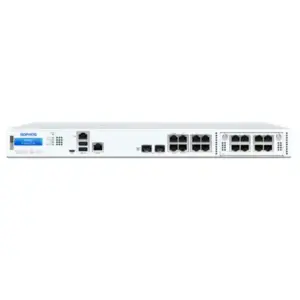
The front-panel interface mix is one of the PA-5580’s main selection reasons. Eight SFP28 ports can support 10Gbps or 25Gbps connectivity, twelve QSFP28 ports support 40Gbps or 100Gbps, and eight QSFP-DD ports support 40Gbps, 100Gbps or 400Gbps. Certain ports can operate in breakout configurations. This flexibility can reduce the need for external media conversion, but only when the precise port map is engineered in advance.
A correct port map should identify the function of each interface, the adjacent device, target speed, fibre type, connector, optic part number, link distance, breakout mode, redundancy path and spare capacity. It should also reserve interfaces for migration and troubleshooting. Data-centre projects frequently fail at the final stage because the firewall was ordered without the correct optics or because a peer switch supports a different breakout arrangement. Supported transceiver lists and current hardware documentation should be checked at quotation time.
Management and logging are separated from production interfaces through two 1/10Gbps SFP+ management ports and two 10Gbps SFP+ logging ports. These ports allow architects to build a dedicated operational network and log path. Whether both are used depends on the management design, but they should be considered in the rack cabling and switch-port plan. Console access through RJ-45 and USB-C, together with USB bootstrapping support, can simplify staging and recovery procedures when included in the implementation runbook.
Resilience, clustering and lifecycle operations
A firewall of this capacity is usually deployed in a critical path, so resilience must be designed beyond simply ordering two units. The PA-5500 Series provides high-speed HSCI interfaces for an inter-firewall link used in NGFW clustering. The supported topology, software prerequisites and operational behaviour should be verified against the current PAN-OS release. The inter-firewall link carries configuration, state and data-plane traffic, so undersizing it can undermine the resilience objective.
The network around the firewalls must also converge correctly. Routing protocol timers, link aggregation, upstream and downstream redundancy, asymmetric paths, session ownership and maintenance procedures all affect failover behaviour. A change plan should document normal traffic paths, expected failure states, test cases and rollback. This is particularly important for service-provider or multi-tenant environments where a single routing event can affect many customers.
Power and cooling are equally significant. The chassis supports AC or DC configurations with up to four load-sharing power supplies. The number needed for operation and redundancy depends on input voltage and chosen hardware variant. A data-centre facilities review should confirm rack depth, 3RU space, equipment weight, front-to-back airflow, available circuits, connector type and heat load. Installation should use the recommended four-post rack kit and appropriate lifting practices for a chassis weighing about 35.83 kilograms.
Lifecycle operations should cover software upgrades, content updates, configuration backups, certificate renewal, subscription renewal, log retention, spare strategy and support escalation. A high-capacity appliance can simplify the topology, but it also concentrates operational importance. Clear ownership, tested procedures and current documentation are therefore essential.
Ideal business environments and use cases
Hyperscale and large enterprise data centres
The platform can sit between data-centre zones, internet edges, shared services and external connectivity where several hundred gigabits of security inspection may be required. Suitability depends on traffic distribution, virtual-system design and east-west inspection goals.
Telecommunications and service providers
High connection rates and large session tables can support subscriber, peering or managed-security use cases, subject to architecture validation, tenant separation, logging scale and operational process.
Cloud and colocation gateways
Dense 100Gbps and 400Gbps links may suit cloud interconnect and colocation fabrics that aggregate many customers or workloads. The security policy, routing design and ownership model must be clearly defined.
Large government and regulated environments
Organisations with major shared networks may use the appliance to enforce consistent controls between trust zones. Compliance goals still require policy, process, monitoring and evidence beyond the firewall itself.
Security platform consolidation
Several ageing high-end firewalls may be consolidated where interface, performance and policy analysis support the change. Migration should include rule cleanup, application validation, testing and staged cutover.
High-capacity internet gateway
The PA-5580 may protect large internet edges with substantial encrypted traffic and connection churn. Decryption policy, certificate management, privacy requirements and threat-service sizing must be reviewed carefully.
Integration and operational considerations
The firewall must fit into a wider security and network operating model. Identity sources, directory services, authentication platforms, certificate infrastructure, DNS, routing, monitoring, SIEM, ticketing and change-management systems can all influence the deployment. The project team should identify which integrations are mandatory on day one and which can be phased after stabilisation.
Central management may use Panorama or supported cloud-management services according to the organisation’s architecture and license position. Logging can be local, forwarded to dedicated collectors or integrated with third-party analytics. Retention calculations should start with expected log volume and compliance requirements rather than available storage alone. Dedicated logging interfaces can be used to isolate log transport from normal management traffic.
Policy migration deserves special attention. Converting legacy port-based rules directly into a new platform can preserve old risk and complexity. A better approach is to identify applications, owners, business purpose, dependencies and review dates, then stage policy with monitoring before enforcement where appropriate. FourTeck can discuss discovery, rule review, configuration, testing and cutover support as separate project activities.
Buyer questions to resolve before ordering
Use real statistics and forecasts, including security services and encrypted traffic, not only circuit capacity.
Document every speed, optic, distance, breakout and peer device before building the bill of materials.
Separate base platform capability from paid cloud-delivered security services and confirm the required term.
Validate clustering or HA mode, inter-firewall links, routing convergence, power feeds and maintenance procedure.
Define retention, collectors, SIEM integration, bandwidth and operational ownership.
Include staging, migration, configuration, testing, documentation and handover where internal resources need support.
Procurement checklist
☐ Exact PA-5580 AC or DC hardware variant
☐ Required appliance quantity and resilience design
☐ Measured and forecast traffic profile
☐ Concurrent session and connection-rate requirements
☐ 10/25G, 40/100G and 400G port map
☐ Supported optics, breakout cables and fibre type
☐ Power supplies, cords, circuits and redundancy
☐ Security subscription bundle and term
☐ Support level and renewal expectations
☐ Panorama or cloud-management requirement
☐ Log collector, storage and retention plan
☐ Rack space, depth, loading and cooling review
☐ Migration, configuration and testing scope
☐ Destination, delivery coordination and target schedule
FourTeck consultation and quotation assistance
FourTeck can help turn an initial PA-5580 enquiry into a procurement-ready requirement. The process can start with a review of network diagrams, traffic statistics, current firewall capacity, circuit upgrades, expected security services, interface requirements and resilience objectives. This information helps determine whether the PA-5580 is proportionate or whether another PA-5500 Series model should be compared.
For quotation preparation, FourTeck can coordinate the hardware variant, power configuration, optics, licenses, subscription term, support, management components and professional-service scope. Where a customer is replacing an existing platform, the request can also include discovery, policy review, configuration build, migration planning, testing and handover. These services are scope dependent and should be listed explicitly rather than assumed.
Buyers may review related firewall options through the FourTeck firewall product catalogue, explore available security planning and deployment services, or contact the team through the Dubai firewall enquiry page. Broader infrastructure requirements can be discussed through the FourTeck UAE contact team.
UAE availability and support guidance
Contact FourTeck to confirm current UAE availability for the exact PA-5580 hardware variant, quantity, power option, security subscriptions, support term and required accessories. Availability may depend on vendor lead time, regional ordering rules and the completeness of the requested bill of materials. Delivery and project coordination can be discussed after the technical requirement is validated.
For projects covering Dubai, Abu Dhabi, Sharjah and Ajman, FourTeck can coordinate requirement review, quotation, delivery planning and the requested installation or configuration scope through one engagement. Site access, rack readiness, power, cabling, change windows and customer responsibilities should be confirmed before scheduling technical work. No stock position, delivery date or installation date should be assumed until it is stated in the accepted quotation.
GCC Availability
FourTeck can assist organisations planning PA-5580 deployments across GCC markets by reviewing the requirement, validating the model, coordinating subscriptions and support, and preparing a quotation that reflects the destination and implementation scope. Projects in the United Arab Emirates, Saudi Arabia, Kuwait, Qatar, Bahrain and Oman can differ in power-cord requirements, license region, delivery arrangements, site access and local project conditions. Buyers should provide the destination country, required quantity, AC or DC preference, interface and optic list, subscription term, support expectation, deployment location and desired schedule. Product availability, licensing, delivery timing, service visits and vendor lead times can vary by country, model and quantity. FourTeck can also discuss configuration, installation planning, migration support and renewal guidance, but each activity should be defined in the quotation. For Kuwait-related coordination, buyers may also review FourTeck Kuwait technology support.
Africa Availability
Organisations in Africa evaluating the PA-5580 can engage FourTeck for model review, licensing guidance, accessory planning, subscription selection, configuration scope and regional procurement coordination. Large firewall projects often require careful attention to destination, power and rack standards, optic availability, shipping arrangements, vendor lead time, support entitlement and the availability of suitable implementation resources. Buyers should share the destination country, exact hardware and power requirement, quantity, intended deployment date, subscription term, management design and any installation or migration expectations. Availability and fulfilment can vary across East, West, Central and Southern Africa, and no local inventory or delivery outcome should be assumed without confirmation. For regional enquiries, visit FourTeck Africa, FourTeck Kenya or FourTeck Uganda to discuss the project context and suitable next steps.
Related products and services to consider
Other PA-5500 Series models
Compare the PA-5570, PA-5560, PA-5550 and PA-5540 when traffic, session or interface requirements do not justify the top model.
Security subscriptions
Identify the required threat, URL, malware, DNS, data and IoT services, then align the license term with procurement and renewal policy.
Optics and cabling
Plan supported SFP28, QSFP28 and QSFP-DD optics, breakout assemblies and fibre types for every network and clustering link.
Installation and migration support
Define rack installation, configuration, rule migration, testing, rollback, documentation and handover as a scoped service.
Why businesses contact FourTeck
Large firewall purchases involve more than choosing the highest performance number. Businesses contact FourTeck to clarify requirements, compare models, validate power and interface choices, identify licenses and subscriptions, structure the bill of materials and coordinate a quotation. This is especially useful for PA-5580 projects because an incomplete order can delay deployment even when the base appliance has been selected correctly.
FourTeck can also help define the boundary between product supply and professional services. Installation, configuration, migration, testing, documentation, training and post-deployment support can be discussed according to the customer’s resources and change process. The objective is to give procurement and technical teams a common, reviewable scope before purchase.
Frequently asked questions
Is the PA-5580 suitable for a normal enterprise branch?
Usually not. It is designed for very large data-centre, internet-gateway and service-provider traffic volumes. A smaller PA-Series model will normally be more proportionate for a branch or ordinary campus edge.
What is the main difference between the PA-5580 and lower PA-5500 models?
The PA-5580 occupies the top performance and scale position in the family. Lower models provide reduced throughput and capacity. The correct choice should be based on inspected traffic, sessions, connection rate and interface requirements.
Are threat-prevention and URL-filtering licenses included?
Do not assume they are included. Cloud-delivered security services are subscription dependent and should be shown as separate or bundled lines in the quotation.
Does the appliance support 400Gbps interfaces?
Yes, the PA-5580 has QSFP-DD ports supporting up to 400Gbps. The exact optic, fibre, breakout arrangement and peer compatibility must be confirmed.
Can the PA-5580 be deployed as a redundant pair or cluster?
The PA-5500 Series supports resilience options including NGFW clustering with high-speed inter-firewall links. The supported topology and PAN-OS prerequisites should be validated for the planned deployment.
What power options are available?
AC and DC variants are available, with load-sharing power supplies. The required number of supplies and redundancy arrangement depend on input voltage and chosen configuration.
What information is needed for an accurate quote?
Provide quantity, destination, AC or DC choice, traffic and session requirements, port and optic list, subscriptions, support term, management design and any implementation services.
Can FourTeck help with migration from an existing firewall?
Migration assistance can be discussed, including discovery, rule review, configuration, testing, cutover and documentation. The exact scope depends on the current platform and project requirements.
Is the PA-5580 currently available in Dubai?
Contact FourTeck to confirm current UAE availability. Lead time may vary by hardware variant, quantity, licenses, support and vendor supply conditions.
How should warranty and support be confirmed?
Review the exact support entitlement, term, service level and regional conditions in the quotation. Do not rely on a generic warranty statement for a project of this scale.
Build a complete PA-5580 requirement before purchase
Share your traffic profile, interface plan, power preference, subscription needs, support term and target deployment. FourTeck can help validate the model and prepare a project-specific quotation.

Reviews
There are no reviews yet.