
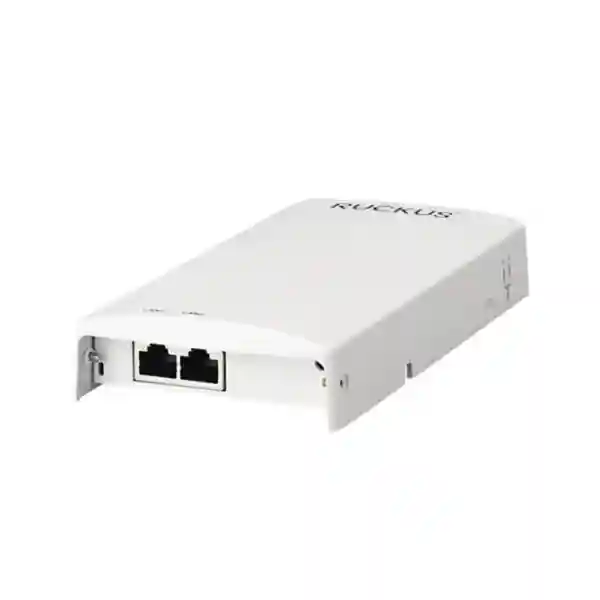
RUCKUS H350 Wall-Mounted Access Point
The RUCKUS H350 is an indoor wall-plate access point built for spaces where wireless service and local wired connections need to meet at the room. It combines dual-band Wi-Fi 6, a 2×2:2 radio design, BeamFlex+ adaptive antennas, two downstream Gigabit Ethernet ports, integrated IoT capability and flexible RUCKUS management options in a low-profile form factor. For hotels, serviced apartments, student accommodation, multi-dwelling properties, branch offices and smaller enterprise areas, that all-in-one design can simplify how room connectivity is planned without assuming that every site has the same cabling, switching, power or management requirements.
- Wi-Fi 6, IEEE 802.11a/b/g/n/ac/ax
- 2×2:2 radios on 2.4 GHz and 5 GHz
- Up to 574 Mbps at 2.4 GHz and 1,200 Mbps at 5 GHz
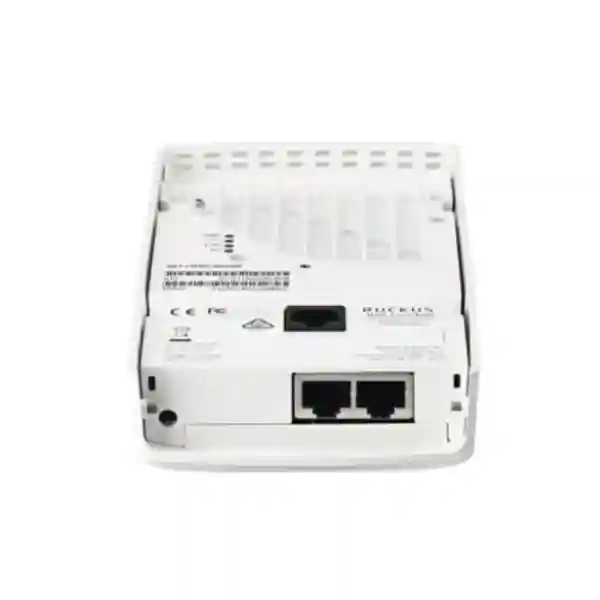
- One Gigabit Ethernet PoE-in uplink plus two Gigabit Ethernet access ports
- Integrated switchable BLE or Zigbee IoT radio
Dual-radio operation across 2.4 GHz and 5 GHz with Wi-Fi 6 support.
Maximum PHY figures are theoretical link rates, not a promise of application throughput.
One PoE-in uplink and two local Gigabit access ports for compatible room devices.
An integrated switchable radio can support selected IoT designs without a separate in-room radio device.
What the RUCKUS H350 is designed to solve
A conventional ceiling access point can be ideal for open offices and shared areas, but guest rooms, apartments, dormitories and segmented spaces create a different radio and cabling problem. Walls, doors, bathrooms, furniture and room boundaries can weaken or reshape coverage. At the same time, each room may still require wired connectivity for an IPTV receiver, IP telephone, workstation, media device or another Ethernet endpoint. The RUCKUS H350 addresses that room-oriented requirement by combining an access point with local wired ports in a wall-mounted enclosure. This does not remove the need for proper network design; instead, it gives designers a practical endpoint for delivering wireless and wired services from a single room location.
The H350 uses RUCKUS BeamFlex+ adaptive antenna technology and ChannelFly channel management to help the radio adapt to changing RF conditions. It supports Wi-Fi 6 features through the 802.11ax standard, while retaining compatibility with older Wi-Fi generations listed by the manufacturer. SmartMesh support can also be relevant where a wireless mesh design is appropriate, although wired Ethernet backhaul remains an important planning option in structured deployments. Buyers should treat the H350 as part of a complete network rather than as an isolated speed upgrade: switch capacity, PoE budget, VLAN design, internet bandwidth, controller strategy, roaming policy, cabling quality, radio planning and client capability all affect the final user experience.
Verified specifications that matter during design
Wireless and capacity
The H350 supports IEEE 802.11a/b/g/n/ac/ax on 2.4 GHz and 5 GHz. The manufacturer lists a maximum PHY rate of 574 Mbps on 2.4 GHz and 1,200 Mbps on 5 GHz, for a combined maximum of 1,774 Mbps. It uses two spatial streams per band and supports 20, 40 and 80 MHz channel widths. RUCKUS lists capacity for up to 512 clients per AP and eight SSIDs per radio; practical design density should still be based on traffic type, airtime demand, signal quality and expected concurrency rather than the maximum association figure alone.
Network and management
RUCKUS identifies H350 support for RUCKUS Cloud, SmartZone, Unleashed and ZoneDirector management environments. The best choice depends on the existing estate, site count, lifecycle strategy, licensing position and operational model. The access point supports VLAN functions, IPv4 and IPv6, 802.1X functions and policy controls described in the product documentation. Management compatibility should always be checked against the exact software release and project architecture before ordering.
Power, mounting and environment
The H350 provides a 1GbE RJ-45 PoE-in port using 802.3af Class 3 and two 1GbE RJ-45 access ports. RUCKUS documentation also lists a DC power option and an optional surface-mount bracket. The device is designed for indoor use, with an operating temperature range of 0°C to 40°C. Its wall-plate form factor can fit room-focused deployments, but installers should confirm wall-box compatibility, cable path, ventilation, service access, local electrical requirements and the physical condition of the mounting surface.
Security, roaming and IoT planning
The H350 supports WPA2 and WPA3 security modes listed in the official data sheet, together with enterprise authentication options, captive portal capabilities, Hotspot 2.0 and wireless intrusion detection or prevention features within supported RUCKUS architectures. Those features are useful building blocks, but secure deployment depends on how they are configured. A hospitality network may require strict separation between guest devices, staff systems, payment equipment and building-management services. A student residence may need per-user authentication, rate policies and isolation. A branch office may prioritize corporate identity services, protected management access and consistent VLAN mapping. The access point should therefore be deployed with a security design that matches the organisation rather than relying on default settings.
The integrated IoT radio can operate with BLE or Zigbee, which may be useful in projects that need supported sensors, locks or other room technologies. Compatibility must be checked at the solution level because an integrated radio does not automatically make every BLE or Zigbee device interoperable with every management platform or application. Similarly, Wi-Fi roaming performance depends on client behaviour, AP placement, signal overlap and controller configuration. Features such as 802.11r/k/v can assist compatible environments, but they should be tested against the actual client mix, especially where voice handsets, scanners, tablets or older devices are important.
For customers planning a broader connected-office or hospitality network in the UAE, FourTeck’s Wi-Fi and network support services provide context around access-point placement, structured cabling, switching, power, troubleshooting and business connectivity. The H350 should be evaluated as one part of that end-to-end design.
Before requesting a quotation
A useful H350 quotation starts with the deployment context. Tell FourTeck how many rooms or spaces need service, whether structured Ethernet is already available, what PoE switches are installed, which wired devices must connect locally, whether BLE or Zigbee is part of the project, and which RUCKUS management platform is already in use. If this is a new RUCKUS design, include the number of sites, expected user count, guest-network requirements, authentication method, internet topology and any requirement for central monitoring.
Also confirm the destination country before the bill of materials is finalized. RUCKUS ordering information is region-specific, and accessories such as injectors, power supplies or mounting hardware must be matched to the project. FourTeck can use the requirement list to discuss the suitable H350 variant and related infrastructure without assuming stock, lead time or country certification before verification.
RUCKUS H350 Wall-Mounted Access Point Dubai
Customers searching for a RUCKUS H350 Dubai supplier are commonly trying to solve a specific indoor coverage problem rather than simply buy another access point. In Dubai hotels, serviced apartments, residences, staff accommodation and smaller commercial sites, room-by-room connectivity can be complicated by concrete walls, decorative finishes, corridors, service shafts and varying room layouts. The H350 is relevant where a wall-mounted Wi-Fi 6 access point with two local Gigabit Ethernet access ports can reduce the need for separate room switching hardware. It can serve wireless clients while also providing wired connectivity for suitable devices such as IPTV receivers or IP phones, subject to the network design and port requirements.
For a Dubai deployment, the first question should be whether the building already has structured Ethernet to the intended wall location. The H350 accepts PoE through its uplink, so the upstream switch and total PoE budget must be confirmed. In retrofit projects, installers should check whether the existing cable is suitable, whether the wall box can accept the mounting arrangement and whether legacy switches provide the necessary power and VLAN features. Radio planning also matters. A wall-plate AP in every room is not automatically the correct answer for every floor; the design should reflect wall attenuation, expected occupancy, neighboring AP overlap, client device mix and common-area coverage.
Dubai hospitality and mixed-use properties may also need segmented networks for guests, staff, management systems, voice, IPTV and IoT. The H350 supports the technologies needed to participate in such a segmented design, including VLAN functions and enterprise Wi-Fi security options, but the final configuration belongs to the overall network architecture. Buyers should also decide whether RUCKUS Cloud, SmartZone, Unleashed or an existing supported controller platform is the operational fit. FourTeck’s UAE technology portfolio can help project teams connect the access-point requirement with switching, cabling, security and support considerations.
When requesting RUCKUS H350 price in Dubai, provide quantity, installation scope, preferred management platform, destination, accessory needs and whether configuration or site work is required. That produces a more useful quotation than comparing an access-point unit price without the power, licensing, mounting and deployment context. Availability and delivery should be confirmed at the time of enquiry rather than assumed from a generic product listing.
RUCKUS H350 Wall-Mounted Access Point UAE
A RUCKUS H350 UAE requirement can range from a single small property to a multi-emirate hospitality or branch rollout. The model is particularly relevant where each room or small zone needs both Wi-Fi 6 and local Ethernet connections in a discreet wall-mounted format. Because the H350 combines an AP, a small Ethernet access layer and an IoT radio, procurement teams can evaluate it against the complete room bill of materials instead of comparing it only with ceiling access points. The cost and operational benefit depends on what would otherwise be installed in each room, how the building is cabled and whether the existing network can power and manage the chosen design.
Across the UAE, network conditions can differ significantly between new construction, hospitality refurbishments, offices in fitted towers, education accommodation and existing residential properties. A new project may allow structured cabling and switch design to be engineered around the H350 from the beginning. A retrofit may need cable certification, PoE verification, wall-box inspection and careful coordination with interior finishes. The official operating temperature range is for indoor use, so the AP should not be treated as an outdoor or unconditioned-space device. For lobbies, pools, exterior walkways or harsh environments, a different RUCKUS access-point family may be more appropriate after site review.
UAE buyers also need to think about management and lifecycle. If an organization already uses SmartZone, RUCKUS Cloud, Unleashed or ZoneDirector, compatibility with the installed software release should be checked before adding H350 units. New deployments should compare central visibility, site count, administrative skills, licensing model and future growth. Security design should cover guest isolation, corporate authentication, IoT separation, management access and any payment or operational systems sharing the same physical infrastructure.
For procurement, ask for the exact country-appropriate variant and confirm accessories rather than relying on a generic H350 model reference. Provide the UAE delivery destination, quantity, requested support scope, existing switches and controller details. This makes it easier to build a complete, compatible bill of materials while avoiding unsupported assumptions about stock or lead time.
RUCKUS H350 Wall-Mounted Access Point Uganda
Organizations looking for the RUCKUS H350 Uganda typically need dependable indoor Wi-Fi for guest accommodation, residences, offices, education spaces or distributed rooms where a wall-mounted access point can also terminate wired devices. The H350’s two local Gigabit Ethernet access ports can be useful when one structured cable must support both wireless service and selected room endpoints. That capability is most valuable when the upstream switch, PoE budget, VLAN configuration and cabling are designed together, because the access point cannot compensate for an unstable uplink, insufficient power or congested internet connection.
In Uganda projects, site conditions should be documented before quantity is finalized. Construction materials, long corridors, room partitions, floor layout and available cable routes all influence coverage. A design based only on room count can lead to excessive overlap in one property or poor service in another. For hotels and lodges, planners should identify guest-room needs separately from restaurants, reception areas, conference rooms and outdoor spaces. For education or staff accommodation, capacity patterns may change sharply at certain times of day. The H350’s 2×2:2 Wi-Fi 6 radios and RUCKUS RF features can support these environments, but placement and channel planning remain essential.
Procurement teams should also confirm how the network will be managed. RUCKUS Cloud, SmartZone, Unleashed and ZoneDirector are listed management options for the H350, but the preferred platform depends on the number of sites, existing RUCKUS estate, operational skill and lifecycle expectations. If the project includes BLE or Zigbee devices, the exact IoT workflow and application compatibility should be checked before assuming the integrated radio removes all additional gateways.
FourTeck’s Uganda technology solutions site provides a regional path for networking and infrastructure enquiries. For a useful H350 quotation, include city, site type, number of rooms or zones, current switch models, cabling status, internet architecture, management platform and whether installation, configuration or remote support is expected.
RUCKUS H350 Wall-Mounted Access Point Kampala
A RUCKUS H350 Kampala deployment is often evaluated for hotels, apartments, hostels, campuses, clinics, offices and other properties where users are separated into rooms or smaller spaces. In these settings, the wall-mounted format can place Wi-Fi closer to occupants while the integrated Ethernet access ports provide a practical connection point for selected wired devices. The value is not just stronger signal in a room; it is the ability to design a repeatable room network pattern with one powered uplink, local Wi-Fi and local Ethernet, provided the building’s structured cabling supports that architecture.
Kampala properties can vary from newly constructed commercial buildings to retrofits where cable routes, wall boxes and switch capacity were not designed for modern Wi-Fi. Before ordering, verify the path from access switch to room, cable quality, PoE availability and whether the existing switch can provide the required VLANs and operational visibility. Where the property has multiple floors, RF planning should account for vertical as well as horizontal signal propagation. Installing an AP in every room without testing can create unnecessary co-channel contention, while spacing APs too far apart can leave weak edges and poor roaming.
Hospitality buyers should map guest internet, staff operations, IPTV, IP telephony and IoT as separate service needs even if they share the same physical infrastructure. The H350 can participate in segmented networks and offers BLE or Zigbee IoT capability, but those features require an intentional configuration and compatible applications. For business sites, WPA3 support and enterprise authentication options can be incorporated into a security plan, while guest access may use a captive portal or other supported onboarding method depending on the selected RUCKUS platform.
When comparing RUCKUS H350 price in Kampala, include the network elements needed to make the AP usable: power, switching, mounting, licensing or management, configuration and any site survey work. Ask for a destination-specific bill of materials and verify availability at quotation time. This approach keeps the purchase tied to the actual building and avoids treating a wall-plate AP as a plug-and-play replacement for every existing access point.
RUCKUS H350 Wall-Mounted Access Point Arua
For a RUCKUS H350 Arua project, procurement should begin with the physical site and service priorities. Hotels, guest houses, offices, training facilities and accommodation buildings may have rooms that are difficult to serve reliably from corridor or ceiling access points because of masonry walls, long floor plans or inconsistent internal layouts. A wall-mounted H350 can bring the radio closer to users while offering two wired Gigabit access ports for compatible in-room equipment. The model is therefore worth considering where a structured cable can be delivered to each room or zone and where the upstream network can provide stable PoE and switching services.
Arua deployments may also need careful planning around internet backhaul and operational support. High PHY rates on an access point do not create high internet speed if the WAN connection is limited or heavily shared. The design should therefore separate local Wi-Fi capability from the available upstream bandwidth. For guest properties, it may be more useful to define per-user or per-room service goals, authentication, traffic policies and priority applications than to focus on the theoretical maximum radio rate. The H350 supports Wi-Fi 6 efficiency features, but user experience still depends on airtime, signal quality and the capacity of the entire path to the internet.
Power and resilience deserve equal attention. Confirm the PoE switch model, available power budget, UPS protection and rack environment. If the site experiences power interruptions, network recovery behavior and backup power for switches and internet equipment may be more important than adding extra APs. For multi-site operators, remote management through a supported RUCKUS platform can improve visibility, but the platform choice should reflect licensing, connectivity and staff capability.
When requesting an H350 quotation for Arua, share the number of rooms, floor plans if available, current cabling, switch details, expected number of simultaneous users, wired devices per room and whether IoT features are required. That information allows the access point quantity and supporting infrastructure to be discussed as a system rather than a standalone hardware purchase.
RUCKUS H350 Wall-Mounted Access Point Mbarara
Customers evaluating the RUCKUS H350 Mbarara for hospitality, education, healthcare accommodation or business sites should focus first on the room topology. The H350 is designed as an indoor wall-mounted Wi-Fi 6 access point with integrated Ethernet access, so it fits scenarios where one room location can serve both wireless clients and selected wired endpoints. In a hotel this might mean guest devices plus an IPTV receiver; in a staff residence it may be a workstation or IP phone; in a branch environment it can provide local connectivity in a small enclosed area. The exact use should be confirmed before assigning ports or VLANs.
For Mbarara projects, a site walk can reveal constraints that are easy to miss in a bill of quantities. Wall thickness, ceiling height, corridor shape, room orientation, furniture and neighboring radio networks can all affect the RF result. Existing cable routes should be checked for length and condition, and any legacy PoE switches should be reviewed against the H350’s power requirement. A property with good cabling but weak switching may need network upgrades before access points are added. Conversely, a site with modern switches but poor room cabling may require a different deployment strategy.
The H350’s integrated BLE or Zigbee radio can be relevant where the project includes compatible IoT systems, but buyers should not assume that every smart lock, sensor or automation platform can connect directly. Document the intended IoT application, vendor and protocol so compatibility can be checked. The same principle applies to wireless management: select RUCKUS Cloud, SmartZone, Unleashed or an existing supported platform based on how the site will actually be operated after installation.
A complete Mbarara quotation should include the destination, quantity, management approach, power source, mounting requirement and support expectations. If the project will grow later, describe the anticipated next phase as well. That allows switch capacity, VLAN design and management scale to be planned with expansion in mind instead of treating the first batch of H350 access points as an isolated purchase.
RUCKUS H350 Wall-Mounted Access Point Gulu
A RUCKUS H350 Gulu deployment can be a practical option for indoor sites that need repeatable room-level Wi-Fi and Ethernet, especially guest accommodation, residential facilities, offices and education-related buildings. The unit’s wall-plate form factor, dual-band Wi-Fi 6 radios and two downstream Gigabit Ethernet ports support a converged design where one structured uplink reaches the room and then serves wireless users together with selected wired endpoints. The deployment still depends on correct PoE, cabling and switching, so the H350 should be specified alongside the access network rather than independently.
In Gulu, project planning should consider the support model after installation. A smaller single-site property may value a straightforward operational approach, while an organization with multiple branches may need centralized monitoring, configuration consistency and remote troubleshooting. RUCKUS lists several management platforms for the H350, and the appropriate one should be chosen based on site count, existing infrastructure, licensing and administrative capability. Software compatibility should be verified against the actual controller release in an established RUCKUS environment.
Network segmentation is another important procurement question. Guest traffic, staff devices, business systems, voice, IPTV and IoT should not simply be placed on one flat network because the AP has enough ports. Define VLANs, authentication, guest isolation and addressing before deployment. If a captive portal is required, document the user journey and any external authentication dependencies. If IoT is part of the project, identify whether BLE or Zigbee is needed and how those devices will be managed.
For a Gulu quotation, include room count, building layout, user profile, cable status, PoE switch information, WAN capacity and any requirement for installation or remote assistance. Ask that accessories and country-specific ordering details be confirmed with the H350 units. This provides a more reliable procurement picture than using online hardware prices that may exclude power, management, tax, freight, installation or project-specific support.
RUCKUS H350 Wall-Mounted Access Point Kenya
The RUCKUS H350 Kenya is relevant to hotels, serviced residences, student housing, branch offices and other indoor properties that benefit from room-oriented wireless coverage with local wired ports. The AP provides dual-band Wi-Fi 6 in a compact wall-mounted format and includes two Gigabit Ethernet access ports in addition to its PoE-in uplink. This architecture can reduce separate in-room hardware where the network design requires both wireless and wired services. It is particularly useful to evaluate in properties that already have, or are planning, a structured cable to each room.
Kenyan deployments should be designed around the actual site rather than a generic AP-per-room formula. Construction materials, floor layout and neighboring RF activity affect coverage, while user behavior affects capacity. A conference hotel may have low room usage during the day but very high demand in meeting spaces. Student housing may see heavy evening concurrency. A branch office may prioritize collaboration applications and secure corporate access. These patterns determine where the H350 fits and where another AP format may be more suitable for shared or high-density areas.
Power and management also need early decisions. Confirm upstream PoE capability and UPS protection, especially for sites where internet and switching resilience are business-critical. If the organization operates multiple locations, central management can reduce configuration drift, but the selected RUCKUS platform should match the wider estate and licensing model. Security requirements should document guest access, corporate authentication, VLAN separation, IoT policy and administrative access. WPA3 capability is useful, yet client compatibility should be tested before enforcing settings across mixed device populations.
FourTeck’s Kenya IT and networking site offers a regional route for project enquiries. When requesting an H350 Kenya quote, provide destination, quantity, site type, cabling status, switch models, expected users, required wired endpoints and management preference so the bill of materials can be checked as a complete network requirement.
RUCKUS H350 Wall-Mounted Access Point Kuwait
A RUCKUS H350 Kuwait requirement often comes from hospitality, residential, education or commercial projects where room-level connectivity must be discreet and serviceable. The H350 combines Wi-Fi 6, adaptive BeamFlex+ antennas, integrated Ethernet access and BLE or Zigbee capability in an indoor wall-mounted enclosure. In hotels and apartments, this can help place the radio inside the space where users actually connect instead of relying exclusively on corridor coverage. It also offers wired ports that may reduce the need for an additional small switch in rooms requiring Ethernet devices.
Kuwait buyers should pay particular attention to indoor environmental conditions and placement. The H350 is specified for 0°C to 40°C operation, so it belongs in conditioned indoor spaces, not external walls, rooftops, plant areas or other locations that may exceed the operating range. For large lobbies, ballrooms, outdoor terraces or high-density common spaces, another RUCKUS AP model may be a better design choice. The room-focused H350 should therefore be part of a mixed access-point plan when the property contains very different space types.
Structured cabling and power should be verified before installation. Confirm whether the access switch supports 802.3af PoE with sufficient aggregate power, and check that cable paths and wall boxes suit the planned mounting. Where existing room networks include IPTV or voice, document VLANs and port behavior so migration does not disrupt those services. If the project includes IoT, identify whether BLE or Zigbee integration is required and validate the end-to-end system rather than specifying the radio feature alone.
For an H350 Kuwait quote, include quantity, property type, room count, current RUCKUS management platform if any, switch details and installation scope. Country-specific product ordering and accessories should be confirmed as part of the bill of materials. Pricing should be treated as project-specific because management, mounting, freight, taxes, configuration and supporting network work can differ significantly from a bare AP price.
RUCKUS H350 Wall-Mounted Access Point Ghana
The RUCKUS H350 Ghana can suit indoor hospitality, residential, office and education projects that need Wi-Fi close to users while retaining wired access at the room. Its wall-mounted format is especially relevant where thick internal walls or segmented floor plans make corridor-only Wi-Fi difficult to engineer. By combining a Wi-Fi 6 AP with two local Gigabit Ethernet access ports, the H350 can support a room design that includes both wireless devices and selected Ethernet endpoints without adding a separate room switch, provided the upstream network and cabling are designed accordingly.
Ghana project teams should distinguish between radio capacity and internet capacity. The H350’s maximum Wi-Fi PHY rates describe the wireless link, not the speed a guest or employee will necessarily receive from an application. WAN bandwidth, contention, traffic policy, DNS, upstream switching and the client device all affect real performance. For hotels or residences, define expected service by user type and occupancy pattern. For offices, identify critical applications, video calls, voice traffic and corporate authentication needs. Those requirements help determine AP placement and the correct number of units.
A deployment plan should also cover power resilience and management. Review PoE switch capacity and backup power, and decide who will monitor the WLAN after handover. Multi-site businesses may prefer centralized visibility, while smaller locations may prioritize operational simplicity. The H350 supports several RUCKUS management options, but software version and licensing should be checked before procurement. BLE or Zigbee capability should similarly be mapped to a specific compatible IoT use case instead of treated as a generic automation promise.
For wider West African and cross-border technology requirements, FourTeck’s Africa technology solutions portal provides additional context. An H350 Ghana enquiry should include city, delivery destination, quantity, room or zone count, switch model, cabling condition, controller preference, required wired endpoints and any installation or support scope.
RUCKUS H350 Wall-Mounted Access Point Nigeria
Organizations searching for a RUCKUS H350 Nigeria supplier are often comparing ways to provide reliable in-room connectivity across hotels, serviced apartments, residences, campuses and branch environments. The H350 is positioned as a wall-mounted indoor Wi-Fi 6 access point with switching and IoT functions, making it useful where each room needs wireless coverage plus one or two local Ethernet connections. It can be mounted near the user area rather than relying solely on a hallway AP, which may improve the design options in properties with heavy wall attenuation.
Nigeria deployments should account for power architecture from the beginning. The H350 can receive power over Ethernet, so the access switch, UPS strategy, generator or alternate backup plan and rack distribution can have a direct effect on WLAN availability. If the switching layer loses power, room Wi-Fi and wired services on the H350 disappear together. That may be acceptable or may require additional resilience depending on the property. For multi-floor buildings, switching closets and cable runs should be planned to keep Ethernet within standards and to simplify future maintenance.
Security and service separation are also important. Guest networks should be isolated from administrative or operational systems. Staff access may use enterprise authentication, while IoT devices may belong on dedicated VLANs and policy groups. The H350’s feature set can support these architectures, but policy is implemented through the broader RUCKUS and network configuration. If the site already has a controller, verify H350 support in the installed release before purchasing. For a new deployment, compare RUCKUS Cloud, SmartZone and Unleashed approaches against the number of sites and operational resources.
A useful Nigeria quote should state the destination city, quantity, building type, existing switch and controller details, room count, expected users, local Ethernet requirements and whether installation or remote configuration is part of the request. Buyers should ask for confirmed country-specific ordering details and current availability rather than assuming that an international online SKU is the correct unit for the project.
RUCKUS H350 Wall-Mounted Access Point Seychelles
The RUCKUS H350 Seychelles is especially relevant to hospitality and accommodation projects where guest rooms need dependable indoor Wi-Fi, discreet equipment and the option to connect wired room devices. Island resorts, hotels, villas and serviced properties can have a mix of room blocks, standalone units, public areas and outdoor spaces. The H350 is intended for the indoor room portion of that environment. Its wall-mounted Wi-Fi 6 design, two downstream Gigabit Ethernet ports and integrated IoT radio can help consolidate in-room connectivity, while outdoor and exposed areas should be served by equipment designed for those conditions.
For Seychelles projects, logistics and lifecycle planning can be as important as the initial AP specification. Before procurement, identify the total unit quantity, any spare strategy, mounting accessories, PoE requirements and management approach. A remote property may benefit from consistent hardware, documented configurations and centralized visibility because replacing or troubleshooting equipment can involve more coordination than in a dense urban site. The selected RUCKUS platform should therefore be evaluated not only for features but also for how the property or management company will operate it over time.
The network design should separate guest traffic, property operations, voice, IPTV and IoT where required. If smart-room devices use BLE or Zigbee, confirm exact interoperability and management integration. For Wi-Fi, room density and wall construction should guide AP placement, while restaurants, pools, reception areas and event spaces may require separate capacity planning. The H350’s theoretical PHY rate should not be used as a substitute for surveying the property and understanding internet bandwidth available to guests.
When asking for an H350 Seychelles quotation, provide island or delivery location, property layout, number of rooms, switch architecture, WAN design, management preference and service scope. Confirm regional ordering information, accessories and current lead time before committing to the rollout. This creates a realistic bill of materials and reduces the risk of overlooking power, mounting, spares or remote-support requirements.
Common buyer questions about the RUCKUS H350
Is the RUCKUS H350 a Wi-Fi 6 access point?
Yes. RUCKUS specifies the H350 for IEEE 802.11ax Wi-Fi 6 operation on both 2.4 GHz and 5 GHz, with backward support for earlier standards listed in the official product documentation.
How many Ethernet ports does it have?
The official data sheet lists three Gigabit Ethernet interfaces in total: one RJ-45 uplink that accepts 802.3af PoE and two RJ-45 access ports for local wired devices. Project teams should verify whether two downstream ports are sufficient for each room and whether the required VLAN behavior is supported by the planned configuration.
Can the H350 be used for hotel rooms?
Hospitality guest rooms are one of the manufacturer’s named use cases. The suitability of the H350 for a specific hotel still depends on wall construction, room layout, wired-device requirements, switching, PoE, internet service and the WLAN design for common areas.
Does it support BLE and Zigbee?
The H350 includes an integrated IoT radio that can operate with BLE or Zigbee. Confirm compatibility with the intended IoT platform and endpoint devices before specifying it for a smart-room application.
Which RUCKUS management options are supported?
RUCKUS lists H350 support for RUCKUS Cloud, SmartZone, Unleashed and ZoneDirector. Existing environments should verify software-release compatibility and new projects should select the platform according to scale, licensing, visibility and operational needs.
Can I use the maximum 1,774 Mbps figure as expected internet speed?
No. It is a combined maximum PHY rate across the two radio bands. Actual application throughput is lower and varies with channel width, client capabilities, signal level, interference, airtime sharing, protocol overhead, switching and internet capacity.
How to decide whether H350 is the right form factor
Strong fit
Room-by-room indoor deployments with structured Ethernet, PoE availability, a need for local wired ports and a preference for a low-profile wall-mounted AP. Typical examples include guest rooms, residences, dormitories and small enclosed business spaces.
Needs comparison
Large open offices, halls, lobbies, conference areas, very high-density zones, outdoor spaces or locations needing more downstream ports may call for a different RUCKUS model or a mixed AP design. The H350 should be selected because its wall-plate architecture matches the space, not simply because it is compact.
Related FourTeck resources
For organizations building a broader wireless and secure network, the FourTeck UAE technology site covers connected infrastructure across networking, security and business IT. Customers with deployment and troubleshooting needs can review FourTeck IT support and Wi-Fi services. Regional enquiries can also be routed through the FourTeck Uganda site, the FourTeck Kenya site or the broader FourTeck Africa portal, depending on project location.
These links are intended to help buyers connect the H350 requirement with related switching, cabling, network security, deployment and regional project discussions. Exact product availability, local delivery arrangements and service scope should be confirmed for each enquiry.
Quotation checklist
Country, city, property type, number of rooms, floors, common areas and planned H350 quantity.
Switch models, PoE budget, cabling category and condition, VLANs, internet links and any current RUCKUS controller.
IPTV, IP phones, workstations, printers or other wired endpoints that may use the two local Ethernet ports.
Hardware supply, mounting, configuration, survey, migration, controller work, documentation, training or ongoing support.
Decision recap
Choose the RUCKUS H350 when the project benefits from a wall-mounted indoor Wi-Fi 6 access point that also provides two local Gigabit Ethernet ports and integrated BLE or Zigbee capability. Verify the design around the building, cabling, PoE, client density, RUCKUS management platform and security policy. For open spaces, outdoor areas, very high density or requirements for more ports, compare other RUCKUS models rather than forcing the H350 into a role it was not intended to fill.
For sales planning, send FourTeck the location, quantity, floor or room layout, switch details and management preference. A project-specific quotation can then cover the correct regional ordering information and any required accessories or services.

Reviews
There are no reviews yet.