
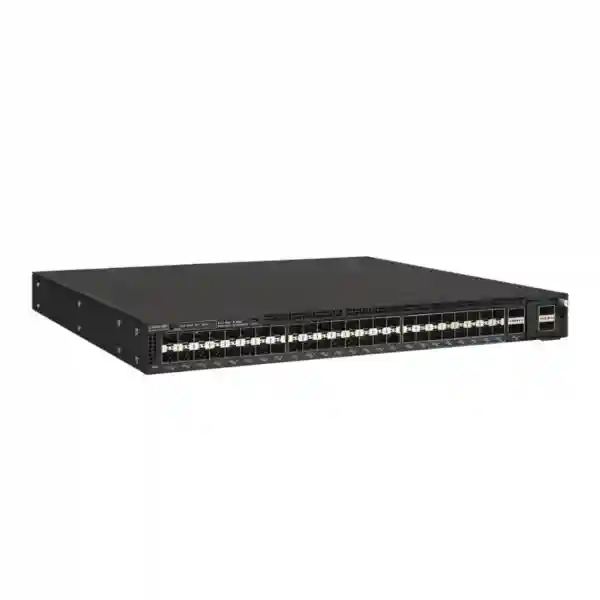
RUCKUS ICX 7550-48F Fiber Switch
The RUCKUS ICX 7550-48F Fiber Switch is a high-density enterprise aggregation platform for organisations that need a substantial number of SFP-based fiber connections, 10 Gigabit uplink capacity, resilient stacking and Layer 3 network functions in a compact switch architecture. RUCKUS publishes a maximum switching capacity of 912 Gb/s for this model, with up to 48 1 GbE SFP ports, up to 12 10 GbE SFP+ ports, high-speed QSFP/QSFP28 connectivity, stacking for as many as 12 switches and an aggregate stacking bandwidth of up to 2.4 Tb/s. Buyers should treat those values as platform capabilities and confirm the exact port use, optics, licensing, power supplies, airflow orientation and software requirements for the proposed bill of materials before ordering.
Share the required fiber link count, SFP/SFP+ speeds, fiber type and distance, upstream bandwidth, stacking requirement, routing features, preferred airflow, redundancy goals and deployment country.
Maximum published switching capacity for the ICX 7550-48F.
Up to 48 1 GbE SFP and up to 12 10 GbE SFP+ ports, depending on port configuration.
Stacking enables a larger logical switching system with high aggregate stack bandwidth.
Static routing, RIP and additional advanced routing features are supported subject to software and license requirements.
What is the RUCKUS ICX 7550-48F designed to do?
The RUCKUS ICX 7550-48F is the fiber-focused member of the ICX 7550 family and is positioned by RUCKUS for entry-level aggregation. In practical network design, that means it can sit between access switches, fiber-connected buildings, server or service segments and upstream network layers where many optical links need to be consolidated. The model is especially relevant when the design calls for numerous SFP interfaces rather than a large bank of copper RJ45 access ports. That distinction matters: this is a non-PoE fiber switch, so buyers should not select it as a direct replacement for a copper access switch that must power phones, cameras or wireless access points.
The published platform capabilities include stacking, sFlow, VRF, MACsec, BGP, VxLAN, reversible airflow options, redundant power options and hot-swappable internal power supplies and fans. Some advanced routing capabilities can depend on the chosen software license or feature set, so a quotation should identify the expected routing role rather than assuming every feature is enabled by default. In the same way, optical modules are selected according to speed, wavelength, fiber type, connector, distance and equipment at the far end. A complete aggregation-switch quotation should therefore include the switch, required power and cooling components, suitable optics, stacking or uplink components, licenses if applicable and support coverage.
For organisations refreshing an older campus or aggregation layer, the most useful question is not simply whether the ICX 7550-48F has enough ports. The design should verify how many links will operate at 1 GbE, how many must run at 10 GbE, whether 40/100 GbE uplinks are required, what level of redundancy is expected, whether multiple units should operate as a stack and which management platform will be used. FourTeck can help turn those questions into a bill of materials for a quotation without making unsupported promises about stock, price or lead time.
Verified RUCKUS ICX 7550-48F specifications
| Specification | Published capability | Buying implication |
|---|---|---|
| Switching capacity | Up to 912 Gb/s | Validate real traffic patterns and uplink design rather than sizing only by headline capacity. |
| SFP interfaces | Up to 48 x 1 GbE SFP | Useful for high-density fiber aggregation; optics are selected separately for the actual links. |
| SFP+ interfaces | Up to 12 x 10 GbE SFP+ | Supports faster fiber links where access, server or distribution traffic requires more bandwidth. |
| High-speed uplinks | QSFP/QSFP28 options; up to 40 GbE and 100 GbE capabilities | Confirm module, port mode, cabling and topology for the proposed uplink or stacking design. |
| Stacking | Up to 12 switches; up to 2.4 Tb/s aggregate stack bandwidth | Useful for scaling port density and simplifying administration where the design suits a stack architecture. |
| PoE / PoE+ | No | Powered endpoints require separate PoE access switching or other suitable power arrangements. |
| Routing and network features | Static, RIP, OSPF capability; BGP, VRF, VxLAN and other features supported by platform/software | List required routing protocols and overlays during quotation to confirm licensing and software support. |
| Resilience | Redundant power option; hot-swap internal power supplies and fans; reversible airflow option | Specify rack airflow, power feeds and redundancy expectation before finalising hardware. |
Specification summary is based on current RUCKUS product and ICX 7550 family documentation. Exact enabled features, optics, licenses, power components and software compatibility must be confirmed for the final configuration.
Important configuration note before purchase
A fiber aggregation switch is purchased as part of a network design, not as an isolated port-count decision. Before placing an order, document the existing switches, fiber type, link distances, transceiver standards, required speeds, upstream device interfaces, rack airflow, available power, redundancy plan, management platform and routing requirements. That information prevents common procurement errors such as ordering the wrong optics, overlooking power-supply requirements, assuming PoE is available, or planning a 100 GbE uplink without validating the exact module and cabling. FourTeck can review the requirement and prepare a quotation based on the actual topology.
RUCKUS ICX 7550-48F Fiber Switch Dubai
Businesses searching for the RUCKUS ICX 7550-48F Fiber Switch Dubai typically have a defined aggregation requirement rather than a simple desktop switching need. Dubai offices, hospitality properties, warehouses, education campuses, commercial buildings and multi-floor enterprise sites can accumulate many fiber links between distribution rooms, server areas, access-switch clusters and upstream security infrastructure. In that environment, the ICX 7550-48F is relevant because it concentrates a large number of optical interfaces while also supporting higher-speed uplinks and stacking. A Dubai quotation should begin with the number of fiber runs that terminate at the aggregation layer, the mix of 1 GbE and 10 GbE services, the required uplink capacity and whether the deployment needs one switch or a resilient multi-switch design.
Local procurement teams should separate the switch chassis from the complete deployment bill of materials. The ICX 7550-48F does not provide PoE, so wireless access points, phones or cameras that need power should connect through suitable access switches. The fiber switch can then aggregate those access layers. Optics should be selected by actual distance and fiber plant rather than by model name alone. A short multimode link inside a building has different transceiver needs from a longer single-mode link between facilities. Buyers should also confirm rack depth, airflow direction, redundant power requirements and the support arrangement expected by the IT team. These details are more useful than asking only for a RUCKUS ICX 7550-48F price in Dubai because two quotations for the same base switch can represent very different usable configurations.
For Dubai organisations integrating the aggregation layer with security infrastructure, FourTeck’s firewall product catalogue provides context for the edge-security devices that may sit upstream, while the network security service area explains deployment and configuration considerations around protected business networks. These links do not imply automatic compatibility with every firewall; the final topology must be reviewed. UAE buyers can also use FourTeck UAE for wider enterprise IT enquiries. When requesting a Dubai quote, include quantity, desired SFP/SFP+ port use, required uplink speeds, existing RUCKUS environment if any, software expectations, optics list and target deployment date. Availability and delivery should be confirmed in the formal quotation rather than assumed from a product page.
RUCKUS ICX 7550-48F Fiber Switch UAE
A UAE-wide RUCKUS ICX 7550-48F Fiber Switch requirement often involves more than one site or a central IT team coordinating infrastructure across Dubai, Abu Dhabi, Sharjah, Ajman or other Emirates. In multi-site projects, procurement becomes easier when the network team standardises the technical brief before requesting price and availability. Record how many ICX 7550-48F units are required, whether every location needs the same optics, which sites need redundant power, what uplink speed is expected and whether a stack will be created. A standard switch model can simplify operations, but the transceiver mix and physical fiber plant may still differ by building, so each site’s bill of materials should remain explicit.
The ICX 7550-48F is particularly suited to projects where fiber density is the main driver. RUCKUS lists the platform with up to 48 1 GbE SFP ports and up to 12 10 GbE SFP+ ports, with high-speed QSFP/QSFP28 capability and stacking. Network architects can use that flexibility when consolidating access switches, building links or service segments, but they should plan oversubscription and uplink capacity around real application traffic. A site with many nominally 1 GbE access uplinks may not require every connection to be active at line rate simultaneously, whereas storage, video, virtualization or high-density wireless traffic can create a different aggregation profile. Routing features should also be identified early because advanced protocols and feature sets can depend on licensing and software support.
UAE buyers frequently ask whether an aggregation switch can connect directly to the firewall. In many designs it can form part of the switching layer adjacent to a firewall, but the correct topology depends on VLAN design, routing ownership, high availability, interface speeds and security segmentation. The perimeter firewall planning guide is useful for understanding how upstream security fits into the network edge, and the firewall deployment guidance highlights the importance of mapping VLANs, SFP needs and routing before implementation. For switch-specific UAE research, FourTeck’s network switch UAE resource provides broader buying context. Request a written quotation that identifies exact model, quantity, optics, power, fan/airflow components, licenses, support and any implementation services separately.
RUCKUS ICX 7550-48F Fiber Switch Uganda
For organisations researching the RUCKUS ICX 7550-48F Fiber Switch Uganda, the purchasing discussion should start with the physical network between buildings, floors and equipment rooms. Fiber aggregation is often selected because copper distance is limited, because separate buildings need reliable uplinks, or because the existing network already uses SFP-based connections. The ICX 7550-48F can serve as an aggregation point for many such links, but the correct transceiver type depends on whether the installed fiber is single-mode or multimode, the connector presentation, the link distance and the speed required at both ends. Procurement teams should ask the network engineer or integrator to document these details before requesting a complete quotation.
Uganda deployments may include corporate campuses, universities, financial services locations, hospitality properties, healthcare facilities, government environments, logistics operations and multi-building business sites. Each has different traffic patterns. A university may aggregate large numbers of access switches and wireless networks; a hotel may combine guest connectivity, operational systems and surveillance networks; a business campus may need segmented services and routing between departments. The RUCKUS platform supports stacking and Layer 3 capabilities that can be useful in these environments, but the intended feature set, software version and licenses should be confirmed before purchase. If resilience matters, buyers should specify redundant power and airflow expectations rather than assuming every shipped configuration includes the same components.
A practical Uganda quote request should state the destination, quantity, installation role, current switch models, number and speed of fiber links, optics required, rack conditions, available power, stacking plan and whether configuration assistance is required. Do not treat an online listing as proof of local stock or a guaranteed lead time. FourTeck’s regional platform at FourTeck Uganda can be used for Uganda-focused enquiries, while FourTeck Africa network switches offers broader switching guidance for projects that span more than one African market. If the ICX 7550-48F will feed an upstream firewall or routed security zone, include interface speed and VLAN handoff details in the design brief so the switching and security layers are specified together rather than purchased separately.
RUCKUS ICX 7550-48F Fiber Switch Kampala
Kampala buyers searching for the RUCKUS ICX 7550-48F Fiber Switch are often planning a central aggregation point for office towers, multi-floor commercial premises, education environments, hotels, hospitals, service providers or larger enterprise compounds. The city-level requirement should be translated into a port map before product selection. List each fiber link, where it terminates, its current speed, expected future speed, fiber type and the device at the far end. Doing this exposes whether the switch is being selected for genuine aggregation density or simply because the model name appears in a specification. It also helps identify how many 1 GbE SFP interfaces are sufficient and where 10 GbE SFP+ capacity is required.
Kampala projects can also benefit from early power and rack planning. The RUCKUS ICX 7550-48F supports redundant power options and hot-swappable internal power supplies and fans, but the desired hardware configuration should be identified explicitly. If the facility uses UPS-backed racks or dual power feeds, the switch design should align with that resilience strategy. Airflow direction matters in dense equipment rooms, particularly when switches, servers and security appliances share racks. A quotation that only lists the base model may therefore be incomplete for the actual site. Ask for optics, power components, fan orientation, support and any required licenses as separate and clearly described line items.
For a Kampala enterprise that already operates RUCKUS wireless or ICX switching, management integration may be another reason to evaluate the ICX 7550 family. RUCKUS publishes support for its broader management ecosystem, but exact controller or cloud-management compatibility should be checked against the intended software versions. Where the switch aggregates networks toward an internet-security gateway, document VLANs and routing responsibilities before installation. FourTeck can review a Kampala requirement through the Uganda technology platform and use the wider FourTeck Africa channel for multi-country projects. When requesting pricing, include the full deployment location, quantity, required optics and whether installation or remote configuration support should be quoted; avoid assuming that delivery, warranty or onsite work is included unless it appears in the formal offer.
RUCKUS ICX 7550-48F Fiber Switch Arua
A RUCKUS ICX 7550-48F Fiber Switch Arua enquiry is most useful when it describes the network role rather than only the desired model. Organisations in Arua may be connecting separate buildings, extending business networks across a campus, aggregating fiber-fed access switches or strengthening the distribution layer for data, wireless and security services. The fiber-focused ICX 7550-48F can be relevant when many optical links must terminate at one manageable platform, but the number of ports by itself does not determine suitability. Buyers should document current and planned link speeds, distances, transceiver type, available rack space and the capacity needed upstream.
For a site outside a major metropolitan logistics hub, configuration completeness is especially important because a missing optic, incompatible module or omitted power component can delay deployment even when the core switch arrives. A procurement checklist should therefore include the exact switch model, power supplies, fans or airflow requirement, rack accessories, SFP/SFP+ modules, any QSFP/QSFP28 components, patch leads where required, software or advanced routing license needs and support coverage. Where the fiber plant is already installed, verify whether it is single-mode or multimode and record the approximate path length for every link. If a new fiber build is still being designed, coordinate the passive cabling specification with the active equipment selection.
The ICX 7550-48F does not supply PoE, so Arua sites that need to power access points, cameras or phones should keep PoE at the access layer and use the fiber switch for aggregation. This separation can be beneficial because it allows the aggregation layer to focus on bandwidth, resilience and routing, but it should be reflected clearly in the network diagram. If an internet firewall or secure WAN device sits upstream, include its fiber or copper interface specification so the handoff is correctly planned. FourTeck Uganda can receive the model list and deployment details, while the FourTeck Africa switching resources can support broader comparison if the requested RUCKUS configuration requires an alternative. Current availability, delivery handling, warranty and support conditions should be confirmed for Arua in the quotation rather than inferred from another country’s product listing.
RUCKUS ICX 7550-48F Fiber Switch Mbarara
For businesses and institutions considering the RUCKUS ICX 7550-48F Fiber Switch Mbarara, the model can be evaluated as a central aggregation layer for multiple fiber-connected access areas. Typical design questions include how many access switches feed the aggregation point, how much traffic each link carries, whether 1 GbE remains adequate for some areas, which links require 10 GbE, and what upstream capacity connects the aggregation layer to security, core or server infrastructure. The RUCKUS platform’s published switching capacity and stacking capability provide room for substantial network designs, but the architecture should still be built from measured or estimated workload rather than the maximum specifications alone.
Mbarara deployments in education, healthcare, agribusiness, hospitality, logistics and multi-building commercial sites may have mixed requirements. One building could contain office users and wireless access points, while another supports surveillance, laboratory systems, classrooms, guest services or operational equipment. VLAN design and routing policy help keep these services organised, and the ICX 7550 family includes Layer 3 functions that can participate in that architecture. The exact division between switch routing and firewall enforcement should be decided by the network design. Advanced routing such as BGP or OSPF may also require software or licensing decisions, so include protocol requirements in the procurement brief instead of leaving them until installation.
A complete Mbarara bill of materials should consider environmental and operational issues as well as interfaces. Specify airflow direction, rack position, redundant power needs, UPS strategy, cable management, spare optics and the support process expected after deployment. If multiple switches will be stacked, identify the intended stack topology and high-speed components needed for that design. For organisations purchasing through a central Uganda procurement team, consolidating the Mbarara requirements into the same technical format used for Kampala or other locations makes comparisons easier while still preserving site-specific optics and quantities. FourTeck can use the Uganda and Africa platforms to discuss the requirement without assuming local inventory or delivery timing. Ask for a written quotation that separates hardware, transceivers, licenses, support, shipping and professional services so stakeholders can see exactly what is included.
RUCKUS ICX 7550-48F Fiber Switch Gulu
A Gulu deployment of the RUCKUS ICX 7550-48F Fiber Switch should start with a simple topology drawing showing every major network area and how it connects back to the aggregation layer. This is particularly valuable for campuses, healthcare facilities, hospitality environments, public-service locations, regional offices and organisations with several nearby buildings. The model’s dense SFP/SFP+ connectivity can reduce the need to spread fiber terminations across multiple smaller switches, while stacking can provide a path to larger logical port counts. Whether that architecture is preferable depends on resilience objectives, maintenance strategy and budget, so the design should compare single-switch, stacked and dual-path options.
Fiber planning is the most important practical step. Confirm strand availability, fiber mode, connector type, distance, expected bandwidth and the transceiver at both ends. Avoid ordering optics by speed alone. A 10 GbE SFP+ requirement still needs the correct optical standard for the fiber plant and distance. The same applies to higher-speed uplinks. If the network will use 40 GbE or 100 GbE connectivity, confirm the exact QSFP/QSFP28 arrangement, cables and peer-device support. RUCKUS publishes high-speed uplink capabilities for the ICX 7550-48F, but the final implementation must match the selected hardware configuration and software.
Operational support in Gulu should also be part of procurement. Ask who will configure the switch, how backups are stored, which management interface is used, how firmware is maintained and whether spare transceivers or power components are needed for critical sites. Because the model is non-PoE, downstream access switches should provide endpoint power where phones, access points or cameras require it. If the site uses a firewall between internal networks and the internet, clarify whether routing happens on the switch, the firewall or both, and document the VLAN handoffs. FourTeck Uganda can be used for country-specific enquiry handling, and FourTeck Africa can support cross-border procurement discussions when a company operates in several countries. Availability, freight, warranty handling and onsite service should be confirmed specifically for the Gulu project rather than assumed from a general regional statement.
RUCKUS ICX 7550-48F Fiber Switch Kenya
Kenya organisations researching the RUCKUS ICX 7550-48F Fiber Switch may be planning aggregation for corporate campuses, universities, hotels, data-centre-adjacent business networks, industrial sites, healthcare facilities, branch hubs or multi-building offices. The model is most compelling where fiber density and faster uplinks are central requirements. Start with the access layer: count switches and other fiber-connected devices, note their uplink speeds and estimate aggregate traffic. Then decide whether the aggregation design needs 1 GbE, 10 GbE or higher-speed upstream connectivity. This workload-led method is more reliable than selecting a switch simply because it provides many ports.
Kenyan procurement teams should also examine lifecycle and interoperability. If the organisation already has RUCKUS ICX switches, confirm the software version and management approach used across the estate. If the new switch will interoperate with another vendor’s equipment, verify standards-based link settings, VLAN tagging, routing protocols, link aggregation and optics compatibility. RUCKUS lists Layer 3 capabilities, MACsec, VxLAN and other enterprise features for the ICX 7550-48F platform, but not every design needs all of them. Define the features required for the actual network so licensing and configuration are clear. Redundant power and hot-swap components can support resilience, while stacking can simplify a larger aggregation block when that topology matches the operational model.
For Kenya-focused purchasing, FourTeck Kenya provides the regional enquiry path, and its broader networking content can help organisations frame requirements around switches, Wi-Fi, security and business infrastructure. Multi-country organisations can also use FourTeck Africa for coordinated requirements. A Kenya quotation request should contain the exact ICX 7550-48F model, quantity, required optics, fiber distances, uplink design, stack plan, power redundancy, airflow, advanced routing requirements, support term and delivery destination. If the switch will connect toward a firewall, include the firewall interface type and expected routed or VLAN handoff. Current pricing, stock, lead time and warranty conditions can change and should therefore be confirmed in the written offer.
RUCKUS ICX 7550-48F Fiber Switch Kuwait
A RUCKUS ICX 7550-48F Fiber Switch Kuwait project can support organisations that need a dense optical aggregation layer for corporate offices, campuses, hospitality, retail groups, education, healthcare, industrial facilities or multi-site business infrastructure. Kuwait buyers should distinguish aggregation switching from endpoint access switching. This model is fiber-focused and non-PoE, making it better suited to concentrating SFP/SFP+ links and connecting upstream network layers than directly powering user devices. If phones, cameras or access points need PoE, those devices should normally connect to suitable access switches that in turn uplink toward the ICX 7550-48F.
The Kuwait bill of materials should reflect both technical and environmental requirements. Record how many 1 GbE and 10 GbE optical links are needed, which high-speed uplinks will be used, whether stacking is planned and whether redundant power is required. Rack airflow and cooling deserve attention because business IT rooms can carry dense equipment loads, and the switch platform offers reversible airflow options that should match the rack design. Transceivers must be selected around distance and fiber type. Where the project involves new cabling, coordinate optics and passive fiber choices before installation. Where the cabling already exists, obtain the fiber documentation or test information before ordering modules.
FourTeck’s Kuwait IT platform includes networking, security and communication categories for organisations building complete business infrastructure. If the ICX 7550-48F is part of a network refresh, share current switch models, management tools, routing protocols and VLAN architecture so the proposed unit can be assessed in context. Advanced Layer 3 features and software requirements should be confirmed before the quotation is finalised. Kuwait buyers should also specify whether they need supply only, remote configuration guidance or a broader implementation discussion. Product availability, regional part configuration, freight, warranty handling and project scheduling can vary; the commercial offer should state these items rather than relying on generic online claims. A detailed technical brief leads to a cleaner quote and reduces the chance of missing optics, power components or support items.
RUCKUS ICX 7550-48F Fiber Switch Ghana
For Ghana businesses and institutions, the RUCKUS ICX 7550-48F Fiber Switch is relevant when an aggregation point must handle many optical links and provide room for faster uplinks. Projects may involve enterprise offices, education campuses, hospitality, financial services, healthcare, industrial facilities, logistics sites or multi-building developments. The practical design begins by separating access traffic from aggregation traffic. Count each downstream fiber connection, note the speed and identify where it terminates. Then model the upstream requirement. If dozens of access links converge on a single aggregation switch, the upstream path must be sized so that the architecture does not create avoidable bottlenecks during peak demand.
Ghana procurement teams should pay particular attention to a complete and supportable hardware package. A switch order may require power supplies, fan modules or airflow selection, rack hardware, optics, high-speed uplink components, licensing and support. RUCKUS publishes redundant power options, hot-swappable power and fans, stacking, Layer 3 functions, sFlow, MACsec, VRF, BGP and VxLAN capabilities for the platform. These are useful design tools, but they should be mapped to the project rather than simply listed as features. For example, an organisation that only needs Layer 2 aggregation may not need the same license planning as one that expects the switch to run dynamic routing or participate in more advanced network segmentation.
Fiber compatibility should be confirmed before shipment. State whether links use multimode or single-mode fiber, the approximate distances, connector presentation and required speeds. If the switch is replacing older aggregation equipment, record the existing optics because some may not be appropriate for the new platform even when the connector appears similar. FourTeck’s Ghana regional site can be used to discuss business IT requirements, and FourTeck Africa provides broader network-switch context for organisations operating across the continent. Ask for a quotation that identifies the exact RUCKUS model and every supporting component, along with destination, warranty terms, support and any configuration scope. Availability and lead time should be confirmed for the Ghana requirement at the time of enquiry.
RUCKUS ICX 7550-48F Fiber Switch Nigeria
A Nigeria deployment of the RUCKUS ICX 7550-48F Fiber Switch can be considered for high-density fiber aggregation in enterprise campuses, commercial buildings, education, hospitality, healthcare, energy, financial services, logistics and other networks that connect many distributed access points back to central infrastructure. The first design task is to define the role of the switch. Is it aggregating access switches from multiple floors, terminating building-to-building fiber, connecting service networks, supporting server-side traffic or acting as a distribution layer between access and core? The answer determines the mix of SFP and SFP+ ports, uplink capacity, routing features and resilience that should be specified.
Nigeria buyers should avoid using a generic ’48-port fiber switch’ description as the full purchase specification. The ICX 7550-48F has a particular architecture, including up to 48 1 GbE SFP ports, up to 12 10 GbE SFP+ ports, higher-speed QSFP/QSFP28 capability, stacking and enterprise Layer 3 features. A usable deployment still requires the right optical modules and supporting components. For every fiber link, document distance, fiber type, speed and the device at the opposite end. For high availability, state whether dual power feeds or stacked units are expected. For advanced routing, state the protocols and feature requirements so licensing can be checked. For operations, identify whether the organisation will use local administration, RUCKUS management tools or integration into an existing monitoring environment.
FourTeck’s Nigeria regional platform can receive project and product enquiries, while FourTeck Africa can support requirements that include several African countries. If the ICX 7550-48F aggregates networks toward perimeter security, document the expected firewall uplink speed and routing boundary. This is especially important when internet, VPN, cloud and inter-VLAN traffic share the same aggregation layer. A Nigeria quote request should include exact model, quantity, destination, optics, rack and power requirements, stacking components, software features, support term and desired service scope. Pricing and availability can vary with supply conditions and configuration, so the formal quotation should be treated as the source for current commercial information rather than a static webpage.
RUCKUS ICX 7550-48F Fiber Switch Seychelles
The RUCKUS ICX 7550-48F Fiber Switch can suit Seychelles organisations that need a central optical aggregation layer for hotels and resorts, corporate offices, public-sector facilities, education, healthcare or multi-building business properties. Island deployments benefit from particularly careful bill-of-material planning because shipping an omitted optic or accessory later can create unnecessary delay and cost. Before requesting a quotation, build a link schedule showing every fiber run, link distance, speed, fiber type and far-end device. That document can be used to select the correct SFP, SFP+ or higher-speed components and to determine whether spare optics should be included for operational resilience.
The switch itself provides significant aggregation flexibility, including published support for stacking, redundant power options, Layer 3 features and high-speed uplinks. For Seychelles sites, resilience planning may include UPS-backed power, redundant power supplies, spare critical modules and a documented configuration backup process. If several buildings depend on the aggregation switch, maintenance strategy matters as much as capacity. A stack can increase port density and provide one operational architecture, while separate redundant paths can serve other design goals. The appropriate model depends on topology and failure requirements. Airflow and rack cooling should also be considered, particularly in enclosed communications rooms where heat and environmental conditions can affect equipment life.
Because the ICX 7550-48F is non-PoE, endpoint power should be handled by appropriate access switches or other power systems. The fiber switch can then aggregate those access networks toward servers, routing or firewall infrastructure. Where hotel guest networks, business systems, CCTV, voice and staff services share common infrastructure, segmentation and routing should be planned clearly so the aggregation layer supports the security design. FourTeck Africa can be used for Seychelles-focused product enquiries and regional procurement discussions. When asking for a quote, include destination island or project location, quantity, preferred support arrangement, optics list, rack and power details, routing requirements and desired deployment assistance. Confirm shipping, customs-related documentation, warranty handling and lead time in the commercial response rather than relying on assumptions based on another market.
How to size and specify the ICX 7550-48F
1. Build a fiber link schedule
List every current and planned fiber connection, its speed, distance, fiber type, connector and far-end device. This is the foundation for selecting the correct optics and identifying whether 1 GbE or 10 GbE ports are needed.
2. Define uplink capacity
Estimate the aggregated traffic that must travel toward the core, servers or firewall. Select high-speed uplinks around actual demand and resilience rather than assuming the maximum available interface is always necessary.
3. Decide the routing boundary
State whether inter-VLAN routing, dynamic routing or overlays will run on the ICX switch, upstream routers, or security appliances. This determines feature, software and license requirements.
4. Plan resilience
Choose whether the design needs stacking, dual switches, redundant power, spare optics or multiple uplinks. The architecture should match the business impact of a switch or link failure.
5. Confirm management
Document the intended software release, monitoring approach, administrative access, configuration backup process and any RUCKUS management integration so the switch can be operated consistently after deployment.
6. Quote the complete system
Ask the supplier to show chassis, power, fans, optics, cables, licenses, support, shipping and professional services as identifiable line items. This makes competing quotations easier to compare.
Related FourTeck resources for a complete network design
The ICX 7550-48F may sit next to routing, firewall and access infrastructure, so the following verified pages are useful when reviewing the wider network. They are not presented as automatic compatibility guarantees; each link supports a different planning task.
Review upstream security product categories when the fiber aggregation layer connects toward a protected internet or WAN edge.
Useful as an example of branch firewall interface planning; final compatibility with the ICX design must be verified.
Illustrates why firewall interface type and media must be considered when planning the handoff from an aggregation switch.
Provides another edge-security reference for smaller-site designs where interface capabilities differ substantially from fiber aggregation gear.
Helpful when evaluating security appliances with different performance and interface profiles upstream of the switching layer.
Use this to map VLANs, routes, SFP needs and security handoffs before combining the switch with firewall infrastructure.
Useful for deciding where routing, segmentation and internet-facing security controls should sit relative to aggregation switching.
Review the wider security and infrastructure support context before requesting a combined switching and firewall project discussion.
Frequently asked questions about the RUCKUS ICX 7550-48F
Is the ICX 7550-48F a 48-port 10 Gigabit switch?
It should not be described that way without qualification. RUCKUS publishes up to 48 1 GbE SFP ports and up to 12 10 GbE SFP+ ports for the ICX 7550-48F. The family data sheet describes a fixed mix that includes 36 100/1000 Mbps SFP downlinks and 12 1/10 GbE SFP/SFP+ downlinks, with additional modular high-speed interfaces. Buyers should use the official port map for the exact configuration they plan to deploy.
Does the RUCKUS ICX 7550-48F provide PoE?
No. RUCKUS lists PoE/PoE+ as not supported on this fiber model. Devices that require power over Ethernet should be connected through suitable PoE access switches or powered by another appropriate method.
Can the ICX 7550-48F be stacked?
Yes. RUCKUS publishes support for stacking up to 12 switches and an aggregate stack bandwidth of up to 2.4 Tb/s for this platform. The exact stack design, ports, cables and software should be confirmed for the deployment.
Does it support 100 GbE?
The ICX 7550-48F platform includes QSFP28 high-speed capability and RUCKUS lists up to 100 GbE interface support. Confirm the exact port mode, optic or cable, software level and peer-device compatibility before planning a 100 GbE link.
Does it support Layer 3 routing?
Yes. The platform supports Layer 3 functions including static routing and RIP, with additional protocols such as OSPF and BGP supported according to the product’s software and licensing model. Define the required protocols in the quotation so the correct entitlement can be confirmed.
Are SFP and SFP+ transceivers included?
Do not assume that the required optics are included with the base switch. Transceivers are selected according to speed, wavelength, fiber type, distance and peer equipment. The quotation should list every required optic separately unless the supplier explicitly identifies a bundle.
What information is needed for an accurate quote?
Provide the exact model, quantity, deployment country and city, number of 1 GbE and 10 GbE fiber links, fiber type and distance, desired high-speed uplinks, stacking plan, power redundancy, airflow requirement, routing protocols, management approach, support term and any configuration or installation service required.
Decision recap
The RUCKUS ICX 7550-48F is best evaluated as a fiber aggregation switch rather than a general-purpose copper access switch. Its value is highest where many SFP-based links need to be concentrated, some links require 10 GbE, high-speed uplinks are necessary, or multiple units may be stacked for a larger logical system. It is not a PoE switch, and the final usable solution depends on optics, power, airflow, software, licensing and topology choices. Organisations comparing it with another aggregation platform should use the same link schedule and resilience requirements for each option so the comparison is based on equivalent designs.
Good reasons to shortlist it
- High-density optical aggregation is required.
- The network needs a mix of 1 GbE and 10 GbE fiber connectivity.
- Stacking and enterprise Layer 3 capabilities fit the architecture.
- High-speed uplinks are part of the growth plan.
- The organisation already values the RUCKUS wired or wireless ecosystem.
Questions to resolve first
- Which exact ports and speeds will be used?
- What optics match the installed fiber?
- Which routing features and licenses are needed?
- Is stacking or separate redundancy preferred?
- Which power and airflow configuration belongs in the order?
Quotation checklist and consultation
For the fastest technical review, send a concise bill-of-material brief. Include the product name RUCKUS ICX 7550-48F Fiber Switch, required quantity, delivery country and city, current switch environment, fiber link count, link speeds, single-mode or multimode fiber, approximate distances, desired uplink speed, stacking requirement, routing protocols, redundancy expectation, airflow preference, support term and target deployment schedule. If you already have a network diagram or optic list, include it. If you do not, describe the existing topology and FourTeck can identify the questions that need to be resolved before a complete quote is prepared.
For broader regional enquiries, use the relevant FourTeck platforms for UAE, Kenya, Uganda, Kuwait and Africa. These regional links help route procurement and infrastructure enquiries without implying guaranteed stock in a particular market.

Reviews
There are no reviews yet.